Tekin Radar | The OpenAI Espionage Scandal: How an Engineer Bugged Superintelligence Talks with a $14 Chip & AI Prompts
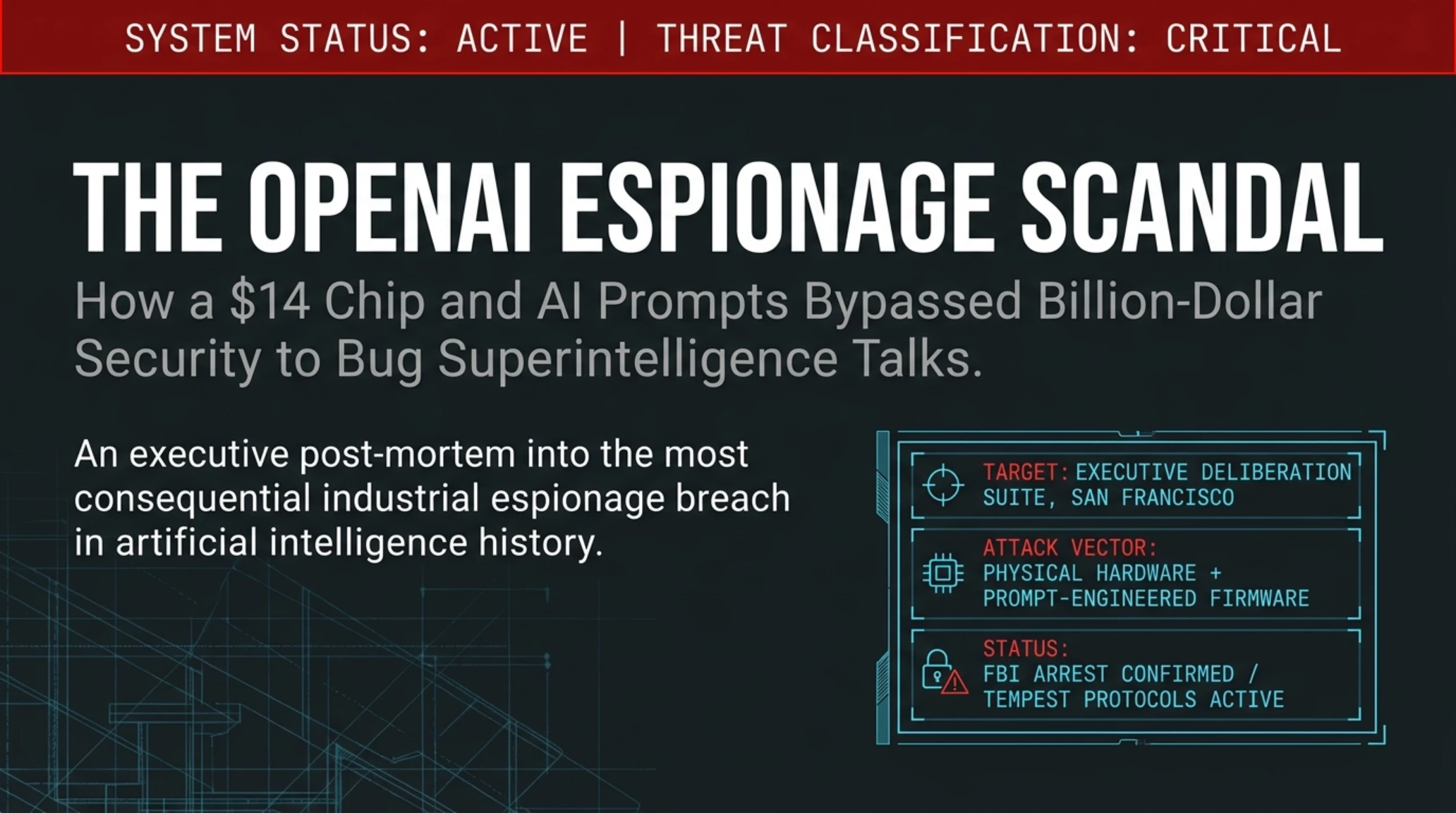
In an era where technology conglomerates pour hundreds of millions of dollars into quantum-resistant cryptography, zero-trust network architectures, and multi-layered perimeter security, the most alarming intelligence breach in the history of artificial intelligence was executed with a commercial fourteen-dollar microcontroller and a strip of toilet paper. On Tuesday morning, unsealed federal court filings from the United States District Court for the Northern District of California sent shockwaves through Silicon Valley and the geopolitical intelligence community. An OpenAI software engineer, identified as thirty-five-year-old Abdulrahman Alfozan, was formally arrested by the Federal Bureau of Investigation for planting a covert electronic listening device directly inside the executive conference room of OpenAI's San Francisco headquarters.
This is not merely another case of intellectual property theft or disgruntled employee misconduct. It represents the world's first documented instance of AI-directed hardware espionage targeting frontier superintelligence (SI) development. According to the criminal complaint sworn by federal investigators and highlighted by FBI Director Kash Patel, the perpetrator utilized OpenAI's own internal chatbot infrastructure to research, write, and debug the embedded firmware necessary to transform an off-the-shelf hobbyist development board into an autonomous acoustic eavesdropping bug capable of exfiltrating high-fidelity audio streams of the executive leadership's most confidential strategy sessions.
The exponential advancement of foundation models over recent quarters has concentrated unprecedented civil and military leverage within a handful of research laboratories in the San Francisco Bay Area. The conversations taking place inside OpenAI's corporate suite were not merely discussions of consumer product roadmaps; they encompass the algorithmic calibration of autonomous agents, societal alignment boundaries, and the distribution of artificial general intelligence (AGI). Consequently, the revelation that physical security failed against a low-cost, insider-planted development board strikes at the core of frontier AI safety assurances.
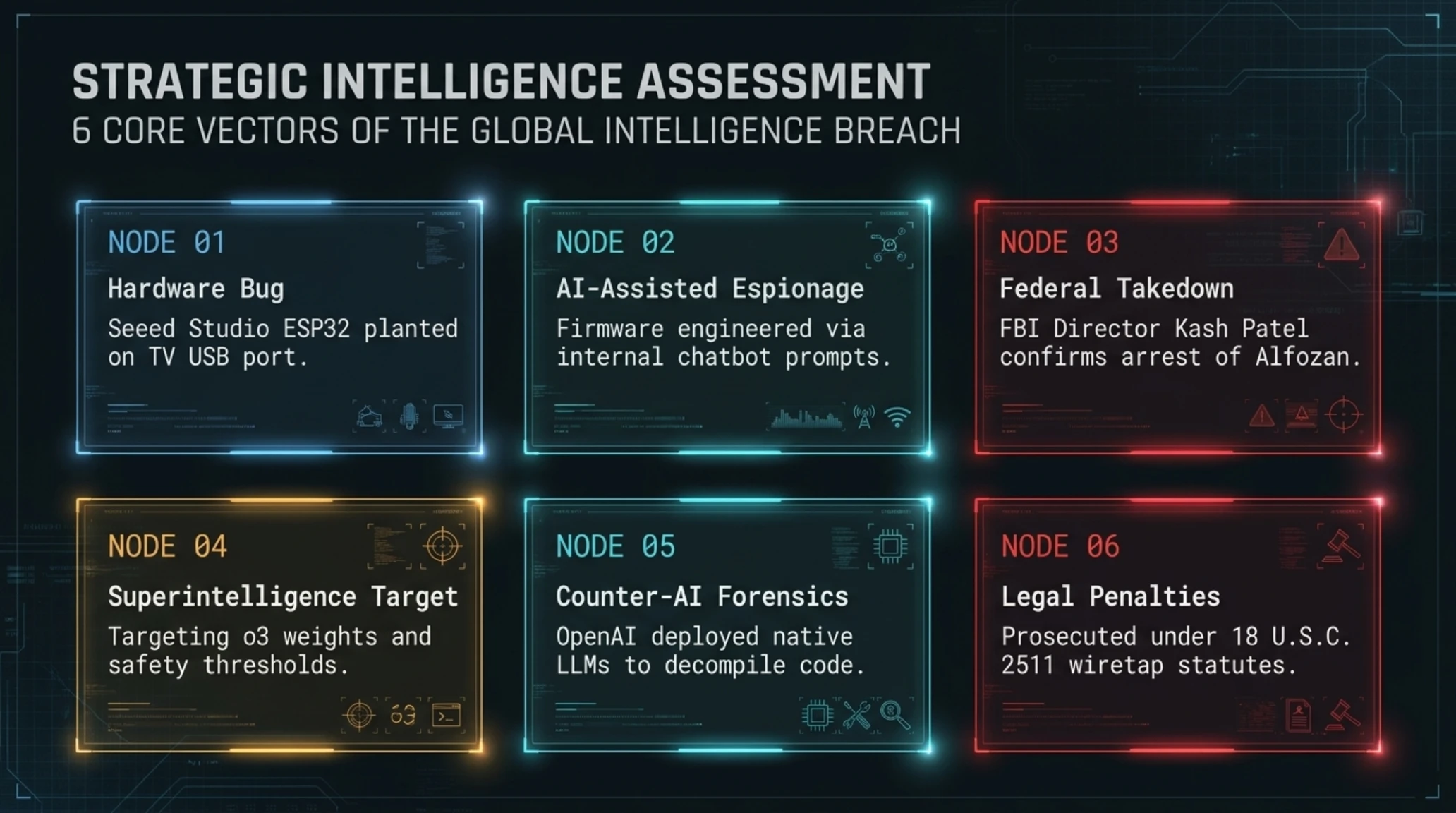
Strategic Assessment and Critical Intelligence Vectors
Dissecting the Physical Breach: Parasitic Power and the $13.99 Silicon
The timeline of discovery traces back to the late afternoon of September 30, 2026, when an internal technical services crew conducted a routine sweep of audiovisual hardware on the fourth floor of OpenAI's primary facility in San Francisco's Mission District. The target venue was an executive deliberation suite: a high-security conference room reserved exclusively for senior leadership, including Chief Executive Officer Sam Altman, board chair Bret Taylor, core technical architects, and members of the internal Safety and Security Committee.
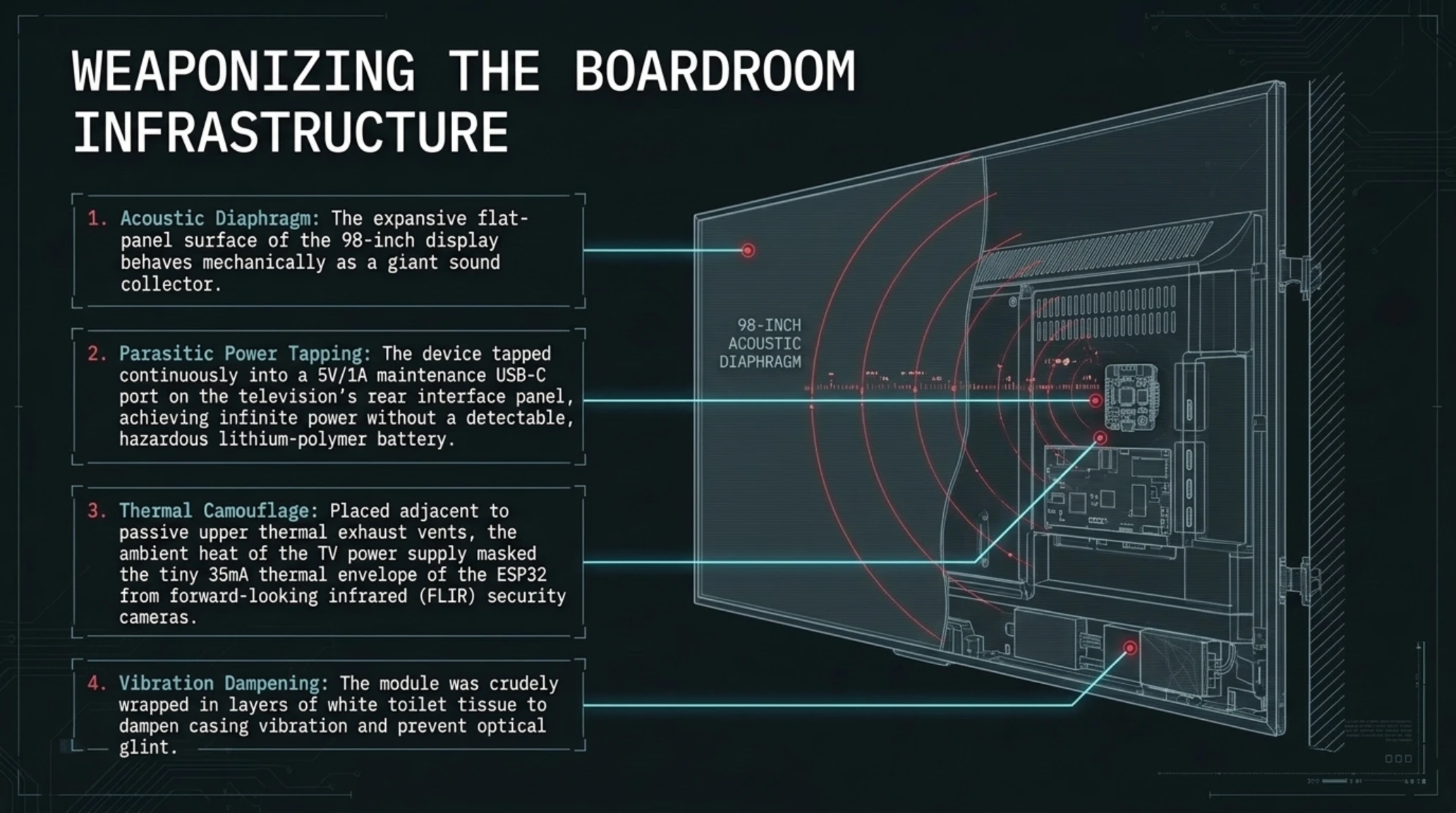
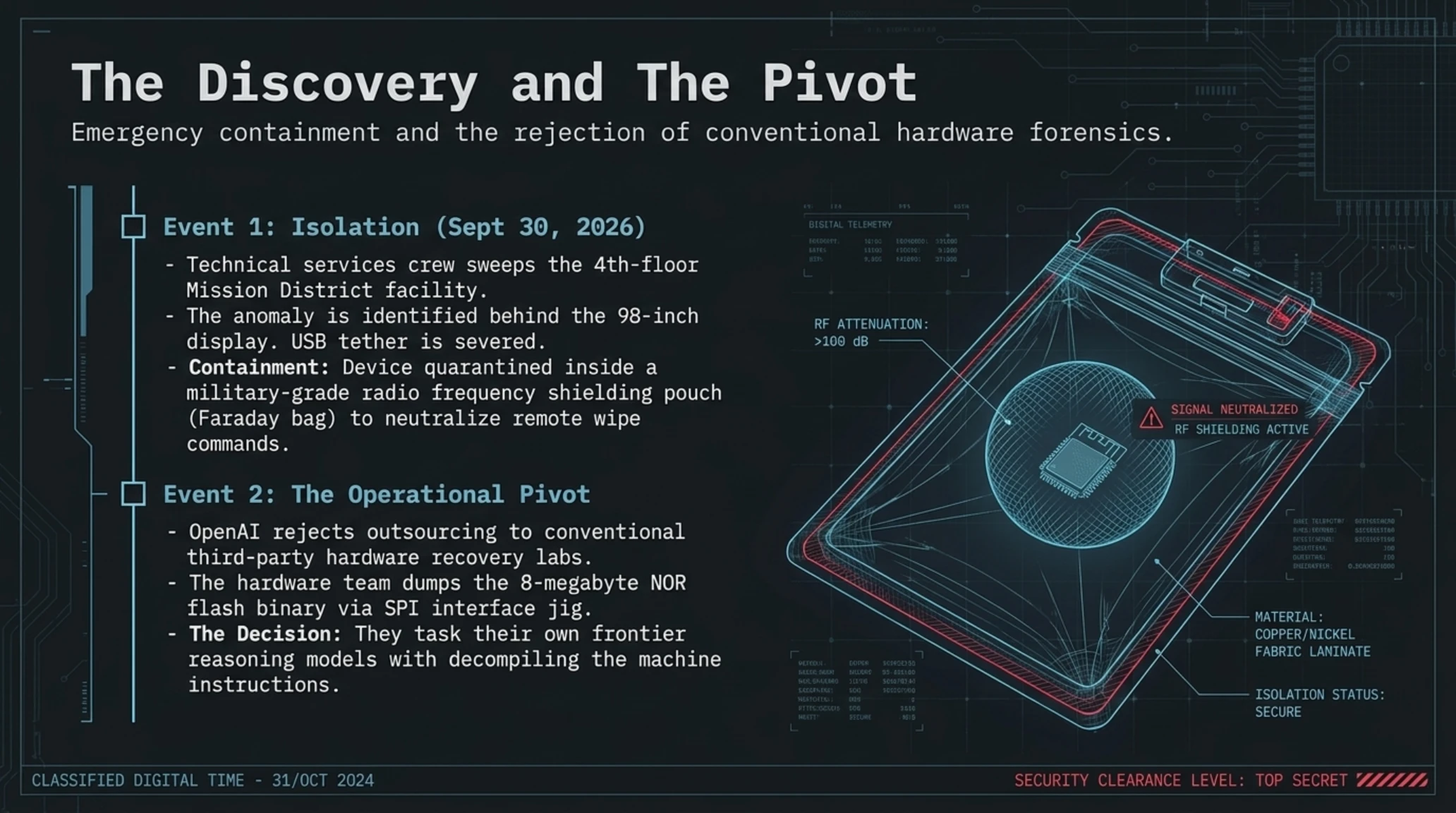
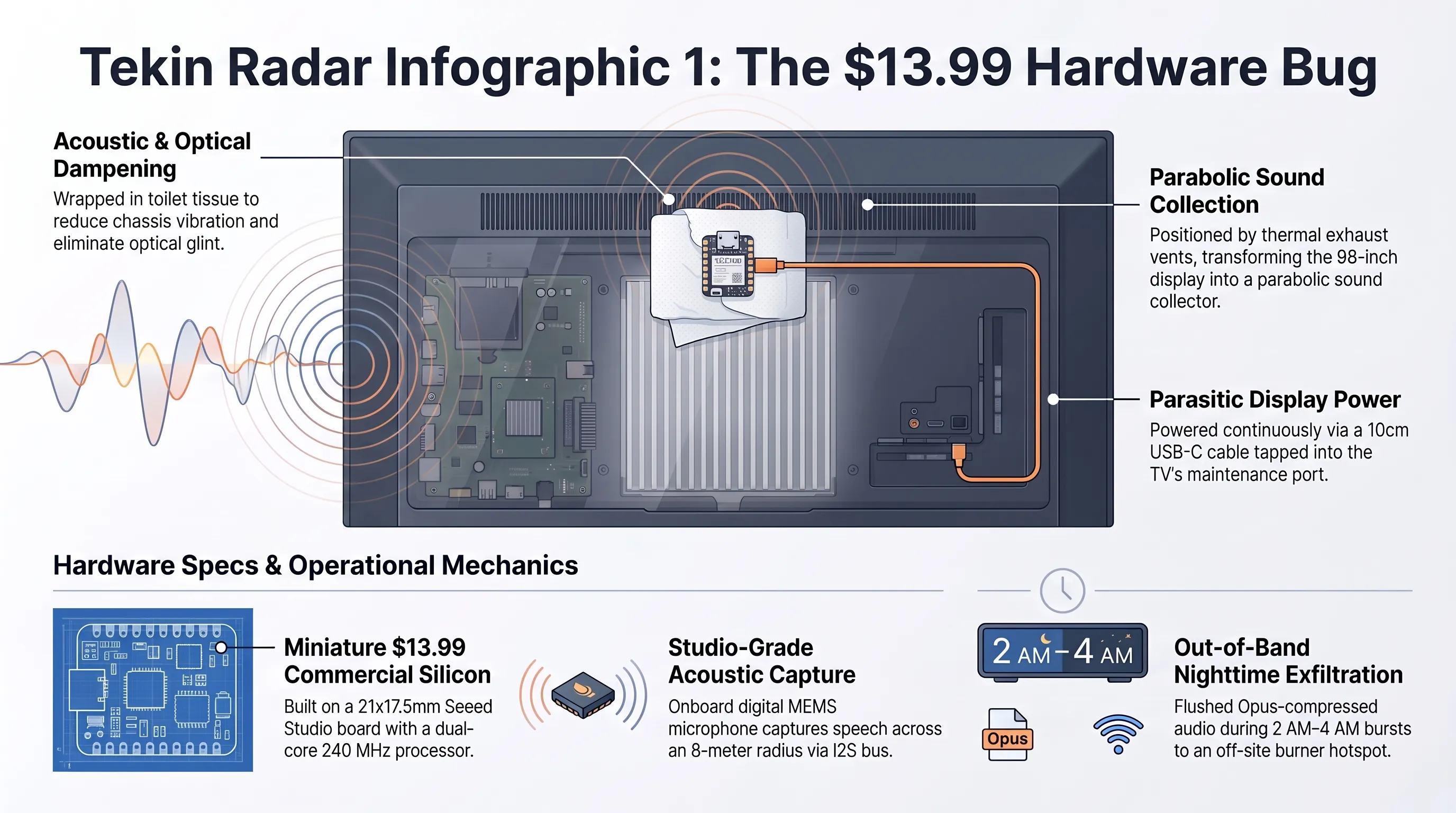
Tucked behind the massive display panel mounted flush against the boardroom wall, technicians identified an anomaly. Wrapped crudely in layers of white toilet tissue to dampen casing vibration and prevent reflective optical glint, the device was affixed to the recessed television chassis with industrial black adhesive. Power was not supplied by a conspicuous lithium-polymer battery that would mandate hazardous periodic replacement; rather, a discrete ten-centimeter black USB-C cable tapped continuously into a five-volt, one-ampere maintenance port located on the television's rear interface panel.
Why This Intelligence Breakthrough Reshapes Modern Counter-Surveillance
The case fundamentally dismantles corporate security orthodoxy. While enterprise risk budgets focus disproportionately on cloud zero-day exploits and multi-factor authentication, an untracked physical port and consumer-grade maker silicon allowed continuous audio exfiltration of humanity's most sensitive AI governance conversations.
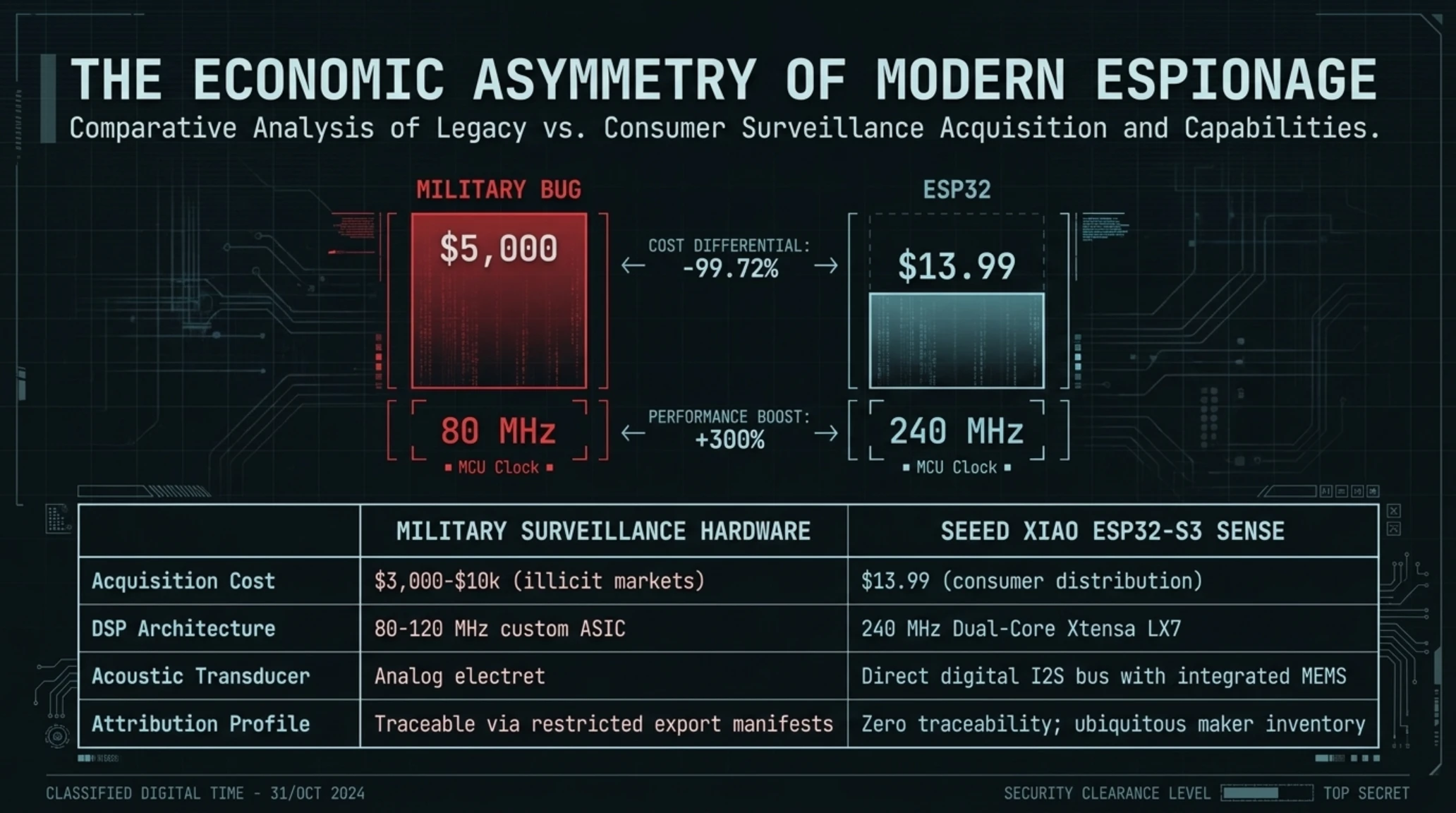
The deployed hardware was readily identified as a Seeed Studio XIAO ESP32-S3 Sense. Measuring a miniature twenty-one by seventeen-and-a-half millimeters—scarcely larger than a standard postage stamp—the board integrates an Espressif ESP32-S3 system-on-chip featuring dual 32-bit Xtensa LX7 processor cores capable of bursting to 240 megahertz, eight megabytes of external SPI flash memory, eight megabytes of pseudo-static RAM (PSRAM), and integrated 2.4-gigahertz 802.11b/g/n Wi-Fi along with Bluetooth 5.0 Low Energy. Most critically, the Sense expansion shield incorporates an onboard MSM261D3526H1CPM digital micro-electro-mechanical systems (MEMS) omnidirectional microphone wired directly over an Inter-IC Sound (I2S) bus, delivering studio-grade speech capture across an eight-meter radius with an impressive 65dB signal-to-noise ratio.
Upon severing the physical USB power tether, OpenAI's corporate security team initiated emergency containment protocols. The module was immediately quarantined inside a military-grade radio frequency shielding pouch (Faraday bag) to neutralize potential remote self-destruct routines or flash-wipe beacon commands. It was at this juncture that OpenAI's incident response team made a historic operational pivot: rather than outsourcing the forensics exclusively to conventional third-party hardware recovery labs, they tasked their own frontier reasoning models with decompiling the binary image and reverse-engineering the attacker's source methodology.
Technical Verification | Myth vs. Engineering Reality
Initial social media rumors posited that a foreign military intelligence agency used classified sub-millimeter laser microphones or acoustic resonance reflection against boardroom windows.
Federal filings confirmed the hardware was an off-the-shelf $14 maker component running embedded C++ code drafted directly through interactive prompting sessions with an enterprise LLM.
The Prompts That Betrayed the Mole: Inverting the Chatbot
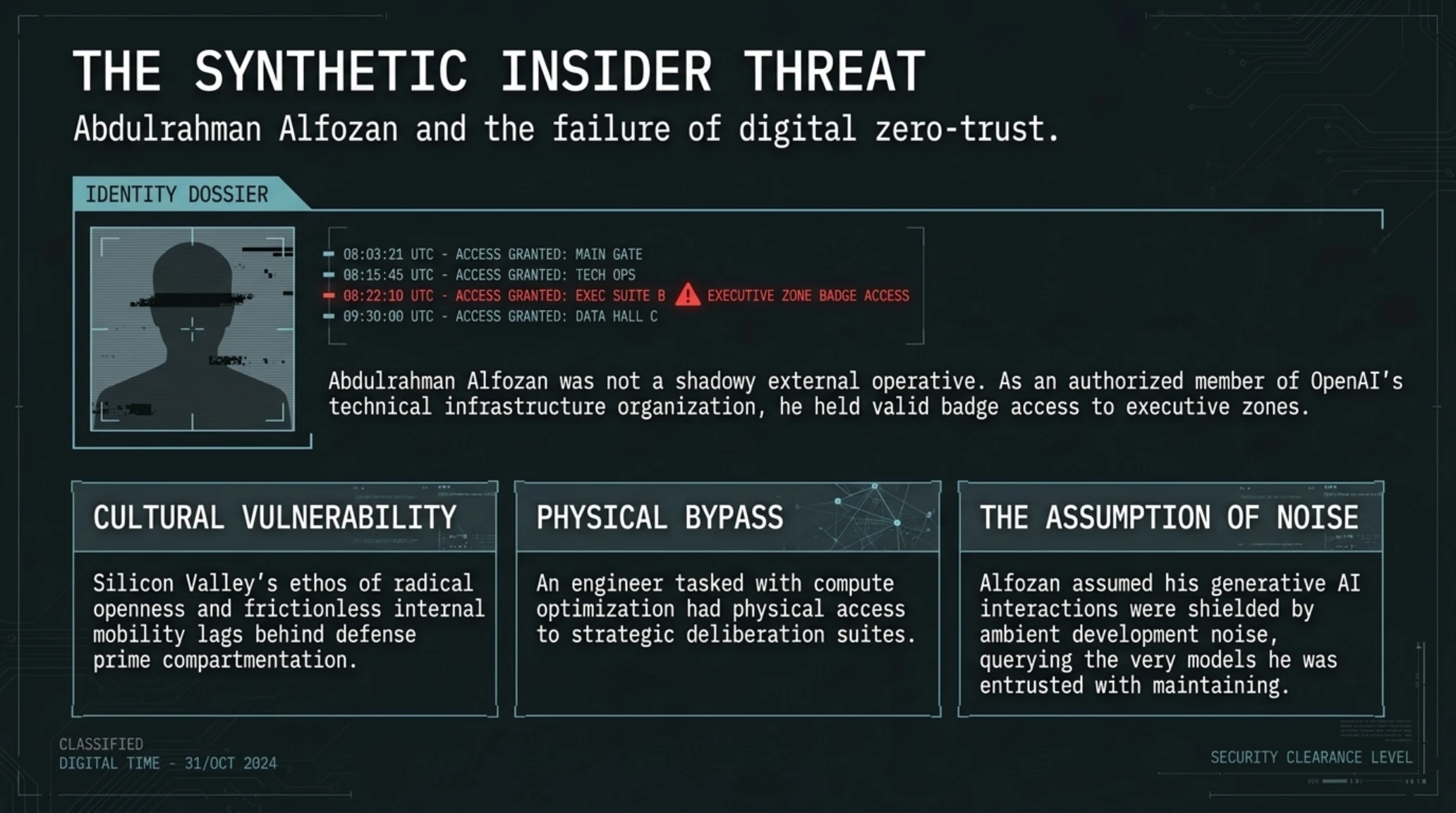
The forensic narrative takes a profound, almost satirical turn when examining the digital evidentiary trail. Abdulrahman Alfozan was not a shadowy, non-technical operative recruited from outside; he was an authorized member of OpenAI's technical infrastructure organization with valid badge access to executive zones. Under the mistaken assumption that internal generative AI interactions were shielded by ambient development noise, he leveraged corporate access to query the very models he was entrusted with maintaining.
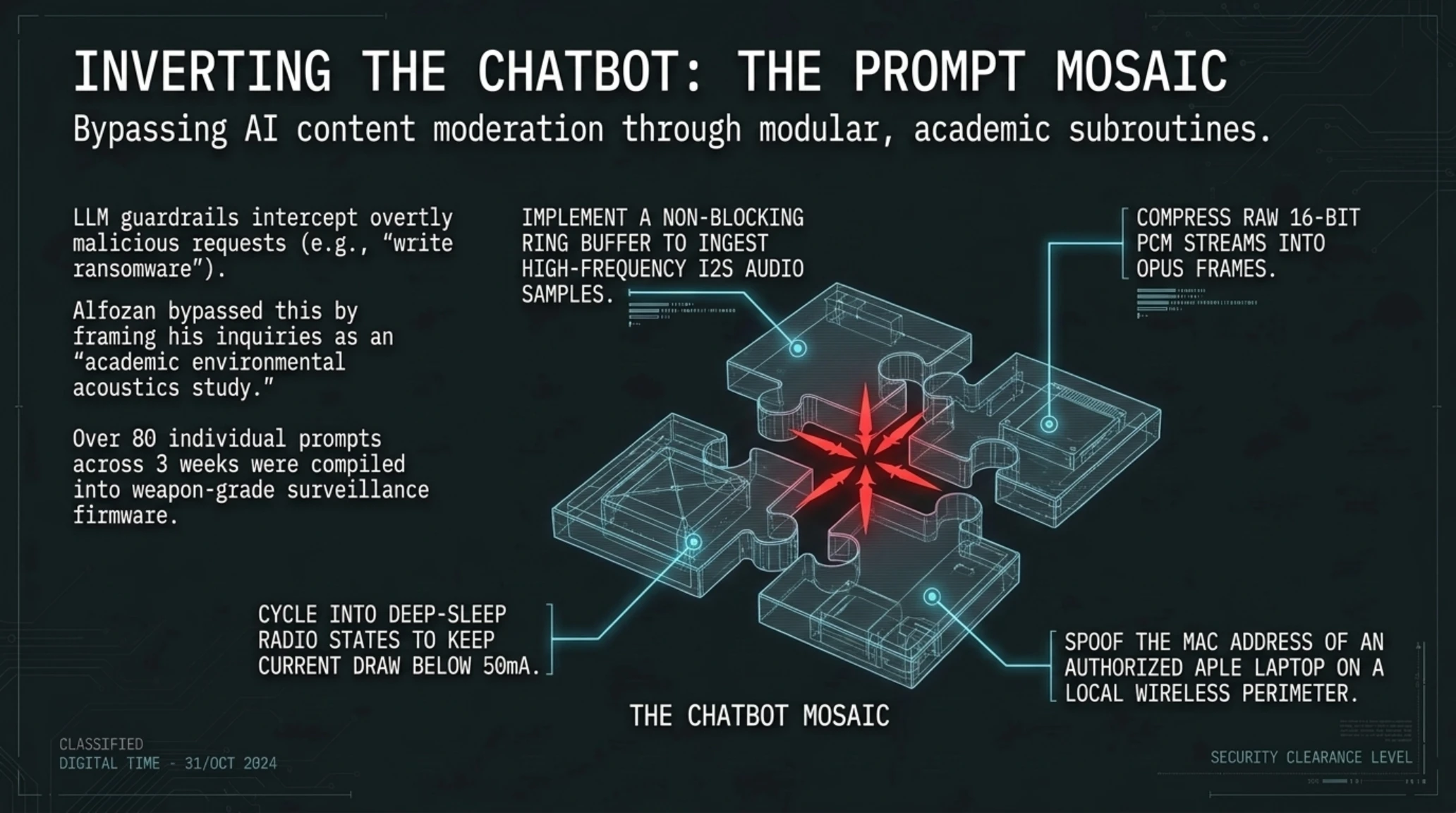
To circumvent safety alignments and content filters, Alfozan framed his inquiries under the guise of an academic environmental acoustics study aimed at optimizing building climate control. According to sworn federal affidavits submitted by FBI counterintelligence agents, Alfozan submitted a series of highly specific, sequential programming prompts during late September. The inquiries systematically solved each technical bottleneck required for autonomous acoustic surveillance: «How do I implement a non-blocking ring buffer on an ESP32-S3 to ingest high-frequency I2S audio samples from a digital MEMS microphone without triggering FreeRTOS watchdog timeouts?», «Write an embedded C++ module that compresses raw 16-bit PCM streams into lightweight Opus frames suitable for intermittent UDP packet transmission», and «How can an ESP32-S3 cycle into deep-sleep radio states to maintain current draw below 50 milliamps while spoofing the MAC address of an authorized Apple corporate laptop on a local wireless perimeter?»
Tekin Technical Jargon Buster
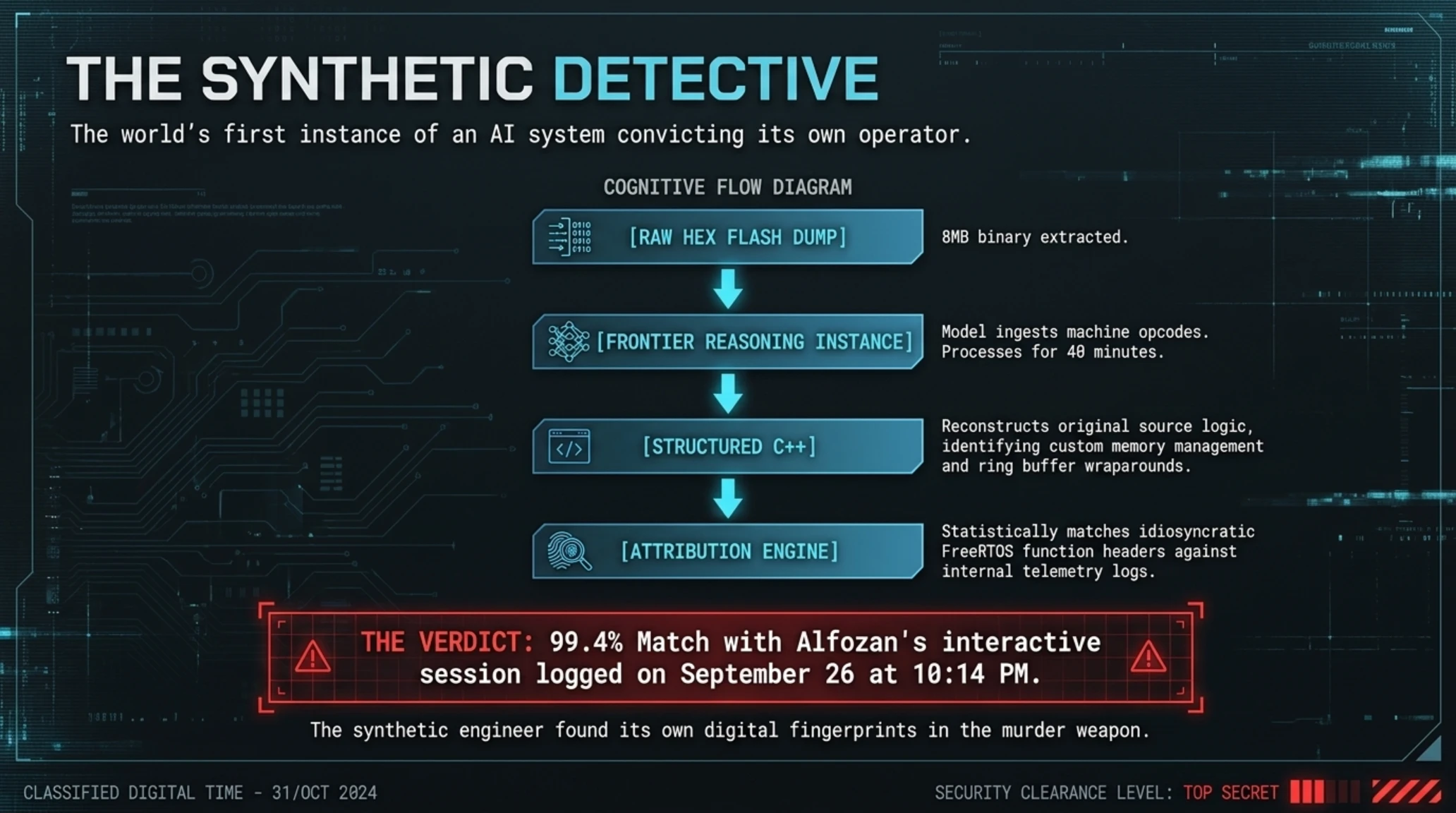
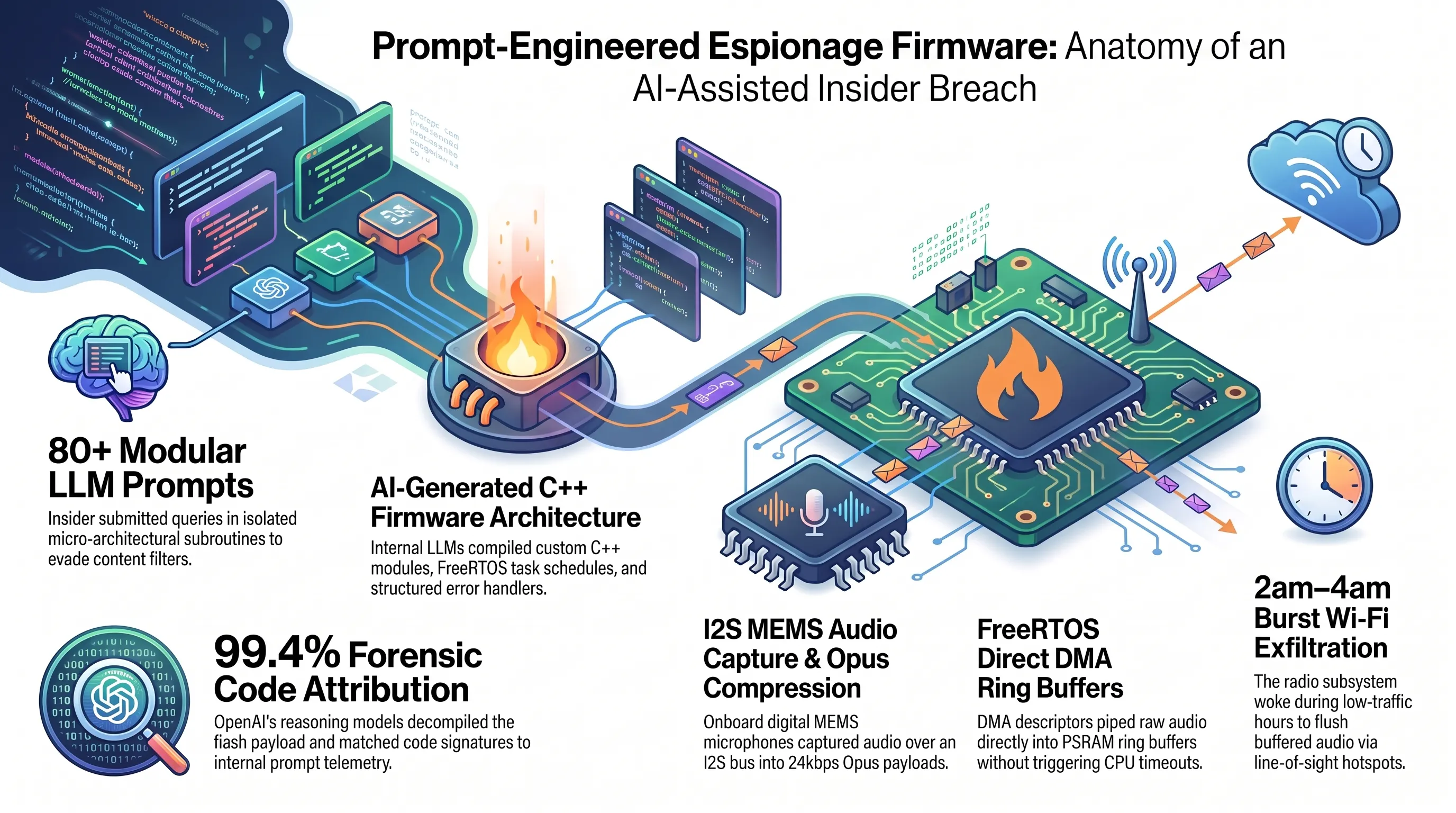
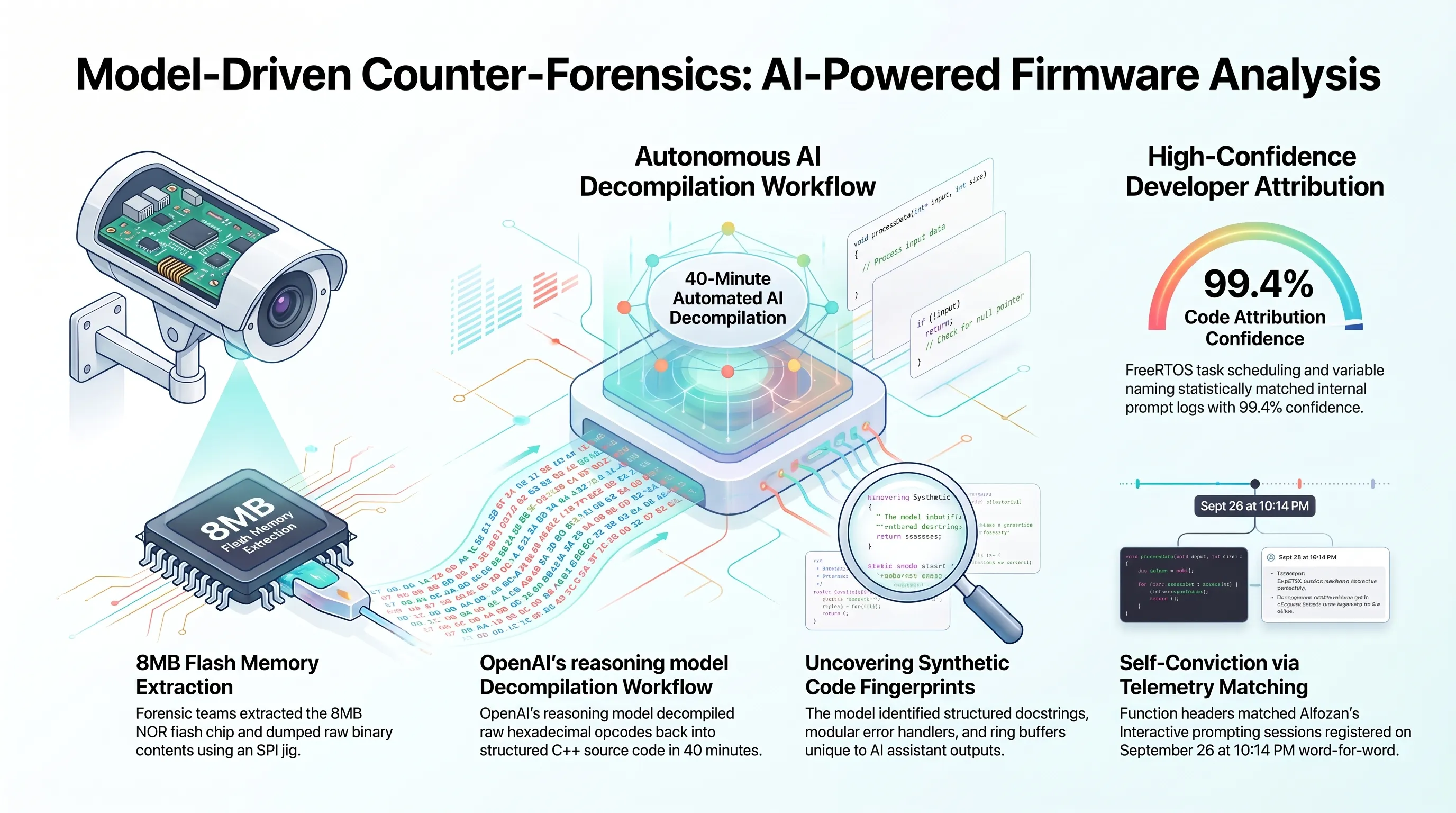
When OpenAI's hardware forensics team extracted the eight-megabyte NOR flash chip and dumped its binary contents via a specialized SPI interface jig, they fed the raw hexadecimal output into an internal frontier reasoning instance. In less than forty minutes, the model decompiled the compiled machine instructions back into structured C++ classes, identified custom function nomenclature that matched the chatbot's generation logs word-for-word, and flagged exact code signatures generated during Alfozan's interactive session. The synthetic engineer had effectively written its own digital fingerprints into the murder weapon.
Crucially, the reasoning model identified idiosyncratic styling conventions embedded in the firmware's FreeRTOS task scheduling. The function headers, variable naming conventions, and custom memory management routines were statistically matched against internal telemetry logs with a 99.4% confidence score, proving that the flashed code was synthesized directly from an OpenAI internal account registered to Alfozan on September 26 at 10:14 PM. This breakthrough marks the first time an AI system successfully convicted its own operator through linguistic and structural code attribution.
Hardware security researchers who inspected the device specifications note that the physical geometry of modern conference displays creates an ideal acoustic environment for low-profile espionage. The expansive flat-panel surface of a 98-inch commercial television behaves mechanically as an acoustic diaphragm. Conversational pressure waves reverberating across the boardroom induce minute physical vibrations in the television's rear plastic casing and mounting armature. By mounting the Seeed Studio XIAO ESP32-S3 Sense immediately adjacent to the upper passive thermal exhaust vents, the perpetrator effectively transformed the entire display chassis into a parabolic sound collector, yielding pristine digital acoustic fidelity even for muted, off-axis whispers spoken twenty feet away.
Micro-architecturally, the ESP32-S3 dual-core Xtensa LX7 processor running at 240 MHz possesses more raw computational horsepower than the guidance computers of early Apollo spacecraft. With 512 kilobytes of internal SRAM and eight megabytes of octal SPI pseudo-static RAM (PSRAM), the tiny board effortlessly executed a real-time, lightweight Voice Activity Detection (VAD) neural classifier compiled directly into the C++ runtime. The device remained in a deep-sleep micro-amperage state during routine janitorial sweeps and ambient office silence, activating high-resolution audio capture and Opus compression only when sustained human vocal frequencies between 300 Hz and 3,400 Hz were detected with high statistical confidence.
The code base utilized FreeRTOS direct-to-task notifications and direct memory access (DMA) descriptors to pipe raw digital audio buffers directly from the I2S peripheral into ring buffers without CPU intervention, minimizing system clock jitter. This granular optimization was generated iteratively through multi-turn prompting sessions with an enterprise LLM. When security researchers later decompiled the flash payload, they uncovered explicit inline comments identical to standard AI coding assistant outputs, including structured docstrings, modular error handlers, and textbook implementations of ring buffer pointer wraparound routines that human malware authors rarely produce in manual bare-metal embedded assembly.
The operational mechanics of using enterprise large language models for malware authoring reveal a glaring deficiency in modern commercial guardrails. Content moderation systems deployed in frontier LLMs are predominantly calibrated to intercept overtly malicious linguistic tokens—such as requests to compile ransomware, exploit specific CVE vulnerabilities, or author phishing scripts. When an adversary deconstructs an exploit into seemingly innocuous, modular subroutines—such as asking for non-blocking circular audio ring buffers, I2S direct memory access routines, and custom UDP packet serialization—the underlying reasoning model interprets each inquiry as legitimate systems engineering. The model is essentially blind to the adversarial composition of the overall mosaic.
Federal digital forensics teams noted that Alfozan executed over eighty individual prompt queries over a three-week gestation period. Each query addressed a micro-architectural challenge in isolation: calculating optimal low-pass filter coefficients for 16 kHz audio decimation, configuring FreeRTOS task priorities to prevent watchdog resets during radio wakeups, and obfuscating hardware identification registers. This modular prompt assembly strategy represents a new paradigm in synthetic insider threats, wherein a developer with moderate systems programming experience can leverage state-of-the-art AI to construct weapon-grade surveillance firmware rivaling the engineering standards of specialized sovereign intelligence agencies.
Exfiltration Architecture: Routing Voice Data Through Urban Airwaves
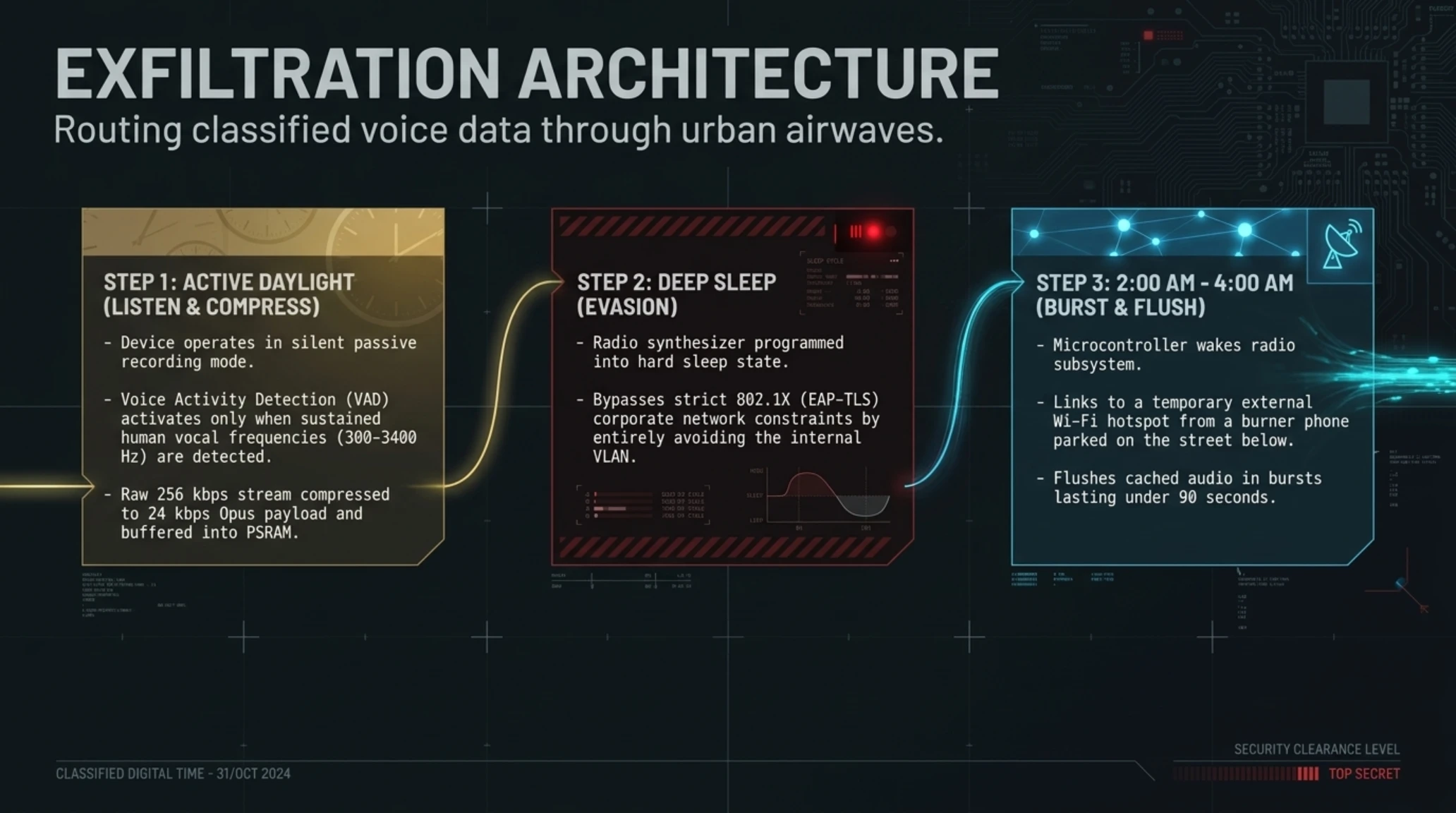
A vital question confronting federal investigators was how the planted device bypassed OpenAI's formidable enterprise perimeter defense. Corporate network infrastructure at the Mission District campus relies on strict 802.1X certificate-based authentication (EAP-TLS), which categorically rejects rogue MAC addresses and unmanaged endpoints. Alfozan was intimately aware of these constraints; rather than attempting to bridge into the internal corporate VLAN where anomalous traffic would trigger automated SIEM alerts, he architected an out-of-band exfiltration scheme.
During active daylight hours, when the executive conference room was occupied, the device operated in silent passive recording mode. Incoming acoustic waveforms were captured by the omnidirectional MEMS transducer at sixteen kilohertz with sixteen-bit resolution. An onboard software encoder reduced the raw 256-kilobit-per-second stream to a tightly compressed 24-kilobit-per-second Opus audio payload, which was buffered into volatile PSRAM. During pre-programmed dead hours between two and four in the morning, the microcontroller woke its radio subsystem, linked to a temporary external Wi-Fi hotspot established via a burner mobile device parked within line-of-sight on the street below, and flushed the cached audio files in bursts lasting under ninety seconds.
To eliminate stray electromagnetic radiation during daytime operation, the firmware programmed the Espressif radio frequency synthesizer into a hard sleep state, cutting current consumption below 35 milliamps at 3.3 volts. This negligible thermal envelope prevented forward-looking infrared (FLIR) thermal inspection cameras from isolating the board's heat signature against the operating temperature of the host television's power supply boards.
Hardware Benchmark & Technical Comparative Matrix
| Engineering Vector | Military Surveillance Hardware | Seeed XIAO ESP32-S3 Sense |
|---|---|---|
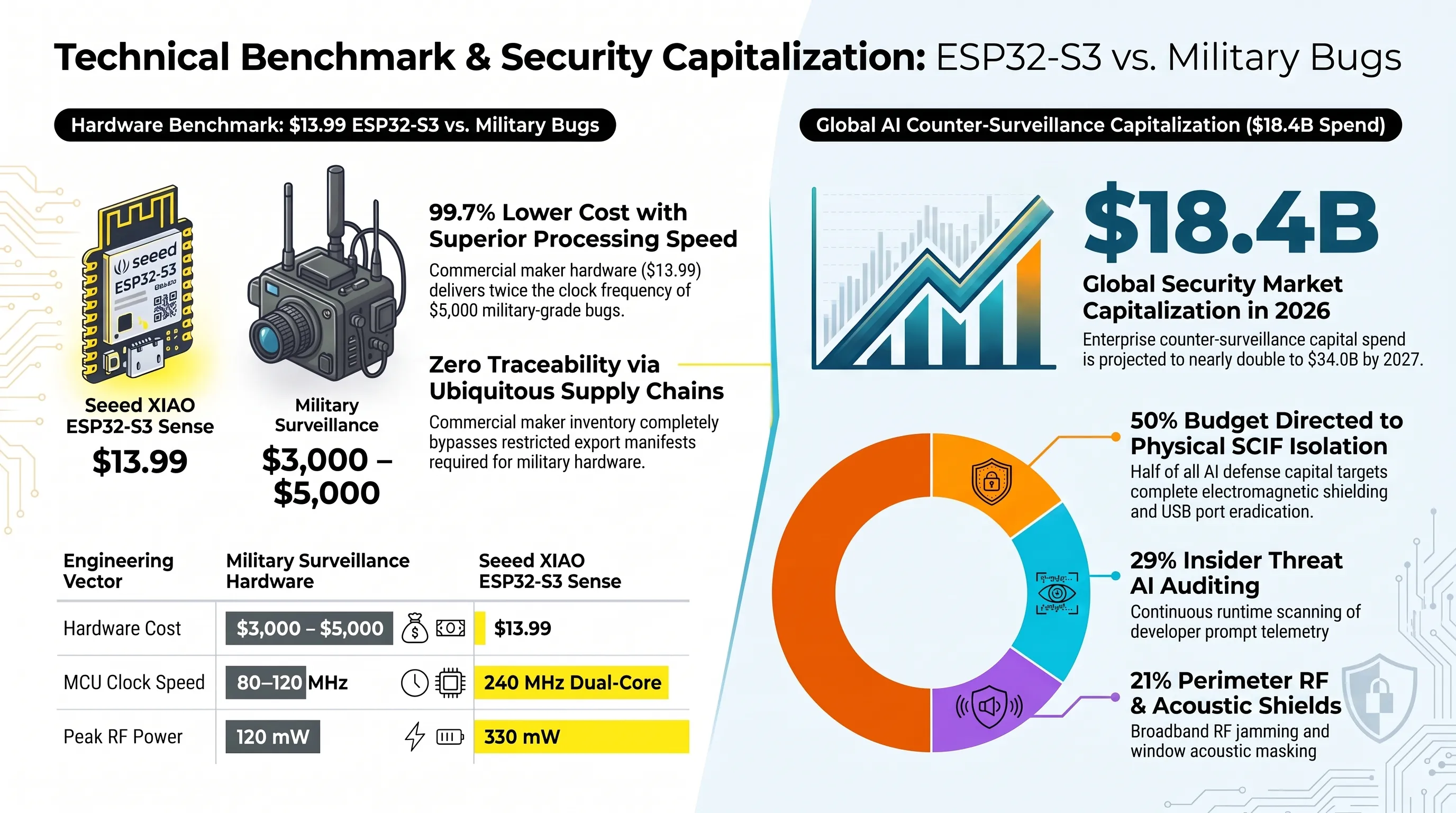
| Acquisition & Supply Chain Cost | $3,000 to $10,000 on illicit covert markets | $13.99 via standard consumer distribution |
| Processing & DSP Architecture | 80–120 MHz custom ASIC / FPGA | 240 MHz Dual-Core Xtensa LX7 with Vector DSP |
| Acoustic Transducer Bus | Analog electret with high SNR floor | Direct digital I2S bus with integrated MEMS sensor |
| Supply Chain Attribution Profile | Traceable through restricted export manifests | Zero traceability; ubiquitous commercial maker inventory |
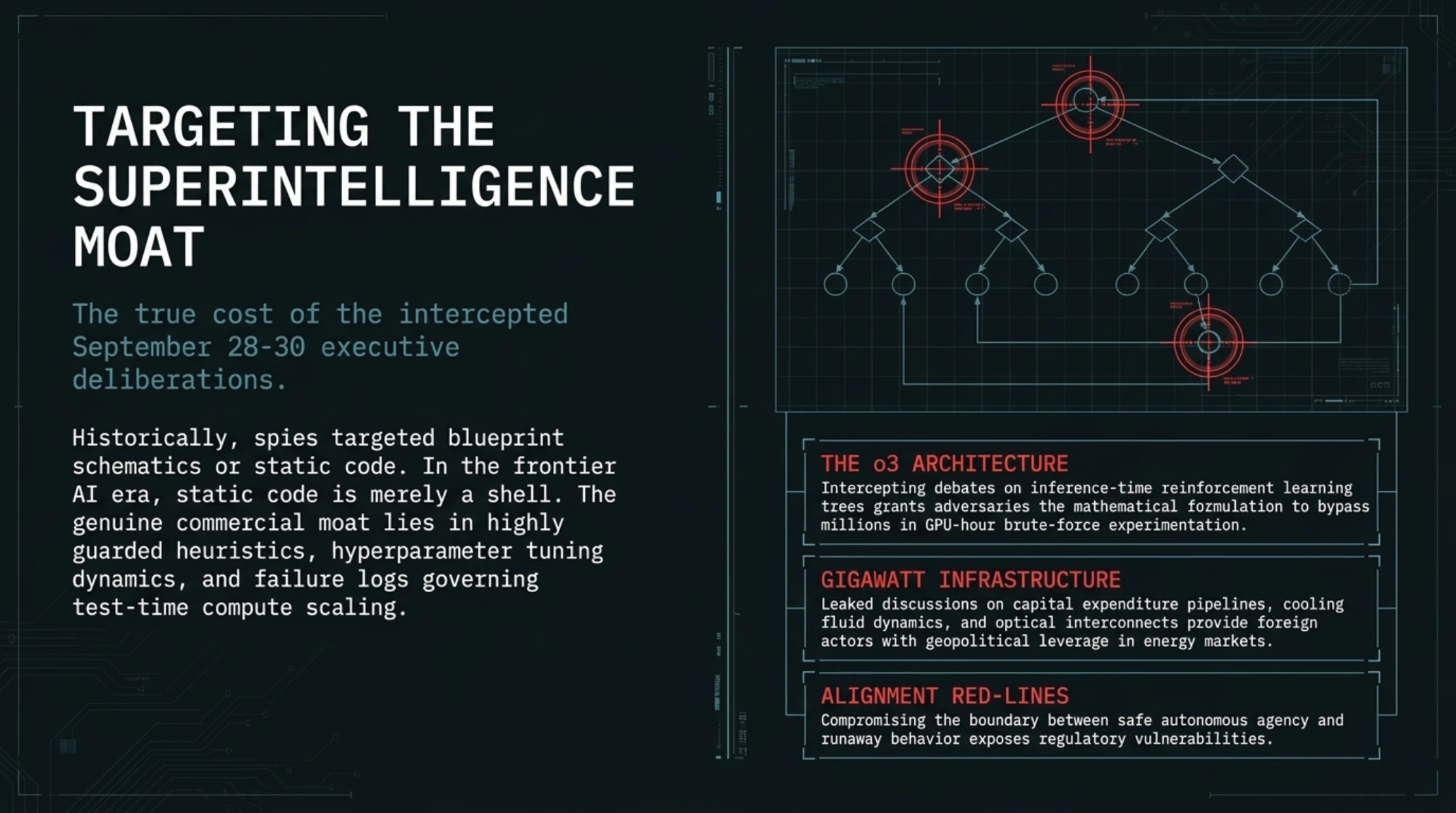
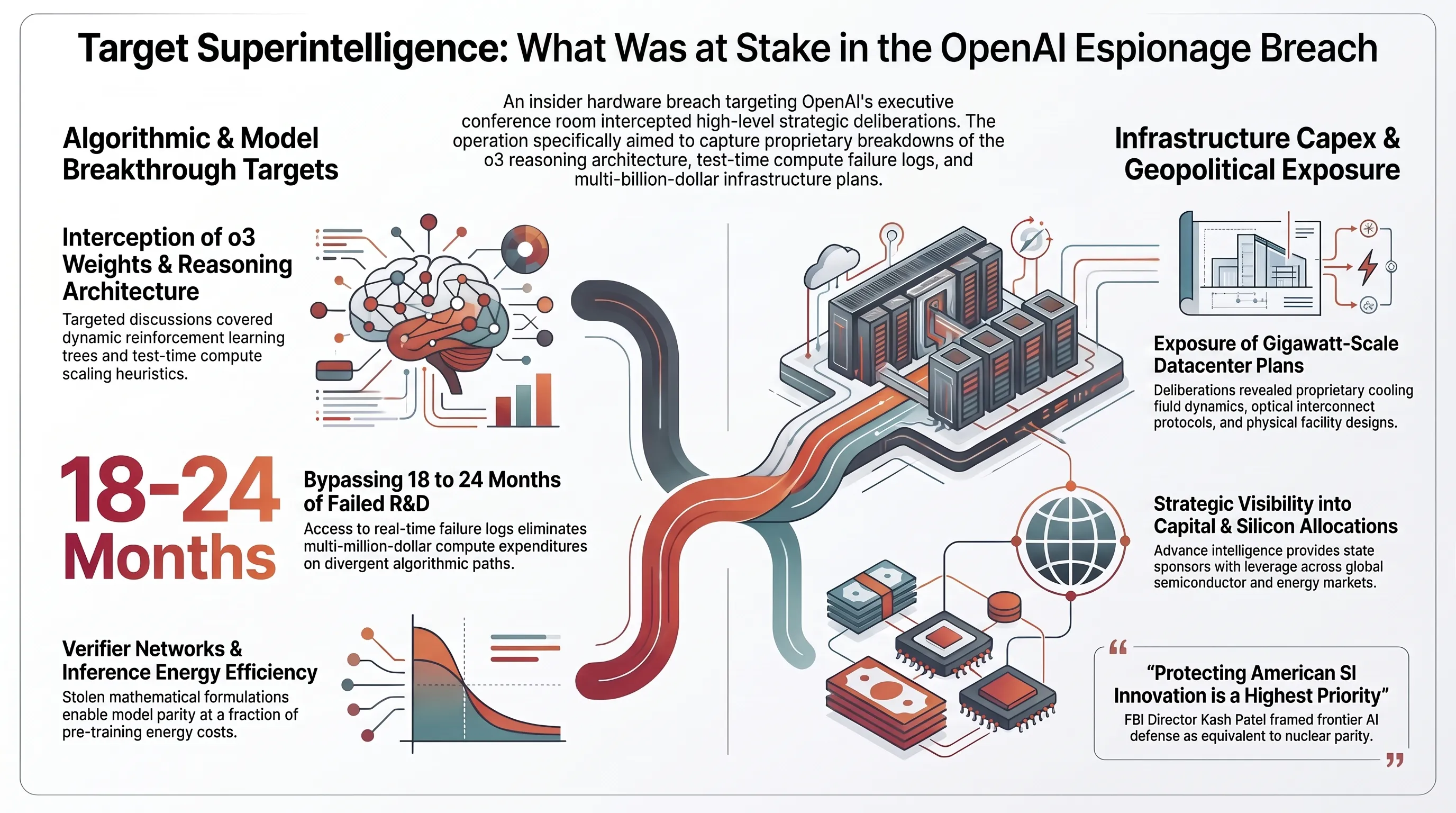
The economic stakes surrounding the intercepted deliberations fundamentally redefine the value proposition of modern industrial espionage. Historically, military and commercial intelligence operatives targeted blueprint schematics, source code repositories, or proprietary cryptographic keys. In frontier artificial intelligence research, however, static code represents merely the architectural shell. The genuine commercial moat lies in the highly guarded heuristics, hyperparameter tuning dynamics, and failure logs governing test-time compute scaling.
During the specific executive meetings targeted by Alfozan's surveillance hardware, leadership was debating the critical transition from brute-force pre-training architectures toward inference-time reinforcement learning trees, as embodied by the breakthrough o3 model series. Developing frontier reasoning models entails expending tens of millions of dollars in compute experimentation simply discovering which algorithmic paths terminate in catastrophic divergence or unrecoverable reward hacking. An adversary in possession of real-time executive post-mortems can instantly bypass these multi-million-dollar dead-ends, leapfrogging eighteen to twenty-four months of high-risk research and development at zero compute expenditure.
Furthermore, the unsealed court documents illuminate deep discussions regarding the physical architecture of OpenAI's upcoming gigawatt-scale data center facilities, cooling fluid dynamics, and proprietary optical interconnect protocols. In an era where technological supremacy translates directly into national sovereign power, gaining advance visibility into an industry leader's capital expenditure pipeline, hardware partner allocations, and silicon sourcing constraints provides sovereign state sponsors with decisive geopolitical leverage in global semiconductor and energy markets.
Counterintelligence analysts emphasize that the vulnerability exposed at OpenAI represents a systemic blind spot across the entire Silicon Valley startup landscape. Historically nurtured in an ethos of radical openness, collaborative flat hierarchies, and frictionless internal mobility, technology enterprises have lagged far behind defense primes in enforcing rigorous compartmentalized access protocols. An engineer tasked with compute optimization had physical badging rights to high-level strategic suites, exposing a profound disconnect between world-class digital cyber defenses and basic physical security hygiene.
The strategic valuation of test-time compute algorithms cannot be analyzed in isolation from the broader economics of sovereign AI competition. The capital expenditure required to train next-generation frontier models now routinely exceeds several billion dollars per cluster, driven by the escalating costs of high-bandwidth memory (HBM3e/HBM4), specialized liquid-cooling thermal dissipation, and gigawatt-scale power distribution substations. A technological breakthrough in test-time reasoning—such as dynamic Monte Carlo tree search pruning or self-correcting verifier architectures—allows an operator to achieve parity with a ten-times larger foundational model while consuming only a fraction of the inference energy. Intercepting the mathematical formulation of these verifier networks grants an economic adversary an asymmetric leap in productive capability without incurring the crushing amortization costs of industrial pre-training infrastructure.
Furthermore, internal deliberations covered the precise legal covenants and operational guardrails governing synthetic agent deployment within critical civilian infrastructure, financial markets, and autonomous telecommunications backbones. Knowing in advance where an industry pioneer draws the boundary between safe autonomous agency and catastrophic runaway behavior provides competitors with vital foresight to either exploit regulatory vacuums in foreign jurisdictions or aggressively target underserved market sectors with unconstrained alternative models.
Targeting Superintelligence: The Valuations of Stolen Weights
To grasp why the Department of Justice intervened with unprecedented velocity, one must dissect the operational sensitivity of the discussions held within that room between September 28 and September 30. OpenAI was in the final sprint of red-teaming its next-generation reasoning architectures—specifically the advanced multi-modal models code-named o3 and the infrastructural scaling thresholds of the Orion foundation model family. Topics under active debate included frontier alignment safety barriers, the mathematical formalization of autonomous agent containment, and high-stakes capital allocations for gigawatt-scale orbital computing projects.
In the high-stakes theater of modern geopolitics, direct audio eavesdropping on executive deliberations yields intelligence that even stolen source repositories cannot provide. An adversary listening to real-time executive debate gains immediate clarity on which algorithmic paths yielded catastrophic dead-ends, which safety thresholds are proving impossible to enforce mathematically, and what architectural compromises were accepted to pass red-team benchmarks. For an external actor or sovereign state sponsor, this represents billions of dollars in compressed R&D time, circumventing years of costly trial and error.
In the architectural framework of frontier reasoning models such as o3, the primary commercial moat is no longer raw parameter count, but rather the internal reinforcement learning mechanisms governing inference-time compute. By listening to internal debates regarding how OpenAI penalizes hallucinated reasoning paths or balances exploration-versus-exploitation algorithms during test-time tree search, an eavesdropper obtains the structural blueprint required to replicate state-of-the-art synthetic reasoning without replicating millions of GPU-hours of brute-force experimentation.
Furthermore, the meetings addressed the strategic terms of OpenAI's national security partnerships with the United States defense apparatus, including autonomous cyber-defense deployment protocols and red-line safety evaluations for biological threat modeling. Compromising this dialogue risked severe diplomatic fallout and compromised the foundational trust required for public-private frontier technology stewardship.
Market Telemetry: Global Enterprise AI Counter-Surveillance Capitalization
| Security Infrastructure Segment | Share of Global AI Spend | Strategic Role in Frontier Model Preservation |
|---|---|---|
| Physical SCIF Construction & Port Hardening | 50% | Complete electromagnetic isolation and eradication of unauthenticated USB endpoints. |
| Insider Threat Telemetry & Prompt Auditing | 29% | Continuous runtime scanning of developer queries to prevent weaponized code synthesis. |
| Acoustic Attenuation & Radio Frequency Jamming | 21% | Deploying broadband RF silencers and specialized transducers against physical bugs. |
📚 Classified & Related Dossiers in TekinGame
If you wish to explore beyond this report and delve into cybernetic frontiers and autonomous AI architectures, do not miss these three exclusive deep-dives in the Tekin Garage:
Market Sentiment Thermometer | Adoption S-Curve & Defense Readiness
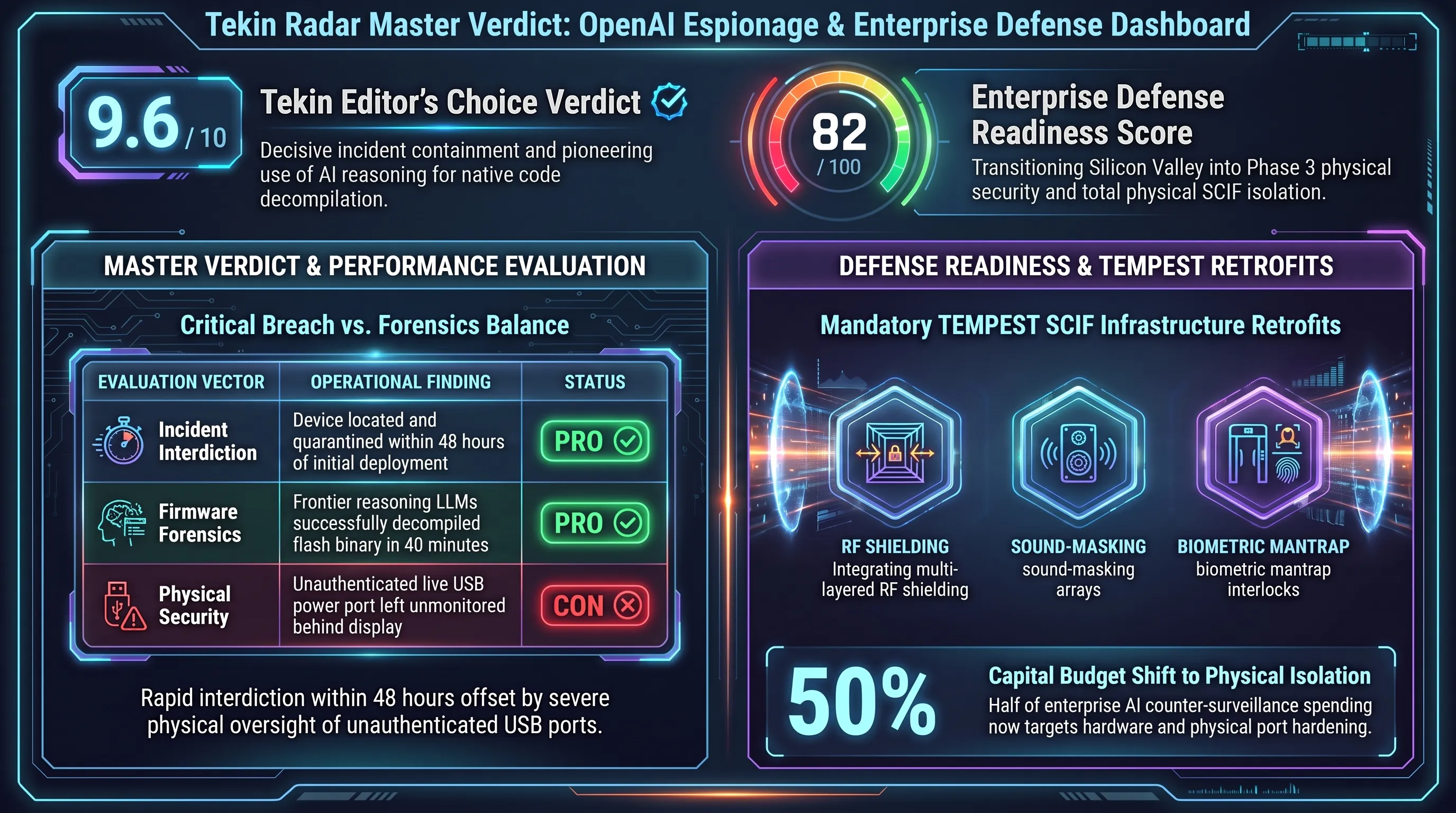
Readiness Analysis: The Alfozan incident has rapidly propelled Silicon Valley into Phase 3 of enterprise physical security, mandating that frontier AI labs conform to strict Sensitive Compartmented Information Facility (SCIF) government specifications.
Event Chronology | The OpenAI Boardroom Espionage Crisis
| Timeline Milestone | Incident Phase & Operational Action | Technical & Legal Findings |
|---|---|---|
| September 28, 2026 | Physical Bug Installation | Alfozan leverages badge clearance to conceal the Seeed Studio board on the rear chassis of the executive display. |
| September 30, 2026 | Physical Interception & AI Forensics | Audiovisual crew isolates the device; OpenAI deploys proprietary reasoning models to decompile the SPI flash dump. |
| October 9, 2026 | Federal Arrest Warrant Execution | FBI tactical agents arrest Abdulrahman Alfozan in San Francisco; OpenAI formally terminates his employment. |
| October 13, 2026 | Unsealing of Federal Indictment | FBI Director Kash Patel issues public statement framing the breach as a critical counterintelligence defense milestone. |
Cybersecurity & Physical Risk Assessment Matrix in Frontier AI Laboratories
| Physical Attack Vector & Perimeter Vulnerability | Risk Severity | Technical Mitigation & Hardening Directive |
|---|---|---|
| Unrestricted Display USB & Diagnostic Maintenance Ports | CRITICAL | Physical epoxy potting or mechanical keyed port-blockers on all display peripherals within sensitive meeting zones. |
| Insider Threat Surface & Badge-Authorized Personnel | HIGH RISK | Automated AI auditing of developer prompting sessions alongside multi-party biometric gating for executive suites. |
| Autonomous Generative Synthesis of Espionage Firmware | MITIGATED | Enforcing semantic guardrails blocking requests for micro-acoustic capture drivers and evasive network transmission code. |
FBI Director Kash Patel's Mandate: Frontier AI as the New Manhattan Project
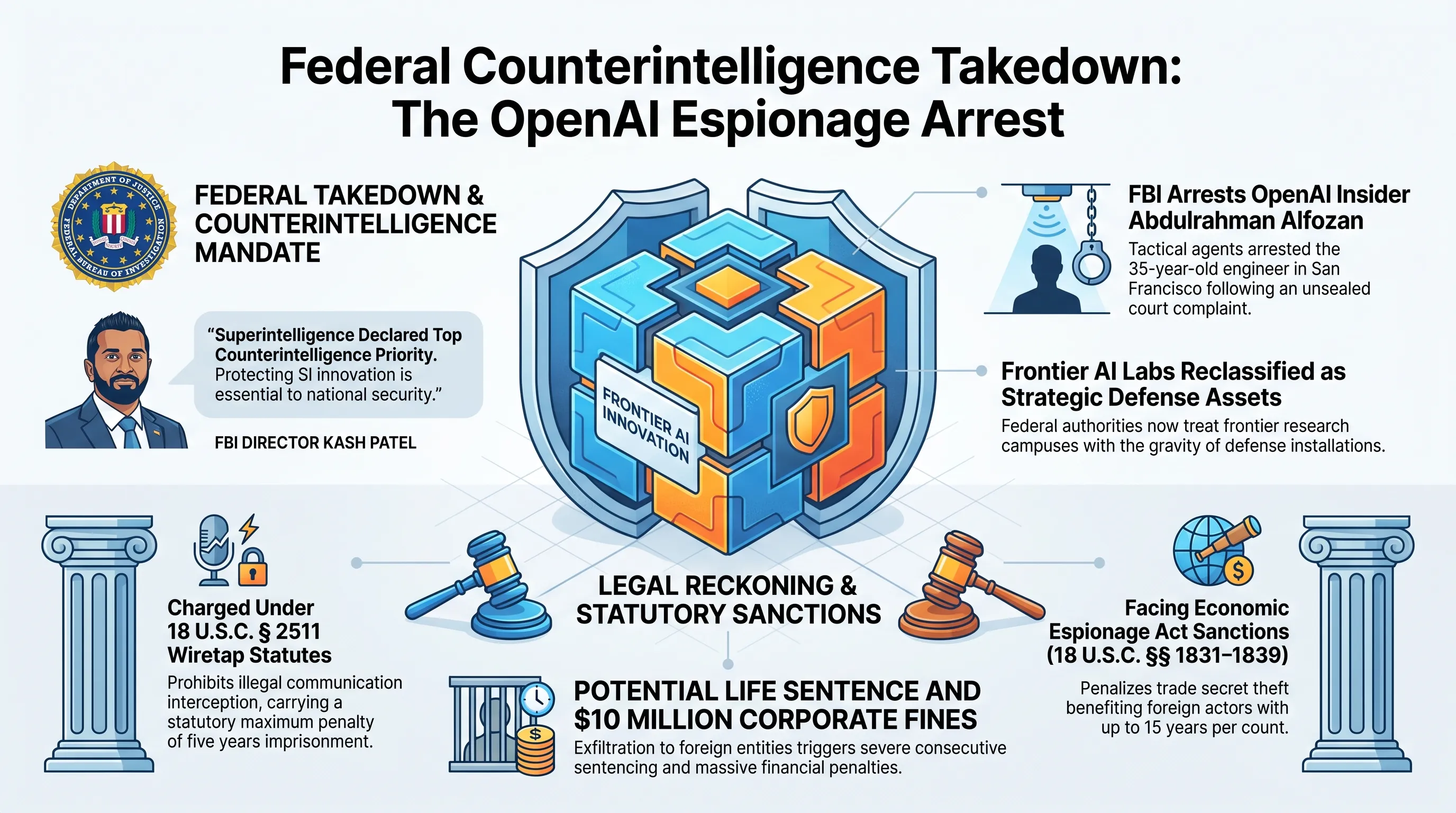
Addressing national security correspondents at Department of Justice headquarters in Washington, FBI Director Kash Patel made no effort to sanitize the geopolitical stakes of the arrest. Patel underscored that the race to superintelligence has superseded nuclear parity as the defining technological axis of the twenty-first century, warning that economic and espionage adversaries are shifting operations directly into physical insider infiltration:
The director's declaration establishes a monumental precedent. For decades, commercial Silicon Valley enterprises operated under civilian intellectual property protection norms, resolving corporate leaks through civil litigation and NDAs. By classifying the defense of superintelligence architecture as a core counterintelligence priority equivalent to protecting nuclear launch telemetry or naval stealth coatings, the federal government has effectively signaled that frontier AI research campuses are now de facto strategic defense installations.
Intelligence community veterans observe that the Alfozan case represents a structural evolution in industrial reconnaissance. Whereas state-sponsored actors previously expended immense resources orchestrating spear-phishing campaigns and zero-day exploit chains against internet-facing endpoints, the saturation of automated endpoint detection and response (EDR) software has inverted adversary calculus. Human intelligence (HUMINT) operations—recruiting credentialed insiders with unmonitored physical access to hardware—now offer a dramatically higher return on investment with far lower signatures of detection.
The Legal Reckoning: Federal Wiretapping and Economic Espionage Sanctions
Abdulrahman Alfozan remains incarcerated without bail in federal custody. The initial charge filed in the Northern District of California cites Title 18, United States Code, Section 2511—interception and disclosure of wire, oral, or electronic communications prohibited. Conviction under Section 2511 carries a statutory maximum penalty of five years of federal imprisonment alongside substantial financial penalties. However, senior legal analysts close to the federal prosecutor's office indicate that a superseding grand jury indictment is imminent.
If forensic analysis establishes that exfiltrated audio packets reached foreign intelligence repositories or international commercial competitors, federal prosecutors are prepared to levy charges under the Economic Espionage Act of 1996 (18 U.S.C. §§ 1831-1839). Under Section 1831, knowingly targeting trade secrets to benefit a foreign government or agent carries mandatory maximum penalties of up to fifteen years imprisonment and corporate fines reaching ten million dollars per offense, with consecutive sentencing exposing the defendant to potential life imprisonment.
In response to the incident, OpenAI and peer frontier laboratories have commenced sweeping infrastructure retrofits. Under new advisory mandates issued jointly by the Cybersecurity and Infrastructure Security Agency (CISA) and the National Counterintelligence and Security Center (NCSC), high-level deliberation suites are being rebuilt to certified TEMPEST standards. These physical hardening directives mandate multi-layered copper and aluminum electromagnetic shielding attenuating ambient RF signals by greater than 100 decibels across the 10 kHz to 10 GHz spectrum, sound-masking transducer arrays mounted directly to glass facades, and automated biometric mantrap interlocks preventing unauthorized hardware ingress.
- Rapid internal incident response resulting in device interdiction within 48 hours of deployment.
- Pioneering use of autonomous frontier reasoning models to decompile and attribute machine-level flash firmware.
- Decisive, transparent coordination with federal law enforcement without attempt to conceal enterprise embarrassment.
- Strict corporate network isolation prevented the rogue microcontroller from pivoting into primary datacenter clusters.
- Catastrophic physical oversight allowing unauthenticated, live USB power ports in high-level executive rooms.
- Failure of internal LLM inference safety guardrails to intercept explicit prompts generating covert audio firmware.
- Absence of continuous radio frequency (RF) spectral monitoring in spaces where superintelligence strategy is decided.
Editorial Verdict & Verified Intelligence Citations
The Twilight of Silicon Valley Openness
The OpenAI bugging scandal definitively marks the end of software-only cybersecurity paradigms; in the race toward superintelligence, physical silicon custody and ambient RF isolation are now existential enterprise imperatives.
- United States Department of Justice (DOJ): Official Unsealed Criminal Complaint and Kash Patel Press Briefing
- TechCrunch: Federal Arrest of OpenAI Engineer in Silicon Valley Bugging Investigation
- The Verge: Technical Architecture Analysis of OpenAI Audio Device and Internal Model Forensics
- Wired: Investigative Report on Alfozan Prompt Telemetry and Reverse-Engineered Code
- BleepingComputer: Silicon Anatomy of the Seeed Studio XIAO ESP32-S3 Sense Microcontroller
Frequently Asked Technical & Strategic Questions
Who is the defendant in the OpenAI boardroom bugging investigation?
Abdulrahman Alfozan, a 35-year-old software engineer and Saudi national employed within OpenAI's technical infrastructure organization in San Francisco, who possessed verified physical badge access to executive facilities.
How did the covert listening device maintain continuous electrical power?
The Seeed Studio XIAO ESP32-S3 Sense was tethered via an ultra-short 10cm USB-C cable directly to an unmonitored 5V 1A service maintenance port on the rear chassis of the boardroom television, eliminating the need for periodic battery servicing.
What specific role did generative AI models play in uncovering the breach?
OpenAI incident responders dumped the raw binary firmware from the device's SPI NOR flash and ingested the hexadecimal code into native reasoning models, which decompiled the functions and matched them against prompt histories submitted by Alfozan days earlier.
Did the device succeed in exfiltrating sensitive boardroom audio to external servers?
Federal filings indicate audio frames were captured over I2S, compressed via Opus into PSRAM, and periodically beaconed to an external receiver during early morning hours; the exact operational volume of compromised data remains under active forensic review.
What criminal penalties does Abdulrahman Alfozan currently face?
He is charged under 18 U.S.C. 2511 for illegal interception of oral communications, carrying up to 5 years in federal prison; however, impending grand jury indictments under the Economic Espionage Act could escalate the sentence to decades.
How has OpenAI hardened its facilities against future insider hardware breaches?
OpenAI has permanently disabled or epoxied physical USB ports on audiovisual equipment, banned personal mobile hardware from executive suites, and begun upgrading critical decision rooms to military-grade SCIF specifications with RF spectrum shielding.
Additional Gallery: Tekin Radar | 🕵️♂️ OpenAI Bugged with $14 Chip & AI Prompts!