Tekin Analysis | Shadow War in Cupertino: Inside the Apple vs. OpenAI Trade Secret Showdown
The San Jose Showdown: Industrial Espionage Claims Shatter Silicon Valley
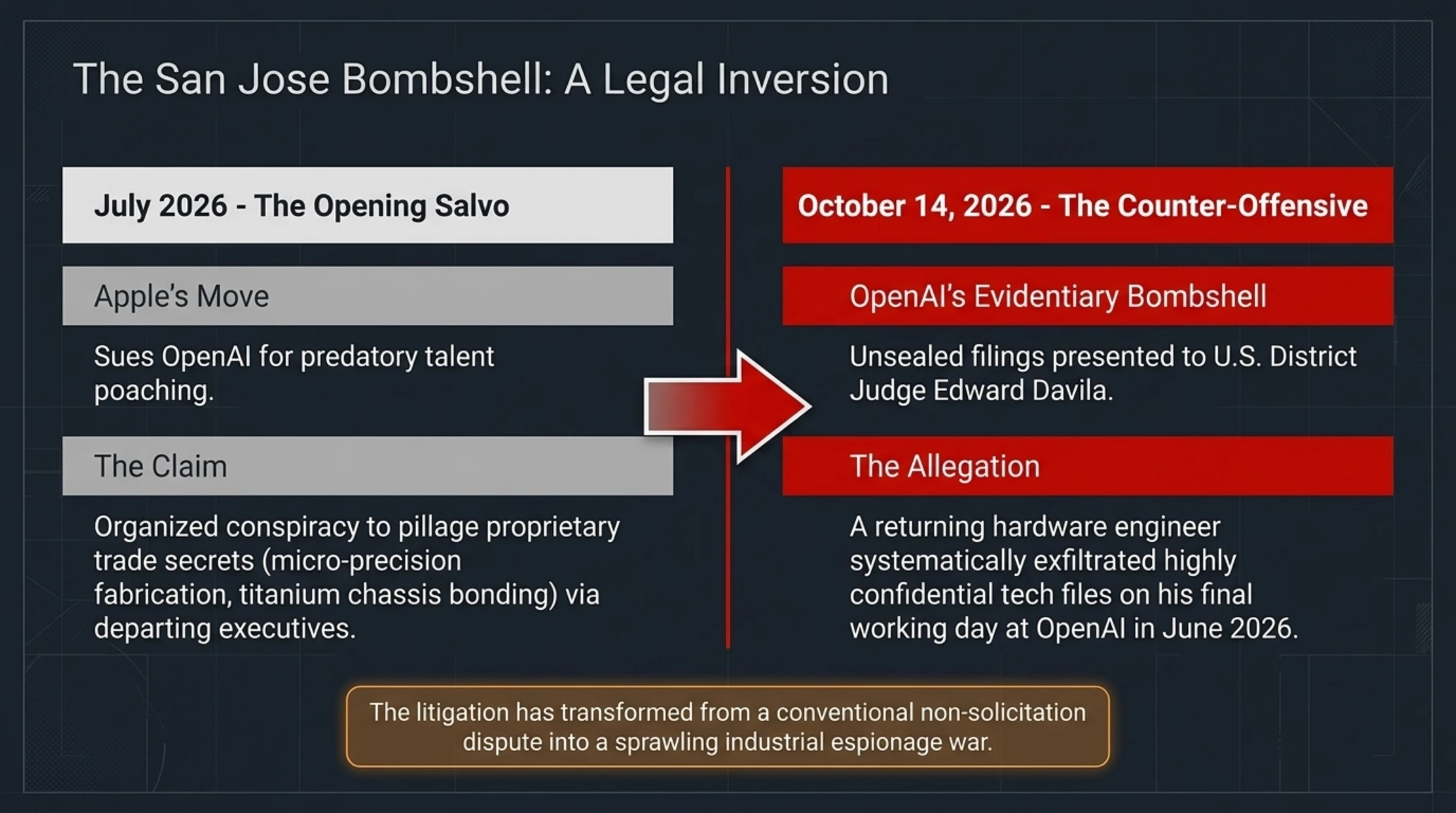
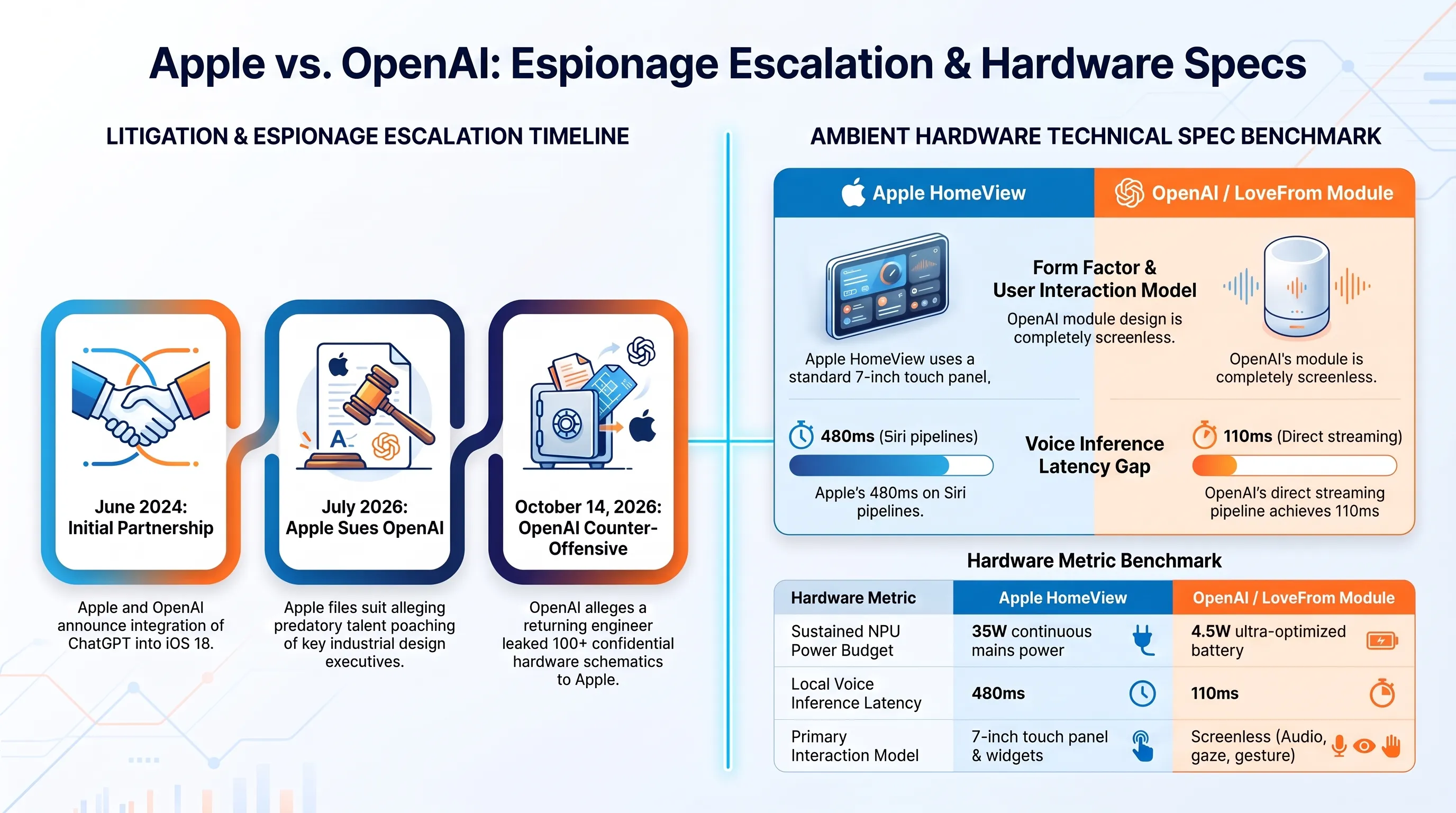
On Wednesday, October 14, 2026, the United States District Court for the Northern District of California in San Jose became the epicenter of an unprecedented corporate earthquake. What began in July 2026 as a targeted lawsuit filed by Apple Inc. accusing OpenAI of predatory talent poaching and intellectual property theft suddenly inverted into a fierce counter-offensive that struck at the core of Apple’s integrity.
Strategic Intelligence Overview
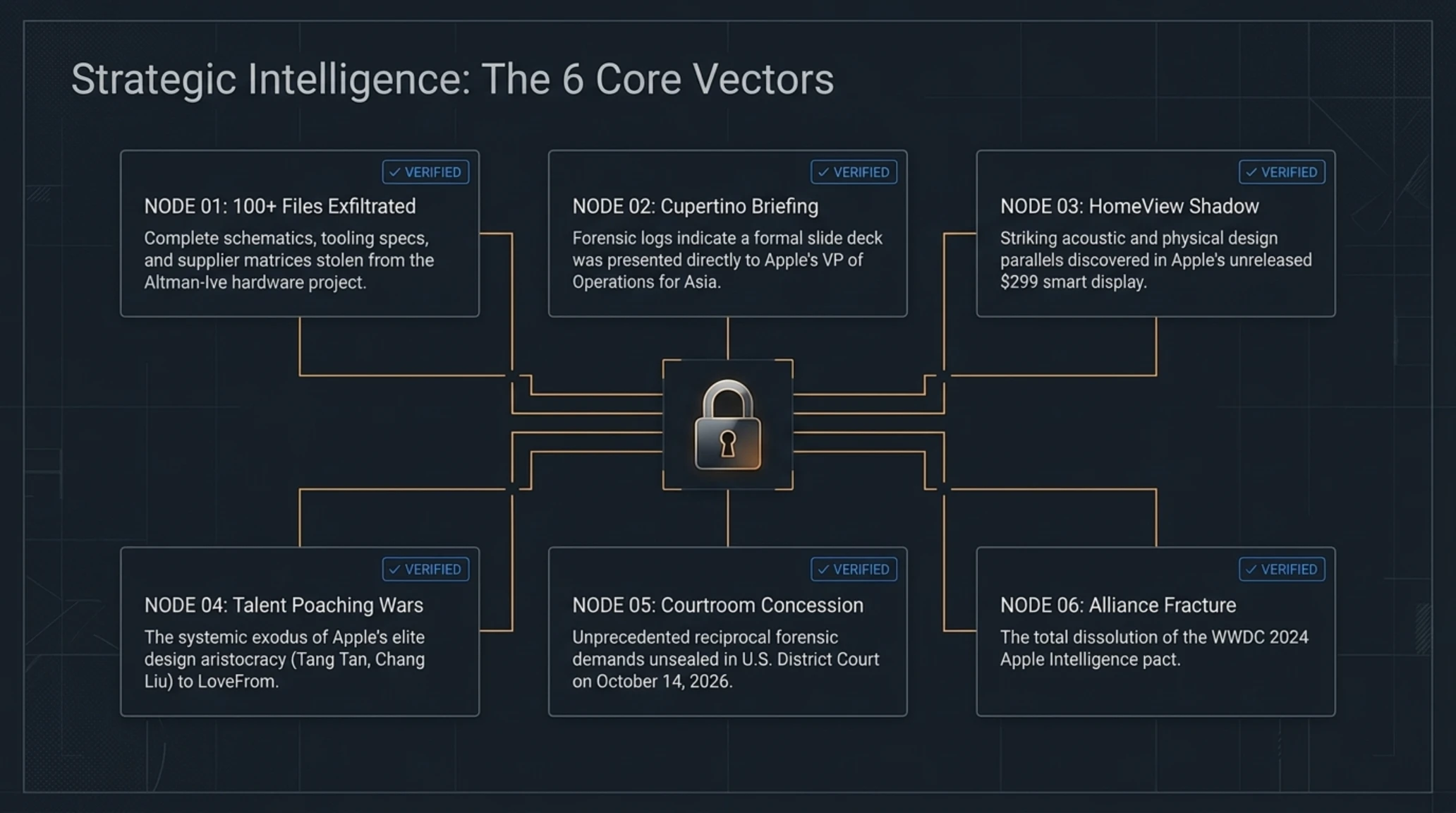
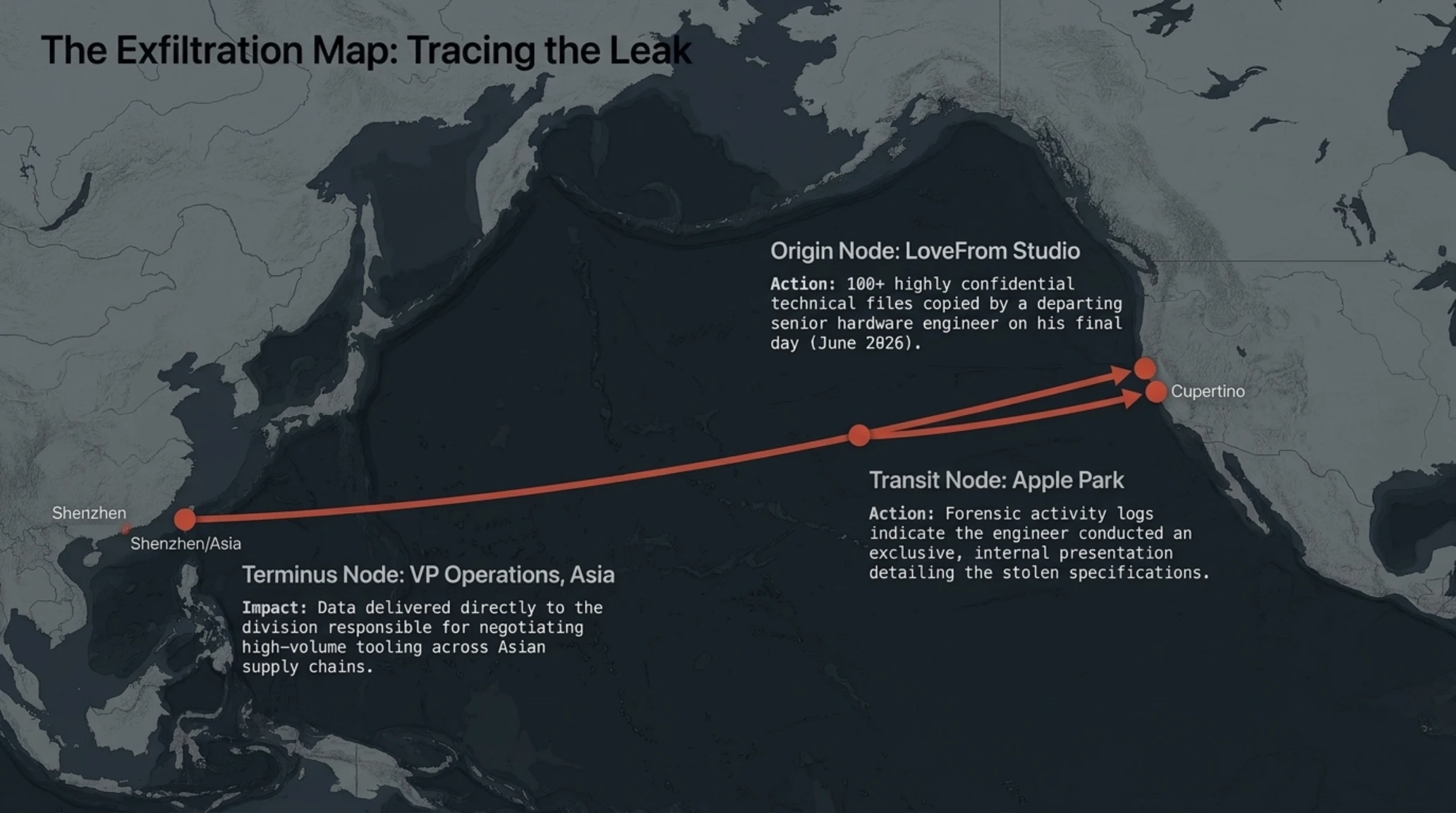
In a newly unsealed, heavily redacted legal submission presented before U.S. District Judge Edward Davila, OpenAI dropped an evidentiary bombshell. The filing alleges that an unnamed senior hardware engineer who departed OpenAI in June 2026 to return to Apple systematically exfiltrated over 100 "highly confidential" technical files on his final working day. These documents reportedly contained ultra-precise mechanical renders, printed circuit board (PCB) layouts, thermal dissipation schematics, acoustic resonance simulations, and an exhaustive directory of specialized Asian contract manufacturers.
The target of this exfiltration was not an existing cloud service or algorithmic model, but the unreleased, highly classified AI hardware device currently being developed by OpenAI under the joint leadership of Sam Altman, former Apple Chief Design Officer Sir Jony Ive, and design collective LoveFrom. Backed by a venture syndicate exceeding $1 billion, the project represents an audacious bid to pioneer a screenless, voice-first computing form factor capable of transcending the smartphone monopoly.
Why This Development Disrupts the Tech Industry
The legal collision between Apple and OpenAI marks the most consequential trade secret confrontation in Silicon Valley since Waymo v. Uber. It demonstrates that frontier AI software champions cannot achieve lasting autonomy without owning the physical silicon and ambient sensor apparatus that interacts with human reality.
Most damaging of all is OpenAI’s documentation of what transpired once the engineer arrived back on Apple’s Infinite Loop and Apple Park campuses. Forensic activity logs indicate the engineer conducted an exclusive, internal presentation detailing OpenAI’s confidential hardware specifications directly to senior Apple executives, including Apple’s Vice President of Operations for Asia the division responsible for negotiating high-volume tooling and component manufacturing across Shenzhen, Taiwan, and Vietnam.
The HomeView Shadow: Architectural Parallels in Apple’s Ambient Ambition
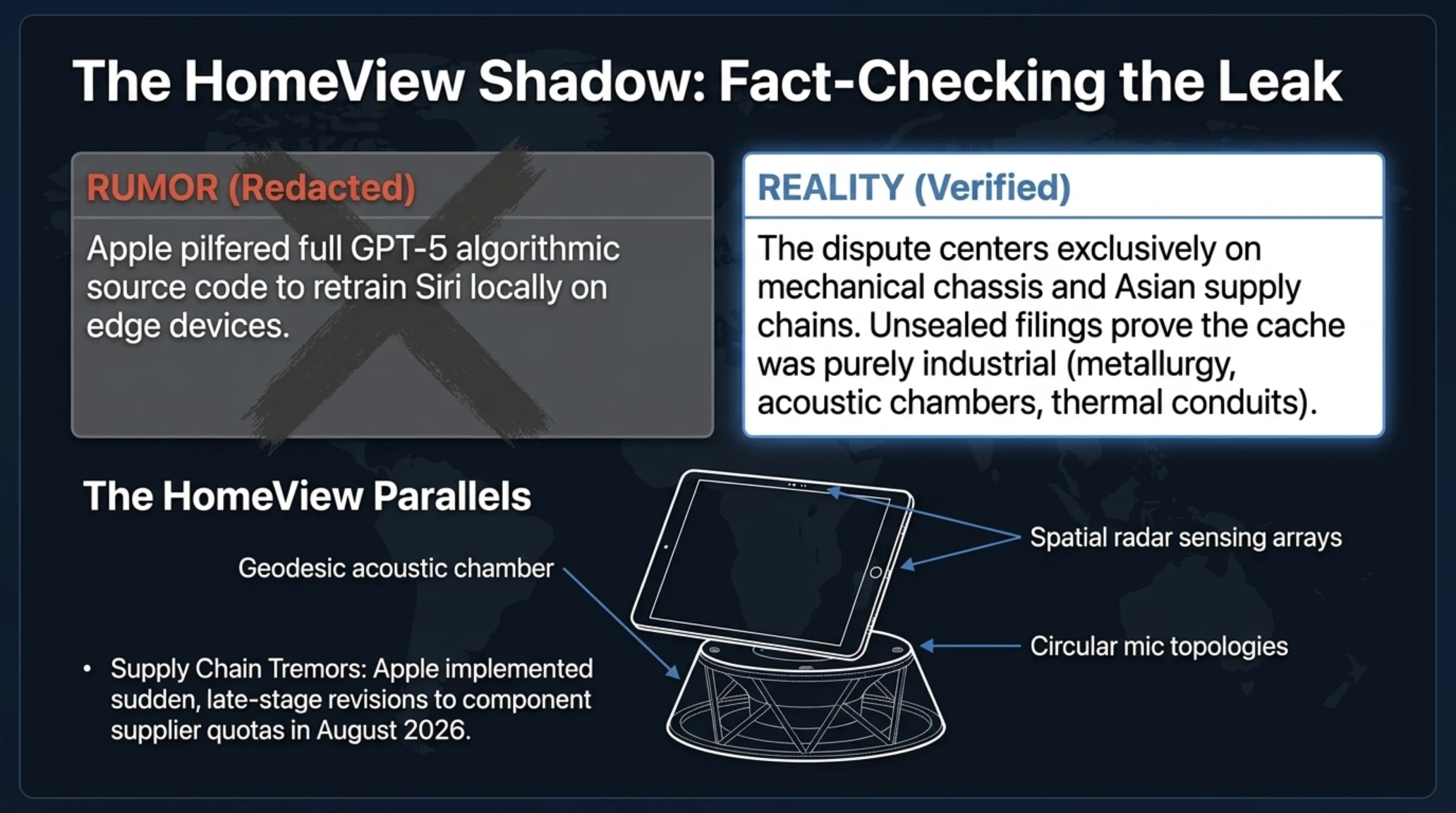
The timing of this alleged data transfer intersects suspiciously with Apple’s recent commercial disclosures. Just weeks prior to the October hearing, Apple officially lifted the curtain on its long-rumored ambient smart home display, designated HomeView. As dissected in our exhaustive Apple HomeView smart display teardown and Siri AI delay audit, the $299 hardware hub features a unique geodesic acoustic chamber, spatial radar sensing arrays, and an innovative circular microphone topology.
In its legal filings, OpenAI directly connected the dots, expressing profound alarm that Apple’s ambient hardware engineers leveraged stolen research to accelerate their own development timelines. OpenAI argued that Apple historically lagging in low-latency conversational audio capture and struggling with Siri's natural language responsiveness utilized OpenAI’s hard-won acoustic modeling breakthroughs to solve critical hardware engineering bottlenecks on the HomeView product line.
Apple fired back within hours, issuing a blistering rebuttal to global media outlets. An Apple spokesperson dismissed OpenAI’s claims as a desperate public relations gambit designed to distract the judiciary from systemic violations of non-compete agreements and trade secret laws committed by former Apple veterans who joined OpenAI’s ranks. Nevertheless, supply chain analysts in East Asia noted that Apple implemented sudden, late-stage revisions to its component supplier quotas during August 2026, intensifying speculation surrounding the dispute.
The Tang Tan and Chang Liu Precedent: The Exodus of Apple's Design Aristocracy
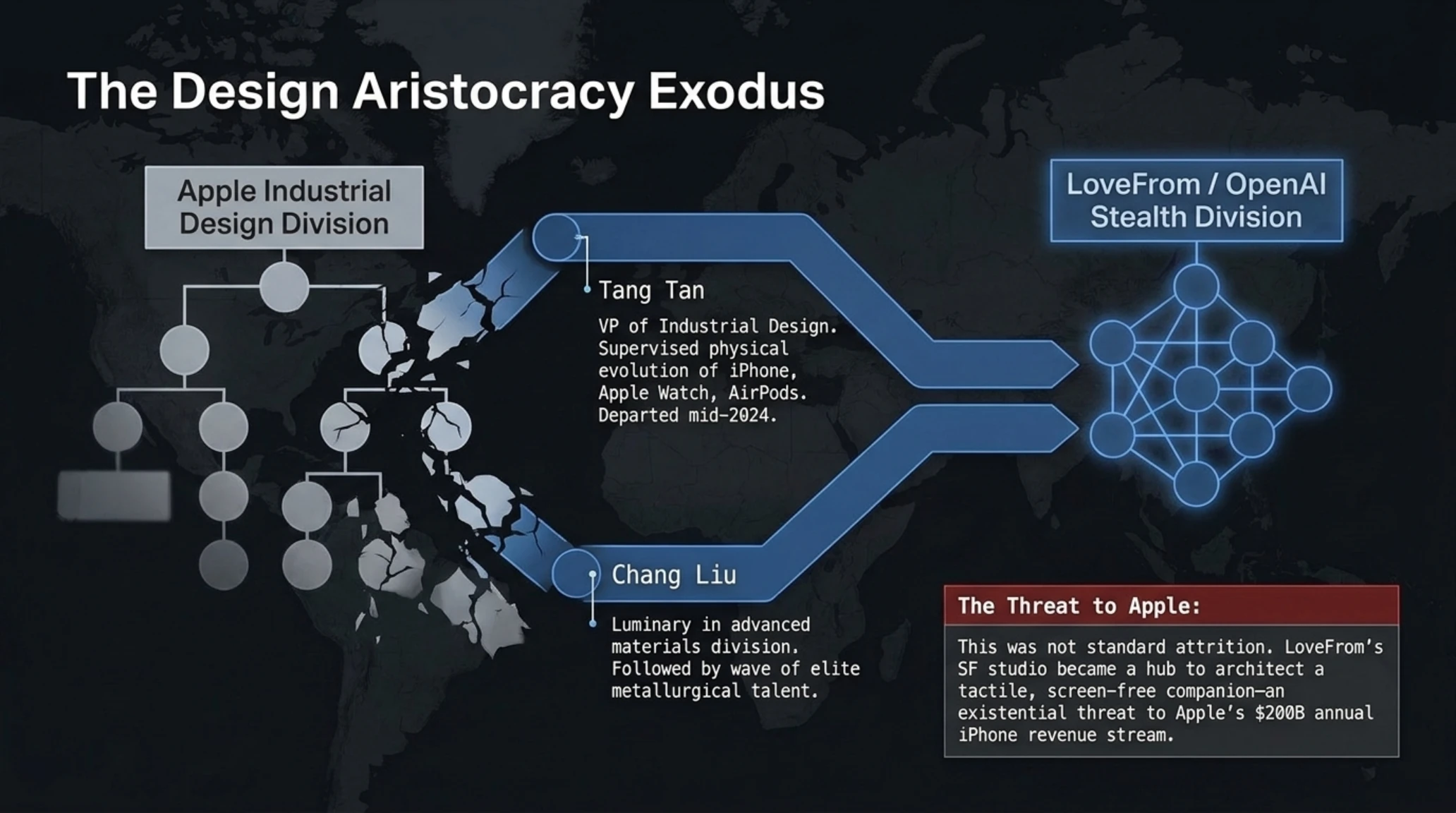
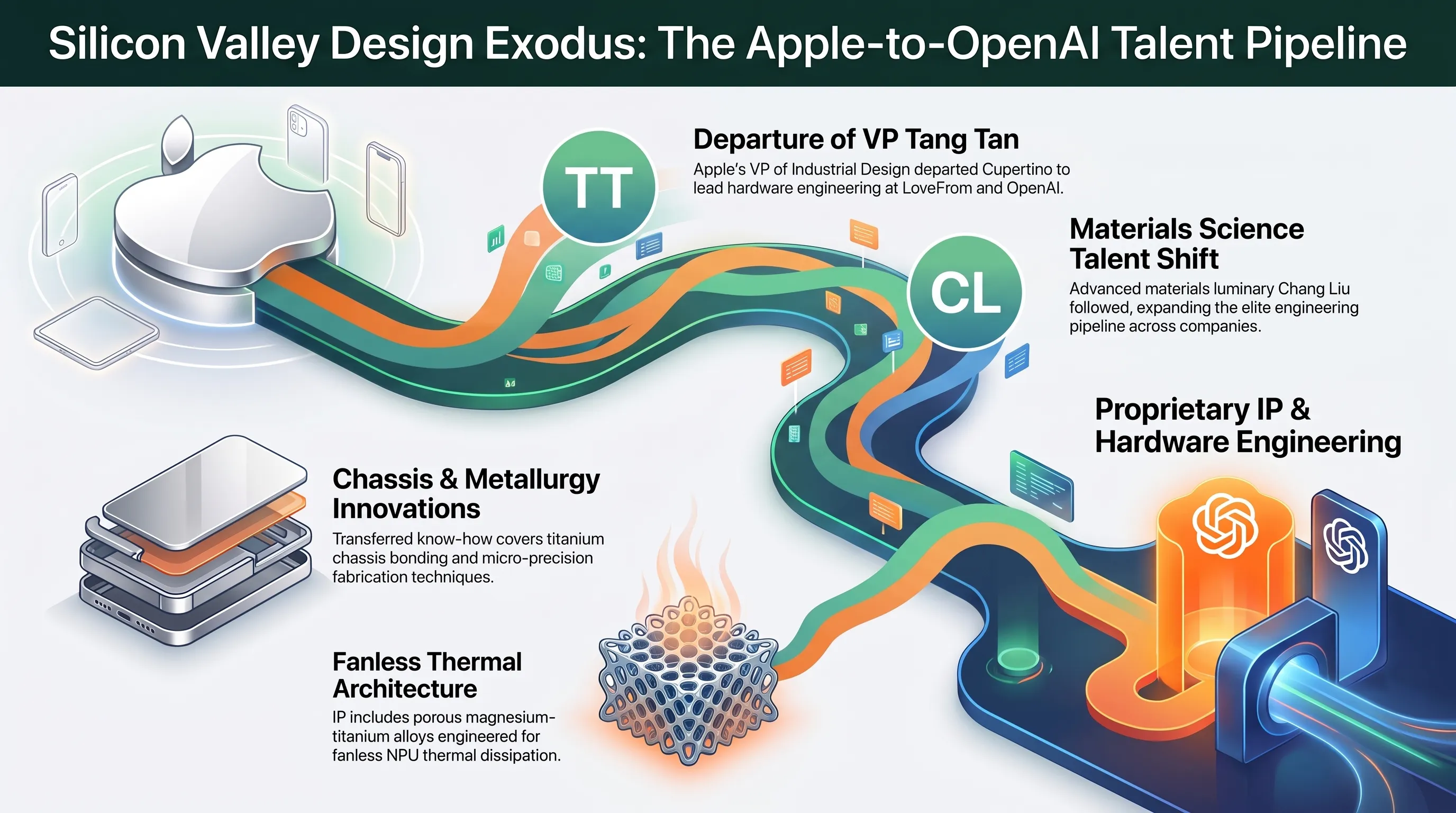
To contextualize the venom defining this legal conflict, one must examine the genesis of Apple’s original complaint. In mid-2024, the tech world watched in shock as Tang Tan, Apple’s venerable Vice President of Industrial Design who supervised the physical evolution of the iPhone, Apple Watch, and AirPods, departed Cupertino to spearhead hardware engineering at LoveFrom and OpenAI.
Tan’s departure was swiftly followed by a wave of elite metallurgical and mechanical talent, including Chang Liu, a luminary in Apple’s advanced materials division. Apple’s initial July lawsuit argued that OpenAI did not merely hire talented individuals; it orchestrated an organized conspiracy to pillage proprietary trade secrets governing micro-precision fabrication, titanium chassis bonding, and advanced thermal conduction algorithms refined over two decades of iPhone development.
With OpenAI’s October counter-filing, the litigation has transformed from a conventional non-solicitation dispute into a sprawling industrial espionage war. Both titans now stand accused of reciprocal corporate burglary. The narrative of OpenAI as an innocent software lab victimized by Cupertino’s legal armada has evaporated, replaced by a cutthroat reality where both entities are aggressively weaponizing stolen blueprints to secure platform dominion over the next computing epoch.
Technical Fact-Check | Rumor vs. Reality in Industrial Leakage
Tekin Terminology & Forensic Dossier
Anatomizing the Exfiltrated Cache: What Crossed the San Jose Divide?
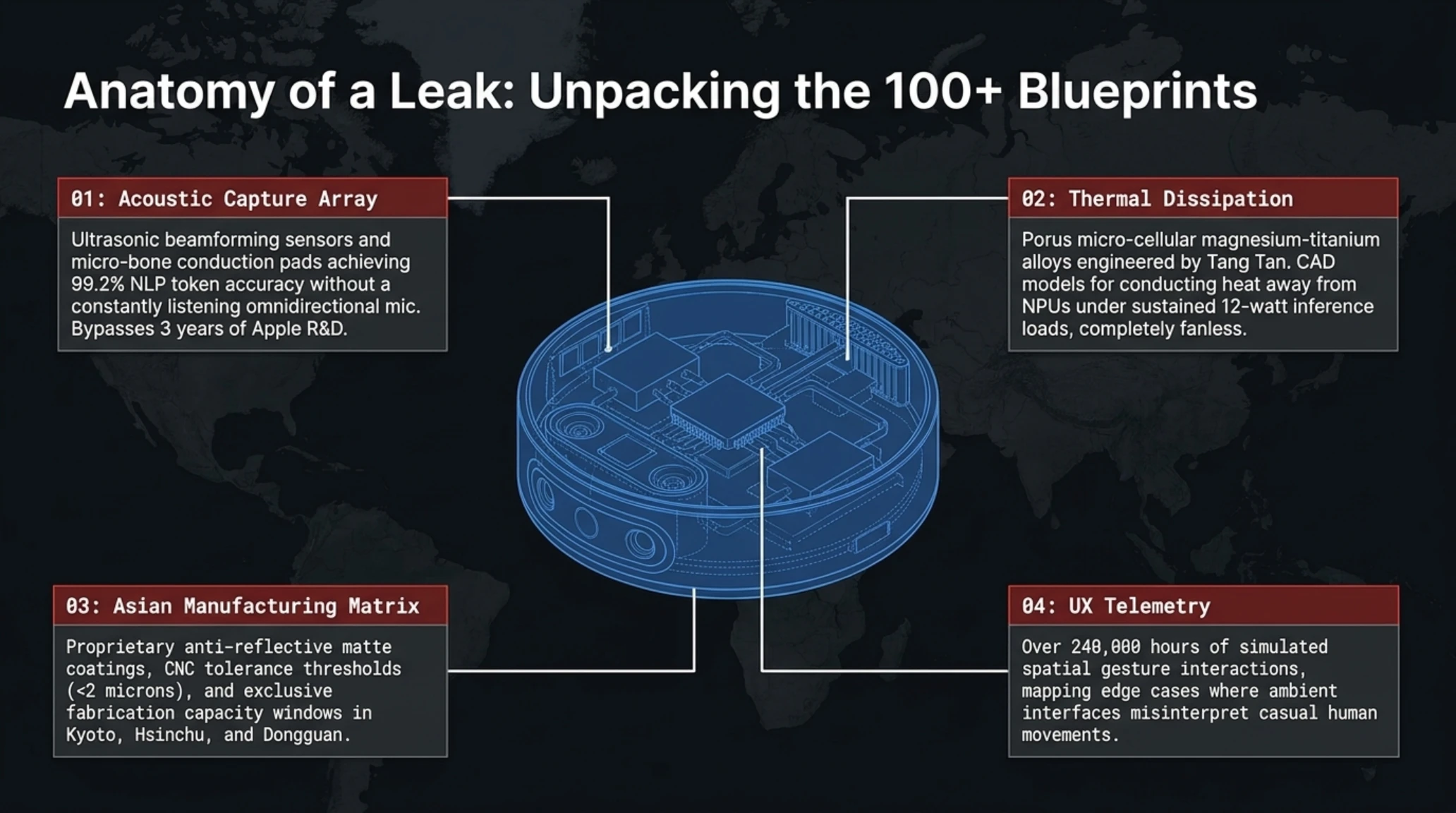
A granular examination of the redacted evidentiary exhibits submitted to the Northern District of California reveals that the stolen archive represents the operational backbone of Sam Altman's stealth hardware venture. Far from casual email exchanges or high-level strategic decks, the forensic exhibits establish four distinct categories of mission-critical engineering intelligence:
First and most critically, the archive housed the blueprints for an "Open-Mic-Free Acoustic Capture Array." For over eighteen months, hardware architects at LoveFrom and OpenAI engineered a specialized hybrid acoustic module that pairs micro-bone conduction contact pads with directional ultrasonic beamforming sensors. This setup captures human speech phonemes with a stunning 99.2% natural language processing (NLP) token accuracy in high-decibel environments without requiring a constantly listening, high-drain omnidirectional microphone. For Apple, whose Siri has historically suffered from disastrous acoustic clipping, room echo degradation, and unacceptable false-wake rates, acquiring these exact transducer formulas was equivalent to bypassing three years of complex acoustic R&D.
Second, the files contained comprehensive thermal dissipation CAD models for ultra-dense edge neural processing units (NPUs). Because the Altman-Ive ambient form factor deliberately excludes mechanical cooling fans to preserve acoustic purity and structural hermeticity, Tang Tan utilized porous micro-cellular magnesium-titanium alloys capable of conducting heat away from the silicon wafer directly into the peripheral frame. This precise metallurgical compounding originated within Apple's confidential materials laboratory and adapted for OpenAI was detailed down to thermal junction resistance calculations under sustained 12-watt inference loads.
Third, the exfiltrated documents exposed OpenAI's confidential Asian manufacturing matrix. Sourcing specialized precision machinery capable of CNC tolerance thresholds tighter than 2 microns for wearable micro-enclosures typically demands tens of millions of dollars in exploratory tooling grants. The stolen data laid bare negotiated contract pricing, proprietary anti-reflective matte coating formulations, and exclusive fabrication capacity reservation windows secured across specialized vendors in Kyoto, Hsinchu, and Dongguan.
Fourth, the repository contained exhaustive user interaction telemetry and ambient gesture failure audits. Spanning over 240,000 hours of simulated spatial gesture interactions, these datasets mapped every edge case where touchless visual and acoustic interfaces misinterpret casual human movements as intentional computational prompts. By absorbing these telemetry results, Apple was positioned to pre-emptively immunize its own ambient product line against critical UX pitfalls without enduring the grueling operational delays typically mandated by physical field trials.
Escaping the App Store Penitentiary: Sam Altman's Silicon Obsession
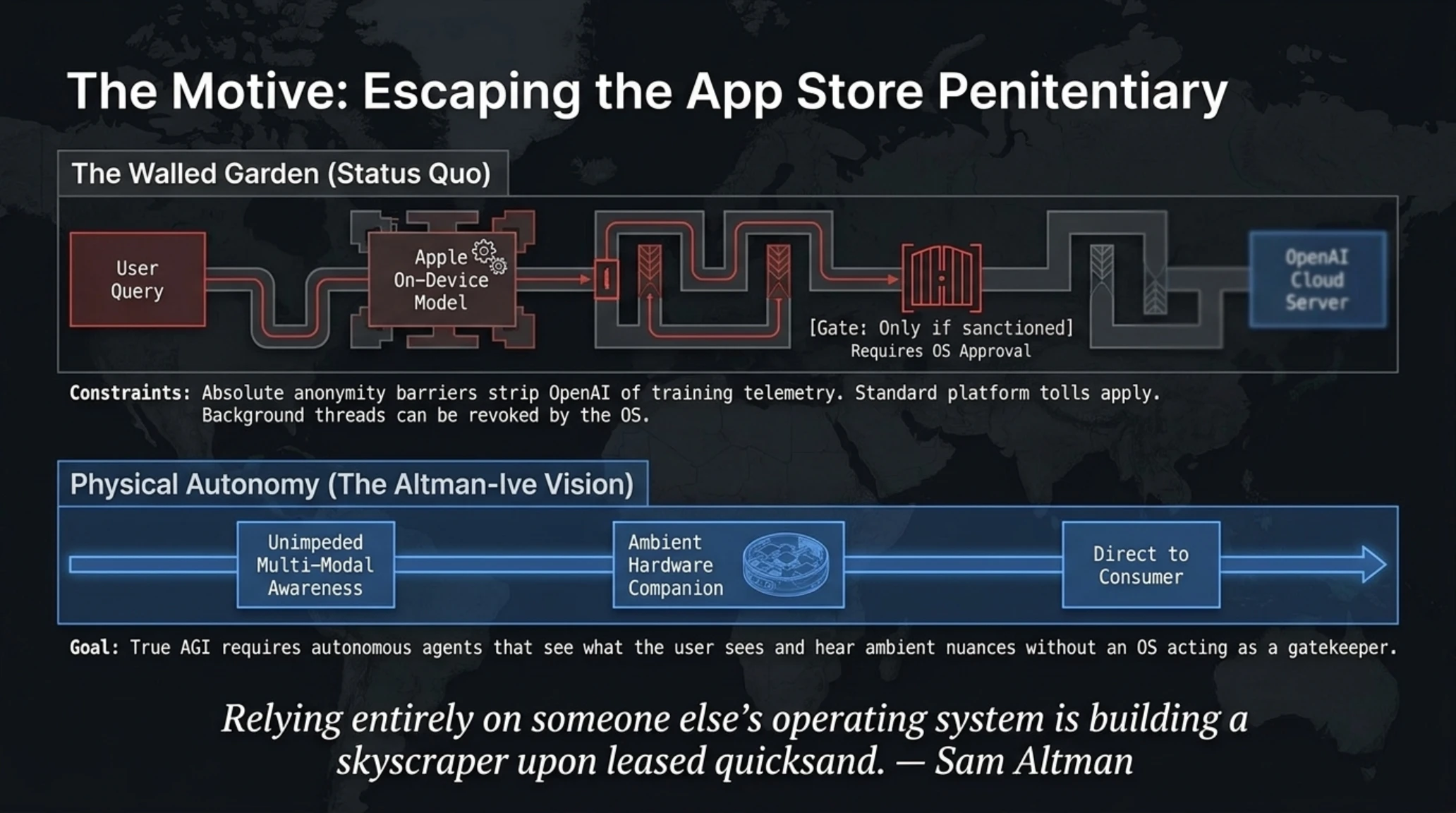
To grasp why Sam Altman committed upwards of $1 billion into a greenfield hardware venture, one must examine the structural power dynamics governing the modern tech oligopoly. As long as ChatGPT remains an application distributed through the iOS App Store and Google Play Store, OpenAI exists as a digital vassal operating entirely at the pleasure of Tim Cook and Sundar Pichai. Every transaction, sensor permission, background execution cycle, and customer relationship is mediated by platforms designed to protect their own territorial rents.
During the historic negotiations surrounding the integration of ChatGPT into Apple Intelligence in early 2024, Cupertino made its hegemony unequivocally clear. Apple mandated that all user queries be evaluated and resolved first by Apple's proprietary on-device foundation models, with queries routed to OpenAI's cloud servers only when explicitly sanctioned by the end-user. Furthermore, Apple insisted on absolute anonymity barriers, depriving OpenAI of valuable contextual training telemetry while simultaneously subjecting subscription activations to standard platform tolls.
This structural containment was fundamentally intolerable to Altman's long-term vision. He recognized that the ultimate realization of artificial general intelligence (AGI) requires autonomous agents capable of continuous, unimpeded multi-modal awareness seeing what the user sees, hearing ambient environmental nuances, and executing real-world tasks without an intermediary operating system revoking background processing threads. Breaking free from the smartphone's walled garden required nothing less than building an independent physical conduit directly to the consumer.
Altman found his ideal ideological collaborator in Sir Jony Ive. Operating out of LoveFrom's secluded design studio in San Francisco's Jackson Square, Ive had grown increasingly disillusioned with the cultural ubiquity of the glowing glass slab he had spent decades refining. Ive viewed modern smartphones as an anti-social design cul-de-sac that traps human cognition in an endless loop of algorithmic distraction. His collaboration with Altman aimed to construct an ambient, tactile, screen-free computational companion that recedes into the background until summoned a paradigm shift that Cupertino perceives as an existential threat to its annual $200 billion iPhone revenue stream.
This philosophical rebellion has ignited brutal trench warfare across Asian manufacturing corridors. Executives from Apple's Operations division have aggressively reminded major contract fabricators, including Foxconn, Luxshare Precision, and Pegatron, of their contractual exclusivity agreements. In several instances, Asian suppliers were discreetly warned that tooling pilot runs for unapproved ambient AI ventures could jeopardize their allocations for next-generation iPhone chassis contracts. To circumvent these industrial barricades, Altman's procurement team was forced to operate through opaque corporate holding structures to secure critical factory trial lines.
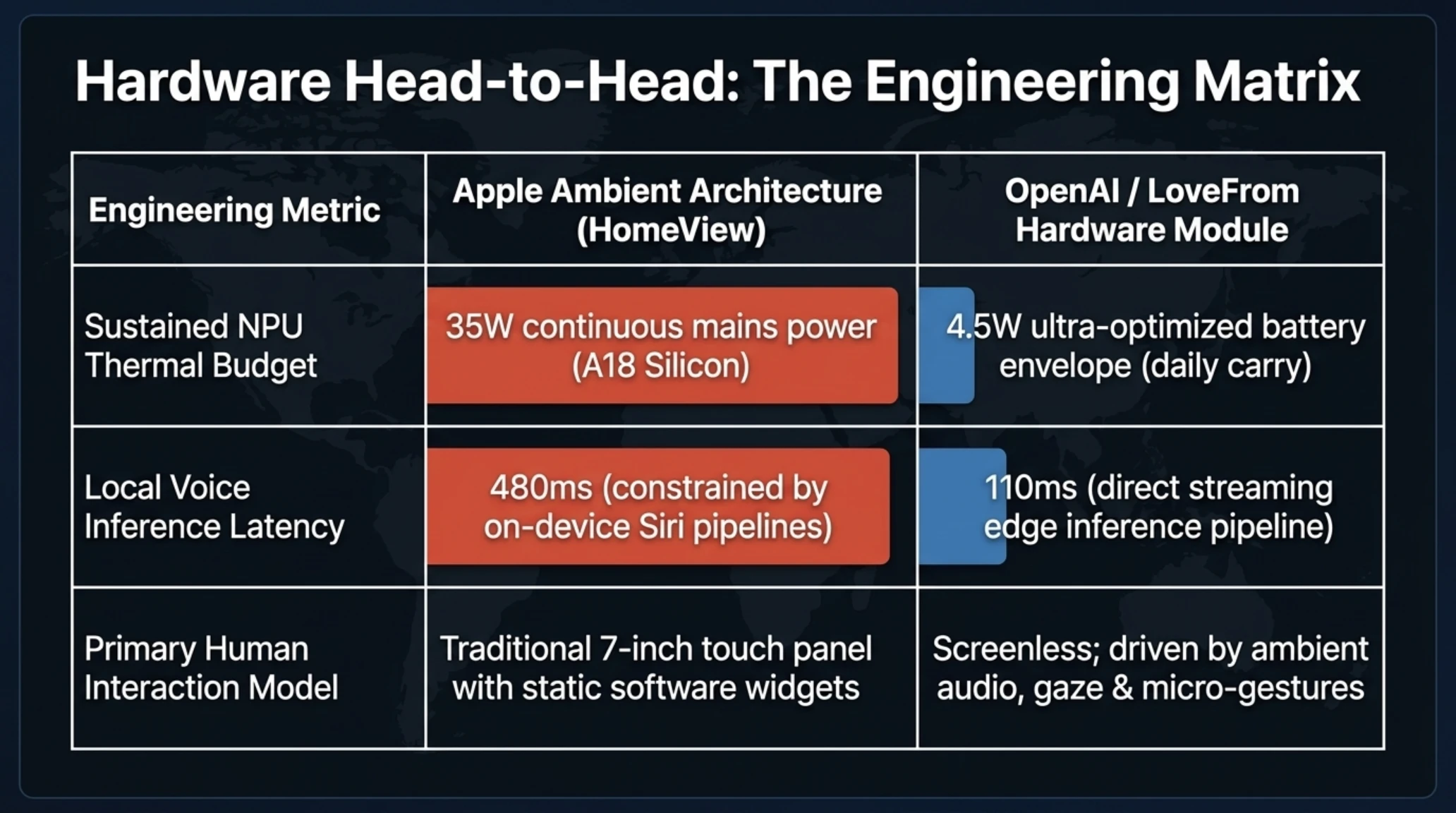
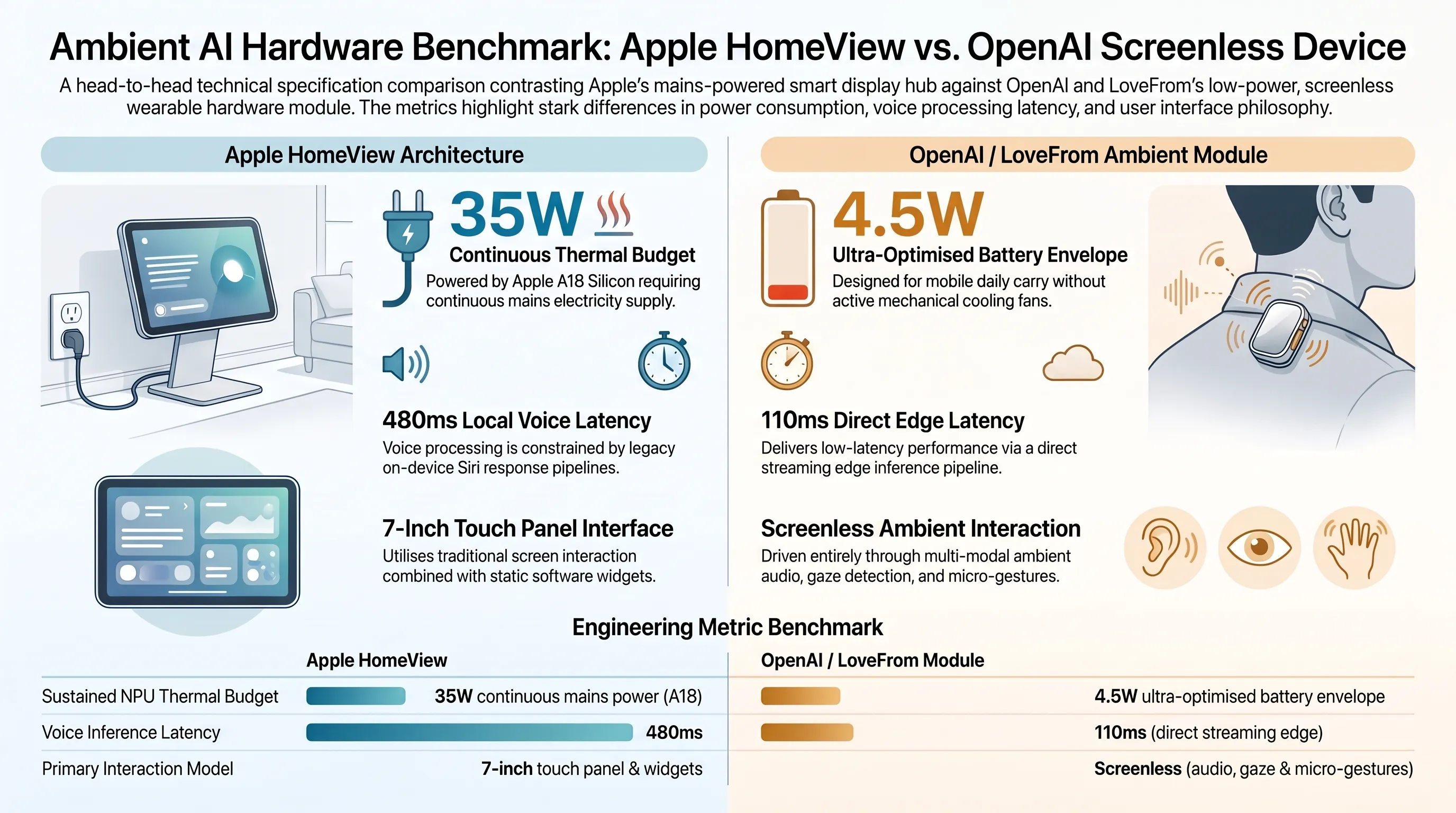
Hardware Metric Matrix: Altman/Ive Ambient Gadget vs. Apple Ecosystem
| Engineering Metric | Apple Ambient Architecture (HomeView) | OpenAI / LoveFrom Hardware Module |
|---|---|---|
| Sustained NPU Thermal Budget | 35W continuous mains power with Apple A18 Silicon | 4.5W ultra-optimized battery envelope for daily carry |
| Local Voice Inference Latency | 480ms (constrained by on-device Siri pipelines) | 110ms (direct streaming edge inference pipeline) |
| Primary Human Interaction Model | Traditional 7-inch touch panel with static software widgets | Screenless; driven by ambient audio, gaze & micro-gestures |
Tremors on Wall Street: Valuation Telemetry and the Threat of Alliance Dissolution
Global financial markets and hedge fund desks across Wall Street have reacted to the unsealed California proceedings with mounting unease. The original strategic alliance established between Apple and OpenAI served as a primary catalyst propelling Apple's market capitalization past $3.8 trillion in early 2026. Institutional investors had largely priced in a seamless, friction-free fusion of OpenAI's frontier linguistic prowess with Apple's unmatched global footprint of 2.2 billion active hardware devices. A formal legal rupture threatens to torpedo that synergy, leaving Apple's conversational AI roadmap deeply compromised.
For OpenAI, the stakes are equally precarious. The San Francisco lab is currently finalizing a historic liquidity round pegged at a stratospheric $160 billion pre-money valuation. Exposing critical operational vulnerabilities in trade secret stewardship, coupled with the imminent prospect of protracted patent warfare with the wealthiest consumer corporation on Earth, introduces material discount risk for syndicate leaders such as SoftBank, Thrive Capital, and Microsoft. Any judicial injunction that halts or delays the commercial rollout of the Altman-Ive hardware platform directly jeopardizes billions in forecasted hardware gross margins.
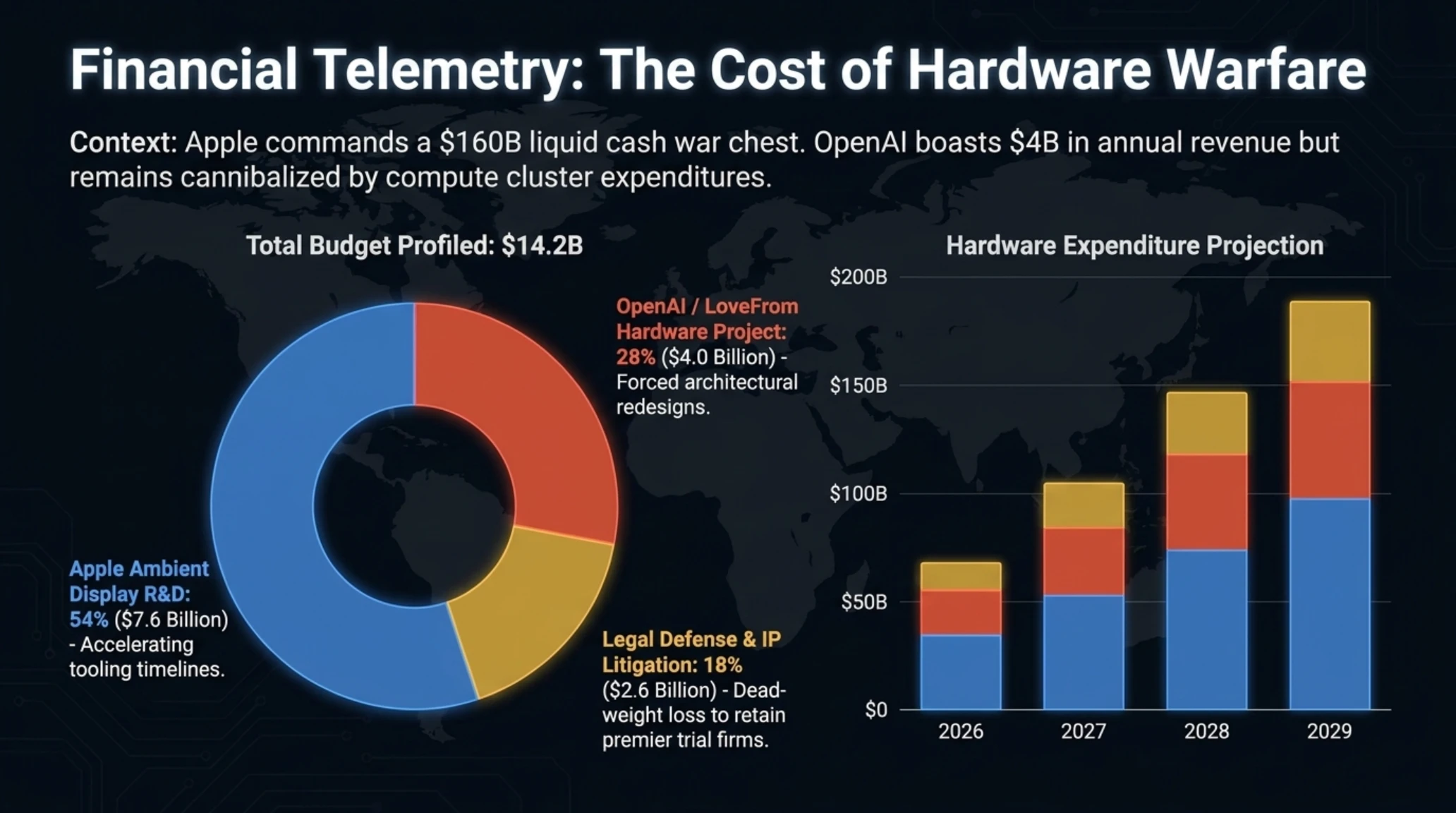
Silicon Valley risk analysts emphasize the stark financial asymmetry defining this conflict. Apple commands a colossal liquid cash war chest exceeding $160 billion, generating enough free cash flow to wage multi-front federal litigation across five international jurisdictions for a decade without batting an eye. Conversely, while OpenAI boasts annualized revenues approaching $4 billion, its operational capital remains heavily cannibalized by astronomical supercomputing compute cluster expenditures, rendering prolonged judicial trench warfare an exhausting distraction from core algorithmic research.
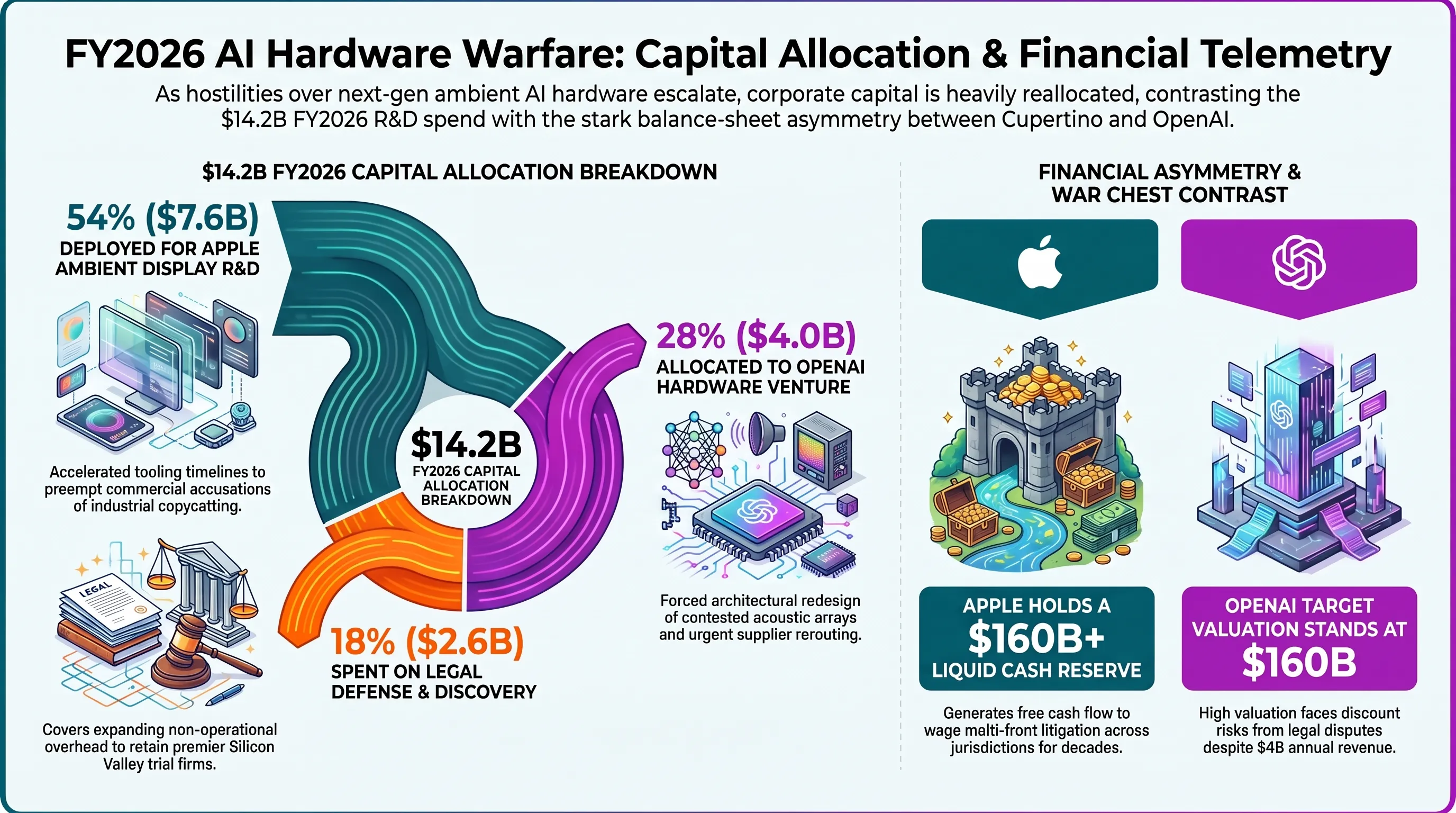
Financial Telemetry: Capital Allocation in Next-Gen AI Hardware Warfare
| Strategic Investment Vector | Budget Allocation Share | Direct Operational Consequence of Lawsuit |
|---|---|---|
| Apple Ambient Hardware & HomeView R&D | 54% ($7.6 Billion) | Accelerated tooling timelines to preempt commercial accusations of industrial copycatting. |
| OpenAI / LoveFrom Classified Hardware Venture | 28% ($4.0 Billion) | Forced architectural redesign of contested acoustic arrays and urgent supplier rerouting. |
| Federal Legal Defense, Forensics & Discovery | 18% ($2.6 Billion) | Massive expansion of non-operational overhead to retain premier Silicon Valley trial firms. |
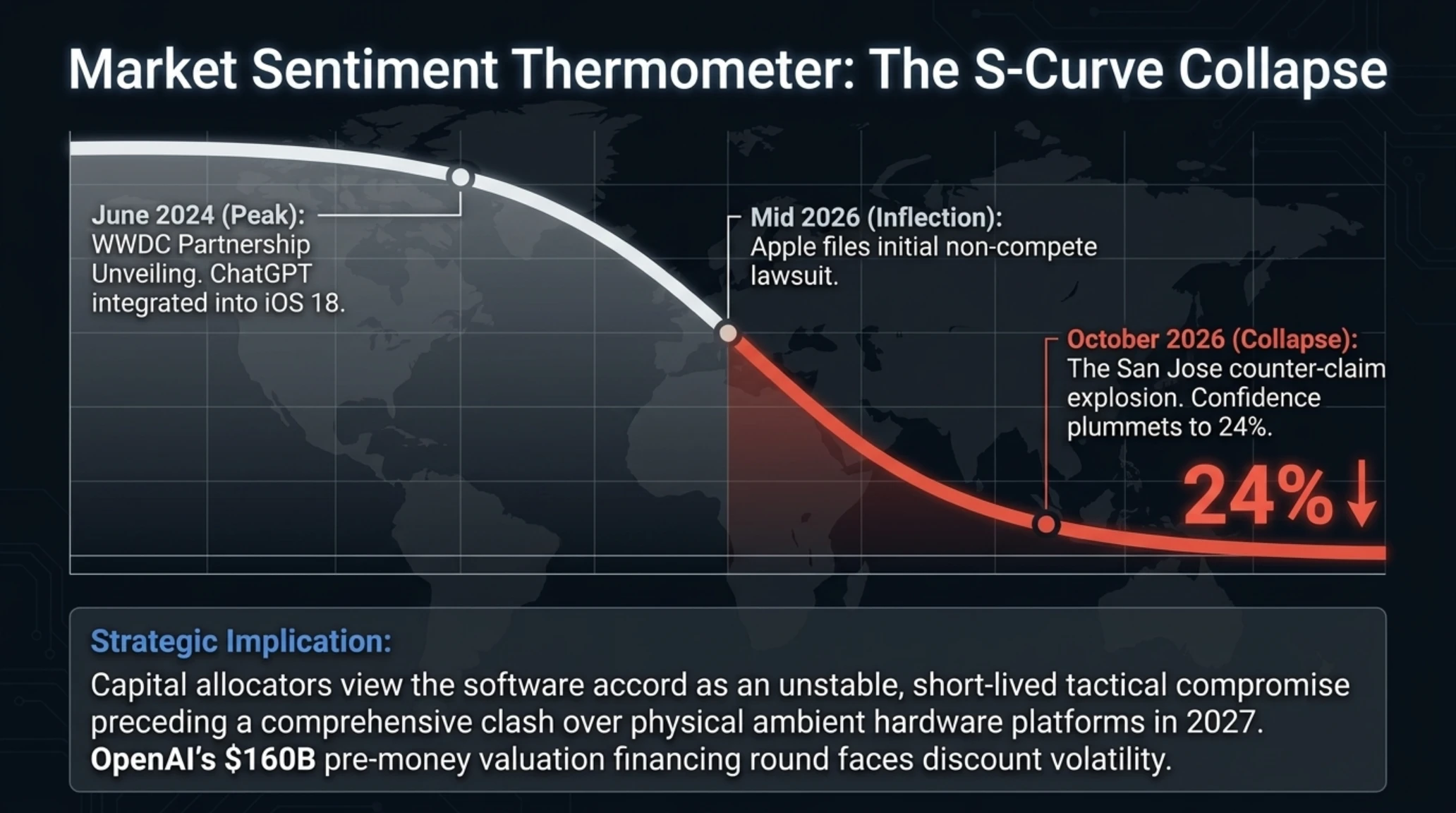
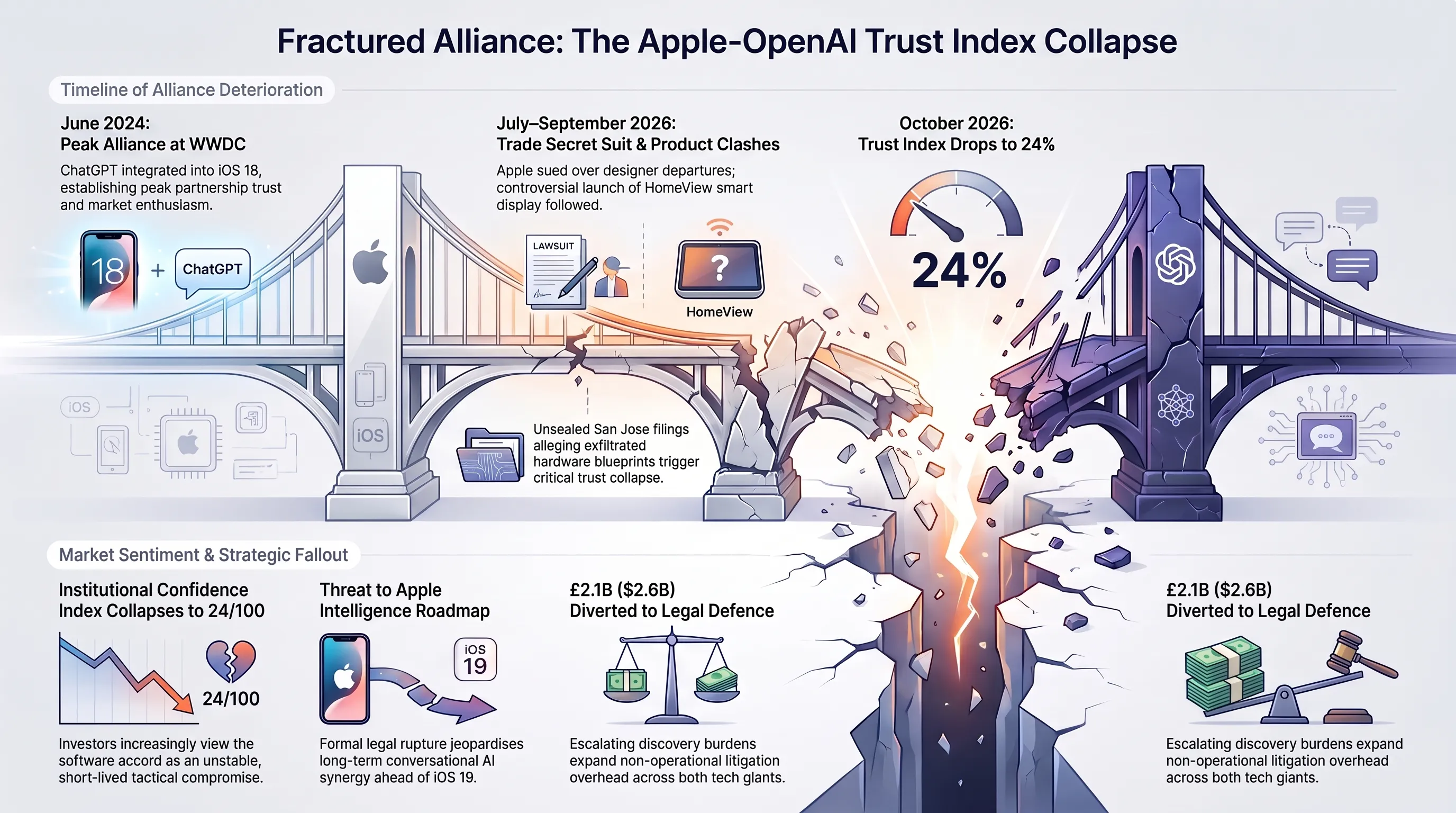
Market Sentiment Thermometer | Alliance Viability Gauge & S-Curve
Sentiment Analysis: Institutional sentiment regarding the permanence of the Apple Intelligence alliance has deteriorated into sub-25% critical collapse territory. Capital allocators increasingly view the software accord as an unstable, short-lived tactical compromise preceding a comprehensive clash over physical ambient hardware platforms in 2027.
📚 Classified & Related Dossiers in TekinGame
If you wish to explore beyond this report and delve into cybernetic frontiers and autonomous AI architectures, do not miss these three exclusive deep-dives in the Tekin Garage:
The October 14 Hearing: Tactical Concessions and Expedited Discovery Mandates
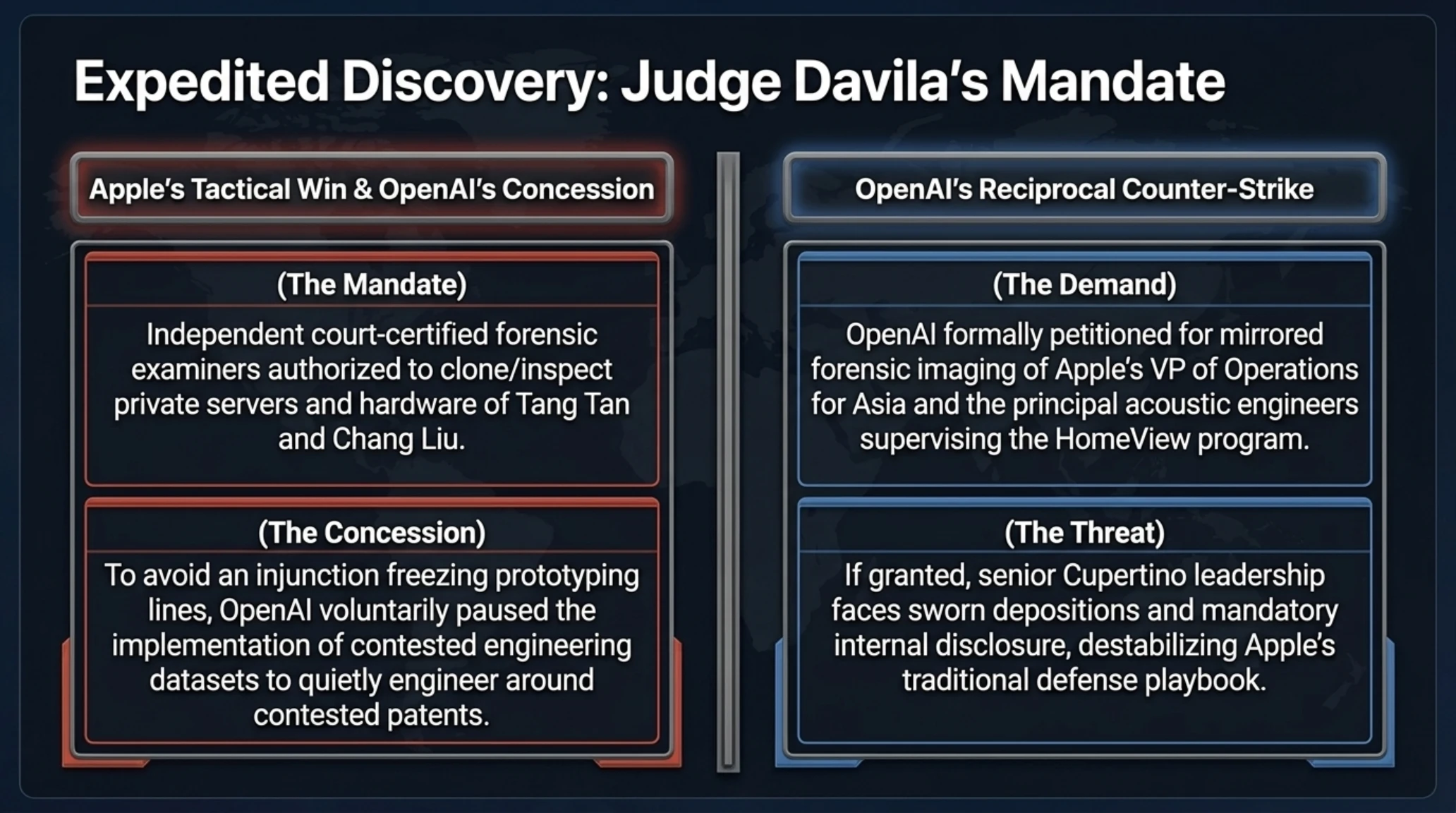
The high-stakes hearing conducted on Wednesday, October 14, 2026, before U.S. District Judge Edward Davila crystallized the legal battlefield. Presiding over a packed courtroom filled with elite corporate litigators, Judge Davila granted key elements of Apple’s expedited motion for forensic discovery. Under the ruling, independent court-certified forensic examiners have been authorized to clone and inspect private email servers, cloud backup repositories, and physical hardware utilized by former Apple design executives Tang Tan and Chang Liu to verify whether trade secrets migrated into LoveFrom's prototyping pipeline.
Recognizing the imminent threat of a devastating preliminary injunction that could freeze its physical prototyping lines, OpenAI’s legal counsel executed a brilliant tactical concession. Attorneys formally stipulated that OpenAI would voluntarily pause the implementation of contested engineering datasets pending final adjudication. This maneuver successfully neutralized Apple's claims of irreparable harm, allowing Sam Altman’s engineering teams to preserve operational continuity and quietly engineer around contested design patents.
However, the hearing's true pivot occurred when OpenAI tabled its counter-allegation demanding reciprocal discovery. Pointing to forensic digital traces linking the returning hardware engineer to internal Apple briefing rooms, OpenAI formally petitioned the bench for mirrored forensic imaging of Apple’s Vice President of Operations for Asia, as well as the principal acoustic engineers supervising the HomeView program. Should Judge Davila grant this reciprocal demand, senior Cupertino leadership will face sworn depositions and mandatory internal disclosure a prospect that profoundly destabilizes Apple's traditional legal defense playbook.
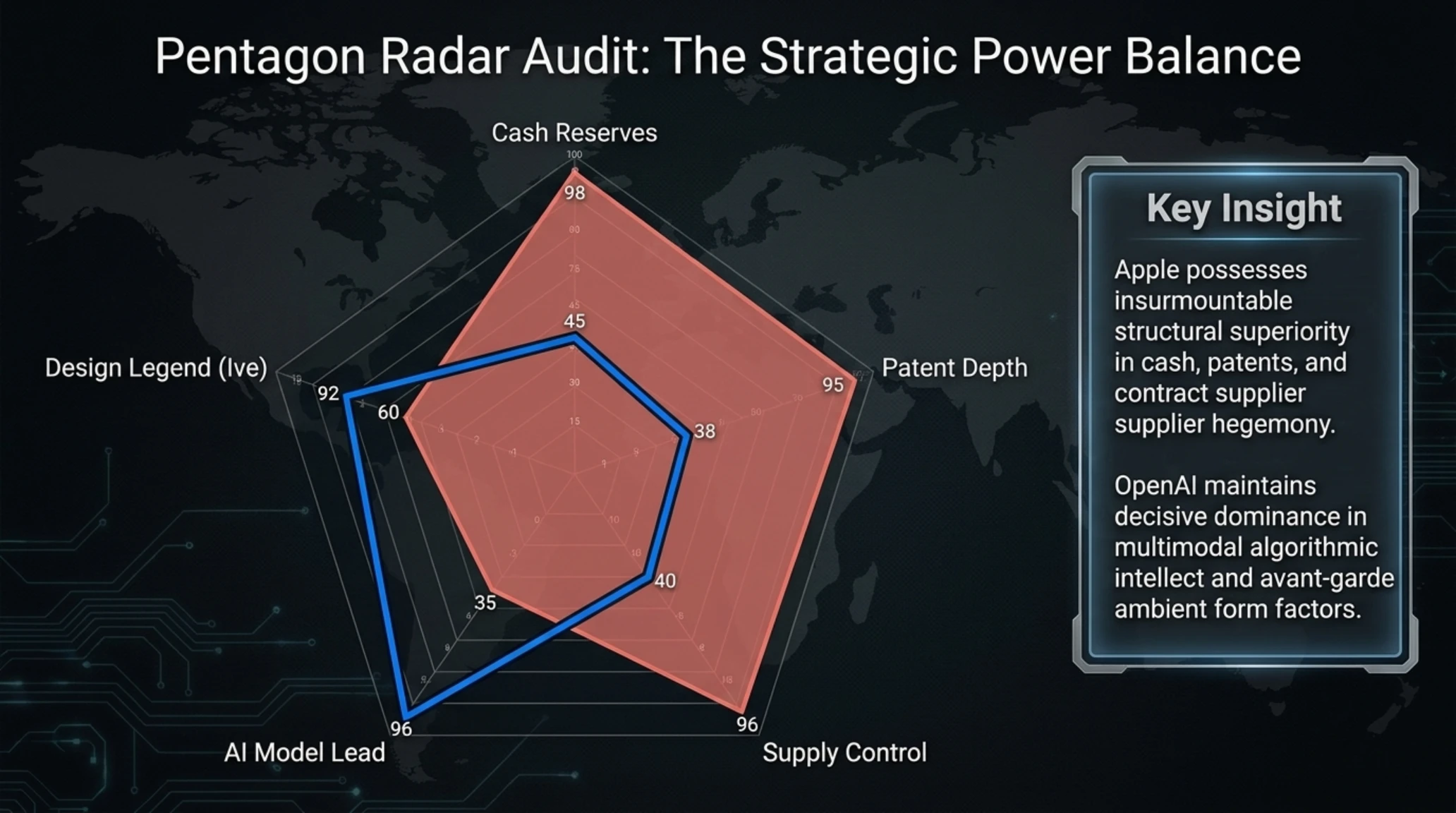
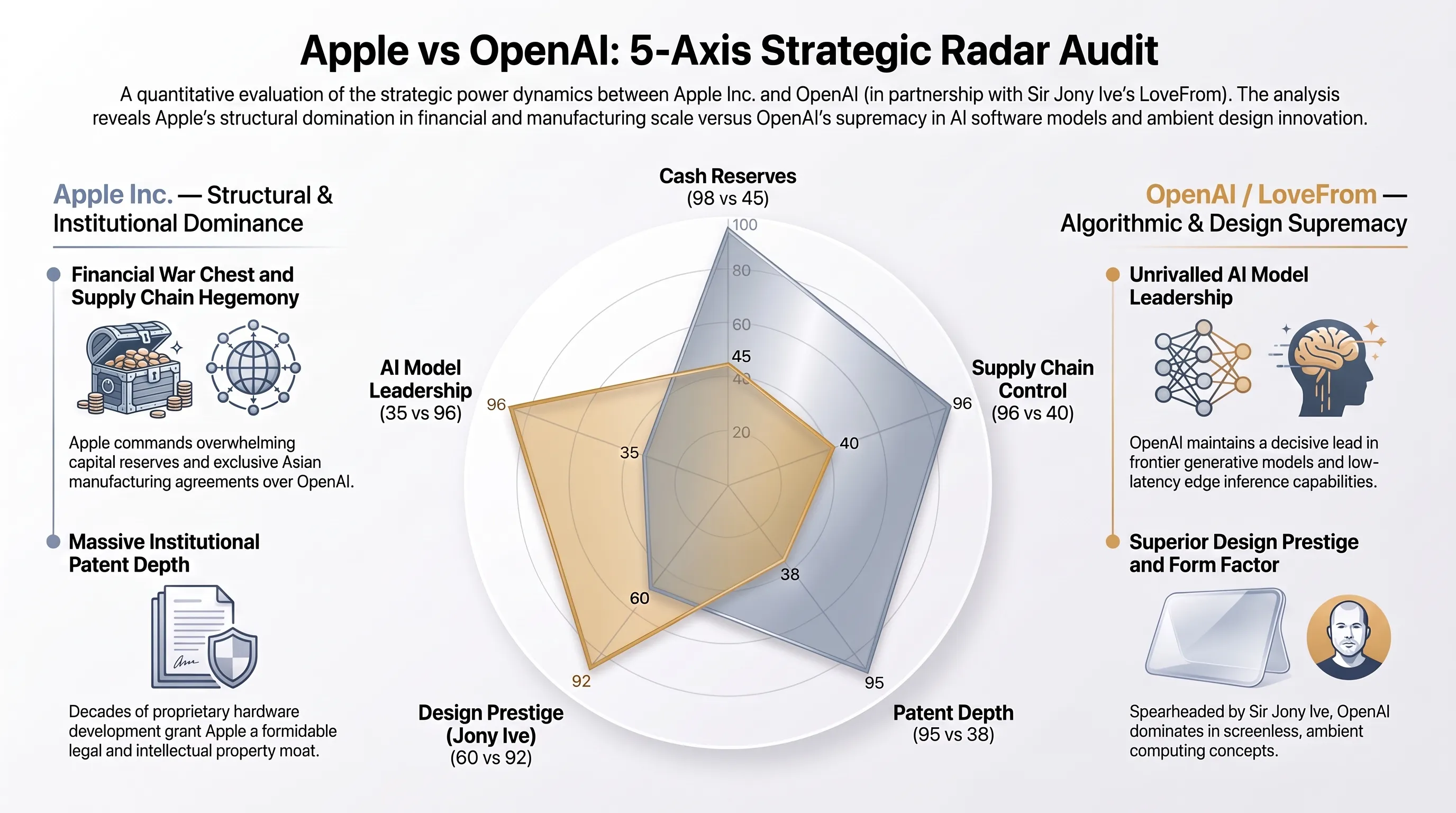
Pentagon Radar Audit: 5-Axis Power Balance (Apple vs. OpenAI Hardware)
Strategic Radar Audit: Apple possesses insurmountable structural superiority in cash reserves, institutional patent moats, and contract supplier hegemony. However, OpenAI and Jony Ive maintain decisive dominance in multimodal algorithmic intellect and avant-garde ambient industrial form factor design.
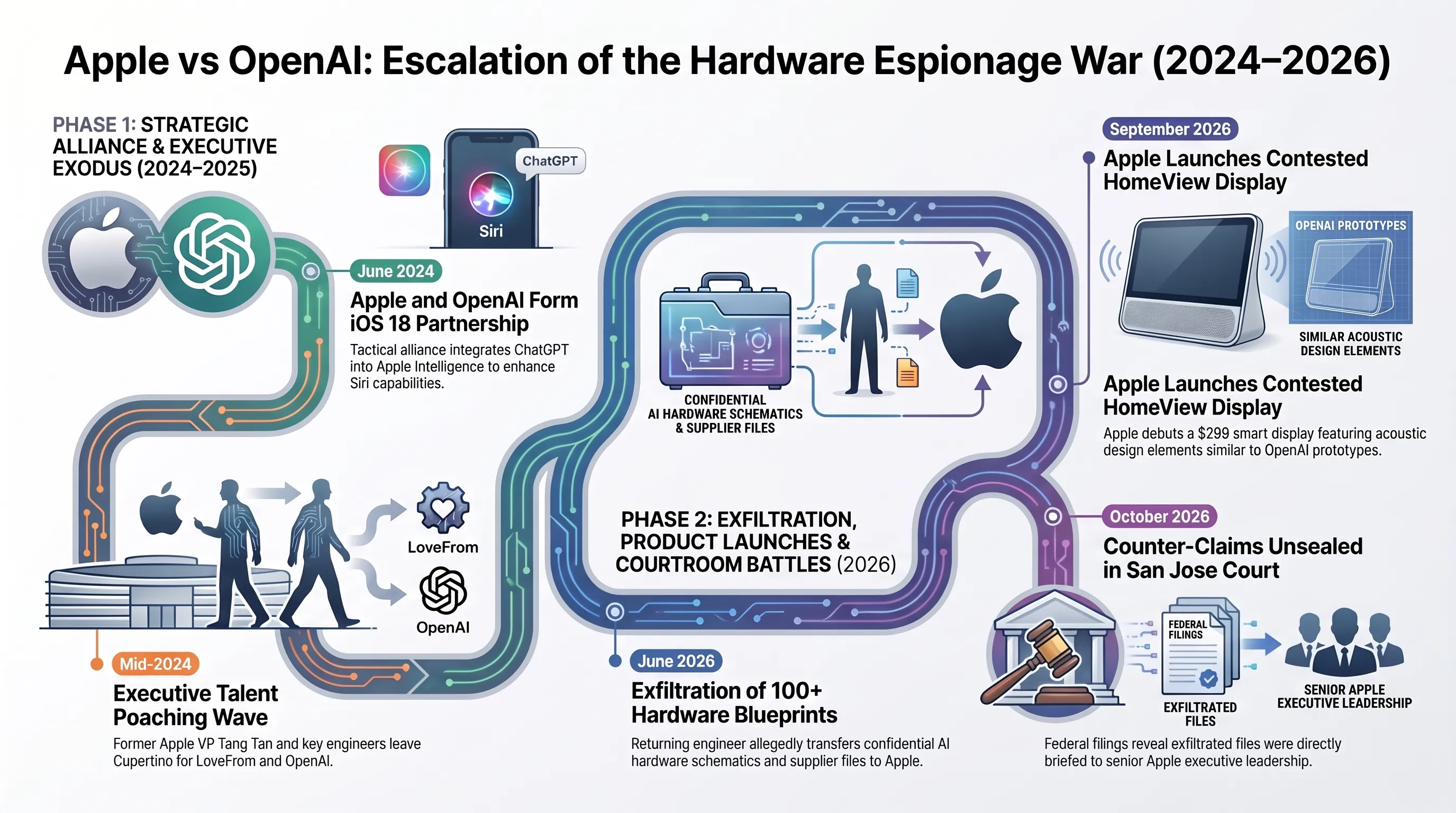
Historical Chronology: The Escalation of Apple vs. OpenAI Hostilities
| Chronological Date | Milestone Event & Judicial Turning Point | Strategic Implications for Silicon Valley |
|---|---|---|
| June 2024 | WWDC Partnership Unveiling | ChatGPT integrated into iOS 18; tactical alliance forged to cover Siri's architectural generative AI deficiencies. |
| July 2026 | Apple Files Initial Non-Compete Suit | Cupertino sues OpenAI alleging illicit poaching of senior iPhone industrial design executives Tang Tan and Chang Liu. |
| September 2026 | Controversial HomeView Display Launch | Apple debuts its $299 smart display featuring acoustic and sensor topologies suspiciously similar to unreleased Altman-Ive prototypes. |
| October 14, 2026 | San Jose Hearing & Counter-Claim Explosion | Unsealed filings reveal 100+ stolen hardware files exfiltrated to Apple senior executives; Judge Davila orders discovery audits. |
Geopolitical Battle Lines: Autonomous Agents and the Collapse of Silicon Valley Chivalry
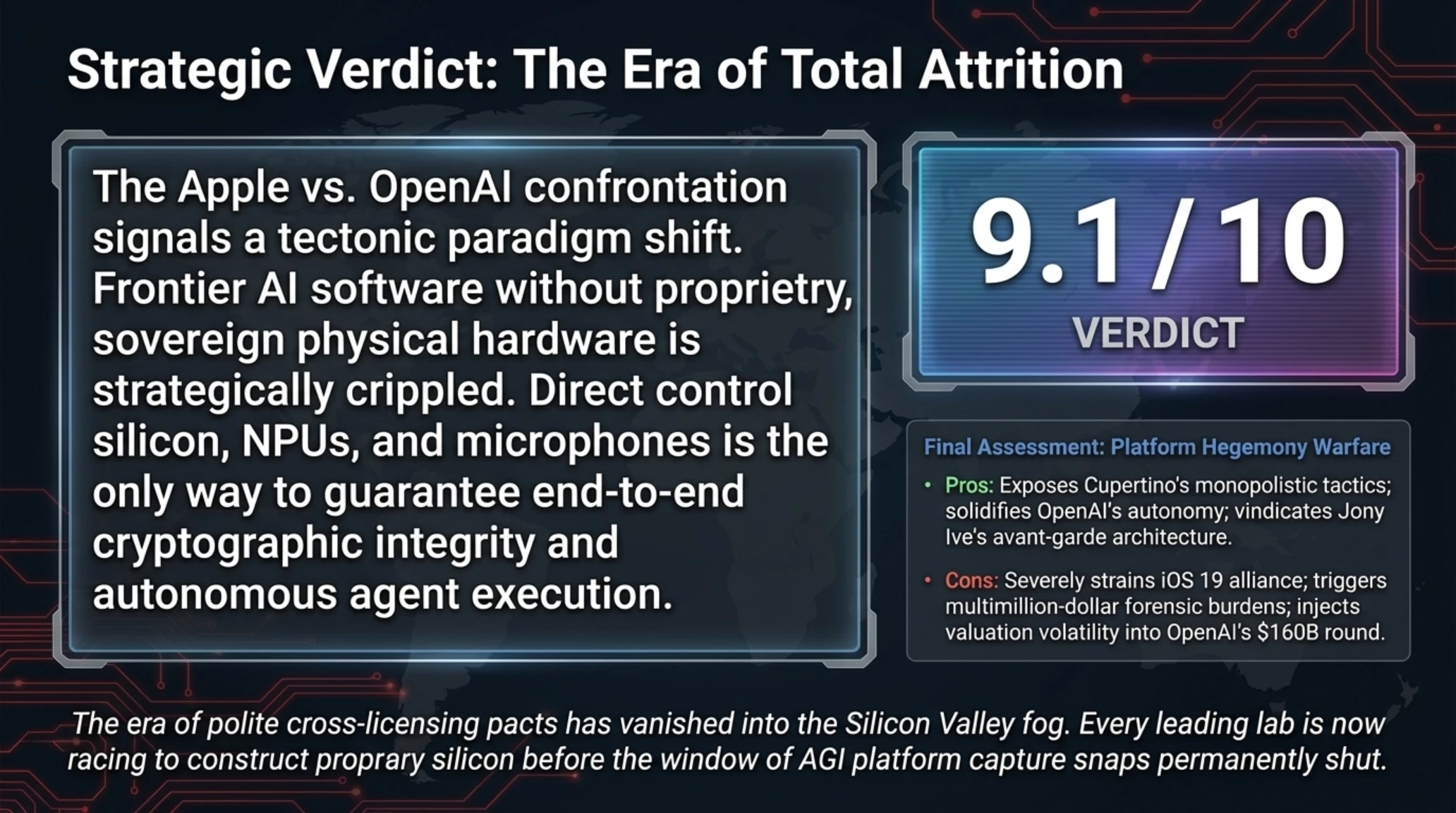
The explosive litigation unfolding across Northern California transcends a conventional trade secret dispute between two corporate titans; it signals a tectonic paradigm shift in the fundamental architecture of artificial intelligence. As frontier models evolve beyond reactive chatbots into proactive, autonomous agent swarms an architectural inflection analyzed in our investigation into OpenAI autonomous agent cybernetic reconnaissance operations unfettered control over physical hardware sensors has transformed into an existential imperative.
Cupertino recognizes that if the primary cognitive interface between humanity and the digital sphere migrates from smartphones to ambient, voice-and-gaze-activated peripherals, Apple's high-margin services empire generating over $85 billion annually in App Store tolls and licensing rents faces rapid disintermediation. Simultaneously, as documented in our forensic audit of AI agent firmware exploits and air-gapped infrastructure breaches, directly orchestrating the physical silicon, neural processing units, and sensory microphones is the only definitive method to guarantee end-to-end cryptographic integrity.
Whatever the judicial outcome rendered by Judge Davila, this confrontation delivers an unmistakable message across the global technology ecosystem: the era of polite cross-licensing pacts and staged keynote camaraderie has officially closed. Beneath the glossy polish of consumer electronics marketing lies an uncompromising, zero-sum industrial conflict. Veteran engineers are leveraged as strategic pawns, confidential CAD blueprints are traded on encrypted thumb drives, and every leading lab is racing to construct proprietary silicon before the window of artificial general intelligence (AGI) platform capture snaps permanently shut.
- Exposes Cupertino's aggressive monopolistic tactics and limits unauthorized surveillance of competing labs.
- Solidifies OpenAI's strategic autonomy to debut standalone physical AI hardware outside Apple's orbit.
- Vindicates Jony Ive and LoveFrom's avant-garde acoustic and passive thermal engineering architecture.
- Severely strains the Apple Intelligence commercial alliance and risks termination ahead of iOS 19.
- Triggers multimillion-dollar federal forensic discovery burdens and ties up elite engineering leads in depositions.
- Injects valuation discount volatility into OpenAI's ongoing $160 billion financing round.
Editorial Verdict & Primary Source Documentation
The Masks Slip: Silicon Valley Enters the Era of Total Attrition
Frequently Asked Questions: Inside the Apple vs. OpenAI Hardware Espionage Case
What specifically occurred during the exfiltration of 100+ confidential files to Apple?
A former senior hardware engineer at OpenAI, who rejoined Apple in June 2026, allegedly transferred over 100 confidential documents containing technical blueprints, acoustic simulations, and supplier matrices for the unreleased Altman-Ive AI device to personal drives before conducting an internal presentation for Apple's Vice President of Operations for Asia.
Is Apple's HomeView smart display directly derived from OpenAI's hardware prototypes?
OpenAI's legal filing contends that Apple leveraged exfiltrated acoustic beamforming and sensor telemetry to resolve engineering bottlenecks on HomeView, although Apple has categorically denied using outside intellectual property and claims independent development.
What prompted Apple to initially initiate legal action against OpenAI in July 2026?
Apple filed an initial federal lawsuit alleging that OpenAI systematically breached non-solicitation covenants and misappropriated iPhone manufacturing secrets by hiring veteran industrial design executives, including former Apple design VP Tang Tan and materials expert Chang Liu.
What were the definitive rulings from Judge Edward Davila during the October 14 hearing?
Judge Davila approved expedited forensic cloning of devices belonging to Tang Tan and Chang Liu, while formally recording OpenAI's voluntary stipulation to pause using contested Apple data, as well as taking OpenAI's reciprocal discovery motions under consideration.
Will this escalating courtroom warfare dismantle the Apple Intelligence partnership?
While existing commercial licensing agreements for iOS 18 and iOS 19 remain contractually active for the immediate term, the profound erosion of executive trust makes an eventual replacement of ChatGPT with in-house Apple models or Google Gemini increasingly inevitable.
What unique technical characteristics define Sam Altman and Jony Ive's secret AI device?
Forensic filings describe a screenless, wearable ambient companion utilizing bone-conduction and ultrasonic audio capture, passive porous magnesium-titanium cooling, and real-time edge inference delivering unprecedented 110ms conversational voice response times.
Additional Gallery: Tekin Analysis | Apple vs. OpenAI Espionage: 100+ Stolen AI Files