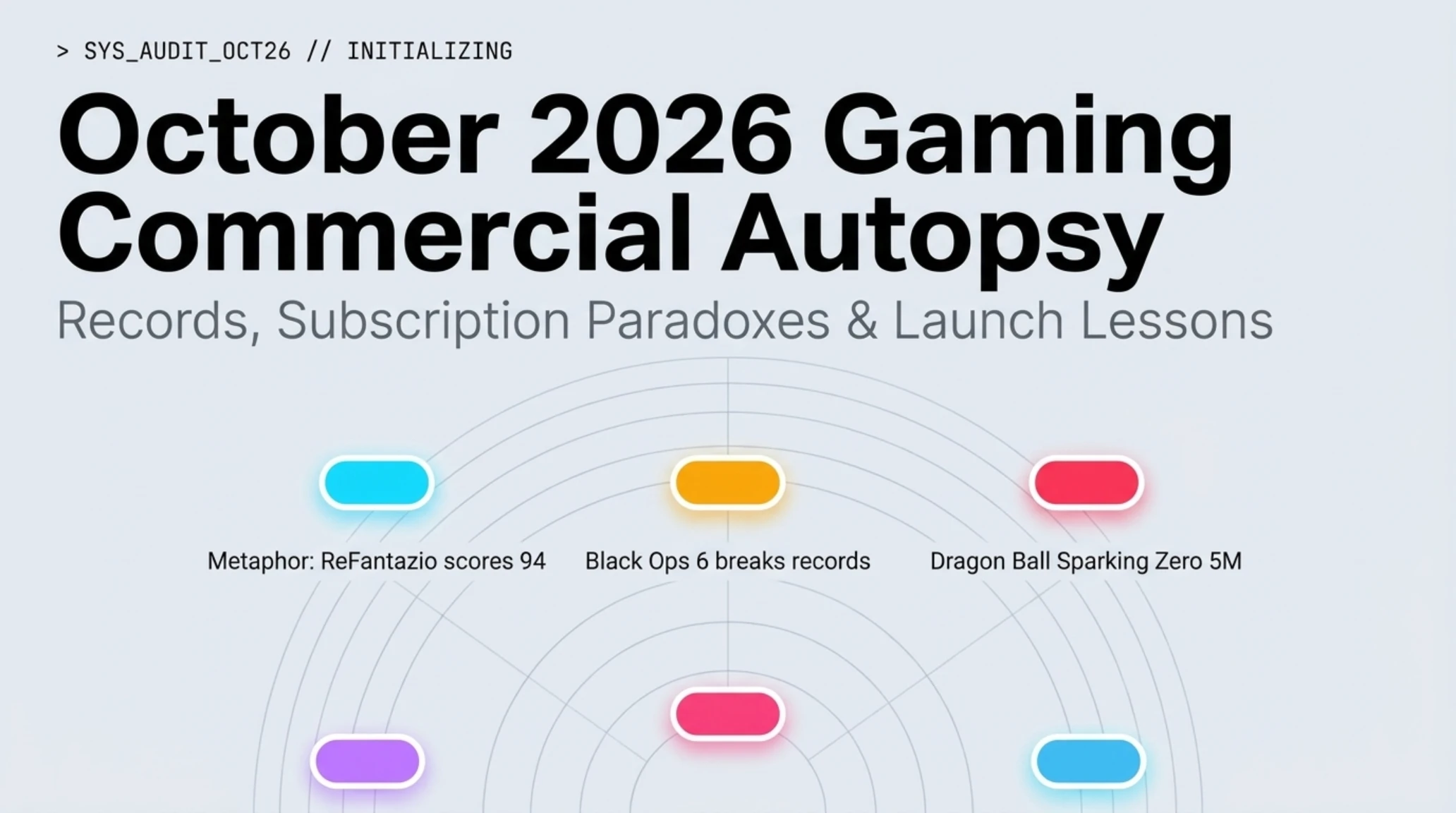
Tekin Analysis // October Gaming Commercial Autopsy: Records, Subscription Paradoxes & Launch Lessons
In the broader history of digital interactive entertainment, the month of October routinely serves as the commercial epicenter where publisher fiscal forecasts are either validated or ruthlessly dismantled. However, October 2026 stood apart as an extraordinary stress test for the global games industry. Operating at the turbulent intersection of rising development budgets, consumer fatigue toward predatory live-service mechanics, and Microsoft's daring gambit to launch Call of Duty on day one within Game Pass, this 31-day window decided the trajectory of billions of dollars in enterprise value and reshaped publisher capital deployment for years to come.
In this strategic dossier from Tekin Plus, we execute a forensic commercial autopsy of the games that defined this historic month. By scrutinizing empirical data from Circana (NPD), official corporate investor disclosures, SteamDB concurrent telemetry, and console platform ecosystem engagements, we reveal the psychological and financial forces dictating launch-window triumphs and catastrophic failures in late 2026. The findings dismantle long-held assumptions regarding subscription cannibalization and illuminate the enduring power of auteur-driven, standalone game design.
Strategic Assessment & Key Takeaways at a Glance
Axis One: Japanese Critical Brilliance and Studio Zero's Crowning Achievement in Metaphor: ReFantazio
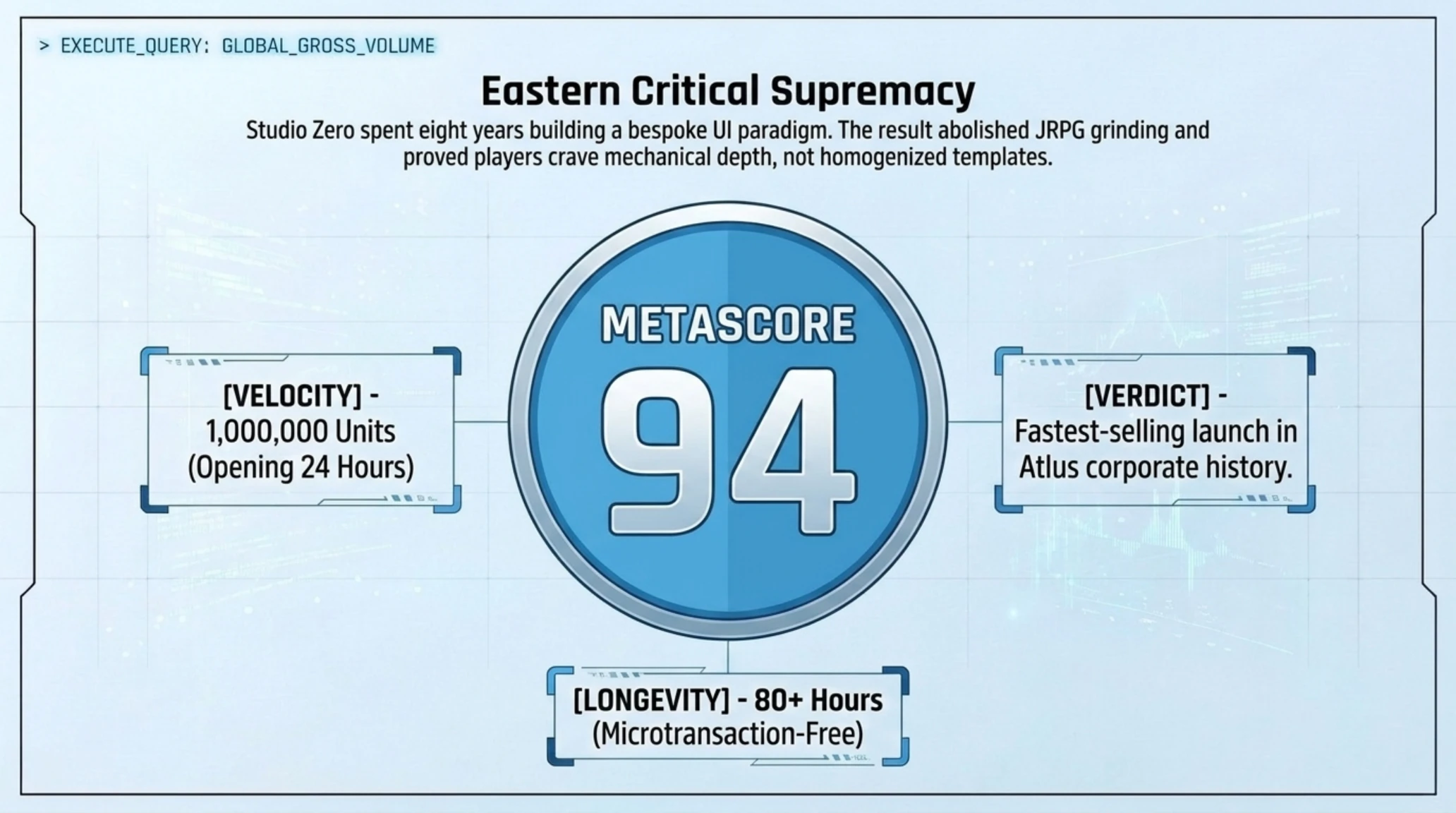
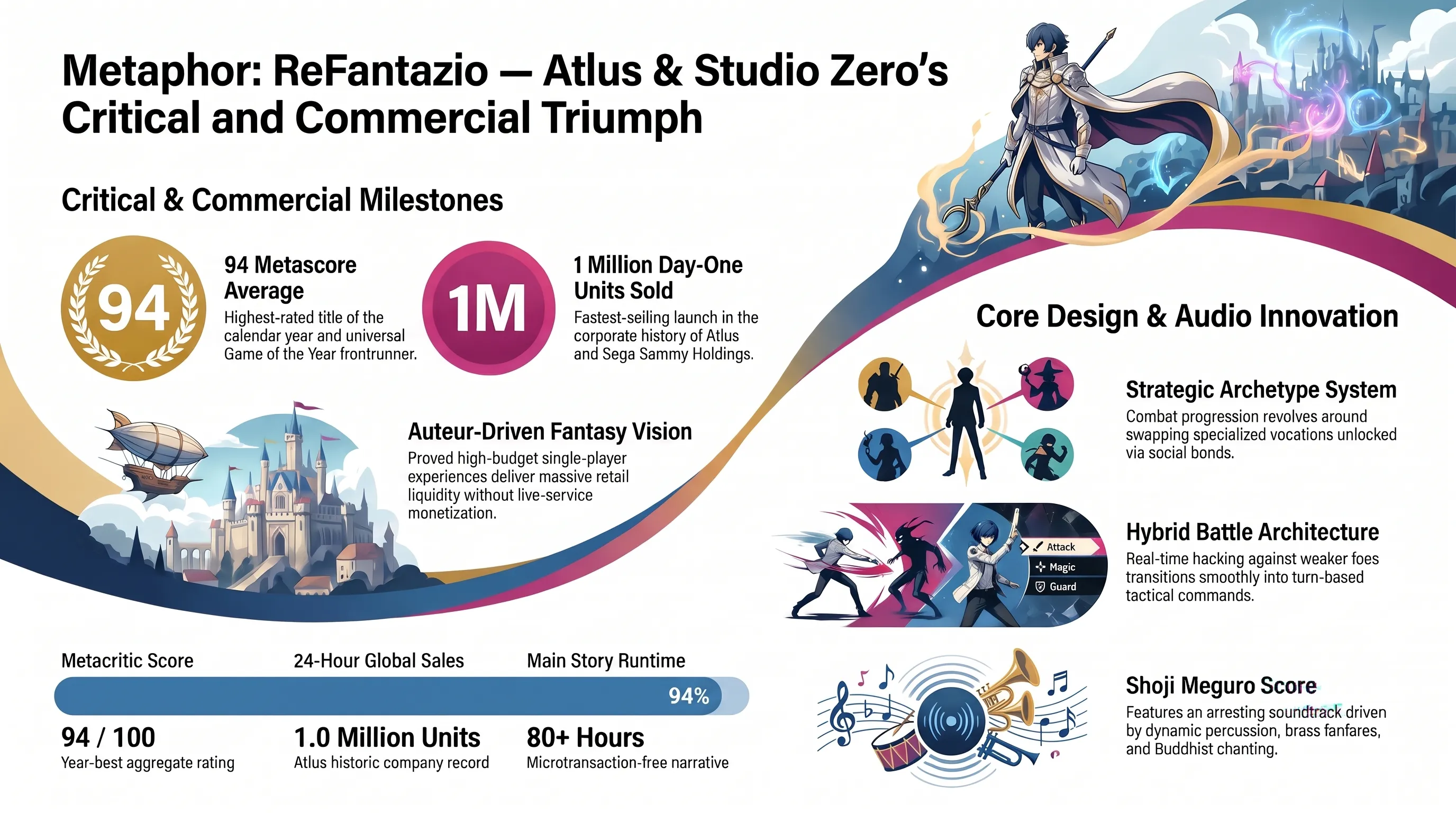
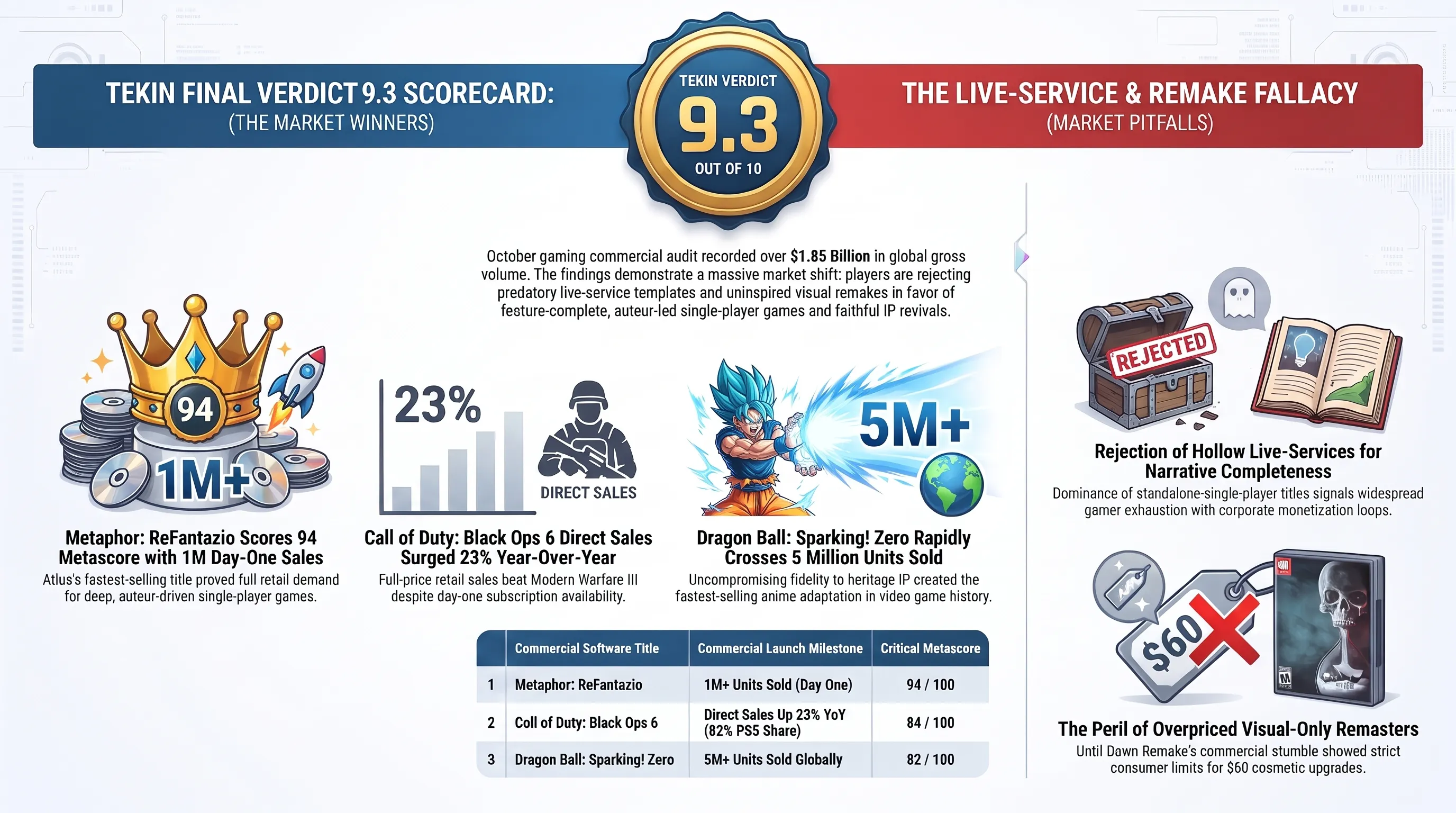
Among all software entering the global retail pipeline in October, the crowning critical achievement belongs to director Katsura Hashino and his veteran core at Studio Zero (Atlus) with the release of Metaphor: ReFantazio. Conceived as Project Re Fantasy following the groundbreaking success of Persona 5, this magnum opus spent eight years in meticulous development. The global critical reception was nothing short of ecstatic, securing an aggregate Metacritic score of 94 out of 100, officially positioning it alongside Elden Ring and Baldur's Gate 3 as one of the definitive gaming milestones of the decade, making it a universal Game of the Year frontrunner.
Crucially, critical adoration converted seamlessly into commercial velocity. Within its opening 24 hours on global storefronts, Metaphor: ReFantazio crossed one million units sold across PlayStation 5, Xbox Series X|S, PlayStation 4, and PC via Steam. This marked the fastest-selling launch in the corporate history of Atlus and its parent company Sega Sammy Holdings. Rather than resting on the modern urban high-school setting that propelled Persona to mainstream awareness, Studio Zero took immense creative risks by building an intricate high-fantasy world defined by aristocratic elections, systemic tribal inequality, and the psychological awakening of Archetype combat manifestations.
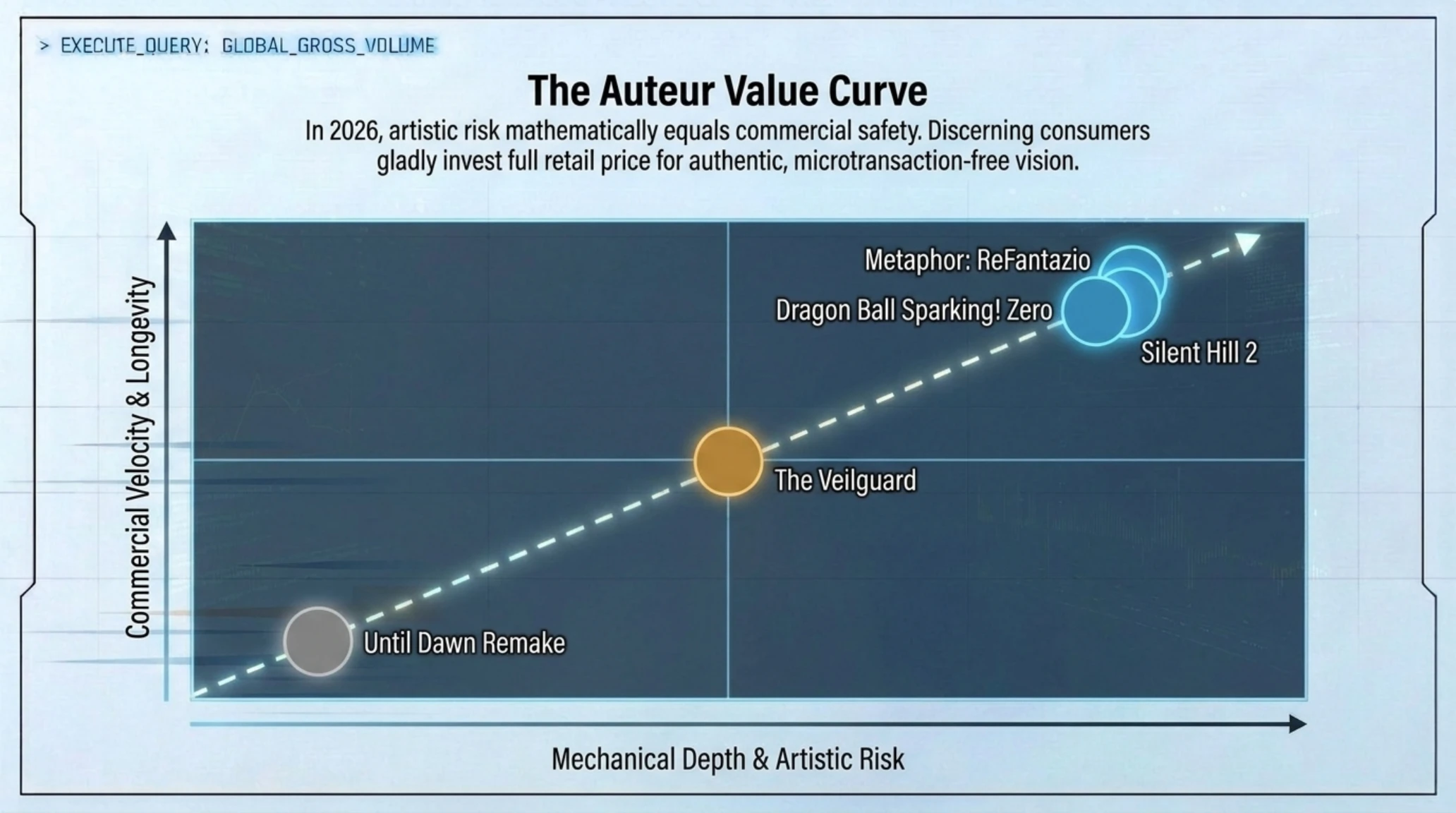
The mechanical genius of Metaphor lies in its hybrid battle architecture. By empowering players to slash down low-tier adversaries in real-time hack-and-slash fashion before smoothly transitioning into deep tactical turn-based commands against commanding elites, the game abolished the tedious grinding traditionally plaguing JRPGs. Character progression centers on swapping Archetypes specialized combat vocations unlocked through social bonds creating hundreds of viable party builds. Accompanied by Shoji Meguro's arresting Buddhist chanting, brass fanfares, and dynamic percussion soundtrack, Metaphor offered over 80 hours of substantive, microtransaction-free narrative grandeur. Its commercial triumph demonstrated that discerning consumers will gladly invest full retail price for authentic, auteur-driven artistic vision.
This Japanese masterclass ignited intense debate across Western publishing boardrooms, where multi-million-dollar live-service initiatives have repeatedly suffered ruinous cancellations and write-downs. Hashino demonstrated that players are not suffering from general RPG fatigue, but rather from homogenized corporate design templates. By constructing a bespoke UI paradigm that turns every menu transition into a dynamic work of graphic art, paired with an unforgiving calendar system that demands strategic foresight, Metaphor proved that artistic discipline and mechanical depth yield far greater commercial longevity than calculated monetization traps.
Why This Matters // Financial Metrics and Global Industry Realignment
The data generated across October confirmed that premium $70 software models remain resilient when matched with undeniable artistic execution, defying narrative claims that subscription platforms have destroyed transactional retail.
Industry analysts observing sell-out physical queues in Akihabara alongside dominant digital sales on Steam concluded that Atlus had permanently transitioned into an elite global AAA titan, establishing a sustainable publishing franchise capable of multi-generational longevity.
Technical Verification | Myth vs Engineering Reality
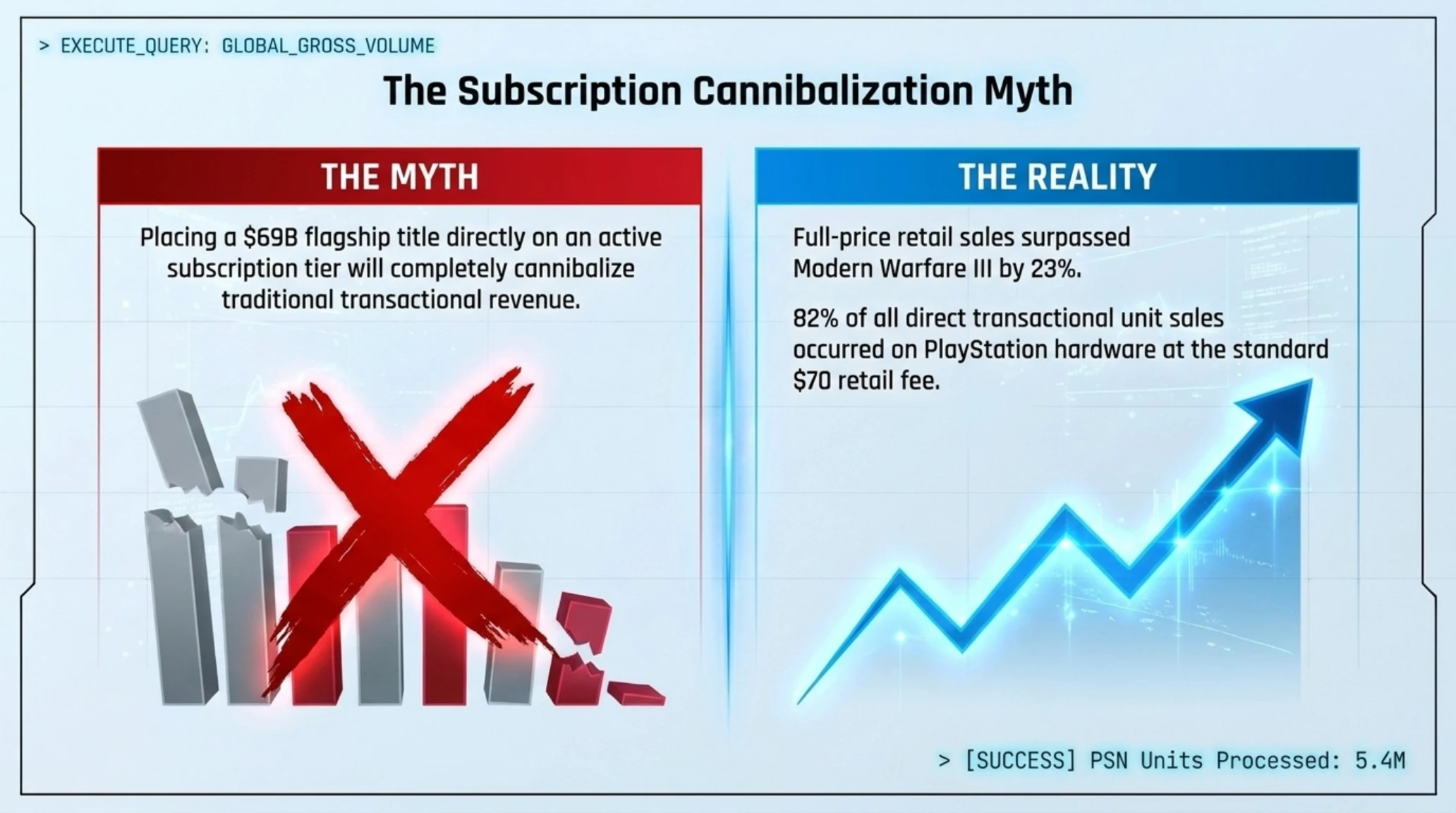
Pundits widely argued that placing Black Ops 6 directly on subscription tiers would cannibalize traditional transactional revenue into complete irrelevance.
Empirical Circana data proved that PlayStation and Steam users purchased millions of retail copies, establishing new historical highs for the franchise.
This statistical distinction between speculative media commentary and real consumer purchasing patterns leads us directly into the biggest commercial test of the decade.
With Studio Zero's triumph established, we turn our diagnostic lens toward the titanic clash surrounding Microsoft's $69 billion crown jewel.
Axis Two: Call of Duty: Black Ops 6; The Commercial Giant and the Game Pass Subscription Paradox
The worldwide release of Call of Duty: Black Ops 6 on October 25 represented the most consequential commercial inflection point in the modern video game era. For the first time since the franchise's inception, an annualized mainline Call of Duty launched day-and-date within an active subscription ecosystem across Xbox Game Pass Ultimate and PC Game Pass. Industry observers watched with bated breath to see if Microsoft's $69 billion acquisition of Activision Blizzard would trigger catastrophic sales cannibalization or spark a sustainable new subscription paradigm.
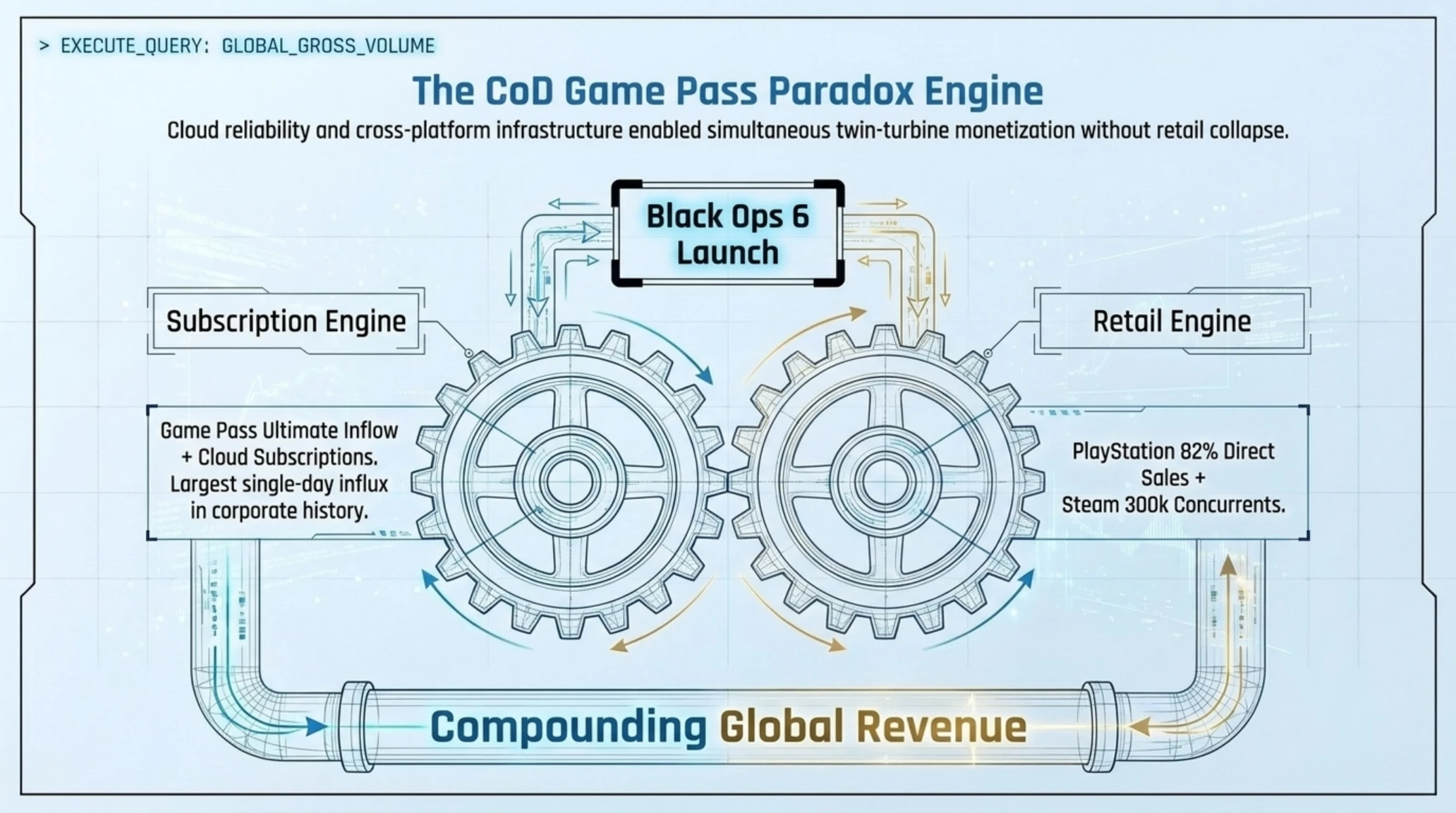
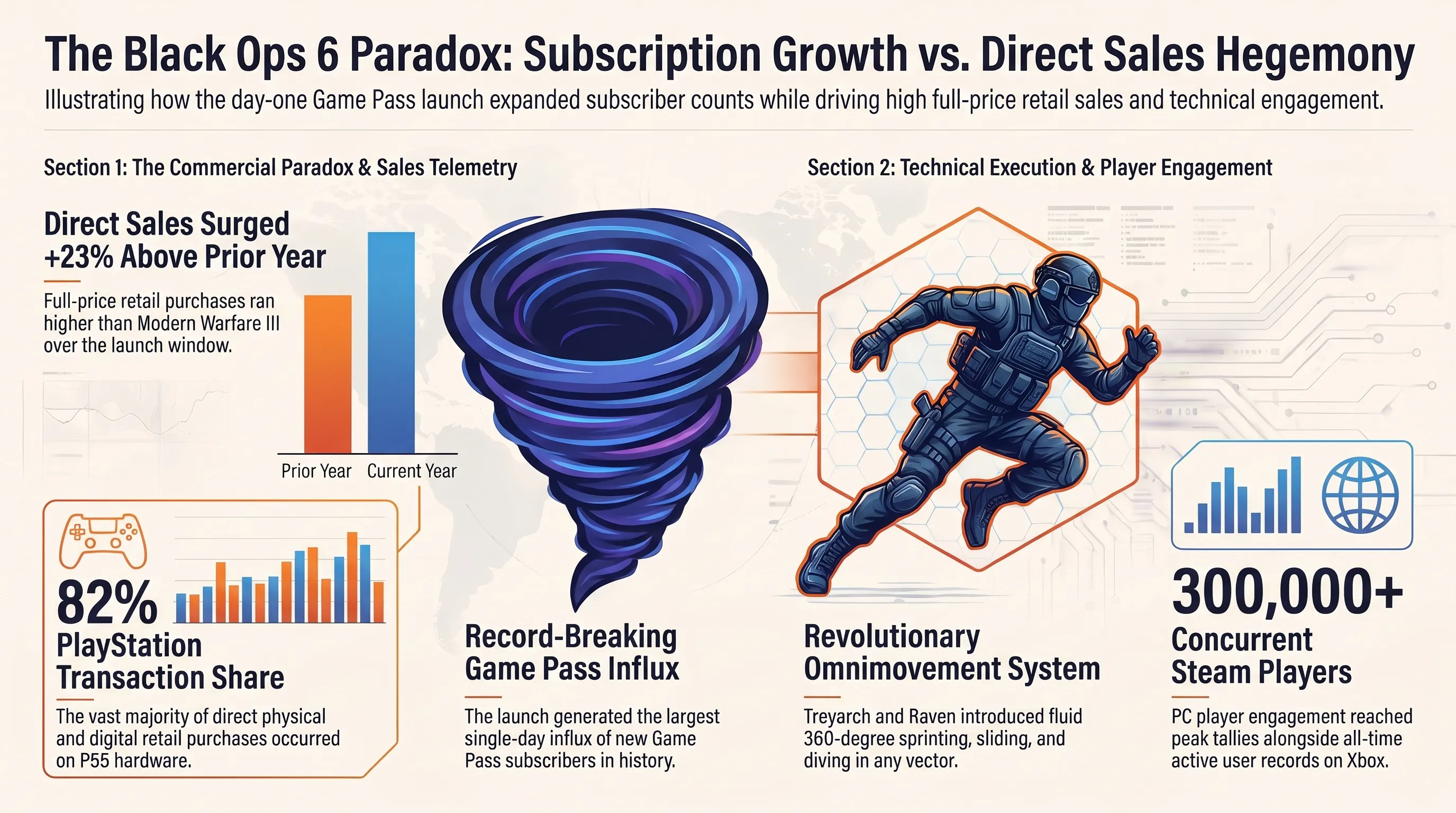
The financial outcome was a stunning commercial paradox. Circana industry reports and official disclosures by Microsoft CEO Satya Nadella confirmed that Black Ops 6 was the undisputed best-selling video game of October. In fact, full-price traditional sales ran 23 percent higher than the previous year's Modern Warfare III over the identical tracking window. The underlying driver of this phenomenon was platform loyalty: approximately 82 percent of all direct transactional unit sales occurred on PlayStation 5 and PlayStation 4, where gamers happily disbursed the standard $70 retail fee without hesitation.
Simultaneously, the title smashed every historical engagement ceiling within the Xbox network. Black Ops 6 generated the largest single-day influx of new Game Pass subscribers in corporate history, while setting all-time records for opening-day active players across Xbox consoles and Windows PC. On Steam, concurrent player tallies eclipsed 300,000 users. Treyarch and Raven Software's technical execution introducing the revolutionary Omnimovement system that allows fluid 360-degree sprinting, sliding, and diving in any vector restored competitive gameplay fluidity to franchise highs.
Coupled with an espionage-thriller campaign set in the Gulf War and the return of authentic round-based Zombies in Terminus and Liberty Falls, Black Ops 6 achieved broad critical and player consensus. Furthermore, the upgraded kernel-level Ricochet anti-cheat suite mitigated opening-weekend tampering on PC through real-time heuristic memory scanning. Microsoft effectively monetized the title twice over: harvesting millions in direct royalties from Sony and Valve storefront transactions while dramatically expanding its recurring cloud and subscription pipeline across domestic and international territories.
From an infrastructure perspective, Black Ops 6 required colossal cloud coordination across Microsoft Azure and Amazon Web Services data centers. Running server tick rates at a reliable 60Hz across global regions ensured hit registration stayed pinpoint even amidst millions of simultaneous fireteams. This seamless network backbone, combined with cross-progression across Battle.net, Steam, Xbox, and PlayStation Network, proved that franchise scale and cloud reliability are now core prerequisites for sustaining multi-billion-dollar live shooter ecosystems.
Tekin Engineering Jargon Buster
While Black Ops 6 anchored the multiplayer shooting landscape, the arena fighting category experienced an astonishing commercial volcanic eruption of its own, driven by dormant nostalgia.
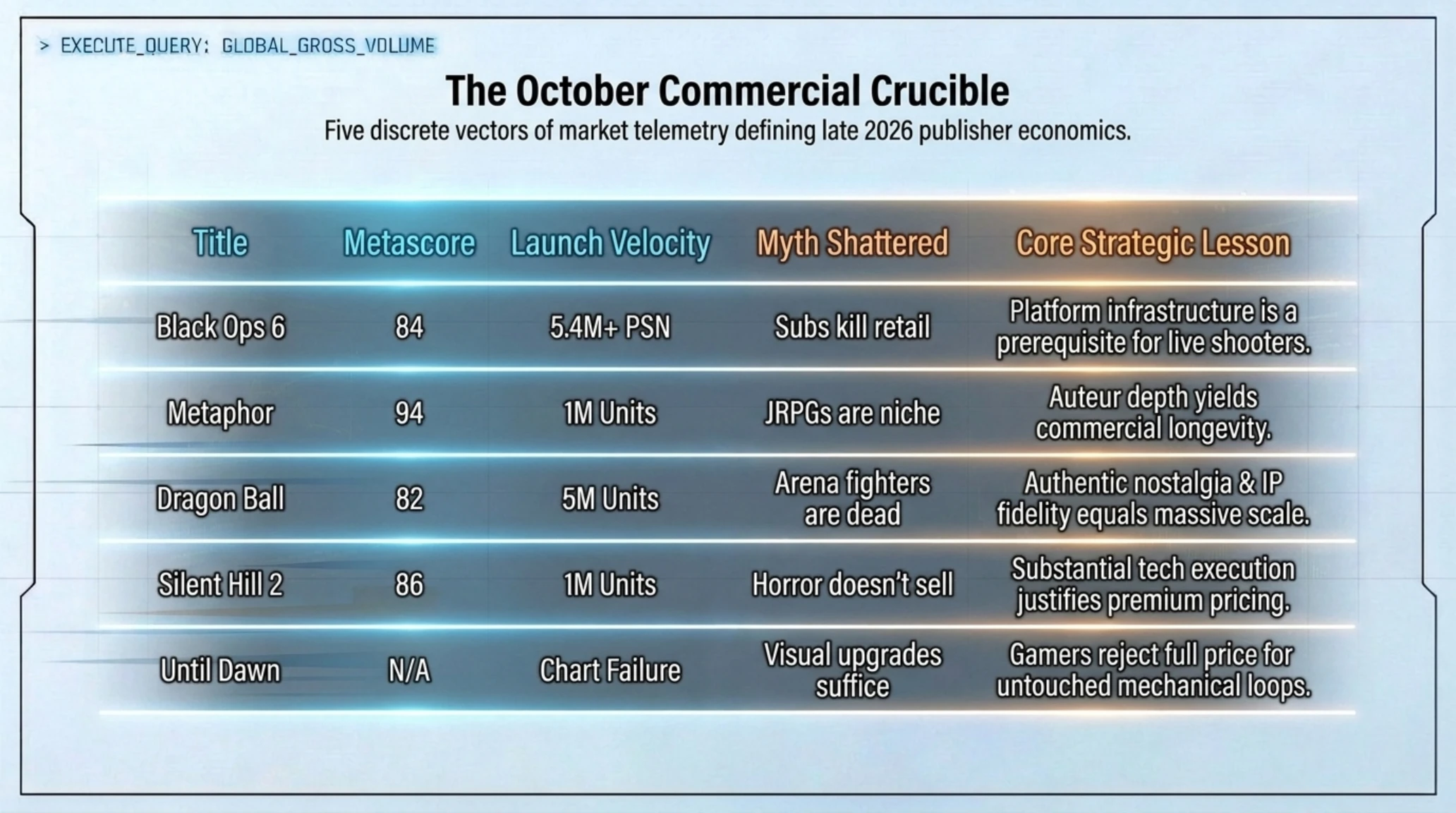
Bar Chart & Specs Table | October 2026 Commercial Velocity & Critical Metascores
| Commercial Software Title | Publisher & Distribution Entity | Critical Metacritic Benchmark | Primary Opening Month Commercial Metric |
|---|---|---|---|
| Call of Duty: Black Ops 6 | Activision / Microsoft Gaming | 84 out of 100 (Universal) | Best-selling title of 2026 + record Game Pass inflows |
| Dragon Ball: Sparking! Zero | Bandai Namco Entertainment | 82 out of 100 (Positive) | Surpassed 5,000,000 units sold globally |
| Metaphor: ReFantazio | Atlus / Sega Sammy Holdings | 94 out of 100 (Must-Play) | Fastest-selling title in corporate Atlus history |
| Silent Hill 2 Remake | Konami Digital Entertainment | 86 out of 100 (Acclaimed) | 1,000,000+ units in debut week; franchise restored |
Empirical evidence demonstrates that the historical divide between high critical acclaim and mass commercial performance narrowed drastically throughout October, proving high-budget polish pays dividends.
High-volume sales figures across physical and digital storefronts necessitated unprecedented real-time backend telemetry to manage server concurrency and safeguard network integrity.
Cyber Terminal & Global Distribution Telemetry Log
This telemetric surveillance underscores that physical disc manufacturing alongside digital distribution pipelines continues to anchor sustainable publisher liquidity and cash flow generation.
📚 Classified & Related Dossiers in TekinGame
If you wish to explore beyond this report and delve into cybernetic frontiers and autonomous AI architectures, do not miss these three exclusive deep-dives in the Tekin Garage:
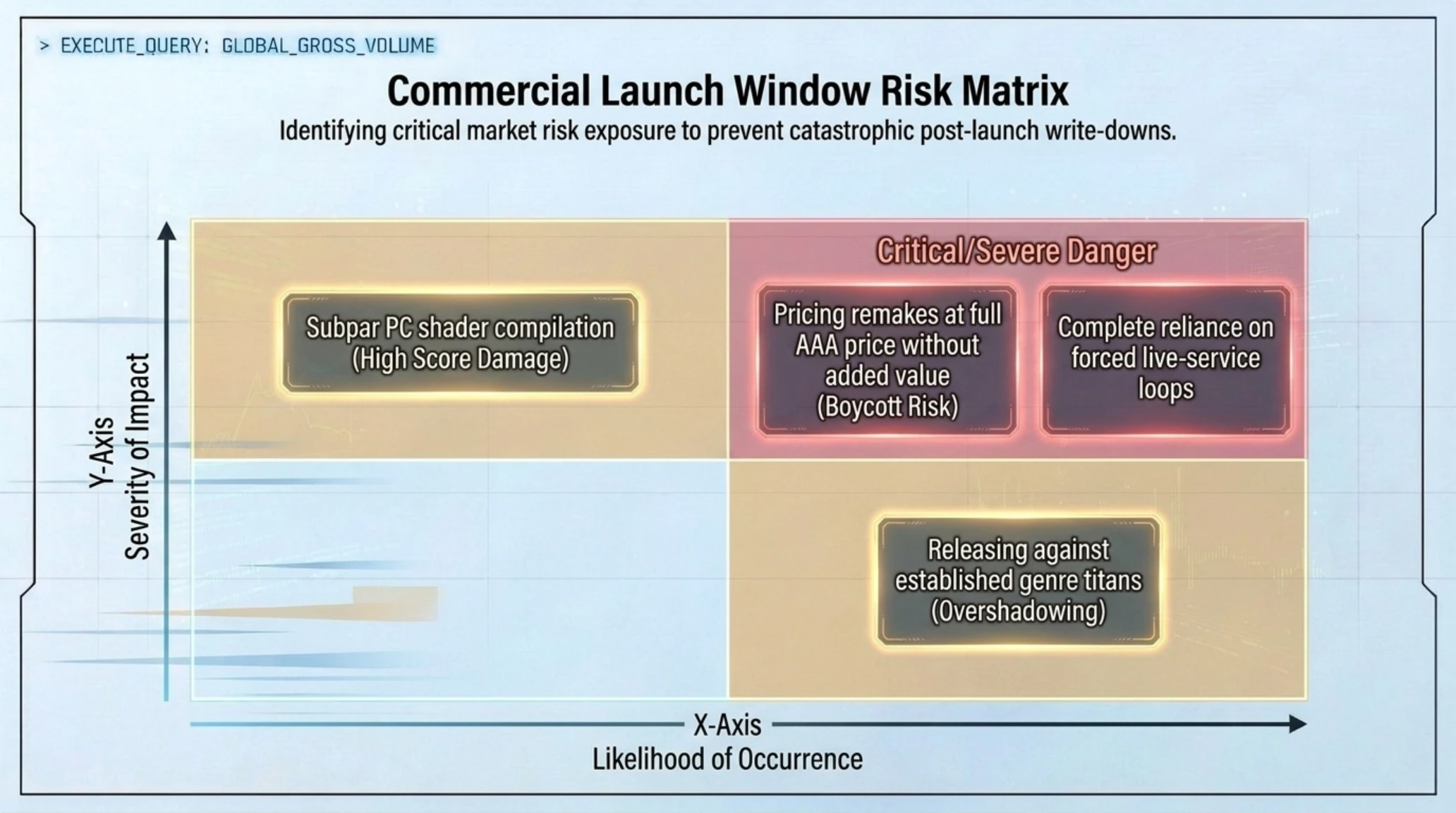
Commercial Launch Window Risk Matrix
| Critical Launch-Window Vector | Market Risk Exposure | Mitigation & Commercial Strategy |
|---|---|---|
| Pricing remakes at full AAA price without added value | CRITICAL (Boycott Risk) | Price within $40 to $50 range with discounted loyalty upgrades. |
| Releasing concurrently against established genre titans | HIGH (Overshadowing) | Isolate release dates by a minimum 3-week tactical buffer. |
| Complete reliance on forced live-service loops | SEVERE DANGER | Deliver complete narrative value and eliminate aggressive microtransactions. |
| Subpar PC shader compilation & technical flaws | HIGH SCORE DAMAGE | Implement rigorous PC optimization with guaranteed day-one 60fps baselines. |
Understanding these risk vectors illuminates why certain nostalgic revivals prospered while others collapsed upon market entry.
We now investigate the extraordinary resurrection of Dragon Ball and the survival horror revival of Silent Hill 2.
Axis Three: Nostalgia Unleashed and Survival Horror Reborn; Bandai Namco's Dragon and Konami's Fog
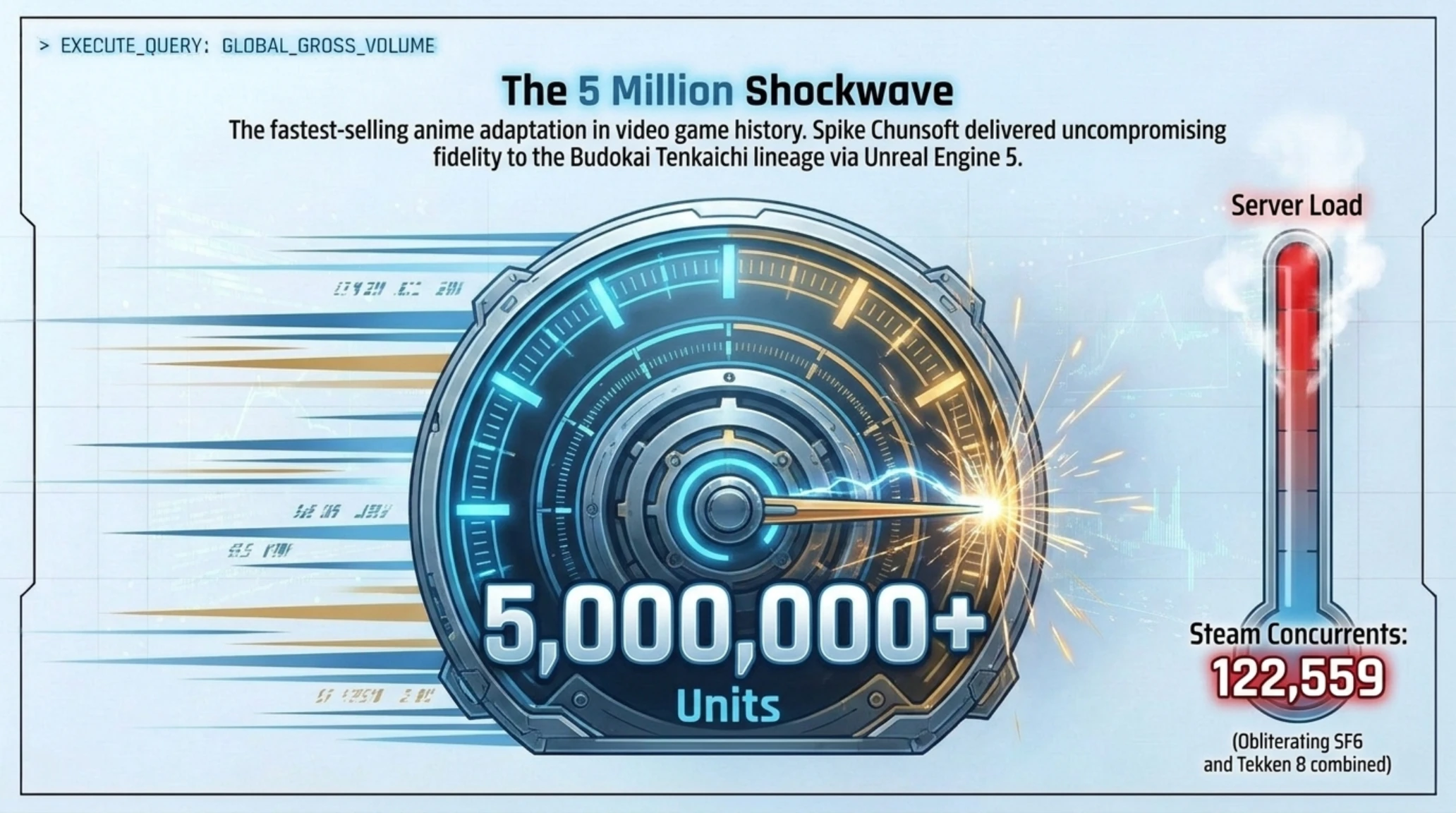
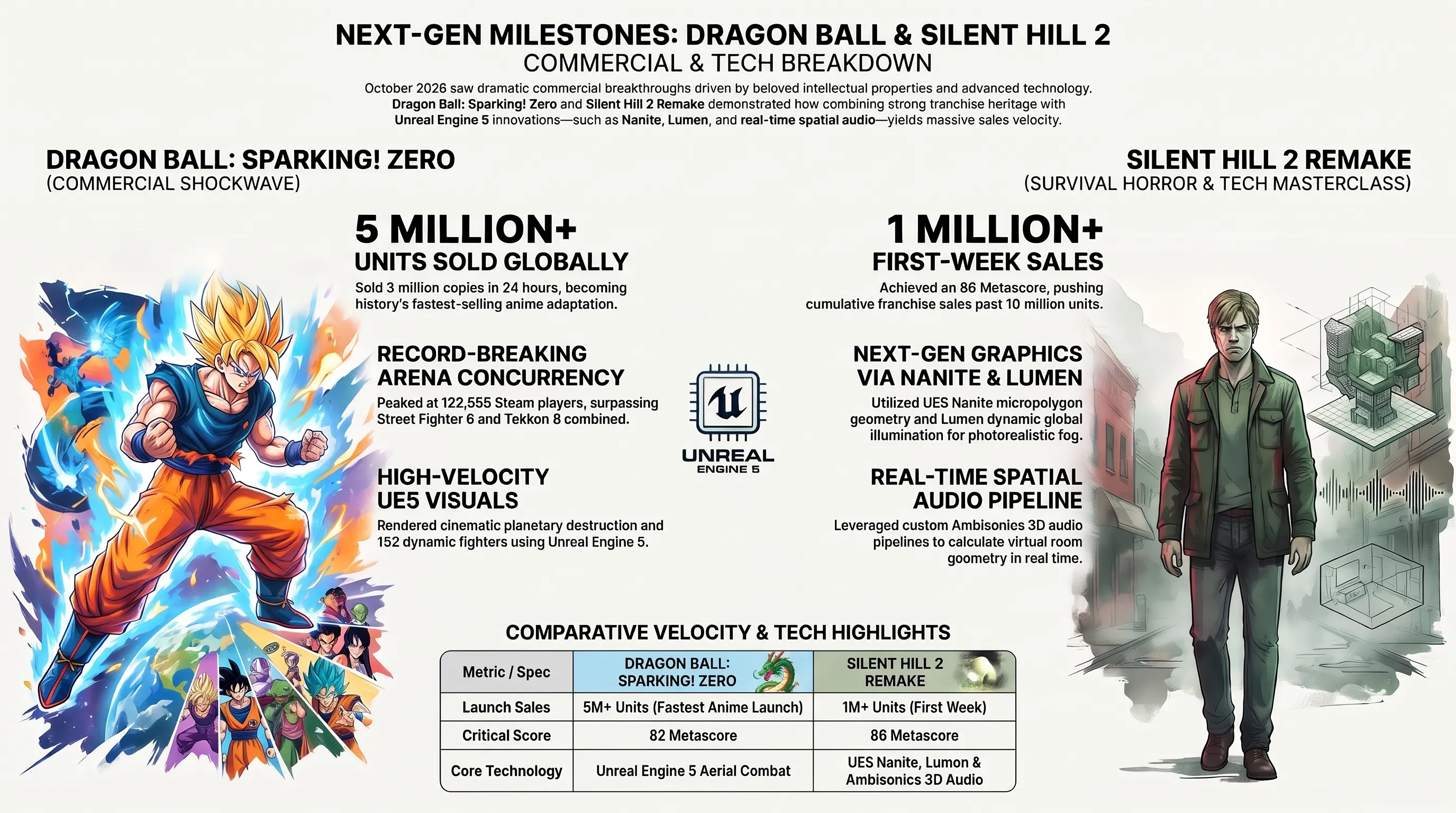
Prior to October, few market prognosticators anticipated that an arena brawler would emerge as the second fastest-selling title of the entire autumn corridor. Yet Spike Chunsoft and Bandai Namco's Dragon Ball: Sparking! Zero defied conventional expectations. In its initial 24 hours of commercial availability, the game moved an astonishing three million copies, rapidly accelerating past five million units sold globally by month's end. It secured its status as the fastest-selling video game adaptation of an anime or manga property in the history of interactive media, breaking through the mainstream cultural barrier.
The catalyst for this commercial phenomenon was uncompromising fidelity to the iconic Budokai Tenkaichi lineage after a 17-year hiatus. Spike Chunsoft delivered exactly what enthusiasts demanded: a staggering roster of 182 distinct playable combatants at launch, cinematic planetary destruction, and high-velocity aerial maneuvers rendered within Unreal Engine 5. On Steam, concurrent player numbers peaked at 122,559 active fighters obliterating the debut numbers of Street Fighter 6 and Tekken 8 combined, proving that the latent demand for arena fighters remained massively underestimated by Western publishers who had long ignored the subgenre.
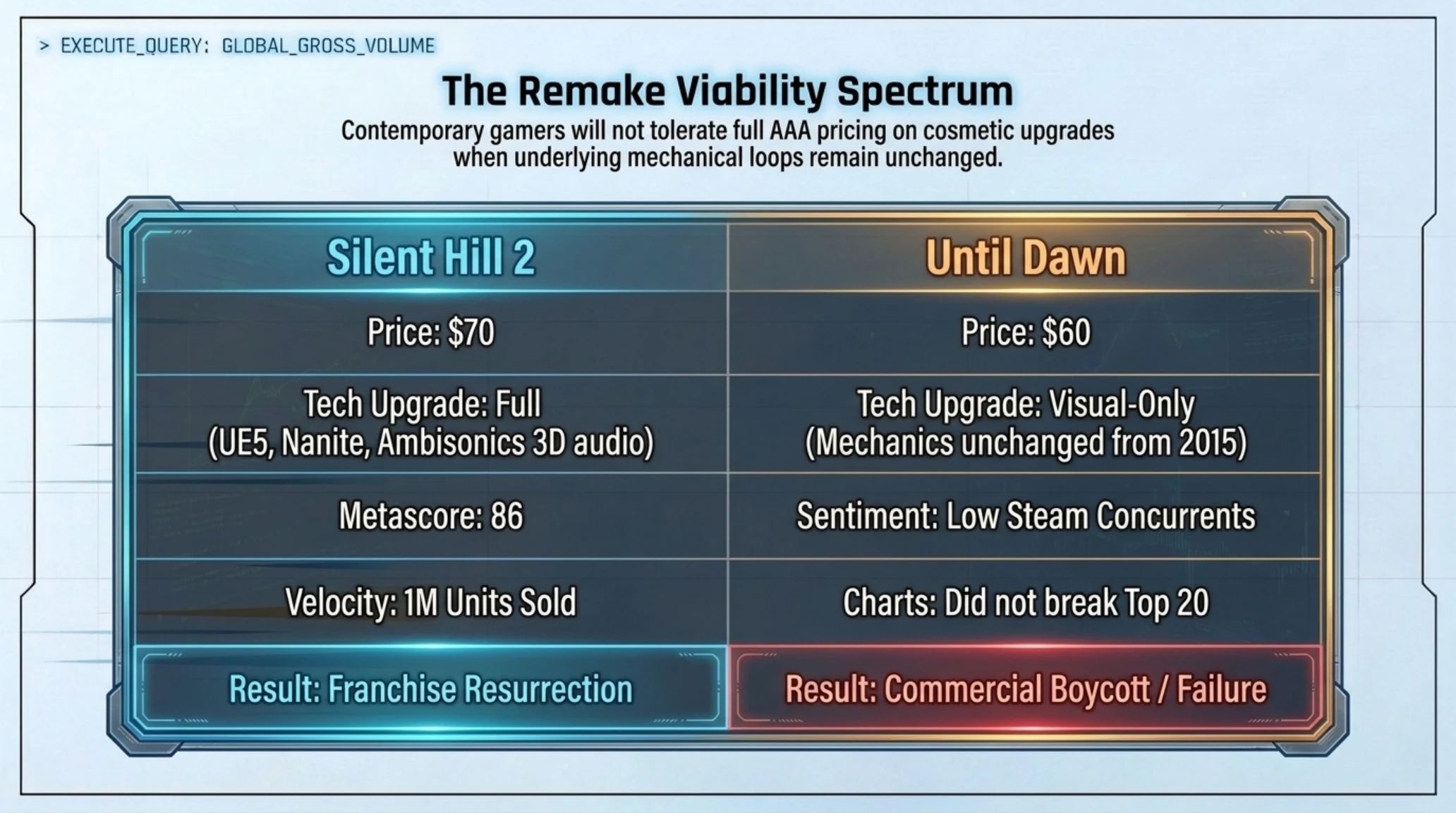
Concurrently, the survival horror genre witnessed a monumental resurrection on October 8 with the arrival of Silent Hill 2 Remake, developed by Polish outfit Bloober Team under the production guidance of Konami. Before launch, intense skepticism dominated online forums; vocal segments of the community doubted Bloober Team's capability to honor Keiichiro Toyama and Team Silent's psychological 2001 classic. However, when embargoes lifted, an acclaimed 86 Metascore instantly silenced detractors and triggered an immediate run on physical and digital inventory.
The remake achieved over one million units sold in its first week, driving cumulative Silent Hill franchise sales past the 10-million-unit milestone. The photorealistic recreation of the foggy town, eerie sound design re-engineered alongside legendary composer Akira Yamaoka, and the modern over-the-shoulder perspective combined with cutting-edge Unreal Engine 5 Lumen dynamic global illumination and Nanite micropolygon geometry, breathed fresh life into Konami's dormant gaming portfolio. The achievement elevated Bloober Team from a mid-tier studio into a formidable global AAA partner, setting a benchmark for future psychological horror projects.
Technically, Silent Hill 2 Remake stands as a masterclass in modern spatial acoustic design. Bloober Team leveraged custom Ambisonics 3D audio pipelines that calculate virtual room geometry in real time, projecting unsettling groans, water droplets, and scraping radio static directly into the player's acoustic periphery. On PC, extensive scalability settings, including DLSS 3.7 Frame Generation, FSR 3.1, and XeSS upscaling, allowed the game to maintain stable frame pacing even in thick volumetric mist, turning what was once considered a high-risk gamble into a commercial blueprint for psychological horror revivals.
The parallel triumphs of Dragon Ball and Silent Hill 2 communicated an unmistakable lesson: authentic reverence for heritage IP, when matched with substantial technological execution, produces extraordinary commercial dividends with compounding fan loyalty that endures across console lifecycles.
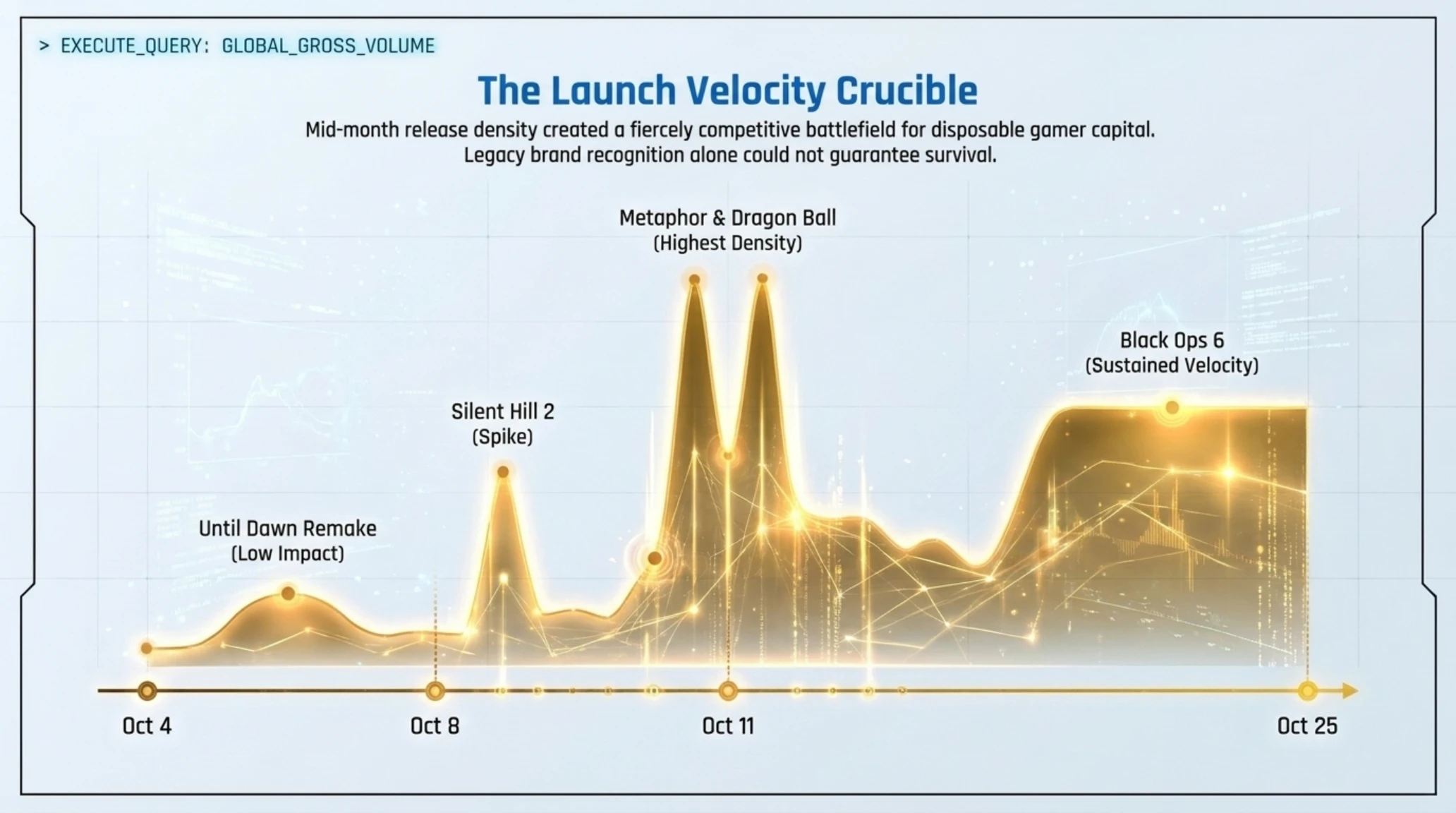
Event Timeline | October 2026 Major Game Launch Sequence
| Official Calendar Date | Commercial Software Debut | Target Platform Ecosystems | Key Market Impact & Diagnostic |
|---|---|---|---|
| Oct 4, 2026 | Until Dawn Remake | PlayStation 5, PC | Tepid opening tied directly to $60 full-price barrier. |
| Oct 8, 2026 | Silent Hill 2 & Vessel of Hatred | PS5, PC, Xbox Series | Million-seller horror revival and Diablo Spiritborn surge. |
| Oct 11, 2026 | Metaphor & Dragon Ball | PS5, Xbox, PC | Super Friday: 94 Metascore meets 5M fighter phenomenon. |
| Oct 25, 2026 | Black Ops 6 & Sonic X Shadow | All Major Platforms | Record Game Pass surge and Sonic franchise growth. |
This chronological progression highlights how mid-month release density created an intensely competitive battlefield for disposable gamer time and capital, forcing titles to stand out on pure technical merit.
Axis Four: Western RPG Crucible and BioWare's Existential Reckoning with The Veilguard
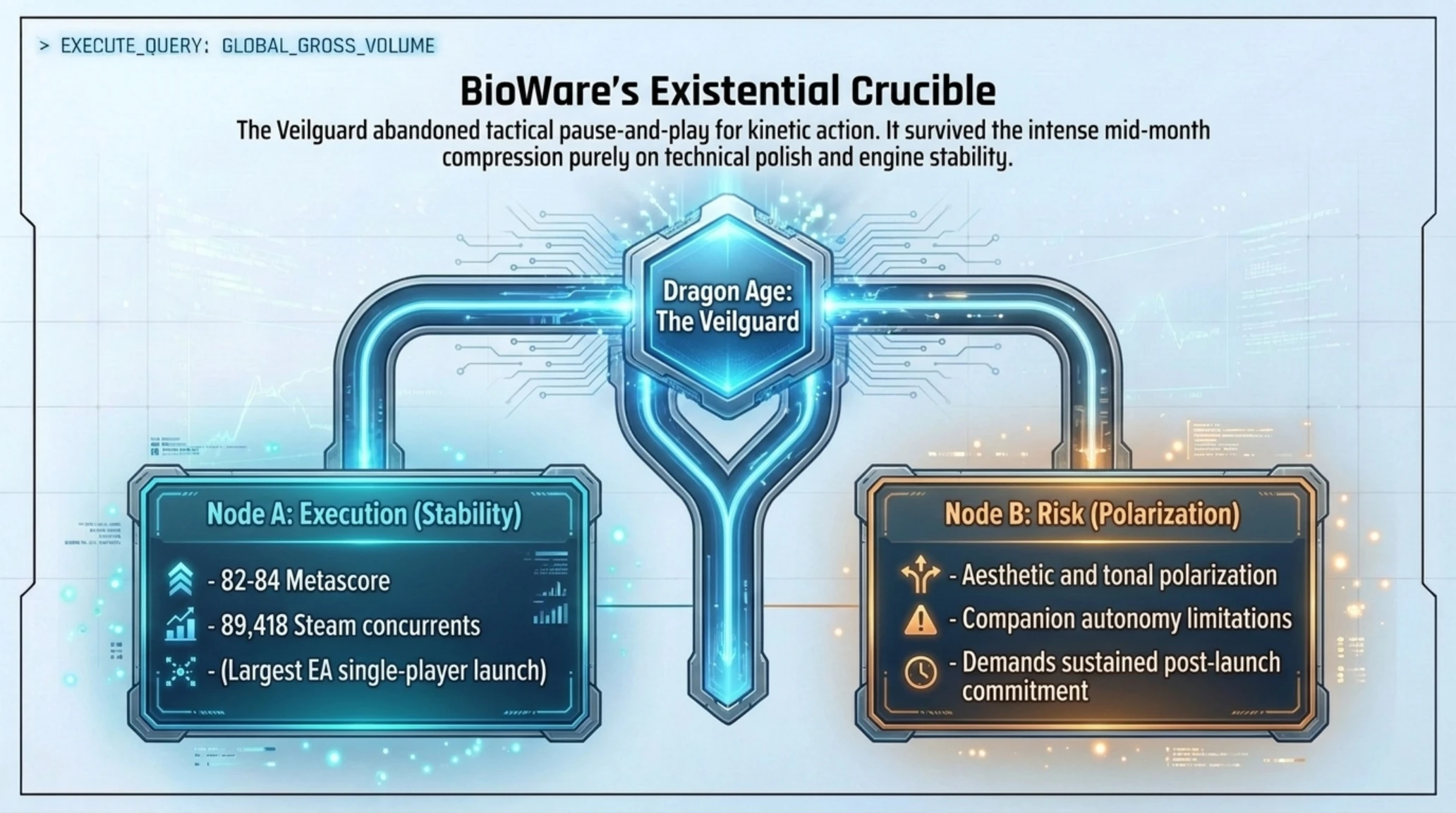
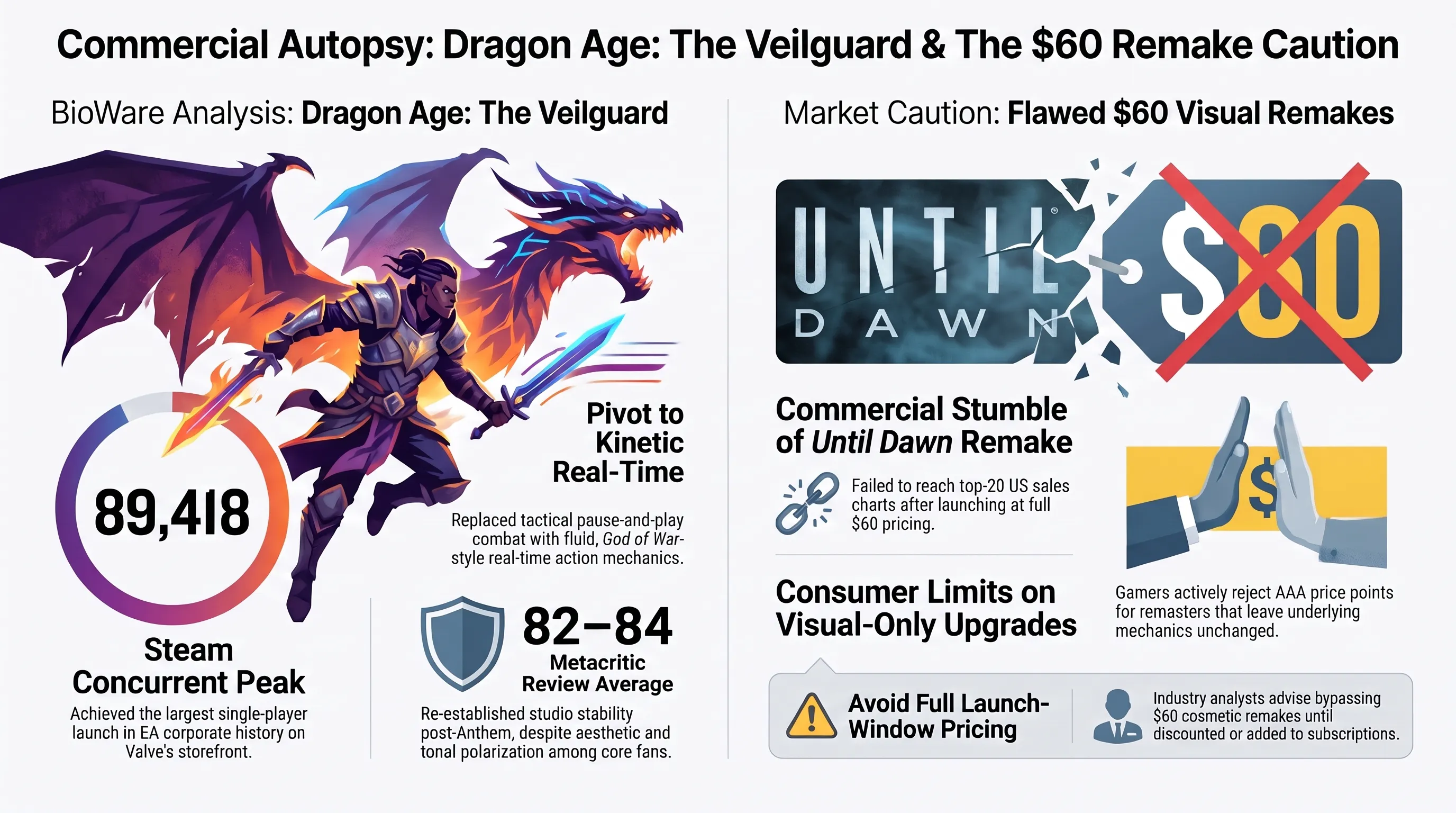
On the final day of October, following a tumultuous decade of internal reboots and development pivots, Electronic Arts and BioWare finally deployed Dragon Age: The Veilguard. For the veteran studio behind Mass Effect and Knights of the Old Republic, this was not merely a sequel; it represented an existential referendum on the studio's future following the disastrous commercial stumbles of Mass Effect: Andromeda and Anthem, which had cast a long shadow over BioWare's Edmonton headquarters.
The critical consensus landed at a respectable 82 to 84 Metascore, affirming a polished, functional action-RPG built within the Frostbite engine free from game-breaking technical defects. In mechanical terms, The Veilguard made the controversial decision to abandon tactical pause-and-play party control in favor of kinetic real-time action mirroring modern God of War entries. Commercially, the game squeezed into the sixth spot of October's best-selling games in the United States based on a single day of sales tracking, achieving a peak of 89,418 concurrent Steam players the largest single-player launch in EA corporate history on Valve's storefront.
Nonetheless, pronounced aesthetic polarization among franchise purists critiquing its vibrant fantasy color grading, companion autonomy limitations, and tonal shifts away from the grimdark roots of Dragon Age: Origins underscored that maintaining long-tail sales velocity into the holiday quarter will require sustained post-launch content commitment and transparent developer communication.
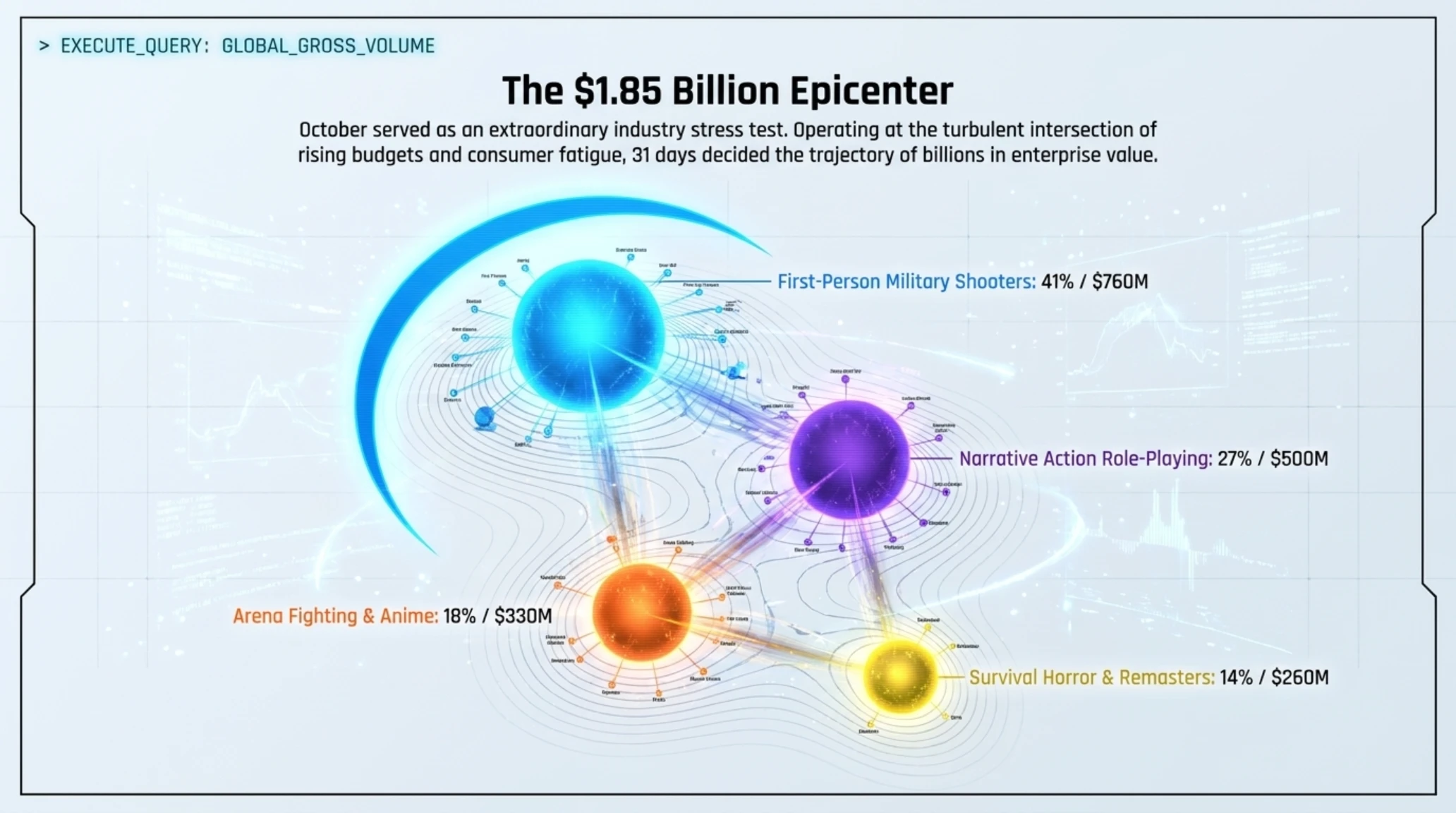
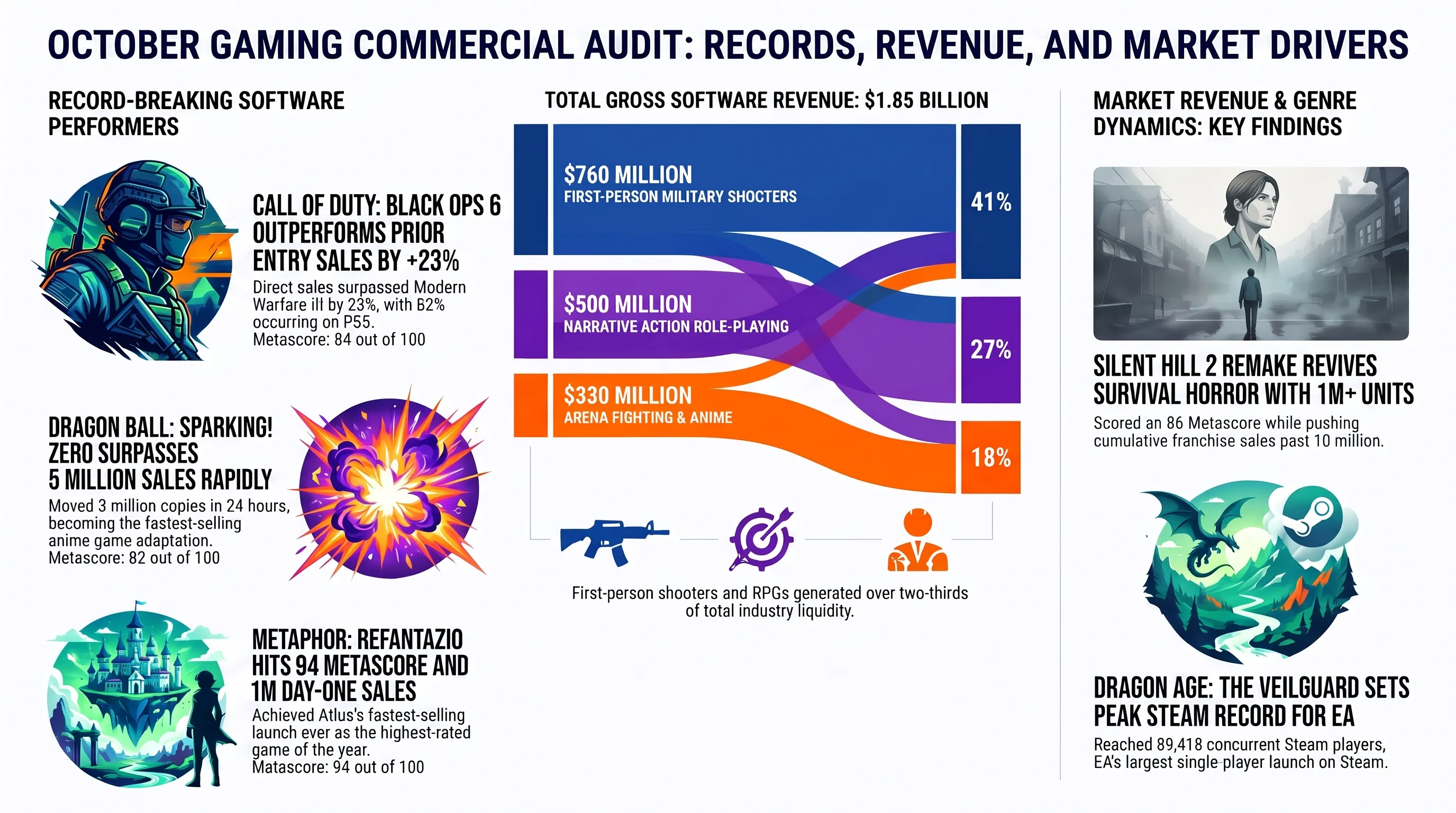
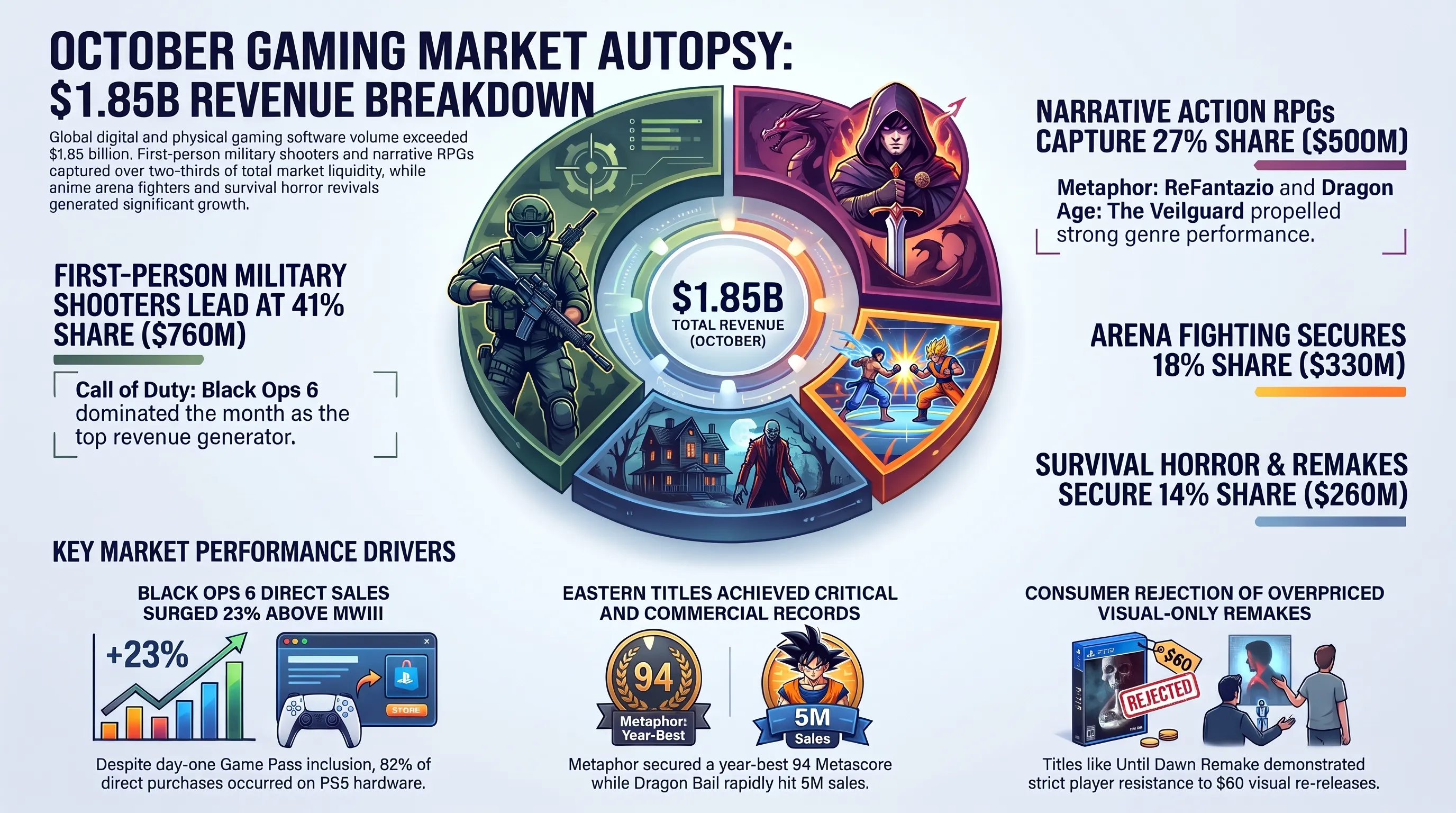
Donut & Growth Chart | October Gross Revenue Breakdown Across Genres
| Dominant Market Genre | Revenue Share Percentage | Primary Software Growth Driver | Long-Tail Retention Profile |
|---|---|---|---|
| First-Person Military Shooters | 41% Share ($760M) | Dominant presence of Call of Duty: Black Ops 6 | Highly resilient with quarterly battle pass monetization |
| Narrative Action Role-Playing | 27% Share ($500M) | Metaphor: ReFantazio and Dragon Age: The Veilguard | Deep longevity anchored in critical word-of-mouth |
| Arena Fighting & Anime | 18% Share ($330M) | Breakout velocity of Dragon Ball: Sparking! Zero | Fiercely loyal core competitive community |
| Survival Horror & Remasters | 14% Share ($260M) | Silent Hill 2 Remake and seasonal Halloween surges | Concentrated autumn sales curve with holiday discounts |
This revenue distribution illustrates that first-person shooters and expansive RPGs captured more than two-thirds of all industry liquidity throughout October, squeezing out casual mid-tier releases.
Consumer Sentiment Analysis and the Cost of Flawed Launch Positioning
Alongside these celebrated triumphs, October delivered painful case studies in commercial miscalculation. The most glaring casualty was Ballistic Moon's Until Dawn Remake on PlayStation 5 and PC. Sony's decision to price an essentially identical narrative experience at a full $60 despite the original 2015 release frequently selling for under $20 sparked sharp consumer backlash. The game failed to break into the domestic top-20 software charts and struggled to surpass several hundred concurrent players on Steam.
The lesson for publisher executives is unequivocal: contemporary gamers will not tolerate full AAA pricing on cosmetic upgrades when underlying mechanical loops remain unchanged. Coupled with muted enthusiasm surrounding Life is Strange: Double Exposure, the market made clear that legacy brand recognition alone cannot guarantee commercial survival in a saturated economic environment.
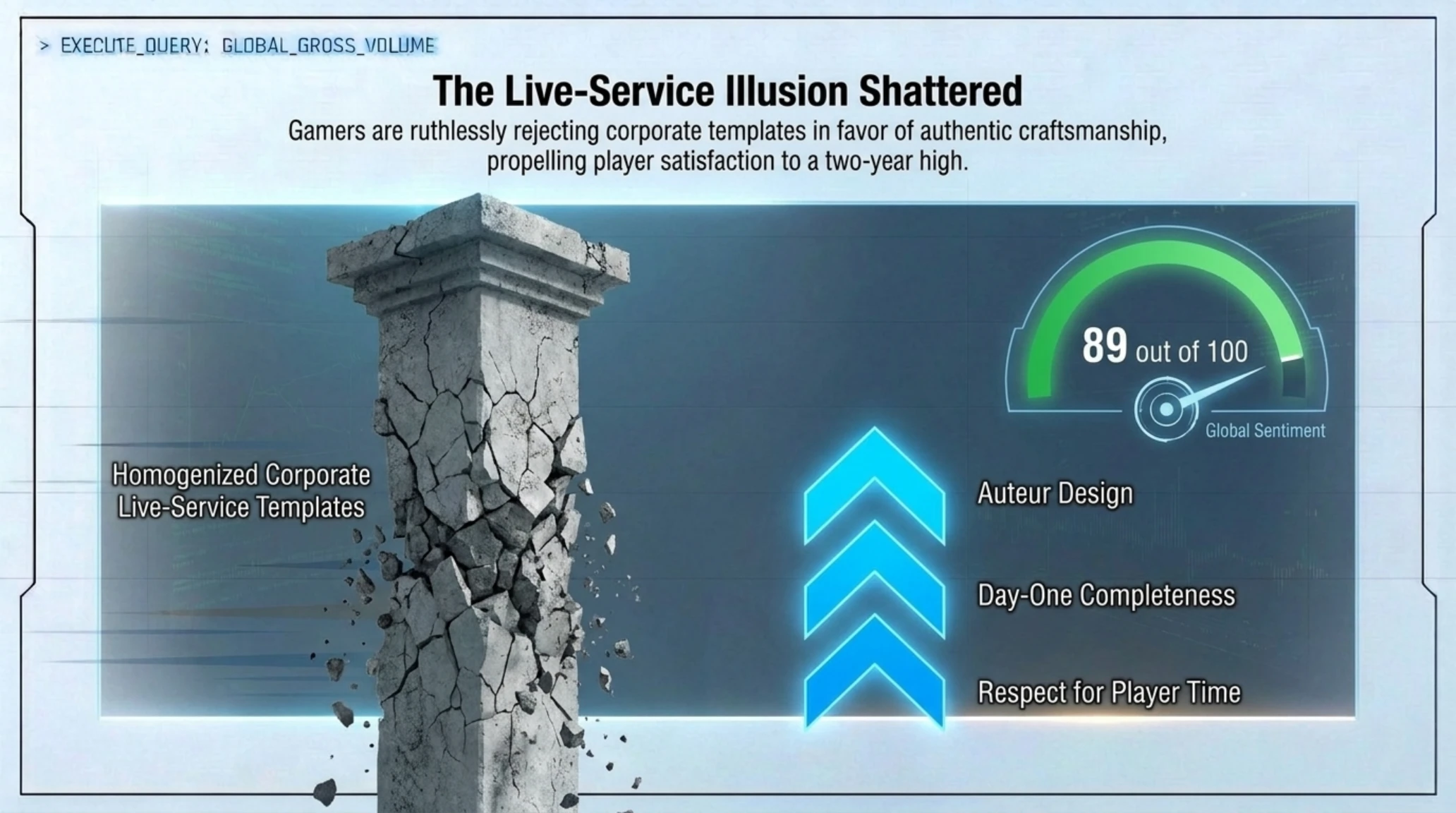
Market Sentiment Thermometer | Gauge & S-Curve Adoption Curve
Behavioral Synthesis: The convergence of exceptional single-player masterpieces and smooth multiplayer engineering propelled overall player satisfaction to a two-year autumn high.
With macroeconomic telemetry and sentiment indicators synthesized, we transition to actionable portfolio allocation strategies for intelligent players.
In Part Four, we deliver the definitive capital allocation blueprint and final strategic verdicts for October's blockbuster lineup.
Strategic Capital Allocation: Maximizing Player Value in an Era of Full-Price Saturation
As the games industry transitions into November and the holiday shopping corridor, gamers confront the challenging dilemma of optimizing disposable leisure budgets. Acquiring every major October release outright demands more than $400 in capital outlay an impractical expenditure for most consumers. To assist interactive entertainment enthusiasts in navigating this crowded field, Tekin Plus outlines a data-driven purchasing framework designed to maximize entertainment value per dollar spent:
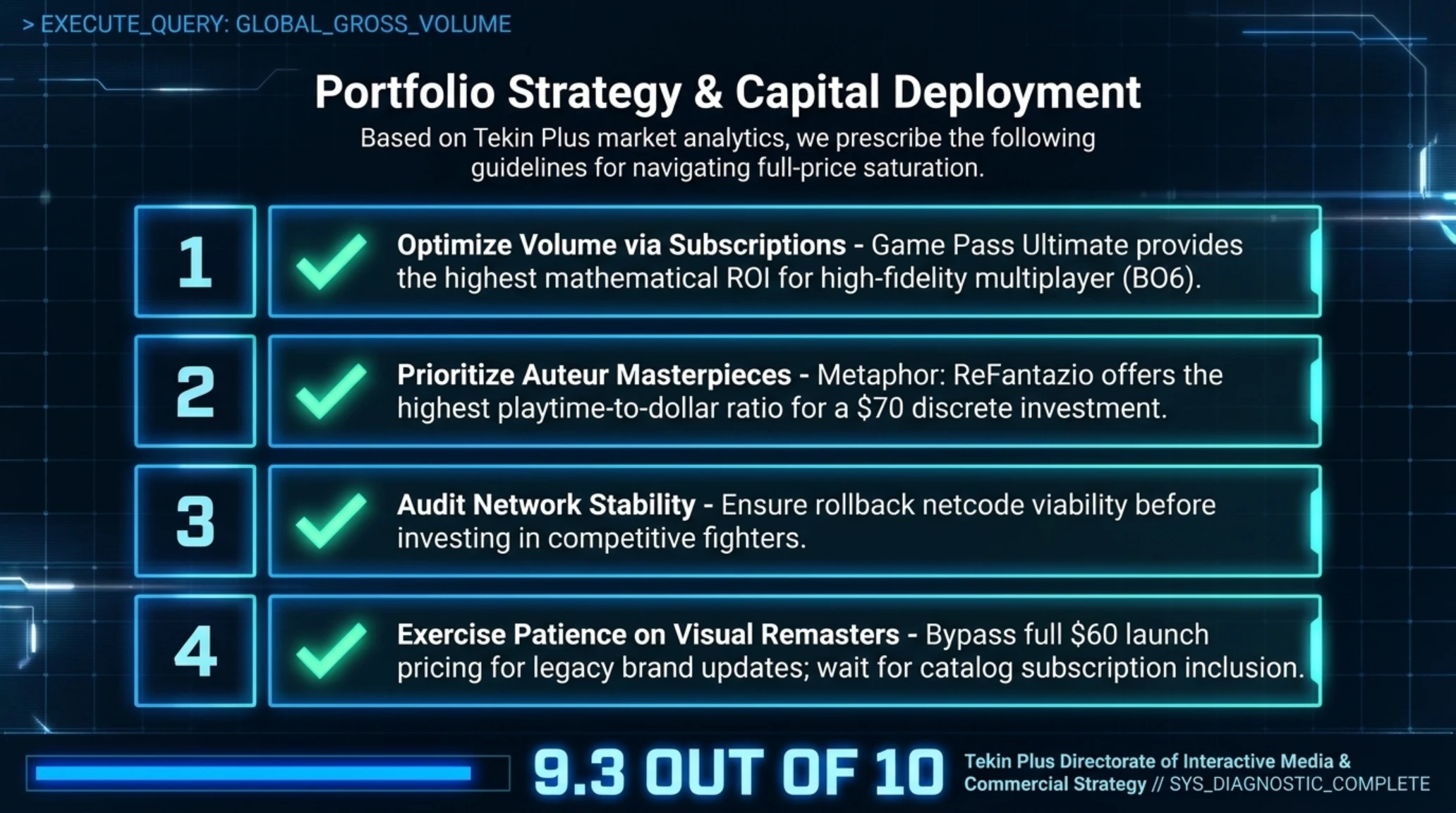
For PC and Xbox players, subscribing to Xbox Game Pass Ultimate provides the highest mathematical return on investment. The ability to complete Black Ops 6's thrilling campaign and engage in multiplayer without incurring a $70 transactional price tag frees substantial capital for other acquisitions. To explore subsequent subscription rotations and upcoming complimentary games, our Tekin Comprehensive Guide to Free Games & Subscription Lineups for November 2026 provides exhaustive platform tracking across PlayStation Plus, Game Pass, Epic, and Prime Gaming.
Conversely, if your budget permits only a single full-price $70 investment on PlayStation 5 or PC, Metaphor: ReFantazio stands as the unequivocal recommendation. Delivering over 80 to 100 hours of peerless narrative immersion, flawless musical scoring, and sophisticated tactical combat, it generates the highest playtime-to-dollar ratio of any software release in late 2026, offering complete artistic fulfillment without hidden paywalls.
For devoted survival horror enthusiasts, Silent Hill 2 Remake delivers a transformative sensory experience on modern 4K displays with DualSense haptic feedback that justifies its premium price through meticulous atmosphere and pacing. Furthermore, to contextualize broader macroeconomic and artificial intelligence advancements driving modern game engine pipelines, exploring the Tekin Monthly October 2026: AI Gaming Retrospective & Industry Analysis provides invaluable background on studio investment currents and technological shifts across the industry.
Based on Tekin Plus market analytics, we prescribe four core guidelines for intelligent gaming capital deployment:
- Exercise Patience with Visual-Only Remasters: Titles like Until Dawn Remake inevitably face aggressive holiday discounts or catalog subscription inclusion; bypass paying full $60 launch pricing.
- Leverage Standalone Free Demos: Atlus deployed a substantial multi-hour prologue demo for Metaphor with seamless save transfer; always sample extensive demos before purchasing.
- Audit Fighting Game Network Stability: Before diving into Dragon Ball: Sparking! Zero, ensure a stable wired LAN connection to navigate competitive rollback netcode effectively.
- Monitor Post-Launch Optimization Patches: Titles like Dragon Age: The Veilguard continue receiving frame rate stability updates on mid-tier hardware across post-launch patch cycles.
- Arrival of authentic, genre-defining JRPG masterpieces scoring 90+ with immense longevity
- Triumphant return of Call of Duty with Omnimovement innovation and record Game Pass growth
- Prestigious revivals of iconic franchises including Silent Hill 2 and Dragon Ball without quality compromise
- Validation of multi-platform simultaneous deployment across retail and subscription ecosystems
- Severe release congestion creating intense competition for player leisure time and finances
- Overambitious $60 pricing on visual-only remakes like Until Dawn triggering consumer alienation
- Performance variance on older hardware configurations and previous-generation consoles
This balanced assessment encapsulates the immense commercial turbulence that reshaped the closing quarter of 2026, establishing new benchmarks for publisher accountability and player expectations across all global markets.
The global video game industry now prepares for The Game Awards and the annual selection of Game of the Year honorees, where October's standout champions will undoubtedly dominate the spotlight.
Ultimately, October confirmed that the interactive entertainment market remains vibrant, deeply demanding, and fiercely unforgiving of flawed corporate assumptions, rewarding those who champion player satisfaction above all else.
We trust this forensic commercial autopsy empowers you to curate your personal software library with strategic precision and artistic appreciation throughout the season ahead.
Editorial Verdict & Official Source Dossier
The Decisive Triumph of Auteur Craft Over Corporate Live-Service Formulas
October proved that uncompromising software craftsmanship, narrative completeness, and respect for player leisure time constitute the most resilient commercial foundation in gaming.
- Circana Official Market Intelligence: Comprehensive Domestic Physical & Digital Video Game Sales Audit
- GamesIndustry.biz Corporate Analysis: Economic Dissection of Black Ops 6 Game Pass Dynamics & PS5 Sales Velocity
- IGN Global Editorial: In-Depth Commercial Tracking of Metaphor ReFantazio and Dragon Ball Launch Milestones
- Metacritic Industry Database: Official Critical Review Averages and Platform Rankings for October Releases
- SteamDB Real-Time Telemetry: Verified Concurrent Player Metrics and Global Revenue Charts
- Eurogamer Official: Technical Retrospective on Silent Hill 2 Remake and Bloober Team's AAA Transformation
Frequently Asked Questions & Technical Analysis
Why did Metaphor: ReFantazio achieve such extraordinary critical acclaim?
Studio Zero seamlessly blended real-time hack-and-slash mechanics with turn-based strategy, set within an intricate political narrative accompanied by Shoji Meguro's soundtrack, free from predatory monetization.
Did Call of Duty's day-one Game Pass arrival harm Activision's commercial profitability?
No; traditional retail sales climbed 23 percent year-over-year, driven by PlayStation 5 users purchasing over 82 percent of standalone copies while Xbox achieved record subscriber inflows.
How did Dragon Ball: Sparking! Zero cross five million sales so rapidly?
Absolute mechanical reverence for the Budokai Tenkaichi franchise, an unprecedented 182-character launch roster, dynamic Unreal Engine 5 destruction, and immense pent-up community demand catalyzed the record.
What caused the commercial disappointment of Until Dawn Remake?
A full $60 price point for a primarily visual upgrade where the original 2015 experience remained playable on the same hardware for under $20 caused widespread consumer resistance.
Did Dragon Age: The Veilguard meet commercial expectations for Electronic Arts?
The game achieved EA's highest single-player concurrent player record on Steam with 89,000 players, though sustaining long-term sales velocity will depend on post-launch player retention.
What is the most cost-effective recommendation for budget-conscious gamers?
Subscribing to Game Pass Ultimate to experience Black Ops 6 while allocating standalone funds toward Metaphor: ReFantazio represents the optimal balance of gaming expenditure and playtime.
Additional Gallery: October 2026 Game Sales Autopsy: Black Ops 6, Metaphor & Flops