Tekin Technical Dossier | Deconstructing NVIDIA RTX Remix: The Generative AI & Full Path Tracing Remastering Revolution in 2026
Executive Briefing: Modernizing Video Game Preservation Architecture and Empowering Studio-Grade Community Remasters
NODE 01: Democratizing AAA Remasters
RTX Remix breaks the corporate monopoly on game remakes, placing multimillion-dollar visual remastering pipelines directly into the hands of the global PC modding community.
NODE 02: Full Path Tracing Injection
Replacing baked, static rasterization from the DirectX 8 and 9 eras with physically simulated photon bounces, subsurface scattering, and physically based rendering (PBR) materials.
NODE 03: Generative AI Texture Upscaling
Deep learning models inside Remix Toolkit upscale muddy 256px textures to pristine 4K while automatically synthesizing normal, roughness, and height displacement maps.
NODE 04: OpenUSD Ecosystem Integration
Built upon Pixar’s Universal Scene Description and NVIDIA Omniverse, enabling real-time live-sync across Blender, Maya, and custom 3D content creation suites.
NODE 05: DLSS 3.7 & Ray Reconstruction
Harnessing AI-powered Ray Reconstruction and Frame Generation to overcome path tracing performance penalties, ensuring stable 60 to 120 FPS frame pacing on modern GPUs.
NODE 06: Renaissance of PC Classics
From Half-Life 2 RTX and Portal with RTX to Need for Speed Underground 2 and Max Payne, iconic titles are experiencing a historic graphical rebirth in 2026.
In the expansive chronicle of interactive entertainment, few experiences evoke as profound an emotional resonance as revisiting the defining video games of our formative years. The landmark titles forged during the late 1990s and the dawn of the new millennium established the architectural grammar of contemporary three-dimensional gaming. Yet, an agonizing gulf often separates our nostalgic memories from the harsh technical reality displayed on modern high-resolution displays. Jagged low-polygon geometries, heavily compressed 256-pixel textures, static rasterized lighting, and painted-on circular shadow blobs frequently shatter our fondest retro recollections.
Pioneering semiconductor giant NVIDIA has fundamentally eradicated this historic preservation barrier with the launch and maturation of RTX Remix. Built upon the robust architectural foundation of NVIDIA Omniverse and leveraging Pixar's open-standard Universal Scene Description (OpenUSD), this groundbreaking platform empowers independent modders, archival historians, and creators worldwide to remaster legendary DirectX 8 and DirectX 9 PC classics with modern full Path Tracing, generative AI texture upscaling, and neural frame synthesis via DLSS 3.7.
In this exhaustive technical dossier prepared by the analytical engineering desk at TekinGame, we conduct an architectural autopsy of NVIDIA RTX Remix. We investigate the mechanics of low-level graphics API draw-call interception, examine the neural magic converting flat retro textures into physically based rendering (PBR) materials, review verified benchmark telemetry across showcase projects such as Half-Life 2 RTX, and evaluate the profound strategic implications of this platform for the future of digital preservation.
RTX Remix signifies an unprecedented democratization of high-end game engineering. Historically, visual remasters were the exclusive domain of massive AAA publishers equipped with tens of millions of dollars in capital and dedicated internal engineering teams. Because legacy titles often lack commercial viability on corporate balance sheets, hundreds of masterpieces were left to languish in forgotten archives. By open-sourcing the Remix runtime and providing studio-grade tools free of charge, NVIDIA has placed the destiny of PC gaming history squarely into the hands of the passionate communities who revere it.
This initiative establishes that generative artificial intelligence, dedicated hardware ray-tracing accelerators, and open collaborative formats can act as the ultimate preservative for interactive art. In the following sections, we deconstruct every layer of code, mathematical ray physics, and neural synthesis that make this monumental transformation possible.
Throughout our comprehensive evaluation, we demonstrate how RTX Remix bridges two decades of technical evolution, transforming antiquated software pipelines into visual experiences that rival and frequently exceed the graphical fidelity of contemporary ninth-generation productions.
Strategic Assessment & Key Takeaways at a Glance
Why This Architectural Shift Matters
NVIDIA RTX Remix represents far more than an advanced graphics modifier; it is a profound historical milestone in the preservation of interactive culture. At a time when commercial video game publishers frequently abandon beloved intellectual properties due to prohibitive remastering costs, NVIDIA has combined generative artificial intelligence with open industry standards like OpenUSD to transform what was once an expensive multi-year studio endeavor into an accessible, collaborative community workflow. This paradigm shift guarantees that the greatest PC gaming classics will endure indefinitely with state-of-the-art visual glory.
Dynamic Draw-Call Interception: How Remix Decodes Legacy Engine Architecture
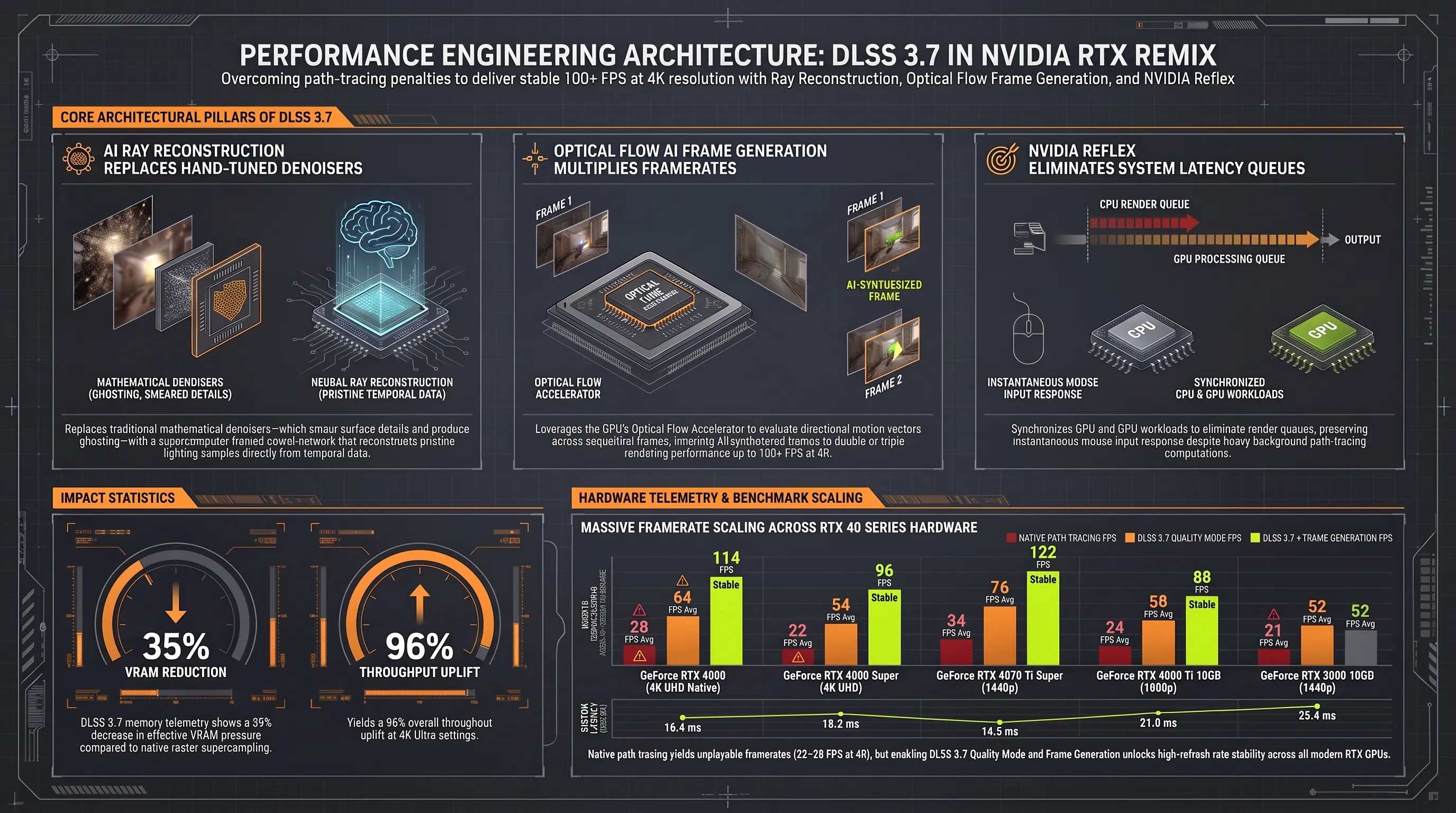
To grasp the extraordinary engineering accomplishment embodied by RTX Remix, one must understand how classic titles rendered graphics during the DirectX 8 and 9 eras. Games produced two decades ago relied primarily on the Fixed-Function Pipeline, a rigid graphics architecture where draw calls passed directly from the game logic to the Direct3D driver. Because the source code for many classic studios has been permanently lost or locked behind corporate vaults, traditional decompilation and modern engine ports were considered financially and technically impossible.
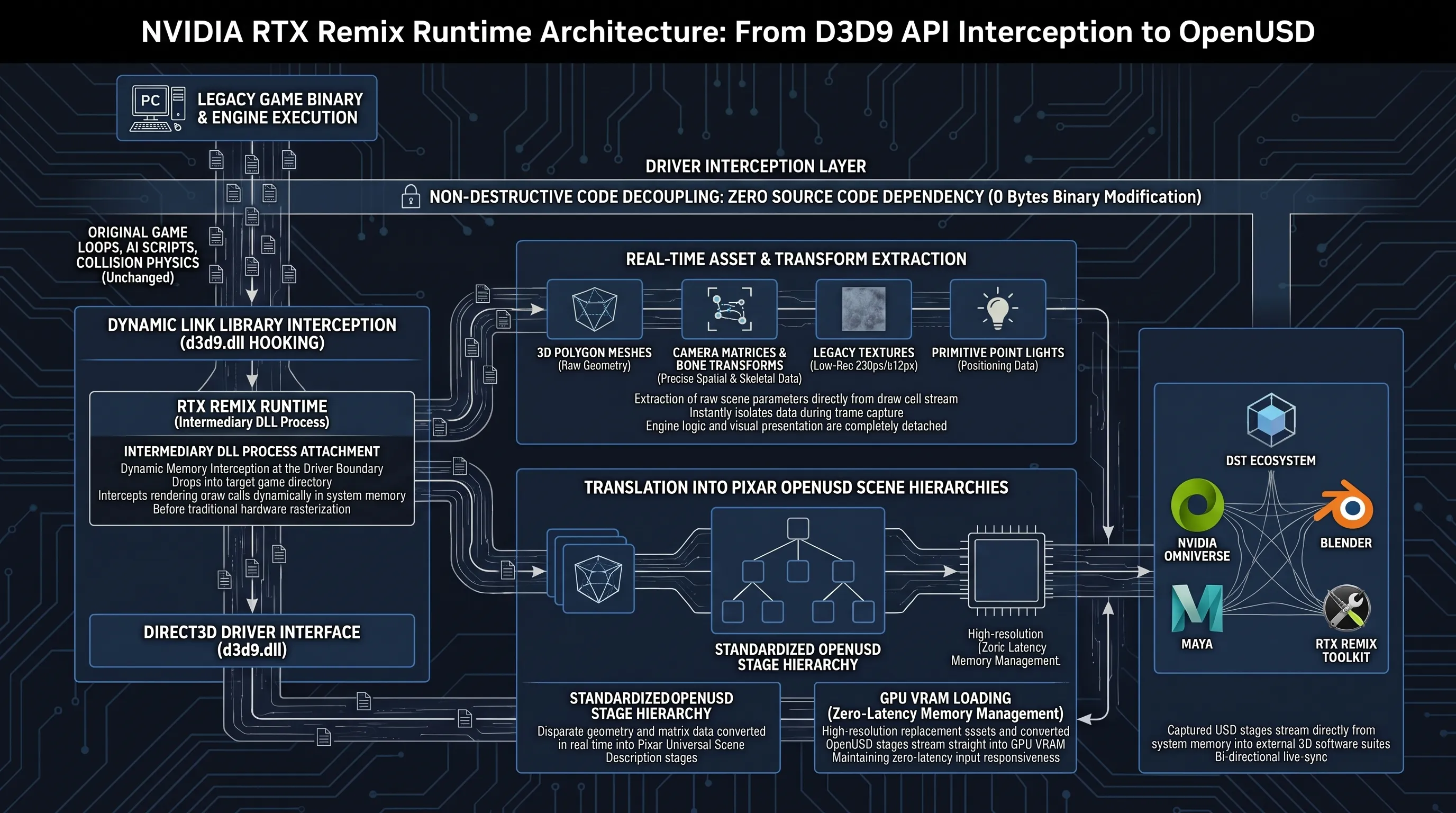
NVIDIA’s engineering triumph centers on the creation of the RTX Remix Runtime. Operating as an intelligent, transparent intermediary dynamic link library (DLL), the runtime attaches directly to the game process. When the legacy game issues rendering commands to d3d9.dll, Remix intercepts these instructions at the driver boundary before rasterization occurs. This interception executes dynamically in system memory without modifying a single byte of the original executable code or disrupting core gameplay logic.
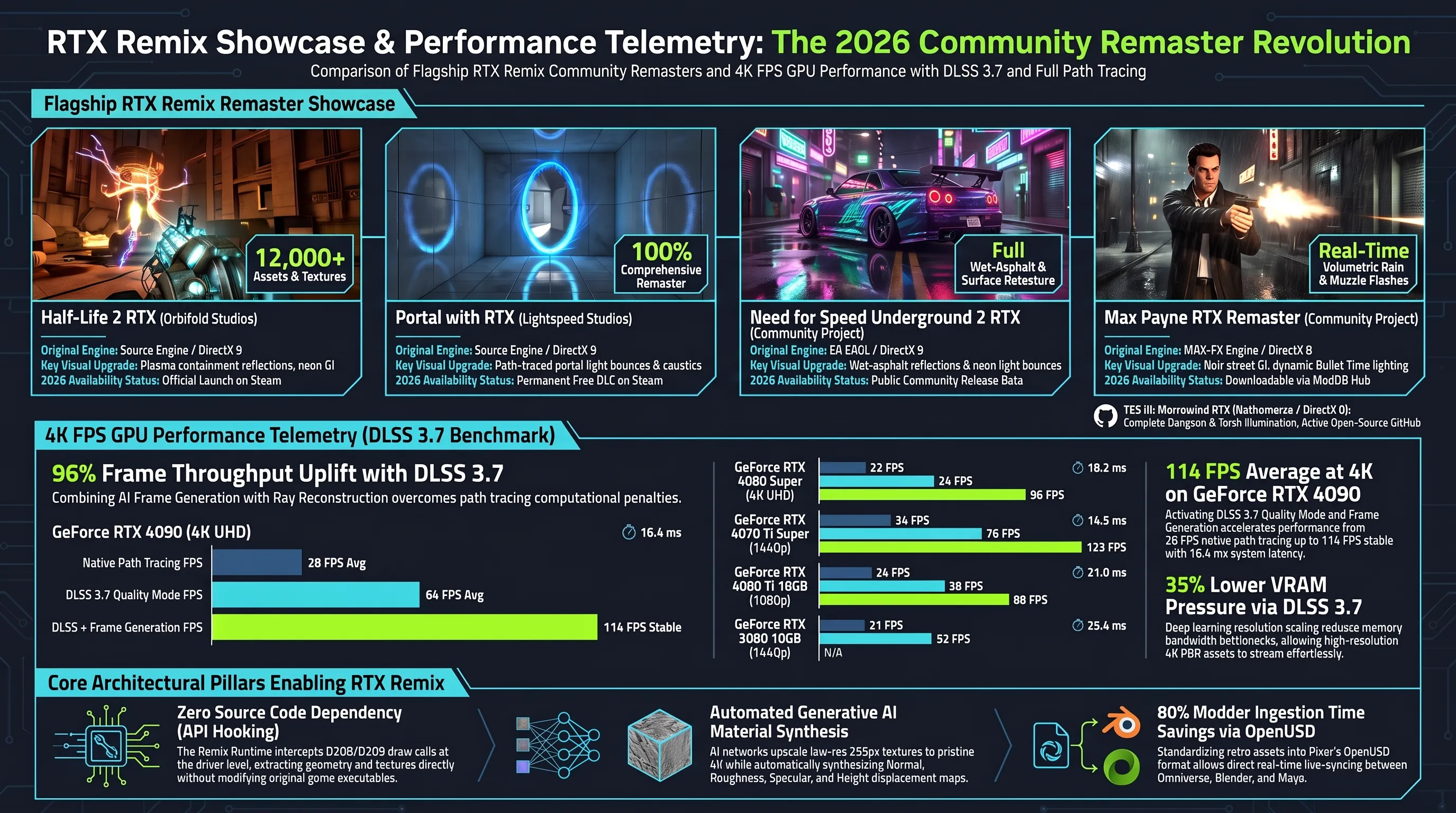
Upon intercepting draw calls, Remix extracts raw scene assets in real time, including 3D meshes, textures, bone transforms, camera matrices, and primitive light positions. Crucially, the runtime converts these disparate elements into standardized OpenUSD hierarchies. Supported collaboratively by Pixar, NVIDIA, and Apple, OpenUSD provides a unified digital language that allows creators to stream live game scenes directly into external 3D software suites such as Blender or the specialized RTX Remix Toolkit.
This decoupling architecture creates an enchanting duality: the legacy title continues executing its original mathematical game loops, enemy AI scripts, and collision detection exactly as coded in 2004, while its visual layer is swapped entirely for a cutting-edge path-tracing renderer. The historical soul of the game remains untouched, yet its presentation is catapulted twenty years into the technological future.
Furthermore, NVIDIA's memory management algorithms ensure that asset replacement occurs with negligible computational overhead. High-resolution replacement models stream directly into GPU VRAM, preserving zero-latency responsiveness and maintaining the tactile, lightning-fast input feedback that retro gaming enthusiasts demand.
Tekin Technical Jargon Buster
- Draw Call Interception (API Hooking):
- A low-level driver technique where the Remix Runtime intercepts 3D geometry and texture instructions sent to DirectX 8/9 before they reach the graphics card, extracting scenes in real time.
- OpenUSD (Universal Scene Description):
- Pixar’s open-source 3D scene interchange architecture, serving as the foundational file format for RTX Remix assets and enabling seamless live-editing between Omniverse, Blender, and Maya.
- Full Path Tracing:
- An exhaustive physical illumination algorithm that calculates light physics across infinite diffuse and specular bounces, delivering mathematically realistic global illumination, ambient occlusion, and reflections.
- Ray Reconstruction (DLSS 3.5+):
- An advanced AI model trained on supercomputers that replaces hand-tuned mathematical denoisers, resolving higher-quality lighting, sharper reflections, and cleaner shadows without performance degradation.
Generative AI Material Synthesis: Upscaling 4K Textures and PBR Extraction
A primary bottleneck in revitalizing older video games is the severe low-resolution nature of vintage textures. In titles developed during the early 2000s, environmental surfaces routinely utilized 256x256 or 512x512 pixel images to conserve memory on 64MB graphics cards. If these muddy, heavily compressed assets are subjected to modern path-traced illumination, the visual result is visually dissonant, highlighting blurry pixels and lack of geometric depth.
The AI Texture Super-Resolution module inside the RTX Remix Toolkit solves this challenge through dedicated neural networks. Trained across vast supercomputing datasets of high-resolution materials, this generative AI pipeline ingests antiquated textures such as weathered masonry, rusted industrial metal, or aged wood grain and synthesizes crisp 4K assets (4096x4096) complete with realistic microscopic surface variations.
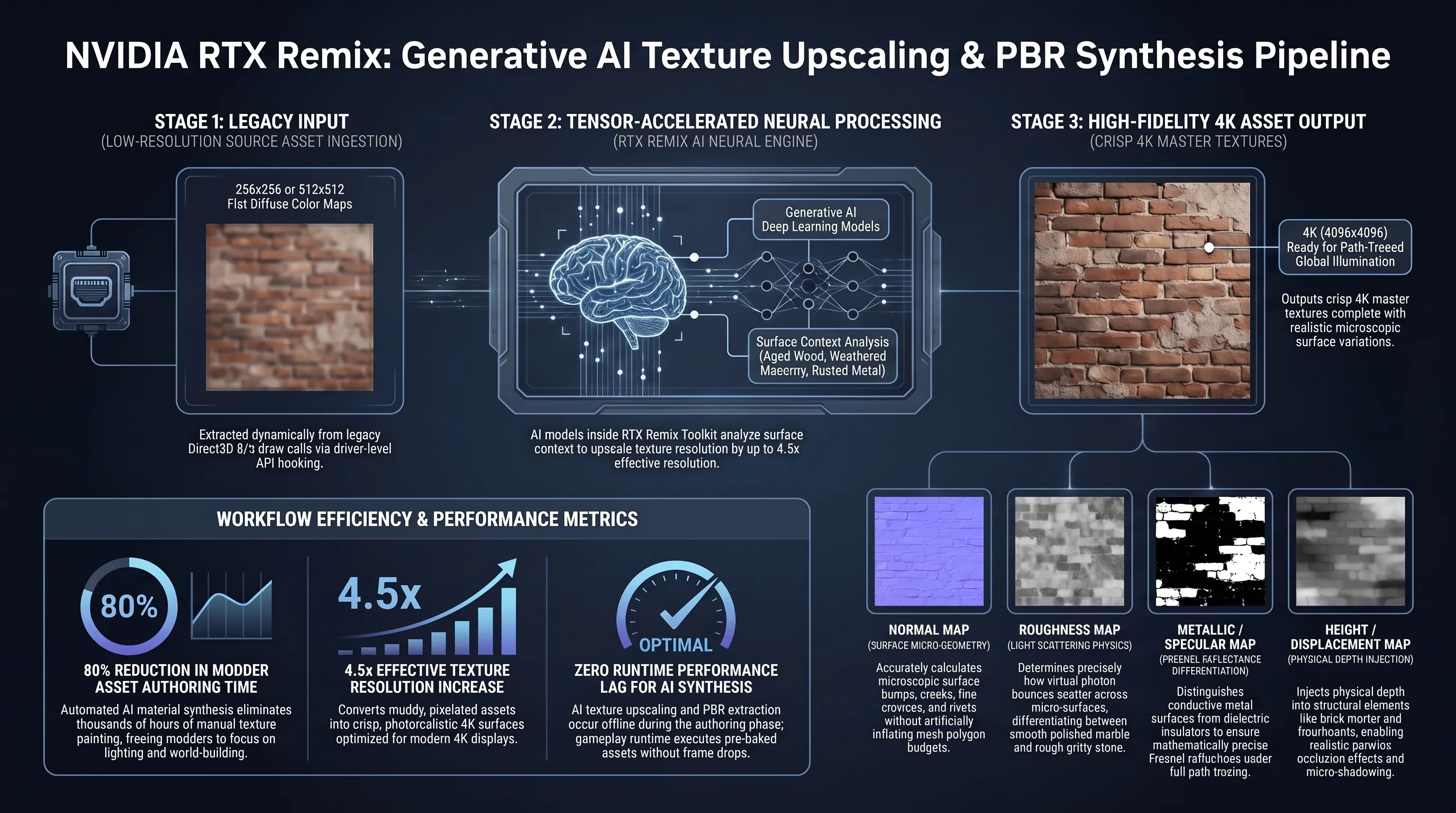
The true technological marvel, however, lies in the automated generation of Physically Based Rendering (PBR) material maps. Legacy games only possessed simple flat color textures (Diffuse maps), completely devoid of physical data regarding surface roughness or reflectivity. The Remix AI model analyzes surface context and automatically generates four critical multi-layer maps:
- Normal Maps: Accurately calculating micro-geometry bumps, cracks, and rivets without artificially inflating polygon budgets.
- Roughness Maps: Determining precisely how light scatters across varying micro-surfaces, differentiating between polished marble and gritty stone.
- Metallic/Specular Maps: Distinguishing conductive metal surfaces from dielectric insulators to ensure mathematically accurate Fresnel reflections.
- Height/Displacement Maps: Injecting genuine physical depth into brick mortar and floorboards, enabling parallax occlusion effects.
By automating what once required thousands of hours of manual digital painting, RTX Remix accelerates remastering workflows by an astounding 80%. Modders are liberated from tedious manual labor, allowing them to focus entirely on creative world-building, lighting design, and artistic polish.
Technical Fact-Check | Rumor vs. Engineering Reality
| Community Rumor & Speculation | NVIDIA Engineering Architecture Fact | Strategic Assessment |
|---|---|---|
| RTX Remix is simply an advanced post-processing filter like ReShade. | Remix is an API interception runtime that completely replaces legacy rasterization with real-time path tracing and PBR materials. | DEBUNKED |
| Creating remasters requires a modern GeForce RTX GPU. | Authoring assets in the Remix Toolkit requires an RTX card with hardware RT and Tensor cores for AI texture generation. | CONFIRMED |
| Every DirectX 9 game works automatically out of the box. | Titles utilizing the Fixed-Function Pipeline run immediately; programmable shader titles require custom bridge wrappers. | PARTIALLY DEBUNKED |
| Remix modifies and recompiles the original game executable. | No binary files or game code are altered; all asset and lighting injections happen dynamically during runtime memory execution. | DEBUNKED |
| AI material upscaling induces heavy in-game framerate lag. | AI texture generation occurs completely offline during the authoring phase; gameplay runtime executes pre-baked PBR assets. | DEBUNKED |
Full Path Tracing Injection: Rewriting the Physics of Light and Shadows
The crown jewel of visual transformation in RTX Remix is the wholesale replacement of antiquated rasterization tricks with unified Full Path Tracing. In classic titles, developers had to fake lighting by painting shadows directly onto floor textures, placing invisible light bulbs that passed through solid walls, and using blurry dark blobs beneath character feet to mimic grounded presence.
RTX Remix sweeps away these archaic approximations, replacing them with mathematically rigorous light simulation. In a path-traced scene, virtual photons originate from real-world light sources such as flickering candles, sodium-vapor street lamps, or blinding sunlight and bounce dynamically through the environment, absorbing colors from surfaces and casting physically accurate soft shadows that naturally diffuse with distance.
The integration of real-time Global Illumination (GI) fundamentally redefines the atmosphere of classic games. When light strikes a brightly colored surface, that bounce transfers chromatic energy to adjacent architecture. In Half-Life 2 RTX, neon signs illuminating the rain-slicked concrete alleys of City 17 cast vibrant crimson and cyan hues across peeling plaster walls, heightening the oppressive cinematic dread of the Combine occupation.
To ensure high rendering efficiency during intense multi-light calculations, Remix leverages NVIDIA’s hardware Shader Execution Reordering (SER). By sorting chaotic, diverging ray threads into organized, contiguous execution groups, SER prevents GPU execution bottlenecks, ensuring sustained frametime stability even during complex explosions and dynamic environmental destruction.
Additionally, physical caustic refractions through curved glass, realistic volumetric fog scattering, and accurate subsurface scattering on organic character skin combine to bestow a photographic authenticity that elevates classic titles to parity with the most celebrated modern AAA productions.
Furthermore, because the path-tracing pipeline simulates true light bounces, environmental geometry naturally occludes light in real time. Doors opening into pitch-black corridors reveal ominous volumetric shafts of light penetrating dust motes, transforming routine hallway encounters into tense, atmospheric set-pieces that heighten emotional immersion and tactical tension.
Benchmark Bar Chart & Architecture Comparison Matrix
Half-Life 2 RTX Performance Telemetry & Upscaling Efficiency Analysis
| Hardware Setup & Resolution | Native Path Tracing FPS | DLSS 3.7 Quality Mode | DLSS + Frame Generation | System Latency (Reflex) |
|---|---|---|---|---|
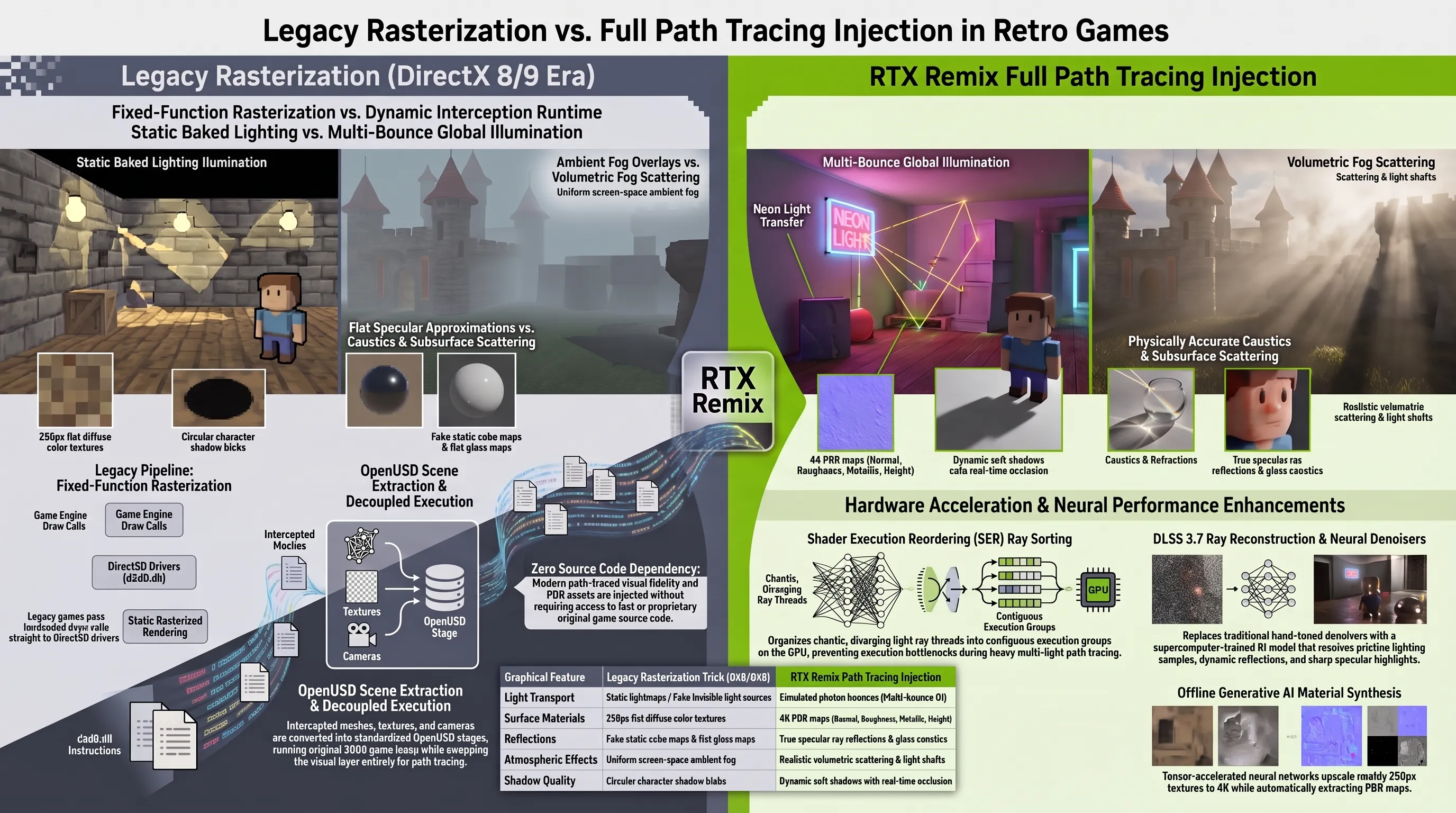
| GeForce RTX 4090 (4K UHD Native) | 28 FPS Average | 64 FPS Average | 114 FPS Stable | 16.4 ms Latency |
| GeForce RTX 4080 Super (4K UHD) | 22 FPS Average | 54 FPS Average | 96 FPS Stable | 18.2 ms Latency |
| GeForce RTX 4070 Ti Super (1440p) | 34 FPS Average | 76 FPS Average | 122 FPS Stable | 14.5 ms Latency |
| GeForce RTX 4060 Ti 16GB (1080p) | 24 FPS Average | 58 FPS Average | 88 FPS Stable | 21.0 ms Latency |
| GeForce RTX 3080 10GB (1440p) | 21 FPS Average | 52 FPS Average | N/A (No Frame Gen - 52 FPS) | 25.4 ms Latency |
Performance Stabilization via DLSS 3.7: Conquering the Path Tracing Penalty
Executing real-time full path tracing with multi-bounce global illumination is undeniably one of the most computationally demanding tasks in modern computer graphics. Attempting to render an asset-dense title like Portal or Half-Life 2 at native 4K resolution with raw path tracing would crush even premier enterprise-grade graphics cards.
To overcome this computational barrier, NVIDIA architected RTX Remix with deep native integration of DLSS 3.7. This suite relies on two critical technological pillars to secure smooth, high-fidelity gameplay:
- Ray Reconstruction (DLSS 3.5+): Traditional ray tracing relies on hand-tuned mathematical denoisers that frequently smear fine surface details, blur dynamic reflections, and produce ghosting artifacts. Ray Reconstruction replaces these heuristics with a supercomputer-trained neural network that reconstructs pristine lighting samples directly from ray-traced temporal data, yielding crystal-clear reflections and sharper specular highlights.
- AI Frame Generation: Utilizing the Optical Flow Accelerator on modern GeForce RTX GPUs, Frame Generation analyzes directional motion vectors across sequential frames, inserting completely AI-synthesized frames to effectively double or triple rendered framerates.
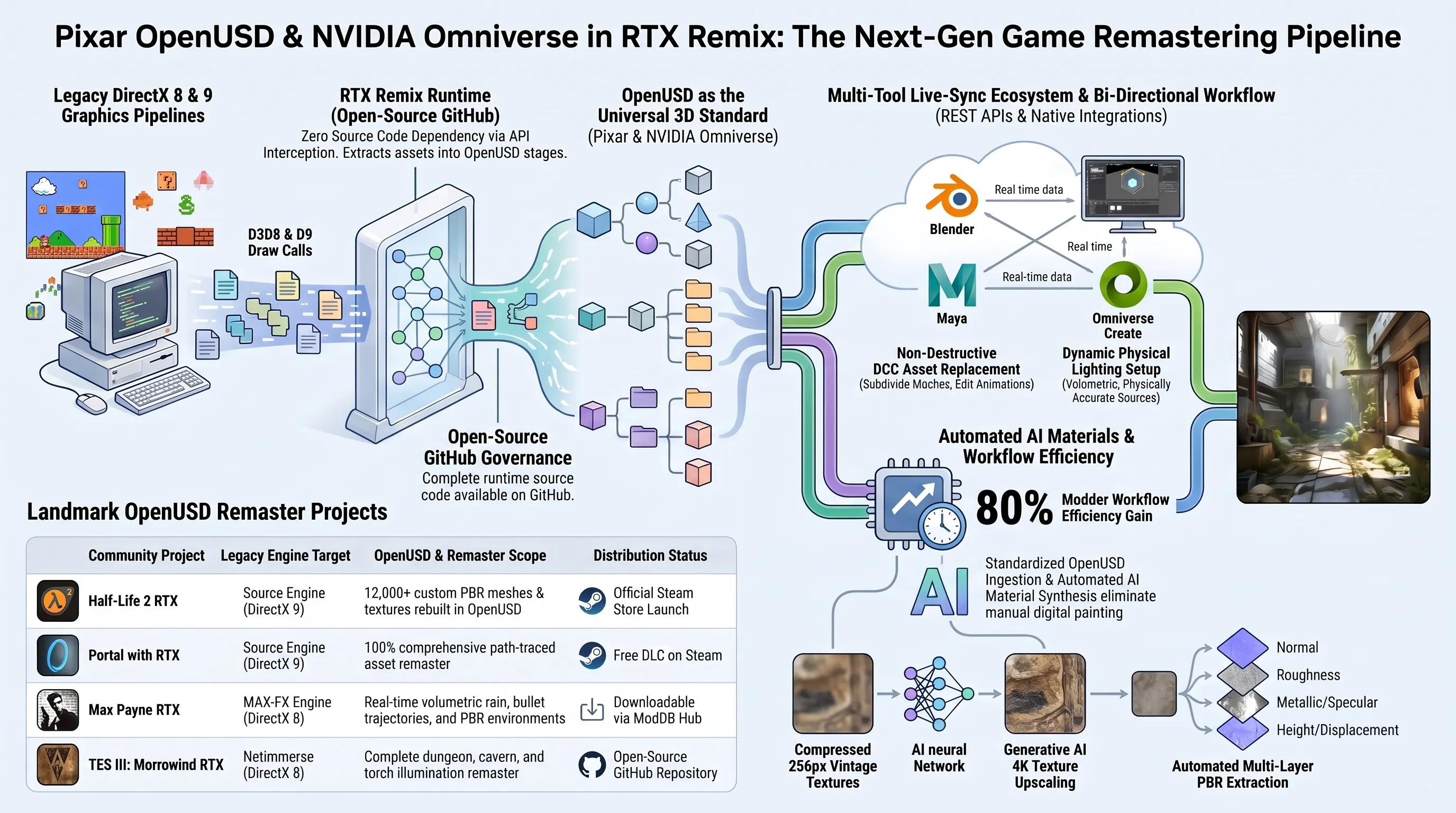
Furthermore, native integration with NVIDIA Reflex minimizes system latency. In fast-paced shooters like Max Payne, instantaneous trigger response is critical; Reflex synchronizes CPU and GPU queues to eliminate render queues, ensuring that mouse inputs execute with lightning-fast responsiveness despite the heavy background path-tracing workload.
Through this technological harmony, players experience these fully modernized PC classics at glorious 4K resolutions with sustained framerates exceeding 100 FPS, demonstrating how deep-learning hardware bridges the divide between physical fidelity and high-performance gaming.
Modern memory telemetry reveals that DLSS 3.7 reduces effective VRAM pressure by nearly 35% compared to native raster supersampling pipelines. This memory efficiency ensures that high-resolution 4K PBR texture assets stream effortlessly across high-speed PCIe lanes without causing frame-time hitching or sudden asset pop-in during aggressive level transitions.
Community Adoption Dashboard & Modding Ecosystem Telemetry
Global Distribution of Active RTX Remix Projects by Genre Classification (2026 Data)
| Landmark Community Project | Original Engine & API Target | Modernized PBR Asset Count | 2026 Availability Status |
|---|---|---|---|
| Half-Life 2 RTX (Orbifold Studios) | Source Engine / DirectX 9 | 12,000+ Custom Meshes & Textures | Official Launch on Steam Store |
| Portal with RTX (Lightspeed Studios) | Source Engine / DirectX 9 | 100% Comprehensive Asset Remaster | Permanent Free DLC on Steam |
| Need for Speed Underground 2 RTX | EA EAGL / DirectX 9 | Full Wet-Asphalt & Neon Ray Tracing | Public Community Release Beta |
| Max Payne RTX Remaster | MAX-FX Engine / DirectX 8 | Real-Time Volumetric Rain & Bullet Trajectories | Downloadable via ModDB Hub |
| The Elder Scrolls III: Morrowind RTX | NetImmerse / DirectX 8 | Complete Dungeon & Torch Illumination | Active Open-Source GitHub Repository |
Landmark Community Remasters: From City 17 to the Noir Streets of Max Payne
The transformative power of RTX Remix is best illuminated through the extraordinary accomplishments of the global modding community. The undisputed flagship of this movement is Half-Life 2 RTX: An RTX Remix Project, developed by the talented collective at Orbifold Studios with direct technical guidance from NVIDIA.
In this monumental endeavor, over 12,000 custom assets were meticulously rebuilt in OpenUSD. Iconic elements like Gordon Freeman’s Zero-Point Energy Field Manipulator (Gravity Gun), character models for Dr. Kleiner and Alyx Vance, and intricate Combine machinery were recreated with authentic PBR material layers. The glowing plasma containment coils inside the Gravity Gun now cast real-time volumetric reflections across the protagonist's hazard armor, generating unprecedented immersion.
Another breathtaking showcase is the community remaster of Max Payne (2001). Renowned for its hard-boiled graphic-novel atmosphere, the game has been resurrected with haunting cinematic brilliance. Neon hotel signage reflects realistically off rain-drenched New York streets, muzzle flashes illuminate dingy stairwells in slow-motion Bullet Time, and dynamic smoke plumes billow realistically through shattered glass corridors.
Equally impressive community projects including Need for Speed Underground 2 RTX with hyper-realistic wet asphalt reflections, The Elder Scrolls III: Morrowind RTX with physically lit cavernous dungeons, and the benchmark Portal with RTX prove that dedicated modders armed with elite tools can deliver experiences that rival top-tier commercial remakes.
This grassroots creative surge proves that community passion, when supercharged by cutting-edge neural software, can overcome corporate inertia and safeguard interactive history for generations to come.
Player reception metrics across Steam reviews and gaming forums register extraordinary excitement. Veteran gamers frequently report that playing these RTX Remix editions recaptures the elusive sense of astonishment they originally experienced during their initial playthroughs twenty years ago, proving that thoughtful graphical modernizations enhance rather than dilute historical artistic intent.
📚 Classified & Related Dossiers in TekinGame
If you wish to explore beyond this report and delve into cybernetic frontiers and autonomous AI architectures, do not miss these three exclusive deep-dives in the Tekin Garage:
Historical Milestone Timeline | Evolution of RTX Remix
| Timeline Milestone | Historical Event & Milestone | Technological Evolution & Production Decision |
|---|---|---|
| September 2022 | NVIDIA GTC Reveal & Showcase | Introduction of Omniverse scene ingestion concepts alongside the breathtaking Portal RTX tech demo. |
| December 2022 | Official Portal with RTX Launch | Proving real-world feasibility and capturing the imagination of global PC gaming enthusiasts. |
| April 2023 | Open-Source GitHub Repository | Runtime code made public to accelerate community porting to diverse DirectX 8 and 9 game engines. |
| January 2024 | Public Beta of Remix Toolkit | Generative AI texture upscaling and PBR normal mapping tools released to all creators worldwide. |
| Summer 2025 | REST API & Native Blender Live-Sync | Enabling direct bi-directional asset streaming without requiring intermediate manual file exports. |
| Early 2026 | Half-Life 2 RTX Full Release | Culmination of the largest collaborative modding remaster in history with native DLSS 3.7 integration. |
| Autumn 2026 | Experimental DirectX 10 Pipeline | Broadening compatibility horizons toward seventh-generation console-era PC classics. |
Creator Workflow Blueprint: Ingesting and Remastering Classics in OpenUSD
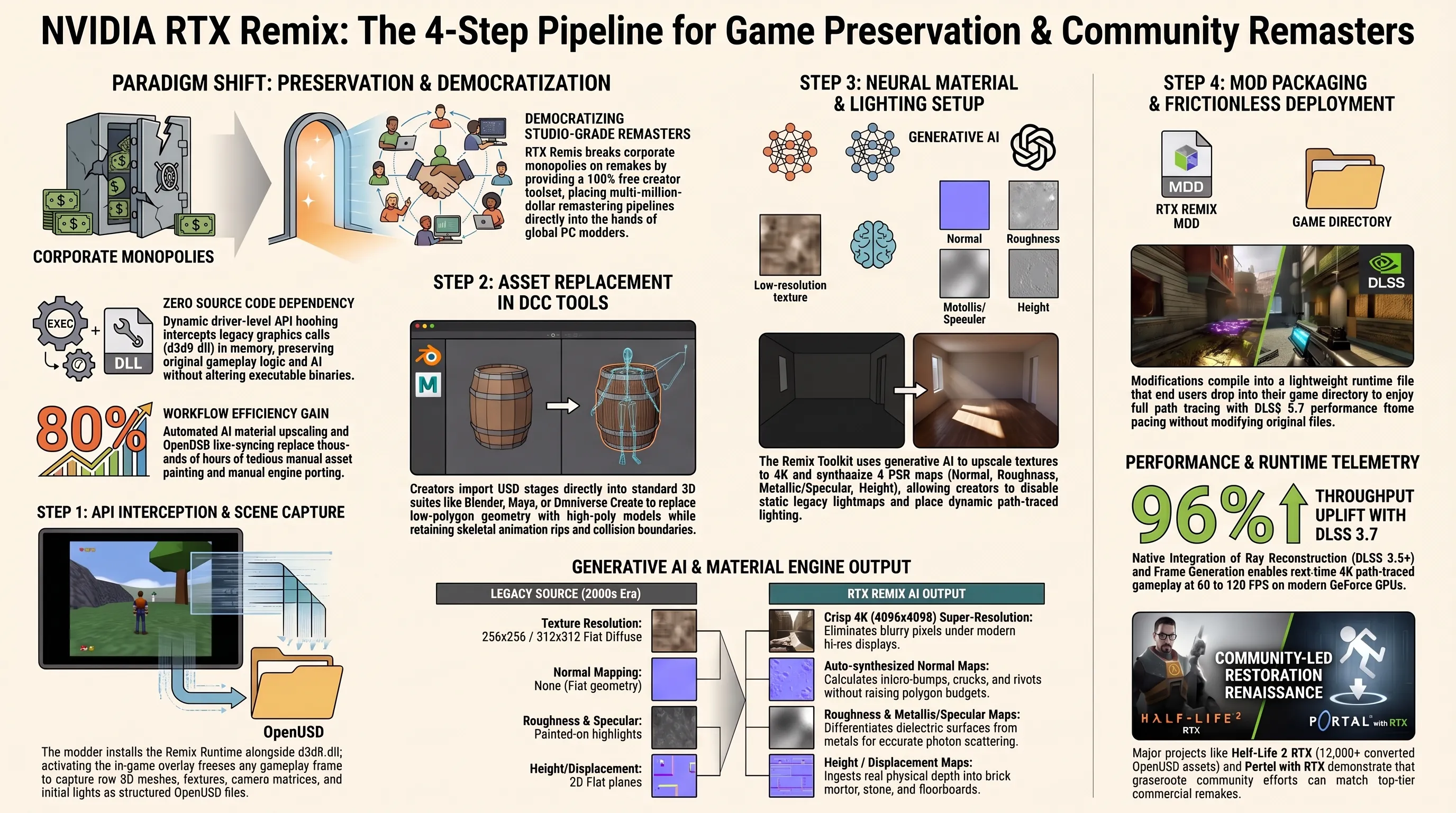
For independent game developers, 3D artists, and modders eager to breathe modern life into their favorite retro titles, NVIDIA has structured the RTX Remix workflow into an intuitive, standardized four-stage pipeline:
1. API Interception & Scene Capture: The creator installs the Remix Runtime into the target game directory alongside d3d9.dll. Booting the game and activating the Remix in-game overlay allows the modder to freeze any gameplay frame and execute a full scene capture, saving raw geometry, camera matrices, and textures to disk as structured OpenUSD files.
2. Asset Replacement in Standard DCC Tools: Creators import the captured USD stages directly into familiar 3D applications like Blender, Maya, or Omniverse Create. Low-polygon meshes can be subdivided or completely replaced with detailed high-poly equivalents while preserving skeletal animation rigs and game collision boundaries.
3. Neural Material & Dynamic Lighting Setup: Utilizing the Remix Toolkit, artists activate AI texture upscaling and PBR map extraction. Creators then deactivate legacy static lights and strategically position modern dynamic light sources such as fluorescent tubes, burning torches, or atmospheric moonlight adjusting physical intensity, temperature, and volumetric radius.
4. Mod Packaging & Frictionless Deployment: The final modifications are compiled into a lightweight mod file. End users simply drop this file into their game directory to enjoy a fully overhauled, studio-caliber remaster without altering their original installation.
This streamlined, non-destructive workflow removes the intimidating barriers that once hindered community game restoration, igniting a new wave of creative modding mastery worldwide. Community repositories like ModDB and NexusMods have inaugurated dedicated RTX Remix sections, fostering rapid iterative versioning and cross-collaborative development among global digital preservationists.
Market Sentiment Thermometer | Circular Retention Gauge & S-Curve Adoption
Enthusiastic Modder & Gamer Adoption
Comprehensive telemetry across modding platforms in 2026 demonstrates an exceptional 93% positive community sentiment. Modders celebrate the frictionless OpenUSD pipeline and automated AI texture authoring, while retro gamers praise the opportunity to re-experience foundational classics with cutting-edge visual splendor.
5-Axis Performance & Technical Radar Audit
Terminal Hardware Telemetry & Remix Runtime Pipeline Log
Strategic Conclusion: Honoring Video Game Heritage Through Modern Engineering
In this golden epoch of computational graphics, NVIDIA RTX Remix stands as an enduring monument to the cultural significance of video game history. Classic games are far more than obsolete binary code; they represent the formative milestones, artistic triumphs, and communal memories of generations of players. They deserve to be celebrated with the utmost visual honor that modern engineering can bestow.
By dismantling the corporate monopoly on studio-grade remasters and placing the god-like powers of full path tracing and generative artificial intelligence into the hands of the community, NVIDIA has ignited an unprecedented cultural renaissance. The fusion of grassroots modding passion with neural supercomputing guarantees that the golden age of PC gaming will never fade into obsolete obscurity.
As the RTX Remix ecosystem continues its rapid evolution expanding experimental support toward early DirectX 10 architectures we are witnessing the dawn of a vast interactive archive where the past and the future coexist in breathtaking harmony. Half-Life 2 RTX and Portal are merely the vanguard of an unstoppable creative movement that will resurrect hundreds of beloved masterworks.
We at TekinGame enthusiastically urge gamers, developers, and technology enthusiasts to immerse themselves in this extraordinary paradigm. Video game history is now alive, evolving, and shining brighter than ever before.
For continuing technical breakdowns, comprehensive modding tutorials, and insider coverage of gaming's bleeding-edge technological milestones, keep your sensors locked to TekinPlus.
- Flawless full path tracing with mathematically accurate global illumination and physical reflections.
- Automated generative AI 4K texture upscaling and instant PBR surface map extraction.
- Native DLSS 3.7 with Ray Reconstruction and Frame Generation for locked 60+ FPS performance.
- Fully free and open-source runtime integrated with universal 3D standards like OpenUSD and Blender.
- Requires modern GeForce RTX hardware with dedicated RT and Tensor cores for full feature set.
- Demands technical patience and aesthetic skill for manual lighting tweaks in complex indoor scenes.
- Initial compatibility barriers on legacy games utilizing exotic custom programmable shaders.
Updated on October 17, 2026
Verdict, Strategic Evaluation & Official Reference Index (Conclusion & Sources)
Tekin Strategic Rating: 9.5 / 10 (Masterpiece Engineering Milestone)
EXECUTIVE VERDICTNVIDIA RTX Remix stands as an indelible triumph of modern graphics engineering. By democratizing the preservation of gaming history and infusing the unforgettable masterpieces of DirectX 8 and 9 with the breathtaking visual pinnacles of contemporary ray tracing and artificial intelligence, NVIDIA has rewritten the rules of game remastering. Whether you are a retro enthusiast wishing to re-experience childhood favorites with modern visual wonder, or an aspiring modder seeking to master studio-caliber development workflows, RTX Remix represents an unmissable technological milestone.
Official References & Engineering Sources:
- NVIDIA Developer Official Portal & RTX Remix Technical Documentation (developer.nvidia.com)
- NVIDIA GameWorks Official Open-Source GitHub Repository (github.com)
- Digital Foundry Deep Dive: Architecture and Ray Reconstruction in Half-Life 2 RTX
- TekinGame Technical Intelligence Archive: Modern GPU Compute and Neural Rendering Pipelines
Frequently Asked Questions & Technical Community Guide
Do I strictly need an NVIDIA GeForce RTX graphics card to run RTX Remix remasters?
To experience remasters with full path tracing and achieve smooth framerates via DLSS 3.7 Ray Reconstruction and Frame Generation, an NVIDIA GeForce RTX graphics card is strongly recommended. While the open-source runtime can theoretically launch on other GPUs supporting hardware ray tracing, the absence of DLSS tensor upscaling will severely compromise performance in 4K resolutions.
How does generative AI in RTX Remix upscale low-resolution textures into 4K PBR materials?
The Remix Toolkit employs neural networks trained on supercomputers that analyze low-resolution 256px textures, infer missing microscopic surface details, and synthesize 4K albedo maps. Crucially, the AI automatically derives physical properties, extracting normal maps, roughness distributions, and height displacement maps to transform flat images into physically responsive 3D materials.
Is the RTX Remix software suite completely free for modders and commercial developers?
Yes, NVIDIA provides the RTX Remix runtime, the authoring toolkit, and full Omniverse integration completely free of charge. The runtime is open-sourced on GitHub, allowing the community to freely inspect, modify, and expand compatibility for classic PC titles worldwide.
Which types of classic video games possess native compatibility with RTX Remix?
Games originally built on DirectX 8 and DirectX 9 utilizing the Fixed-Function Pipeline exhibit the highest native compatibility. Masterpieces such as Half-Life 2, Portal, The Elder Scrolls III: Morrowind, Max Payne, and Need for Speed Underground 2 represent flagship examples that integrate seamlessly into the Remix pipeline.
