Tekin Analysis | Hardware Rebellion & AI Paradox: Why Gamers Became Victims of the AI Revolution
Introduction: When Gamers Were Left in the Queue
Greetings, Tekin Army! Imagine walking into a shop to buy a graphics card, only to be told: "Sorry, we don't make GPUs for gamers anymore. The profit margin is simply too low." This is no longer a hypothetical dystopian scenario; this is the harsh, unyielding reality of 2026.
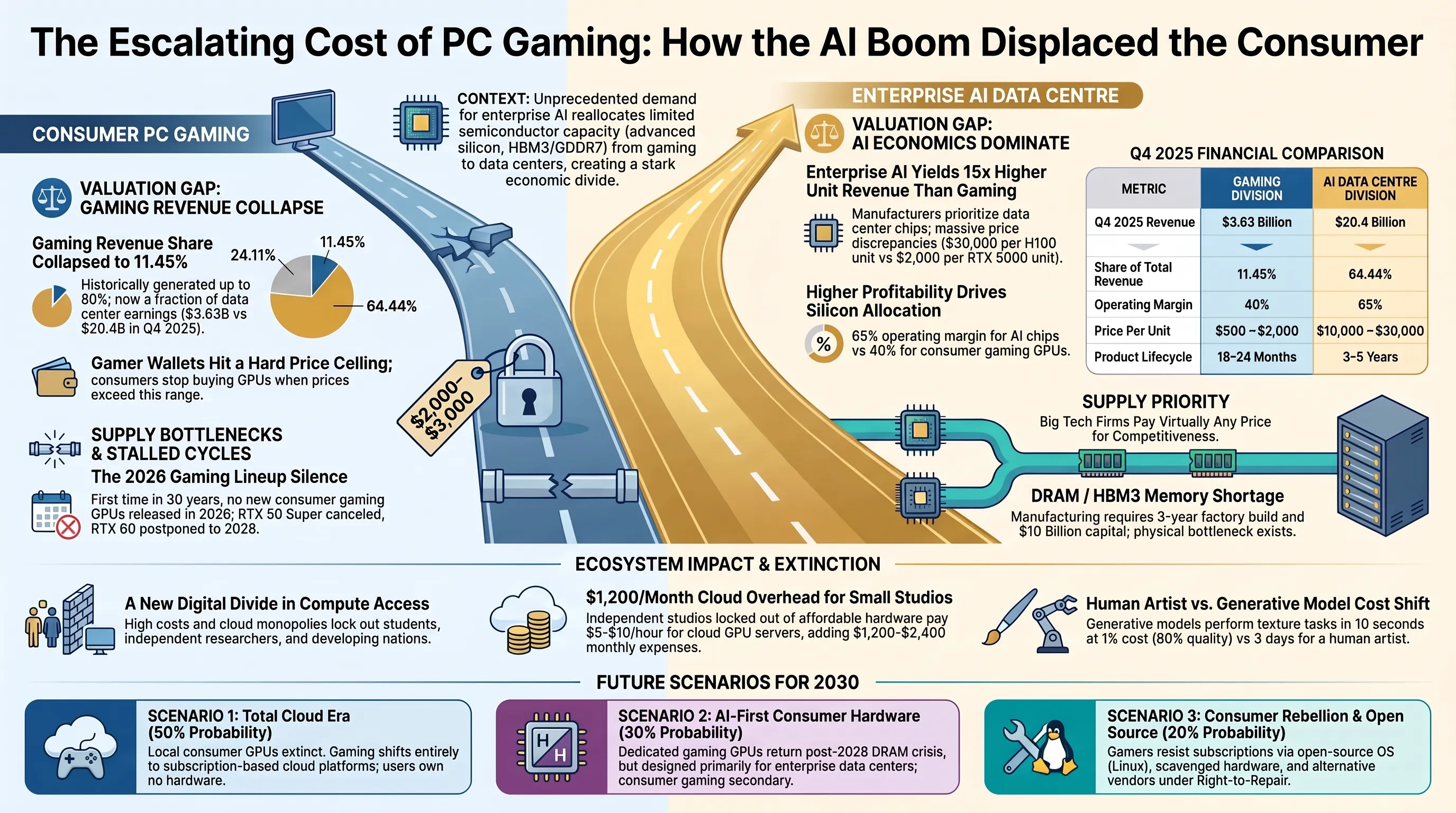
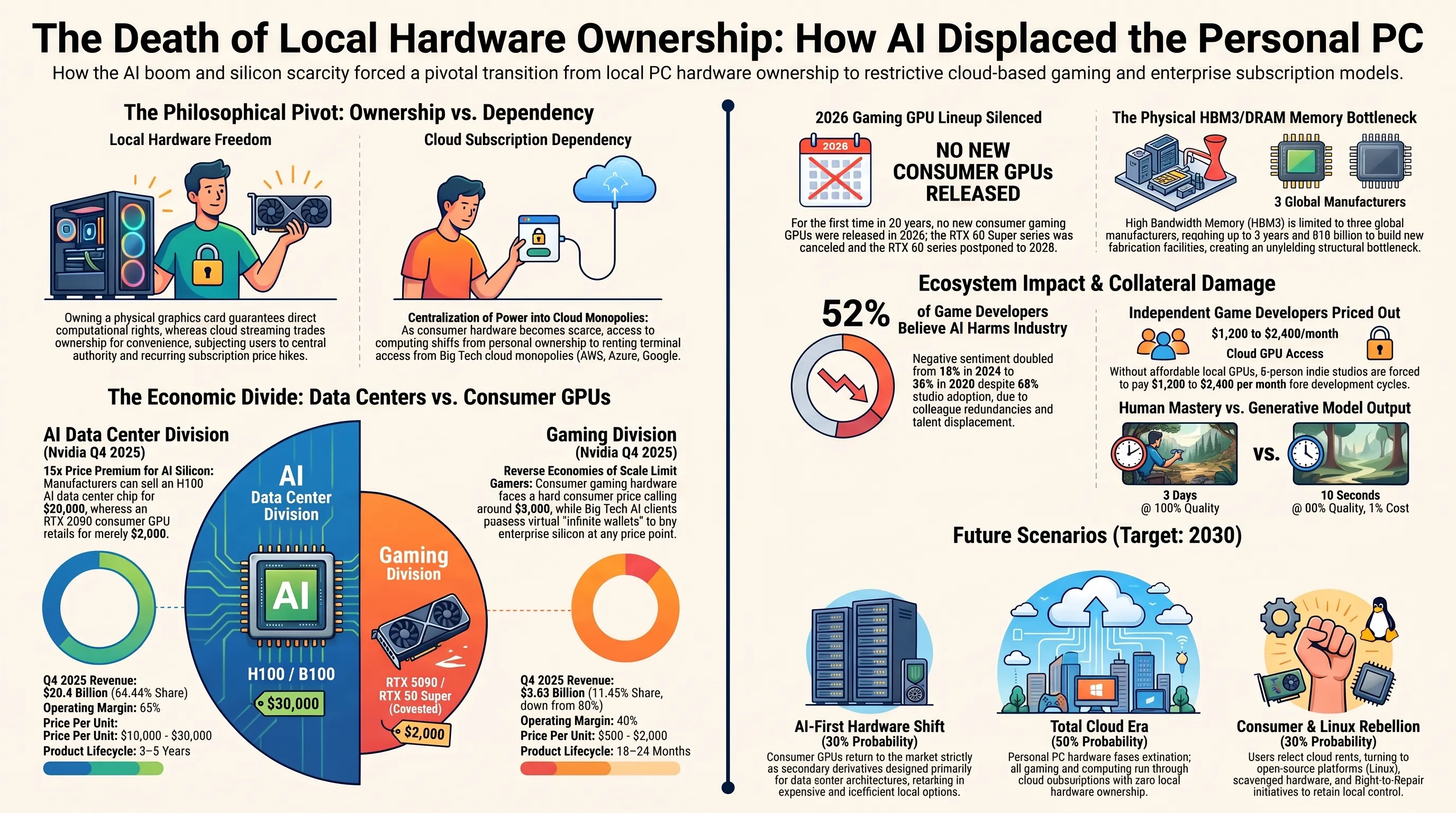
Nvidia, the undisputed titan of the graphics industry, has made a decision unprecedented in its 30-year history: for the first time, it will not release a single new gaming GPU in 2026. The highly anticipated RTX 50 Super series has been abruptly cancelled, and the subsequent RTX 60 series has been postponed until at least 2028. Meanwhile, the GDC 2026 survey reveals a terrifying trend: while 68% of game studios use AI, 52% of developers believe AI is actively harming the industry (a massive spike from 18% in 2024).
We are facing a colossal paradox: the technology that was supposed to revolutionize gaming is now cannibalizing its foundational infrastructure. Why? Because selling an AI chip to data centers yields a staggering 65% operating margin, whilst selling the exact same silicon to a gamer yields only 40%. This is a "Hardware Rebellion" a moment in time where silicon itself decides who truly deserves computational power.
Strategic Evaluation & Key Takeaways at a Glance
Technical Autopsy: Why Nvidia Abandoned Gamers
The Economics of Silicon: When DRAM Becomes Gold
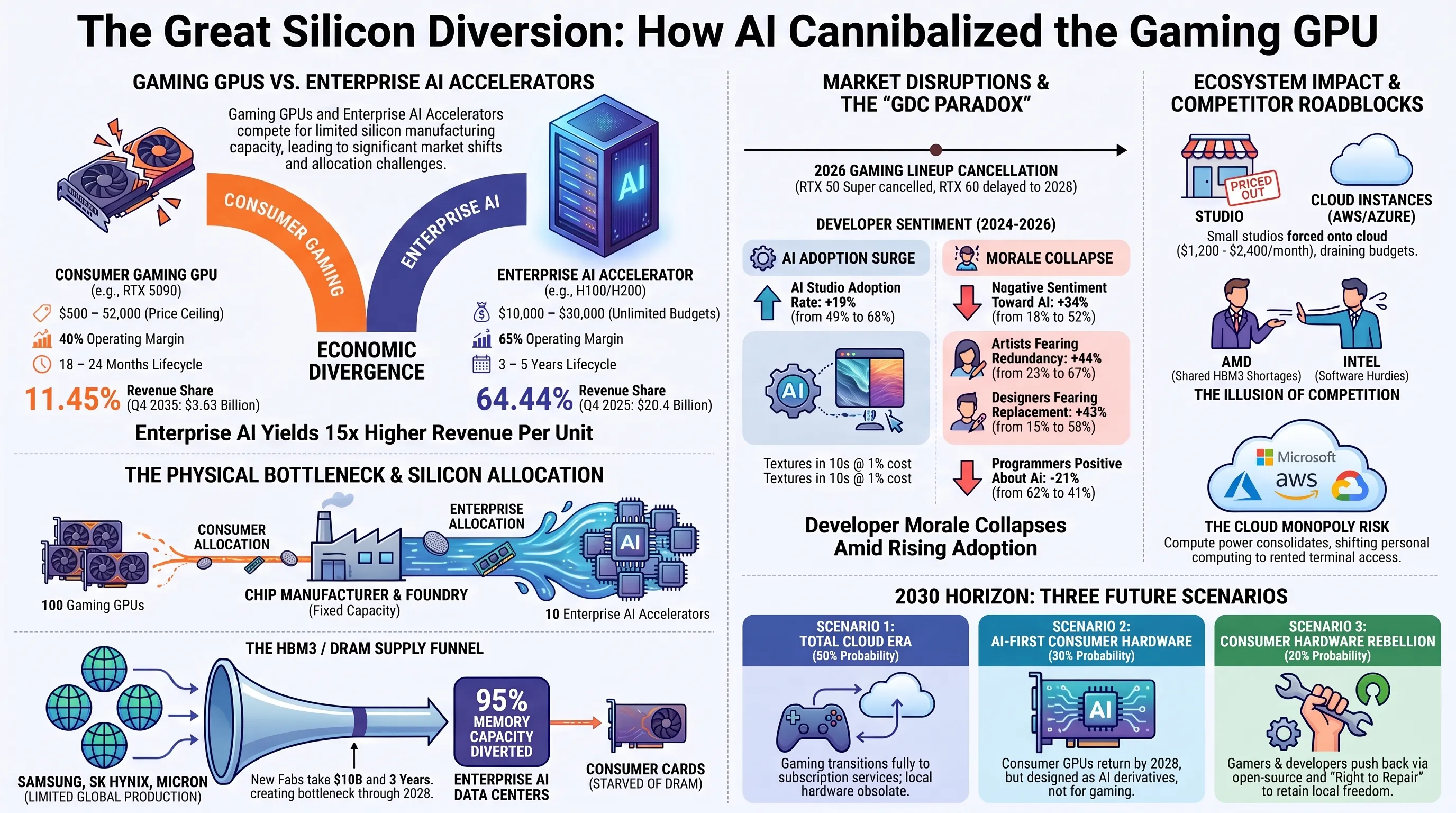
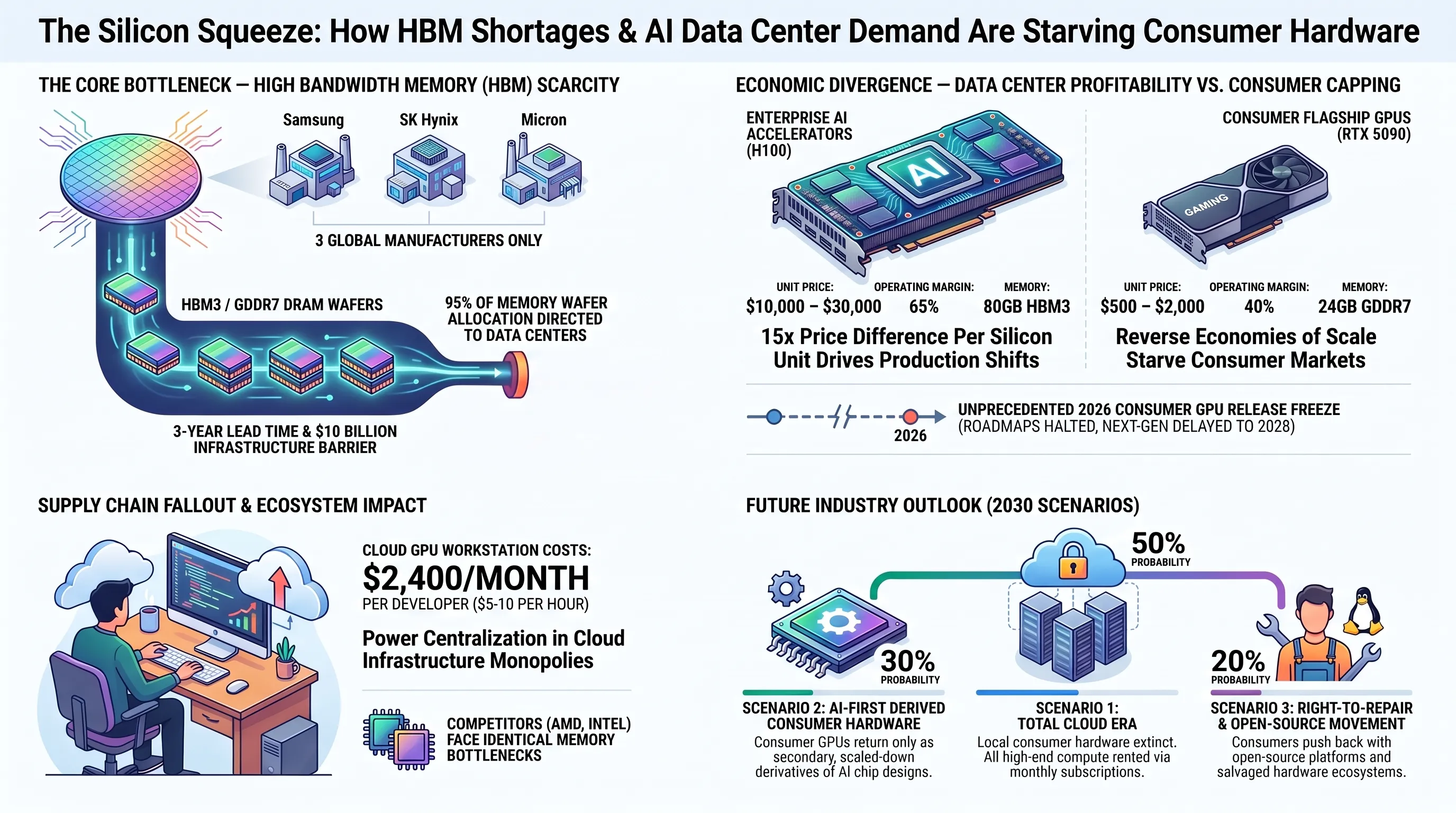
Let us examine what lies beneath the bonnet. A flagship graphics card like the RTX 5090 requires 24GB of cutting-edge GDDR7 memory. The exact same foundational memory is utilized in an H100 chip designed for data centers. However, there is one critical difference: Nvidia can sell a single H100 chip for $30,000, whilst an RTX 5090 retails for a mere $2,000.
Now, inject the global DRAM crisis into this equation. Memory manufacturers like Samsung and SK Hynix simply cannot produce fast enough to satiate the market. Nvidia is forced to choose: manufacture 100 graphics cards for gamers, or 10 AI chips for data centers? From a strictly financial perspective, the answer is brutally unambiguous.
Financial Comparison Matrix: Gaming vs. AI Data Centers
| Financial / Production Metric | Gaming Division | AI Data Center Division |
|---|---|---|
| Q4 2025 Revenue | $3.63 Billion | $20.4 Billion |
| Share of Total Revenue | 11.45% | 64.44% |
| Operating Margin | 40% | 65% |
| Price Per Unit (Retail) | $500 - $2,000 | $10,000 - $30,000 |
| Product Lifecycle | 18 - 24 Months | 3 - 5 Years |
This table tells the real, unfiltered story: Nvidia's gaming division, which historically accounted for 80% of the company's revenue, now represents a trivial 11.45%. This is an economic revolution that has completely transformed the tech landscape in just three years.
The GDC Paradox: When Developers Fear Their Own Tools
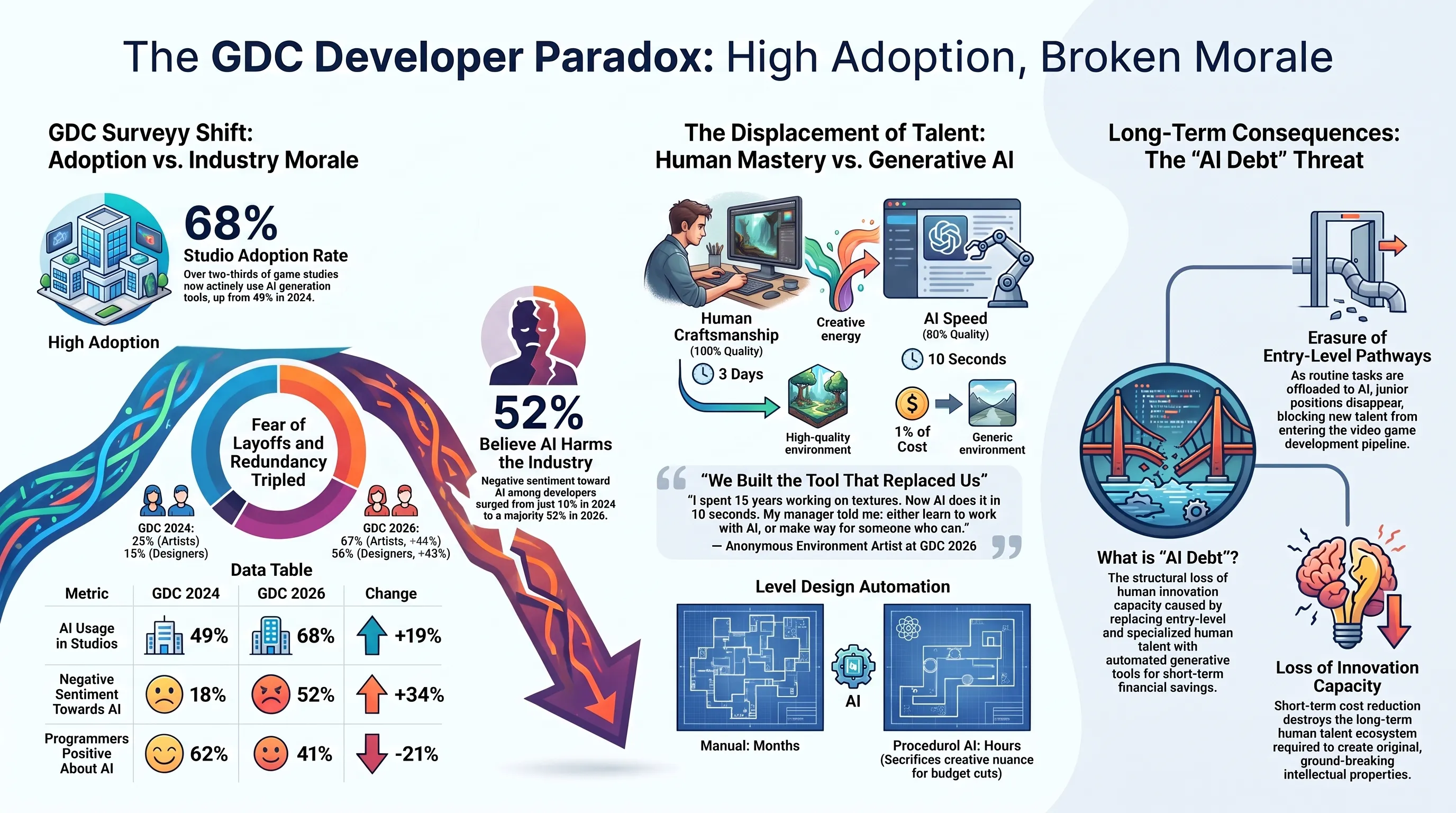
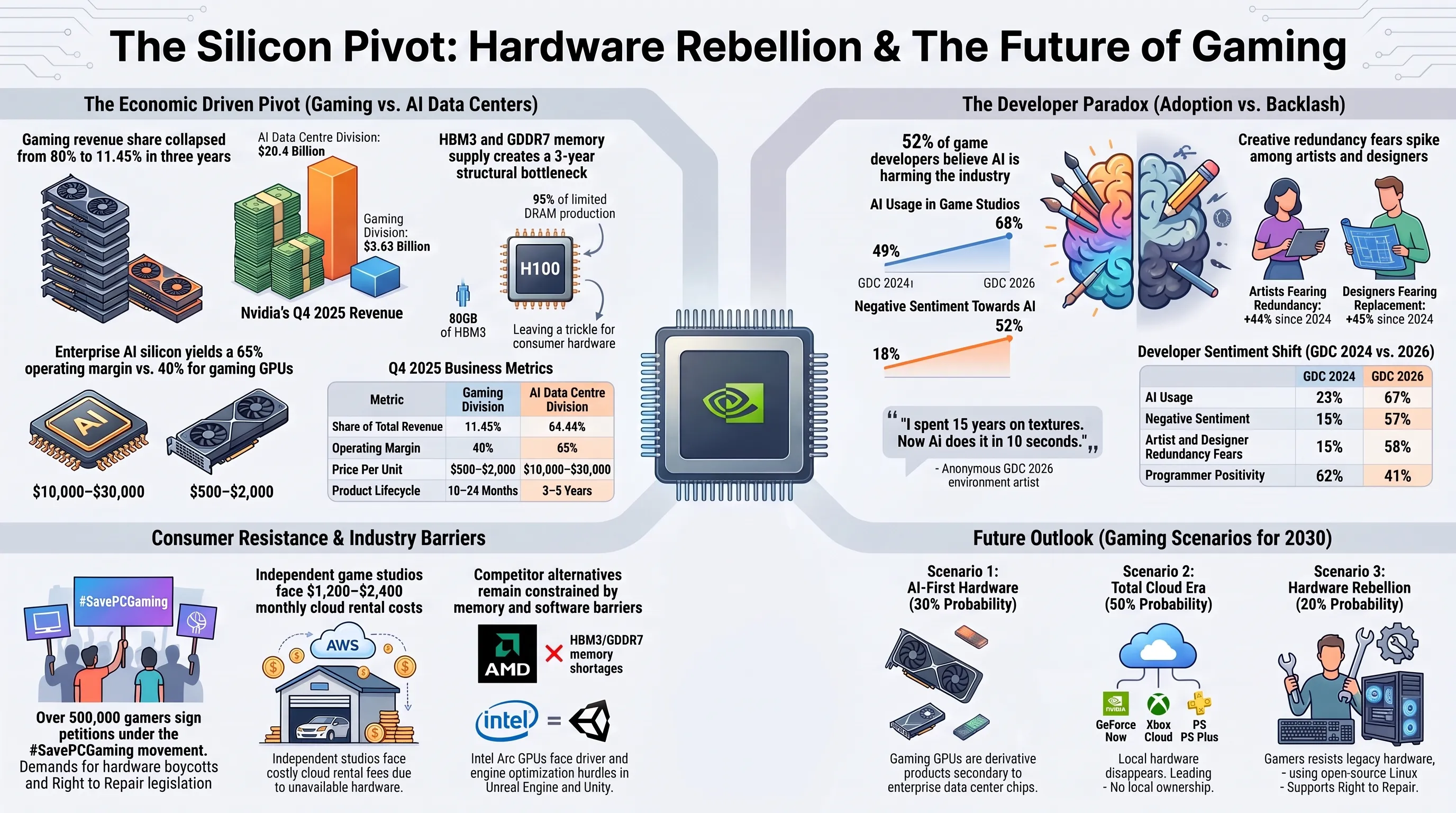
The Game Developers Conference (GDC) conducts a comprehensive survey of game developers annually. The 2026 results were genuinely shocking: while 68% of studios actively use artificial intelligence, 52% of individual developers believe AI is severely damaging the industry. For context, this negative sentiment figure was only 18% in 2024.
What has transpired? Why do the very people utilizing AI harbour such deep resentment towards it?
GDC Sentiment Shift: 2024 vs. 2026
| GDC Survey Metric | Year 2024 | Year 2026 | Trend / Change |
|---|---|---|---|
| AI Usage in Studios | 49% | 68% | +19% (Massive Growth) |
| Negative Sentiment Towards AI | 18% | 52% | +34% (Rising Fear) |
| Artists Fearing Redundancy | 23% | 67% | +44% (Severe Anxiety) |
| Level Designers Fearing Replacement | 15% | 58% | +43% (Severe Anxiety) |
| Programmers Positive About AI | 62% | 41% | -21% (Drop in Optimism) |
This table reveals a lethal trend: the more deeply AI is adopted within studios, the more intensely negative the sentiment becomes. Why? Because developers are witnessing the rapid redundancy of their colleagues firsthand.
At GDC 2026, an environment artist who wished to remain anonymous stated: "I spent 15 years mastering texture design. Now, a Stable Diffusion model does in 10 seconds what used to take me three days. My manager told me point-blank: either learn to work with AI, or make way for someone who can." This represents classic "AI Debt" studios sacrifice human talent for short-term cost reduction, permanently crippling the industry's long-term capacity for genuine innovation.
Geopolitical Analysis: The Chip War and Collateral Damage
This is not merely an economic narrative; it is a full-scale geopolitical war. The US government has imposed draconian export restrictions on advanced silicon heading to China. Consequently, Nvidia is legally barred from selling H100 or A100 chips to Chinese markets, restricted only to downgraded variants like the H800.
However, these restrictions have birthed unintended collateral damage: to maintain explosive revenue growth, Nvidia has decided to concentrate absolutely all of its unfettered production capacity on high-margin data center products for Western and allied markets. Gamers are simply no longer a priority. This raises a profound philosophical question: Data Sovereignty and Silicon Who truly owns computational power?
Risks and Challenges: The Dark Side of the AI Revolution
The Slow Death of Independent Gaming
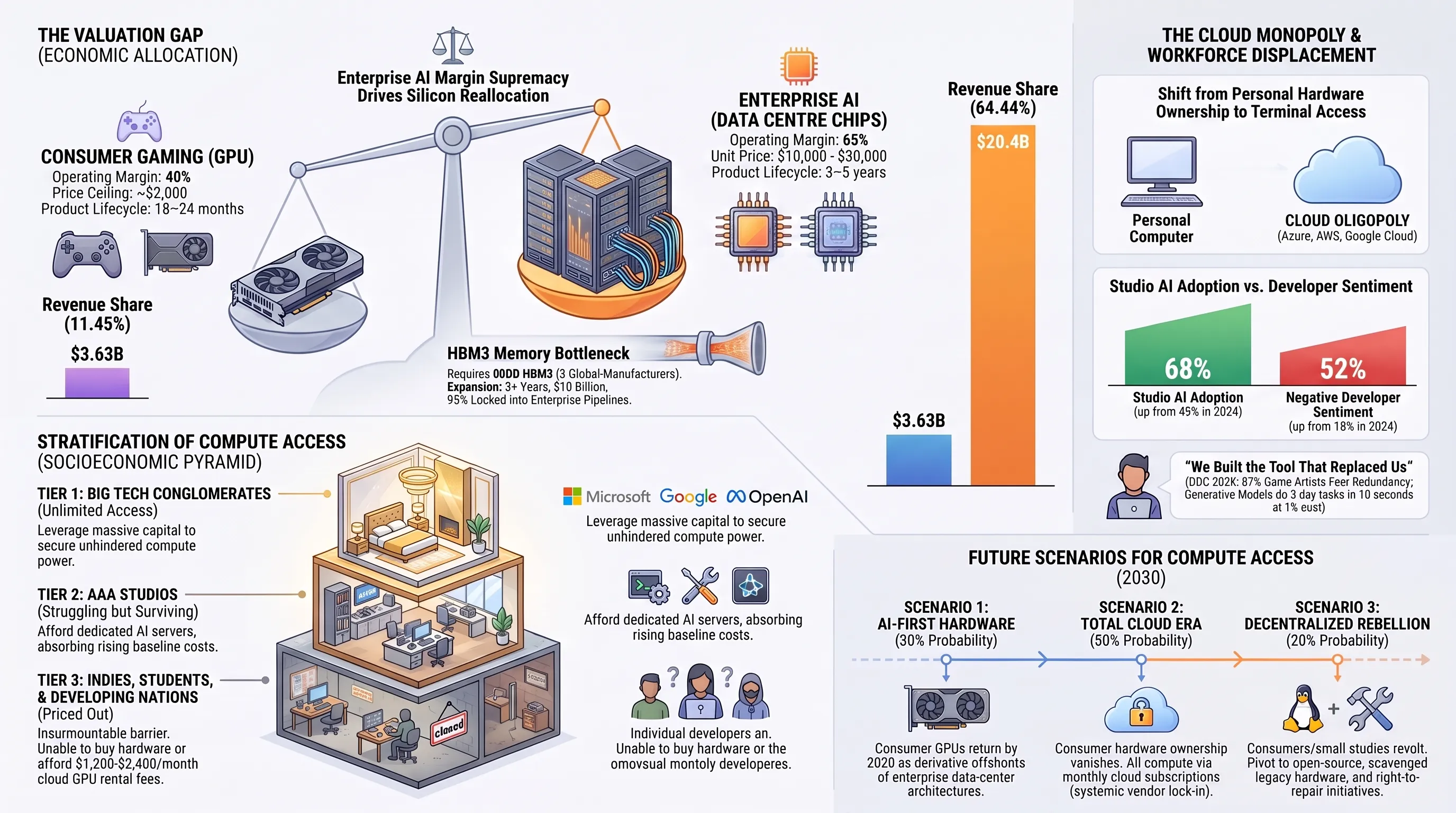
The greatest casualty of this hardware rebellion is the independent studio ecosystem. A AAA juggernaut like Ubisoft or EA can easily afford to spend millions on dedicated AI servers. But a five-person indie studio in Poland, Brazil, or Turkey? They desperately rely on affordable consumer graphics cards.
Now imagine a scenario where the RTX 5060 (theoretically the affordable mid-range option) will not see the light of day until 2028. Small studios are forced into a corner: either work with hopelessly obsolete hardware or rent cloud services like AWS or Azure, which carry crippling monthly costs (often $5 to $10 an hour for a powerful GPU instance).
Tekin Technical Jargon Buster
Future Vision: The World of 2030 - Gaming Without Gamers?
Three primary scenarios exist for the future of the gaming industry:
- The Return of Consumer Hardware (30% Probability): The DRAM crisis resolves by 2028, and Nvidia returns. However, consumer GPUs will be labeled \"AI-First,\" functioning primarily as derivatives of data center architectures rather than dedicated gaming silicon.
- The Complete Cloud Era (50% Probability): By 2030, physical graphics cards vanish from consumer shelves. Everything is streamed via GeForce Now, Xbox Cloud Gaming, or PlayStation Plus. In this dystopian reality, you no longer own your hardware; you merely rent access. If the server goes down, you have absolutely nothing.
- Consumer Rebellion (20% Probability): Gamers rebel against the monopoly, migrating en masse to open-source platforms like Linux and fully embracing AMD or Intel alternatives, sparking a massive "Right to Hardware Ownership" movement.
📚 Classified & Related Dossiers in TekinGame
If you wish to explore beyond this report and delve into cybernetic frontiers and autonomous AI architectures, do not miss these three exclusive deep-dives in the Tekin Garage:
5-Axis Radar: Cloud Monopoly vs. Consumer Hardware
5-Axis Radar Analysis: The shift toward a Cloud Monopoly grants mega-corporations absolute market control and 65% profit margins, while simultaneously crushing consumer freedom and reducing hardware ownership to near absolute zero.
Industry Response: Who Is Resisting?
Can AMD or Intel fill this devastating void? AMD has announced the release of the Radeon RX 8000 series for late 2026. However, they are battling the exact same HBM3 and GDDR7 memory bottleneck. Ultimately, AMD must also choose between servicing the data center or the gaming market. Intel has returned to the fray with the Arc Battlemage series (B580 and B770). Yet, the critical issue remains that major game engines like Unreal Engine 5 are heavily optimized for Nvidia architecture, leaving early Intel adopters to wrestle with severely unoptimized drivers and constant bugs.
Technical Fact-Check | Industry Myth vs. Engineering Reality
Many consumers falsely believe that the current GPU shortage is a temporary supply-chain hiccup (like the 2021-2022 crypto boom) that will resolve itself once factories catch up.
The insatiable demand for AI is permanent and structural. Building a new HBM3 memory fab requires a $10 Billion investment and a minimum of 3 years. This crisis cannot be solved by simply throwing money at it.
Final Conclusion: Who Controls the Future?
We stand at a monumental historical inflection point. One truth is absolute: the golden age of PC Gaming the era where anyone could purchase a powerful graphics card at a reasonable price is definitively over. We are now entering a bleak new epoch where computational power is treated as a scarce, ultra-luxurious commodity, rather than a fundamental right.
Gamers, independent developers, and digital artists are all tragic collateral damage in this silicon revolution. The movement #SavePCGaming has amassed over 500,000 signatures, pleading with Nvidia to return to the consumer market. But history dictates that consumer sentiment rarely alters the trajectory of a 65% corporate profit margin.
The ultimate question remains: Are we willing to sacrifice our hardware freedom, our ownership, and our privacy for the convenience of cloud gaming, or will we fight to reclaim our silicon? Tekin Army, the choice is yours.
- Intel and AMD attempting to fill the mid-range market void with architectures like Arc Battlemage in 2026.
- The potential resurgence of 'Right to Repair and Own' hardware movements pushing users toward open-source Linux ecosystems.
- A renewed golden age for traditional home consoles (PS5 Pro / Xbox) as the last remaining bastion for affordable high-end gaming.
- Nvidia's ruthless abandonment of the consumer gaming market due to severe profit margin inequality (40% vs. 65%).
- An existential crisis for indie game studios unable to afford exorbitant cloud compute or physical hardware for UE5 development.
- The terrifying GDC paradox where 52% of developers view AI as an active threat to job security and human creativity.
Final Editorial Verdict & Official Reference Sources
The End of the Consumer Hardware Golden Age
Nvidia's hardware rebellion proves that in the ruthless capitalism of silicon, computational power is no longer a gamer's right, but an exclusive lever to dominate the AI economy.
Frequently Asked Questions & Technical Analysis
Why did Nvidia stop producing gaming graphics cards in 2026?
Due to a massive disparity in operating margins. Selling an AI chip like the H100 to a data center yields a 65% profit margin (at $30,000), whereas gaming GPUs max out at around a 40% margin.
How does the DRAM memory crisis affect GPU shortages?
Global manufacturers like Samsung cannot simultaneously supply HBM3 for data centers and GDDR7 for gaming. Because building a new memory fab takes 3 years and $10B, Nvidia has routed all available resources to the highly profitable data center market.
What is the GDC 2026 Paradox?
While 68% of game studios actively use AI to cut costs, 52% of developers simultaneously believe AI is destroying the industry by replacing human artists, designers, and programmers.
What is the danger of a 'Cloud Monopoly' for gamers?
If physical consumer hardware becomes impossible to buy, gamers will be forced to rent compute power from three giants (Microsoft, Amazon, Google). This completely destroys the concept of hardware ownership and surrenders all pricing power to an oligarchy.
Why are independent studios the biggest victims of this crisis?
Small indie developers lack the budget to buy scarce, price-gouged GPUs or rent expensive cloud servers ($5-$10/hr). This prices them entirely out of creating modern, high-fidelity games on engines like Unreal Engine 5.
