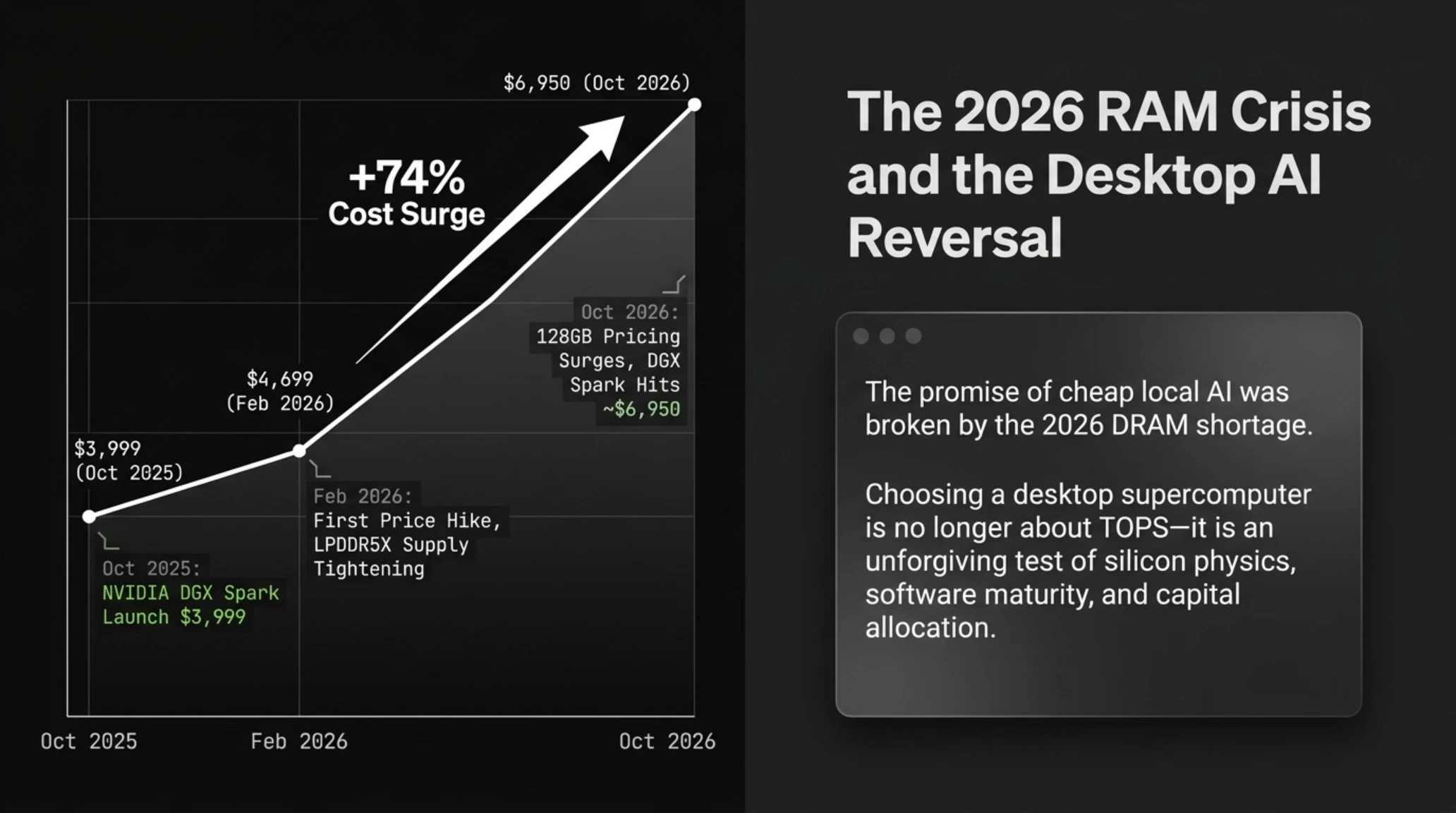

The 2026 DRAM shortage pushed NVIDIA's 128GB DGX Spark up 74% to ~$6,950, AMD Strix Halo 128GB to $3,299-$3,500 ($27.34/GB), and Apple's 512GB Mac Studio M5 Ultra to $22,299 (still cheaper than four Spark nodes). This Tekin Versus deep dive compares all three across Prefill, Decode, CUDA vs. MLX vs. ROCm, and cloud GPU break-even math.
Tekin Briefing | Core Contenders in the 2026 Local AI Hardware Showdown
Twelve months ago, the promise of personal AI supercomputers felt almost effortless. Run a 120-billion-parameter reasoning model silently beside your monitor, skip five-figure datacenter rack leases, keep proprietary codebases completely air-gapped, and pay roughly the price of a high-end gaming tower for the privilege. That pitch ignited a wave of local-inference enthusiasm across software teams, quantitative boutiques, and independent machine-learning labs.
By late November 2026, physical supply chains have delivered a blunt reality check. Unrelenting hyperscaler demand for High Bandwidth Memory (HBM) and server RDIMMs has starved the broader DRAM market, turning soldered LPDDR5X packages into the single most expensive line item inside every compact AI workstation. What began as an accessible developer revolution has rapidly evolved into an unforgiving test of silicon architecture, software maturity, and capital allocation.
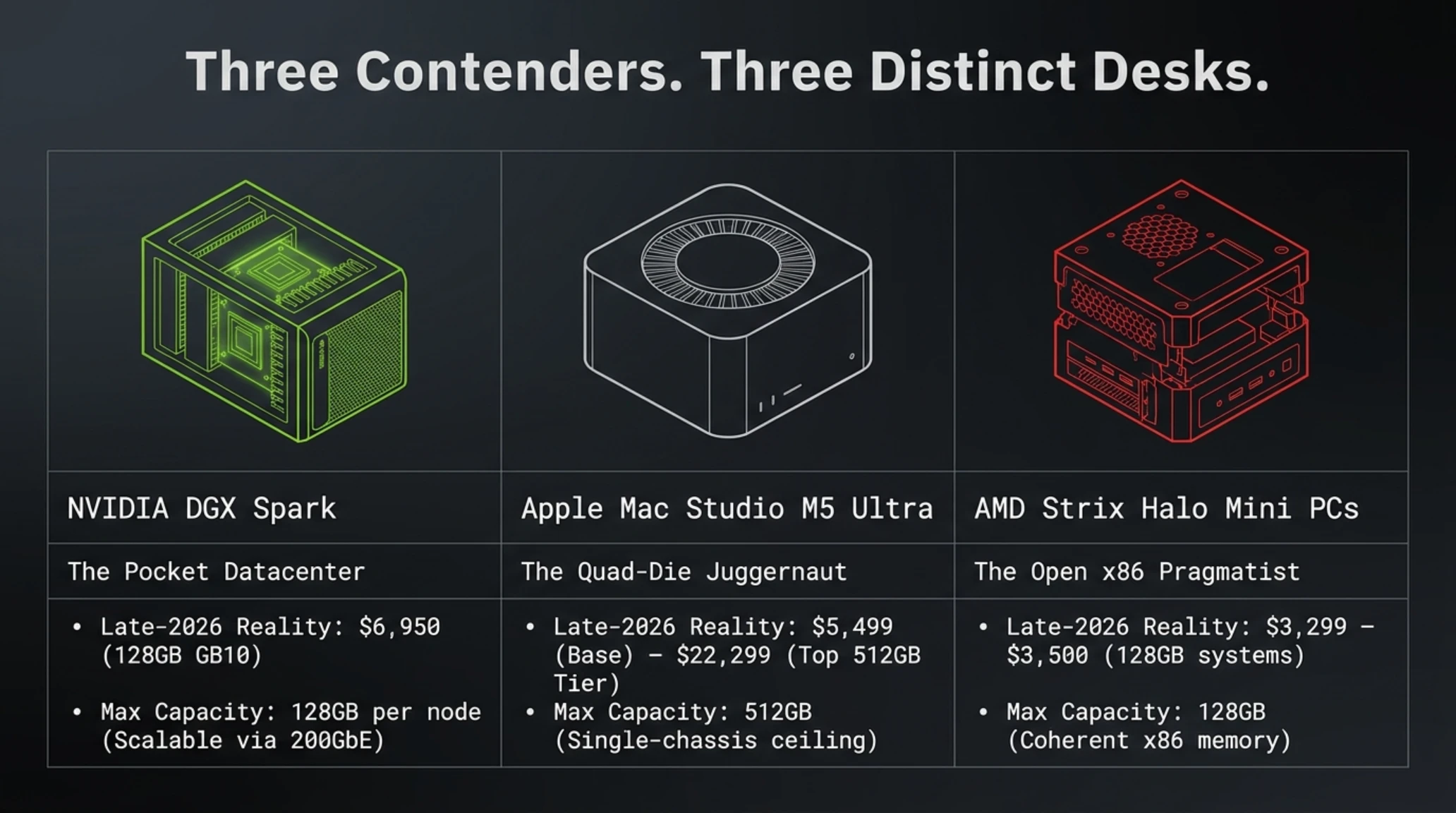
Three radically different machines now define the desktop AI landscape. In the green corner stands the NVIDIA DGX Spark, a 1.2-kilogram Grace Blackwell appliance whose 128GB retail tier climbed nearly 74 percent over its first year on sale. In the silver corner sits Apple's quad-die Mac Studio with M5 Ultra, wielding 1.2 TB/s of unified memory bandwidth and a staggering 512GB single-chassis ceiling. In the red corner marches a sprawling ecosystem of AMD Strix Halo (Ryzen AI Max+ 395) mini PCs no longer the sub-$2,000 bargains originally pitched at trade shows, yet still offering 128GB of coherent x86 memory at half the dollar-per-gigabyte cost of NVIDIA's flagship box.
Choosing between them requires ignoring almost every headline spec sheet number. Peak sparse PFLOPS, theoretical TOPS, and single-prompt demo clips conceal the mechanical bottlenecks that actually govern a coding agent or enterprise inference server at 3:00 PM on a Tuesday. In this Tekin Versus investigation, we dissect the verified late-2026 benchmarks, silicon design trade-offs, software stacks, and cloud break-even math behind all three platforms.
The New Economics of Unified Memory in Late 2026
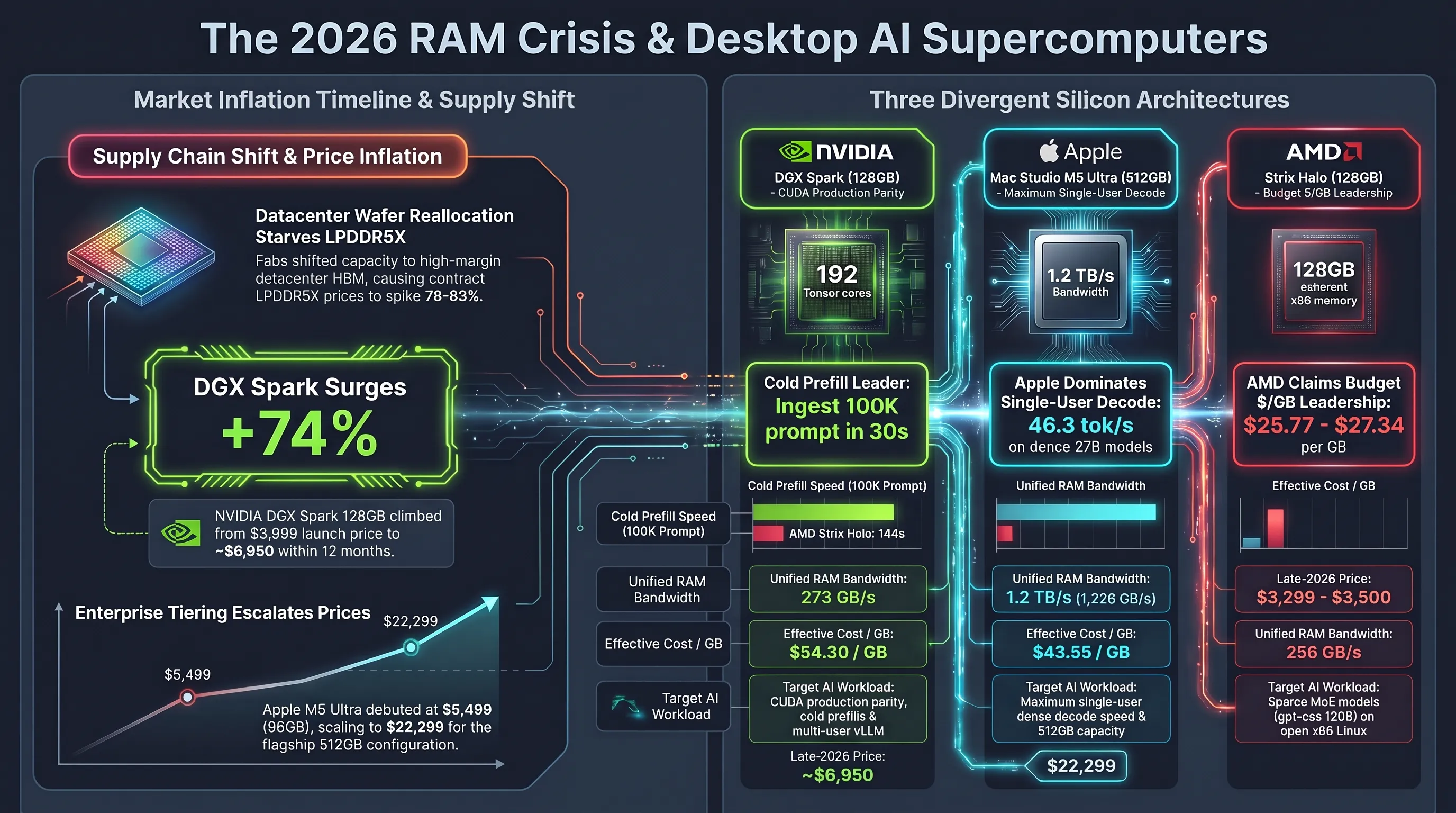
To understand why a palm-sized 128GB workstation now commands used-car money, you have to follow wafer allocation upstream from Apple, AMD, and NVIDIA straight to Samsung, SK Hynix, and Micron. Throughout 2026, memory fabs aggressively shifted cleanroom capacity toward high-margin HBM stacks and enterprise server DDR5 destined for multi-gigawatt AI training clusters. Conventional DRAM and high-density mobile LPDDR5X modules the exact silicon packages required to cram 128GB or 256GB onto a compact motherboard bore the brunt of that reallocation.
Market tracking published by TrendForce's DRAM contract price monitor and its quarterly supply reports paints an extraordinary picture of sustained inflation. Conventional DRAM contract prices jumped an estimated 93 to 98 percent quarter-over-quarter in Q1 2026, climbed another 58 to 63 percent in Q2, and experienced 78 to 83 percent month-over-month spikes in LPDDR5X contracts during mid-year negotiations. Even Apple widely regarded as the most formidable supply-chain negotiator on earth reportedly absorbed roughly 53 percent full-year DRAM and 52 percent NAND contract increases from Samsung under its 2026 long-term agreements. In its November 25, 2026 outlook, TrendForce warned that while NAND flash pricing could begin cooling in 2027, DRAM shortages are projected to persist through all of 2027 as global DRAM revenue marches toward $1.15 trillion.
The ripple effects reached every corner of enterprise computing. Reporting from the Financial Times echoed by Tom's Hardware on November 23, 2026 revealed that major server OEMs have been imposing 25 to 45 percent post-contract price hikes on corporate buyers, with memory-heavy CPU nodes doubling or tripling in delivered cost. Desktop AI workstations, whose entire value proposition rests on massive unified memory pools, had zero insulation from that shock.
Why the 2026 Memory Crunch Reshaped Every Buying Calculation
Each vendor reacted to the memory squeeze in a revealing way. NVIDIA first shipped the Founders Edition 128GB/4TB DGX Spark on October 15, 2025 at $3,999, following its official developer launch announcement. Just four months later, on February 23, 2026, NVIDIA posted a price change notice on its developer forum raising the MSRP 18 percent to $4,699, explicitly citing memory supply constraints. Then came the October shock: as documented by ServeTheHome and Hardware Busters on October 2 3, 2026, OEM-dependent pricing for the 128GB/4TB DGX Spark jumped to roughly $6,950. Alongside that hike, NVIDIA published its DGX Spark 64GB announcement, introducing a half-memory tier from Acer, ASUS, Dell, Gigabyte, HP, and MSI shipping October 23 at $4,999 a surreal milestone where half the memory costs $1,000 more than the original full-capacity system did one year earlier.
Apple faced identical physics, though its response leaned heavily into extreme tier segmentation. When Cupertino unveiled the updated workstation in its August 25, 2026 Apple Newsroom release (shipping September 22), the entry Mac Studio M5 Ultra broke four years of $3,999 baseline pricing, jumping straight to $5,499 with 96GB of memory and a 1TB SSD. Upgrading that base machine to 256GB adds $4,000, bringing a configured 36-core CPU / 80-core GPU / 256GB / 4TB review unit tested by Tom's Hardware to $12,299. Then on October 28, Apple opened orders for the flagship 512GB M5 Ultra configuration: buyers must start with the top $6,799 chip tier and add a breathtaking $15,500 memory upgrade, landing at $22,299 before touching SSD capacity (which tops out at $29,799 with 16TB).
AMD's board partners weathered the same LPDDR5X storm. Early-2026 expectations of $1,499 to $1,999 128GB Strix Halo boxes have completely evaporated. In late November 2026 retail listings, the GMKtec EVO-X2 (128GB/1TB) sells around $3,499, the Framework Desktop DIY 128GB configuration sits at $3,449, Acemagic's F9A (128GB/2TB) lists at $3,299, and Newegg lists the GEEKOM A9 Mega (128GB/2TB) on backorder at $3,499.99 complete with an explicit Strix Halo scarcity banner. Yet relative to NVIDIA's $6,950 reset, a $3,500 street price still preserves AMD's status as the accessible gatekeeper to 128GB local inference.
Silicon Under the Microscope: Three Divergent Engineering Philosophies
All three contenders share one foundational architectural premise: put CPU cores and GPU compute engines on the same coherent memory pool so massive neural network weights never have to crawl across a PCIe bus. Beyond that shared starting point, NVIDIA, Apple, and AMD built machines aimed at completely different desks.
NVIDIA DGX Spark: A Pocket Datacenter Node Dressed for the Desk
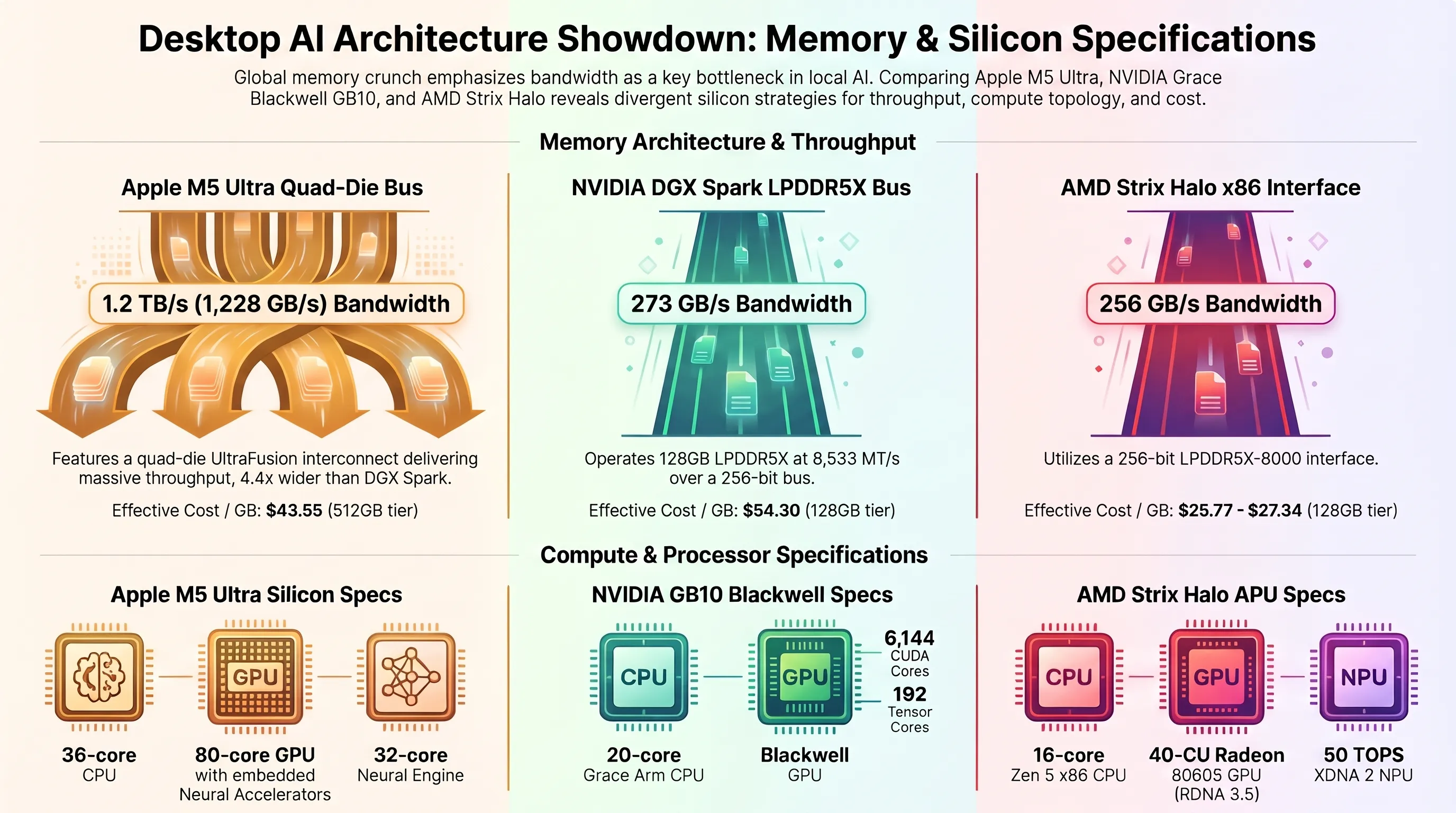
The DGX Spark makes zero pretense of being a general-purpose personal computer. Engineered around the NVIDIA GB10 Grace Blackwell Superchip, it pairs a 20-core Arm CPU co-designed with MediaTek (10 Cortex-X925 performance cores and 10 Cortex-A725 efficiency cores) with a single Blackwell-generation GPU die packing 6,144 CUDA cores, 192 fifth-generation Tensor cores, and 48 fourth-generation RT cores. That GPU silicon shares the same architectural lineage as GeForce RTX 50-series cards, delivering up to 1 sparse PFLOP of native FP4 compute and roughly 100 TFLOPS at FP16.
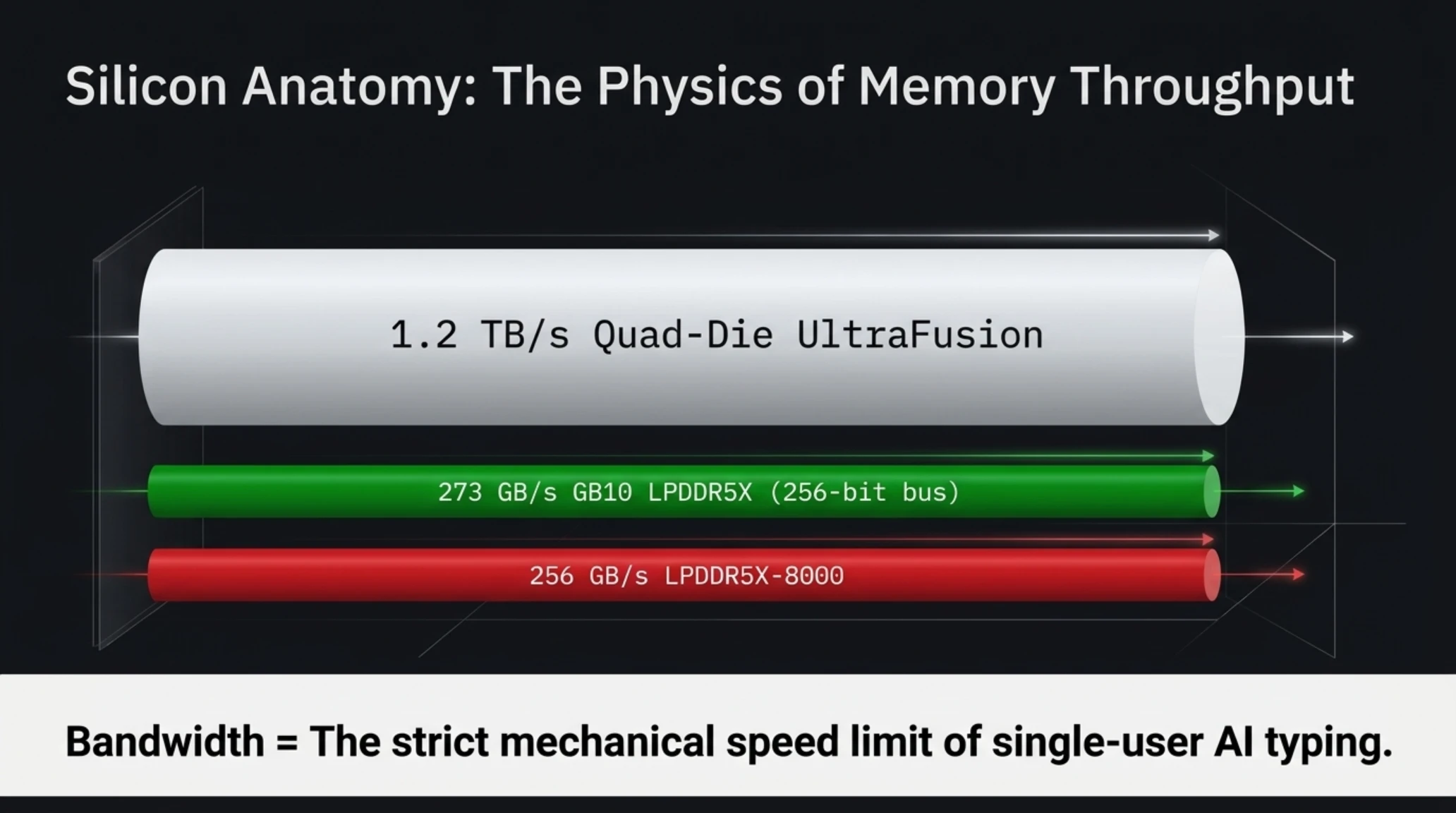
Its memory subsystem consists of 128GB of soldered LPDDR5X running at 8,533 MT/s across a 256-bit bus, yielding 273 GB/s of bandwidth modest compared to discrete GDDR7 cards, yet spacious enough to host 70B dense or 120B MoE models natively. Where NVIDIA truly differentiates the GB10 box is fabric connectivity. Every DGX Spark ships with dual ConnectX-7 200 Gb/s QSFP ports even the newer $4,999 64GB variant retains them allowing developers to directly cable two boxes into a 256GB coherent cluster or link four nodes into a 512GB ring capable of running 400B to 700B parameter models.
The physical trade-offs reveal its single-minded identity. The GB10 package carries a 140W TDP fed by a 240W external brick, and developer forum reports from October 2026 documented chassis temperatures pushing near 95°C during sustained 122B inference loops. NVIDIA also opted for a single uncommon M.2 2242 PCIe 5.0 x4 SSD slot, omitted DisplayPort, and locked the machine to Ubuntu-based DGX OS on Arm64. You do not buy a DGX Spark to edit spreadsheets or drive a gaming monitor; you plug it into your network switch, SSH into it from your laptop, and treat it as a miniature Blackwell rack node.
Apple Mac Studio M5 Ultra: Quad-Die Bandwidth Supremacy
With the M5 Ultra, Apple broke new ground in desktop packaging by assembling its first quad-die M-series SoC. According to Apple's engineering disclosure and official Mac Studio technical specifications, the processor bridges two dual-die M5 Max silicon packages manufactured on a third-generation 3nm process via next-generation UltraFusion interconnects delivering more than 4.4 TB/s of inter-die bandwidth. At the top bin, users receive a 36-core CPU (12 super cores plus 24 performance cores clocking up to 4.61 GHz), an 80-core GPU with dedicated Neural Accelerators embedded inside every single GPU core, and a 32-core Neural Engine.
The headline engineering achievement, however, is memory throughput. By scaling its wide memory interface across four dies, Apple achieved 1.2 TB/s (1,228 GB/s) of unified memory bandwidth a 50 percent jump over the M3 Ultra's 819 GB/s and roughly 4.4 times wider than the DGX Spark's 273 GB/s bus. That brute-force memory pipe pairs with formidable conventional CPU muscle: in Geekbench 7 testing conducted by Tom's Hardware and Notebookcheck, the 36-core M5 Ultra posted roughly 3,748 to 3,770 single-core and 51,749 to 52,293 multi-core scores, edging out an AMD Ryzen Threadripper 9980X in video transcoding workloads while sitting silently inside a compact desktop cube rated at 480W maximum continuous power.
Apple rounded out the platform for modern multi-machine studios as well. Thunderbolt 5 ports (120 Gb/s) support RDMA clustering across up to four Mac Studios, flanked by Wi-Fi 7, Bluetooth 6, 10Gb Ethernet, and PCIe Gen 6 internal flash storage running macOS 27 Golden Gate. Unlike the DGX Spark, the Mac Studio doubles seamlessly as a flagship workstation for Xcode compilation, 8K ProRes finishing, audio mastering, and everyday desktop productivity.
AMD Strix Halo: Open x86 Pragmatism in a Three-Liter Box
AMD's Ryzen AI Max+ 395 (codenamed Strix Halo) takes a refreshingly pragmatic route. Inside a roughly 120W APU envelope housed in compact 3-liter to 4.5-liter chassis from OEMs like Framework, GMKtec, Acemagic, GEEKOM, and Corsair, AMD combines a 16-core Zen 5 x86 CPU, a 50 TOPS XDNA 2 NPU, and the muscular Radeon 8060S integrated GPU sporting 40 RDNA 3.5 compute units (roughly 59 60 theoretical FP16 TFLOPS, ~36.9 TFLOPS measured in typical workloads).
Paired with 128GB of LPDDR5X-8000 on a 256-bit bus, Strix Halo achieves 256 GB/s of theoretical memory bandwidth landing within roughly 6 percent of NVIDIA's $6,950 DGX Spark. Crucial OS mechanics apply here: on Windows 11, AMD's driver caps GPU-addressable unified memory at 96GB of the 128GB pool, whereas booting Linux unlocks up to 120GB directly for GPU inference. Equally important for independent developers, Strix Halo is the sole x86-64 platform in this trio. It runs native Windows engineering suites, PC games, virtual machines, Docker containers compiled for standard amd64 servers, and dual-boot Linux installations without a single binary translation layer.
Tekin Jargon Buster | Three Concepts That Actually Govern Local LLM Speed
Prefill Versus Decode: Where Marketing Specs Break Down
The single biggest mistake buyers make when comparing local AI hardware is treating tokens-per-second as a monolithic score. Independent benchmarking conducted across September, October, and November 2026 proves that these three systems swap leads dramatically depending on whether a workflow stresses single-stream generation, cold long-context ingestion, or concurrent multi-user serving.
Single-User Decode: Physics Hands Apple an Untouchable Lead on Dense Models
When a single developer runs a dense model interactively, memory bandwidth acts like an unforgiving speed limit. Every generated token requires streaming the active weights out of RAM once. On dense 27B to 70B models, the Mac Studio M5 Ultra's 1.2 TB/s interface turns the comparison into a blowout.
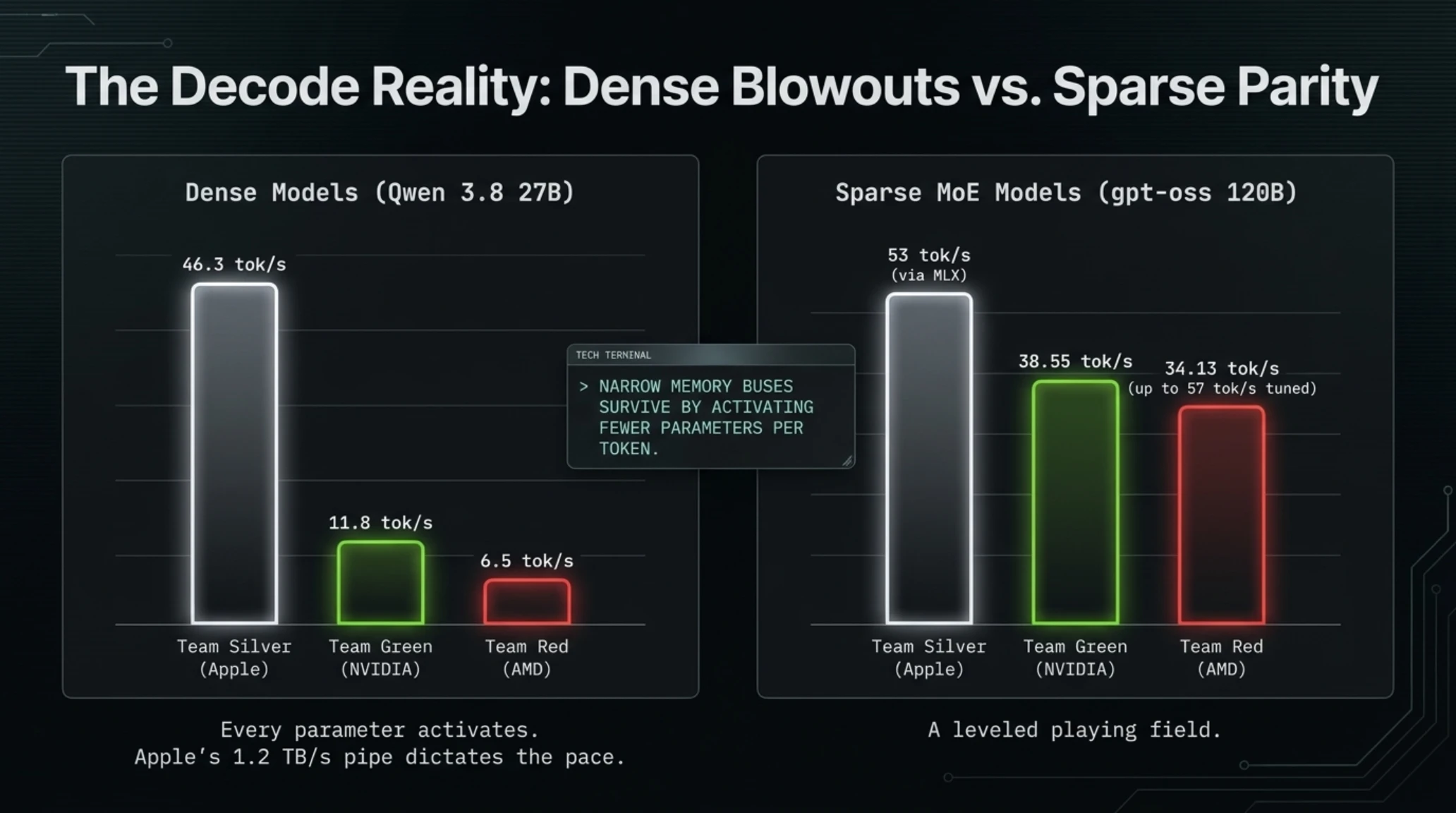
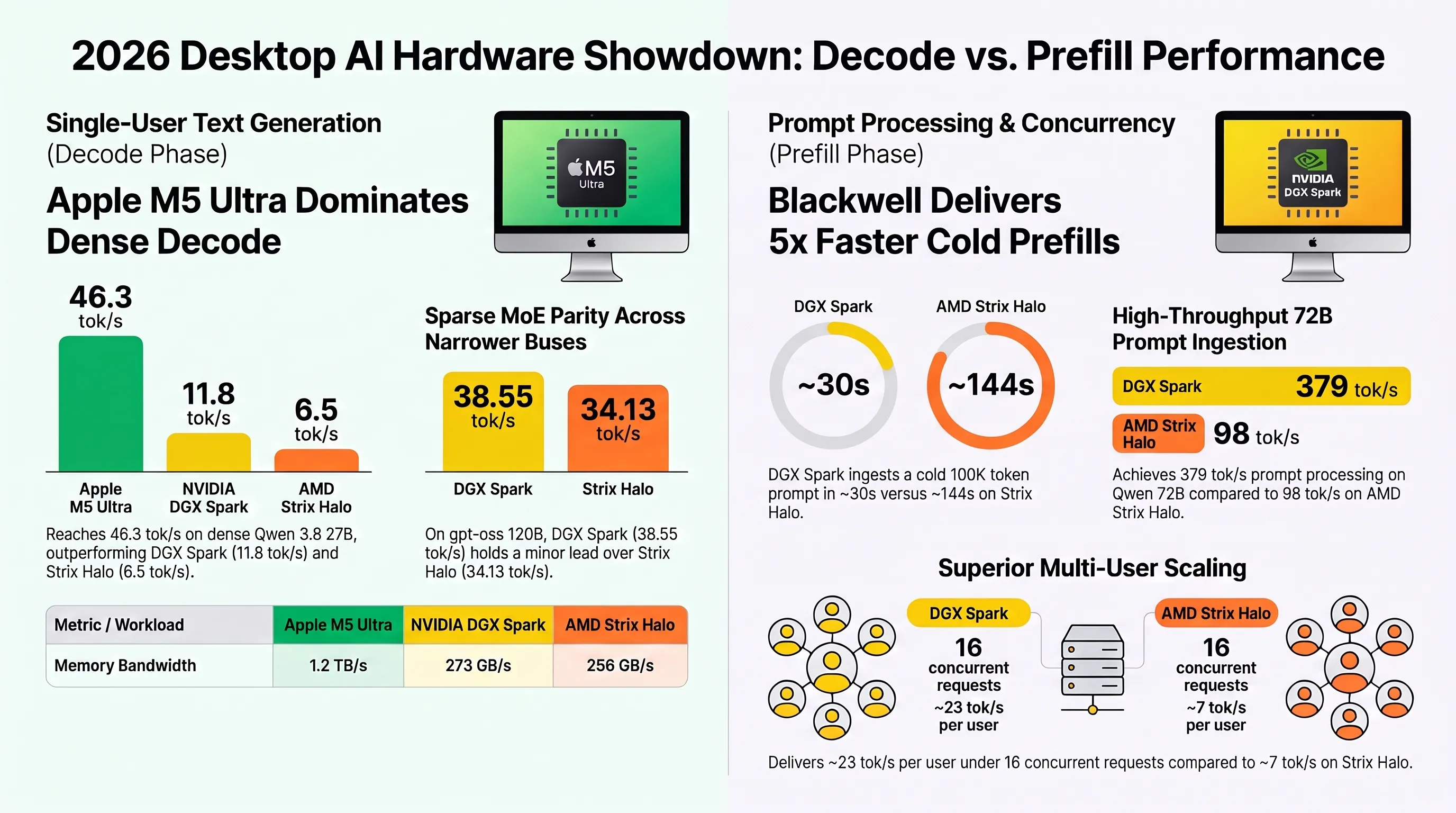
In October 2026 testing by Contra Collective on the dense Qwen 3.8 27B model, the M5 Ultra Mac Studio sustained 46.3 tokens per second during single-stream decode, while a single NVIDIA DGX Spark managed just 11.8 tokens per second nearly a 4x advantage for Apple. Andrew E. Freedman's September 21, 2026 review for Tom's Hardware independently confirmed that pattern on Qwen 3.8-27B-Q4_K_M, finding M5 Ultra decode throughput nearly four times faster than DGX Spark across the board and roughly double that of an M4 Max Mac Studio. On similar dense 27B models quantized at Q8, 128GB AMD Strix Halo boxes hover near 6.5 tokens per second, constrained by their 256 GB/s ceiling usable for background batch summarization, but noticeably sluggish for interactive pair programming.
Switch to sparse Mixture-of-Experts (MoE) architectures, however, and the economics tilt dramatically toward AMD. Because a 120B MoE model only reads a small active parameter slice per token, narrow 256-bit LPDDR5X buses suddenly feel lively. In widely cited llama.cpp benchmarks published by Georgi Gerganov on gpt-oss 120B, the DGX Spark achieved 38.55 tokens per second while AMD Strix Halo posted 34.13 tokens per second. Independent testing by KyzoroX on a 30B model yielded an almost identical 15 percent spread: 84 tok/s on DGX Spark versus 73 tok/s on Strix Halo. With tuned Linux Vulkan/ROCm builds, community benchmarks on gpt-oss 120B have pushed Strix Halo into the 52 to 57 tok/s band. Put plainly: if your primary goal is single-user MoE chat and coding, paying an extra $3,450 for a DGX Spark buys barely a 10 to 15 percent bump in typing speed.
Cold Prompt Prefill and Multi-User Serving: Blackwell Strikes Back
Where does NVIDIA's 6,144-core Blackwell GPU and 192 fifth-generation Tensor cores earn their keep? The moment you feed a massive uncached document, a sprawling codebase, or sixteen simultaneous API requests into the engine.
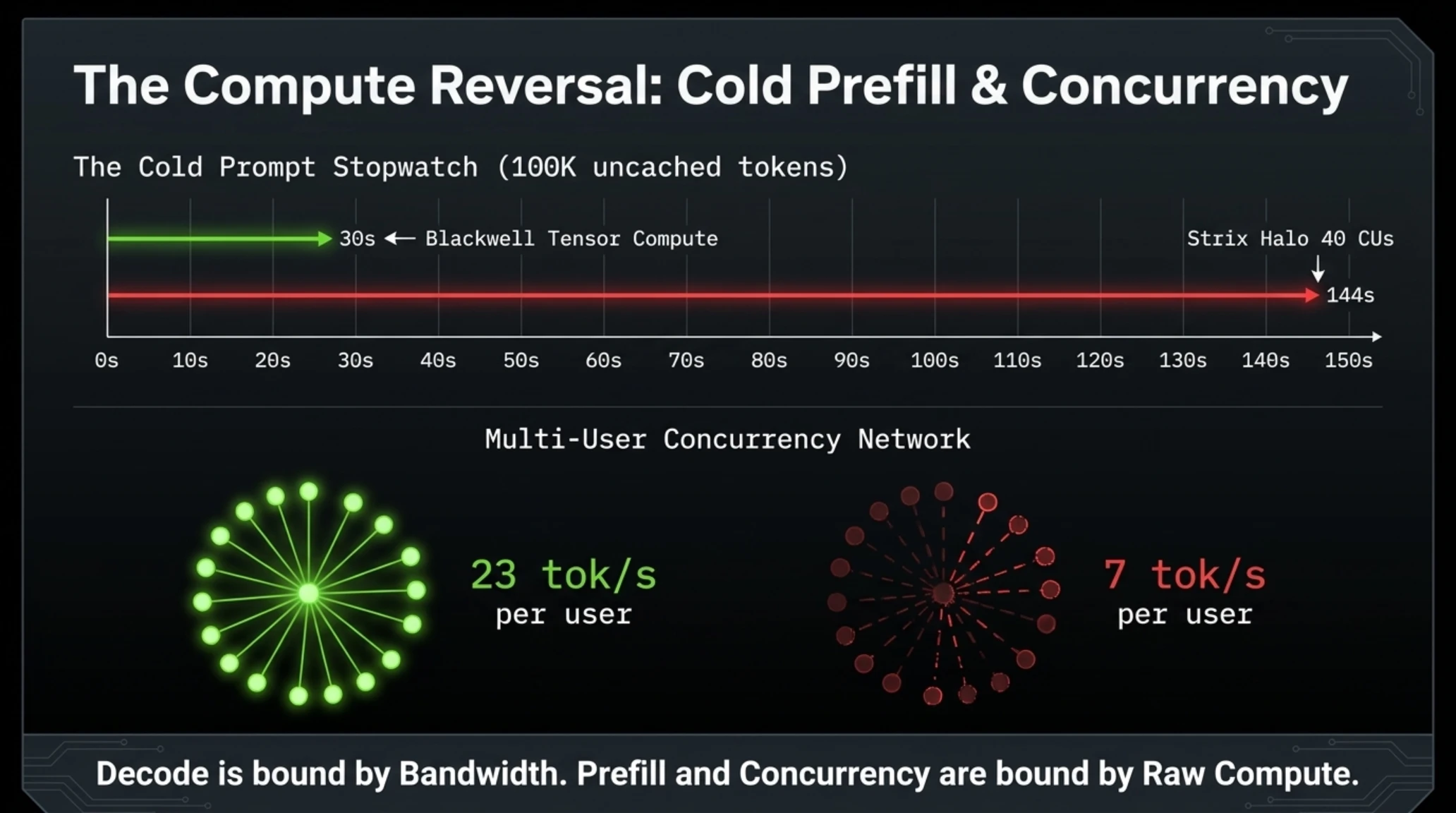
Controlled benchmarks published by Vitor Pontual on October 6, 2026 using Qwen3.6-35B exposed a chasm between NVIDIA and AMD under compute-heavy loads. Given a cold, uncached 100,000-token prompt, the DGX Spark completed prefill in roughly 30 seconds; the AMD Strix Halo box took approximately 2.4 minutes (144 seconds) nearly five times slower. In November 2026 testing by Petronella Technology Group on qwen2.5:72b, prompt processing throughput hit 379 tok/s on DGX Spark compared to just 98 tok/s on Strix Halo.
Even Apple's M5 Ultra despite embedding Neural Accelerators inside all 80 GPU cores and achieving up to 4x faster LM Studio prompt processing than the M3 Ultra can lose ground to Blackwell on massive uncached contexts when software pipelines are unoptimized. Benchmarks highlighted by Alex Ziskind and MindStudio in October 2026 showed a dual-node DGX Spark cluster chewing through a cold 32,000-token codebase prefill in roughly 17 seconds, versus 44 to 50 seconds on a 256GB Mac Studio M5 Ultra. In a deep-dive follow-up published on November 10, 2026 by Tom's Hardware comparing M5 Ultra against DGX Spark on larger models, Jeffrey Kampman demonstrated that bespoke inference-engine recipes are mandatory at extreme scale: under unoptimized llama.cpp runs on DeepSeek V4.1 Flash at deep context, the Mac could stall for 10 to 25 minutes on cold prompt ingestion where tuned Blackwell serving finished in under five minutes.
Concurrency magnifies that divergence further. Under Vitor Pontual's 16-concurrent-user load test, DGX Spark delivered roughly 23 tok/s per request while Strix Halo sagged to 7 tok/s per request. StorageReview's vLLM serving suite told the same story: DGX Spark won all 18 measured scenarios against AMD Ryzen AI Halo, running 2x to 13x faster in 16 of them. Against the Mac Studio M5 Ultra in MindStudio's multi-user DeepSeek V4 Flash tests, Apple scaled cleanly up to four simultaneous users (peaking at 66 tok/s aggregate) before declining to 46 tok/s aggregate at eight users confirming that M5 Ultra is built for an individual powerhouse or a tight four-seat pod, while Blackwell shines as a shared team inference server.
Even power efficiency holds a subtle surprise. As Tom's Hardware demonstrated in its watt-hour methodology running gpt-oss-120b via llama-benchy (ingesting a 2,048-token prompt at 32,768 context depth before generating 1,024 tokens), measuring instantaneous wattage misses the finish line. Because the GB10 finishes heavy prefill loops dramatically faster than slower-compute peers, its total task energy in watt-hours on prefill-dominated agent loops can undercut rivals that draw fewer watts at the plug but stay pegged at 100 percent load for minutes longer.
Verified Benchmark Matrix | Real-World Measurements Across All Three Architectures
| Verified Workload / Metric | NVIDIA DGX Spark (GB10) | Mac Studio M5 Ultra |
|---|---|---|
| Unified Memory Bandwidth | 273 GB/s (128GB LPDDR5X) | 1.2 TB/s (96GB / 256GB / 512GB) |
| Qwen 3.8 27B Dense Decode (Contra Collective) | 11.8 tok/s (single node) | 46.3 tok/s (single chassis) |
| gpt-oss 120B MoE Decode (llama.cpp / Gerganov) | 38.55 tok/s (vs. 34.13 on Strix Halo) | 53 tok/s on DeepSeek V4 Flash via MLX |
| Cold 100K Prompt Prefill (Qwen3.6-35B / Pontual) | ~30 seconds (vs. ~144s on Strix Halo) | Strong with KV prompt caching; slower cold uncached |
| 16-User Concurrent Serving (Qwen3.6-35B) | ~23 tok/s per user (vs. ~7 tok/s on Halo) | Peaks at 66 tok/s total (4 users), dips to 46 (8 users) |
Fact Check | Two Persistent Local AI Hardware Myths in Late 2026
The Software Trench War: CUDA Parity Against MLX Maturity and ROCm Friction
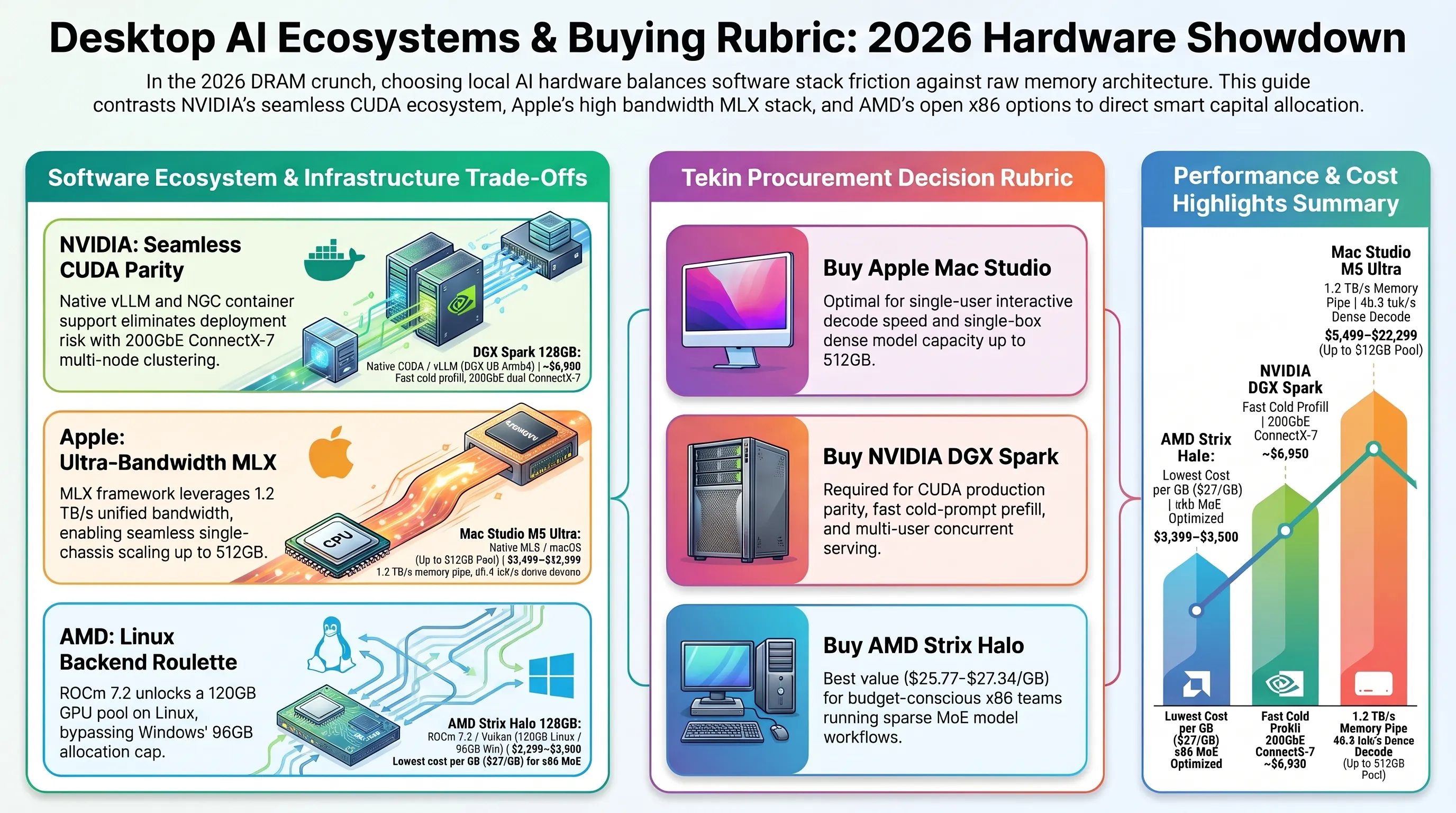
If raw silicon alone decided enterprise purchasing orders, the DGX Spark's $6,950 price tag might have sunk its commercial momentum overnight. It hasn't for one simple, enduring reason: software deployment parity.
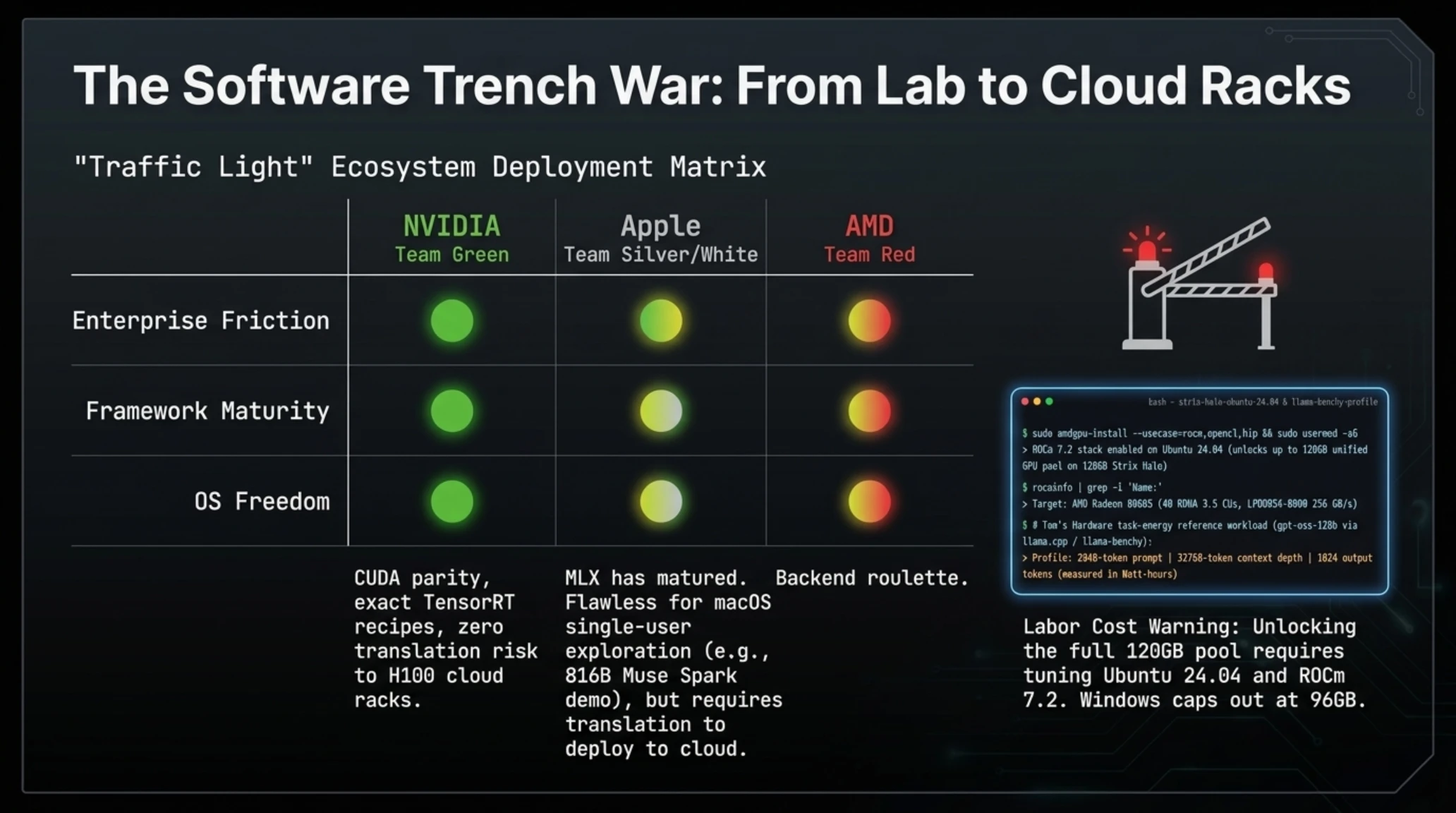
Inside regulated financial institutions, healthcare AI startups, and SaaS companies deploying inference onto H100, H200, or Blackwell B200 cloud clusters, validating a fine-tuned model on Apple's MLX or AMD's Vulkan backend introduces unacceptable engineering translation risk. Quantization behavior, KV-cache quantization kernels, FlashAttention implementations, and custom CUDA extensions behave slightly differently across stacks. On the DGX Spark, engineers pull the exact same NVIDIA NGC containers, run the exact same vLLM and TensorRT-LLM serving recipes, and benchmark identical FP4 quantization pipelines locally before shipping straight to production racks. As engineering consultancy SNOK.AI put it in its September 2026 procurement breakdown, teams increasingly split desks along destination lines: Mac Studio for exploratory lab work demanding huge single-pool capacity, GB10 boxes for anything shipping directly onto client NVIDIA racks.
Apple's software narrative, meanwhile, has undergone a quiet transformation throughout 2026. Early local-AI adopters on macOS leaned heavily on llama.cpp, which treated Apple Silicon like a generic GPU and left substantial performance untapped. By autumn 2026, Apple's open-source MLX framework had matured into a first-class inference engine tuned specifically for M5-series GPU Neural Accelerators. Switching from llama.cpp to MLX on DeepSeek V4 Flash jumped M5 Ultra output from roughly 40 tok/s to 53 tok/s a 34 percent gain without touching a single screw. Even more striking was the October 15, 2026 public demonstration of Meta's colossal 816-billion-parameter Muse Spark Open model running across two linked 512GB Mac Studio M5 Ultra systems over MLX, utilizing a full terabyte of coherent desktop memory. Combined with aggressive prompt caching in modern agentic coding tools (which turns repetitive repository scans into cheap cache hits), macOS has closed much of its historical usability gap for individual engineers.
AMD Strix Halo occupies the trickiest software middle ground a landscape infrastructure analysts at Spheron dubbed 'backend roulette' in October 2026. While AMD's ROCm 7.2 Linux stack has made real strides supporting the RDNA 3.5 Radeon 8060S integrated GPU, out-of-the-box reliability still trails CUDA and MLX. Many practitioners end up toggling between Vulkan (prized for effortless setup and solid stability inside Ollama, LM Studio, and llama.cpp) and native ROCm HIP builds (which can unlock faster prompt prefill on Linux at the cost of tighter kernel and driver version management). Windows ROCm support lags Linux by roughly a minor release, and Windows' 96GB GPU memory cap means serious 120B-model users almost universally install Ubuntu or Fedora to unlock the full 120GB addressable pool.
Technical Terminal | Verified Linux ROCm 7.2 Setup and Benchmark Workload Reference
📚 Classified & Related Dossiers in TekinGame
If you wish to explore beyond this report and delve into cybernetic frontiers and autonomous AI architectures, do not miss these three exclusive deep-dives in the Tekin Garage:
Dollars Per Gigabyte and the Cloud Break-Even Equation
When memory prices jump 75 percent in a single calendar year, hardware enthusiasts and CTOs alike must stop shopping by nostalgia and run hard capital-efficiency math. Comparing all three platforms across the three major unified-memory tiers 128GB, 256GB, and 512GB produces two major surprises that overturn conventional assumptions about Apple's 'RAM tax'.
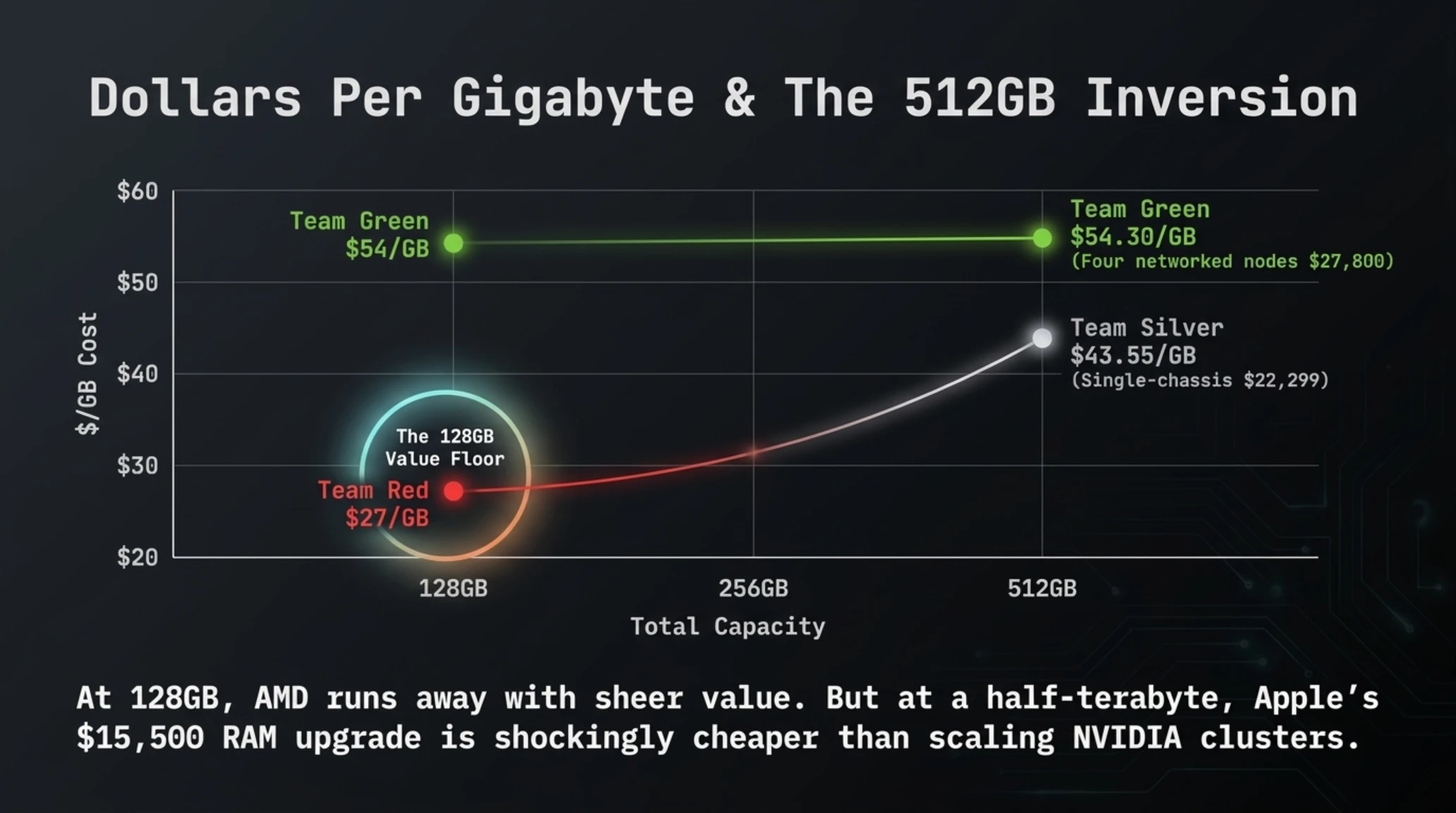
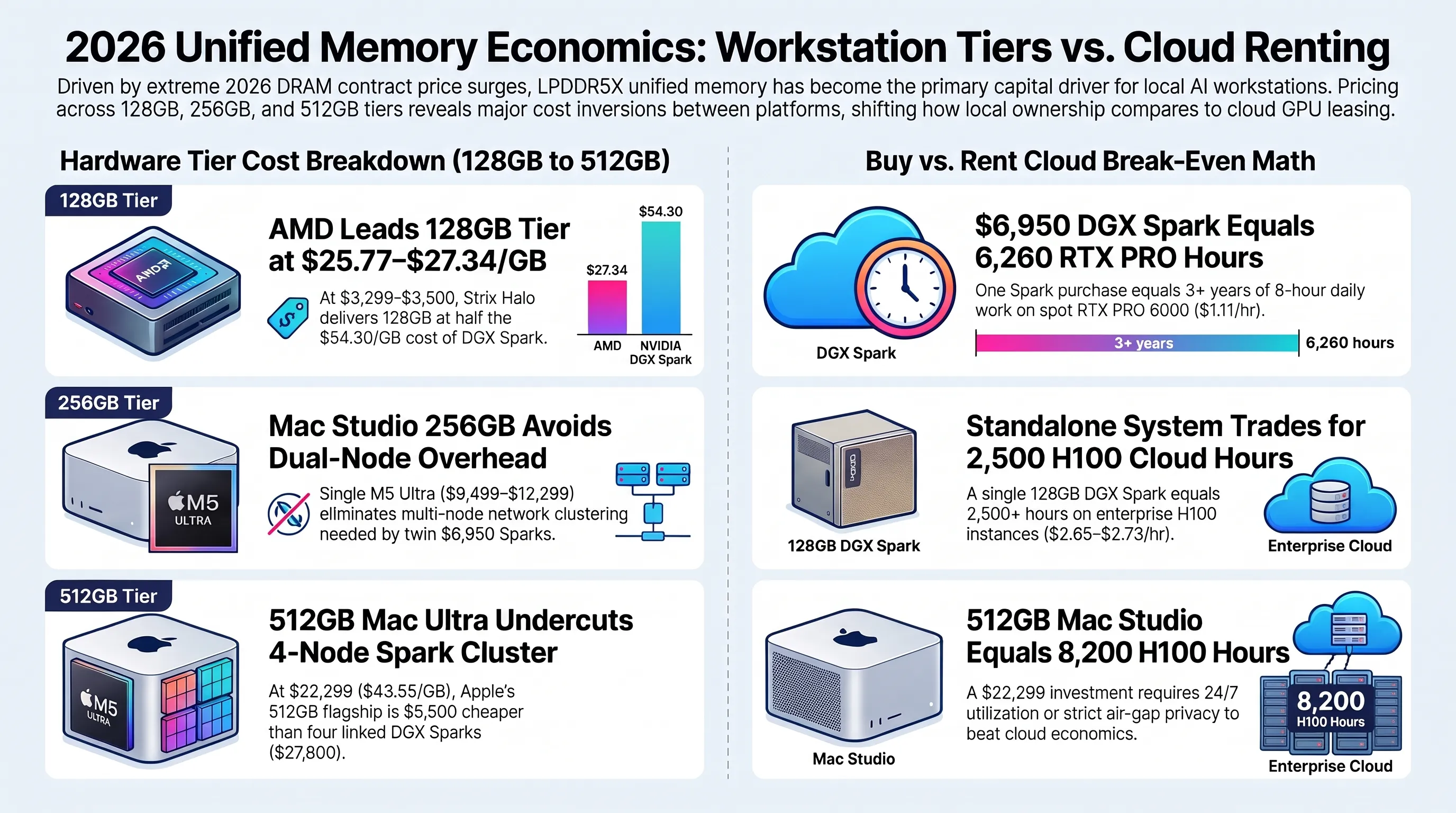
- The 128GB Tier (AMD Runs Away on Value, M5 Max Sneaks In): At $3,299 to $3,500, a 128GB Strix Halo mini PC delivers coherent unified memory at $25.77 to $27.34 per gigabyte. At $6,950, NVIDIA's 128GB DGX Spark sits at $54.30 per gigabyte literally double AMD's price per gigabyte. Worse still for NVIDIA's new entry SKU, the $4,999 64GB DGX Spark clocks in at an eye-watering $78.11 per gigabyte. Even Apple quietly undercuts NVIDIA at 128GB: a configured Mac Studio M5 Max with 128GB of memory (around $5,099 to $5,399) costs roughly $1,500 less than a DGX Spark while delivering 614 GB/s of memory bandwidth more than double the GB10's bus width.
- The 256GB Tier (Single-Box Simplicity vs. Dual-Node Complexity): Reaching 256GB with NVIDIA requires purchasing two 128GB DGX Spark nodes and linking them via ConnectX-7, totaling roughly $13,900 at new MSRP tiers (and often closer to $15,000 through resellers). Apple's Mac Studio M5 Ultra with 256GB unified memory lands between $9,499 and $12,299 $14,299 depending on CPU/GPU bin and SSD size, delivering 1.2 TB/s in a single silent enclosure with zero cluster orchestration overhead. ServeTheHome's own lab experience underscored this vertical-scaling rule: an 8-node GB10 cluster their team assembled earlier in 2026 at ~$3,000 per node would cost over $50,000 to rebuild at October prices, prompting their unambiguous recommendation to scale up inside one larger machine before scaling out across multiple nodes.
- The 512GB Tier (Apple's Shocking Price Inversion): Apple's $15,500 memory upgrade fee to reach 512GB on the Mac Studio M5 Ultra ($22,299 total starting price, or $43.55/GB) provoked immediate sticker shock online. Yet do the multiplication on NVIDIA's side: assembling four 128GB DGX Spark units at $6,950 each to match 512GB of total memory costs $27,800 before cabling and rack switches. At the extreme half-terabyte summit, Apple's flagship Mac Studio is actually $5,500 cheaper than a four-node DGX Spark cluster while keeping every single gigabyte inside one ultra-wide 1.2 TB/s address space.
Financial Telemetry | Cost Per Gigabyte and DGX Spark's 12-Month Price Trajectory
| Platform & Configuration | Late-November 2026 Price | Effective Cost Per GB |
|---|---|---|
| AMD Strix Halo Mini PC (128GB / 1TB-2TB SSD) | $3,299 - $3,500 | $25.77 - $27.34 / GB |
| NVIDIA DGX Spark (128GB / 4TB SSD) | ~$6,950 (64GB OEM: $4,999) | $54.30 / GB ($78.11 on 64GB) |
| Mac Studio M5 Ultra (96GB / 256GB / 512GB) | $5,499 / ~$12,299 / $22,299 | $57.28 / ~$48.04 / $43.55 / GB |
Before wiring five figures to any hardware vendor, disciplined engineering teams must run one more sanity check: own versus rent. Decentralized and boutique GPU cloud pricing in late November 2026 remains remarkably competitive despite hardware scarcity. Spot instances of NVIDIA's workstation-class RTX PRO 6000 (96GB VRAM) trade near $1.11 per hour on Spheron (with managed pods around $2.49/hr on RunPod), while full datacenter H100 instances rent on-demand for roughly $2.65 to $2.73 per hour across Spheron and Akash Network.
Do the break-even math: the $6,950 required to purchase a single 128GB DGX Spark buys approximately 6,260 hours of spot RTX PRO 6000 compute more than three full years of eight-hour workdays or over 2,500 hours on an H100 backed by multi-terabyte-per-second HBM bandwidth. Likewise, a $22,299 512GB Mac Studio equals more than 8,200 hours of H100 rental. Buying desktop hardware in late 2026 only beats cloud economics under three clear conditions: your utilization runs near 24/7 with autonomous agents and local fine-tuning loops, regulatory or intellectual-property rules strictly forbid sensitive data from leaving your local network, or predictable zero-latency local ownership outweighs variable monthly API bills.
Chronology | How the 2025-2026 Memory Crunch Reshaped Desktop AI Hardware
| Date | Milestone | Market Impact |
|---|---|---|
| Oct 15, 2025 | NVIDIA DGX Spark Launches at $3,999 | 128GB/4TB Founders Edition sets the initial benchmark for personal Grace Blackwell workstations. |
| Feb 23, 2026 | First DGX Spark Price Hike (+18%) | NVIDIA raises MSRP to $4,699, formally pointing to tightening global LPDDR5X memory supply. |
| Aug 25, 2026 | Apple Unveils Mac Studio M5 Max & M5 Ultra | Quad-die M5 Ultra debuts with 1.2 TB/s bandwidth; base Ultra price climbs from $3,999 to $5,499 (ships Sept 22). |
| Oct 2-3, 2026 | DGX Spark 128GB Hits ~$6,950; 64GB Arrives | OEM 128GB pricing surges nearly 74% above launch; 64GB OEM models debut at $4,999 (shipping Oct 23). |
| Oct 28, 2026 | 512GB Mac Studio M5 Ultra Opens for Order | Top unified-memory tier debuts at $22,299 ($15,500 RAM upgrade), undercutting a 4-node DGX Spark cluster. |
| Nov 25, 2026 | TrendForce Warns DRAM Shortage Runs Into 2027 | Projected $1.15T DRAM market in 2027 signals no near-term price relief for 128GB+ unified-memory systems. |
Deployment Playbook: Matching Each Box to a Real Workload
Rather than crowning a single fictional winner that fits every desk, the cleanest way to navigate late-2026 desktop AI pricing is to map each architecture directly to the workload profile where it creates undeniable ROI and call out the traps where buyers waste thousands of dollars.
Buy the NVIDIA DGX Spark If...
Your engineering team ships directly to NVIDIA datacenter GPUs and cannot afford silent divergences between local evaluation and production deployment. You routinely hammer models with cold 32K to 100K token contexts without prompt caching, serve 8 to 16 simultaneous internal users over vLLM, or plan to stitch multiple nodes over 200 Gb/s ConnectX-7 networking. Conversely, skip the $4,999 64GB SKU unless you are specifically assembling a budget-capped CUDA multi-node testbed; for almost every standalone buyer, 64GB is too tight for serious 70B+ quantization at deep context windows.
Buy the Apple Mac Studio M5 Ultra (or M5 Max) If...
You want the fastest single-user interactive decode experience money can buy on a quiet desk, run dense 27B to 70B models or colossal 200B to 400B+ weights inside a single memory pool, and value having a world-class macOS creative and software-development workstation alongside local AI. One vital nuance often overlooked in Ultra hype: if 128GB satisfies your model roster, the Mac Studio M5 Max (128GB, 614 GB/s) near $5,100 $5,400 delivers an extraordinary sweet spot undercutting the $6,950 DGX Spark while more than doubling its memory bandwidth. Step up to the M5 Ultra specifically when 256GB or 512GB single-box capacity and 1.2 TB/s throughput are non-negotiable.
Buy an AMD Strix Halo 128GB Mini PC If...
You are an independent developer, AI researcher, homelab builder, or nimble startup focused heavily on sparse MoE models (like gpt-oss 120B, Qwen MoE, or DeepSeek Flash variants), want the lowest dollar-per-gigabyte entry into 128GB coherent memory ($3,299 $3,500), and demand full x86 compatibility across Linux and Windows. Just budget an afternoon to configure Ubuntu 24.04 with ROCm 7.2 or tuned Vulkan builds so you claim the full 120GB GPU memory allocation rather than leaving 24GB stranded under Windows driver limits.
Skip All Three Unified-Memory Boxes If...
Your primary workload is image synthesis, video generation (such as Flux, Wan, or ComfyUI pipelines), or fast inference exclusively on compact 8B to 32B models. Unified LPDDR5X systems optimize for capacity per watt, not brute-force FP16/BF16 diffusion speed. For diffusion workflows and smaller LLMs, a conventional desktop tower housing a discrete 24GB or 32GB NVIDIA RTX GPU (or a multi-GPU used RTX 3090 rig, which hits ~124 tok/s on gpt-oss 120B) will run circles around both Strix Halo and DGX Spark at a fraction of the price.
Final Verdict: Three Specialists, Zero Compromise-Free Shortcuts
The romantic era of cheap, abundant unified memory paused in 2026, replaced by a sharper, more disciplined hardware market. Every dollar now buys a distinct physical capability: AMD Strix Halo sells affordable 128GB x86 capacity for sparse MoE workloads; Apple's Mac Studio M5 Ultra sells unmatched 1.2 TB/s single-box bandwidth and half-terabyte simplicity; and NVIDIA's DGX Spark sells frictionless CUDA production parity, blistering cold-prompt prefill, and multi-user Blackwell throughput.
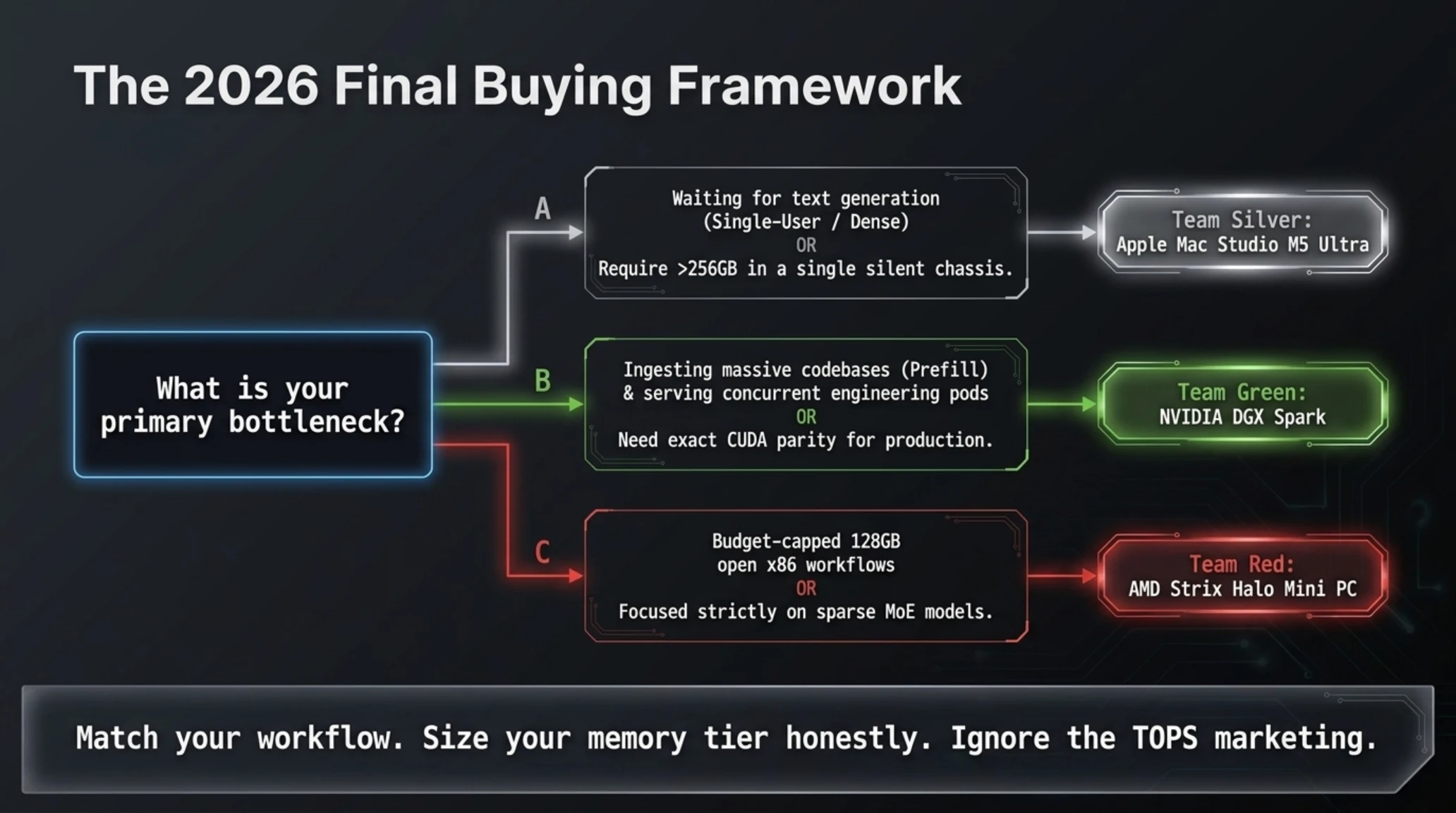
Measure your actual bottleneck before placing an order. If your daily workflow stalls waiting for models to finish typing, buy bandwidth which points straight to Apple Silicon. If your agents choke digesting fresh 50,000-token repositories or serving a whole engineering pod concurrently on CUDA, swallow the price hike for Blackwell. And if your priority is getting 128GB of coherent local AI memory onto an open Linux/Windows workstation without crossing the $3,500 line, Strix Halo remains the pragmatic champion of a turbulent memory crisis.
- Complete elimination of recurring API bills and 100% air-gapped privacy for sensitive codebases and enterprise documents.
- Unmatched 1.2 TB/s unified bandwidth and single-chassis 512GB ceiling on Mac Studio M5 Ultra for effortless single-user decode.
- Commanding cold-prompt prefill speed, multi-user vLLM scaling, 200GbE ConnectX-7 clustering, and exact CUDA production parity on NVIDIA DGX Spark.
- Best-in-class $25.77-$27.34/GB memory economics and unrestricted x86 Windows/Linux flexibility on 128GB AMD Strix Halo mini PCs.
- Severe 2026 DRAM inflation pushed DGX Spark up ~74% to $6,950, Strix Halo above $3,300, and Apple's 512GB RAM upgrade alone to $15,500.
- Soldered, non-upgradable memory across all three platforms turns under-specifying capacity into a permanent, costly mistake.
- Narrow 256-273 GB/s buses on Strix Halo and DGX Spark noticeably throttle interactive decode speeds on large dense models.
- ROCm backend friction and Windows' 96GB GPU cap on AMD, alongside Arm64 Linux appliance constraints and M.2 2242 storage limits on DGX Spark.
Editorial Verdict & Direct Verified Sources
- Apple Newsroom (OFFICIAL SOURCE): Apple introduces new Mac Studio with M5 Max and M5 Ultra (August 25, 2026)
- Apple Technical Specifications (OFFICIAL SOURCE): Mac Studio Technical Specifications M5 Max and M5 Ultra
- NVIDIA Official Blog (OFFICIAL SOURCE): DGX Spark 64GB Gives Developers More Ways to Build and Scale Local AI (October 2, 2026)
- NVIDIA Developer Forum (OFFICIAL SOURCE): DGX Spark 2/23/2026 Price Change Announcement
- ServeTheHome (INDUSTRY REPORT): NVIDIA DGX Spark 64GB Launched and Big 128GB GB10 Price Increases (October 3, 2026)
- Hardware Busters (INDUSTRY REPORT): Nvidia DGX Spark 64GB Arrives at $4,999 as the 128GB Model Jumps to $6,950 (October 2, 2026)
- Tom's Hardware (INDUSTRY REPORT): Going deep on local AI performance benchmarking with Apple's Mac Studio with M5 Ultra taking on Nvidia DGX Spark (November 10, 2026)
- TrendForce (INDUSTRY REPORT): DRAM Contract Price Tracking and 2026-2027 Market Supply Analysis
- GMKtec Official Listing (OFFICIAL SOURCE): AMD Ryzen AI Max+ 395 EVO-X2 128GB AI Mini PC Specifications and Pricing
Frequently Asked Questions About 2026 Desktop AI Workstations
Why does the Mac Studio M5 Ultra beat the NVIDIA DGX Spark by nearly 4x in dense LLM text generation?
Single-user token generation (decode) on dense language models is strictly bottlenecked by memory bandwidth, because the processor must read all model weights for every generated token. The Mac Studio M5 Ultra delivers 1.2 TB/s of unified memory bandwidth about 4.4 times higher than the DGX Spark's 273 GB/s LPDDR5X bus translating directly into 46.3 tok/s versus 11.8 tok/s on dense Qwen 3.8 27B tests.
Is NVIDIA's new $4,999 64GB DGX Spark worth buying in late 2026?
For most standalone developers, no. At $78.11 per gigabyte of unified memory, the 64GB DGX Spark costs roughly $1,500 more than a 128GB AMD Strix Halo mini PC while offering half the RAM capacity. It makes sense primarily for enterprise CUDA teams building low-cost multi-node ConnectX-7 testbeds where production software parity outweighs local model size.
How does a 512GB Mac Studio M5 Ultra compare in cost to matching 512GB with NVIDIA DGX Spark nodes?
Surprisingly, Apple wins on total capital cost at 512GB. While Apple's $22,299 starting price (including a $15,500 RAM upgrade) looks steep in isolation, buying four 128GB DGX Spark boxes at ~$6,950 each totals roughly $27,800 before cabling and splits the memory across four slower 273 GB/s nodes instead of one unified 1.2 TB/s pool.
Should Strix Halo 128GB buyers run Windows or Linux for local LLM inference?
Linux is strongly recommended for serious local AI workloads. Windows caps AMD's Radeon 8060S integrated GPU at 96GB of addressable unified memory, whereas Ubuntu or Fedora Linux unlocks up to 120GB for GPU inference and provides cleaner ROCm 7.2 support alongside Vulkan.
Will desktop AI workstation prices drop in early 2027?
Near-term relief looks unlikely. TrendForce's November 25, 2026 market forecast projects that hyperscaler demand will keep DRAM supply tight throughout all of 2027 (driving global DRAM revenue toward $1.15 trillion), meaning 128GB and 256GB unified-memory systems are expected to remain elevated well into next year.
Additional Gallery: Tekin Versus: DGX Spark vs. Mac Studio M5 Ultra vs. Strix Halo