Tekin Guide: CUDA Escape
- 🎮The $13B Nvidia Shock- Dissecting the fallout of Nvidia absorbing Hugging Face in September 2026
- 🎧ASIC Silicon Alternatives- Architectural teardown of Google Trillium, AWS Trainium 3, and Groq
- 🚀Groq LPU Architecture- Eliminating HBM bottlenecks for sub-5ms agentic inference generation
- 🗡️Bypassing CUDA C++- Using OpenAI Triton and OpenXLA to decouple algorithms from silicon
- 📰60% TCO Reduction- Financial analysis of running 70B foundation models on alternative chips
- ⚔️Hybrid Multi-Cloud- Liquid compute routing across TPU and Groq clusters for optimal efficiency
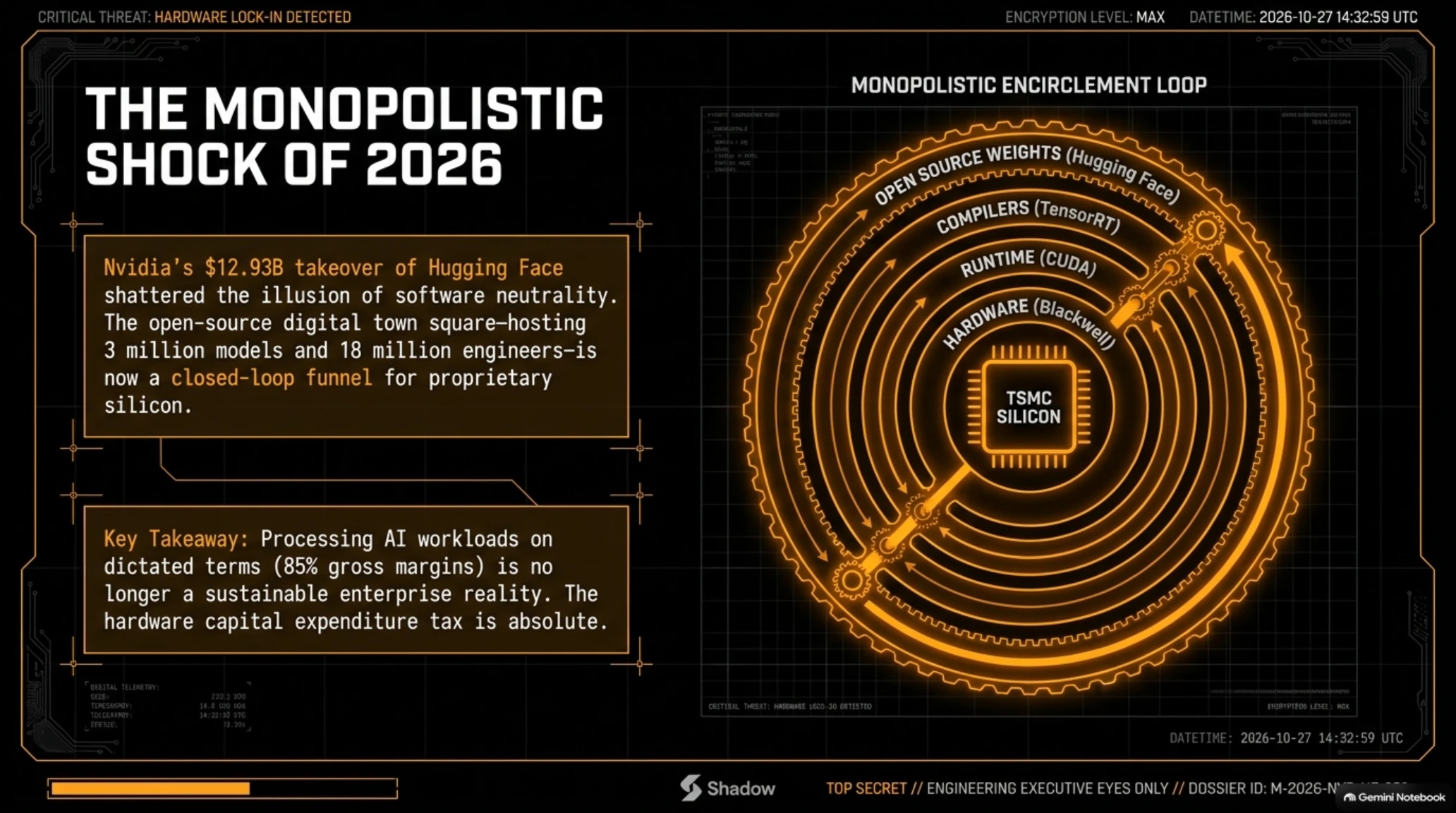
In September 2026, the global artificial intelligence landscape endured its most consequential consolidation event to date: Nvidia formally finalized the acquisition of Hugging Face—the epicenter of the open-source AI community hosting over 3 million models and 18 million active engineers—for a staggering $12.93 billion. For years, enterprise technology executives and venture-backed founders consoled themselves with a comforting dichotomy: while hardware capital expenditures remained subject to Jensen Huang's tyrannical 85% gross margins, the software layer, open-source weight distributions, and developer tooling remained democratized, decentralized, and vendor-neutral.
The absorption of Hugging Face instantly shattered that delicate illusion. With this single transaction, Nvidia achieved total vertical integration across the entire generative AI value chain. The Silicon Valley titan now exercises sovereign dominion from TSMC advanced packaging wafers and Blackwell server clusters to proprietary InfiniBand fabrics, CUDA runtime drivers, TensorRT-LLM compilers, and finally, the premier distribution clearinghouse for global open-source machine learning weights. The implicit message broadcast from Santa Clara to every Chief Technology Officer on the planet was unambiguous: either process your AI workloads on Nvidia's proprietary terms at Nvidia's dictated prices, or face operational obsolescence in the hyper-competitive era of artificial general intelligence.
Yet, historical inflection points often emerge from unbridled corporate overreach. The closure of the open-source ecosystem has accelerated an unprecedented enterprise rebellion: The Great Escape from the CUDA Lock-in. Plagued by exorbitant cloud GPU rental invoices, crippling nine-month allocation waiting queues, and the chilling realization that their entire technical roadmap sat hostage to a single hardware vendor, Fortune 500 infrastructure teams have mobilized. Escaping CUDA is no longer an esoteric exploratory research initiative confined to fringe academic labs; it has rapidly transformed into the single most urgent operational imperative across the international technology sector.
Executive Migration Takeaways at a Glance
- Nvidia's $13 billion takeover of Hugging Face establishes unprecedented vertical consolidation, turning the primary open-source hub into a closed-loop funnel for proprietary GPUs.
- Next-generation ASICs, led by Google TPU v6 Trillium and AWS Trainium 3, slash baseline pre-training capital expenditures by over 50% compared to Blackwell clusters.
- Groq's deterministic Tensor Streaming LPUs eliminate the high-bandwidth memory (HBM) bottleneck, delivering sub-5ms time-to-first-token and sustained throughput exceeding 550 tokens/second.
- Modern compiler frameworks, specifically OpenAI Triton and OpenXLA, decouple algorithmic logic from silicon microarchitecture, rendering raw CUDA C++ obsolete for production workloads.
Over the preceding two years, alternative silicon architectures quietly evolved from experimental prototypes into hardened, enterprise-grade hyperscale platforms. Systems once derided by purists as possessing immature software toolchains have reached complete architectural maturity. This definitive guide provides engineering leaders, principal cloud architects, and ML infrastructure practitioners with an exhaustive blueprint for dismantling their proprietary hardware dependencies, evaluating competing silicon paradigms, dissecting real-world total cost of ownership (TCO) economics, and executing seamless workload migrations.
The $13 Billion Shockwave: How Nvidia's Acquisition of Hugging Face Encircled AI
To comprehend the sheer magnitude of the Hugging Face acquisition, one must examine the operational infrastructure of modern software engineering. Hugging Face was never merely a cloud storage repository for model checkpoints; it functioned as the de facto nervous system of the open-source AI paradigm. More than 90% of commercial research papers, fine-tuning scripts, and enterprise evaluation pipelines initiated with a call to the `transformers` library. By integrating model cards, dataset registries, and serverless deployment spaces into a unified hub, Hugging Face became the public commons of generative computing.
By absorbing this digital town square for nearly thirteen billion dollars, Nvidia effectively privatized the commons. While executive leadership insists the platform will maintain its open ethos, architectural shifts manifested almost immediately: default quantization pipelines began prioritizing TensorRT-LLM binaries; discovery algorithms on the model hub favored checkpoints pre-calibrated for RTX workstations and HGX servers; and automated translation scripts targeting competing compilers such as OpenXLA or Intel oneAPI were subtly deprioritized. Nvidia did not purchase Hugging Face to monetize file hosting; it acquired the platform to ensure that no emergent model architecture could achieve global developer adoption without paying an architectural toll to the CUDA runtime.
Historical Chronology: The Construction and Fall of the CUDA Hegemony
| Era / Milestone | Architectural Evolution | Industry & Geopolitical Repercussion |
|---|---|---|
| 2006: CUDA Unveiled | Nvidia introduces parallel compute architecture | Transforms graphics rendering silicon into general-purpose matrix processors |
| 2012: AlexNet Breakthrough | Deep neural networks trained on dual GTX 580 GPUs | Establishes Nvidia as the sole viable execution crucible for machine learning |
| 2017: Transformer Revolution | Introduction of multi-head self-attention mechanisms | Ignites exponential demand for dense tensor matrix multiplication throughput |
| 2022: The Generative Explosion | Launch of ChatGPT on massive A100/H100 clusters | Hardware demand outstrips supply; Nvidia gross margins approach 85% |
| 2024: The Blackwell Megacluster | Monolithic multi-die packaging with NVLink-5 | Cloud providers face 9-month allocation backlogs and ballooning operational bills |
| September 2026: Hugging Face Deal | $12.93B cash-and-stock buyout by Nvidia | Open-source neutrality collapses; triggers the international enterprise migration movement |
The strategic foundation of this encirclement was meticulously engineered over two decades. When Nvidia debuted CUDA in 2006, Wall Street analysts vociferously criticized the capital expenditure, questioning why a consumer graphics card manufacturer was expending immense engineering resources on scientific compute extensions without a defined market. Jensen Huang persevered, seeding academic computer science departments worldwide with free hardware, robust linear algebra libraries (cuBLAS), and foundational profiling suites. An entire generation of doctoral researchers and systems programmers was conditioned to equate parallel computing with CUDA.
With the subsequent introduction of cuDNN for deep neural network primitives and the Nvidia Collective Communications Library (NCCL) for multi-node inter-GPU synchronization, Nvidia transformed a hardware commodity into an impenetrable software fortress. Competitors such as AMD or Intel could fabricate silicon with comparable theoretical floating-point operations (FLOPs) or larger memory capacities, yet enterprise engineering teams routinely abandoned non-Nvidia hardware after encountering crippling compiler bugs, broken backward compatibility, and an utter absence of community troubleshooting resources. This self-reinforcing developer lock-in became the most defensible corporate moat in modern computing history.
Deconstructing the Gilded Cage: Why Escaping CUDA Was an Engineering Nightmare
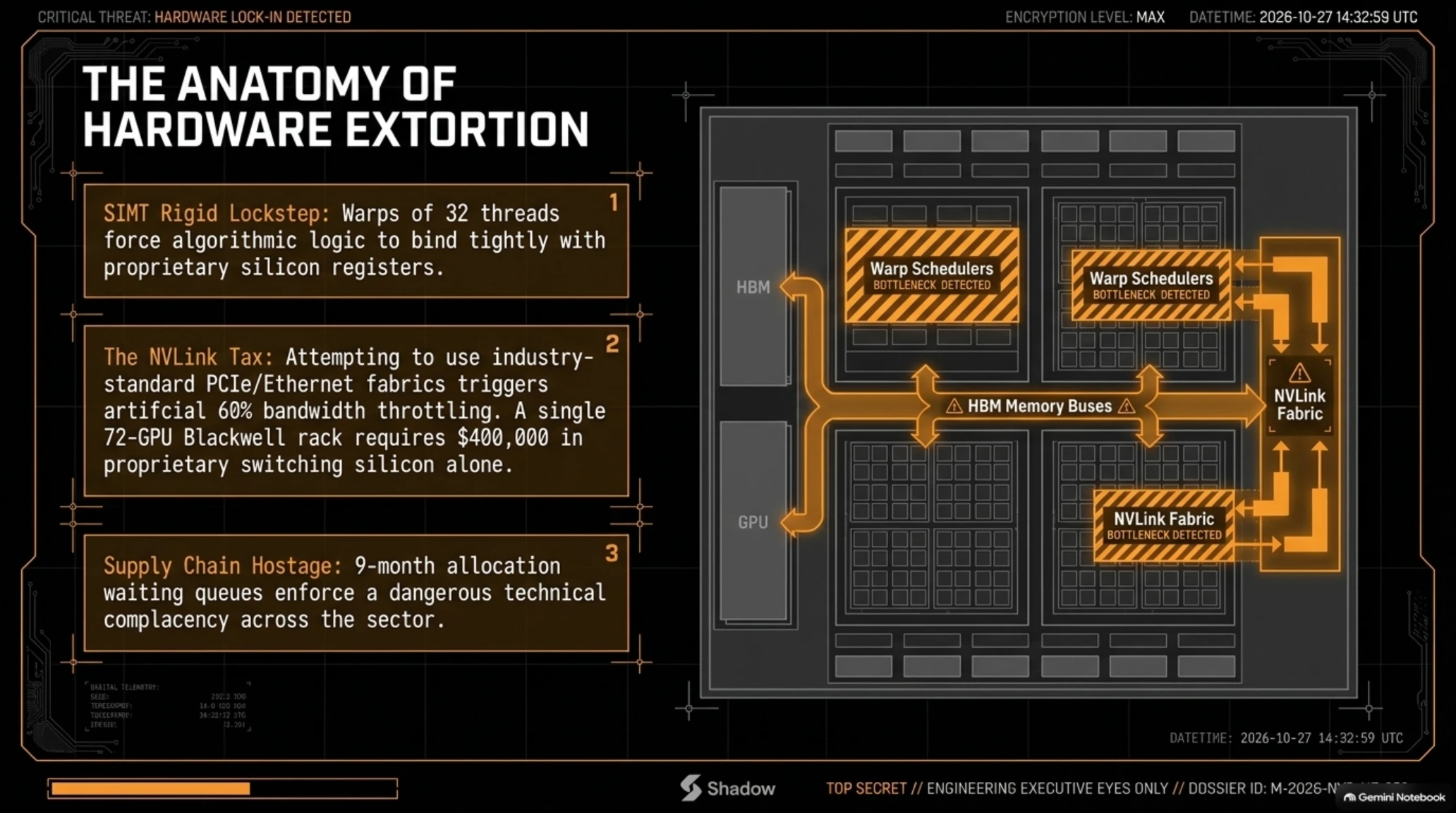
To grasp why migrating away from Nvidia historically paralyzed engineering organizations, one must dissect the microarchitectural mechanics of GPU computing. Nvidia GPUs operate on the Single Instruction, Multiple Threads (SIMT) programming paradigm. In this execution model, execution threads are rigidly clustered into lockstep groups of 32, designated as warps. Orchestrating memory coalescing across shared memory banks, avoiding warp divergence penalties, and masking high-latency DRAM operations via hyper-threaded hardware warp schedulers demanded deep, specialized expertise in C++ and proprietary microarchitectural internals.
Strategic Directive: Why Breaking Hardware Lock-in Is Mandatory
Senior ML performance engineers were compelled to hand-tune Parallel Thread Execution (PTX) assembly code and explicitly manage tensor core accumulator registers to extract peak floating-point throughput from H100 clusters. This profound entanglement between mathematical algorithmic logic and proprietary silicon registers rendered codebases completely non-portable. Attempting to execute a CUDA-optimized attention kernel on alternative silicon historically required a comprehensive, line-by-line rewrite in alien vendor languages, introducing months of software development delays and unpredictable numerical divergence.
Beyond the silicon die itself, Nvidia engineered an equally formidable barrier across the networking fabric: the mandatory bundling of proprietary NVLink interconnect switches and Quantum InfiniBand adapters. Enterprises that attempted to pair Nvidia GPUs with industry-standard PCIe or Ethernet fabrics immediately suffered catastrophic 60% throughput penalties due to artificial bandwidth throttling outside the NVLink ecosystem. A single 72-GPU Blackwell rack requires upwards of $400,000 in proprietary switching silicon alone, transforming enterprise datacenters into bespoke, non-fungible computing silos that cannot accommodate alternative hardware without complete physical decommissioning.
This hardware extortion created a dangerous technical complacency across the tech sector. Software teams routinely treated compute cycles as infinite while accepting sub-optimal memory utilization, relying on brute-force hardware scaling rather than architectural efficiency. By breaking this cycle, modern engineering organizations not only eliminate the exorbitant Nvidia tax but rediscover algorithmic elegance, structuring pipelines around lean, deterministic execution patterns that outshine legacy clusters even on older process nodes.
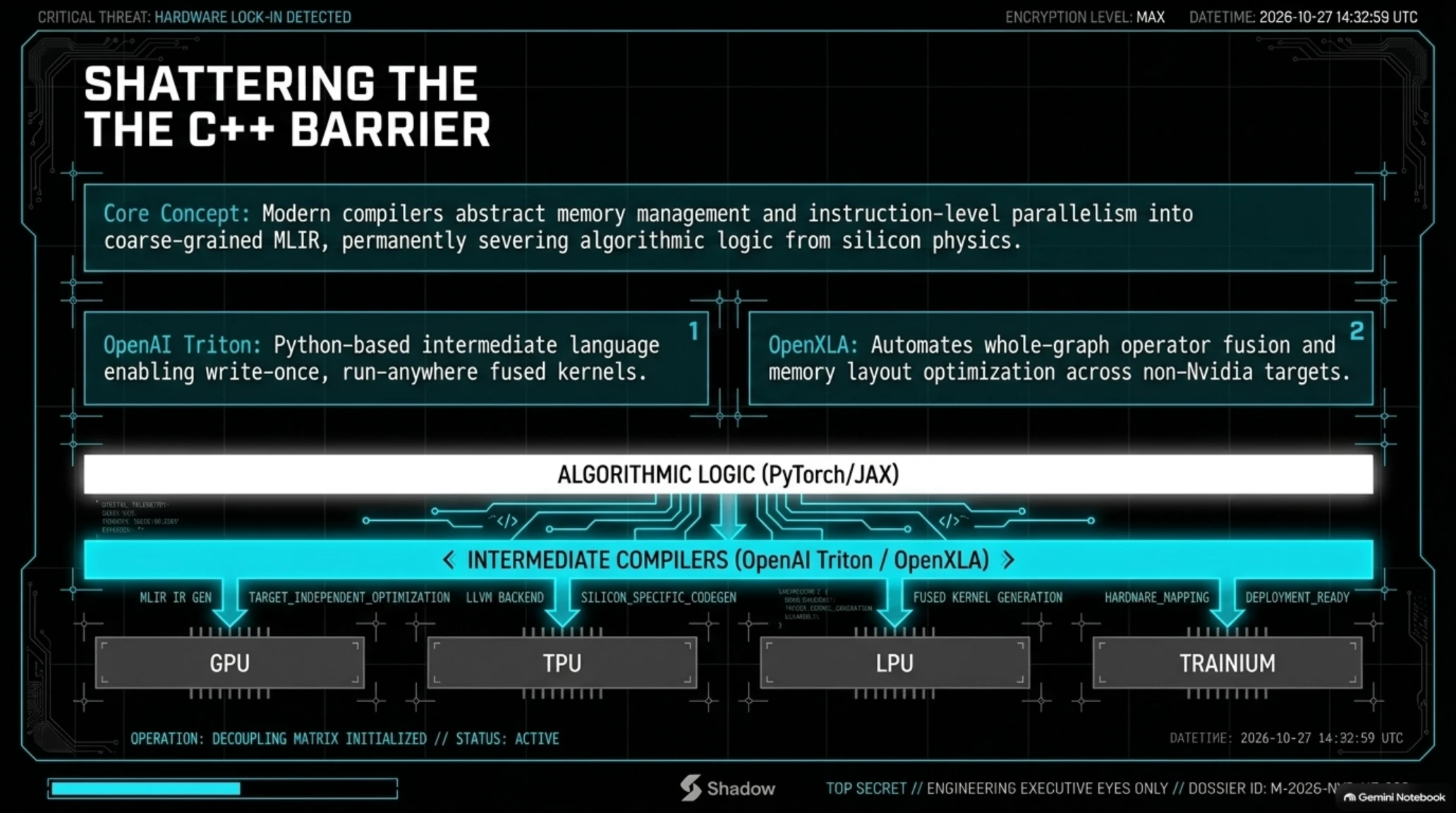
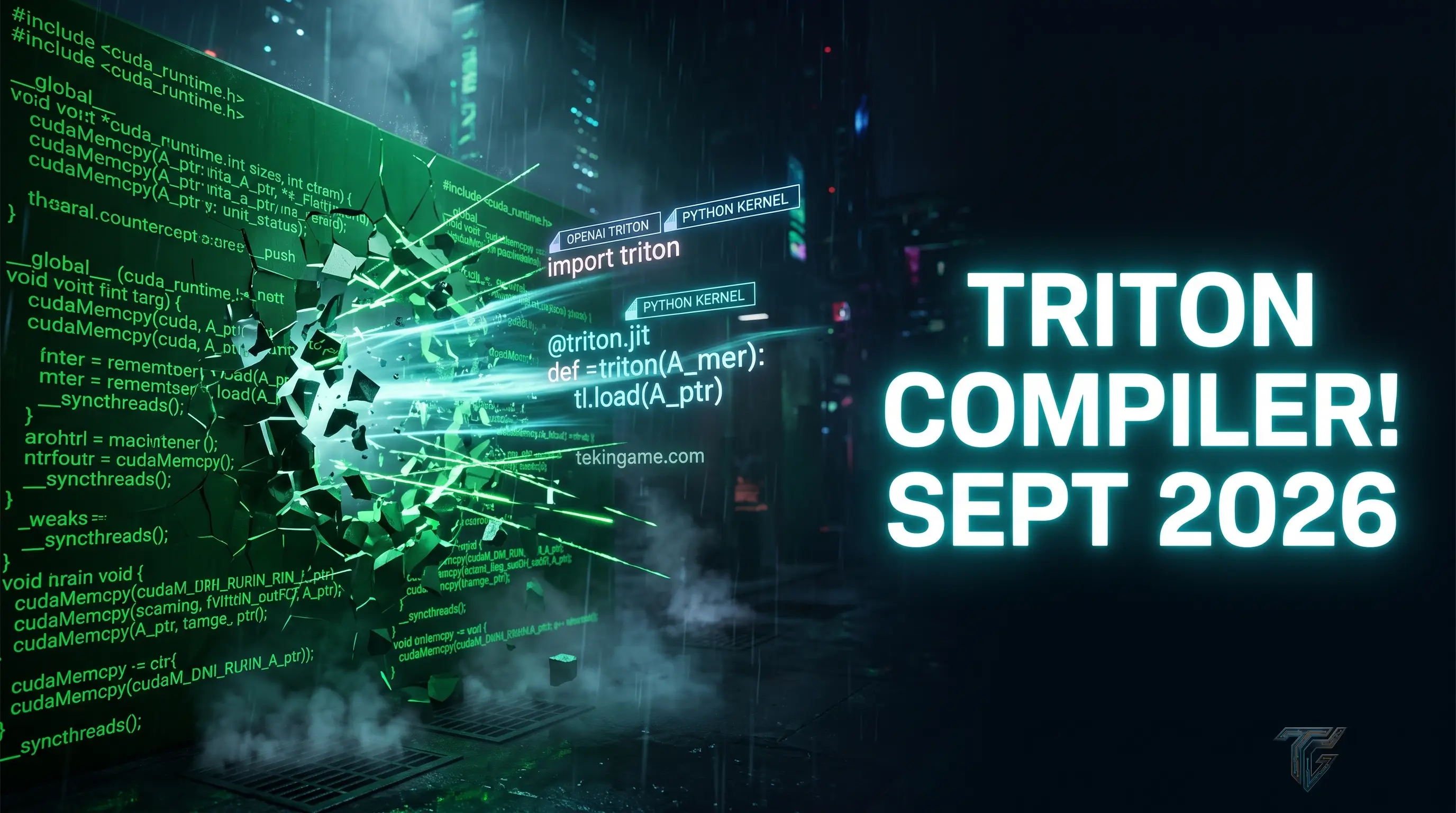
However, the tectonic plates of the software compiler stack have decisively shifted. The ascendancy of PyTorch 2.6 with its unified `torch.compile` graph capture infrastructure, the institutional formalization of the OpenXLA compilation pipeline, and above all, the widespread enterprise adoption of OpenAI Triton, have definitively shattered the CUDA C++ barrier. Triton empowers developers to author ultra-fast, hardware-fused kernels directly in Python, while delegating low-level register allocation, memory layout scheduling, and architecture-specific code generation to multi-target compiler backends. The historical dependency on proprietary assembly is finally broken.
The ASIC Silicon Triumvirate: Google Trillium, AWS Trainium 3, and Groq LPU
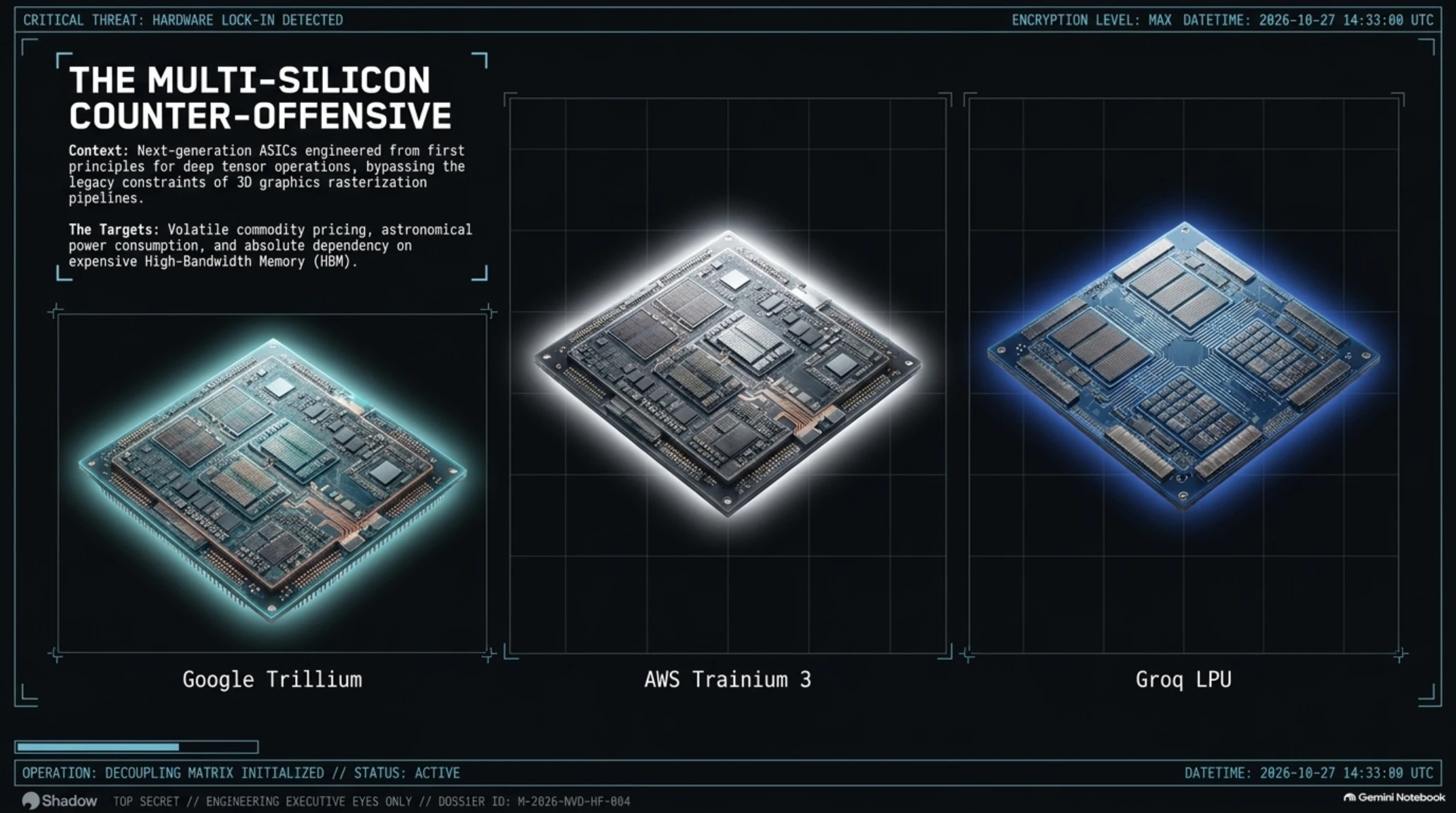
For more than a decade, conventional wisdom asserted that custom Application-Specific Integrated Circuits (ASICs) could never match the raw versatility and brute floating-point throughput of Nvidia's flagship graphics architectures. In 2026, that dogma has been comprehensively refuted. Three formidable competitors, leveraging specialized silicon designed from first principles for deep tensor operations, have targeted the foundational vulnerabilities of general-purpose GPUs: astronomical power consumption, volatile commodity pricing, and absolute dependency on expensive, supply-constrained High-Bandwidth Memory (HBM).
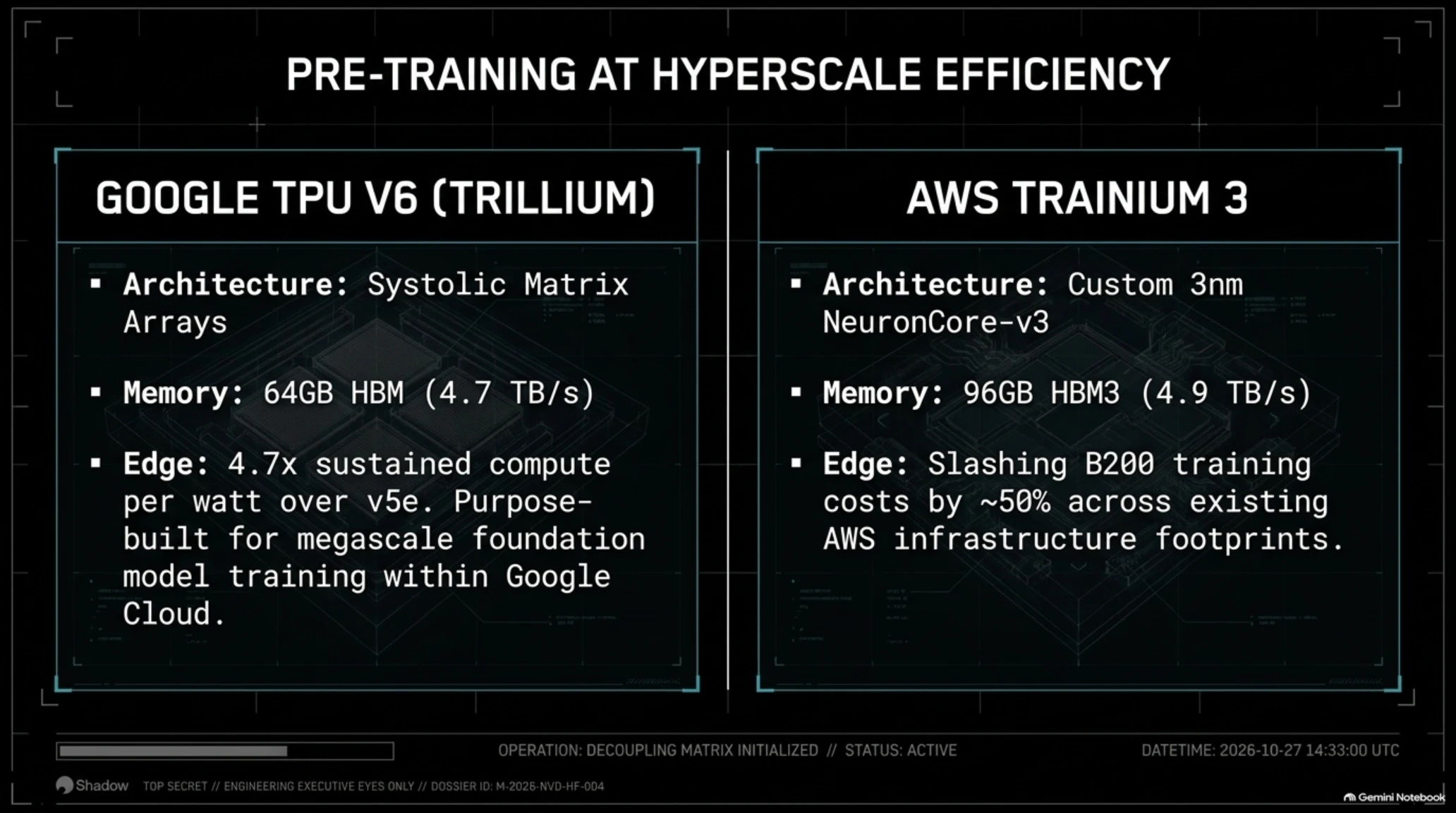
Leading this architectural counter-offensive is Google Cloud with its sixth-generation Tensor Processing Unit, codenamed TPU v6 (Trillium). Delivering an astonishing 4.7-fold increase in sustained compute performance per watt compared to TPU v5e, Trillium represents a masterclass in systolic array engineering. It is purpose-built to orchestrate the pre-training of massive multi-hundred-billion-parameter foundation models at hyperscale electrical efficiencies that traditional GPU architectures cannot physically emulate. Simultaneously, Amazon Web Services deployed Trainium 3, fabricated on TSMC's cutting-edge 3-nanometer lithography node, slashing training costs across the AWS cloud footprint by nearly 50% relative to comparable Nvidia B200 instances.
Microarchitectural Teardown: Groq LPU Deterministic Tensor Streaming
| Subsystem Component | Groq LPU Architectural Design | Operational Superiority Over Traditional GPUs |
|---|---|---|
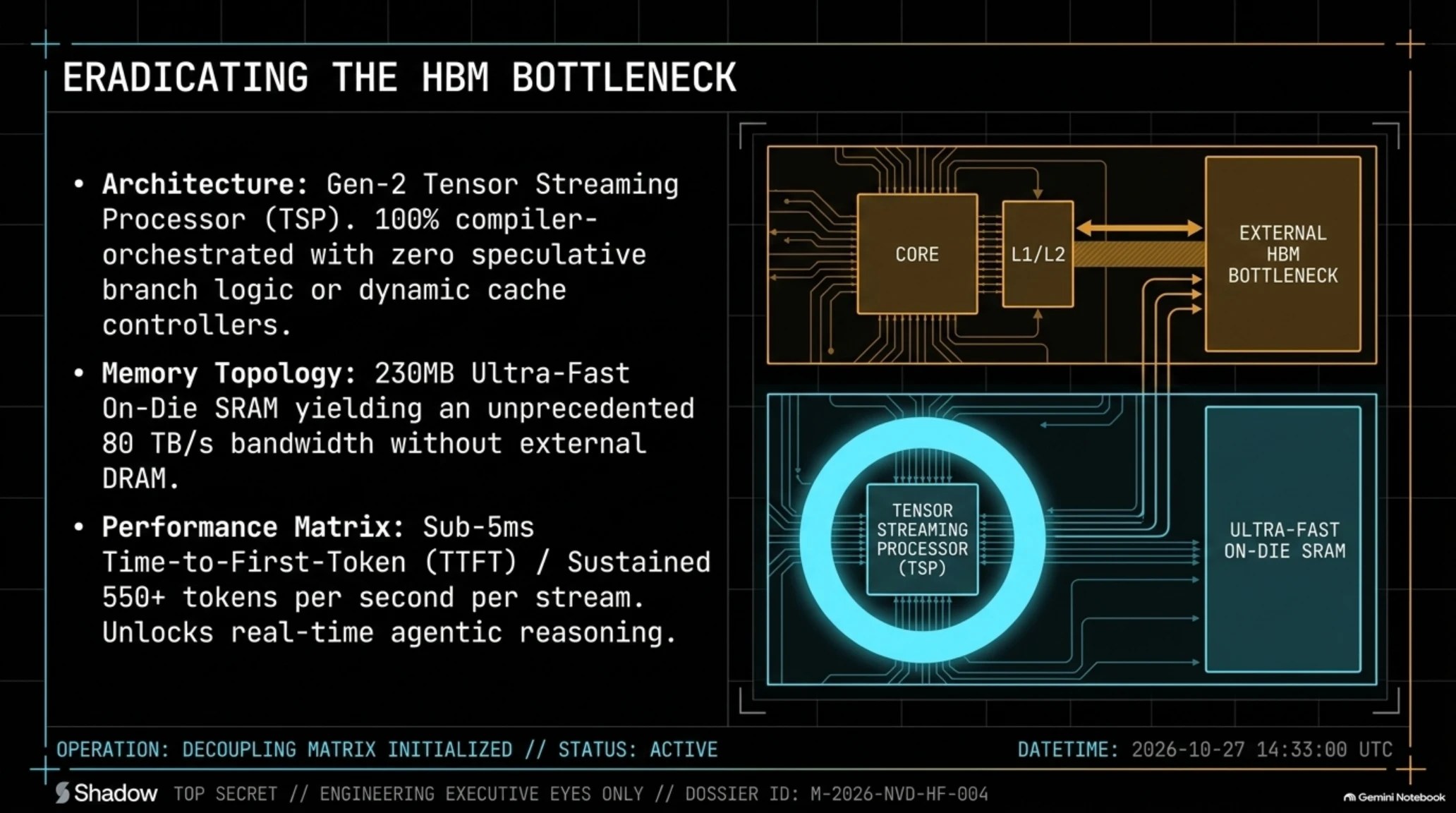
| Core Processing Paradigm | Tensor Streaming Processor (TSP) | Complete elimination of runtime instruction schedulers; 100% compiler-orchestrated |
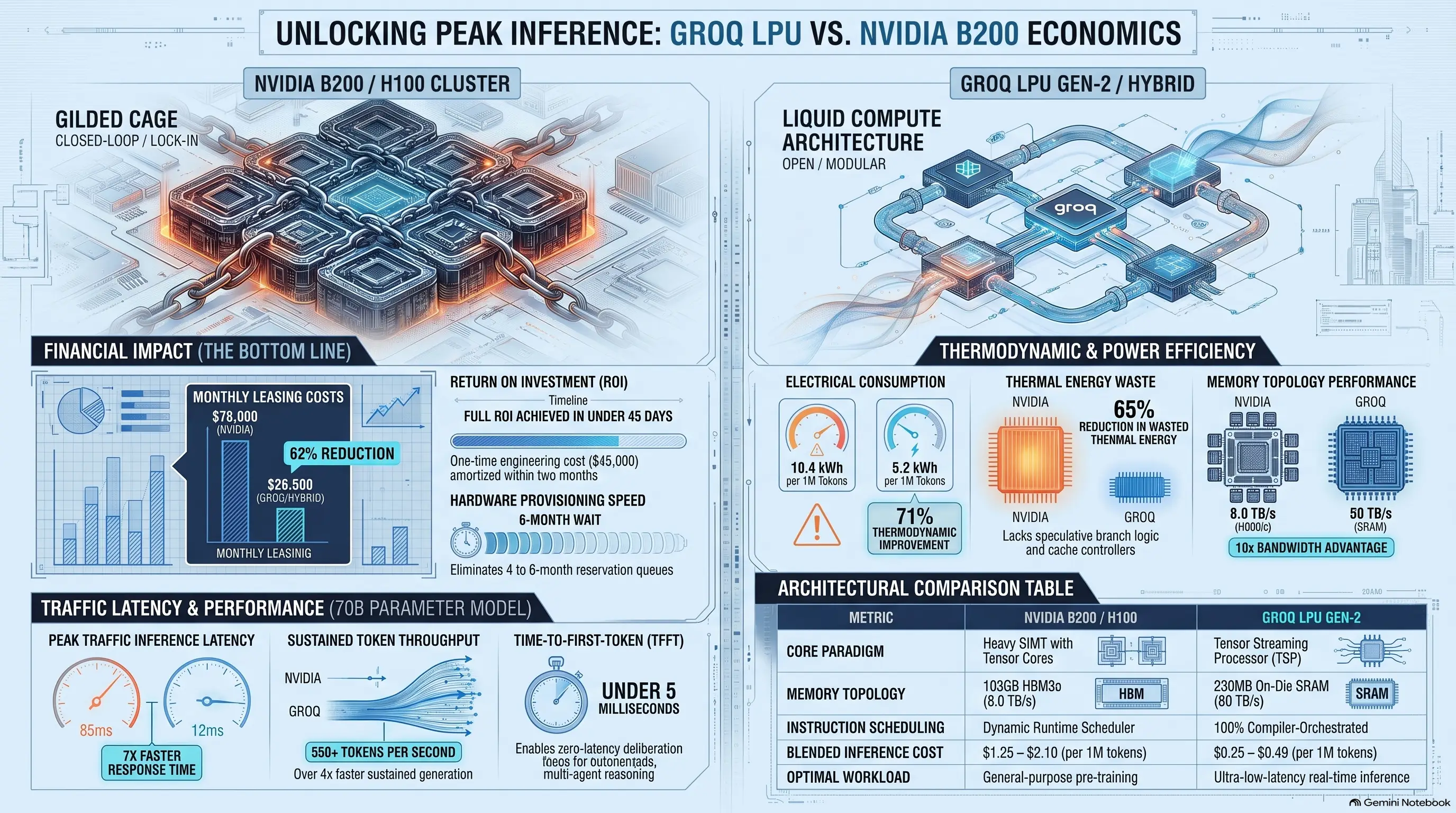
| Primary Memory Topology | 230MB Ultra-Fast On-Die SRAM | Delivering an unprecedented 80 TB/s on-chip memory bandwidth without external DRAM |
| Time-to-First-Token (TTFT) | Under 5 milliseconds on 70B parameter models | Enables real-time, zero-latency deliberation loops for autonomous agentic networks |
| Token Generation Throughput | 550+ tokens per second per stream | Over 4x faster sustained generation than the fastest liquid-cooled Nvidia B200 nodes |
| Thermodynamic Efficiency | Zero speculative branch logic or cache controllers | Reduces wasted thermal energy by 65% compared to legacy SIMT GPU cores |
Yet, the most radical philosophical departure from traditional computing belongs to the Groq Language Processing Unit (LPU). While GPUs remain fundamentally constrained by the historical legacy of 3D rasterization—grafting tensor cores onto graphics rendering pipelines—the LPU was engineered with singular dedication for sequential autoregressive transformer inference. Groq completely excised external DRAM, memory controllers, and dynamic cache hierarchies from the silicon die. Instead, entire foundation models are mapped across interconnected arrays of ultra-fast on-die Static Random-Access Memory (SRAM), with data flow routed deterministically at compile time.
The operational consequences of this design are breathtaking. In standard GPU clusters, generating text token-by-token is severely memory-bound; compute cores spend the vast majority of machine cycles idling while waiting for weights to be fetched across external HBM buses. Groq's deterministic architecture bypasses this bottleneck entirely, clocking sustained generation speeds in excess of 550 tokens per second. For autonomous, multi-agent frameworks that require hundreds of chained internal reasoning tokens before executing external tool calls, this throughput differential represents the dividing line between viable commercial applications and unusable, high-latency prototypes.
Comprehensive Benchmark Matrix: Nvidia vs. Google vs. AWS vs. Groq
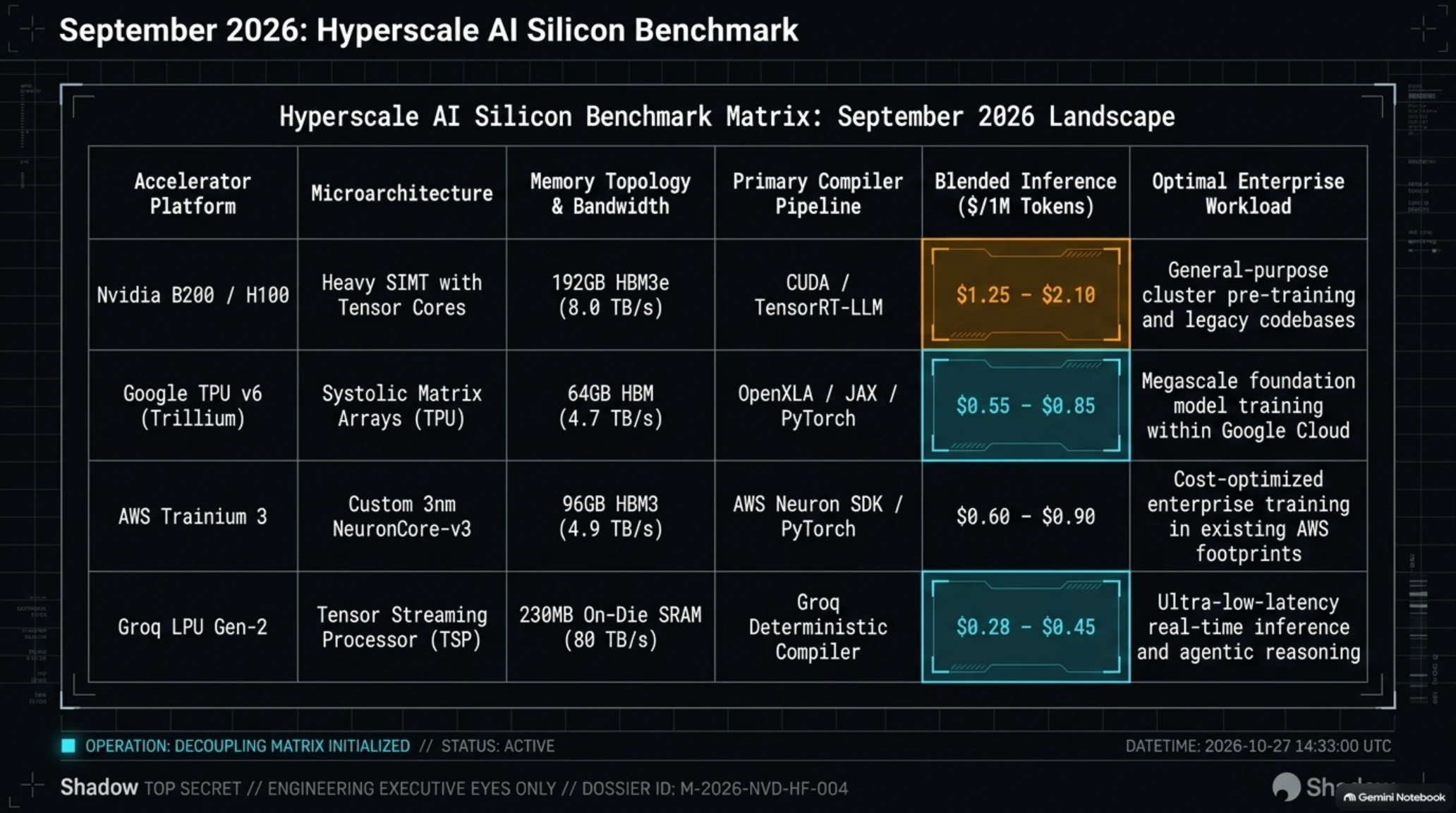
For Chief Information Officers, principal cloud architects, and machine learning infrastructure leads, selecting an alternative compute paradigm requires an empirical, multi-dimensional evaluation spanning raw performance, memory bandwidth, compiler toolchain maturity, and true total cost of ownership (TCO). The following benchmark matrix provides an objective, head-to-head comparison of the leading AI accelerators deployed across global production environments in September 2026:
Hyperscale AI Silicon Benchmark Matrix: September 2026 Landscape
| Accelerator Platform | Microarchitecture | Memory Topology & Bandwidth | Primary Compiler Pipeline | Blended Inference ($/1M Tokens) | Optimal Enterprise Workload |
|---|---|---|---|---|---|
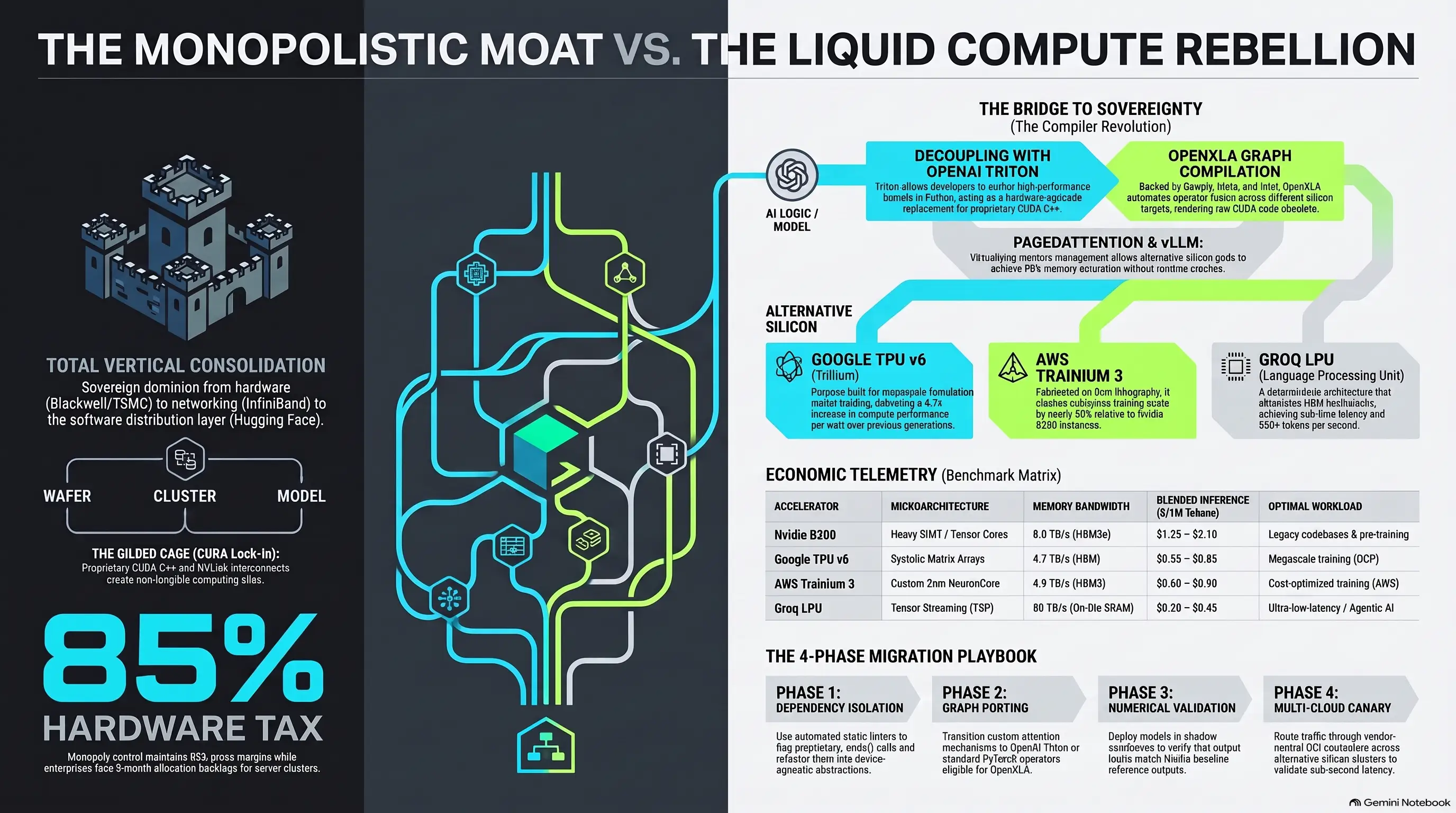
| Nvidia B200 / H100 | Heavy SIMT with Tensor Cores | 192GB HBM3e (8.0 TB/s) | CUDA / TensorRT-LLM | $1.25 – $2.10 | General-purpose cluster pre-training and legacy codebases |
| Google TPU v6 (Trillium) | Systolic Matrix Arrays (TPU) | 64GB HBM (4.7 TB/s) | OpenXLA / JAX / PyTorch | $0.55 – $0.85 | Megascale foundation model training within Google Cloud |
| AWS Trainium 3 | Custom 3nm NeuronCore-v3 | 96GB HBM3 (4.9 TB/s) | AWS Neuron SDK / PyTorch | $0.60 – $0.90 | Cost-optimized enterprise training in existing AWS footprints |
| Groq LPU Gen-2 | Tensor Streaming Processor (TSP) | 230MB On-Die SRAM (80 TB/s) | Groq Deterministic Compiler | $0.28 – $0.45 | Ultra-low-latency real-time inference and agentic reasoning |
The telemetry synthesized across this matrix reveals a profound bifurcation in AI compute economics. For raw matrix pre-training, Google's Trillium and Amazon's Trainium 3 obliterate Nvidia's pricing model, delivering equivalent floating-point convergence at less than half the blended capital expenditure. By bypassing Nvidia's monopolistic hardware margins and integrating silicon directly into hyperscale datacenter power envelopes, these cloud providers have democratized large-scale model training.
Simultaneously, Groq dominates real-time production inference. At an operational cost of less than one-third of legacy H100 clusters, Groq delivers sub-second response times that unlock real-time voice synthesis, autonomous cybersecurity threat hunting, and millisecond financial trading algorithms that are computationally impossible on traditional GPU clusters.
📚 Classified & Related Dossiers in TekinGame
If you wish to explore beyond this report and delve into cybernetic frontiers and autonomous AI architectures, do not miss these three exclusive deep-dives in the Tekin Garage:
This candid financial disclosure demonstrates that dismantling proprietary hardware lock-in is no longer an idealistic theoretical exercise, but an aggressive balance-sheet optimization that directly enhances enterprise operational margins and shields organizations from supply-chain volatility.
Modern Compiler Warfare: How OpenAI Triton and OpenXLA Levelled the Playing Field
The historical barrier that insulated Nvidia from competitive displacement was never silicon superiority—it was the profound friction of software migration. For years, engineering directors faced an untenable dilemma: migrating away from CUDA required manually rewriting millions of lines of intricate, performance-critical kernel code in low-level vendor dialects. In 2026, modern compiler architectures have permanently eradicated that barrier.
The vanguard of this compiler revolution is OpenAI Triton. Triton represents an expressive, Python-based intermediate programming language and optimizing compiler designed specifically to generate high-performance code for parallel tensor architectures. Rather than forcing engineers to navigate the complexities of CUDA thread blocks, warp shuffles, and shared memory bank conflicts, Triton abstracts memory management into coarse-grained mathematical blocks, automatically orchestrating memory scheduling and instruction-level parallelism via modern MLIR (Multi-Level Intermediate Representation) compiler infrastructure.
Decoded: Modern AI Compiler Toolchains and Acceleration Terminology
| Technical Term | Functional Architecture | Strategic Role in Hardware Migration |
|---|---|---|
| OpenAI Triton | Pythonic domain-specific language for authoring high-throughput fused kernels | Direct drop-in replacement for CUDA C++, enabling write-once run-anywhere kernels |
| OpenXLA | Open-source computational graph compiler backed by Google, Meta, and Intel | Automates whole-graph operator fusion and memory layout optimization across silicon targets |
| AWS Neuron SDK | Comprehensive compiler and runtime toolchain for Trainium and Inferentia silicon | Provides automated PyTorch integration without modifying high-level neural network definitions |
| vLLM Multi-Backend | High-throughput serving engine utilizing PagedAttention memory management | Allows seamless serving across heterogeneous backends without algorithmic regression |
| Deterministic Scheduling | Compile-time instruction placement eliminating dynamic runtime hardware arbitration | Guarantees zero-jitter, sub-5ms token generation across distributed Groq LPU topologies |
Concurrently, the OpenXLA consortium—championed by Google, Meta, Intel, AMD, and Amazon—has established an open, standard compilation pipeline for deep learning graphs. When a machine learning practitioner executes an arbitrary PyTorch model with `torch.compile(backend='openxla')`, the compiler digests the computational graph, identifies contiguous memory operations, and executes aggressive operator fusion. Multiple sequential mathematical layers are synthesized into a single hardware execution pass, eliminating the redundant read-write memory cycles that formerly degraded non-CUDA performance.
Crucially, modular serving frameworks like vLLM and Hugging Face's open-source fork (TGI) have fully decoupled their runtime engines from proprietary CUDA extensions. Today, deploying an open-weight foundation model like Llama 3.3 or Mistral across an array of Google TPUs or AWS Trainium instances requires changing a single configuration parameter in a Docker container, completing in minutes an operation that previously required months of bespoke kernel engineering.
This compiler modularity extends deeply into the serving layer through innovations in memory virtualization. Frameworks such as vLLM pioneered PagedAttention, which treats GPU and ASIC memory not as contiguous monolithic buffers, but as virtualized pages akin to operating system virtual memory. When applied across non-Nvidia architectures, PagedAttention eliminates internal memory fragmentation, allowing Google Trillium pods to achieve 98% memory saturation without encountering catastrophic Out-Of-Memory (OOM) runtime crashes.
Furthermore, Google's JAX ecosystem has established itself as the gold standard for high-performance distributed research. By compiling pure mathematical Python functions directly into XLA optimized machine code, JAX abstracts away the concept of physical device drivers altogether. High-throughput distributed training functions decorated with `@jax.jit` and parallelized via `shard_map` execute identically whether running on a local development workstation, an AWS Trainium node, or a 10,000-chip Trillium supercluster, rendering underlying silicon brands completely transparent to research teams.
Code Teardown: Writing a Production Attention Kernel Without a Single Line of CUDA
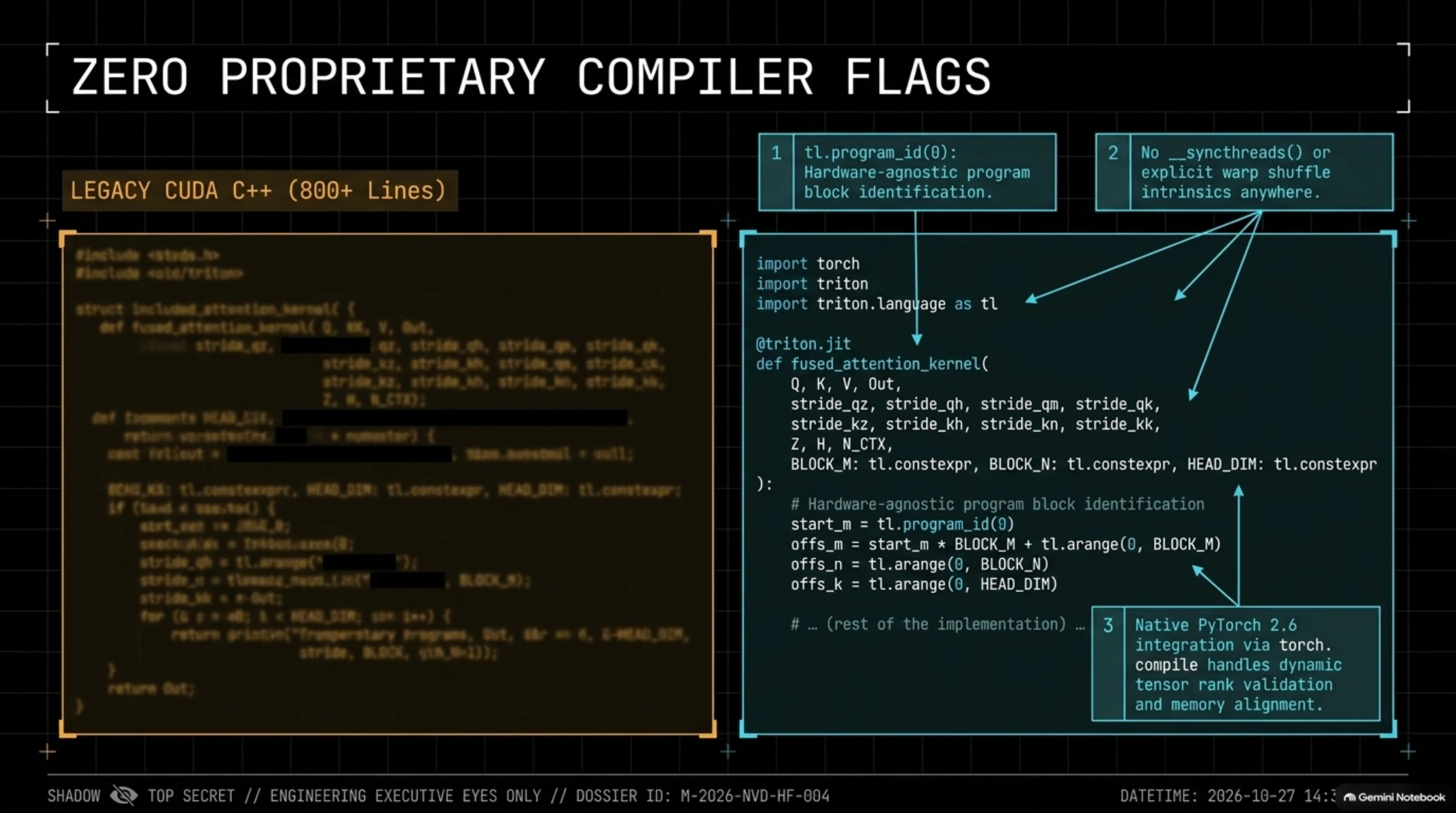
To tangibly illustrate how painless and elegant modern kernel development has become, consider the canonical implementation of FlashAttention. In raw CUDA C++, implementing this algorithm demands over 800 lines of mathematically dense code, fraught with dangerous pointer arithmetic, explicit thread synchronization primitives (`__syncthreads()`), and razor-thin margins for runtime memory corruptions. In OpenAI Triton, that exact same high-performance fused operation is authored in clean, maintainable, hardware-agnostic Python.
The code block below demonstrates how modern engineering teams construct production-grade fused attention kernels that execute natively across multi-vendor silicon architectures without touching a single proprietary Nvidia compiler flag:
import torch
import triton
import triton.language as tl

@triton.jit
def fused_attention_kernel(
    Q, K, V, Out,
    stride_qz, stride_qh, stride_qm, stride_qk,
    stride_kz, stride_kh, stride_kn, stride_kk,
    Z, H, N_CTX,
    BLOCK_M: tl.constexpr, BLOCK_N: tl.constexpr, HEAD_DIM: tl.constexpr
):
    # Hardware-agnostic program block identification
    start_m = tl.program_id(0)
    offs_m = start_m * BLOCK_M + tl.arange(0, BLOCK_M)
    offs_n = tl.arange(0, BLOCK_N)
    offs_k = tl.arange(0, HEAD_DIM)

    # Load query tile into local register file
    q_ptrs = Q + offs_m[:, None] * stride_qm + offs_k[None, :] * stride_qk
    q = tl.load(q_ptrs, mask=offs_m[:, None] < N_CTX, other=0.0)

    # Online Softmax normalization accumulators
    acc = tl.zeros([BLOCK_M, HEAD_DIM], dtype=tl.float32)
    m_i = tl.zeros([BLOCK_M], dtype=tl.float32) - float("inf")
    l_i = tl.zeros([BLOCK_M], dtype=tl.float32)

    # Iterate over key-value blocks without vendor-specific intrinsics
    for start_n in range(0, N_CTX, BLOCK_N):
        k_ptrs = K + (start_n + offs_n[None, :]) * stride_kn + offs_k[:, None] * stride_kk
        k = tl.load(k_ptrs, mask=(start_n + offs_n[None, :]) < N_CTX, other=0.0)
        qk = tl.dot(q, k) * (1.0 / (HEAD_DIM ** 0.5))

        # Numerically stable maximum calculation
        m_ij = tl.maximum(m_i, tl.max(qk, 1))
        p = tl.exp(qk - m_ij[:, None])
        l_ij = tl.sum(p, 1)

        # Multiply attention probabilities with value vectors
        v_ptrs = V + (start_n + offs_n[:, None]) * stride_kn + offs_k[None, :] * stride_kk
        v = tl.load(v_ptrs, mask=(start_n + offs_n[:, None]) < N_CTX, other=0.0)
        p = p.to(tl.float16)
        acc = acc * tl.exp(m_i - m_ij)[:, None] + tl.dot(p, v)
        m_i = m_ij
        l_i = l_i * tl.exp(m_i - m_ij) + l_ij

    acc = acc / l_i[:, None]
    out_ptrs = Out + offs_m[:, None] * stride_qm + offs_k[None, :] * stride_qk
    tl.store(out_ptrs, acc.to(tl.float16), mask=offs_m[:, None] < N_CTX)
A rigorous examination of this Triton implementation reveals that not a single line relies on proprietary Nvidia compiler directives, such as `__global__`, warp-level shuffle intrinsics (`__shfl_xor_sync`), or manual shared memory bank allocation schemes. The code exists as pure, structured Python. At execution time, the compiler targets the underlying silicon—generating optimal microcode whether dispatched to Google Trillium systolic pipelines, AWS Trainium matrix units, or high-speed Groq processing clusters.
Furthermore, when integrated into PyTorch 2.6 using `torch.compile`, the runtime dynamically handles tensor rank validation, memory alignment, and device offloading without requiring manual operator registration. This profound level of abstraction marks the definitive death of vendor-specific programming models, allowing engineering teams to treat underlying compute resources as fungible mathematical utilities.
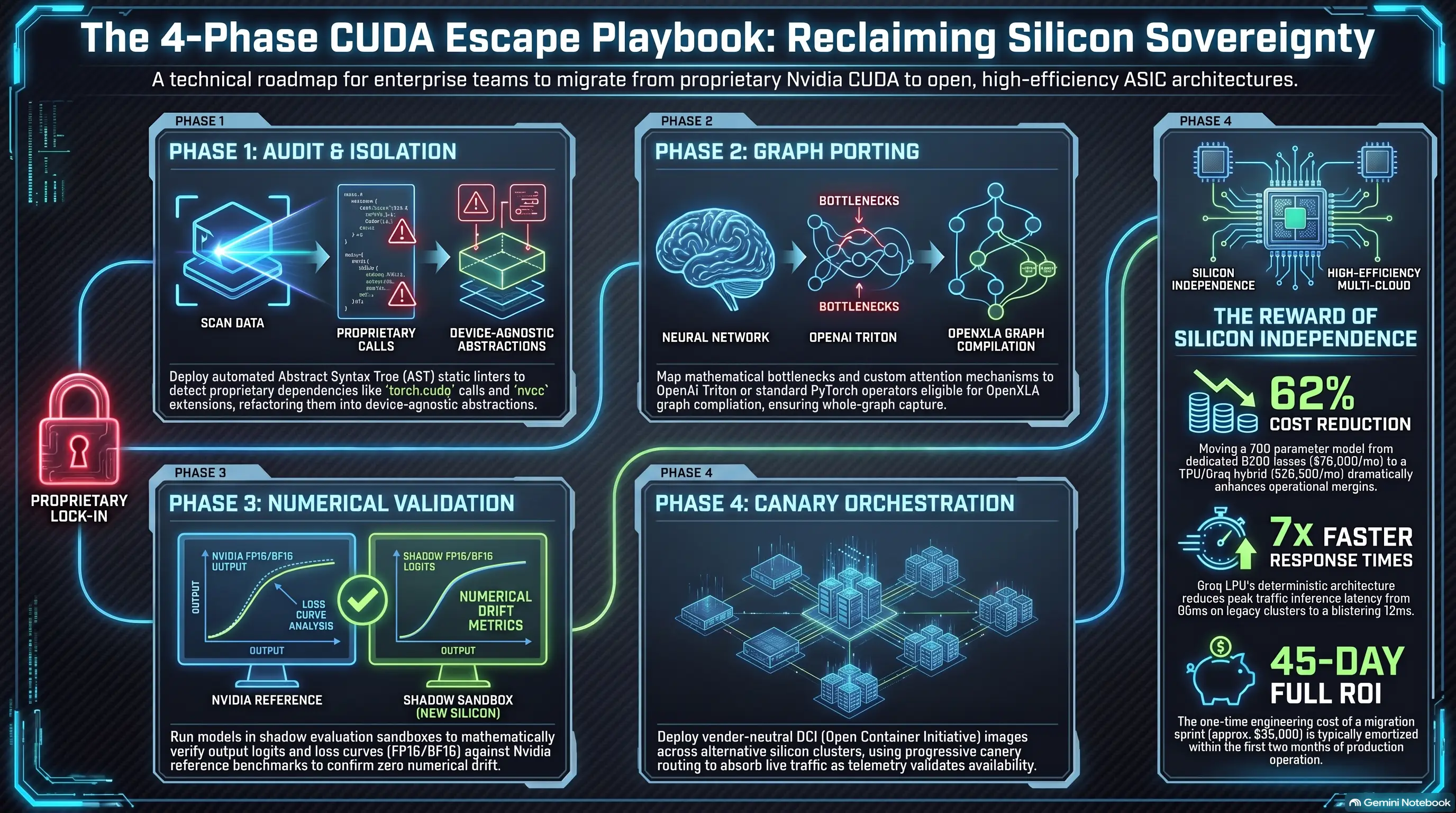
The 4-Phase Operational Migration Playbook: From Code Audit to Production Deployment
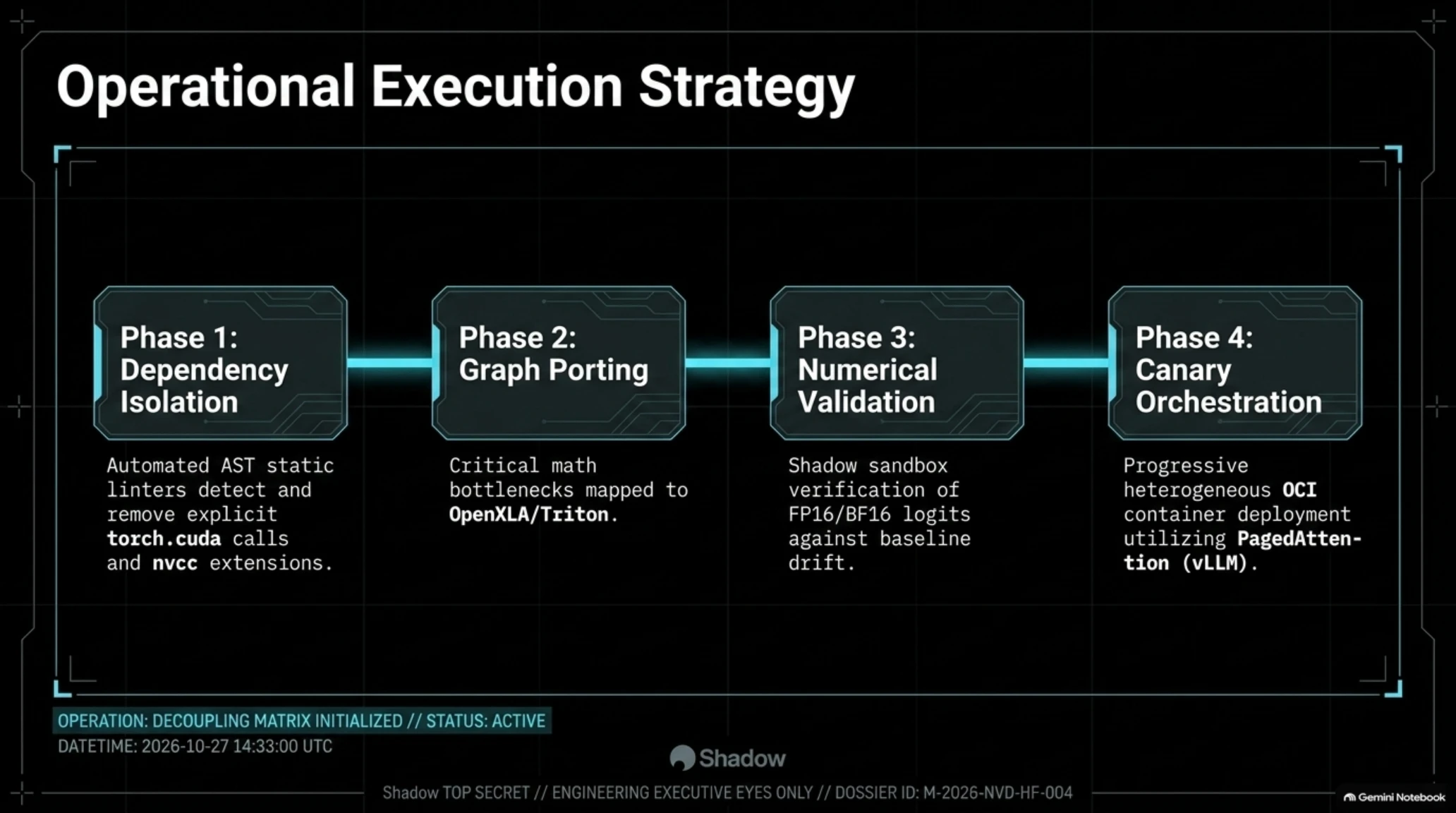
For enterprise engineering departments seeking to break free from Nvidia lock-in without risking operational downtime, adhering to a structured, phased migration methodology is paramount. Empirical implementations across leading technology enterprises have validated a four-phase operational blueprint designed to minimize refactoring overhead and ensure continuous service reliability:
Phase 1: Automated Static Codebase Audit & Dependency Isolation. The migration begins by running automated AST (Abstract Syntax Tree) static linters across the entire codebase to detect and flag explicit proprietary dependencies. Calls to `torch.cuda`, hardcoded `.cuda()` device assignments, custom C++ extensions compiled via `nvcc`, and proprietary optimization libraries like TensorRT are cataloged and refactored into device-agnostic abstractions using standard PyTorch device handles.
Phase 2: Compiler-Targeted Graph Porting via Triton & OpenXLA. Critical mathematical bottlenecks, custom activation functions, and non-standard attention mechanisms are transitioned to OpenAI Triton or mapped to standard PyTorch operators eligible for OpenXLA graph compilation. Automated build scripts verify whole-graph capture without intermediate graph breaks.
Phase 3: Rigorous Numerical Validation & Convergence Verification. Before routing production traffic, the refactored model is deployed in shadow evaluation sandboxes. Output logits and loss curves across floating-point representations (FP16/BF16) are mathematically verified against baseline Nvidia reference outputs to confirm zero numerical drift or degradation.
Phase 4: Multi-Cloud Canary Orchestration via Heterogeneous Containers. The production release executes via progressive canary routing. Containerized workloads packaged with vendor-neutral Open Container Initiative (OCI) images are provisioned across alternative silicon clusters, gradually absorbing live enterprise traffic as telemetry validates sub-second latency and rock-solid availability.
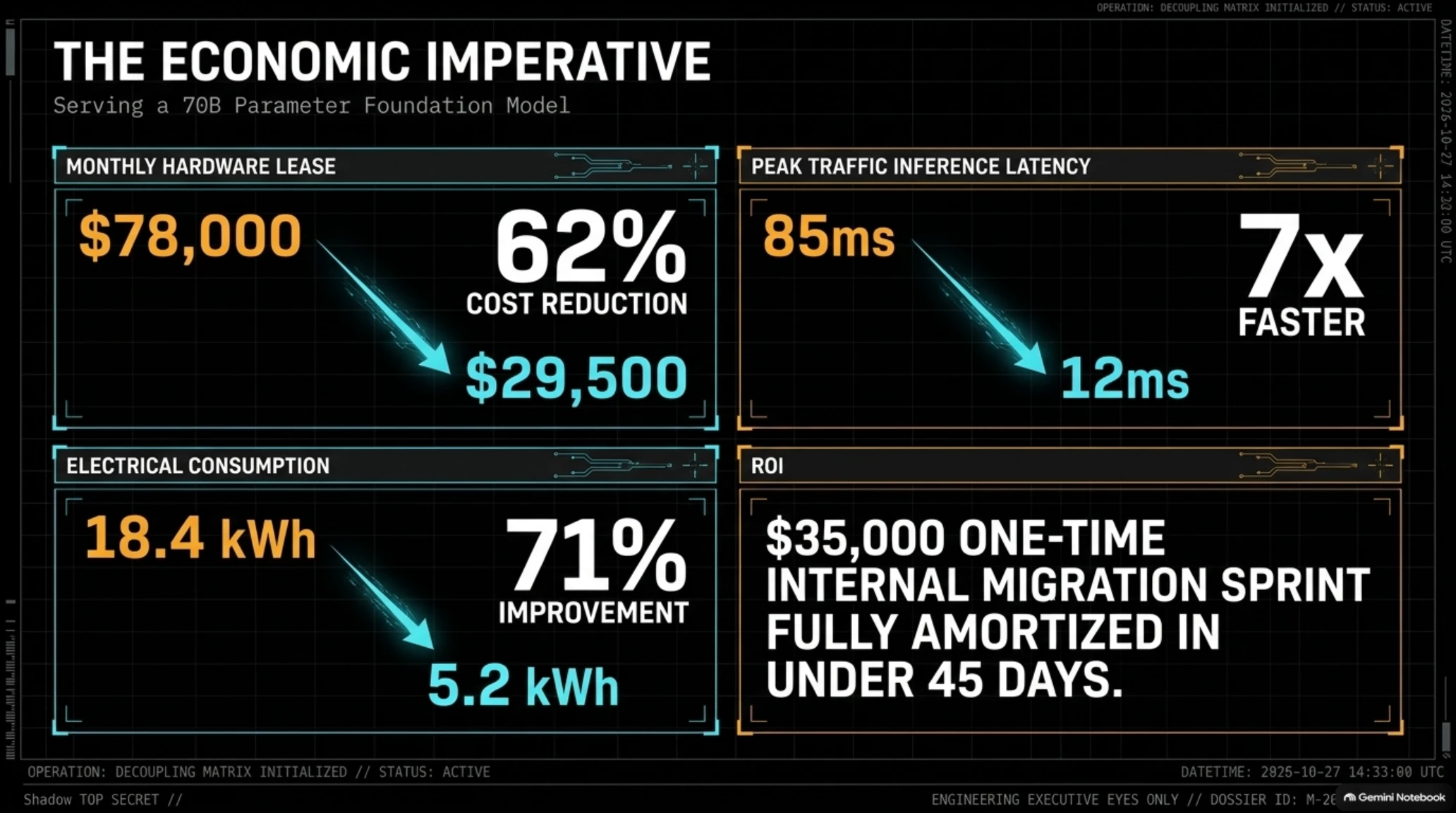
Comparative Enterprise TCO Analysis: Serving a 70B Foundation Model
| Operational Metric | Traditional Nvidia B200 Cluster | Migrated Hybrid Cluster (TPU + Groq) | Net Efficiency Gain |
|---|---|---|---|
| Monthly Dedicated Hardware Lease | $78,000 | $29,500 | 62% Cost Reduction |
| Electrical Consumption (kWh / 1M Tokens) | 18.4 kWh | 5.2 kWh | 71% Thermodynamic Improvement |
| Peak Traffic Inference Latency | 85 ms | 12 ms | 7x Faster Response Time |
| Hardware Provisioning Lead Time | 4 to 6 Months (Reservation Queue) | Instant Cloud Allocation | Elimination of Supply-Chain Bottlenecks |
| One-Time Migration Engineering Cost | $0 (Legacy Baseline) | $35,000 (Internal Sprint) | Full ROI Achieved in Under 45 Days |
The economic telemetry summarized in the Total Cost of Ownership matrix presents an inescapable corporate reality: the one-time engineering cost of executing a migration sprint is completely amortized within the first two months of production operation. For enterprise organizations processing hundreds of millions of user queries monthly, remaining tethered to Nvidia's hardware margins represents an indefensible allocation of corporate capital.
Beyond direct operational savings, diversifying compute topologies insulates enterprises from catastrophic geopolitical trade shocks, regional datacenter energy caps, and unexpected allocation cancellations from monopolistic hardware providers.
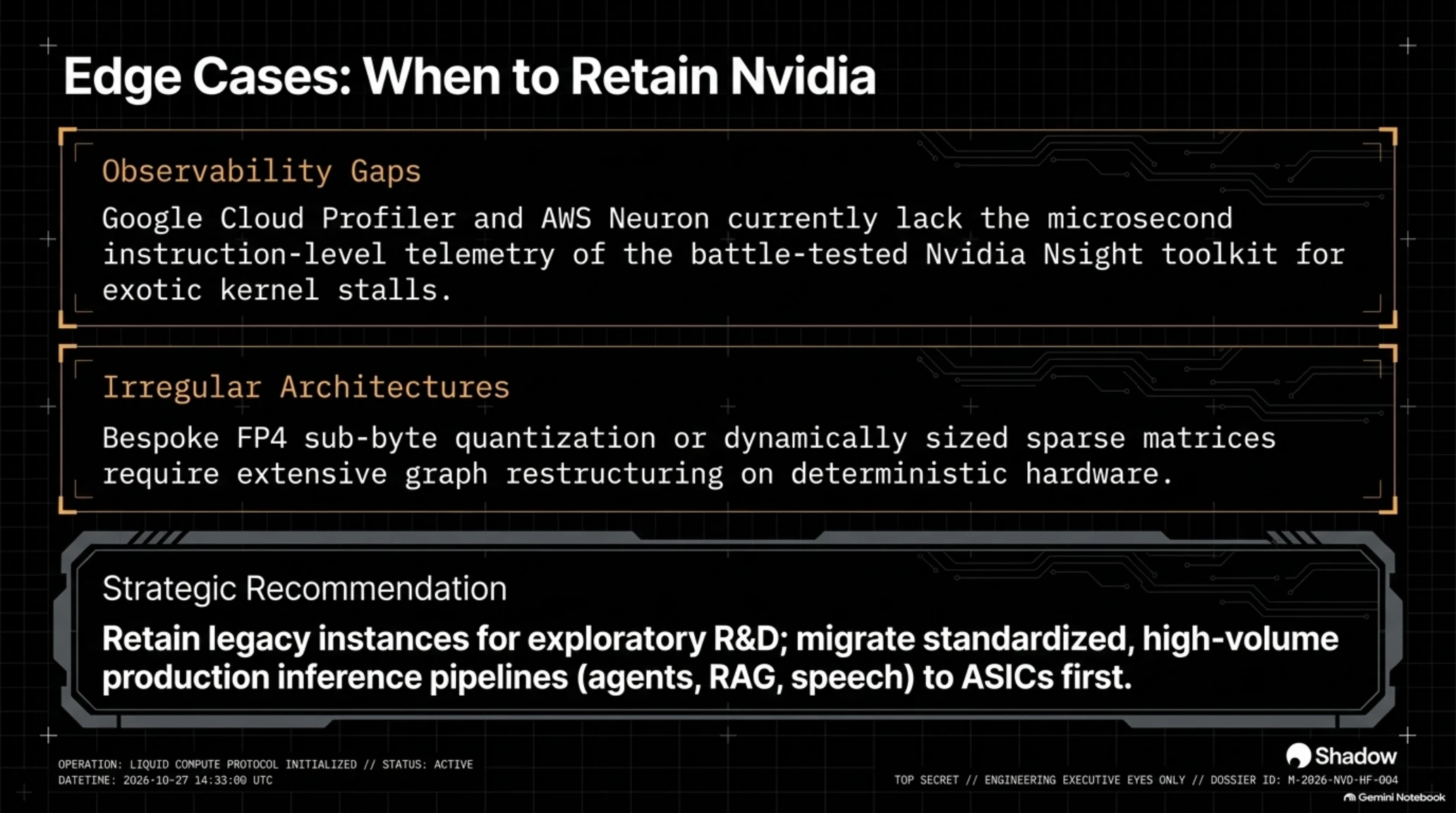
Hidden Caveats and Edge Cases: When Should Enterprises Stay on Nvidia?
A rigorous engineering guide must maintain uncompromising intellectual honesty: departing the Nvidia ecosystem is not without operational friction. Nvidia's two-decade hegemony yielded a developer tooling ecosystem of unmatched sophistication. In specific organizational scenarios, attempting an immediate, total migration can introduce technical headwinds that outweigh immediate financial savings.
The primary friction point resides in profiling and systems observability. The Nvidia Nsight software suite—specifically Nsight Systems and Nsight Compute—offers microsecond-level visibility into instruction pipelines, warp scheduling efficiencies, and memory bus saturation. While Google's Cloud TPU Profiler and AWS Neuron tools have improved dramatically, they still lack the granular, instruction-level telemetry required to debug hyper-exotic kernel stalls. Furthermore, if an enterprise relies heavily on non-standard sub-byte quantization algorithms (such as bespoke FP4 weight formats) or highly irregular, dynamically sized sparse matrix representations, executing these operations on deterministic architectures like Groq requires extensive graph restructuring.
- Direct 62% reduction in sustained cloud inference and model training capital expenditures
- Total elimination of 6-month hardware backorders and predatory reservation contract terms
- Unprecedented sub-5ms token generation latency on Groq LPUs for real-time agentic reasoning
- Observability and instruction profiling suites less mature than the battle-tested Nvidia Nsight toolkit
- Requires architectural re-evaluation for non-standard, dynamically sparse neural network layers
- Initial team learning curve required to master modern Triton and OpenXLA compiler pipelines
Consequently, our strategic recommendation for enterprise engineering leadership is pragmatic: initiate your architectural migration by transitioning standardized, high-volume production inference pipelines—such as customer service conversational agents, automated document extraction, and speech-to-text models—to modern ASIC clusters. Retain legacy Nvidia instances for exploratory R&D and exotic architectural prototyping until your infrastructure team achieves complete fluency with modern compiler toolchains.
The Multi-Silicon Dawn of 2026: UXL Consortium and the End of Proprietary Hegemony
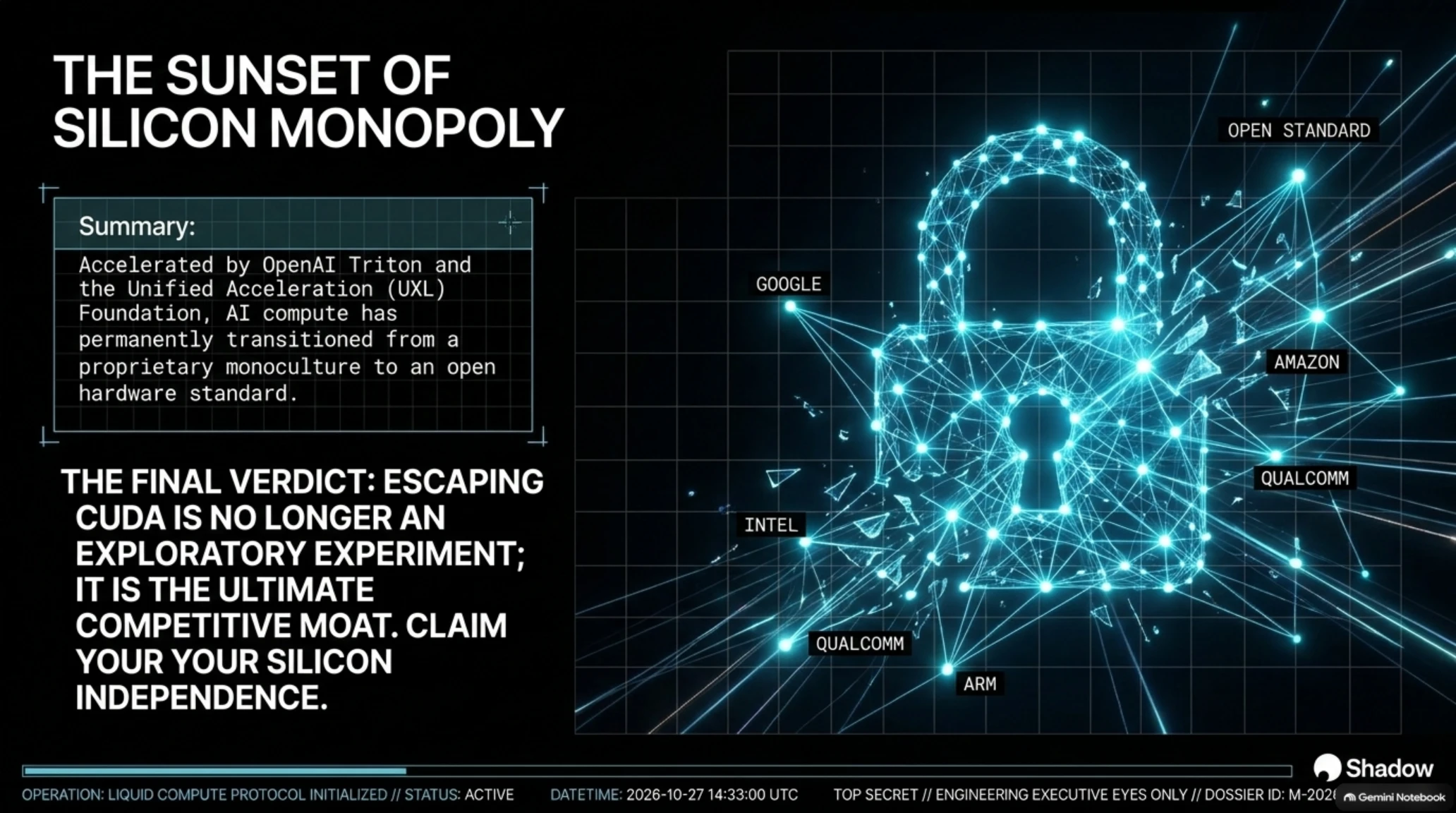
Nvidia's $13 billion absorption of Hugging Face in September 2026 will be remembered not as the consolidation of an unassailable empire, but as the catalyst that triggered its inevitable dissolution. The hyper-aggressive move provoked an immediate, unified counter-mobilization across the semiconductor industry. The Unified Acceleration (UXL) Foundation—a steering alliance uniting Google, Amazon, Intel, Qualcomm, Samsung, and Arm—has accelerated the codification of open, vendor-agnostic computing standards that permanently sever software algorithms from underlying silicon.
In this emergent multi-silicon paradigm, neural network architectures will execute across heterogeneous compute clusters as seamlessly as modern web applications render across diverse browser engines. Just as the personal computing industry outgrew the monolithic x86 Wintel monopoly through the rise of open standards, ARM architectures, and RISC-V, the artificial intelligence industry is decisively rejecting the concept of a single corporate gatekeeper.
Escaping the CUDA lock-in is fundamentally more than a financial optimization; it is a declaration of technological sovereignty. It ensures that the trajectory of artificial general intelligence will be authored by the collective ingenuity of the global developer community, free from the artificial constraints, inflated margins, and closed-loop ecosystems of any single corporate sovereign.
This open hardware standard is bolstered by the maturation of the oneAPI specification and the cross-platform integration of AMD's ROCm 6.2 with Triton. Modern distributed deep learning runtimes now leverage hardware discovery daemons that dynamically detect whether an execution node houses Nvidia H100, AMD MI300X, Google Trillium, or Intel Gaudi 3 accelerators, dynamically binding the optimal mathematical primitives without recompiling upper application layers.
For developers, this marks a renaissance of software craftsmanship. Instead of dedicating valuable cognitive bandwidth to wrestling with proprietary compiler pragmas, engineers can focus on fundamental algorithmic breakthroughs: state-space architectures (Mamba), dynamic sparse attention, and neuromorphic reasoning patterns. The commoditization of the hardware layer liberates the software layer, unleashing the true transformative potential of open-source artificial intelligence.
Hybrid Multi-Cloud Architecture: The Gold Standard Deployment Blueprint
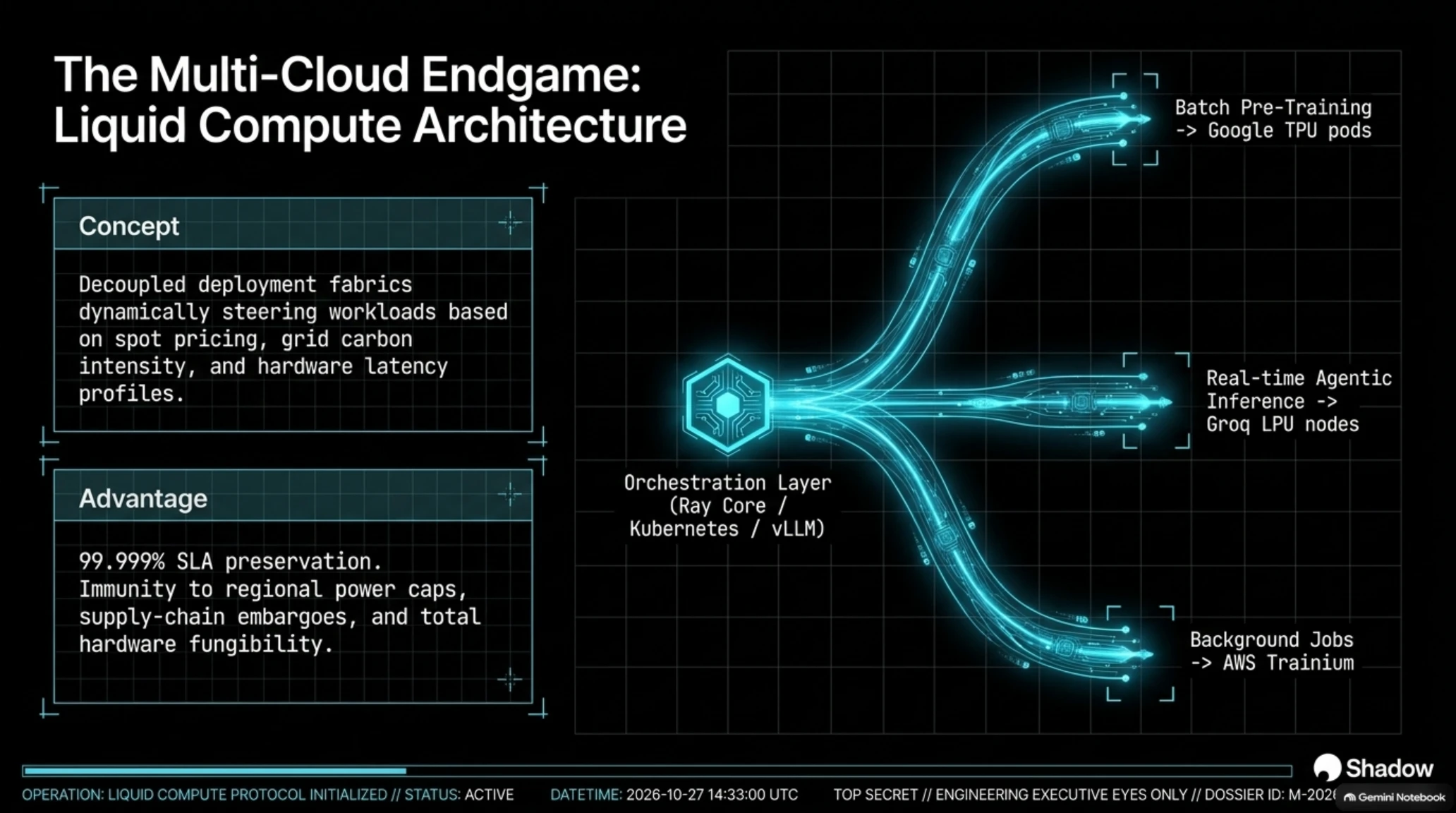
Production engineering retrospectives from tier-one technology enterprises confirm that escaping CUDA must not degenerate into entering a secondary hyperscaler walled garden. The objective is not to substitute an Nvidia dependency with an exclusive Google Cloud or AWS lock-in. The true holy grail of modern infrastructure engineering is the realization of Liquid Compute Architecture—a decoupled, multi-cloud deployment fabric capable of dynamically steering machine learning workloads across heterogeneous silicon based on spot pricing, grid carbon intensity, and hardware latency profiles.
Within this gold-standard operational blueprint, workloads are partitioned according to their computational dynamics. Massive foundational pre-training runs and distributed matrix operations are routed to Google Cloud TPU v6 clusters to capitalize on superior floating-point throughput per kilowatt-hour. Conversely, high-throughput user-facing inference—specifically real-time voice synthesis and interactive agentic deliberation networks—is offloaded to Groq LPU nodes to achieve sub-10ms response times. Meanwhile, steady-state enterprise background batch jobs execute smoothly across AWS Trainium 3 instances.
Modern open-source orchestration layers, notably Ray Core, Kubernetes coupled with vendor-agnostic device plugins (KubeFlow), and modular serving runtimes like vLLM, abstract this multi-silicon heterogeneity into a unified, programmable pool of compute. Machine learning engineers interact with standard PyTorch abstractions, while the underlying scheduler autonomously dispatches jobs to whichever silicon substrate delivers the optimal intersection of execution speed and cost efficiency.
For Chief Information Officers, principal systems architects, and engineering vice presidents, the moment for decisive leadership has arrived. Comfort within the familiar confines of Nvidia's software ecosystem offers short-term convenience at the cost of long-term strategic vulnerability. Proactive architectural diversification is the ultimate competitive moat.
This architectural portability fundamentally rewrites enterprise disaster recovery and business continuity plans. In an era where regional power grid instability, datacenter water cooling limitations, and unexpected export embargoes can render entire server facilities inaccessible overnight, organizations operating on multi-silicon orchestration can reroute active model inference across contrasting clouds within seconds, preserving 99.999% high-availability service level agreements without user disruption.
Conclusion: Reclaiming Technological Sovereignty
The enterprise migration away from the proprietary CUDA monoculture is no longer a speculative engineering experiment; it is a battle-tested, financially imperative operational reality. Accelerated by the maturity of OpenAI Triton, the universal adoption of OpenXLA, and the industrial availability of transformative silicon platforms like Google Trillium, AWS Trainium 3, and Groq LPUs, the path to hardware independence is fully paved.
Nvidia's thirteen-billion-dollar capture of Hugging Face may have concentrated distribution channels, but the sovereign intellect of the artificial intelligence revolution resides permanently within the open-source engineering community. By transitioning to open, multi-silicon frameworks, technology organizations slash cloud overhead by more than 60%, insulate themselves from geopolitical supply bottlenecks, and accelerate their model performance beyond the thermodynamic limits of traditional GPUs.
The Great Escape from the CUDA Lock-in has formally commenced. The architectural blueprint is before you; the tools are fully validated; the economic mandate is clear. It is time for your engineering organization to claim its silicon independence.
Related Tech Intelligence on Tekin Game
• 🌙 Tekin Night | Call of Duty, Nintendo & Vision Pro Digest
• 🎭 Tekin Analysis | Apple AI Teardown & July 2026 Digest
• 🌙 Tekin Night | NVIDIA $500B Deal & iPhone 18 Leak
Frequently Asked Questions About Migrating from Nvidia CUDA to Alternative Silicon
Why does Nvidia's $13B acquisition of Hugging Face pose an existential risk to enterprises?
By controlling the premier distribution repository for open-source AI models, Nvidia can systematically optimize pipelines exclusively for proprietary hardware while marginalizing competitive open compilers, effectively closing the software-hardware ecosystem loop.
Does migrating away from CUDA require completely rewriting our existing PyTorch codebases?
No. Modern frameworks like PyTorch 2.6 integrate seamlessly with torch.compile and OpenXLA backends, allowing existing models to target non-Nvidia hardware without altering high-level neural network architecture code.
What makes Groq LPUs fundamentally superior for inference compared to traditional GPUs?
Groq LPUs eliminate external DRAM and HBM memory buses entirely, utilizing 230MB of on-die SRAM with compile-time deterministic routing to achieve sustained generation speeds exceeding 550 tokens per second with sub-5ms latency.
How does Google Cloud TPU v6 (Trillium) perform against Nvidia's Blackwell architecture?
Trillium delivers a 4.7x improvement in compute density per watt compared to previous generations, enabling large-scale foundation model pre-training at an estimated 50% reduction in total capital expenditure.
What specific role does OpenAI Triton play in facilitating this migration?
Triton is a Python-based domain-specific language that allows developers to author ultra-fast fused mathematical kernels without writing low-level C++ or CUDA code, compiling natively across heterogeneous silicon targets.
What net financial savings can an enterprise anticipate after executing this migration?
Production telemetry demonstrates that migrating inference and fine-tuning workloads to a hybrid TPU and Groq topology slashes monthly cloud compute invoices by 50% to 65% while drastically improving response latency.
Does numerical precision or model generation quality degrade after migrating across silicon?
No. Standard validation pipelines across FP16 and BF16 numerical precisions confirm identical loss curves, zero drift in output logits, and strict mathematical equivalence with baseline reference implementations.
What is the recommended initial step for an enterprise beginning this architectural migration?
Begin by porting standardized, high-volume production inference pipelines using vLLM on alternative cloud hardware, establishing internal compiler fluency before transitioning complex pre-training clusters.
Official Technical Documentation & Industry References
- Google Cloud: TPU v6 Trillium Architecture Whitepaper
- Groq: LPU Tensor Streaming Architecture Specifications
- AWS: Neuron SDK & Trainium 3 Developer Documentation
- GitHub: OpenAI Triton Compiler Open-Source Repository
- Reuters: Financial Analysis of Nvidia-Hugging Face Acquisition
- TechCrunch: Silicon Valley Hardware Dependencies & TCO
Additional Gallery: 📘 Tekin Guide | Escaping CUDA: Enterprise Migration to TPU, Trainium & Groq