Tekin Analysis | Neuralink and the Cyborg Era: When Your Brain Connects to the Internet
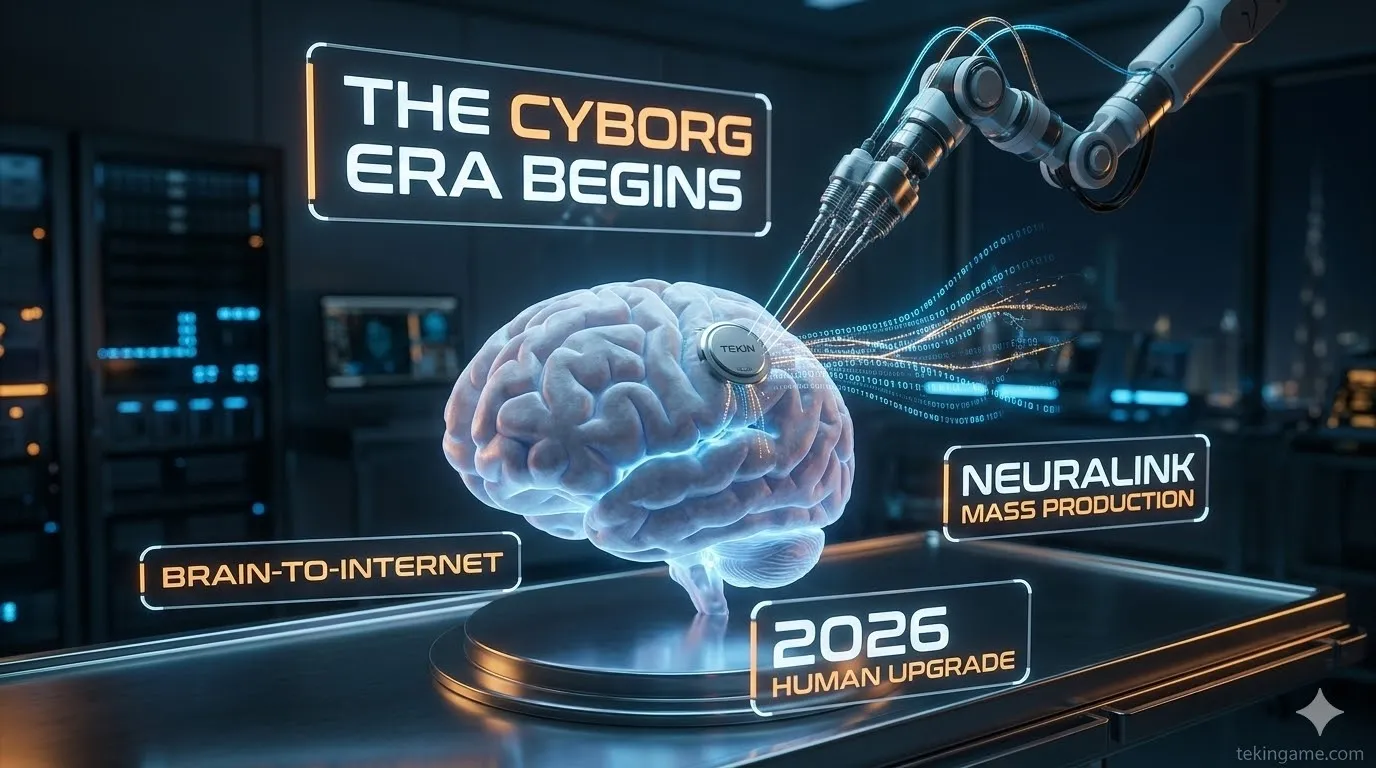
On the very last day of 2025, Elon Musk dropped a historic announcement: Neuralink will officially transition into "high-volume production" in 2026. This is not merely a corporate milestone; it signals that Brain-Computer Interfaces (BCIs) are no longer confined to highly controlled, small-scale clinical trials. Armed with $650 million in fresh capital, a coveted "Breakthrough Device" designation from the FDA for speech restoration, and a staggering goal of performing 20,000 annual implants by 2031, Neuralink is scaling up to mass-market availability.
But the true question remains: is society psychologically and technologically prepared for a world where the human brain interfaces directly with the internet? Welcome to the dawn of the Cyborg Era where the absolute boundaries between human biology and cybernetic infrastructure are systematically dismantled.
Strategic Evaluation & Key Takeaways at a Glance
From Experiment to Mass Production: Musk's Historic Announcement
On the final day of 2025, Elon Musk dropped a bombshell: Neuralink is escalating into "high-volume production" throughout 2026. This shift confirms the technology has matured past the experimental phase and is actively preparing for industrial-scale deployment. Crucially, Musk confirmed that the highly invasive implant surgery will become "nearly fully automated."
This means the proprietary R1 robot capable of weaving ultra-thin electrode threads into brain tissue with micrometer precision while actively dodging blood vessels is graduating from a prototype to a standardized production medical device. Automating brain surgery eliminates human fatigue and tremors, massively reduces costs, and transforms an operation that typically takes hours into a sub-60-minute procedure. It is the core mechanism enabling Neuralink to scale from treating dozens of patients to tens of thousands.
However, Neuralink does not operate in a vacuum. Formidable competitors like Synchron (employing a minimally invasive approach through the jugular vein) and Blackrock Neurotech (leveraging decades of clinical data) are rapidly advancing. This is no longer an isolated scientific experiment; it is the genesis of a trillion-dollar industry.
The Technology: 1,024 Electrodes and Robotic Surgery
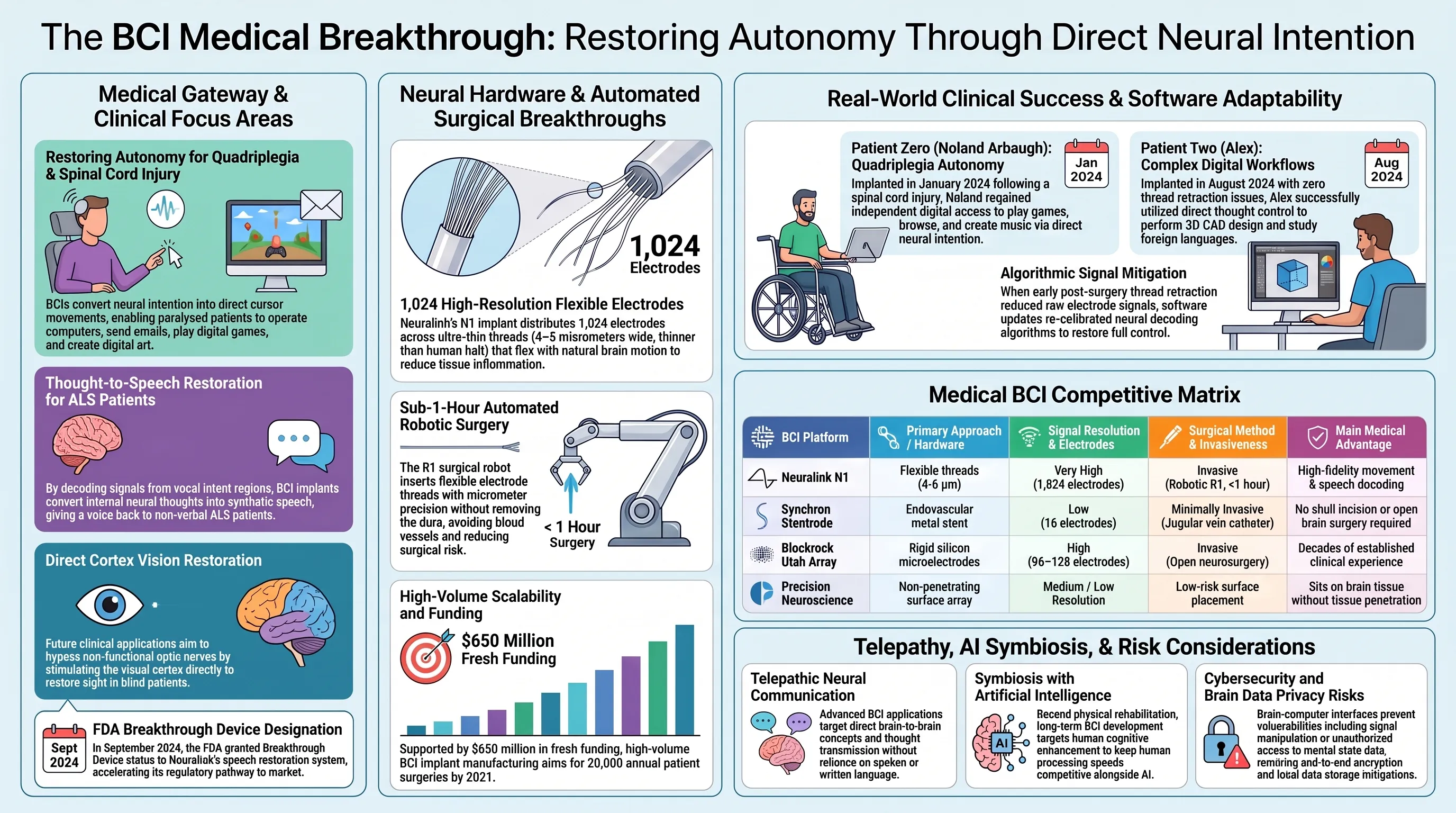
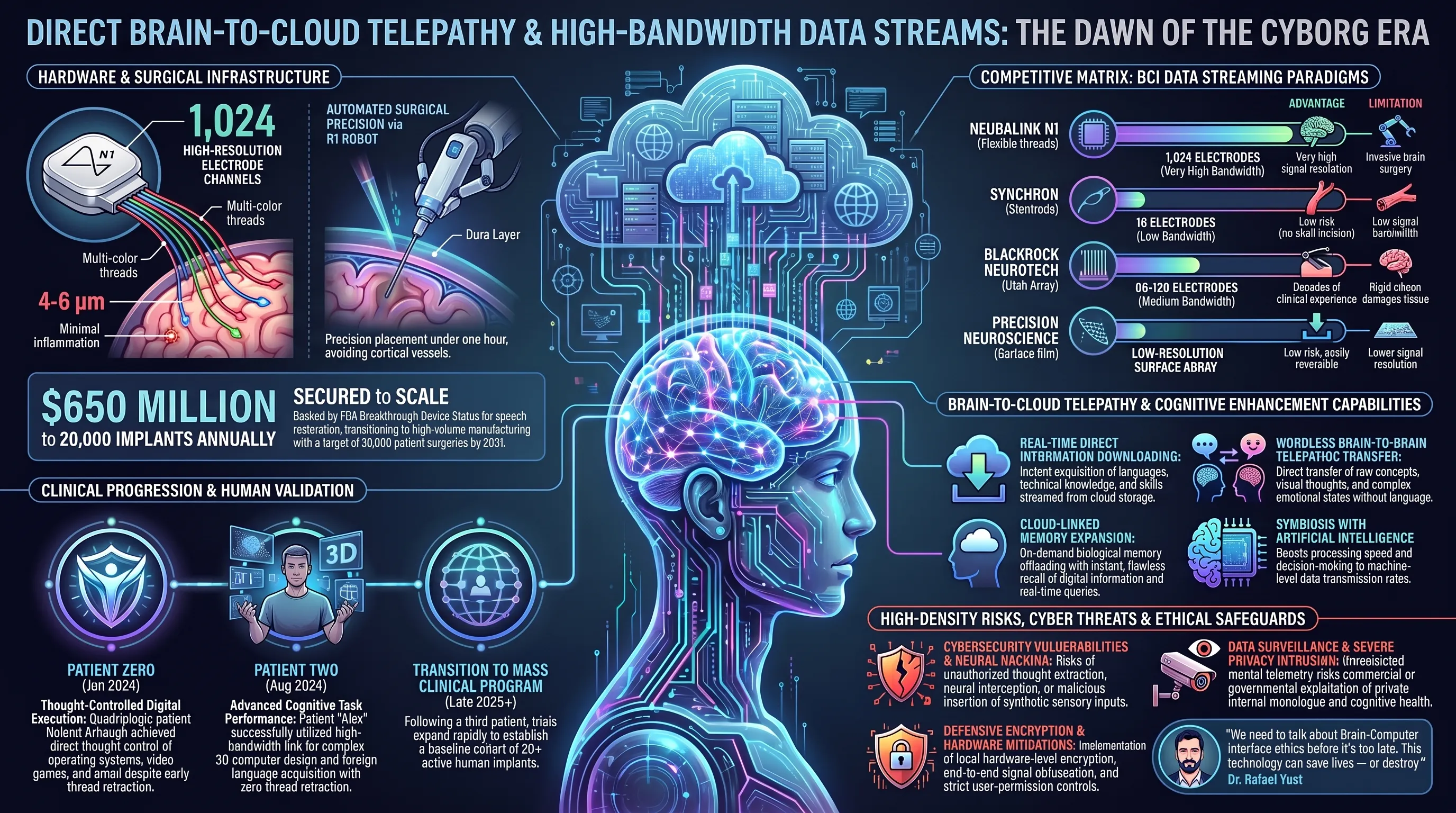
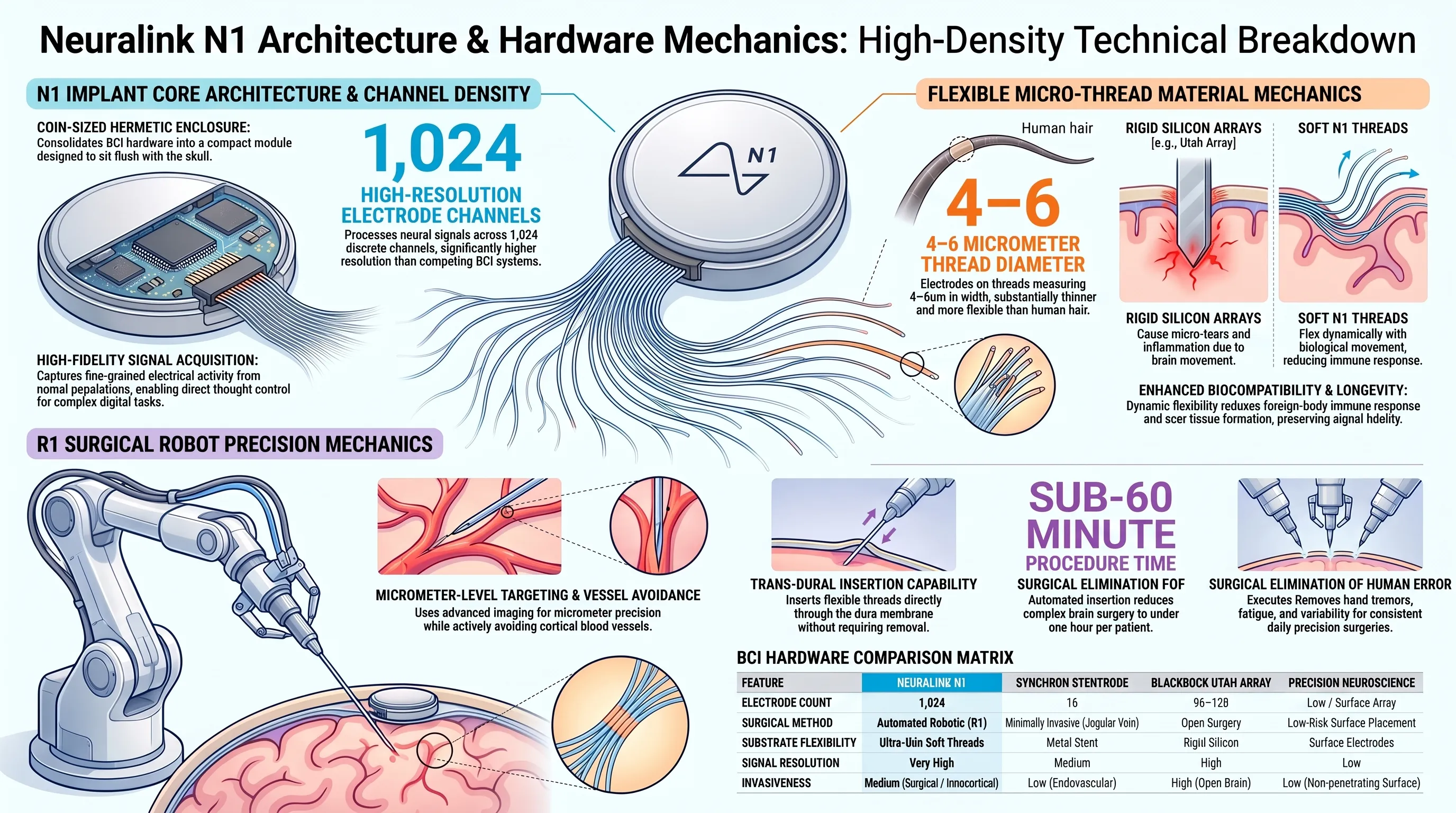
To grasp the magnitude of this achievement, we must dissect the hardware. The Neuralink N1 the company's flagship implant is a hermetically sealed, coin-sized device housing 1,024 electrodes. These electrodes are distributed across 64 highly flexible threads, each measuring merely 4 to 6 micrometers in width (significantly thinner than a human hair).
Why is flexibility so vital? The human brain is a gelatinous organ that shifts and pulsates within the skull. Rigid traditional electrodes (such as the legacy Utah Array) trigger immune responses, create scar tissue, and eventually damage the very neurons they attempt to read. Neuralink's ultra-flexible threads float symbiotically with the brain, vastly extending the implant's operational lifespan and minimizing acute inflammation.
Inserting these microscopic threads is entirely beyond the capability of human hands. Enter the R1 Robot, an autonomous surgical system engineered to:
- Execute Micrometer Precision: The robot’s optical tracking dynamically adjusts to brain movement, placing threads exactly where needed while avoiding delicate vasculature.
- Accelerate the Procedure: Automating the insertion cuts surgical time down to under an hour.
- Eliminate Human Error: The R1 system never tires, never suffers from micro-tremors, and executes its programming flawlessly.
Competitive Matrix: Titans of the Brain-Computer Interface (BCI)
| Company / Architecture | Surgical Deployment Method | Electrode Count & Signal Quality | Primary Advantage | Critical Limitation |
|---|---|---|---|---|
| Neuralink (N1 Chip) | Automated Direct Cranial Implant | 1,024 Electrodes (Extreme Res) | High bandwidth & flexible threads | Highly Invasive (Open Skull) |
| Synchron (Stentrode) | Endovascular (Via Jugular Vein) | Only 16 Electrodes (Low Res) | Minimally Invasive (No Drilling) | Insufficient bandwidth for complex control |
| Blackrock Neurotech | Traditional Open Brain Surgery | 96 - 128 Electrodes (High Res) | Decades of verified clinical trials | Rigid silicon damages tissue over time |
| Precision Neuroscience | Cortical Surface Placement | Variable (Lower Res) | Easily removable, surface-level risk | Unable to capture deep neural signals |
Ultimately, the market will likely fragment. High-resolution tasks (like restoring complex limb movement or vision) will demand Neuralink’s high-bandwidth invasiveness. Conversely, basic cursor control could be perfectly serviced by Synchron’s minimally invasive endovascular approach.
Real Stories: Noland Arbaugh and Alex
Moving from theoretical architecture to human application, we look at Neuralink's pioneering patients. Noland Arbaugh, a quadriplegic paralyzed from the shoulders down due to a diving accident, received the first N1 implant in January 2024. Prior to surgery, he relied on agonizingly slow mouth-operated styluses to interact with digital interfaces. Post-implant, Arbaugh demonstrated the ability to control a computer cursor flawlessly with his thoughts playing Civilization VI, drafting emails, and navigating the web.
The journey, however, encountered a severe technical hurdle. Weeks post-surgery, several microscopic threads retracted from Arbaugh's brain tissue, drastically degrading the signal quality. Rather than attempting a dangerous physical revision, Neuralink’s engineers rewrote the decoding algorithms remotely, optimizing the remaining functional electrodes to restore and even surpass his initial cursor control speed.
The second patient, Alex, received his implant in August 2024. Learning from Arbaugh's complications, the surgical team mitigated the thread retraction issue. Alex now utilizes his BCI to play competitive first-person shooters, design 3D CAD models, and study foreign languages at an unprecedented pace. With a target of over 20 patients by the end of 2025, Neuralink has proven its technology functions reliably in the real world.
Event Timeline | Neuralink's Roadmap to Mass Production (2024–2031)
| Timeline Window | Key Milestone / Event | Strategic & Medical Implication |
|---|---|---|
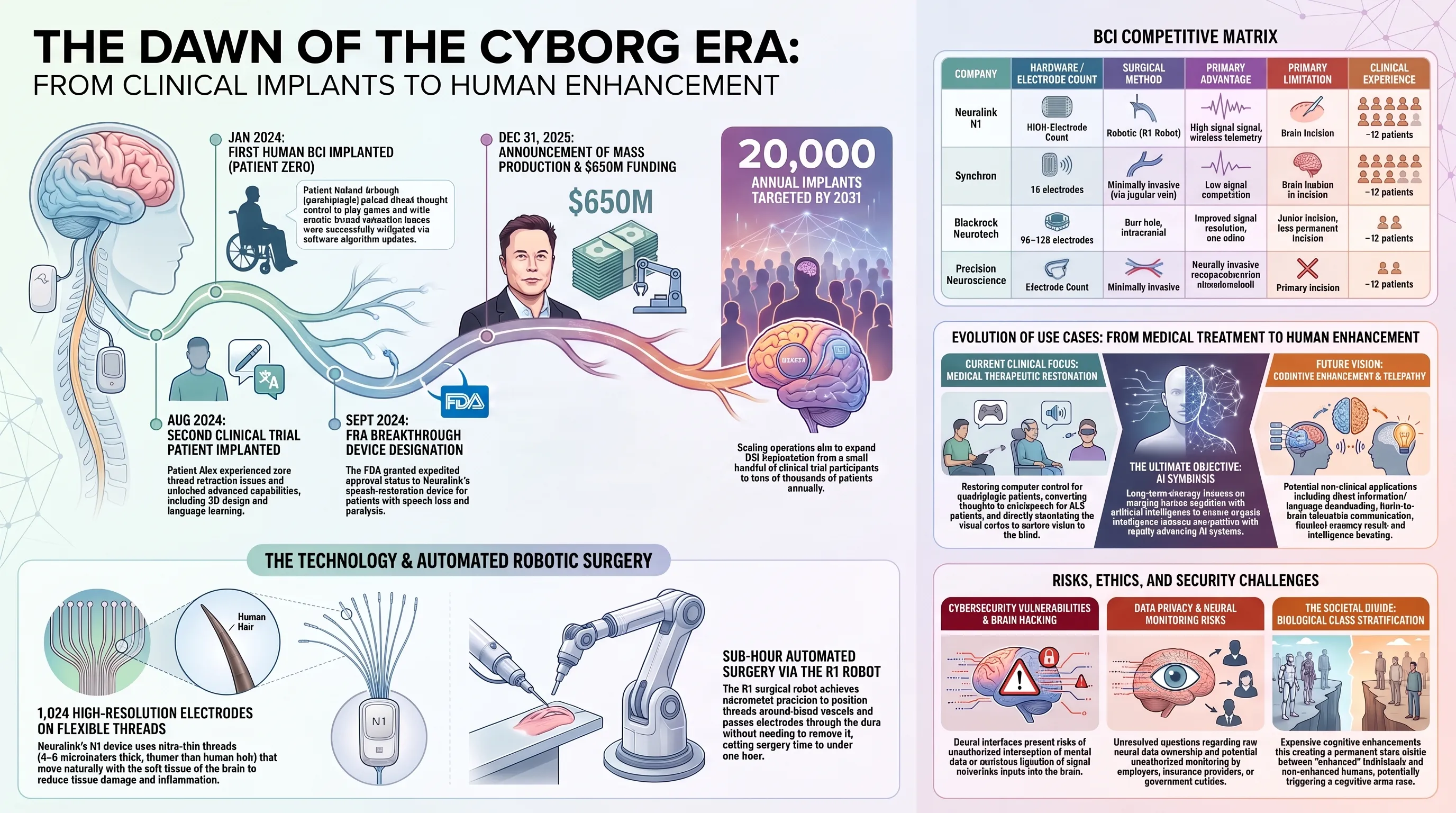
| Jan & Aug 2024 | Successful implantation in Patient 1 & 2 | Verified the N1 chip's capability for telepathic cursor control and 3D modeling. |
| September 2024 | Granted FDA 'Breakthrough' Status | Transitioned from a speculative tech startup to an expedited medical device titan. |
| December 2025 | Secured $650M & Announced Mass Prod. | Funding the industrial scale-up of the R1 surgical robot for 2026 deployment. |
| Year 2031 (Target) | Executing 20,000 Annual Surgeries | Achieving total commercialization and shifting focus toward Human Enhancement. |
Risks and Challenges: Security, Privacy, and Mind Hacking
We must strip away the utopian marketing and confront the dark reality: physically connecting the human brain to the internet introduces terrifying, unprecedented risks. These are not merely technical glitches; they represent existential threats to human autonomy.
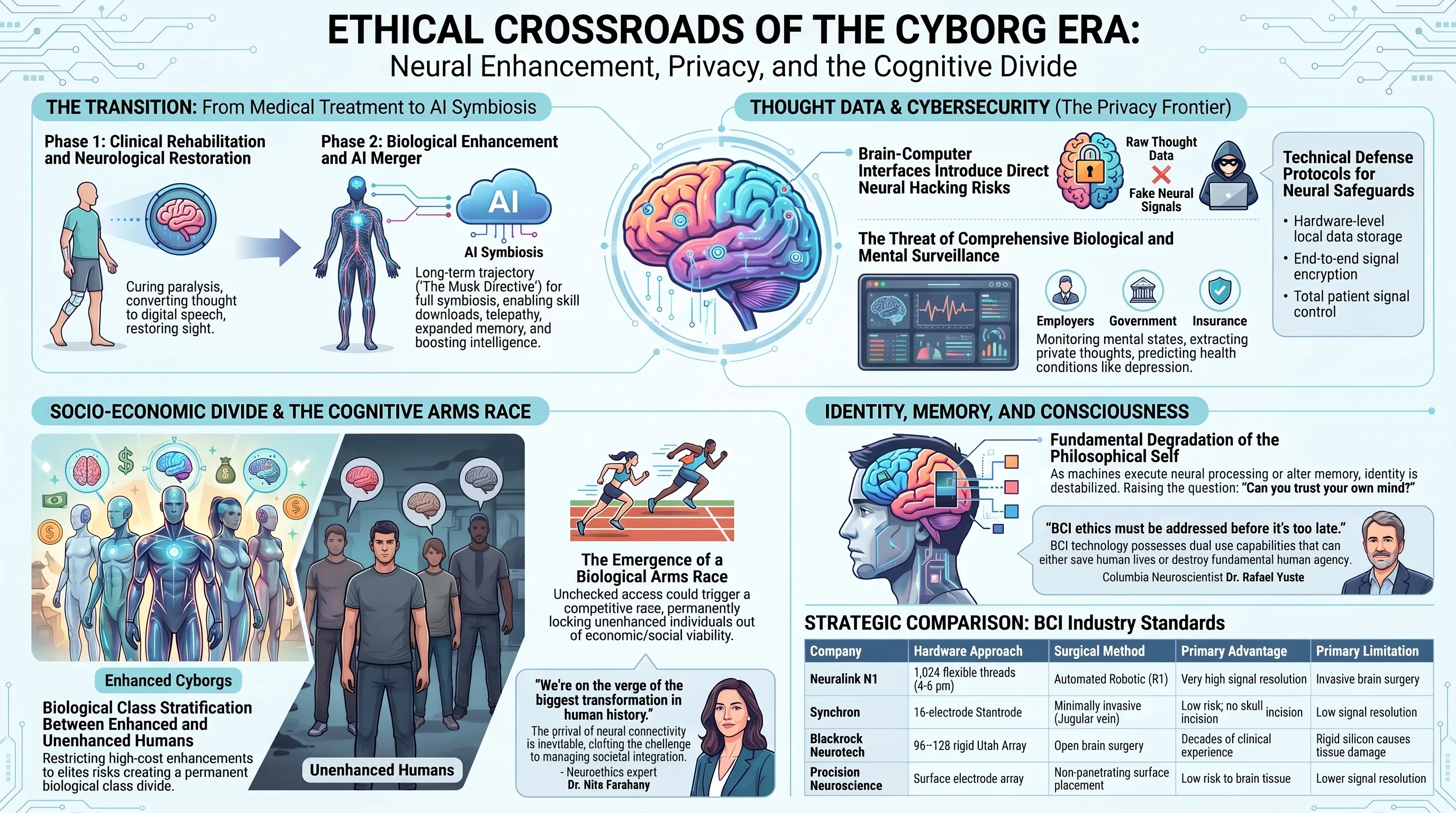
- Cybersecurity & Mind Hacking: If a brain is connected to an external Bluetooth and Wi-Fi network, can it be hacked? The absolute answer is yes. Security researchers have already proven that BCI protocols can be intercepted. Imagine a scenario where cybercriminals not only read your raw neural signals but actively inject "fake thoughts" or malicious impulses directly into your motor cortex.
- Absolute Loss of Privacy: Neuralink reads unfiltered brain activity. Who owns this data? The corporation? Government agencies? Insurance companies? Imagine a future where an employer monitors your neural focus levels, or an insurance algorithm flags your brain waves for early-stage depression, subsequently denying you coverage. It is a dystopian privacy nightmare.
- The Cognitive Class Divide: If Neuralink successfully achieves cognitive enhancement (boosting memory, intelligence, or reflexes), the barrier to entry will undoubtedly be immense wealth. This will fracture society into two distinct biological classes: the wealthy, cybernetically "enhanced" elite, and the un-enhanced "normal" working class.
📚 Classified & Related Dossiers in TekinGame
If you wish to explore beyond this report and delve into cybernetic frontiers and autonomous AI architectures, do not miss these three exclusive deep-dives in the Tekin Garage:
5-Axis Radar: Assessing the Existential Risks of the Cyborg Era
5-Axis Radar Analysis: While Neuralink's medical rewards (curing paralysis and blindness) score exceptionally high, the existential threats such as the risk of mind hacking, absolute privacy destruction, and the creation of a severe cognitive class divide pose an equally terrifying reality.
The Future: From Medical Treatment to Human Enhancement
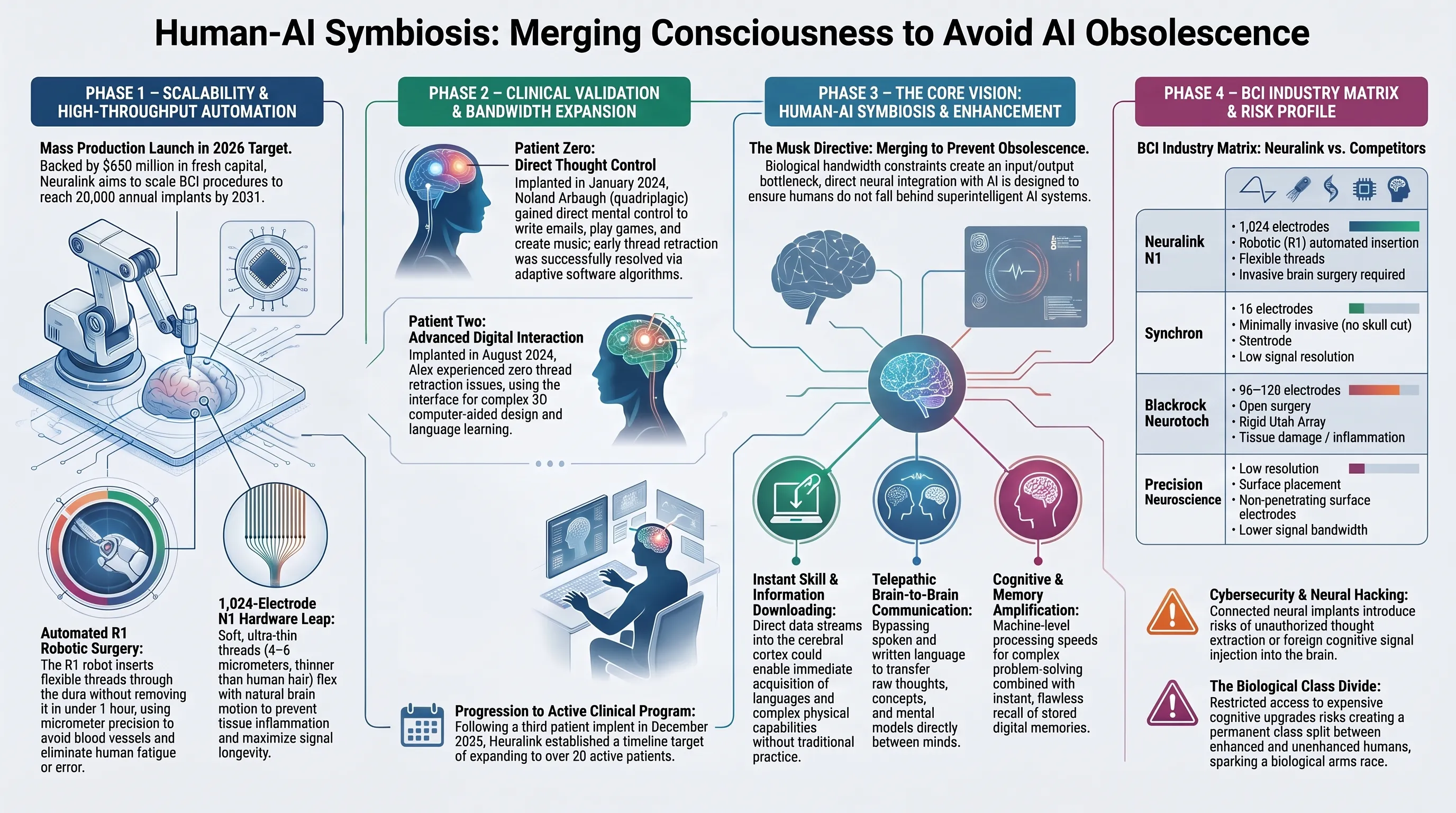
Currently, Neuralink is strictly focused on Treatment: restoring mobility to the paralyzed, returning speech to ALS patients, and curing blindness. However, Elon Musk's ultimate, publicly stated endgame is "Human Enhancement" upgrading perfectly healthy humans to achieve "total symbiosis with artificial intelligence."
Imagine a future where you can download entirely new skills directly into your motor cortex in seconds. Imagine telepathic communication, exchanging raw concepts with another human without uttering a single word. Imagine mechanically overclocking your brain's processing speed and memory retention to compete with Artificial General Intelligence (AGI).
This is no longer the plot of a cyberpunk novel; it is the active engineering roadmap of a $8 billion company. Ethicists warn this could trigger a biological arms race, where individuals and nations are forced to surgically upgrade their brains simply to remain economically competitive.
Tekin Technical Jargon Buster
Conclusion: The Cyborg Era Has Officially Begun
Neuralink is no longer a speculative lab experiment it is a commercial reality. With mass production slated for 2026, autonomous robotic surgeons, FDA backing, and millions in funding, the technology is aggressively entering the global market.
The question is no longer whether BCIs will become mainstream; the real question is how society will regulate them. How will we secure our raw, unfiltered thoughts from cybercriminals? And how will we ensure this god-like technology doesn't exclusively serve a wealthy elite, creating an irreversible biological divide?
Welcome to the Cyborg Era. The physical boundary between human biology and digital silicon is being erased, and the future has already arrived.
- Unprecedented medical breakthroughs capable of curing paralysis, restoring speech to ALS patients, and curing blindness.
- Total automation of complex brain surgery via the R1 robot, eliminating human error and enabling mass scalability.
- The long-term potential for Human Enhancement, allowing humans to symbiotically merge and compete with superintelligent AGI.
- The terrifying existential risk of Mind Hacking, where cybercriminals could theoretically read or inject fake thoughts into the cortex.
- The absolute destruction of privacy, granting corporations or governments direct access to unencrypted, raw human thoughts.
- The creation of a devastating socioeconomic class divide between wealthy, cybernetically 'enhanced' humans and normal citizens.
Final Editorial Verdict & Official Reference Sources
The Blurring of Biology and Silicon
Neuralink's mass production signifies the official birth of the Cyborg Era a technology that holds the potential to be both humanity's greatest medical miracle and its most devastating privacy nightmare.
Frequently Asked Questions & Technical Analysis
What is the significance of Neuralink entering 'mass production' in 2026?
It indicates that Neuralink has moved beyond limited laboratory trials. Utilizing the fully automated R1 surgical robot, the company plans to scale operations drastically, targeting 20,000 implants annually by 2031.
Why are Neuralink's threads superior to competitors' electrodes?
The N1 chip utilizes flexible threads thinner than a human hair, allowing them to move seamlessly with the gelatinous brain tissue. This drastically reduces inflammation and tissue damage compared to older, rigid silicon arrays (like the Utah Array).
Can a Neuralink brain chip be hacked?
Yes, connecting the human brain directly to a Bluetooth/Wi-Fi network introduces severe cybersecurity vulnerabilities. Theoretically, a hacker could intercept private neural data or inject malicious, artificial signals into the user's cortex.
How does Synchron's BCI approach differ from Neuralink's?
Synchron utilizes a minimally invasive method, guiding its 'Stentrode' device through the jugular vein directly into the brain without requiring open skull surgery. However, it only features 16 electrodes, resulting in much lower signal resolution compared to Neuralink's 1,024.
What is Elon Musk's ultimate goal for Neuralink beyond curing paralysis?
The endgame is 'Human Enhancement.' Musk intends to facilitate a total symbiosis between the human brain and Artificial Intelligence, enabling healthy humans to communicate telepathically, download skills instantly, and compete cognitively with superintelligent AGI.
