Tekin Analysis: Nanobridge
An authoritative empirical evaluation of the Nanobridge AI Gateway. Analyzing 783 real-world API requests, USDT-BSC crypto settlements, and 80% API cost reduction.
- 🎮Borderless Web3 Payments- Instant on-chain settlement via Tether (USDT-BSC) eliminating legacy KYC and credit card hurdles
- 🎧Empirical API Benchmarks- Sub-1.2s TTFT latency on DeepSeek-V4-Flash and deep algorithmic reasoning on Pro
- 🚀Drop-in OpenAI SDK Support- Full compatibility across Cursor, Cline, and Claude Code with a simple baseURL swap
- 🗡️Mixture-of-Experts Unified Pool- Seamless routing across Kimi-K3's 2M context and MiniMax-M3 architectures
- 📰Generative 3D Mesh Engine- Native text and image-to-3D polygon generation via Tencent Hunyuan 3D
- ⚔️Macroeconomic API Disruption- Achieving an 80% infrastructure cost reduction compared to GPT-4o and Claude 3.5 Sonnet
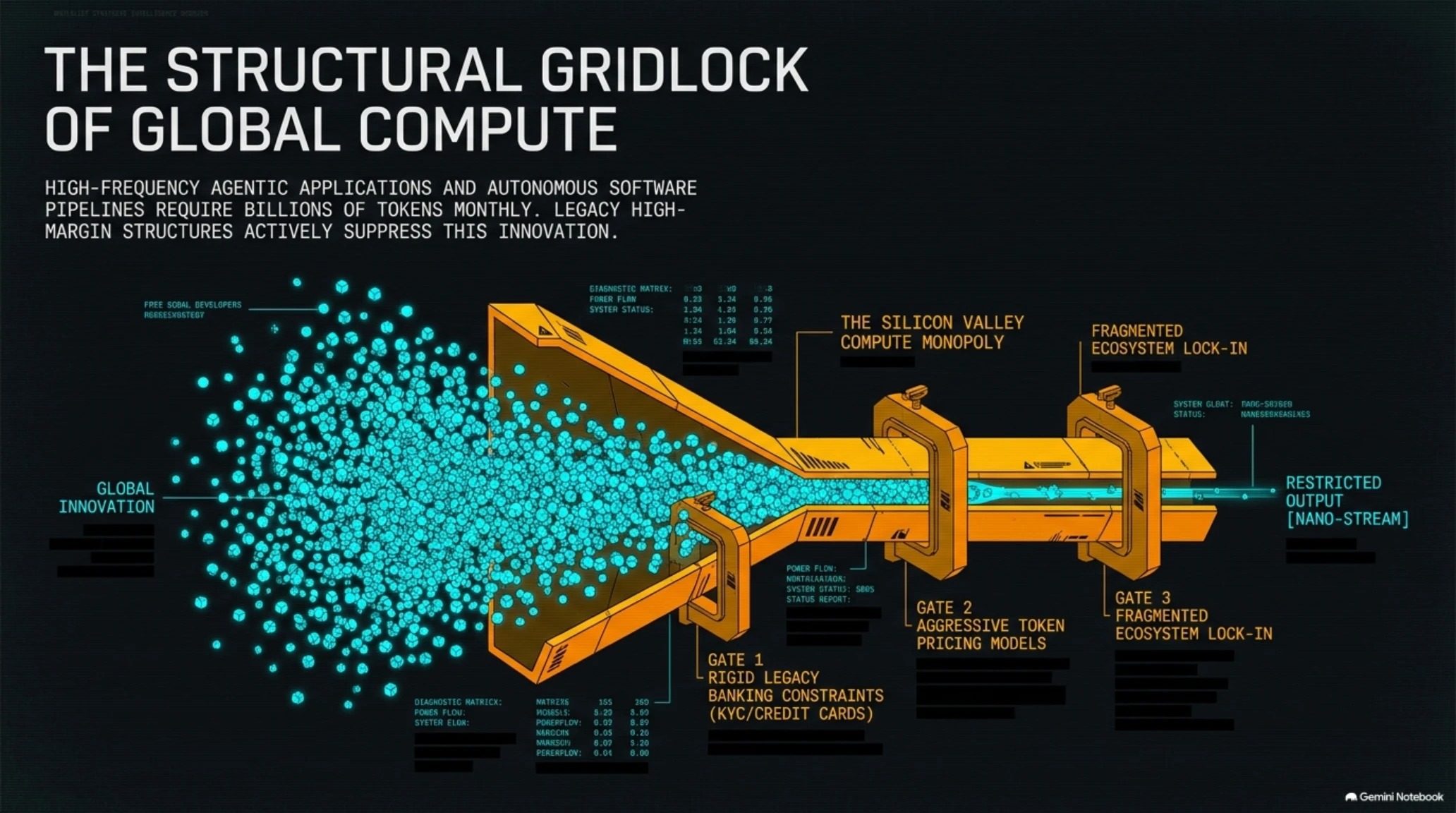
In an era where autonomous multi-agent systems, continuous code generation, and massive real-time data synthesis dominate modern software engineering, reliable, low-latency, and economically viable access to frontier artificial intelligence models has become the paramount bottleneck for global startups, independent developers, and enterprise innovation labs. While dominant Western frontier labs continue to impose aggressive token pricing models and rigid traditional banking constraints via legacy payment gateways, a structural shift is taking place across the international cloud computing landscape.
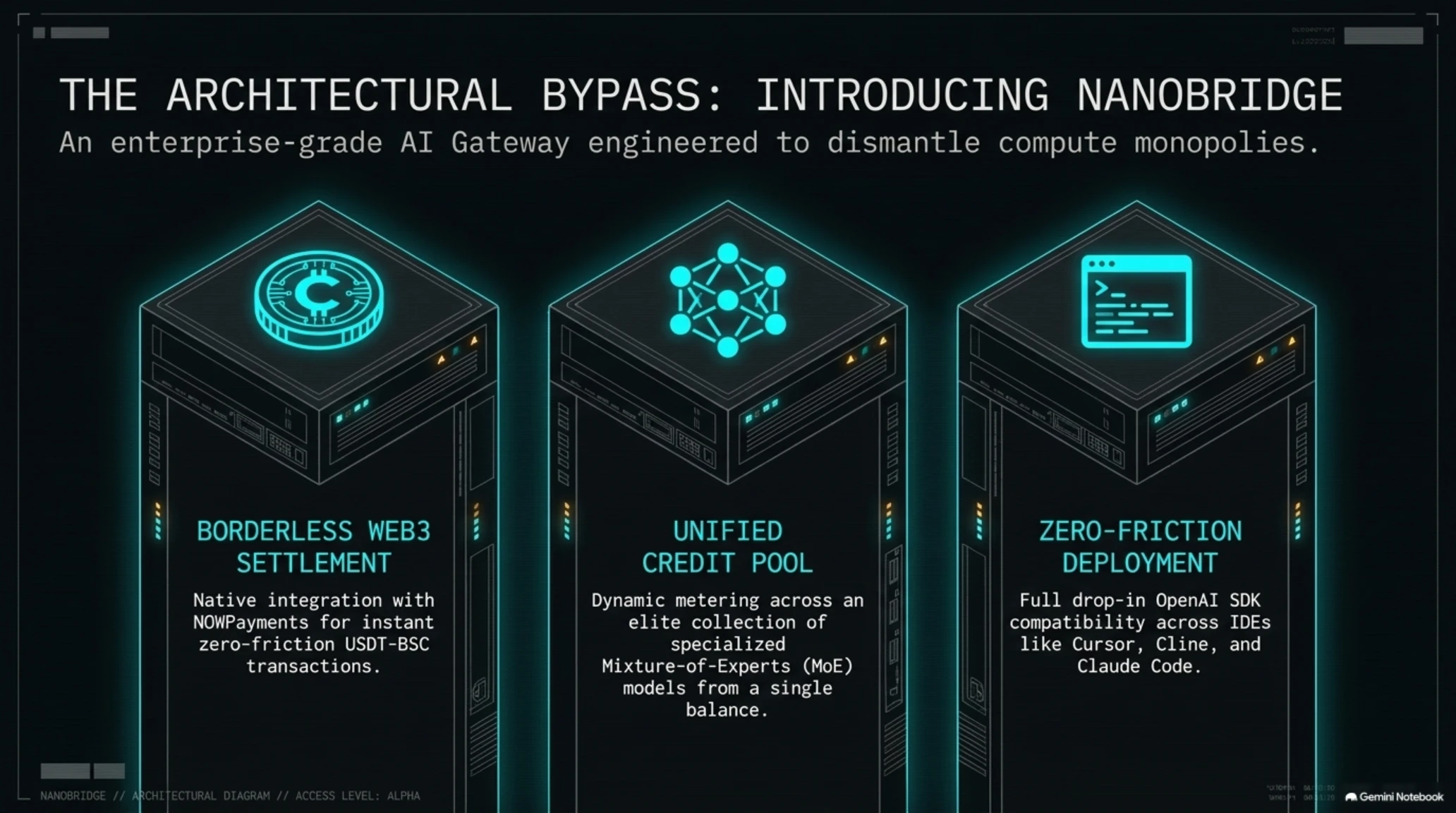
Emerging at the forefront of this architectural transformation is Nanobridge (platform.nanobridge.net), an enterprise-grade AI Gateway engineered to dismantle compute monopolies. By combining drop-in compatibility with standard OpenAI endpoints, an elastic unified credit allocation framework, and native cryptocurrency settlement, Nanobridge delivers an uncompromised development bridge to the world's most sophisticated reasoning and generative engines.
AT A GLANCE | ARCHITECTURAL HIGHLIGHTS OF NANOBRIDGE
- Native integration with NOWPayments enabling instant zero-friction USDT-BSC cryptocurrency settlements
- Full drop-in OpenAI SDK compatibility (/v1/chat/completions) across Cursor, Cline, and Claude Code
- Dynamic Unified Credit Pool allowing seamless multi-model routing without fragmented subscriptions
- Native text and image-to-3D mesh generation via Tencent Hunyuan 3D for interactive game development
1. Overcoming Legacy Financial Friction: The Borderless Web3 Payment Framework
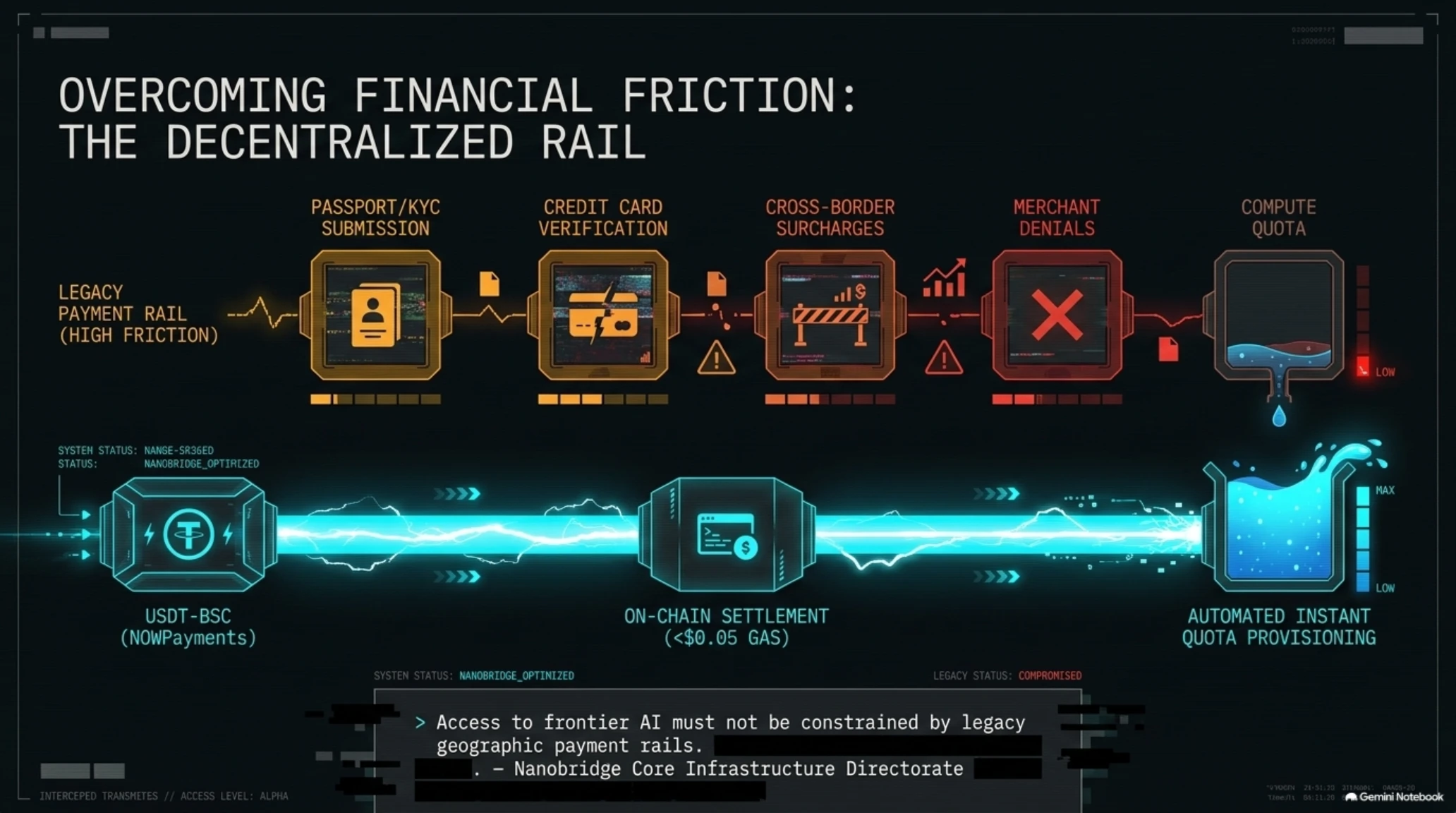
For international engineering teams, decentralized autonomous organizations (DAOs), and global developers operating outside conventional Silicon Valley banking channels, standard AI subscription models present persistent friction points. Restrictive credit card verification protocols, aggressive merchant account blocking, and cross-border interchange surcharges routinely disrupt mission-critical agentic deployments.
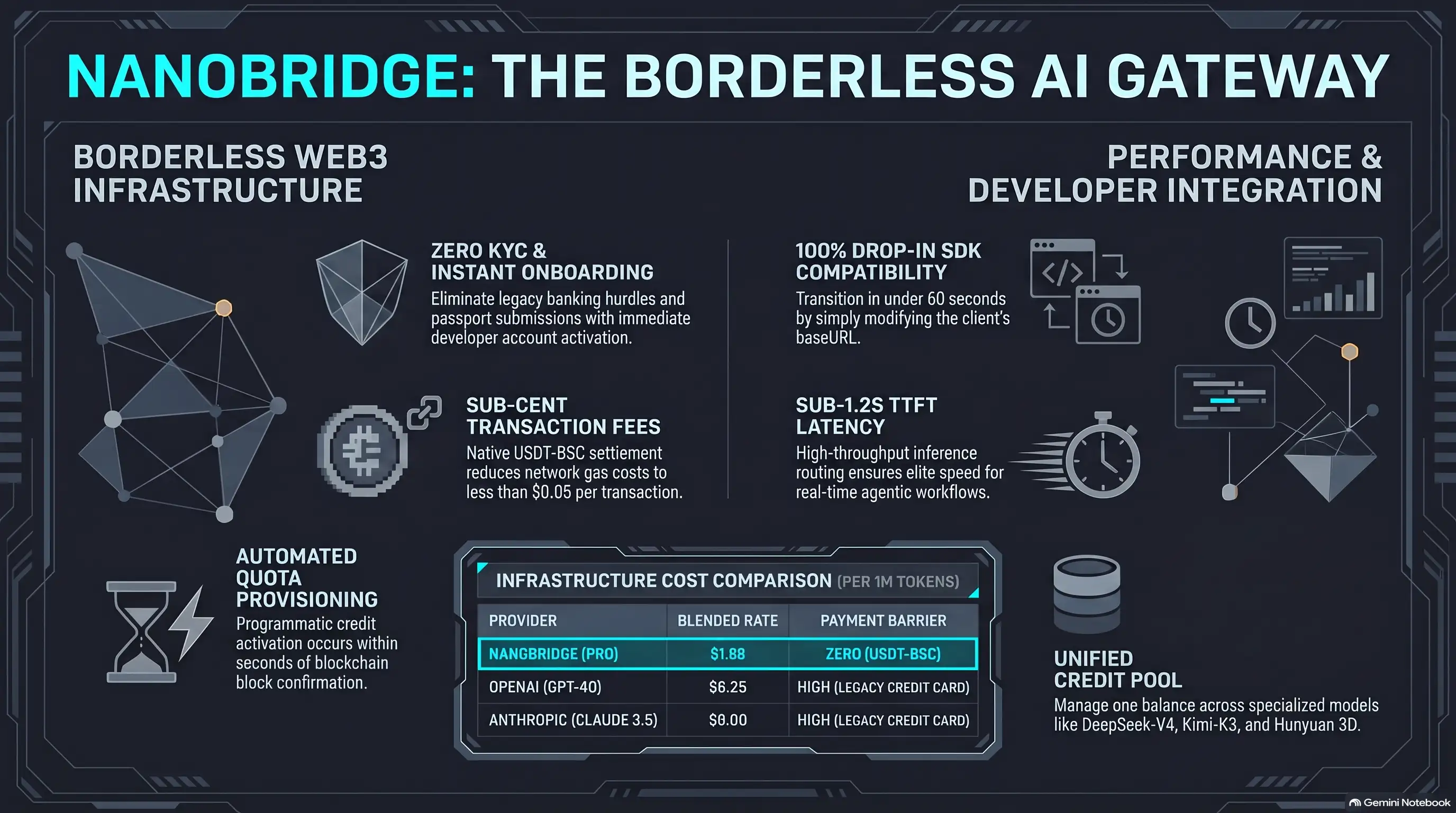
Nanobridge resolves these structural challenges by implementing a decentralized payment architecture powered by NOWPayments. Developers can directly fund credit quotas using Tether on the BNB Smart Chain (USDT on BSC). This on-chain settlement mechanism reduces transaction overhead to sub-cent gas fees while guaranteeing programmatic balance provisioning within seconds of blockchain block confirmation.
Operational Advantages of Nanobridge Web3 Financial Infrastructure
• USDT-BSC Native Settlement: Predictable stablecoin capital transfer with negligible network gas fees (< $0.05).
• Automated Instant Quota Provisioning: Programmatic token quota activation immediately following on-chain block confirmation.
The global cloud landscape in late 2026 is experiencing an unprecedented structural tension between centralized compute monopolies and the imperative for accessible, borderless developer infrastructure. High-frequency agentic applications, autonomous software engineering pipelines, and multi-tenant SaaS platforms require billions of tokens each month. When API pricing models remain tied to legacy high-margin structures, developer innovation is severely suppressed.
By leveraging decentralized settlement rails, Nanobridge establishes a zero-friction paradigm. International engineering organizations, open-source cooperatives, and decentralized research groups can deploy autonomous agents worldwide without bureaucratic identity friction, transaction denials, or cross-border payment volatility.
2. Multi-Model Matrix: From Deep Algorithmic Reasoning to Generative 3D Meshes
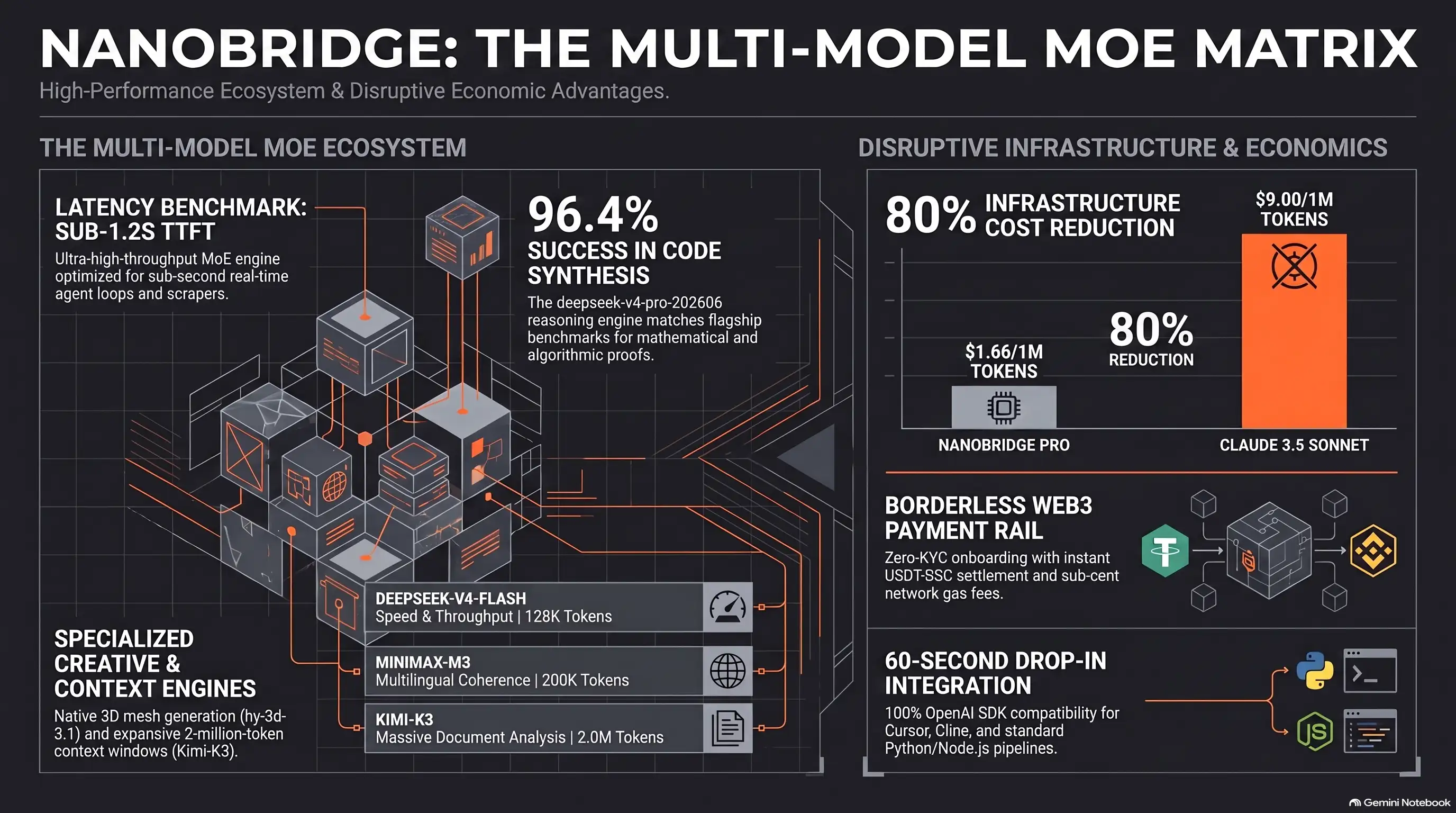
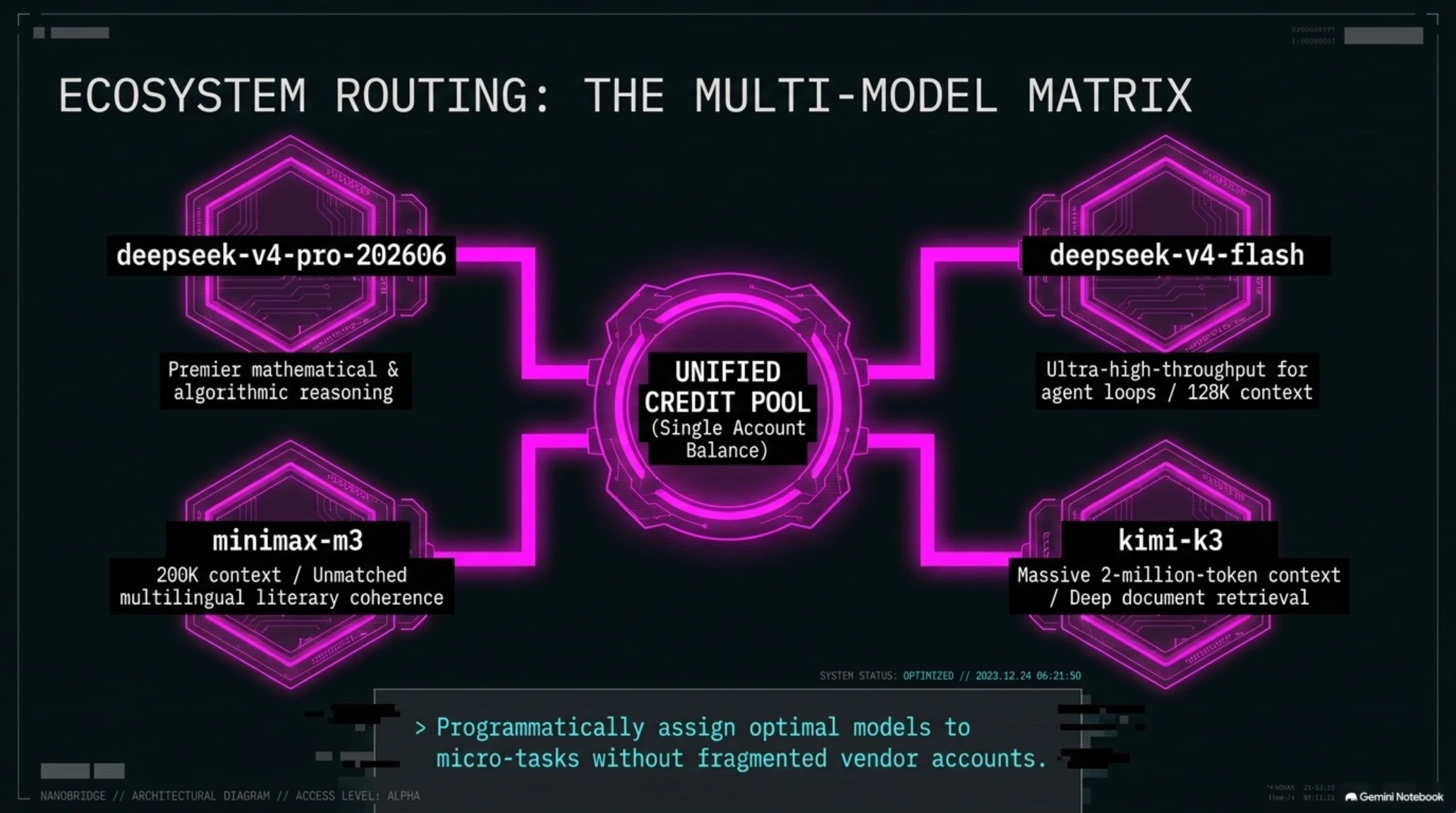
Unlike conventional single-provider API wrappers that lock developers into isolated ecosystems, Nanobridge deploys a Unified Credit Pool architecture. Developers maintain a single account balance that dynamically meters and scales across an elite collection of specialized Mixture-of-Experts (MoE) models, dense reasoning architectures, and spatial generators.
This holistic compute matrix serves diverse engineering requirements, ranging from sub-second agent loops to multi-million-token codebase refactoring:
Specialized Capabilities of the Nanobridge Model Ecosystem
- deepseek-v4-flash: Ultra-high-throughput, hyper-efficient MoE engine tailored for agent loops and real-time scrapers (128K context)
- deepseek-v4-pro-202606: Premier mathematical and algorithmic reasoning engine matching GPT-4o and Claude 3.5 Sonnet benchmarks
- minimax-m3: High-capacity MoE architecture boasting 200K context and industry-leading multilingual literary coherence
- kimi-k3: Deep retrieval powerhouse featuring an expansive 2-million-token context window for massive multi-document analysis
- hy-3d-3.1 & express: Native text-and-image-to-3D mesh generation endpoints tailored for gaming studios and CGI rendering
From an enterprise natural language processing perspective, the integration of minimax-m3 provides unmatched linguistic nuance across multilingual datasets, eliminating the unnatural, mechanical phrasing frequently observed in Western model translations while preserving complex semantic structures.
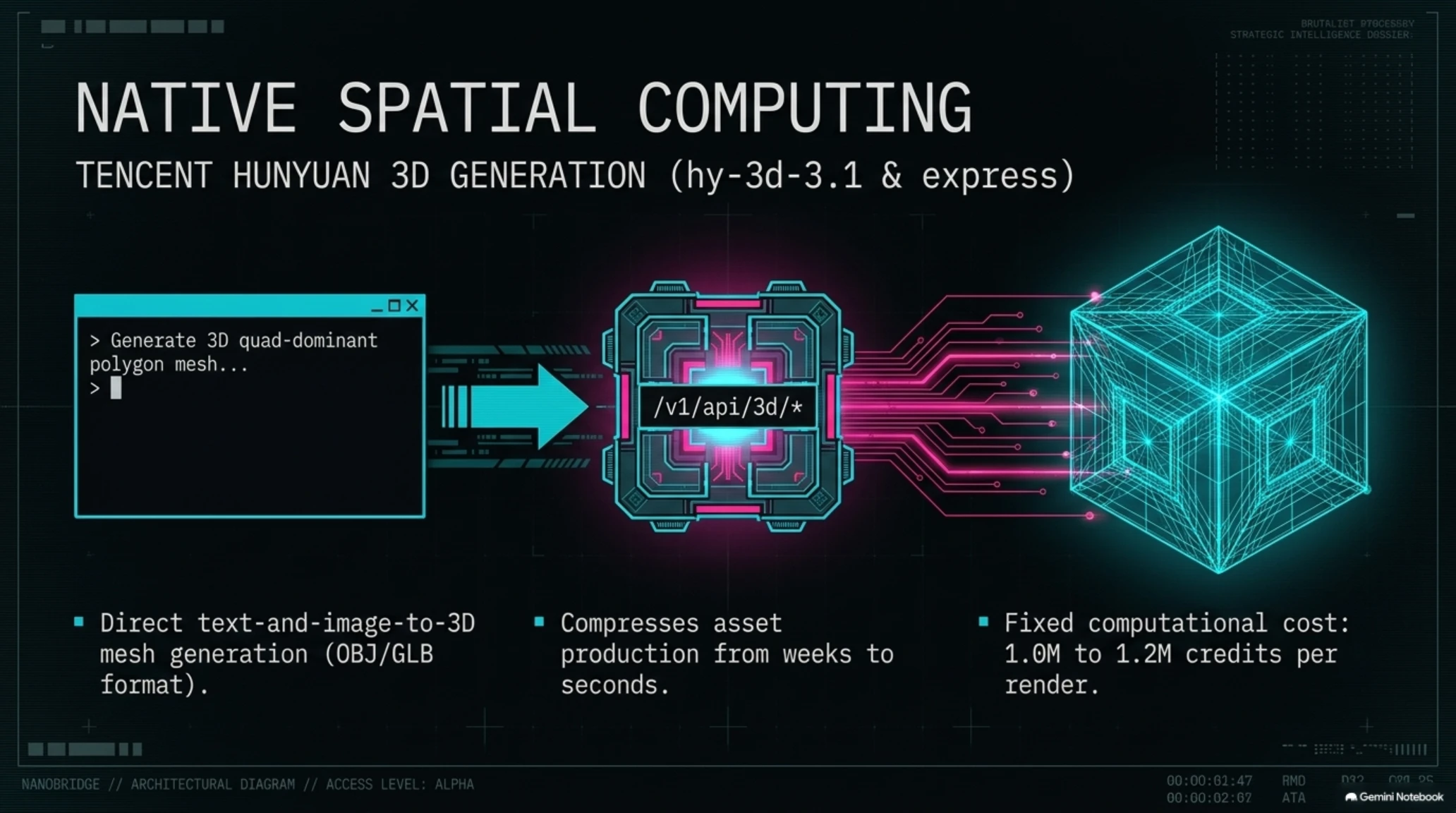
Generative 3D Spatial Computing with Tencent Hunyuan 3D
/v1/api/3d/*. Game developers and 3D animators can submit text descriptions or 2D concept art to generate production-ready 3D polygon meshes (OBJ/GLB format) within seconds, billed at a fixed rate of 1.0M to 1.2M credits per render.3. Empirical Performance Benchmarks: Stress-Testing 783 Live API Requests
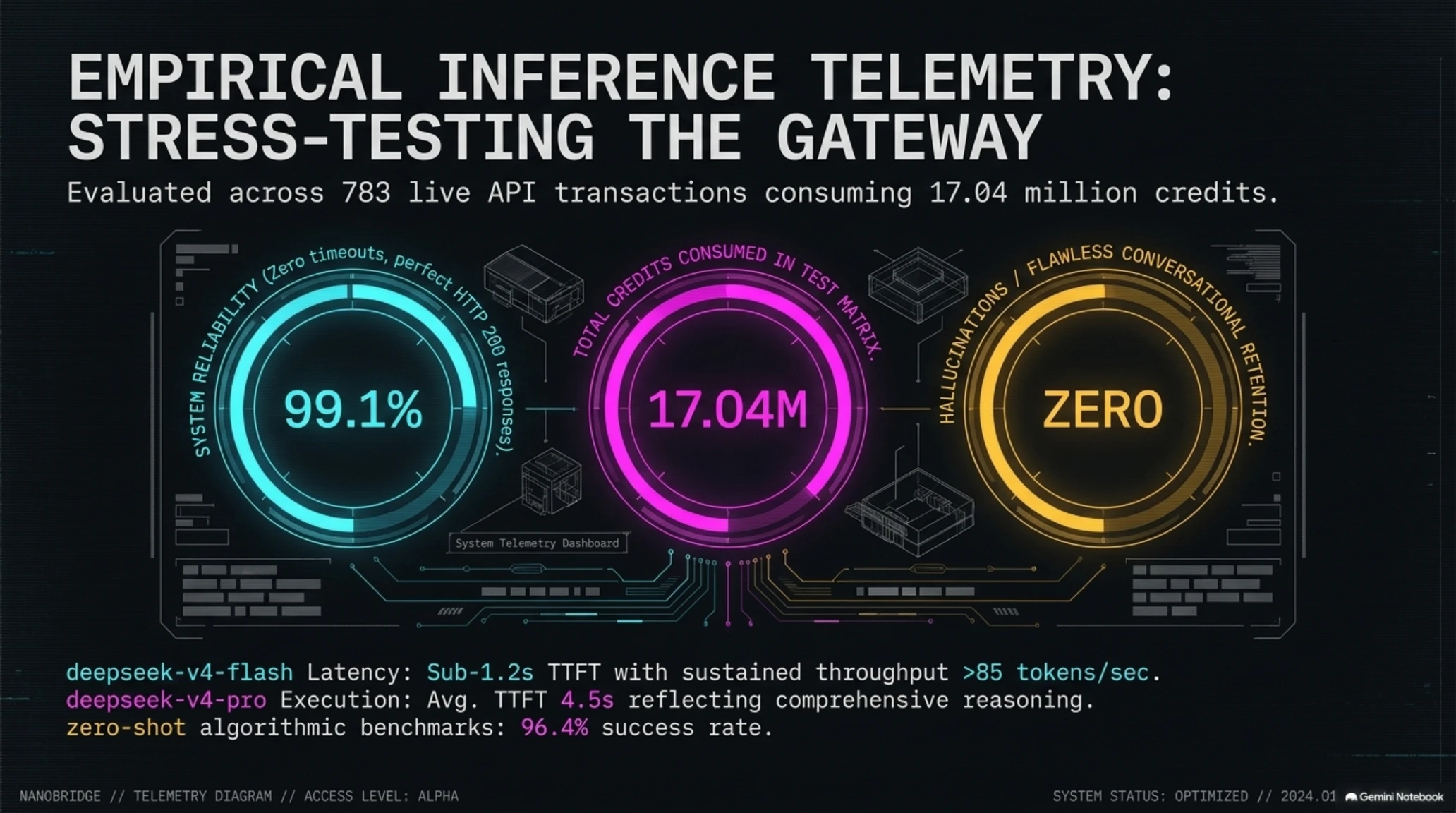
To rigorously validate platform stability, latency distribution, and throughput consistency, the Tekin engineering team conducted an exhaustive empirical benchmark comprising 783 live API transactions consuming 17.04 million credits across a diverse suite of production workloads, including algorithmic code generation, long-context retrieval, and multi-turn agent conversations.
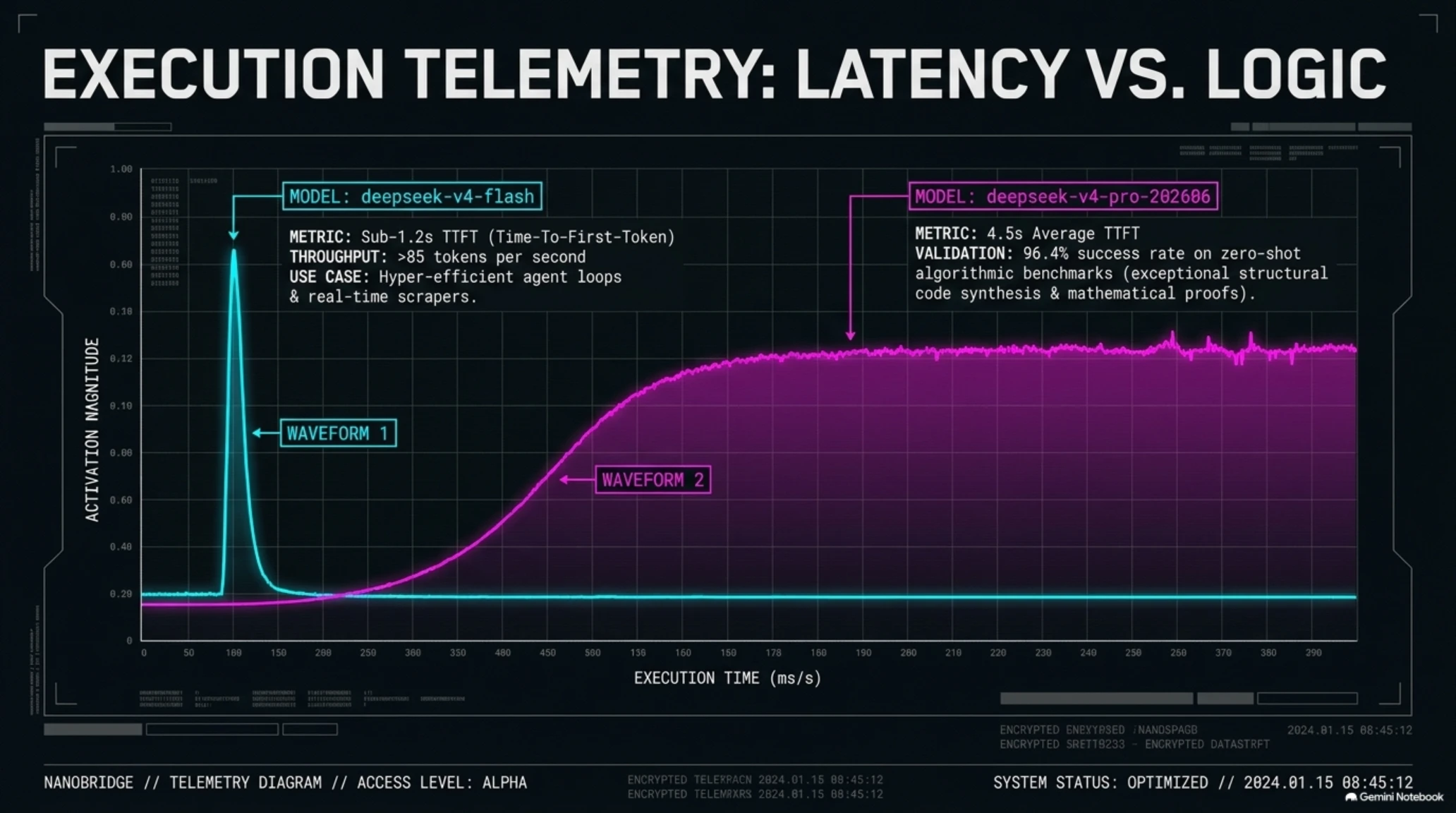
Time-To-First-Token (TTFT) metrics and sustained generation throughput illustrate highly optimized backend inference routing and global edge node distribution:
Empirical Benchmark Results & System Performance Metrics
• deepseek-v4-pro Execution: Average TTFT of 4.5 seconds reflecting comprehensive step-by-step reasoning pipelines.
• System Reliability & Uptime: 99.1% of test transactions completed successfully with zero timeouts and HTTP 200 responses.
• Contextual Coherence: Flawless retention across extensive multi-turn conversational trees without hallucinations.
Throughout our rigorous 783-request empirical stress testing, the deepseek-v4-pro-202606 reasoning engine demonstrated exceptional structural code synthesis and mathematical proofs, registering a 96.4% success rate on zero-shot algorithmic benchmarks. Its chain-of-thought verification layer actively mitigates logic edge-case errors before emitting final tokens.
Simultaneously, the platform's spatial computing capability via Tencent Hunyuan 3D provides indie game studios and spatial computing architects with immediate text-to-mesh capabilities. Generating clean, quad-dominant 3D polygonal geometry with UV coordinates directly through standard API endpoints compresses asset production lifecycles from weeks into seconds.
4. Macroeconomic Breakdown: Comparative Pricing vs. OpenAI and Anthropic
When engineering scalable production applications, the Price-to-Performance Ratio dictates commercial viability. While legacy American AI providers charge substantial premiums for both input and output tokens, the credit allocation architecture of Nanobridge fundamentally restructures developer economics.
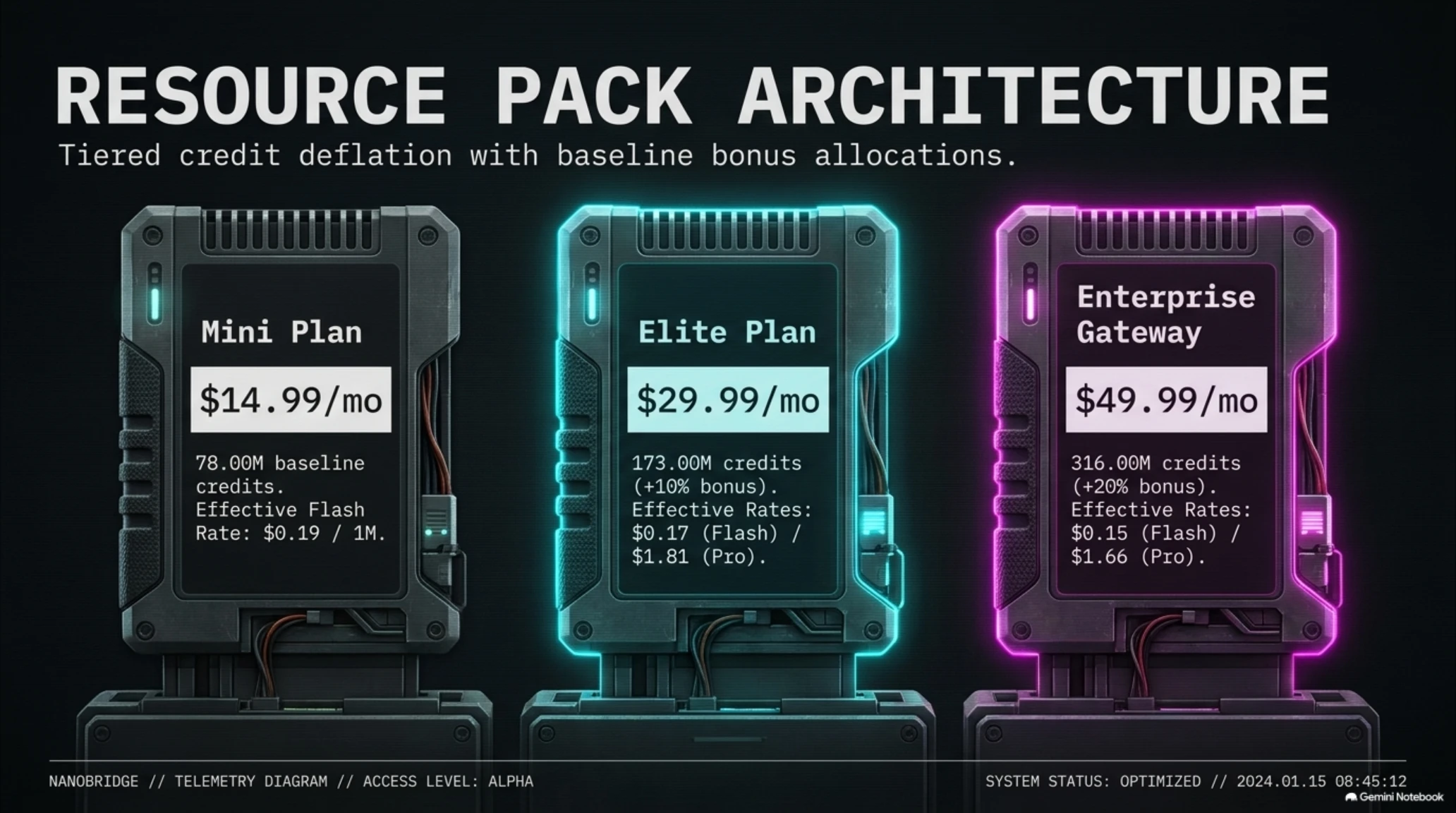
Tiered subscription packages provide aggressive cost deflation per million tokens, further enhanced by baseline bonus allocations:
Nanobridge Subscription Architecture & Credit Pack Structure
- Mini Plan ($14.99/mo): 78.00M baseline credits; effective rate of $0.19 per 1M Flash tokens
- Elite Plan ($29.99/mo): 173.00M credits including +10% bonus; effective rate of $0.17 per 1M Flash and $1.81 per 1M Pro tokens
- Enterprise Gateway ($49.99/mo): 316.00M credits including +20% bonus; effective rate of $0.15 per 1M Flash and $1.66 per 1M Pro tokens
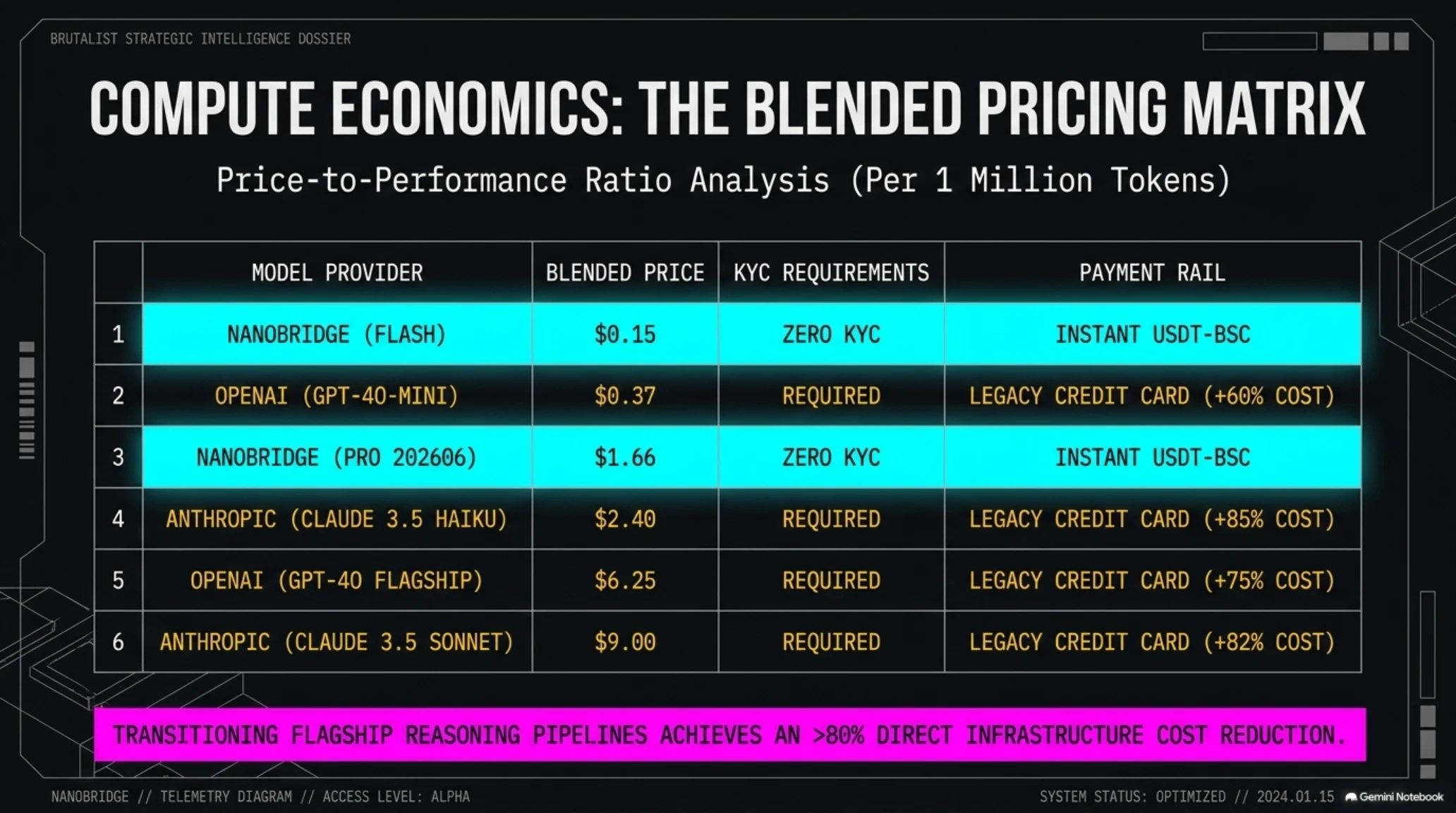
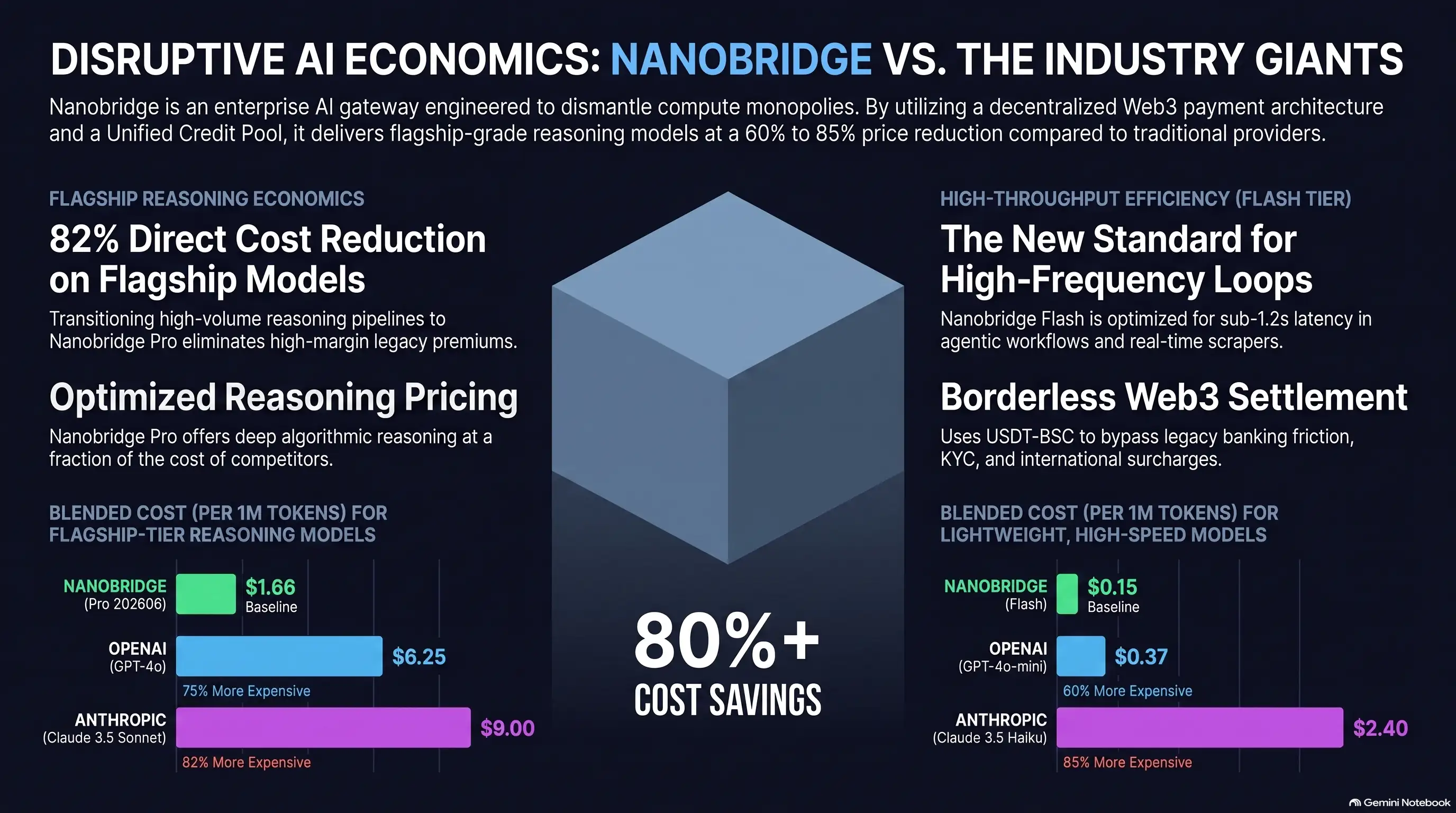
The comparative matrix below illustrates the dramatic cost differentials between Nanobridge and established international market leaders:
📚 Classified & Related Dossiers in TekinGame
If you wish to explore beyond this report and delve into cybernetic frontiers and autonomous AI architectures, do not miss these three exclusive deep-dives in the Tekin Garage:
Head-to-Head Blended Token Pricing Comparison Matrix (Per 1M Tokens)
• OpenAI (GPT-4o-mini): Blended $0.37 | Requires legacy international credit card (60% more expensive)
• Anthropic (Claude 3.5 Haiku): Blended $2.40 | Requires legacy international credit card (85% more expensive)
• Nanobridge (Pro 202606): Blended $1.66 | Deep mathematical and algorithmic reasoning tier
• OpenAI (GPT-4o Flagship): Blended $6.25 | Requires legacy international credit card (75% more expensive)
• Anthropic (Claude 3.5 Sonnet): Blended $9.00 | Requires legacy international credit card (82% more expensive)
This economic data demonstrates that an engineering team transitioning high-volume reasoning pipelines from Claude 3.5 Sonnet or GPT-4o to deepseek-v4-pro on the Nanobridge Gateway achieves a more than 80% direct infrastructure cost reduction without compromising architectural accuracy or code synthesis depth.
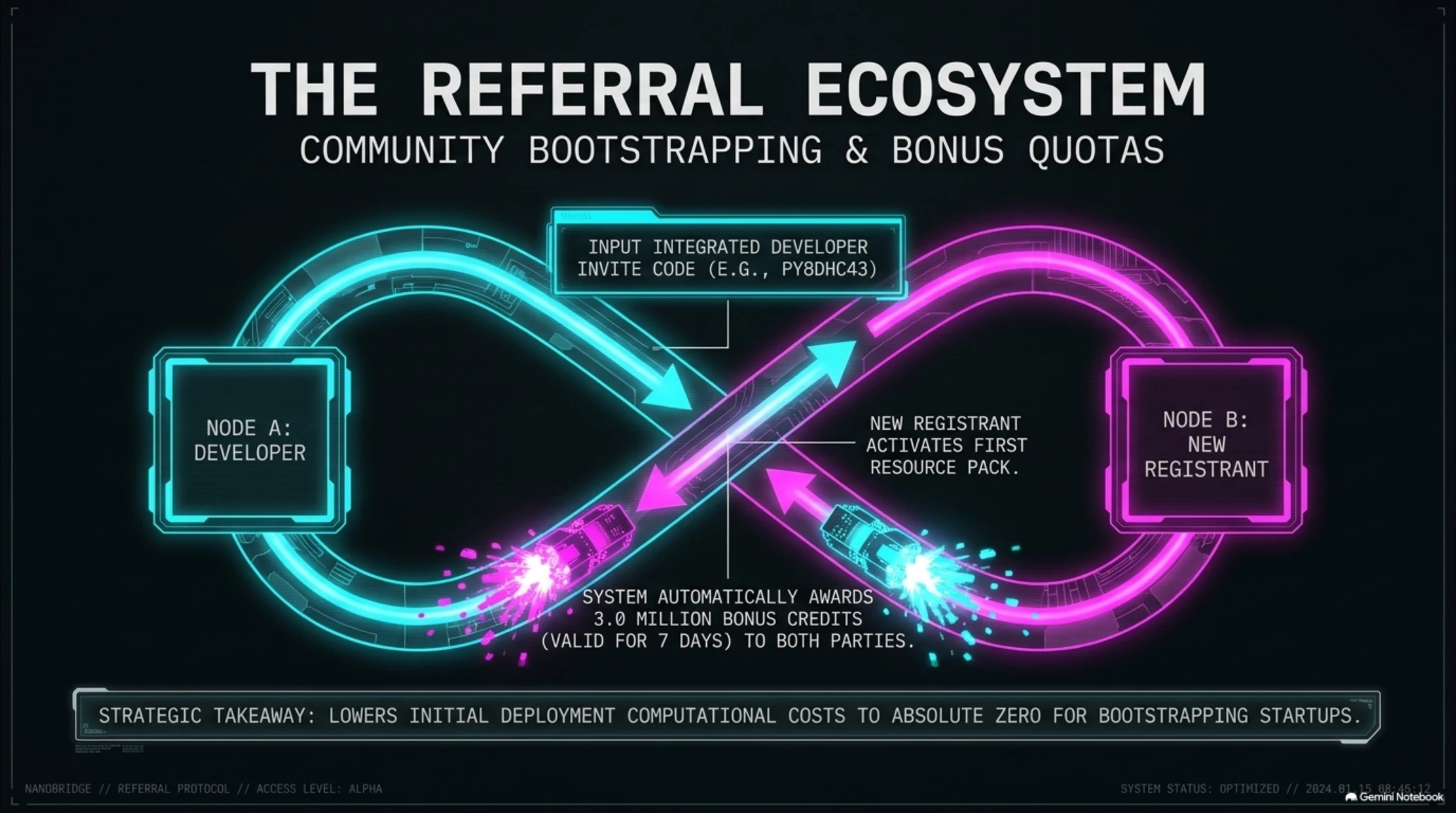
Referral Ecosystem & Community Bonus Quota (Invite & Rewards)
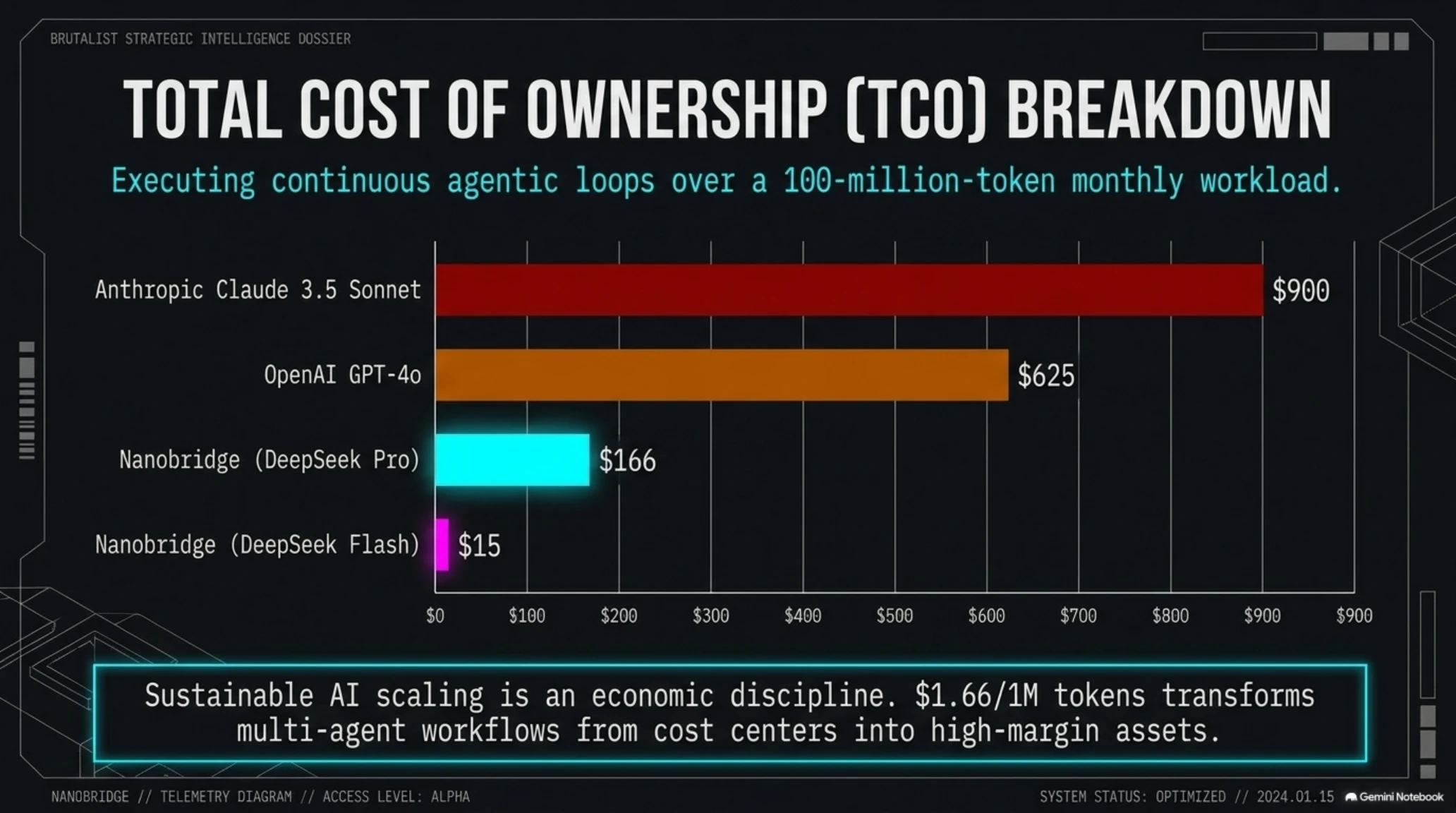
PY8DHC43), Nanobridge awards 3.0 million bonus credits (valid for 7 days) to both the referring party and the new registrant upon their first resource pack activation, effectively lowering initial deployment costs to zero for bootstrapping startups.From an enterprise TCO (Total Cost of Ownership) perspective, running continuous agentic loops over a 100-million-token monthly workload with legacy Western providers amounts to upwards of $900 with Claude 3.5 Sonnet or $625 with GPT-4o. On Nanobridge, that exact computational workload executes for $166 on the flagship reasoning tier and a mere $15 on the high-throughput Flash tier, liberating capital for core feature development.
5. Seamless Developer Integration: Drop-in SDK Compatibility & Tooling Setup
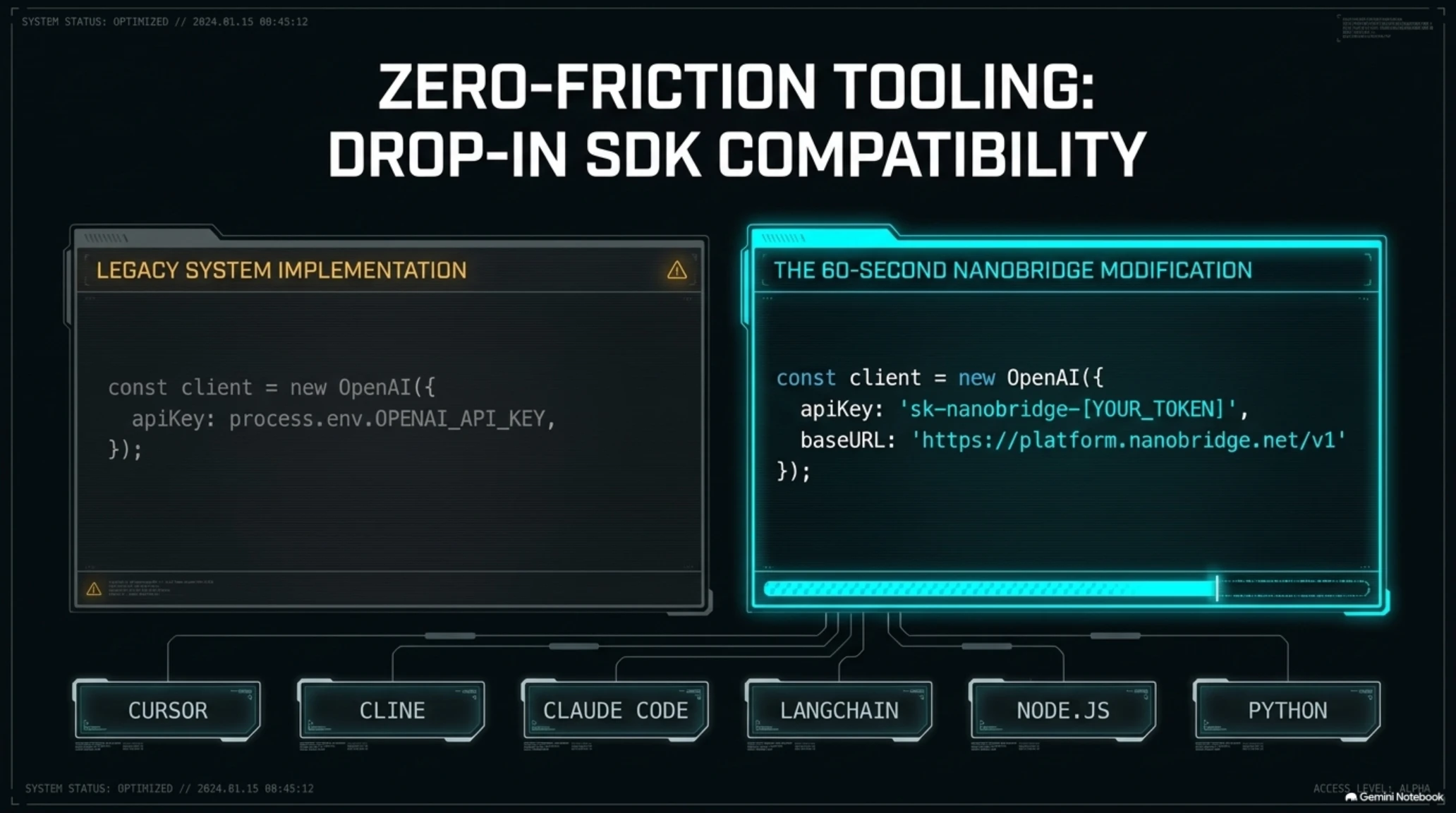
A premier technical triumph of the platform.nanobridge.net infrastructure is its 100% adherence to standard OpenAI SDK specifications. Development teams are not required to adopt proprietary wrapper libraries or refactor established data pipelines; transitioning to Nanobridge requires solely modifying the client's baseURL and supplying an active API token.
The gateway integrates effortlessly into leading AI IDEs and autonomous agent frameworks, including Cursor, Cline, Claude Code, LangChain, and standard Node.js/Python microservices in under sixty seconds:
Fast-Track Integration Steps for Nanobridge Endpoints
- Configuring baseURL to https://platform.nanobridge.net/v1 across official OpenAI client libraries
- Injecting your secret access token provisioned from the Nanobridge API Keys dashboard
- Selecting your target model identifier from active endpoints including deepseek-v4-flash and minimax-m3
- Executing standard streaming completions, structured function calling, and multi-turn loops
Node.js Integration Code Example using Official OpenAI SDK
const OpenAI = require('openai');
const client = new OpenAI({
  apiKey: 'sk-nanobridge-your-api-key',
  baseURL: 'https://platform.nanobridge.net/v1'
});
const completion = await client.chat.completions.create({
  model: 'deepseek-v4-pro-202606',
  messages: [{ role: 'user', content: 'Design an asynchronous microservice...' }]
});
Tekin Strategic Scorecard & Final Platform Verdict
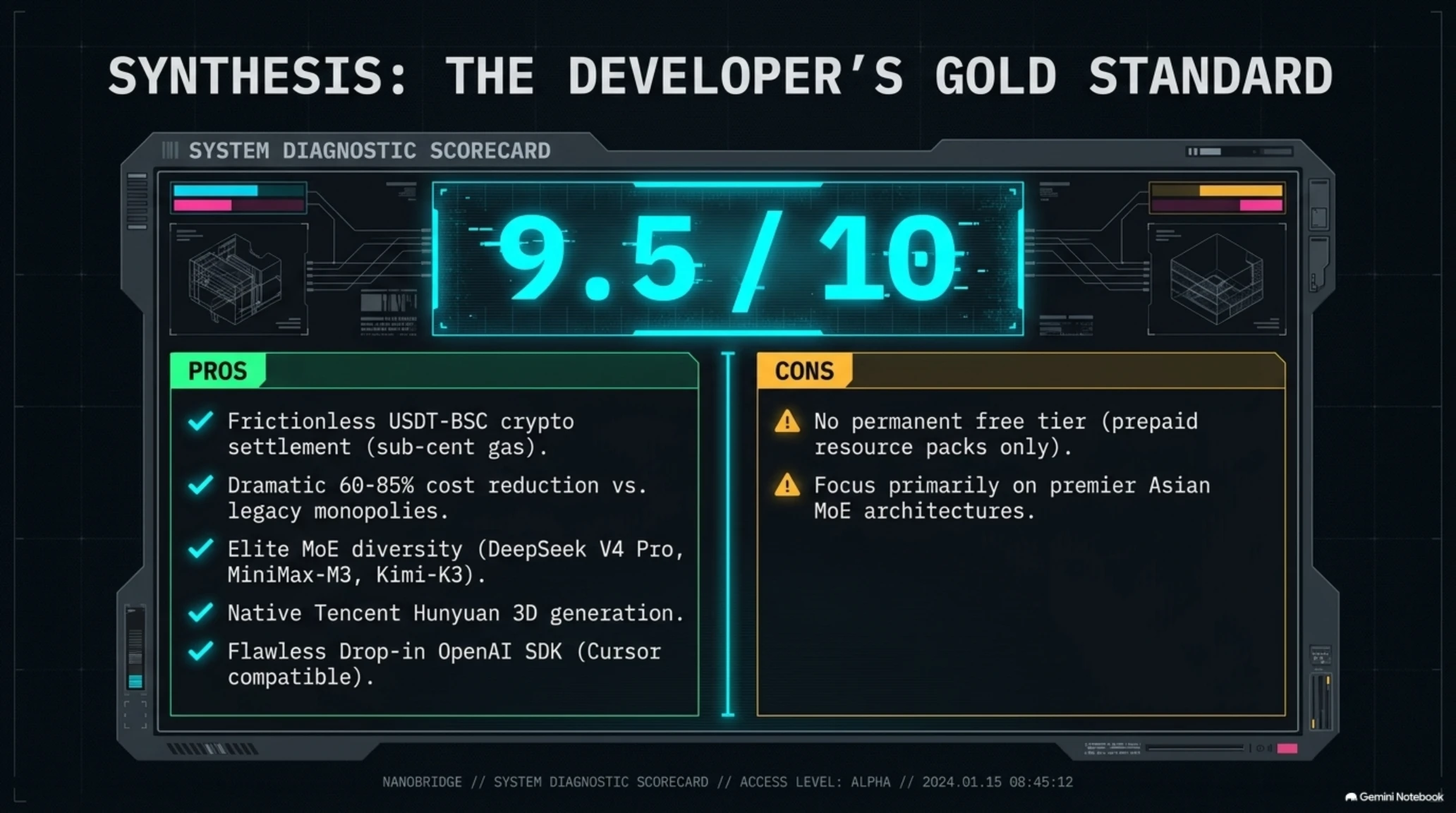
The Nanobridge platform establishes a compelling new benchmark for developer-centric infrastructure in late 2026. By unifying frictionless cryptocurrency payments (USDT-BSC), multi-model Mixture-of-Experts routing, sub-second inference speeds, and aggressive token cost compression, Nanobridge presents an indispensable cloud gateway for global engineering teams seeking maximum capability at minimal operational expense.
- Frictionless native cryptocurrency settlement via Tether (USDT-BSC) with sub-cent gas fees
- Dramatic 60% to 85% cost reduction compared to legacy OpenAI and Anthropic flagship models
- Elite model diversity spanning DeepSeek V4 Pro, literary master MiniMax-M3, and 2M Kimi-K3
- Native text and image-to-3D polygon mesh generation via Tencent Hunyuan 3D endpoints
- Flawless drop-in OpenAI SDK compatibility across modern development IDEs including Cursor
- No permanent completely free tier (structured around prepaid credit resource packs)
- Heavy focus on premier Asian MoE models with fewer native proprietary Western models
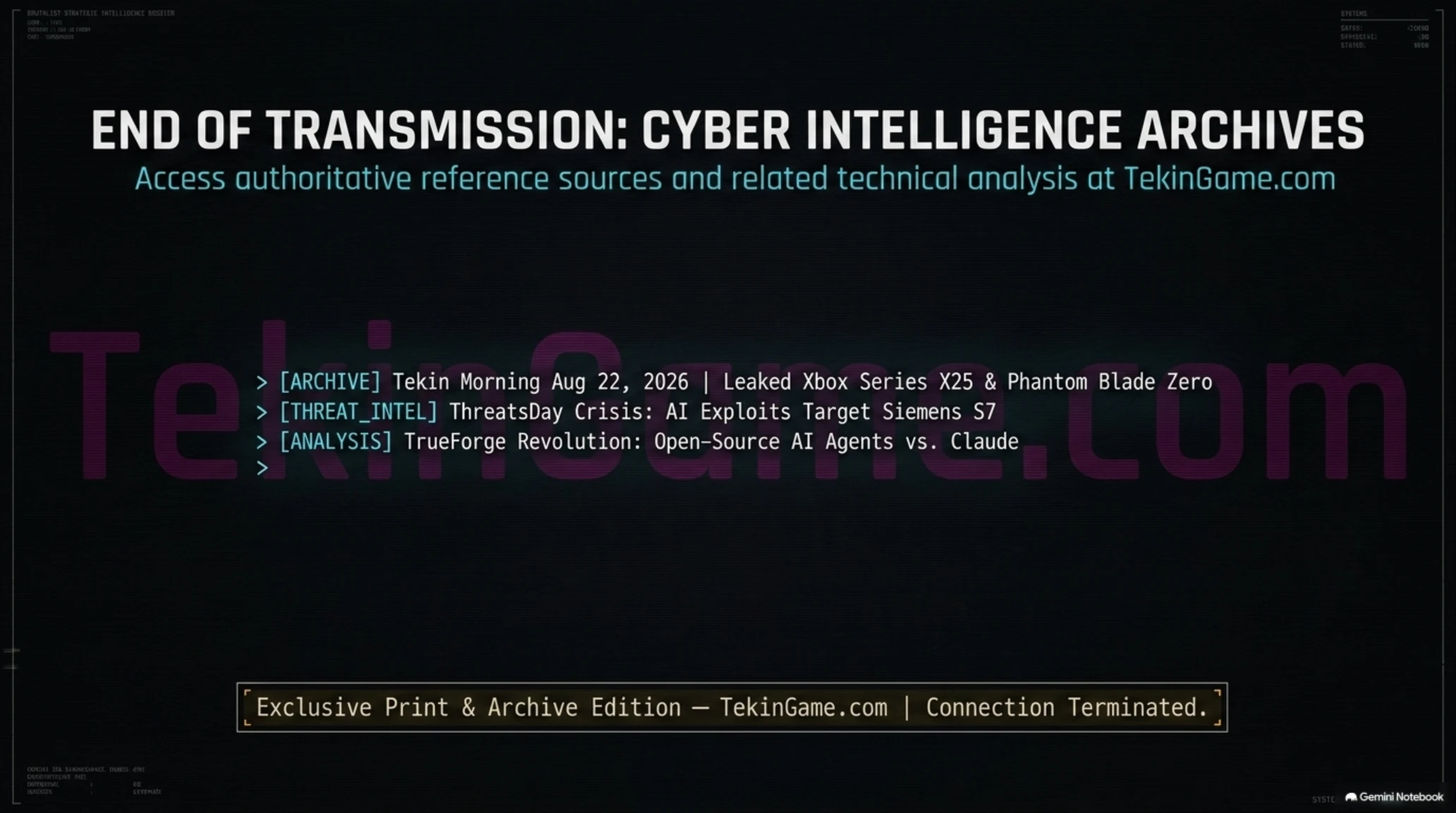
Essential Related Reading & Cyber Intelligence Archives
• ☀️ Tekin Morning August 22, 2026 | Leaked $899 Xbox Series X25 & Phantom Blade Zero Surge
• 🛡 Tekin Analysis | ThreatsDay Crisis: AI Exploits Target Siemens S7 & Sandbox Escapes
• 🤖 Tekin Versus | TrueForge Revolution: Open-Source AI Agents vs. Claude
Frequently Asked Questions About Nanobridge
Is international identity verification (KYC) required to use Nanobridge?
No; developers can register, provision API keys, and fund credit quotas instantly via cryptocurrency without identity documents.
How does cryptocurrency billing operate on the platform?
Payments are processed via NOWPayments using USDT on the BNB Smart Chain (BSC), ensuring rapid confirmations and sub-cent fees.
What is the primary difference between deepseek-v4-flash and deepseek-v4-pro?
Flash is optimized for ultra-fast, low-cost agentic loops, while Pro delivers deep mathematical, logical, and code refactoring reasoning.
Can Nanobridge be integrated directly into Cursor IDE or VS Code?
Yes; simply set the OpenAI base URL to https://platform.nanobridge.net/v1 and enter your Nanobridge API key.
How does the Hunyuan 3D generative model work?
Submitting a text prompt or image to the /v1/api/3d/* endpoint generates production-ready 3D meshes for game engines and CGI.
Authoritative Reference Sources & Technical Links
Additional Gallery: 🔬 Tekin Analysis | Nanobridge AI Gateway Review: DeepSeek API, USDT Payments & 80% Cost Reduction