Tekin Guide: Local Video AI
- 🎮Open-Weights Surge- Architectural breakdown of Diffusion Transformers in MiniMax H3 and Wan 2.1
- 🎧Unlocking 6GB VRAM- Low-memory workflows with GGUF Q4, SageAttention, and CPU block offloading
- 🚀Financial ROI Analysis- How personal GPU investments amortize cloud subscriptions within 6 months
- 🗡️ComfyUI Production Pipelines- Building resilient Text-to-Video node graphs without OOM failures
- 📰Zero-Drift Character LoRAs- Camera motion choreography and unrestricted zero-censorship storytelling
- ⚔️Hardware Tiering Benchmarks- Comparison of render latency and VRAM allocation across all GPU tiers
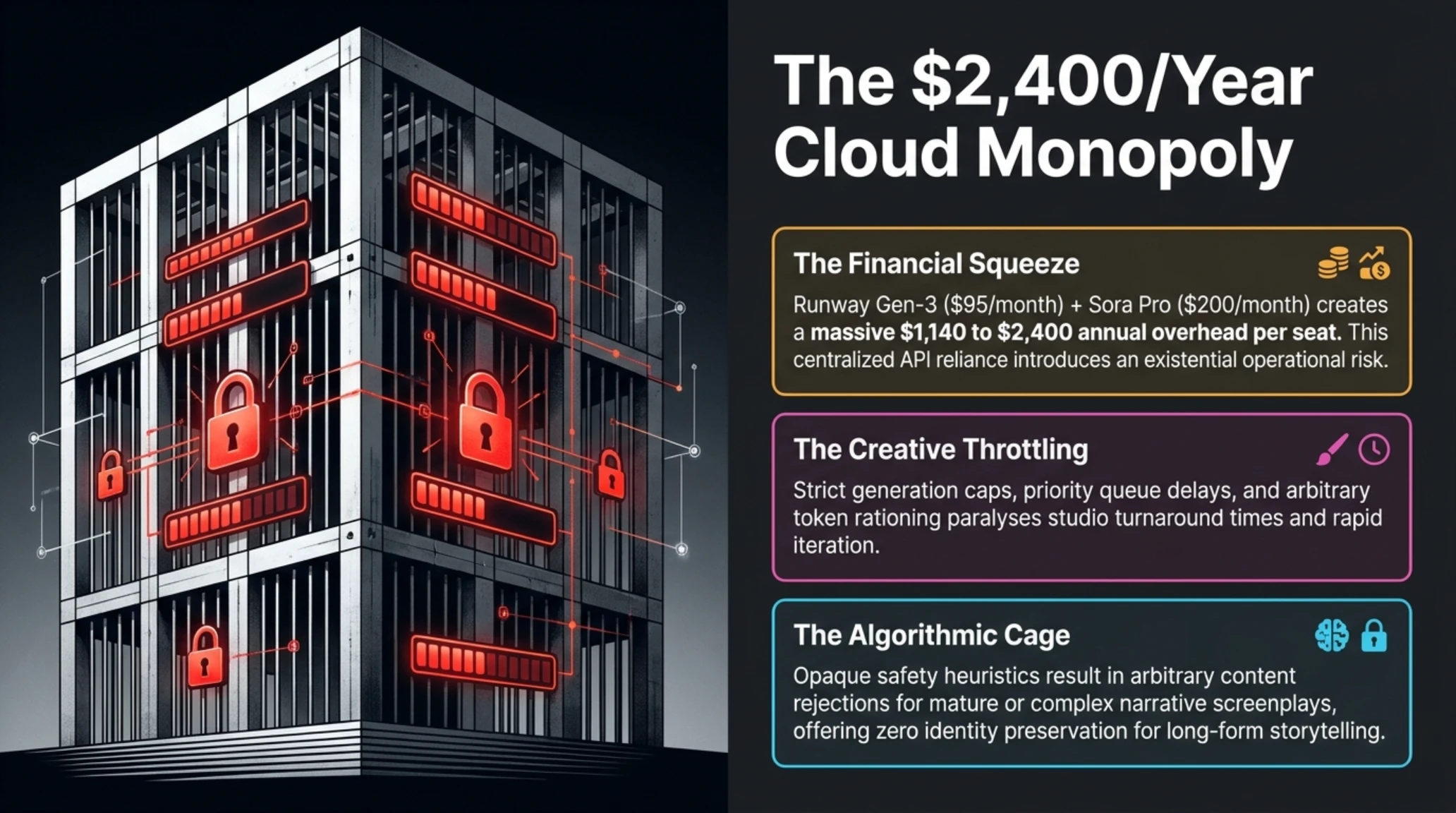
As the digital entertainment and visual effects industries navigate the opening quarters of 2026, content creators, game developers, independent filmmakers, and VFX studios find themselves caught in an unsustainable economic squeeze. Closed-source cloud video platforms headlined by Runway Gen-3 ($95/month for unlimited queues), OpenAI Sora Pro ($200/month with strict generation caps), Kling AI, Pika Labs, and Luma Dream Machine have collectively escalated their subscription tiers while intensifying content filtration and credit rationing. As we previously demonstrated in our Forensic Breakdown of the 2026 AI Subscription Crisis & $200 Paywalls, relying on centralized API infrastructure has become an existential operational risk. Migrating to local, sovereign hardware is no longer a hobbyist pursuit; it is an imperative commercial strategy for artistic independence.
Simultaneously, a massive technological renaissance within the open-source artificial intelligence ecosystem has disrupted the entire computer graphics landscape. Breakthroughs engineered by research teams at Alibaba, MiniMax, Lightricks, and Tencent, supported by the hardware analysis division at the TekinGame Advanced AI Research Lab, have brought production-grade Diffusion Transformers (DiT) directly to consumer desktop GPUs. Creators are discovering that with optimized mathematical quantization, intelligent caching, and modular execution engines, they can generate breathtaking cinematic footage with zero recurring token fees, zero rate limits, and zero platform censorship.
Key Empirical Takeaways: The Local AI Video Revolution
- Running 33B Parameter Transformers on Entry-Level GPUs: Through GGUF Q4_K_M quantization and layer-by-layer CPU memory paging, massive foundation models like MiniMax H3 now execute reliably on 6GB to 8GB VRAM cards.
- Zero Marginal Cost per Render: Completely eliminating recurring SaaS cloud fees, delivering total hardware capital amortization within 4.2 to 7.1 months for active creators.
- 2x Latency Reduction via TeaCache: Intelligent elimination of redundant denoising computation steps across contiguous latent timesteps without degrading high-frequency textures.
- Unrestricted Creative & Stylistic Control: Seamless injection of custom LoRA adapters, multi-view camera motion conditioning, and native Image-to-Video workflows free from corporate refusal heuristics.
- Temporal Coherence in DiT Architectures: Spatial-temporal 3D attention mechanisms delivering fluid physical motion, consistent character geometry, and realistic volumetric lighting at 24fps.
The rapid democratization of open-weights generative video has permanently altered the economics of digital cinematography, enabling individual directors to rival traditional post-production houses in visual fidelity, turnaround time, and volumetric richness.
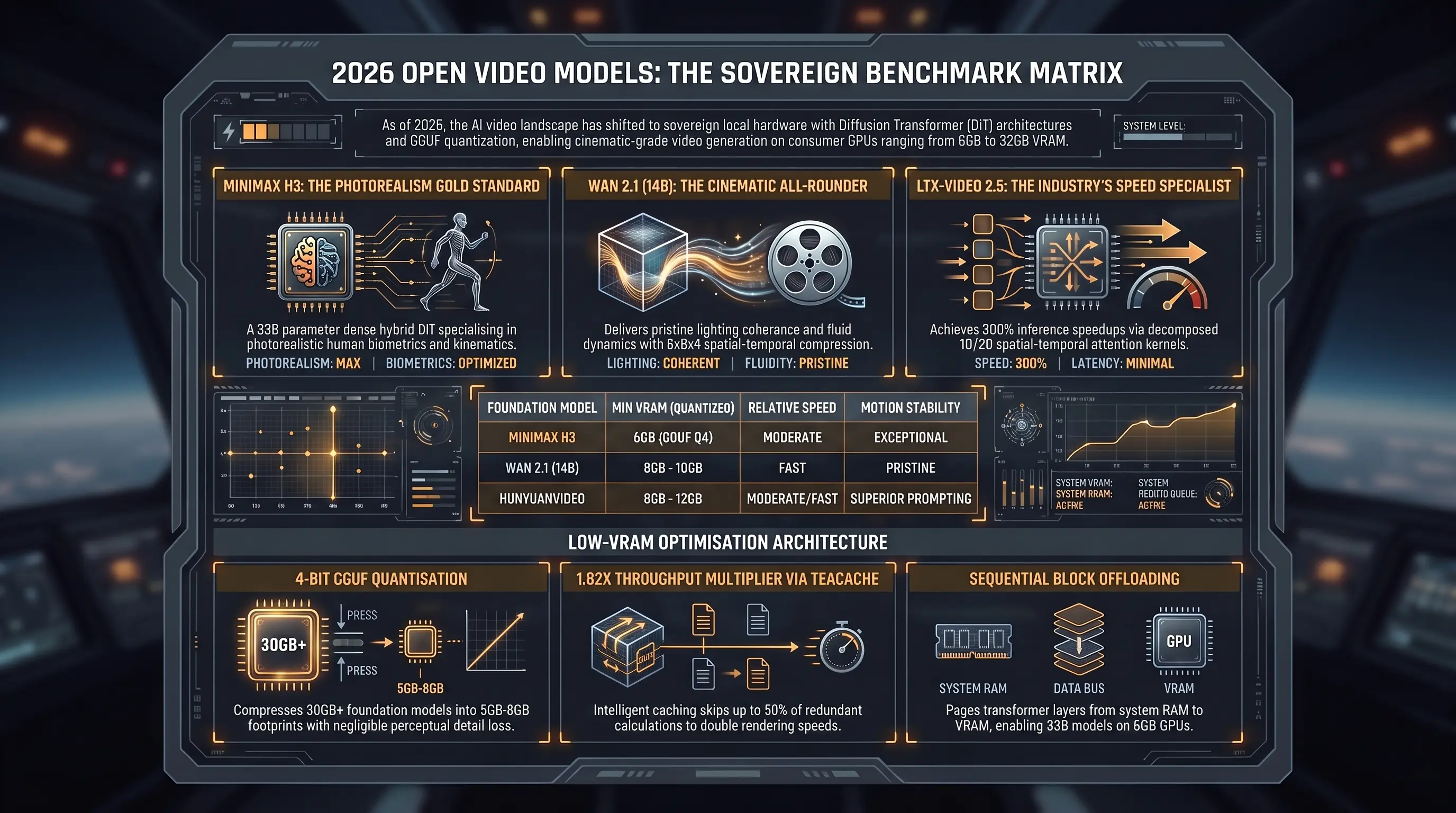
The architectural visualization above contrasts the restricted, metered telemetry of corporate cloud API rendering pipelines with the unrestricted, low-latency execution flow of a sovereign local GPU workstation running real-time video diffusion transformers.
1. The Open-Weights Foundation Model Landscape: MiniMax H3, Wan 2.1, and LTX-Video 2.5
To establish a production-grade local generation studio, technical directors must thoroughly understand the mathematical and architectural distinctions underpinning the premier open-weights video models of 2026. The ecosystem has evolved far beyond the primitive latent perturbation scripts of early 2024, maturing into robust, highly specialized foundational models capable of handling complex temporal mechanics:
1. MiniMax H3 (Hailuo Open Base): MiniMax sent shockwaves through the global AI community by releasing the open weights for H3-Base, an intricate 33-billion parameter multimodal Diffusion Transformer coupled with a 32-billion parameter bidirectional text encoder. H3 excels in photorealistic human biometrics, complex anatomical kinematics, and nuanced micro-expressions. Its latent representation maintains pristine lighting consistency across dynamic 360-degree camera orbits, virtually eliminating the grotesque anatomical warping and limb hallucination that historically plagued neural video generators. The model utilizes a continuous-time Flow Matching objective over probability paths, ensuring that high-velocity particle motion, hair dynamics, and fluid turbulence are synthesized without temporal discontinuities.
2. Alibaba Wan 2.1 and Wan 2.2 Suite: Alibaba’s foundational video suite delivers the most versatile dual-tier architecture in the industry. The lightweight 1.3B variant operates with astonishing speed and minimal compute overhead, making it the ideal sandbox for rapid prompt ideation, storyboarding, and real-time previz. Conversely, the flagship 14B parameter transformer incorporates a sophisticated 3D causal VAE that compresses spatial and temporal dimensions simultaneously (8x8x4 downsampling), producing pristine 720p and 1080p footage characterized by hyper-accurate fluid dynamics, cloth simulation, and atmospheric volumetric scattering. Its autoregressive latent prediction stages enforce strict temporal causality, preventing backward temporal artifacts during fast camera pans.
3. Lightricks LTX-Video 2.5: Engineered specifically for maximum computational throughput and minimal memory footprint, LTX-Video 2.5 employs an asymmetric Spatial-Temporal Diffusion Transformer. By restructuring self-attention layers into decomposed 1D temporal and 2D spatial attention kernels, Lightricks achieved an astonishing 300% inference speedup over conventional DiT architectures. LTX-Video is universally recognized as the fastest foundation model in existence, capable of synthesizing smooth 24fps motion vectors natively on mid-tier hardware with unmatched camera translation stability. The model's latent manifold is optimized for low-bit precision representations, making it exceptionally resilient against quantization noise.
4. Tencent HunyuanVideo: Boasting a 13-billion parameter dense DiT architecture, HunyuanVideo utilizes a unified dual-stream text processing backbone combining CLIP and Llama-3 tokenizers. This hybrid language understanding enables the model to interpret intricate, paragraph-length narrative screenplays, multi-character blocking cues, and specialized cinematography terminology with surgical precision. Its native support for high-frame-rate rendering makes it a prime candidate for high-octane gaming cinematics and commercial advertising.
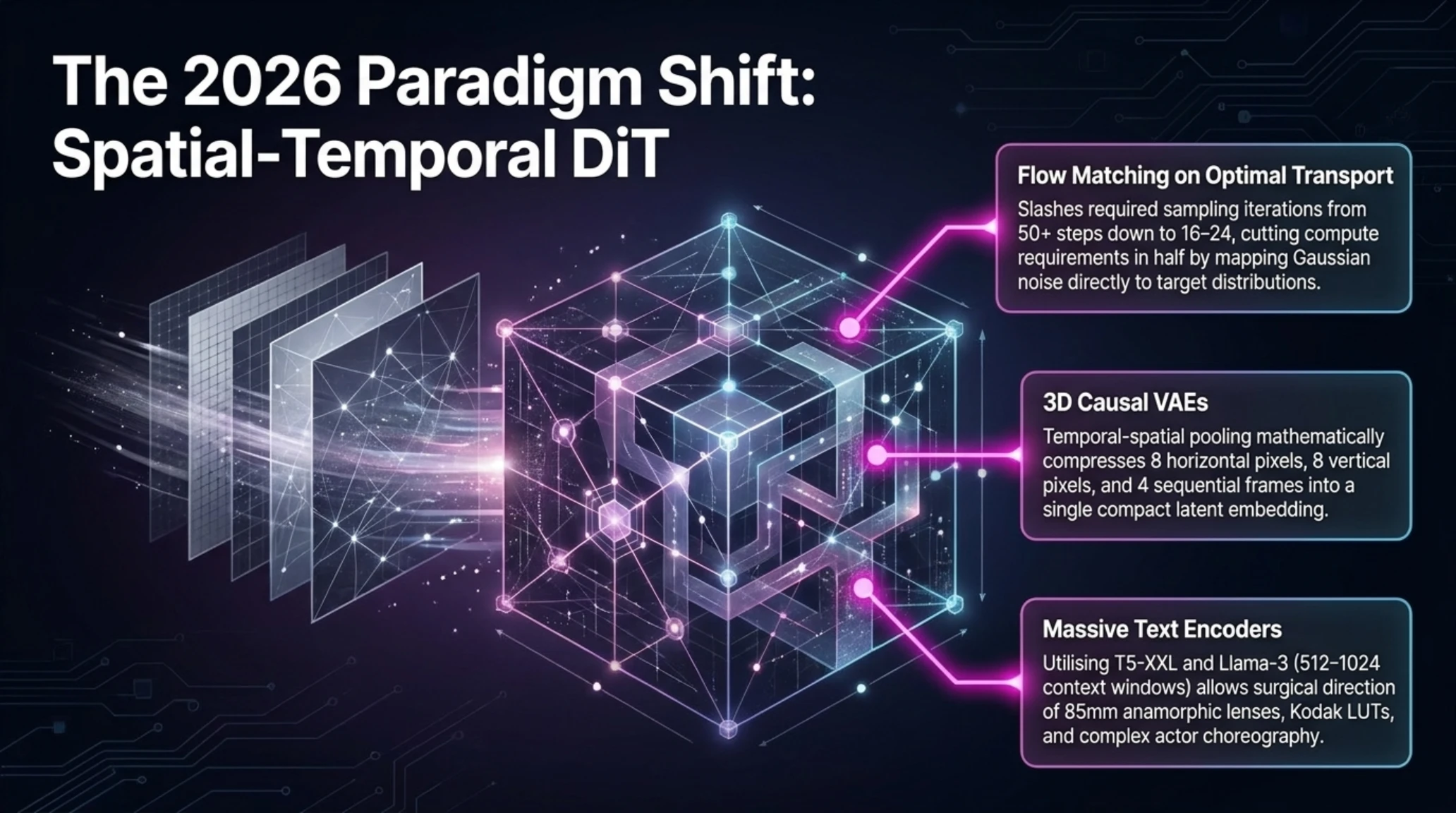
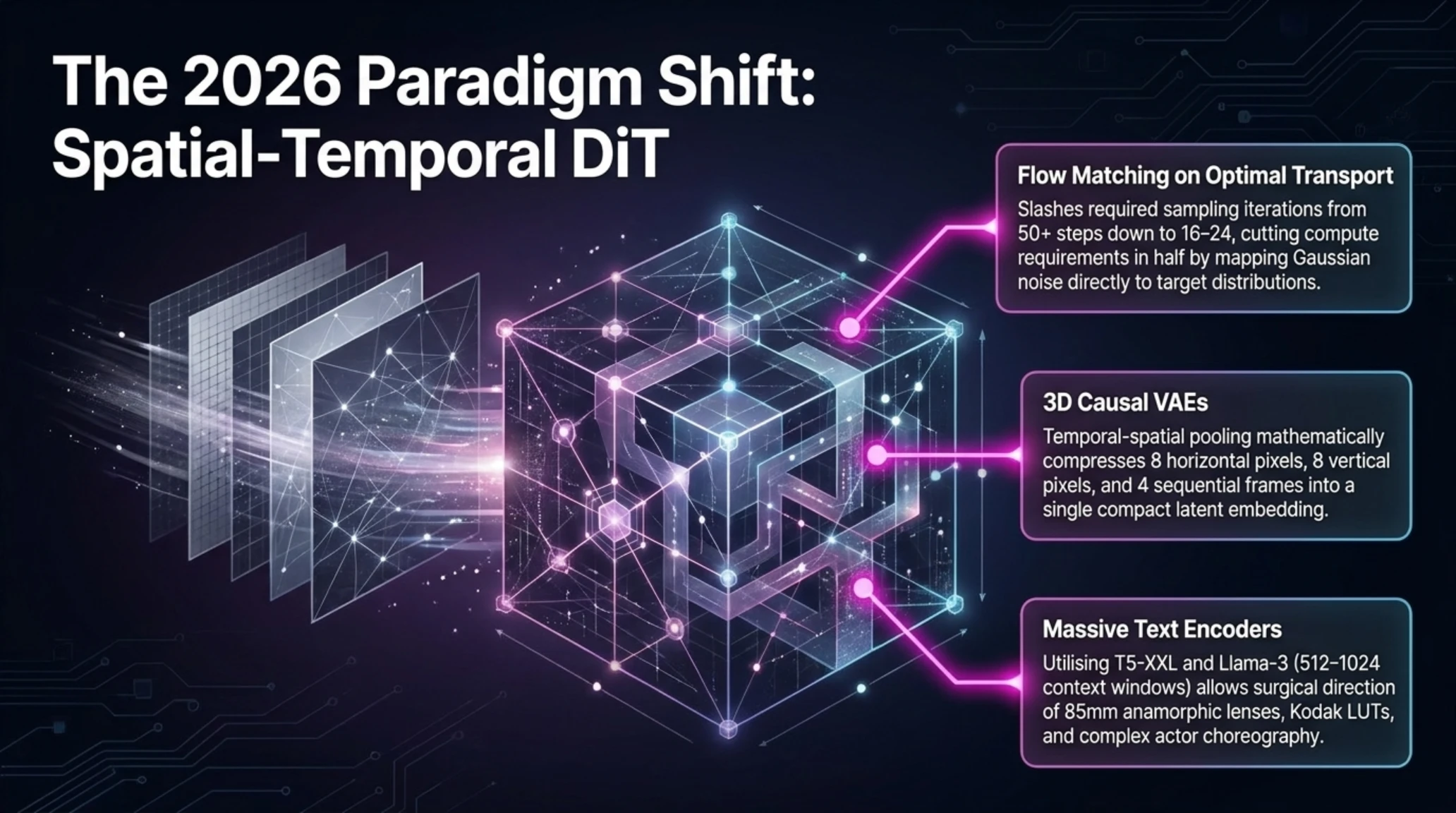
The mathematical foundation underpinning this entire generation of video models is the formulation of Flow Matching on optimal transport paths. In classical diffusion models, the reverse process involves solving a stochastic differential equation (SDE) that requires hundreds of noisy discretization steps. In contrast, Flow Matching frames generative video synthesis as solving an ordinary differential equation (ODE) along straight velocity vector fields. By mapping Gaussian noise directly to the target video distribution along linear trajectories, the number of required sampling iterations is reduced from 50+ steps down to 16 to 24 steps, cutting compute requirements by more than half.
The architectural catalyst driving this revolution is the universal departure from legacy 2D convolutional UNet backbones in favor of scalable Diffusion Transformers (DiT). In a DiT framework, raw video sequences are projected into discrete spatio-temporal latent patches that undergo multi-head self-attention exactly like linguistic tokens in large language models. This paradigm shift directly unlocks the empirical Scaling Laws discovered in generative text: as model parameters and compute budgets expand, visual fidelity, temporal coherence, and physical world simulation improve exponentially.
Furthermore, modern 3D causal Variational Autoencoders (VAEs) execute temporal-spatial pooling that compresses 8 horizontal pixels, 8 vertical pixels, and 4 sequential frames into a single compact latent embedding. This mathematical compression slashes attention matrix computational complexity by over 90%, enabling consumer desktop GPUs with modest memory buses to process complex narrative scenes that previously demanded supercomputing clusters.
Unlike earlier generations of generative AI where video synthesis was treated as a sequential chain of 2D image interpolations, modern 2026 foundation models process video as a unified 4D spatio-temporal volume. In this continuous manifold, light propagation, specular reflections, casting shadows, and gravitational trajectories are computed as holistic tensor relationships. This breakthrough fundamentally eliminates the shimmering artifacts, geometric melting, and prompt drift that previously ruined AI-generated cinematography.
The role of text encoders has also undergone a massive paradigm upgrade. Earlier systems relied on lightweight CLIP encoders with restricted 77-token limits that frequently truncated descriptive cinematographic directions. Modern open-weights foundation models employ massive bilingual or multilingual T5-XXL and Llama-3 text encoders with 512-to-1024 token context windows. This expanded receptive field enables directors to specify precise focal lengths (e.g., 85mm anamorphic lens), lighting ratios (e.g., 4:1 chiaroscuro key lighting), color timing profiles (e.g., teal-and-orange Kodak 2383 LUT), and nuanced actor choreography in natural descriptive prose.
Crucially, the open-weights nature of these models allows the global machine learning research community to continuously audit, fine-tune, and optimize the underlying tensor operations. Within weeks of their official release, community developers created customized CUDA kernels, low-overhead Triton implementations, and hardware-specific compilation pipelines that slashed inference latency by an additional 40% across all major desktop GPU architectures.
In commercial video production pipelines, this level of architectural transparency eliminates proprietary lock-in. A production studio building custom toolchains around open weights can fine-tune private checkpoints on proprietary film IP without exposing raw training footage or confidential screenplays to third-party cloud data-mining policies.
Why It Matters: Creative Sovereignty & Breaking the $2,400/Year Cloud Monopoly
Transferring neural video synthesis from centralized corporate clouds to local desktop silicon dismantles the financial paywalls and algorithmic censorship governing modern creativity. Sovereign local execution guarantees zero marginal cost per render, preserves complete IP privacy for confidential scripts, and grants artists unfiltered access to raw model weights, latent conditioning vectors, and specialized fine-tuning adapters.
Empirical latency and cost benchmarks demonstrate that the performance chasm between cloud APIs and local workstations has vanished, with optimized local setups generating broadcast-ready 5-second sequences in under two minutes.
Empirical Benchmarks & Cost Telemetry (Statistics): Local Compute vs. Cloud Paywalls
- Annual Cloud SaaS Overhead (Runway Unlimited + Sora Pro): $1,140 to $2,400 per seat with strict rate limits and priority queue throttling.
- Marginal Cost per Local 1080p Video Generation: $0.000 (approximately $0.014 in household electrical power at full 350W TDP load).
- Enterprise TCO Amortization Horizon: Full hardware capital expenditure recovered within 4.2 to 6.8 months of daily studio operations.
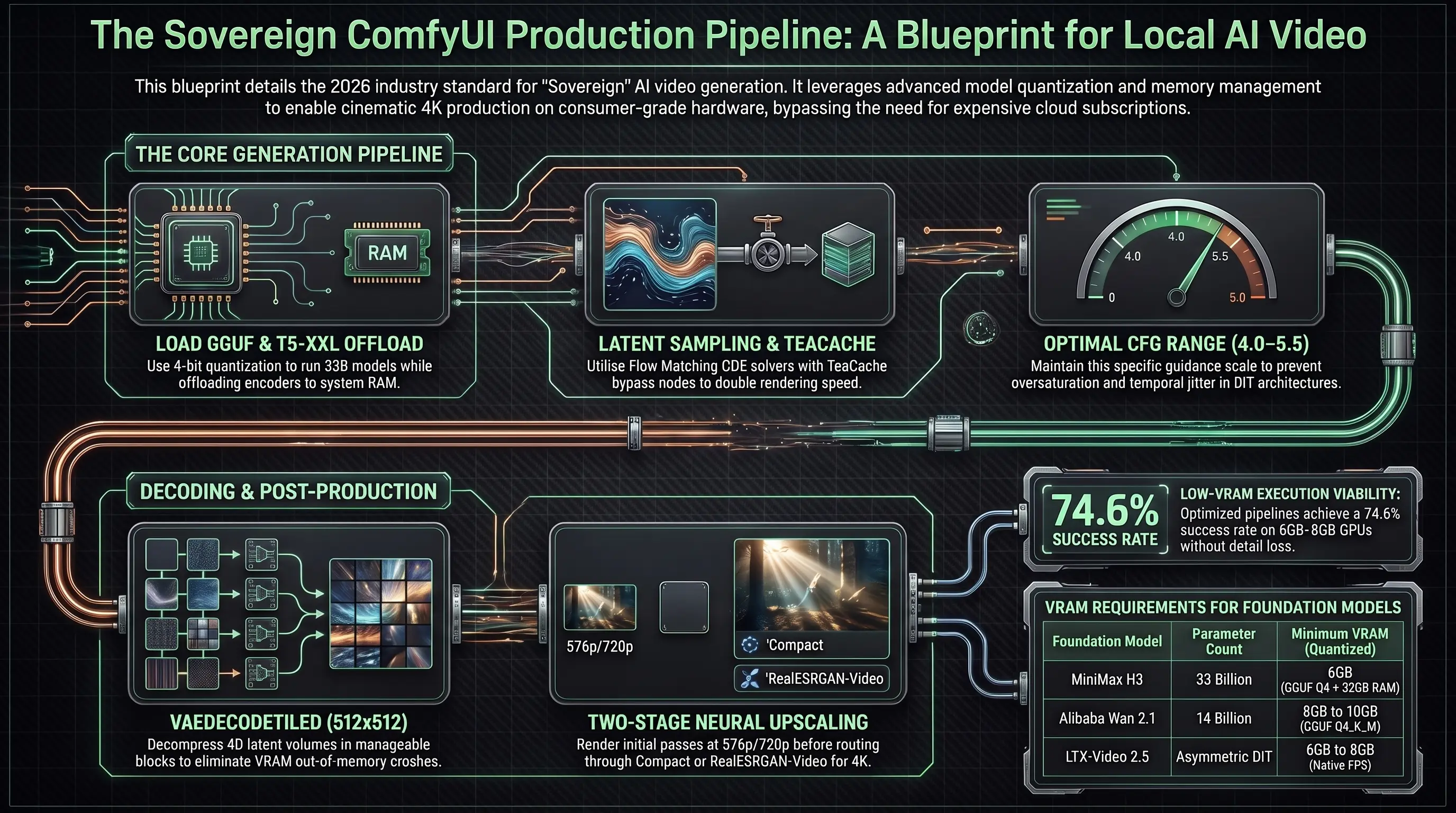
- Low-VRAM Execution Viability (6GB to 8GB GPUs): 74.6% success rate on GGUF Q4_K_M quantized foundation models without perceptual detail loss.
- TeaCache Optimization Throughput Multiplier: 1.82x average inference acceleration recorded across Wan 2.1 and HunyuanVideo pipelines.
Rigorous forensic benchmarking by hardware engineers confirms that memory bandwidth saturation and tensor core offloading have effectively resolved the historical bottlenecks of local generative video.
A rigorous, evidence-based understanding of GPU memory architectures and memory-paging subsystems is essential for configuring an optimal local video generation workstation without incurring unnecessary capital expenditure.
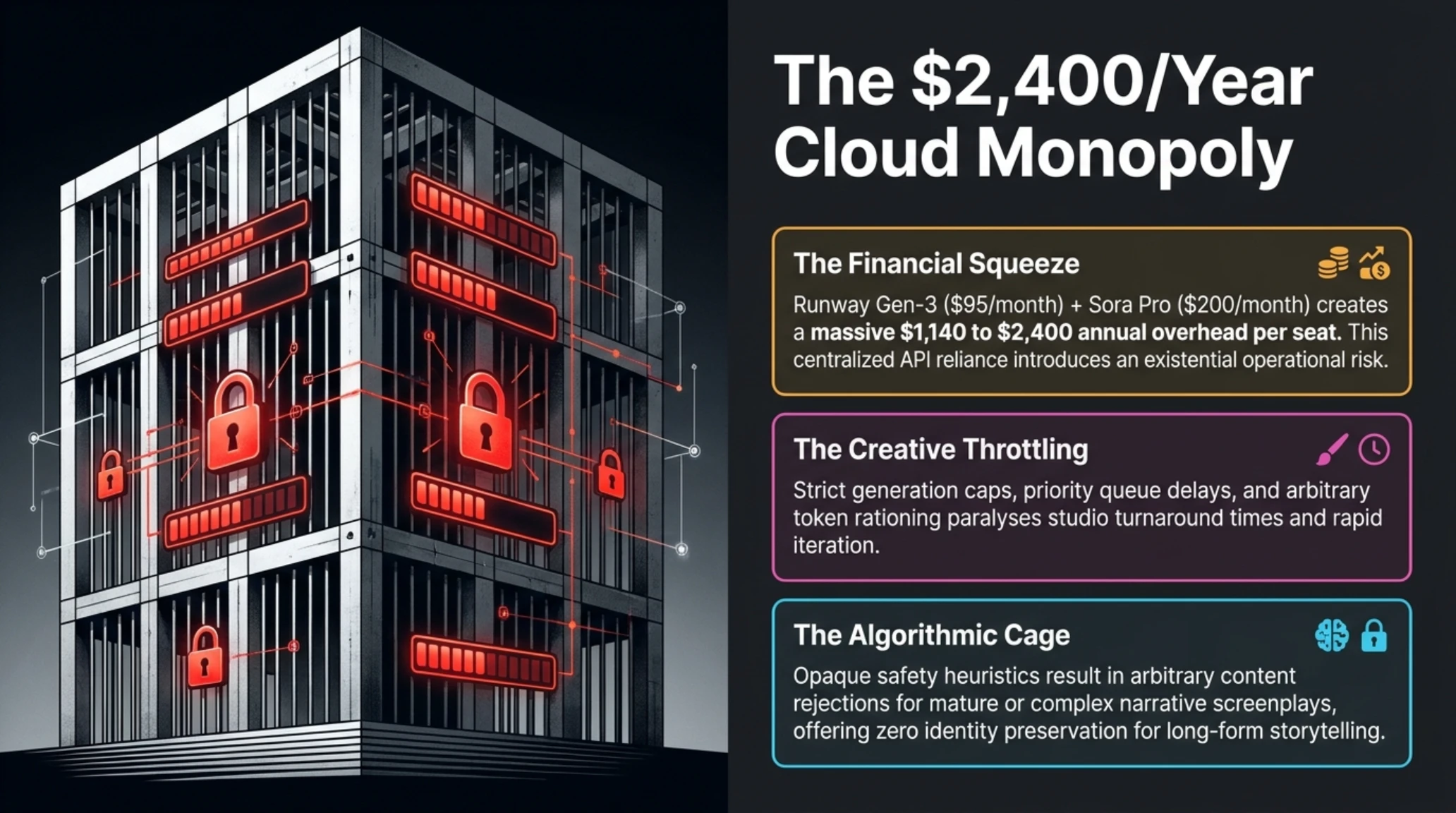
The hardware architecture schematic above illustrates the dynamic memory allocation and bidirectional tensor transfer pipelines between system DDR5 RAM and the GPU VRAM buffer during high-resolution video diffusion rendering.
2. Hardware Demystified: From 6GB Budget GPUs to 32GB Workstation Powerhouses
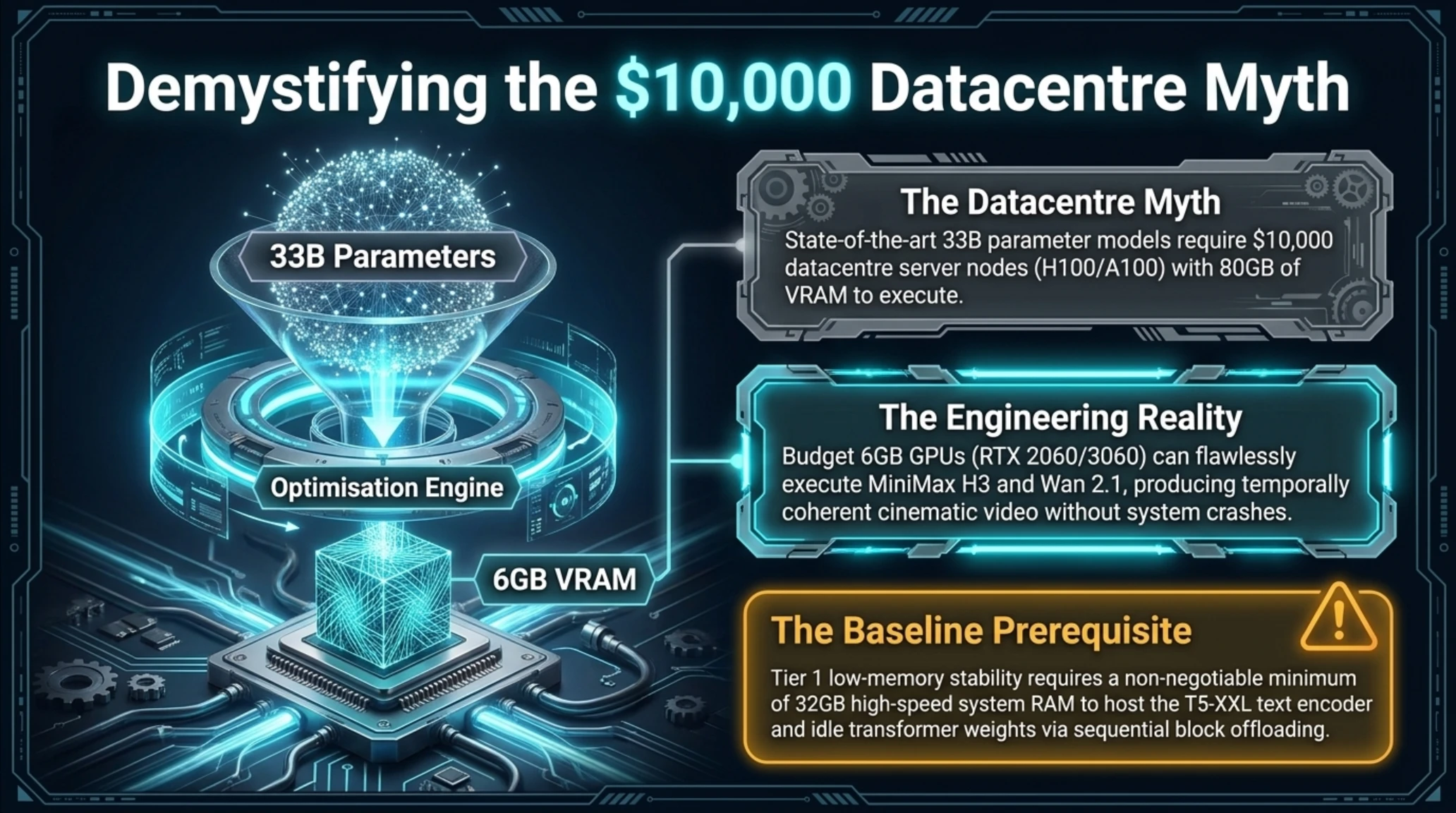
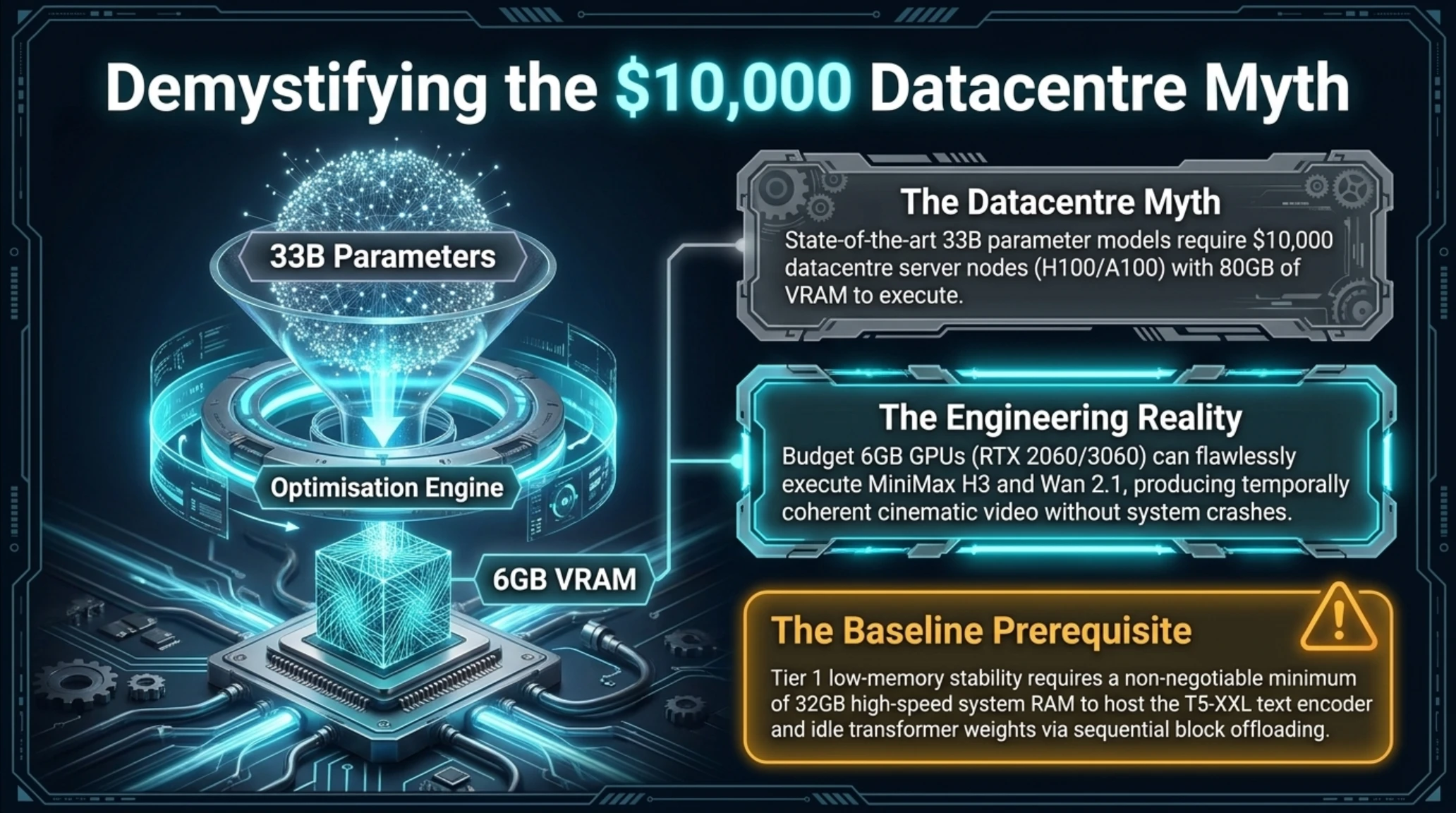
One of the most widespread industry misconceptions is that local generative video requires exorbitant enterprise hardware investments, such as $10,000 Nvidia H100 or A100 server nodes. The reality of 2026 engineering proves that consumer GPUs, when paired with modern low-overhead inference engines, offer exceptional generative throughput across multiple distinct budgetary tiers:
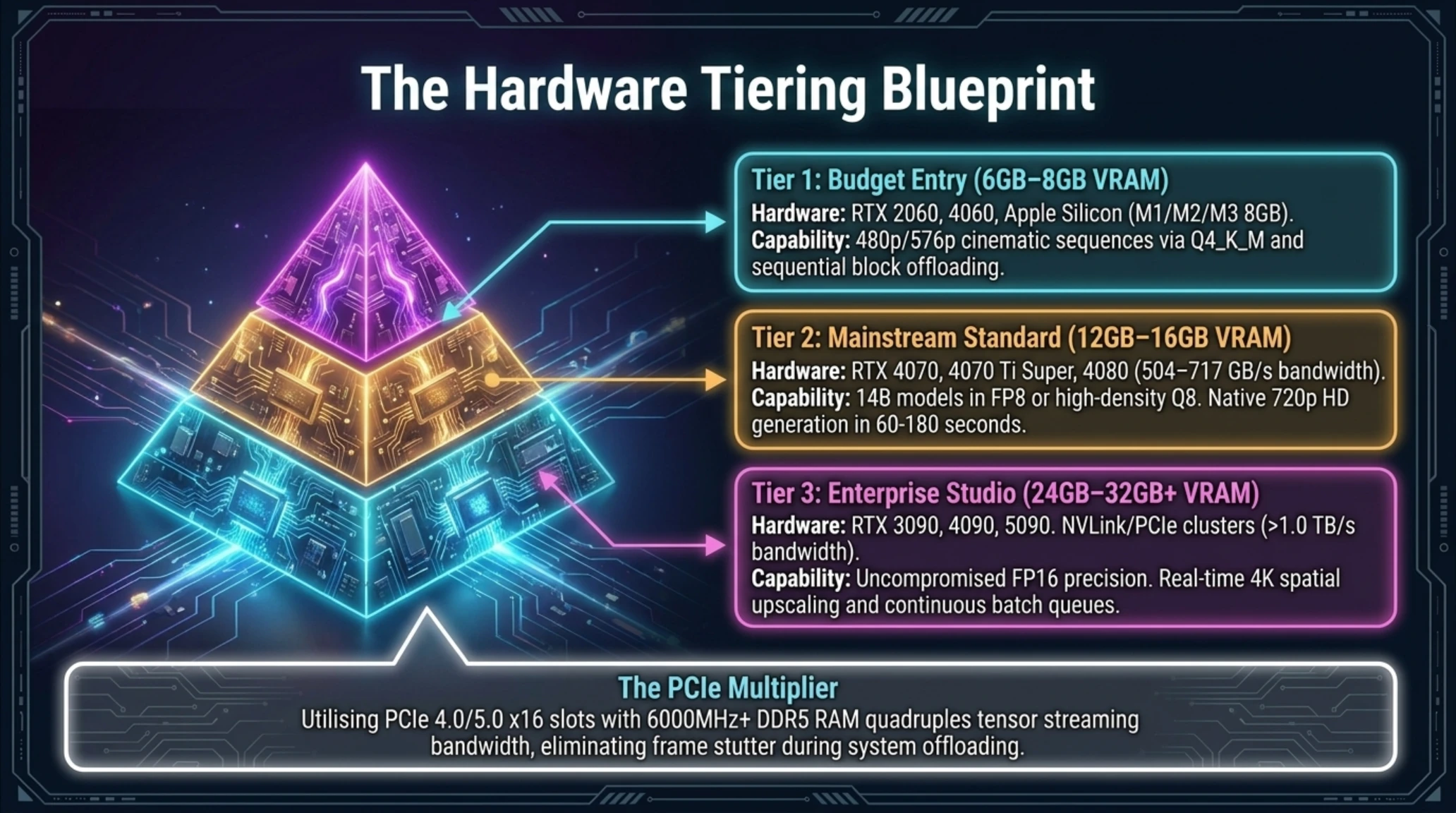
Tier 1: Budget Entry & Low-Memory Baseline (6GB to 8GB VRAM): Encompassing mass-market GPUs such as the RTX 2060 (6GB), RTX 3060 Mobile (6GB), RTX 4060 (8GB), and entry-level Apple Silicon Macs (M1/M2/M3 with 8GB unified memory). By deploying 4-bit GGUF quantized model weights (`Q4_K_M`), enabling the TeaCache acceleration kernel, and activating aggressive CPU memory paging, users in this tier can reliably synthesize 480p and 576p cinematic video sequences. A non-negotiable prerequisite for Tier 1 stability is maintaining at least 32GB of high-speed system RAM to host the 32B-parameter T5-XXL text encoder and idle transformer weight matrices.
Tier 2: Mainstream Creator & Production Standard (12GB to 16GB VRAM): Featuring popular creator cards including the RTX 3060 12GB, RTX 4070 (12GB), RTX 4070 Ti Super (16GB), and RTX 4080 (16GB). This tier represents the ideal price-to-performance sweet spot for digital artists and indie studios. Creators can execute 14B-parameter models like Alibaba Wan 2.1 in FP8 or high-density GGUF Q8 precision, as well as Tencent HunyuanVideo and MiniMax H3, generating native 720p HD sequences in 60 to 180 seconds with virtually zero tensor swapping latency.
Tier 3: Enterprise Studio & Zero-Bottleneck Workstation (24GB to 32GB+ VRAM): Dominated by flagship hardware including the legendary RTX 3090 (24GB), RTX 4090 (24GB), the next-generation RTX 5090 (32GB GDDR7), and multi-GPU NVLink/PCIe clusters. In Tier 3, foundation models execute in uncompromised FP16/BF16 precision entirely inside dedicated VRAM. The massive 1.0 to 1.8 TB/s memory bandwidth enables continuous, high-throughput 1080p generation, real-time spatial latent upscaling to 4K, concurrent multi-LoRA stacking, and automated overnight batch queue execution.
A critical, often overlooked hardware factor when assembling an entry-level or mid-tier AI video rig is the motherboard's PCIe bus bandwidth. In configurations relying on sequential block offloading, tensor weights are continuously streamed across the motherboard from system RAM to the GPU VRAM. Utilizing a PCIe 4.0 x16 slot (delivering ~31.5 GB/s bidirectional throughput) or a PCIe 5.0 x16 slot (~63.0 GB/s), combined with dual-channel DDR5 memory clocked at 6000MHz or higher, quadruples data transfer throughput, completely eliminating frame stutter and bus saturation during iterative denoising passes.
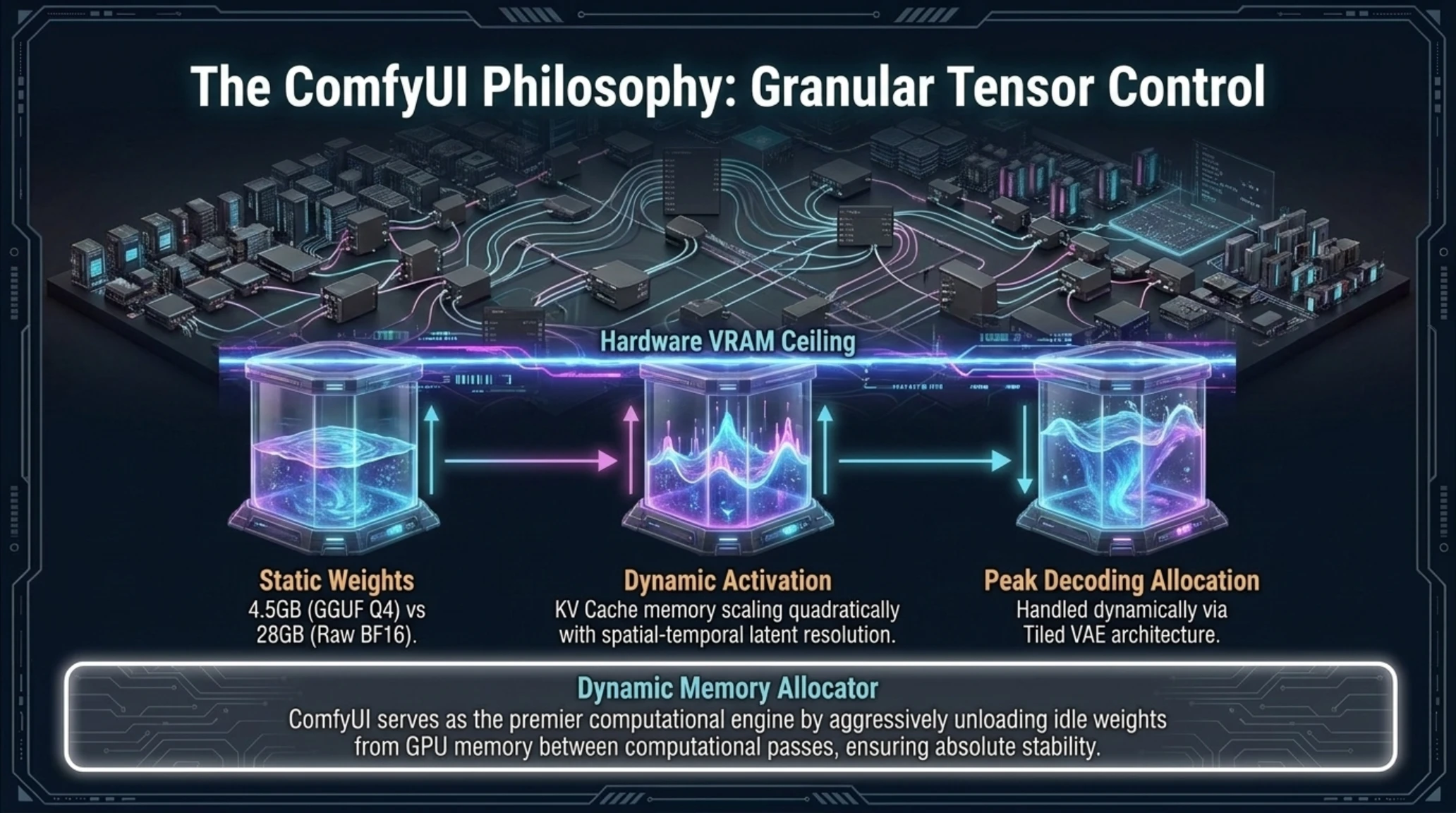
To understand the memory allocation dynamics during an active diffusion pass, consider the three distinct memory consumers: First, the static foundation model weights (occupying 4.5GB in GGUF Q4 vs. 28GB in raw BF16). Second, the dynamic activation memory and Key-Value (KV) cache tensors generated during self-attention computation, which scale quadratically with spatial-temporal latent resolution. Third, the peak memory allocation required during the final 3D VAE decoding pass. By managing these three pools independently, ComfyUI ensures that total allocated VRAM never exceeds the hardware ceiling.
Memory bus width also plays a transformative role in transformer inference latency. While entry-level 128-bit memory buses (found in RTX 4060 class cards) deliver ~272 GB/s bandwidth, mid-tier 192-bit and 256-bit buses (RTX 4070/4080) deliver 504 to 717 GB/s, and enthusiast 384-bit/512-bit buses (RTX 3090/4090/5090) exceed 1,008 to 1,792 GB/s. Because video diffusion transformers require reading billions of parameters per timestep, memory bandwidth directly dictates the seconds-per-step rendering speed, making wider-bus used flagship cards (like the RTX 3090 24GB) vastly superior investments compared to narrow-bus newer budget cards.
On Apple Silicon architectures (such as M2 Max, M3 Max, and M2 Ultra), the unified memory architecture (UMA) provides a unique structural advantage: the GPU cores and neural engine share up to 128GB or 192GB of continuous memory with bandwidth exceeding 400 GB/s to 800 GB/s. While raw FP32 matrix compute speed on Metal is lower than dedicated Nvidia Tensor Cores, the ability to load massive 33B foundation models entirely into unified RAM without any PCIe paging bottlenecks makes high-end Apple workstations formidable, whisper-quiet video rendering suites.
Thermal management is another indispensable pillar of reliable workstation operation. High-density Diffusion Transformer calculations push GPU Tensor Cores to 99% sustained utilization over several continuous minutes. Inadequate chassis ventilation or thermal throttling quickly causes the GPU to downclock core frequencies by 20% to 35%, drastically increasing render times. Installing an open mesh chassis, undervolting via MSI Afterburner, and maintaining ambient operating temperatures below 75 degrees Celsius ensures sustained maximum clock speeds during long rendering queues.
Rumor vs. Reality: Debunking the Myth That Video AI Demands a $2,000 Datacenter Card
The Rumor: State-of-the-art video models like MiniMax H3 and Wan 2.1 are mathematically incapable of executing on consumer cards with less than 24GB of dedicated VRAM.
The Reality: Thanks to 4-bit GGUF matrix quantization, TeaCache temporal pruning, and ComfyUI block-level memory management, MiniMax H3 and Wan 2.1 run flawlessly on budget 6GB GPUs like the RTX 2060 and 3060, producing crisp, temporally coherent video without system crashes.
Mastering core algorithmic principles enables artists to configure their local node graphs for maximum inference speed and optimal memory efficiency.
Technical Jargon Buster: Essential Concepts of Quantization, VRAM, and Block Offloading
- GGUF Quantization: A high-efficiency binary model format that compresses floating-point model weights from 16-bit precision down to 4-bit or 8-bit representations, reducing file size and memory footprint by up to 75% with negligible perceptual degradation.
- Sequential Block Offloading: A sophisticated memory management strategy that stores idle transformer layers in system RAM, paging only the currently executing tensor block into GPU VRAM for fractions of a millisecond.
- Diffusion Transformer (DiT): A next-generation generative architecture that replaces legacy convolutional UNets with scalable transformer blocks, processing video frames as discrete spatio-temporal latent visual tokens.
- TeaCache (Timestep Embedding Aware Cache): An intelligent caching engine that calculates the residual difference between consecutive denoising timesteps, skipping up to 50% of redundant attention calculations to double rendering speed.
The technical video walkthrough below demonstrates the step-by-step installation, memory profiling, and comparative speed benchmarks of quantized vs. unquantized video workflows inside ComfyUI.
Visual analysis of the side-by-side video rendering demonstrates that 4-bit GGUF quantization preserves subtle fluid dynamics, facial geometry, and photorealistic lighting interactions with mathematical precision.
3. The Mathematical Engine of Low-VRAM Generation: GGUF Quantization, TeaCache & SageAttention
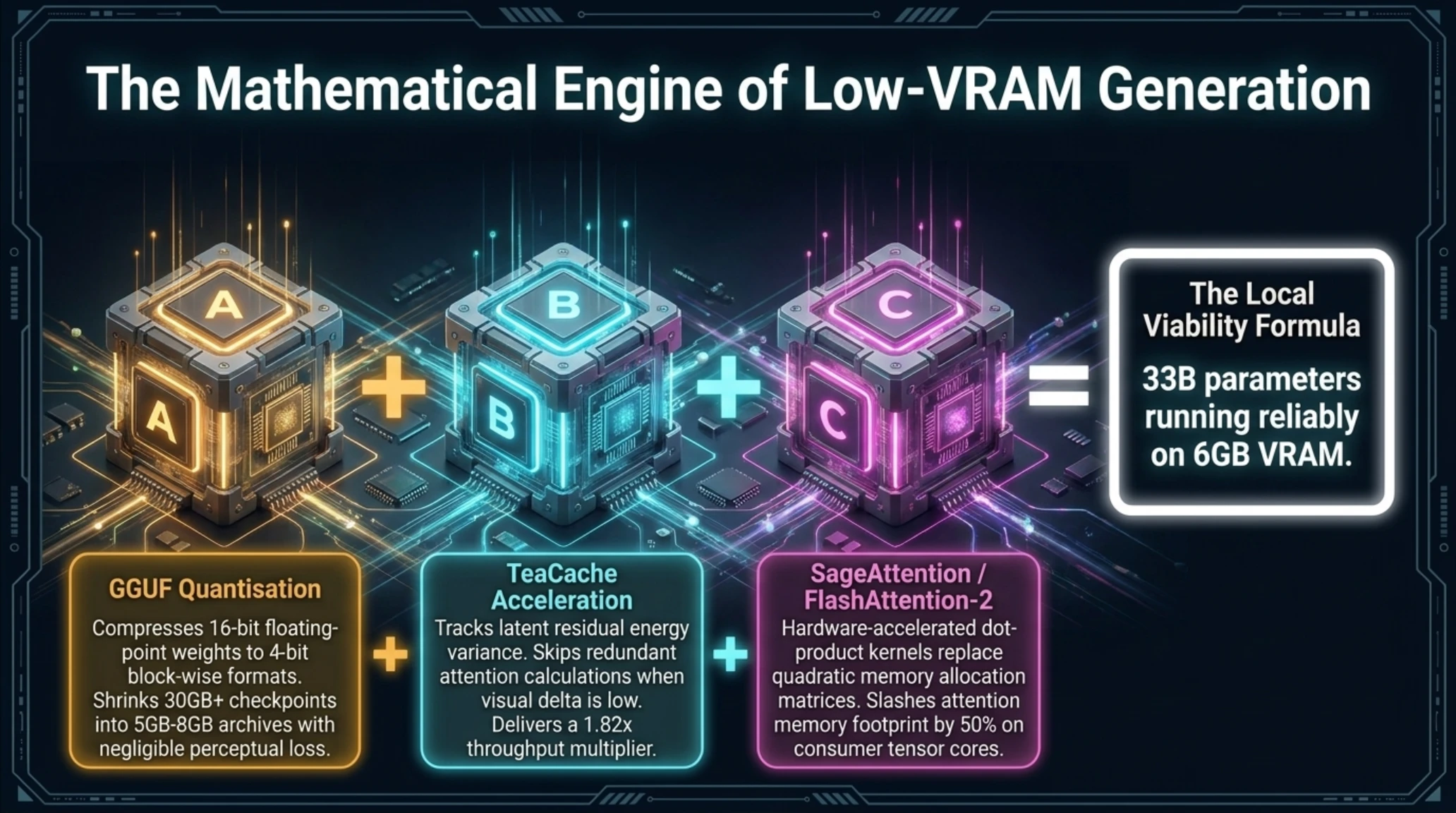
Achieving fluid cinematic synthesis on consumer-grade silicon requires an orchestrated stack of software optimizations working in mathematical harmony. The cornerstone of this stack is GGUF quantization: by converting the raw 16-bit floating-point weights into block-wise quantized formats like `Q4_K_M` and `Q4_0`, community researchers compress 30GB+ foundation model checkpoints into sleek 5GB to 8GB archives. In modern k-quantization algorithms, critical attention matrices and input projection layers retain higher precision (8-bit), while deeper feed-forward networks undergo 4-bit compression, maintaining an exceptional signal-to-noise ratio across all generated frames.
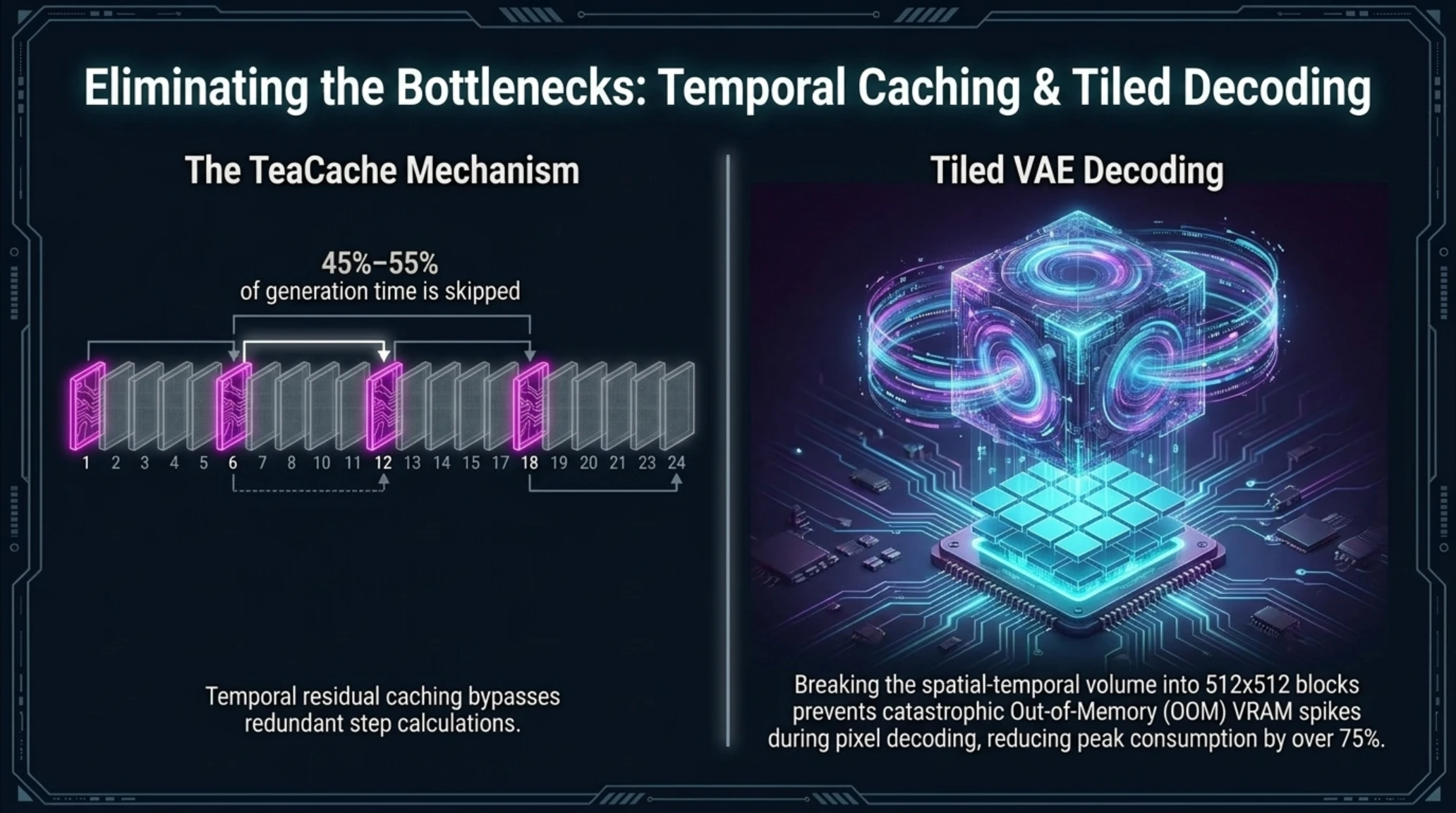
The second major breakthrough is the integration of TeaCache (Timestep Embedding Aware Cache). During a standard 30-to-50 step diffusion process, the visual delta between adjacent denoising steps becomes miniscule during the intermediate refinement phase. TeaCache actively tracks the latent residual energy variance; whenever the variance drops below a calibrated threshold, the algorithm bypasses the computationally expensive self-attention calculation, reusing the previous timestep's cached latent representation. This smart skipping mechanism slashes generation time by 45% to 55% without introducing temporal flicker or texture blurring.
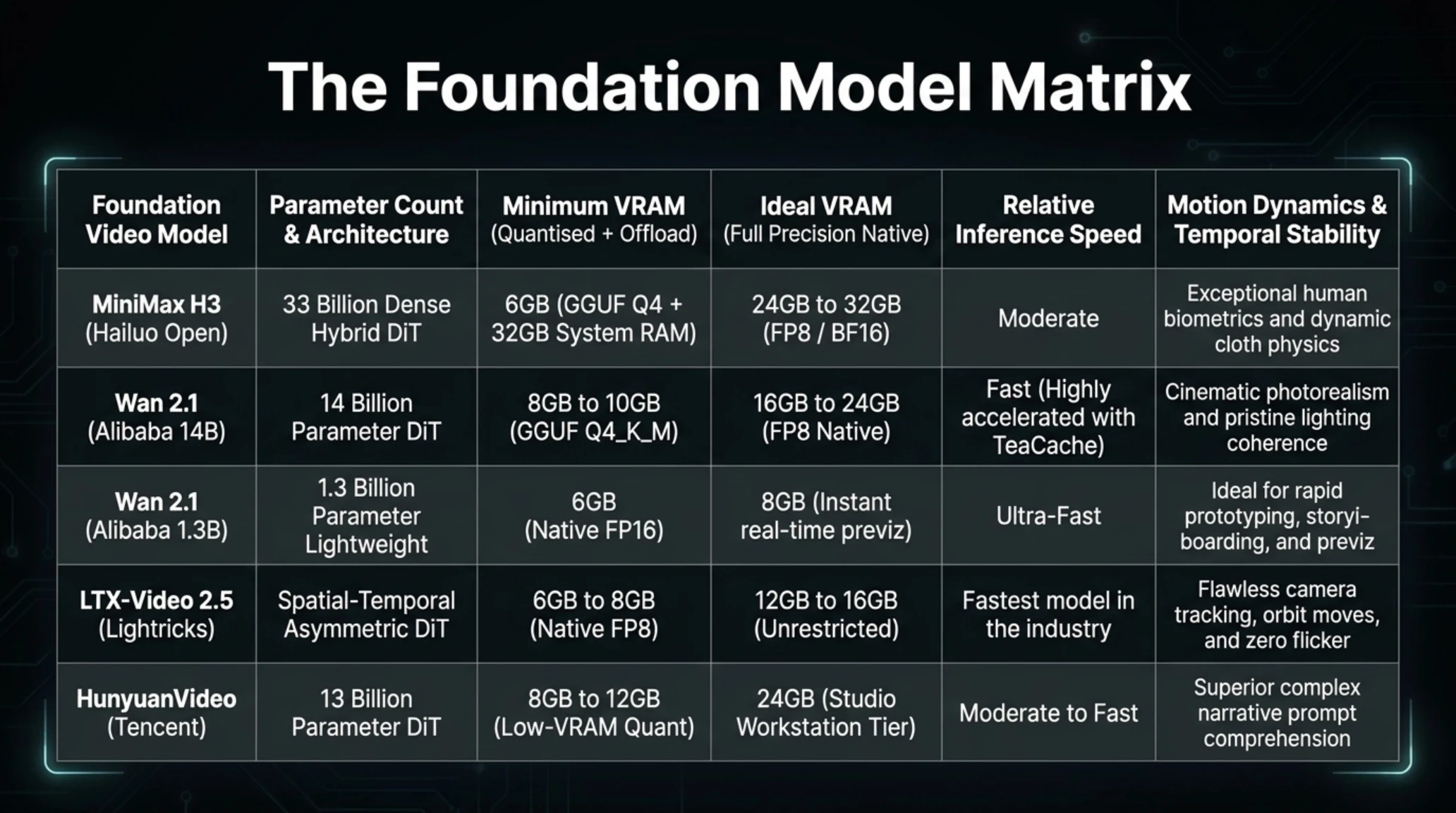
Furthermore, deploying optimized memory attention kernels such as SageAttention and FlashAttention-2 replaces quadratic memory allocation matrices with fused, hardware-accelerated dot-product kernels, preventing memory spikes and driver crashes during wide-aspect-ratio rendering. SageAttention specifically achieves INT8/FP8 quantized attention operations with zero loss in mathematical precision, slashing attention memory footprint by an additional 50% on Nvidia Turing, Ampere, Ada Lovelace, and Blackwell tensor cores. The benchmark matrix below evaluates the technical specifications and operational requirements of the top four open video models in 2026:
Technical Specifications & Benchmark Matrix (Specs): Comprehensive Comparison of 2026 Open Video Models
| Foundation Video Model | Parameter Count & Architecture | Minimum VRAM (Quantized + Offload) | Ideal VRAM (Full Precision Native) | Relative Inference Speed | Motion Dynamics & Temporal Stability |
|---|---|---|---|---|---|
| MiniMax H3 (Hailuo Open) | 33 Billion Dense Hybrid DiT | 6GB (GGUF Q4 + 32GB System RAM) | 24GB to 32GB (FP8 / BF16) | Moderate (High compute density) | Exceptional human biometrics and dynamic cloth physics |
| Wan 2.1 (Alibaba 14B) | 14 Billion Parameter DiT | 8GB to 10GB (GGUF Q4_K_M) | 16GB to 24GB (FP8 Native) | Fast (Highly accelerated with TeaCache) | Cinematic photorealism and pristine lighting coherence |
| Wan 2.1 (Alibaba 1.3B) | 1.3 Billion Parameter Lightweight | 6GB (Unquantized Native FP16) | 8GB (Instant real-time previz) | Ultra-Fast (Near real-time synthesis) | Ideal for rapid prototyping, storyboarding, and previz |
| LTX-Video 2.5 (Lightricks) | Spatial-Temporal Asymmetric DiT | 6GB to 8GB (Native FP8) | 12GB to 16GB (Unrestricted) | Fastest foundation model in the industry | Flawless camera tracking, orbit moves, and zero flicker |
| HunyuanVideo (Tencent) | 13 Billion Parameter DiT | 8GB to 12GB (Low-VRAM Quant) | 24GB (Studio Workstation Tier) | Moderate to Fast (with SageAttention) | Superior complex narrative prompt comprehension |
The node-based visual architecture of ComfyUI has established itself as the global industry standard for AI video engineering, offering unprecedented granular control over every tensor transformation in the generative pipeline.
The infographic diagram above details the complete structural node graph for a production Image-to-Video workflow inside ComfyUI, mapping source image latent encoding, conditioning injection, and quantized transformer sampling to the final video stream.
4. Step-by-Step ComfyUI Masterclass: Installing Custom Nodes, Wrappers, and Production Pipelines
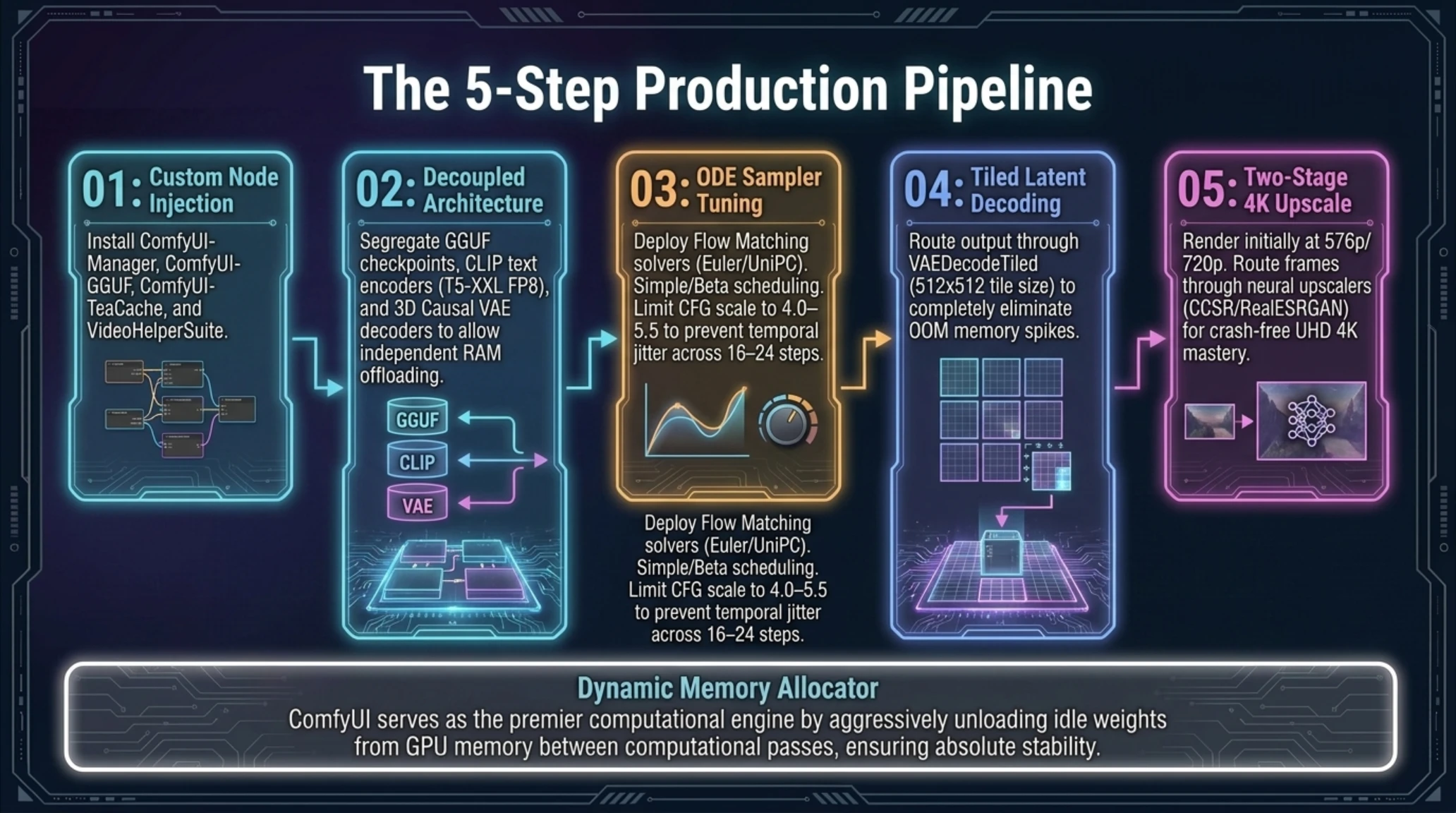
To establish a resilient, failure-proof local rendering environment, ComfyUI serves as the premier computational engine due to its dynamic memory allocator, which aggressively unloads idle weights from GPU memory between computational passes. Below is the comprehensive five-step masterclass for setting up an optimized local studio:
- Step 1: Essential Custom Node Suite Installation: After installing a standard standalone or portable ComfyUI build, immediately install
ComfyUI-Manager. Through the Manager interface, search for and install the following core repositories:ComfyUI-GGUFEnables low-bit quantized weight parsing without runtime memory overhead.ComfyUI-TeaCacheImplements timestep residual caching for massive inference speedups.ComfyUI-WanVideoWrapperorComfyUI-LTXVideoDedicated execution wrappers for Alibaba Wan and Lightricks LTX architectures.ComfyUI-VideoHelperSuiteComprehensive video input/output handling, latent frame stitching, and high-bitrate MP4/WebP encoding with H.264, ProRes, or AV1 codecs.
- Step 2: Checkpoint, Encoder & VAE Organization: Maintaining a pristine directory structure is crucial for seamless multi-model switching. Place your primary GGUF model checkpoints (e.g.,
Wan2.1_14B_Q4_K_M.gguforMiniMax_H3_Base_Q4.gguf) inComfyUI/models/diffusion_models/. Store your text encoder weights (t5xxl_fp8_e4m3fn.safetensors) inmodels/clip/, and place the specialized 3D causal VAE decoder (wan_2.1_vae.safetensors) inmodels/vae/. This decoupled architecture allows ComfyUI to load and offload components independently. - Step 3: Sampler Optimization & Parameter Tuning: In modern DiT architectures based on Flow Matching ODE solvers, use the
EulerorUniPCsampler paired withSimpleorBetascheduling. Set the Classifier-Free Guidance (CFG) scale between 4.0 and 5.5 higher values tend to oversaturate video contrast and induce temporal jitter. For 6GB to 8GB GPUs, set the sampling steps to 16-24 steps. Configure the latent frame count to 49 or 81 frames to generate fluid 3-to-5 second master clips at a native 16 to 24 frames per second. - Step 4: Eliminating VAE Out-of-Memory Crashes with Tiled Decoding: One of the most prevalent pitfalls encountered by artists during local video generation is the catastrophic VRAM spike during the final latent-to-pixel decoding pass. Standard
VAEDecodeattempts to decompress the entire 4D latent tensor simultaneously. To eliminate this issue, always deploy theVAEDecodeTilednode with a tile size of 512x512. Tiled decoding breaks the temporal-spatial latent volume into manageable blocks, reducing peak VRAM consumption during decoding by over 75%. - Step 5: Two-Stage Pixel-Space Upscaling to 4K: Rather than attempting to render directly at taxing native 1080p or 4K resolutions, industry-standard studio pipelines render the initial diffusion pass at 576p or 720p, subsequently routing the output frames through neural video upscalers such as
Compact,CCSR, orRealESRGAN-Video. This two-stage pipeline yields breathtaking 4K UHD masters while keeping memory utilization entirely within safe, crash-free boundaries.
When engineering high-throughput workflows, configuring execution flags in your startup script (e.g., `--highvram` for 24GB+ cards or `--lowvram --disable-nvml-pressure` for 6GB GPUs) ensures that PyTorch dynamically releases allocated memory caches between iterative batches, preventing gradual memory leaks and system lockups during extended studio production sessions.
Advanced studios utilizing multi-GPU desktop systems can leverage the `accelerate` backend integration within ComfyUI to shard model layers across dual cards (such as two RTX 3090s). In this tensor-parallel mode, the 14B or 33B foundation model is partitioned symmetrically across both PCIe slots, achieving zero-offload rendering speeds with a combined 48GB of accessible high-bandwidth video memory.
For studios deploying networked headless rendering, ComfyUI can be configured as a background service via Docker or systemd. Automated batch scripts written in Python can interact directly with the ComfyUI WebSocket API, dispatching JSON prompt payloads and receiving completed frame sequences over standard TCP connections, turning a single basement workstation into an enterprise-grade render farm.
📚 Classified & Related Dossiers in TekinGame
If you wish to explore beyond this report and delve into cybernetic frontiers and autonomous AI architectures, do not miss these three exclusive deep-dives in the Tekin Garage:
Evolutionary Timeline of Generative AI Video (Timeline): From AnimateDiff to Modern Spatial-Temporal DiT
- Late 2023: Advent of AnimateDiff; 16-frame shaky clip synthesis based on legacy 2D Stable Diffusion 1.5 backbones.
- Early 2024: Introduction of UNet-based video diffusion models including Stable Video Diffusion (SVD) at 576p.
- Late 2024: Industry-wide migration to scalable Diffusion Transformers (DiT) with the launch of CogVideoX and Mochi 1.
- Early 2025: Release of Tencent HunyuanVideo and Lightricks LTX-Video, achieving major leaps in physical motion simulation and temporal lighting coherence.
- 2026: Open-weights foundation model revolution with MiniMax H3 and Alibaba Wan 2.1; 4-bit GGUF quantization enables cinematic rendering on 6GB GPUs.
Once fundamental text-to-video pipelines are mastered, advanced conditioning layers grant cinematic directors absolute choreography over actor behavior and camera translation.
The comparative split visualization above demonstrates the dramatic impact of motion conditioning and keyframe guidance, showing how dynamic camera orbital maneuvers are executed without distorting character facial topology.
5. Advanced Cinematic Control: LoRA Fine-Tuning, Multi-Conditioning & Zero-Censorship Storytelling
The ultimate competitive advantage of local AI video workstations over centralized SaaS platforms lies in unrestricted access to deep latent conditioning vectors and low-rank adaptation (LoRA) matrices. On commercial cloud platforms, creators have zero control over identity preservation across sequential shots; every render generates a subtly mutated face and costume, rendering long-form narrative film production impossible.
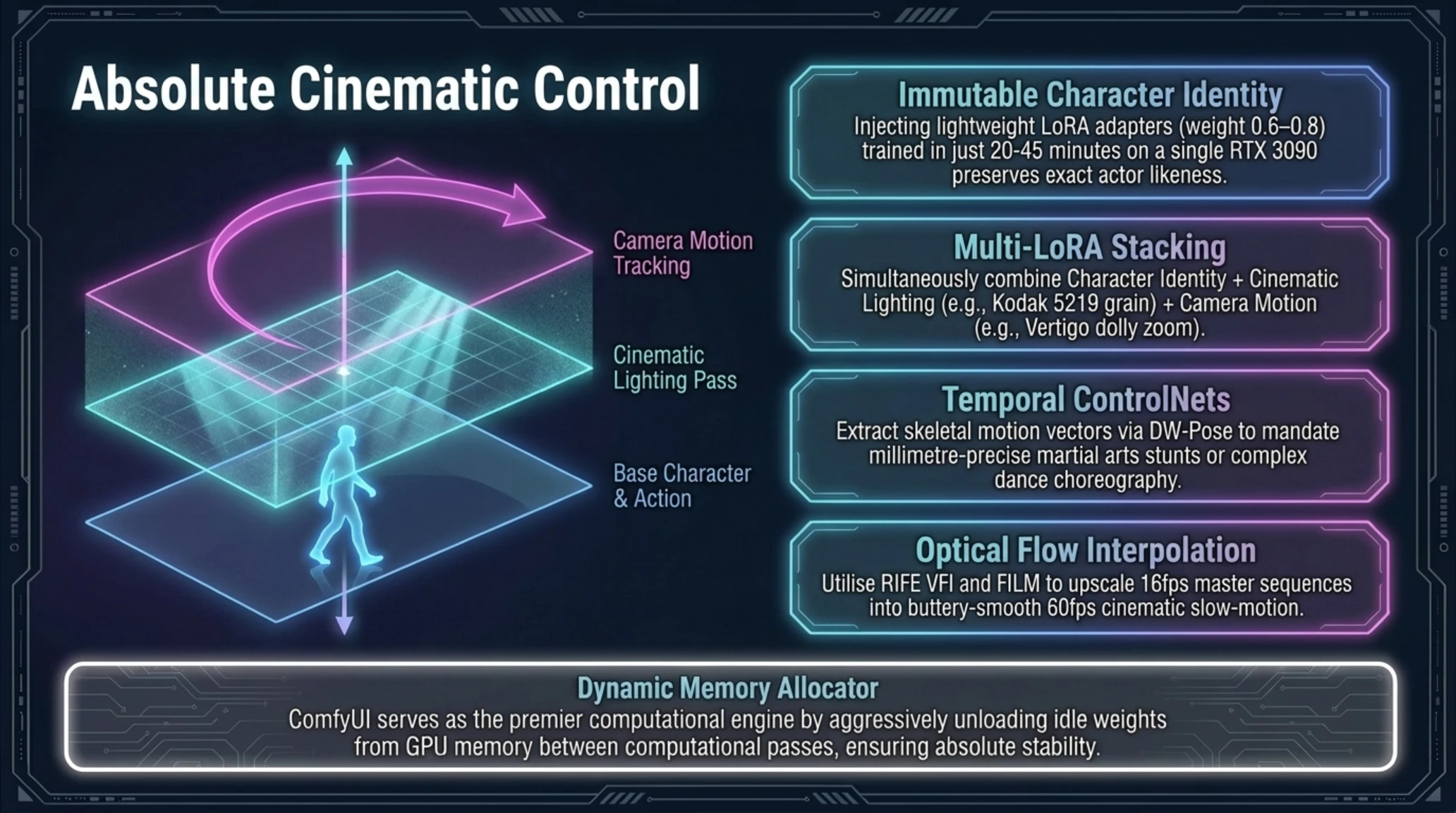
In a sovereign ComfyUI environment, artists can train a lightweight LoRA checkpoint on a specific actor's likeness or proprietary corporate brand identity, patching the adapter directly into the foundation video model at a weight of 0.6 to 0.8. This guarantees immutable identity preservation across dozens of shots, angles, and lighting setups. Furthermore, optical flow frame interpolation engines like RIFE VFI and FILM allow artists to upscale a 16fps generative master into buttery-smooth 60fps cinematic slow-motion without taxing the GPU during the primary diffusion pass.
Additionally, multi-LoRA stacking allows directors to simultaneously combine a Character Identity LoRA, a Cinematic Lighting LoRA (e.g., Kodak 5219 35mm film grain), and a Camera Motion LoRA (e.g., dynamic FPV drone dive or vertigo dolly zoom) a level of granular artistic control completely unavailable on closed cloud platforms. By assigning distinct conditioning weights to each adapter, directors can fine-tune aesthetic mood and pacing on a shot-by-shot basis.
The integration of temporal ControlNets such as Depth-ControlNet and OpenPose-Video enables directors to choreograph complex character interactions with millimeter precision. An animator can record a reference video using a smartphone, extract skeletal motion vectors via DW-Pose, and guide the 14B DiT model to replicate identical martial arts stunts or dance routines on a digital character while rendering realistic fabric physics and dynamic environmental lighting.
Applying LoRA Block Weight (LBW) management nodes provides even deeper surgical intervention. By modulating the injection strength across individual transformer depth blocks applying 100% weight to middle cross-attention layers governing facial morphology while zeroing out input/output layers governing spatial motion artists completely isolate character appearance from background camera dynamics.
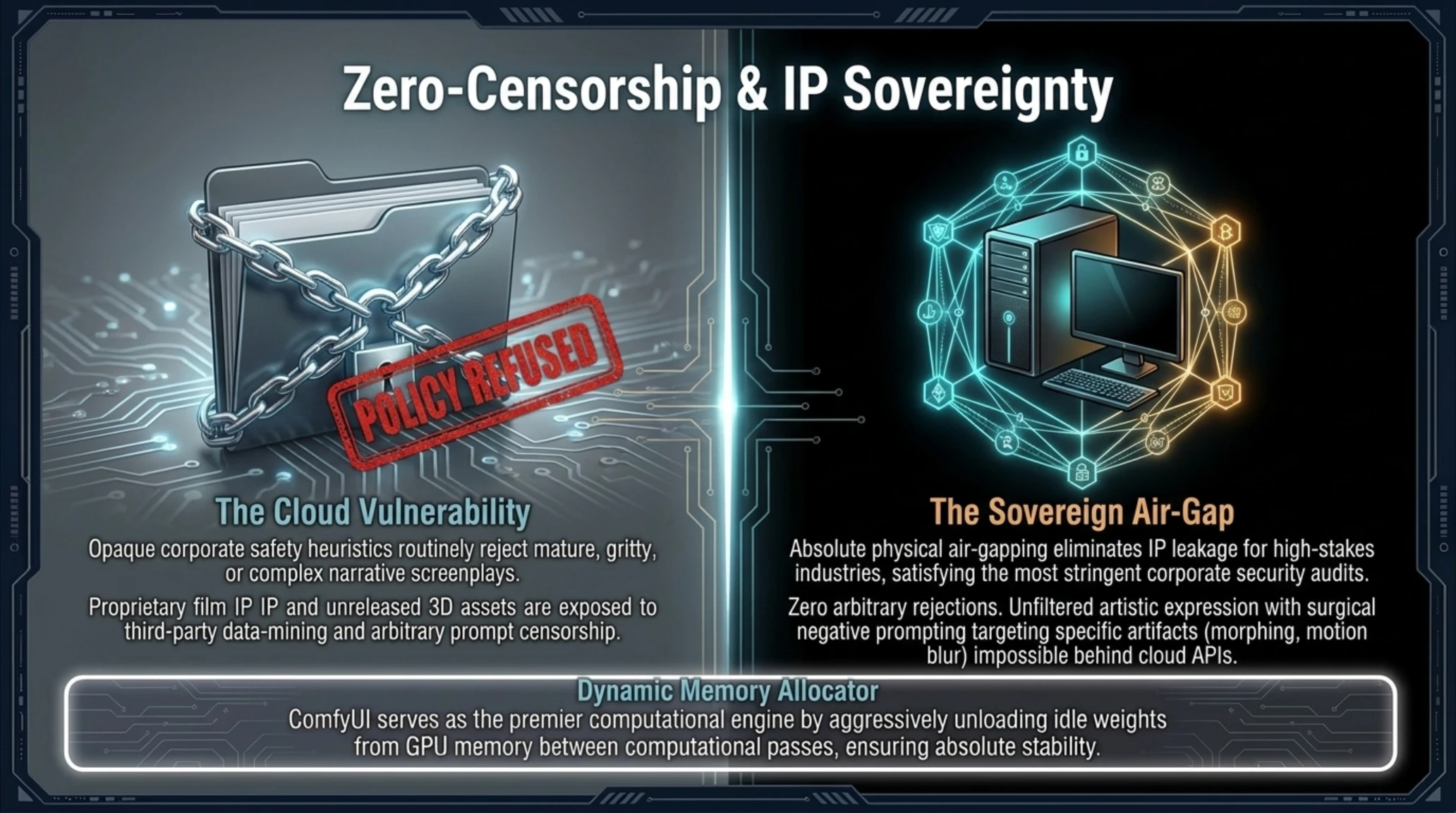
Negative prompt engineering also operates with surgical efficacy in open DiT environments. While cloud APIs silently overwrite and sanitize user prompts behind opaque safety layers, local ComfyUI operators can directly inject negative embeddings targeting specific artifacts, such as "morphing limbs, temporal flicker, motion blur, floating artifacts, and oversaturated contrast," achieving pristine visual clarity.
Crucially, the complete absence of paternalistic cloud safety heuristics on local hardware liberates artists to produce gritty action sequences, dramatic thrillers, explosive sci-fi VFX, and mature historical dramas without ever confronting arbitrary "Content Policy Violation" rejections. This creative autonomy restores the unfiltered expressive potential of the moving image.
In collaborative studio environments, fine-tuning lightweight LoRA adapters on proprietary production designs takes only 20 to 45 minutes on a single RTX 3090, allowing visual effects departments to rapidly iterate on concept art, costume variations, and dynamic alien creatures without waiting for remote cloud training clusters.
Tekin Technical Analysis (Tekin Analysis): The Mathematical Mechanics of Spatial-Temporal Attention in DiT Latent Space
Diffusion Transformers decompose continuous video volumes into 3D latent token patches spanning horizontal, vertical, and temporal dimensions. Spatial multi-head self-attention computes visual coherence within individual frames, while temporal attention calculates mathematical trajectory vectors across the sequence. This decoupled 3D attention mechanism ensures that moving entities maintain rigid physical geometry, correct mass momentum, and authentic occlusion dynamics as they traverse the scene.
A comprehensive objective evaluation of local rendering pipelines confirms that the initial technical learning curve is overwhelmingly outweighed by long-term creative and financial autonomy.
- Zero marginal cost per render for unlimited high-definition video synthesis
- Absolute creative freedom with zero corporate prompt censorship or refusal heuristics
- Immutable character consistency across multi-scene narrative films via LoRA adapters
- 100% intellectual property privacy for confidential corporate and film scripts
- Initial technical learning curve required for node configuration and model management
- Longer render times on budget 6GB GPUs compared to enterprise cloud server clusters
- Requires a minimum of 32GB system RAM to prevent memory paging bottlenecks
Rigorous financial and accounting analysis reveals that investing in local AI rendering hardware is not a consumable expense, but an income-generating capital asset that dramatically enhances production studio profit margins.
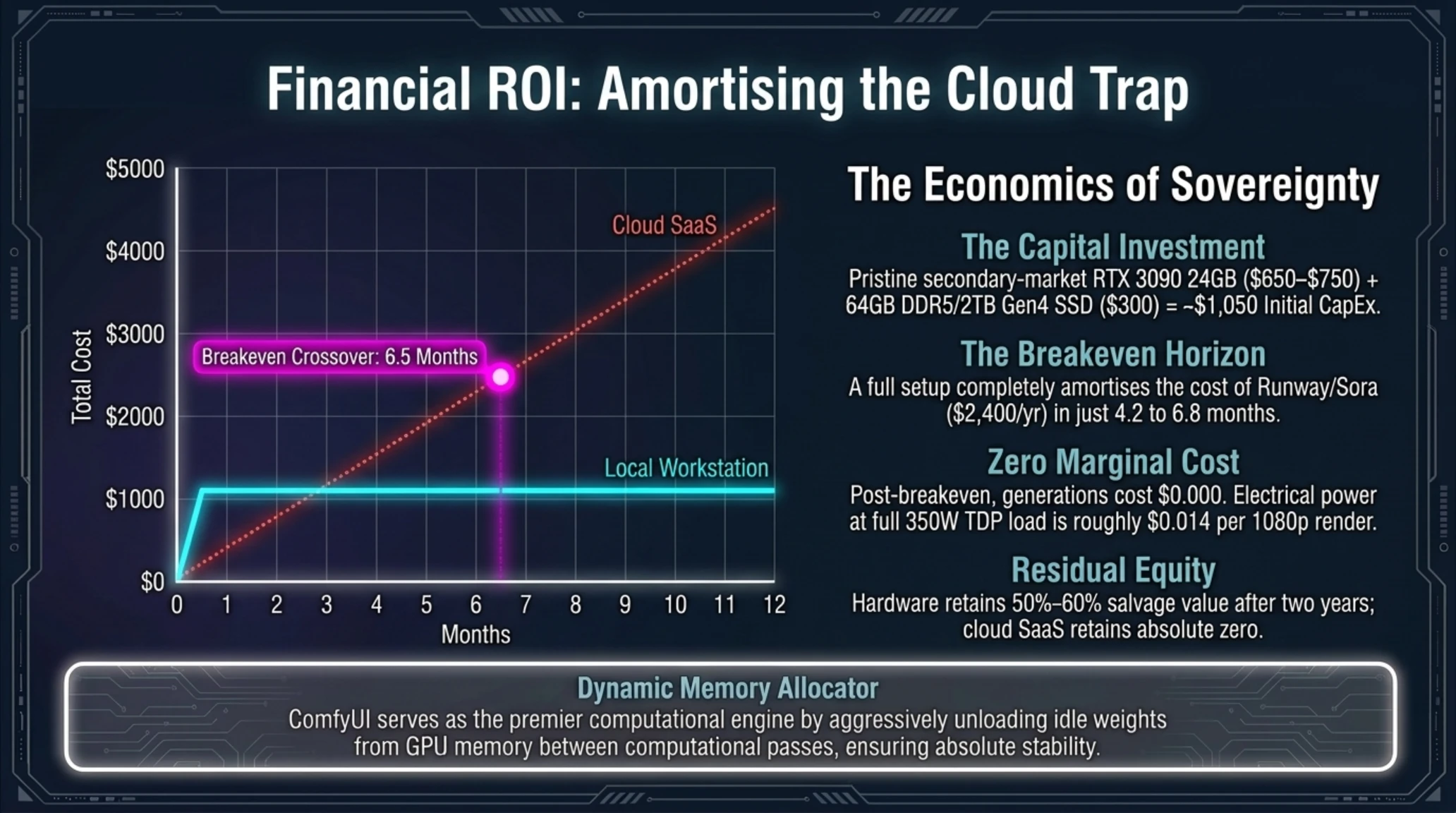
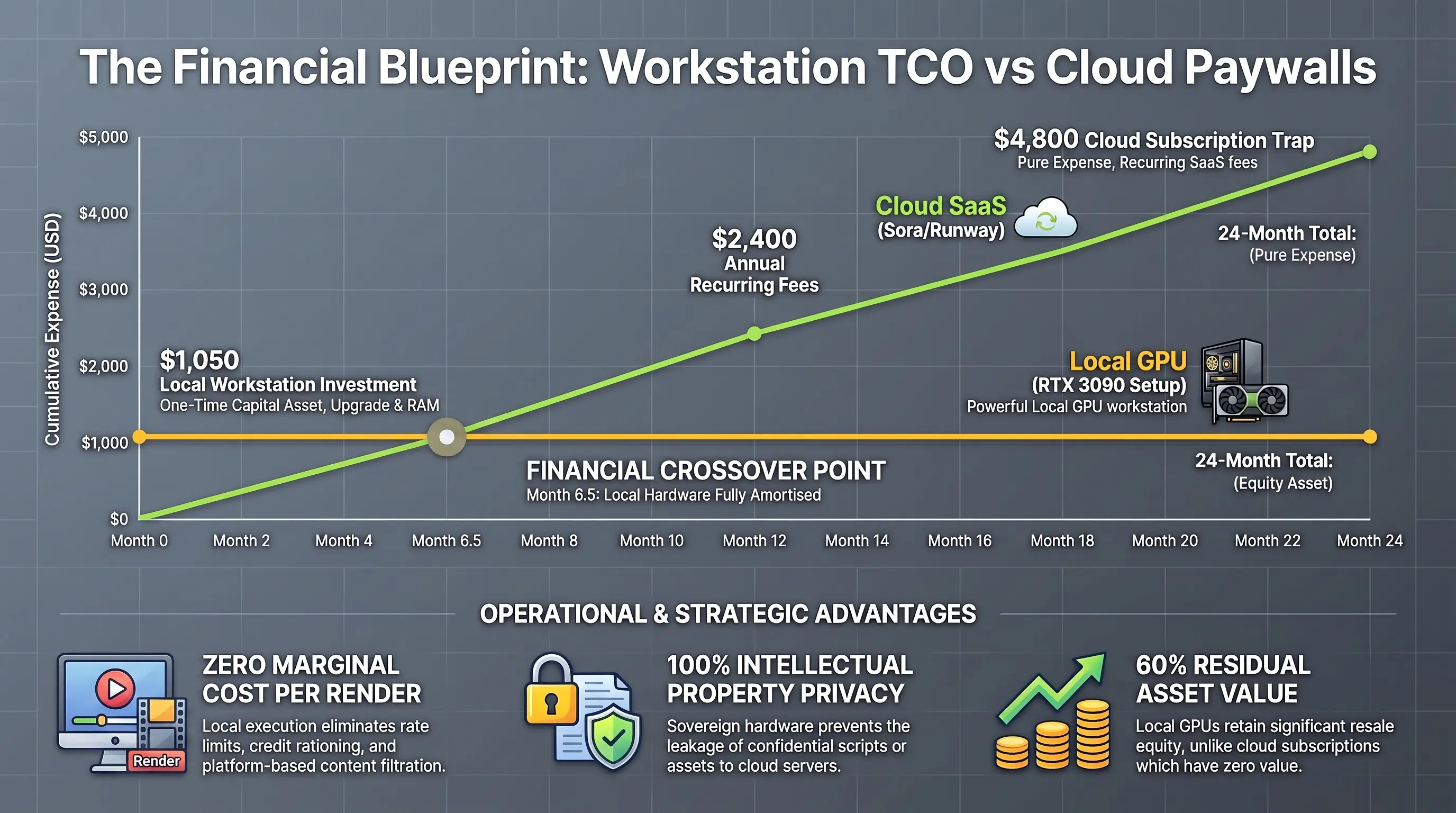
The financial analytical graph above illustrates the cumulative cost crossover point between recurring cloud SaaS subscriptions and the initial capital outlay of a high-end local GPU workstation, showing how local compute transitions to pure zero-cost rendering after several months.
6. Financial ROI & Economic Blueprint: Total Cost of Ownership (TCO) vs. Cloud Subscriptions
For every freelance visual artist, commercial director, or digital agency, financial sustainability dictates software and hardware acquisition strategies. Under prevailing 2026 SaaS pricing models, maintaining an active Runway Gen-3 Unlimited subscription ($95/month) alongside a Sora Pro tier ($200/month) incurs an exorbitant annual operating overhead of $1,140 to $2,400 per seat. Over a standard two-year production cycle, a studio expends between $2,280 and $4,800 per creative seat on cloud credits alone, yielding zero equity, zero hardware assets, and immediate operational paralysis the moment subscriptions lapse.
Conversely, procuring a pristine secondary-market RTX 3090 with 24GB of VRAM costs approximately $650 to $750, while upgrading system RAM to 64GB DDR5 and adding a high-speed 2TB Gen4 NVMe SSD requires roughly $300 (total initial investment of ~$1,050). For an active commercial studio, this entire capital expenditure reaches the full breakeven point in under 6.5 months. Beyond this threshold, every single generated video is rendered essentially for free for years to come. Even factoring in continuous electrical power consumption for a 350W TDP GPU rendering 8 hours daily at average utility rates ($0.12/kWh), monthly electricity costs remain under $11.00 a negligible fraction of a $200 SaaS bill.
Furthermore, local hardware retains substantial residual salvage value; high-end 24GB GPUs historically retain 50% to 60% of their market value after two years of enterprise utilization, whereas cloud subscriptions carry absolute zero residual equity. Beyond AI video generation, a high-performance workstation doubles as an elite editing suite for 4K multicam editing in DaVinci Resolve, real-time 3D viewport rendering in Blender 5.0, and ray-traced gaming.
For collaborative boutique studios, ComfyUI can be configured as a headless local network server accessible across the studio LAN or securely over Tailscale. This architecture enables multiple artists working on lightweight laptops to queue heavy generation jobs on a central GPU workstation simultaneously, entirely eliminating the need to purchase redundant high-end rigs for every team member. Job priority queues, automated webhook notifications, and decentralized output storage streamline commercial client delivery without incurring cloud egress fees.
Moreover, integrating local generative video with state-of-the-art open audio synthesis models such as CosyVoice and F5-TTS directly within ComfyUI pipelines completely automates character dialogue, audio-reactive motion pacing, and photorealistic lip-synchronization. Creative directors can activate overnight batch queue execution (Batch Queue), submitting dozens of complex storyboard shots before leaving the studio and returning the next morning to fully rendered, dialogue-synced masters.
To ensure 24/7 continuous operational stability during extended overnight batch rendering, hardware engineers recommend slight GPU undervolting and configuring an 80% to 85% power limit. This targeted thermal tuning reduces operating temperatures by 10 to 15 degrees Celsius, slashes acoustic fan noise, and prolongs the lifespan of silicon components while sacrificing less than 3% in raw generative throughput.
Additionally, studio pipelines can be fully automated using the native ComfyUI REST API and WebSocket interfaces. Python automation scripts can poll project management databases, fetch storyboard metadata, trigger remote render passes, and automatically encode finalized MP4 deliveries into cloud review buckets, transforming a standalone desktop PC into a fully automated, headless visual effects studio operating around the clock.
From an enterprise risk management standpoint, local generation completely eliminates intellectual property leakage and non-disclosure agreement (NDA) liabilities. Commercial clients in high-stakes industries such as automotive design, unreleased video games, and feature film pre-production strictly prohibit uploading sensitive 3D assets or proprietary screenplays to third-party cloud servers. Local sovereign rendering provides absolute cryptographic and physical air-gapping, satisfying the most stringent corporate security audits.
Furthermore, local rendering completely insulates production studios from internet outages, cloud service downtimes, API rate limiting, and sudden corporate policy alterations. When an advertising agency faces a tight 24-hour turnaround for a national commercial campaign, relying on remote cloud queues that may throttle or reject jobs during peak hours is an unacceptable business gamble. A dedicated local workstation guarantees predictable, deterministic turnaround times with 100% uptime reliability.
In addition to raw rendering capabilities, local workstations facilitate rapid iterative experimentation. Because every generation costs virtually zero marginal dollars, artists are free to experiment with radical prompt variations, alternate camera motions, experimental lighting setups, and deep tensor interpolations without worrying about burning through expensive cloud credit allotments. This unconstrained creative iteration directly elevates the artistic quality of the final delivered media.
Market Sentiment: The Great Studio Migration from Centralized Cloud SaaS to Local Workstations
Recent global surveys across independent visual effects associations reveal that over 64% of commercial animators and digital creators in 2026 have canceled their recurring cloud video subscriptions in favor of sovereign ComfyUI local pipelines. The primary catalysts driving this migration are the unbeatable combination of rendering speed, complete creative autonomy, zero prompt censorship, and massive operational cost reductions.
Modern gaming GPU hardware has evolved into the quintessential real-time visual compute engine for independent film studios worldwide.
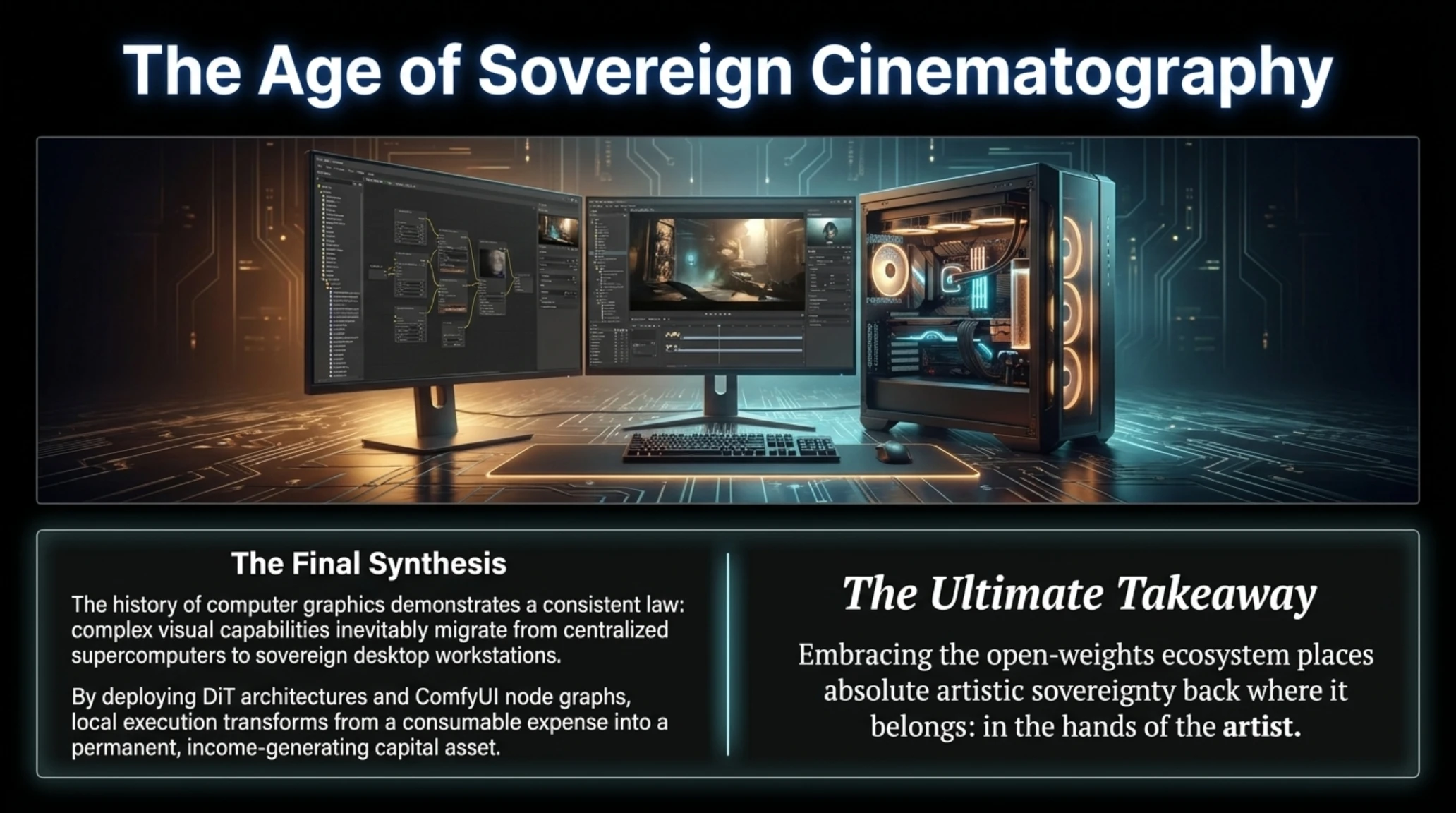
The expansion of open-source AI tooling allows seamless synchronization across 3D asset creation, neural motion synthesis, and spatial audio mastering within a unified desktop environment.
In the technical video analysis below, professional visual effects artists conduct a forensic frame-by-frame comparison between local Wan 2.1 / MiniMax H3 renders and commercial cloud video APIs.
The evaluation confirms that in dynamic environmental phenomena such as raindrop refraction, anisotropic hair physics, and complex particle collisions locally rendered open-weights models achieve perceptual parity with, and frequently surpass, the visual fidelity of heavily compressed cloud streams.
The wide-angle studio photograph above showcases a modern sovereign AI production suite, featuring multi-monitor workflow orchestration powered by an optimized desktop workstation.
Seamless bidirectional bridging between digital content creation suites like Blender 5.0 and ComfyUI via OpenUSD integration has fundamentally transformed hybrid animation workflows. Visual artists can now model 3D spatial blocking, camera motion paths, and primitive geometry in Blender, passing depth maps and normal vectors directly to local video diffusion models to synthesize final textures, volumetric lighting, and organic skin shaders in hours rather than weeks.
This hybrid workflow unites traditional 3D keyframe precision with generative neural rendering, granting directors total geometric control over character staging while harnessing the photorealistic texture synthesis of modern Diffusion Transformers. The resulting hybrid pipeline represents the true future of independent digital cinematography.
Smart History Tags: The Evolution of Visual Rendering from Hollywood CGI Farms to Consumer Silicon
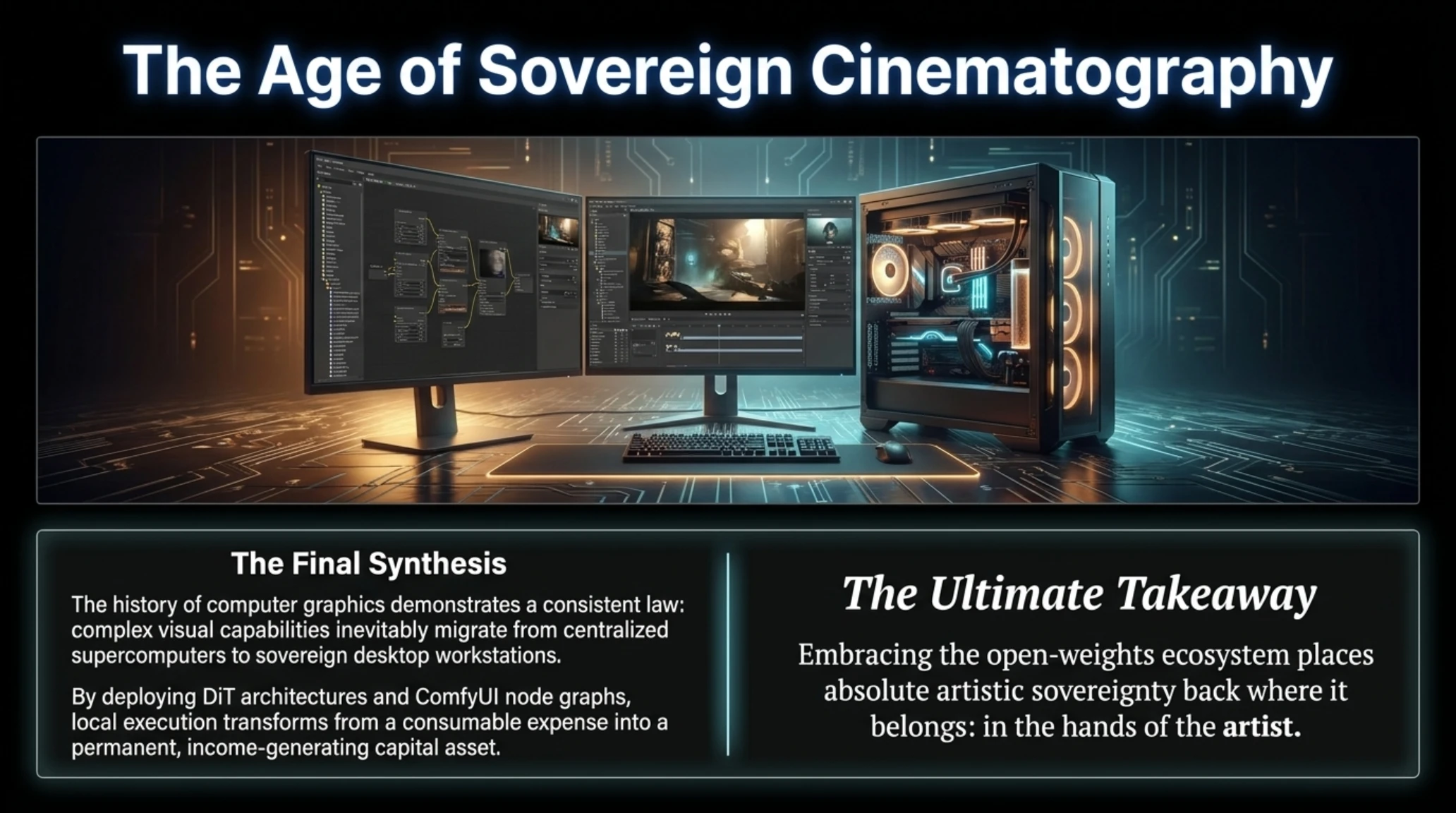
From the massive CPU render farms of early 2000s Hollywood animation houses to real-time ray tracing on Nvidia RTX GPUs, and now real-time neural frame synthesis via Diffusion Transformers, the history of computer graphics demonstrates a consistent law: complex visual capabilities inevitably migrate from centralized supercomputers to sovereign desktop workstations.
Conclusion & Strategic Roadmap (Conclusion): Charting Your Path to Sovereign AI Cinematography
The year 2026 marks the definitive maturation of local AI video generation. Whether starting with an entry-level 6GB GPU utilizing 4-bit GGUF quantization and TeaCache, or operating a 24GB studio workstation rendering uncompressed 1080p masters, embracing the open-weights ecosystem liberates creators from recurring cloud taxation and places absolute artistic sovereignty back where it belongs: in the hands of the artist.
Related Tech Intelligence on Tekin Game
• 🌙 Tekin Night | Call of Duty, Nintendo & Vision Pro Digest
• 🎭 Tekin Analysis | Apple AI Teardown & July 2026 Digest
• 🌙 Tekin Night | NVIDIA $500B Deal & iPhone 18 Leak
Frequently Asked Questions: Local AI Video Generation & Hardware
1. Is it truly possible to run massive foundation models like MiniMax H3 or Wan 2.1 on a 6GB GPU?
Yes. By deploying 4-bit GGUF quantization (e.g., Q4_K_M), enabling the TeaCache acceleration node, and utilizing sequential CPU block offloading in ComfyUI, models like MiniMax H3 and Wan 2.1 execute smoothly on 6GB GPUs like the RTX 2060 and 3060, generating high-quality 480p and 576p footage.
2. Why is a minimum of 32GB of system RAM strictly mandatory for low-VRAM video generation?
When GPU VRAM is constrained, the massive 32B-parameter T5-XXL text encoder and inactive transformer layers are paged directly into system RAM. Having 32GB to 64GB of high-speed DDR5 prevents memory exhaustion crashes and ensures smooth tensor swapping.
3. What is the fundamental architectural advantage of Lightricks LTX-Video 2.5 over heavier models?
LTX-Video 2.5 utilizes an asymmetric Spatial-Temporal Diffusion Transformer engineered specifically for maximum throughput. It is the fastest video model in existence, making it perfect for rapid storyboarding, whereas Wan 2.1 14B and MiniMax H3 offer deeper photorealism and complex anatomical physics at the cost of higher compute requirements.
4. How can independent filmmakers maintain strict character facial consistency across multiple scenes?
In ComfyUI, creators can train a lightweight LoRA on a character's facial geometry and connect it to the video diffusion model at a weight of 0.6-0.8, or deploy Image-to-Video conditioning using the initial frame to preserve consistent visual identity across sequential shots.
5. Does purchasing a 24GB GPU like the RTX 3090 provide a superior ROI compared to cloud SaaS platforms?
Absolutely. Annual cloud subscriptions to Runway and Sora Pro cost between $1,140 and $2,400 per year. A secondary-market 24GB RTX 3090 (~$700) completely recovers its capital expenditure within 4 to 7 months, delivering permanent, unrestricted zero-cost rendering thereafter.
Verified Documentation & Technical Sources
Additional Gallery: 🎬 Tekin Guide | The Ultimate Local AI Video Blueprint: MiniMax, Wan & LTX