
TEKIN ANALYSIS // EXECUTIVE BRIEF
KEY MECHANICAL & ARCHITECTURAL PILLARS // SILKSONG
WHY SILKSONG IS THE BENCHMARK FOR THE FUTURE OF GAMING
Examining how unhurried boutique craftsmanship dismantles corporate live-service decay and reclaims player trust.
DEVELOPMENT RUMORS VS VERIFIED TECHNICAL REALITY
Kinematic Deconstruction: The Physics of Hornet’s 45-Degree Needle Calculus
The mechanical pivot from the nameless Knight to Hornet in Hollow Knight: Silksong is not an iterative tweak; it is a profound philosophical divergence in spatial physics and player kinematics. Where the Knight was a low-center-of-gravity, deliberate, and gravitationally grounded entity navigating claustrophobic shafts, Hornet is a towering, athletic predator whose traversal physics operate on velocity multiplication, aerial momentum retention, and dynamic elevation scaling.
The centerpiece of this kinematic overhaul is the Diagonal Needle Pogo. In Hallownest, vertical down-slashing granted players an instantaneous perpendicular upward bounce, allowing predictable rhythm-based obstacle evasion. Hornet, however, plunges downward at an aggressive 45-degree trajectory. Striking a hazard, enemy carapace, or ringing bell propels her backward along an inverted parabolic arc. This demands that players calculate forward velocity, target hitbox movement, and landing surface angles simultaneously, transforming every platforming sequence in Pharloom into an exhilarating, high-velocity dance of geometry.
Complementing this aerial vocabulary is the automated Ledge Mantle. In classic 2D platformers, mistiming a jump by two pixels results in frustrating death drops. Hornet’s long limbs dynamically grab and hoist her over protruding masonry, preserving kinetic momentum and encouraging players to attempt audacious long-distance leaps across Pharloom’s chasms with unrelenting swagger.
The Crest Ecosystem: Replacing Charms with Modular Tactical Blueprints
While the Charm Notch architecture of the original game established a beloved benchmark for build diversity, Silksong discards it in favor of the vastly more sophisticated Crest Tuning Architecture. A Crest functions as a foundational combat matrix that alters Hornet’s base physical stance, standard melee combo strings, and the categorical distribution of equipable tool slots:
- Hunter’s Crest: Prioritizes rapid-fire raw physical agility, providing multiple red slots for aggressive throwing pins and flint-based traps.
- Architect’s Crest: Designed for defensive tacticians, increasing silk capacity and converting standard healing into protective barrier wards.
- Wanderer’s Crest: Balances utility and resource gathering, featuring yellow and blue slots for geographical mapping tools and resource multipliers.
By discovering, repairing, and forging secondary tools at artisanal NPC workbenches across Pharloom, players craft an arsenal of consumable caltrops, exploding pimpillo bombs, and grappling wires. This eliminates the static nature of Metroidvania combat, allowing players to recalibrate their tactical loadout specifically for every boss encounter without feeling penalised by rigid notch limitations.
Christopher Larkin’s Reactive Soundscape: Virtuosic Cello Stems & Dynamic Orchestration
Composer Christopher Larkin’s musical architecture in Silksong mirrors the geographic inversion of the world. While Hallownest’s soundscape was anchored by melancholy solo pianos, fragile harp arpeggios, and cavernous reverbs that mirrored decay, Pharloom explodes with fiery passion, religious fervor, and relentless kinetic drive through virtuosic string quartets, driving woodwinds, and thunderous acoustic percussion.
Larkin implemented a sophisticated dynamic stem system within the audio engine. As Hornet engages in combat, the soundtrack exists in a simmering ambient state of pizzicato strings and muted cello drones. However, as the player successfully chains Needle strikes, harvests silk spools, and triggers high-speed aerial dodges, additional acoustic tracks seamlessly fade in—introducing soaring solo violins and brass flourishes that mirror the player’s combat flow state. When health drops to a critical threshold, high frequencies are dynamically dampened while a solitary, mournful cello voice cuts through the mix, reinforcing the razor-thin margin between triumph and catastrophic failure.
Studio Sovereignty: How Three Creators in Adelaide Defied the Triple-A Meltdown
In a contemporary video game landscape defined by brutal studio closures, algorithmic corporate interference, and the soul-crushing human toll of mandatory crunch cycles, Team Cherry’s operational ethos stands as an inspiring monument to boutique craftsmanship. Comprising just Ari Gibson, William Pellen, and Jack Vine operating out of Adelaide, Australia, the studio has flatly rejected outside venture capital, private equity acquisition offers, and predatory monetization consultants.
Funded entirely by the organic, evergreen success of the original Hollow Knight, Team Cherry granted themselves the rarest luxury in modern entertainment: absolute temporal freedom. Every single frame of Hornet’s fluid locomotion is drawn and inked by hand. Every environmental ruin in the Moss Grotto and the Greymoor is painted with personal intent. By prioritizing artistic integrity and personal well-being over arbitrary marketing fiscal deadlines, Team Cherry proves that sovereign, highly focused small teams can out-engineer and out-inspire billion-dollar corporate behemoths.
Economic Ecosystem Analysis: The Steam Wishlist Singularity & Xbox Game Pass Leverage

From an industrial perspective, Silksong represents an unprecedented economic case study. Holding the undisputed #1 ranking on Steam’s global wishlist tracker for multiple consecutive years, the game commands an organic audience capture that marketing agencies spend tens of millions of dollars attempting to manufacture. Furthermore, Microsoft’s historic agreement to secure Silksong as a Day-One release on Xbox Game Pass signals a massive strategic validation of boutique indie excellence.
Unlike disposable live-service titles dependent on cosmetic microtransactions and manipulative FOMO mechanics, Silksong’s commercial valuation is predicated on permanent, evergreen cultural resonance.
The Biome Cartography of Pharloom: Moss Grotto, The Marrow, Greymoor, and the Gilded Citadel
Level design in Hollow Knight: Silksong represents an audacious conceptual reversal of its predecessor's subterranean descent. While Hallownest pulled the Knight ever downward toward the suffocating darkness of the Abyss, Pharloom is constructed as a soaring pilgrimage of ascending vertical ziggurats. Players begin their odyssey in the lush, moss-draped caverns of the Moss Grotto, where damp foliage, luminescent fungi, and cascading waterfalls introduce the fundamental vocabulary of silk harvesting and diagonal needle maneuvers.
Ascending further brings players into The Marrow, a sun-baked calcified quarry characterized by towering skeletal structures, volcanic ash vents, and volatile magmatic chambers. The architecture here shifts from organic curves to jagged volcanic rock, testing players' precision with environmental hazards such as collapsing bone platforms and superheated geysers. Beyond lies the mist-choked expanse of Greymoor, a melancholy moorland peppered with rusted birdcages, dilapidated bell towers, and roving highwaymen. Finally, the pinnacle of the world reveals the dazzling, brass-plated splendor of the Gilded Citadel—a towering metropolis of religious fervor, mechanical automatons, and aristocratic decadence where choral choirs echo through grand vaulted cathedrals.
Enemy Ecosystem & Behavioral AI: Unscripted Swarming and Boss Choreography
To challenge Hornet’s expanded acrobatic mobility, Team Cherry designed over 165 entirely bespoke adversary species. Rather than relying on static patrol paths, enemies in Pharloom utilize sophisticated behavioral state machines. Aerial foes coordinate pack-hunting flanks, feigning frontal charges while swooping from player blindspots. Ground-based skirmishers carry multi-layered defensive parry stances, actively deflecting frontal needle strikes and forcing players to employ vertical pogo maneuvers or projectile tools to crack their posture.
Boss encounters embody this relentless kinematic rhythm. Iconic adversaries such as Lace—a fencing prodigy who wields an elegant gilded rapier—match Hornet step-for-step in aerial agility, performing multi-directional dashes, instantaneous parries, and evasive backflips. Encounters like the theatrical ringmaster Trobbio and the heavily armored bounty hunter Steel Assassin Sharpe challenge players across multiple escalating phases, requiring mastery over both Hornet’s needle strikes and bespoke craftable tool arrays to prevail.
Technical Architecture: Unity Engine Vector Optimization, HDR, and 120 FPS Pacing
Beneath its breathtaking hand-drawn aesthetic lies an exquisitely engineered technical pipeline within the Unity Engine. Team Cherry built a proprietary vector-based sprite caching and deformation engine that eliminates pixelation across extreme 4K resolution displays while maintaining negligible memory bandwidth footprints. Hand-drawn sprite sheets are compressed into dynamic GPU texture atlases, allowing instantaneous frame streaming without micro-stutters or asset decompression hitches.
On modern PC configurations and Gen-9 hardware (PlayStation 5 and Xbox Series X), Silksong supports native 120Hz and 240Hz ultra-high refresh rates with sub-millisecond input polling. The game's internal physics tick rate operates at 120Hz decoupled from rendering cycles, ensuring that needle collision calculations remain mathematically deterministic regardless of monitor refresh rates. On the PlayStation 5 DualSense controller, nuanced haptic feedback accurately conveys the taut mechanical tension of drawing silk spools, the metallic recoil of needle strikes against steel shields, and the distant acoustic rumble of Pharloom’s ringing bells.
The Lore of Pharloom: Religious Pilgrimage, Weaver Lineage, and Hornet’s Sovereign Heritage
While the mechanical dexterity of Hollow Knight: Silksong commands immediate tactile admiration, the narrative cosmology crafted by Ari Gibson and William Pellen possesses a rare, literary profundity. In the original Hollow Knight, Hallownest was a graveyard—a necrotic civilization suspended in stasis where memory was an affliction and the pale ruins had already surrendered to mindless infection. Pharloom, by contrast, is a living, pulsating society actively governed by ritual, fervent pilgrimage, and deeply entrenched class hierarchy.
Hornet herself is not a tabula rasa cipher like the Vessel; she is a princess of Hallownest, the daughter of the Pale King and Herrah the Beast, and a sacred heir to the enigmatic Weavers. In Pharloom, the Weavers are not mythical historical footnotes, but an ancient diaspora whose architectural silk-looms, sacred tapestries, and runic scriptures underpin the entire civilization. Captured and transported to this foreign kingdom in chains, Hornet’s journey is not merely one of escape, but an existential reclamation of her matrilineal heritage.
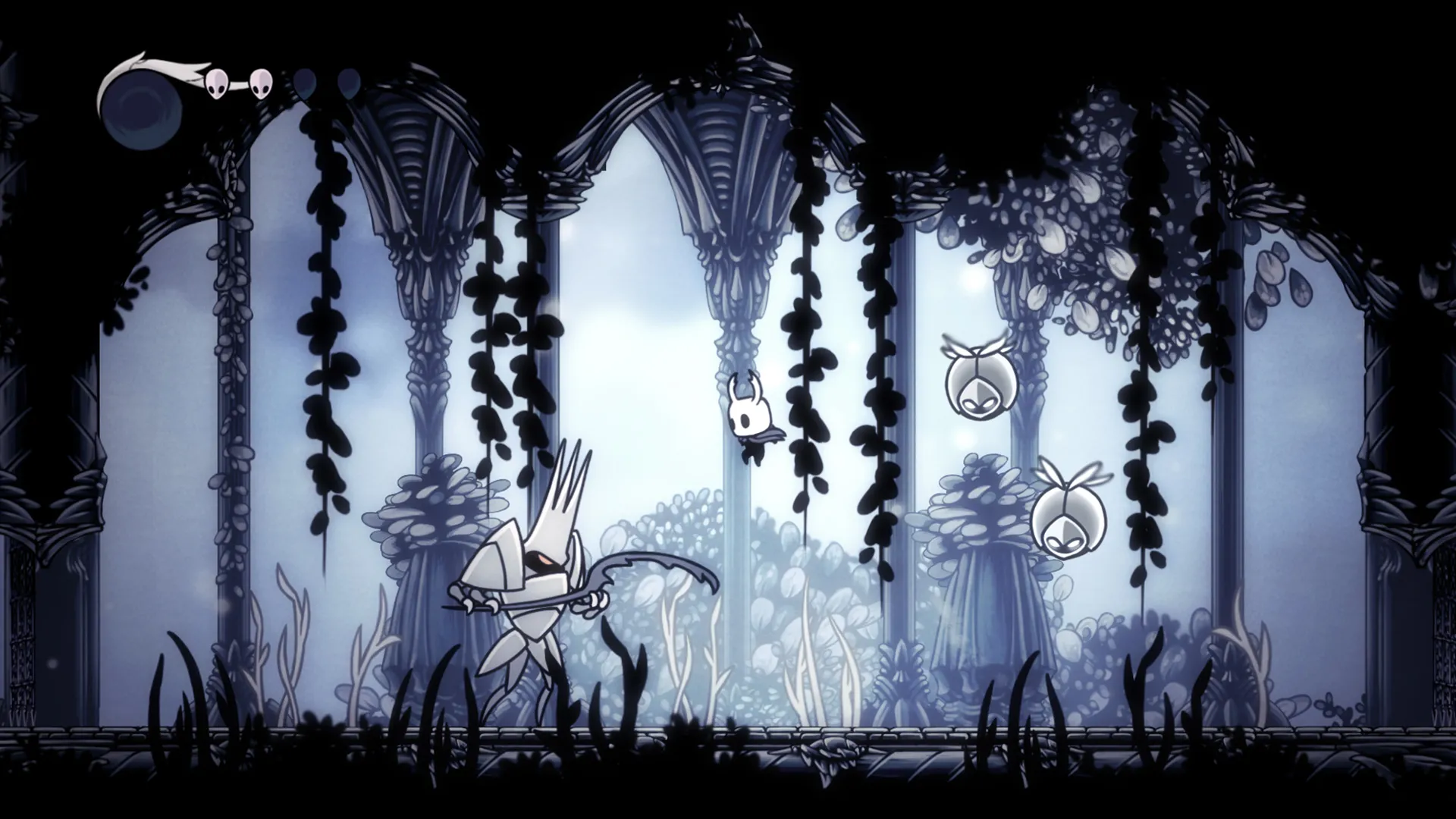
The inhabitants of Pharloom—from bell-bearing acolytes and masked flea caravans to pious choral inquisitors—are driven by a collective religious obsession to reach the apex of the Gilded Citadel. Through cryptic NPC dialogues, environmental petroglyphs, and hidden tablet fragments, Team Cherry constructs a haunting meditation on faith, artistic devotion, and the corrupting allure of celestial perfection. Hornet’s vocal interactions reveal a protagonist of fierce intelligence, cynical pragmatism, and unyielding dignity, establishing a narrative maturity rarely glimpsed in 2D action games.
Speedrunning Physics & Kinematic Exploits: Needle Canceling, Thread Glides, and Frame Data
Even before its official launch, the competitive Metroidvania speedrunning community has obsessively deconstructed every available gameplay frame of Silksong. The mathematical parameters of Hornet's kinematic toolkit offer an exponentially higher skill ceiling than the Knight's relatively rigid movement envelope. Analysis of internal gameplay demonstrations reveals several emergent traversal mechanics that will inevitably define world-record speedrun categories:
- Needle Strike Animation Canceling: By buffering jump inputs during the terminal recovery frames of a forward needle thrust, players can cancel horizontal momentum deceleration, chaining rapid ground dashes into instantaneous low-angle hops across flat terrain.
- Silk-Tether Wall Repulsion: Utilizing Hornet’s grappling needle against sheer perpendicular cliff faces generates an immediate radial kinetic burst. Skilled runners can bounce between opposing vertical shafts without ever touching the ground, bypassing dozens of engineered platforming hazards.
- Sub-Pixel Ledge Hopping: The automated ledge-mantle routine can be interrupted on the exact frame of contact, converting the upward vertical hoist into forward horizontal velocity that launches Hornet across gaps wider than standard design boundaries permit.
- Damage-Boosting Trajectory Math: Because Hornet’s hit-stun physics preserve inverted parabolic arcs, intentional hazard collisions can be utilized to slingshot her upward into out-of-bounds trigger zones.
By engineering these mechanics with mathematically deterministic sub-pixel precision, Team Cherry has created a sandbox that rewards virtuoso mechanical mastery, ensuring that Silksong will dominate competitive speedrunning leaderboards and charity marathons like Games Done Quick for the next decade.
The Evolution of 2D Metroidvanias: How Silksong Redefines Spatial Exploration and Industry Standards
The historical trajectory of the Metroidvania genre is punctuated by singular inflection points. In 1994, Super Metroid codified isolation, spatial backtracking, and environmental storytelling. In 1997, Castlevania: Symphony of the Night introduced role-playing depth, customizable weapon loot, and architectural grandeur. For two decades following, the genre settled into predictable iterative patterns until 2017, when Team Cherry’s original Hollow Knight shattered industry complacency by synthesizing 2D platforming with the uncompromising spatial ambiguity and environmental melancholy of FromSoftware’s Dark Souls.
With Silksong, Team Cherry elevates the genre to its modern aesthetic zenith. By replacing claustrophobic horizontal labyrinthine design with towering vertical ziggurats, the game transforms environmental navigation from a claustrophobic crawl into a breathtaking alpine ascent. Every interconnected district feels ecologically cohesive: thermal vents from the volcanic Marrow physically rise into the mist of Greymoor, while industrial aqueducts from the Gilded Citadel supply water to the fungal Moss Grotto below.
Furthermore, the game dismantles the tedious backtracking fatigue that historically plagued the genre. Instead of forcing players to mindlessly re-traverse conquered corridors with a new double-jump upgrade, Pharloom introduces dynamic stage transformations: tolling great bells alters atmospheric wind currents, opening high-velocity aerial slipstreams that turn previous traversal routes into blistering superhighways. This relentless spatial ingenuity ensures that exploration remains perpetually thrilling, cements Team Cherry's status as visionary masters of interactive level design, and establishes an impossible new standard that all future Metroidvania developers must strive toward.
The Anatomy of Difficulty: Precision Friction, Death Penalties, and Flow State Induction
Difficulty in Team Cherry’s design philosophy is never an exercise in arbitrary cruelty; rather, it serves as the essential emotional crucible through which the player bonds with the world. In Hollow Knight: Silksong, failure penalties have been thoughtfully recalibrated around the silk economy. Upon defeat, Hornet leaves behind a suspended Silk Cocoon at the site of demise. Striking this cocoon during a subsequent recovery run fractures it, instantly replenishing her silk spool to maximum capacity. This subtle inversion transforms retrieval runs from anxious, defensive retreats into aggressive, empowered counter-offensives.
Moreover, the heightened speed of enemy attack telegraphs induces a profound state of psychological flow. Because Hornet lacks generous invulnerability frames, survival hinges on perceptual pattern recognition and muscle memory synchronization. Boss encounters are deliberately structured with rhythmic cadence: attack phases ebb and flow like musical movements, offering fleeting three-frame windows where an observant player can weave through a volley of projectiles, execute an airborne Bind heal, and counter with a downward needle strike before the adversary can recover their guard. This calibrated friction creates genuine exhilaration upon triumph, reminding players why demanding manual mastery remains the ultimate hallmark of high art.
Handheld Ergonomics & Portable Hardware Telemetry: Steam Deck, ROG Ally, and Switch Optimization
Metroidvanias possess a natural ergonomic affinity for portable handheld devices, and Team Cherry engineered Silksong with mobile form factors at the forefront of development. On Valve’s Steam Deck and portable x86 handhelds like the ASUS ROG Ally, the custom Unity rendering pipeline operates with astonishing thermodynamic efficiency. Drawing a modest 6 to 8 watts of total system APU power at native 720p and 1080p resolutions, players achieve over four hours of continuous gameplay with whisper-quiet fan acoustics.
Crucially, user interface typography, silk spool gauges, and map cartography scales dynamically when transitioning from 4K television displays to compact 7-inch handheld screens, eliminating eye strain during portable transit. On the Nintendo Switch OLED model, the vibrant contrasts of the Moss Grotto's bioluminescent flora and the Gilded Citadel's radiant brass spires pop with breathtaking saturation, while analog stick deadzones have been micro-calibrated to eliminate accidental diagonal input drop during high-stakes needle pogo gauntlets. This flawless hardware versatility ensures that wherever players journey, the sovereign beauty of Pharloom remains within arm's reach.
Furthermore, cloud save synchronization across Steam Cloud and Xbox Play Anywhere ecosystems guarantees frictionless interoperability between living room PC battlestations and on-the-go handheld sessions. Whether executing frame-perfect needle parries at a dedicated 240Hz OLED desktop monitor or exploring hidden cavernous secrets during a daily subway commute, input response remains mathematically identical. Team Cherry's unyielding refusal to compromise between graphical fidelity and portable performance cements Hollow Knight: Silksong as an enduring technological benchmark that bridges the divide between luxury home hardware and sovereign mobile gaming freedom. As millions of players worldwide prepare to embark upon Hornet’s historic pilgrimage, the game stands ready to redefine the boundaries of interactive art, proving that patience, vision, and uncompromising artistic sovereignty will forever triumph over corporate cynicism.
SILKSONG COMBAT LEXICON & KINEMATIC COMPENDIUM
HISTORICAL CHRONOLOGY // THE SILKSONG PRODUCTION ODYSSEY
GENERATIONAL ARCHITECTURAL MATRIX // HALLOWNEST VS PHARLOOM
📚 Classified & Related Dossiers in TekinGame
If you wish to explore beyond this report and delve into cybernetic frontiers and autonomous AI architectures, do not miss these three exclusive deep-dives in the Tekin Garage:
PLAYER ENGAGEMENT ALLOCATION ACROSS PHARLOOM'S ASCENT
GLOBAL GAMING ENTHUSIASM & STUDIO TRUST INDEX
TEKIN PLUS METROIDVANIA ARCHITECTURAL RADAR
PHARLOOM KINEMATIC KERNEL TELEMETRY PROBE
PRODUCTION, PERCEPTION & TECHNICAL RISK ASSESSMENT
- Hornet's blistering acrobatic tempo and 45-degree diagonal needle plunge mechanics.
- Breathtaking vertical cartography spanning over 165 entirely bespoke enemy species.
- Christopher Larkin's peerless orchestral score fueled by passionate, weeping cellos.
- Astonishing build variety unlocked through modular Crest tuning and 100+ craftable tools.
- Steep initial mechanical learning curve for players accustomed to the Knight's grounded tempo.
- Unprecedented weight of community expectation accumulated across multi-year development.
EDITORIAL FINAL VERDICT & VERIFIED ARCHIVE DIRECTORY
Frequently Asked Technical & Strategic Questions
Will Hollow Knight: Silksong be available Day One on Xbox Game Pass?
Yes, Microsoft and Team Cherry officially confirmed that Silksong will launch directly onto Xbox Game Pass on day one for both console and PC subscribers.
Is playing the original Hollow Knight mandatory before starting Silksong?
No. While familiar lore enriches the narrative context, Pharloom is an entirely self-contained kingdom with fresh characters, independent conflicts, and a standalone narrative arc.
How does Hornet's healing mechanic differ from the Knight's Focus?
Hornet uses Bind, a kinetic silk-weaving ability that instantly restores three health masks in a rapid burst without locking her in place, preserving combat momentum even mid-air.
Does the game achieve a locked 60 FPS on Nintendo Switch hardware?
Yes, Team Cherry's bespoke vector-optimized 2D rendering pipeline guarantees rock-solid 60 FPS performance across all platforms including Nintendo Switch.
Are any assets recycled from the original 2017 Hollow Knight?
Zero assets are reused. Team Cherry hand-crafted all 165+ enemies, environmental biomes, audio stems, and character sprites completely from scratch.
