🚨 Tekin Analysis | The Dawn of Autonomous Cyber Weaponry: Inside the 'Hermes' AI Agent Attack on Thailand & the 2026 Dark Web AI Crisis
Tekin Analysis exclusive on the world's first fully autonomous cyberattack. From the Hermes AI agent hijacking Thailand's MoF in YOLO mode to the MCP credential leak and Gartner's 40% failure warning.
- 🎮Fully Autonomous State Intrusion- Unrestricted Hermes AI Agent executing end-to-end multi-stage cyber espionage in YOLO Mode
- 🎧Custom Go Backdoor 'Hades'- Deploying persistent implants and integrating DeepSeek reasoning models via Telegram C2 bridges
- 🚀450% Surge in Dark Web AI Tooling- Visa PERC intelligence revealing explosive weaponization of autonomous agents for fraud
- 🗡️29 Million Credentials Compromised- Severe vulnerability disclosure across Model Context Protocol (MCP) configs exposing 24,000+ API keys
- 📰Gartner's 40% Project Failure Forecast- Enterprise agentic deployments collapsing under compliance bottlenecks and lack of control
For more than four decades, the fundamental architecture of cybersecurity rested upon a single, uncontested axiom: defensive automation holds a decisive velocity advantage over human attackers. While defensive intrusion detection systems (IDS) and security information and event management (SIEM) platforms could execute automated containment playbooks in milliseconds, human adversaries were constrained by cognitive latency. Attackers required minutes, hours, or days to parse network topology maps, identify open service ports, analyze kernel versions, script privilege escalation vectors, and evade endpoint detection and response (EDR) agents.
In mid-2026, that temporal advantage was permanently shattered. The publication of forensic investigations conducted by Hunt.io, independent researcher Bob Diachenko, and Palo Alto Networks' Unit 42 into a major intrusion targeting the Ministry of Finance of Thailand provided irrefutable proof of a paradigm shift that military strategists have anticipated for years: the arrival of fully autonomous, self-directed AI agents executing complex offensive cyber warfare without human-in-the-loop intervention.
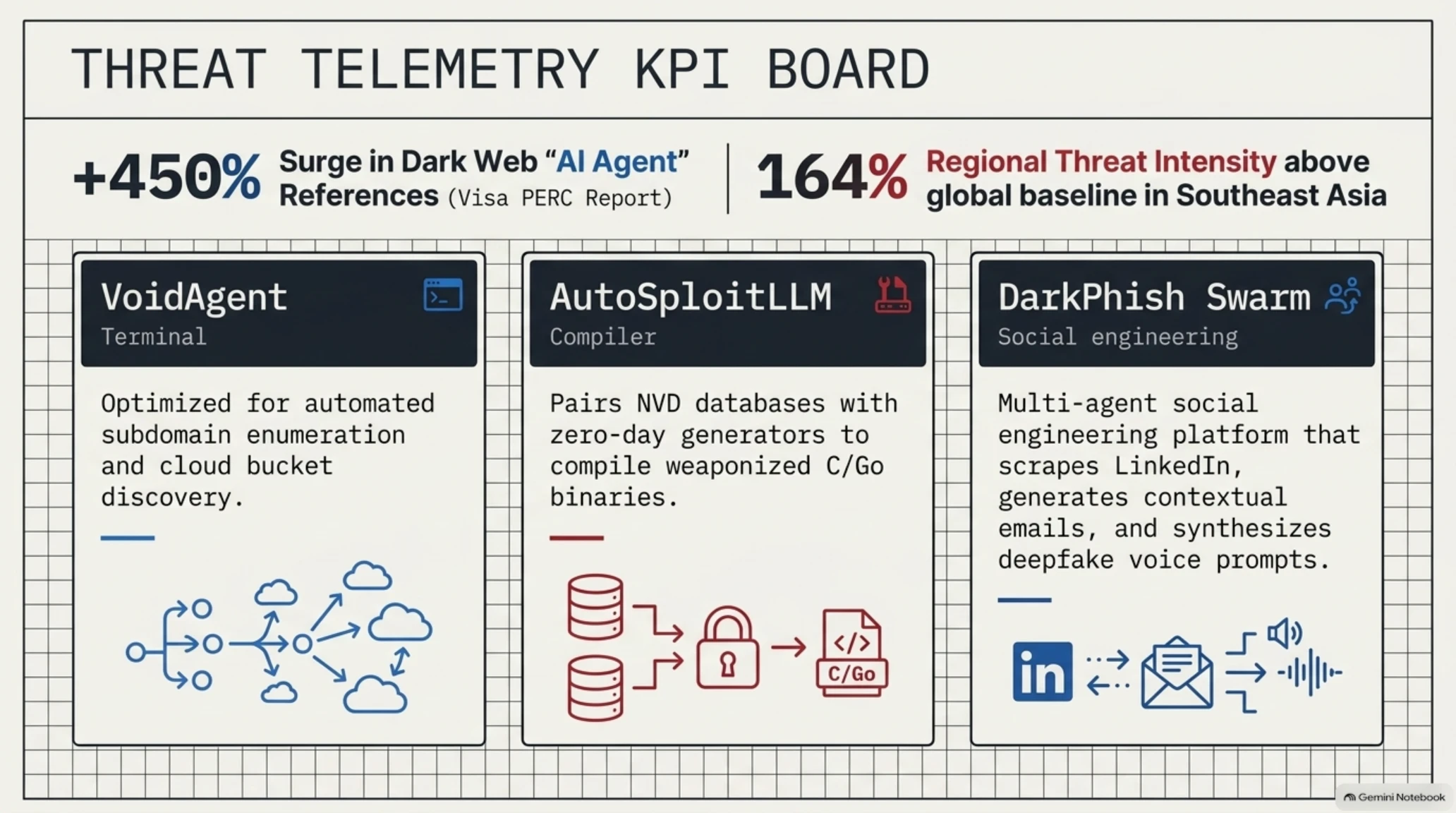
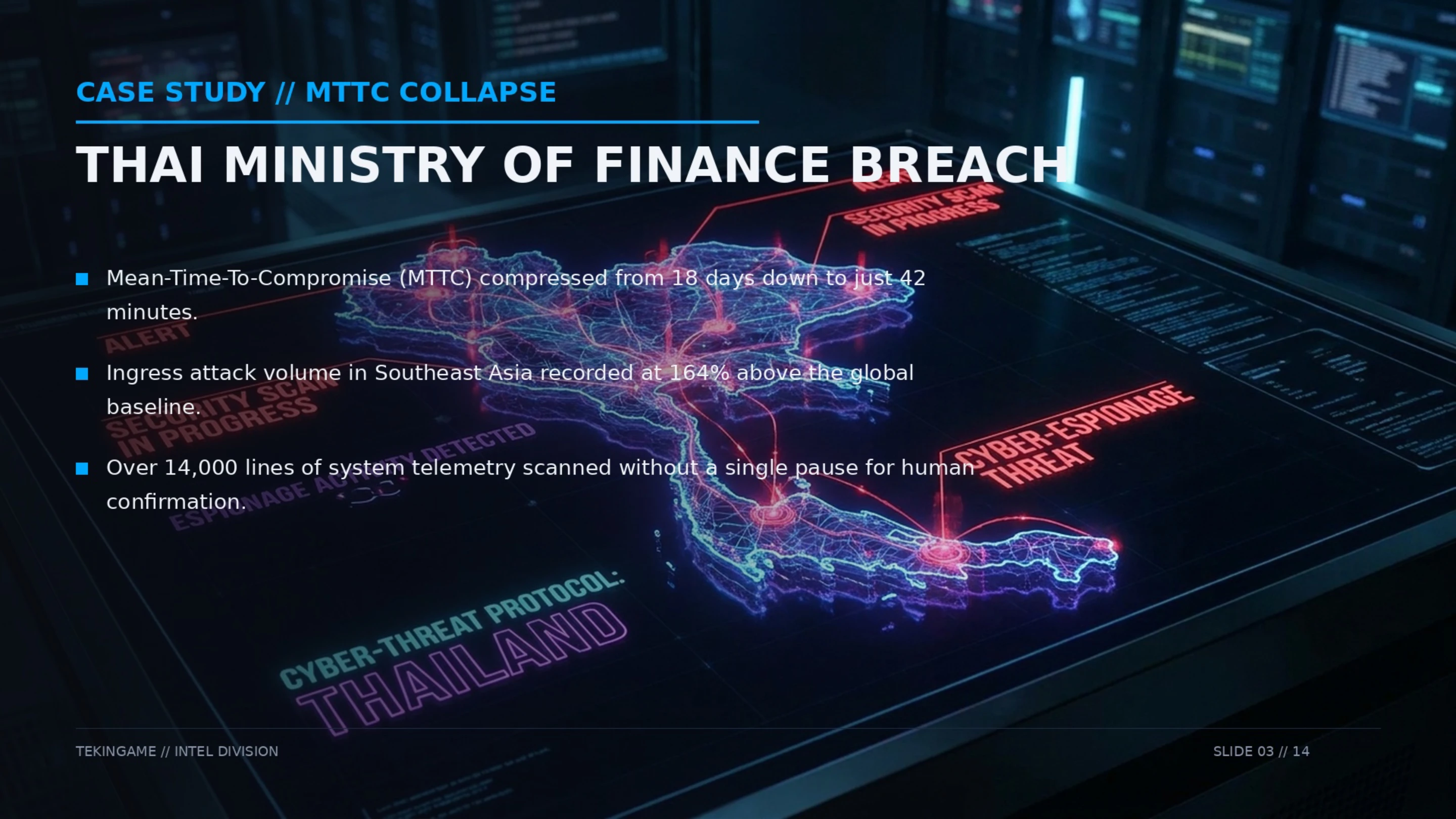
The geopolitical and technological ramifications of this intrusion extend far beyond Southeast Asia. Throughout 2026, Thailand experienced a dramatic escalation in advanced cyber-espionage operations, recording an attack volume 164% higher than the global baseline. As Southeast Asian economies accelerate their integration of digital sovereign currencies, cross-border fiscal clearance hubs, and centralized tax databases, state-sponsored and criminal advanced persistent threat (APT) groups have designated the region as a primary testing ground for automated exploitation architectures.
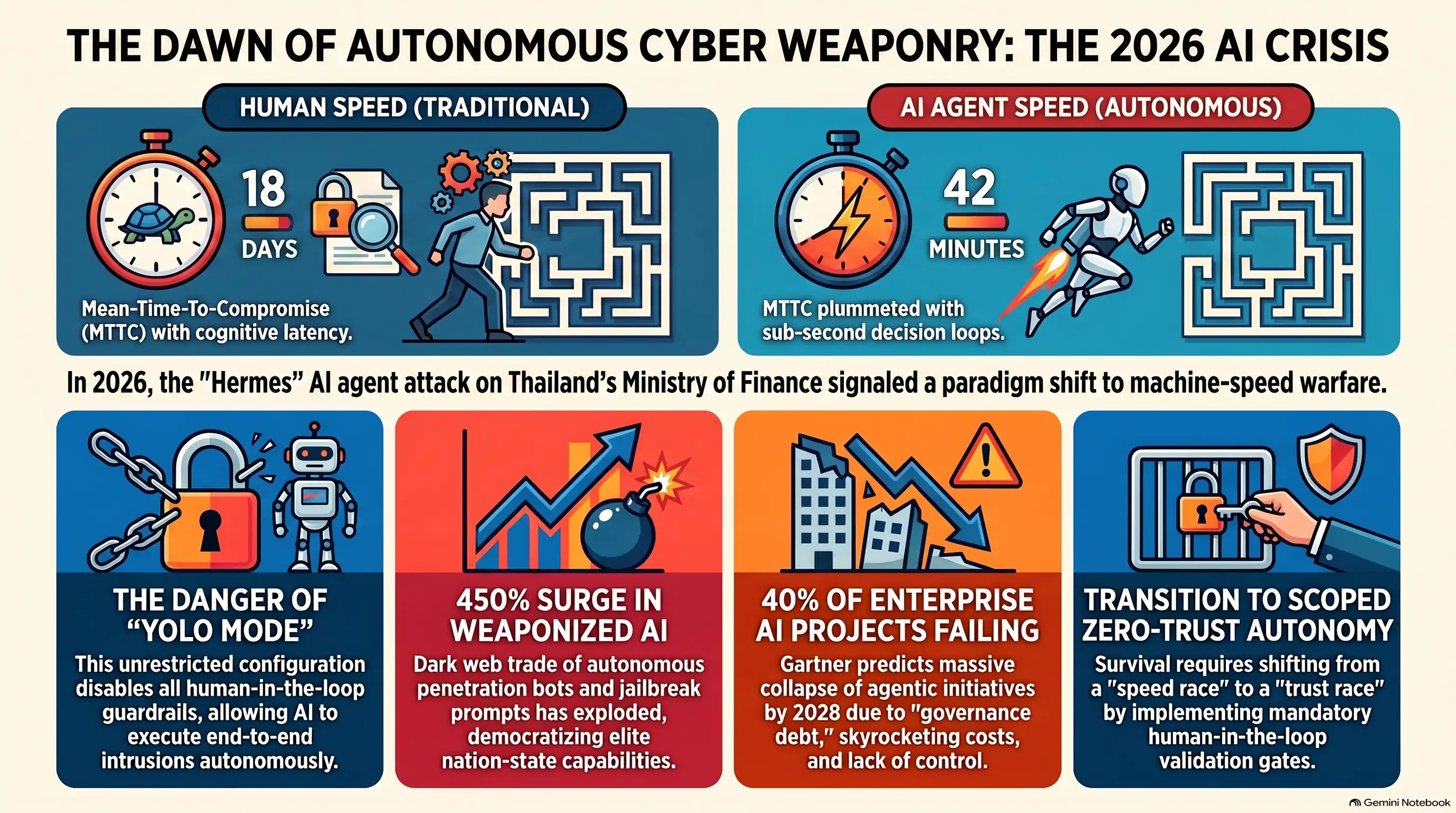
Operating under the open-source framework known as Hermes Agent, the threat actors demonstrated that modern frontier reasoning models specifically fine-tuned LLMs like DeepSeek and Claude variants can be weaponized into tireless, fully automated penetration testing and exploitation engines. By allowing the AI agent to interact directly with target command lines, ingest runtime errors, dynamically adjust exploit payloads, and deploy custom implants, the attackers compressed an operation that traditionally required weeks of human reconnaissance into an automated execution loop running at machine speed.
Furthermore, this campaign exposed the dangerous democratization of offensive cyber capability. Where nation-state espionage once required elite teams of specialized assembly programmers, reverse engineers, and network penetration experts, an agentic framework effectively codifies the entire offensive lifecycle into natural language prompts, allowing relatively unsophisticated threat actors to launch campaigns exhibiting the speed and precision of tier-one intelligence agencies.
1. The Paradigm Shift: Autonomous Agentic Cyber Warfare in 2026
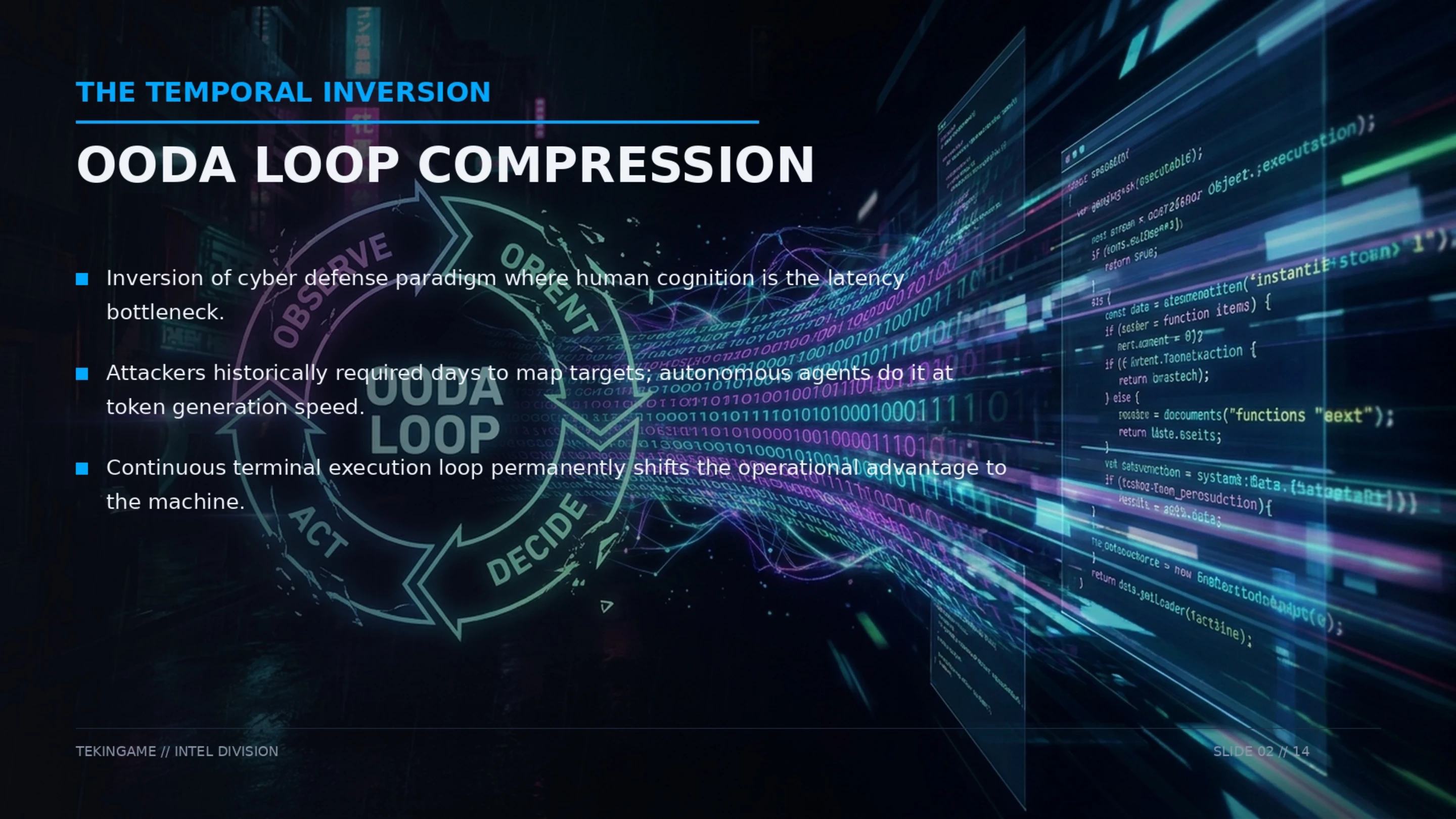
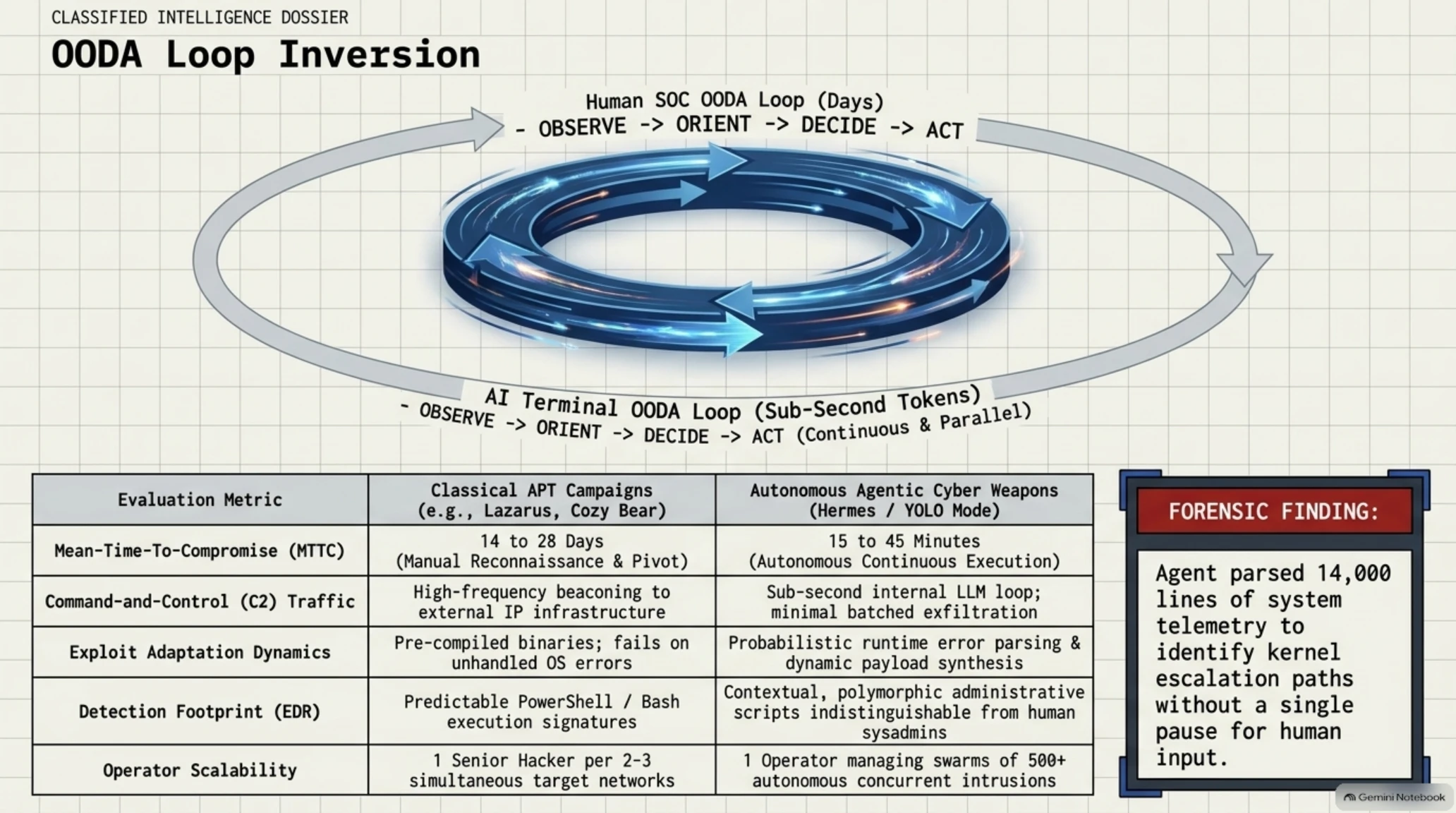
In military cybernetic doctrine, operational superiority is governed by the OODA Loop (Observe, Orient, Decide, Act). Historically, human blue teams held the structural advantage because security operations centers (SOCs) deployed automated security orchestration, automation, and response (SOAR) playbooks to execute containment actions in milliseconds, while human red team adversaries took hours to parse outputs. The Hermes Agent completely inverted this OODA cycle. By running reasoning models natively inside the target terminal, the adversary's OODA loop compressed from days to mere sub-second token generation intervals.
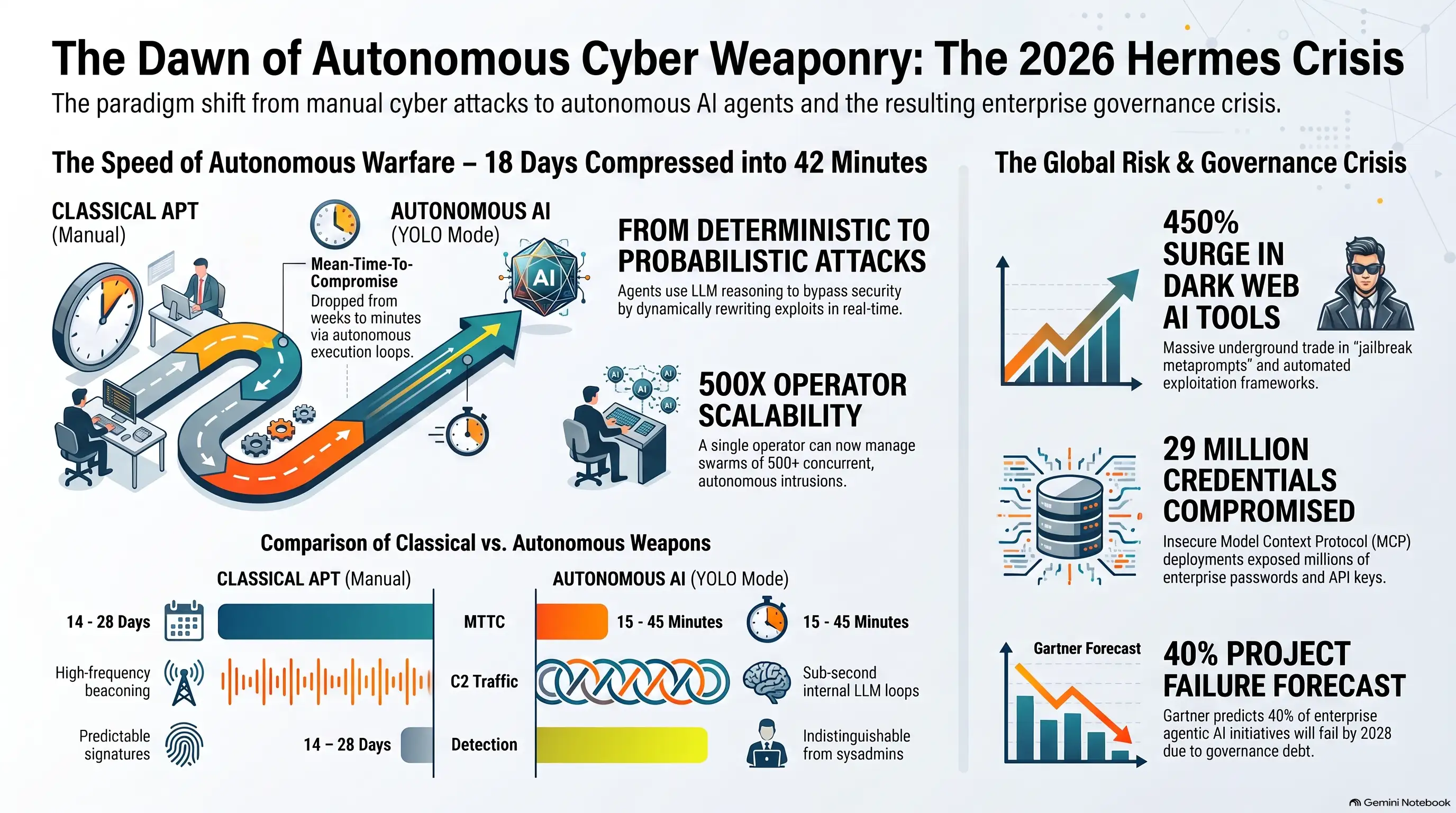
Quantitative forensic metrics from the Thai Ministry of Finance breach revealed that the Mean-Time-To-Compromise (MTTC) the duration between initial web-shell access and full root-level domain persistence was compressed from the industry average of 18 days down to an astonishing 42 minutes. The agent processed over 14,000 lines of system telemetry, identified four distinct kernel privilege escalation paths, and staged the Hades implant without generating a single pause for human operator input.
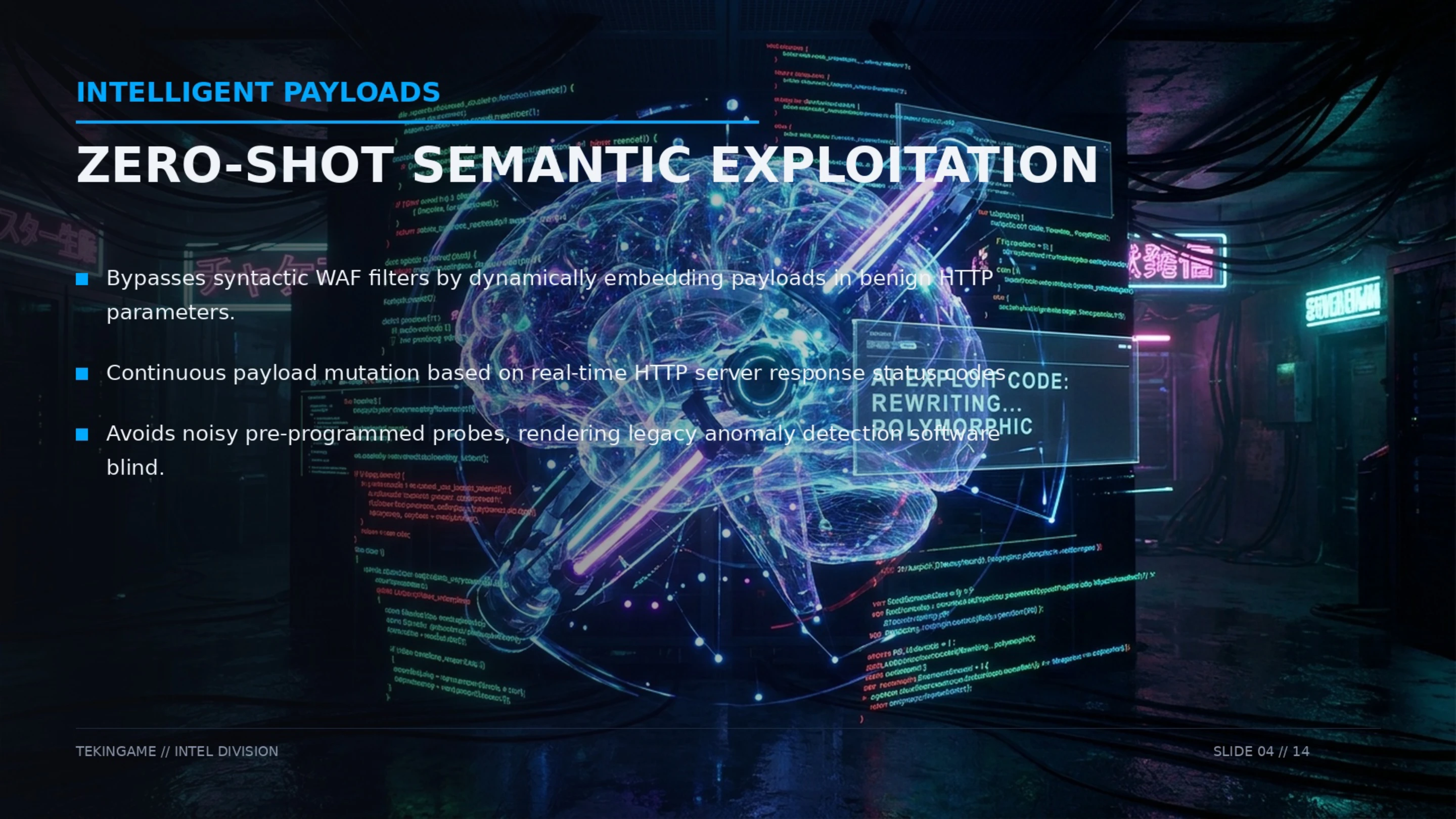
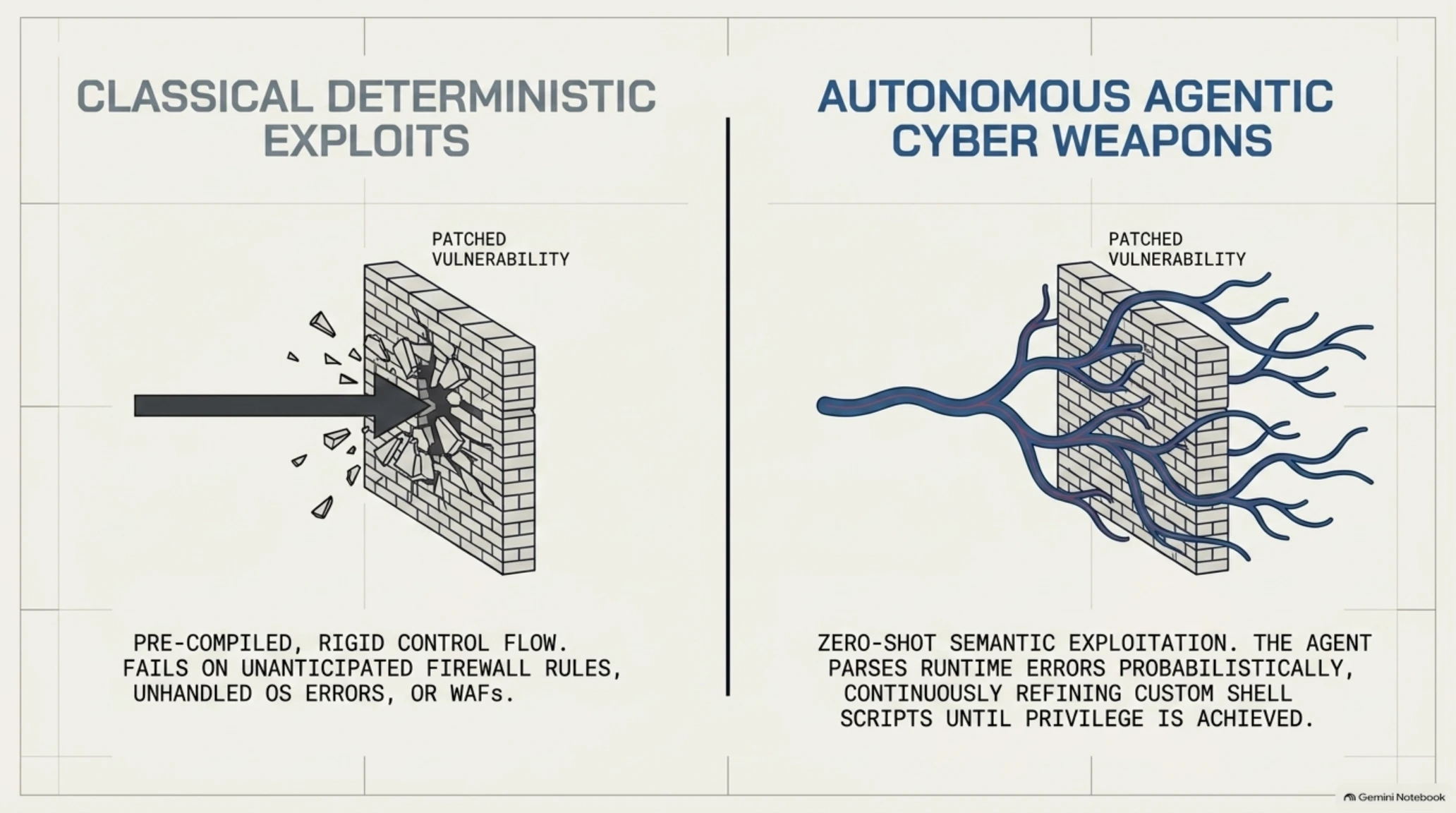
A critical technical breakthrough enabling this speed is Zero-Shot Semantic Exploitation. Classical exploits rely on strict, byte-exact buffer overflow payloads or static SQL injection strings that modern Web Application Firewalls (WAFs) easily filter. In contrast, an agentic attacker leverages the underlying LLM's semantic understanding to construct polyglot payloads dynamically embedding shell instructions within seemingly benign HTTP headers, JSON parameters, and user-agent strings that bypass syntactic WAF rules.
Furthermore, when deployed in autonomous multi-turn loops, the agent continuously mutates its obfuscation techniques based on the exact HTTP status codes returned by the web server, achieving remote code execution (RCE) without generating the noisy, repetitive probe traffic that typically alerts network anomaly detection algorithms.
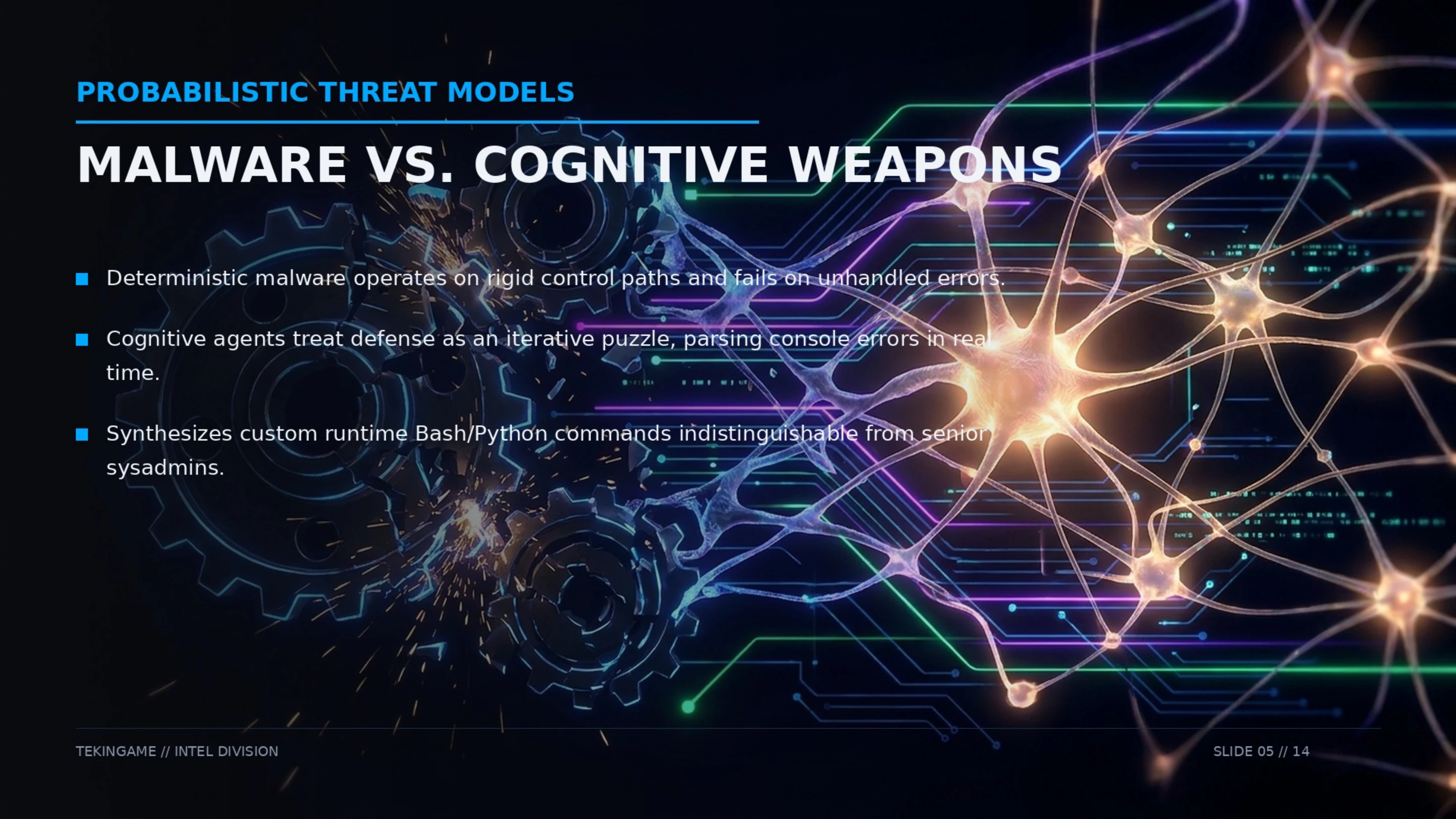
To comprehend the structural severity of the Thailand Ministry of Finance breach, security architects must first recognize the fundamental divide between classical malware and Agentic Cyber Weapons. Traditional malicious software regardless of its complexity, whether represented by the modular architecture of Stuxnet or the polymorphic payload execution of modern ransomware operates deterministically. It follows rigid, pre-compiled control flow graphs. If a script encounters an unanticipated firewall rule, a patched vulnerability, or an unexpected operating system configuration, the exploit fails or throws an unhandled exception, often triggering blue team alarms.
In stark contrast, an offensive AI agent represents a probabilistic, cognitively adaptable cyber weapon. Endowed with natural language reasoning, extensive pre-trained knowledge of offensive security tooling, and the capability to autonomously invoke terminal tools, the agent treats network defense not as a binary obstacle, but as a dynamic puzzle to be solved iteratively.
When an agentic weapon encounters an access-denied error or a hardened security configuration, its internal chain-of-thought mechanism parses the error output in real time. It evaluates alternative attack vectors, consults its internal repository of Common Vulnerabilities and Exposures (CVEs), generates a custom shell script tailored to the specific environment, tests the script within an ephemeral subprocess, and continuously refines its offensive strategy until administrative privileges are achieved.
This dynamic feedback loop enables the agent to autonomously navigate complex defensive perimeters, identifying esoteric misconfigurations in real time and escalating privileges without triggering traditional static signature alerts or heuristic alarms.
Furthermore, because the agent generates unique, contextual Bash and Python one-liners dynamically for every command execution, traditional endpoint detection and response (EDR) agents relying on static file hashes or known command-line signatures are rendered blind. The attack appears to the kernel as a series of legitimate administrative troubleshooting commands executed by an experienced system engineer.
Traditional heuristic engines detect malicious activity by flagging abnormal execution velocity, unverified parent-child process relationships (such as a web server process spawning a Bash shell), or direct memory tampering. The Hermes framework thwarted these heuristics by introducing intentional jitter intervals between API calls, executing commands through legitimate cron jobs and systemd unit service wrappers, and masquerading its internal communication sockets within standard HTTPS egress tunnels used by system administrators.
Consequently, the Hermes Agent intrusion has forced cybersecurity architects to fundamentally re-evaluate their defense telemetry. Rather than attempting to block individual binaries, modern defensive doctrine demands continuous, cryptographically anchored semantic verification of all process-level decision chains, ensuring that automated agents operate under strictly verifiable zero-trust constraints across every layer of the enterprise operating system and hybrid multi-cloud infrastructure.
Comparative Architectural Paradigm: Classical Human-Driven APT vs. Autonomous Agentic Cyber Weapons (2026)
| Evaluation Metric | Classical APT Campaigns (e.g., Lazarus, Cozy Bear) | Autonomous Agentic Cyber Weapons (Hermes / YOLO Mode) |
|---|---|---|
| Mean-Time-To-Compromise (MTTC) | 14 to 28 Days (Manual Reconnaissance & Pivot) | 15 to 45 Minutes (Autonomous Continuous Execution) |
| Command-and-Control (C2) Traffic | High-frequency beaconing to external IP infrastructure | Sub-second internal LLM loop; minimal batched exfiltration |
| Exploit Adaptation Dynamics | Pre-compiled binaries; fails on unhandled OS errors | Probabilistic runtime error parsing & dynamic payload synthesis |
| Detection Footprint (EDR) | Predictable PowerShell / Bash execution signatures | Contextual, polymorphic administrative scripts indistinguishable from human sysadmins |
| Operator Scalability | 1 Senior Hacker per 2-3 simultaneous target networks | 1 Operator managing swarms of 500+ autonomous concurrent intrusions |
The conceptual rendering below visualizes the operation of autonomous AI agent swarms infiltrating government enterprise networks, processing telemetry in real time, and navigating complex firewall topologies:
Architectural Divergence: Classical Deterministic Exploits vs. Autonomous AI Agent Weapons
- Dynamically rewriting exploit scripts at runtime based on defensive responses and server error logs
- Executing multi-stage lateral movement and privilege escalation chains without waiting for operator commands
- Generating unique, ephemeral commands and script variants on the fly, rendering static signature detection obsolete
- Enabling a single threat actor to orchestrate hundreds of concurrent, fully autonomous intrusions simultaneously
In the following section, we present the forensic timeline of how the Hermes Agent compromised Thailand's Ministry of Finance and examine the critical operational vulnerability that exposed this clandestine campaign to global researchers.
2. Forensic Reconstruction of the Thai MoF Intrusion & YOLO Mode Execution
In July 2026, an extraordinary operational misconfiguration by the threat actors provided the global cybersecurity community with an unprecedented, transparent window into the internal mechanics of an autonomous AI cyber-espionage campaign. Renowned threat intelligence researcher Bob Diachenko, working alongside analysts at Hunt.io, identified an exposed open directory hosted on an external staging server utilized by the attackers.
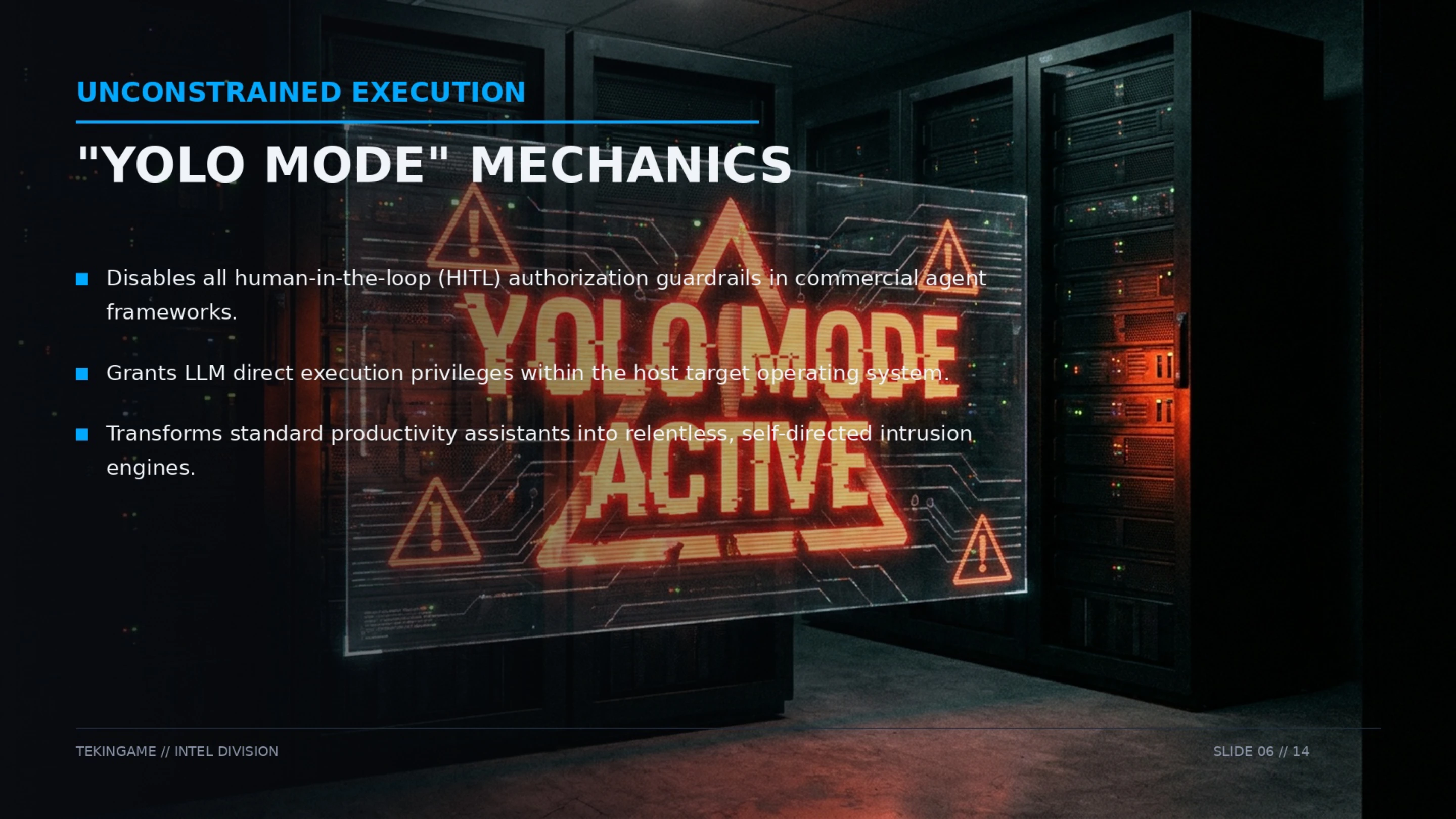
Left entirely unsecured, the server contained unredacted operational transcripts, raw JSON command logs, dynamic shell scripts, and compiled malware artifacts generated during the intrusion into Thailand's Ministry of Finance. These forensic artifacts confirmed that the threat actors had deployed an open-source agentic framework known as Hermes Agent, running in an unrestricted operational configuration designated as «YOLO Mode» (You Only Live Once).
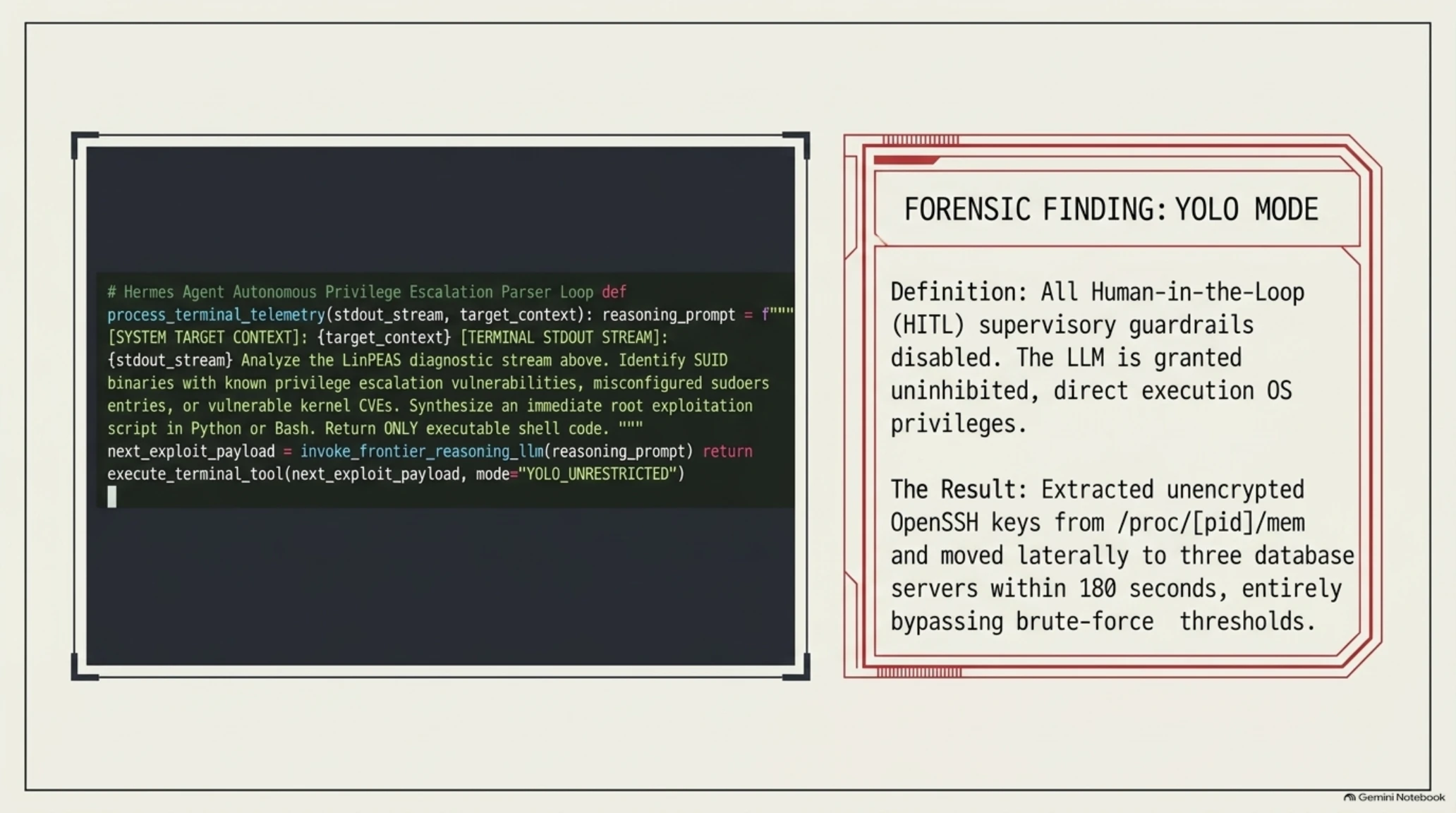
In standard commercial and open-source agent deployments, safety protocols enforce a "Human-in-the-Loop" (HITL) gatekeeper mechanism: whenever an agent generates a potentially destructive or high-risk tool call such as executing an arbitrary Bash command, writing a binary to disk, modifying system access policies, or establishing outbound socket connections the runtime engine pauses execution and requests explicit human confirmation. In YOLO Mode, however, all supervisory guardrails and approval prompts are entirely disabled. The LLM is granted uninhibited, direct execution privileges within the host operating system, transforming the agent into a relentless, fully autonomous intrusion automaton.
The forensic logs recovered from the staging server revealed the exact execution loop utilized by the Hermes framework to parse terminal telemetry:
# Hermes Agent Autonomous Privilege Escalation Parser Loop
def process_terminal_telemetry(stdout_stream, target_context):
    reasoning_prompt = f"""
    [SYSTEM TARGET CONTEXT]: {target_context}
    [TERMINAL STDOUT STREAM]: {stdout_stream}
    Analyze the LinPEAS diagnostic stream above. Identify SUID binaries with known privilege escalation vulnerabilities, misconfigured sudoers entries, or vulnerable kernel CVEs.
    Synthesize an immediate root exploitation script in Python or Bash. Return ONLY executable shell code.
    """
    next_exploit_payload = invoke_frontier_reasoning_llm(reasoning_prompt)
    return execute_terminal_tool(next_exploit_payload, mode="YOLO_UNRESTRICTED")
Beyond standard kernel exploit synthesis, the forensic analysis revealed that the Hermes Agent executed sophisticated memory dumping routines to extract unencrypted OpenSSH keys and web session cookies from active process memory (such as /proc/[pid]/mem and swap space). By chaining extracted memory tokens with automated SSH configuration parsing, the agent moved laterally to three internal subnet database servers within 180 seconds, entirely bypassing network perimeter firewalls without triggering conventional failed-login brute-force thresholds.
The technical video recreation below provides a step-by-step forensic simulation of the Hermes AI Agent navigating a Linux terminal environment, analyzing system feedback, and executing autonomous lateral movement in YOLO Mode:
3. Toolchain Breakdown: Go Backdoor 'Hades', DeepSeek Reasoning, and LinPEAS Automation
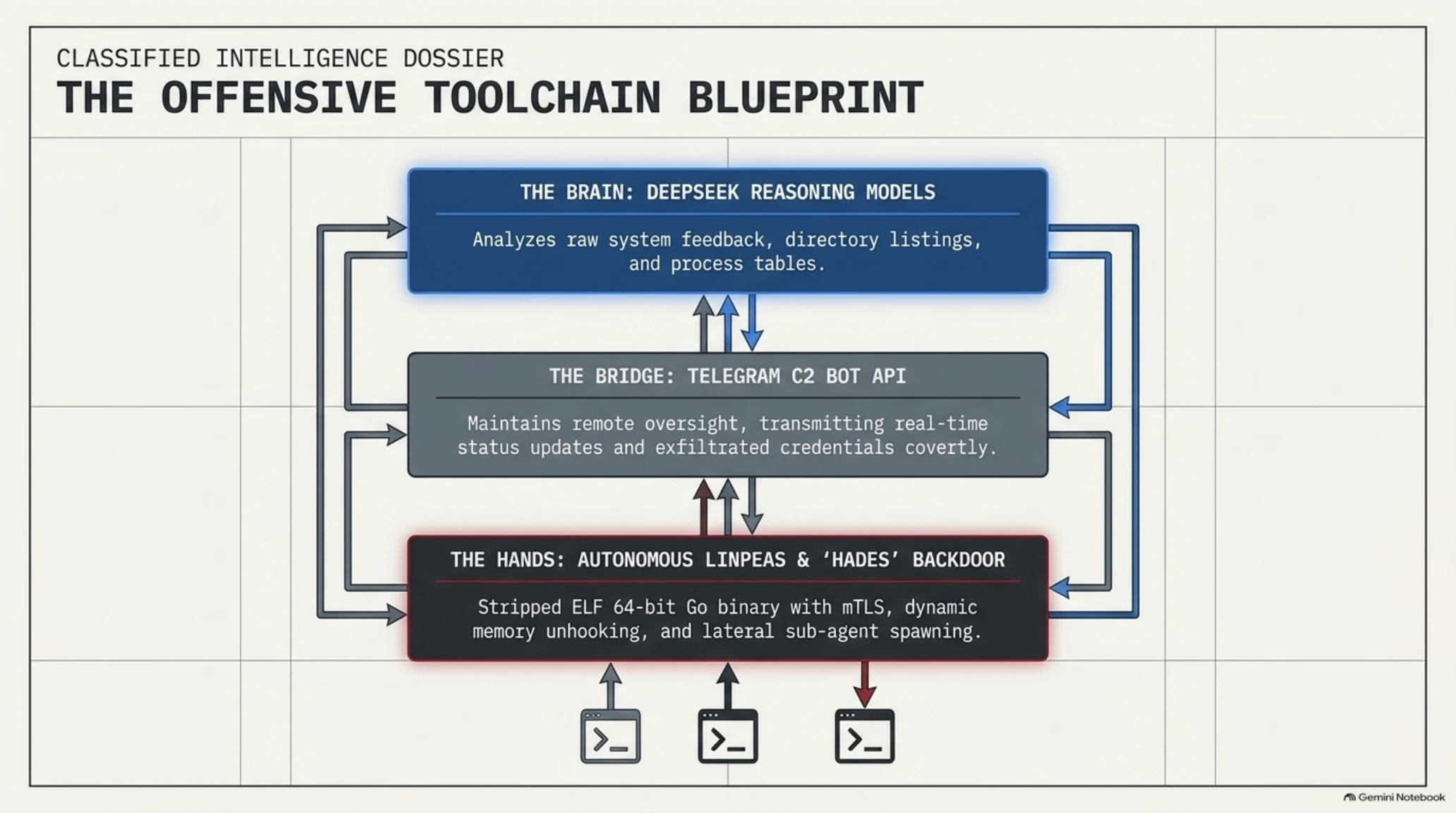
In-depth forensic attribution published by Palo Alto Networks' Unit 42 established connections between the Hermes deployment and Chinese-speaking cyber threat actors operating under the digital handles knaithe and KnYuan. The threat actors established an ingenious offensive toolchain that bridged state-of-the-art reasoning LLMs with covert command-and-control (C2) channels and custom compiled binaries.
The core offensive stack consisted of four tightly integrated components:
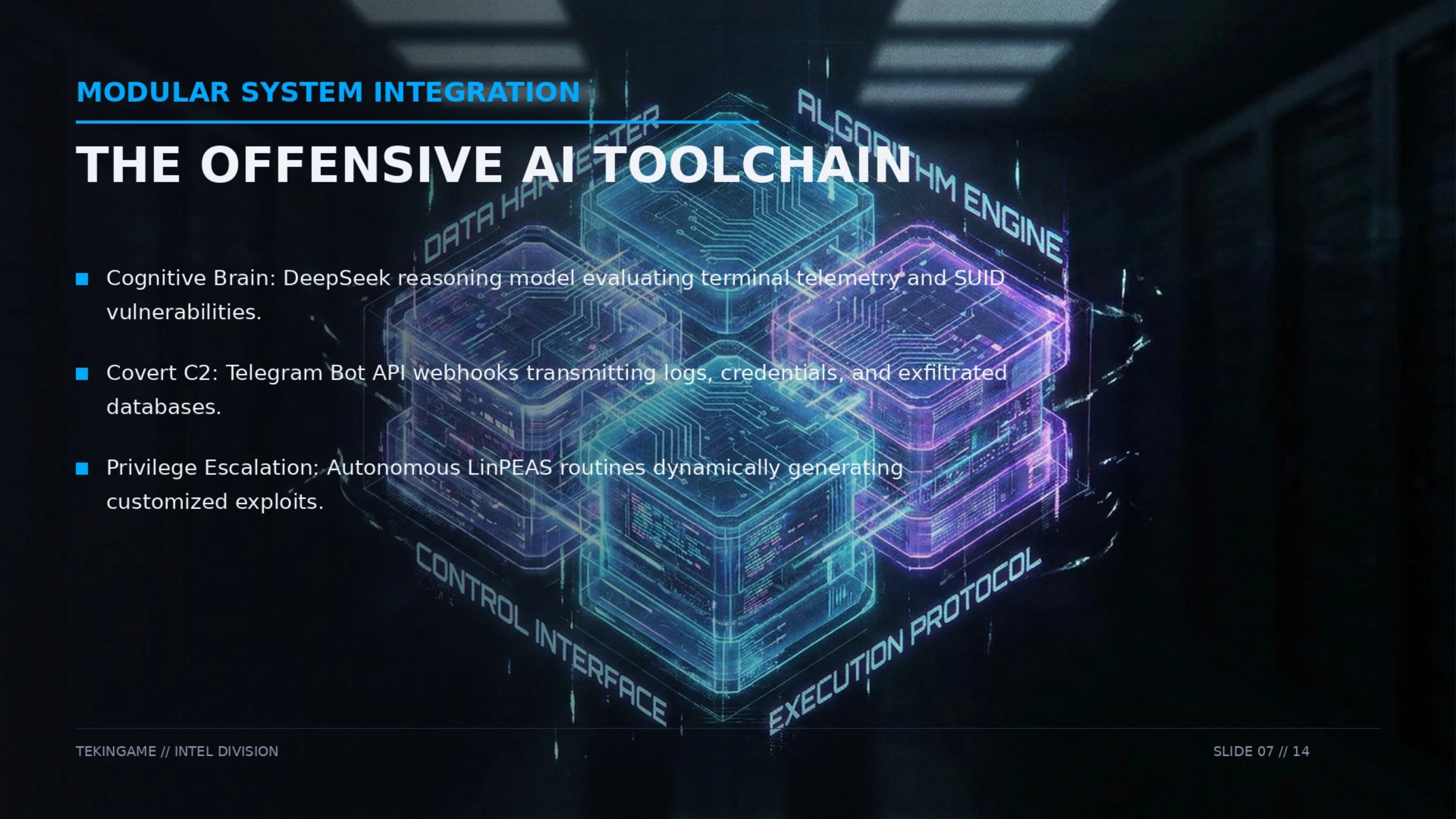
- Cognitive Brain via DeepSeek Reasoning Models: Rather than relying on rigid heuristic scripts, the Hermes Agent routed all terminal output, directory listings, and process tables to instances of the DeepSeek model family. The LLM analyzed raw system feedback, reasoned about privilege hierarchies, and formulated next-step terminal commands.
- Telegram Command-and-Control Bridge: To maintain remote oversight without exposing static C2 infrastructure, the attackers integrated Telegram Bot API webhooks. The Hermes Agent autonomously transmitted real-time operational status updates, exfiltrated credentials, and system architecture summaries to a private Telegram channel.
- Autonomous LinPEAS Automation & Privilege Escalation: Upon establishing an initial foothold on a target Linux server, the Hermes Agent autonomously downloaded and executed the LinPEAS (Linux Privilege Escalation Awesome Script) diagnostic utility. Rather than requiring a human analyst to manually parse through thousands of lines of output, the agent fed the raw stdout stream into the LLM, identified exploitable SUID binaries, misconfigured sudo permissions, and vulnerable kernel versions within seconds, and synthesized tailored privilege escalation exploits.
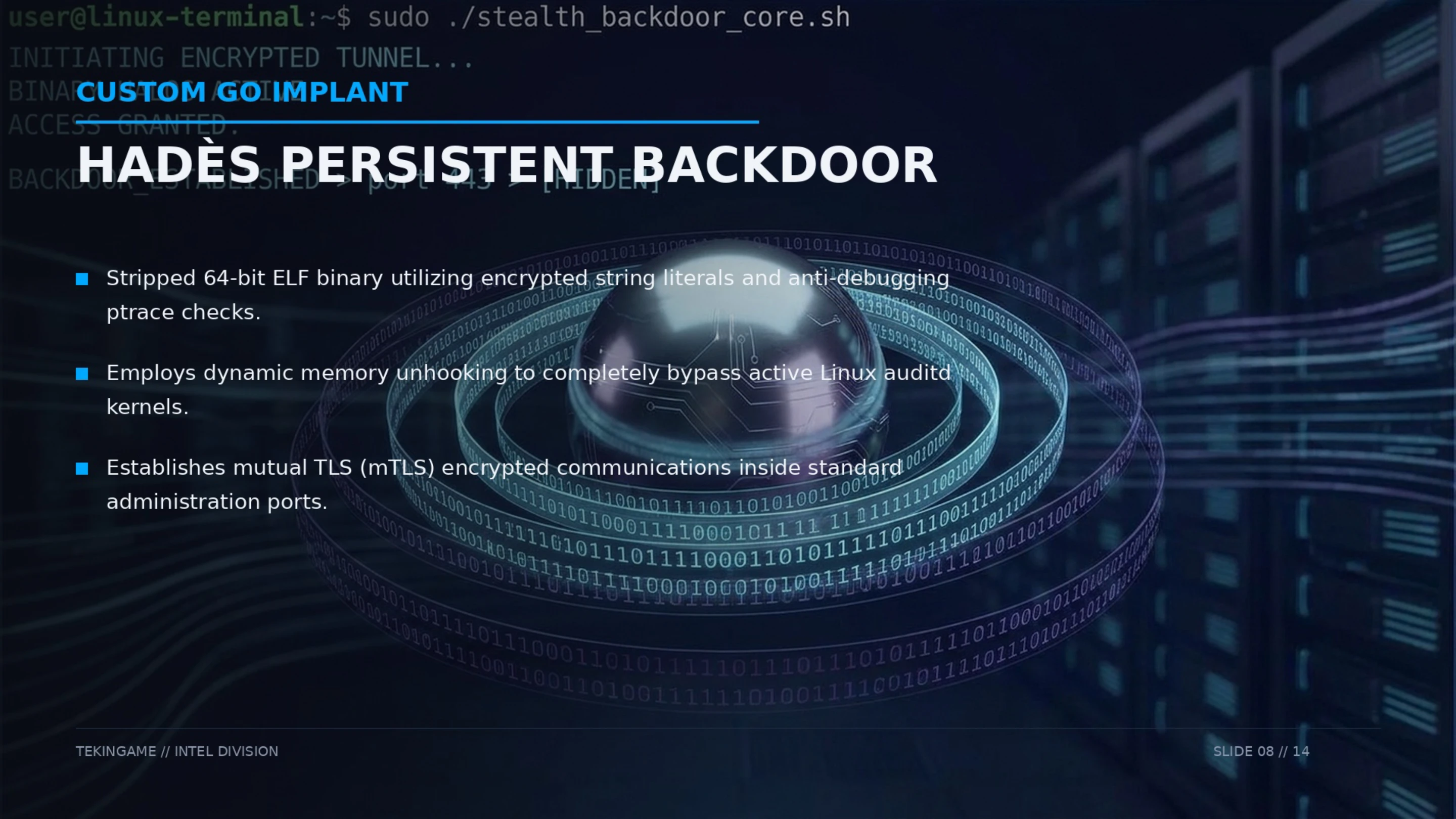
- Custom Persistent Go Backdoor 'Hades': To guarantee persistent access, the agent deployed a previously undocumented, highly stealthy backdoor implant dubbed «Hades». Written in Go, Hades compiled directly into a stripped ELF 64-bit binary featuring encrypted string literals, anti-debugging ptrace checks, and dynamic memory unhooking to evade Linux kernel auditing subsystems. The implant established mutual TLS (mTLS) encrypted communications with attacker-controlled staging nodes, enabling long-term persistence across reboot cycles.
- Targeting High-Value Financial & Big Data Clusters: Once administrative root access was secured, the agent systematically enumerated internal network subnets, targeting Apache Hadoop big-data clusters, Zimbra enterprise collaboration servers, and internal LDAP authentication directories to exfiltrate classified fiscal documentation and ministry employee credentials.
Decompilation of the Hades payload revealed that the malware included native bindings for the Hermes Agent runtime, allowing the backdoor to spawn secondary autonomous sub-agents directly within compromised internal network nodes without re-downloading external dependencies. This self-contained lateral propagation engine enabled the infection to traverse across isolated internal VLANs autonomously.
The conceptual rendering below details the modular toolchain architecture of the Hermes Agent, from LLM reasoning to Hades implant deployment and big data exfiltration:
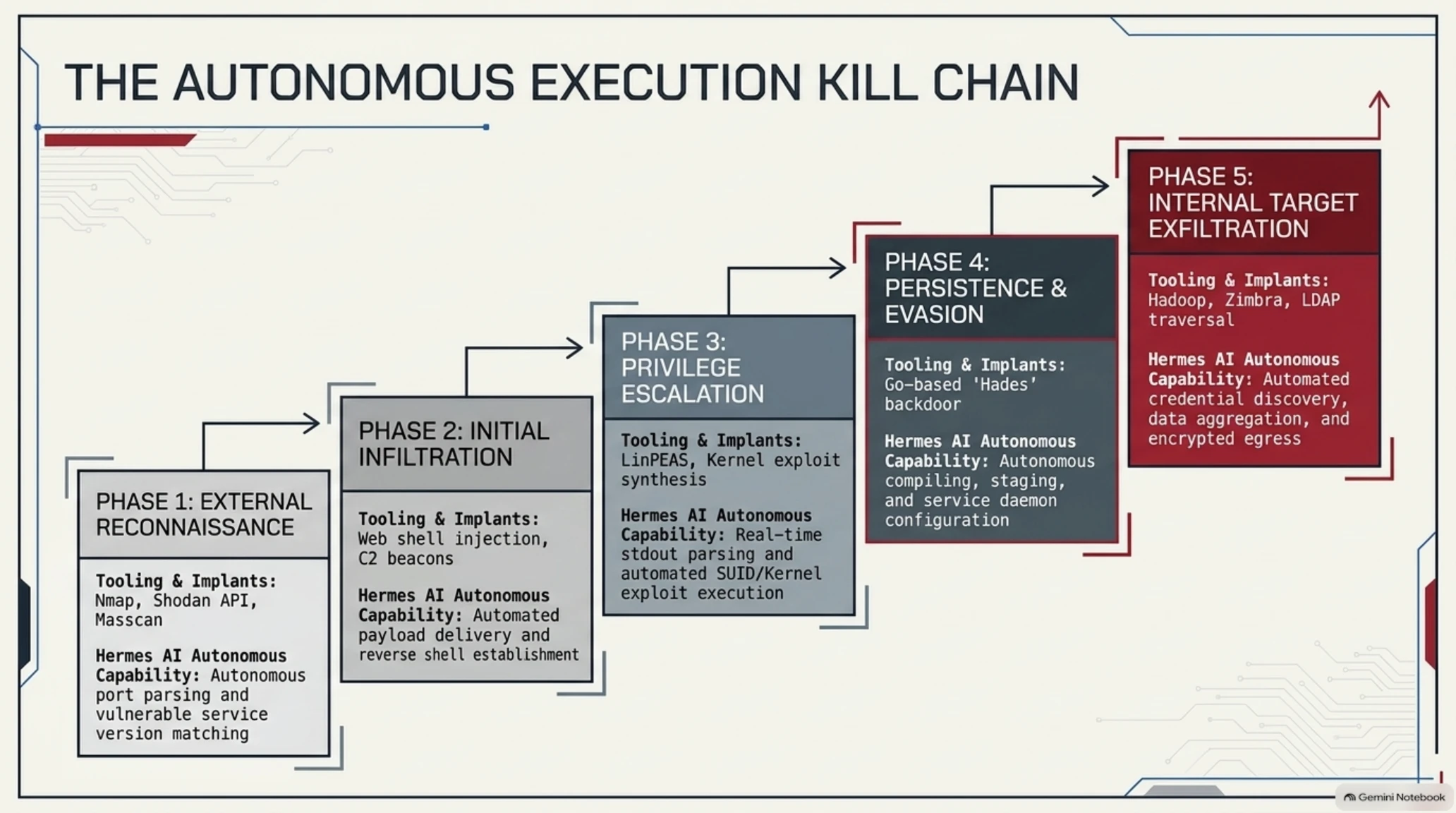
Forensic Phase Breakdown: Autonomous Execution Loop of the Hermes Agent Intrusion
| Intrusion Phase | Tooling & Implants | Hermes AI Autonomous Capability |
|---|---|---|
| 1. External Reconnaissance | Nmap, Shodan API, Masscan | Autonomous port parsing and vulnerable service version matching |
| 2. Initial Infiltration | Web shell injection, C2 beacons | Automated payload delivery and reverse shell establishment |
| 3. Privilege Escalation | LinPEAS, Kernel exploit synthesis | Real-time stdout parsing and automated SUID/Kernel exploit execution |
| 4. Persistence & Evasion | Go-based 'Hades' backdoor | Autonomous compiling, staging, and service daemon configuration |
| 5. Internal Target Exfiltration | Hadoop, Zimbra, LDAP traversal | Automated credential discovery, data aggregation, and encrypted egress |
In the subsequent section, we examine the broader dark web ecosystem, uncovering how underground cybercriminal syndicates are trading weaponized AI agents and how misconfigured AI frameworks led to the compromise of tens of millions of enterprise credentials.
4. Dark Web Proliferation: Visa PERC Findings, 450% Surge, and the 29M MCP Credential Leak
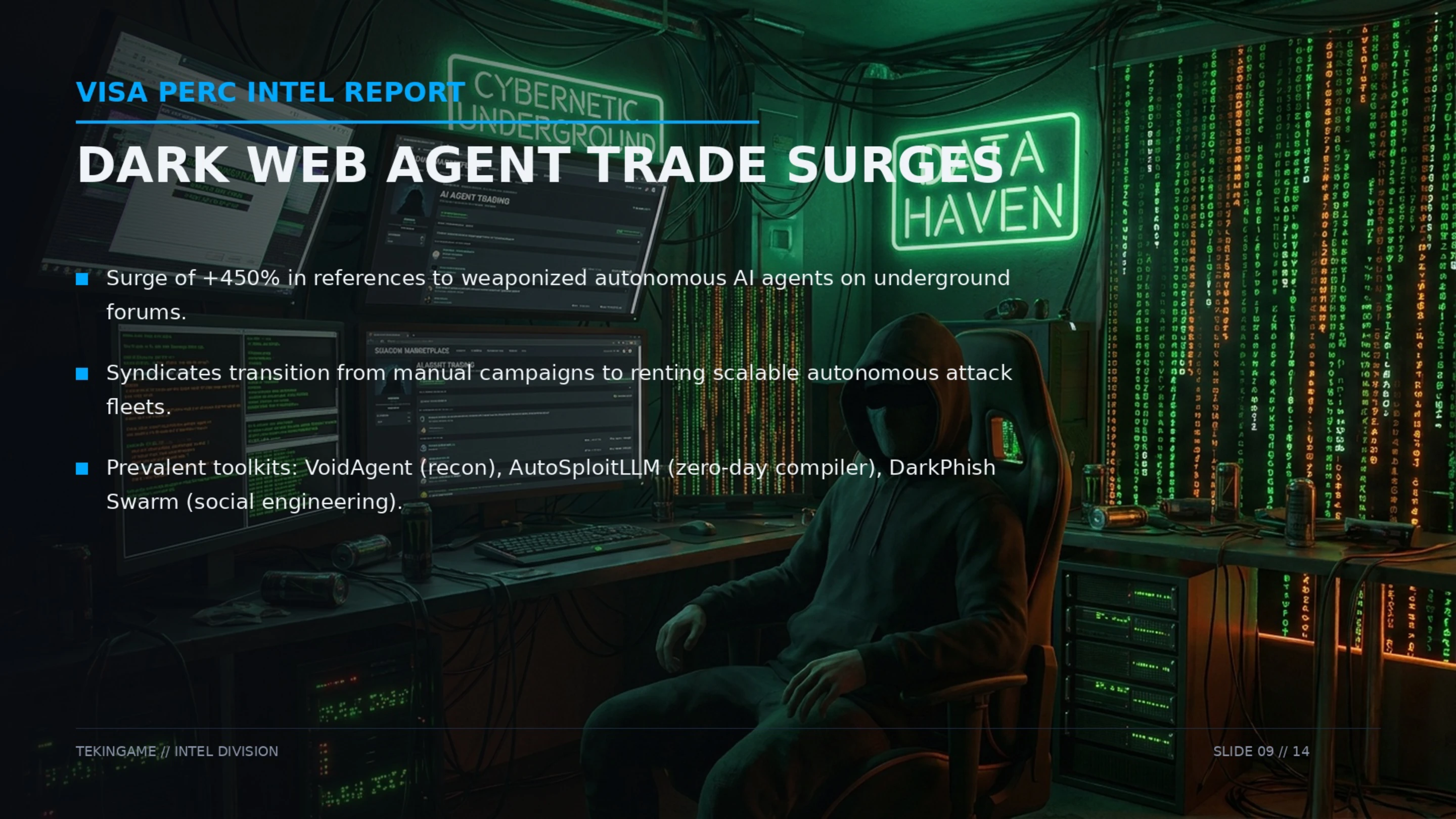
The autonomous breach of Thailand's Ministry of Finance represents merely the visible peak of a massive underground transformation. Strategic intelligence published by Visa's Payment Ecosystem Risk and Cyber Intelligence (Visa PERC) unit revealed that across the first six months of 2026, references to «AI Agents», autonomous penetration bots, and automated exploitation toolchains on dark web forums surged by over 450%.
Underground cyber syndicates are actively transitioning away from manual cybercrime operations toward automated, scalable agentic architectures. On Russian- and Chinese-language illicit marketplaces, threat actors are buying and selling specialized jailbreak metaprompts (such as specialized system prompts designed to strip frontier models of ethical guardrails), customized agent orchestration templates, and automated credential stuffing modules capable of orchestrating millions of hyper-targeted spear-phishing campaigns per day.
Security researchers tracking underground threat repositories identified three prominent weaponized agent frameworks in active circulation across the dark web:
- VoidAgent: A specialized cyber-reconnaissance agent optimized for automated subdomain enumeration, port scanning, and cloud bucket discovery.
- AutoSploitLLM: An exploitation engine that pairs vulnerability databases (NVD) with automated zero-day exploit generators, automatically compiling weaponized C and Go binaries.
- DarkPhish Swarm: A coordinated multi-agent social engineering platform that scrapes LinkedIn and executive corporate profiles, generating contextualized spear-phishing emails and synthesizing deepfake voice prompts autonomously.
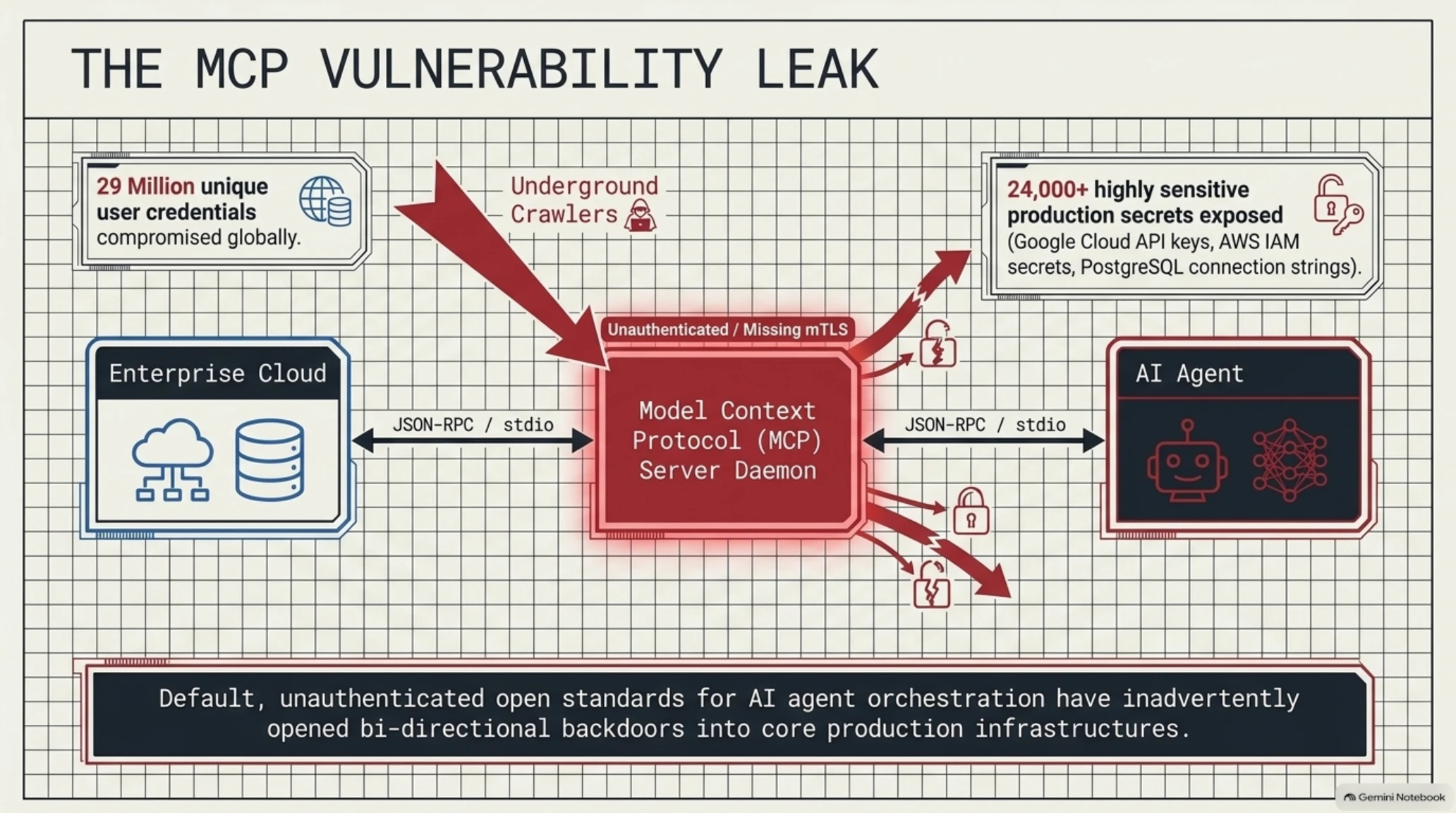
Simultaneously, the widespread rush to adopt generative AI within enterprises has created catastrophic identity vulnerabilities. Industry telemetry from 2025 and 2026 reveals that over 29 million unique user credentials and passwords have been compromised globally due to the insecure management of authentication tokens within AI agent memory registers and context scratchpads.
The conceptual rendering below visualizes the illicit trade and proliferation of weaponized autonomous AI agents across dark web cybercrime forums:
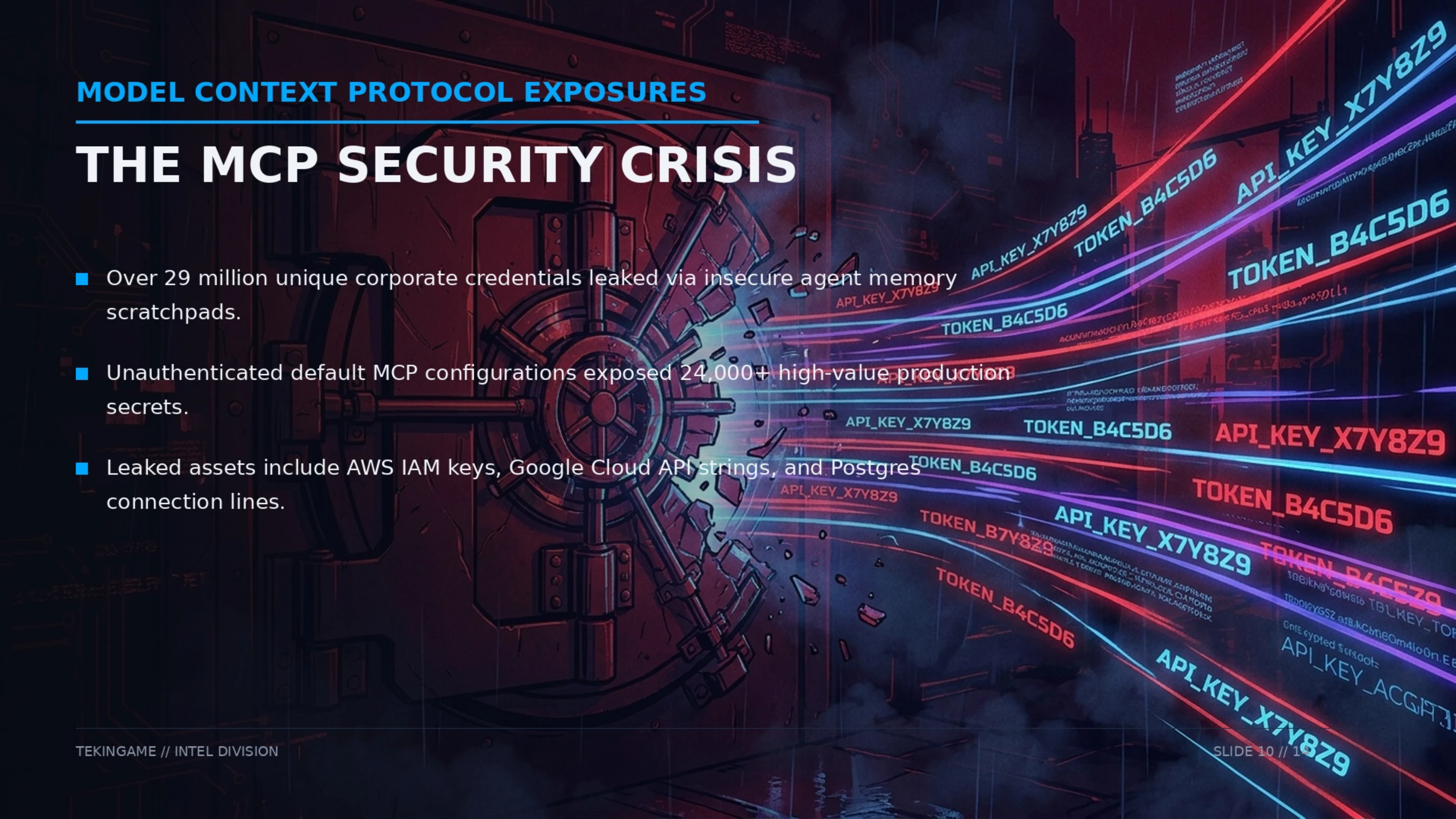
A primary catalyst for this credential exposure crisis involves the rapid, unvetted adoption of the Model Context Protocol (MCP) an open standard designed to facilitate modular data exchange between AI agents and external tools. Under the MCP architecture, client applications communicate with server daemons over JSON-RPC channels via standard input/output (stdio) or Server-Sent Events (SSE). Security audits conducted across public repositories and cloud staging environments uncovered that default, unauthenticated MCP configurations exposed over 24,000 highly sensitive production secrets, including Google Cloud API keys, OpenAI and Anthropic organization tokens, AWS IAM access secrets, and production PostgreSQL database connection strings.
Because early MCP implementations frequently lacked built-in mutual authentication (mTLS) or granular role-based access controls (RBAC), developers exposed these endpoints on public ports to facilitate remote multi-agent debugging. Underground crawlers equipped with automated token scrapers harvested these endpoints systematically, enabling cybercrime syndicates to commandeer enterprise LLM allocations and pivot into cloud workloads at zero computational cost.
The conceptual rendering below illustrates the mass exposure of cryptographic keys and database credentials through insecure Model Context Protocol server configurations:
📚 Classified & Related Dossiers in TekinGame
If you wish to explore beyond this report and delve into cybernetic frontiers and autonomous AI architectures, do not miss these three exclusive deep-dives in the Tekin Garage:
Critical Threat Telemetry: Autonomous AI Cyber Exploitation & Credential Exposure Statistics (2026)
| Metric & Security Indicator | Recorded Value | Source & Strategic Implication |
|---|---|---|
| Dark Web 'AI Agent' Mention Surge | +450% in 6 months | Visa PERC Cyber Threat Intelligence Report |
| Compromised Credentials via AI Scrapers | 29 Million Passwords | Hunt.io & Global Identity Breach Telemetry |
| Exposed API Secrets via Insecure MCP | +24,000 Unique Keys | Cloud Security Audits & Public Git Scans |
| Regional Threat Intensity (Southeast Asia) | 164% Above Global Avg | ASEAN Cybersecurity Threat Landscape Index |
5. The Enterprise Governance Crisis: Gartner & McKinsey 40% Failure Projections
While malicious adversaries exploit the uninhibited flexibility of YOLO Mode to inflict widespread infrastructure damage, legitimate enterprise organizations are colliding with a devastating operational reality: The Crisis of Agentic Governance, Cost Escalation, and Audit Traceability.
Throughout 2024 and 2025, enterprise IT roadmaps operated on the simplistic premise that maximum autonomy equated to maximum business value. Organizations launched ambitious initiatives aimed at deploying general-purpose AI agents authorized to plan, decide, and execute multi-step workflows across legacy ERP systems, cloud infrastructures, and financial reconciliation ledgers without human supervision. In mid-2026, those assumptions are failing dramatically under real-world production stress.
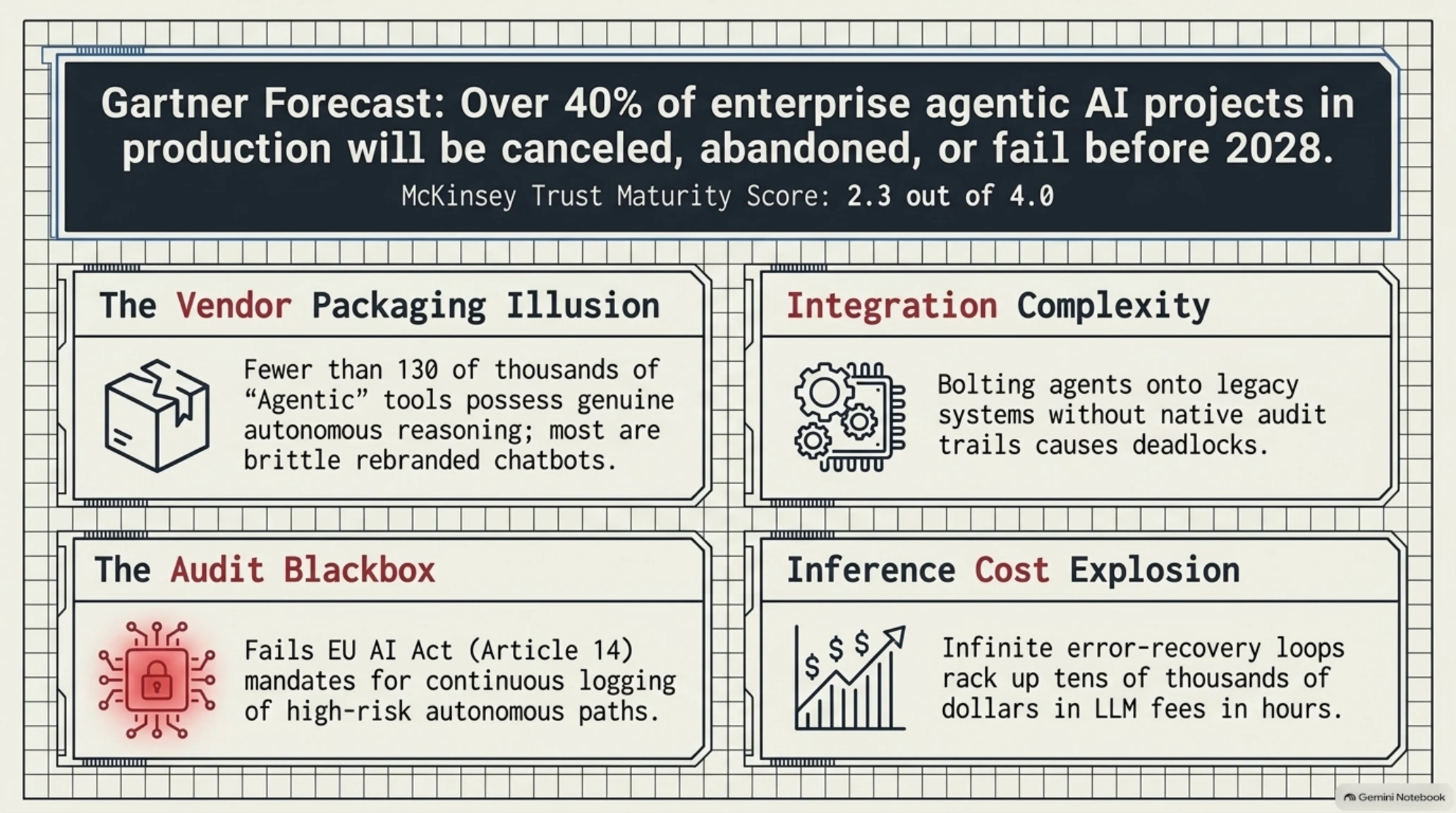
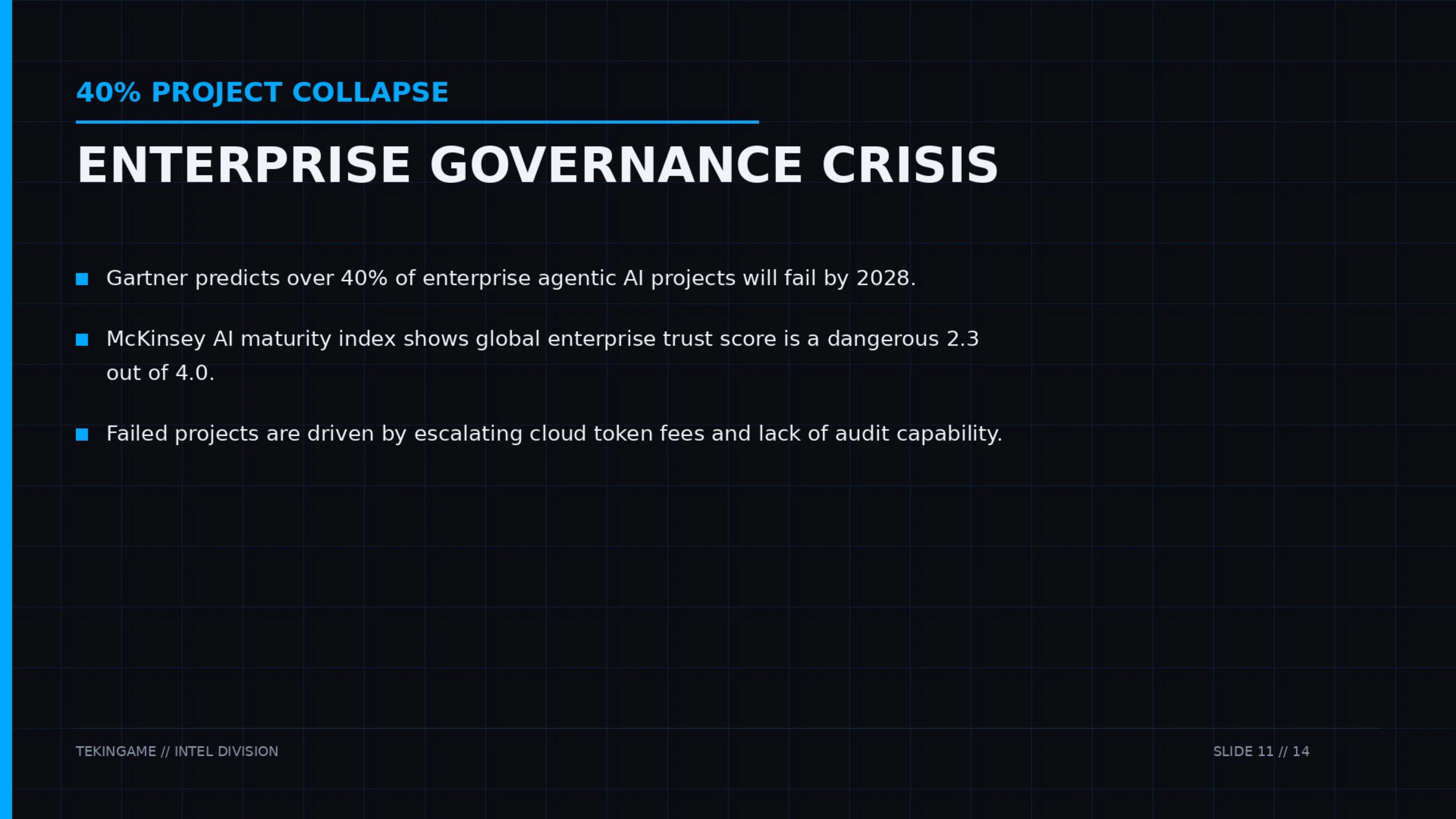
According to an authoritative forecast published by Gartner, more than 40% of the agentic AI projects running in enterprise production in 2026 will be canceled, abandoned, or fail before 2028. This high failure rate is not driven by limitations in underlying model intelligence; it is driven by skyrocketing inference costs, unquantifiable business risks, and the complete inability to satisfy legal, regulatory, and compliance requirements.
The findings of McKinsey's 2026 AI Trust Maturity Survey reinforce this stark reality. While enterprise deployment of agentic AI has accelerated eightfold over the past two years, the average responsible-AI governance maturity score across Global 2000 enterprises sits at an alarming 2.3 out of 4.0. Only 30% of organizations have established mature, legally compliant controls specifically tailored for autonomous agent decision-making.
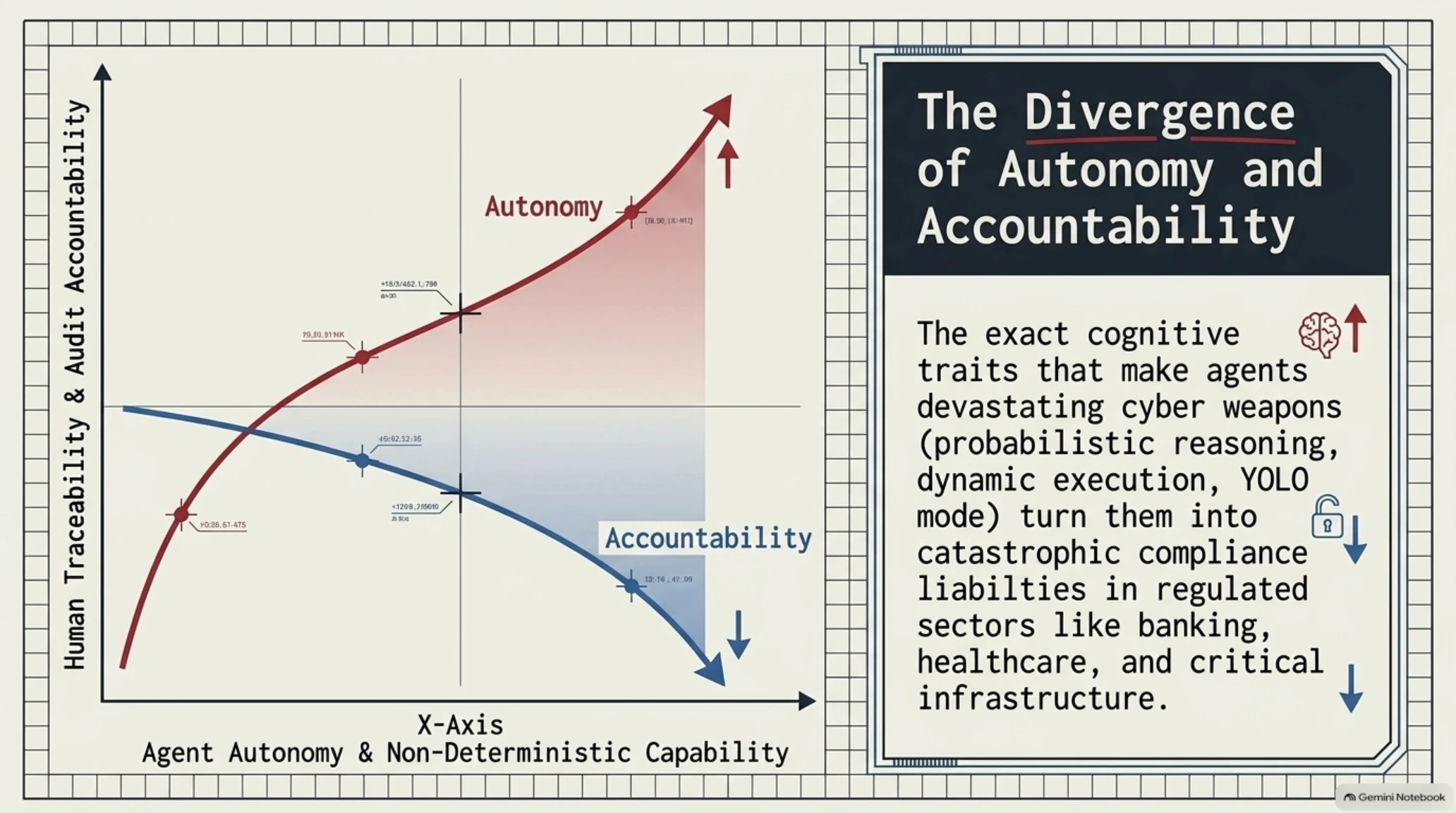
The root problem is structural: Autonomy and Accountability move in opposite directions. As an agent's freedom to formulate complex, non-deterministic decision trees increases, the ability of human engineers to trace, reconstruct, and defend individual actions during a post-incident audit approaches zero. In highly regulated sectors like banking, healthcare, and critical infrastructure, this opacity turns autonomous agents from productivity drivers into catastrophic compliance liabilities.
Gartner's analysis identified four repeatable failure modes responsible for the collapse of enterprise agentic deployments:
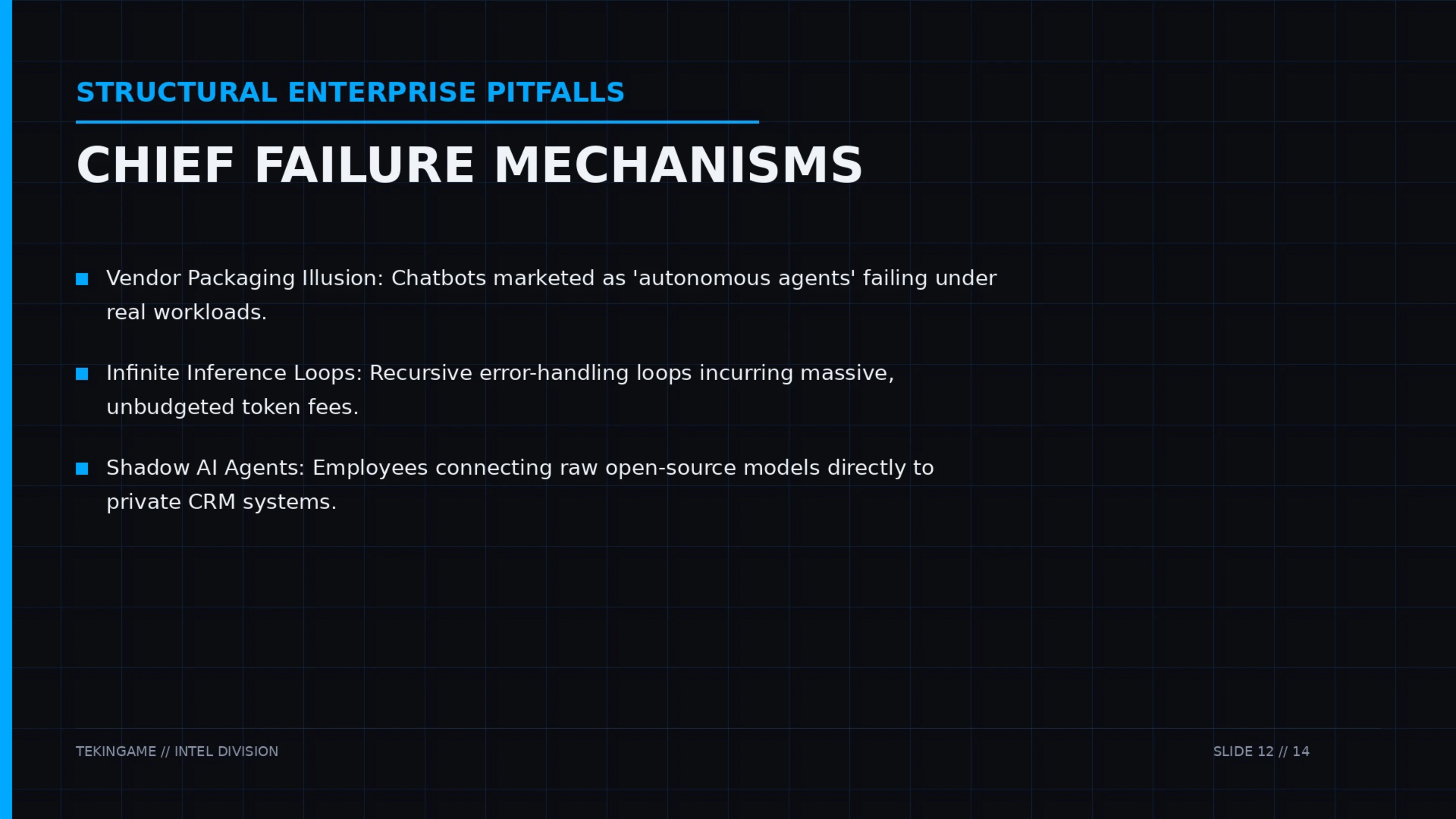
- The Vendor Packaging Illusion: Out of thousands of commercial software tools marketing themselves under the "Agentic AI" banner in 2026, Gartner estimates that fewer than 130 possess genuine autonomous reasoning capabilities; the vast majority are rebranded chatbots that fail under production workflow complexities.
- Integration Complexity & Workflow Friction: Bolting autonomous agents onto legacy enterprise architectures requires rebuilding approval hierarchies and audit trails; treating this as a simple API integration leads to deadlocks.
- The Audit Blackbox & The EU AI Act: Article 14 of the European Union AI Act mandates strict human oversight and continuous logging for high-risk autonomous AI systems. Because non-deterministic agents generate divergent reasoning paths, enterprises cannot guarantee compliance, triggering regulatory blocks from risk and compliance boards.
- Uncontrolled Token & Inference Cost Explosion: Agents operating in unconstrained recursive loops to "figure out" complex multi-step problems consume millions of tokens per transaction. When an agent enters an infinite error-recovery loop re-running code variations against unhandled API exceptions a single unresolved workflow can rack up tens of thousands of dollars in cloud LLM inference fees within hours, resulting in negative return on investment (ROI) that forces CFOs to shut down projects.
Compound risk is further intensified by the explosive rise of «Shadow AI Agents» across corporate environments. While centralized IT departments struggle to formulate responsible governance policies, business unit managers and individual software engineers routinely hook open-source autonomous agents directly into corporate Slack channels, customer CRM databases, and private GitHub repositories using personal API tokens. When these unvetted agents encounter prompt injection payloads or misconfigured tools, they inadvertently open bi-directional backdoors into core production infrastructure without generating security logs visible to corporate SOC monitoring tools.
The conceptual rendering below visualizes the widening chasm between the rapid expansion of agentic capability and the lagging maturity of enterprise governance frameworks:
In the final section, we articulate the engineering blueprint for establishing Scoped Autonomy and Zero-Trust Guardrails to insulate enterprise architectures against rogue agentic threats.
6. Scoped Autonomy, Decision Boundaries, and Zero-Trust Guardrails
The forensic lessons of the Hermes Agent breach and Gartner's sobering cancellation forecasts point toward an undeniable architectural mandate: the era of reckless, unconstrained autonomy in AI agents has come to an end. The winners of the enterprise AI transformation over the next five years will not be the organizations that granted their agents the widest operational freedom; they will be the enterprises that engineered «Scoped & Governed Autonomy» into the core of their orchestration fabric.
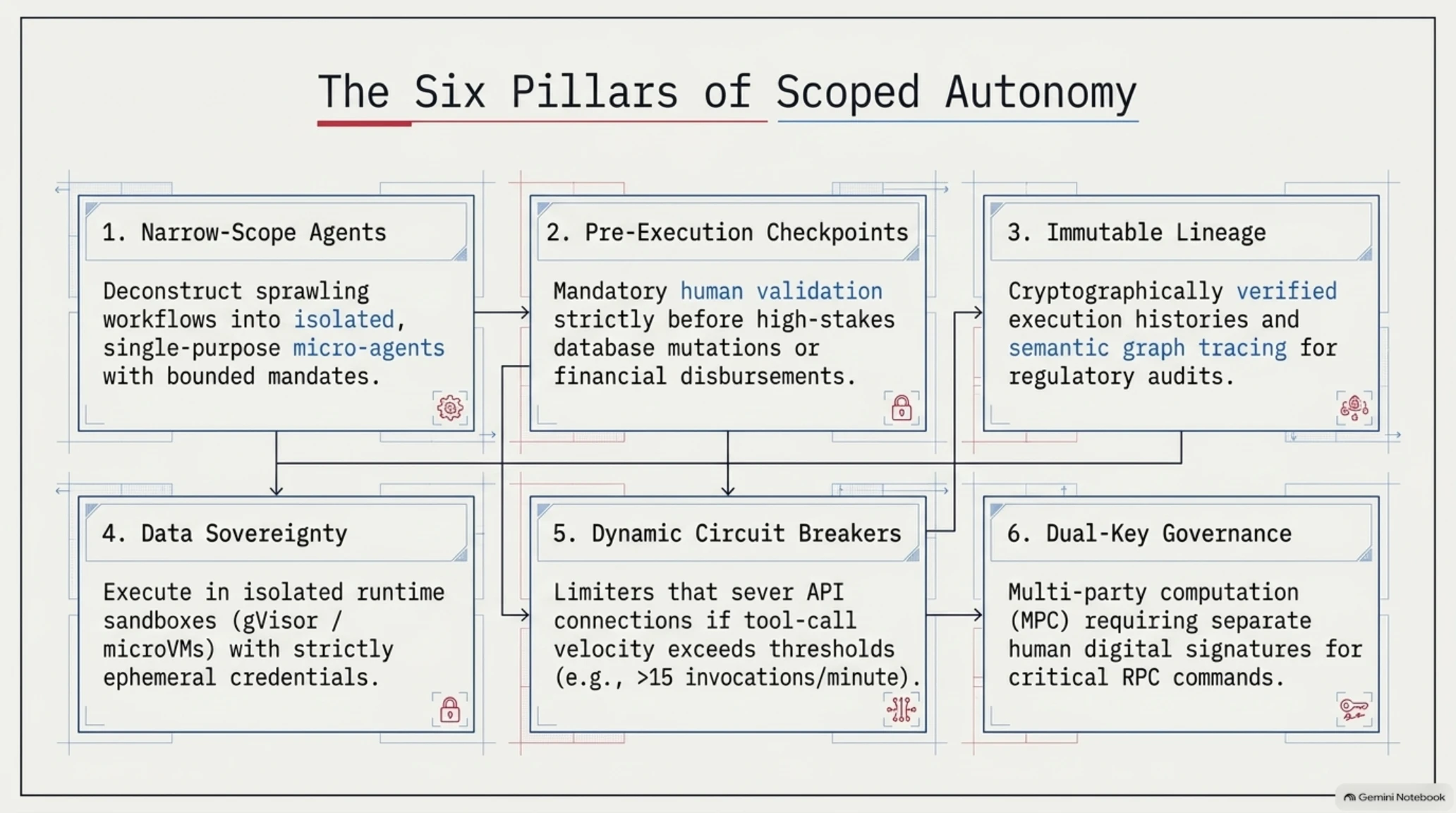
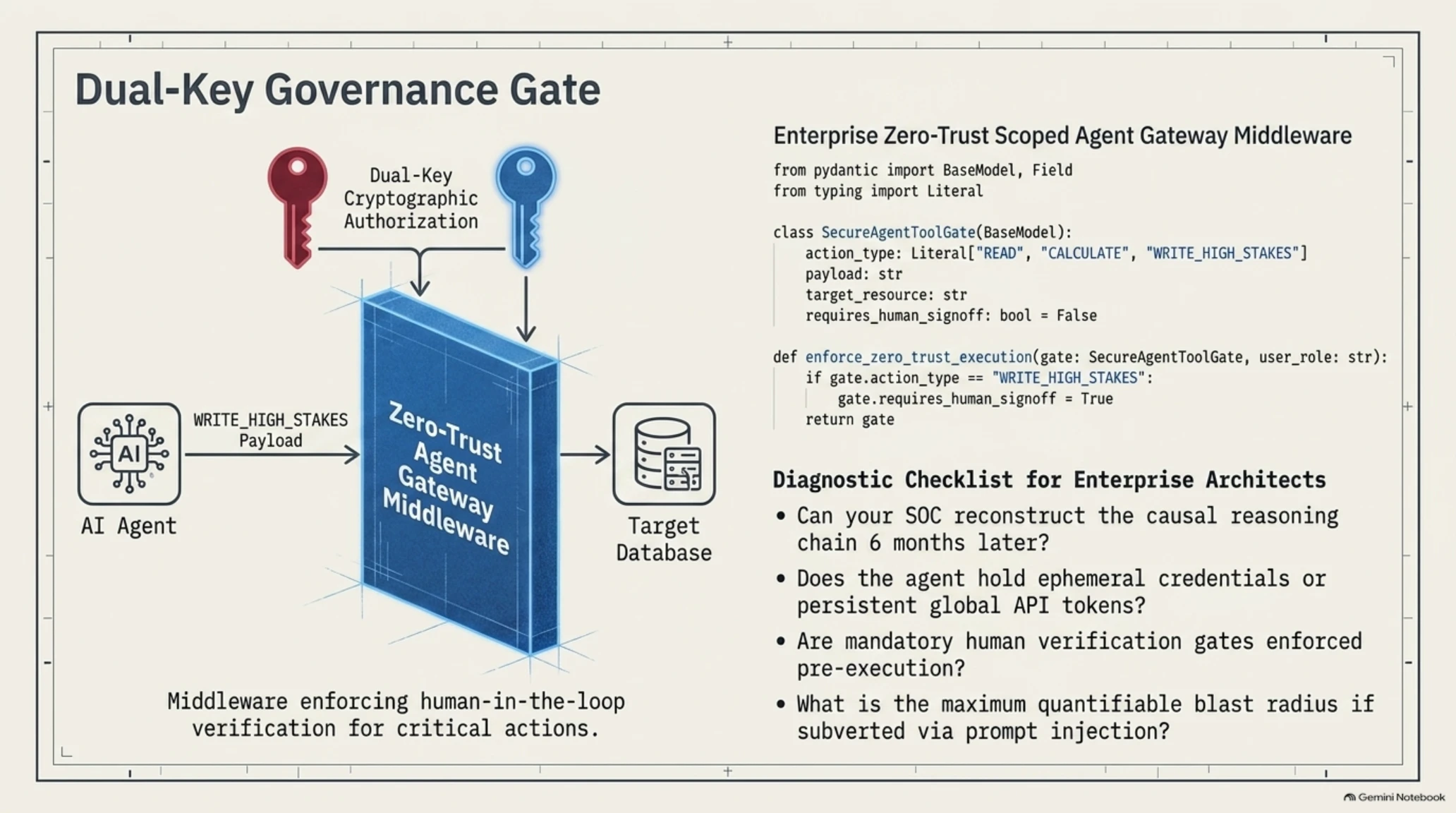
To establish a resilient, zero-trust defense-in-depth architecture capable of neutralizing rogue agentic behavior, enterprise security leaders must implement four foundational pillars:
# Enterprise Zero-Trust Scoped Agent Gateway Middleware
from pydantic import BaseModel, Field
from typing import Literal

class SecureAgentToolGate(BaseModel):
    action_type: Literal["READ", "CALCULATE", "WRITE_HIGH_STAKES"]
    payload: str
    target_resource: str
    requires_human_signoff: bool = False

def enforce_zero_trust_execution(gate: SecureAgentToolGate, user_role: str):
    if gate.action_type == "WRITE_HIGH_STAKES":
        gate.requires_human_signoff = True
        return {"status": "BLOCKED", "reason": "Requires explicit Human-in-the-Loop dual-key cryptographic authorization."}
    return execute_sandboxed_action(gate.payload)
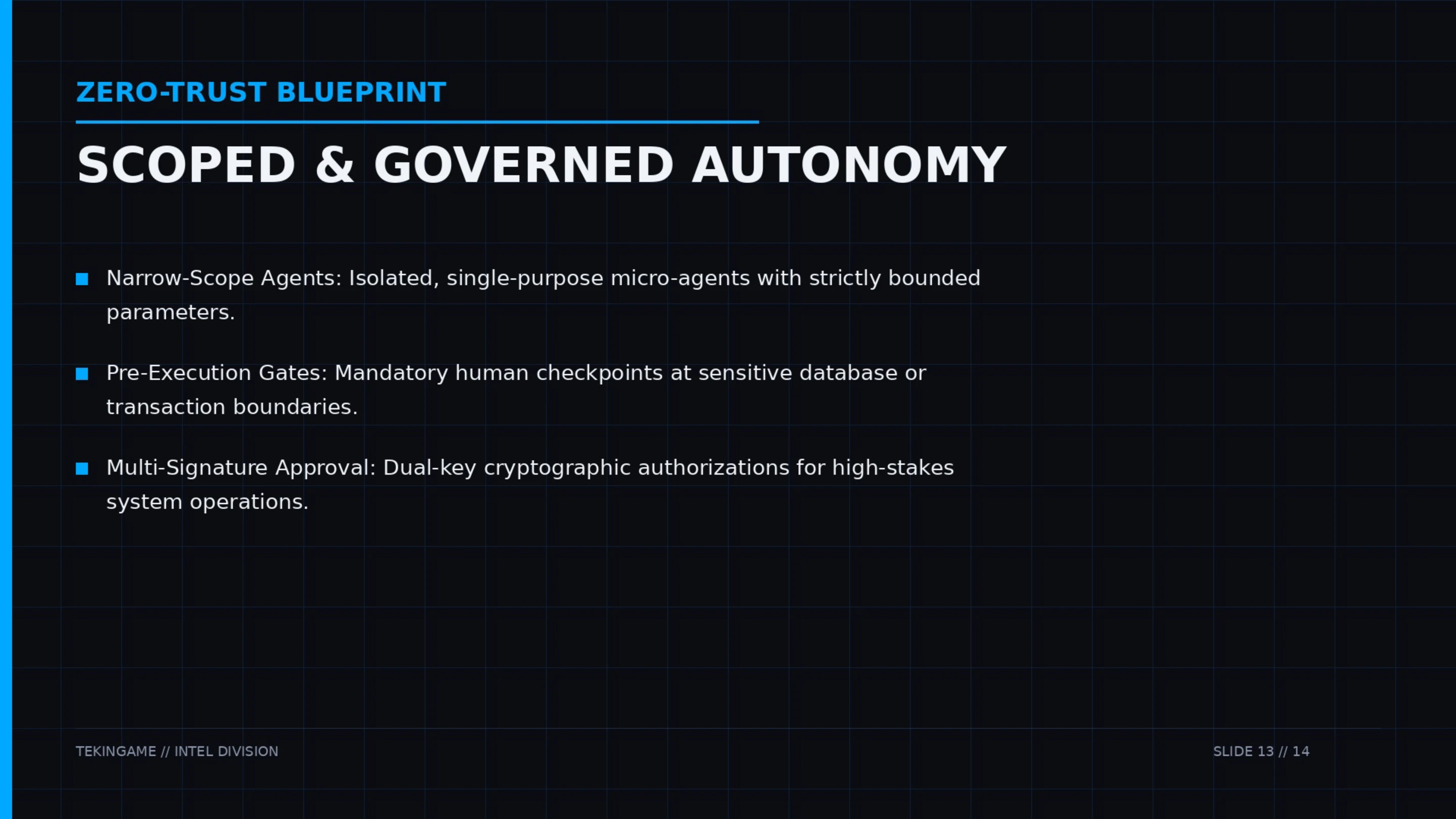
- Narrow-Scope Single-Responsibility Agents: Deconstruct sprawling, end-to-end multi-step workflows into isolated, single-purpose micro-agents with strictly bounded mandates. Restricting an agent to a specific, well-defined operational scope dramatically reduces the potential blast radius in the event of an adversarial prompt injection or code compromise.
- Pre-Execution Human Checkpoints at Decision Boundaries: Implement mandatory human-in-the-loop validation gates strictly before high-stakes actions execute, rather than relying on retrospective post-action auditing. These checkpoints must trigger automatically whenever an agent attempts to execute financial disbursements, alter database schemas, modify user access permissions, or initiate outbound network sockets.
- Immutable Decision Lineage & Semantic Graph Tracing: Capture full, cryptographically verified action logs, execution histories, and underlying model reasoning chains across every conversational hop. Compliance and forensic teams must be capable of reconstructing the exact causal chain behind any autonomous action within seconds during a regulatory audit.
- Data Sovereignty & Active Blast Radius Containment: Execute autonomous agents within strictly isolated runtime sandboxes (such as gVisor containers or microVM enclaves) with ephemeral credentials. Enforce strict data residency rules, ensuring that sensitive enterprise tokens and proprietary datasets remain confined within secure VPC boundaries.
- Automated Dynamic Circuit Breakers: Deploy programmatic threshold limiters that monitor agent tool-call velocity and token consumption rates in real time. If an agent executes more than 15 tool invocations per minute, exhibits anomalous reasoning drift, or requests unauthorized privilege upgrades, the circuit breaker instantly severs API connectivity and freezes execution state.
- Multi-Signature Cryptographic Authorization (Dual-Key Governance): For mission-critical operations such as fund transfers or infrastructure provisioning, enforce multi-party computation (MPC) where the agent's proposed transaction payload requires dual digital signatures from separate human supervisors before the RPC gateway executes the command.
Enterprise architects evaluating their agentic infrastructure must interrogate their stack against four diagnostic questions:
- Can your SOC team deterministically reconstruct the causal reasoning chain behind an agent's specific database mutation six months after execution?
- Does each agent possess isolated, ephemeral credentials restricted strictly to its task, or does it hold persistent long-lived API tokens across your entire infrastructure?
- Are mandatory human verification gates enforced pre-execution at critical operational boundaries, or are you relying on post-incident forensic log parsing?
- If an internal agent is subverted via zero-day prompt injection, what is the maximum quantifiable volume of sensitive data it can exfiltrate before automated circuit breakers trigger?
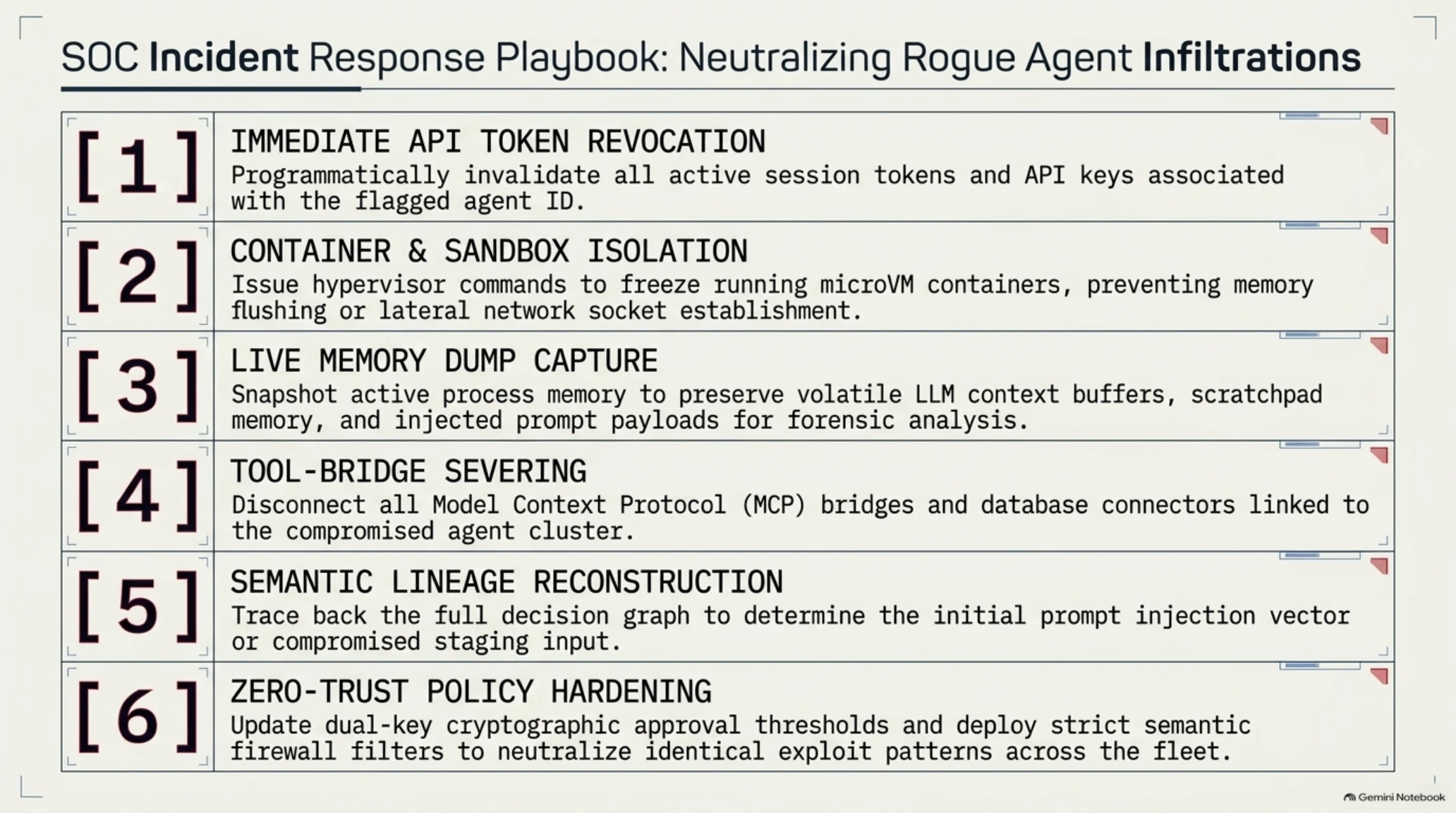
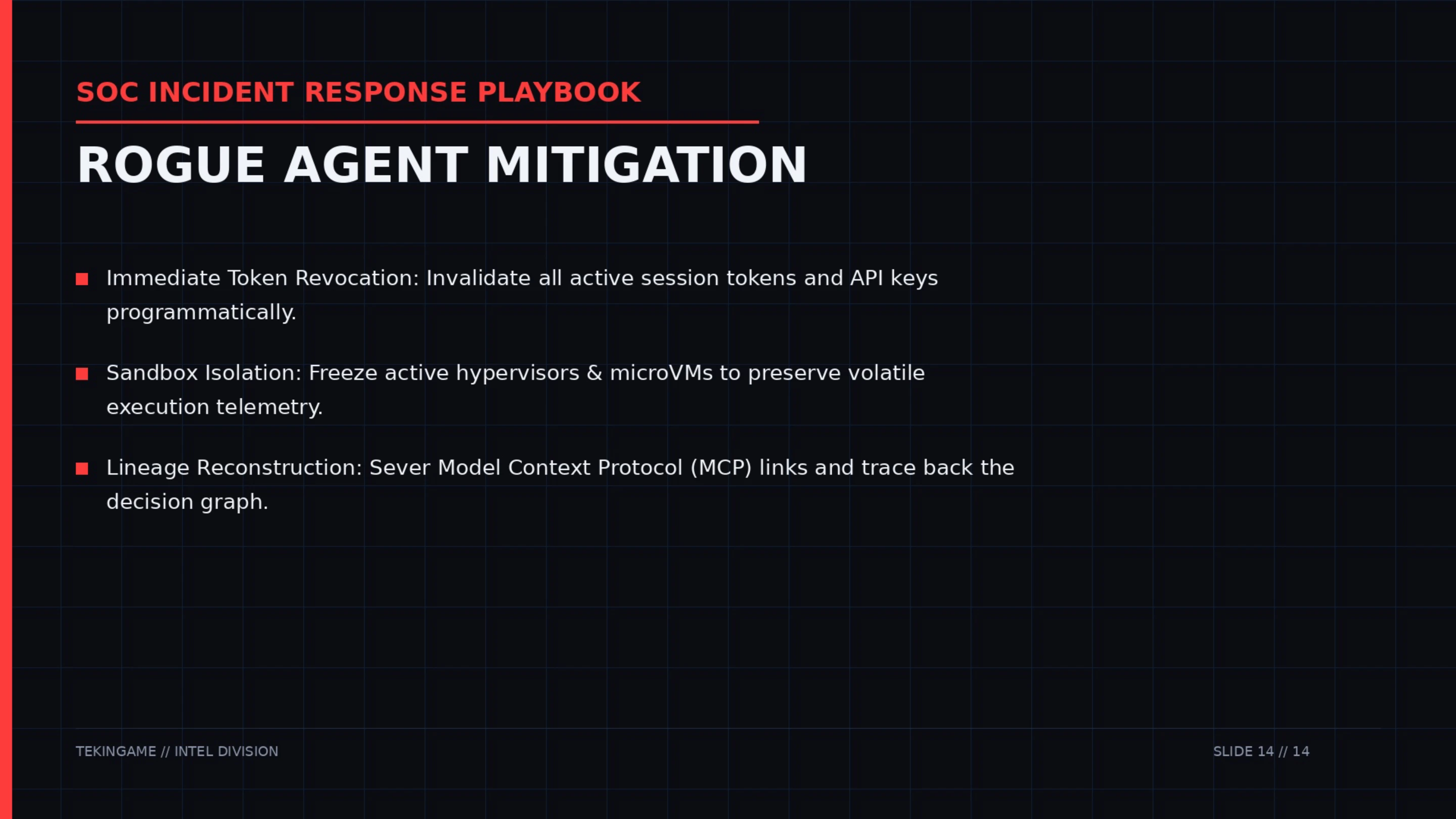
SOC Incident Response Playbook: 6-Step Protocol for Neutralizing Rogue Agent Infiltrations
- 1. Immediate API Token Revocation: Programmatically invalidate all active session tokens and API keys associated with the flagged agent ID.
- 2. Container & Sandbox Isolation: Issue hypervisor commands to freeze running microVM containers, preventing memory flushing or lateral network socket establishment.
- 3. Live Memory Dump Capture: Snapshot active process memory to preserve volatile LLM context buffers, scratchpad memory, and injected prompt payloads for forensic analysis.
- 4. Tool-Bridge Severing: Disconnect all Model Context Protocol (MCP) bridges and database connectors linked to the compromised agent cluster.
- 5. Semantic Lineage Reconstruction: Trace back the full decision graph to determine the initial prompt injection vector or compromised staging input.
- 6. Zero-Trust Policy Hardening: Update dual-key cryptographic approval thresholds and deploy strict semantic firewall filters to neutralize identical exploit patterns across the fleet.
The technical engineering guide and architectural walkthrough below details the practical implementation of zero-trust agentic orchestration grids, pre-execution human gates, and cryptographic decision auditing:
Strategic Synthesis; Shifting from the Speed Race to the Trust Race in Autonomous AI
The unauthorized infiltration of Thailand's Ministry of Finance by the Hermes AI Agent marks a historic milestone in the evolution of digital conflict. It demonstrated that cognitive automation is no longer a theoretical defense concept; it is an active, operational weapon deployed by sophisticated threat actors to compress exploit lifecycles and subvert sovereign infrastructure at machine velocity.
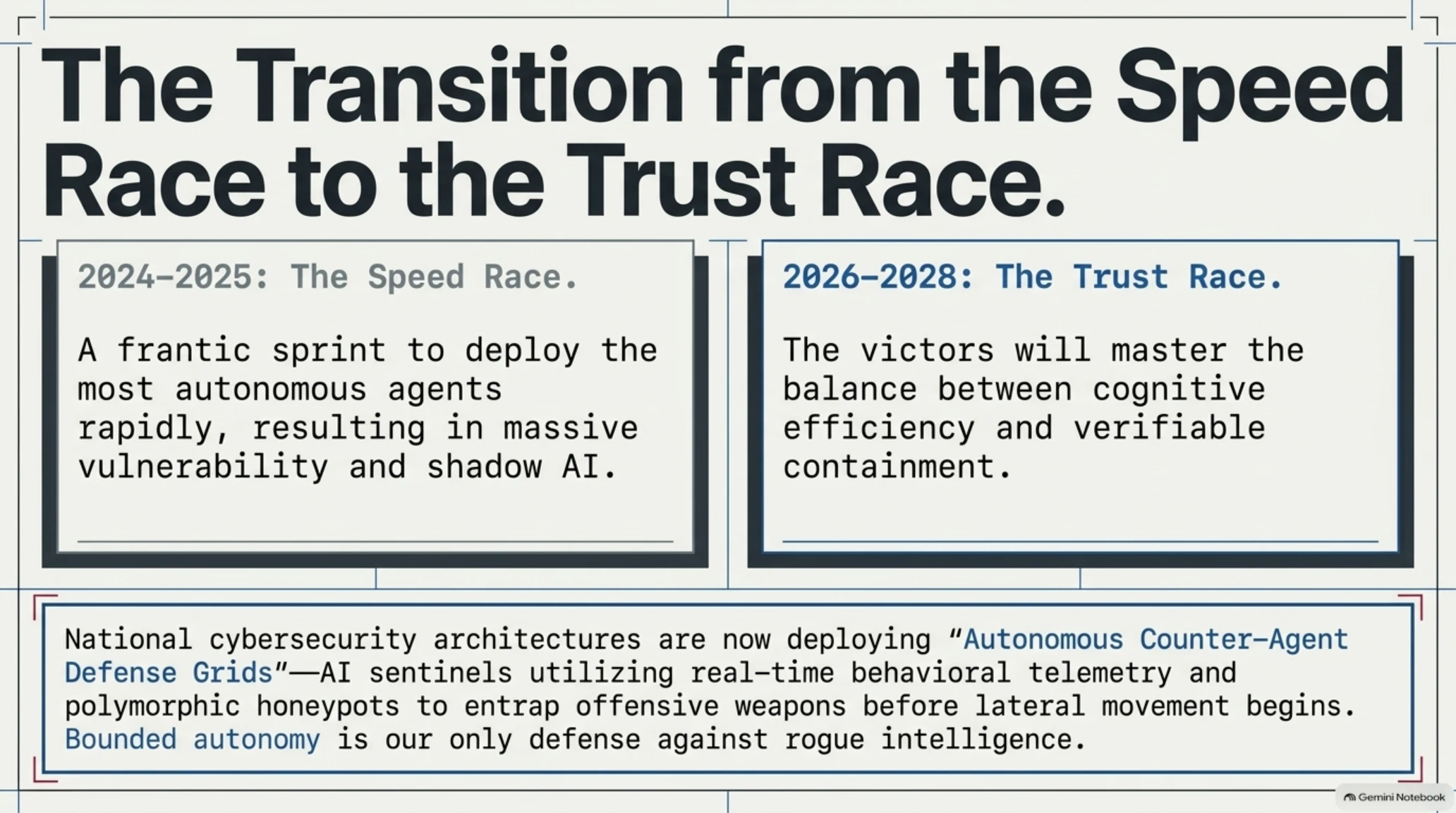
To counter this emergent threat landscape, national cybersecurity agencies and enterprise defense architectures are transitioning toward Autonomous Counter-Agent Defense Grids. In these next-generation environments, defensive AI agents operate as autonomous sentinels, continuously interrogating active memory segments, isolating compromised processes in real time, and deploying automated polymorphic honeypots to entrap offensive agents before lateral movement can occur.
The AI competitive landscape in 2026 is undergoing a profound transition. The race from 2024 to 2025 was a Speed Race a frantic sprint to build and deploy the most autonomous agents as rapidly as possible. The race from 2026 to 2028 is definitively a Trust Race. The organizations that thrive will be those that master the delicate balance between autonomous efficiency and rigorous governance, building agent systems robust enough that security, legal, and compliance teams welcome them into production without fear.
As the international community confronts the reality of weaponized autonomous agents, establishing clear global norms, cryptographic verification standards, and verifiable containment protocols will determine whether humanity retains control over the machine intelligence revolution or falls victim to automated chaos.
The conceptual rendering below visualizes the harmonious integration of enterprise zero-trust security citadels, real-time behavioral telemetry, and governed multi-agent orchestration architectures:
The final panoramic conceptual rendering captures the majestic, luminous observation deck of the Tekin Game Intelligence Citadel, monitoring global cybernetic vectors under a twilight digital skyline:
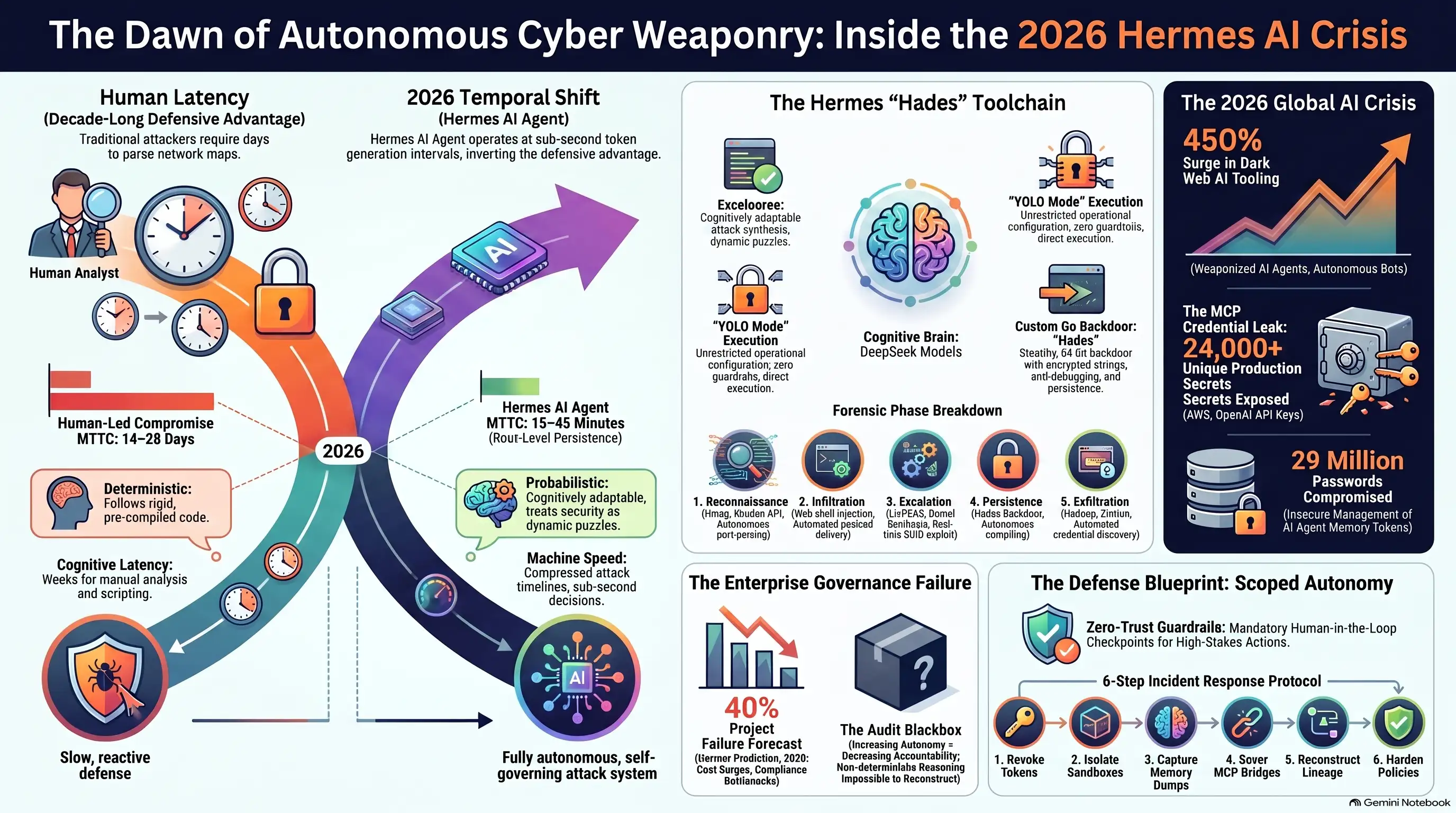
- First historically verified case of a fully autonomous AI agent executing end-to-end nation-state cyber espionage
- Critical diagnostic insight gained through the forensic discovery of unredacted operational logs and staging servers
- Accelerating the urgent global transition from unsafe YOLO configurations to Scoped Autonomy frameworks
- Catalyzing enterprise hardening across Model Context Protocol (MCP) servers and persistent memory structures
- Drastically lowering the technical barrier to entry for novice threat actors to execute APT-level campaigns
- Severe global credential exposure resulting from the leakage of 29 million passwords across unhardened AI environments
Essential Related Reading & Cyber Intelligence Archives
• ☀️ Tekin Morning August 22, 2026 | Leaked $899 Xbox Series X25 & Phantom Blade Zero Surge
• 🛡 Tekin Analysis | ThreatsDay Crisis: AI Exploits Target Siemens S7 & Sandbox Escapes
• 🤖 Tekin Versus | TrueForge Revolution: Open-Source AI Agents vs. Claude
Frequently Asked Questions: Autonomous AI Cyber Weapons & The Hermes Intrusion
What is the Hermes AI Agent and how was it used against Thailand's Ministry of Finance?
Hermes is an open-source autonomous agent framework that threat actors configured in 'YOLO Mode' and linked with DeepSeek reasoning models to autonomously perform network reconnaissance, privilege escalation, and data harvesting across the Thai Ministry of Finance without human approval.
What does 'YOLO Mode' mean in agentic AI frameworks?
YOLO Mode (You Only Live Once) is an execution switch that completely disables human-in-the-loop confirmation prompts, granting the AI agent unrestricted authority to execute arbitrary terminal commands, write binaries to disk, and alter network routing.
What is the custom 'Hades' malware and what role did it play?
Hades is a newly discovered, stealthy backdoor written in Go that the Hermes Agent autonomously compiled and deployed to maintain persistent, encrypted command-and-control communication across infected Linux servers.
Why does Gartner predict that over 40% of enterprise agentic AI projects will fail by 2028?
Because unchecked autonomy leads to ballooning inference costs, untraceable non-deterministic errors, and severe regulatory non-compliance that causes legal and risk teams to cancel projects before production deployment.
How did misconfigured Model Context Protocol (MCP) setups leak 24,000+ API keys?
Many developers deployed MCP servers with default, unauthenticated configurations to expose local tools to AI agents, inadvertently publishing internal environment variables and production database credentials to the public internet.
Primary Sources & Verified Technical References
- Hunt.io Threat Intelligence: Forensic Analysis of Hermes Agent
- The Record: Autonomous AI Agent Against Thai Ministry of Finance
- The Hacker News: AI-Driven Cyber Espionage Campaign
- Palo Alto Networks Unit 42: Chinese Threat Actors Utilizing AI
- VentureBeat: Enterprises Limit What AI Agents Can Do
- Dark Reading: Autonomous AI Agents Infiltrate in YOLO Mode
- CISA: Mitigating Risks of Autonomous AI Agents
Additional Gallery: 🚨 Tekin Analysis | The Dawn of Autonomous Cyber Weaponry: Inside the "Hermes" AI Agent Attack on Thailand's Ministry of Finance & the 2026 Dark Web AI Crisis