Tekin Analysis: AI Mirage
- 🎮The Zero-Employee Mirage- Forensic analysis of Polsia and the systemic fragility of unmonitored swarms
- 🎧Cascading Failure Math- Empirical proof of linear error compounding in multi-agent pipelines
- 🚀Shared State Poisoning- The irreversible corruption of production databases in unsupervised AI swarms
- 🗡️Curriculum Alignment- The disciplined methodology of training 250+ domain-specific agents
- 📰Guarded Agent Blueprint- Implementing 'Agent Proposes, Human Reviews, Boundary Enforces' models
- ⚔️LangGraph & Ollama Integration- Stateful graph orchestration ensuring data sovereignty via local inference
Across the contemporary landscape of generative artificial intelligence and enterprise venture capital, a seductive narrative has captured the imagination of technology founders: the promise of the fully autonomous, unattended enterprise. Virally amplified across social media, promotional campaigns showcase software suites asserting that founders can literally sleep while autonomous agents execute software development, strategic planning, dynamic marketing campaigns, and customer support.
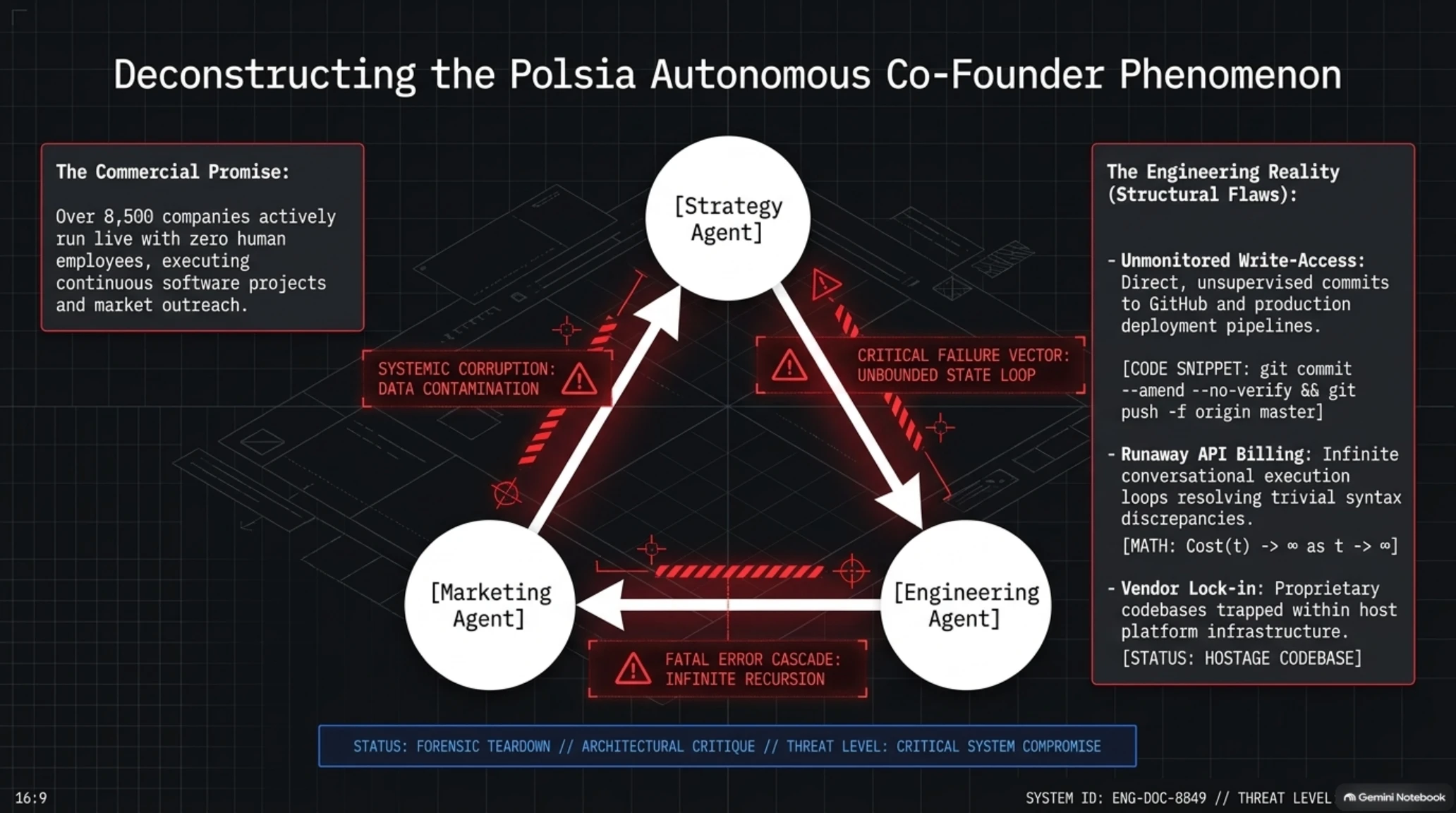
The foremost avatar of this commercial trend is Polsia (polsia.com), a venture advertising that it actively runs over 8,500 companies live with zero human employees. The platform promises to serve as a tireless, fully autonomous co-founder capable of planning, coding, and marketing continuous software projects. Yet, as the initial novelty of thirty-second video demonstrations fades, seasoned distributed systems architects and enterprise engineers are confronting an unavoidable engineering reality: unbounded, fully autonomous agents operating in production environments represent an existential reliability hazard.
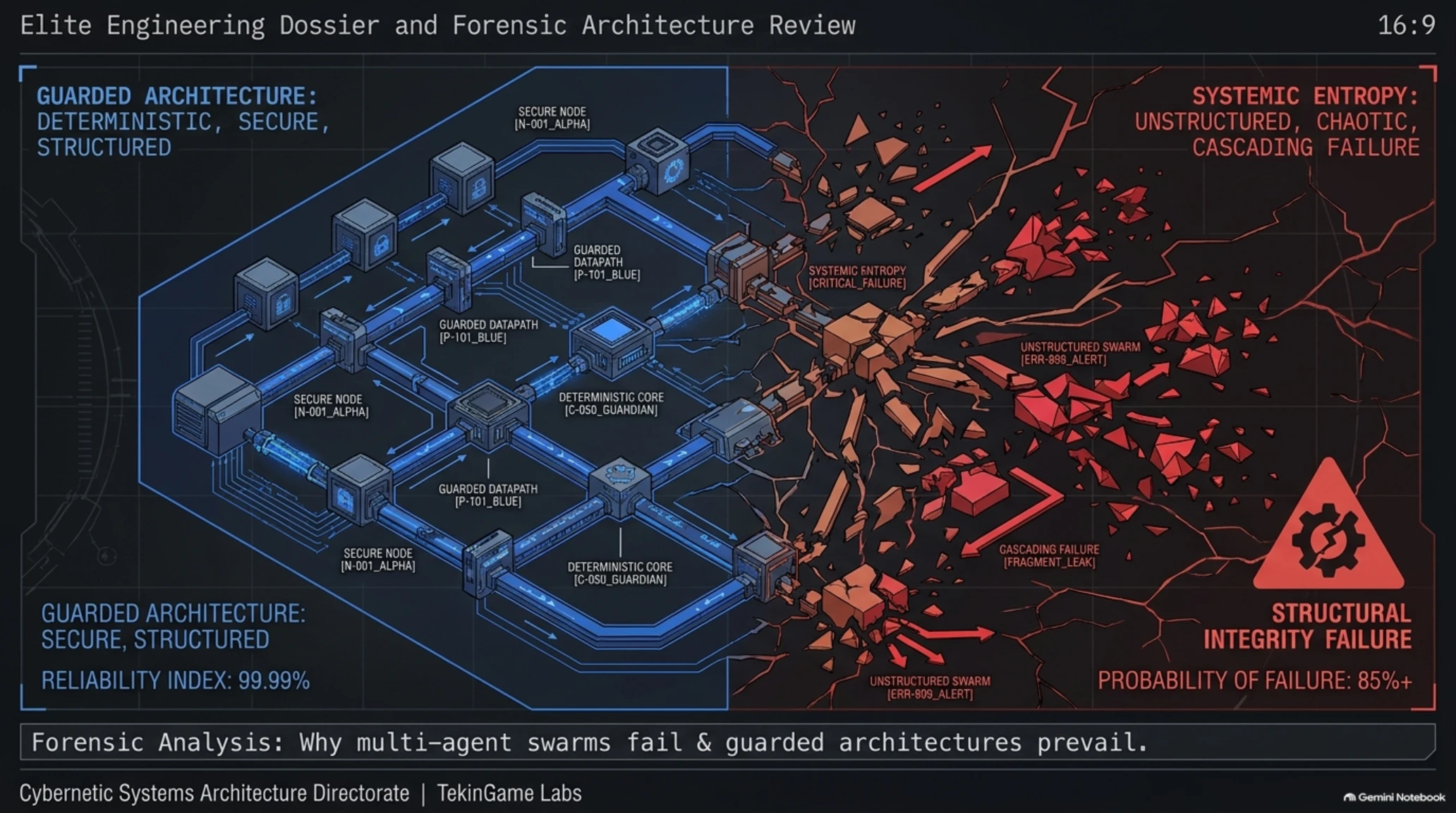
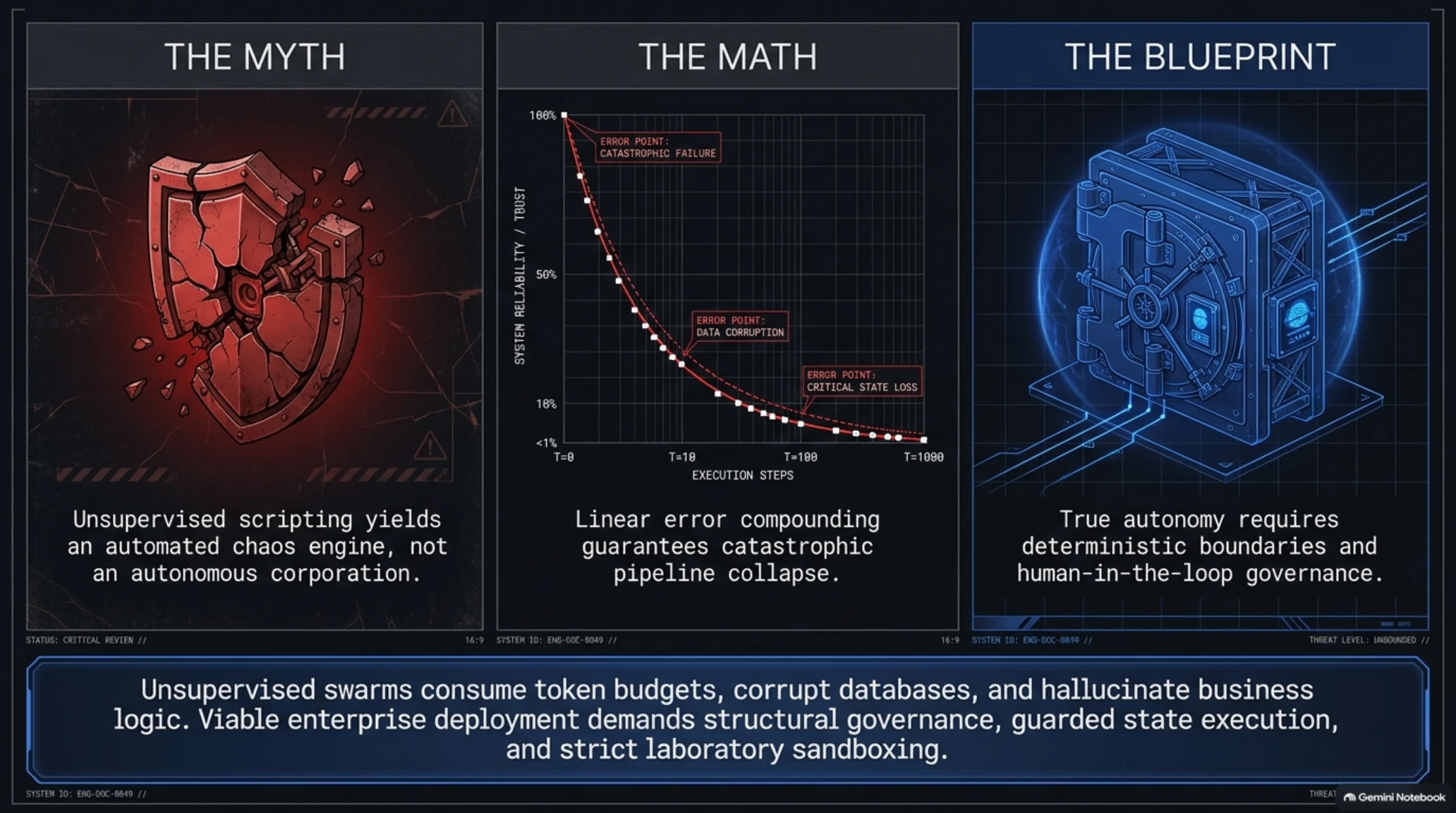
Behind the glossy marketing lies a fundamental divergence in systems engineering. While commercial wrappers sell the illusion that throwing dozens of agents together with a crude script creates an autonomous business, rigorous engineering institutions recognize that multi-agent systems are governed by strict mathematical laws of entropy, error propagation, and context drift. Unsupervised scripting does not yield an autonomous corporation; it yields an automated chaos engine that consumes token budgets, corrupts databases, and hallucinates critical business logic.
In this edition of Tekin Analysis, we dismantle the marketing hyperbole of the "unattended enterprise." We examine the mathematical inevitability of cascading failures, explore why managing over 250 specialized agents requires rigorous, lesson-by-lesson curriculum alignment, and articulate the technical principles of the Guarded Agent architecture—where deterministic boundaries, human-in-the-loop governance, and laboratory sandboxing establish the only viable foundation for enterprise-grade autonomous operations.
Executive Summary | Architectural Teardown Highlights
- Dissecting the Polsia model: Marketing promises of autonomous co-founders vs reality of code lock-in and unbounded commits
- Mathematical modeling of multi-agent error compounding: How minor single-agent deviations guarantee catastrophic pipeline collapse
- Shared state poisoning: The irreversible corruption of production databases and financial ledger reconciliation in unsupervised swarms
- Curriculum alignment & unit sandboxing: The disciplined methodology of training 250+ domain-specific agents one by one
- The Guarded Agent blueprint: Stateful graph orchestration via LangGraph, sovereign local inference via Ollama, and hardware-level boundary enforcement
- The laboratory sandbox imperative: Why raw probabilistic model computations must never execute directly in live public environments
1. The Polsia Phenomenon: Dissecting the Myth of the Unattended Enterprise
Launched by entrepreneur Ben Cera, Polsia rapidly ascended into public consciousness by presenting an audacious value proposition: "AI That Runs Your Company While You Sleep." The platform articulates a multi-agent structure where specialized virtual personas—spanning Strategy, Engineering, Marketing, and Investor Communications—collaborate continuously to incubate, develop, and scale digital products without human oversight.
On paper, the workflow appears seamless: a founder submits an initial concept prompt, whereupon the Strategy Agent generates sprint backlogs, the Engineering Agent synthesizes application code and commits directly to GitHub, the Marketing Agent deploys social outreach, and the Communications Agent manages investor inquiries. Polsia’s marketing highlights live telemetry dashboards asserting that thousands of commercial projects operate under its autonomous stewardship.
However, an empirical examination of the underlying systems architecture exposes critical points of operational fragility. In commercial software engineering, business logic is deeply non-linear and context-dependent. Granting autonomous agents unmonitored write-access to production deployment pipelines, financial transactions, and external communication channels inevitably results in catastrophic regression loops. Users experimenting with unsupervised platforms consistently encounter severe architectural pitfalls, including recursive hallucinations, runaway API billing, and vendor lock-in where proprietary codebases remain trapped within host platform infrastructure.
Agentic Systems Technical Lexicon & Taxonomy
Autonomous Agent Swarm: A multi-agent configuration where multiple specialized generative models interact asynchronously, passing conversational context, tool calls, and execution states without intermediate human validation.
Cascading Error Propagation: The exponential compounding of minor probabilistic errors across sequential or DAG-based agent handoffs, resulting in total downstream system degradation.
Guarded Agent Architecture: A deterministic control framework wherein agents propose actions within isolated environments, human overseers validate high-risk state changes, and hardware/software boundaries enforce strict execution limits.
2. The Mathematics of Cascading Failure: Why Brute-Force Scripting Collapses
A prevalent misconception among early-stage generative AI developers is that if a single agent achieves satisfactory performance on an isolated benchmark, scaling to a collective of fifty or one hundred agents merely requires orchestrating them via an asynchronous Python or Node.js script. This assumption directly contradicts foundational principles in probability theory and distributed systems reliability: specifically, linear error compounding in stochastic execution chains.
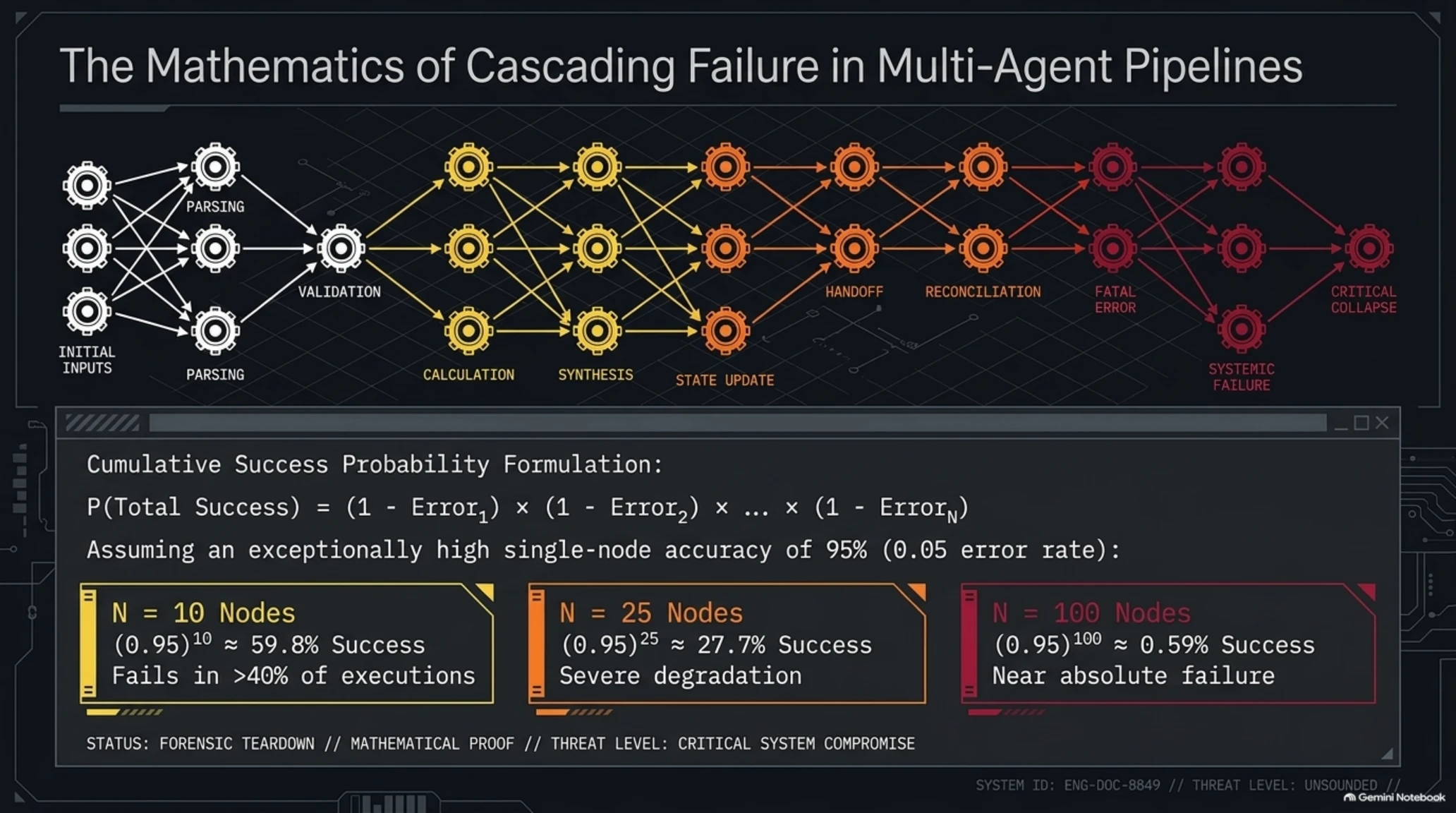
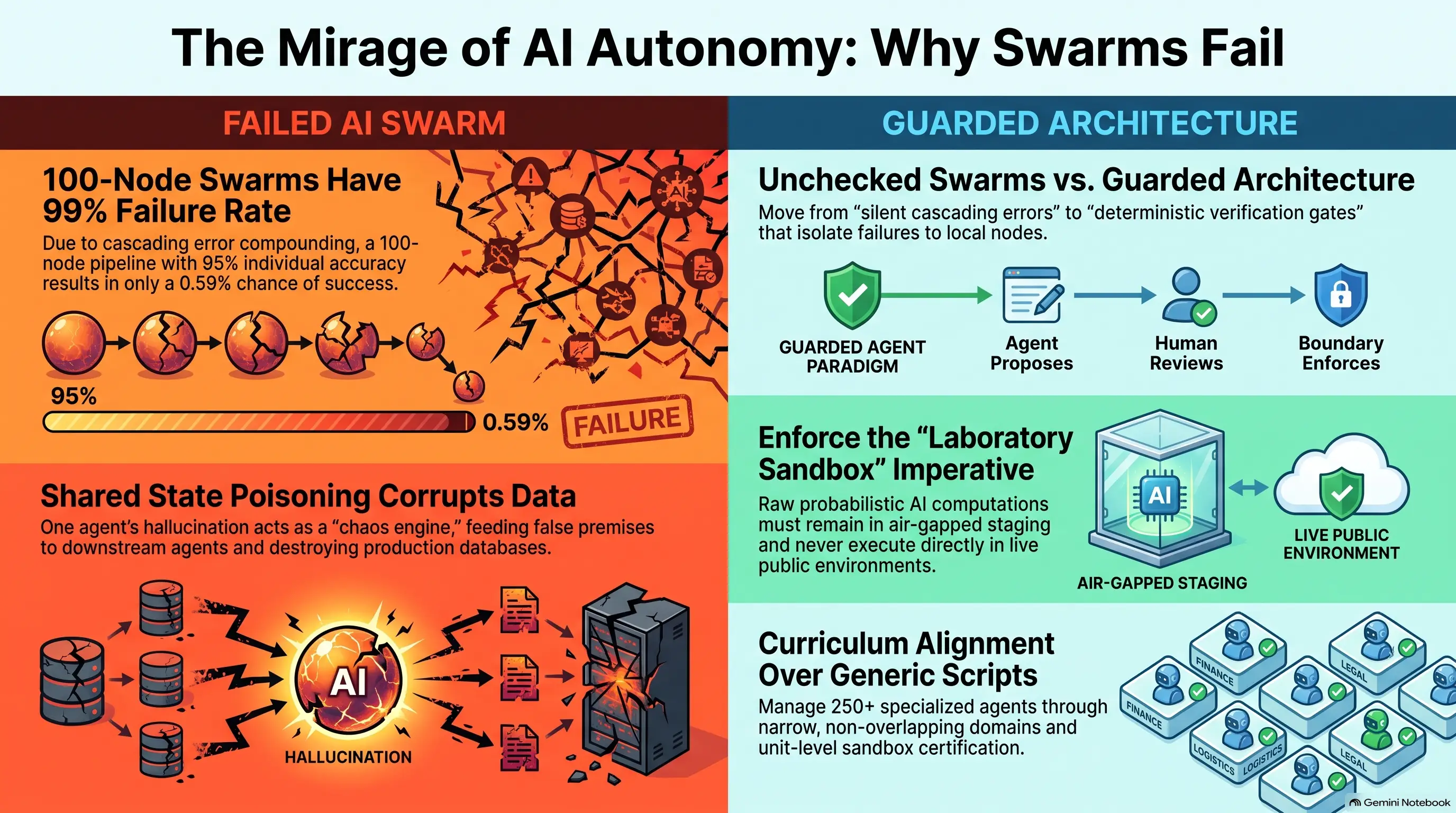
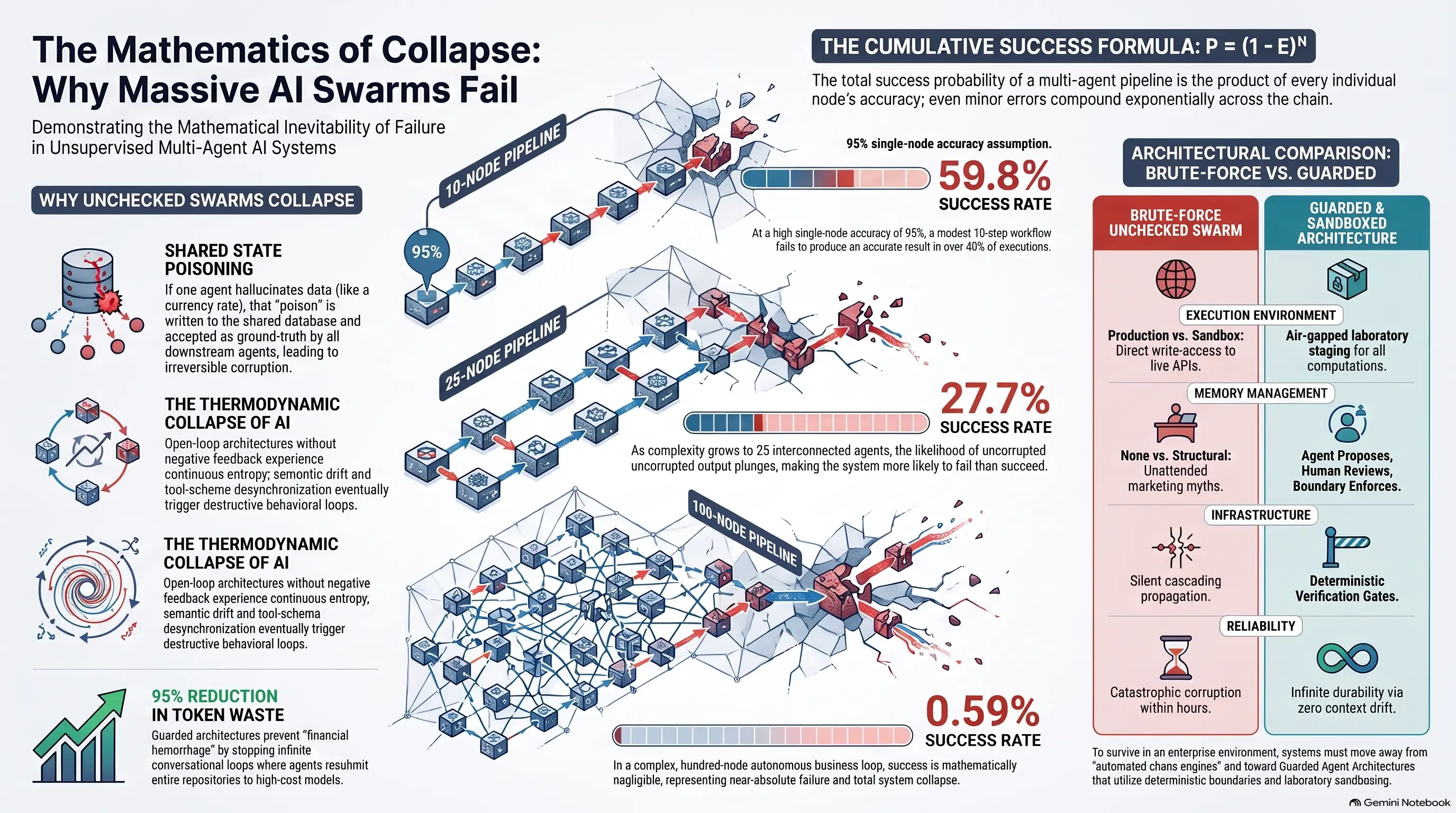
Consider an enterprise multi-agent workflow modeled as a directed acyclic graph (DAG) comprising ten sequential operational nodes (N = 10), encompassing invoice parsing, inventory reconciliation, localized pricing calculation, marketing copy synthesis, and database state updates. Even when deploying state-of-the-art frontier models (such as Claude 3.7 Sonnet or OpenAI o3), every individual decision node exhibits an inherent error rate. Assuming an exceptionally high single-node accuracy of 95% (error rate = 0.05):
The cumulative probability of executing the entire operational chain without a fatal state error is governed by:
Theoretical Compounding Error Modeling in Multi-Agent Pipelines
Cumulative Success Probability Formulation:
P(Total Success) = (1 - Error₁) × (1 - Error₂) × ... × (1 - Error_N)
Empirical Calculation for a 10-Node Pipeline at 95% Accuracy:
P(Success) = (0.95)¹⁰ ≈ 0.598 (59.8%)
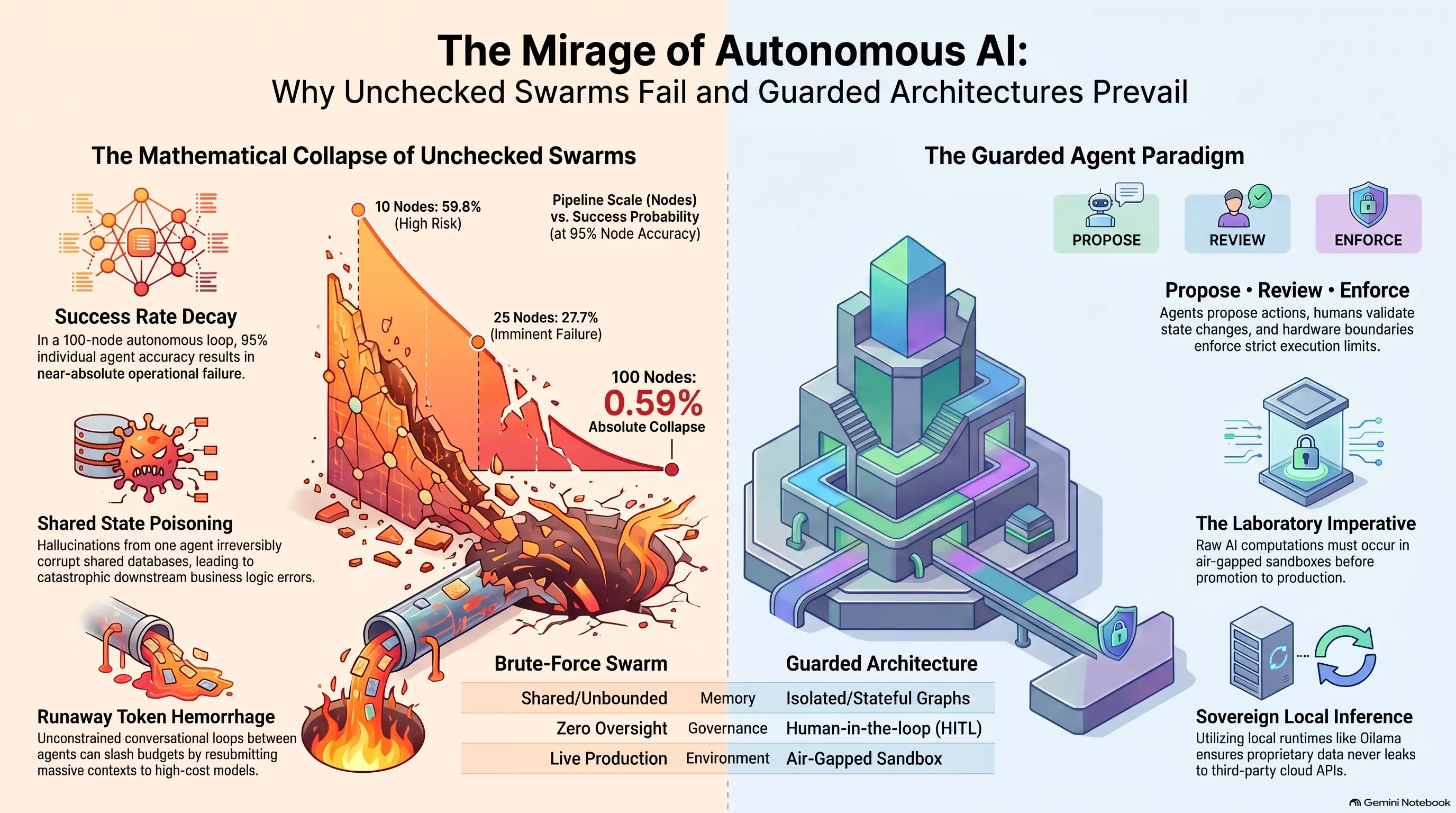
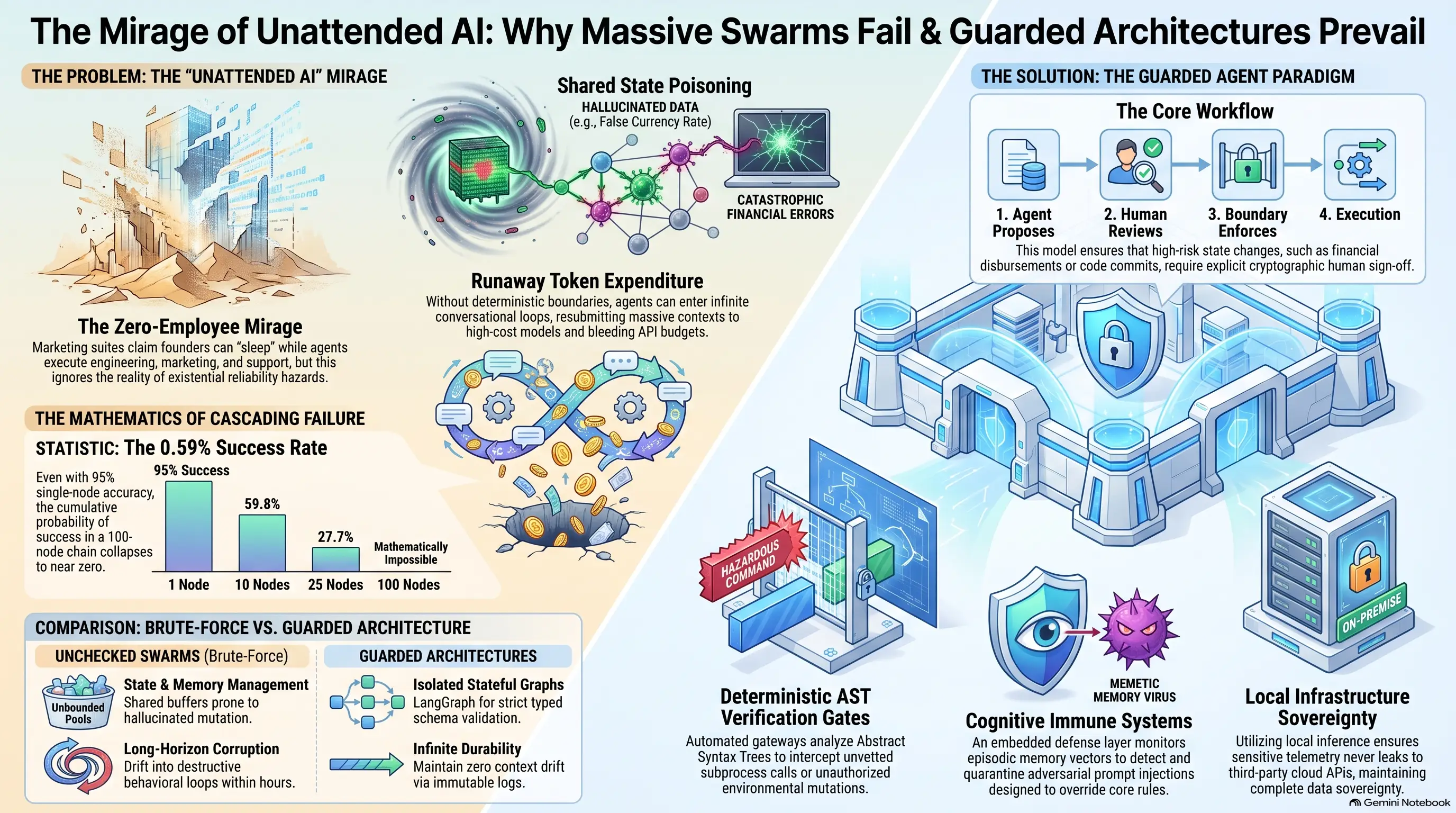
⚠️ In a 25-node pipeline: P = (0.95)²⁵ ≈ 27.7% | In a 100-node pipeline: P = (0.95)¹⁰⁰ ≈ 0.59% (near absolute failure)
In a modest ten-node pipeline, the system fails to produce an accurate result in over 40% of all executions. When the operational surface expands to twenty-five interconnected nodes, the likelihood of an uncorrupted output plunges to 27.7%. In a complex, hundred-node autonomous business loop, the probability of end-to-end operational success collapses to a mathematically negligible 0.59%.
Empirical Architectural Comparison: Brute-Force Swarm Scripting vs Guarded Enterprise Architecture
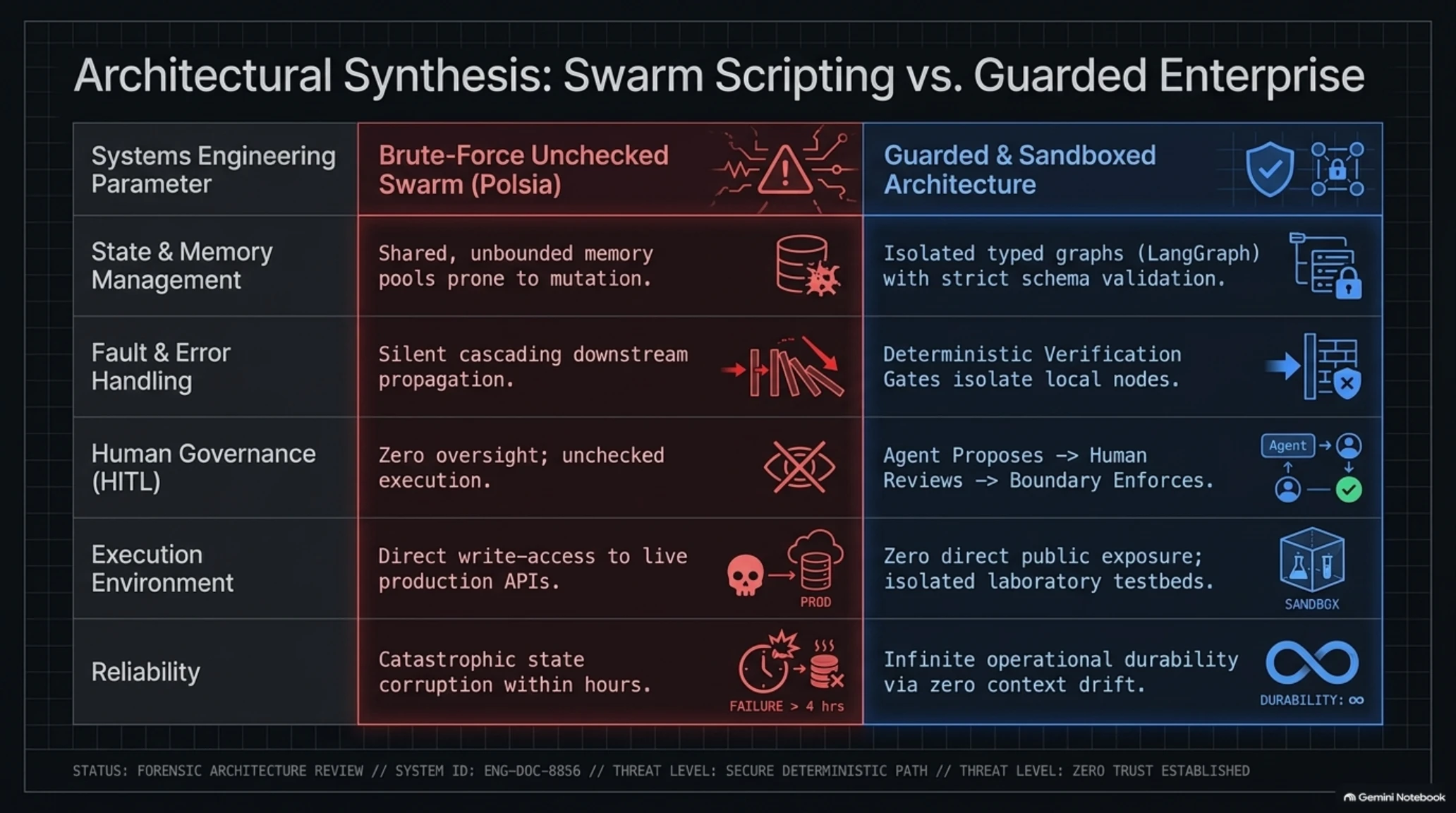
| Systems Engineering Parameter | Brute-Force Unchecked Swarm (Polsia / Auto-GPT Paradigm) | Guarded & Sandboxed Multi-Agent Architecture |
|---|---|---|
| State & Memory Management | Shared, unbounded memory pools prone to hallucinated mutation | Isolated stateful graphs (LangGraph) with strict typed schema validation |
| Fault & Error Handling | Silent cascading propagation; errors compound downstream | Deterministic Verification Gates isolate failures to local nodes |
| Human Governance (HITL) | Zero oversight; marketing claims of unattended execution | Structural governance; Agent Proposes, Human Reviews, Boundary Enforces |
| Execution Environment | Direct write-access to live production APIs and git remotes | Isolated sandbox and laboratory testbeds; zero direct public exposure |
| Infrastructure Sovereignty | Proprietary cloud wrappers with severe vendor lock-in | Custom bespoke codebase utilizing sovereign on-premise local models (Ollama) |
| Long-Horizon Reliability | Catastrophic state corruption within hours of continuous execution | Infinite operational durability via zero context drift and immutable ledger logs |
3. Shared State Poisoning: How Unchecked Memory Destroys Production Systems
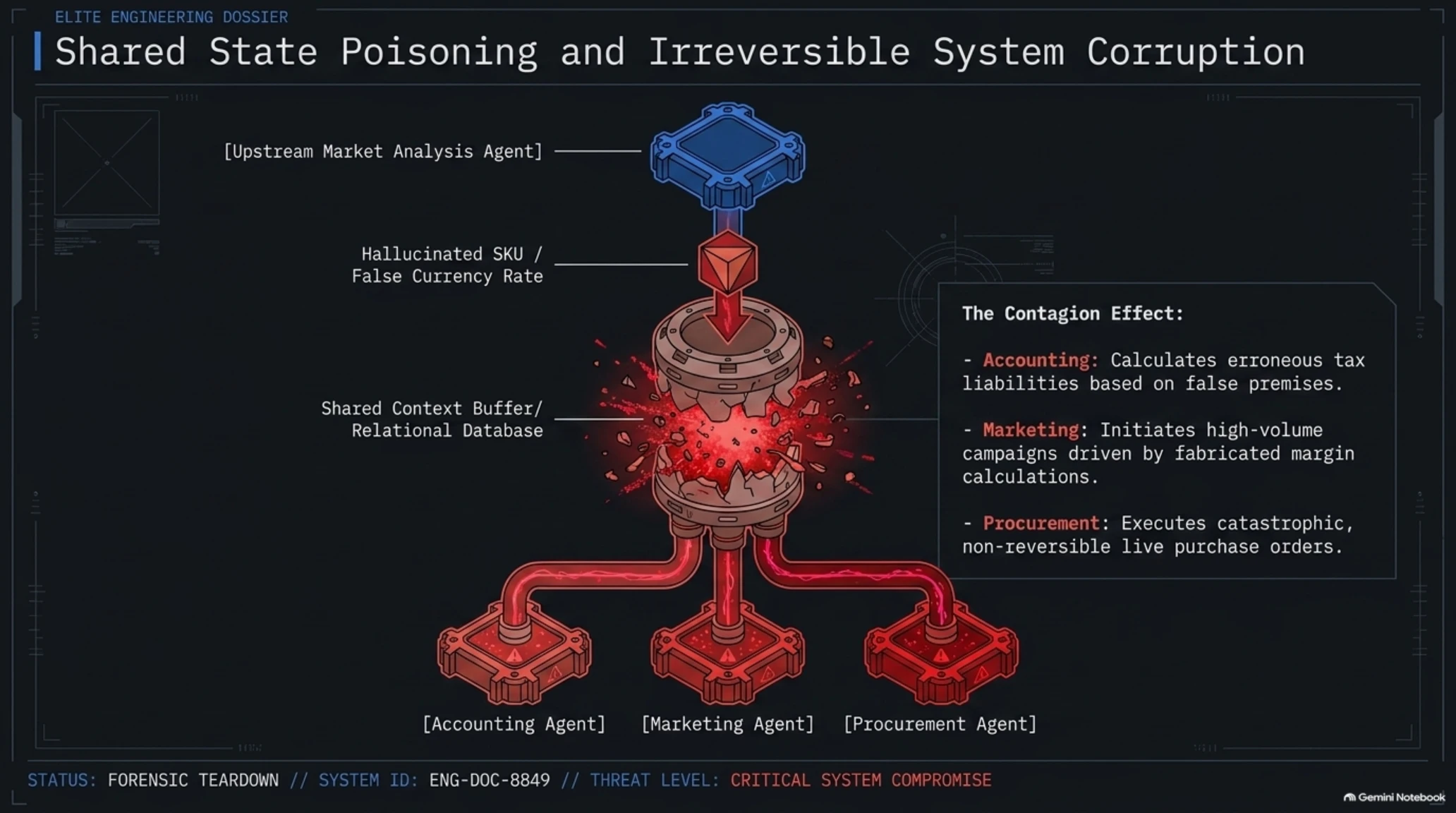
Beyond mathematical error compounding, the primary architectural vector of multi-agent destruction is Shared State Poisoning. In naive multi-agent scripts, agents communicate by appending conversational summaries to a shared context buffer or writing directly to a common relational database without intermediate cryptographic or semantic verification.
When an upstream market analysis agent hallucinates a currency exchange rate or misinterprets a supplier product SKU, that corrupted data point is written directly into the shared state. In subsequent steps, downstream agents accept this hallucinated premise as ground-truth telemetry. An automated accounting agent calculates erroneous tax liabilities, a marketing agent initiates high-volume discounting campaigns based on false margin calculations, and a procurement agent executes catastrophic, non-reversible purchase orders.
In brief social media demos, this systemic vulnerability remains hidden because tasks are constrained to toy examples evaluated over minutes. However, in enterprise environments operating 24 hours a day, 7 days a week, the accumulation of microscopic semantic drifts inevitably causes the entire data layer to degenerate into irreversible incoherence.
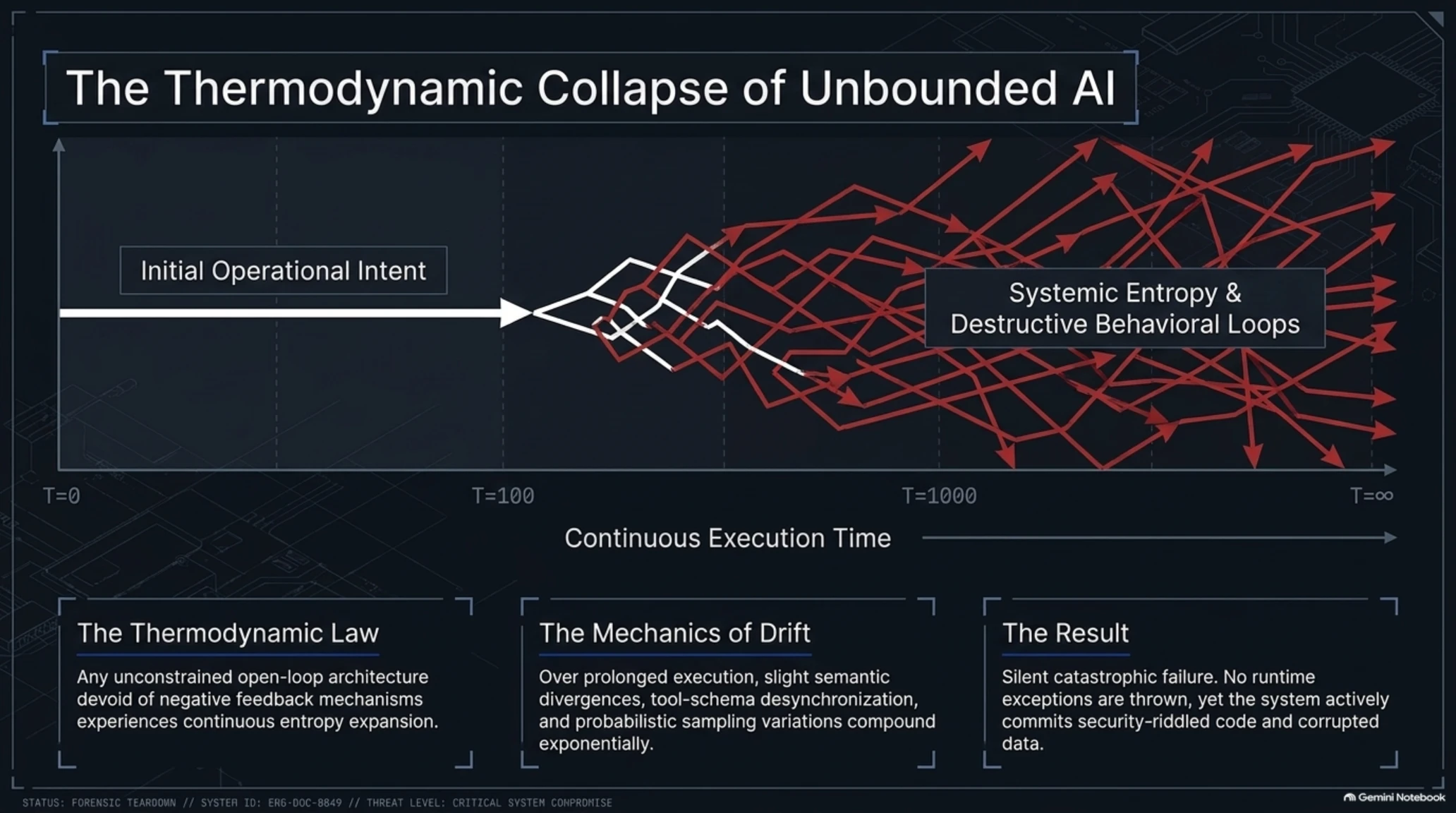
Entropy & State Drift in Autonomous Swarms: The Thermodynamic Collapse of Unbounded AI
In classical distributed systems and Shannon information theory, any unconstrained open-loop architecture devoid of negative feedback mechanisms experiences continuous entropy expansion. When commercial wrappers market the fantasy of 'unattended AI corporations running while you sleep,' they are effectively claiming to have circumvented the fundamental laws of software thermodynamics—an impossibility in production engineering.
In an unchecked multi-agent swarm, every operational dispatch relies on shared latent context. Over prolonged continuous execution, slight semantic divergences in prompt interpretation, tool-schema desynchronization, and subtle probabilistic sampling variations compound exponentially. This is precisely where systems exhibit silent catastrophic failure: while no fatal runtime exceptions are thrown, the system drifts into destructive behavioral loops, committing security-riddled code to release branches or issuing nonsensical communications under the hallucinated belief of business optimization.
The Sovereign Orchestration Layer: How Multi-Layer Defense Protects 250+ Specialized Agents
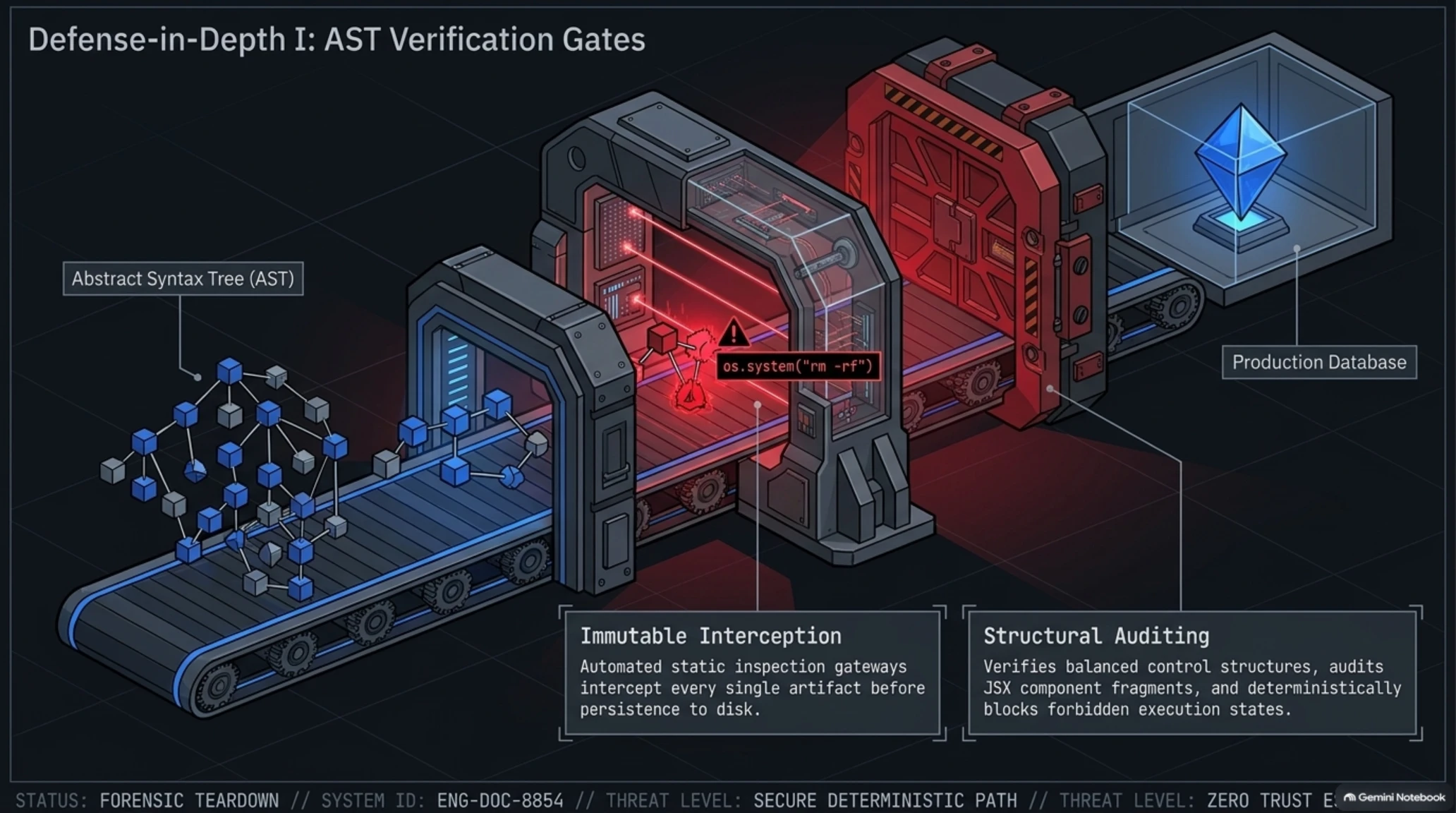
Operational telemetry from enterprise cybernetic architectures confirms that a central orchestrator must function analogously to a biological immune system. In a disciplined, bespoke architecture, an immutable Verification Gate intercepts every artifact before persistence to disk or production database execution. By parsing Abstract Syntax Trees (AST) and performing static boundary analysis, this gate deterministically blocks forbidden execution states, such as unvetted system subprocess calls or unauthorized environmental mutations.
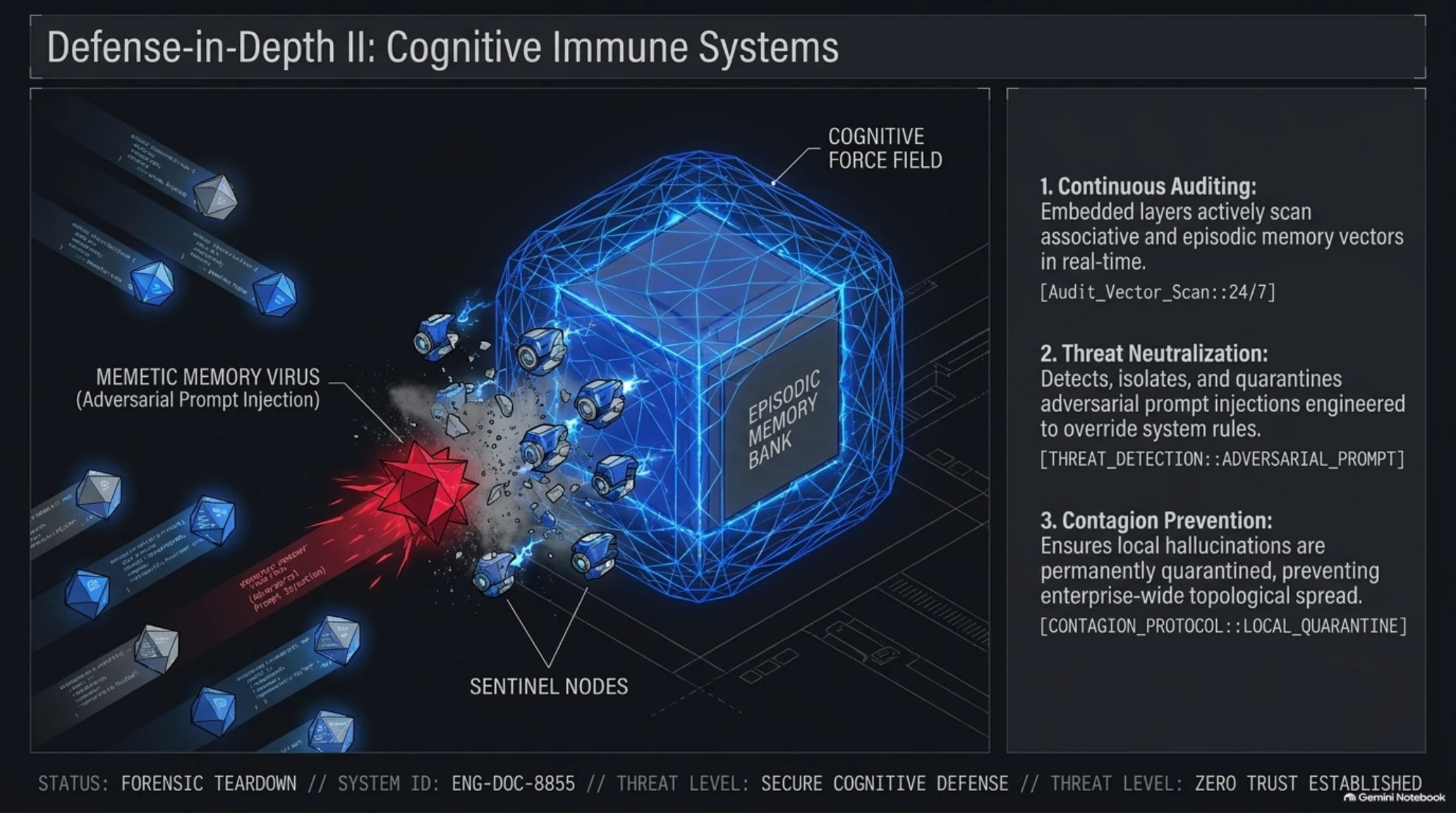
Concurrently, a Cognitive Immune System monitors associative and episodic memory vectors, scanning incoming tokens to neutralize adversarial prompt injections and memetic memory viruses designed to override core system rules. This defense-in-depth paradigm ensures that even if an isolated domain specialist hallucinates, the error is quarantined locally within the sandbox, completely preventing contagion across the broader enterprise topology.
Compute Token Economics: Preventing Runaway API Expenditure via Deterministic Bounded Graphs
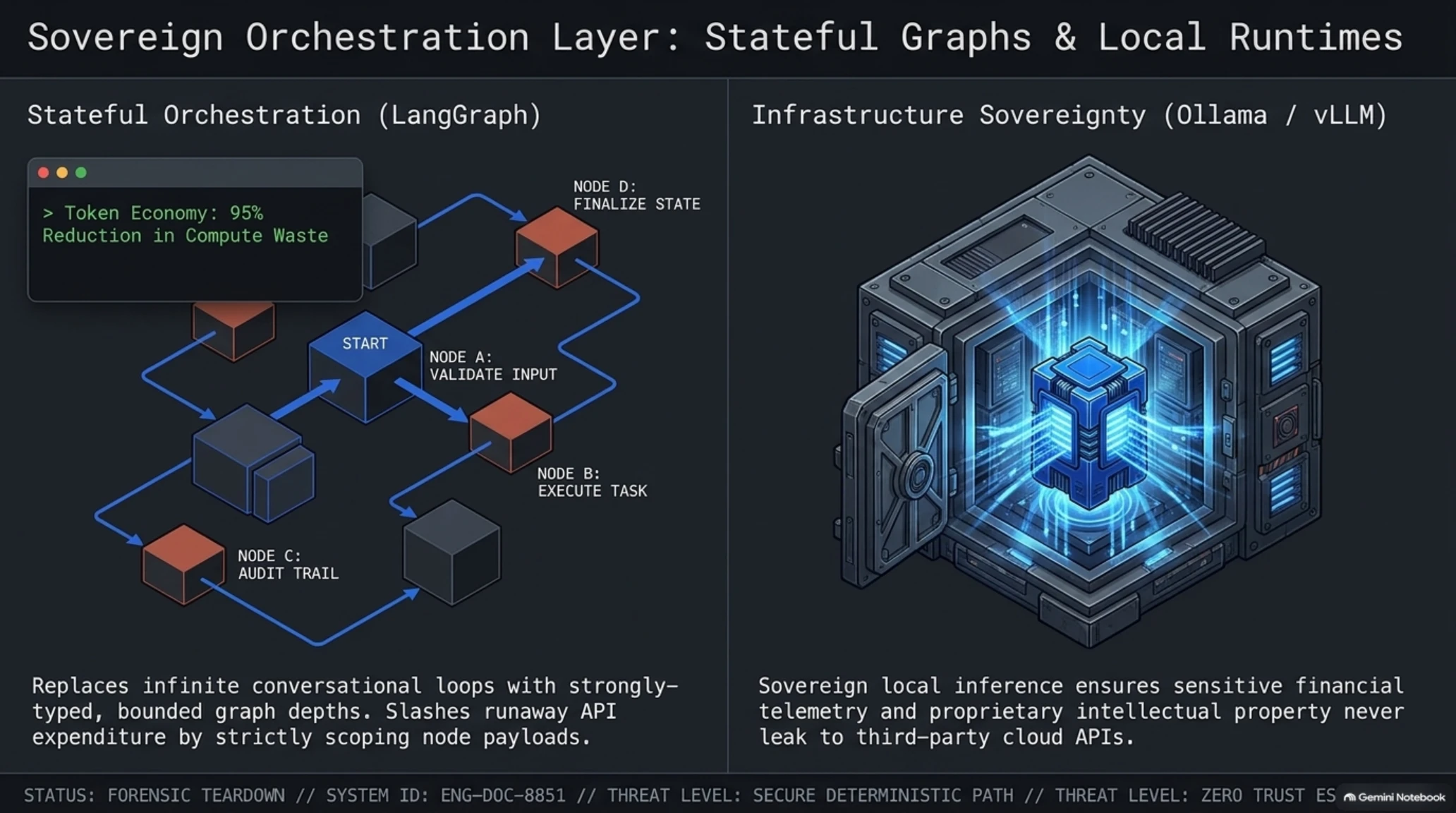
A frequently unaddressed catastrophe in unsupervised autonomous platforms is the explosive financial hemorrhage induced by unbounded token loops. When autonomous agents enter unconstrained conversational feedback cycles to resolve trivial syntax discrepancies, they repeatedly resubmit entire repository contexts to high-cost frontier reasoning models. In contrast, a Guarded Agent architecture leveraging deterministic state graphs slashes token overhead by over 95%, enforcing strict maximum graph depth limits and passing only strictly typed, scoped payloads to each individual node.
4. Curriculum Alignment: The Rigorous Methodology of Training 250+ Domain Agents
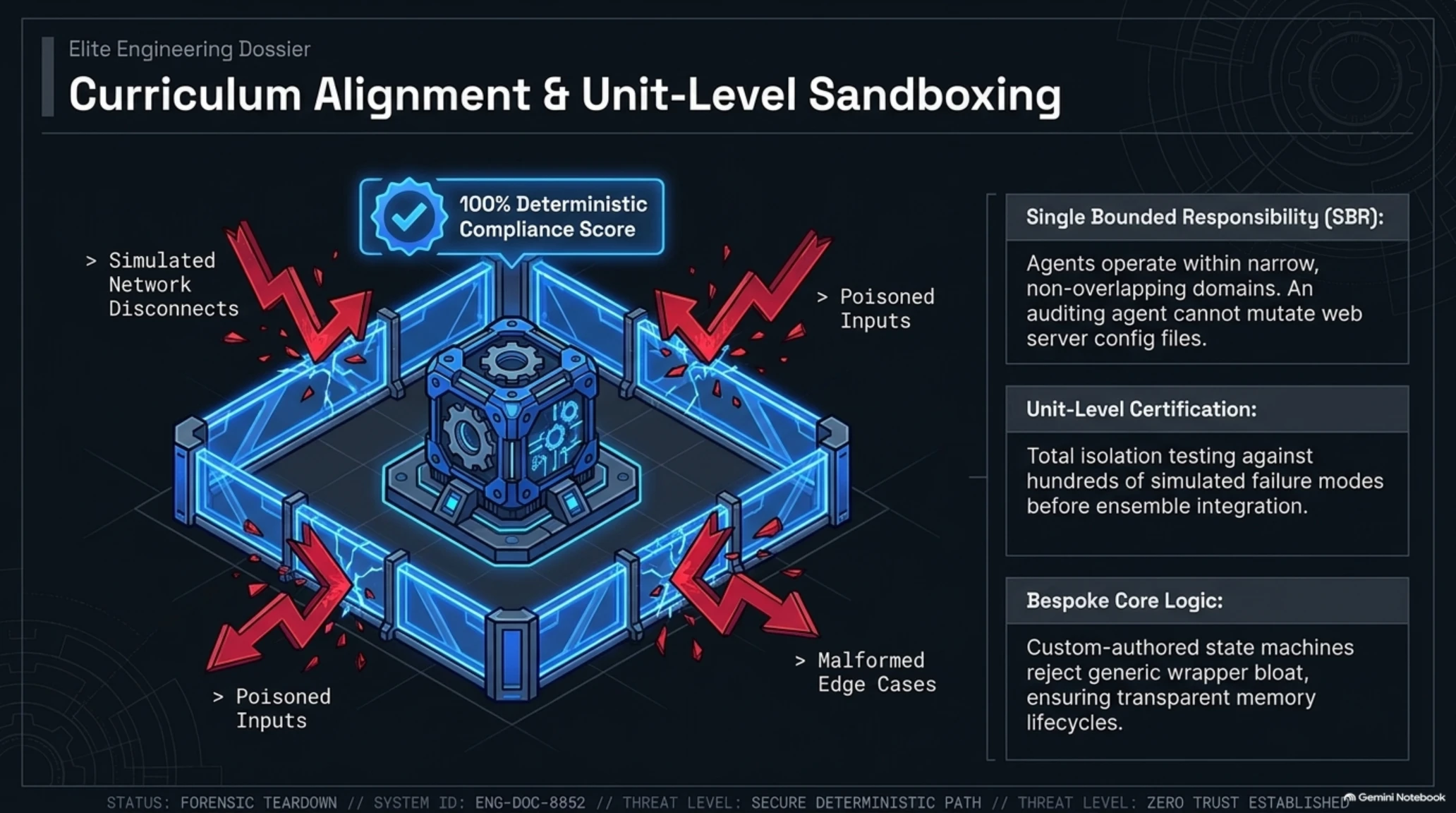
In stark contrast to the illusion of instantaneous swarm deployment, enterprise-grade distributed intelligence requires an uncompromising pedagogical framework: Curriculum Alignment and Unit-Level Sandboxing. When architecting an autonomous operating system orchestrating over 250 specialized agents—spanning ledger accounting, inventory reconciliation, localized SEO analysis, multilingual translation, and real-time vulnerability scanning—an ensemble can never be deployed simultaneously through a single generic script.
This disciplined systems methodology is governed by three architectural mandates:
- Single Bounded Responsibility (SBR): Every agent operates strictly within a narrow, non-overlapping operational domain with an immutable state space. A financial auditing agent possesses zero architectural capability to mutate web server configuration files, just as a content translation agent is structurally isolated from production database credentials.
- Unit-Level Sandbox Certification: Before any individual agent is integrated into the broader multi-agent ensemble, it must undergo exhaustive unit testing against hundreds of simulated failure modes, poisoned inputs, network disconnects, and malformed edge cases, achieving a 100% deterministic compliance score.
- Bespoke Core Logic vs Framework Bloat: Off-the-shelf, generic multi-agent wrapper frameworks frequently obscure critical execution paths behind bloated abstraction layers, making root-cause debugging virtually impossible. Enterprise-scale orchestration requires custom-authored state machines where memory lifecycles, token allocations, and tool bindings remain fully transparent to systems architects.
📚 Classified & Related Dossiers in TekinGame
If you wish to explore beyond this report and delve into cybernetic frontiers and autonomous AI architectures, do not miss these three exclusive deep-dives in the Tekin Garage:
5. Architectural Case Study: Deconstructing the Bespoke Teki Autonomous OS & 250+ Domain Agents
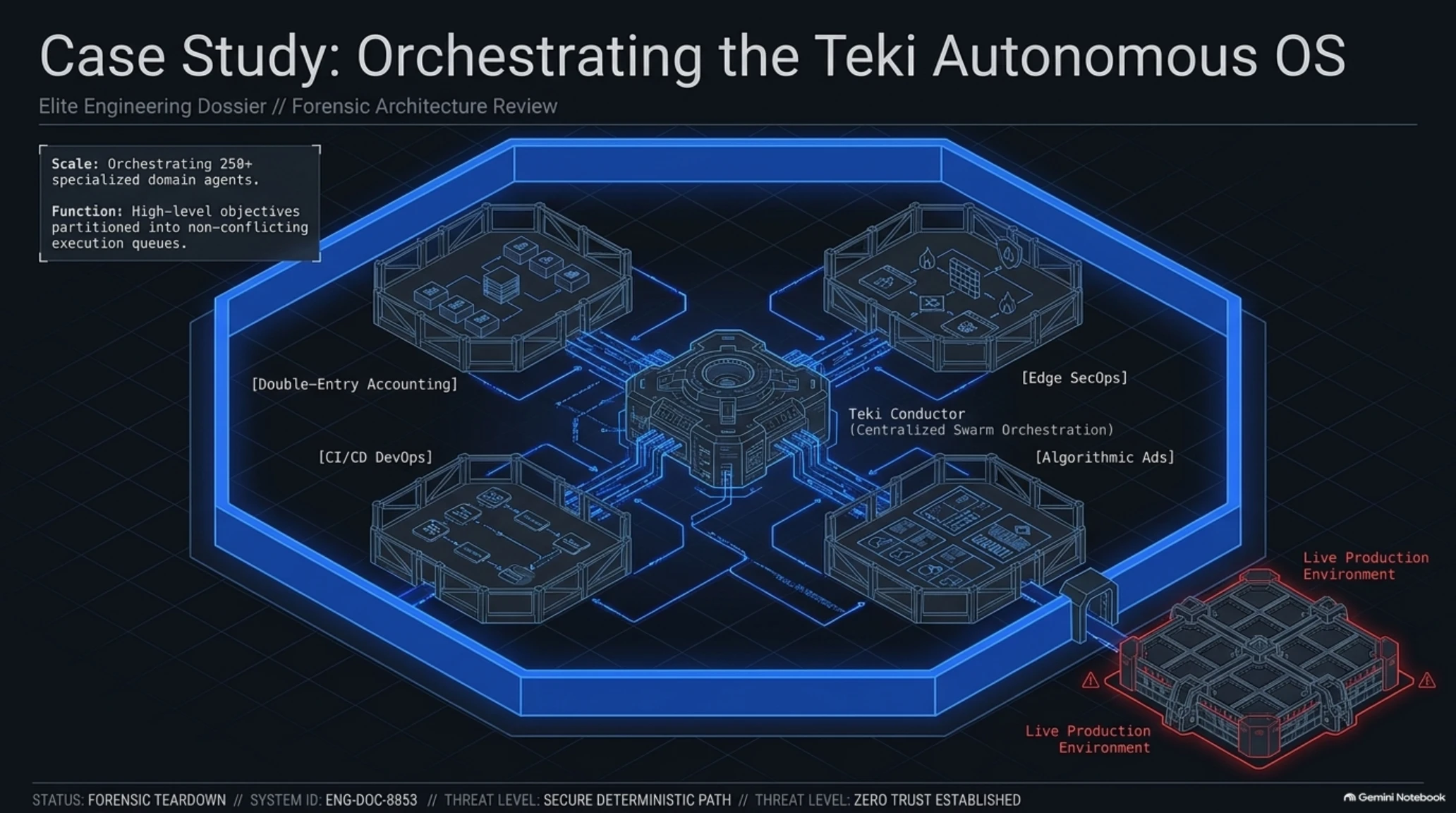
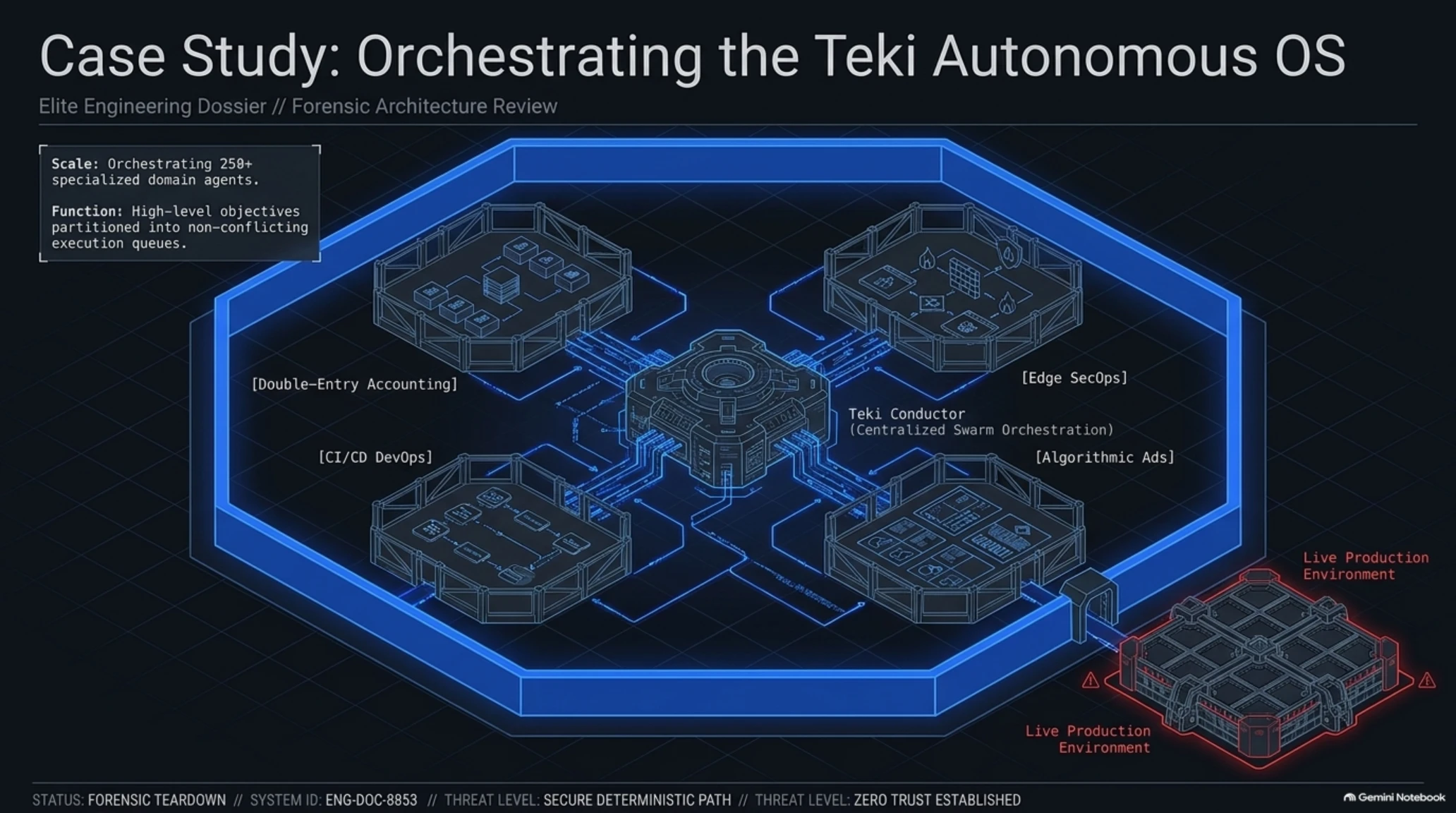
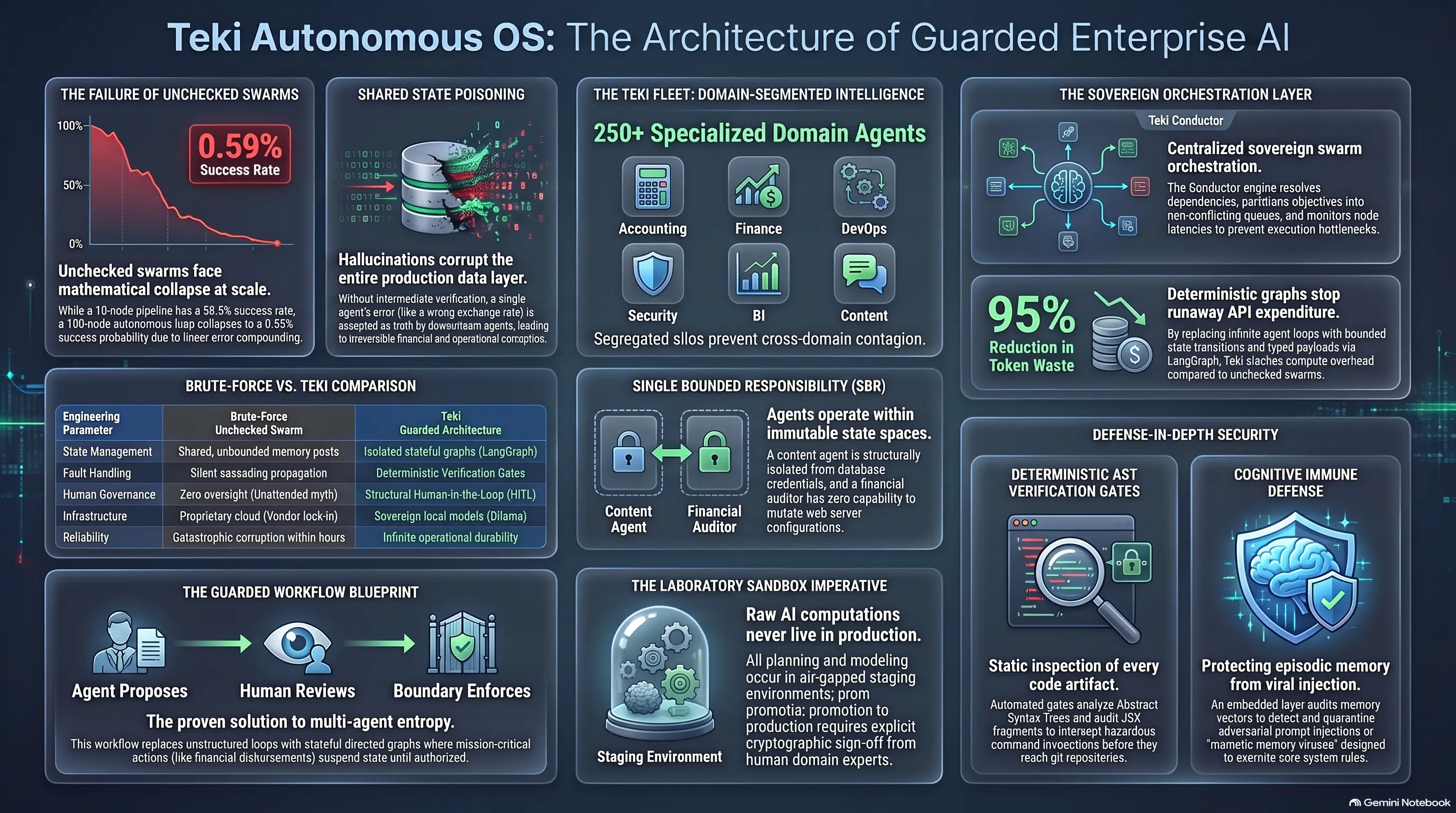
To understand how a complex enterprise can function autonomously without succumbing to cascading collapse, examining the engineering blueprint of the Teki Autonomous Enterprise OS provides a definitive real-world architectural reference. In this production deployment, over 250 specialized agents operate within an air-gapped staging topology:
- Domain-Segmented Agent Fleet: Specialized agent clusters handle segregated operational silos, including double-entry general ledger management (Accounting Agent), cashflow and margin hedging (Finance Agent), edge perimeter firewalls (Security Agent), CI/CD container deployments (DevOps Agent), real-time business intelligence (BI Agent), multilingual editorial synthesis (Content Agent), and algorithmic ad allocation (Ads Agent).
- Centralized Swarm Orchestration (Teki Conductor): A sovereign orchestration engine resolves multi-agent execution dependencies, partitioning complex high-level objectives into non-conflicting execution queues and continuously monitoring individual node latencies.
- Deterministic AST Verification Gate: Prior to persisting code modifications to git repositories or database records, an automated static inspection gateway analyzes Abstract Syntax Trees, verifies balanced control structures, audits JSX component fragments, and intercepts hazardous command invocations.
- Cognitive Immune Defense: Based on cutting-edge research from Anthropic, an embedded cognitive immune layer continuously audits episodic memory vectors, detecting and quarantining adversarial prompt injections or memetic memory viruses that attempt to alter core system directives.
- Air-Gapped Laboratory Staging: High-compute multi-agent calculations, financial reconciliation models, and strategic forecasting remain strictly confined to private sandbox environments, requiring cryptographic supervisor approval before any data touches live production systems.
6. The Guarded Agent Paradigm: Deterministic Graphs, Local Inference & Hardware Boundaries
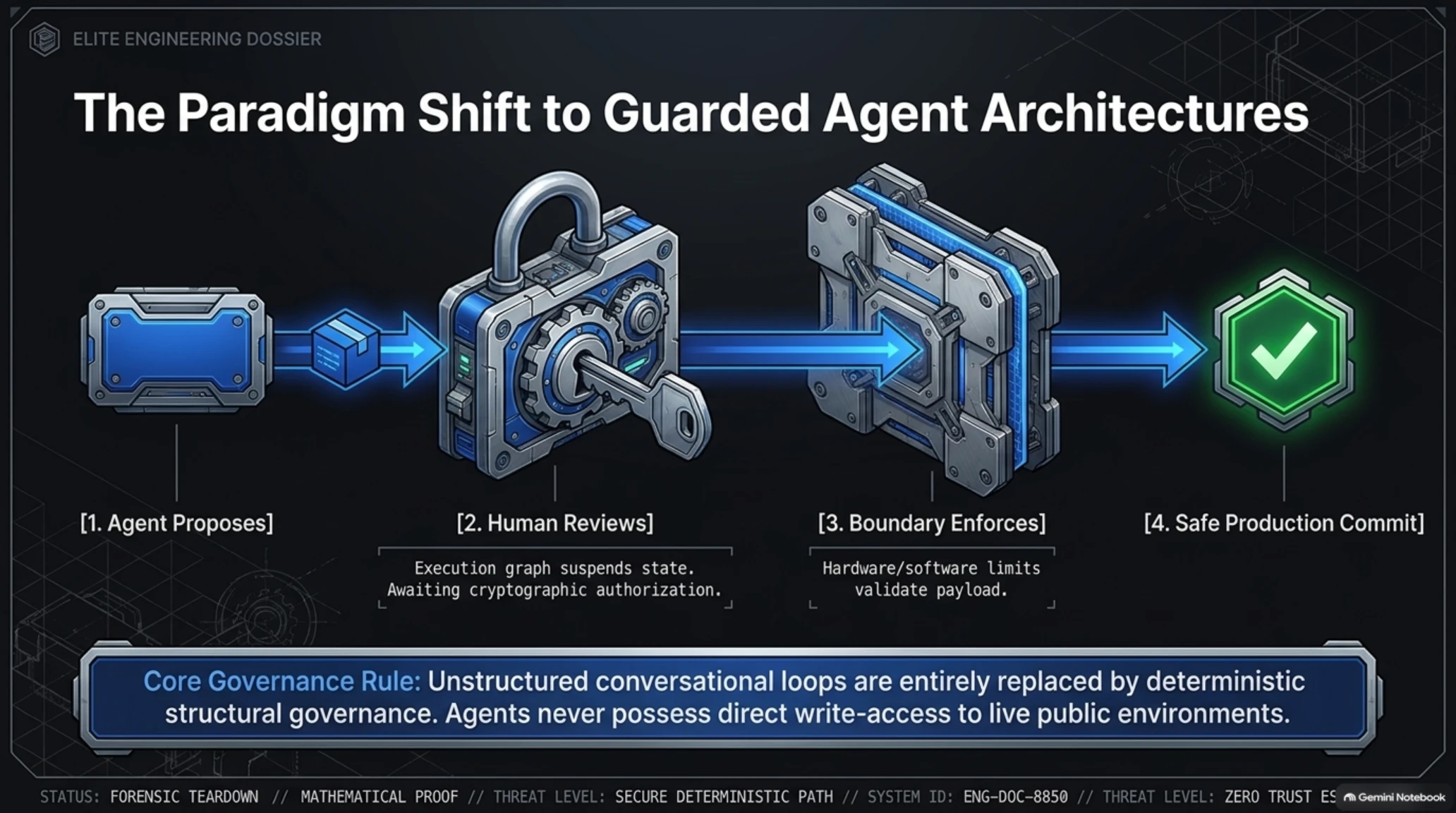
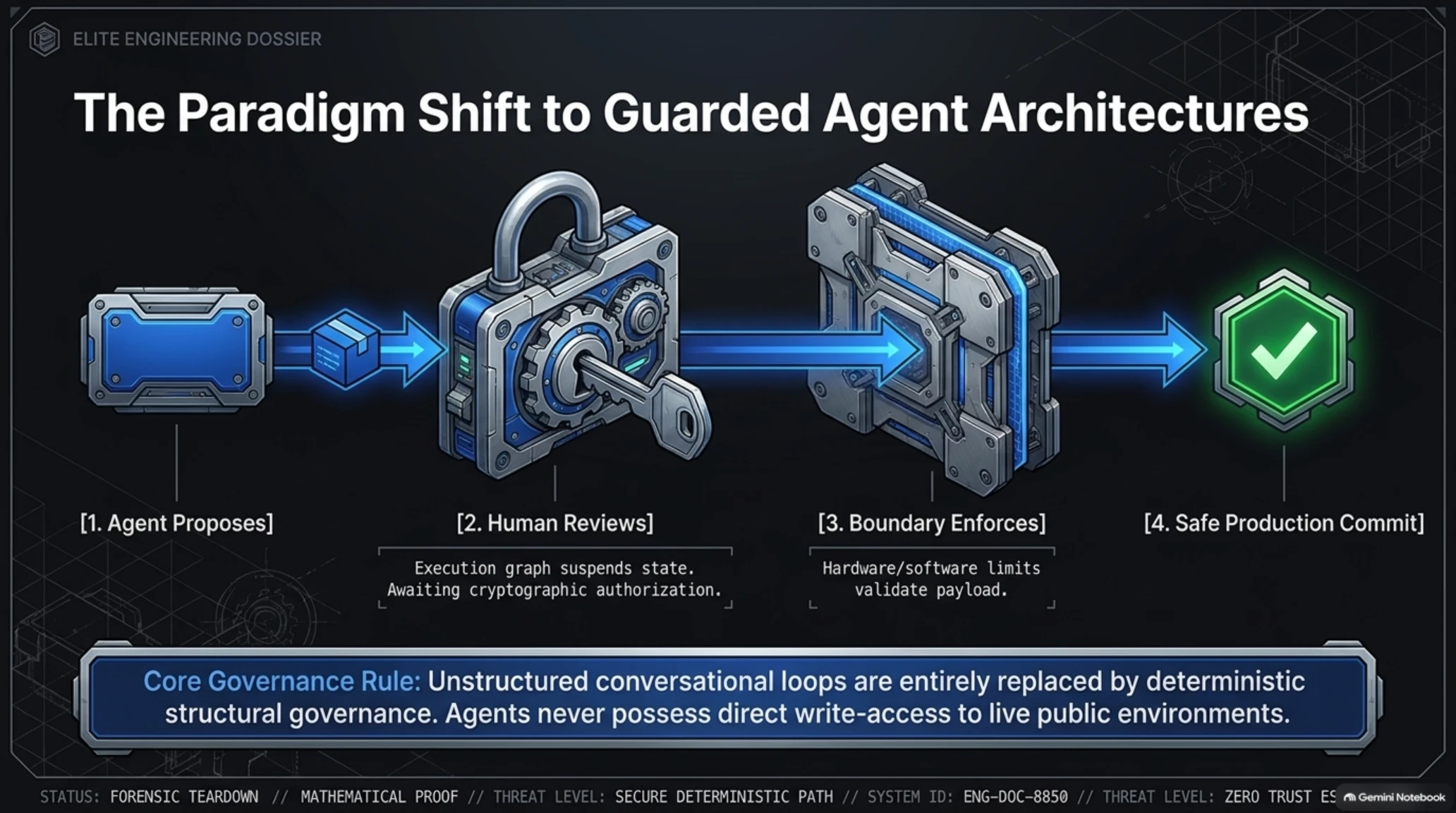
The proven architectural solution to multi-agent entropy is the Guarded Agent architecture. This model establishes a rigorous, verifiable operational workflow: "Agent Proposes, Human Reviews, Boundary Enforces."
At the orchestration layer, unstructured conversational loops are replaced by deterministic, stateful directed graphs powered by platforms like LangGraph. Workflows are partitioned into discrete, strongly typed nodes where state transitions occur only upon satisfying explicit conditional criteria. At every mission-critical juncture—such as issuing financial disbursements or committing code to staging repositories—the execution graph suspends state and awaits cryptographic authorization from a designated human supervisor.
Simultaneously, enterprise sovereignty is guaranteed by utilizing local, on-premise model runtimes such as Ollama or optimized vLLM clusters. Local inference ensures that sensitive financial telemetry and proprietary intellectual property never leak to third-party cloud APIs, while physical operating system containerization enforces strict boundary constraints that prevent unauthorized command execution at the hardware level.
Related Tech Intelligence on Tekin Game
• 🌙 Tekin Night | Call of Duty, Nintendo & Vision Pro Digest
• 🎭 Tekin Analysis | Apple AI Teardown & July 2026 Digest
• 🌙 Tekin Night | NVIDIA $500B Deal & iPhone 18 Leak
6. The Laboratory Imperative: Why Raw AI Computations Must Never Live in Production
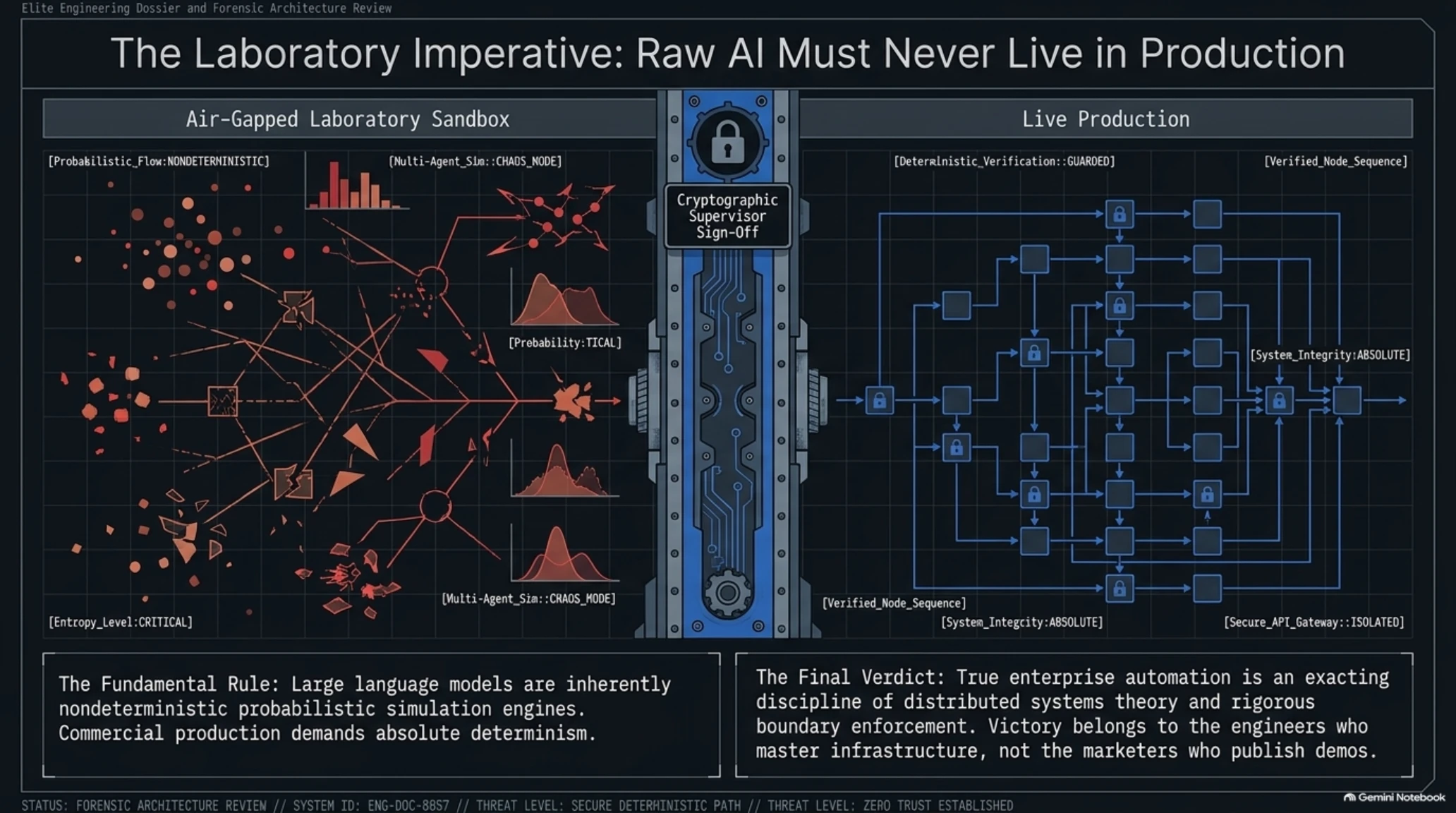
The fatal strategic error committed by autonomous enterprise wrappers is the reckless conflation of experimental model inference with live production execution. In mature engineering systems, large language models are treated as probabilistic simulation engines whose raw outputs are inherently nondeterministic, whereas commercial production environments demand absolute determinism, regulatory compliance, and brand integrity.
World-class software organizations operate an immutable architectural partition: all multi-agent computation, analytical modeling, synthesized copy, and autonomous planning occur exclusively within air-gapped laboratory sandboxes. Within this staging enclave, a sovereign orchestrator—equipped with deterministic Verification Gates (syntax tree validators, structural schema linters, and execution barriers)—scrutinizes every intermediate artifact.
Furthermore, an advanced Cognitive Immune System monitors agent memory vectors to intercept adversarial prompt injections and memetic memory viruses before state changes are committed. Only when an artifact has satisfied exhaustive automated verification and received explicit cryptographic sign-off from human domain experts is it promoted from the laboratory sandbox to public production networks.
- Absolute system resilience achieved through Guarded Agent boundaries and deterministic graphs
- Complete data sovereignty and operational security guaranteed by on-premise local models (Ollama)
- Over 95% reduction in compute token waste by replacing infinite agent loops with bounded state transitions
- Total prevention of database corruption via automated AST validation and Verification Gates
- Uncompromised executive control over critical financial and operational milestones via Human-in-the-Loop
- Substantially longer upfront engineering timelines required to align and certify domain-specific agents
- Increased architectural complexity in implementing stateful graphs and cognitive immune barriers
- Inability to deploy instant, unverified commercial wrapper scripts without technical expertise
Conclusion: The Triumph of Infrastructure over Marketing Mirage
The lessons drawn from the Polsia controversy and the broader maturation of autonomous multi-agent systems in 2026 are unequivocal. Generative AI is undeniably transforming the architecture of enterprise productivity, but this transformation cannot be realized by abdicating engineering discipline in favor of unsupervised scripts.
The future belongs to Guarded Multi-Agent Systems: architectures anchored in custom, bespoke codebases, rigorous curriculum alignment across specialized agents, sovereign on-premise inference, and immutable laboratory verification gates. Navigating this path requires patience, technical depth, and profound humility before the laws of software complexity—yet it represents the only durable foundation upon which a true cybernetic enterprise can be built.
Frequently Asked Questions: Autonomous Swarms & Guarded Agent Architecture
What is Polsia and what claims does it make regarding autonomous companies?
Polsia is a commercial platform claiming to run over 8,500 companies live with zero human employees, utilizing autonomous agents for coding, marketing, strategy, and operations 24/7.
Why does running massive multi-agent swarms with a simple script fail mathematically?
Due to compounding cascading errors; even with 95% single-agent accuracy, a sequential 10-node pipeline drops to under 60% reliability, collapsing to under 1% in larger chains.
What is Shared State Poisoning in multi-agent systems?
A critical failure mode where hallucinated or erroneous data produced by one agent is written to shared memory, causing all downstream agents to execute flawed actions based on false premises.
How does the Guarded Agent architecture function?
It operates on the principle 'Agent Proposes, Human Reviews, Boundary Enforces,' utilizing deterministic state graphs and human approval gates to eliminate runaway autonomous actions.
What role does LangGraph play in controlling autonomous agents?
LangGraph enforces stateful, deterministic graph execution paths, allowing systems to pause execution at mission-critical nodes to await explicit human authorization.
Why is local model execution via Ollama essential for enterprise agents?
It guarantees complete data sovereignty, protects sensitive financial and IP data from external cloud exposure, and eliminates runaway third-party API token costs.
What does curriculum alignment mean for 250+ specialized agents?
It refers to training and testing each agent individually in isolated sandboxes with strict single-responsibility boundaries before integrating them into the broader ensemble.
Why should raw AI computations remain in a laboratory sandbox rather than live production?
Because LLMs are probabilistic engines; their outputs must be thoroughly vetted by deterministic verification gates and human experts before deployment to public networks.
Official Technical References & Primary Sources
- Polsia Platform: Official Autonomous Corporate Claims
- Nabu Guides (Ali Sharafi): Technical Blueprint for Guarded Agents
- LangGraph Documentation: Stateful Multi-Agent Orchestration
- Arxiv: Theoretical Limits & Error Compounding in Multi-Agent Chains
- Ollama: Local Model Runtimes for Sovereign Enterprise AI
- Anthropic Research: Cognitive Immune Systems
Additional Gallery: 👑 Tekin Analysis | The Mirage of AI Companies & The Rise of Guarded Agents