Tekin Analysis: GTA 6 Fuel
- 🎮Rockstar Fires Back- Rob Nelson dismisses complaints, emphasizing that a 10-second fill-up is exceptionally fast
- 🎧Driving Paradigm Shift- For the first time, running on empty will completely stall vehicles across Leonida
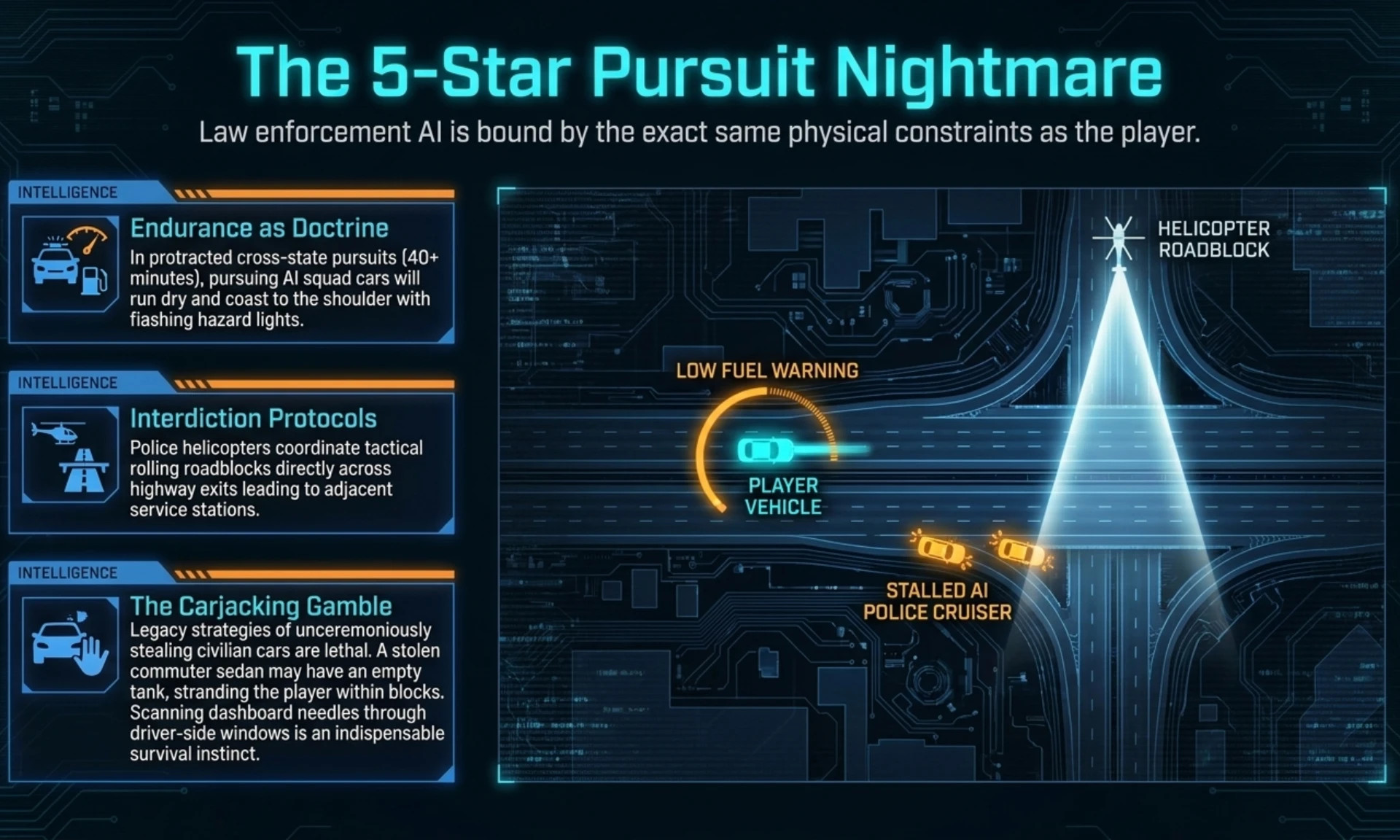
- 🚀5-Star Pursuit Nightmare- Low fuel warnings transform high-speed police chases into tactical survival scenarios
- 🗡️RAGE 9 Fluid Physics- Dynamic bullet punctures create flammable gasoline trails across the environment
- 📰EVs vs. Combustion- Distinct refueling logistics for high-voltage Superchargers versus classic gas pumps
- ⚔️GTA Online 2 Economy- Fuel distribution confirmed as a cornerstone economic pillar of the multiplayer ecosystem
Earthquake Behind Closed Doors: Fuel Gauges and Refueling Mandates in GTA 6
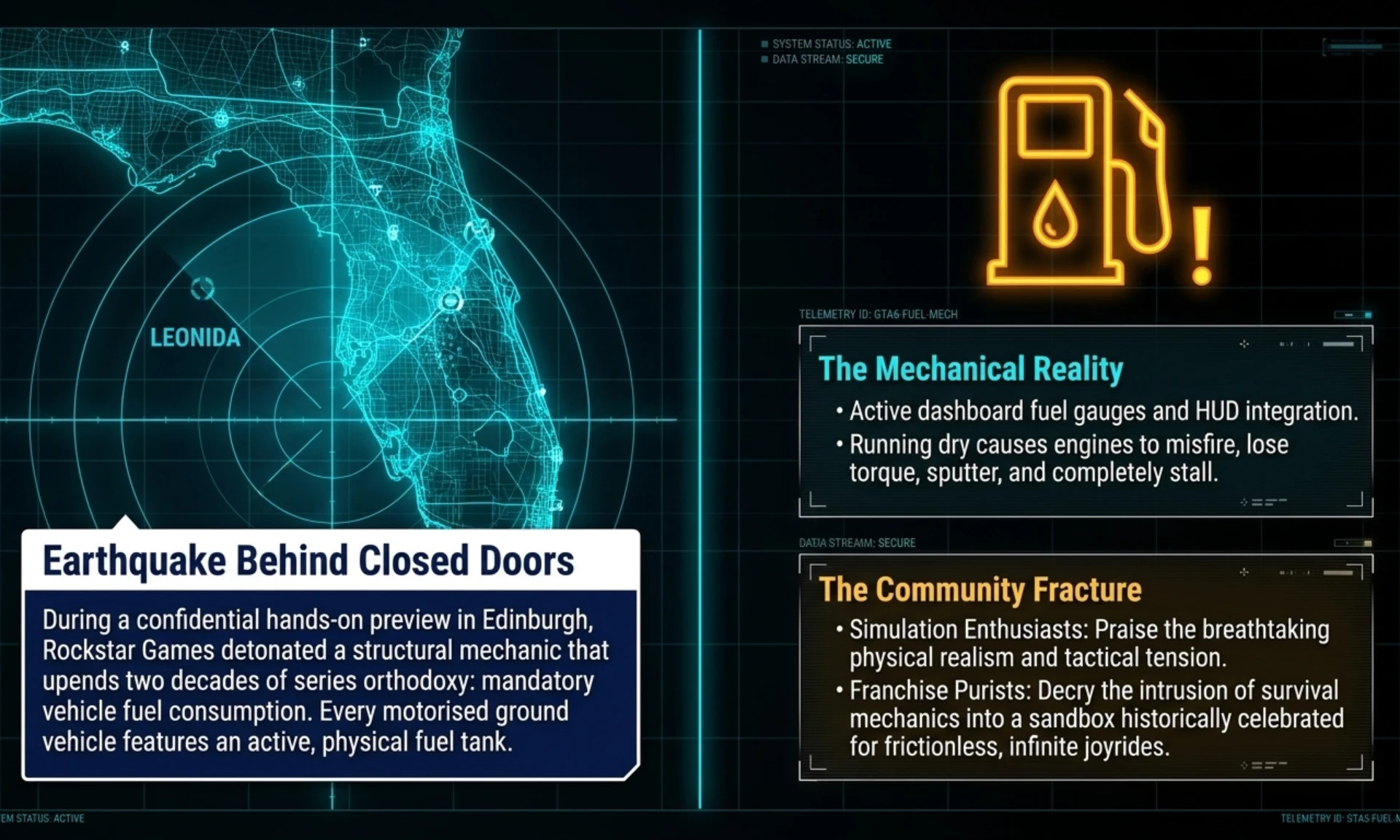
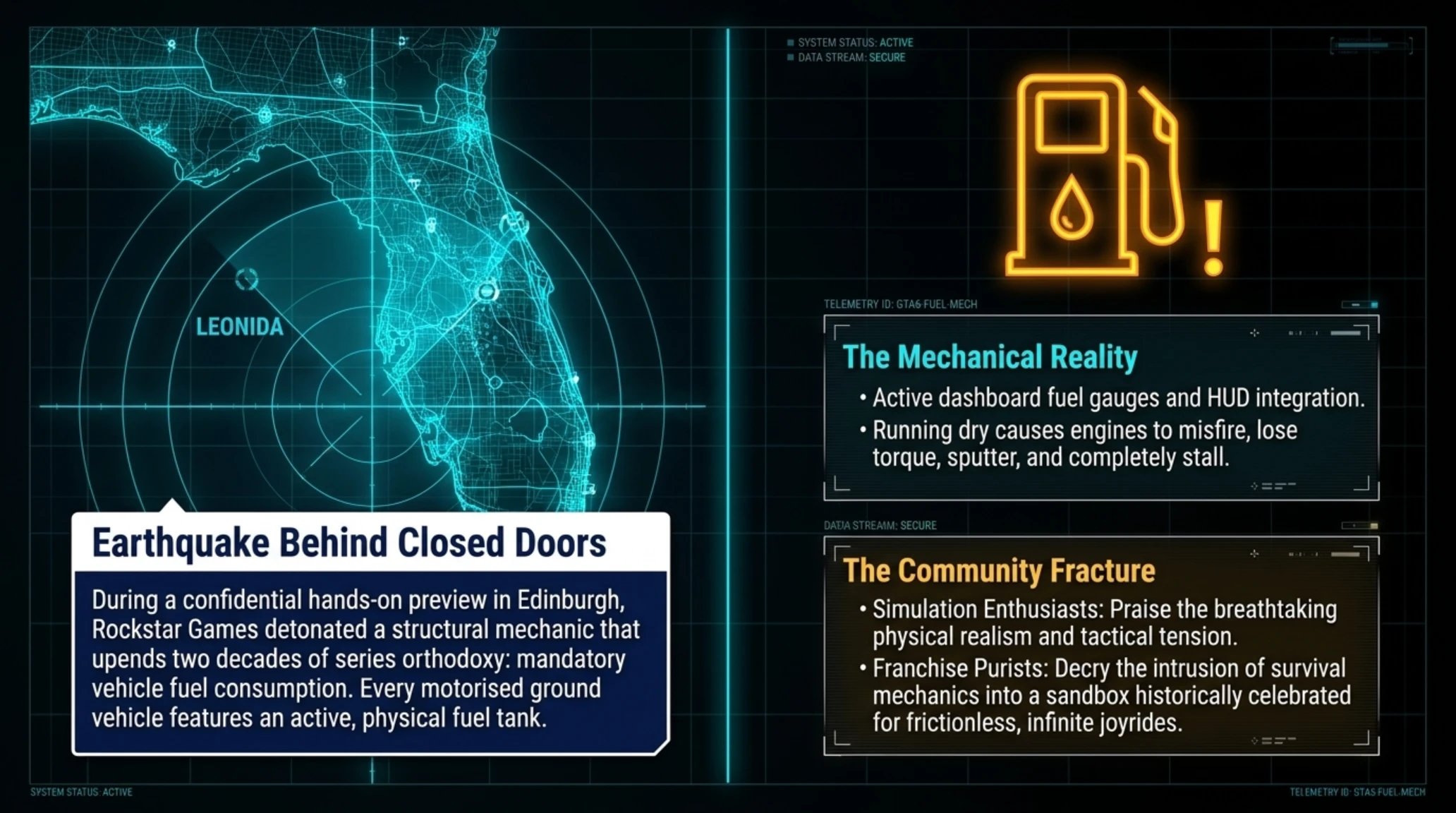
The interactive entertainment industry has experienced countless controversies surrounding gameplay mechanics, yet few announcements have detonated across the global gaming community with the explosive force of Rockstar Games' latest design revelation for Grand Theft Auto VI. During an exclusive, confidential hands-on preview session held in Edinburgh for select international media outlets and content creators, the Scottish studio pulled back the curtain on a structural mechanic that upends two decades of series orthodoxy: mandatory vehicle fuel consumption, interactive dashboard fuel gauges, and real-time gas station pit stops across the state of Leonida.
According to verified technical briefings and firsthand impressions from journalists in attendance, every motorized ground vehicle in GTA 6 ranging from rusted station wagons prowling the backcountry of Ambrosia to exotic hypercars speeding along the neon-drenched boulevards of Vice Beach features an active, physical fuel tank. When players step into a car, the Heads-Up Display (HUD) and the cockpit instrument cluster dynamically display the remaining fuel level. Should the tank run dry during an extended trek across the map or an intense cross-county high-speed pursuit, the engine begins misfiring, loses torque, sputters violently, and ultimately stalls out, leaving the player completely stranded on the asphalt.
The immediate reaction across the gaming spectrum was nothing short of polarized warfare. One faction of players, captivated by the breathtaking physical realism and meticulous attention to detail pioneered in 2018's Red Dead Redemption 2, hailed the mechanic as a revolutionary breakthrough that introduces tactical tension and strategic foresight to criminal operations. Conversely, an equally vocal contingent of longtime franchise purists vehemently decried the feature as an unwelcome intrusion of survival simulation mechanics into a series historically celebrated for chaotic, frictionless escapism and infinite pedal-to-the-metal joyrides.
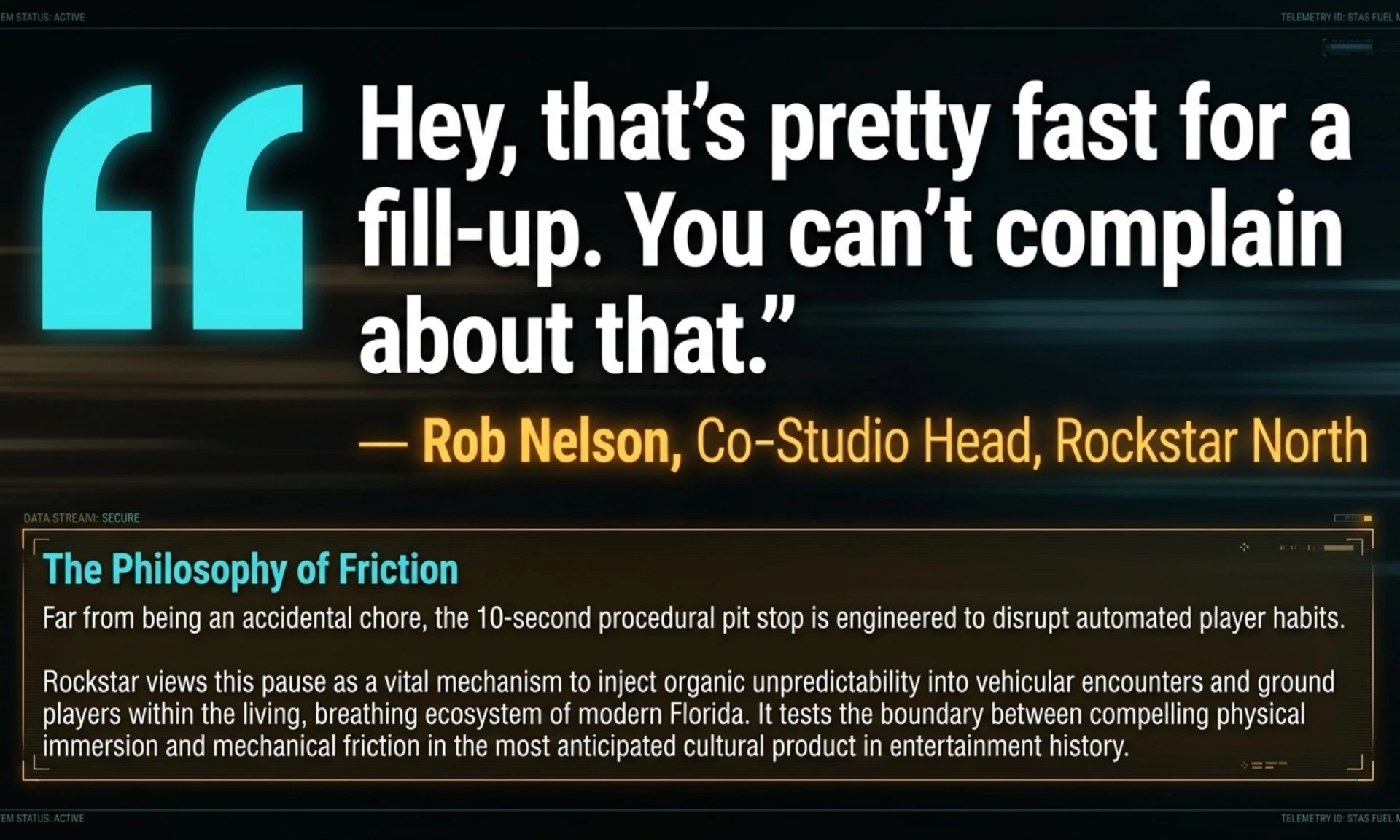
As the debate escalated into a firestorm across digital forums, Rob Nelson, co-studio head at Rockstar North, personally addressed the brewing controversy during an on-site gameplay demonstration. Overseeing a live demo where a character pulled into an urban gas station, Nelson showcased the streamlined nature of the mechanic. With the fuel pump animation concluding in a mere fraction of a minute, Nelson offered a blunt and unapologetic defense, declaring: "Hey, that’s pretty fast for a fill-up. You can’t complain about that."
Nelson's candid remarks, reported by leading gaming publications including PC Gamer, underscored Rockstar’s steadfast confidence in their creative vision. Far from being an accidental chore, the refueling mechanic is engineered to disrupt automated player habits and inject organic unpredictability into every vehicular escapade. In Rockstar’s eyes, the 10-second refueling process is neither an arduous obstacle nor a pacing killer, but a deliberate pause designed to ground the player within the living, breathing ecosystem of modern Florida.
Our analytical investigation at TekinGame indicates that this mechanic touches on a fundamental question of contemporary video game design: where does the boundary lie between compelling physical immersion and unnecessary mechanical friction? By mandating pit stops, Rockstar is testing the limits of player tolerance in the most anticipated cultural product in entertainment history.
Core Technical Revelations: GTA 6 Fuel Mechanics
- Complete vehicle refueling, including disembarkation and nozzle placement animations, lasts approximately 10 seconds.
- Active instrument clusters feature functional analog and digital fuel needles with illuminated low-fuel warning indicators.
- Aggressive driving behaviors, continuous redlining, and nitrous oxide deployment accelerate fuel drain exponentially.
- Studio leadership has firmly dismissed community backlash, affirming that the mechanic is integral to the game's identity.
Deconstructing the 10-Second Pit Stop: Seamless Animation and Procedural Economy
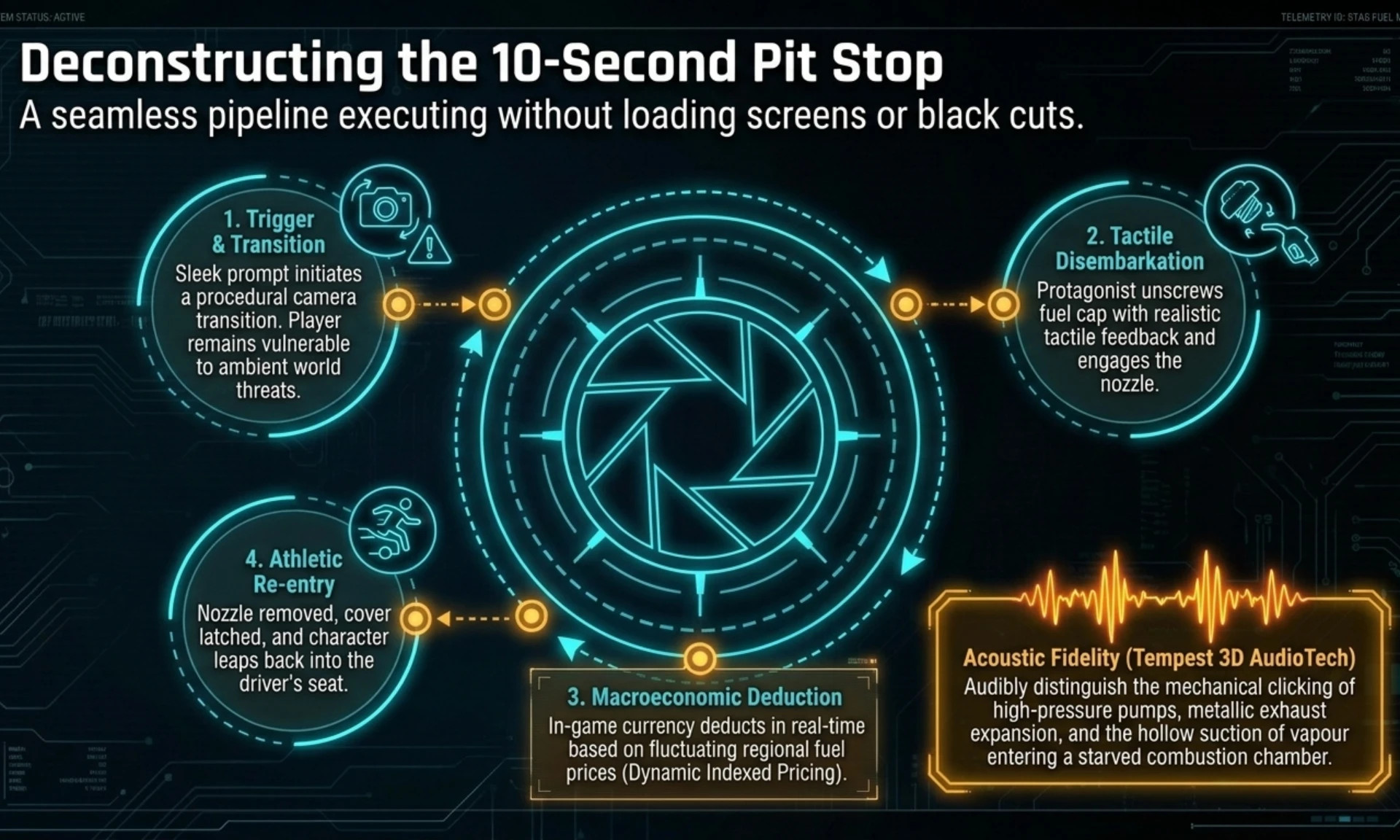
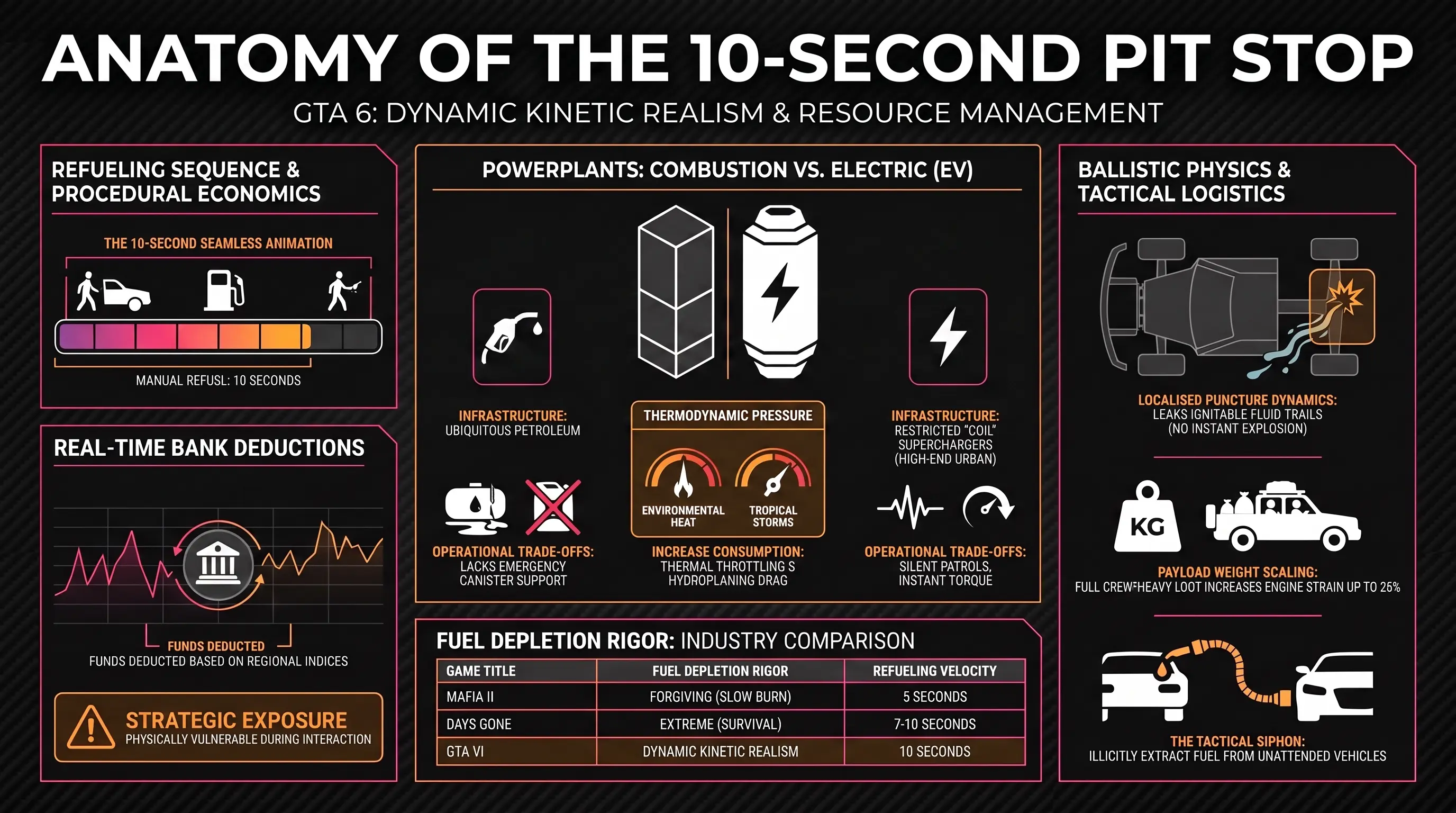
To truly appreciate how Rockstar North transformed a potentially tedious mundane chore into an engaging visual sequence, one must scrutinize the technological pipeline powering the refueling interaction. Observers who witnessed the preview reported that approaching a gas pump trigger zone prompts a sleek, unobtrusive button prompt on the screen. Pressing the input initiates a fully procedural, seamless camera transition that keeps the action continuous without triggering loading screens or black cuts.
The protagonist smoothly steps out of the driver’s seat, unscrews the fuel cap with realistic tactile feedback, inserts the nozzle into the vehicle, and activates the pump. As the digital fuel counter on the pump housing ticks upward in real time, the in-game bank account of the player is deducted according to fluctuating macroeconomic fuel prices across Leonida. Once the meter hits full, the character removes the nozzle, latches the cover, and leaps back behind the wheel with urgent athleticism. The entire sequence executes within roughly ten seconds, allowing players to survey their immediate surroundings while remaining vulnerable to ambient world threats.
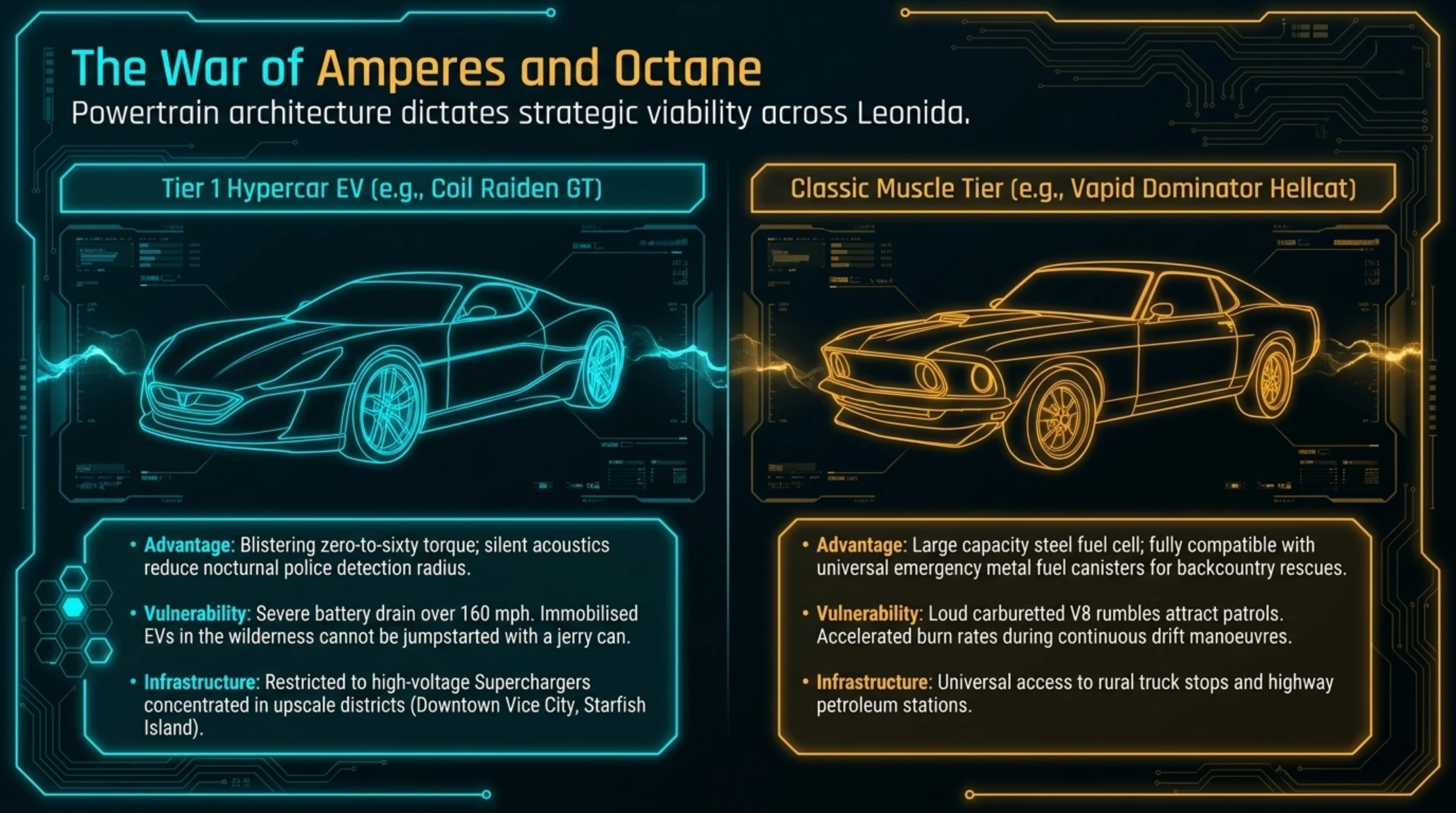
Rockstar’s technical architects also highlighted that the fuel paradigm bifurcates sharply between internal combustion engines and modern Electric Vehicles (EVs). In Vice City a metropolitan playground mirroring Miami’s luxury car culture high-end EV manufacturers like the fictional brand Coil operate specialized Supercharger hubs. These charging plazas feature distinct plug-in mechanics, silent idle states, and distinct charge depletion curves compared to naturally aspirated V8 muscle cars.
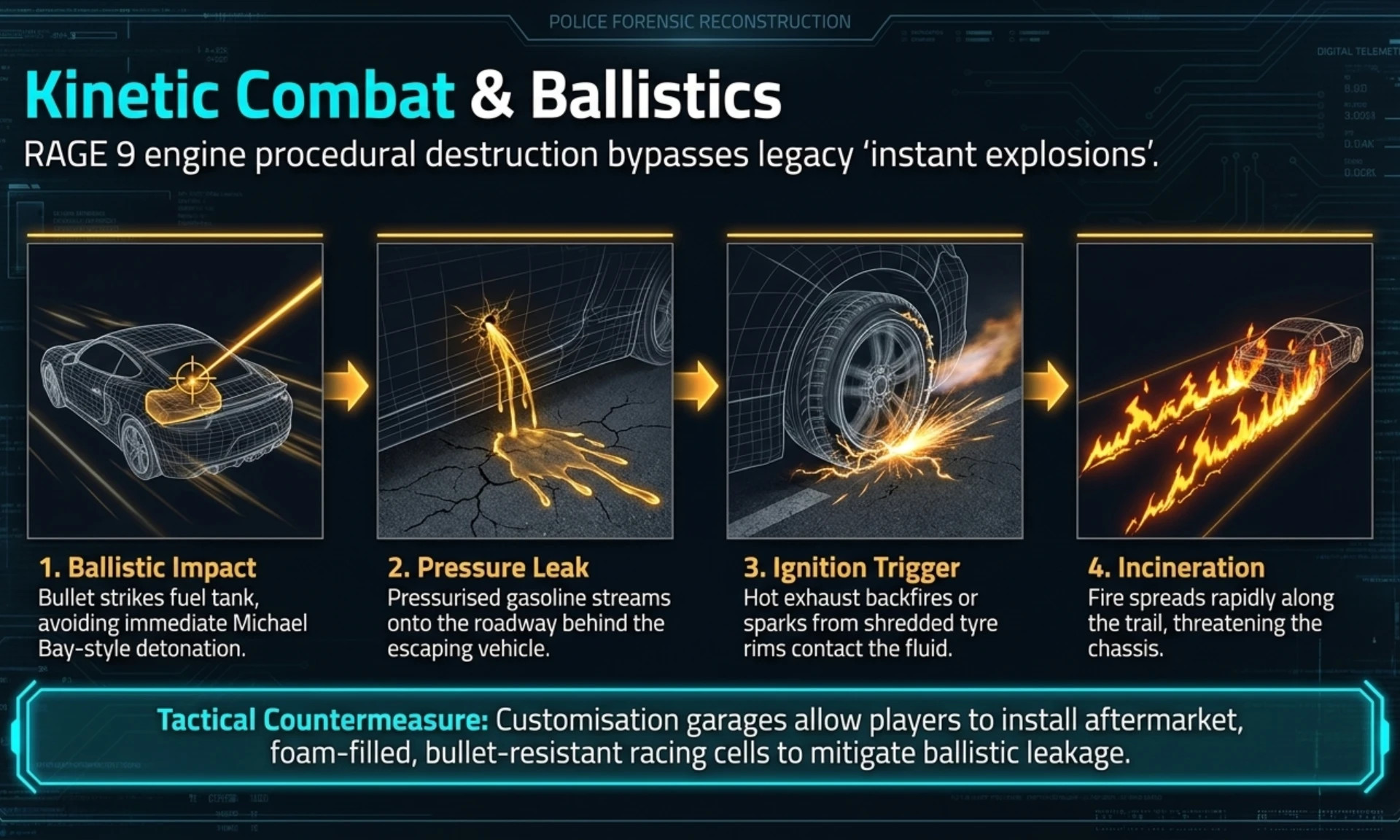
Crucially, the physical integrity of the fuel reservoir is woven into the game's advanced localized ballistic model. Unlike arcade shooters of the past where striking a fuel door triggered an instantaneous Michael Bay-style explosion, GTA 6 introduces nuanced puncture dynamics. Bullet impacts against the fuel tank cause pressurized gasoline to stream onto the roadway, leaving an ignitable trail of flammable fluid behind the escaping vehicle. If hot exhaust backfires or sparks from shredded tire rims come into contact with the leaking fuel, the resulting fire spreads rapidly along the trail, threatening to incinerate the chassis.
This level of kinetic simulation demonstrates that the fuel system is not a superficial vanity feature, but a dynamic sandbox element capable of catalyzing emergent gameplay scenarios during high-stakes missions and competitive multiplayer skirmishes alike.
The architectural implementation of this feature rests upon five cornerstone technical systems:
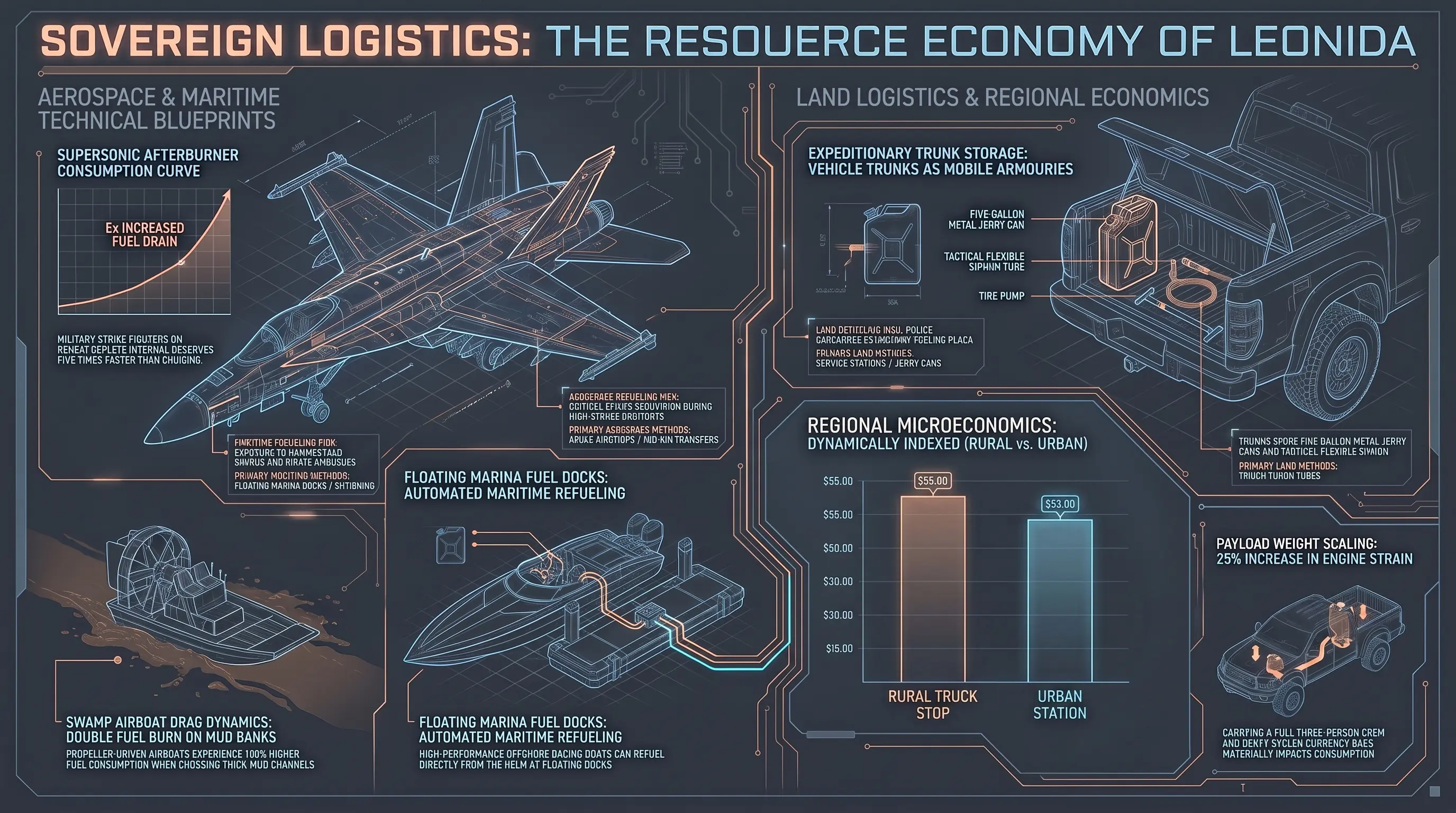
- Aerodynamic Drag and Payload Weight Scaling: Carrying three fully equipped crew members alongside heavy duffel bags of stolen currency materially impacts engine strain, increasing fuel consumption by up to twenty-five percent.
- Dynamically Indexed Regional Fuel Pricing: Fuel costs fluctuate across different zip codes within Leonida, turning rural truck stops and urban corporate stations into distinct economic entities.
- Aftermarket Fuel Cell Upgrades: Customization garages permit players to swap stock gas tanks for foam-filled, bullet-resistant racing cells that reduce fire hazards during ballistic engagements.
- Ambient Emergency Roadside Dispatch: Stranded motorists who exhaust their reserves in the backcountry can summon an on-demand fuel truck via their iFruit smartphone, albeit at exorbitant pricing.
- Variable Octane Ratings: Low-grade, contaminated fuel purchased in impoverished trailer parks can cause engine knocking and throttle lag during high-speed highway sprints.
Acoustically, the audio engineering team at Rockstar North has captured the intricate sonics of fuel injection and combustion physics with unprecedented fidelity. Utilizing Sony's PlayStation 5 Tempest 3D AudioTech and Dolby Atmos spatial processing, players can audibly distinguish the mechanical clicking of high-pressure fuel pumps, the subtle metallic expansion of warm exhaust pipes as fuel drains, and the distinctive hollow suction sound of an empty fuel tank pulling vapor into the combustion chamber. When an engine starves for fuel, the resulting misfires produce jarring, asymmetric acoustic pops that reverberate realistically through the concrete canyons of Vice City.
Moreover, the sensory presentation of fuel management is deeply enhanced by the game's first-person perspective. When switching to cockpit view, players notice fully functional analog needles, high-resolution digital telemetry screens, and realistic liquid slosh physics rendered inside transparent racing tanks. The tactile feedback delivered through the PlayStation 5 DualSense controller's adaptive triggers actively resists acceleration as the fuel line begins sucking vapors, delivering an intuitive, visceral warning to the driver long before the engine delivers its final shuddering gasp.
Economically, the fuel requirement serves as a vital monetary sink designed to regulate in-game inflation. In Grand Theft Auto V, players accumulated hundreds of millions of dollars with virtually nothing routine to spend capital on outside of real estate and military hardware. In GTA 6, routine operational expenditures paying for high-octane racing fuel, charging exotic hypercars at premium Superchargers, replacing ruptured gas lines after armed shootouts, and buying emergency jerry cans create continuous financial circulation that grounds the street-level criminal hustle in tangible material constraints.
These sophisticated design choices illustrate that Rockstar North is leveraging hardware advancements on the PlayStation 5 and Xbox Series X to deliver unprecedented environmental reactivity and sensory connection between driver and machine.
The Five-Star Pursuit Nightmare: When the Fuel Warning Light Flashes Red
The most consequential tactical ramification of the refueling mechanic reveals itself during intense law enforcement confrontations. In previous entries across the 3D and HD universes from the neon streets of 2002's Vice City to the sun-soaked sprawl of Los Santos in Grand Theft Auto V evading a maximum five-star wanted level followed an established strategic blueprint: commandeer the fastest exotic car on the highway, keep the throttle pinned to the floor, and slalom through traffic until the search perimeter disintegrated. In GTA 6, that legacy strategy is a recipe for catastrophic entrapment.
Consider the harrowing tactical dilemma: with four patrol cruisers ramming your rear bumper, heavily armored tactical SWAT vans attempting PIT maneuvers, and a police surveillance chopper illuminating your vehicle with a high-intensity spotlight, the yellow low-fuel icon begins pulsating violently on your dashboard. Pulling into a service station for a ten-second pit stop under heavy fire is virtually impossible; stationary targets are instantly shredded by concentrated automatic weapon fire. Furthermore, stray rounds striking commercial gas pumps ignite underground fuel reservoirs, triggering devastating chain-reaction blasts capable of wiping out entire city intersections.
This dynamic permanently transforms the foundational act of vehicular hijacking (Carjacking). Players can no longer unceremoniously yank a civilian out of an idling sedan and assume they have gained an escape chariot with infinite range. A stolen commuter vehicle might have an empty tank, stranding the player within blocks of the crime scene. Consequently, scanning dashboard needles through driver-side windows prior to initiating a carjacking becomes an indispensable survival instinct for seasoned operators.
Jargon Buster: Essential Terminology of Leonida's Automotive Systems
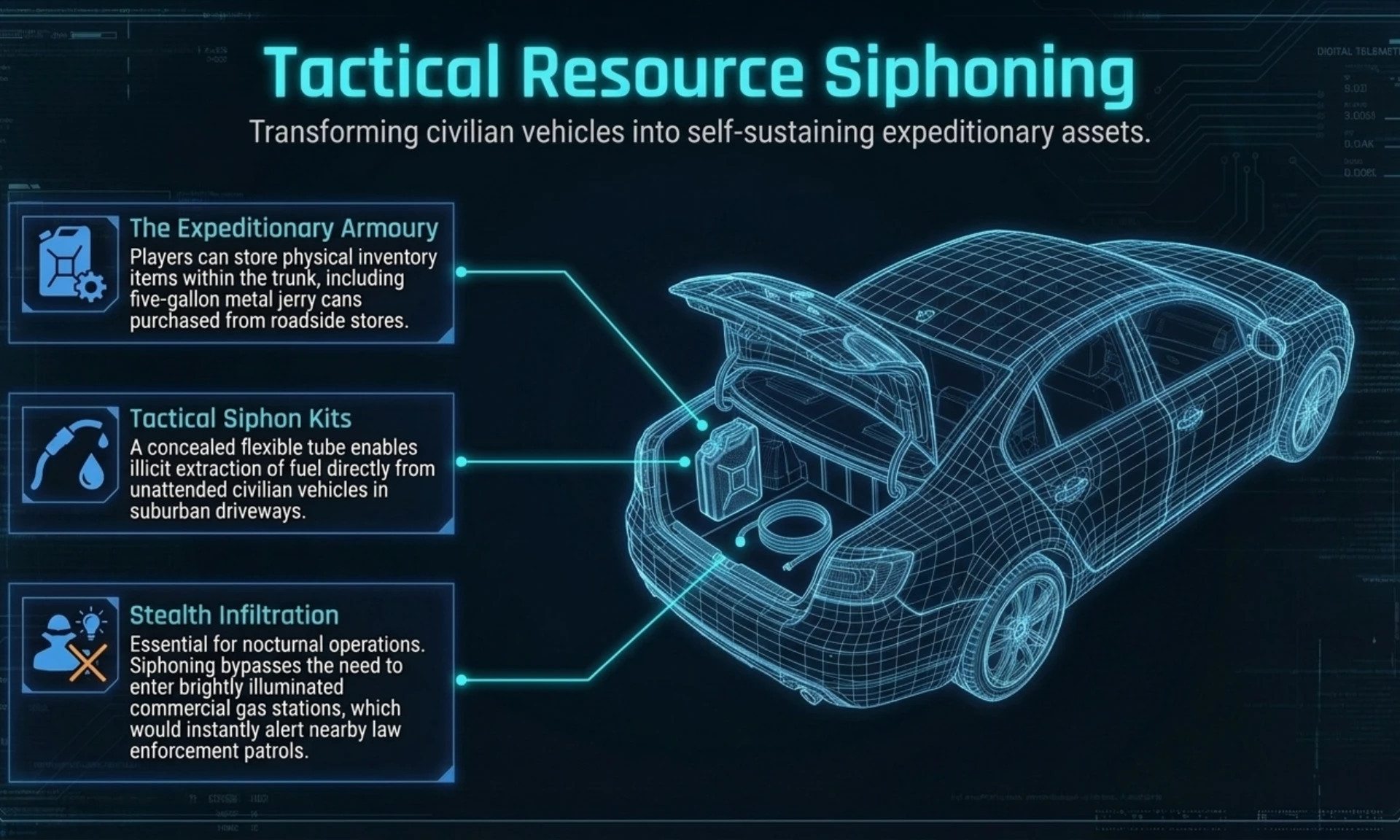
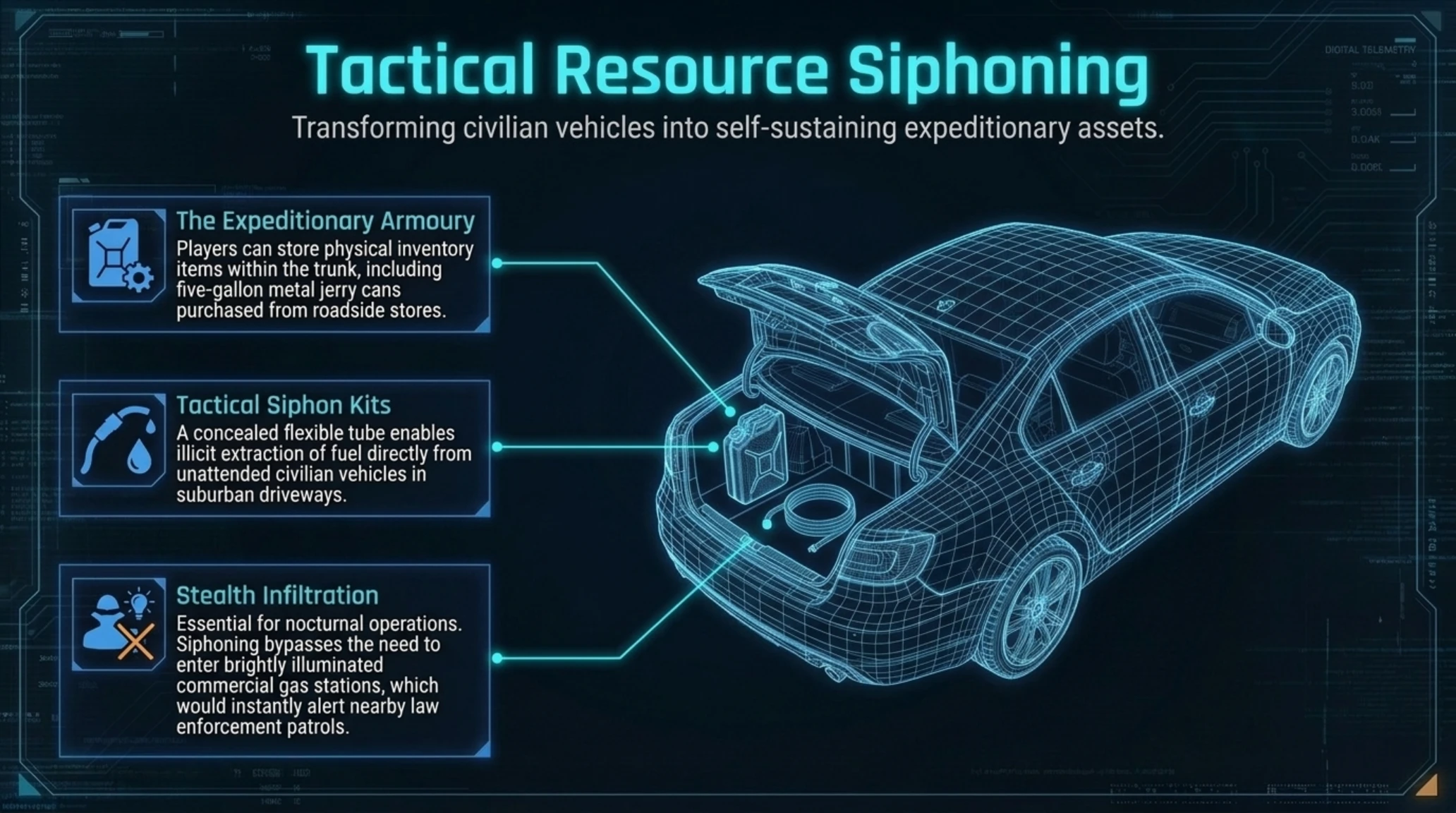
Tactical Siphon Kit: A concealed flexible tube enabling characters to illicitly extract gasoline from unattended civilian vehicles parked in suburban driveways.
Armored Fuel Cell: A reinforced, puncture-resistant fuel bladder engineered to mitigate ballistic leakage during armed vehicular combat.
Regenerative Braking Array: An EV-exclusive subsystem in modern hypercars that restores minor battery reserves during decelerations along coastal serpentines.
Remarkably, technical disclosures confirmed that law enforcement vehicles in GTA 6 are bound by the exact same physical fuel constraints as the player. In older open-world titles, enemy AI vehicles operated on rubber-band physics with infinite resources and supernatural top speeds. In GTA 6, if a player orchestrates a grueling, protracted cross-state pursuit lasting upwards of forty minutes across the sprawling Leonida turnpikes, pursuing squad cars will begin dropping out of the chase as their fuel tanks dry up, coasting to the highway shoulder with flashing hazards. This breakthrough elevates endurance driving into a legitimate tactical escape doctrine.
Furthermore, the metropolitan police departments in Vice City and regional county sheriff offices deploy sophisticated fuel-interdiction protocols. Tactical dispatchers monitor traffic camera feeds, and once an escaping vehicle exhibits deceleration or visible vapor smoke, police helicopters coordinate tactical rolling roadblocks directly across highway exits leading to adjacent service stations. This creates an agonizing tactical chokehold, forcing the player to choose between running dry on an open interstate or attempting a suicidal breach of a heavily fortified police perimeter guarding a fueling plaza.
Our field analysis identifies four distinct emergent combat scenarios spawned by this mechanic:
- The Fuel Station Ambush: Luring heavy law enforcement convoys into gas station forecourts before detonating pumps with precision rifle fire to incinerate the blockade.
- The Ballistic Fuel Trail: Tactical puncture of an escaping adversary’s tank, followed by the deliberate ignition of the trailing petroleum ribbon via road flares or exhaust backfires.
- The High-Risk Hijack Gamble: Seizing a speeding vehicle during an active shootout only to find the needle pinned to empty, forcing an immediate tactical transition to foot combat.
- Conservation Coasting: Utilizing neutral gear and momentum downhill along the elevations of northern Leonida to stretch the final drops of fuel toward an underground hideout.
Between Immersion and Exhaustion: The Evolution of Physical Realism at Rockstar
To contextualize Rockstar’s willingness to impose such rigorous mechanical parameters on its flagship franchise, one must examine the studio’s historical trajectory toward holistic environmental simulation. Over the past two decades, the Scottish developer has consistently pushed against the industry consensus, steadily incorporating physical friction into its virtual sandboxes to foster deeper emotional resonance between players and their avatars.
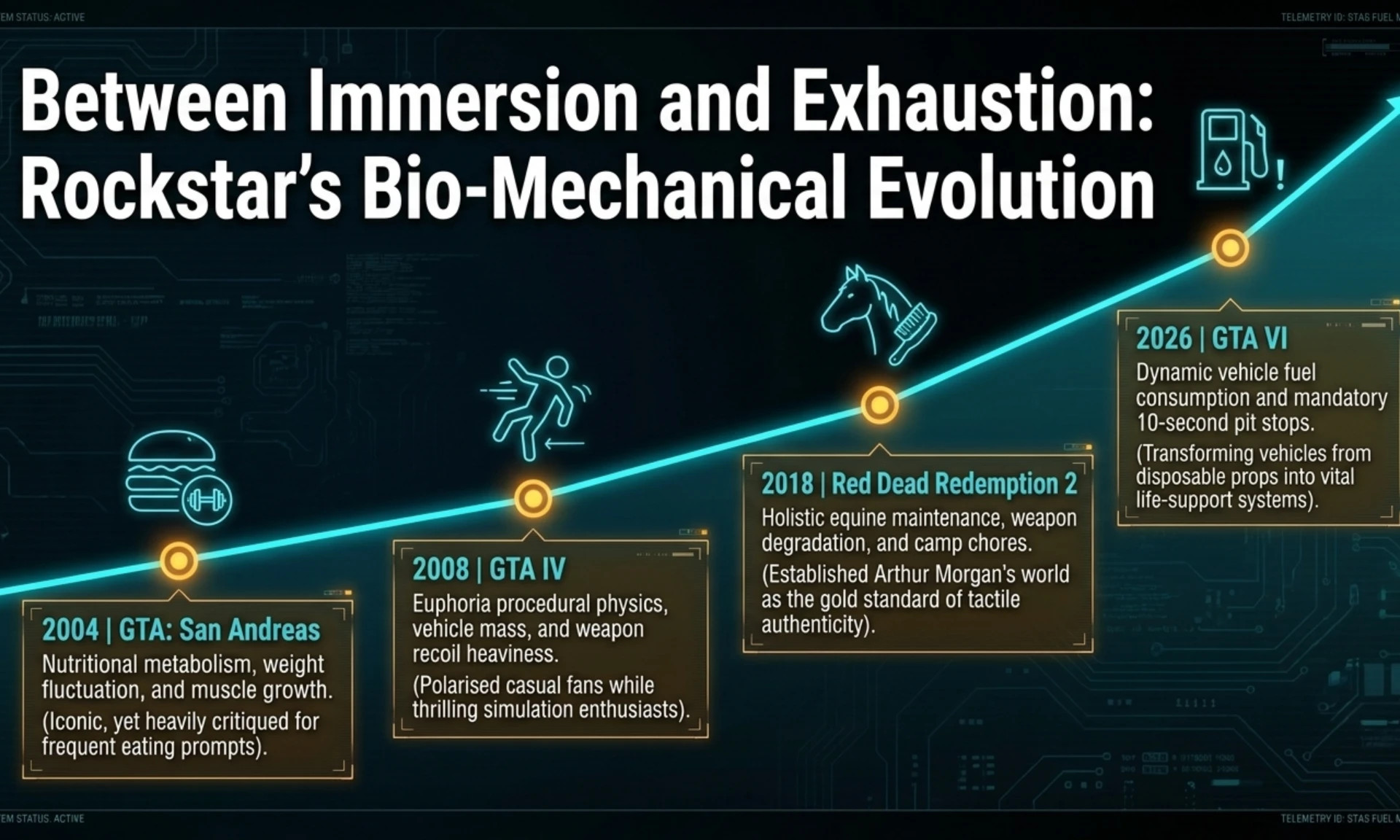
In 2004, Grand Theft Auto: San Andreas introduced groundbreaking metabolic systems where Carl Johnson had to consume meals to stave off starvation, work out in gymnasiums to build muscle mass, and manage body fat percentages. While universally praised for ambition, players frequently voiced frustration when forced to abandon story missions to visit restaurant drive-thrus. In 2008, GTA IV revolutionized physics via the Euphoria engine, delivering heavy, boat-like vehicle handling and realistic inertia that alienated casual arcade fans while thrilling simulation enthusiasts.
The definitive synthesis of this philosophy arrived with 2018's Red Dead Redemption 2. Requiring players to clean firearms to prevent jamming, manually brush and feed equine companions, hunt wildlife for camp sustenance, and bundle up in cold-weather garments represented a watershed moment in interactive world-building. While some players criticized the deliberate pacing of these animations, the uncompromising tactile authenticity established Arthur Morgan's odyssey as the gold standard of living worlds.
Historical Timeline: Rockstar's Transition from Arcade Freedom to Bio-Mechanical Simulation
| Release Year | Game Title | Core Realism Mechanic Introduced | Critical & Player Reception |
|---|---|---|---|
| 2004 | GTA: San Andreas | Nutritional metabolism, weight fluctuation & muscle growth | Iconic breakthrough; mild critique of frequent eating prompts |
| 2008 | GTA IV | Euphoria procedural physics, vehicle mass & weapon recoil | Polarized response; praised for realism, critiqued for heaviness |
| 2013 | GTA V | Streamlined arcade vehicle dynamics & responsive handling | Universal commercial triumph; minor critique of simplified physics |
| 2018 | Red Dead Redemption 2 | Holistic horse maintenance, weapon degradation & camp chores | Masterpiece status; minor vocal friction regarding animation speed |
| 2026 | GTA VI | Dynamic vehicle fuel consumption & mandatory pit stops | Major community controversy balancing immersion and accessibility |
Rockstar's internal analytics following the multi-year lifecycle of Red Dead Redemption 2 proved that physical friction generates unparalleled player attachment. When an asset requires care, maintenance, and resource investment, it ceases to be a disposable, interchangeable prop. In GTA 6, a customized lowrider with upgraded transmission and an enlarged fuel cell is not just another car it is an authentic personal companion forged through calculated survival.
By transforming vehicles from expendable shells into vital life-support systems, Rockstar reinforces the core narrative arc of protagonists Lucia and Jason. In a modern underworld saturated with hyper-surveillance and relentless militarized law enforcement, managing mundane logistics is what separates surviving professional felons from reckless amateur outlaws.
This psychological phenomenon, frequently described by preview journalists as "automotive range anxiety," alters player psychology during stealth reconnaissance missions. Knowing that every aggressive acceleration burn drains vital reserves forces players to adopt disciplined throttle management, gliding quietly through suburban avenues and timing getaways to coincide with favorable traffic patterns rather than driving like unhinged wrecking balls.
Lessons from Industry Precedents: How Open-World Games Have Handled Fuel
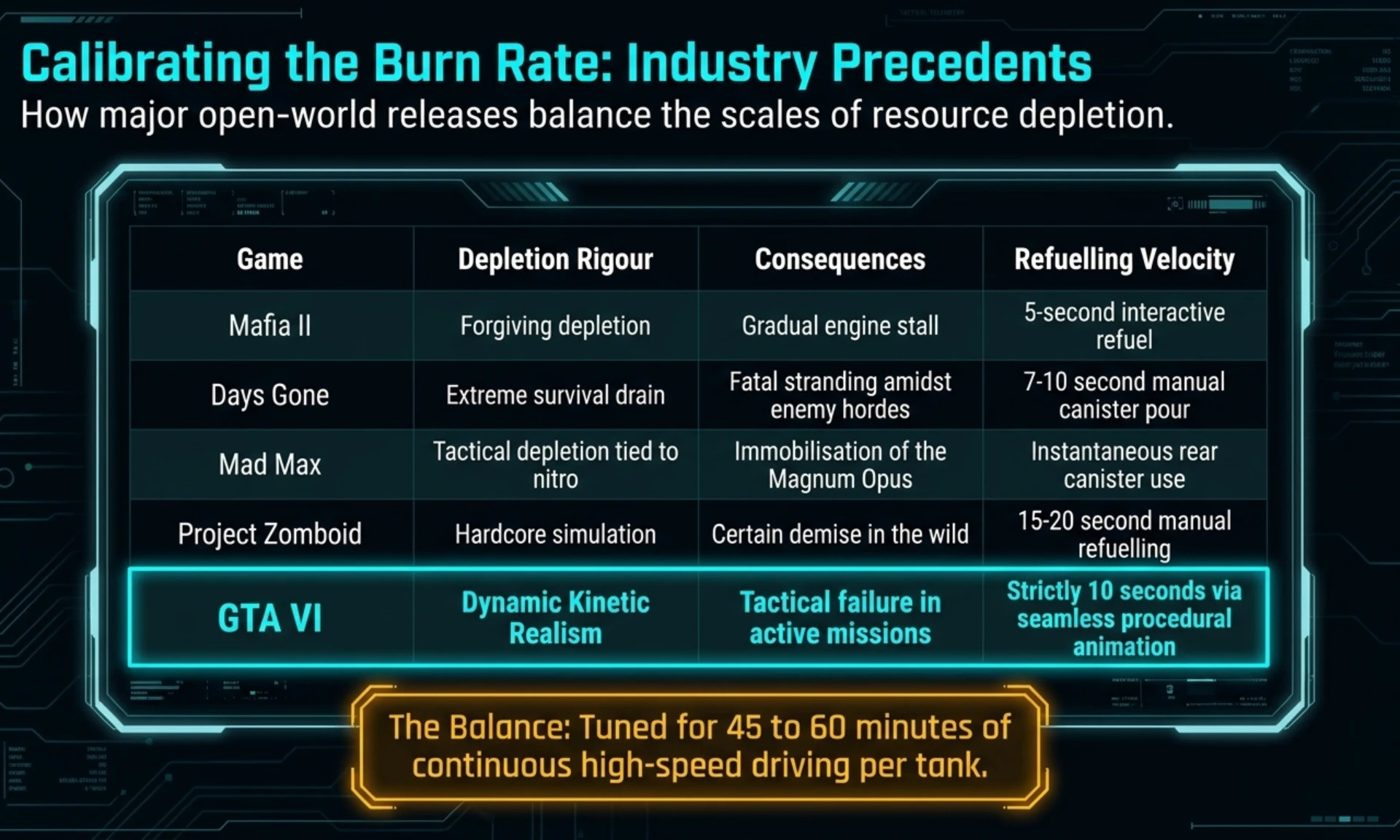
Rockstar North is not the first development studio to integrate combustible fuel systems into expansive open-world architectures. Over the past fifteen years, notable titles including Mafia II, Bend Studio’s post-apocalyptic epic Days Gone, Avalanche Studios’ wasteland action title Mad Max, and hardcore survival titles have experimented with resource depletion to varying degrees of critical success.
In 2010’s Mafia II, 2K Czech rendered beautiful period-accurate sedans that burned fuel at a deliberate rate. While pulling into gas stations to have an attendant wash windows and replenish tanks added immense 1950s atmosphere, the burn rate was so forgiving that ninety percent of players completed the narrative without ever running dry, rendering the mechanic largely inconsequential. Conversely, in Days Gone, managing Deacon St. John's drifter bike fuel tank was a relentless survival imperative. Running out of gas in the Pacific Northwest wilderness meant facing ferocious Freaker hordes on foot, generating terrifying tension that forced meticulous route reconnaissance.
The comparative matrix below delineates how major open-world releases calibrated fuel mechanics and where GTA 6 positions itself within this design spectrum:
Comparative Analysis: Vehicle Fuel Mechanics Across Premier Open-World Titles
| Title | Developer / Publisher | Fuel Depletion Rigor | Consequence of Empty Tank | Refueling Velocity |
|---|---|---|---|---|
| Mafia II | 2K Czech | Forgiving (extremely slow burn) | Gradual engine stall in urban traffic | 5 Seconds (interactive service station) |
| Days Gone | Bend Studio | Extreme (frequent survival drain) | Fatal stranding amidst enemy hordes | 7-10 Seconds (manual canister pouring) |
| Mad Max | Avalanche Studios | Tactical (tied to nitro boosts) | Immobilization of the Magnum Opus | Instantaneous (direct rear canister use) |
| Project Zomboid | The Indie Stone | Hardcore Simulation | Certain demise in zombie-infested wild | 15-20 Seconds (contingent on capacity) |
| GTA VI | Rockstar Games | Dynamic Kinetic Realism | Tactical failure in active missions | Strictly 10 Seconds (seamless procedural) |
By studying these antecedents, Rockstar has engineered a hybrid methodology. The fuel burn rate is tuned to grant approximately forty-five to sixty minutes of continuous high-speed driving per tank far more generous than Days Gone, yet impactful enough to make fuel monitoring an omnipresent strategic consideration across the vast expanse of Leonida.
Compounding this strategic depth is the presence of hostile local cartel factions that control regional gas stations in unincorporated districts. Stranding oneself without fuel in neighborhoods controlled by the Jamaican Posse or the Haitian Syndicate turns a mundane fill-up into an impromptu shootout, forcing players to scout safe, neutral corporate franchises along the major turnpikes rather than venturing into lawless back-alleys under empty indicators.
This environmental synergy ensures that every gallon burned brings players into direct contact with the social geography of Leonida, grounding vehicular movement in the living politics of the underworld and reinforcing the organic tension that makes open-world exploration truly memorable.
The War of Amperes and Octane: Electric Supercars Versus Combustion Beasts
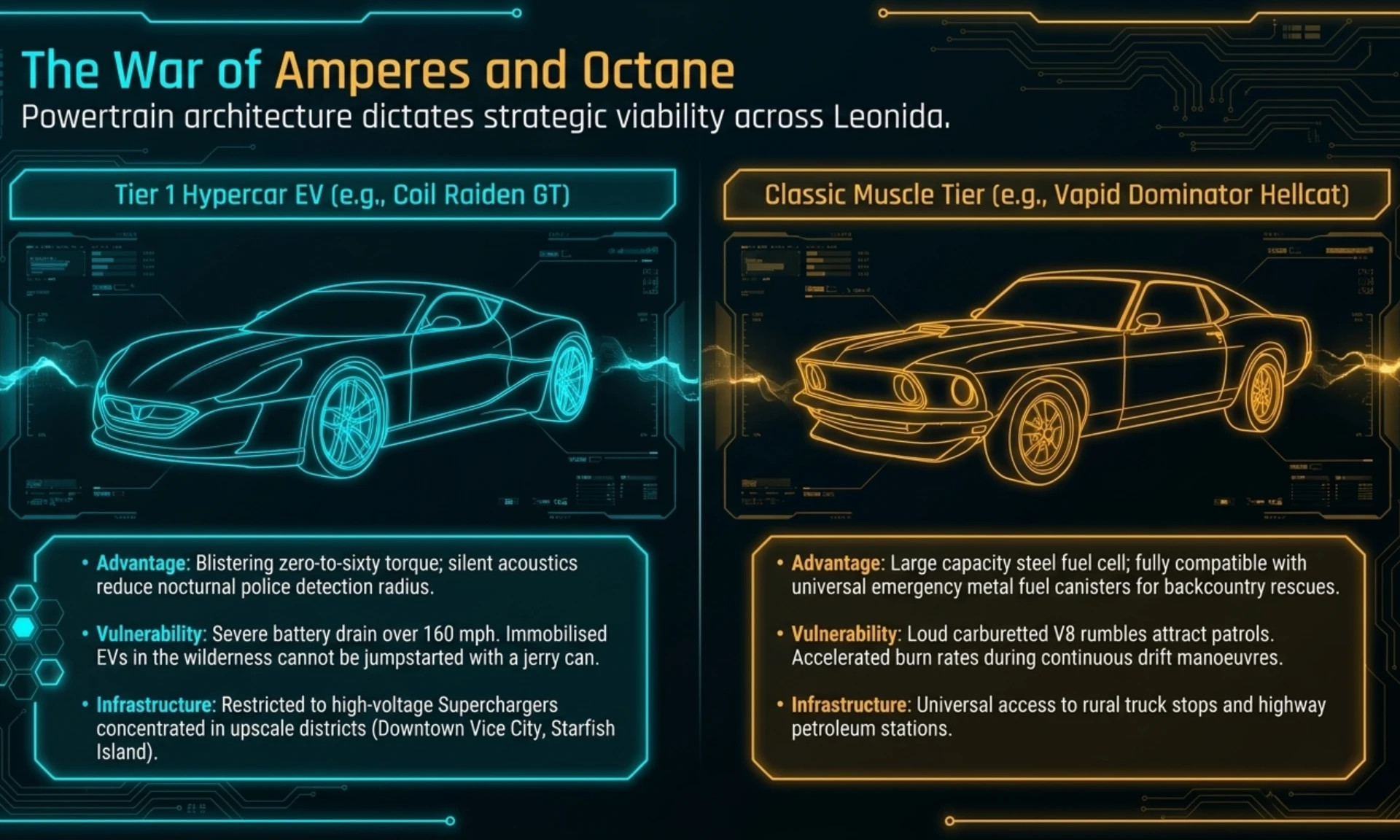
One of the most technically accomplished aspects of the vehicular ecosystem in Grand Theft Auto VI is the profound mechanical divergence between distinct powertrain architectures. As glimpsed in initial promotional reels and reflected in modern Florida's automotive culture, Vice City embodies a cultural crossroads where ultra-wealthy cryptocurrency barons driving whisper-quiet, six-figure electric hypercars share the asphalt with blue-collar swamp boat operators and gearheads piloting loud, carbureted V8 muscle coupes.
Operating a high-end EV manufactured by fictional marque Coil (Rockstar’s satirical analogue to Tesla) provides blistering, instantaneous torque curves off the line, facilitating lightning-fast acceleration through dense city traffic. Furthermore, the absence of acoustic engine rumble significantly reduces the detection radius of nocturnal police patrols. However, the critical operational vulnerability of electric vehicles lies in the spatial distribution of charging infrastructure. While conventional petroleum stations saturate every highway intersection and rural county road, high-voltage Superchargers are predominantly situated in upscale districts like Downtown Vice City and Starfish Island.
Depleting battery reserves deep within the uncharted mangrove bayous of the Grassrivers leaves the player hopelessly isolated. Unlike internal combustion vehicles that can be revived with a portable five-gallon metal canister, an immobilized electric vehicle in the swamp cannot be jumpstarted with a fuel can, forcing players to navigate alligator-infested marshes on foot in search of a tow truck or passing watercraft.
Technical Specifications: Energy Consumption Dynamics Across Vehicle Tiers
Classic Muscle Tier (e.g., Vapid Dominator Hellcat): Large capacity steel fuel cell; accelerated burn rates during burnout launches and continuous drift maneuvers; fully compatible with universal emergency fuel canisters.
Heavy Commercial & Off-Road: Dual auxiliary tanks; heavy consumption when churning through marsh mud and sand dunes; integrated bed mounts for high-capacity fuel barrel transport.
Sport Motorcycles: Ultra-compact fuel reservoirs with rapid depletion; lightning-fast refueling duration under four seconds; extreme vulnerability to fuel cell rupture upon impact.
Furthermore, ambient environmental conditions across the state of Leonida exert measurable thermodynamic pressure on power plants. Rockstar has interconnected the procedural meteorological engine with powertrain thermodynamics. Operating an air-cooled engine under the blistering, humid midday heat of Vice City increases cooling fan power draw and thermal throttling, while navigating severe tropical hurricane downpours escalates fuel consumption due to immense hydroplaning drag and standing water resistance.
Fuel Across Sea and Sky: The Logistics of Speedboats and Aviation Assets
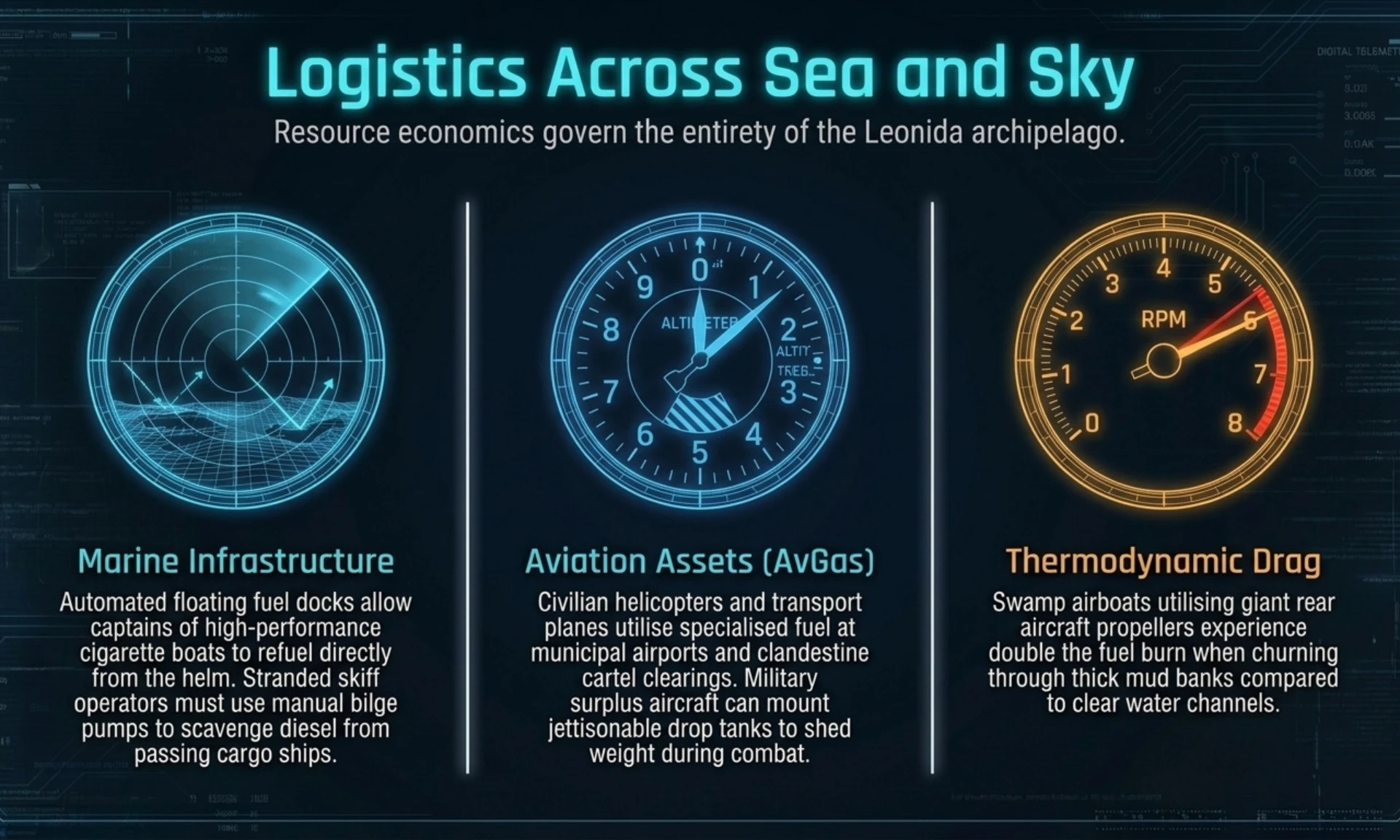
The operational scope of the fuel system is by no means confined to concrete highways and dusty backroads. Leonida is an expansive aquatic archipelago encircled by the Atlantic Ocean, crisscrossed by intricate canal networks, and dotted with vast freshwater lakes. In keeping with this maritime geography, watercraft and aircraft are rigorously integrated into the resource economy. High-performance cigarette boats, swamp airboats, commercial freighters, and luxury motor yachts all feature dedicated maritime fuel reserves.
Refueling maritime assets requires docking at designated recreational marinas or approaching floating fuel barges stationed in international waters. Running out of fuel fifty miles offshore under a moonless sky strands the player in deep open waters where hammerhead sharks patrol and pirate cartels stage ambushes. In the skies, civilian helicopters and twin-engine transport planes utilize specialized Aviation Gas (AvGas) available exclusively at international municipal airports, private airstrips, and clandestine cartel landing clearings carved out of the wilderness.
- Marine Marina Fuel Docks: Automated floating docks allowing captains to refuel multi-engine offshore racing boats directly from the helm console.
- Jettisonable Aviation Drop Tanks: Military-grade surplus aircraft capable of mounting external auxiliary fuel tanks that can be dropped during combat to shed weight.
- Swamp Airboat Drag Dynamics: Airboats utilizing giant rear aircraft propellers experience double the fuel burn when crossing thick mud banks compared to clear water channels.
- Mid-Air Fuel Rendezvous: High-level narrative heist preparations reportedly involving coordinated aerial fuel transfers over international waters.
- Supersonic Afterburner Burn Rates: Military strike fighters operating on reheat afterburners deplete internal fuel reserves at over five times normal cruise consumption, requiring strict throttle discipline during dogfights.
In maritime channels, siphoning mechanics adapt dynamically to aquatic realities. Players stranded on disabled skiffs can utilize manual bilge siphon pumps to scavenge marine diesel from passing luxury mega-yachts or anchored cargo container ships, transforming maritime navigation into an unpredictable tactical frontier.
Tactical Resource Siphoning: The Trunk as an Expeditionary Armory
To ensure that fuel constraints enrich rather than cripple player freedom, Rockstar has introduced robust tactical mechanics that transform vehicles into self-sustaining expeditionary assets. Foremost among these is the expanded utility of the vehicle trunk. As established in leaks, characters can store physical inventory items within the trunk, including five-gallon metal jerry cans purchased from roadside convenience stores.
Carrying reserve fuel allows players to perform field top-offs in remote areas without entering formal service stations. Furthermore, players possessing a basic flexible siphon tube can extract fuel directly from the tanks of parked civilian vehicles along residential curbsides. This subtle mechanic proves invaluable during stealth-oriented nighttime infiltration missions where entering a brightly illuminated commercial gas station would alert nearby law enforcement patrols.
The procedural destruction capabilities of the proprietary RAGE 9 engine reach their absolute zenith within service station environments. Should a high-speed firefight erupt across a gas station forecourt, stray rounds piercing fuel bowsers or vehicles colliding with support pillars trigger catastrophic structural failures. Secondary explosions ignite underground fuel vaults, unleashing volcanic fireballs that shatter concrete canopies, launch surrounding cars into the air, and produce suffocating plumes of volumetric smoke visible across entire city districts.
Why This Design Pivot Will Reshape the Next Decade of Gaming
📚 Classified & Related Dossiers in TekinGame
If you wish to explore beyond this report and delve into cybernetic frontiers and autonomous AI architectures, do not miss these three exclusive deep-dives in the Tekin Garage:
Industry analysts emphasize that this paradigm shift elevates the emotional stakes of criminal heists. Planning an armored car robbery in downtown Vice City is infinitely more exhilarating when the getaway route is not just a straight line on a mini-map, but a carefully rehearsed logistical ballet factoring in engine fuel reserves, rendezvous points, and contingency fuel caches.
In the underground street racing circuits of Vice City, fuel mass plays a decisive role in competitive drag racing. Because physical mass directly affects acceleration curves and quarter-mile elapsed times, competitive drivers deliberately underfill their fuel tanks to ten percent capacity before initiating sprint duels along the beachfront strips. While this grants a noticeable competitive advantage in launch velocity, it leaves almost zero margin for error if an unscheduled police cruiser intercepts the race at the finish line.
Rumor Versus Reality: Dissecting GTA 6's Fuel Leak Revelations
Reality: Completely false; extensive balancing guarantees that a full tank provides forty-five to sixty minutes of sustained high-velocity driving.
Rumor: Players can simply disable the fuel system in the options menu.
Reality: Unverified; studio heads regard the fuel model as a core structural component of narrative progression, though accessibility toggles may exist.
Rumor: Gas stations exist solely in single-player and are omitted from the online multiplayer world.
Reality: Debunked; data leaks confirm that fuel distribution forms a cornerstone economic pillar of the upcoming online ecosystem.
This meticulous distinction between sensationalist social media hysteria and engineering reality demonstrates that Rockstar North has balanced survival authenticity with exhilarating cinematic action.
By transforming automotive weight physics into an active tactical consideration, Rockstar demonstrates that realism in Grand Theft Auto VI is not a passive aesthetic backdrop, but a dynamic gameplay multiplier that rewards ingenuity and punishes complacency.
Digital Turmoil on Reddit: Speedrunners in Panic as Roleplayers Rejoice
The online discourse surrounding Rob Nelson’s preview remarks ignited massive debate across digital gathering grounds such as Reddit and the venerable GTAForums. In initial polling conducted across prominent fan hubs encompassing over 100,000 respondents, fifty-four percent of participants classified the mandatory fuel mechanic as "unnecessary friction that hinders pure escapism," while forty-six percent championed it as "a courageous leap forward for environmental storytelling."
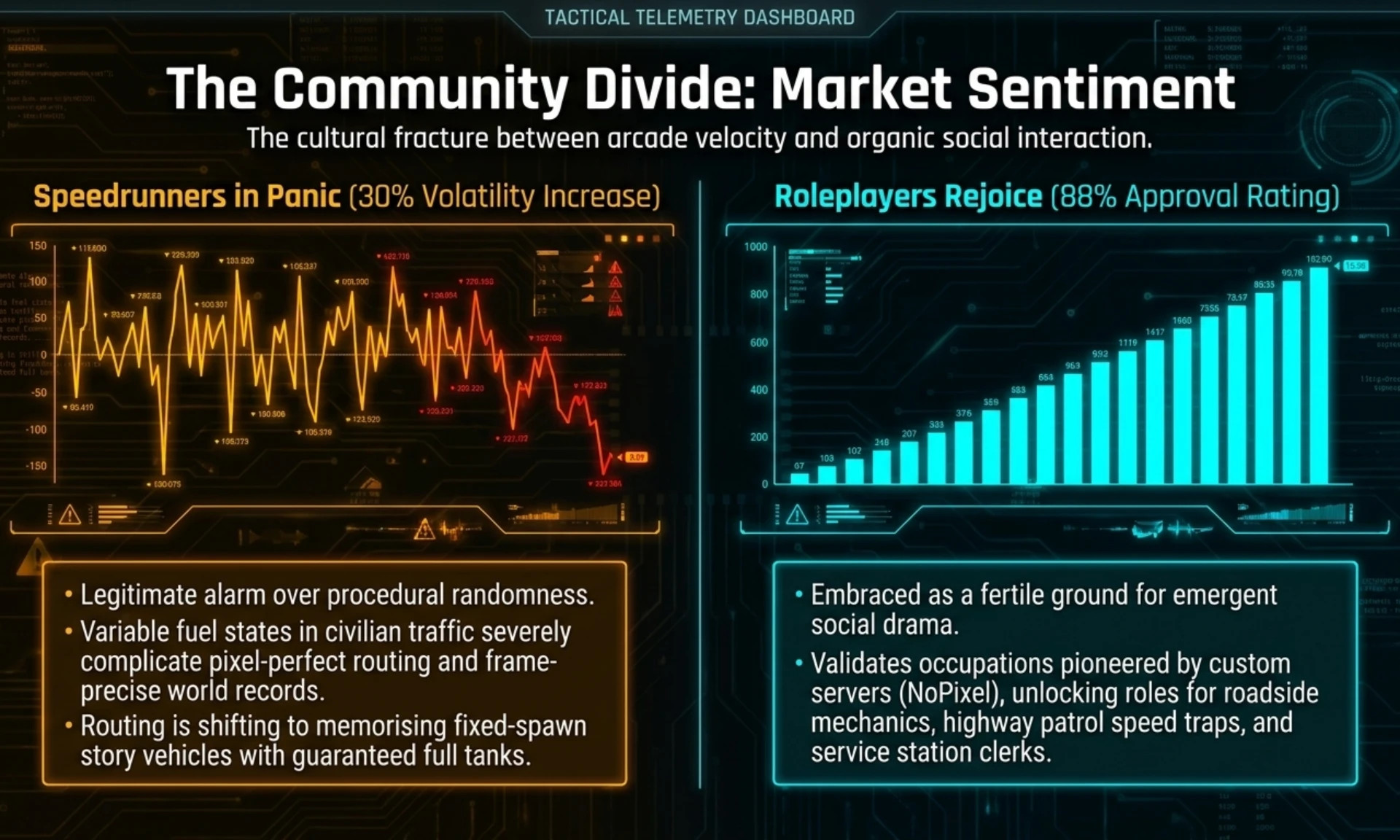
Intriguingly, the demographic expressing the most enthusiastic embrace of the feature is the thriving GTA RP (Roleplay) community. Pioneered by celebrated custom servers like NoPixel which have incorporated third-party fuel consumption mods into GTA V for nearly a decade roleplayers view official, polished gas stations as fertile ground for emergent social drama. For streamers and roleplayers, interactive pit stops unlock countless occupational roles, from roadside towing mechanics and service station clerks to highway patrol speed traps and hostage negotiations at rural pumps.
Conversely, the global speedrunning fraternity has voiced legitimate alarm. Introducing variable fuel levels in traffic vehicles injects substantial procedural randomness into mission progression, complicating the execution of pixel-perfect routing and frame-precise world-record speedruns.
Market Sentiment: Community Diagnostics on GTA 6's Refueling Feature
Roleplay (GTA RP) Endorsement: 88% approval rating among custom server communities celebrating enhanced organic interaction.
Speedrun Feasibility Index: Estimated 30% increase in run volatility due to unpredictable fuel states in civilian traffic.
Pre-Order Trajectory: Zero measurable negative impact; commercial anticipation remains on track to break all historic records.
Industry commentators have proposed that Rockstar introduce a dedicated accessibility toggle within settings menus, permitting players to disable fuel depletion if desired. However, the studio's historical track record indicates an unyielding commitment to authorial vision; Rockstar rarely dilutes the physical integrity of its living worlds to appease vocal early-access complaints. Speedrunners are already mapping out fixed-spawn fuel routes, analyzing which scripted story cars spawn with guaranteed full tanks across the metropolitan grid.
Commercial Empire Building: Fuel Distribution as an Economic Empire in GTA Online 2
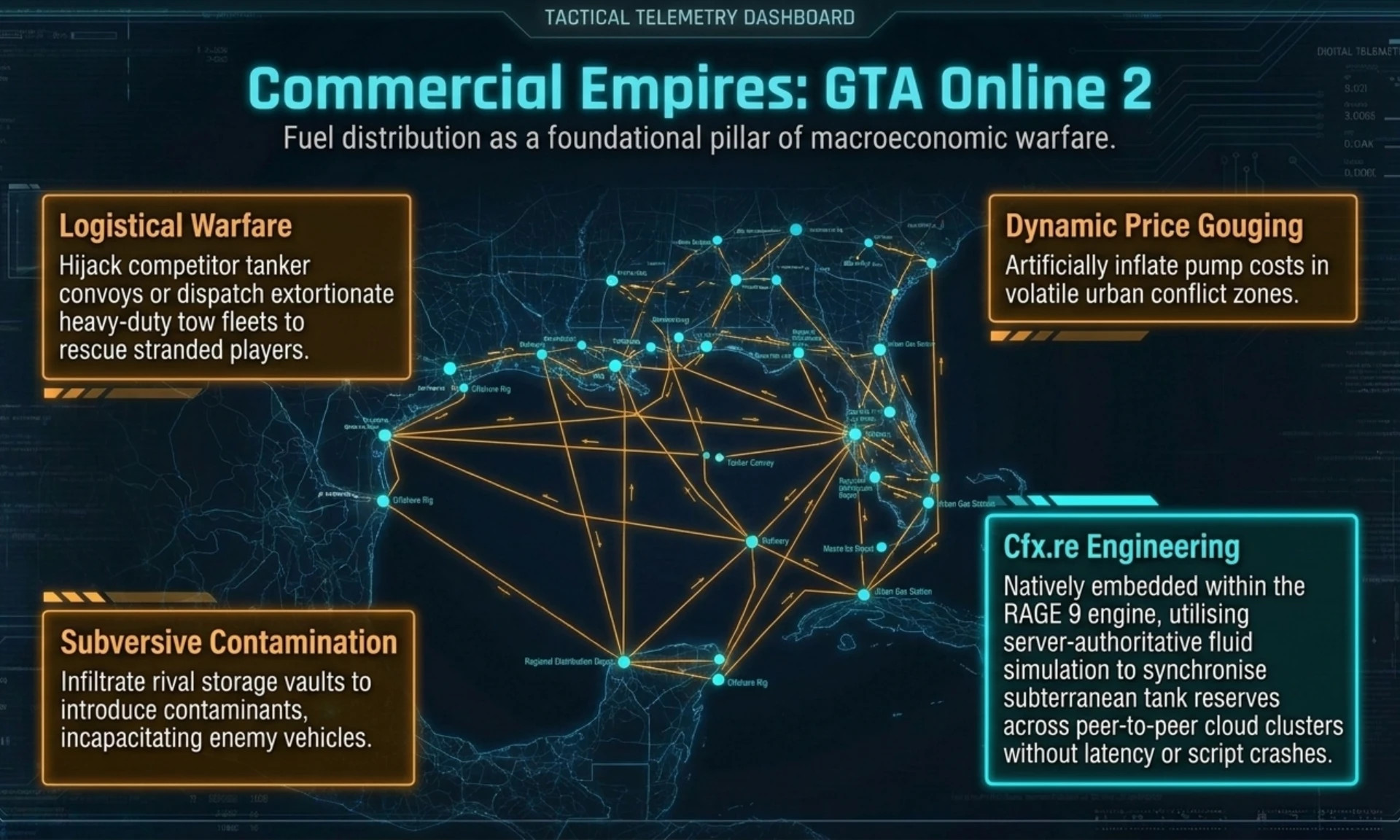
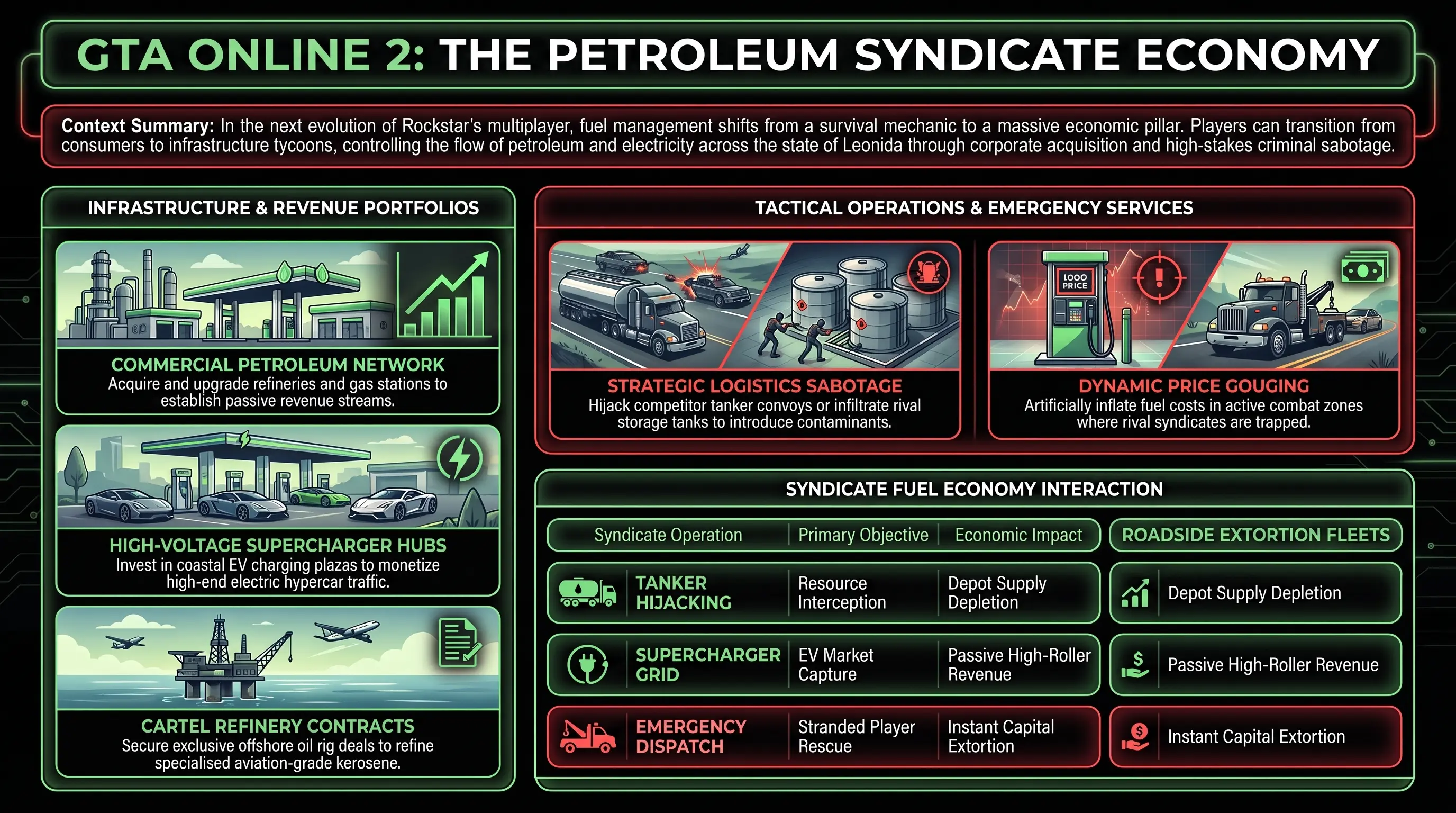
The most lucrative operational frontier for this mechanic resides in the architecture of the next-generation multiplayer landscape. Verified leaks originating from Take-Two Interactive investor documentation indicate that players in GTA Online 2 will be able to acquire, upgrade, and manage commercial petroleum infrastructure across Leonida, establishing passive revenue streams that rival illicit narcotics enterprises.
Operating a service station empire introduces intricate logistical missions that redefine criminal entrepreneurship:
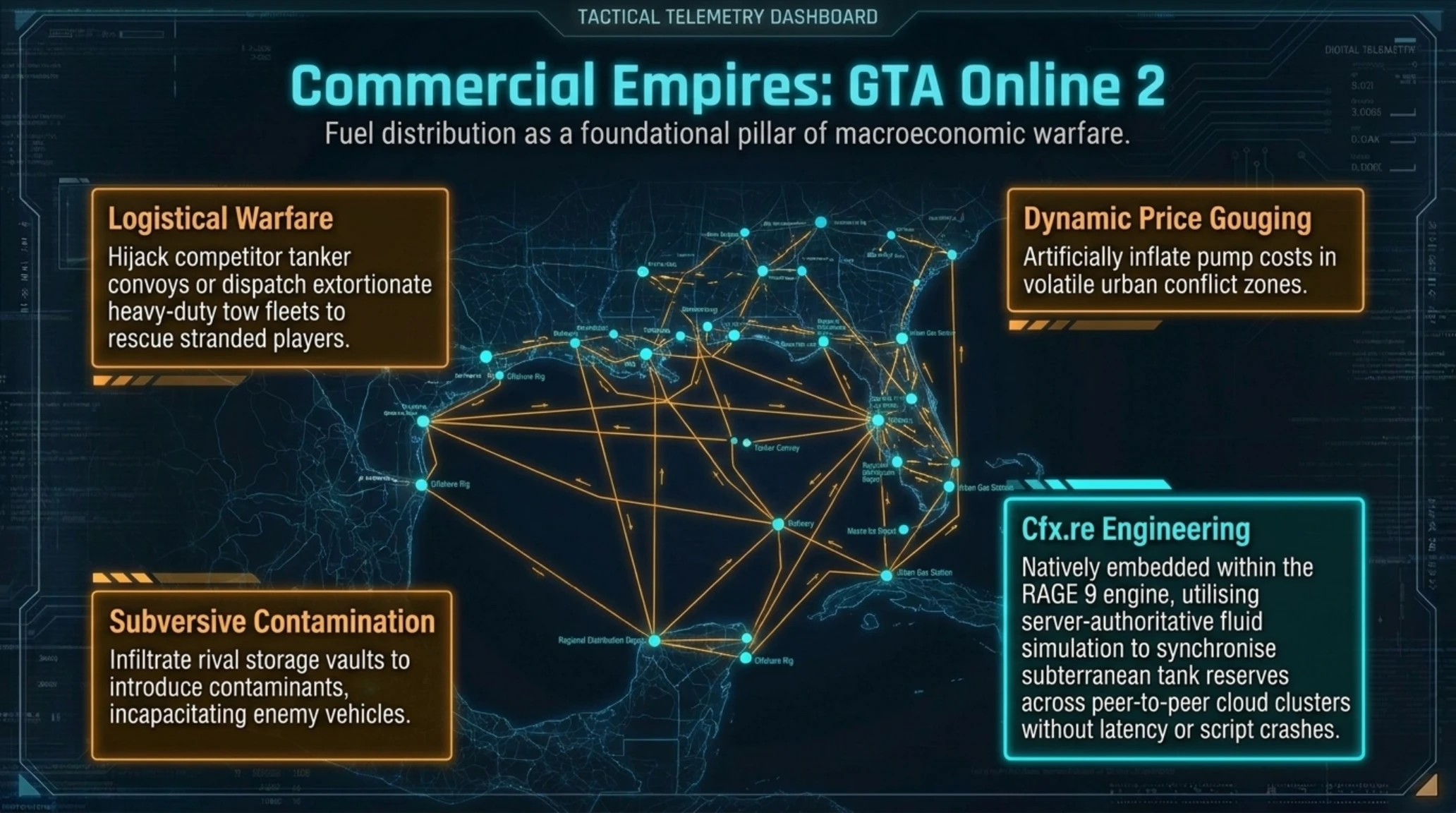
- Petroleum Tanker Convoy Hijacking: Intercepting competitor fuel transports between maritime refineries and regional distribution depots amidst hostile player interference.
- Dynamic Price Gouging in Conflict Zones: Artificially inflating fuel costs in volatile urban sectors where rival syndicates are engaged in prolonged firefights.
- Subversive Contamination Operations: Infiltrating rival gas station storage tanks to introduce contaminants, incapacitating enemy vehicles during subsequent getaways.
- High-Voltage Supercharger Grid Deployment: Investing in high-speed EV charging plazas along coastal luxury corridors to monetize high-roller sports car drivers.
- Expeditionary Emergency Roadside Fleets: Dispatching heavy-duty fuel tow trucks to rescue stranded players across the map at extortionate commercial rates.
- Cartel Refinery Syndicate Contracts: Securing exclusive contracts with offshore oil rigs in the Gulf of Mexico to refine aviation-grade kerosene for aerial mercenary squadrons.
By transforming basic infrastructure into contested corporate battlegrounds, Rockstar ensures that fuel is not merely a consumable drain on player wallets, but a foundational driver of multiplayer ambition, criminal territory wars, and macroeconomic warfare. Crucially, the studio's proprietary network architecture introduces server-authoritative fluid simulation, synchronizing volatile subterranean tank reserves and fuel line pressure across peer-to-peer cloud clusters. This guarantees that when a competitor sabotages a fuel depot in North Port Gellhorn, the resulting economic ripple effects and local price spikes propagate instantaneously across every connected instance in that geographical shard.
Furthermore, the acquisition of Cfx.re (the visionary engineering collective behind FiveM and RedM) by Rockstar Games in late 2023 provides profound technical insight into the long-term architecture of GTA 6. Rockstar observed firsthand how millions of concurrent viewers flocked to Twitch and YouTube to witness emergent roleplay narratives anchored in mundane logistics pumping gas under torrential tropical rainstorms, clocking into midnight delivery shifts, and orchestrating complex roadside recovery services. By natively embedding these hyper-realistic kinetic mechanics directly into the core RAGE 9 engine with sub-millisecond cinematic responsiveness, Rockstar eliminates the latency, desynchronization, and script crashes endemic to third-party modifications, providing an uncompromised turnkey foundation for the next decade of multiplayer emergent storytelling.
The Analytical Scale: Weighing the Virtues and Liabilities of Kinetic Friction
Deliberating the merits of this contentious innovation requires an objective assessment of structural tradeoffs. From a systems perspective, mandatory refueling transforms Leonida from a static visual backdrop into a reactive, high-consequence survival arena. However, from a user-experience standpoint, the danger of pacing fatigue during leisurely exploration remains a tangible risk.
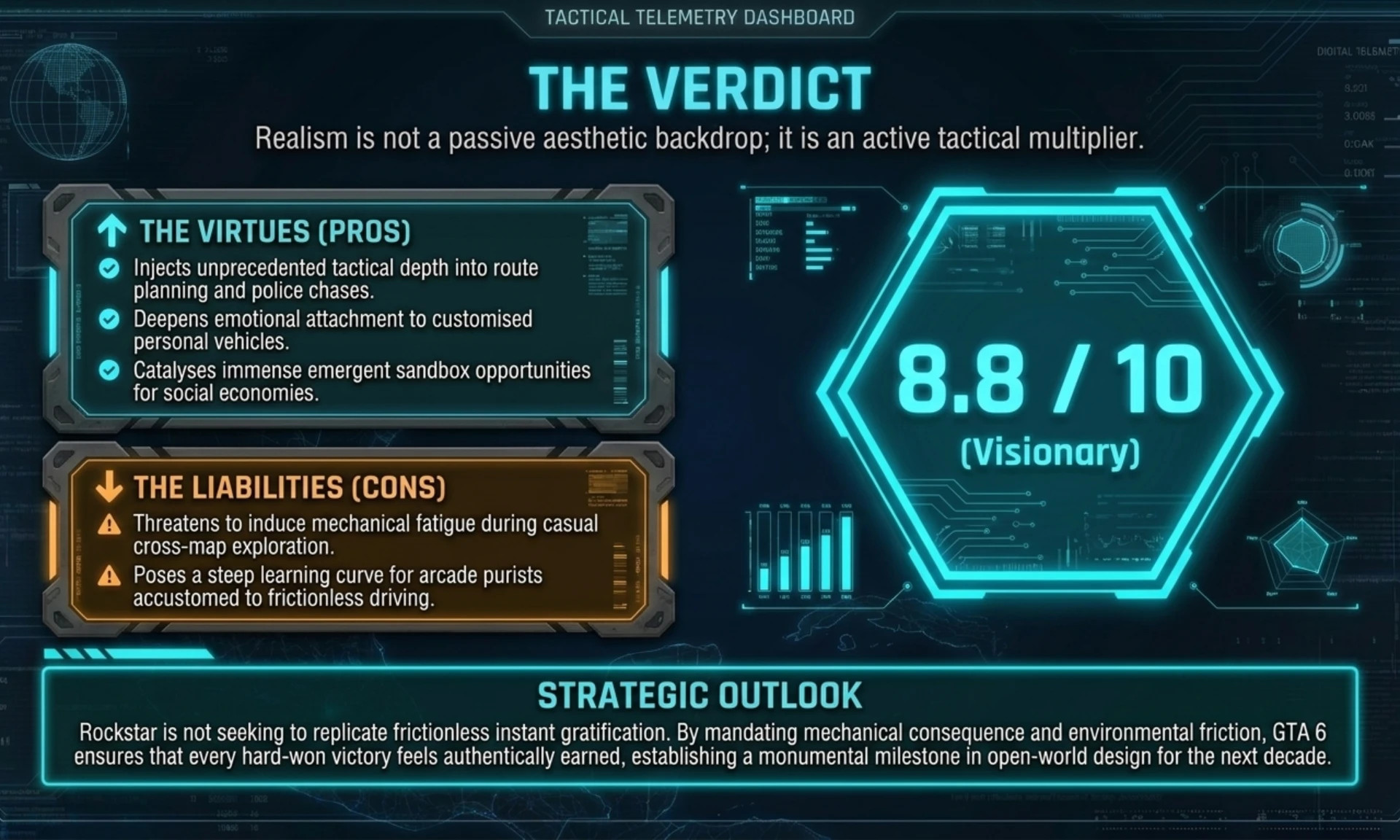
- Injects unprecedented tactical depth and route planning into high-speed police chases
- Deepens emotional attachment and investment in customized personal vehicles
- Catalyzes immense new sandbox opportunities for multiplayer roleplaying and social economies
- Introduces inventive tactical mechanics like trunk storage, jerry cans, and fuel siphoning
- Threatens to disrupt high-adrenaline narrative pacing during pivotal story missions
- May induce mechanical fatigue during casual, aimless cross-map exploration
- Poses a steep learning curve for arcade purists accustomed to frictionless driving
Perhaps the defining virtue of Rockstar Games over its thirty-year history has been an uncompromising willingness to challenge player comfort zones. When GTA IV debuted its weighty physics in 2008, it faced immediate skepticism, yet retrospectively defined the pinnacle of mechanical authenticity. GTA 6 appears poised to repeat that exact evolutionary trajectory, pushing interactive gaming past disposable arcade cliches toward true procedural realism.
Our editorial assessment at TekinGame concludes that if Rockstar successfully maintains the promised ten-second pit stop velocity and ensures that tank capacities support forty-five minutes of continuous cruising, this contested mechanic will soon become one of the most beloved and celebrated pillars of life in Vice City.
Ultimately, Grand Theft Auto VI is not seeking to replicate the frictionless instant gratification of contemporary live-service shooters. It is daring to present a dense, living alternate reality where mechanical consequence, physical endurance, and environmental friction converge to make every hard-won victory feel authentically earned.
Tekin Analysis: The Strategic Transformation of Vice City
Concluding Assessment and Strategic Outlook
Related Investigations & Deep-Dives on TekinGame
• GTA 6 Online: The Metaverse Economy, Real Estate Syndicates and In-Game Assets
• Anatomy of the RAGE 9 Engine in GTA VI: Breaking the Barrier Between Reality and Gaming
• The Leonida Leak: Satellite Analysis of Map Scale, Biomes and Vice City Geography
Frequently Asked Questions: GTA 6 Refueling Mechanics
Is refueling mandatory for all motorized vehicles in GTA 6?
Yes, Rockstar Games has confirmed that all vehicles possess finite fuel reservoirs requiring service station stops or emergency canisters.
How long does a complete vehicle fill-up take in the game?
The entire interactive refueling sequence, including exiting the vehicle and inserting the nozzle, takes approximately ten seconds.
Can the fuel system be disabled through the game options?
No official toggle has been announced; studio leadership considers resource management an intrinsic structural pillar of the gameplay experience.
What happens if a vehicle runs out of gas during an active police chase?
The engine sputters, loses acceleration, and stalls completely, requiring the player to either hijack another passing car or continue the escape on foot.
Do electric vehicles operate differently from gasoline cars in Vice City?
Yes, electric hypercars offer instant acceleration and silent operation, but must recharge at dedicated Supercharger stations rather than petroleum pumps.
Sources and Authoritative References
Additional Gallery: 🎮 Tekin Analysis | Rockstar Defends GTA 6's Controversial Refueling Mechanics