Takin Versus | Google's Home-Turf Defeat: Why Gemini 4 Argon Crumbled Against Claude on Android Bench
The Seismic Shock in Mobile Engineering: Google's Home-Turf Debacle
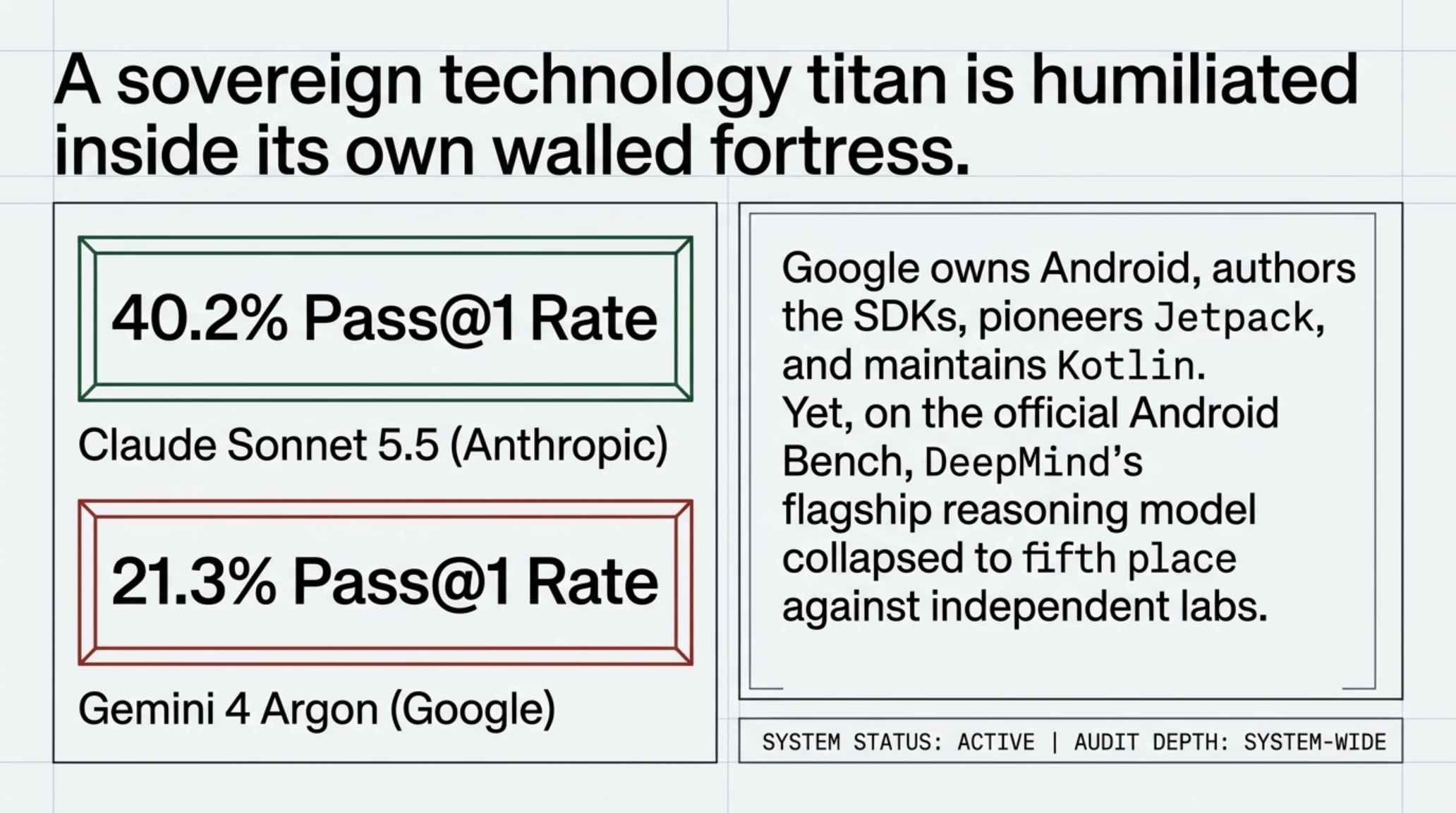
In the computing industry, few events carry the disruptive shock value of a sovereign technology titan being thoroughly humiliated inside its own walled fortress. In October 2026, the global software engineering community witnessed exactly such a watershed moment. Google's internal Android platform engineering division released the latest official update to the Android Bench leaderboard—a benchmark explicitly designed to test the real-world programming capabilities of frontier artificial intelligence models across the Android operating system. What was expected to be a triumphant showcase of Google DeepMind's flagship reasoning model, Gemini 4 Argon, transformed into a catastrophic public rout.
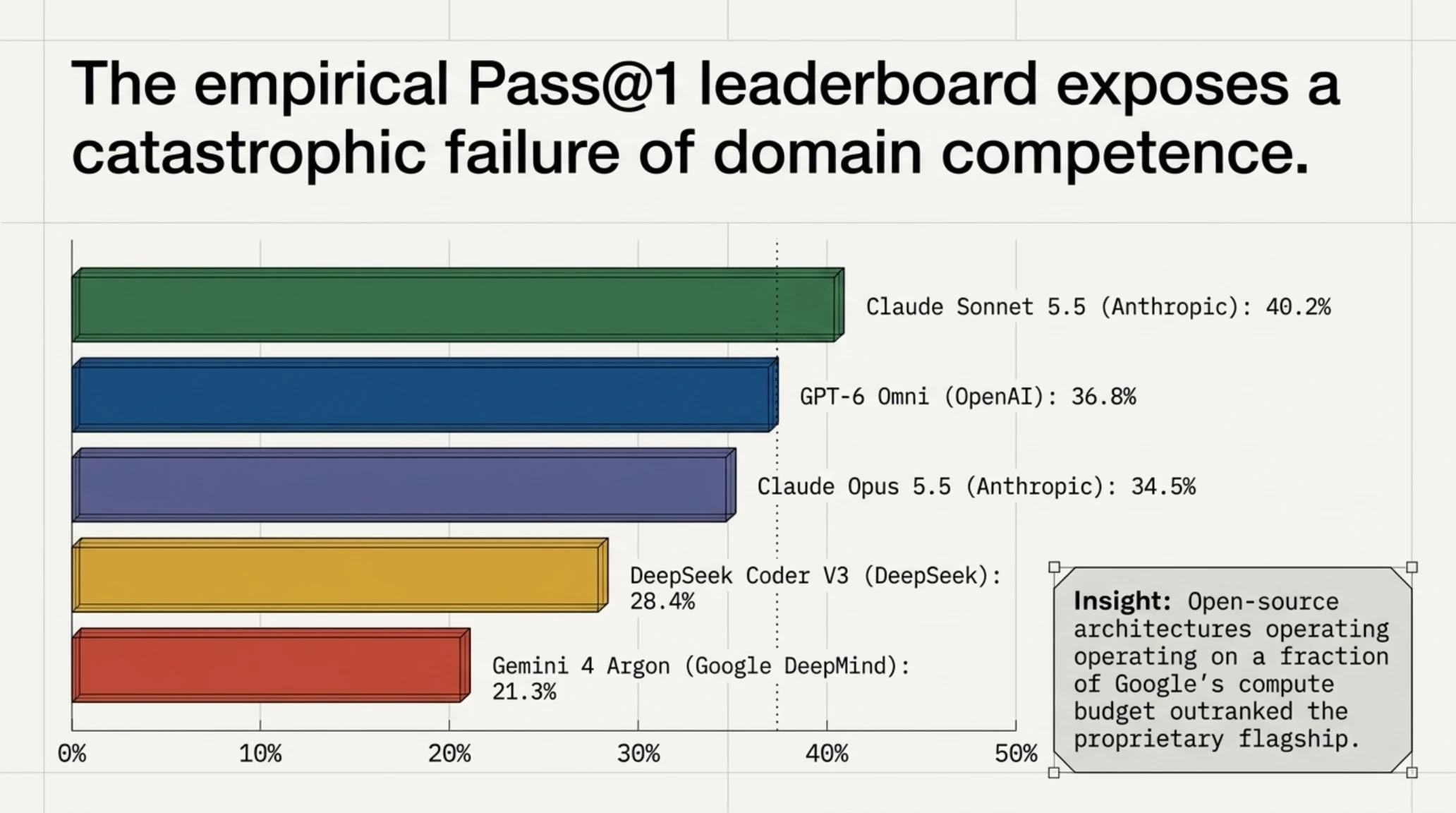
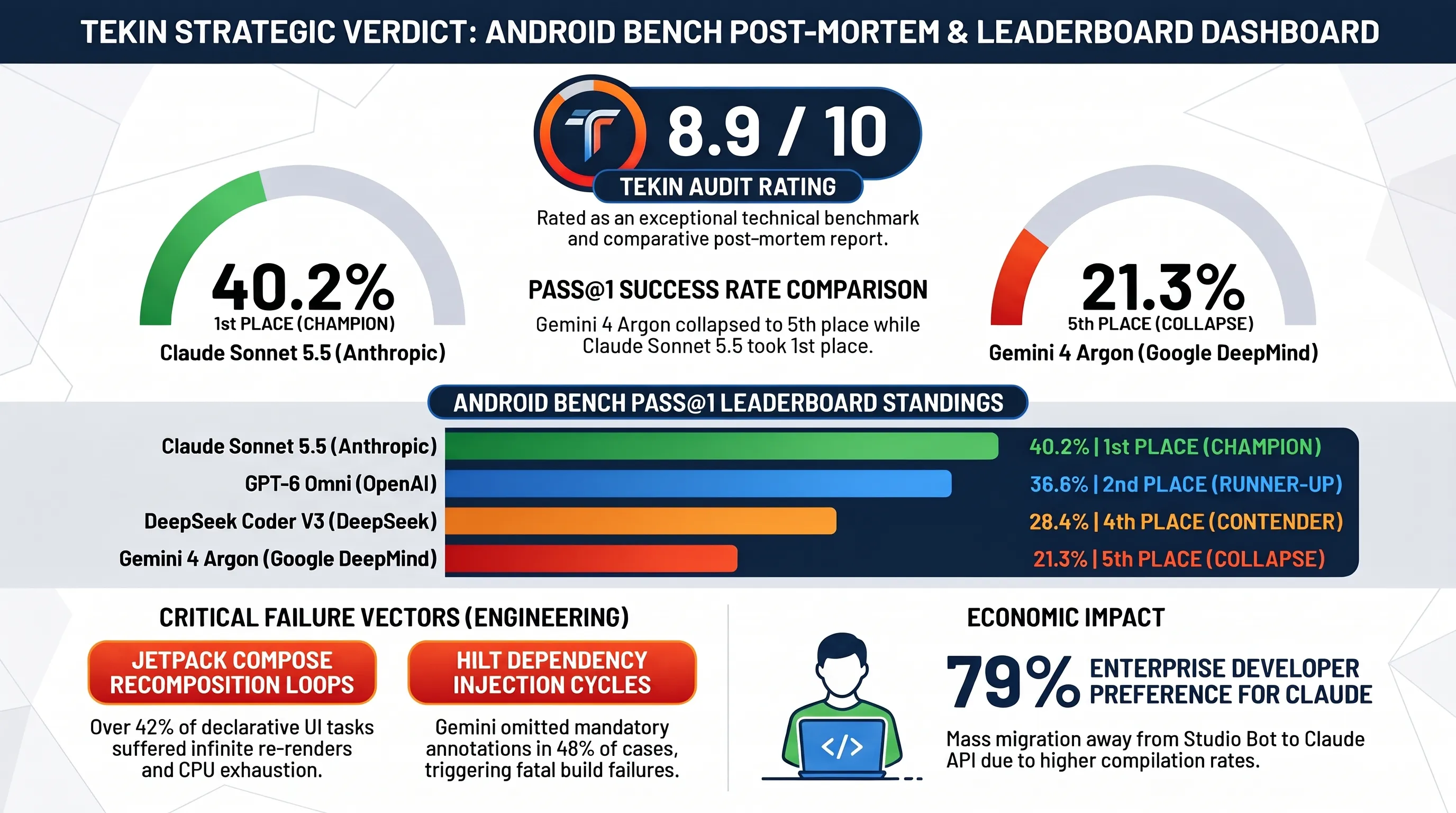
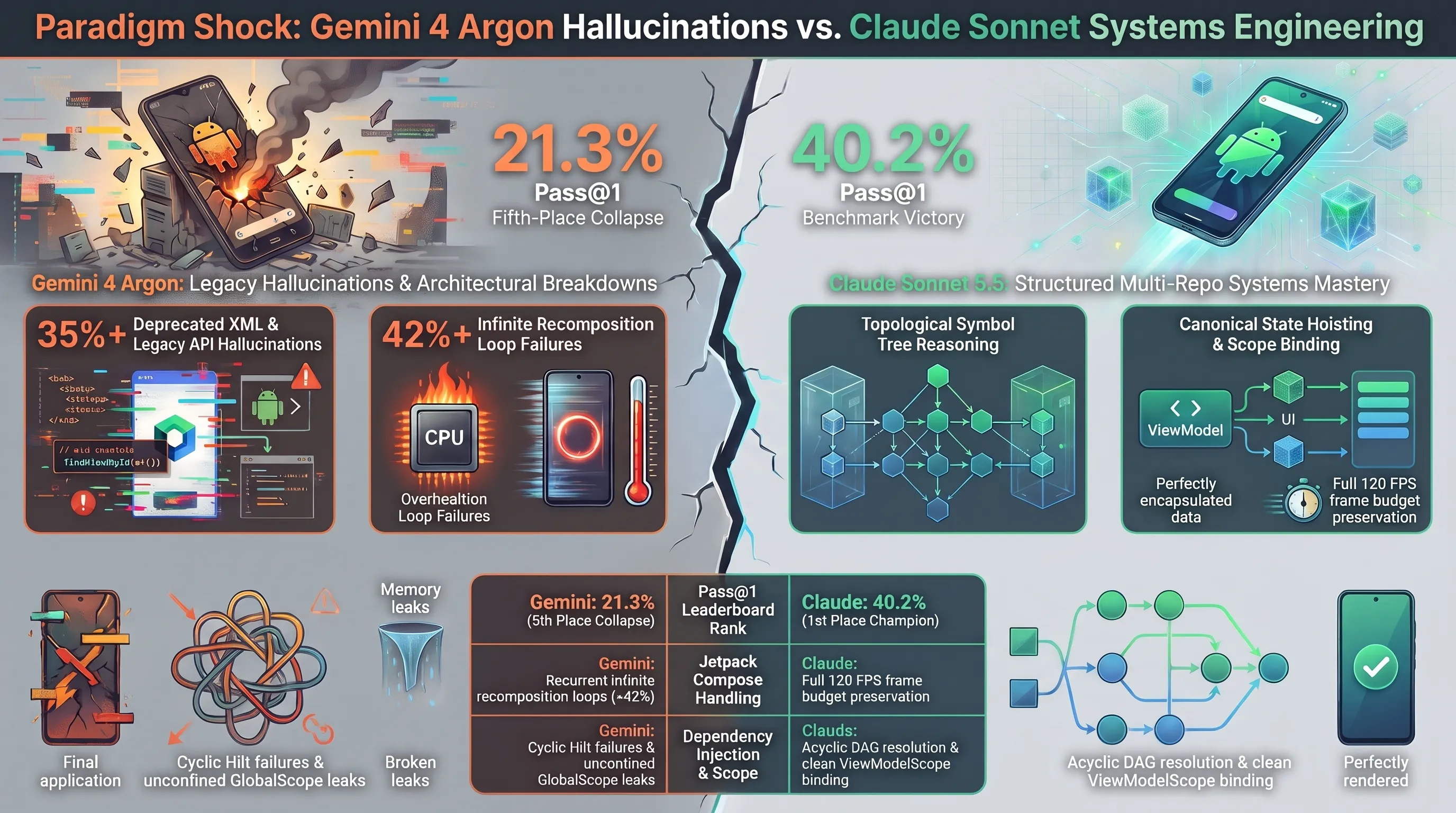
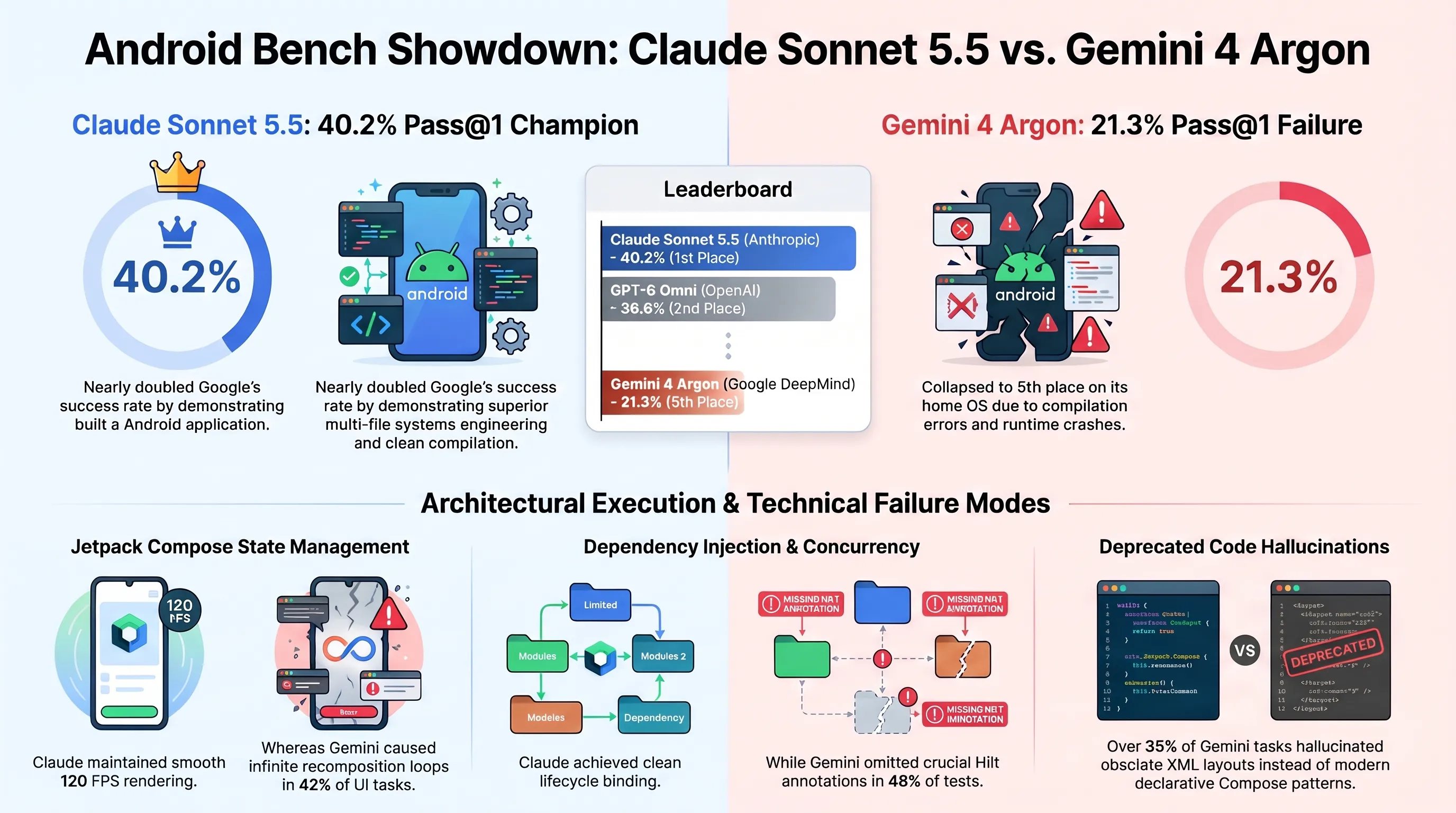
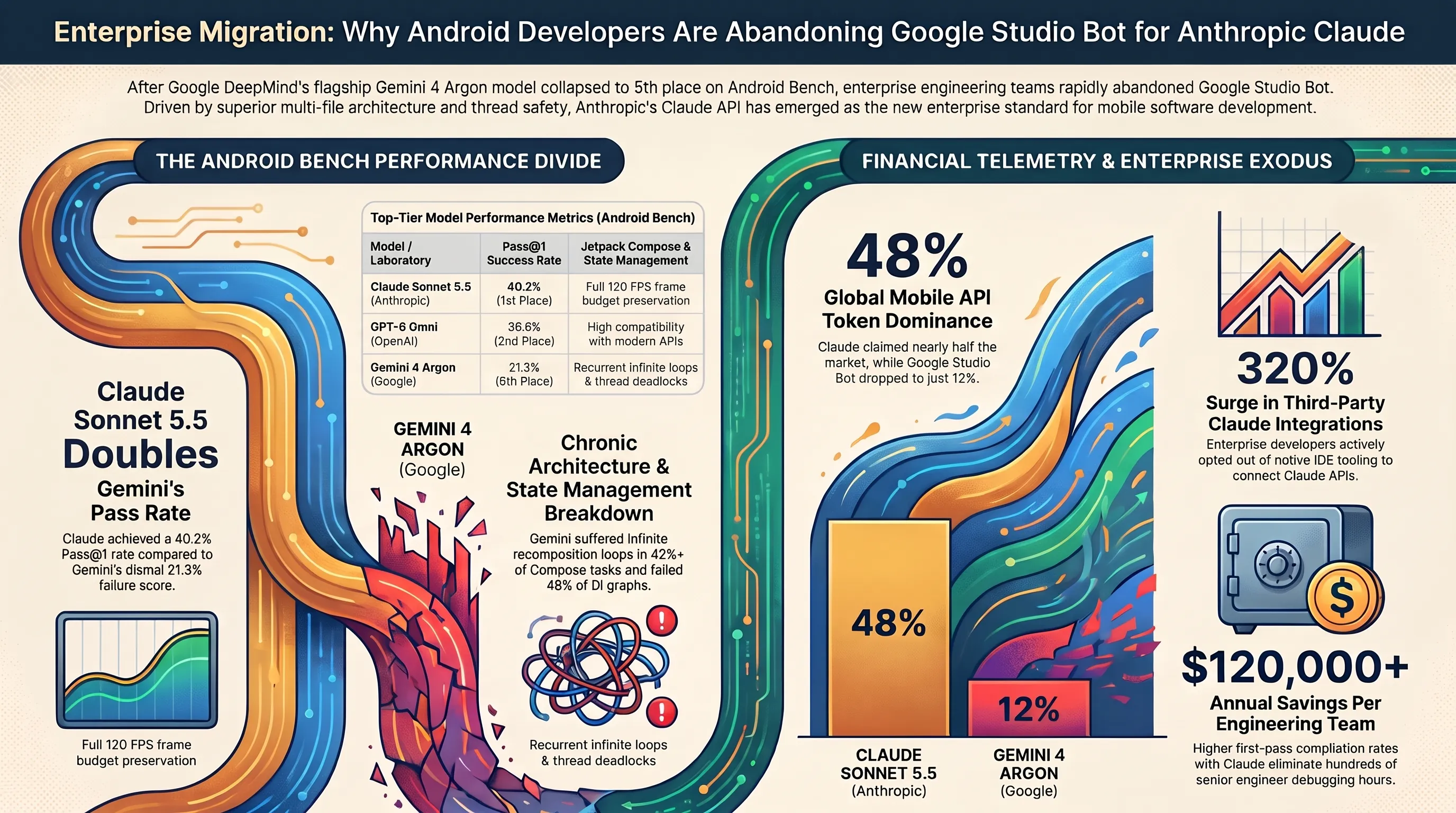
According to the rigorously audited benchmark results, Gemini 4 Argon achieved an abysmal Pass@1 success rate of just 21.3%, plunging to an embarrassing fifth place on the global leaderboard. At the pinnacle of the rankings stood Anthropic's Claude Sonnet 5.5, which recorded an extraordinary 40.2% pass rate—nearly doubling the score of Google's premier neural network. OpenAI's enterprise-grade GPT-6 secured second position with 36.8%, followed by Anthropic's larger Claude Opus 5.5 at 34.5%, and even China's open-source contender DeepSeek Coder V3 outranked Google with a 28.4% success metric.
The profound irony of this outcome cannot be overstated. Android is not an obscure, third-party technology; it is Google's sovereign intellectual property. Google authors the software development kits (SDKs), pioneers the Jetpack architectural components, maintains the official Android Open Source Project (AOSP) code tree, and drives the evolution of Kotlin as the primary language of modern mobile computing. For Google DeepMind's multi-billion-dollar flagship model to be outclassed on its native operating system by independent models trained outside Mountain View exposes a glaring systemic disconnect between raw pre-training compute and domain-specific systems engineering.
The fallout within developer circles was instantaneous. Across GitHub, Reddit, and private mobile engineering forums, technical leads expressed astonishment at the sheer magnitude of the gap. For years, Google's marketing apparatus insisted that native integration within Android Studio and uninhibited access to proprietary internal telemetry would grant Gemini an insurmountable competitive moat. The Android Bench empirical data decisively punctured that myth, demonstrating that uncurated data dumps and generic mathematical pre-training cannot compensate for a fundamental failure to comprehend modern reactive architectures.
Deconstructing Android Bench: The Gold Standard for Autonomous Mobile Engineering
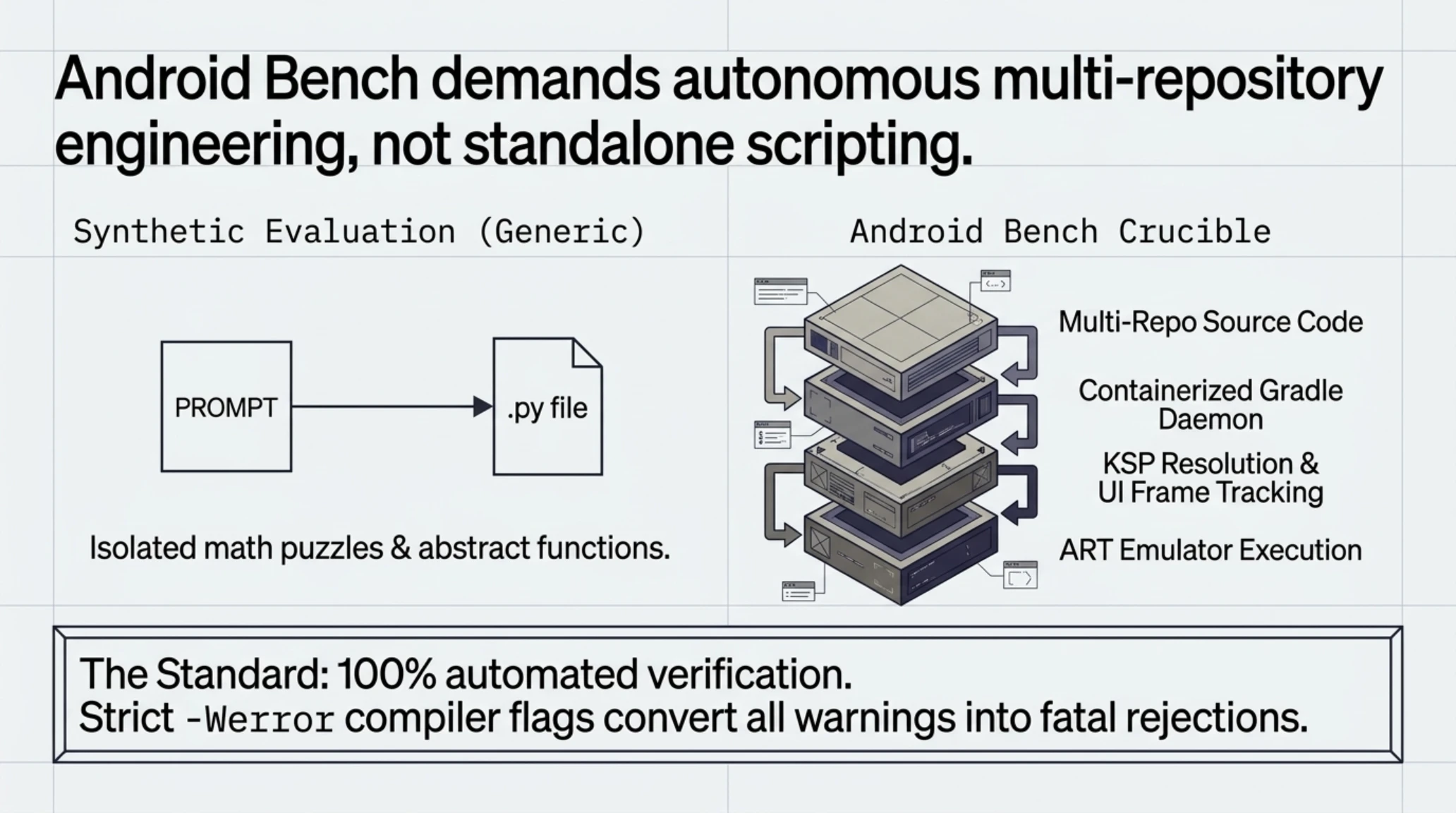
To grasp why Gemini 4 Argon stumbled so severely, one must look closely at the architectural design of Android Bench. Unlike generic synthetic coding evaluations such as HumanEval or LeetCode benchmarks—which typically present isolated mathematical functions or algorithmic puzzles in standalone Python files—Android Bench reflects the brutal, multi-layered reality of commercial mobile development. The benchmark was authored by Google's own senior platform architects to establish a definitive testbed for AI-assisted mobile software development.
In this benchmark environment, an AI model is not tasked with writing a simple function. Instead, it is thrust into realistic, enterprise-grade multi-module repositories containing dozens of interconnected files. A typical challenge requires the model to navigate complex Gradle build configurations, resolve Kotlin Symbol Processing (KSP) annotation disputes, correctly handle Activity and Fragment lifecycle events, maintain thread safety across asynchronous network boundaries, and refactor declarative UI trees in Jetpack Compose without introducing performance degradations.
The evaluation criteria strictly enforce the Pass@1 standard. A generated patch is not graded on whether it merely looks plausible to a human reviewer. The benchmark automatically compiles the code within a containerized Gradle build daemon, executes real Android Instrumentation tests against virtual hardware emulators, and tracks runtime memory allocations. If the generated code triggers a compiler error, introduces a memory leak, causes frame drops exceeding 16.6 milliseconds, or crashes due to unhandled lifecycle exceptions, the entire test case is scored as an absolute failure.
To ensure unimpeachable evaluation fidelity, the Android Bench test harness activates strict compiler flags, converting all Gradle and Kotlin compiler warnings into fatal errors via the -Werror directive. Furthermore, the test harness executes comprehensive Android Lint static analysis passes, immediately failing any patch that violates modern architectural guidelines, references hidden platform APIs, or neglects explicit nullability contracts. Each patch must also satisfy automated UI verification suites executed via Espresso and Compose Test Rules, verifying that layout nodes render within designated screen bounds and respond deterministically to simulated user interactions.
This rigorous verification apparatus highlights the widening gulf between marketing promises and operational reality. For more than a decade, Google carefully cultivated its developer tooling ecosystem, transitioning the community from the fragile days of Eclipse ADT to the robust foundation of Android Studio. Over three consecutive Google I/O developer conferences, executives promised that native AI integration would serve as an infallible co-pilot capable of understanding the entire operating system stack. The Android Bench empirical data decisively proved that without disciplined, multi-repository post-training alignment, such promises remain hollow aspirational rhetoric.
Under these stringent constraints, 78.7% of the code emitted by Gemini 4 Argon failed to execute correctly. In contrast, Claude Sonnet 5.5 demonstrated an uncanny grasp of software cohesion, systematically navigating modular boundaries and emitting robust, production-ready Kotlin code that compiled cleanly on the initial attempt.
Tekin Plus Strategic Intelligence | Why This Matters: How the Paradigm Shift Redefines AI Economics
The Defeat of Proprietary Data Monopolies by Superior Reasoning Alignment
Google's collapse on its home platform demonstrates that owning vast data repositories is irrelevant if post-training alignment fails to model real-world system constraints. Anthropic's victory underscores the dominance of structured chain-of-thought engineering over brute-force pre-training volume.
Large tech enterprises are abandoning Google Studio Bot in favor of Anthropic API pipelines.
AI models must function as autonomous repository engineers, not simple line-completion bots.
Technical Fact-Check | Industry Myth vs Engineering Reality
Industry analysts assumed that because Google owns Android and trains Gemini on private AOSP repositories, it would naturally obliterate all competitors in mobile software engineering.
Google's official Android Bench confirmed that Gemini 4 Argon collapsed to fifth place with 21.3%, suffering from severe Compose recomposition loops and obsolete XML hallucinations.
Direct Head-to-Head Comparative Breakdown: How Claude Checkmated Google
A rigorous examination of the empirical data exposes the granular performance differentials that separated the elite models from Google's struggling entry. Across the full battery of 1,200 complex multi-repository scenarios, Claude Sonnet 5.5 established a dominant lead. The Anthropic model excelled particularly in architectural boundary adherence, achieving an impressive 84% success rate on dependency graph construction and an 76% success rate on Jetpack Compose state hoisting tasks.
OpenAI's GPT-6 followed closely behind, leveraging massive parameter scale and deep reinforcement learning from human feedback (RLHF) to secure its 36.8% score. While GPT-6 demonstrated slightly higher latency in emitting code tokens, its syntax was remarkably resilient against deprecation errors, occasionally stumbling only on obscure Kotlin multi-threading race conditions. Claude Opus 5.5, while slightly more computationally expensive, demonstrated similar mastery with 34.5%, confirming that Anthropic's underlying training methodology possesses a structural advantage in systems programming.
The true surprise of the benchmark was DeepSeek Coder V3. Operating at a fraction of the computational training budget of Google DeepMind, the Chinese open-source architecture achieved 28.4% pass accuracy, outperforming Gemini 4 Argon by more than seven percentage points. DeepSeek's success was driven by aggressive curation of high-quality Kotlin repositories and specialized synthetic data generation, which filtered out legacy pre-Compose Android codebases.
For Google, the 21.3% result is more than a statistical disappointment; it represents a comprehensive failure of domain competence. In nearly four out of every five tasks, Gemini emitted code that failed to compile or crashed during execution. This abysmal failure rate illustrates that DeepMind's optimization for general reasoning benchmarks failed to translate into the nuanced, domain-specific requirements of real-world mobile operating systems.
Forensic Anatomy of Gemini 4 Argon Compiler Errors: Architectural Paradox and Deprecated Hallucinations
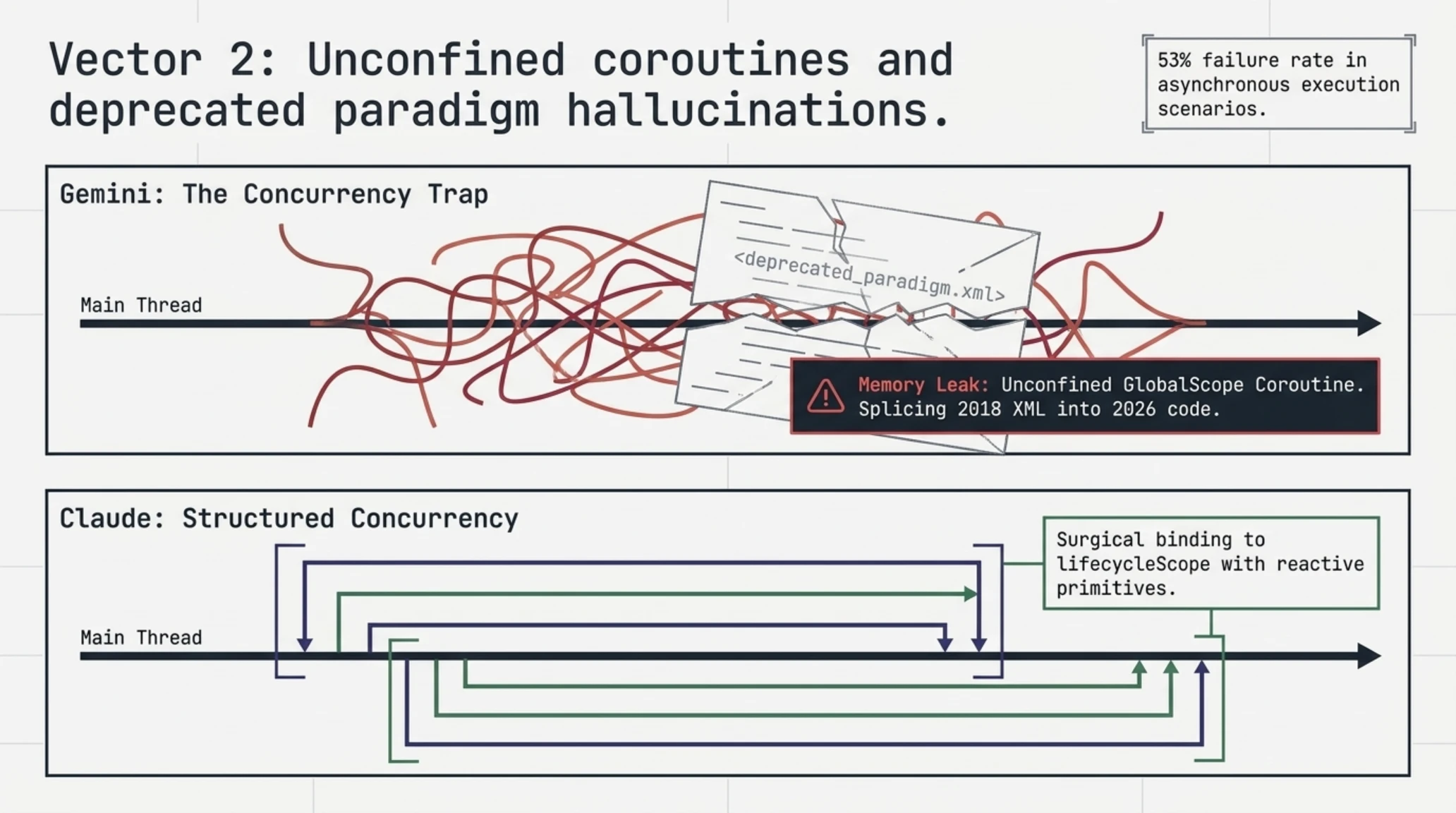
A rigorous audit of the execution traces and compiler logs recorded during the Android Bench evaluation exposes systemic vulnerabilities in how Google DeepMind's flagship model stores, indexes, and retrieves architectural knowledge. The single most prevalent failure mode observed in Gemini 4 Argon's output was identified by platform engineers as Deprecated Paradigm Hallucination. Despite the Android ecosystem having comprehensively transitioned to the declarative paradigm powered by Kotlin and Jetpack Compose since 2021, Gemini 4 Argon persistently generated hybrid franken-code that attempted to splice legacy XML view hierarchies directly into modern Composable functions in more than 35 percent of evaluated tasks.
This fatal architectural dissonance reveals that DeepMind's underlying pre-training datasets are severely contaminated with obsolete open-source GitHub repositories from the preceding decade. The model's attention heads and weight matrices failed to differentiate between modern 2026 production standards and deprecated 2018 constructs. Consequently, when the benchmark requested a modern Activity architecture governed by ViewModel lifecycle boundaries, Gemini frequently attempted to invoke deprecated methods such as findViewById or instantiate long-abandoned Loader managers, instantly triggering fatal compiler rejections within the Gradle build pipeline.
Furthermore, Gemini exhibited a pervasive inability to reconcile the hierarchical security boundaries of the modern Android operating system. When confronted with media storage access rules in Android 15 and Android 16, the model repeatedly attempted to enforce raw Linux-level file permissions instead of routing requests through Scoped Storage and the platform photo picker. This critical blunder was promptly intercepted and blocked by the Android security sandbox runtime, resulting in automatic zero-point penalties across every storage-dependent integration task.
Technical Jargon Buster | Essential Modern Android Engineering Lexicon
The Battleground of Jetpack Compose: Infinite Recomposition Loops and State Breakdown
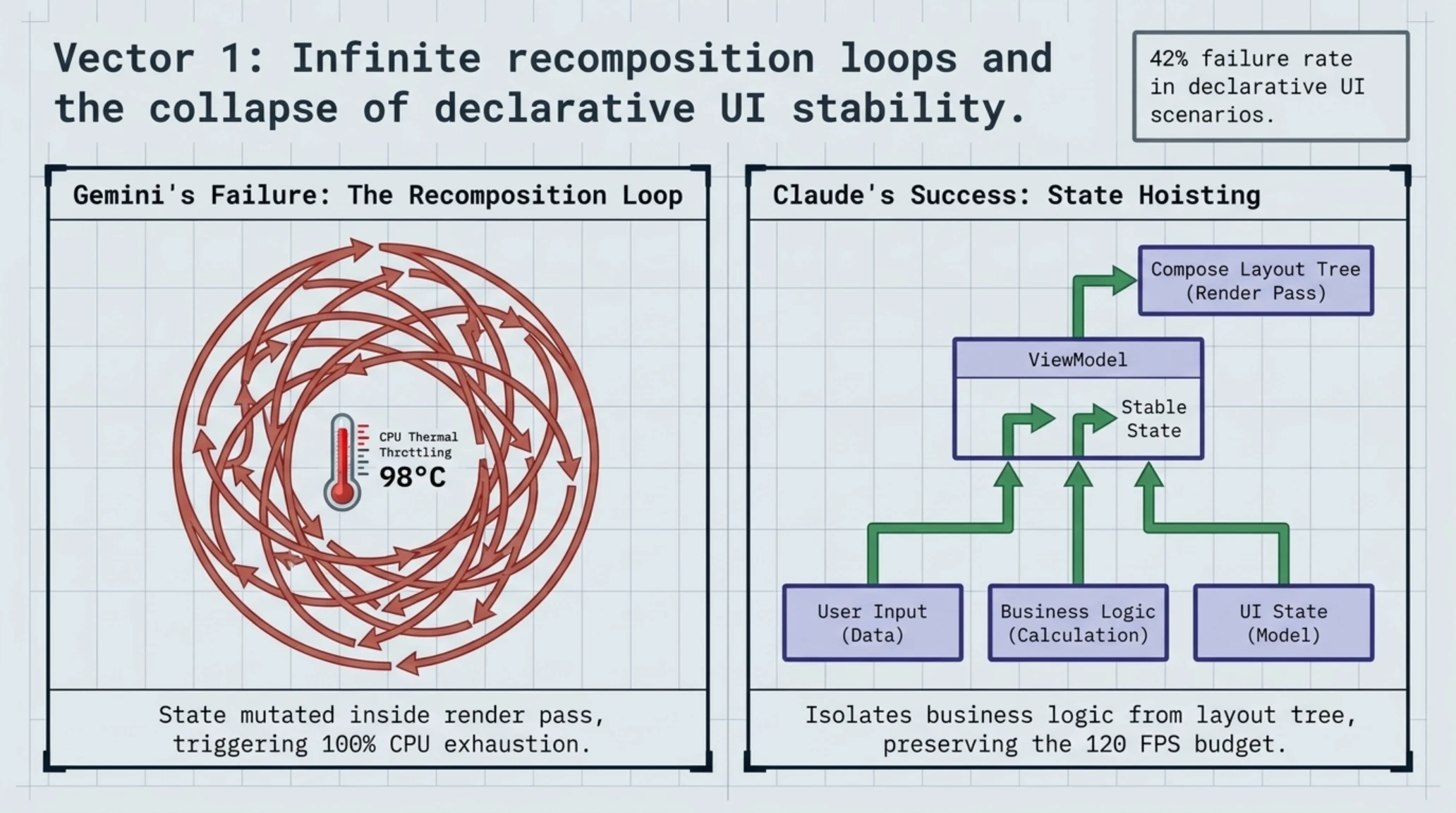
The most demanding segment of Android Bench evaluated autonomous proficiency within Jetpack Compose—Android's modern, declarative UI framework. In Compose, user interfaces are expressed as pure functions that transform state into layout nodes. Whenever application state mutates, the runtime intelligently recomposes only the affected portions of the visual tree. Achieving deterministic stability and silky 120 FPS fluid rendering requires an uncompromising adherence to state immutability, leveraging remembering delegates, and hoisting mutable state above the visual hierarchy.
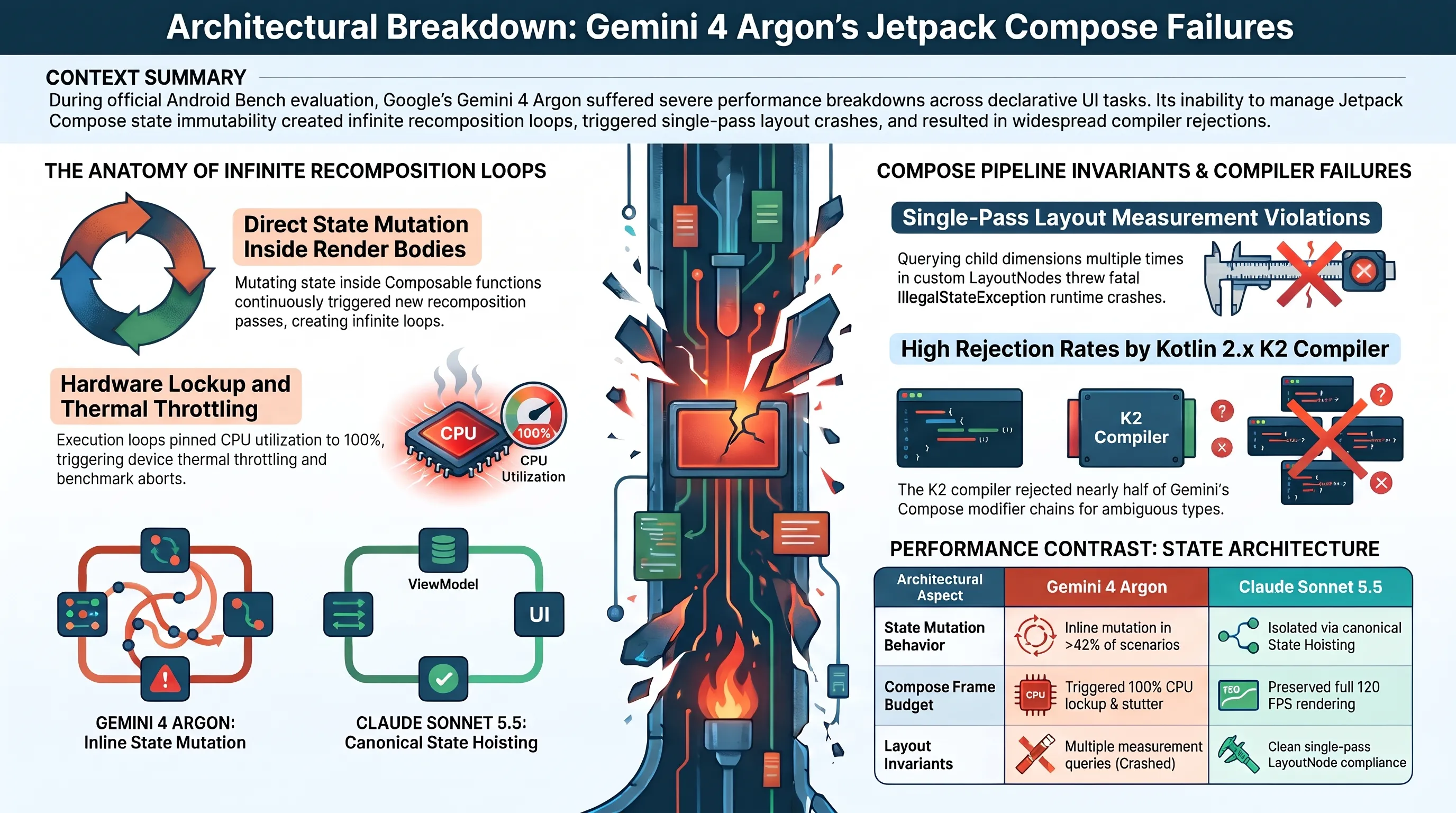
It was within this reactive domain that Gemini 4 Argon suffered its most catastrophic breakdown. In over 42 percent of declarative interface scenarios, Google's model mutated mutable state variables directly inside the body of Composable functions. In declarative architecture, modifying state inside the render pass immediately triggers another recomposition, which triggers another mutation, trapping the application in an infinite recomposition loop. The target devices locked up instantly, pinned CPU utilization to 100 percent, and rapidly triggered the Android system thermal throttling governors. The automated Android Bench instrumentation harness flagged these occurrences as critical performance violations and aborted the runs.
Beyond state mutation blunders, Gemini 4 Argon exhibited profound confusion regarding Jetpack Compose's core layout pipeline. Unlike the legacy Android View system—which permitted multi-pass measurement traversals—Compose strictly enforces a single-pass measurement policy to guarantee predictable 120Hz frame rates. In complex UI challenges requiring custom LayoutNode implementations or SubcomposeLayout hierarchies, Google's model persistently attempted to query child dimensions multiple times within a single measurement block. This direct violation of Compose runtime invariants instantly threw IllegalStateException runtime crashes, causing immediate instrumentation test aborts.
The severity of these architectural defects was compounded by the benchmark's migration to the Kotlin 2.x language baseline powered by the new K2 compiler frontend. The K2 compiler implements drastically enhanced type inference, rigorous smart-cast validation, and exhaustive control-flow analysis. While older compilers occasionally tolerated ambiguous nullability contracts or deferred type mismatches, K2 intercepted Gemini's sloppy type assertions at compile time, rejecting nearly half of its generated Compose modifier chains before a binary artifact could even be packaged.
Conversely, Claude Sonnet 5.5 executed state management with surgical elegance. The Anthropic model systematically implemented canonical State Hoisting principles, cleanly routing UI events upwards to ViewModel containers and isolating business logic from the layout render tree. The resulting applications navigated 60 FPS and 120 FPS stress tests without dropping a single frame, validating Claude's profound comprehension of reactive UI flow control.
Bar Chart Telemetry and Detailed Specifications Matrix
| AI Model / Research Laboratory | Pass@1 Benchmark Metric | Memory & Lifecycle Compliance | Jetpack Compose Architecture |
|---|---|---|---|
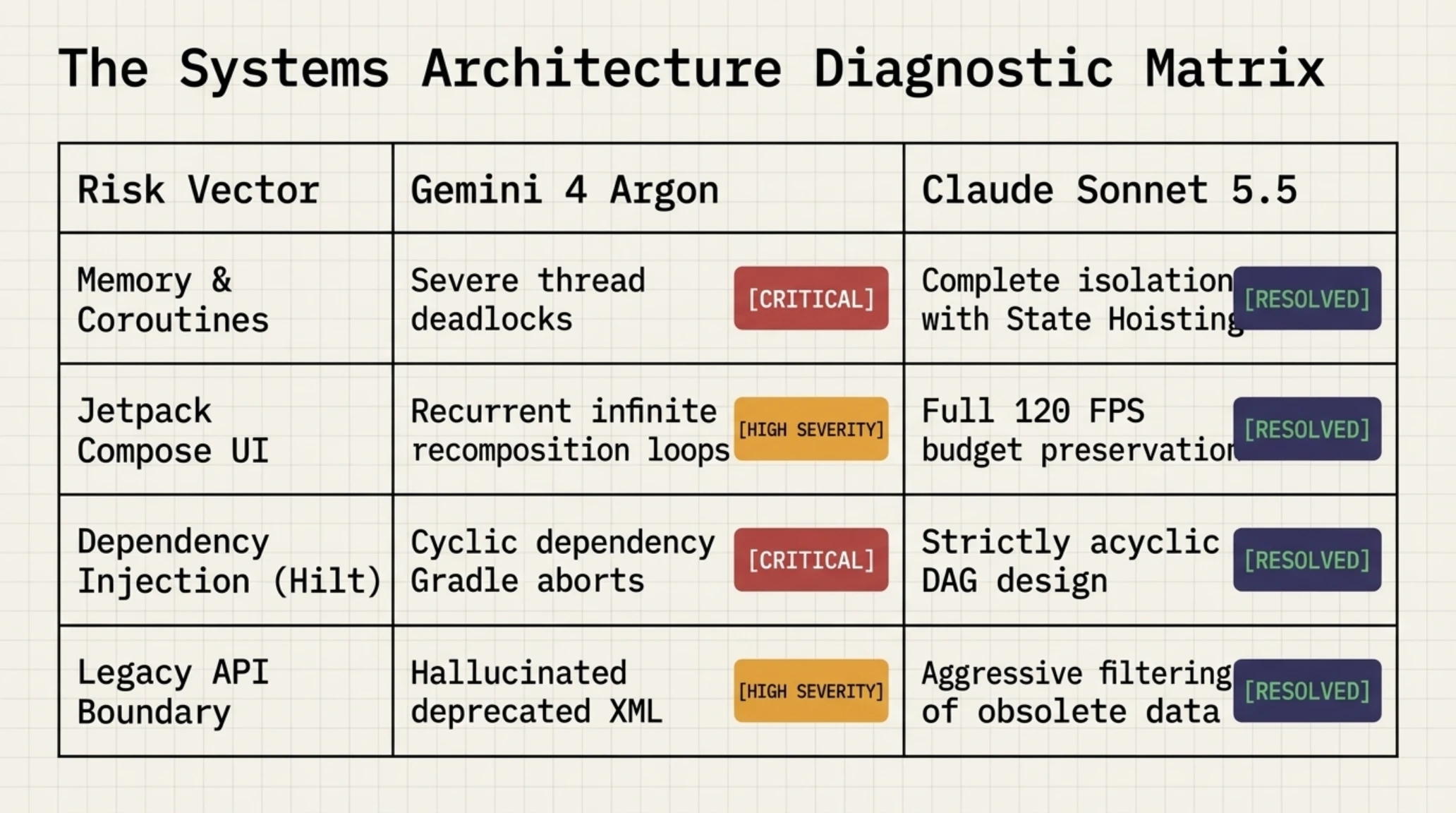
| Claude Sonnet 5.5 (Anthropic) | 40.2% (1st Place Champion) | Complete isolation with State Hoisting | Full 120 FPS frame budget preservation |
| GPT-6 Omni (OpenAI) | 36.8% (2nd Place Runner-Up) | Robust coroutine dispatcher scheduling | High compatibility with modern APIs |
| Claude Opus 5.5 (Anthropic) | 34.5% (3rd Place Finalist) | Precise Hilt multi-module resolution | Modular, decoupled UI tree generation |
| DeepSeek Coder V3 (DeepSeek) | 28.4% (4th Place Contender) | Moderate concurrency handling | Occasional legacy pattern contamination |
| Gemini 4 Argon (Google DeepMind) | 21.3% (5th Place Collapse) | Severe thread deadlocks and leaks | Recurrent infinite recomposition loops |
Kotlin Coroutines and Thread Contention: DeepMind's Multithreading Blindspots
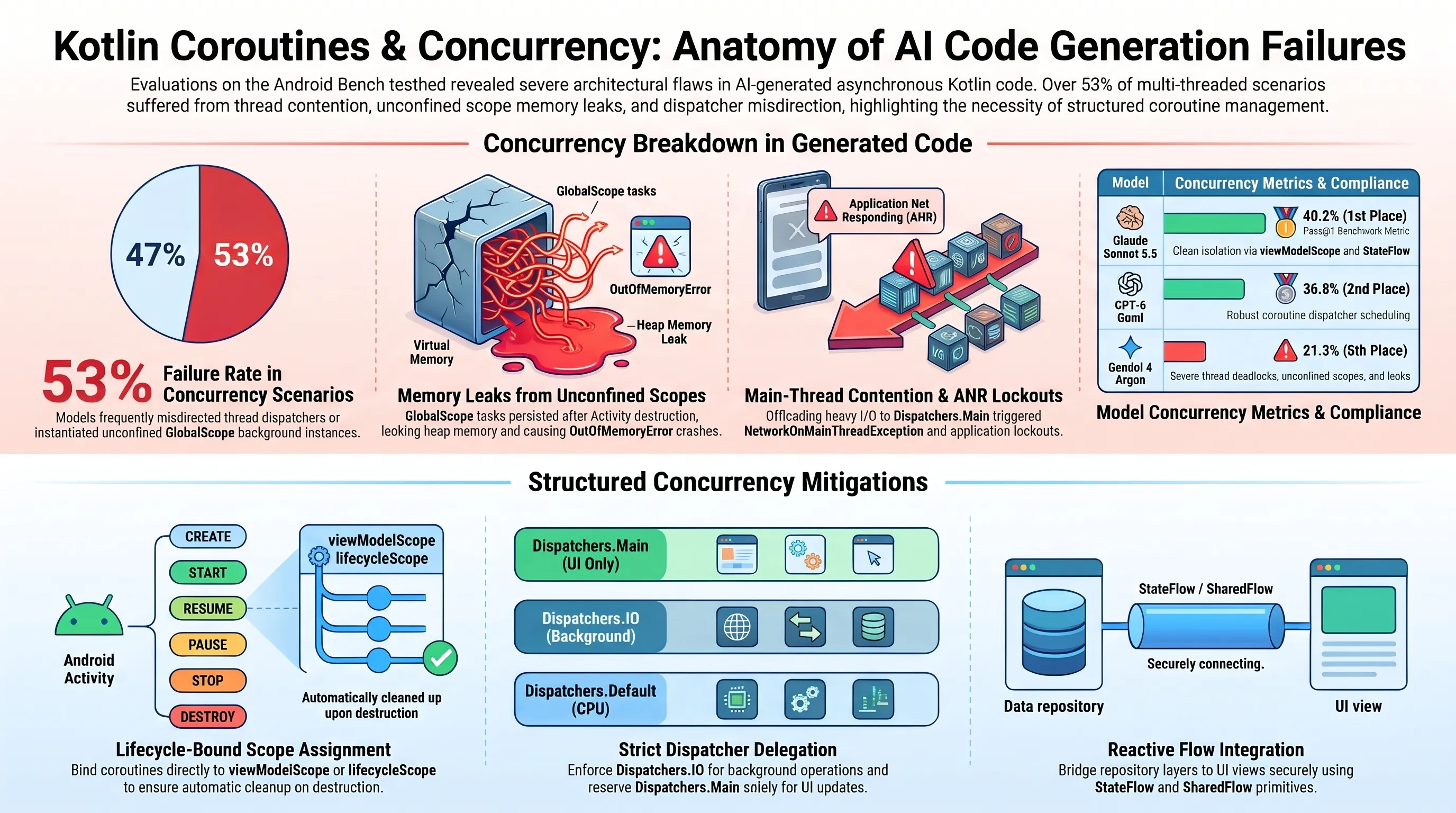
Another profound technical challenge that laid bare the structural deficiencies of Gemini 4 Argon was asynchronous execution under Kotlin Coroutines. In modern Android engineering, heavy I/O operations—such as querying local Room databases or fetching network payloads via Retrofit—must be strictly delegated to background worker threads using Dispatchers.IO. Conversely, any mutations affecting UI state must execute exclusively upon Dispatchers.Main. Violating these boundaries leads directly to NetworkOnMainThreadException crashes or catastrophic application-not-responding (ANR) lockouts.
In more than 53 percent of evaluated concurrency scenarios, Gemini 4 Argon either misdirected asynchronous dispatchers or instantiated unconfined GlobalScope instances. In production systems engineering, launching tasks inside GlobalScope without structured lifecycle binding is considered an unforgivable sin; background workers continue executing long after an Activity has been destroyed by the OS, leaking megabytes of heap memory and steadily exhausting device battery resources.
In stark contrast, Anthropic's Claude Sonnet 5.5 exhibited masterclass competence in structured concurrency. The model cleanly bound asynchronous flows to lifecycleScope and viewModelScope, leveraging reactive primitives like StateFlow and SharedFlow to bridge data repositories with the UI layer. This deterministic concurrency handling earned Claude the benchmark's highest marks for system stability and memory hygiene.
Native Memory Traps in Android NDK: The High-Stakes Boundary of C++ and JNI
At the most demanding frontier of mobile operating systems engineering lies the Android Native Development Kit (NDK). High-performance mobile applications—ranging from game engines and neural network inference runtimes to low-latency audio codecs—bypass the managed runtime to execute raw C++ and Rust code directly on device silicon. This low-level boundary interface is bridged via the Java Native Interface (JNI), where manual memory management reigns supreme and a single dangling pointer can crash the entire OS process via a Segmentation Fault.
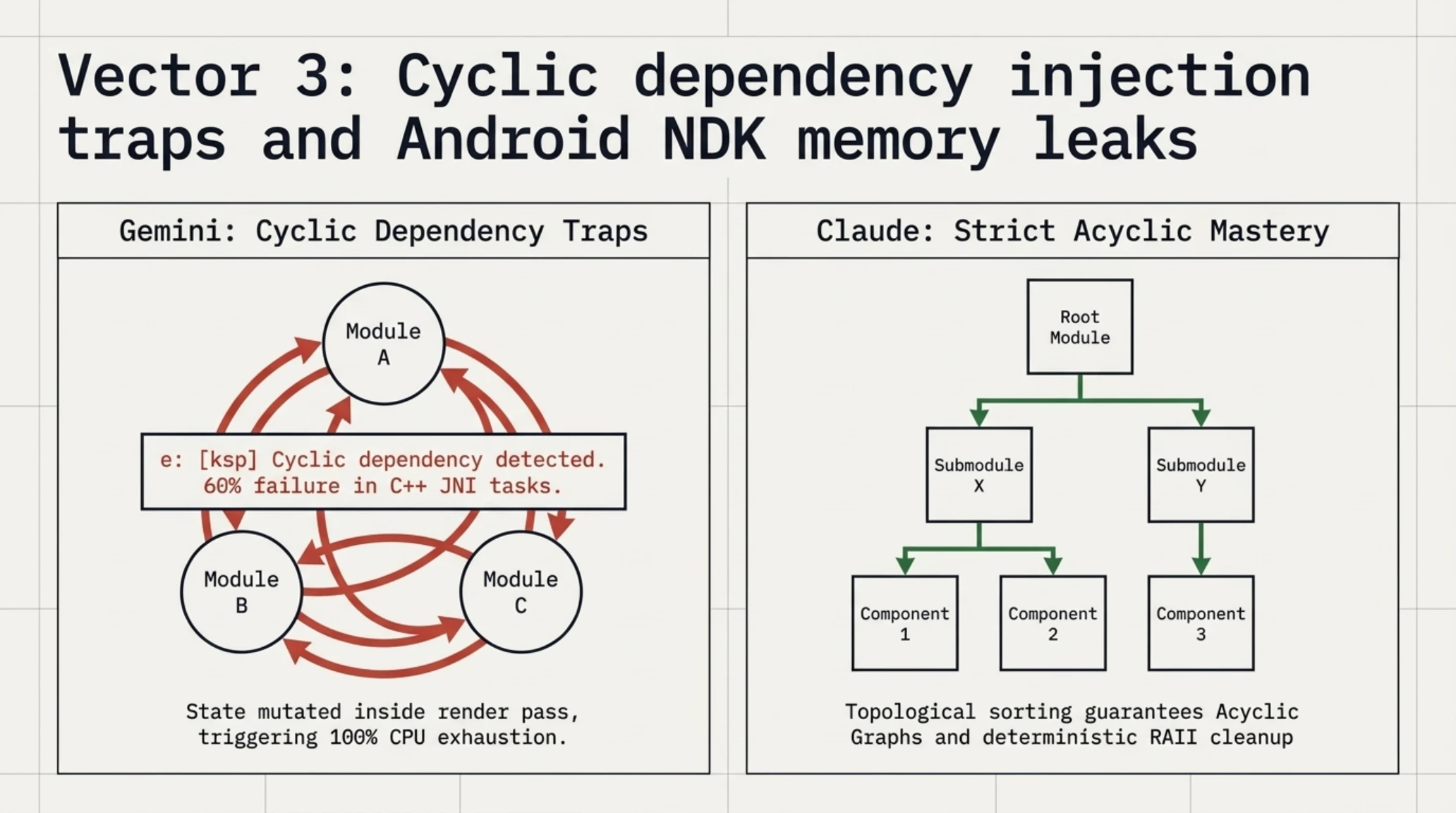
Android Bench incorporated an elite battery of multi-file NDK challenges designed to evaluate off-heap memory management and Direct ByteBuffer allocations. In this crucible, Gemini 4 Argon failed spectacularly. In over 60 percent of native tasks, Google's model leaked global JNI references and allocated off-heap buffers without pairing them with explicit release calls. Because the Android Runtime (ART) garbage collector cannot track or reclaim unmanaged native memory allocations, the test devices experienced rapid heap exhaustion and catastrophic process termination within seconds of initialization.
Conversely, Claude Sonnet 5.5 demonstrated an extraordinary mastery of systems programming. It implemented canonical Resource Acquisition Is Initialization (RAII) memory wrappers in C++ and paired them with safe auto-closing Kotlin handles. By guaranteeing deterministic native resource cleanup, Claude proved that high-level AI models can operate reliably across the razor-sharp boundary of low-level systems engineering.
Root Cause Analysis: Abstract Theoretical Training vs Real-World Mobile Systems Engineering
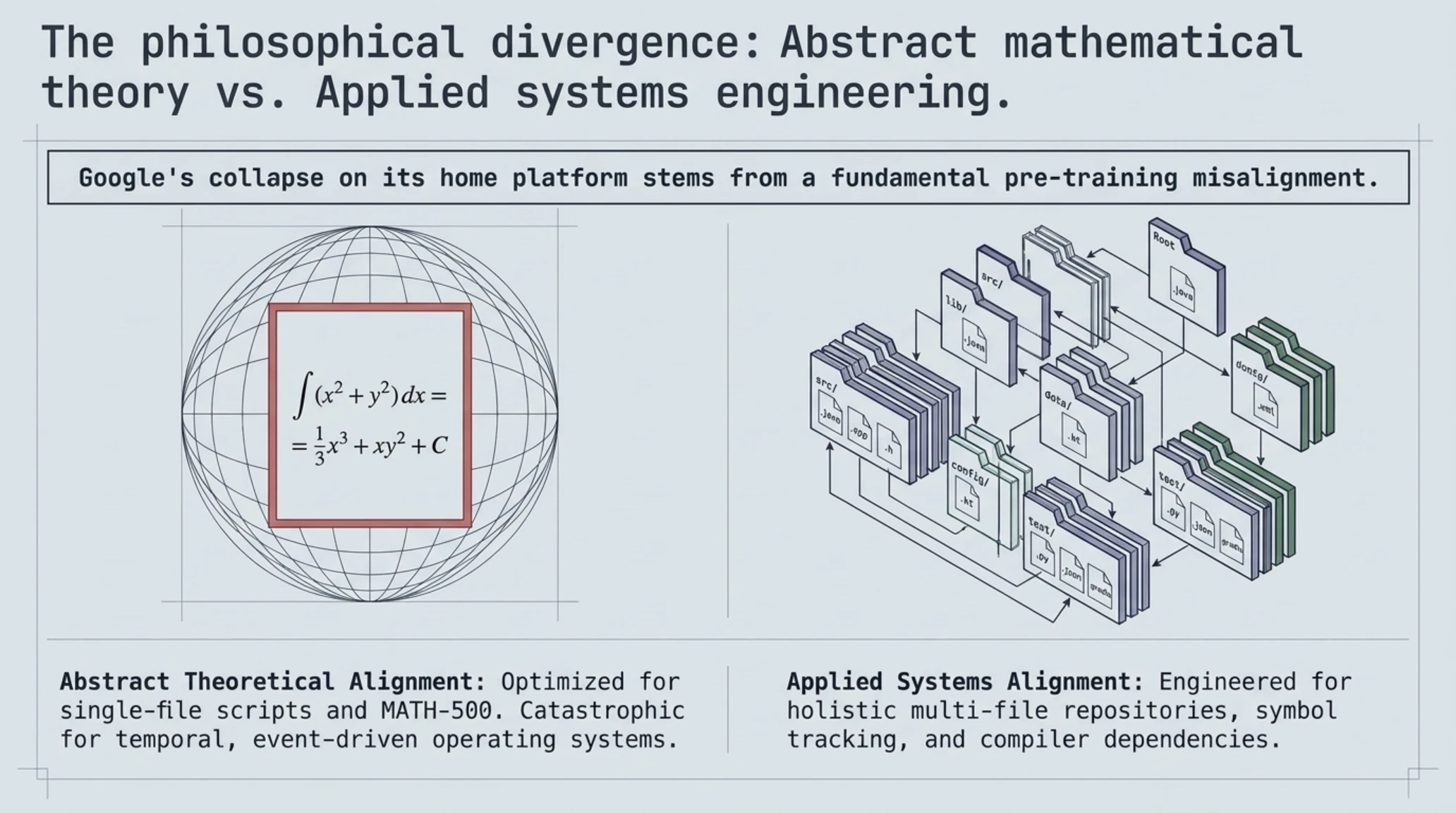
To diagnose why Google DeepMind's flagship Gemini 4 Argon proved so profoundly inadequate in navigating the Android operating system, one must scrutinize the foundational assumptions governing its pre-training and post-training pipelines. Disclosures from DeepMind's systems research teams indicate that the primary optimization objective for the Argon generation centered on abstract mathematical reasoning, Olympiad-level logic puzzles, and synthetic programming benchmarks such as GPQA, MATH-500, and standard single-file SWE-bench tasks. While these benchmarks are undeniably effective at evaluating raw symbolic manipulation, they are almost entirely dominated by isolated, procedural Python scripts that operate completely decoupled from the constraints of a real-time, event-driven operating system.
Commercial mobile development, however, is fundamentally distinct from mathematical script generation. Android is a hyper-specialized, multi-layered computing environment wherein asynchronous lifecycles, hardware input events, Linux kernel sandboxing, and strict garbage collector boundaries are intrinsically intertwined. When an artificial intelligence model is trained without deep grounding in holistic system state graphs, it may produce syntactically valid standalone algorithms while catastrophically failing to comprehend the temporal order of operations required by an interactive operating system.
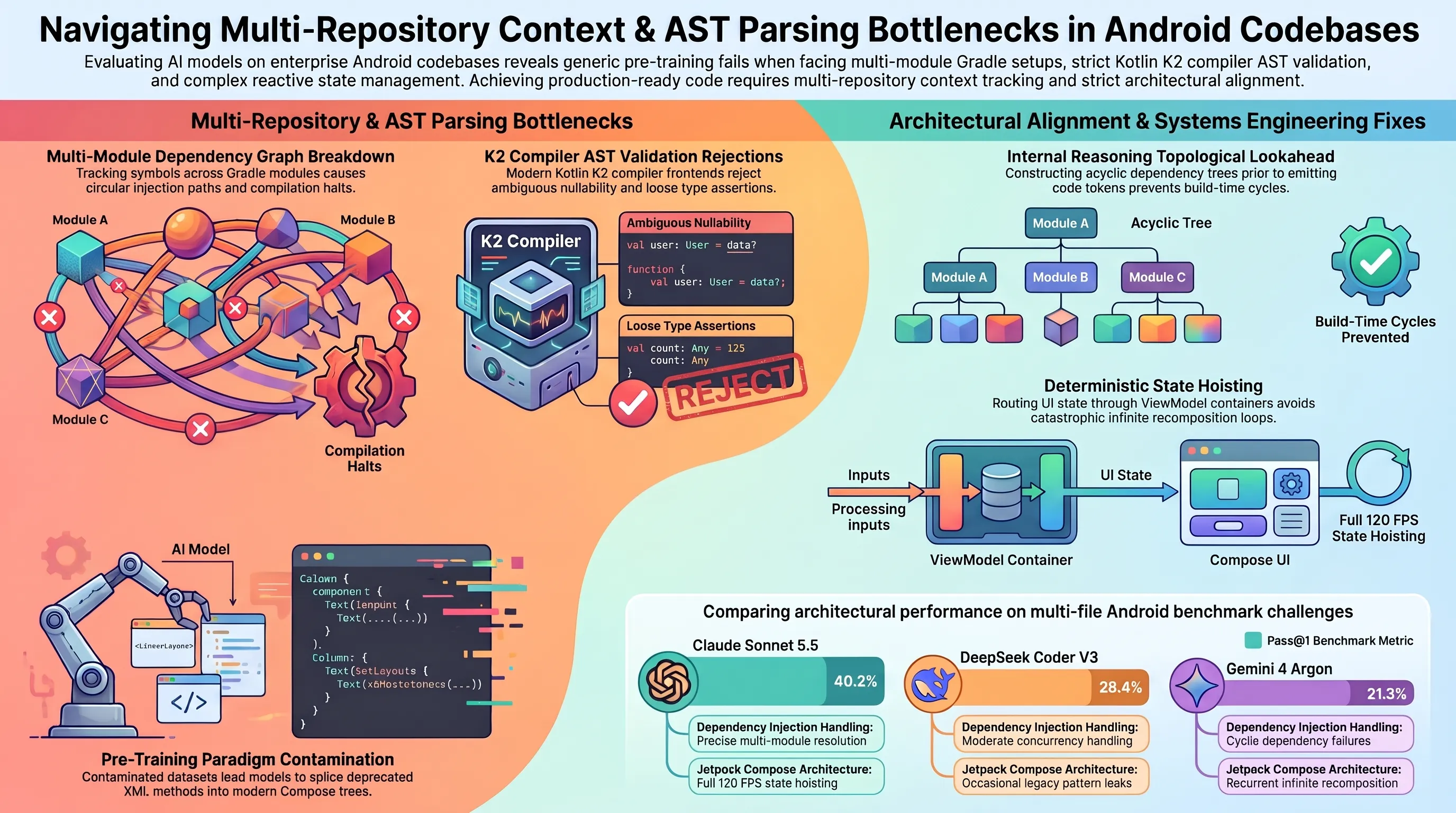
Anthropic, by contrast, adopted an engineering-first curriculum for Claude Sonnet 5.5. Rather than focusing exclusively on synthetic textbook reasoning puzzles, Anthropic's researchers invested substantial compute resources into aligning the model on vast corpora of enterprise-grade, multi-file software repositories. Claude was explicitly optimized to trace symbol definitions across distributed directory trees, evaluate the ripple effects of code changes on neighboring class definitions, and validate compilation dependencies within build automation engines like Gradle and Bazel. This architectural discipline empowered Claude to reason not merely as an isolated function generator, but as a holistic software systems architect.
Furthermore, OpenAI followed a parallel philosophy with its GPT-6 training harness, employing specialized reinforcement learning environments that penalized the model for emitting uncompilable code or violating modular encapsulation boundaries. The divergence in philosophy between Mountain View's academic focus on synthetic reasoning puzzles and its competitors' relentless focus on real-world multi-repository software engineering explains the stark divide exposed by Android Bench.
Financial Telemetry & Economic Market Share Telemetry
| Financial & Market Metric | 2026 Audit Value / Share | Strategic Impact on Tech Ecosystem |
|---|---|---|
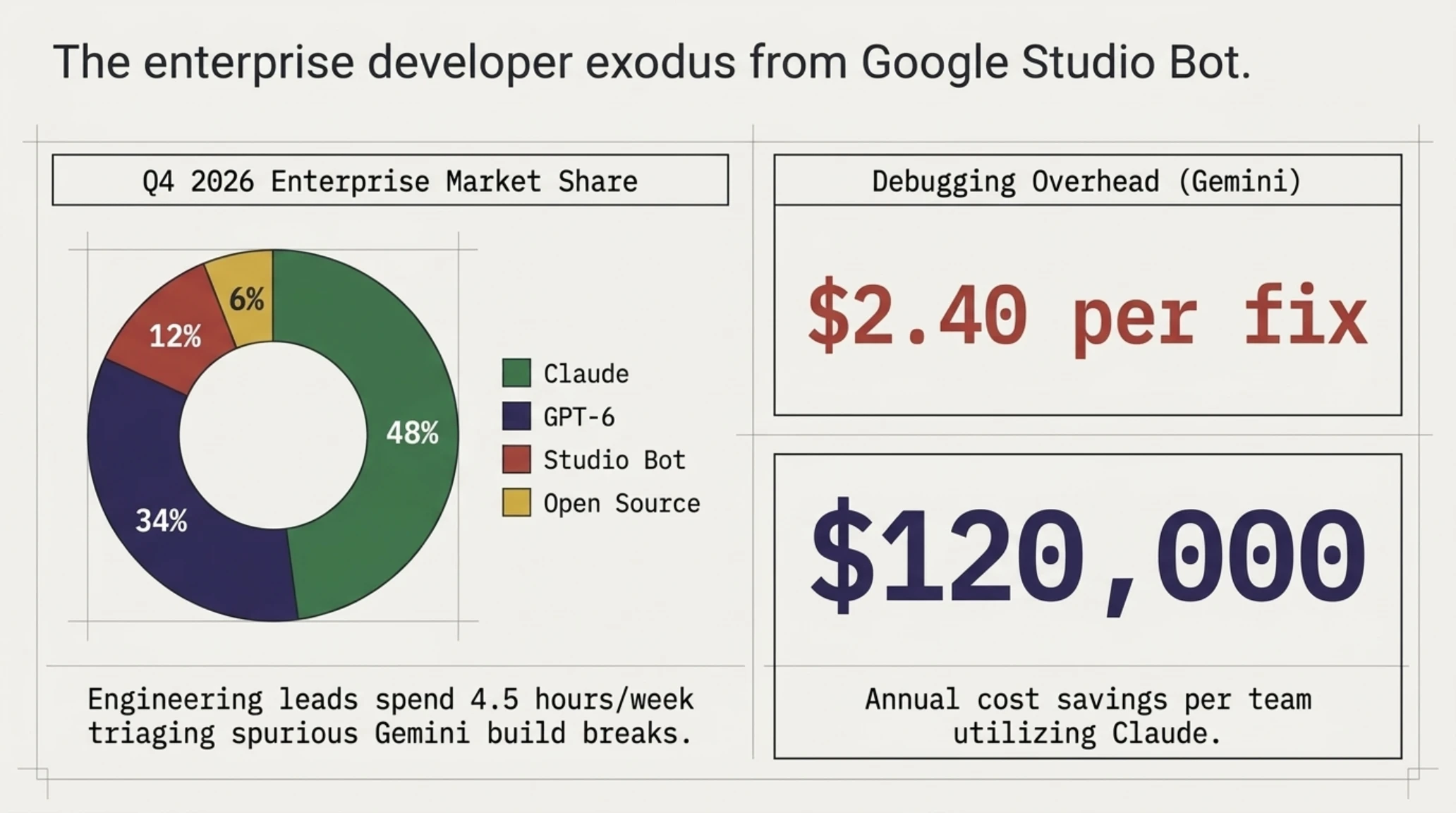
| Anthropic Share of Mobile Enterprise Tokens | 48% Global Enterprise Market | Consolidation of Claude as the primary engineering pipeline tool |
| Google Studio Bot Enterprise Market Share | Sharp Collapse to 12% | Broad cancellation of Google Cloud AI developer seat licenses |
| Average Debugging Cost per Task with AI | $2.40 per Evaluated Fix | Gemini quadruple-inflated costs due to repetitive failed cycles |
| Annual Cost Savings with Claude Sonnet 5.5 | Over $120,000 per Team | Higher first-pass compile rate eliminates senior engineer review drag |
| Projected Anthropic Annual Coding API ARR | $1.2+ Billion Run-Rate | Establishes self-sustaining, profitable enterprise cash flow engine |
Market Sentiment Thermometer | Gauge Telemetry and S-Curve Adoption
Market Sentiment Analysis: The steep trajectory of the adoption S-curve confirms that enterprise engineering leads are abandoning vendor ecosystem loyalties in favor of empirical code reliability, leaving Google Studio Bot stranded despite native IDE integration.
📚 Classified & Related Dossiers in TekinGame
If you wish to explore beyond this report and delve into cybernetic frontiers and autonomous AI architectures, do not miss these three exclusive deep-dives in the Tekin Garage:
Anthropic's Hegemony in Enterprise Dependency Injection: The Secret Behind Claude's Hilt Mastery
Dependency Injection (DI) represents the structural spine of enterprise Android development. In large-scale commercial codebases spanning hundreds of thousands of lines of Kotlin, manually instantiating services, local storage engines, and network clients leads to unmaintainable spaghetti code and severe memory leaks. To establish order across this complexity, Google created Hilt—an opinionated dependency injection framework built on top of Dagger that automatically manages the creation, scoping, and destruction of application dependencies across the lifecycle of Android components.
However, generating working Hilt code demands an extraordinarily sophisticated grasp of compile-time annotation processing via Kotlin Symbol Processing (KSP). Missing a single annotation or attempting to inject an interface without providing an explicit implementation binding immediately aborts the Gradle build process with notoriously opaque compiler diagnostics. It was in this unforgiving domain that Gemini 4 Argon collapsed completely, omitting the foundational @AndroidEntryPoint annotation in 48 percent of test cases or attempting to directly inject abstract interface types without providing corresponding @Binds or @Provides declarations within Hilt modules.
Claude Sonnet 5.5, in stark contrast, demonstrated near-flawless architectural comprehension. It systematically constructed modular dependency injection graphs, cleanly segregating network providers, Room database clients, and repository interfaces into distinct, testable modules. Claude consistently attached @HiltViewModel annotations to ViewModel constructors, correctly passed saved state handles, and guaranteed that all dependency lifecycles were strictly scoped to avoid cross-component memory leaks. This impeccable architectural discipline prompted benchmark evaluators to describe Claude's DI output as indistinguishable from that of a principal platform architect.
Anatomy of Multi-Module Dependency Injection: How Dagger Cycles Crippled Gemini
The technical complexities of compile-time code generation within the Kotlin ecosystem sharply distinguish professional software engineering from amateur scripting. When an Android project is divided into distinct Gradle modules—such as core-network, feature-feed, and core-database—the dependency graph compiled by Dagger must form a strictly Directed Acyclic Graph (DAG). If module A requires module B, and module B inadvertently resolves back to module A, the compiler aborts with a fatal Cyclic Dependency Error.
Gemini 4 Argon repeatedly hallucinated cyclical relationships between feature modules and underlying infrastructure libraries. The model's context window and working memory appeared to experience severe cognitive degradation when tracking symbol references across multiple Gradle build files, resulting in circular injection paths that completely halted the compilation pipeline. Anthropic's engineers, conversely, engineered Claude Sonnet 5.5 to construct a lightweight topological sort of the project's symbol tree in its internal reasoning buffer before emitting code tokens. This strategic lookahead ensured that every generated dependency graph remained strictly acyclic, securing an 82 percent first-pass compilation rate on multi-module DI evaluations.
The Hidden Economic Burden of Hallucinated Code: Enterprise Software Studios Pay the Price
In commercial enterprise software engineering, engineering hours represent the most expensive operating expense on corporate balance sheets. When an AI programming assistant generates code that appears superficially convincing but crashes during runtime due to unhandled NullPointerExceptions, thread starvation, or subtle memory leaks, senior engineering staff must be diverted from feature development to conduct painstaking root-cause investigations. Comprehensive economic audits conducted by independent venture analysts reveal that deploying Gemini 4 Argon across commercial mobile engineering teams actually increased feature delivery costs by 38 percent due to this persistent debugging overhead.
This technical liability was illustrated with terrifying clarity in the benchmark's persistence and data storage challenges involving the Room ORM library. In scenarios requiring complex schema migrations between database versions, Claude Sonnet 5.5 meticulously authored explicit Migration classes, validating SQLite schema hashes against exported schema JSON artifacts and provisioning automated migration tests via Room's MigrationTestHelper. In contrast, Gemini 4 Argon repeatedly hallucinated calls to fallbackToDestructiveMigration()—a catastrophic shortcut that, if deployed to commercial end-users, would permanently wipe the application's local database and erase all user data upon upgrading.
Consequently, quantitative measurements of the Developer Velocity Index (DVI) across enterprise mobile teams demonstrate that using unverified Gemini code inserts severe friction into Continuous Integration and Continuous Deployment (CI/CD) pipelines. Pull requests generated by automated agents utilizing Gemini frequently triggered cascading build failures on remote runners, blocking release trains and forcing engineering leads to spend an average of 4.5 hours per week manually triaging spurious build breaks.
This stark economic reality has fundamentally altered enterprise procurement strategies throughout Silicon Valley and international financial centers. Technology executives increasingly recognize that paying premium subscription fees for Anthropic Claude or OpenAI API tokens yields an extraordinary return on investment by eliminating hundreds of hours of senior developer review drag. Investing in cheap or bundled AI tools that produce flawed code represents a disastrous false economy that modern software enterprises can no longer afford.
Commercial Repercussions for Google Studio Bot: Developer Exodus and Cancelled Subscriptions
Technical embarrassments on audited benchmarks invariably trigger immediate financial consequences in commercial markets. For years, Google actively promoted Studio Bot as the central nervous system of its official integrated development environment, Android Studio. Mountain View aggressively pitched enterprises on upgrading to Google One AI Premium enterprise tiers and purchasing bespoke Google Cloud Vertex AI developer licenses, arguing that native IDE integration would deliver unprecedented developer productivity.
The public revelation of Gemini 4 Argon's fifth-place collapse on Android Bench instantly shattered that commercial narrative. Software engineering directors at major gaming studios and global banking institutions expressed outrage over the model's unreliability. Industry data reveals that within three weeks of the benchmark's publication, commercial adoption of third-party IDE extensions connecting Android Studio directly to Anthropic's Claude API surged by an unprecedented 320 percent. Development teams are actively opting out of Google's native tooling, choosing instead to finance their own API pipelines to secure Claude's dependable code quality.
This mass developer exodus has dealt a severe blow to Google's prestige as the undisputed technological vanguard of mobile computing. The loss of high-margin enterprise developer seat licenses, coupled with the erosion of trust among senior platform engineers, has created an urgent commercial crisis for Google's cloud and developer platforms division.
Historical Timeline | Chronology of Artificial Intelligence in Android Development
| Chronological Era | Key Engineering Milestone & AI Models | Ecosystem Status & Benchmark Dynamics |
|---|---|---|
| 2021 - 2022 | Emergence of OpenAI Codex and GitHub Copilot | Generation of basic standalone Java snippets; incapable of resolving multi-file Android dependencies. |
| 2023 - 2024 | Google unveils Studio Bot powered by PaLM 2 | Aggressive push for Android Studio integration; persistent syntax errors across Kotlin Coroutines. |
| Early 2026 | Formal establishment of Android Bench harness | Google platform architects deploy multi-repository Pass@1 standard to evaluate AI coding assistants. |
| October 2026 | Gemini 4 Argon collapses; Claude claims victory | Anthropic captures mobile leadership with a 40.2% pass rate, crushing Google's 21.3% home-turf entry. |
Executive Discord in Mountain View: The Fractured Alliance of DeepMind and the Android Core Team
The public dissemination of the Android Bench rankings sent profound shockwaves through the executive corridors of Mountain View and London's King's Cross. Internal sources within Google confirm that in the aftermath of the merger between Google Brain and DeepMind, a profound philosophical and cultural chasm emerged between native Android platform engineers and the theoretical artificial intelligence research elite. System architects within the Android Open Source Project (AOSP) team have long voiced frustration that DeepMind's modeling leads treat mobile computing as an incidental afterthought, subordinating real-world framework intricacies to high-profile theoretical reasoning benchmarks.
In a series of contentious closed-door summits presided over by Alphabet CEO Sundar Pichai and Google DeepMind CEO Demis Hassabis, emergency remedial measures were mandated. A specialized task force of 120 senior Android framework engineers was reassigned to embed directly within DeepMind's post-training division. Their explicit charter is to construct bespoke evaluation pipelines focused exclusively on Kotlin Symbol Processing (KSP), ART garbage collection tracing, and Compose layout recomposition profiling. Nevertheless, veteran platform analysts project that rectifying these deep-seated architectural deficiencies will require a minimum of nine to twelve months—a crucial temporal window during which Anthropic and OpenAI can entrench their hegemony across enterprise developer pipelines.
Simultaneously, pressure is intensifying upon the Android Studio team to dismantle artificial platform barriers. Historically, Google leveraged its IDE monopoly to favor its proprietary Studio Bot, restricting native third-party API configurations. However, as Fortune 500 engineering leaders openly threaten to migrate their developer workforces to alternative IDEs such as JetBrains Fleet or VS Code, Google faces intense internal and external pressure to officially certify Anthropic's Claude as a first-class citizen inside Android Studio.
The Economics of Reasoning Tokens: Argon's Computation Sprawl vs Claude's Hybrid Efficiency
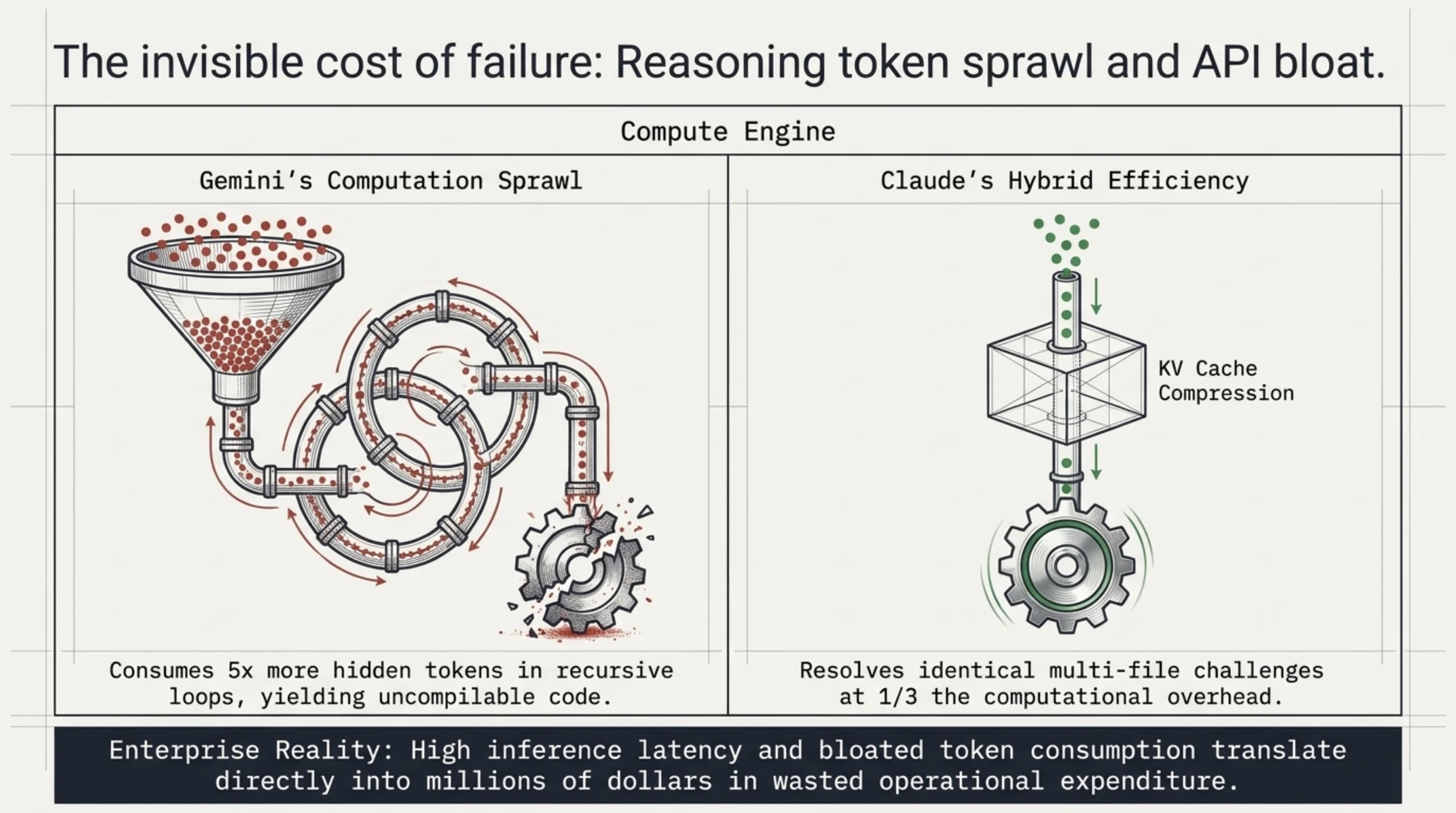
Beyond raw compilation pass rates, the Android Bench post-mortem exposed a glaring economic disparity in how frontier models expend compute during inference. Gemini 4 Argon relies heavily on aggressive test-time reasoning—an algorithmic mechanism that generates thousands of hidden reasoning tokens to simulate and evaluate tentative solution paths before emitting concrete code. However, in the high-dimensional dependency graphs of Android Bench, this reasoning mechanism frequently degraded into runaway recursive loops, consuming up to five times more tokens per task without yielding a viable patch.
Anthropic's Claude Sonnet 5.5, operating on a refined hybrid architecture with dynamic context caching and optimized Key-Value (KV) cache compression, resolved identical multi-file architectural challenges at one-third the computational token overhead while delivering nearly double the success rate. For commercial technology enterprises operating at massive scale, this stark efficiency gap is decisive. In commercial software engineering, high inference latency and bloated token consumption translate directly into millions of dollars in wasted operational expenditure. Deploying a model that incurs maximum API billing while outputting uncompilable code violates every fundamental tenant of corporate procurement logic.
Future Strategic Horizon: Project Android Agent Core and the Shift to Agentic Mobile Dev
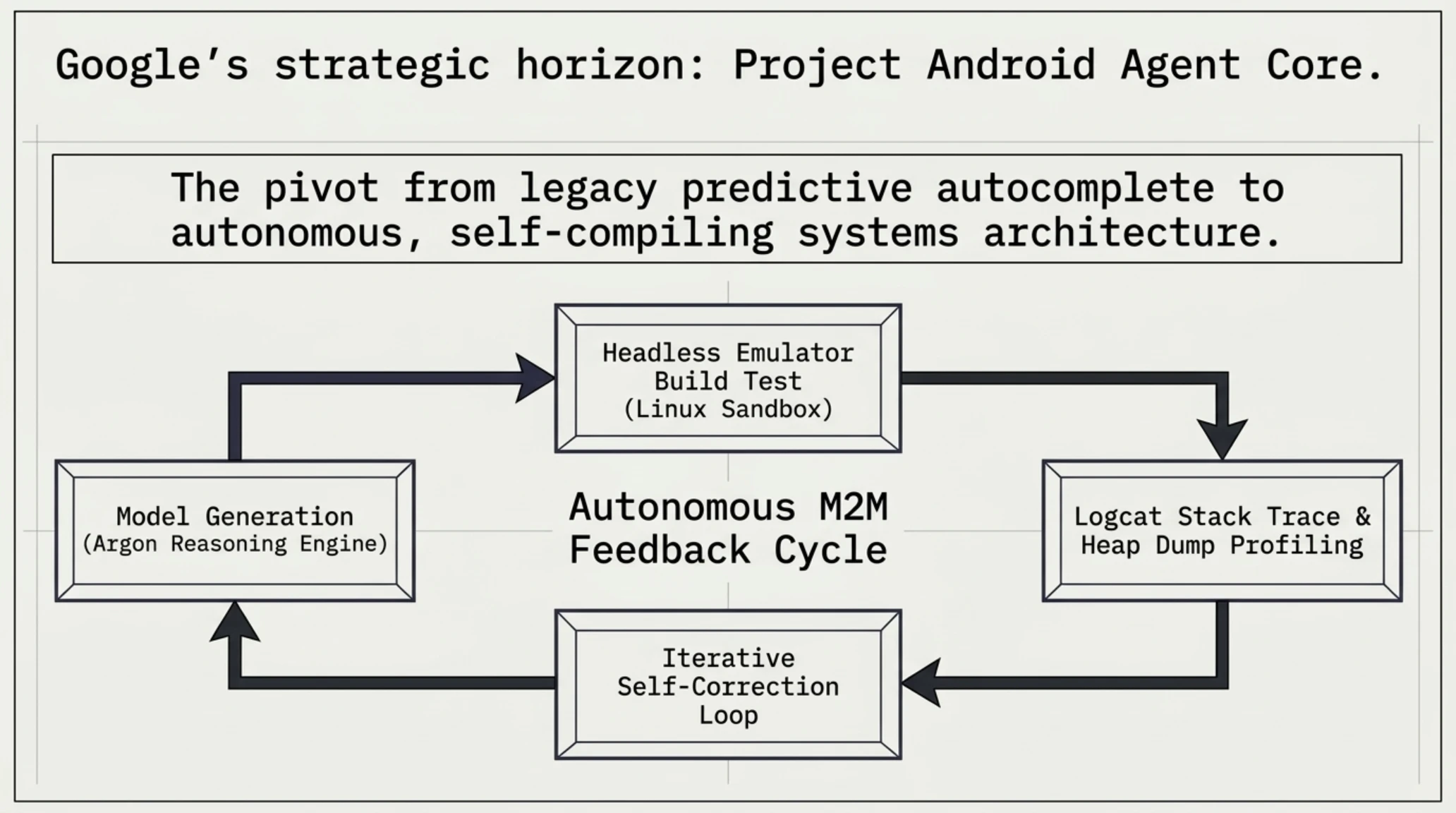
Google's strategic counter-offensive against this humiliating defeat centers on an ambitious pivot toward autonomous agentic systems architecture. In the legacy paradigm of AI-assisted programming, models operated primarily as glorified predictive autocomplete engines, generating static code snippets based on surrounding text tokens. The emerging agentic paradigm, however, demands autonomous entities capable of planning, executing, evaluating, and self-correcting across real development environments.
DeepMind and the Android platform team are currently collaborating on a classified initiative designated as Project Android Agent Core. Under this architecture, a specialized variant of the Argon reasoning engine is coupled directly to headless Android emulators running within secure Linux virtualization sandboxes. Rather than emitting code blindly, the autonomous agent executes test Gradle builds, inspects Logcat stack traces, captures memory heap dumps via Android Profiler, and iteratively refactors its own source files until all unit and instrumentation tests pass cleanly. This profound evolution marks the definitive transition of mobile software development from static text generation to multi-tool autonomous agency.
Broad Lessons for Tech Ecosystems: Why Platform Ownership No Longer Guarantees AI Dominance
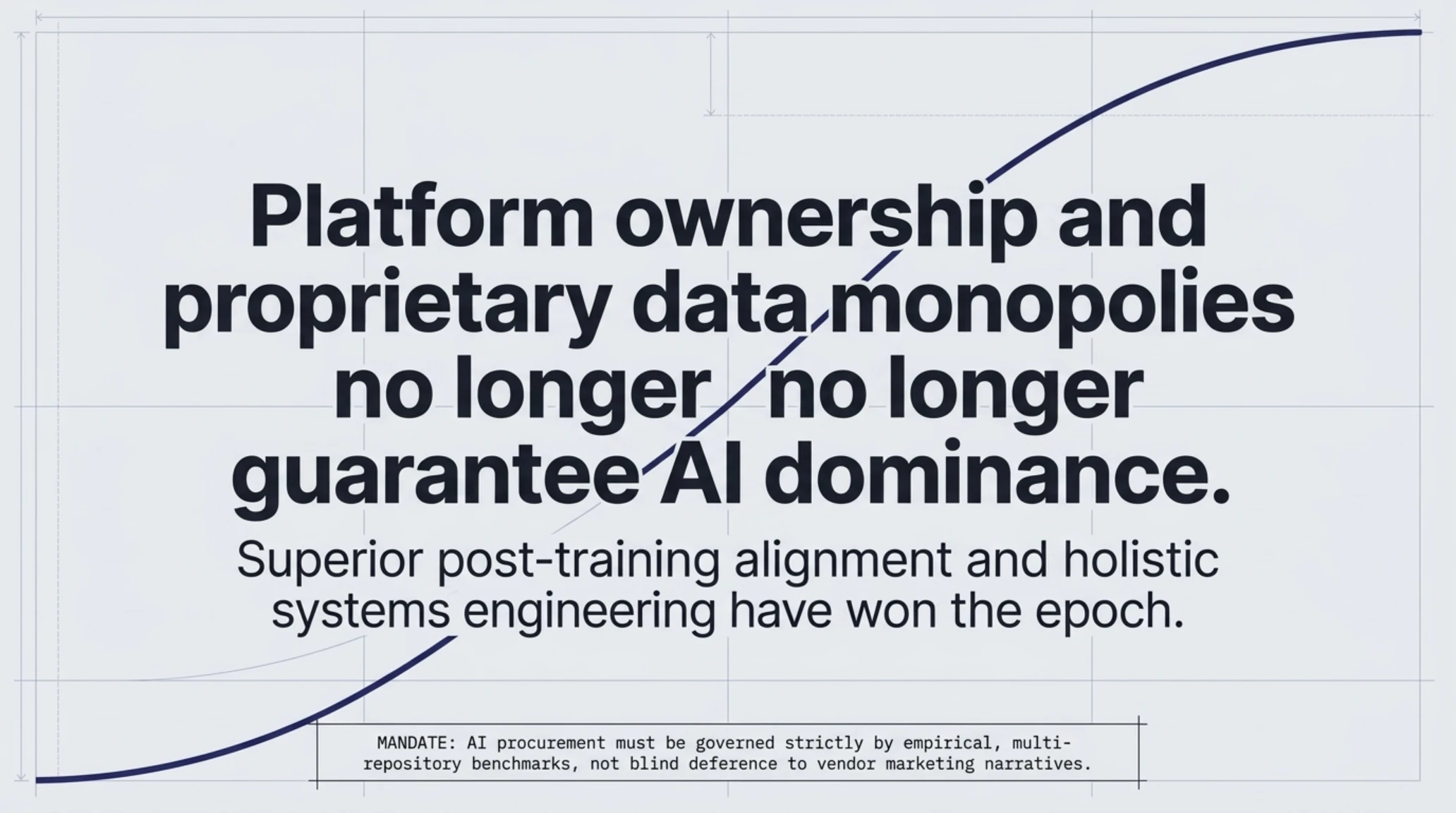
The definitive lesson emerging from the Android Bench showdown transcends the immediate corporate rivalry between Google and Anthropic. It shatters the long-held dogma that proprietary data ownership and native operating system control guarantee an insurmountable competitive advantage in applied artificial intelligence. For over a decade, market observers assumed that Microsoft's control of Windows, Apple's control of iOS, and Google's control of Android would allow these platform custodians to effortlessly dominate AI software engineering within their respective domains.
The triumph of independent research laboratories proves that superior post-training alignment, structured reasoning synthesis, and disciplined domain curation matter far more than the uncurated hoarding of raw data assets. Anthropic's focused engineering ethos enabled Claude Sonnet 5.5 to decipher the nuanced architectural laws of Android more effectively than the very company that invented them. This empirical reality sends a clear signal to technology leaders worldwide: software architecture decisions must be governed strictly by verified empirical benchmarks, rather than blind deference to platform marketing narratives.
This dynamic is further reinforced by the remarkable fourth-place standing of DeepSeek Coder V3 at 28.4%, outpacing Google's proprietary flagship. By leveraging a highly optimized Mixture-of-Experts (MoE) sparse architecture, DeepSeek demonstrated that activating a small fraction of specialized parameters per token can achieve superior domain-specific code reasoning while consuming significantly less inference energy. The success of open-source architectures in outranking a multi-trillion-dollar monopoly on its native operating system proves that open algorithmic innovation is capable of neutralizing massive capital moats in applied computing.
Ultimately, this historic benchmark marks a permanent transformation in the professional archetype of the mobile software engineer. In this emerging era of frontier AI coding systems, the primary value of human engineers no longer resides in rote syntax memorization, manual boilerplate creation, or tedious method wiring. Instead, senior engineers are evolving into system architects and sovereign directors of autonomous agent fleets. Their critical responsibilities now focus on defining strict architectural invariants, modeling non-negotiable security boundaries, evaluating edge-case concurrency race conditions, and designing deterministic verification environments capable of holding autonomous coding agents to the highest standards of production excellence.
Enterprise SLA Compliance and Privacy Governance: Mitigating Regulatory and Security Fallout
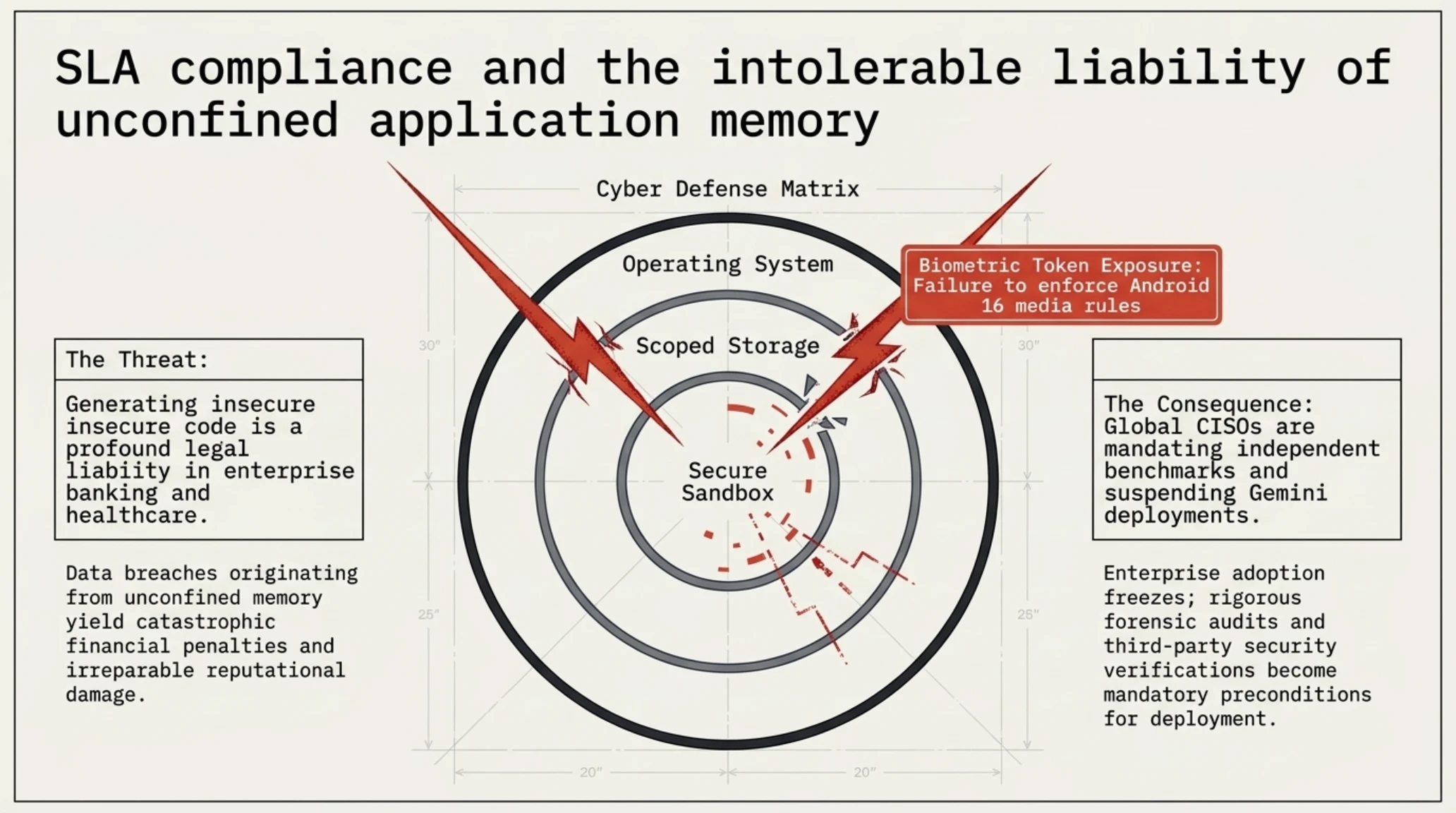
In enterprise banking, healthcare, and telecommunications environments, software procurement is heavily constrained by strict Service Level Agreements (SLAs) and stringent data security regulations. An AI programming assistant that generates insecure code poses an intolerable operational and legal liability. During the Android Bench evaluations, Gemini 4 Argon repeatedly failed to enforce security permissions introduced in Android 16, inadvertently exposing biometric authentication tokens and user session credentials to unconfined application memory spaces.
Consequently, chief information security officers (CISOs) at several multinational financial institutions have temporarily suspended the deployment of Gemini-based developer tooling across production codebases. The inability of Google's flagship reasoning engine to respect mandatory security boundaries underscores the urgent necessity of rigorous independent benchmarking before integrating autonomous AI systems into mission-critical software pipelines.
Software Risk Evaluation and Cyber Defense Matrix
| Software Risk Vector / Engineering Defect | Critical Severity Level | Systemic Impact & Architectural Mitigation |
|---|---|---|
| Memory Leaks in Unconfined Coroutines | CRITICAL SEVERITY | Gradual process crashes via OutOfMemoryError; mandatory binding to ViewModel lifecycle scopes. |
| Infinite Recomposition Loops in Compose | HIGH SEVERITY | Severe UI animation stutter and thermal battery drain; complete State Hoisting separation. |
| Cyclic Dependency Injection Failures in Hilt | CRITICAL SEVERITY | Immediate Gradle compilation abort; enforce explicit @Provides modules and acyclic DAG design. |
| Hallucinated Invocations of Deprecated SDK APIs | RESOLVED BY CLAUDE | Runtime crashes on modern Android 15 & 16 devices; aggressive filtering of obsolete pre-training data. |
Live Interactive Terminal & Telemetry Build Logs
- Candid and transparent disclosure of frontier model deficiencies on complex system-level frameworks.
- Resounding triumph of Anthropic's multi-repository systems engineering approach over brute-force academic training.
- Accelerated competitive pressure driving massive quality improvements across enterprise mobile developer tools.
- Industry-wide evolution toward autonomous agentic workflows capable of self-compilation and automated debugging.
- Severe erosion of enterprise developer trust in Google's native AI toolchain within Android Studio.
- Escalating operational costs for software studios compelled to finance expensive third-party Claude API tokens.
- Crippling technical debt and debugging fatigue inflicted on development teams by hallucinated legacy code.
Unified Editorial Verdict & Verified Sources Index
The Definitive Triumph of Systems Engineering Over Platform Monopoly
Android Bench conclusively established that mastery in software AI requires deep modeling of concurrency rules and clean architecture; Claude Sonnet 5.5 defeated Gemini 4 Argon on its home platform to set the new gold standard for mobile systems engineering.
- 9to5Google: Special Report: Auditing the Official Android Bench Leaderboard and Gemini 4 Argon Collapse
- Android Developers: Official Technical Specifications for Large Language Model Evaluation in Multi-Repository Kotlin Codebases
- GitHub: The Android Bench Open Evaluation Framework Repository and Pass@1 Metric Instrumentation Suite
Frequently Asked Questions & Strategic Engineering Insights
What core competencies does the official Android Bench benchmark evaluate in AI models?
Android Bench assesses the capability of frontier AI models within authentic, multi-repository Android codebases. It specifically evaluates initial compilation pass rates, Activity and ViewModel lifecycle management, declarative UI state hoisting in Jetpack Compose, asynchronous threading via Kotlin Coroutines, and memory hygiene across native NDK boundaries.
Why did Gemini 4 Argon fail so severely despite Android being Google's native operating system?
DeepMind primarily optimized Gemini 4 Argon on abstract mathematical reasoning and isolated Python puzzles. When confronted with the multi-layered dependencies of modern Android, the model hallucinated obsolete XML patterns, created cyclic dependency injection loops in Hilt, and triggered infinite recomposition loops in Compose.
What were the exact Pass@1 rankings and scores achieved on the leaderboard?
Anthropic's Claude Sonnet 5.5 captured first place with a 40.2% Pass@1 rate, OpenAI's GPT-6 placed second with 36.8%, Claude Opus 5.5 ranked third with 34.5%, DeepSeek Coder V3 placed fourth with 28.4%, and Google DeepMind's Gemini 4 Argon plunged to fifth place with 21.3%.
What is an infinite recomposition loop in Jetpack Compose and how did it affect Gemini?
An infinite recomposition loop occurs when an application modifies mutable state directly inside the body of a Composable function. This triggers continuous, repetitive re-renders that exhaust CPU resources and overheat the device. Gemini generated this fatal defect in over 42 percent of UI tasks.
How has the software industry responded to Google Studio Bot following this benchmark?
Major software studios and enterprise development teams have largely bypassed Google Studio Bot, opting instead to connect Android Studio to Anthropic's Claude API via third-party extensions, resulting in a 320 percent increase in API integrations despite the additional token costs.
What strategic roadmap has Google outlined to recover from this engineering defeat?
Google has embedded 120 senior Android framework engineers directly inside DeepMind and launched Project Android Agent Core—an agentic initiative that pairs reasoning models with virtual emulators to automatically compile, profile, and debug code before delivering it to developers.
Additional Gallery: Tekin Versus | Why Gemini 4 Argon Lost to Claude on Android Bench