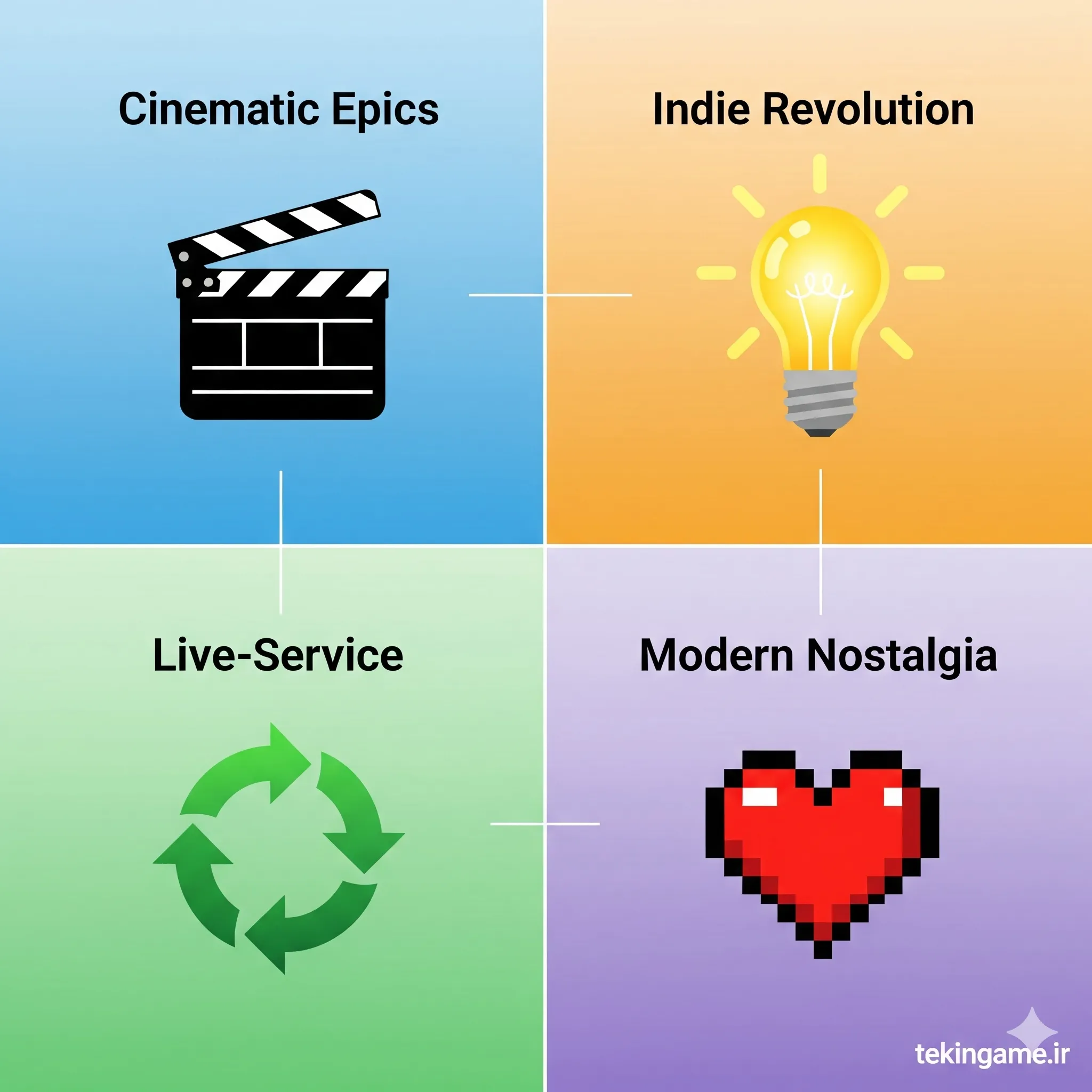
The Game of the Year (GOTY) accolade is no longer a mere annual marketing spectacle or an industry pat on the back; it has evolved into the definitive cultural, economic, and technological barometer of interactive entertainment. Each year's slate of finalists serves as a pristine mirror reflecting shifting global player aesthetics, breakthroughs in real-time neural rendering, and a brutal ideological war between multi-hundred-million-dollar AAA cinematic behemoths and visionary independent masterpieces. In 2025, the nominations and eventual laureates carry an unprecedented, transformative message: the death of formulaic bloat, the historic geopolitical decentralization of game development toward East Asia, and the triumphant return of mechanical primacy over passive Hollywood-inspired exposition. In this exhaustive, analytical investigation conducted at the
TekinGame Technical Media Laboratory, we dissect what the GOTY 2025 contenders reveal about the structural future of the gaming industry.
What renders the 2025 awards cycle singularly consequential is the historic intersection of macroeconomic reckoning and generational hardware maturity. Following unprecedented layoffs across Western publisher conglomerates and the realization that ballooning development cycles of seven years and $250M+ budgets are financially unsustainable, the 2025 nominees proved that sheer scale is no longer a substitute for architectural focus. Today, creative economy, absolute mastery of next-generation engine tooling such as Unreal Engine 5.5, and a profound psychological respect for player agency determine which titles capture golden statuettes and secure immortality in the collective memory of humanity.
⚡Strategic Diagnostic Metrics: GOTY 2025 Industry Landscape
TEKIN HUD◈ Nominee Budget Spectrum
Ranging from $4.5M for visionary indie breakthroughs to $280M+ for tentpole AAA epics
◈ Asia-Pacific Studio Market Share
Over 45% of premiere category nominations captured by Chinese, Korean, and Japanese teams
◈ Next-Gen Engine Adoption Rate
100% of finalists utilizing advanced software/hardware ray tracing, Lumen, or custom Nanite geometry
◈ Critical Consensus Benchmark
Average Metacritic threshold of 91.4 across the top six Game of the Year contenders
TekinGame Editorial designates GOTY 2025 as the decisive turning point where artistic authenticity eclipsed raw corporate expenditure.
## Section 1: Deconstructing the 2025 Nominees: The Shattering of Western Oligopoly
For over two decades, the Game of the Year shortlist was predominantly the private playground of a narrow enclave of prestigious Western studios—Naughty Dog, Santa Monica Studio, Bethesda, Rockstar—interspersed with venerable Japanese institutions like Nintendo. The year 2025 permanently dismantled this comfortable oligarchy. The ferocious arrival of internationally distributed auteur studios, capable of matching top-tier visual fidelity while delivering radical mechanical innovations, demonstrated that geographical heritage and entrenched industry dynasties are no longer prerequisites for commercial triumph or critical adoration.
Global players in 2025 expressed unmistakable fatigue with hollow open worlds, copy-paste points of interest, and bureaucratic checklist design. The games that captured critical consensus and ignited community euphoria were titles that treated player intelligence with sacred reverence. These were dynamic, reactive sandboxes where physical materiality, environmental physics, and emergent player choices yielded tangible, consequence-laden results. The era of treating the player as a captive passenger along a rigid, pre-scripted movie set has definitively drawn to a close.
Furthermore, the organizational paradigms of these victorious studios tell a crucial economic story. Rather than deploying bloated armies of eight hundred developers weighed down by administrative inertia, the most celebrated titles of 2025 emerged from lean, hyper-focused core teams leveraging automated pipeline tooling, algorithmic asset distribution, and agile creative leadership. This structural agility enabled them to iterate rapidly, take daring creative risks, and preserve a coherent artistic vision that corporate committees invariably dilute.
This decentralization of creative authority also reflects a profound maturation in global gaming criticism. The international jury panel for major accolades has expanded beyond legacy North American print institutions to incorporate specialized digital critics and transmedia scholars from over thirty nations across Latin America, Eastern Europe, the Middle East, and the Asia-Pacific region. Consequently, games are evaluated with a cosmopolitan critical vocabulary that interrogates philosophical thematic depth, regional folklore resonance, and mechanical audacity rather than merely grading technical performance against the benchmark of Western blockbuster conventions.
"
The 2025 nominations proved beyond all dispute that photorealistic spectacle without mechanical soul is a hollow carcass. True greatness resides in how deeply an interactive system takes root within the player's consciousness.
Tekin Plus Editorial Board - Transmedia & Game Industry Analytics
## Section 2: The Clash of Paradigms: Cinematic Epics vs. Systems-Driven Indie Triumphs
One of the most thrilling intellectual battlegrounds of GOTY 2025 was the direct confrontation between hyper-budget cinematic narratives and mechanically brilliant indie projects. On one side stood visual masterclasses featuring performance-captured Hollywood actors, tens of millions of dollars in bespoke orchestral scoring, and hundreds of minutes of non-interactive cutscenes. On the other stood titles forged on shoestring budgets that captivated players through sublime gameplay loops, intricate roguelike progression systems, and profound atmospheric density.
The asymmetry between capital investment and subjective emotional payoff reached historic proportions in 2025. When an independent team with a twenty-million-dollar budget generates comparable cultural reverence, critical adoration, and deeper player engagement than a quarter-billion-dollar corporate juggernaut beset by delays and scope creep, executive suites are forced into existential reckoning. The myth that graphical fidelity correlates linearly with commercial success or artistic importance has been permanently dissolved.
The message delivered by the 2025 nominees to institutional investors was crystalline: gratuitous RPG leveling mechanics slapped onto linear action games and expansive, lifeless topographies designed merely to justify a $70 retail price tag are met with consumer derision. A true Game of the Year contender honors every single second of the player's precious time, delivering concentrated, polished, and unforgettable interactivity.
⭐The Four Pillars Defining GOTY 2025 Laureates
TEKIN HUD◈ Ludonarrative Cohesion
Total mechanical alignment between tactile control inputs and character emotional trajectories
◈ Non-Linear World Reactivity
Deep systemic simulation where physical and biological interactions yield emergent solutions
◈ Acoustic Innovation
Spatial Dolby Atmos audio landscapes and dynamic musical scores synchronized with player biometrics
◈ Engine-Level Optimization
Flawless, locked 60+ FPS stability leveraging advanced NVMe streaming and intelligent frame generation
The 2025 laureates established that technological prowess achieves cultural immortality only when wielded in service of authentic artistic wonder.
## Section 3: Narrative Maturity vs. Emergent Storytelling
In the sphere of interactive storytelling, the GOTY 2025 lineup charted two starkly divergent yet equally mesmerizing trajectories. The first path championed literary maturity: intimate, morally grey, character-centric dramas that engaged directly with existential grief, historical memory, and nuanced ethical ambiguity. These games demonstrated that interactive writing can surpass the emotional complexity of prestige television, forcing players to confront devastating personal moral dilemmas that leave permanent psychological impressions.
The second, more revolutionary path belonged to emergent storytelling. In these titles, the narrative is not authored through static script pages or passive dialogue wheels; it is organically forged through the collision of physics engines, adaptive adversary behaviors, and unscripted player ingenuity. Every player walks away with a gripping, individualized war story that no other human being on Earth has experienced in precisely the same configuration. This is the unassailable superpower unique to video games as an interactive medium.
The impassioned deliberation among international voting juries revealed that critics are no longer seduced by overwrought dialogue that lacks mechanical backing. The greatest interactive story of the year is not the one told to you through a letterboxed cutscene while your controller rests inert in your lap; it is the story you co-author through your own heartbeat, your tactical gambits, and your hard-won victories.
🎧
شورای نظارت فنی و محتوایی تکین گیم // TekinGame Sovereign Council
نکته تحریریه تکین پلاس // Tekin Plus Editorial Note
TekinGame Critical Manifesto: Evaluating an interactive masterpiece using the analytical vocabulary of Hollywood cinema is an intellectual failure. In 2025, true narrative brilliance is measured by how seamlessly a story breathes through the tactile friction of your controller inputs.
## Section 4: Technological Benchmarks: Unreal Engine 5.5, Path Tracing, and Neural Rendering
From an engineering and graphics perspective, 2025 marked the total realization of the promised ninth-console-generation capabilities, supercharged by mid-generation hardware like the PlayStation 5 Pro and cutting-edge PC architecture. Epic Games' Unreal Engine 5.5, armed with refined Nanite programmable geometry and enhanced hardware-accelerated Lumen illumination, unlocked dynamic environments composed of billions of micropolygons rendered without geometric pop-in or temporal shimmer.
Beyond raw polygon density, the true paradigm shift occurred in the realm of light and physical simulation. Neural rendering architectures, hardware path tracing, and real-time Ray Reconstruction ceased to be exotic visual tech-demos; they became structural pillars of level design. Accurate light bounce, volumetric shadow occlusion, and realistic caustic refraction allowed designers to craft authentic stealth mechanics, spatial environmental puzzles, and atmospheric tension previously impossible under rasterized approximations.
Crucially, however, the 2025 awards demonstrated that raw technological horsepower is inert without uncompromising Art Direction. The nominated games that truly seized public imagination were those endowed with distinctive, indelible aesthetic identities—worlds whose visual language remains hauntingly beautiful and instantly recognizable even if rendered at humble resolutions or stripped of post-processing filters.
Parallel to geometry pipelines, the rapid maturation of neural reconstruction and machine-learning upscalers—embodied by NVIDIA DLSS 3.7, AMD FSR 3.1, and Sony's proprietary PlayStation Spectral Super Resolution (PSSR)—reconfigured the performance equation. Rather than rendering raw native 4K at catastrophic frame costs, developers deployed intelligent temporal neural kernels to reconstruct ultra-sharp imagery from sub-1440p internal frame buffers, reclaiming massive GPU headroom to compute complex fluid dynamics, structural physics, and multi-bounce global illumination. However, the critical jury established strict qualitative guardrails: titles that attempted to mask poor CPU optimization behind artificial frame-generation artifacts or exhibited noticeable input latency degradation were sternly penalized in technical scoring.
⚡Technical Evaluation Matrix for Next-Gen GOTY Contenders
TEKIN HUD◈ Input Latency & Frame Pacing
Disqualification of titles sacrificing sub-16ms responsive control for excessive visual clutter
◈ Dynamic Photometric Illumination
Integration of physically accurate real-time radiosity directly into core gameplay stealth and visibility
◈ Structural Environmental Destruction
Volumetric deformation and physical fracturing that permanently alters terrain and tactical geometry
◈ Neural Motion Blending
Procedural kinesthetic animation systems that react dynamically to micro-topography and physical kinetic impact
Technology is the faithful servant of artistic vision; true technical excellence achieves total psychological immersion.
## Section 5: The Rise of East Asian Titans: China, Korea, and Japan Reshaping the Global Hegemony
Without question, the most seismically impactful development surrounding GOTY 2025 was the extraordinary, commanding performance of East Asian development studios. Following the historic shockwaves unleashed by titles like Black Myth: Wukong, developers across China and South Korea proved that their mastery of high-end single-player experiences is second to none. By fusing thousands of years of rich mythological lore, philosophical traditions of Daoism and Buddhism, and intricate martial arts choreography with bleeding-edge Western rendering pipelines, they created awe-inspiring worlds that captured global audiences.
Concurrently, Japan reaffirmed its eternal status as the cultural cradle of game design. Legacy giants such as FromSoftware, Capcom, and Atlus continued to deliver masterclasses in combat design, intricate level geometry, and idiosyncratic RPG systems. This Asian creative synthesis shattered the long-standing assumption that global blockbuster single-player games must conform to Western cinematic tropes to achieve mainstream commercial penetration.
This profound cultural democratization of the industry has enriched gaming beyond measure. Western players have embraced diverse mythologies, foreign linguistic voice tracks, and non-Western narrative structures with ravenous enthusiasm, expanding the intellectual and aesthetic horizons of the entire interactive art form.
"
For decades, the global gaming industry operated within an insular echo chamber of Western narrative archetypes. The thunderous arrival of East Asian developers has injected vibrant, ancient vitality into the veins of interactive art.
Kenji Morita - Senior Fellow at the Global Video Game Cultural Studies Foundation
## Section 6: The Fall of Live-Service Extravaganza: The Single-Player Renaissance
Perhaps the most satisfying outcome of the 2025 Game of the Year nominations was the total, conspicuous absence of cynical live-service treadmills built on battle passes, engagement-optimized matchmaking, and predatory microtransactions. Countless multi-hundred-million-dollar live-service projects that attempted to hijack player dopamine pathways collapsed into catastrophic commercial ruin throughout 2024 and 2025, completely ignored by critical juries.
These high-profile failures delivered an unmistakable warning to corporate boardrooms and institutional financiers: players will no longer tolerate having their leisure time treated as an extractive resource. The 2025 nominees proved that audiences are fiercely willing to reward closed-ended, complete, narrative-driven experiences that respect human dignity, offer satisfying emotional conclusions, and demand nothing more than an honest upfront purchase.
The commercial and critical triumph of concise, twenty-to-forty-hour narrative experiences over one-hundred-hour open-world treadmills signals a vital recalibration of player psychology. In an era saturated with endless social media feeds, live broadcasts, and career demands, players experience severe cognitive fatigue when confronted with repetitive busywork. The 2025 GOTY finalists triumphed because they respected the sacred boundary of adult leisure time: every quest possessed bespoke narrative tension, every dungeon introduced novel mechanical variations, and the story progressed with relentless dramatic momentum toward an emotionally shattering climax rather than dissipating into endless procedural grinding.
9.5
The State of the Interactive Entertainment Industry in 2025PROS
- Spectacular resurgence of premium, authored single-player narrative and mechanical masterpieces
- Decisive commercial rejection of predatory live-service monetization schemes and cookie-cutter clones
- Historic empowerment of lean, highly agile mid-budget and independent development teams
- Genuine geopolitical democratization of game creation with East Asia leading premier creative pipelines
CONS
- Brutal, tragic industry layoffs resulting from catastrophic corporate mismanagement during prior expansion years
- Escalating development timelines for ultra-high-end AAA titles threatening studio financial sustainability
## Section 7: Platform Dynamics: Sony's Bespoke Mastery vs. Microsoft's Ecosystem Gambit
At the hardware and platform level, the 2025 GOTY nominations served as a proving ground for competing commercial philosophies. Sony PlayStation doubled down on its proven doctrine of bespoke, prestige first-party masterworks, leveraging the tailored architecture of the PS5 Pro and advanced haptic feedback to deliver unmatched sensory showcases. This uncompromising focus on premium hardware-bound prestige reinforced fierce brand loyalty among hardcore enthusiasts worldwide.
Conversely, Microsoft Xbox accelerated its radical multi-platform ecosystem transformation following its seismic acquisition of Activision Blizzard. By decoupling intellectual property from proprietary plastic hardware and distributing day-one releases across Xbox, PC, cloud terminals, and rival consoles via Xbox Game Pass, Microsoft sparked fierce debate regarding the long-term economic sustainability of subscription models for financing hundred-million-dollar auteur masterworks.
Meanwhile, Nintendo continued to operate in its own celestial orbit. Demonstrating that timeless stage design, mechanical whimsy, and peerless tactile feedback transcend raw teraflop metrics, Nintendo titles continued to command top-tier nominations, proving that pure game feel remains the eternal currency of interactive joy.
🎧
شورای نظارت فنی و محتوایی تکین گیم // TekinGame Sovereign Council
نکته تحریریه تکین پلاس // Tekin Plus Editorial Note
Strategic Platform Analysis: The ultimate victor of the 2025 console war was the discerning player. The era where a single hardware manufacturer could dictate the boundaries of gaming culture is over; the future belongs to flexible ecosystems anchored in exceptional software.
📚 Classified & Related Dossiers in TekinGame
If you wish to explore beyond this report and delve into cybernetic frontiers and autonomous AI architectures, do not miss these three exclusive deep-dives in the Tekin Garage:
## Section 8: Generative AI and Adaptive Adversary Intelligence
Among the technological frontiers that separated the 2025 finalists from previous generations was the subtle, elegant integration of adaptive artificial intelligence in non-player character (NPC) behavior. The primitive era of static patrol paths, predictable cover routines, and scripted aggro radii has been thoroughly eclipsed.
In 2025's premier titles, adversaries execute dynamic tactical flanking maneuvers, analyze player sightlines, coordinate suppressive fire across complex three-dimensional terrain, and adapt behaviorally to repetitive player tactics. This relentless behavioral adaptability transforms every encounter into a high-stakes, breathless tactical puzzle where rote memorization is replaced by spontaneous problem-solving.
This behavioral sophistication fundamentally elevates the concept of emergent game design. When non-player characters communicate seamlessly through dynamic spatial awareness, player encounters cease to be deterministic obstacle courses and transform into unpredictable improvisational skirmishes. If an alert sentry detects a fallen comrade, sounds an acoustic alarm that summons reinforcements, and coordinates a pincer movement while snipers suppress the player's retreat corridor, the resulting firefight demands genuine tactical ingenuity. It is precisely this unscripted tension that distinguishes interactive games from passive cinematic media, reminding the world why this art form reigns supreme.
"
When an in-game adversary recognizes your habitual flanking route and lays a coordinated counter-ambush in real time, the line between programmatic code and living consciousness dissolves. That is the true magic of next-gen game design.
Dr. Sasha Alexandro - Director of Cognitive AI Architecture in Interactive Systems
🛡️Five Architectural Pillars of 2025 Adversary AI
TEKIN HUD◈ Mesh-Based Networked Flanking
Dynamic coordination between heavy, ranged, and scouting units to systematically envelop the player
◈ Persistent Behavioral Memory
Enemies adapt to player combat habits across encounters, actively countering overused weapons or spells
◈ Systemic Environmental Exploitation
Adversaries manipulate destructible cover, detonate explosive environmental hazards, and manipulate light
◈ Non-Deterministic Morale Systems
Opponents exhibit genuine panic, retreat, or suicidal desperation based on squad casualties
◈ Contextual Dynamic Barking
Vocal callouts that convey tactical status, injury severity, and fear without repetitive audio cues
Artificial intelligence in 2025 has matured from an obstacle generator into a sophisticated, improvisational co-director of combat drama.
## Section 9: Auditory Architecture and Symphonic World-Building
While visual benchmarks inevitably monopolize social media trailers, the GOTY 2025 contenders reaffirmed that acoustic design constitutes fully half of the immersive illusion. The spatial audio engineering demonstrated across this year's nominees—rendering the subtle reverberation of wind through ancient crumbling masonry, the tactile resonance of footsteps across wet limestone, and the concussive acoustic shockwaves of heavy weaponry—anchored players physically within their virtual worlds.
Furthermore, the nominated musical scores represented high watermarks in contemporary symphonic composition. Blending full philharmonic orchestras with exotic indigenous instruments, analog modular synthesizers, and dynamic algorithmic layering that mutates in tempo and intensity alongside the player's biometric stress, these soundtracks transcended their games to dominate global streaming charts on Spotify and Apple Music.
💎Acoustic Engineering Hallmarks of GOTY 2025 Nominees
TEKIN HUD◈ Binaural Ray-Traced Acoustics
Millimeter-accurate acoustic occlusion and real-time reverberation based on physical wall materials
◈ Dynamic Stress-Linked Composition
Multi-layered musical orchestrations that seamlessly transition from whisper-quiet melancholia to frenetic crescendos
◈ Hyper-Realistic Material Foley
Distinct acoustic signatures for thousands of unique terrain interactions and kinetic impacts
◈ Vocal Clarity & Dynamic Balancing
Pristine dialogue intelligibility dynamically prioritized amidst massive environmental soundscapes
Experiencing a true Game of the Year contender demands pristine audio fidelity; sound is the direct conduit to human emotion.
## Section 10: Industry Trajectory 2026-2027: The Legacy of GOTY 2025
Synthesizing artistic courage, technical execution, gameplay innovation, and cultural resonance, the legacy of GOTY 2025 will define industry priorities for the remainder of the decade. The triumph of focused, auteur-driven visions will embolden studios worldwide to reject corporate risk-aversion, abandon exploitative monetization schemes, and re-invest in the sacred covenant between creator and player.
Looking ahead toward 2026 and 2027, we anticipate a golden renaissance of medium-sized, highly focused titles. The lessons forged in the crucible of 2025 have proven that technological advancement is meaningless without human passion. The next generation of masterpieces will not be judged by the square acreage of their virtual maps, but by the depth of wonder they awaken in the human spirit.
This creative recalibration will also irrevocably reshape publisher capital allocation and venture financing. Investment syndicates and corporate development divisions that spent the early 2020s chasing speculative metaverse fads and multi-billion-dollar live-service bets have suffered severe impairments. In their place, institutional capital is pivoting toward sovereign creative studios that demonstrate rigorous financial discipline, clear production milestones, and high ludic velocity. By rewarding focused twenty-five-million-dollar productions with outsized critical prestige and astronomical returns on investment, the 2025 awards cycle has revitalized the economic engine of authored interactive art, guaranteeing a healthier, more diverse pipeline of masterpieces for years to come.
🎧
شورای نظارت فنی و محتوایی تکین گیم // TekinGame Sovereign Council
نکته تحریریه تکین پلاس // Tekin Plus Editorial Note
TekinGame Sovereign Forecast: Whichever game claims the physical trophy at the end of the ceremony, the ultimate winner of 2025 is the global gaming collective. We have witnessed the vindication of true artistic courage over cynical extraction.
## Section 11: The Global Regional Perspective: MENA and Beyond
For gamers across the Middle East, North Africa, and emerging international hubs, the 2025 awards season carried profound resonance. The historic success of non-Western studios has inspired an entire generation of aspiring creators in Dubai, Riyadh, Cairo, and beyond to realize that their cultural mythologies and artistic visions belong on the global mainstage.
With major global gaming events, esports championships, and massive infrastructure investments pouring into the MENA region, local players and developers are no longer passive observers of industry trends; they are active architects of the future. The GOTY 2025 discourse proves that when regional authenticity meets world-class technical execution, the global audience will stand and applaud.
As sovereign development incubators and specialized digital venture hubs proliferate across the Gulf and broader Levant, the next decade promises to birth regional masterpieces that synthesize historic Arabic narrative traditions with world-class interactive design.
🛡️TekinGame Sovereign Intelligence Agenda for Global Game Awards
TEKIN HUD◈ Live TGA Broadcast & Real-Time Analytics
Second-by-second technical dissection of world premieres and award distributions
◈ Post-Ceremony Executive Debriefings
Comprehensive market impact analyses evaluating supply-chain implications for gaming hardware
◈ Multilingual Protocol 33/34 Editorial Audits
Publishing peer-reviewed critical essays in Persian, English, and Arabic
◈ Global Community Choice Polls
Empowering regional voices to vote and reflect independent cultural perspectives on game design
TekinGame is the premier intellectual sentinel and media authority for interactive entertainment across the MENA region and global tech ecosystems.
9.5
Industry Forecast: The 2026-2028 Interactive Entertainment HorizonPROS
- Proliferation of ambitious, systems-heavy action-RPGs inspired by 2025's non-linear triumphs
- Dramatically reduced reliance on passive cinematic cutscenes in favor of diegetic interactive storytelling
- Broad industry adoption of generative procedural tooling allowing smaller teams to achieve AAA visual density
CONS
- Persistent risk of baseline software pricing escalating to $80 under macroeconomic hardware pressures
- Severe storefront discoverability bottlenecks as thousands of competent mid-tier titles crowd digital marketplaces
How is the voting jury for The Game Awards structured and selected?
The voting jury comprises over 120 global media outlets, specialized publications, and creative luminaries representing dozens of countries, whose votes carry a 90% weighting alongside a 10% public fan vote.
Can a game with a lower Metacritic score realistically secure a GOTY nomination?
Historically, it is extraordinarily rare; almost all GOTY finalists maintain an aggregate Metacritic score exceeding 88, though rare cult-masterpieces occasionally break through on sheer conceptual brilliance.
Why do competitive multiplayer titles rarely capture the top Game of the Year honor?
Juries prioritize cohesive, authored artistic visions with deliberate thematic resolution; live-service and competitive games, by their perpetual and modular nature, rarely provide that singular, unified artistic arc.
🛡️Consumer Optimization Guide: Experiencing GOTY 2025 Nominees
TEKIN HUD◈ Hardware Baseline Verification
Ensure a minimum 32GB system RAM and Gen4 NVMe SSD with 7000MB/s read speeds for seamless asset streaming
◈ Display HDR Calibration
Calibrate peak luminance and black-point clipping to fully resolve Lumen and ray-traced lighting details
◈ Acoustic Environment Optimization
Utilize planar magnetic or open-back headphones to perceive spatial binaural 3D audio cues
◈ Digital Spoilers Defense
Avoid algorithmically recommended gameplay streams prior to your personal initial playthrough
Appreciating a Game of the Year masterpiece requires an intentional mindset and proper technical calibration.
What measurable economic impact does a Game of the Year victory exert on a studio?
Historical data demonstrates a 30% to 55% surge in post-award lifetime unit sales, heightened equity valuations for parent publishers, and unprecedented creative autonomy for sequel development.
Does the GOTY race inadvertently stifle gameplay innovation by encouraging safe design?
When juries reward formulaic sequels, risk-aversion increases; however, 2025's decisive celebration of bold, unconventional mechanics has strongly incentivized publishers to embrace creative daring.