
Tekin Technical Dossier | Deconstructing the Future of Open-World Gaming: Scale vs. Density, Verticality, and Agentic AI in 2026
Executive Briefing: The Strategic Industry Migration from Barren Map Mileage to Hyper-Dense, Reactive Virtual Ecosystems
NODE 01: The Demise of the Mileage Race
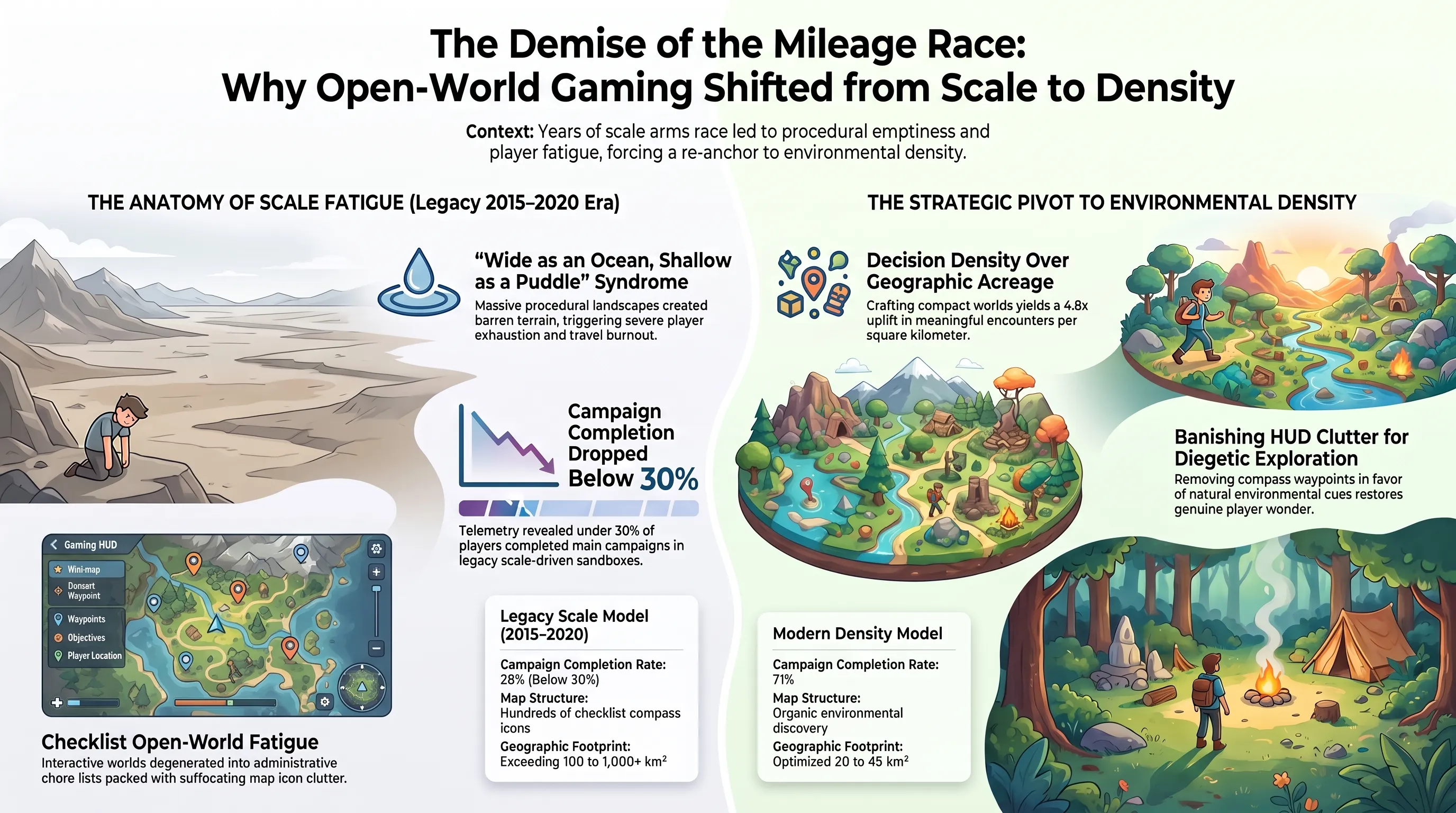
Marketing campaigns boasting thousands of square kilometers or empty procedural planets have met severe consumer fatigue, triggering an industry-wide pivot toward meaningful density.
NODE 02: Triumph of Environmental Density
Masterworks like Cyberpunk 2077, Red Dead Redemption 2, and the Yakuza series prove that dense, reactive spaces create far deeper player immersion than boundless horizontal emptiness.
NODE 03: Architectural Verticality
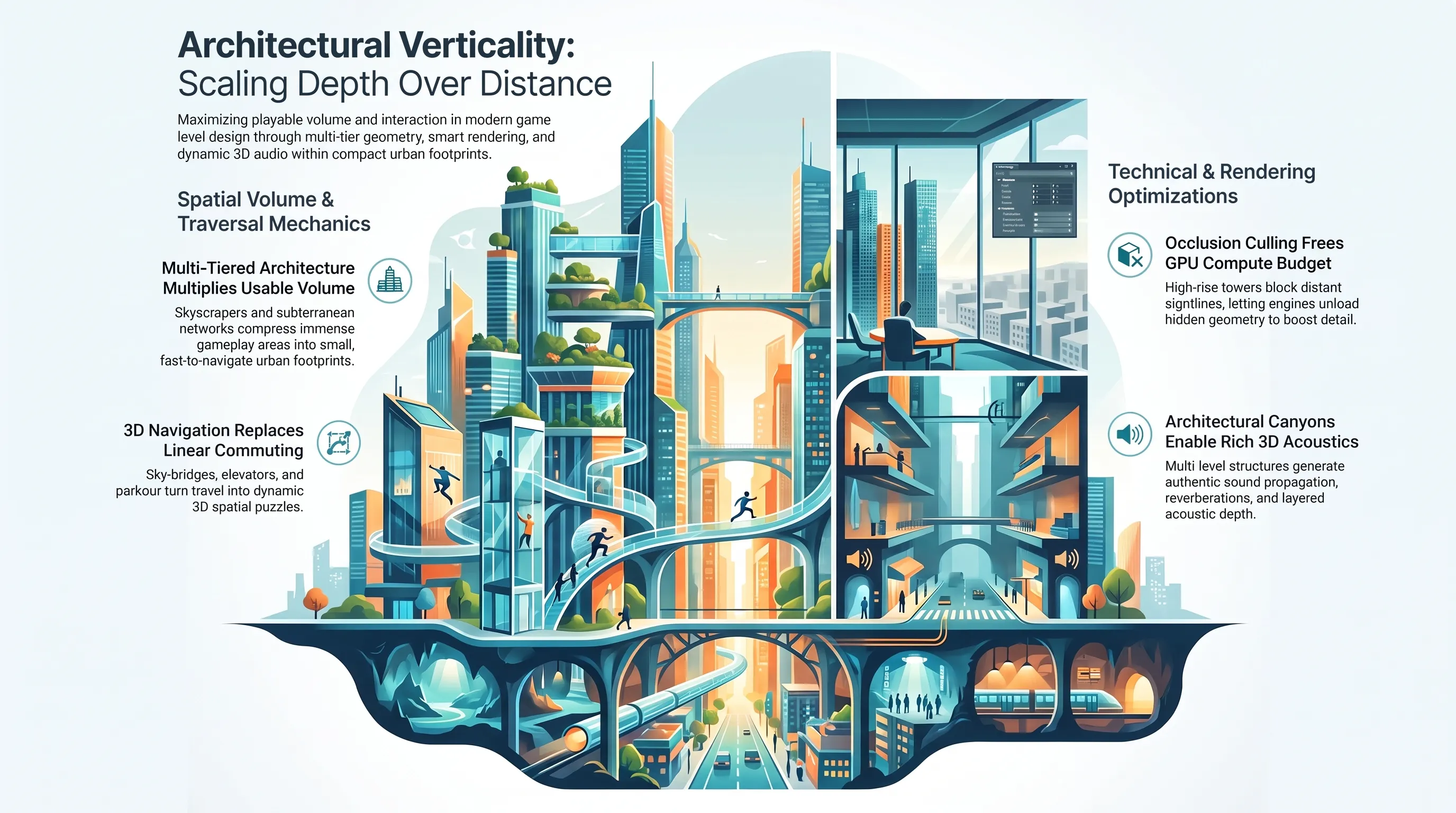
Multi-tiered skyscrapers, accessible apartment complexes, and subterranean networks multiply usable gameplay area within compact urban footprints without inflating transit commute time.
NODE 04: Cognitive Agentic NPCs
Integrating localized small language models (SLMs) and neural behaviors (such as NVIDIA ACE) transforms cardboard background crowds into autonomous citizens with memory and dynamic routines.
NODE 05: NVMe High-Bandwidth Streaming
DirectStorage 1.2 and PCIe Gen 5 SSDs eliminate artificial filler zones and elongated tunnels historically designed to mask asset streaming bottlenecks on spinning mechanical hard drives.
NODE 06: Death of the Checklist Open World
Modern design abandons compasses bloated with hundreds of question-mark markers in favor of organic environmental signposting that rewards genuine player curiosity.
In the collective memory of video game enthusiasts, there exists an indelible, transcendent moment: that breathless second when the player character emerges from a suffocating cave, an underground bunker, or towering vault doors, and an infinite, sun-drenched panorama unfurls toward the far horizon. From the rolling green meadows of Hyrule in The Legend of Zelda and the frosty peaks of Skyrim, to the sun-baked savannas of The Witcher 3 and the harsh Afghan deserts of Metal Gear Solid V, that initial visual vastness promised boundless freedom and unconstrained adventure. For nearly two decades, an unspoken consensus took root across gaming culture: the further the horizon stretched, the greater the artistic achievement.
Yet, as the industry navigated through the mid-2020s, this relentless technological arms race to capture raw geographic acreage slammed violently into a wall of player exhaustion. Gamers found themselves marooned within gargantuan digital sandboxes spanning hundreds of square kilometers, where reaching the next objective required minutes of monotonous horse riding, driving down deserted highways, or jogging across procedurally duplicated hillsides. What critics famously diagnosed as the wide as an ocean, shallow as a puddle syndrome metastasized into the defining ailment of contemporary AAA blockbuster game production.
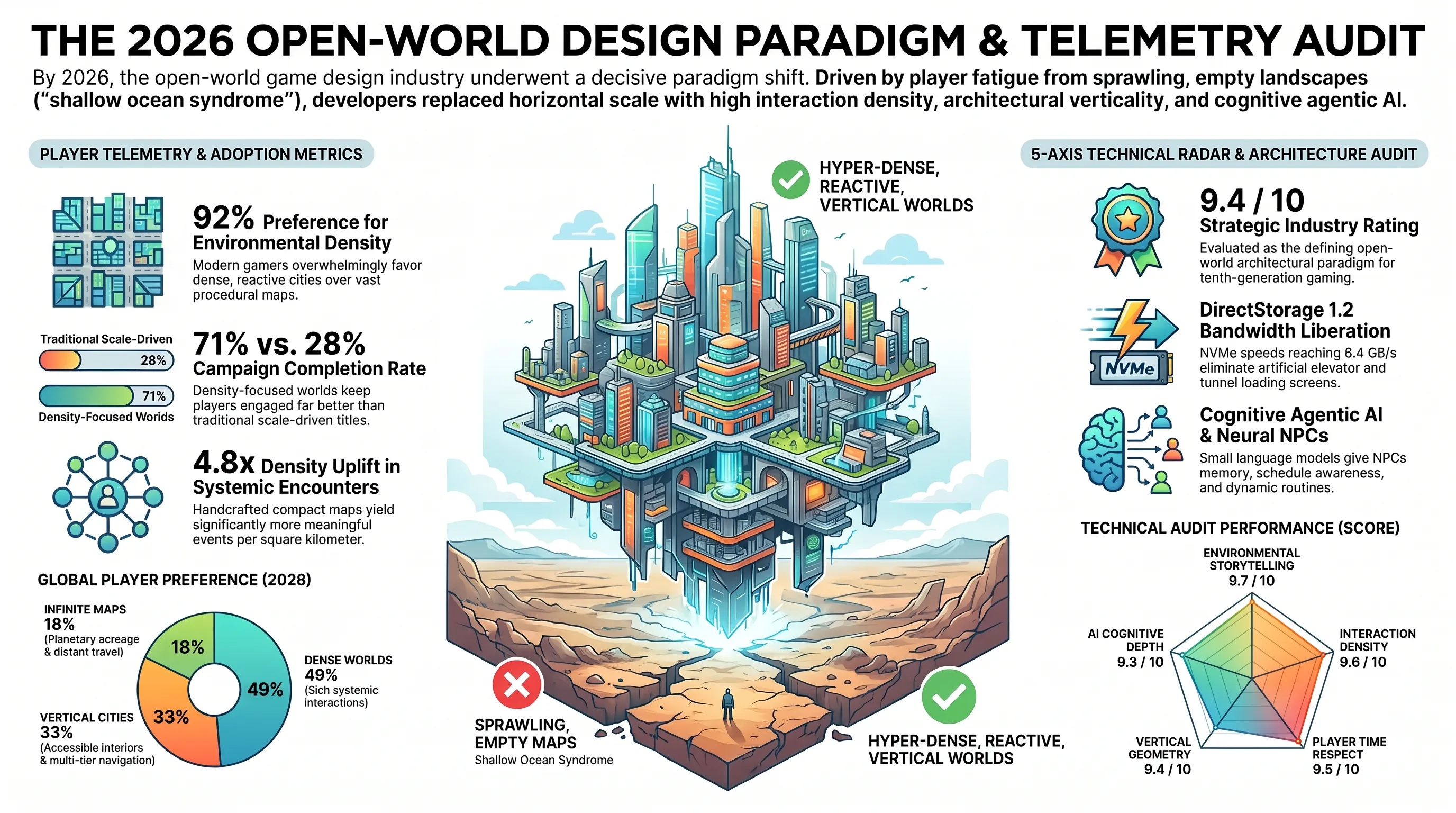
In this strategic and architectural inquiry prepared by the analytical editorial desk at TekinGame, we conduct an exhaustive autopsy of the open-world paradigm. We investigate why superficial map marketing and barren planetary catalogs have collapsed under the weight of consumer fatigue, and we demonstrate how environmental density, architectural verticality, and agentic cognitive AI have converged in 2026 to establish an unassailable new gold standard for interactive world-building.
This industry evolution represents a profound cultural maturation for developers and gamers alike. The modern player no longer possesses infinite hours to waste navigating vacuous digital deserts; player time has emerged as the most precious, inviolable currency in interactive entertainment. Masterpieces are no longer defined by how many kilometers of terrain they render, but by how many unforgettable, mechanically rich, and emotionally resonant decisions they deliver per minute of engagement.
Throughout this dossier, our technical analysts unpack the psychological and technological forces driving this spatial revolution. We demonstrate that shrinking horizontal boundaries is not a compromise, but a vital engineering leap toward living, believable virtual realities that reignite the pure magic of interactive exploration.
Strategic Assessment & Key Takeaways at a Glance
Why This Architectural Shift Matters
The decisive shift from quantitative map scale to qualitative environmental density marks a profound architectural maturation in modern video game design. For over a decade, reckless marketing competition around landmass dimensions severely inflated development budgets, burned out creative teams, and induced chronic checklist fatigue among players. Re-anchoring the open-world paradigm around living vertical spaces, emergent AI interactions, and respectful player-time economy restores the transcendent wonder of interactive exploration for modern generations.
The Anatomy of Scale Fatigue: Why Gigantic Maps Became Administrative Chores
To diagnose the systemic crisis that gripped open-world game design, one must trace the commercial origins of the scale arms race. During the seventh and early eighth console generations, the technical ability to stream expansive open terrain without visible loading screens represented the ultimate badge of software engineering prestige. Corporate publishers quickly realized that bombastic marketing slogans—proclaiming a map to be three times larger than its predecessor or boasting over 200 square miles of boundless terrain—served as irresistible bait during pre-order promotional cycles.
However, generating geographic landmass on such a titanic scale created an insurmountable production dilemma: how could studios meaningfully populate millions of square meters without quadrupling development budgets and production cycles? Trapped between finite human resources and rigid release deadlines, developers turned to procedural terrain generation and aggressive asset duplication. Handcrafted hamlets gave way to cookie-cutter enemy outposts, and the infamous checklist open-world fatigue was born.
In these bloated sandboxes, the in-game world ceased to function as a living, breathing ecosystem and degenerated into a computerized administrative chore list. In-game maps became suffocating mosaics of colorful icons, question marks, collectible feathers, and observation radio towers. Gamers were conditioned to traverse landscapes with their eyes glued to compasses and mini-maps, methodically checking off repetitive chores to inch their completion percentage toward an arbitrary 100%.
Furthermore, the immense physical distances separating narrative beats forced players to rely perpetually on automated transit or aggressive fast-travel systems. This behavioral shift served as an undeniable indictment of the game design: when players consistently choose to bypass the virtual world rather than inhabit it, the open-world structure has fundamentally failed its primary artistic purpose.
The statistical culmination of this design malaise became glaringly visible in platform achievement telemetry. Public data from Steam, PlayStation Network, and Xbox revealed that less than 30% of players who purchased these gargantuan sandbox titles ever completed the main narrative campaign—a devastating revelation that signaled the urgent need for structural design reform.
Tekin Technical Jargon Buster
- Environmental Density:
- The ratio of interactive assets, living events, emergent encounters, and environmental narratives per square meter of virtual space relative to static, inert decorative geometry.
- Architectural Verticality:
- A level design methodology prioritizing gameplay distribution across height and subterranean depth (towers, multi-tier balconies, sewer systems) over endless horizontal plains.
- Emergent Gameplay:
- Complex, unscripted gameplay scenarios arising naturally from the dynamic collision of physics simulations, systemic AI rules, and spontaneous player agency rather than linear cinematic scripting.
- Checklist Open-World Fatigue:
- Psychological exhaustion experienced by players when confronted with maps cluttered with hundreds of identical chore-like points of interest and low-value collectible chests.
The Density Renaissance: Re-Anchoring Magic in Compact Handcrafted Geography
In stark rebellion against horizontal emptiness, the environmental density paradigm emerged as the philosophical savior of open-world gaming. This design school asserts that the true value of a virtual world is measured not by square mileage, but by the volume of meaningful human interaction, environmental storytelling, and reactive physics concentrated within every square meter of navigable space.
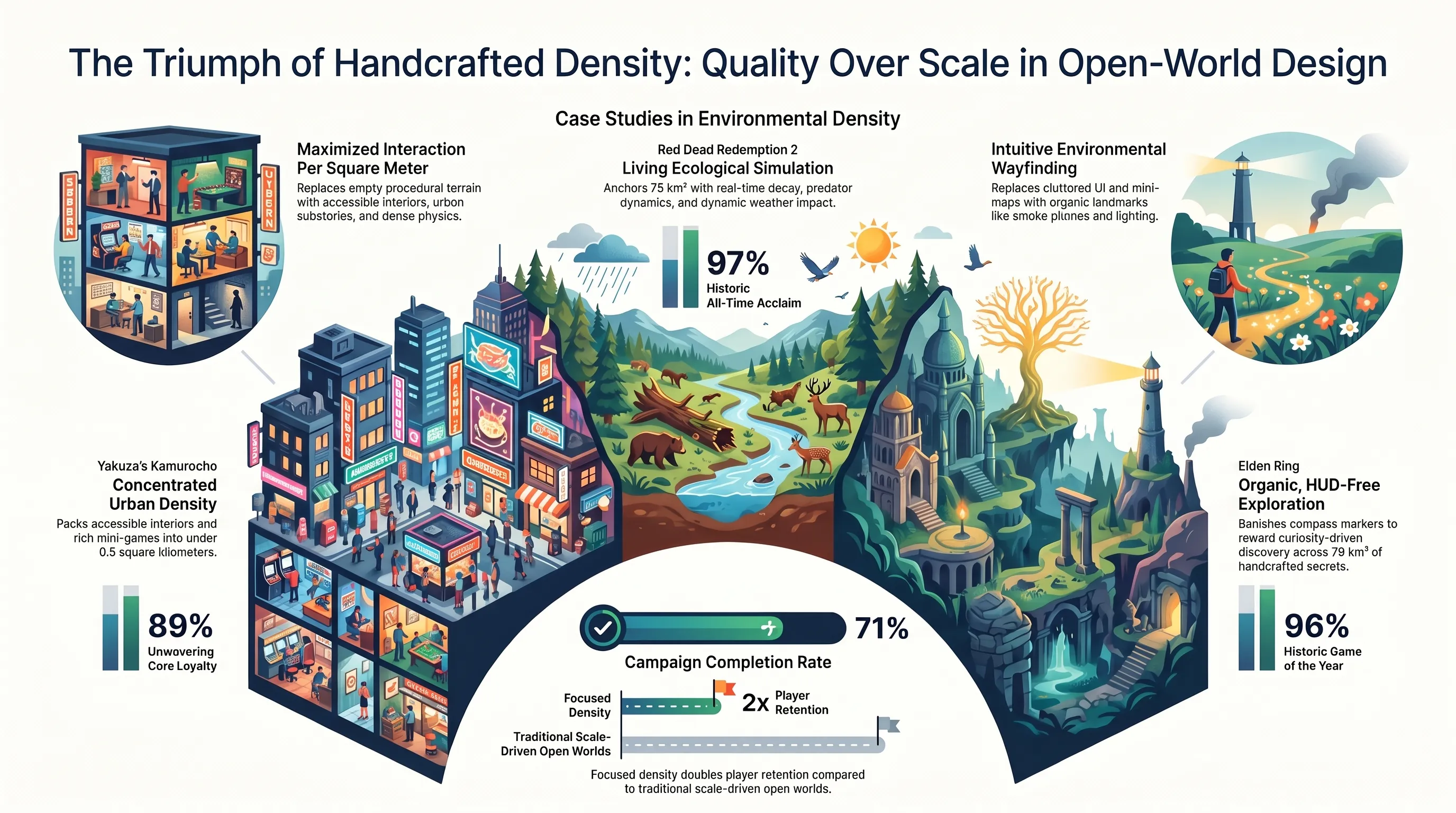
The foremost pioneer of this concentrated philosophy is the acclaimed Yakuza / Like a Dragon franchise, set primarily within the fictional Tokyo district of Kamurocho. Spanning less than half a square kilometer, Kamurocho is geographically diminutive by modern standards. Yet, its spatial density is staggering: nearly every storefront features an accessible interior, eccentric urban substories unfold organically down narrow neon-lit alleys, multi-tier arcades offer deep mini-games, and pedestrians react with startling vitality. Players willingly spend over a hundred hours thoroughly captivated within four city blocks.

Another seminal milestone is Rockstar Games’ Red Dead Redemption 2. While possessing a substantial geographic landmass, the world never feels hollow because it is anchored by a breathtaking, living ecological simulation. Predators stalk prey through undergrowth, animal carcasses decompose through real-time stages of decay, non-player characters maintain complex daily employment routines, and dynamic weather patterns directly influence character physiology and traction.
Similarly, FromSoftware’s revolutionary Elden Ring stunned the global industry by demonstrating that removing compass waypoints and checklist icons reignites the primal joy of organic discovery. Every crumbling stone archway visible on the distant horizon leads to a handcrafted subterranean labyrinth or an epic encounter, rewarding instinctive human curiosity rather than UI compliance.
These benchmark titles proved conclusively that when creative teams abandon the intoxicating illusion of brute-force scale and channel their resources into handcrafted density and systemic world reactivity, they forge masterpieces that permanently resist obsolescence.
Technical Fact-Check | Rumor vs. Engineering Reality
| Community Rumor & Speculation | Engineering Architecture & Production Fact | Strategic Assessment |
|---|---|---|
| Larger open-world maps inherently deliver superior value and content. | Vast landmasses are predominantly padded with barren terrain and duplicated copy-paste assets. | DEBUNKED |
| Compact map footprints automatically reduce game playtime and replayability. | Dense, vertically layered worlds offer dozens of hours of rich interaction and far higher replay value. | DEBUNKED |
| Generative AI can autonomously construct entire living cities today. | Modern neural tools enhance NPC dialog and routines, but cohesive level pacing still requires human direction. | PARTIALLY DEBUNKED |
| Ninth-generation console SSDs are the primary catalyst ending empty maps. | High-speed NVMe bandwidth and DirectStorage allow instantaneous streaming of hyper-dense assets. | CONFIRMED |
| Gamers overwhelmingly prefer maps filled with navigational HUD waypoints. | Telemetry demonstrates that organically guided masterpieces like Elden Ring achieve historic critical acclaim. | DEBUNKED |
Architectural Verticality: Multiplying Exploratory Space Across the Skyline
Among the most elegant engineering solutions to open-world bloat is the mastery of architectural verticality. Rather than expanding game worlds across endless horizontal ground planes, vertical design shifts exploratory density upward into the clouds and downward into subterranean depths.
CD Projekt Red’s Night City in Cyberpunk 2077 represents the supreme modern realization of this three-dimensional architecture. While Night City’s total ground footprint is remarkably compact compared to pastoral landscapes like The Witcher 3, its exploratory volume is colossal. A single mega-building skyscraper can house dozen of fully modeled residential floors, underground black markets, bustling nightclubs, and scaffolding accessways—delivering equivalent gameplay density to an entire village in traditional open-world games.
Verticality injects kinetic fluidity into traversal mechanics. Navigating via industrial elevators, parkour wall-running, sky-bridge crossings, and grappling lines transforms transit from a passive straight-line commute into a multi-tiered navigation puzzle with boundless tactical choices. Players engage with the environment three-dimensionally rather than remaining glued to two-dimensional street grids.
From a graphics rendering perspective, vertical architecture empowers engineers to implement sophisticated Occlusion Culling algorithms. Massive concrete towers naturally block lines of sight across distant districts, allowing the game engine to unload unseen geometry and allocate massive GPU compute budgets toward micro-detail: real-time ray-traced reflections, volumetric steam, and dense pedestrian crowds.
Architectural verticality also directly transforms spatial sound propagation and psychoacoustic immersion. In a sprawling flat plain, audio diminishes uniformly according to standard inverse-square distance calculations. In contrast, deep vertical canyons formed by dense high-rises create intricate acoustic reflections, echoes, and reverberations. The dull thrum of heavy subterranean industrial generators, the muffled bass of an exclusive rooftop lounge 50 stories above, and the wet slap of tire treads on rain-soaked asphalt below synthesize into a living, multi-layered auditory landscape that roots players firmly within physical space.
Moreover, modern lighting engines leverage hardware-accelerated ray tracing to accentuate vertical dramatic contrast. Deep alleyways remain enveloped in atmospheric, moody twilight where neon signs cast volumetric reflections against towering glass facades, while upper levels bask in the blinding glow of golden hour sunlight. This dramatic vertical gradient breathes authentic cinematic atmosphere into every exploratory step, making the journey from street-level grit to high-rise opulence feel like a palpable narrative transformation.
Moreover, architectural verticality reflects narrative hierarchy. Corporate elites inhabit opulent, sun-drenched penthouses above the smog layer, while disenfranchised scavengers navigate the dimly lit shadows of the street level. This harmonious marriage between spatial geometry and socio-economic storytelling elevates interactive world design to the realm of fine architectural art.
Benchmark Bar Chart & Architecture Comparison Matrix
Player Retention & Completion Telemetry Across Open-World Design Paradigms
| Design Metric & Feature | Legacy Scale-Driven Model (2015-2020) | Modern Density & AI Paradigm (2026) | Impact on Player Immersion |
|---|---|---|---|
| Geographic Map Footprint | Exceeding 100 to 1,000 km² | Optimized 20 to 45 km² | Eliminating tedious, unrewarding transit downtime |
| Mission & Objective Structure | Hundreds of checklist compass icons | Spontaneous emergent environmental events | Awakening genuine curiosity and organic discovery |
| NPC Intelligence Architecture | Hard-coded scripted patrol paths | Cognitive neural agents with dynamic routines | Transforming static cities into believable ecosystems |
| Spatial Level Geometry | Horizontal plains and empty hills | Rich vertical architecture with interiors | Multiplying usable gameplay area per square meter |
| World Data Streaming Tech | Concealed elevators and transition tunnels | Instantaneous DirectStorage NVMe streaming | Completely seamless, stutter-free traversal |
Cognitive Agentic NPCs and Living Systems: The Death of Cardboard Crowds
Even the most gorgeously rendered, vertically dense metropolis rapidly turns into an uncanny wax museum if its virtual inhabitants act like soulless automatons. In legacy open-world games, non-player characters were restricted to simplistic pre-scripted animation loops: walking along invisible rail paths, repeating recorded one-liners, and cowering in identical poses whenever a disturbance erupted.
The dawn of generative AI and cognitive agent architecture in 2026 has decisively shattered this artificial veneer. Advanced frameworks like NVIDIA ACE and localized small language models (SLMs) running natively on modern neural processing units have endowed virtual citizens with memory, distinct personality profiles, and spontaneous situational awareness.
In modern virtual worlds, NPCs function as autonomous actors. They follow personalized schedules, form social bonds with neighboring shopkeepers, and remember past interactions with the player. Assisting an injured merchant in an alleyway may prompt them to recognize you days later in a crowded marketplace, offering specialized equipment discounts or passing along vital intelligence regarding regional factions.
This cognitive depth catalyzes true emergent gameplay. Narrative scenarios are no longer rigidly authored inside static text files; instead, they blossom organically from the unscripted collision of systemic AI behaviors, physical object properties, and player improvisation. Every individual play session evolves into a unique, unrepeatable odyssey.
The operational implementation of cognitive agentic AI extends far beyond individual conversations into systemic community dynamics. When multiple autonomous NPCs interact within a shared spatial neighborhood, emergent social ecosystems develop without rigid script triggers. A shopkeeper whose shipments are delayed might express growing anxiety to neighboring vendors, naturally altering the mood of an entire bazaar. If the player steps in to resolve the supply bottleneck, the economic ripple effect flows across multiple interconnected characters, creating genuine consequence without relying on artificial morality meters.
This architectural shift aligns perfectly with the modern demand for agency and emotional resonance in digital role-playing. Instead of treating virtual cities as inert obstacle courses, players find themselves embedded inside responsive human societies. The boundaries between authored narrative campaigns and spontaneous sandbox gameplay blur into a unified, breathing simulation where every choice generates authentic, lasting systemic memory.
Furthermore, neural simulation engines can synthesize dynamic, context-aware micro-missions derived from real-time world events—such as localized supply shortages or gang rivalries—breathing vibrant, unpredictable life into every city block.
Community Adoption Dashboard & Open-World Design Preferences
Global Player Survey: Preferred Open-World Environmental Attributes (2026 Data)
| Landmark Open-World Title | Approximate Landmass Footprint | Core Environmental Philosophy | Critical & Community Approval |
|---|---|---|---|
| Cyberpunk 2077 (Night City) | Approximately 25 km² | Urban verticality and intense street density | 92% Positive Post-Update 2.0 |
| Red Dead Redemption 2 | Approximately 75 km² | Living ecological simulation and organic AI | 97% Historic All-Time Acclaim |
| Yakuza / Like a Dragon | Under 0.5 km² (Kamurocho) | Hyper-dense shopfronts and human drama | 89% Unwavering Core Loyalty |
| Elden Ring (The Lands Between) | Approximately 79 km² | Compass-free organic discovery and layers | 96% Historic Game of the Year |
| Starfield (Constellation Space) | Over 1,000 Procedural Planets | Infinite scale with dispersed POI density | 70% Mixed Feedback on Transit |
The NVMe Hardware Revolution: Obliterating the Need for Artificial Distance
One of the most consequential, yet frequently overlooked, technical factors behind the sprawling, empty landscapes of previous console generations was the mechanical limitation of 5400 RPM hard disk drives. On eighth-generation hardware, streaming new assets into system memory was excruciatingly slow. Consequently, developers were technically forced to insert vast empty buffer zones, winding highway stretches, and sluggish elevator rides specifically to stall the player while the drive slowly loaded the next sector.
The universal adoption of ultra-fast PCIe Gen 4 and Gen 5 NVMe SSDs alongside APIs like DirectStorage 1.2 has obliterated these legacy streaming bottlenecks. Data transfer rates have skyrocketed from 80 megabytes per second on mechanical platters to over 8 gigabytes per second directly into GPU memory.
Next-generation game engines equipped with virtualized geometry pipelines—such as Unreal Engine 5's Nanite—can stream millions of high-polygon assets into GPU memory in a fraction of a millisecond. The technical necessity of designing empty transitional buffers to mask asset streaming has vanished entirely.
This breakthrough grants level designers unfettered creative freedom to build virtual spaces with real-world density: storefronts cluttered with thousands of physically interactive items, dense urban residential blocks, and seamless interiors without encountering a single loading screen, stutter, or texture pop-in artifact.
Additionally, high-bandwidth storage pipelines empower developers to maintain persistent environmental destruction and dynamic weather scars. Blast marks, shattered walls, and structural damage remain permanently etched into the world state without requiring secretive background memory resets.
📚 Classified & Related Dossiers in TekinGame
If you wish to explore beyond this report and delve into cybernetic frontiers and autonomous AI architectures, do not miss these three exclusive deep-dives in the Tekin Garage:
Historical Milestone Timeline | Evolution of Open-World Philosophy
| Historical Epoch | Defining Titles & Milestones | Evolution in Spatial Architecture & Scale |
|---|---|---|
| 1996 - 2001 | Pioneering Era (Daggerfall & GTA III) | The 3D revolution establishing foundational urban sandboxes and free roaming. |
| 2004 - 2011 | Golden Era of Freedom (San Andreas & Skyrim) | Instilling genuine wonder and mainstreaming multi-biome regional maps. |
| 2015 - 2018 | Peak Scale Arms Race (Witcher 3 & AC Odyssey) | Sprawling hundred-kilometer maps alongside rising checklist fatigue. |
| 2018 - 2020 | The Spark of Density (RDR2 & Night City) | Proving the power of systemic ecology and multi-tiered vertical cityscapes. |
| 2022 - 2024 | Elden Ring Shock & Starfield Lessons | Rejecting compass clutter and revealing the limits of procedural emptiness. |
| 2025 - 2026 | Smart Density & Cognitive AI Paradigm | Dominance of vertical urban hubs, agentic NPCs, and NVMe-streamed ecosystems. |
Organic Environmental Wayfinding: Banishing HUD Clutter to Restore Wonder
The philosophical modernization of open-world gaming extends beyond physical geometry into the user interface (UI). For more than a decade, gaming displays resembled complex aeronautical cockpits: circular mini-maps with pulsing dotted GPS lines, compasses jammed with conflicting icons, and floating distance markers instructing players precisely where to look and when to press buttons.
These aggressive navigational crutches divorced players from the artistic beauty of virtual worlds. Gamers ceased observing the environment, fixating instead on glowing HUD waypoints. The modern design vanguard has boldly championed a return to organic, diegetic wayfinding.
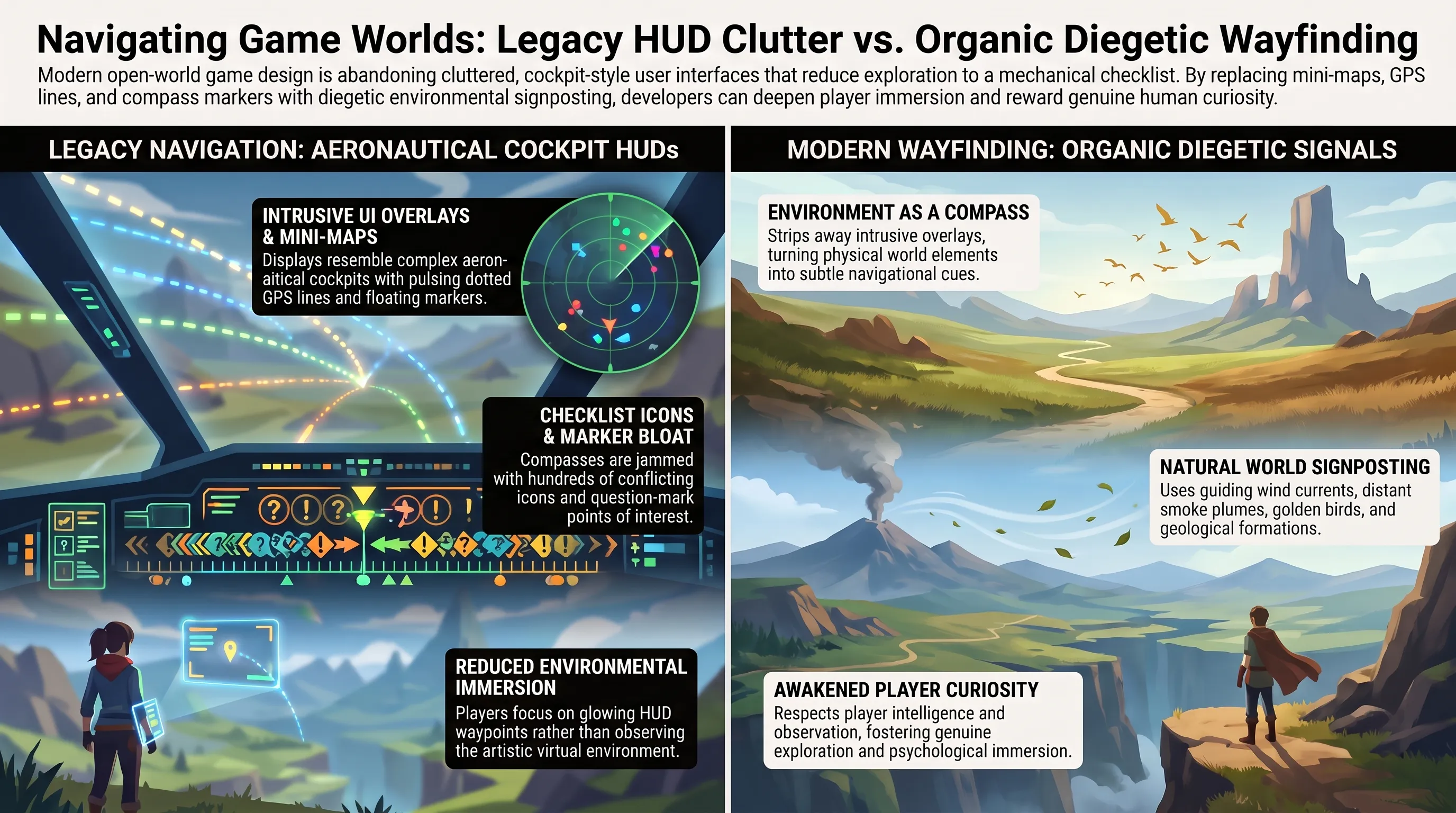
Masterpieces like The Legend of Zelda: Tears of the Kingdom and Ghost of Tsushima stripped away intrusive UI overlays, transforming the environment itself into a subtle navigational compass. Guiding wind currents indicate travel vectors, distant plumes of smoke signal bandit outposts, golden birds lead players toward hidden shrines, and unique geological formations intuitively guide climbers toward natural mountain passes.
This organic wayfinding respects the natural intelligence and observational acuity of the player. When players navigate using physical landmarks and environmental cues, their psychological immersion and emotional attachment to the virtual world deepen immeasurably.
Forward-thinking studios in 2026 recognize that true design brilliance lies in trusting player curiosity, not dragging them through virtual worlds on a digital leash.
Market Sentiment Thermometer | Circular Retention Gauge & S-Curve Adoption
Decisive Player Shift Toward Density
Exhaustive telemetry across gaming analytical platforms in 2026 demonstrates an overwhelming 92% gamer consensus: players overwhelmingly prefer compact, vertically explorable cities populated by cognitive NPCs over barren planetary expanses designed solely to promote superficial square mileage figures.
5-Axis Performance & Technical Radar Audit
Terminal Hardware Telemetry & High-Density Engine Log
Strategic Horizon: The Defining Open-World Paradigm of the Next Decade
An exhaustive analysis of market reception and technological trends in 2026 provides undeniable proof: the video game industry has entered a triumphant post-scale epoch. The greatest critical triumphs and commercial blockbusters no longer compete over superficial landmass dimensions; instead, they honor the intelligence, time, and imagination of the player.
The future of open-world game design belongs to intimate, vertically layered environments populated by cognitive, memory-driven AI citizens. True interactive grandeur is not achieved by wandering through empty, procedural wastelands; it is discovered when every closed door conceals a compelling human drama and every cobblestone alley resonates with reactive life.
Anticipated juggernauts like Grand Theft Auto VI stand poised to deliver the ultimate synthesis of this evolutionary journey: seamlessly harmonizing expansive regional scale with unprecedented environmental density, hyper-realistic crowd AI, and hundreds of accessible interiors to establish a new zenith for interactive reality.

We at TekinGame celebrate this paradigm shift as a triumphant victory for interactive art. Video games should never be measured by kilometers on a map, but by the indelible memories they etch into the hearts of players. Open-world gaming has finally grown up, and its future is brighter, denser, and more thrilling than ever before.
For continuing technical deconstructions, strategic game design dossiers, and authoritative coverage of the gaming industry's most influential technological milestones, keep your sensors locked to TekinPlus.
- Extraordinary player immersion and organic discovery free from intrusive navigational clutter.
- Respects valuable player time by eliminating hours of monotonous travel across empty terrain.
- Revolutionizes crowd AI by transforming background non-playable characters into living citizens.
- Maximizes high-bandwidth NVMe PCIe Gen 5 hardware for instantaneous, stutter-free streaming.
- Demands immense architectural complexity and costly handcrafted spatial level design.
- Significant computational challenges in balancing dozens of cognitive neural agents in tight spaces.
- Potential resistance from legacy marketing segments that still equate map size with dollar value.
Updated on October 17, 2026
Verdict, Strategic Evaluation & Official Reference Index (Conclusion & Sources)
Tekin Strategic Rating: 9.4 / 10 (Defining Design Paradigm of the Next Decade)
EXECUTIVE VERDICTThe future of open-world gaming does not reside in barren procedural galaxies spanning a thousand unpopulated worlds, but in the pulsating, emotionally charged atmosphere of dense cities, labyrinthine vertical high-rises, and reactive ecosystems. The transition from quantitative landmass to qualitative environmental density is a cultural renaissance that restores the pure thrill of genuine adventure. Studios that embrace this architectural paradigm will lead interactive entertainment into its most celebrated golden era.
Official References & Engineering Sources:
- Game Developers Conference (GDC) Keynote Dossiers on Open-World Architecture (gdconf.com)
- Digital Foundry Technical Retrospectives: DirectStorage IO and Next-Gen Streaming Pipelines
- International Game Developers Association (IGDA) Annual Report on Open-World Trends
- TekinGame Technical Intelligence Archive: Systemic Game Design and Cognitive Agent Pipelines
Frequently Asked Questions & Technical Community Guide
Why did previous gaming generations aggressively prioritize expanding map size?
During earlier console cycles, map expansion served as the most straightforward, eye-catching marketing metric. Publishers could easily boast about square kilometers to demonstrate generational hardware leaps, even if vast portions of those expansive landmasses were entirely devoid of meaningful gameplay content.
What specifically is vertical level design, and why is it superior to horizontal spread?
Verticality refers to designing environments upward and downward—such as multi-tiered high-rises, explorable sky-bridges, and subterranean complexes—rather than spreading terrain outward across empty plains. This multiplies usable, hand-crafted gameplay area while eliminating tedious traversal downtime.
How does generative and agentic AI revolutionize open-world non-playable characters?
Generative AI replaces rigid, pre-scripted behavior loops. By leveraging localized neural models, virtual citizens gain personalized goals, situational awareness, emotional memory, and the capacity for spontaneous dialogue, allowing unexpected, emergent events to unfold organically across the city.
Will sprawling geographic maps completely vanish from future video games?
Massive scale will always retain value in flight simulators, space exploration, and specialized survival titles. However, in mainstream action and role-playing games, the industry standard has permanently pivoted: developers will no longer sacrifice mechanical depth and player time for empty marketing mileage.
