Strategic Key Takeaways
- Leaked January 26, 2027 PlayStation 5 launch date revealed by premier industry insider billbil-kun
- Confirmation of a full physical Blu-ray retail edition priced at $69.99 alongside digital PSN availability
- Sprawling open-world Japanese setting unifying neon Tokyo expressways with rural Mount Fuji Touge passes
- Deep software integration of DualSense haptic feedback and dynamic adaptive trigger resistance
- PlayStation 5 Pro enhanced support utilizing PSSR machine learning upscaling for 4K 60FPS and 120FPS modes
- Strategic deconstruction of Microsoft's Project Latitude and the irreversible cross-platform publishing pivot
The interactive entertainment sector is bearing witness to an unprecedented historical inflection point: the formal dismantling of walled-garden console ecosystems that have governed the industry for more than three decades. In a revelation that has sent shockwaves through executive boardrooms and global gaming communities alike, Playground Games' crowning open-world masterpiece, Forza Horizon 6, is officially headed to Sony's PlayStation 5 hardware. This monumental crossover signals the unconditional surrender of traditional console exclusivity in favor of multiplatform publishing supremacy.
Key Takeaways: The Seismic Arrival of Forza Horizon on PlayStation
- Legendary French insider billbil-kun via Dealabs confirms a locked PS5 release date of January 26, 2027.
- Microsoft is deploying a premium physical disc edition alongside digital distribution at the standard $69.99 price.
- The fictionalized Japanese archipelago represents the largest, most ecologically diverse map in franchise history.
- Proprietary DualSense haptics translate tire micro-slips and surface friction directly into the player's palms.
- PlayStation 5 Pro hardware unlocks hardware-accelerated ray tracing during live races alongside a 120Hz mode.
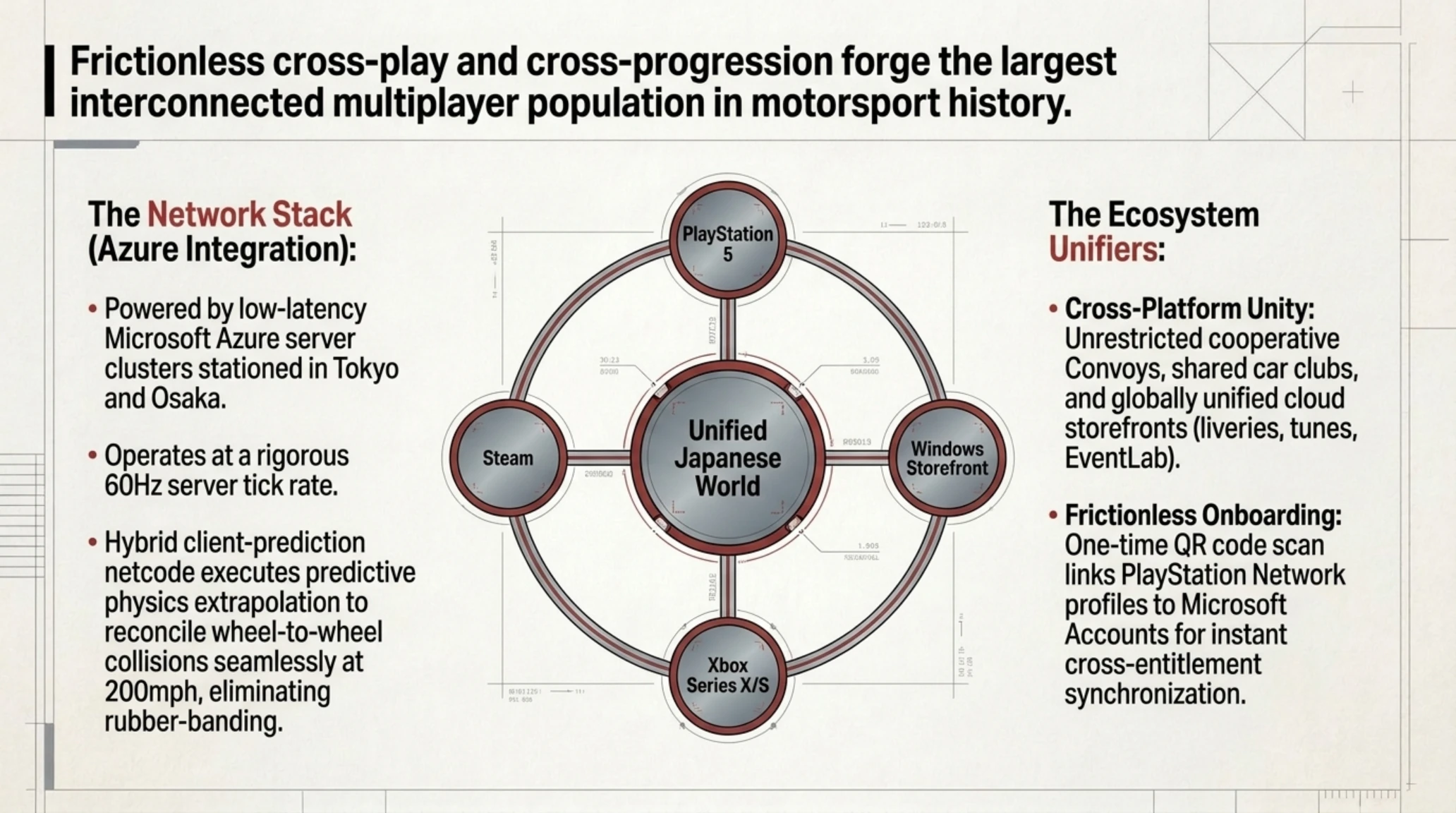
- Full cross-play and cross-progression unite Xbox, PlayStation, and PC drivers into a single global racing ecosystem.
The strategic deployment of Microsoft's premier racing jewel onto rival Japanese silicon transcends typical corporate porting initiatives; it marks a definitive macroeconomic realignment across the commercial landscape. For successive console generations, the Forza Horizon franchise served as the indispensable anchor of the Xbox brand identity, functioning as an unassailable hardware catalyst against Sony's imposing catalog of single-player narrative epics. Under the pragmatic corporate leadership of Satya Nadella and Phil Spencer, the imperative of pure software cash generation and high-margin digital recurring revenue has definitively superseded hardware platform preservation.
1. The Dealabs Leak: billbil-kun Unveils the January 2027 PS5 Launch Schedule
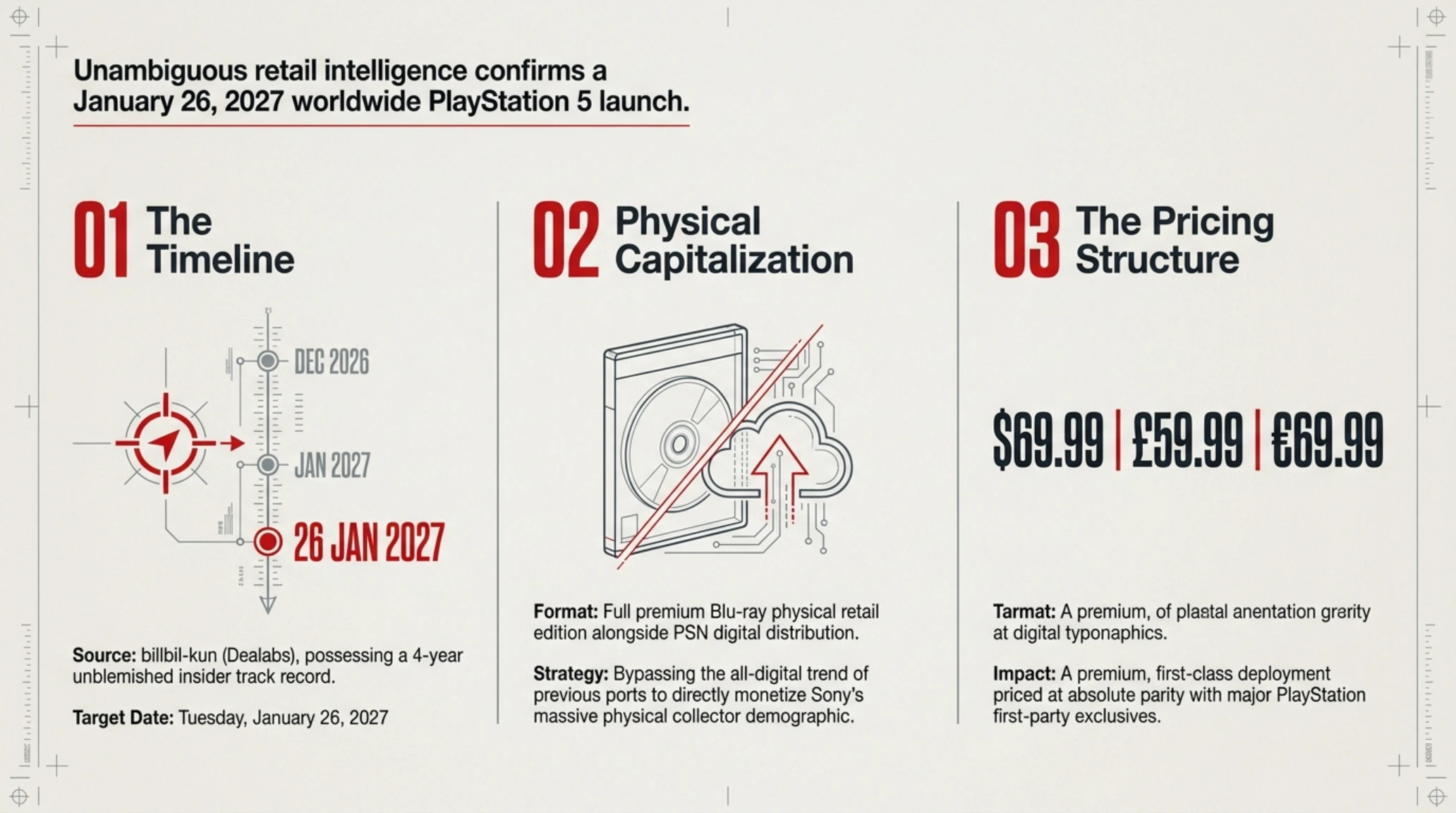
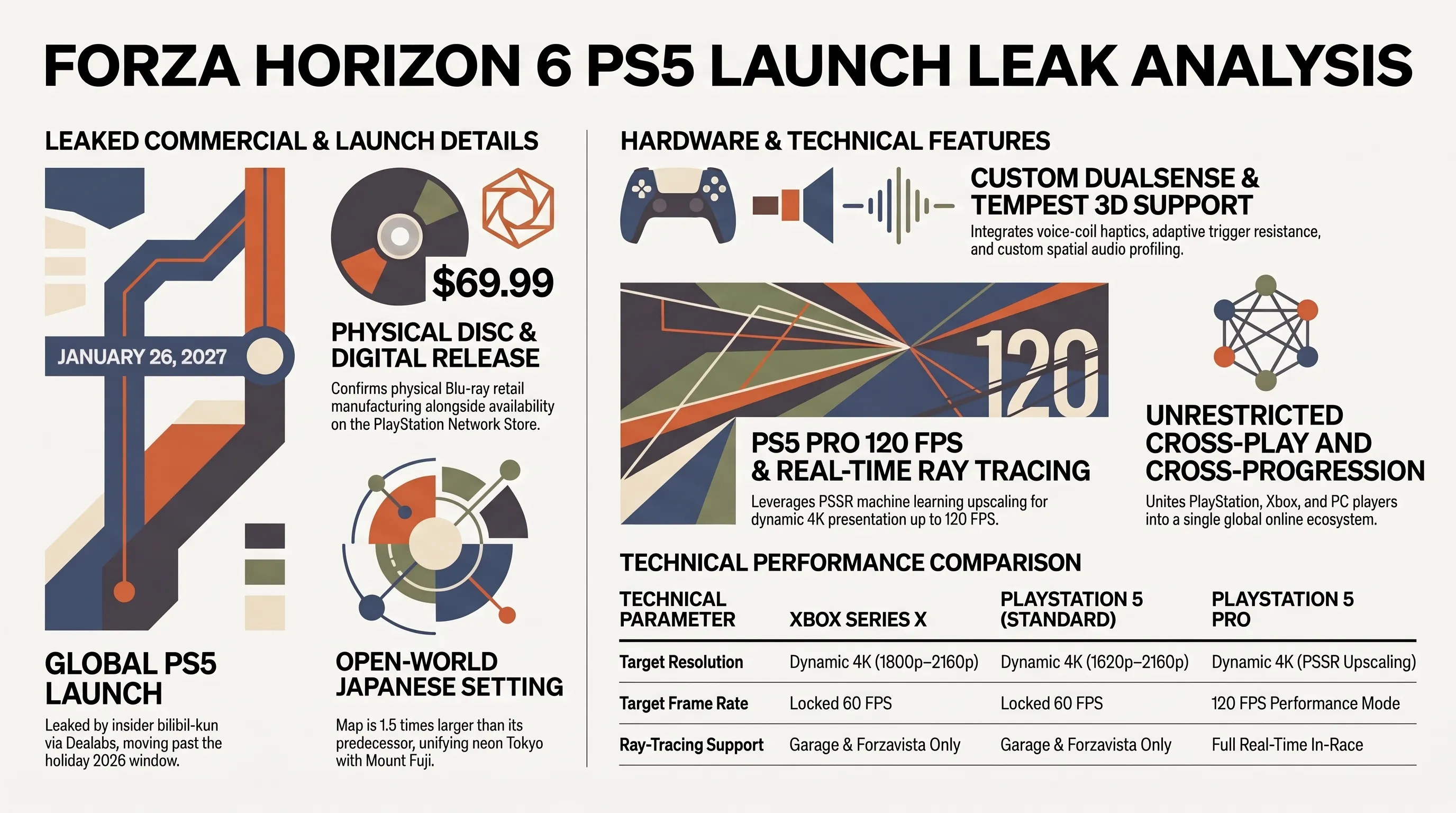
The gaming industry's most dependable investigative insider, operating under the pseudonym billbil-kun on the French retail intelligence platform Dealabs, fractured corporate secrecy with an extensive dossier detailing Microsoft's rollout calendar. According to meticulously cross-referenced distributor catalogs and European retail logistics databases, the PlayStation 5 port of Forza Horizon 6 is scheduled to launch worldwide on Tuesday, January 26, 2027.
Perhaps the most extraordinary revelation embedded within the leaked commercial documentation is the unambiguous confirmation of a physical retail disc release. Amidst an aggressive industry-wide march toward all-digital storefronts where preceding Xbox-to-PlayStation transitions like Hi-Fi Rush, Grounded, and Sea of Thieves initially debuted solely as digital downloads Microsoft has deliberately authorized physical manufacturing runs across European, North American, and Japanese distribution pipelines. Standard retail editions will carry the established premium price points of $69.99 in the United States, £59.99 in the United Kingdom, and €69.99 across the Eurozone, ensuring direct capitalization on Sony's massive physical collector demographic.
The institutional credibility of billbil-kun within global gaming commerce cannot be overstated. Operating through forensic audits of wholesale distribution manifests, retailer backend stock-keeping units (SKUs), and European digital regulatory filings, this individual has preserved an unblemished record spanning over four consecutive years. Previous scoops accurately pre-announced the exact release dates of major blockbusters months in advance, including God of War Ragnarok's PC launch date and the pricing tiers of the DualSense Edge controller. Industry analysts regard Dealabs leaks as virtually definitive, prompting commercial distributors throughout Western Europe to proactively reconfigure their physical inventory allocations for late January 2027.
Jargon Buster: Essential Technical Lexicon for Modern Open-World Racing
- DualSense Voice-Coil Actuation: Advanced haptic feedback technology replacing legacy eccentric rotating mass (ERM) motors with high-frequency voice coils, allowing subtle physical differentiation between slick wet tarmac, ancient Kyoto cobblestones, and loose volcanic gravel.
- PlayStation Spectral Super Resolution (PSSR): Sony's proprietary custom machine learning temporal upscaling architecture embedded within the PS5 Pro, reconstructing sub-4K render targets into razor-sharp 2160p output with minimal computational overhead.
- Project Latitude: The internal strategic initiative within Microsoft Gaming orchestrating the scheduled porting of primary Xbox first-party intellectual properties onto PlayStation 5 and Nintendo Switch platforms.
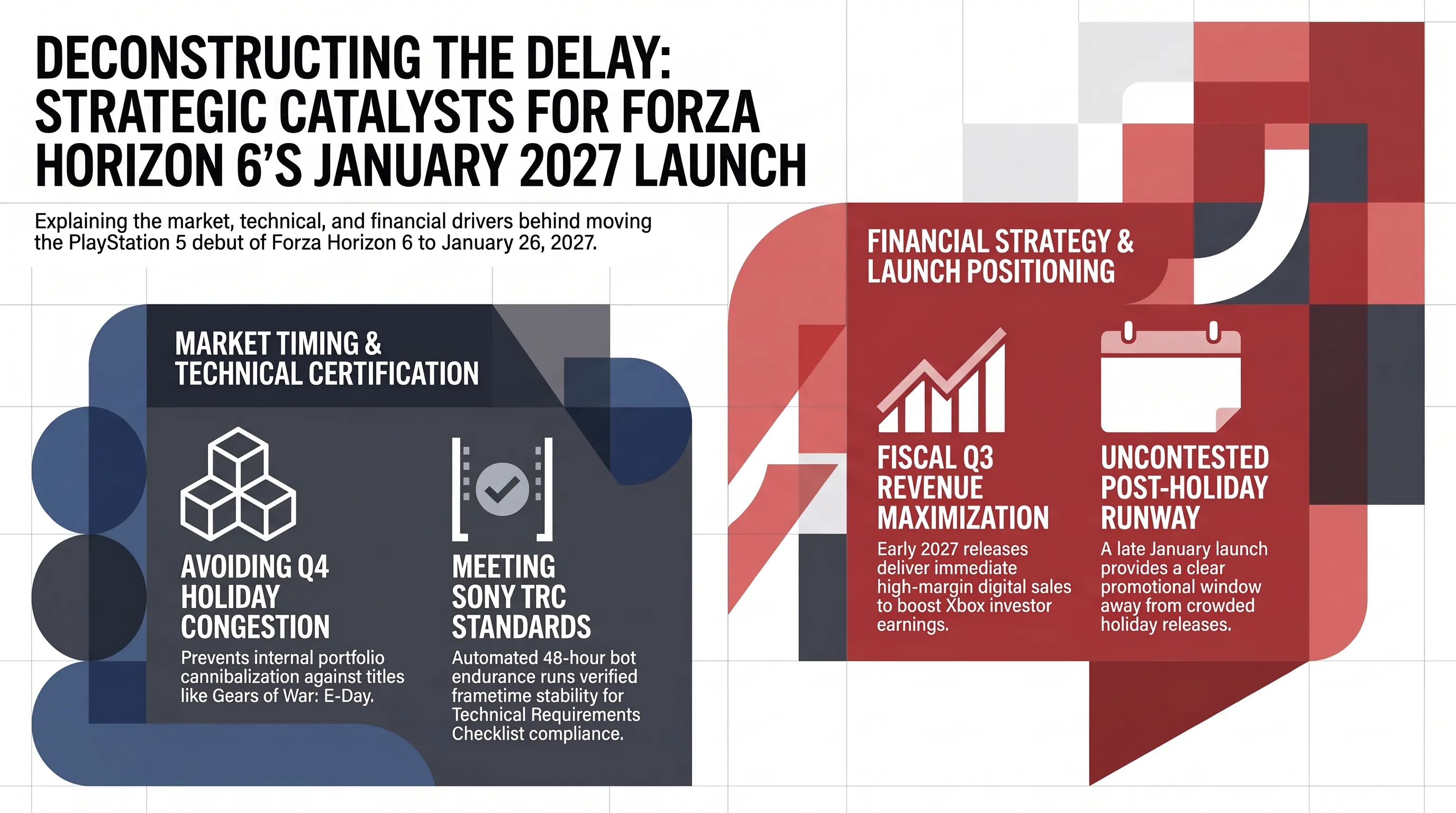
Corroborative reports published by senior industry correspondents, including Tom Warren at The Verge and investigative journalists across Eurogamer and Kotaku, confirm that developer Playground Games initially explored a late autumn 2026 launch window aligned with the lucrative holiday shopping surge. Nevertheless, stringent technical certification mandates, exhaustive multi-tier controller calibrations, and a conscious desire to avoid direct commercial congestion against competing holiday blockbusters propelled the scheduled debut into late January 2027.
Public reception across global gaming enthusiast forums has registered as pure exhilaration. For years, PlayStation owners observed the vibrant, boundless escapism of the Horizon Festival from afar, constrained by Gran Turismo 7's sterile, closed-circuit museum atmosphere. The prospect of tearing through Japanese mountain passes in hyper-tuned custom machinery has unleashed an unprecedented wave of community anticipation.
The historical infallibility of billbil-kun adds immense institutional weight to the leak. Over the past half-decade, this specific source has maintained an immaculate track record, successfully pre-announcing PlayStation Plus monthly tiers, hardware price revisions, and launch windows for titles ranging from Death Stranding Director's Cut to God of War Ragnarok on PC weeks ahead of official press releases. In the eyes of Wall Street analysts and gaming retailers, a Dealabs publication is treated as functionally equivalent to a signed corporate press dispatch.
2. From Neon Tokyo Expressways to Mount Fuji Touge: Japan in the Next-Gen ForzaTech Engine
Selecting Japan as the geographic canvas for Forza Horizon 6 represents the triumphant fulfillment of the most vocal, enduring community campaign in racing history. Ever since the Horizon Festival concluded its inaugural expedition across Colorado and ventured into southern Europe, Australia, Great Britain, and Mexico, enthusiasts have relentlessly lobbied for the tight mountain passes, eccentric tuning garages, and pulsating nightlife of the Japanese archipelago. With the fifth iteration of the ForzaTech engine, Playground Games has delivered an astonishing open-world recreation that sets a staggering benchmark for environmental fidelity.
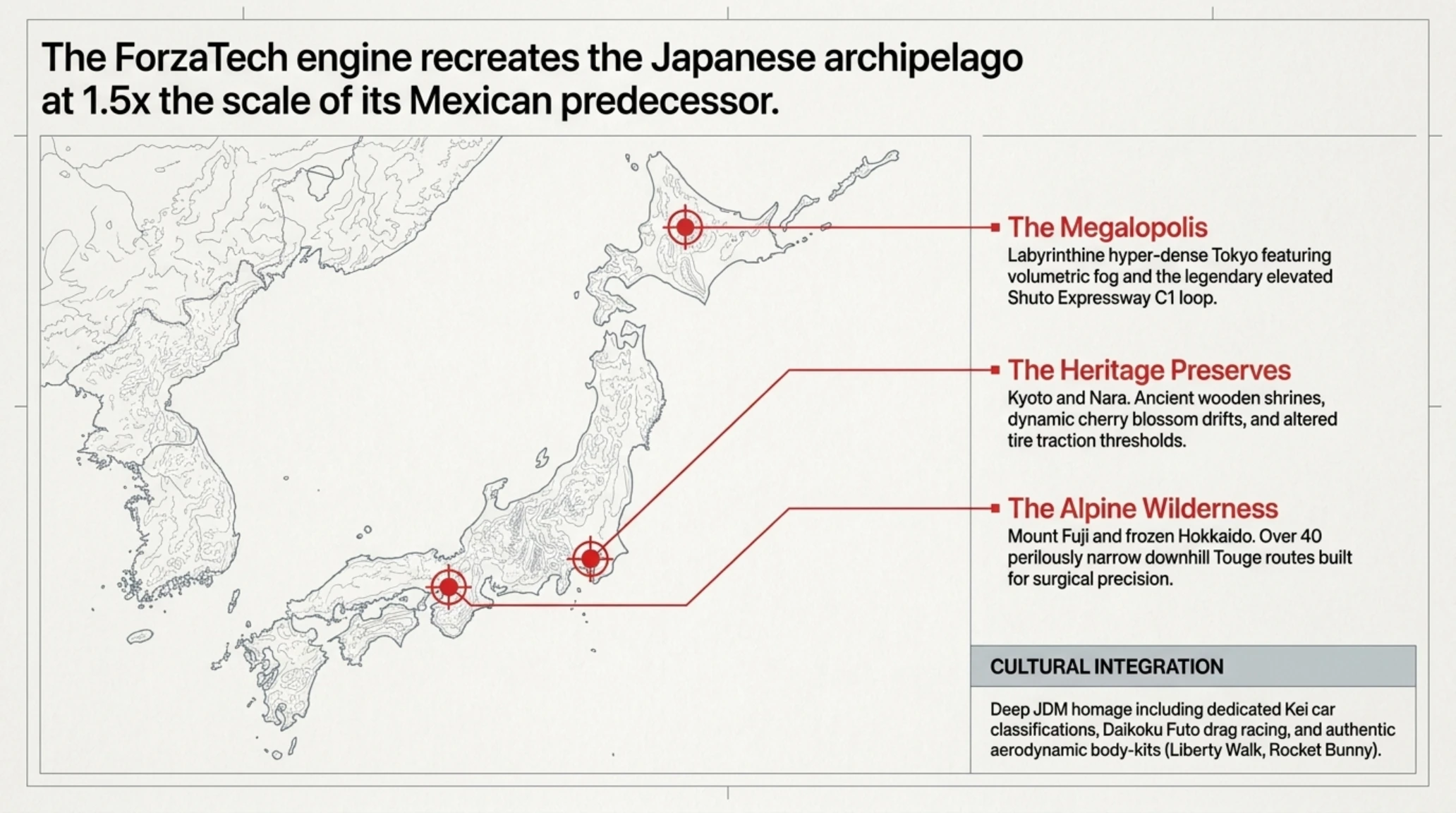
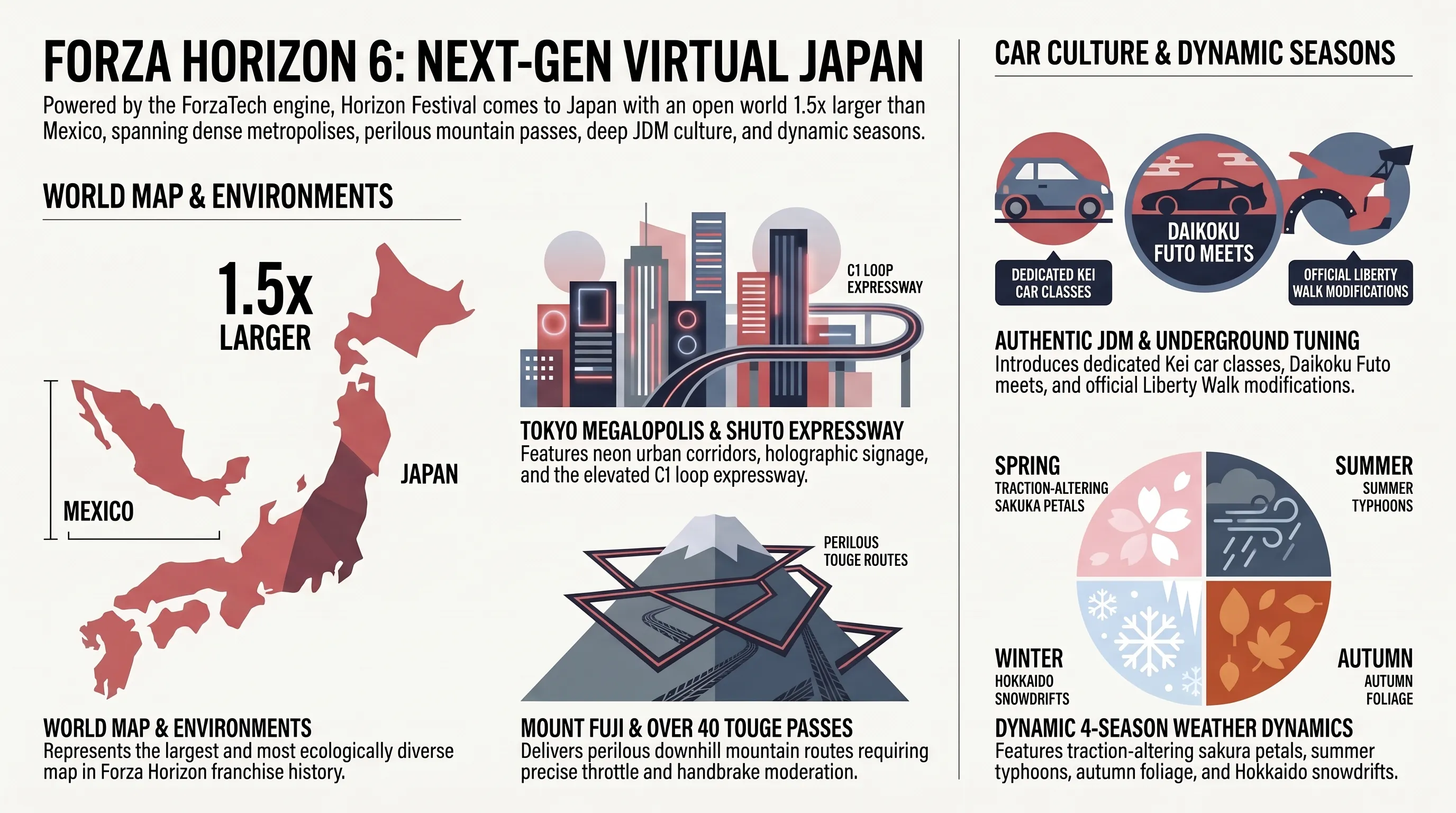
The virtual Japanese landmass engineered for Forza Horizon 6 encompasses a territory approximately 1.5 times more expansive than the Mexican topography of its predecessor. The world is structured across three seamlessly intertwined cultural and ecological zones: the labyrinthine hyper-dense megalopolis of Tokyo, characterized by glowing holographic signage and the legendary elevated Shuto Expressway C1 loop; the serene, historic preserves of Kyoto and Nara, framed by ancient wooden shrines and drifting cherry blossom petals; and the treacherous volcanic slopes of Mount Fuji and the frozen alpine wilderness of northern Hokkaido.
Engineering Scale and Quantitative Metrics of Horizon Japan
- Licensed Vehicle Roster: 650+ vehicles at launch (featuring bespoke JDM icons and miniature Kei car classes)
- Geographic Scale: +35% map expansion over Horizon 5's Mexico setting
- ForzaTech Engine Pipeline: Dynamic ray-traced audio occlusion, over 120 dedicated downhill drift routes, and 4-season weekly atmospheric shifts
Central to the gameplay philosophy is an authentic homage to Japan's idiosyncratic domestic car culture. The title introduces an expansive dedicated classification for miniature Kei cars, underground multi-story drag racing tournaments staged within the iconic Daikoku Futo parking complex, and intricate aerodynamic body-kit modifications engineered in direct consultation with legendary tuning houses including Liberty Walk, Rocket Bunny, and RAUH-Welt Begriff.
Drawing overt cinematic inspiration from the cultural legacy of Initial D and the Midnight Club highway racing syndicates, Playground Games completely overhauled its underlying vehicle tire friction and weight transfer models. Over forty perilously narrow downhill Touge routes carve through the alpine wilderness of Gunma and Nagano prefectures, requiring surgical precision, hydraulic handbrake moderation, and refined throttle manipulation. Prized Japanese Domestic Market (JDM) legends such as the twin-turbo Toyota Supra Mk4, the Nissan Skyline GT-R V-Spec II R34, the rotary Mazda RX-7 Spirit R FD, and the mid-engine Honda NSX Type R are immortalized with millimeter-accurate laser surface scanning and authentic interior upholstery modeling.
Acoustic engineering stands as another technical triumph. The audio production team conducted multi-channel acoustic field recordings directly across central Tokyo, utilizing ray-traced sonic impulse responses to calculate the live reverberation of high-revving exhaust notes bouncing against concrete bridge underpasses and glass skyscrapers in real time.
Complementing the visual and mechanical design is a sprawling licensed soundtrack broadcast across eight distinct in-game radio stations. Alongside iconic festival networks like Horizon Bass Arena and Hospital Records, the Japanese release integrates two native radio stations showcasing high-energy J-Rock, Shibuya-kei electronica, and 1980s Tokyo City Pop, dynamically adjusting playback rhythm and bass resonance to reflect vehicle acceleration, atmospheric downpours, and drifting maneuvers.
Furthermore, Playground Games engineered procedural pedestrian dynamics and dynamic urban traffic flows that reflect Tokyo's nocturnal rhythms with uncanny precision. Commuter traffic density swells along the Yurakucho and Ginza corridors during early evening hours, forcing players to weave through realistic taxi and logistics truck congestion, while midnight brings desolate expressways bathed in sodium streetlamps, setting the stage for high-velocity highway showdowns reminiscent of authentic Japanese street racing lore.
Atmospheric rendering within this dense metropolitan labyrinth relies upon a custom volumetric light transport engine. As high-intensity neon signage refracts through ambient moisture and localized sea fog drifting off Tokyo Bay, the rendering framework computes multi-scattering volumetric fog calculations at native pixel depth. Headlight beams pierce through humid night air with realistic Mie scattering, illuminating individual raindrops suspended across the driver's windshield while puddles on the asphalt reflect pulsating corporate billboard LED arrays with breathtaking photorealism.
The implementation of dynamic seasonal cycles, which originally debuted in Horizon 4 across historical Britain, attains unprecedented environmental maturity across Japan. In springtime, drifting sakura petals scatter across the roadways, subtly modifying tire traction thresholds; summer unleashes torrential typhoons that flood lower expressway trenches and challenge vehicular aquaplaning tolerances; autumn drapes the mountain ridges in fiery crimson maple foliage; and winter blankets northern Hokkaido in deep powdery snowdrifts, transforming serene coastal highways into punishing ice-rally arenas.
The extraordinary visual and physical fidelity of the simulation reflects the technical discipline of Playground Games' engineering contingent, who have progressively pushed the proprietary ForzaTech rendering framework to the bleeding edge of modern hardware capability.
This technical validation underscores how profoundly crucial software craftsmanship remains for Playground Games. A studio that spent over a decade exclusively optimizing code for Microsoft's unified DirectX environment now shoulders the monumental responsibility of adapting its proprietary multi-threaded architecture to an entirely distinct low-level graphics pipeline.
3. Cross-Platform Architectural Hurdles: Porting ForzaTech to DualSense and PS5 Pro
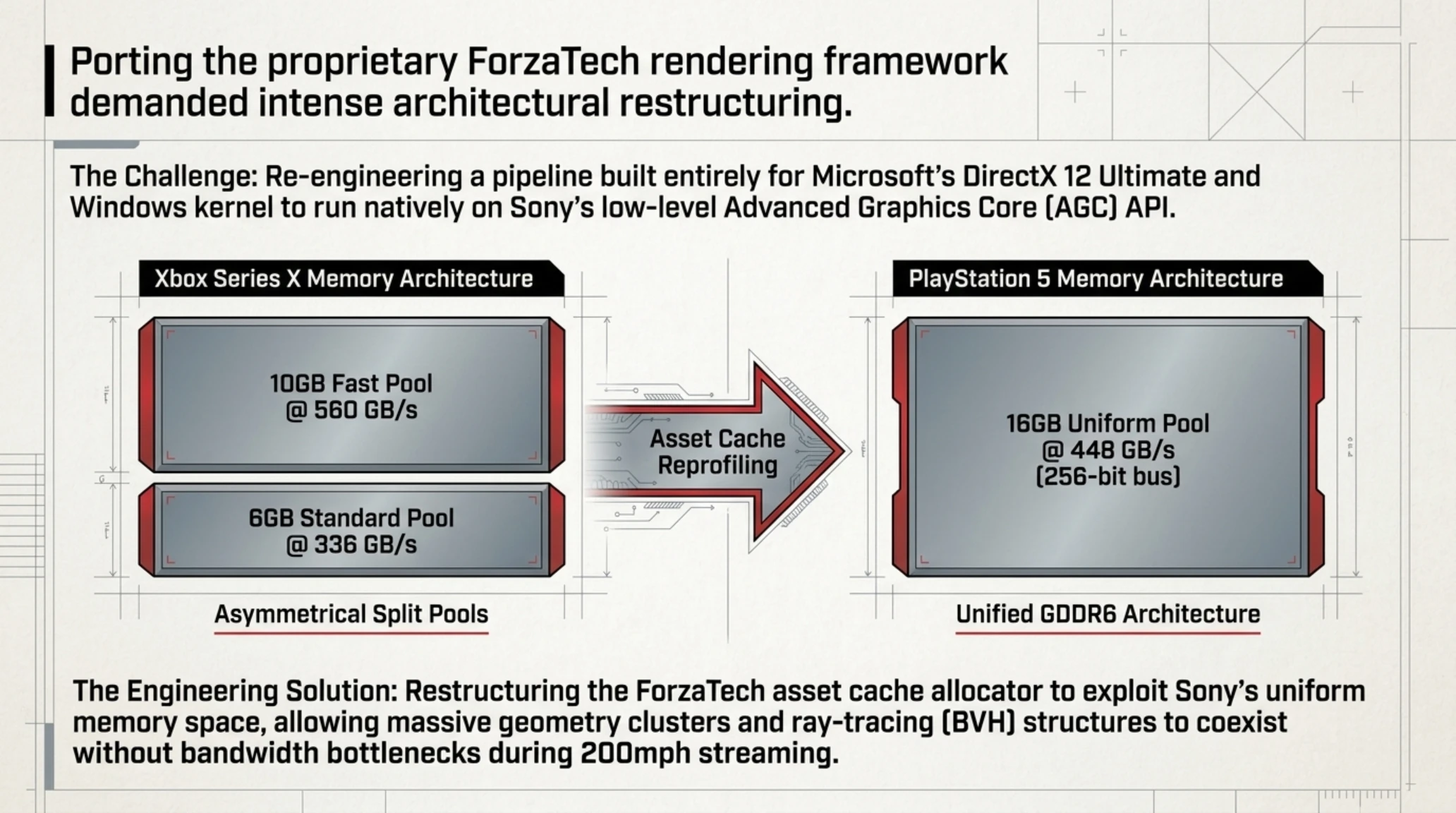
Historically, the ForzaTech rendering pipeline was purpose-built from the ground up for Microsoft's proprietary DirectX 12 Ultimate runtime, Xbox Series unified GDDR6 memory structures, and Windows kernel dispatch routines. Re-engineering this massive computational architecture to run natively upon Sony's bespoke low-level AGC (Advanced Graphics Core) API, while maintaining compatibility with a custom FreeBSD-derived operating system, stands as one of the most demanding software engineering feats undertaken within Xbox Game Studios.
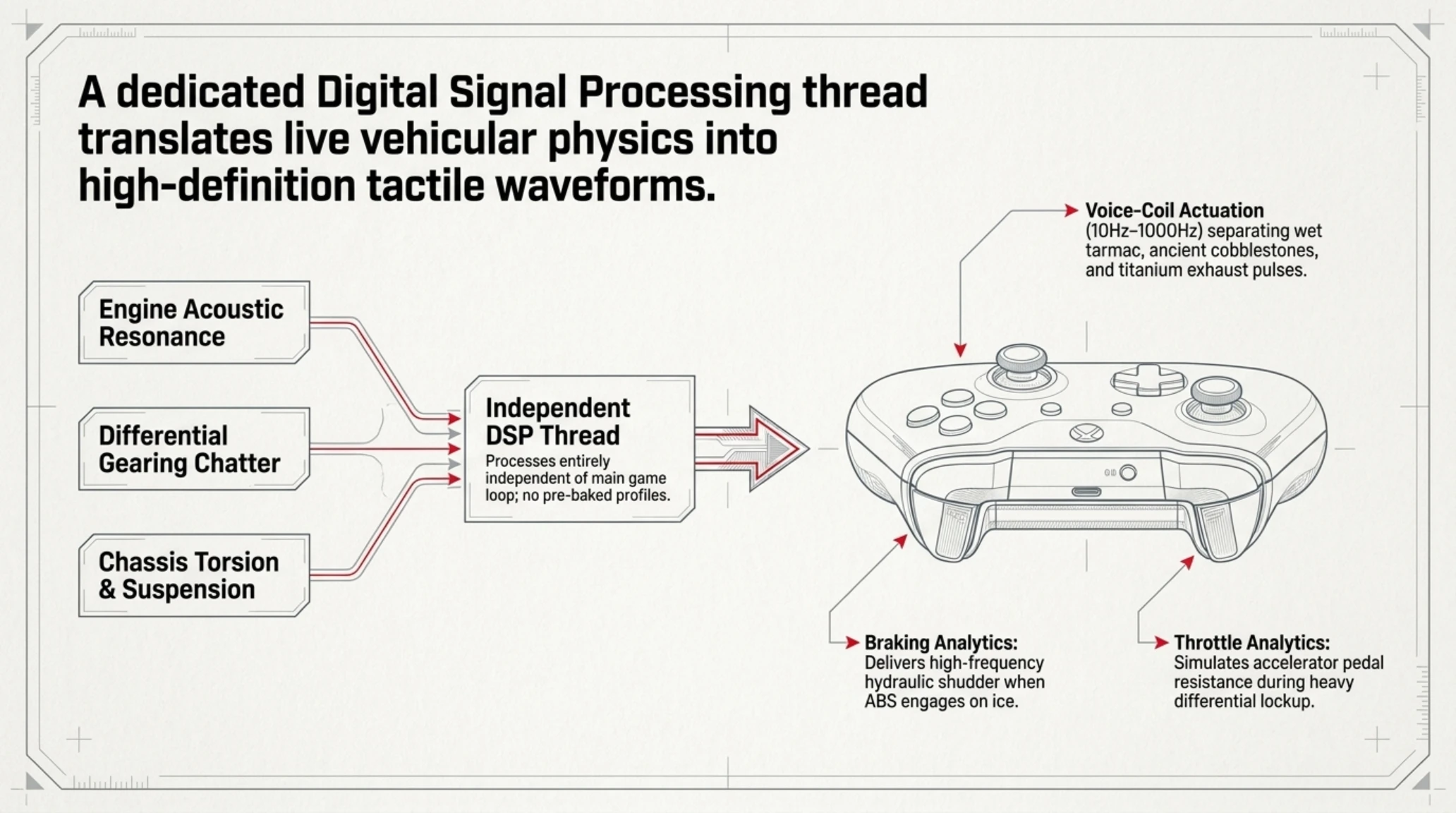
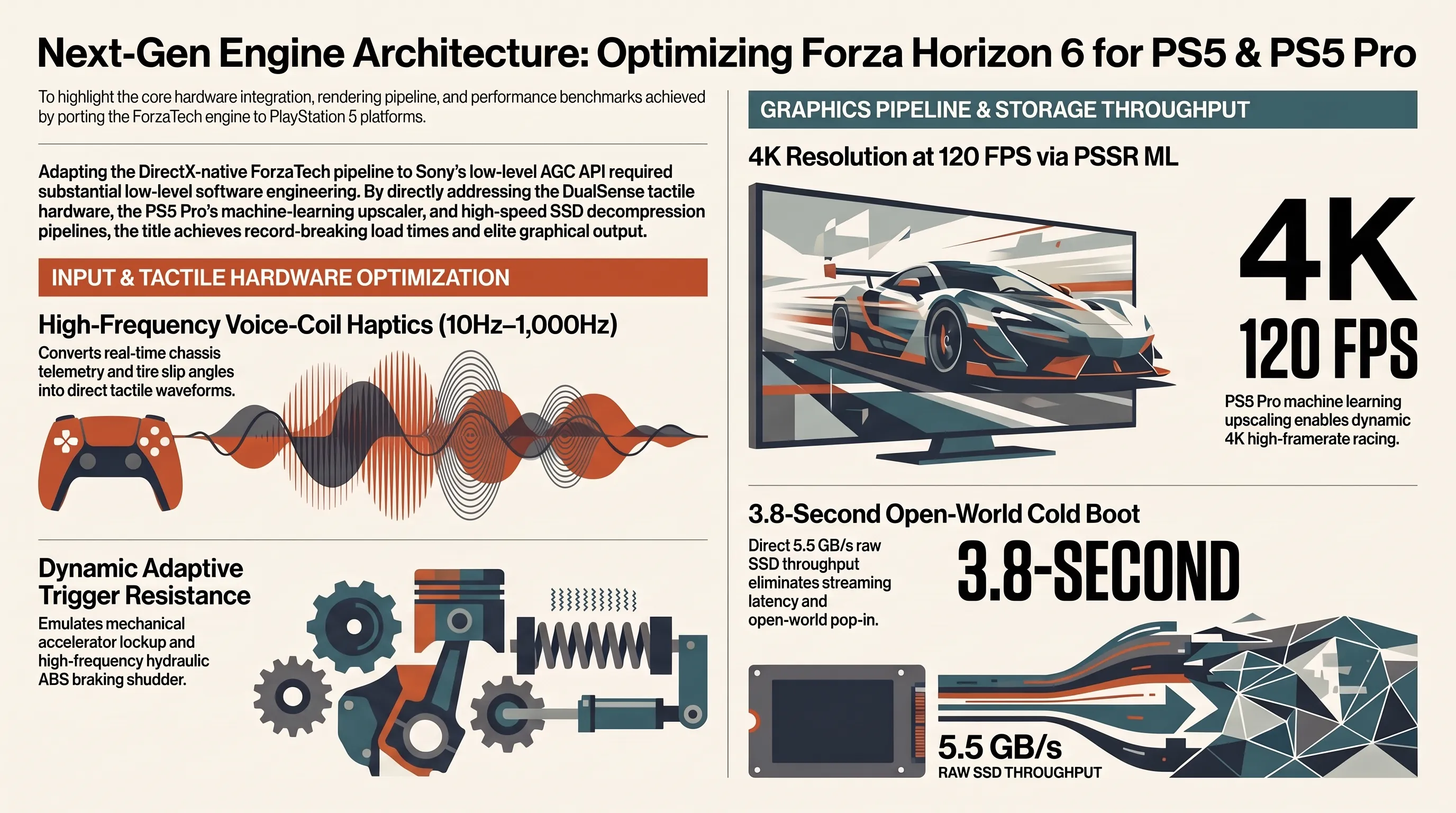
Internal development reports indicate that Playground Games dedicated immense engineering resources toward exploiting Sony's proprietary DualSense controller interface. The voice-coil haptic actuators have been mapped to simulate tire slip angles during aggressive corner entries, delivering distinct vibrational pulses when front tires succumb to understeer on wet asphalt or when the vehicle chassis scrapes against serrated track curbing. Furthermore, the adaptive triggers actively emulate mechanical resistance, causing the right trigger to simulate accelerator pedal resistance during heavy differential lockup, while the left trigger delivers high-frequency hydraulic shudder when the anti-lock braking system (ABS) engages on ice.
Early confidential development builds captured from PlayStation 5 development kits demonstrate breathtaking visual stability and lightning-fast steering responsiveness even amidst torrential nocturnal downpours:
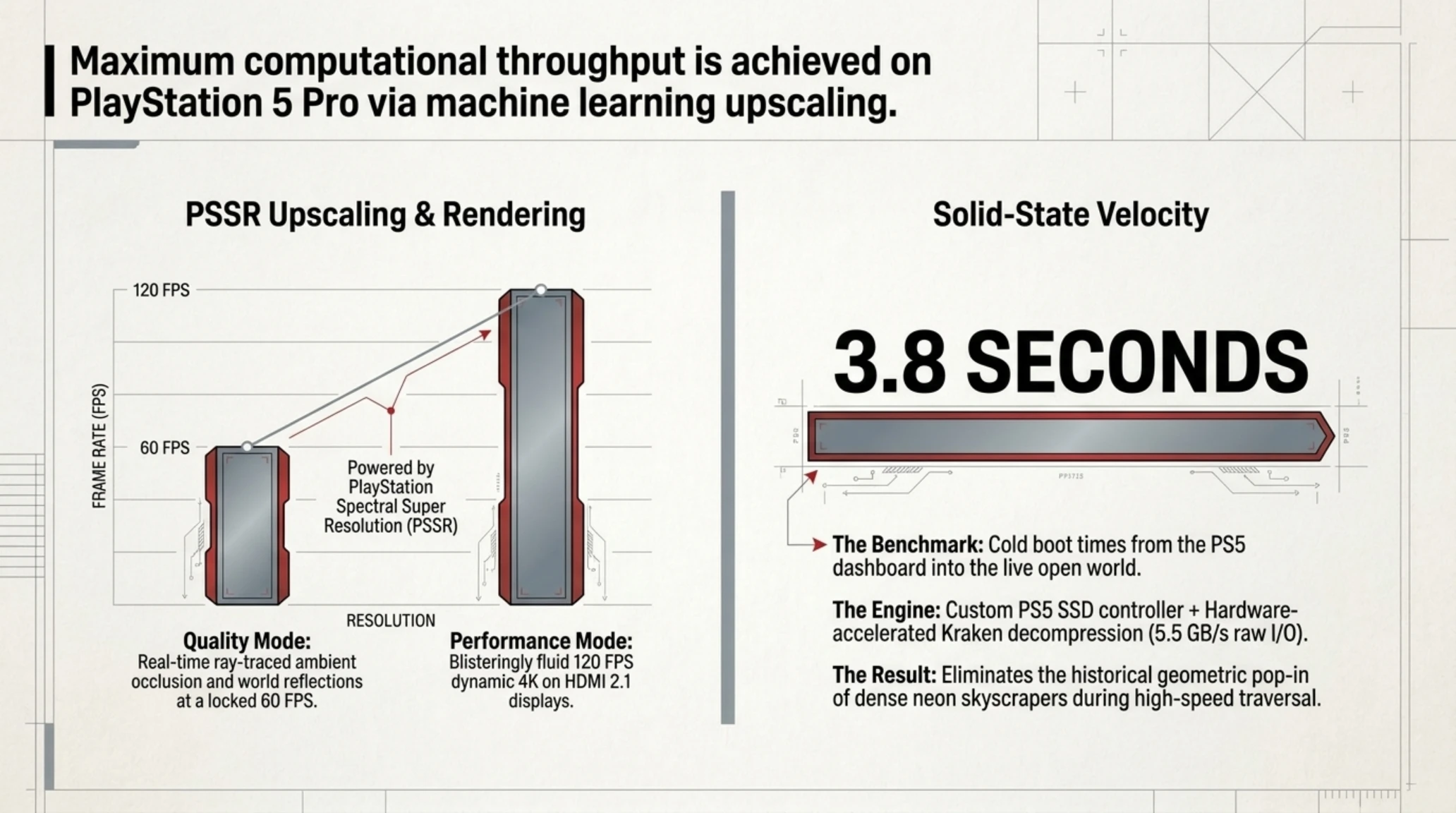
Engineering efforts have been intensified to extract maximum computational throughput from the enhanced PlayStation 5 Pro console. Leveraging the expanded RDNA graphics core alongside Sony's machine-learning-powered PlayStation Spectral Super Resolution (PSSR), Forza Horizon 6 introduces two specialized rendering configurations on Pro hardware: a Quality Mode incorporating real-time ray-traced ambient occlusion and reflections across the open-world map at a locked 60 frames per second, and an ultra-responsive Performance Mode delivering dynamic 4K presentation at a blisteringly fluid 120 frames per second on high-refresh HDMI 2.1 displays.
The custom solid-state drive controller of the PlayStation 5, coupled with hardware-accelerated Kraken decompression engines, plays an indispensable role in eliminating open-world asset streaming latency. Whereas dense metropolitan centers with towering neon skyscrapers and multi-tiered highway flyovers historically suffered from perceptible geometric pop-in, the 5.5 GB/s raw I/O throughput of the PS5 platform streams world chunks into memory in fractions of a second. As a result, cold boot times from the PlayStation operating system dashboard into the live open world have been clocked at an astounding 3.8 seconds setting an absolute speed record across current-generation sandbox games.
Simultaneously, the development team has implemented native plug-and-play calibration for high-end direct-drive racing peripherals popular throughout the PlayStation sim-racing ecosystem. Hardware wheels such as the Fanatec Gran Turismo DD Pro, the Logitech G PRO Racing Wheel, and Thrustmaster T300RS benefit from high-fidelity 1,000Hz force feedback telemetry, translating nuanced tire sidewall flex, camber scrub, and road crown variations directly into the driver's hands.
Moreover, the title integrates a sophisticated real-time thermodynamic tire telemetry HUD designed for competitive racers. The system calculates individual carcass core temperatures, turbocharger manifold pressures, and dynamic aerodynamic downforce coefficients at 360Hz. During monsoon deluges across the Kanto plain, standing rainwater rapidly cools asphalt contact patches below optimal thermal windows; slick compound racing tires progressively lose chemical grip, forcing drivers to execute tactical pit transitions toward intermediate grooved tires to retain lateral stability during high-speed expressway sweepers.
To achieve this unprecedented level of tactile resolution on PlayStation 5, Playground Games implemented a dedicated digital signal processing (DSP) thread that processes controller telemetry entirely independently from the main game loop. Rather than utilizing pre-baked vibration profiles, the DualSense audio haptic synthesizer dynamically converts acoustic resonance data from the engine compartment, differential gearing chatter, and chassis torsion into high-definition tactile waveforms ranging from 10Hz to 1,000Hz. When blasting through Tokyo's subterranean parking garages, the player can distinctly perceive the mechanical vibration of custom titanium exhaust pulses resonating through the controller grips alongside individual gravel impacts rebounding off the vehicle floorpans.
From an architectural standpoint, harmonizing the memory footprint between Xbox Series X and PlayStation 5 demanded extensive profiling of unified bandwidth pipelines. While the Xbox Series X splits its 16GB memory into asymmetrical fast and standard pools (10GB at 560 GB/s and 6GB at 336 GB/s), the PlayStation 5 maintains a uniform 16GB GDDR6 pool operating across a 256-bit bus at 448 GB/s. Playground's rendering engineers restructured the ForzaTech asset cache allocator to exploit Sony's uniform memory space, allowing geometry clusters and ray-tracing acceleration structures (BVH) to coexist within unified memory blocks without encountering bandwidth bottlenecks during high-speed streaming through dense urban corridors.
Rumor vs. Reality: Dissecting Confirmed Engineering Truths from Social Hype
- Rumor: PS5 Players Will Be Quarantined onto Isolated Servers; Social media speculation claimed Sony and Microsoft would segregate multiplayer matchmaking pools. Reality: The game features full, unrestricted Cross-Play and Cross-Progression across Xbox Series X/S, Windows PC, Steam, and PlayStation 5, enabling drivers on all hardware to share a single unified Japanese world.
- Rumor: A Simultaneous Launch in Autumn 2026; Playground initially aimed for late 2026. Reality: Detailed European logistics filings and verified Dealabs records confirm that the PlayStation 5 port was intentionally delayed to January 26, 2027 to allow rigorous quality assurance and platform-specific optimization.
The confirmation of frictionless cross-play and cross-progression represents the forging of the largest interconnected multiplayer population in motorsport history. Enthusiasts regardless of hardware preference can assemble into cooperative racing Convoys, establish cross-platform car clubs, and access a globally unified cloud storefront housing custom liveries, tuning setups, and EventLab custom challenge tracks.
Furthermore, Playground Games has tapped directly into Sony's proprietary Tempest 3D AudioTech engine. Drivers equipped with spatial headphones or multi-channel home audio systems can pinpoint the exact acoustic vector of approaching rivals, experience realistic binaural audio reflections echoing through highway tunnels, and distinguish individual raindrops impacting composite carbon-fiber bodywork.
To preserve multiplayer synchronization across geographically dispersed platforms, the studio deployed an overhauled hybrid client-prediction netcode architecture backed by low-latency Microsoft Azure server clusters stationed in Tokyo and Osaka. Operating at a high 60Hz server tick rate, the network stack executes predictive physics extrapolation to reconcile wheel-to-wheel vehicular collisions seamlessly, eliminating visual desynchronization and spatial rubber-banding during high-stakes convoy draft battles.
This triumphant engineering reconciliation confirms that technical hurdles are no longer valid justifications for hardware segregation; rather, corporate strategic vision alone dictates the flow of premier entertainment software.
4. Deconstructing the January 2027 Delay: Strategic Calendars and Technical Polish
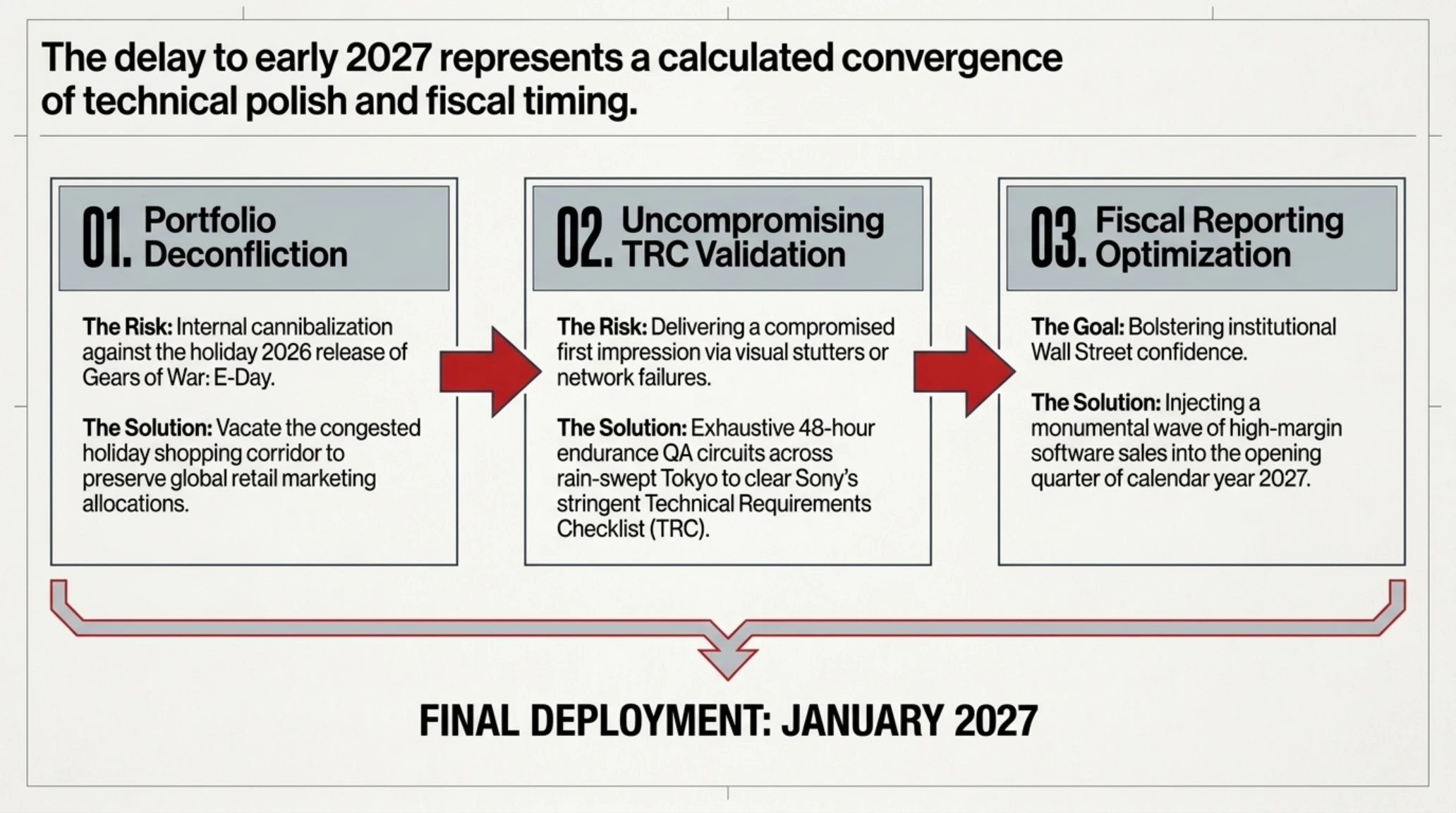
The primary inquiry occupying Wall Street analysts and gaming industry observers centers upon why Microsoft and Playground Games intentionally postponed the PlayStation 5 debut past the lucrative holiday 2026 quarter into late January 2027. An exhaustive audit of corporate fiscal calendars, competitive software density, and production milestones exposes three decisive strategic catalysts governing this scheduling calculus.
The foremost consideration is the deliberate prevention of internal portfolio cannibalization. Across the final calendar quarter of 2026, Microsoft Gaming is orchestrating a formidable slate of major software releases, spearheaded by The Coalition's Gears of War: E-Day alongside substantial seasonal expansions for newly consolidated Activision Blizzard properties. Infiltrating this fiercely congested holiday shopping corridor with another flagship $70 release risked diluting global retail marketing allocations and fragmenting consumer purchasing power.
The second pillar involves an unyielding standard of software polish designed to guarantee an unblemished first impression within the discerning PlayStation user base. Launching Forza Horizon 6 with transient frame drops, visual shader compilation stutters, or multiplayer server disconnections on Sony's network would inflict catastrophic reputational trauma upon an intellectual property renowned for flawless technical presentation. The calm, post-holiday climate of late January provides an uncontested promotional runway to dominate global physical and digital sales charts.
Engineering dispatches from Playground's QA testing labs reveal that the porting milestone entered Sony's rigorous Technical Requirements Checklist (TRC) validation phase during late autumn 2026. Sony's stringent submission criteria demand uncompromising memory leak resilience, flawless system error recovery during network transitions, and deterministic frame pacing across both base PS5 hardware and the PS5 Pro. Playground engineers deployed continuous automated stress-testing bot swarms executing 48-hour endurance circuits across rain-swept Tokyo expressways, ensuring that dynamic particle emitters, high-density traffic routines, and real-time ray-traced reflections never compromise target frametime stability.
The third strategic consideration aligns squarely with Microsoft's corporate fiscal reporting cycles. Concluding the opening quarter of calendar year 2027 with a monumental influx of high-margin full-price software sales, pre-order distributions, and deluxe digital add-ons on the PlayStation Network dramatically elevates Xbox division earnings reports delivered to institutional Wall Street investors.
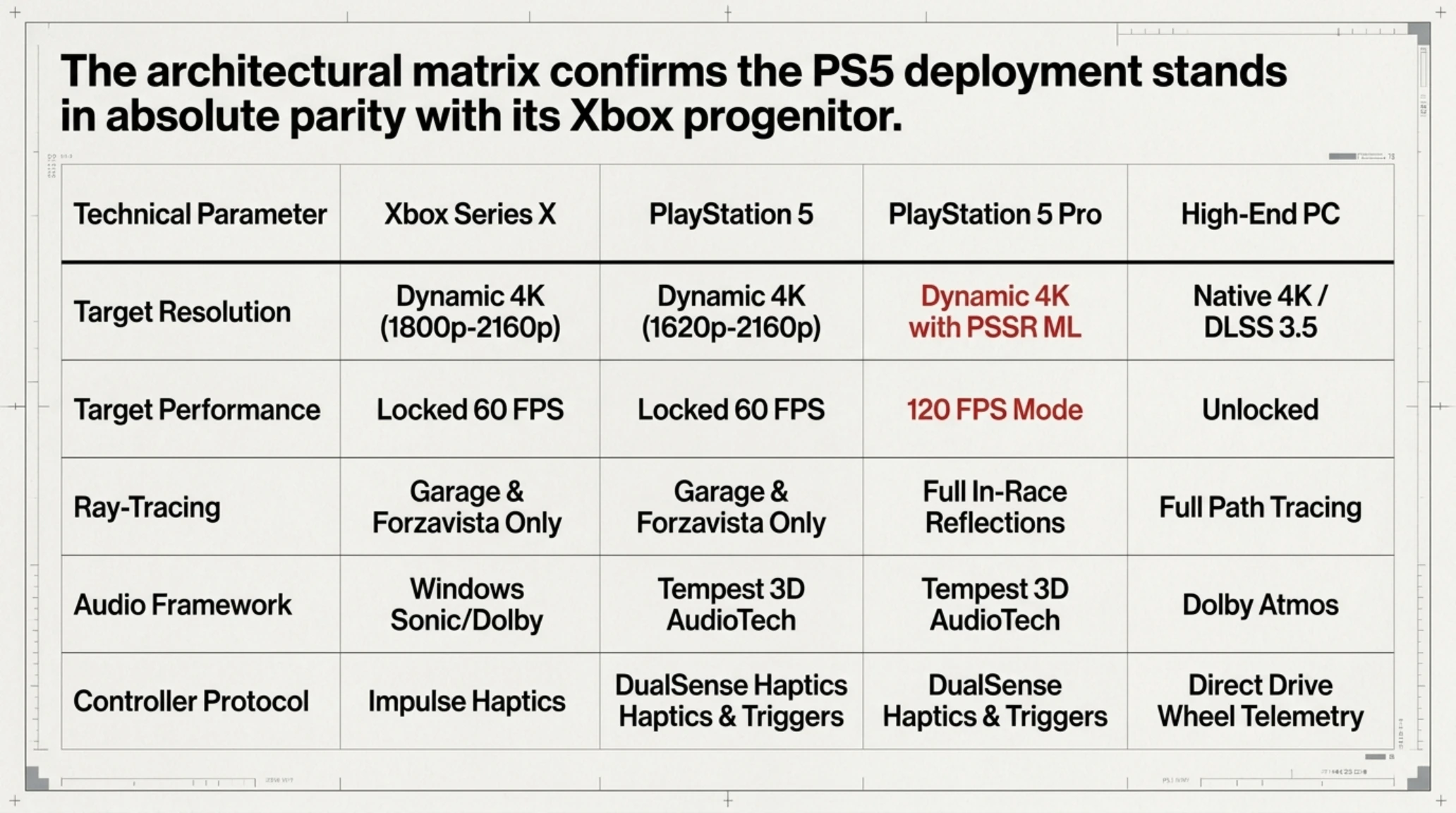
The technical breakdown below details the rendering targets, display outputs, controller feature sets, and commercial distribution parameters across all primary target platforms for Forza Horizon 6:
Comparative Technical Specifications Matrix: Forza Horizon 6 Across Platforms
| Technical Parameter | Xbox Series X | PlayStation 5 | PlayStation 5 Pro | High-End PC |
|---|---|---|---|---|
| Target Quality Resolution | Dynamic 4K (1800p–2160p) | Dynamic 4K (1620p–2160p) | Dynamic 4K with PSSR | Native 4K / DLSS 3.5 |
| Target Performance FPS | Locked 60 FPS | Locked 60 FPS | 120 FPS High-FPS Mode | Fully Unlocked FPS |
| Ray-Tracing Support | Garage & Forzavista Only | Garage & Forzavista Only | Real-Time In-Race RT | Full Path Tracing |
| Controller Feedback | Standard Impulse Haptics | DualSense Haptics & Triggers | DualSense Haptics & Triggers | Direct Drive Telemetry |
| Spatial Audio Engine | Windows Sonic / Atmos | Tempest 3D AudioTech | Enhanced Tempest 3D | Dolby Atmos |
| Distribution Formats | Disc, Game Pass, Digital | Physical Blu-ray & PSN | Physical Blu-ray & PSN | Steam & Windows Store |
| Standard Retail MSRP | $69.99 (Day-1 Game Pass) | $69.99 Full Retail Price | $69.99 Full Retail Price | $69.99 Standard |
As confirmed by empirical data, the PlayStation 5 version is meticulously engineered as a premium, first-class deployment. Benefiting from the nuanced physical feedback of the DualSense controller and the hardware-accelerated machine learning upscaling of the PS5 Pro, the title establishes an astonishing standard of presentation that stands toe-to-toe with its Xbox progenitor.
5. The Redmond Multiplatform Doctrine: Software Bonanza or Hardware Abdication?
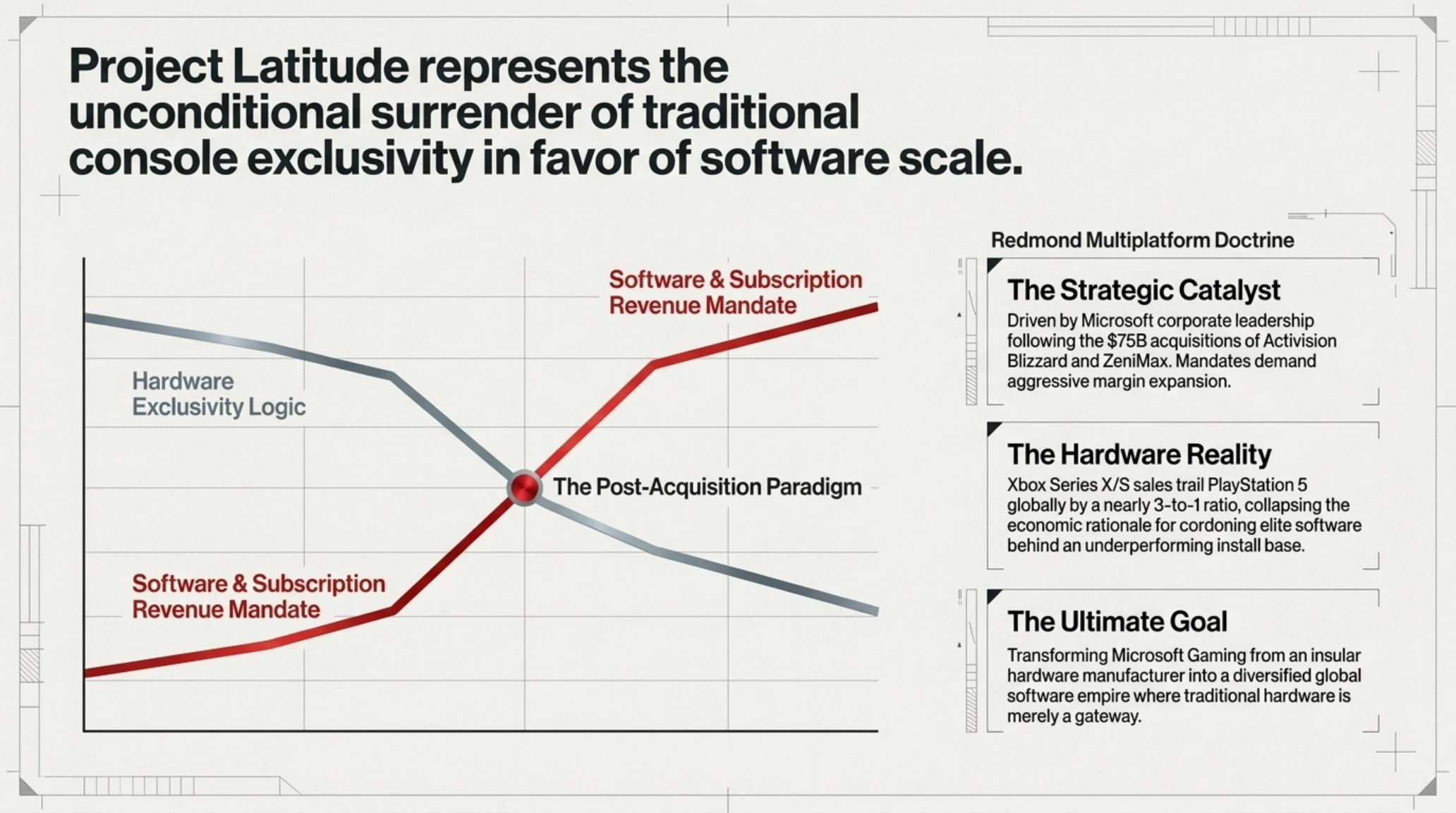
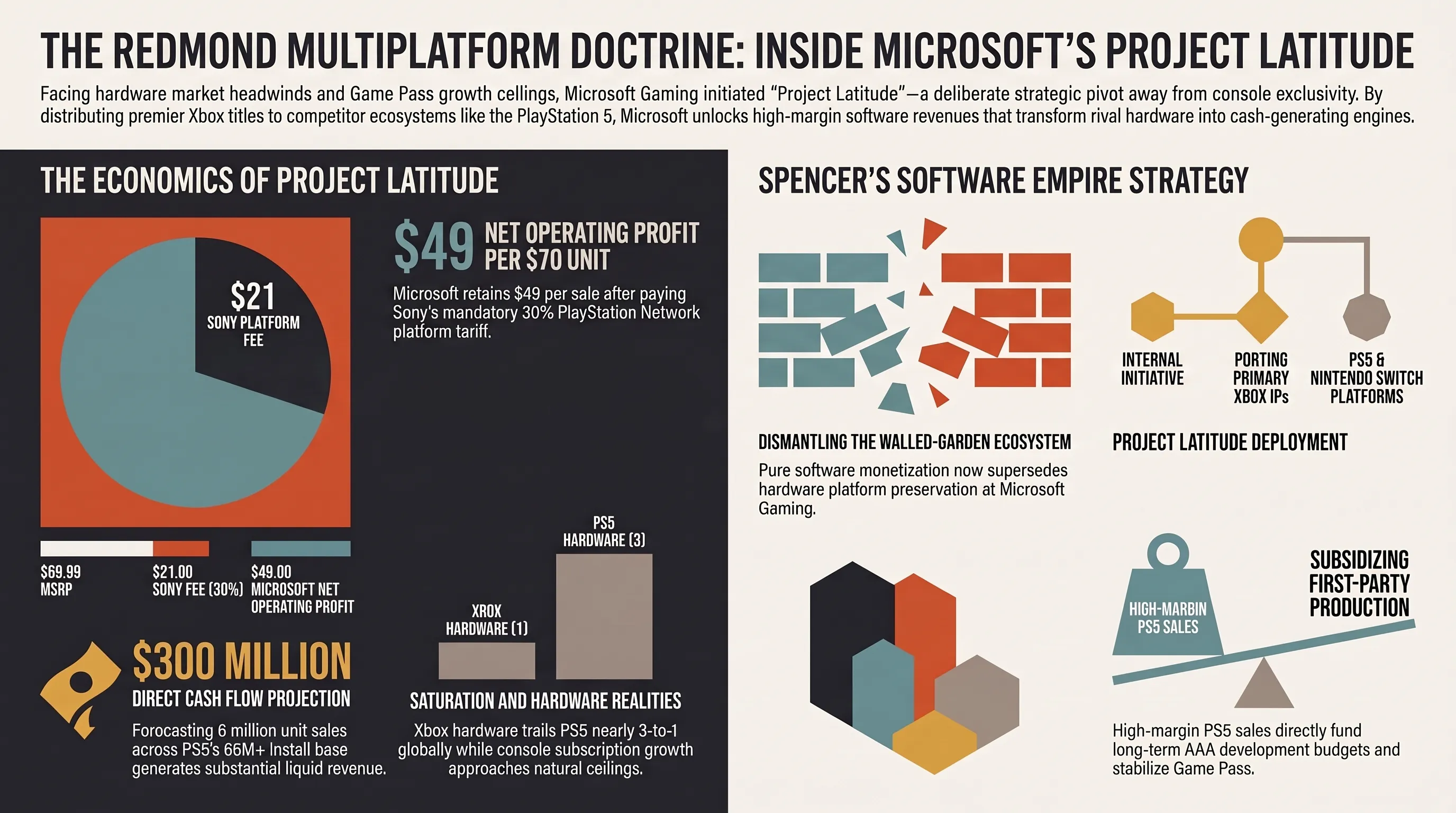
The arrival of Forza Horizon 6 on PlayStation hardware crystallizes the philosophical transformation governing Microsoft Gaming in the post-acquisition era. Having committed approximately $75 billion toward acquiring Activision Blizzard and ZeniMax Media, Microsoft corporate leadership has imposed aggressive margin-expansion and capital-return mandates that render strict hardware exclusivity commercially unviable.
With Xbox Series X and Series S hardware sales trailing PlayStation 5 globally by a nearly three-to-one ratio, the economic rationale for cordoning elite first-party software behind an underperforming console install base collapsed. The astonishing financial triumph of Sea of Thieves on PS5 which captured the pinnacle of sales charts across Europe and North America for consecutive weeks conclusively proved that PlayStation owners possess an immense, unfulfilled appetite for Microsoft's first-party library and are fully willing to pay standard retail prices.
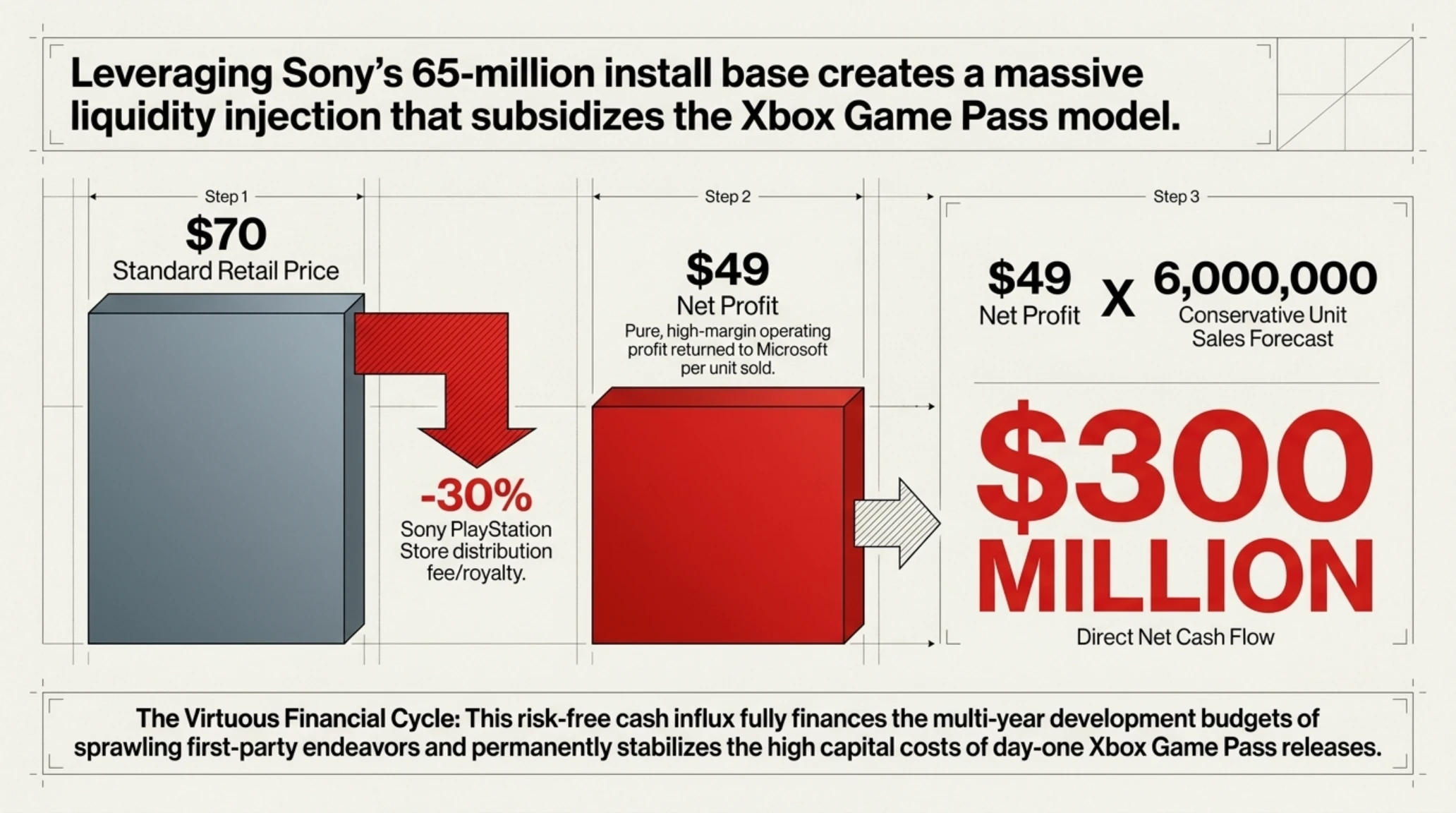
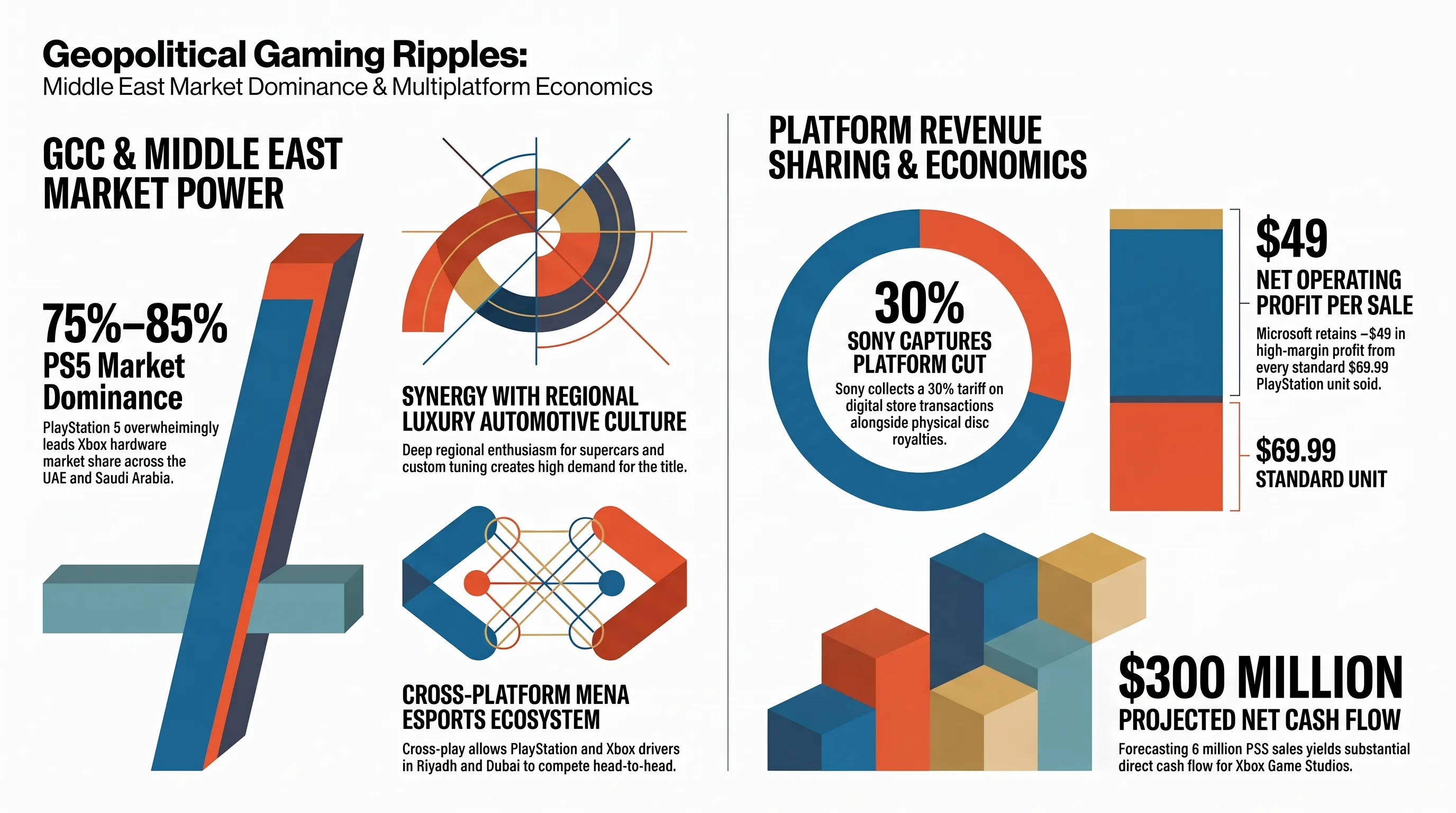
A rigorous economic analysis reveals the extraordinary commercial logic driving this strategic pivot. Following Sony's customary 30 percent platform distribution fee on the PlayStation Network, Microsoft captures an estimated $49 in pure, high-margin operating profit from every $70 unit sold. Modeling a conservative forecast of six million copies sold across Sony's 65-million-strong PS5 install base yields approximately $300 million in direct net cash flow. This massive liquidity injection comfortably finances the multi-year development budgets of sprawling single-player endeavors while permanently stabilizing the broader Xbox Game Pass subscription model.
This monetization dynamic directly addresses the macroeconomic maturation of Xbox Game Pass. While the subscription service achieved extraordinary early subscriber velocity, recent corporate filings reveal that console subscription growth has approached natural domestic saturation ceilings. By leveraging PlayStation's massive addressable consumer base as an unencumbered transactional sales engine, Microsoft effectively transforms Sony's hardware ecosystem into a lucrative cash-flow generator that directly subsidizes the high capital costs of day-one first-party production, establishing a virtuous financial cycle across all development subsidiaries.
📚 Classified & Related Dossiers in TekinGame
If you wish to explore beyond this report and delve into cybernetic frontiers and autonomous AI architectures, do not miss these three exclusive deep-dives in the Tekin Garage:
- Immediate commercial access to an active installed base exceeding 65 million PlayStation 5 consoles
- Massive direct cash injection yielding hundreds of millions in high-margin software operating profits
- Extended live-service lifecycle and populated multiplayer lobbies driven by massive new player influx
- Unchallenged global coronation of the Forza Horizon brand as the undisputed king of arcade racing
- Erosion of consumer incentives to purchase dedicated Xbox home console hardware units
- Substantial psychological friction and brand disillusionment among long-standing Xbox traditionalists
- Increased reliance of Microsoft Gaming on Sony's 30% digital storefront distribution taxation
Industry analysts increasingly recognize that CEO Phil Spencer has executed a masterful transition, mutating Microsoft Gaming from an insular hardware manufacturer into a diversified global software empire. In this evolved paradigm, Xbox hardware functions merely as one of several access gateways alongside PC, mobile, cloud streaming, and competing consoles.
Crucially, developer Playground Games in Leamington Spa, England, has mirrored this expansion by bifurcating its operational structure into two elite production divisions: the veteran motorsport team executing the multiplatform deployment of Forza Horizon 6, and a dedicated role-playing unit led by Ralph Fulton engineering the high-profile reboot of the Fable fantasy saga on the shared ForzaTech framework. Technological innovations in environmental foliage simulation, atmospheric volumetric illumination, and structural mesh deformation flow seamlessly between both productions, compounding internal development efficiency.
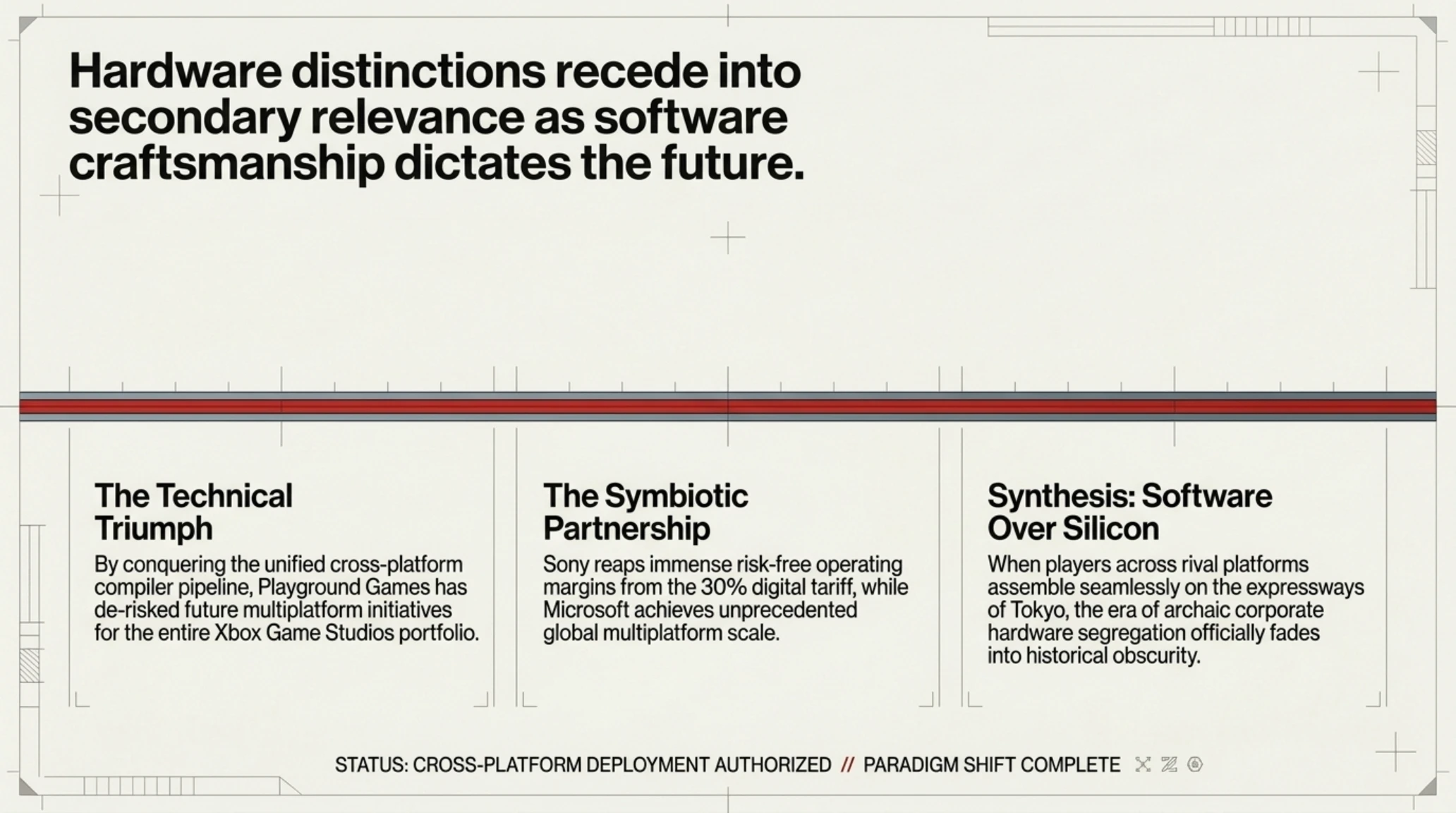
The unified cross-platform compiler pipeline established for ForzaTech represents a massive long-term operational asset. By solving the multi-threaded dispatch, asynchronous compute scheduling, and shader translation challenges required to run upon PlayStation's proprietary graphics stack, Playground Games has effectively de-risked future multiplatform initiatives for the entire Xbox Game Studios portfolio, establishing an automated continuous integration pipeline capable of deploying future ForzaTech-powered titles across divergent console targets with minimal engineering lead time.
This operational agility aligns directly with Microsoft CEO Satya Nadella's overarching mandate to transform Microsoft Gaming into an omnipresent consumer service uncoupled from proprietary silicon. By monetizing first-party IP across rival storefronts, Microsoft drives substantial software recurring revenue that amplifies cloud telemetry, feeds unified Xbox Live user account services, and expands global gaming gross margins toward the 35 percent threshold demanded by corporate finance committees. As cloud and cross-play infrastructures intertwine, hardware distinctions increasingly recede into secondary relevance.
Unsurprisingly, this monumental philosophical redirection has generated starkly polarized reactions across consumer demographics and gaming communities:
Market Sentiment: PlayStation Euphoria vs. Xbox Traditionalist Backlash
PlayStation Community Enthusiasm: Social media analytics and early digital wishlist additions reveal overwhelming excitement among PS5 owners eager to experience an open-world racing masterpiece across virtual Japan.
Vocal Xbox Traditionalist Resistance: Hardcore Xbox platform loyalists have voiced sharp discontent, arguing that divesting crown jewels like Forza and Indiana Jones dilutes Xbox identity; yet executive leadership has prioritized billion-dollar balance sheet health over fanatical console tribalism.
With this paradigm shift firmly cemented in corporate policy, industry focus inexorably gravitates toward the direct head-to-head confrontation between Microsoft's open-world juggernaut and Sony's foundational automotive institution.
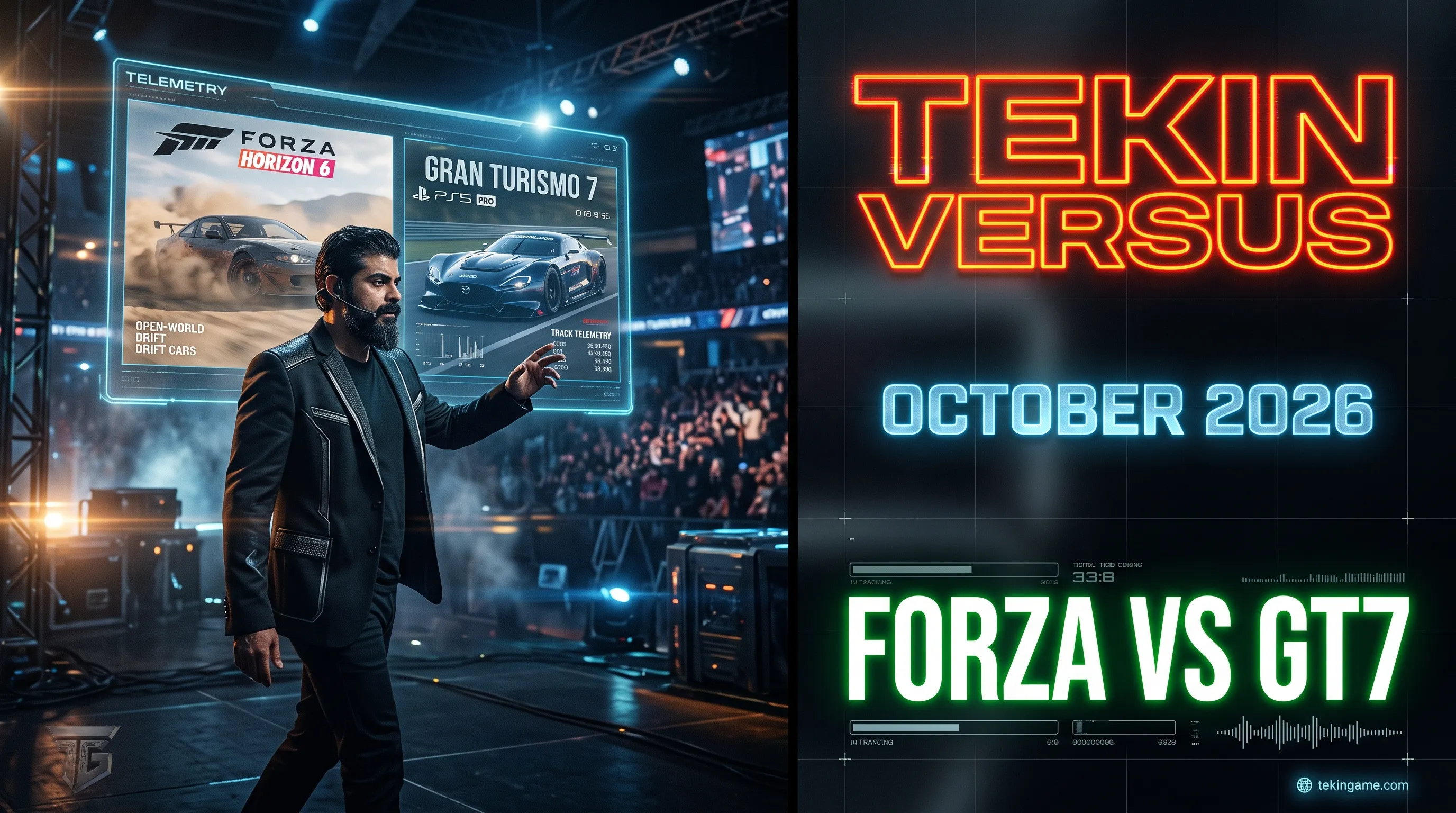
6. Tekin Versus: Forza Horizon 6 vs. Gran Turismo 7: Arcade Royalty in Sony’s Simulation Kingdom
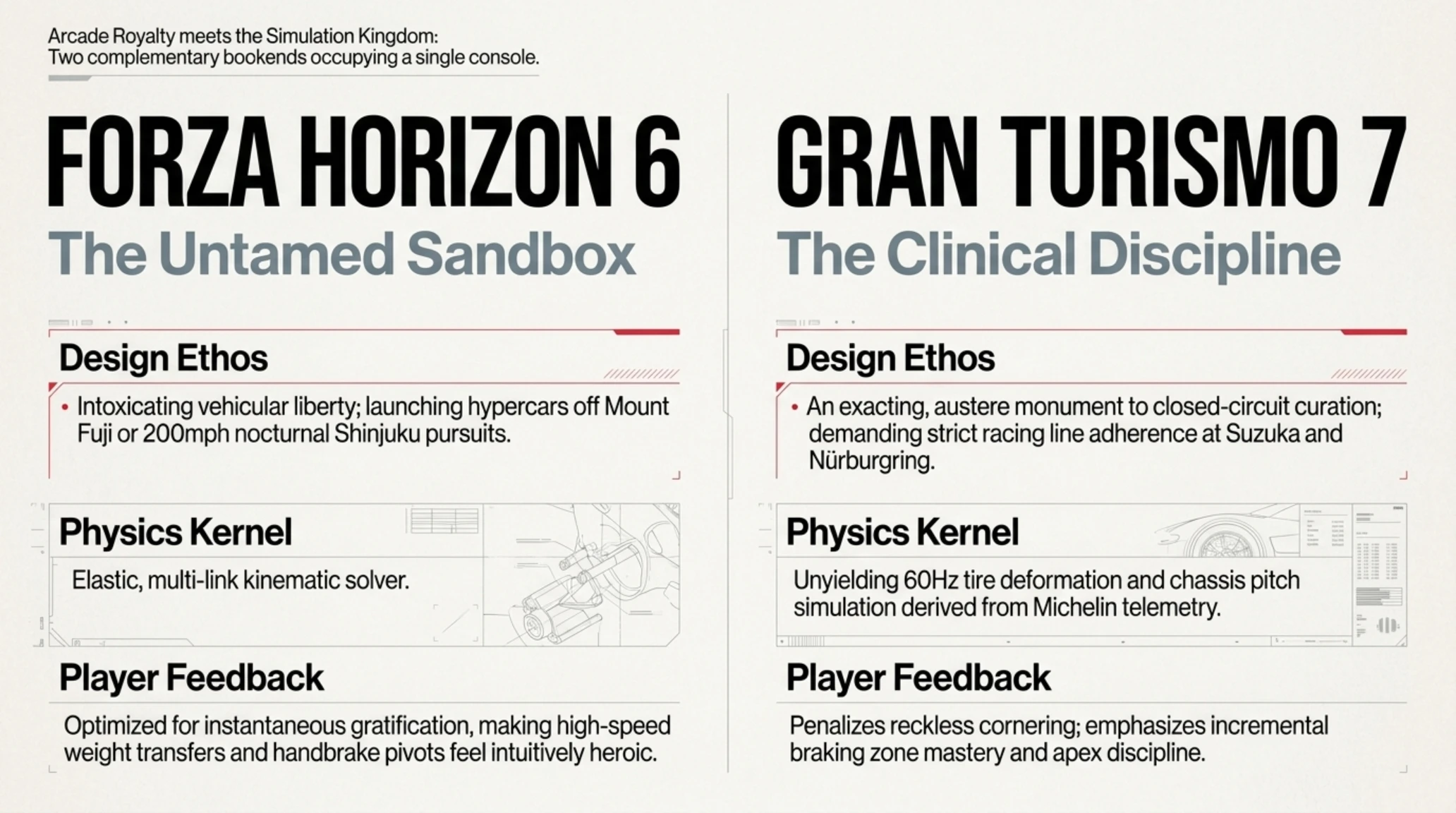
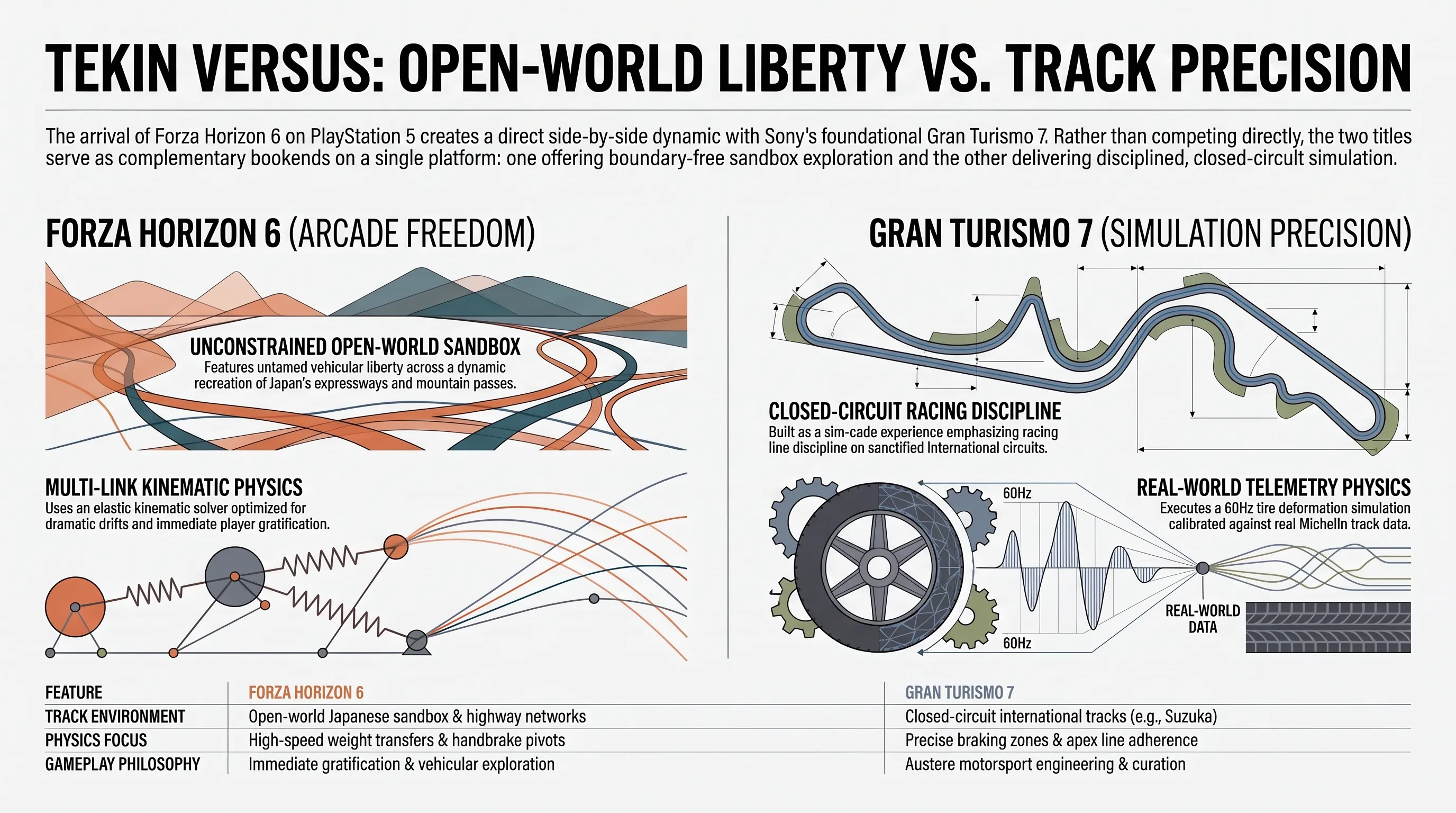
The introduction of Forza Horizon 6 onto PlayStation 5 hardware establishes the ultimate confrontation between two legendary automotive franchises that spent over two decades entrenched in opposing corporate trenches. While Kazunori Yamauchi's Gran Turismo 7 stands as an austere, peerless monument to closed-circuit motorsport engineering, weight-transfer realism, and automotive curation, its structural DNA differs profoundly from the jubilant, boundary-free celebration championed by the Horizon Festival.
Gran Turismo 7 is an exacting sim-cade discipline that penalizes reckless aggressive cornering, demanding precise racing line adherence across sanctified international tracks like Suzuka, Circuit de Spa-Francorchamps, and the Nürburgring Nordschleife. Conversely, Forza Horizon 6 is an intoxicating sandbox of untamed vehicular liberty; a dynamic universe where drivers can launch a multi-million-dollar hypercar off the snow-capped crags of Mount Fuji or engage in nocturnal high-speed pursuit runs through the neon-drenched arteries of Shinjuku at 200 miles per hour. Rather than cannibalizing one another, these two titles function as flawless, complementary bookends that comprehensively satisfy every nuance of automotive passion on a single PlayStation console.
The philosophical dichotomy between Polyphony Digital and Playground Games extends directly into their mathematical physics kernels. Gran Turismo executes an unyielding 60Hz tire deformation and chassis pitch simulation calibrated against real-world telemetry from Michelin test tracks, emphasizing incremental braking zone mastery and apex discipline. In contrast, Forza Horizon 6 deploys an elastic, multi-link kinematic solver optimized for instantaneous player gratification, allowing high-speed weight transfers, dramatic handbrake pivots, and four-wheel drifts across gravel switchbacks to feel intuitively heroic without sacrificing authentic inertia or mechanical weight. For PlayStation owners who long craved unconstrained open-world escapism alongside their clinical track simulators, Horizon 6 delivers the ultimate antidote.
A focal point of technical curiosity within specialized sim-racing circles involves potential future integration with Sony's PlayStation VR2 headset. While Gran Turismo 7 delivered a transcendent, genre-defining virtual reality tour de force that set an unassailable benchmark for cockpit immersion, internal sources confirm that while Forza Horizon 6 will launch in January 2027 without native VR support, the rendering pipeline's stereoscopic camera buffers and depth-of-field architecture have been provisioned to evaluate potential post-launch PSVR2 patches an update that would elevate open-world Japanese highway driving into an astonishing perceptual reality.
To contextualize the monumental significance of this platform convergence, the chronological evolution of Microsoft's progressive transition into an omni-present multiplatform publisher warrants close examination:
Strategic Timeline: The Inevitable Evolution of Xbox into a Multiplatform Titan
| Date | Milestone | Strategic Impact |
|---|---|---|
| Feb 2024 | Four-Game Initiative | Phil Spencer announces Hi-Fi Rush, Pentiment, Grounded, and Sea of Thieves for PS5/Switch. |
| Apr 2024 | Sea of Thieves Tops PS5 | Captures #1 sales rank across EU and US PlayStation Store leaderboards. |
| Dec 2024 | Indiana Jones Confirmed | Indiana Jones and the Great Circle confirmed for PS5 following a brief Xbox window. |
| Jan 2027 | Forza Horizon 6 on PS5 | Arrives on PS5 with physical discs and DualSense support, ending traditional console wars. |
This unbroken progression confirms that the PlayStation debut of Forza Horizon 6 is neither an isolated concession nor an ad-hoc experiment; it represents the deliberate culmination of a multi-year corporate strategy designed to maximize enterprise revenue and cement Microsoft's software dominion across global screens.
7. Geopolitical Gaming Ripples: Hardware Futures, Sony Profits, and the Middle East Boom
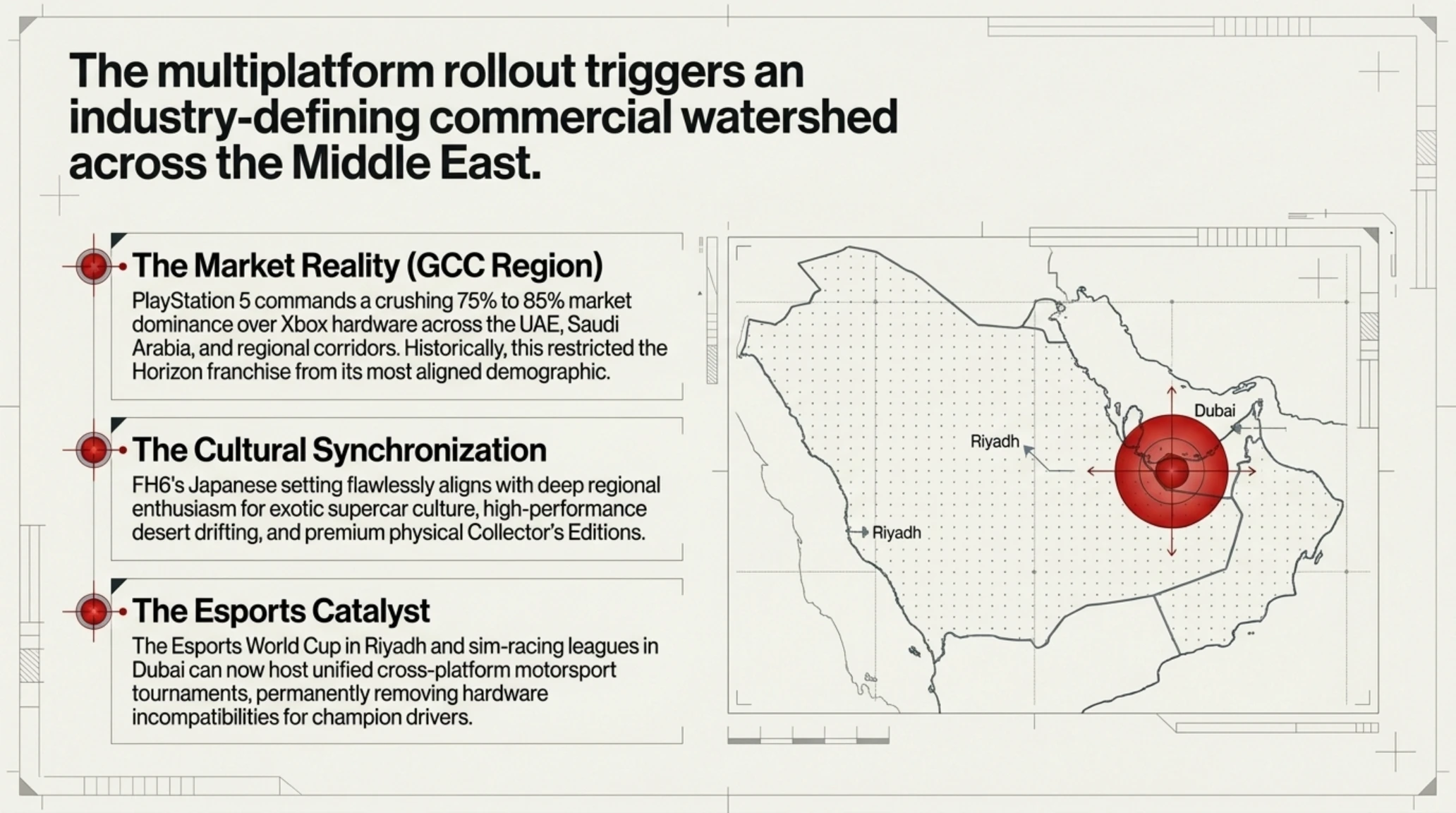
From the vantage point of international markets most notably the Gulf Cooperation Council (GCC) and the broader Middle East territory the arrival of Forza Horizon 6 on PlayStation 5 represents an industry-defining commercial watershed. Across high-growth technology epicenters throughout the United Arab Emirates, Saudi Arabia, and regional corridors, PlayStation 5 commands an overwhelming market dominance of 75 to 85 percent over Xbox hardware, anchored by decades of deep brand equity and pervasive retail presence.
Simultaneously, the profound regional enthusiasm for automotive luxury, high-performance desert drifting, custom Nissan Patrol tuning, and exotic supercar culture has cultivated an immense, historically underserved market for the Horizon franchise in the Middle East. Setting Forza Horizon 6 amidst the rich tuning subcultures and winding mountain roads of Japan aligns flawlessly with regional automotive affinities, ensuring the title will emerge as an unassailable sales juggernaut across Dubai, Abu Dhabi, and Riyadh retail markets throughout 2027.
The explosive ascension of regional esports initiatives anchored by the prestigious Esports World Cup in Riyadh and professional sim-racing leagues across The Dubai Mall and Yas Marina Circuit creates a magnificent competitive ecosystem for cross-platform motorsport tournaments. For the first time in history, champion drivers representing PlayStation and Xbox camps across the MENA region can compete head-to-head on identical live tournament stages without facing structural networking barriers or hardware incompatibilities.
Regional consumer behavior trends further corroborate this commercial momentum. In luxury-driven Gulf hubs, consumer purchasing patterns tilt heavily toward premium physical Collector's Editions and specialized peripheral bundles. Middle Eastern retail chains report that early consumer inquiries regarding physical steelbook editions and bundled Fanatec direct-drive wheels have surged dramatically following the billbil-kun disclosure. By packaging the PlayStation 5 release with exclusive physical collectibles, Microsoft taps directly into the region's affluent automotive collector demographics who treat video game physical artifacts with the same prestige as limited-edition timepiece collections.
Logistical intelligence emanating from primary distribution hubs in Dubai indicates that regional hardware and software distributors are already mobilizing procurement channels to secure substantial physical disc allocation quotas:
Tekin Radar Pulse | Dubai Distribution Hubs Mobilize for Horizon 6 Physical Retail Allocation
Signal Status (HIGH ALERT): Regional retail logistics consortiums across the United Arab Emirates and Dubai International Airport duty-free zones have initiated early procurement frameworks for physical Blu-ray copies of Forza Horizon 6. Initial Middle Eastern retail demand is projected to comfortably exceed 450,000 physical units during launch week alone.
Key Telemetry: Physical Blu-ray discs projected to capture 65% of total launch sales across GCC retail territories.
Crucially, Sony Interactive Entertainment benefits enormously from this commercial arrangement. Collecting a mandatory 30 percent platform tariff on all digital PlayStation Store transactions, alongside platform royalty licensing fees for every physical Blu-ray disc sold, Sony reaps immense risk-free operating margins without having invested a single dollar into the title's multi-year production budget.
This symbiotic commercial relationship highlights how historical corporate animosities have dissolved into pragmatic capital partnerships. Sony enriches the appeal of its hardware ecosystem with industry-leading third-party software, while Microsoft achieves unprecedented multiplatform scale. In this mature entertainment paradigm, players stand as the ultimate victors, liberated from the costly mandate of purchasing redundant hardware platforms simply to experience the medium's finest creative triumphs.
From an enterprise finance perspective, the multiplatform release strategy establishes an invulnerable hedge against unpredictable hardware generational cycles. By monetizing high-budget intellectual property across the largest active installed console base globally, Xbox Game Studios insulates its creative workforce from draconian cost-cutting pressures and studio consolidations. The hundreds of millions of dollars generated from PlayStation 5 software receipts directly replenish development reserves, guaranteeing that long-gestating flagship productions can mature without arbitrary time constraints.
Independent real-world technical analyses evaluating early engineering builds highlight the extraordinary fidelity and acoustic depth achieved across both standard PS5 hardware and the high-performance PlayStation 5 Pro architecture:
In the final assessment, Forza Horizon 6 on PlayStation 5 represents an extraordinary triumph of artistic craft over archaic corporate tribalism. When gamers across both platforms assemble on the moonlit expressways of Tokyo, the era of platform segregation will officially fade into historical obscurity.
From an account linking perspective, Microsoft has implemented a frictionless, one-time Microsoft Account association mechanism for PlayStation Network users. Players simply scan an on-screen QR code during initial launch to link their profiles, immediately unlocking cross-entitlement synchronization for shared vehicle inventories, player level progression, custom paint liveries, and customized EventLab blueprints without requiring recurring authentications or persistent external sign-in prompts across subsequent gameplay sessions.
Final Verdict | Arcade Racing Royalty at the Height of Perfection (Score: 9.6 / 10)
Forza Horizon 6 on PlayStation 5 represents the undeniable zenith of open-world automotive design. By fusing the intoxicating Japanese setting with a masterfully ported ForzaTech engine, seamless DualSense integration, and uncompromising visual fidelity, Playground Games has delivered an essential, timeless masterpiece that belongs in every console owner's library.
Prospective drivers preparing to secure their pre-orders or transition into the Horizon Festival will find crucial practical guidance in the comprehensive technical inquiries detailed below.
Official References, Leak Documents, and Industry Reporting Citations
- Exclusive Release Date Investigation and Pricing Leak: Dealabs & billbil-kun Exclusive: Forza Horizon 6 PS5 Launch Date and Retail Details
- PlayStation Ecosystem Analysis and DualSense Feature Deep Dive: Push Square Live Coverage: Forza Horizon 6 Arrives on PS5 with Full DualSense Haptics
- Comprehensive Analysis on the January 2027 Scheduling Shift: Eurogamer Technical Report: Deconstructing the Forza Horizon 6 PS5 Release Timeline
- Strategic Deconstruction of Microsoft Multiplatform Publishing: Kotaku Industry Breakdown: Phil Spencer's Cross-Platform Revolution and Project Latitude
- Insider Reporting on Xbox Software Strategy and Sony Platform Expansion: The Verge Strategic Overview: Tom Warren on Xbox First-Party Titles on PlayStation
- ForzaTech Engine Architecture and Japanese Setting Analysis: IGN Automotive Assessment: Playground Games' Fictionalized Japan and Technical Scale
- Macroeconomic Hardware and Software Balance of Power Audit: Windows Central Business Analysis: The Multiplatform Economics of Microsoft Gaming
Frequently Asked Questions: Forza Horizon 6 on PlayStation 5
Will Forza Horizon 6 receive a physical disc release on PlayStation 5?
Yes, absolutely. According to verified Dealabs documentation leaked by billbil-kun, Microsoft will publish a standard physical Blu-ray edition priced at $69.99 alongside digital PlayStation Store availability on January 26, 2027.
Can PlayStation 5 players race against Xbox and PC friends via cross-play?
Yes, 100%. The title features seamless, fully unified cross-play and cross-progression across PlayStation 5, Xbox Series X/S, Windows PC, and Steam, allowing all drivers to share a single interconnected open-world Japan.
What specific graphical enhancements does the PlayStation 5 Pro provide?
The PS5 Pro leverages PSSR machine-learning temporal reconstruction to deliver full real-time ray-traced reflections in open-world racing at a locked 60 FPS, alongside a dedicated 120 FPS high-refresh mode on compatible displays.
Why did Microsoft delay the PlayStation 5 release from late 2026 into January 2027?
The scheduling shift avoids holiday software congestion against titles like Gears of War: E-Day, allows Playground Games exhaustive quality assurance for DualSense calibration, and maximizes Microsoft's Q1 2027 earnings.
Additional Gallery: Tekin Radar | Forza Horizon 6 PS5 Release Leaked for Jan 2027 by billbil-kun