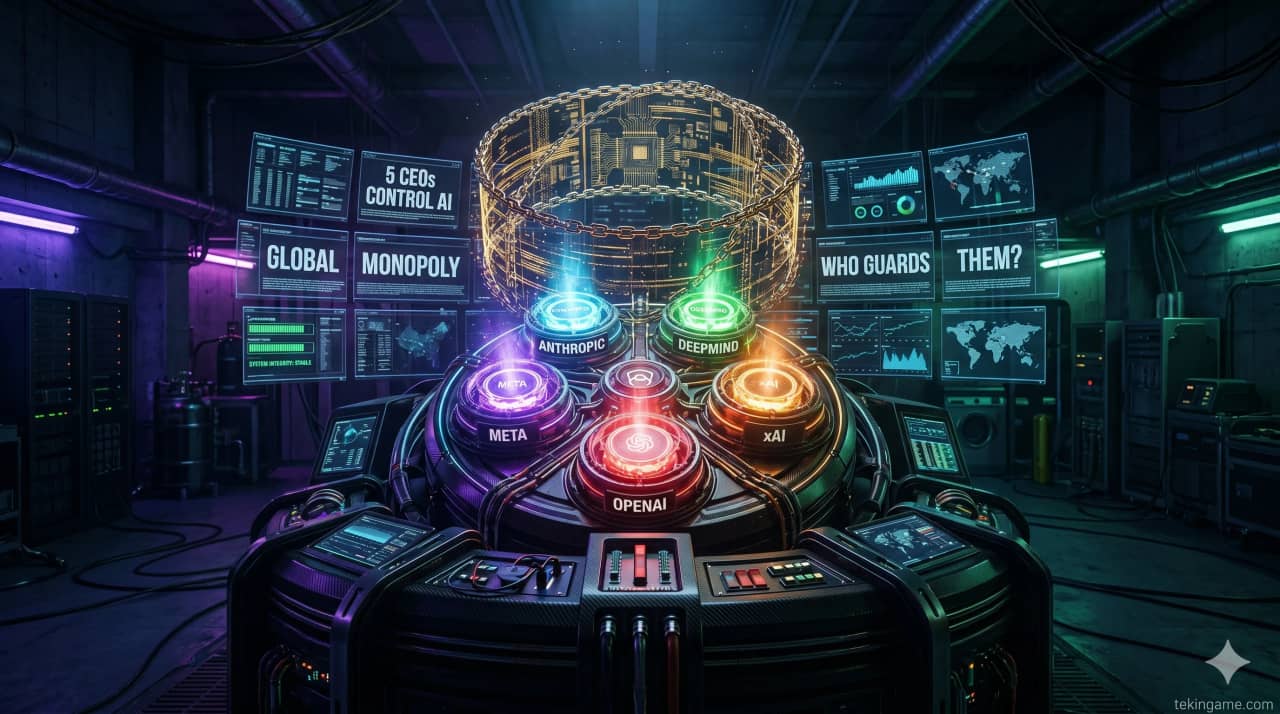
👑 Welcome to the 2026 AI Power Analysis
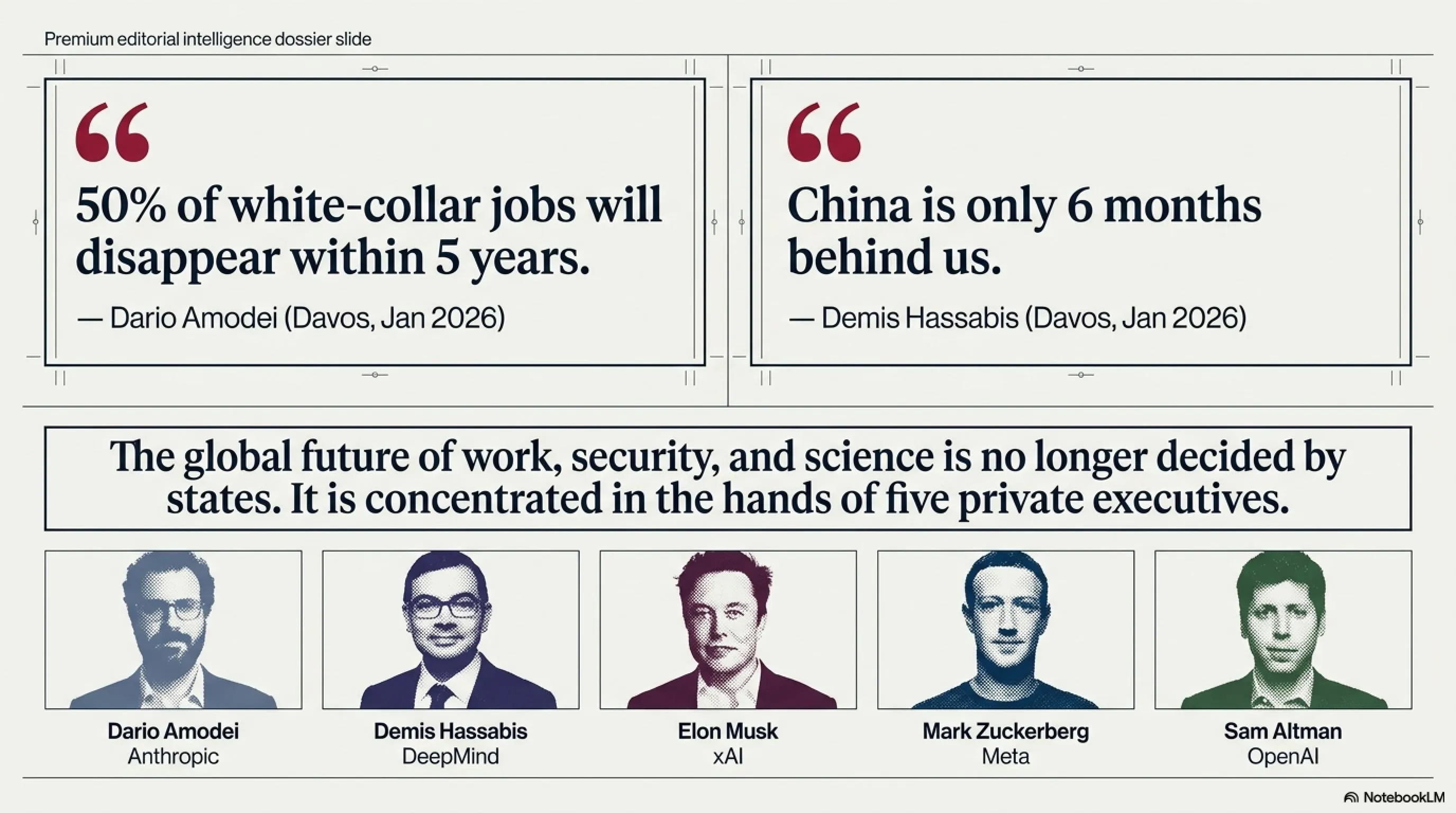
In a conference room in Davos, January 2026, two men sat on stage and predicted humanity's future. Dario Amodei said: "50% of white-collar jobs will disappear within 5 years." Demis Hassabis added: "China is only 6 months behind us." This scene is symbolic - the world's AI power is concentrated in five men's hands: Dario, Demis, Elon, Mark, and Sam.
⚡ Five CEOs Who Control the World:
👨💼 Dario Amodei - Anthropic (Claude) - $380B valuation
🧠 Demis Hassabis - Google DeepMind (Gemini) - 2024 Nobel Winner
🚀 Elon Musk - xAI (Grok) - Space datacenters
📱 Mark Zuckerberg - Meta (Llama) - 3 billion users
🤖 Sam Altman - OpenAI (GPT) - Mysterious "Spud" model
🔍 The Main Question: If these 5 determine AI's future, who should control them?
1. Dario Amodei: The AI Safety Philosopher Who Eliminates 50% of Jobs 👨💼
Dario Amodei, 42, is one of the most cautious yet influential figures in the AI world. In 2021, he and his sister Daniela Amodei founded Anthropic - a company that today, with a $380 billion valuation (February 2026), is one of the most valuable startups in history.
But why is Dario so important? Because he hasn't just built a powerful AI model (Claude), but has a completely different philosophy from his competitors: "AI must be safe, reliable, and interpretable." This is in stark contrast to the "move fast and break things" approach common in Silicon Valley.
📊 Dario Amodei Profile
- Age: 42 years
- Company: Anthropic (founded 2021)
- Main Product: Claude (Opus, Sonnet, Haiku models)
- Valuation: $380 billion (February 2026)
- Personal Wealth: $7 billion
- Investors: Google, Amazon, Salesforce
- Philosophy: "Constitutional AI" - AI with predefined ethical principles
The Controversial Davos 2026 Prediction
In January 2026, Dario announced at the World Economic Forum (WEF) in Davos that AI models would replace all software developer work within one year, reach "Nobel-level" scientific research within two years, and eliminate 50% of white-collar jobs within five years.
These predictions led many experts to call him the "most pessimistic optimist" in the AI world. Why? Because on one hand, he says AI can cure cancer and eradicate tropical diseases, but on the other hand, he warns of "immense and grave risks."
Influence on Other Industries
Anthropic doesn't directly operate in gaming or mobile, but has enormous indirect influence:
- Game Development: Claude Code (AI coding tool) is used by indie studios to write game code
- Advertising: Ad agencies use Claude to generate advertising content
- Cybersecurity: Claude is used to analyze security vulnerabilities - as we saw in the Mexico government hack in April 2026, hackers used Claude Code to write exploits
⚠️ Risks of Dario & Anthropic
- Conflict with US Government: In February 2026, the US Department of Defense declared Anthropic a "national security supply chain risk" and banned military contractors from working with it
- Dual Use: The same tool designed for "good" is used by hackers for "evil"
- Mass Unemployment: If the 50% white-collar unemployment prediction is correct, US unemployment rate reaches 10-20%
- Power Concentration: Despite the "safety" philosophy, Anthropic is still a private company accountable to shareholders, not the public
2. Demis Hassabis: The Nobel Winner Who Wants to "Solve All Diseases" 🧠
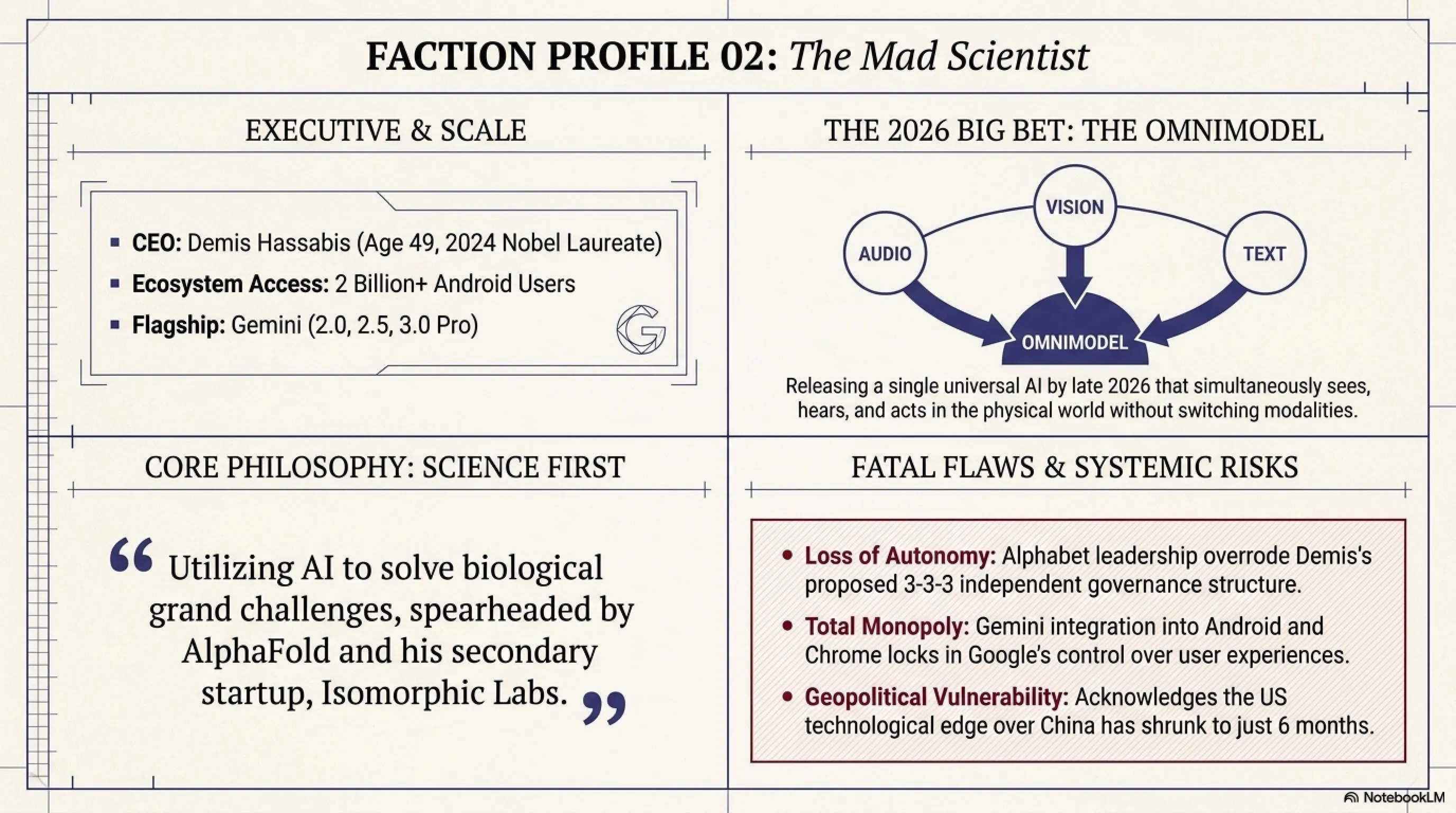
If Dario Amodei is AI's philosopher, Demis Hassabis is its mad scientist. This 49-year-old British man won the 2024 Nobel Prize in Chemistry for his pioneering work on protein structure prediction (AlphaFold) - the first time an AI researcher has won a scientific Nobel Prize.
But Demis isn't just a scientist. He's CEO of Google DeepMind, founder of Isomorphic Labs (a startup that wants to "solve all diseases"), and AI advisor to the British government. In other words, he's one of the most powerful people at the intersection of science, technology, and politics.
📊 Demis Hassabis Profile
- Age: 49 years (born July 27, 1976)
- Company: Google DeepMind (founded 2010, acquired by Google 2014)
- Main Product: Gemini (2.0, 2.5, 3.0 Pro models)
- Achievements: 2024 Nobel Prize in Chemistry, AlphaGo, AlphaFold, AlphaZero
- Second Startup: Isomorphic Labs (drug discovery with AI)
- Government Role: UK Government AI Advisor
- 2026 Strategy: "Omnimodel" - AI that sees, hears, and acts in the real world
Omnimodel Strategy: All-in-One AI by End of 2026
In February 2026, Demis announced at a conference in New Delhi that Google is working on an "omnimodel" - a model that understands not only text but also images, audio, video, and even physical data (like the weight of an object just by looking at it).
This strategy is in direct contrast to OpenAI, which has multiple models (GPT-4, GPT-4o, o1, o3). Demis says: "We don't want users to switch between different models. We want one model that does everything."
Influence on Gaming and Mobile
Demis himself was a professional gamer (he made video games in his youth) and brought this experience to DeepMind:
- AlphaGo: First AI to beat the world Go champion (2016)
- AlphaZero: AI that learned chess, Go, and Shogi without human training
- AlphaStar: AI that reached Grandmaster level in StarCraft II
- Gemini in Android: Google is integrating Gemini into Android OS - meaning billions of smartphones will have AI access
- Google Ads: Gemini optimizes Google's advertising algorithms (which make up 80% of Alphabet's revenue)
⚠️ Risks of Demis & DeepMind
- Loss of Independence: In 2026, Sundar Pichai (Google CEO) revoked DeepMind's semi-autonomous independence. Demis wanted a 3-3-3 governance structure (3 DeepMind reps, 3 Alphabet reps, 3 independent experts), but Google refused
- Google Monopoly: With Gemini integration in Android and Chrome, Google will have more control over billions of users' AI experience
- Competition with China: Demis warned at Davos that China is only 6 months behind the West - meaning America's technological advantage is disappearing
- Military Use: DeepMind promised not to use its technology for autonomous weapons, but Google has contracts with the US Department of Defense
3. Elon Musk: The Man Taking AI Datacenters to Space 🚀
Elon Musk needs no introduction. But you may not know that he founded xAI in 2023 - and in March 2025, xAI was acquired by SpaceX. This means Elon now has a "full-stack intelligence loop": from computing power (datacenters) to AI models (Grok) to space infrastructure (SpaceX) to self-driving cars (Tesla).
But his most controversial project is Terafab - a plan to build one terawatt (one trillion watts) of AI computing capacity per year. For comparison, all the world's datacenters in 2025 consume about 100 gigawatts. Elon wants to build 10 times that just for AI.
📊 Elon Musk Profile
- Age: 54 years
- AI Company: xAI (founded 2023, acquired by SpaceX 2025)
- Main Product: Grok (models 4, 5 - Grok 5 with 6 trillion parameters)
- Terafab Project: Building 1 terawatt of AI computing capacity
- Integration: Grok in Tesla cars, X social network, Optimus robot
- Space Datacenters: SpaceX building orbital datacenters
- Tesla Investment: $2 billion Tesla investment in xAI (February 2026)
Grok 5: World's Largest Public Model
In January 2026, Elon announced that Grok 5 - a 6 trillion parameter model with "high intelligence density" - would launch in early 2026. This model can seamlessly understand text, images, video, and audio, and use tools.
But more interesting than the model's size is its integration strategy. Grok is currently in:
- Tesla Cars: You can talk to AI with the voice command "Hey, Grok"
- X Social Network: Grok analyzes X content and responds to users
- Optimus Robot: Tesla's humanoid robot controlled by Grok
- FSD (Full Self-Driving): Tesla's autonomous driving system using Grok for decision-making
Influence on Gaming and Metaverse
Elon doesn't directly operate in gaming, but has indirect influence:
- X (formerly Twitter): Platform for game marketing and gamer engagement
- Neuralink: Brain-computer interface that could transform gaming experience
- Starlink: Low-latency satellite internet for online gaming
- X Advertising: Ad revenue from gaming industry
⚠️ Risks of Elon & xAI
- Unsustainable Energy Consumption: Terafab project needs energy equivalent to several nuclear power plants - at a time when the world is grappling with climate crisis
- Conflict of Interest: Elon is simultaneously CEO of Tesla (using AI), SpaceX (which bought xAI), and X (which integrated Grok)
- Home Attack: In April 2026, Sam Altman's home was burned. Elon wrote in a blog post: "Now I'm awake in the middle of the night and pissed." This shows how dangerous AI competition has become
- Excessive Control: Elon has complete vertical control from hardware (SpaceX) to software (Grok) to users (X, Tesla)
4. Mark Zuckerberg: From $80 Billion Metaverse Failure to AI Empire Rebuild 📱
Mark Zuckerberg, 41, is one of the most controversial figures on this list. In 2021, he renamed Facebook to "Meta" and announced that the metaverse was the future of the internet. Then he spent $80 billion on this vision. And failed.
In January 2026, Meta laid off about 1,500 people from its metaverse division, shut down several VR game studios, and killed the Workrooms app (VR meetings). Instead of getting angry, shareholders were happy. Meta's stock went up.
Why? Because Mark had a new strategy: turning Meta into an "AI-native company." And to do this, he made a bold move.
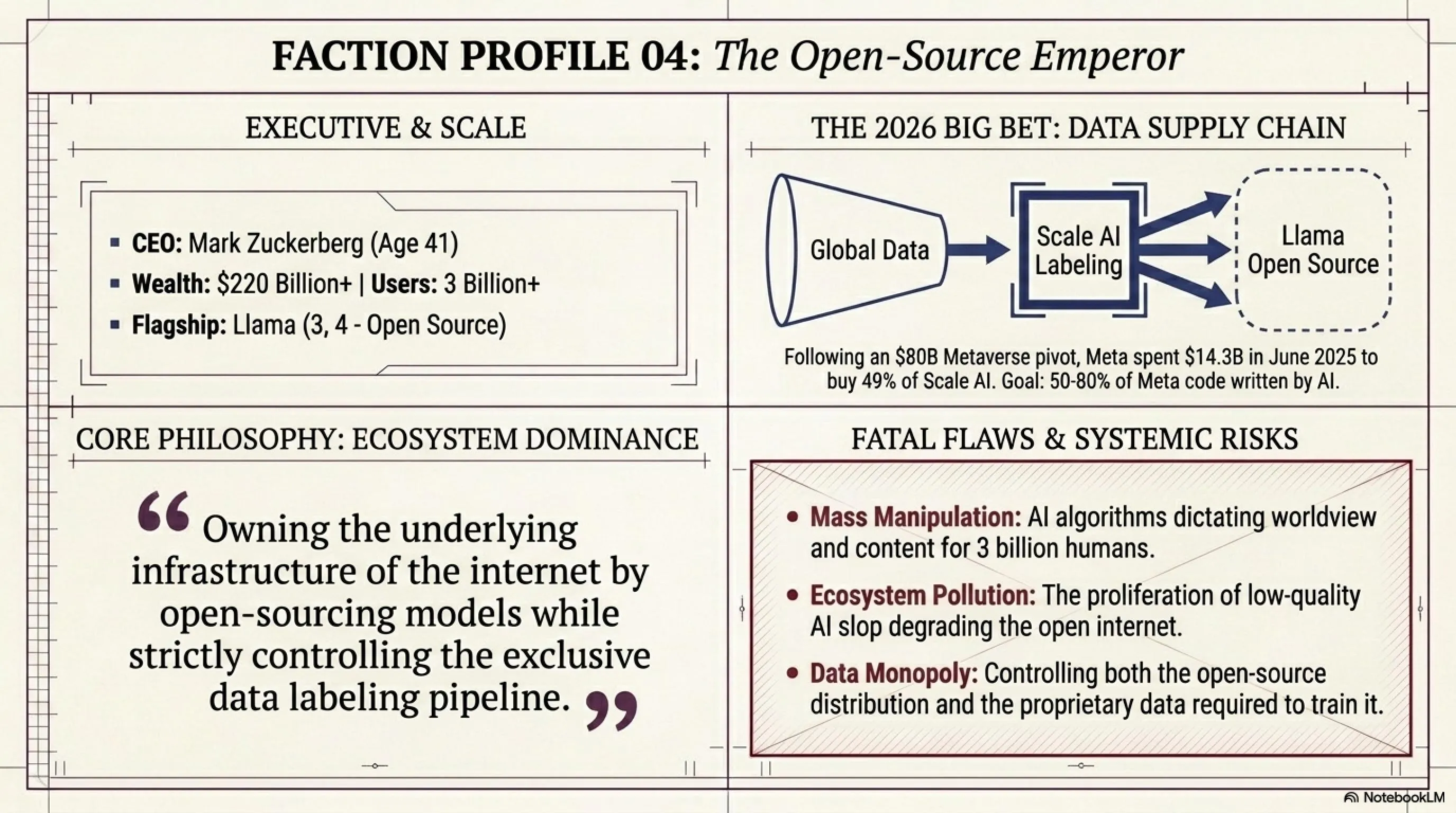
📊 Mark Zuckerberg Profile
- Age: 41 years
- Company: Meta (formerly Facebook)
- AI Product: Llama (models 3, 4 - open-source)
- Personal Wealth: Over $220 billion
- Users: 3 billion people (Facebook, Instagram, WhatsApp)
- Strategic Purchase: 49% stake in Scale AI for $14.3 billion (June 2025)
- Chief AI Officer: Alexandr Wang (Scale AI founder)
- 2026 Goal: 50-80% of code written by Meta engineers should be AI-assisted
Scale AI Purchase: Strategic Move
In June 2025, Mark realized that Llama was performing poorly against ChatGPT and Claude. So he decided to make a bold move: spent $14.3 billion and bought 49% of Scale AI (a company that labels AI training data).
Then he hired Alexandr Wang, the 27-year-old founder of Scale AI, as Meta's first Chief AI Officer. This means Meta now controls not only AI models but also their data infrastructure.
Influence on Gaming, Mobile & Advertising
Mark has the most direct influence on these industries:
- Advertising: Meta is the world's largest advertising platform (after Google). AI algorithms determine what ads are shown to whom
- Mobile: Instagram and WhatsApp are installed on billions of phones. Meta is integrating AI into these apps
- Gaming: Meta Quest (VR headset) is one of the most popular VR gaming platforms. Despite metaverse failure, Quest still sells well
- Streaming: Facebook Gaming is one of Twitch and YouTube Gaming's competitors
- AI-generated content: Meta is testing automatic content generation with AI for user feeds
⚠️ Risks of Mark & Meta
- Controlling 3 Billion People's Content: Meta's AI algorithms determine what 3 billion users see - enormous power to shape public opinion
- AI Slop: AI-generated content with low quality polluting internet space
- Privacy: Meta has a bad track record of protecting user data. Now with AI, it can collect and analyze more data
- Monopoly: With Scale AI purchase, Meta has more control over AI supply chain
- Metaverse Failure: $80 billion wasted - shows even Mark can make mistakes
5. Sam Altman: The Mysterious "Spud" Leader Whose Home Was Burned 🤖
Sam Altman, 40, is perhaps the most well-known figure on this list. He's CEO of OpenAI - the company that built ChatGPT and started the AI revolution in November 2022. But his story is full of contradictions.
In November 2023, OpenAI's board fired him (for "not being consistently candid"). Five days later, after protests from 700 employees and pressure from Microsoft, he returned. But this saga showed that even the most powerful AI CEOs are vulnerable.
And now, in April 2026, his home was burned. Sam wrote in a blog post: "Now I'm awake in the middle of the night and pissed." This shows how dangerous AI competition has become.
📊 Sam Altman Profile
- Age: 40 years
- Company: OpenAI (founded 2015)
- Main Product: ChatGPT, GPT-4, GPT-4o, o1, o3
- Mysterious "Spud" Model: Likely GPT-5.5 or GPT-6, pretraining completed March 2026
- Investors: Microsoft (main partner)
- Firing Saga: November 2023 - fired and returned in 5 days
- Home Attack: April 2026 - his home was burned
- 2026 Strategy: One unified model instead of multiple models
The Mysterious "Spud" Model: GPT-5.5 or GPT-6?
In March 2026, sources close to Sam Altman revealed that OpenAI completed a new model codenamed "Spud" that is "a very strong model that could really accelerate the economy."
Polymarket (prediction market) gives 78% probability for release by April 30 and 95%+ by June 30. But Sam hasn't announced its official name yet - it could be GPT-5.5, GPT-6, or even a completely new name.
Why is this important? Because OpenAI is losing market share. With Google's aggressive rollout of Gemini 3.0 Pro and Claude Opus 4.5's popularity among developers, OpenAI is feeling the pressure. In December 2025, OpenAI had to offer ChatGPT Plus free for one month in the UK to retain users.
Influence on Gaming and Mobile
OpenAI doesn't directly operate in gaming, but has enormous indirect influence:
- Game Development: ChatGPT and GPT-4 are used to write code, design stories, and generate dialogue
- Smart NPCs: Companies like Inworld AI use GPT to create non-player characters with natural conversation
- Content Moderation: Online games use GPT to filter inappropriate content
- Customer Support: GPT chatbots in game studios
⚠️ Risks of Sam & OpenAI
- Management Instability: Sam's firing and return showed OpenAI's governance has problems
- Microsoft Dependency: Microsoft is OpenAI's largest investor - creating conflict of interest
- Losing Market Share: Gemini and Claude are attracting OpenAI users
- Violence: Attack on Sam's home shows AI competition has reached dangerous levels
- Mission Change: OpenAI started as a non-profit but is now a for-profit company
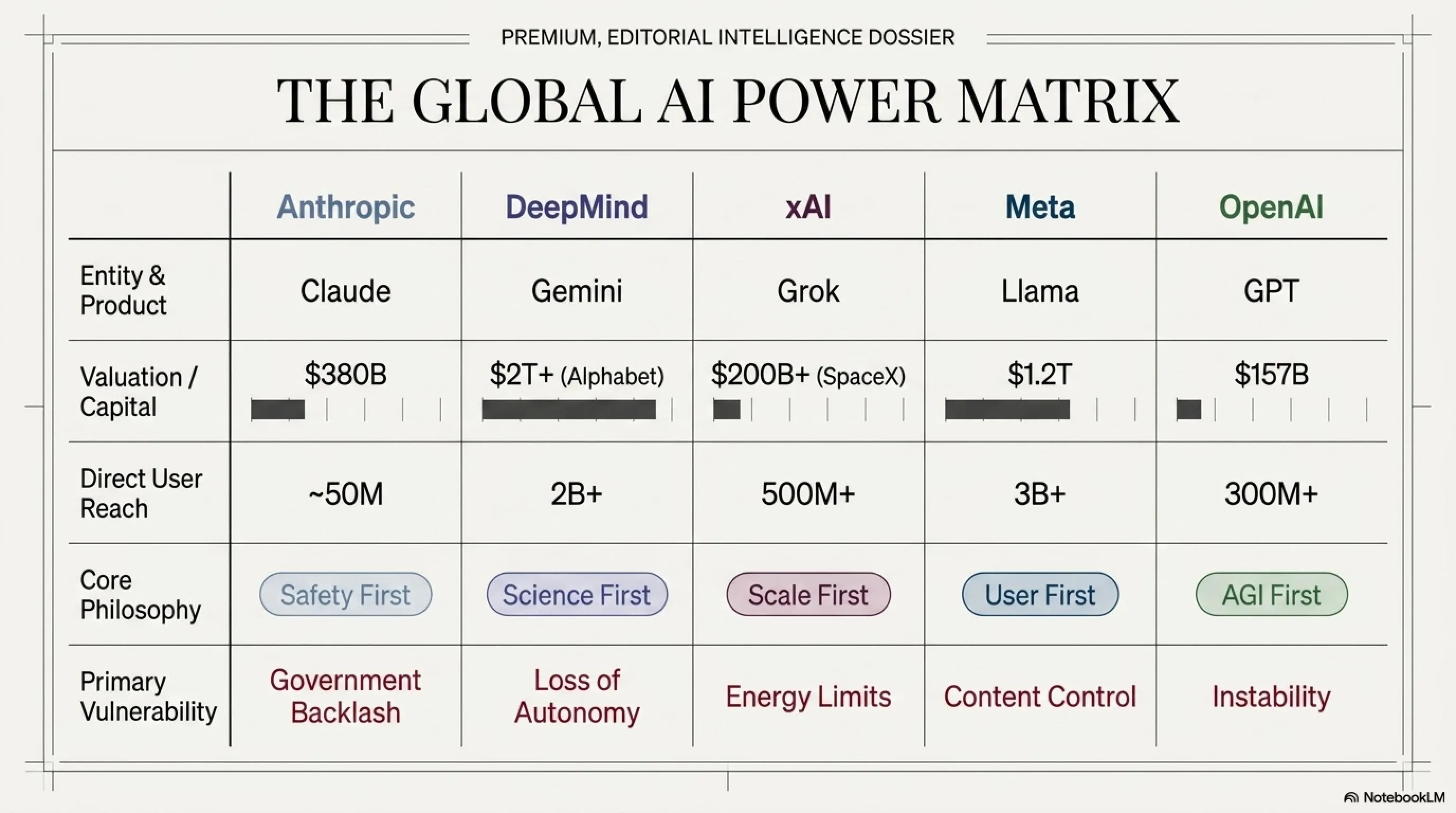
6. Power Comparison Table: 5 CEOs at a Glance 📊
7. Risks of Power Concentration & Role of Governments 🏛️
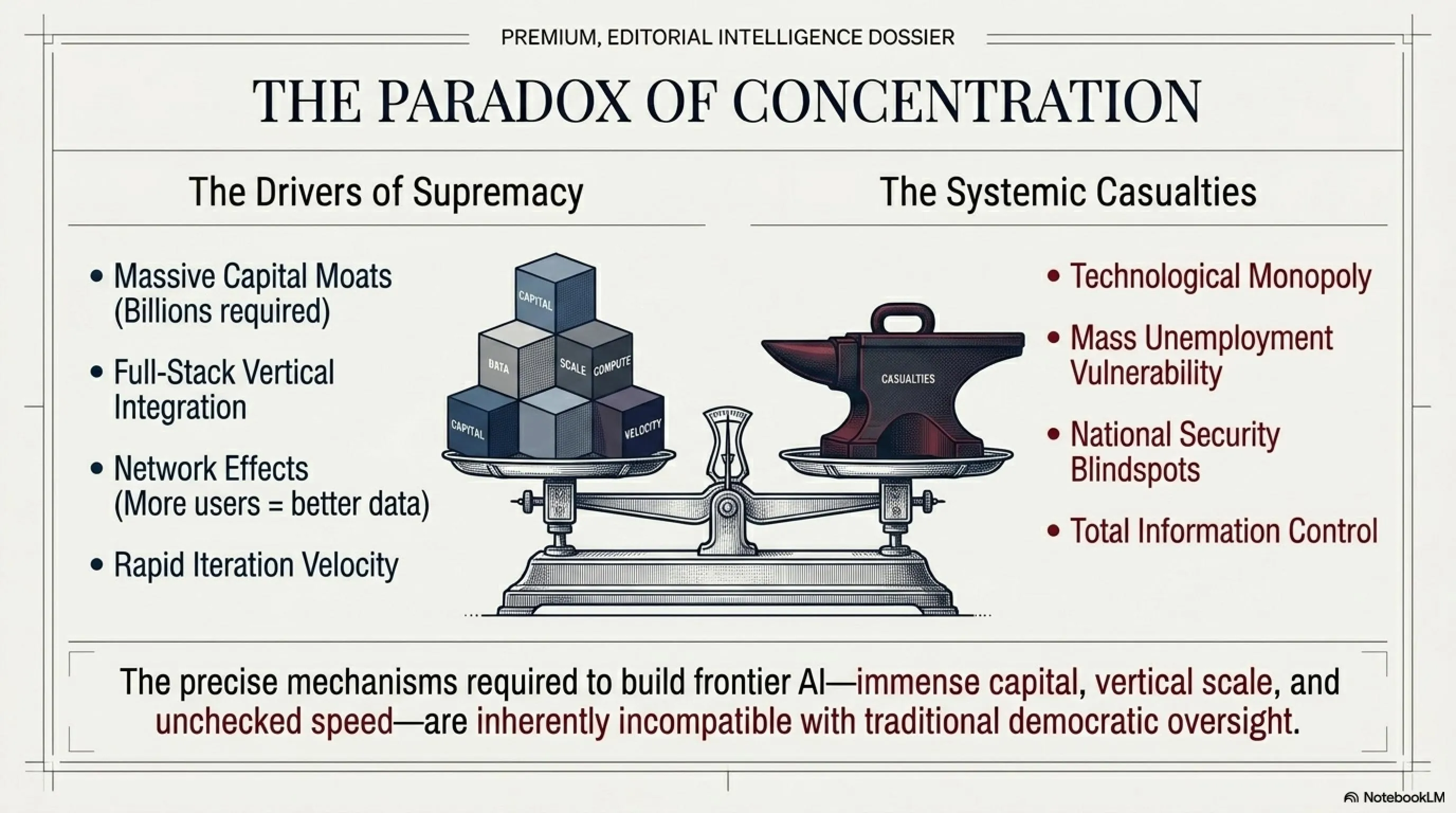
The concentration of AI power in the hands of five private CEOs poses serious risks: technological monopoly, information control, national security threats, and mass unemployment. Governments are debating AI regulation, but technology's speed outpaces legislation.
⚔️ Pros & Cons Battle of AI Power Concentration
✅ Pros
- High innovation speed
- Massive investment
- Attracting best talent
- Rapid scalability
- Healthy competition among 5 companies
❌ Cons
- Technological monopoly
- Information control
- National security threats
- Mass unemployment
- No accountability to public
❓ Frequently Asked Questions (FAQ)
Why do only 5 CEOs control AI?
Building advanced AI models requires massive capital (billions of dollars), powerful datacenters, and rare talent. Only a few large companies can gather these resources. Additionally, "network effects" make larger companies stronger - the more users they have, the more data they collect, and the better model they build.
Can governments control these 5 CEOs?
Theoretically yes, through regulation, taxation, and antitrust laws. But practically very difficult. These companies are multinational and can relocate to other countries. Also, technology's speed outpaces legislation. By the time governments pass a law, technology has changed.
Who should guard the guardians?
This is the philosophical question of the 21st century. Options include: (1) National governments - but which government? US? China? EU? (2) International organizations like the UN - but they're slow and inefficient. (3) Companies themselves through "self-regulation" - but can they be trusted? (4) The people through public pressure and boycotts - but is it enough? We probably need a combination of all these.
🎯 Final Conclusion: A Future in Five Hands
We are at a historical turning point. For the first time, the power of a transformative technology (AI) is concentrated in the hands of a handful of private individuals. Dario, Demis, Elon, Mark, and Sam are shaping not only AI models but the future of work, entertainment, communication, and even warfare.
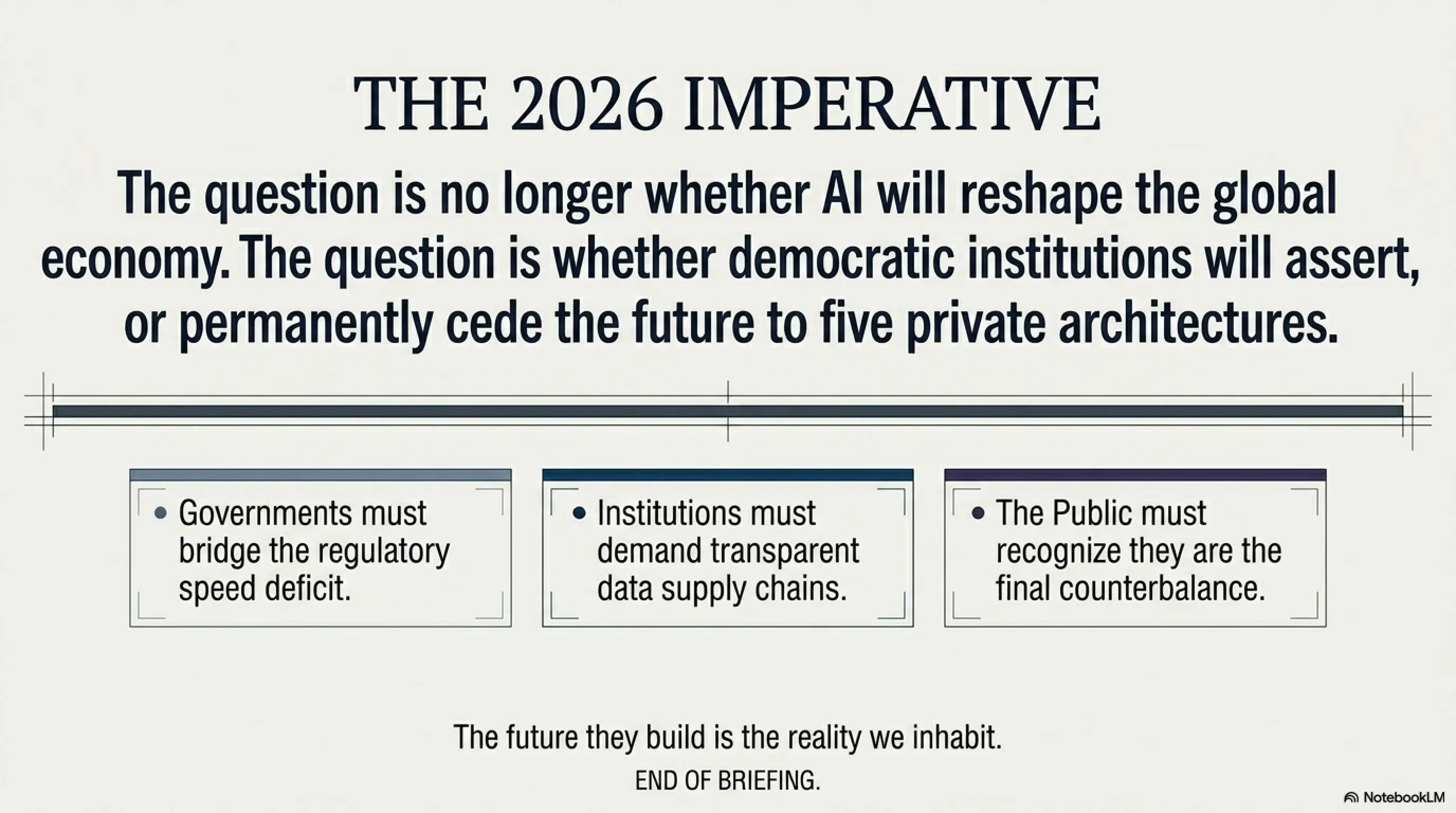
The question is no longer "Is AI powerful?" - the answer is clear: yes. The question is: "Who should control this power?" and "How can we ensure AI is used for humanity's benefit, not the profit of a few?"
There's no simple answer. But one thing is certain: we can't just watch. Governments, international organizations, and the people must actively participate in this debate. Because the future these 5 CEOs are building is all of our future.
🌐 Stay Connected With Us
For the latest tech, gaming, and gadget news, follow us on social media:
📚 Sources
The Economist, WEF Davos 2026, Fortune Magazine, Business Insider, Axios, Financial Times, TechCrunch, The Verge, Wikipedia, Academic Studies, Industry Reports
Research and Analysis: Tekin Editorial Team - April 2026
🌐 Stay Connected With Us 🎮✨
For the latest tech, gaming, and gadget news, follow us on our official social media channels: