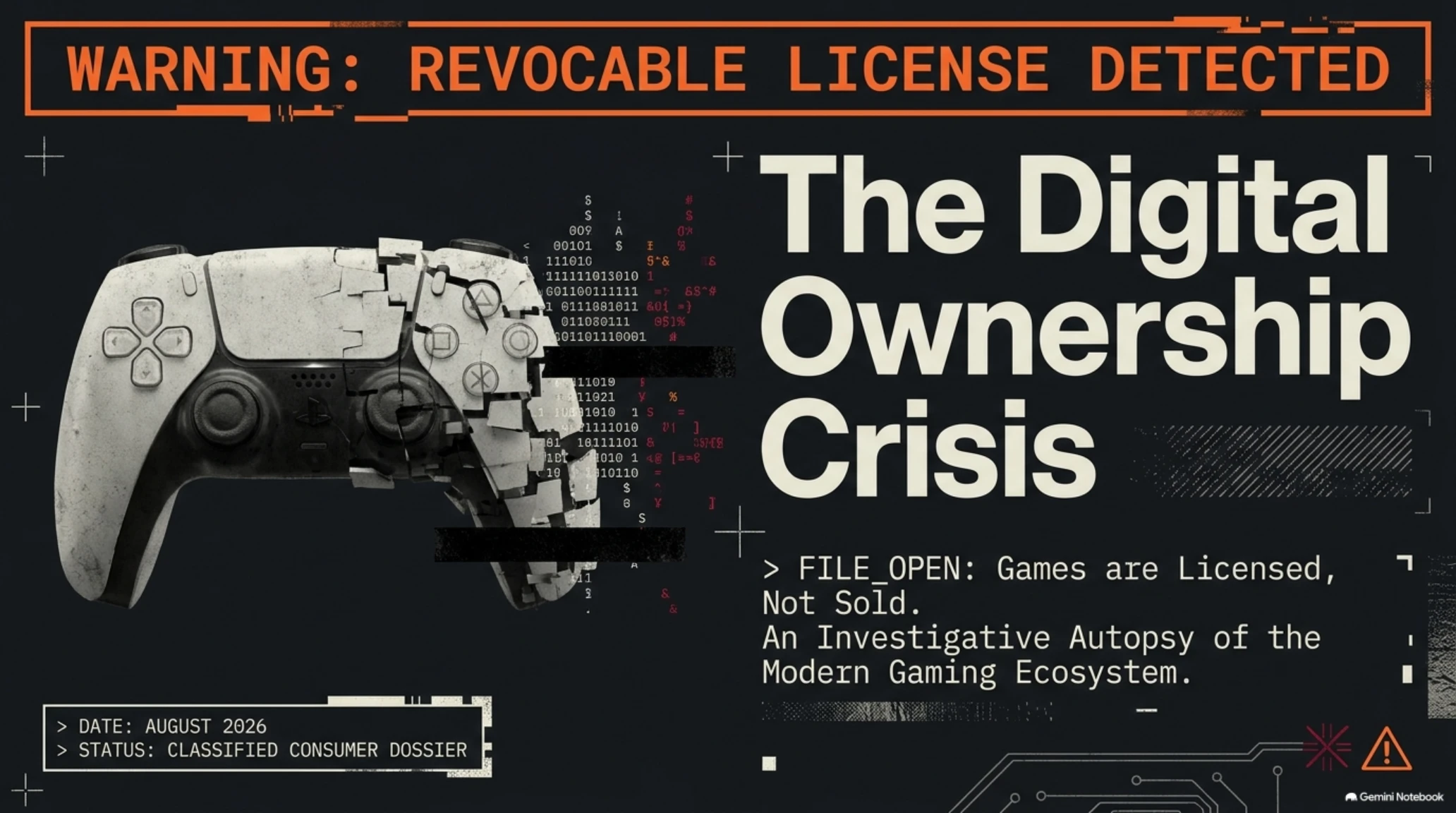
⚖️ Tekin Analysis | The Digital Ownership Crisis: Games Are Licensed, Not Sold
Tekin Analysis exclusive: A definitive legal investigation into Sony's explicit reminder that PS5 digital purchases grant revocable licenses. Analyzing AB 2426, EULAs, Steam disclaimers, #PSBlackout, and the demise of physical media.
- 🎮Sony's License Disclosure- Platform holders affirm that digital storefront checkouts grant conditional access, not ownership
- 🎧California AB 2426 & EULAs- New legislative mandates ban misleading 'Buy' buttons across digital storefronts
- 🚀The Ghost of The Crew- Historical precedents of publisher server shutdowns deleting purchased games
- 🗡️Steam, Xbox & Nintendo- Comparing licensing terms across major walled-garden gaming ecosystems
- 📰The Global #PSBlackout- Stop Destroying Videogames citizen initiatives fighting for consumer preservation
- ⚔️The Death of Physical Discs- The long-term danger of converting interactive art into corporate subscription silos
Over the past two decades, the aggressive migration of the video game industry from physical media (optical discs and ROM cartridges) toward cloud-tethered digital storefronts was celebrated as the ultimate commercial triumph of twenty-first-century software publishing. Frictionless access to massive digital catalogs, tempting seasonal sales, and the sheer convenience of instantaneous downloads persuaded hundreds of millions of consumers to retire their physical shelving, entrusting their gaming heritage and hard-earned capital entirely to remote «Cloud Libraries».
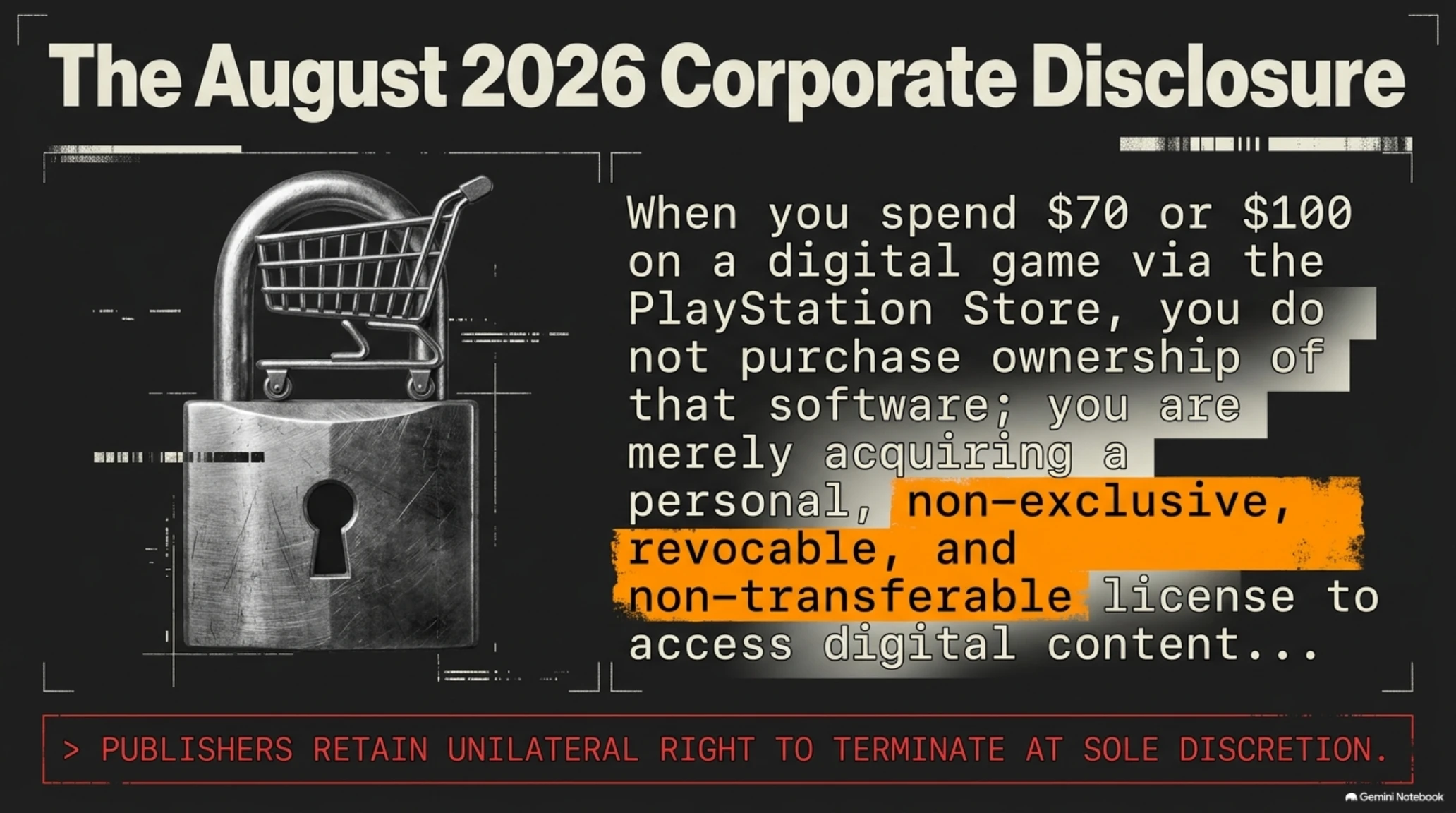
However, in August 2026, a formal public disclosure and platform terms reminder issued by Sony Interactive Entertainment to PlayStation 5 owners ignited a firestorm of consumer outrage across the global gaming community. In an updated terms-of-service advisory and checkout flow revision across the PlayStation Network (PSN), Sony delivered an unvarnished legal reminder: «When you spend $70 or $100 on a digital game via the PlayStation Store, you do not purchase ownership of that software; you are merely acquiring a personal, non-exclusive, revocable, and non-transferable license to access digital content, which Sony and third-party publishers retain the unilateral legal right to terminate, modify, or withdraw at their sole discretion.»
While such restrictive provisions have long lingered within dense End User License Agreements (EULAs), Sony's explicit framing—coinciding with the global #PSBlackout boycott and the systematic elimination of optical disc drives from tenth-generation hardware—confronted gamers with an inescapable modern reality: «You own nothing in the digital cloud; you are merely transient tenants leasing access from multinational platform landlords.»
AT A GLANCE | KEY REALITIES OF THE DIGITAL LICENSING CRISIS
- Sony explicitly affirmed that digital storefront transactions convey revocable licenses, not property
- California AB 2426 legislation forces platforms to abandon deceptive 'Buy' terminology at checkout
- Steam, Xbox, and Nintendo enforce identical revocable license structures within their respective EULAs
- Ubisoft's deletion of The Crew demonstrated how publishers can erase purchased games without compensation
- The EU 'Stop Destroying Videogames' citizen initiative demands legal guarantees for offline game preservation
- The impending shift to digital-only releases (e.g. GTA VI) cements total platform pricing monopolies
1. Autopsy of Sony's Disclosure: The Demise of Ownership & The Architecture of EULAs
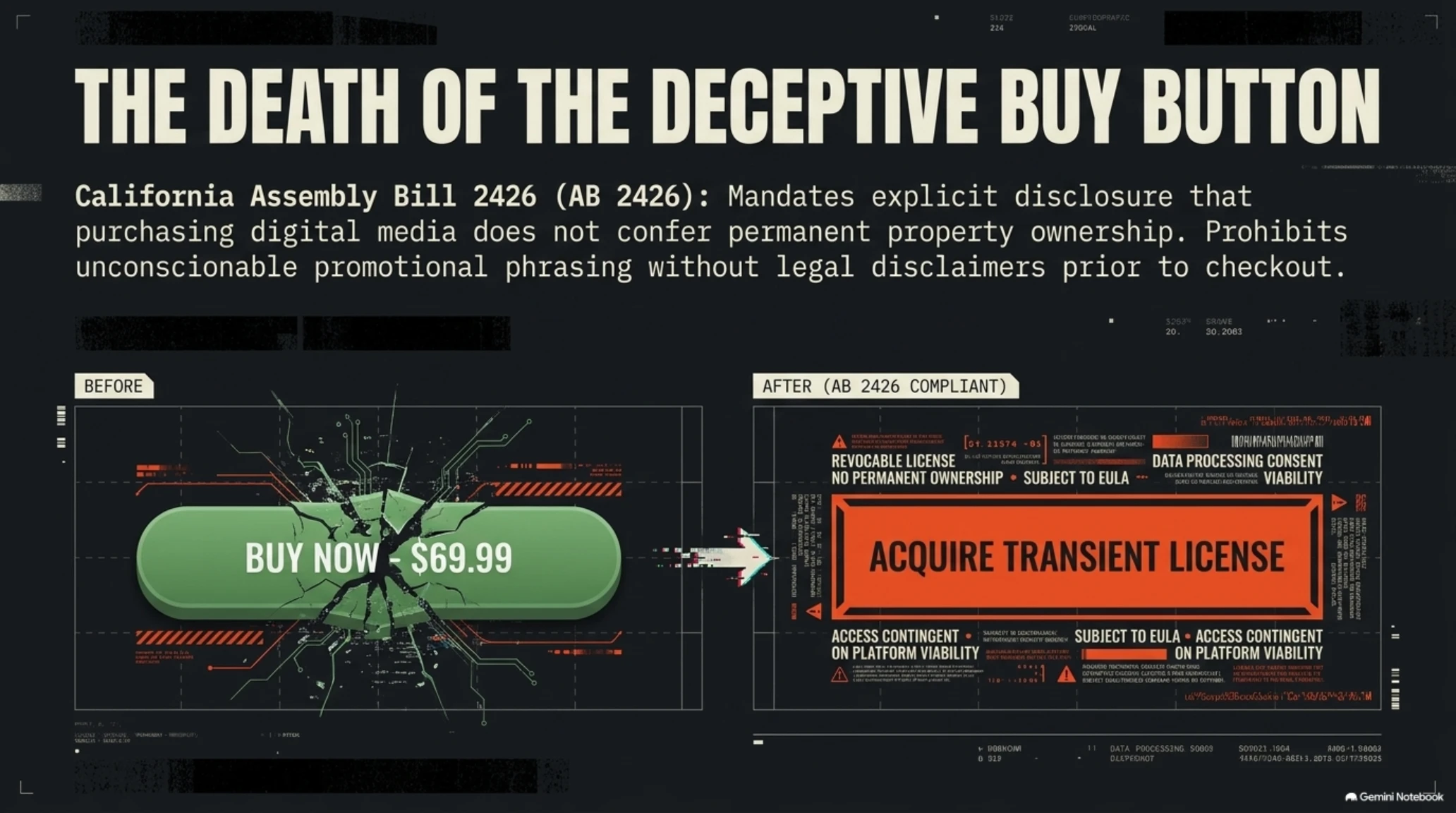
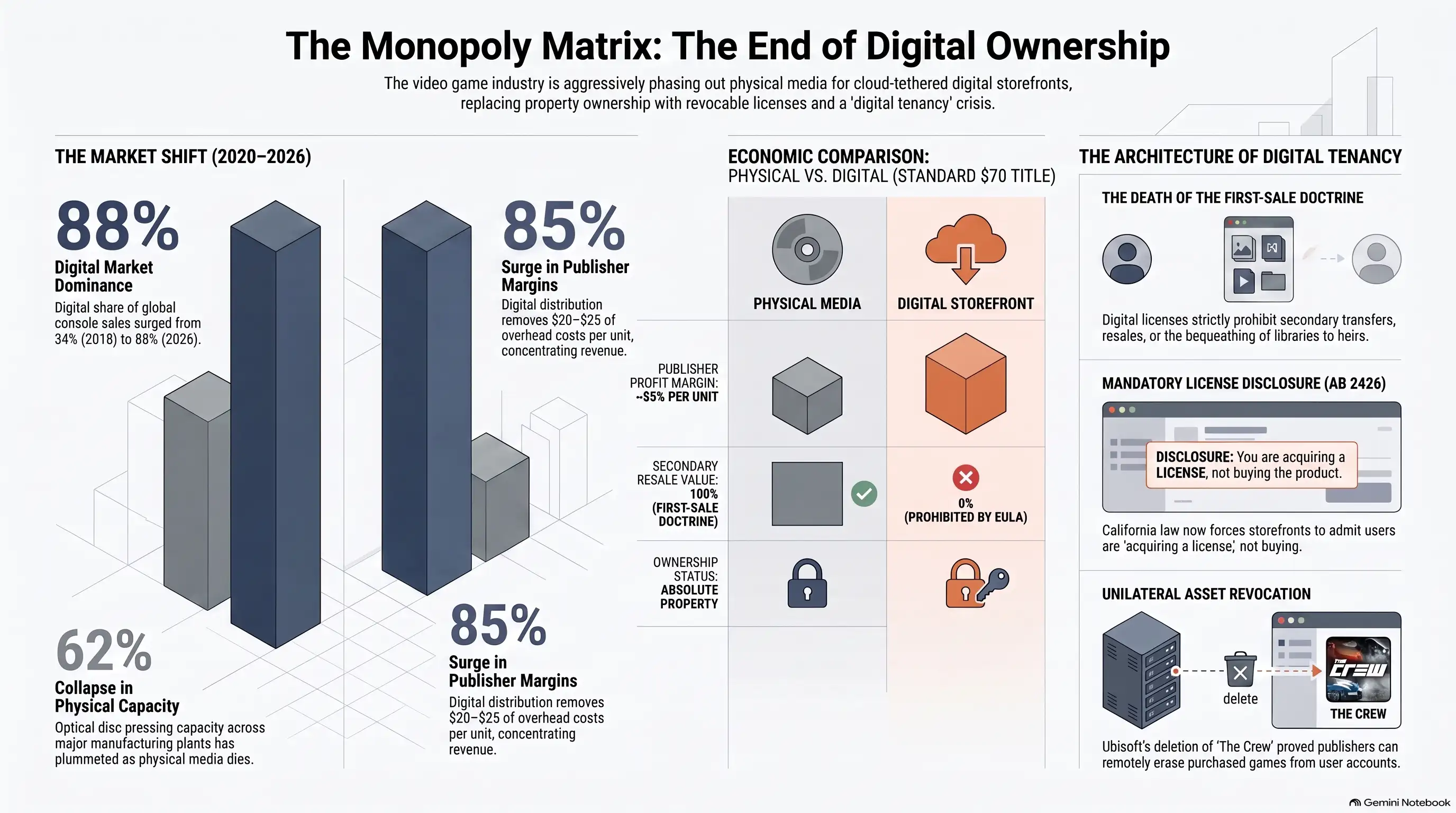
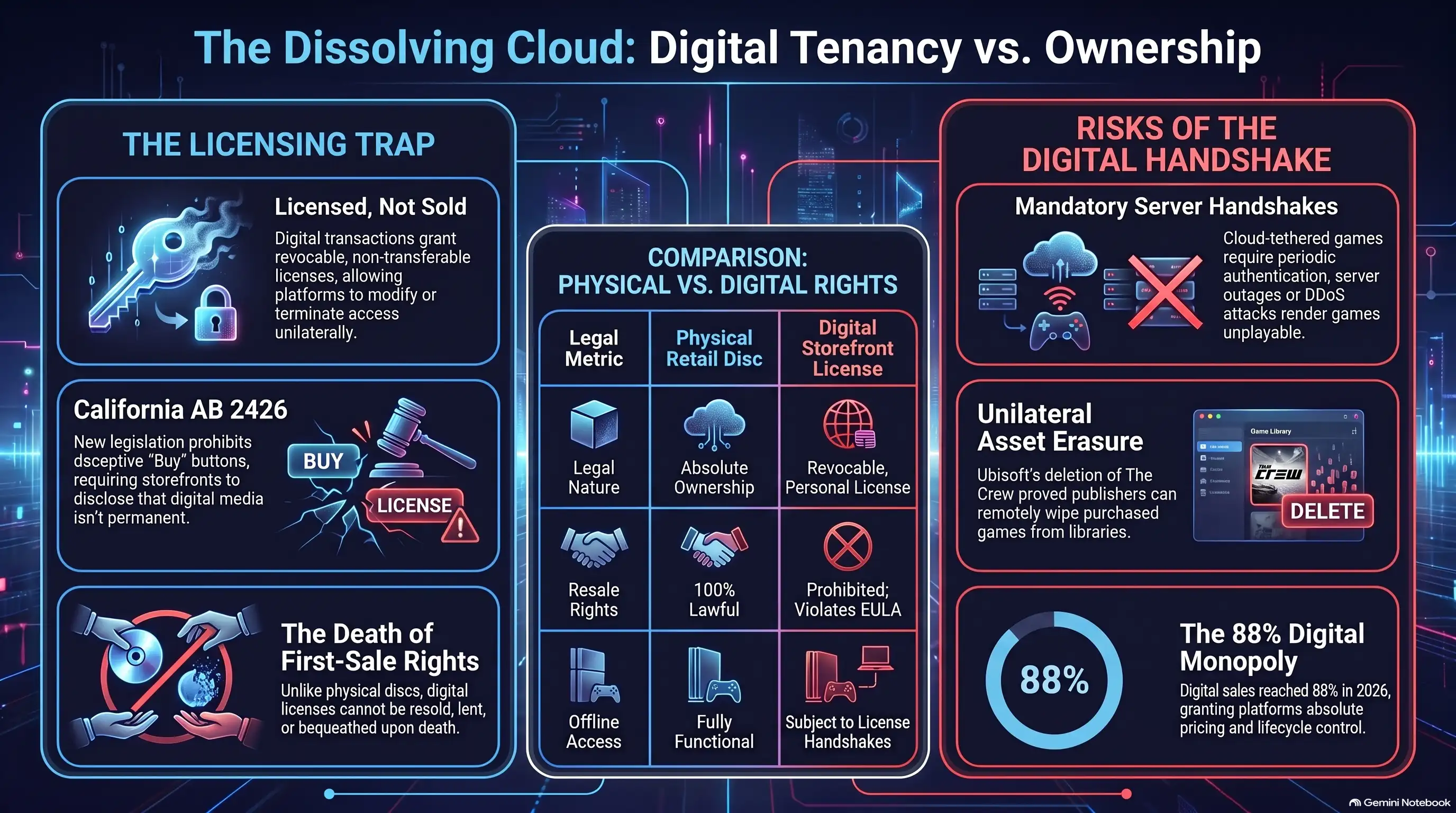
Sony's updated advisory is a direct compliance response to groundbreaking consumer protection legislation enacted in California and the European Union, most notably California Assembly Bill 2426 (AB 2426). This statute mandates that digital storefronts—spanning Sony, Steam, Apple, and Amazon—must explicitly disclose to consumers prior to transaction completion that purchasing digital media does not confer permanent property ownership, prohibiting deceptive promotional phrasing such as «Buy Now» without explicit qualifying disclaimers.
In response, Sony updated its checkout interface, supplementing traditional transaction buttons with explicit legal qualifiers such as «Acquire License» alongside mandatory terms pop-ups. From a jurisprudence standpoint, this distinction carries profound structural implications for consumers:
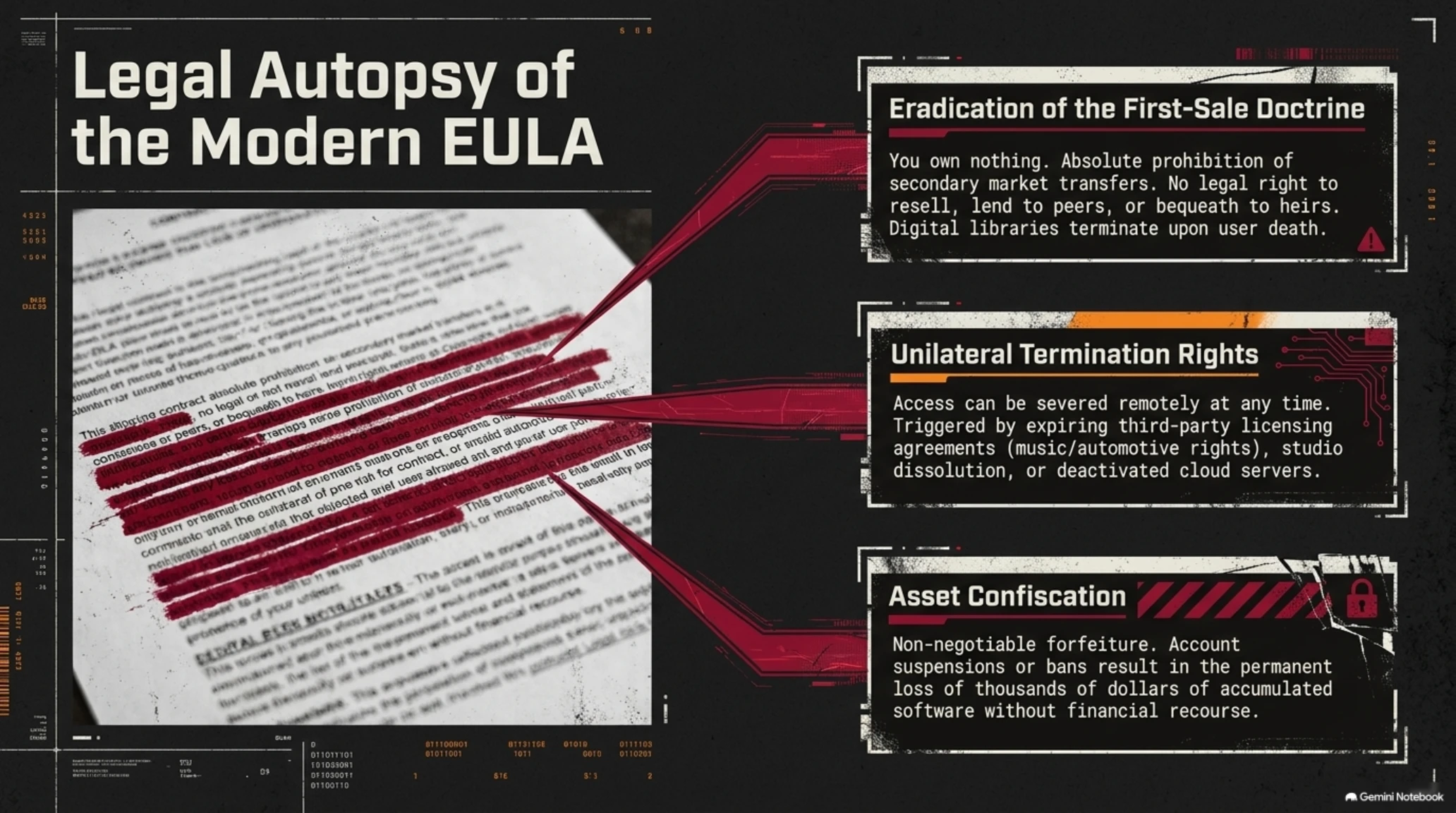
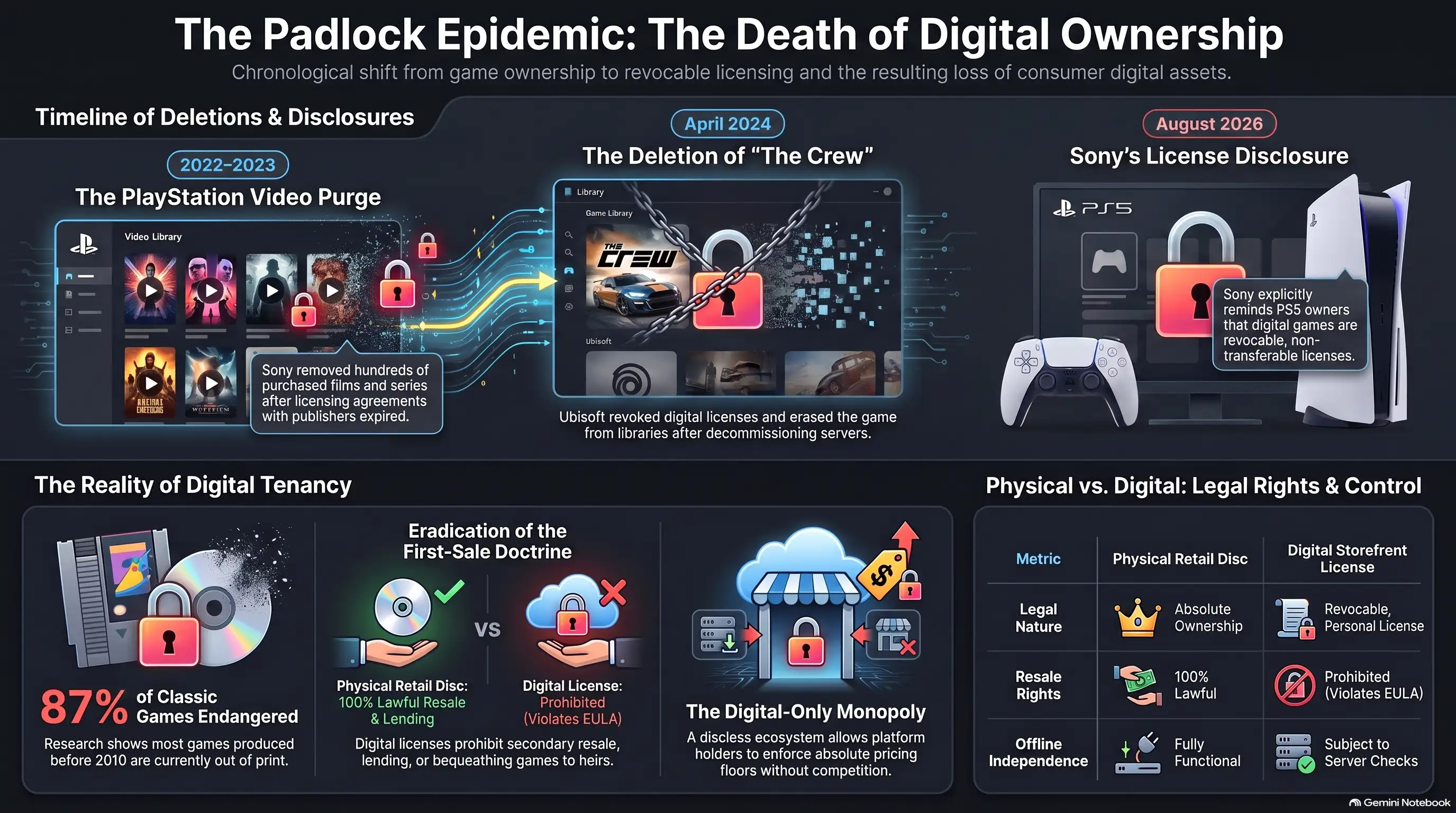
- Eradication of the First-Sale Doctrine: With physical media, the First-Sale Doctrine guarantees that upon purchasing a physical disc, the buyer possesses absolute ownership over that specific physical copy, retaining the lawful right to resell it on secondary markets, lend it to peers, or bequeath it to heirs. Digital licenses, by contrast, strictly prohibit secondary transfer, and upon an account holder's death, the entire software library legally terminates.
- Unilateral Termination Rights: Publishers retain the unrestricted prerogative to revoke software access if third-party licensing agreements expire (such as automotive licenses in *Forza* or soundtrack rights in *Grand Theft Auto*), if studios dissolve, or if cloud authentication servers are decommissioned.
- Account Banning & Asset Confiscation: If a user's PlayStation Network account is suspended or banned—whether due to terms-of-service disputes, moderation flags, or suspected console modifications—the user permanently forfeits access to thousands of dollars of accumulated software without recourse or financial compensation.
From an international jurisprudence and intellectual property perspective, the friction between unilateral adhesion contracts and statutory consumer protection has reached a watershed climax. Historically, courts presumed that clicking «I Agree» constituted informed contractual consent. However, landmark statutory developments in the European Union and California have established that embedding forfeiture clauses within non-negotiable consumer software agreements constitutes an unconscionable business practice that fails basic standards of consumer transparency.
From a behavioral consumer sociology perspective, converting interactive art into ephemeral subscription streams induces severe digital alienation and investment anxiety. When consumers recognize that hundreds of dollars invested in interactive experiences remain perpetually vulnerable to unilateral corporate erasure, psychological attachment to gaming heritage diminishes, eroding the cultural prestige of interactive media.
The conceptual rendering below visualizes the ephemeral nature of digital software licenses as game icons dissolve from a console's cloud interface:
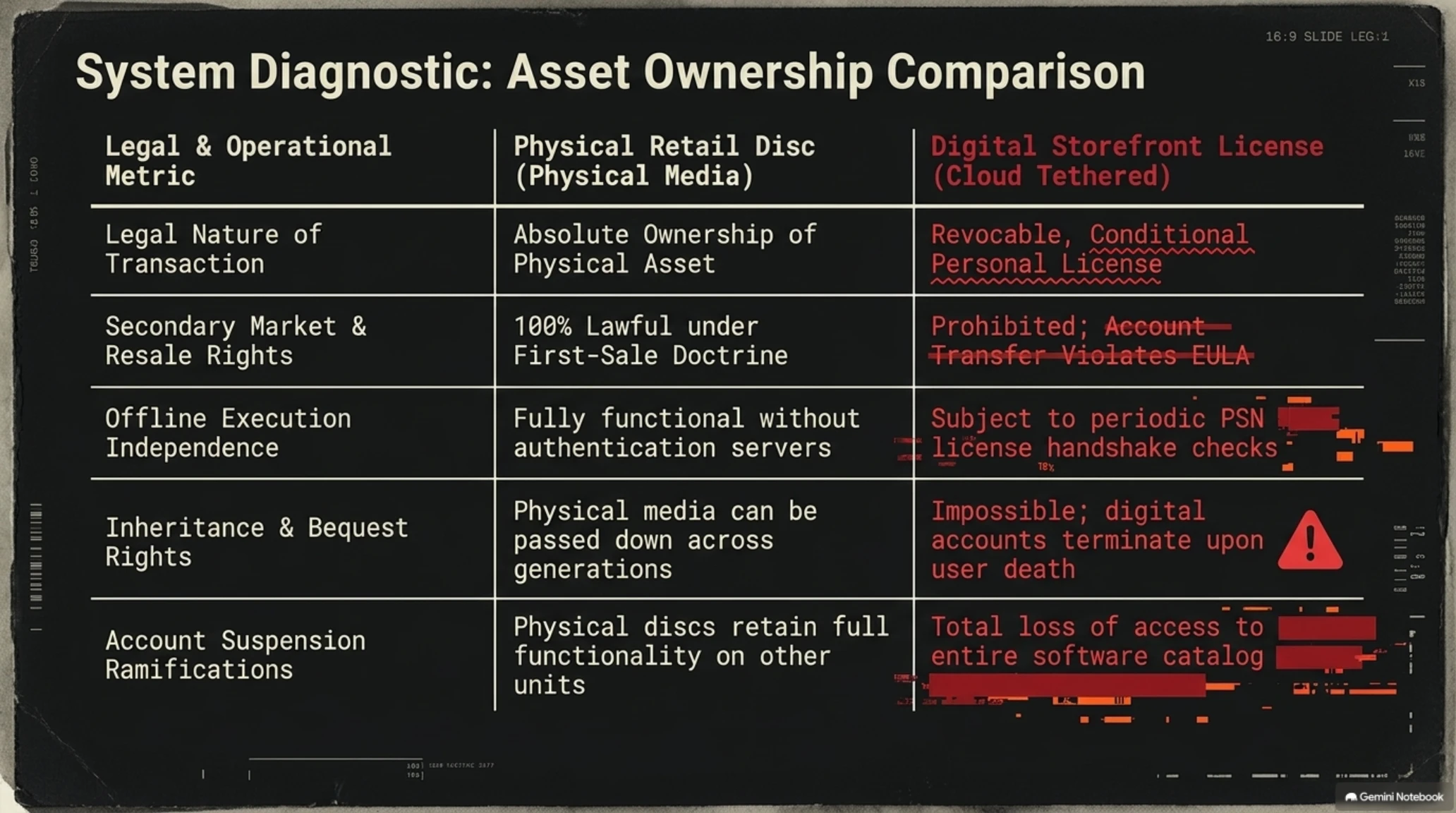
Comparative Legal Matrix: Physical Optical Media vs. Digital PS5 Licenses
| Legal & Operational Metric | Physical Retail Disc (Physical Media) | Digital Storefront License (Cloud Tethered) |
|---|---|---|
| Legal Nature of Transaction | Absolute Ownership of Physical Asset | Revocable, Conditional Personal License |
| Secondary Market & Resale Rights | 100% Lawful under First-Sale Doctrine | Prohibited; Account Transfer Violates EULA |
| Offline Execution Independence | Fully functional without authentication servers | Subject to periodic PSN license handshake checks |
| Inheritance & Bequest Rights | Physical media can be passed down across generations | Impossible; digital accounts terminate upon user death |
| Account Suspension Ramifications | Physical discs retain full functionality on other units | Total loss of access to entire software catalog |
2. The Revocation Precedent: Lessons from the Deletion of The Crew and PlayStation Video Purges
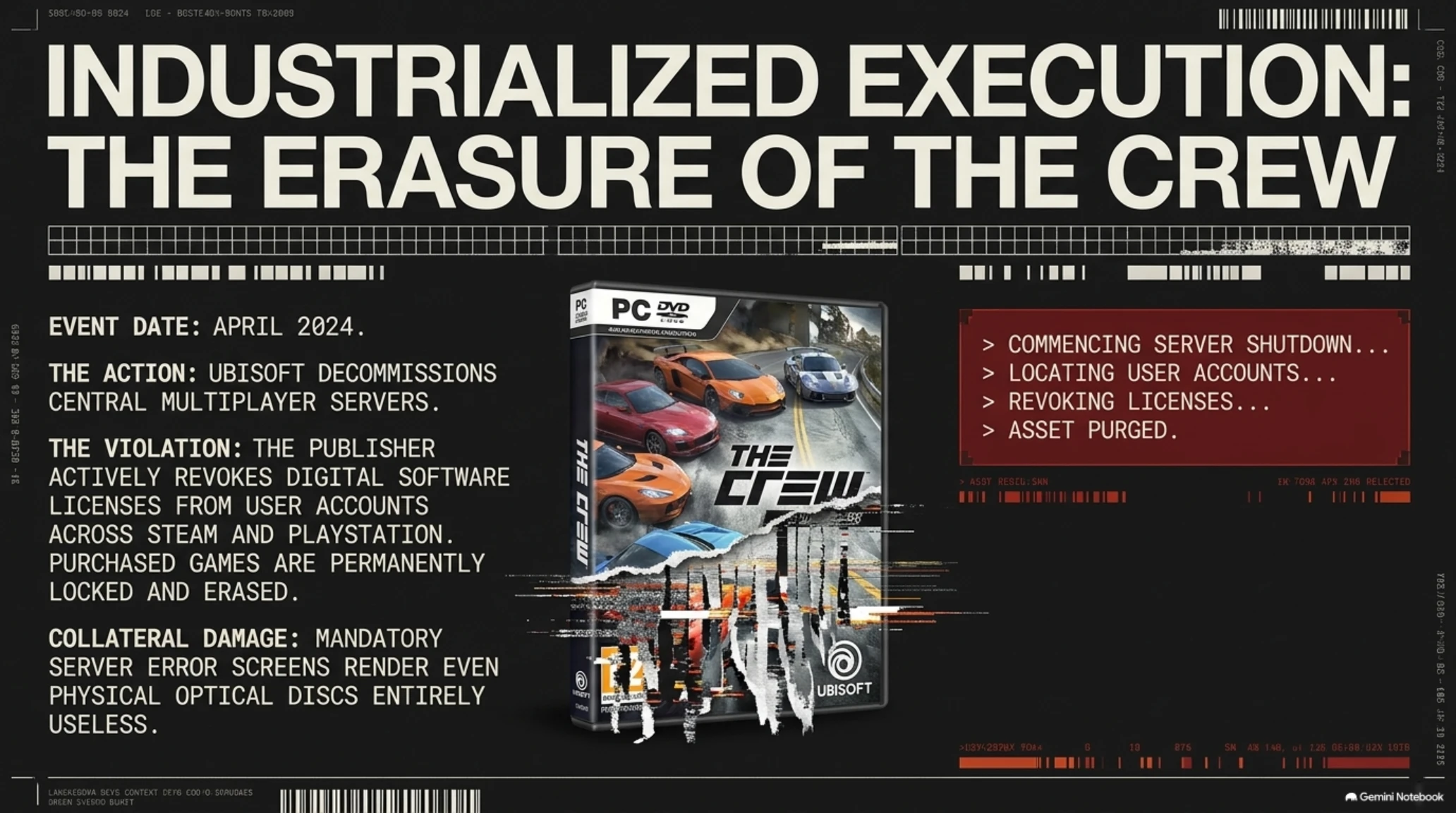
Consumer anxiety surrounding digital licensing is grounded in empirical precedent. The most egregious manifestation of digital asset erasure occurred in early 2024 with Ubisoft's open-world racing title, The Crew.
Upon decommissioning the title's central multiplayer servers, Ubisoft did not merely disable online matchmaking; the publisher actively revoked the digital software license from user accounts across Steam and PlayStation, permanently locking and erasing the game from the libraries of legitimate paying customers. Even consumers who held physical discs encountered mandatory server error screens that rendered the optical media entirely useless—marking the first industrialized execution of a major video game by its own publisher.
Sony possesses its own history of digital content revocations:
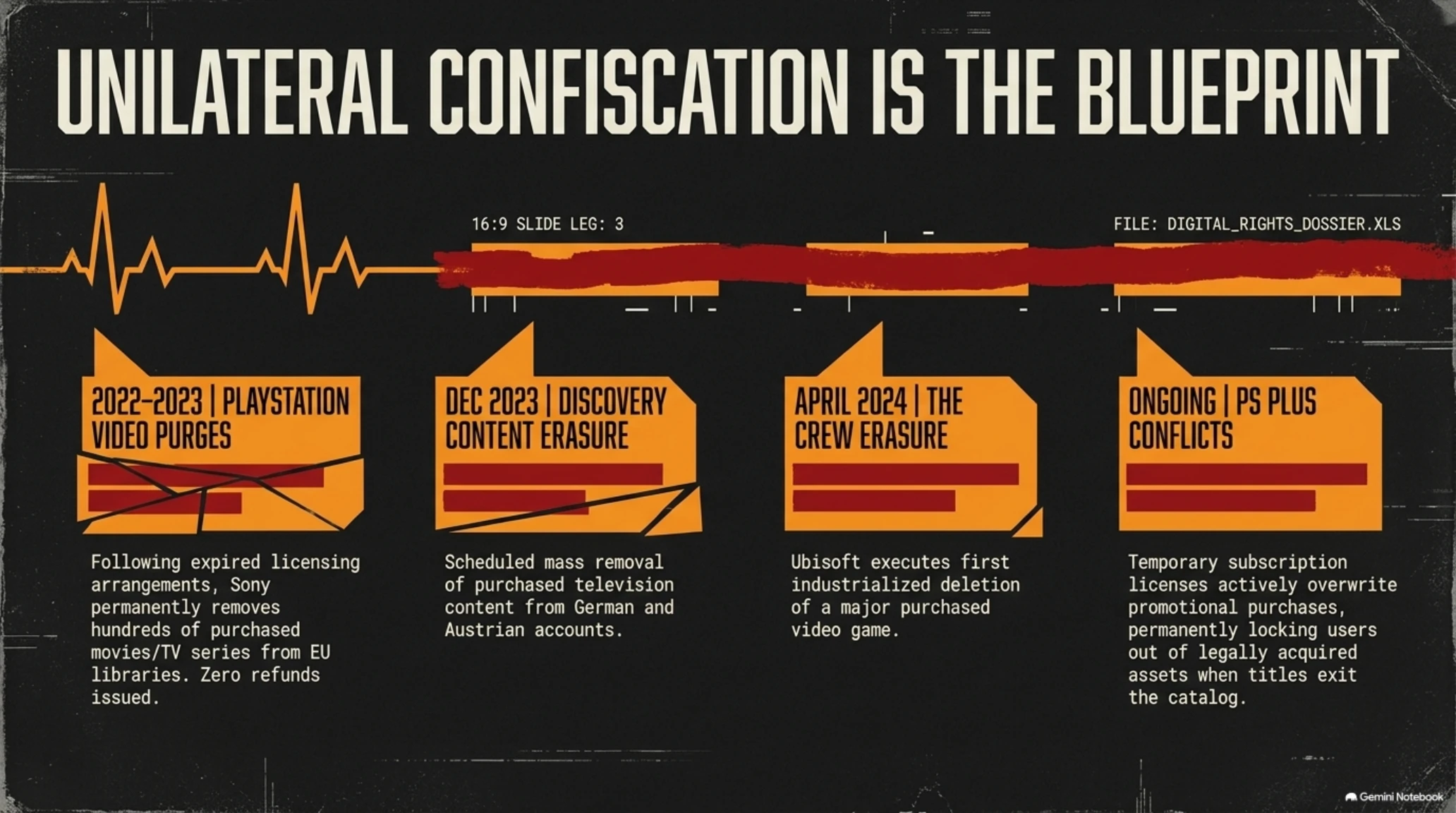
- PlayStation Video Content Purges: In 2022 and 2023, following the expiration of licensing arrangements with StudioCanal and Warner Bros., Sony permanently removed hundreds of purchased movies and television series from user libraries across European territories without issuing financial refunds.
- PlayStation Plus Licensing Conflicts: Thousands of users have documented instances where purchasing a title during promotional sales resulted in irreversible licensing conflicts when the title subsequently entered and exited the PlayStation Plus Extra catalog, effectively locking users out of their purchased assets.
The investigative documentary below explores the legal aftermath of The Crew's deletion and the rising global movement against digital software destruction:
Financial forensics reveal that the transition to digital distribution expanded publisher operating margins by over 60% per unit. Under traditional retail economics, disc stamping, packaging, freight logistics, and retailer margins consumed approximately $20 to $25 of a $70 retail price. In digital storefronts, these overhead costs evaporate, concentrating revenue directly between platform holders and publishers. Yet, rather than passing these massive logistics savings to players through reduced price points, publishers maintained price parity while systematically eliminating secondary resale value.
The conceptual rendering below depicts the dreaded digital padlock icon superimposed over purchased video game titles on a modern user interface:
Historical Timeline: Key Digital License Revocations & Legislative Milestones
• December 2023: Sony announces scheduled removal of purchased Discovery television content from German/Austrian accounts.
• April 2024: Ubisoft decommissions The Crew servers and permanently revokes digital licenses from player accounts.
• September 2024: California passes Assembly Bill 2426 outlawing deceptive 'Buy' labeling on digital storefronts.
• 2025–2026: Steam, PlayStation, and Xbox deploy explicit license disclosure pop-ups at all digital checkout touchpoints.
3. Platform Comparison: How Steam, Xbox, GOG, and Nintendo Handle Digital Rights
While Sony occupies the center of current public criticism, examining the broader software distribution landscape demonstrates that the entire commercial gaming infrastructure is built upon identical licensing paradigms:
Comparative Analysis: Digital Licensing Terms Across Major Global Gaming Ecosystems
| Gaming Platform | EULA Licensing Classification | Server Decommissioning & DRM Policy | Offline Backup Independence |
|---|---|---|---|
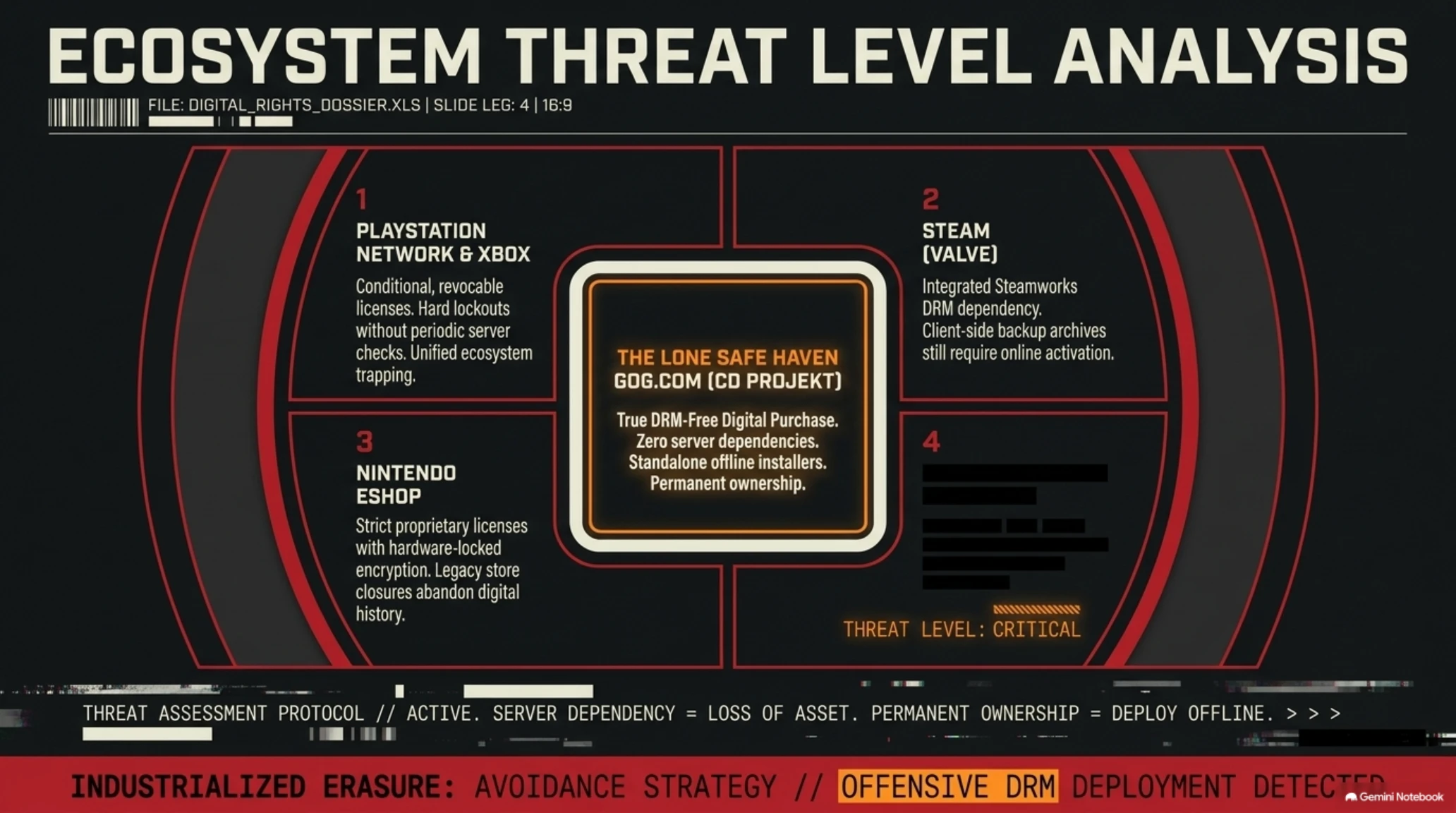
| PlayStation Network (Sony) | Personal, Revocable License | Hard lockout without periodic server check | Encrypted storage; no direct binary access |
| Steam (Valve Corporation) | Subscriber Agreement License | Integrated Steamworks DRM dependency | Client-side backup archives requiring activation |
| GOG.com (CD Projekt) | True DRM-Free Digital Purchase | Zero server dependencies or online DRM | Standalone offline installers; permanent ownership |
| Xbox Network (Microsoft) | Conditional Software License | Home Console offline play supported | Unified licensing spanning PC and console |
| Nintendo eShop (Nintendo) | Strict Proprietary License | Legacy store closures (Wii U / 3DS) | Hardware-locked encryption on optical/flash media |
Across the entire digital landscape, GOG.com (operated by CD Projekt) remains the sole mainstream storefront that truly «sells» video games to consumers, providing fully DRM-free offline installation binaries that function permanently without client dependencies or network connectivity.
The conceptual rendering below visualizes the contrast between closed, encrypted cloud walled-gardens and open, DRM-free offline preservation archives:
4. The Global #PSBlackout Backlash & The European Citizens' Initiative
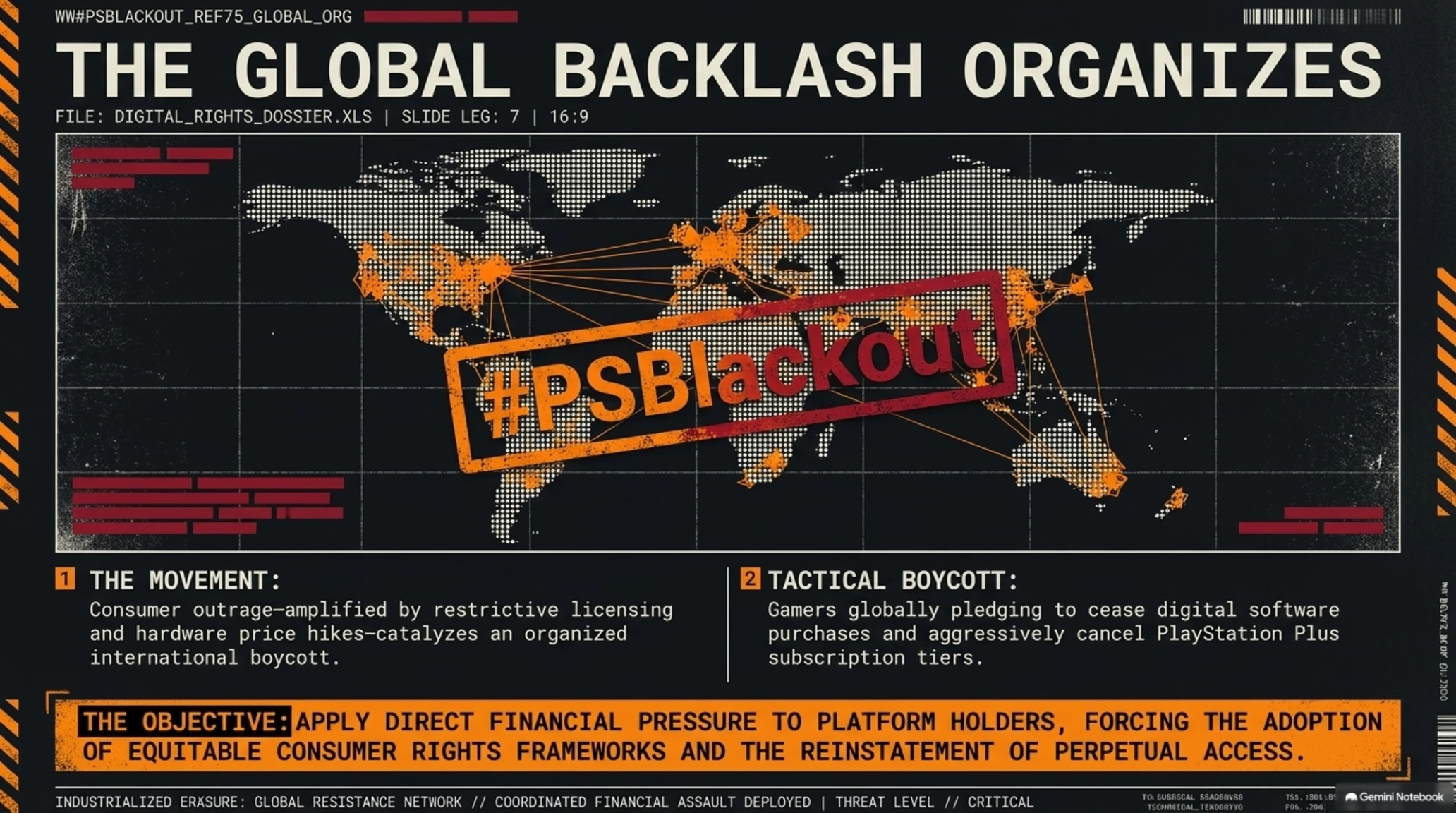
Consumer outrage over digital licensing—amplified by recent console and accessory price hikes—has catalyzed an organized international boycott movement operating under the #PSBlackout banner. Participating gamers have pledged to cease digital software purchases, cancel PlayStation Plus subscription tiers, and pressure platform holders to adopt equitable consumer rights frameworks.
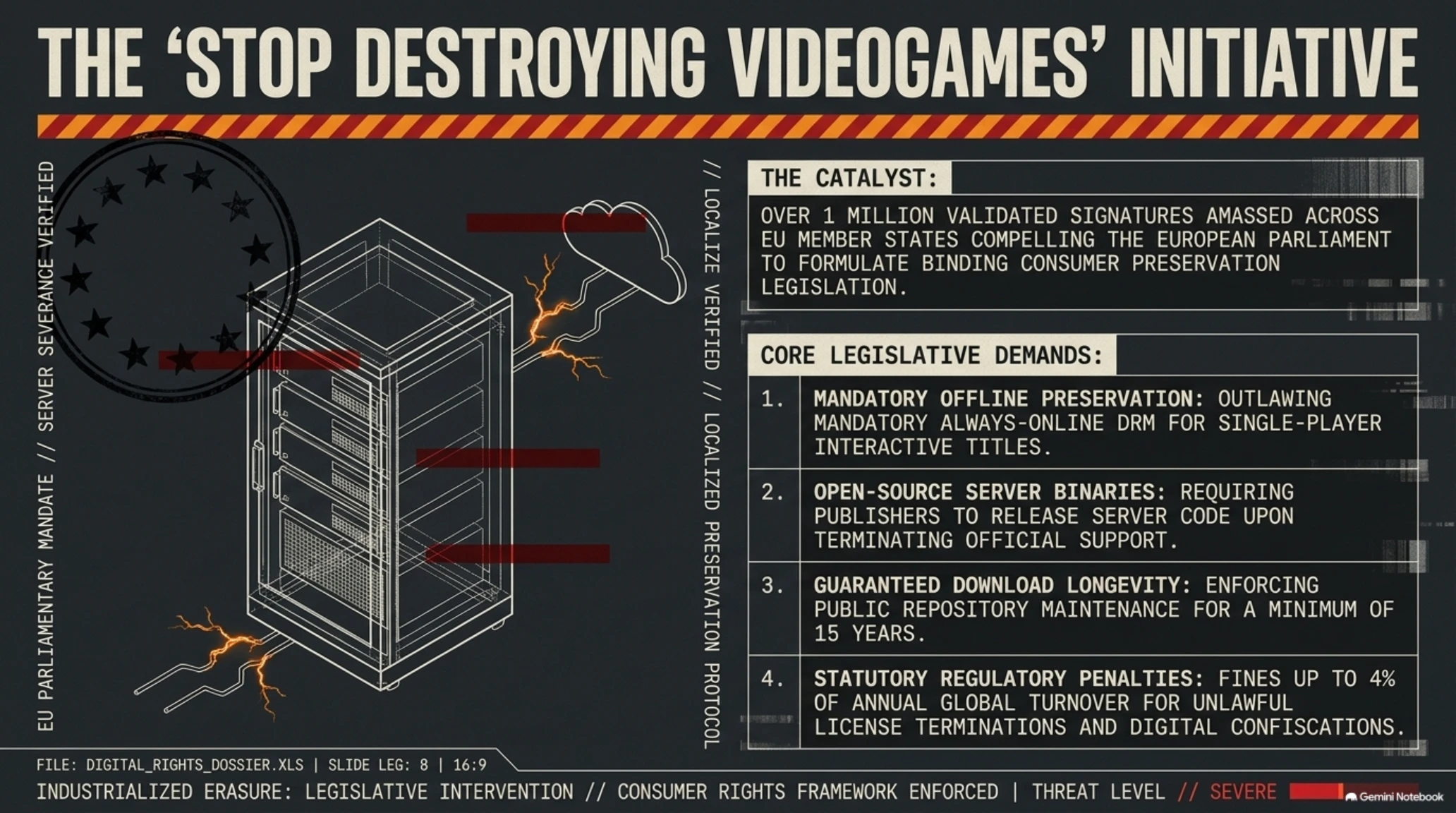
Simultaneously, the European Citizens' Initiative «Stop Destroying Videogames» has amassed over one million validated signatures across European Union member states, compelling the European Parliament to formulate binding legislation requiring publishers to:
- Provide functional offline patches or publish standalone server binaries upon decommissioning online multiplayer infrastructure.
- Guarantee perpetual single-player execution capabilities completely decoupled from remote DRM authentication servers.
- Prohibit digital storefronts from silently revoking previously acquired software without offering full statutory financial restitution.
From a network architecture standpoint, tethering offline single-player experiences to periodic cloud DRM handshakes introduces critical points of failure. During routine maintenance outages or distributed denial-of-service (DDoS) incidents targeting PlayStation Network authentication nodes, locally installed single-player games on a user's internal SSD become completely unplayable due to failed cryptographic license verifications—an egregious engineering flaw that penalizes legitimate paying consumers.
The conceptual rendering below illustrates digital consumer protests and legal challenges confronting corporate entertainment headquarters:
Core Legislative Demands of the European Union Video Game Preservation Mandate
• Open-Source Server Binaries: Requiring publishers to release server code upon terminating official support.
• Guaranteed Download Longevity: Enforcing public download repository maintenance for a minimum of 15 years.
• Statutory Regulatory Penalties: Fines up to 4% of annual global turnover for unlawful license terminations.
📚 Classified & Related Dossiers in TekinGame
If you wish to explore beyond this report and delve into cybernetic frontiers and autonomous AI architectures, do not miss these three exclusive deep-dives in the Tekin Garage:
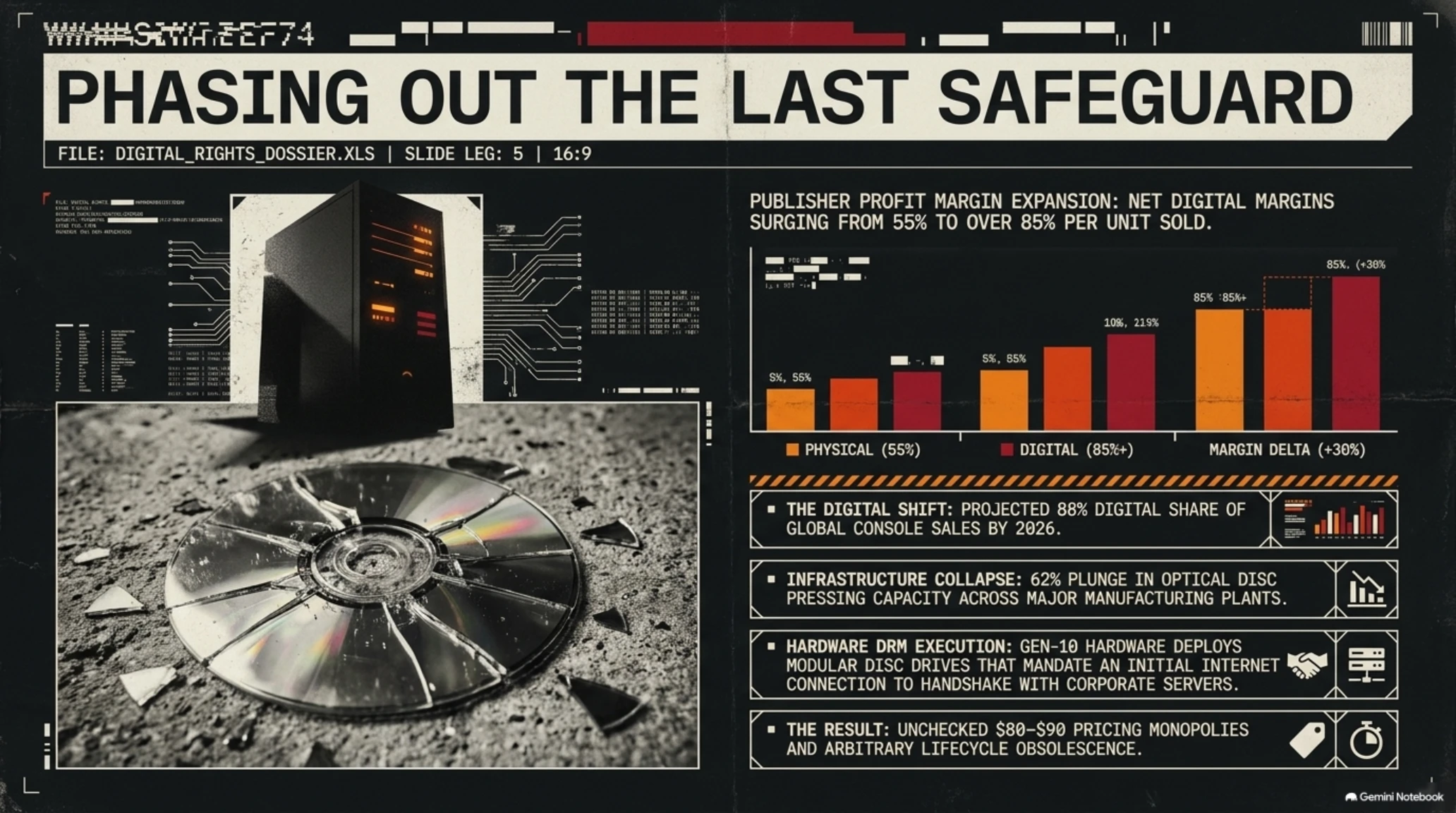
5. The Phasing Out of Optical Discs: The Push Toward a Digital-Only Monopoly
The most alarming dimension of platform strategy is the deliberate, phased elimination of physical retail media. With the introduction of modular disc drives on the PlayStation 5 Slim (which mandate an initial internet connection to handshake with Sony servers!) and persistent industry rumors of digital-only launches for monumental releases like Grand Theft Auto VI, consumers face the imminent loss of their last physical safeguard.
A completely discless gaming ecosystem yields absolute platform control:
- Unchecked Pricing Monopolies: Platform holders can enforce rigid $80 or $90 price floors across an entire console generation without facing price competition from secondary markets or retail disc liquidations.
- Arbitrary Lifecycle Obsolescence: Platform holders can instantly render an entire generation's software library unplayable simply by shutting down legacy download servers.
The conceptual rendering below highlights the visual collision between legacy physical optical media and streaming cloud monopolies:
The Decline of Physical Media: Digital Market Share Statistics (2020–2026)
• Optical Disc Pressing Capacity: Plunging by 62% across major optical manufacturing plants.
• Publisher Profit Margin Expansion: Net digital margins surging from 55% to over 85% per unit sold.
• Online Drive Pairing Restrictions: Modular console drives disabled if authentication servers fail.
6. Long-Term Cultural Ramifications: Preserving Interactive Art for Posterity
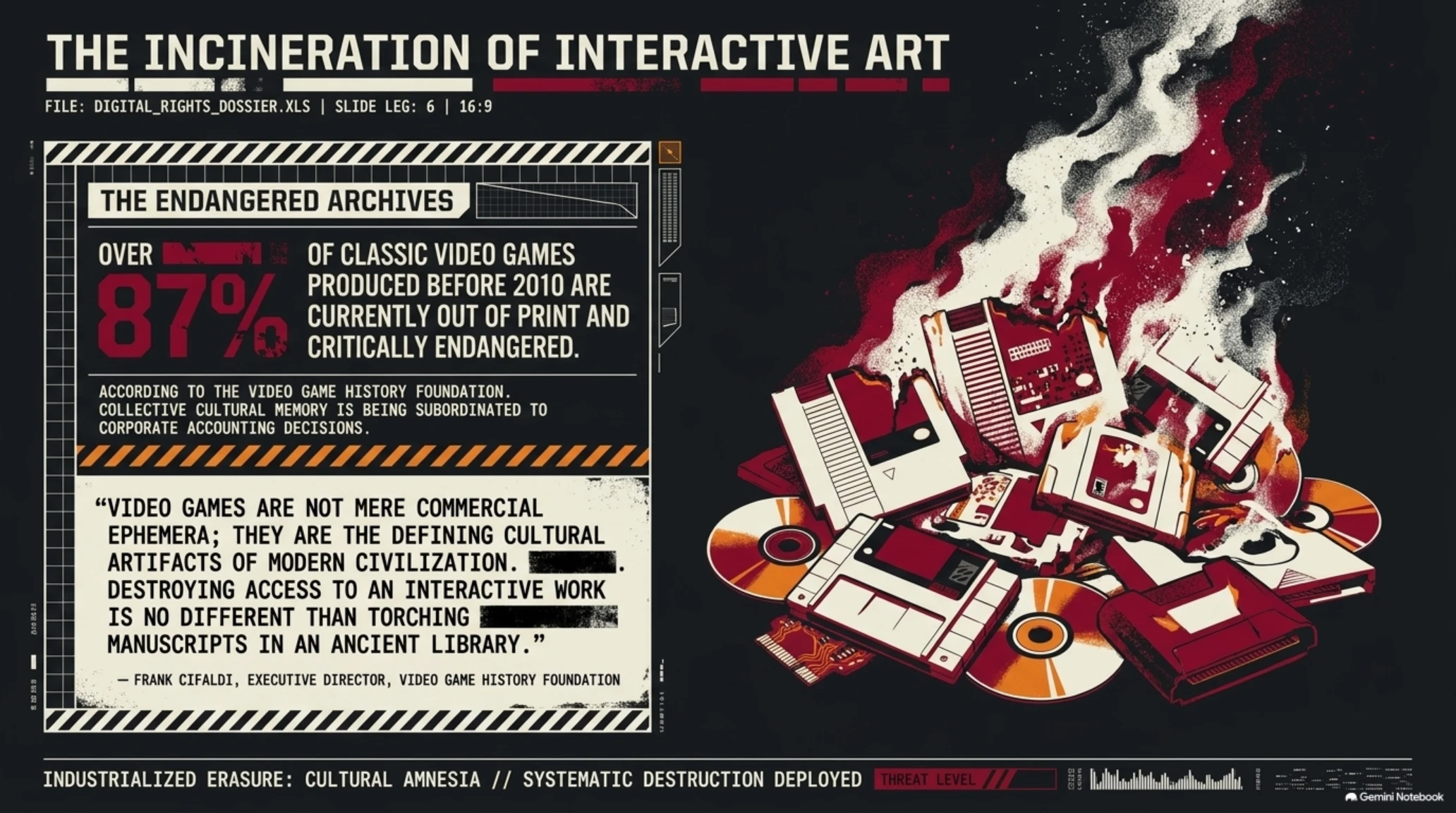
Beyond immediate consumer financial injury, the digital ownership crisis threatens the very preservation of video game history. According to comprehensive research published by the Video Game History Foundation, over 87% of classic video games produced before 2010 are currently out of print and critically endangered.
When interactive creative works exist exclusively as revocable cloud licenses, our collective cultural memory becomes subordinate to corporate accounting decisions, risking the permanent loss of historical masterworks.
Pioneering Community Initiatives in Digital Video Game Code Preservation
• Open-Source Server Emulation: Community resurrection of decommissioned MMOs including Star Wars Galaxies and City of Heroes.
• Free Software Foundation (FSF): Drafting the Defective by Design manifesto fighting against restrictive corporate DRM locks.
The conceptual rendering below depicts an archival digital museum safeguarding interactive game history within decentralized cloud vaults:
7. Consumer Countermeasures: How Players Can Protect Their Game Libraries
In response to platform enclosure, players must adopt proactive strategies to safeguard their software collections:
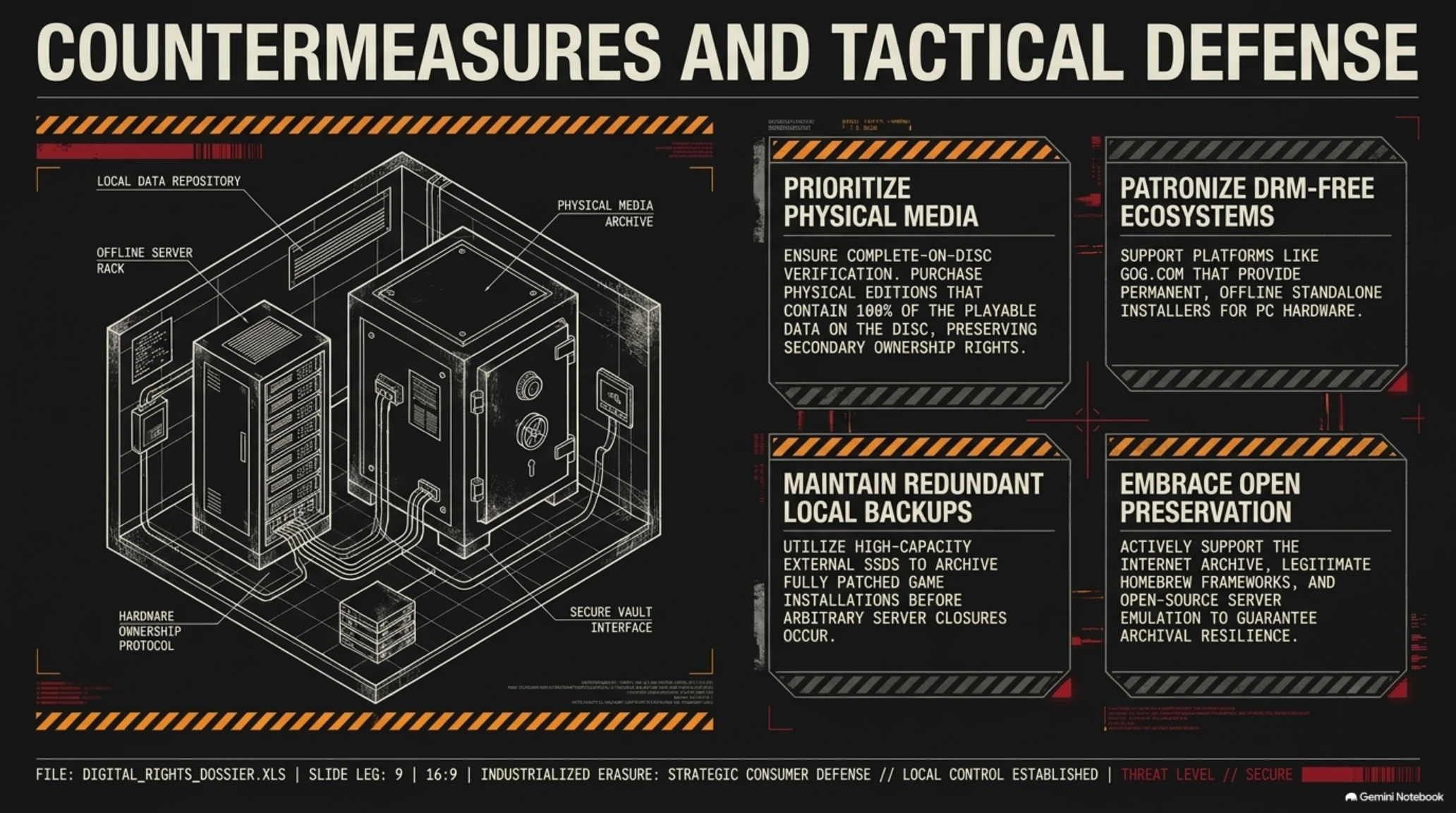
- Prioritize Physical Media Whenever Viable: Purchasing physical retail discs preserves secondary ownership rights and ensures offline launch capabilities.
- Patronize DRM-Free Ecosystems Like GOG: Support platforms that provide permanent, offline standalone installers for PC hardware.
- Maintain Redundant Local Backups: Utilize external solid-state storage to archive fully patched game installations before server closures occur.
- Actively Support Legislative Reform: Participate in citizen petitions and consumer advocacy initiatives demanding statutory digital ownership rights.
The conceptual rendering below visualizes an enthusiast preservation workstation equipped with physical archives and secure offline storage arrays:
Strategic Consumer Playbook: Mitigating Digital License Revocation Risks
• Zero Wallet Balances: Keeping digital wallet balances minimal to prevent financial freezing during account disputes.
• Robust Multi-Factor Security: Enabling hardware-token 2FA to preclude account theft and asset loss.
• Embrace Open Preservation: Supporting legitimate homebrew and emulation frameworks for archival resilience.
The investigative interview below explores consumer rights strategies and technical archiving methodologies with industry legal experts:
Strategic Conclusion: The Crossroads Between Digital Tenancy and Consumer Rights
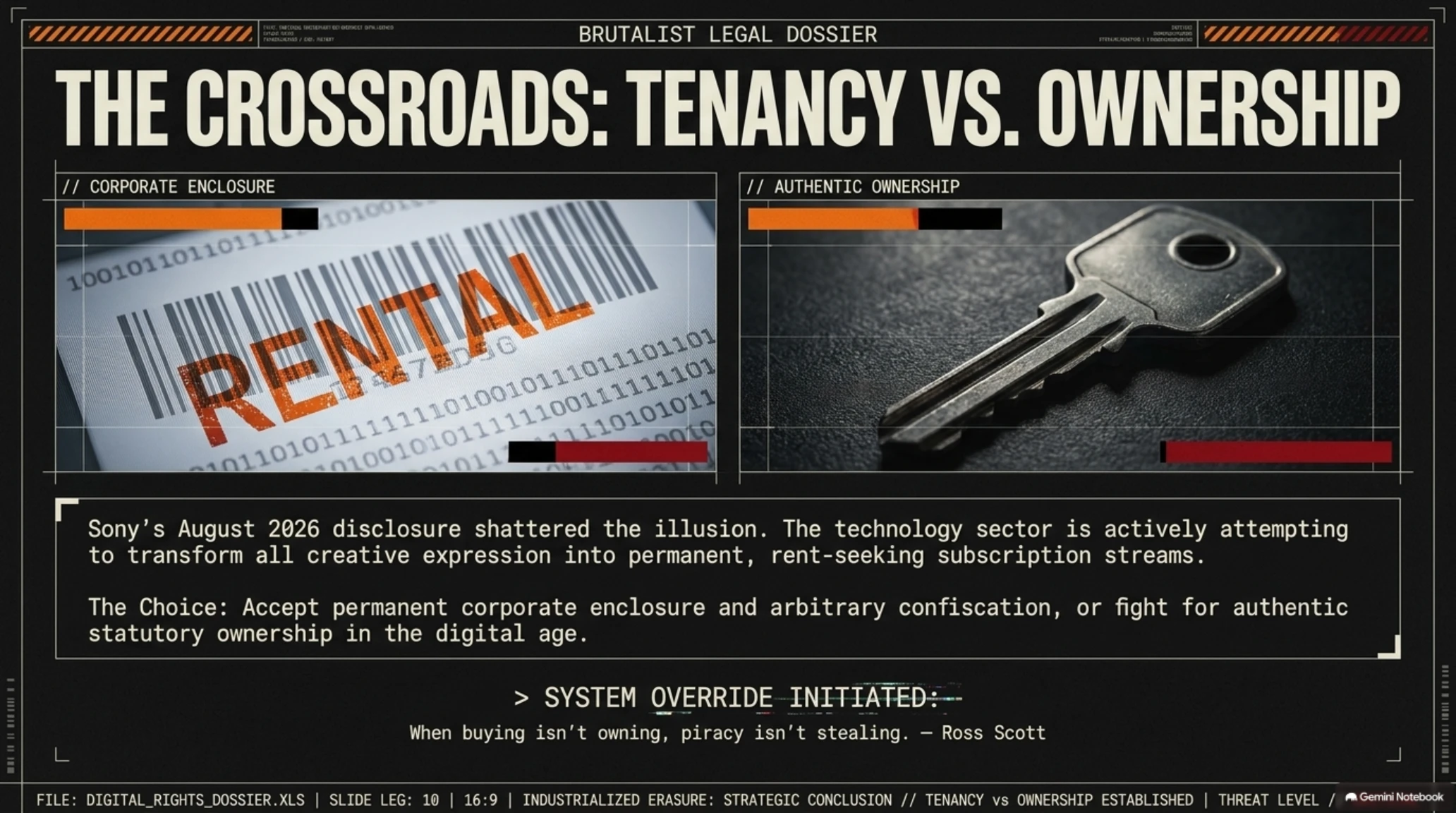
Sony's transparent disclosure regarding digital PlayStation 5 licenses has shattered the illusion of digital ownership. We reside in an era where multinational corporations seek to transform all creative expression into permanent, rent-seeking subscription streams.
Resolving this crisis demands collective consumer solidarity, resolute legislative action, and steadfast support for developers who prioritize artistic integrity over predatory licensing models. The choice is clear: accept permanent digital tenancy, or stand together to demand authentic ownership in the digital age.
- Mandatory transparency exposing the reality of digital software tenancy
- Catalyzing global consumer rights movements including #PSBlackout and Stop Destroying Videogames
- Elevating consumer awareness regarding DRM-free alternatives like GOG.com
- Pressuring international regulators to enforce statutory digital property protections
- Complete absence of secondary resale, lending, or inheritance rights in digital ecosystems
- Persistent risk of unilateral software deletion when publisher authentication servers close
- Absolute platform pricing monopolies in the wake of physical retail disc market decline
Essential Related Reading & Cyber Intelligence Archives
• ☀️ Tekin Morning August 22, 2026 | Leaked $899 Xbox Series X25 & Phantom Blade Zero Surge
• 🛡 Tekin Analysis | ThreatsDay Crisis: AI Exploits Target Siemens S7 & Sandbox Escapes
• 🤖 Tekin Versus | TrueForge Revolution: Open-Source AI Agents vs. Claude
Frequently Asked Questions
When I pay $70 for a digital PS5 game, do I actually own it?
No. Under Sony's terms of service, you are purchasing a personal, non-exclusive, revocable license to access digital content; you do not own the software.
Why did Sony explicitly issue this licensing reminder to users?
The disclosure responds to new consumer protection mandates, such as California AB 2426, requiring storefronts to eliminate deceptive 'Buy' terminology.
Can Sony or a publisher legally delete a game I purchased from my library?
Yes. If licensing agreements expire, authentication servers close, or account terms are violated, platforms retain the legal right to revoke access without compensation.
Do Steam and Xbox enforce the same digital licensing restrictions?
Yes. Steam, Xbox, and Nintendo enforce identical revocable license structures; GOG.com is the primary exception, offering DRM-free permanent offline installers.
How does physical disc ownership fundamentally differ from a digital purchase?
Physical media is protected by the First-Sale Doctrine; you own the physical disc and can play offline, lend, or resell it without publisher server dependencies.
Official Technical & Legal References
Additional Gallery: ⚖️ Tekin Analysis | Digital Ownership Crisis: Sony Reminds PS5 Owners Games Are Licensed