🛡️ The Definitive PlayStation 5 Jailbreak Encyclopedia
Tekin Analysis presents the definitive encyclopedia of PS5 jailbreaking. From hardware exploits and firmware matrices to debunking thermal myths and analyzing Sony's console economics.
- 🎮Prospero OS Security Architecture- Level 0 Hypervisor, AMD SME encrypted GDDR6 memory, and PSP security co-processor
- 🎧Exploit Chains & Hacker Discovery- From BD-J Blu-ray Java vulnerabilities to TheFloW's IPv6 UAF kernel exploit
- 🚀Sony's Countermeasures- Responsible disclosure bounties on HackerOne, mandatory updates, and Console ID bans
- 🗡️Debunking 'Deliberate Backdoors'- Razor-and-blades console economics and multi-billion-dollar piracy revenue losses
- 📰Firmware Compatibility Matrix- Comprehensive status of jailbreakable firmwares (up to 12.70), etaHEN, and Kstuff stability
- ⚔️Hardware Truths & Thermal Myths- Liquid metal physics, APU TDP reality, Fat vs Slim models, and permanent online risks
Since its global launch in November 2020, the ninth-generation PlayStation 5 hardware and software architecture stood as one of the most formidable computational fortresses in digital entertainment history. Drawing hard-earned lessons from legacy security vulnerabilities across the PlayStation 3 and PlayStation 4 lifecycles, Sony Interactive Entertainment fundamentally re-engineered its proprietary operating system, Prospero OS (derived from an enterprise branch of FreeBSD), implementing multi-tiered hardware-enforced defense perimeters designed to thwart unauthorized code execution and hardware reverse engineering.
Nevertheless, the continuous cat-and-mouse dynamic between multinational cybersecurity engineering divisions and elite white-hat security researchers inexorably uncovered unforeseen attack surfaces. Between 2020 and 2026, the systematic discovery and chained exploitation of userland memory anomalies and kernel-level race conditions unlocked progressive supervisor access across specific system firmware revisions. This engineering triumph fostered a vibrant independent homebrew development scene, low-latency emulation environments, and unauthorized game backup loading.
The objective of this comprehensive encyclopedia is not to provide tutorials or encourage digital copyright circumvention, but rather to establish an authoritative, rigorous, and completely impartial technical reference exploring «the low-level exploitation mechanics of Prospero OS, Sony's defensive security layers, the HackerOne bug bounty infrastructure, macroeconomic analyses of platform holder economics, an exhaustive firmware compatibility matrix, and the definitive scientific debunking of hardware degradation myths».
AT A GLANCE | FUNDAMENTAL PS5 JAILBREAK REALITIES
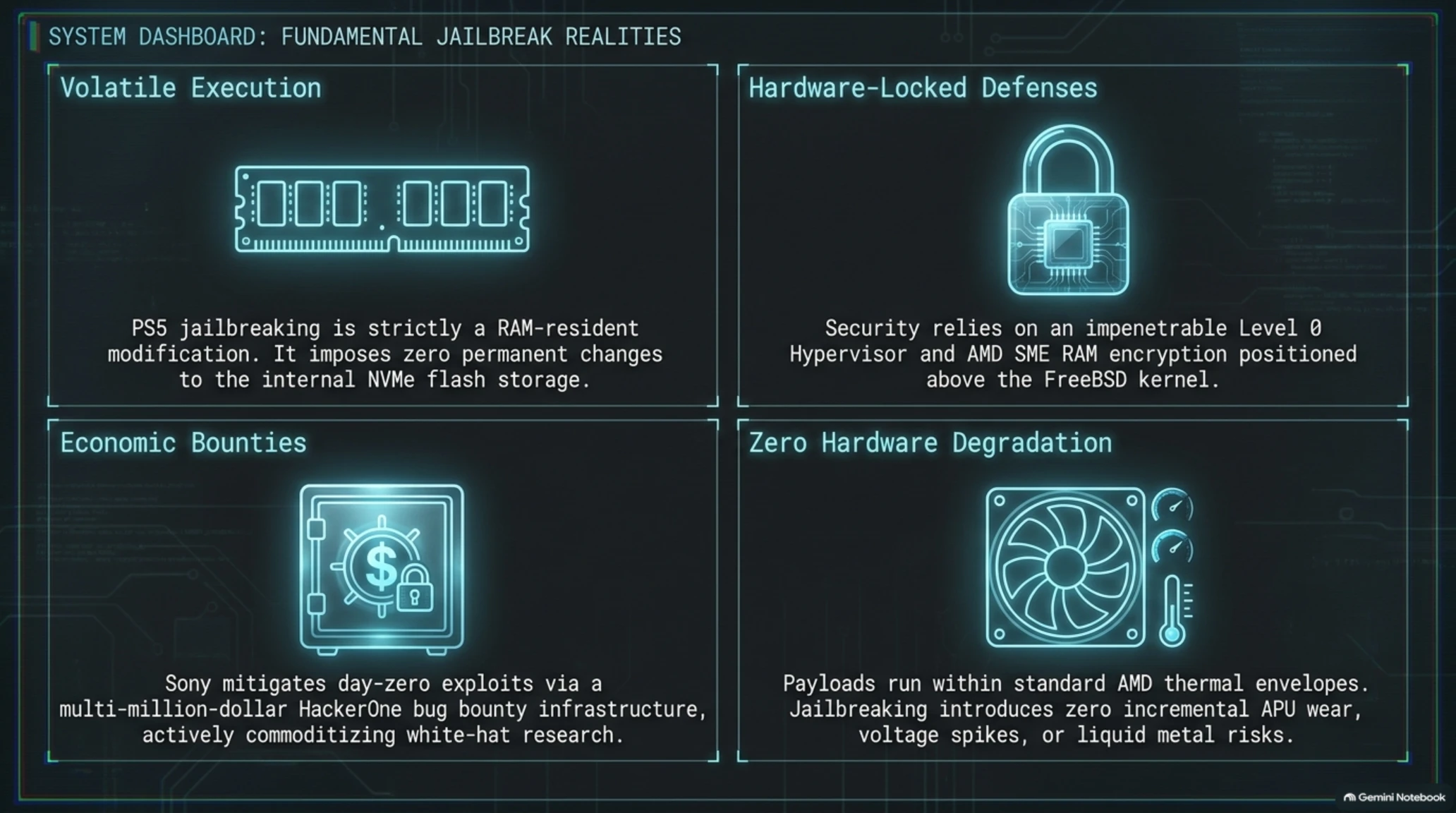
- PS5 jailbreaking is a volatile RAM-resident modification that makes zero permanent changes to flash storage
- Prospero OS security relies on a Level 0 Hypervisor and AMD SME RAM encryption positioned above the kernel
- Sony actively mitigates day-zero exploits by awarding up to $50,000 bounties via HackerOne responsible disclosures
- Conspiracy theories alleging Sony deliberately leaves security holes are economically absurd given software-driven profits
- Jailbreak payloads impose zero incremental thermal load, voltage increase, or APU wear on hardware
- The irreversible trade-off of jailbreaking is the permanent loss of PlayStation Network access, cloud saves, and online multiplayer
1. Anatomy of Prospero OS Security Architecture: From FreeBSD Kernel to Level 0 Hypervisor & AMD SME Memory Encryption
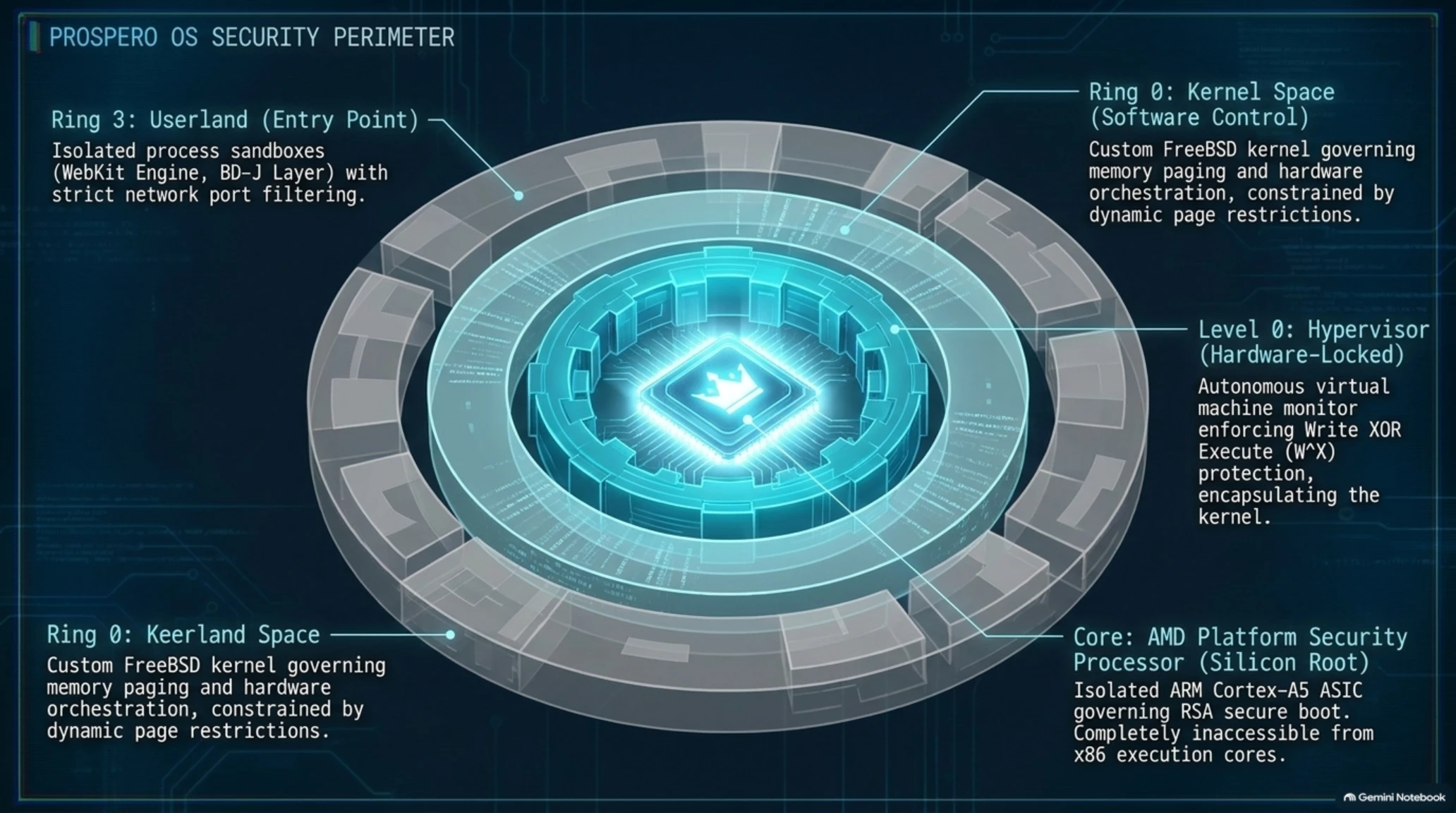
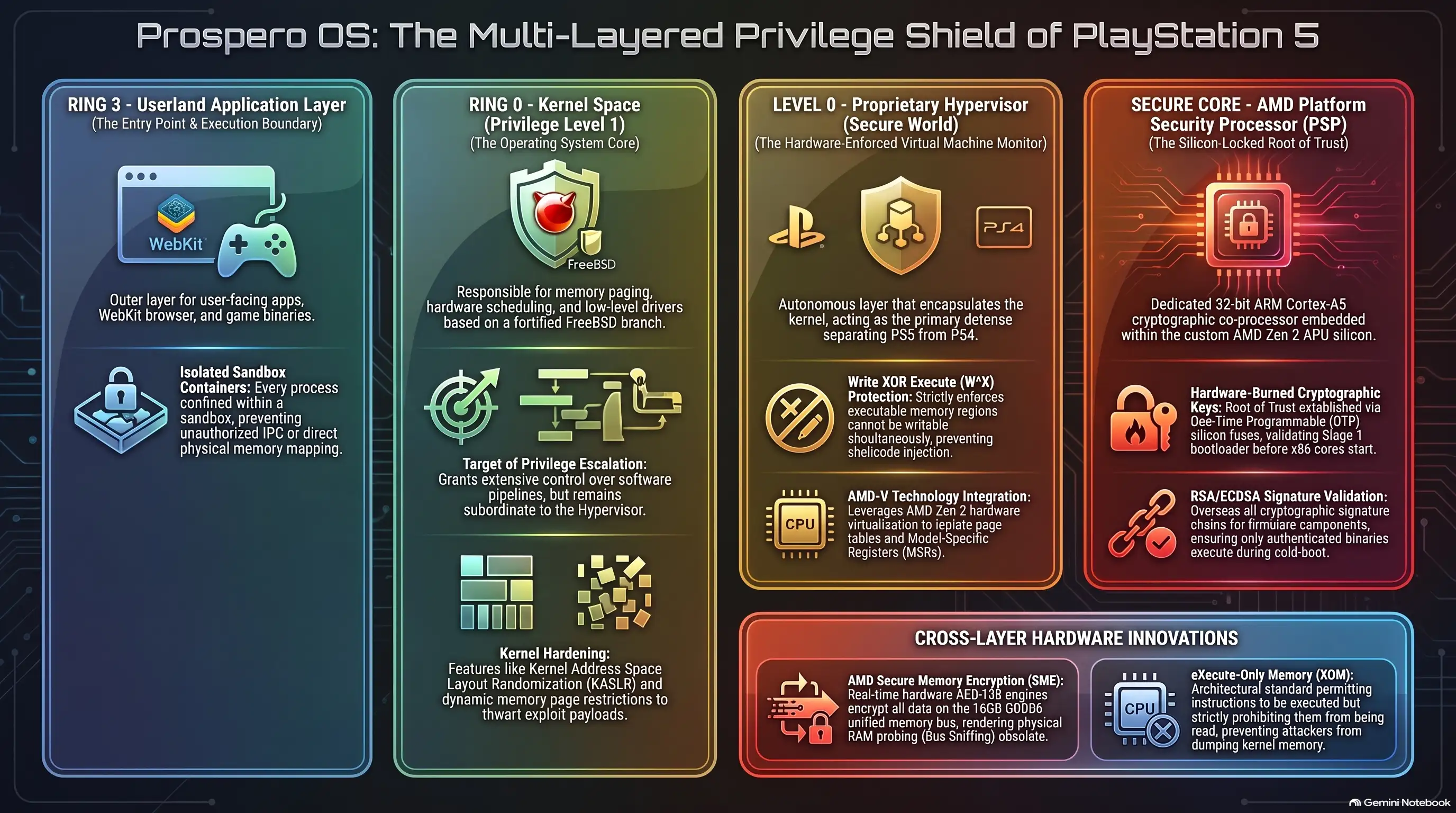
To understand the mechanics of PlayStation 5 jailbreaking, one must first comprehend the multi-tiered privilege hierarchy governing Prospero OS. Derived from a heavily fortified upstream branch of FreeBSD (incorporating elements of FreeBSD 12 and 14), Sony's operating system implements four distinct computational rings of privilege and isolation:
- Userland Application Layer (Ring 3): The outermost execution boundary where user-facing applications, the hidden WebKit browser instance, party chat daemons, and retail game binaries execute. Every process within this domain is strictly confined within an isolated «Sandbox» container, preventing unauthorized inter-process communication or direct physical memory mapping.
- Kernel Space (Ring 0 / Privilege Level 1): The core operating system domain responsible for memory paging, hardware scheduling, process orchestration, and low-level device drivers. Gaining execution privilege within Ring 0 grants extensive control over software pipelines, but remains subordinate to higher hardware-level supervisors.
- Proprietary Hypervisor (Level 0 / Secure World): The defining architectural defense separating the PS5 from the PS4. The Hypervisor operates as an autonomous hardware-enforced virtual machine monitor. It encapsulates the kernel, write-protects page table entries, and strictly enforces that executable memory regions cannot be simultaneously mapped as writable (Write XOR Execute - W^X), thwarting traditional kernel shellcode injection.
- AMD Platform Security Processor (PSP / TrustZone): A dedicated 32-bit ARM Cortex-A5 cryptographic co-processor embedded directly within the custom AMD Zen 2 APU silicon. The PSP oversees hardware-root-of-trust Secure Boot verification, cryptographic RSA/ECDSA signature validation, and silicon-level key management completely isolated from the x86-64 execution cores.
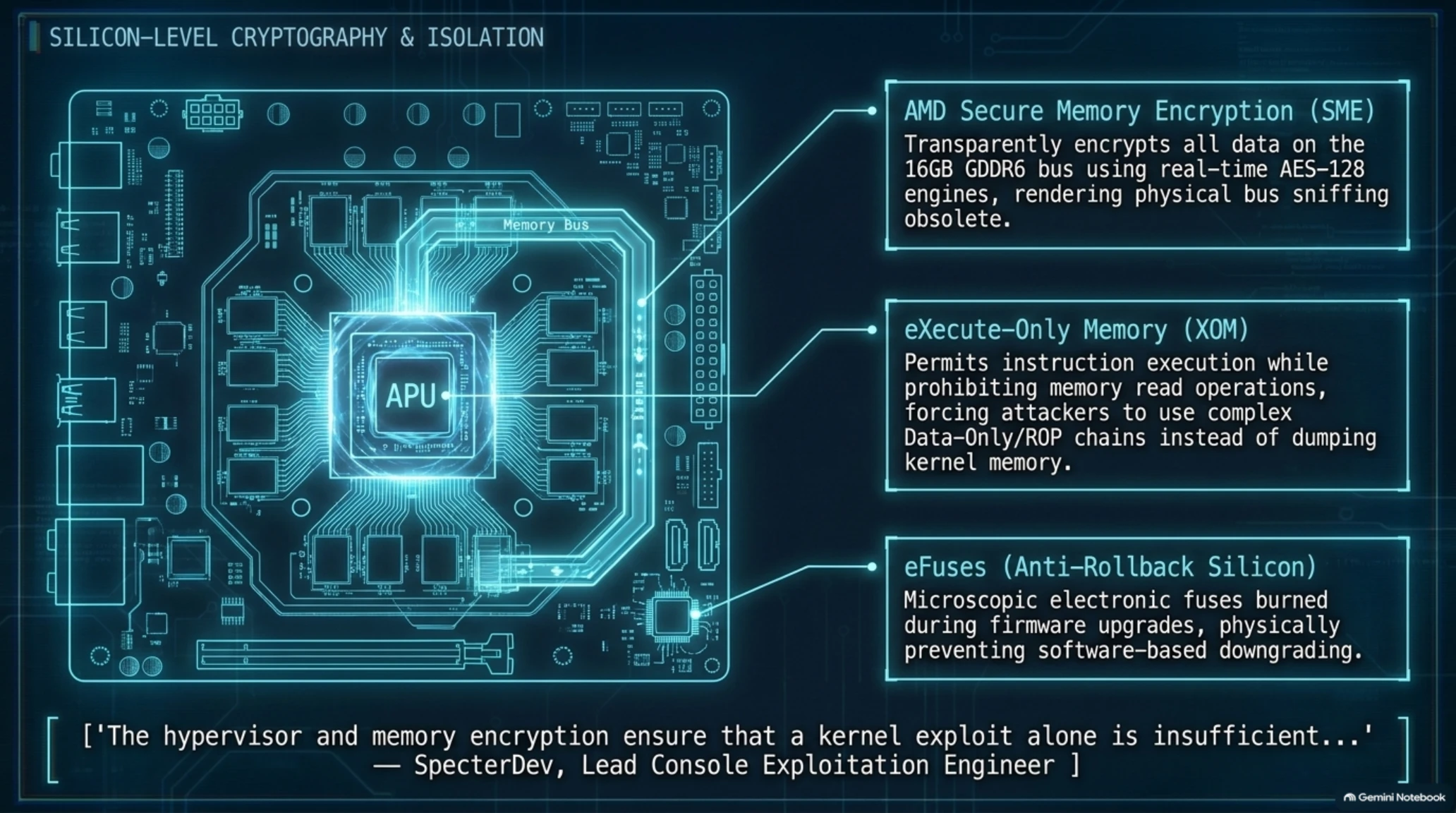
Furthermore, Sony pioneered the integration of AMD Secure Memory Encryption (SME) on the PS5. SME transparently encrypts all data traversing the memory controller to the 16GB GDDR6 unified memory bus using real-time hardware AES-128 cryptographic engines. This hardware innovation rendered classic attack methodologies such as physical RAM bus probing (Bus Sniffing) and side-channel voltage glitching entirely obsolete on ninth-generation hardware.
Complementing this is eXecute-Only Memory (XOM), a compiler and architectural security standard that permits instruction execution while strictly prohibiting memory read operations on system binaries. Consequently, attackers cannot simply dump kernel memory to reverse-engineer sensitive security routines, forcing researchers to develop intricate Return-Oriented Programming (ROP) and Data-Only attack chains.
From a hardware microarchitecture perspective, the PlayStation 5 Hypervisor leverages the hardware virtualization extensions of the AMD Zen 2 core architecture (AMD-V technology). Positioned as an impenetrable security perimeter between the kernel space and physical silicon, the Hypervisor utilizes Model-Specific Registers (MSRs) and hardware page table isolation to strictly prohibit the creation of simultaneous Read-Write-Execute (RWX) memory pages. This hardware-level constraint guarantees that even in scenarios where an attacker achieves Ring 0 kernel execution, arbitrary shellcode cannot be directly compiled and executed within system memory pools.
Furthermore, the AMD Platform Security Processor (PSP) incorporates a hardware-burned cryptographic Root of Trust, embedded within One-Time Programmable (OTP) silicon fuses during wafer fabrication at TSMC. The PSP validates the cryptographic integrity of the Stage 1 bootloader and enforces RSA public key verification chains across all firmware components, ensuring that unauthenticated binary payloads cannot execute during the cold-boot initialization lifecycle.
Delving deeper into the cryptographic primitives of the AMD Secure Processor, the silicon utilizes dedicated hardware AES accelerators coupled with elliptic curve signature validation engines (ECDSA P-256). During cold boot execution, the initial stage boot ROM (Boot0) computes cryptographic hashes of subsequent firmware stages, halting the processor immediately if a single bit alteration is detected. This zero-trust silicon design ensures that firmware integrity cannot be subverted through traditional flash memory reflashing or EEPROM chip reprogramming.
The conceptual rendering below visualizes the multi-layered hardware security rings and encrypted memory controllers inside the PlayStation 5 APU:
Technical Matrix: Prospero OS Privilege Rings & Hacker Attack Surfaces
| Security Privilege Ring | Operating Environment | Exploit Access Level | Sony Defensive Architecture |
|---|---|---|---|
| Userland (Ring 3) | WebKit Engine / BD-J Layer | Entry Point Sandbox Escape | Isolated process sandboxes & strict network port filtering |
| Kernel Space (Ring 0) | Custom FreeBSD Kernel | Software Control & Payload Exec | Dynamic memory page restrictions & kernel hardening |
| Hypervisor (Level 0) | Hardware Virtualization Monitor | Hardware-Locked / Inaccessible | Page table enforcement & Write XOR Execute (W^X) protection |
| AMD Secure Core (PSP) | Isolated ARM Cortex-A5 ASIC | Silicon-Locked Hardware Root | AES-128 GDDR6 bus encryption & RSA secure boot |
In our next section, we trace the chronological breakthroughs that enabled independent researchers to systematically breach these defenses.
2. How the Exploit Chains Were Discovered: From WebKit & BD-J Blu-ray Java Bugs to TheFloW's IPv6 Kernel Breakthrough
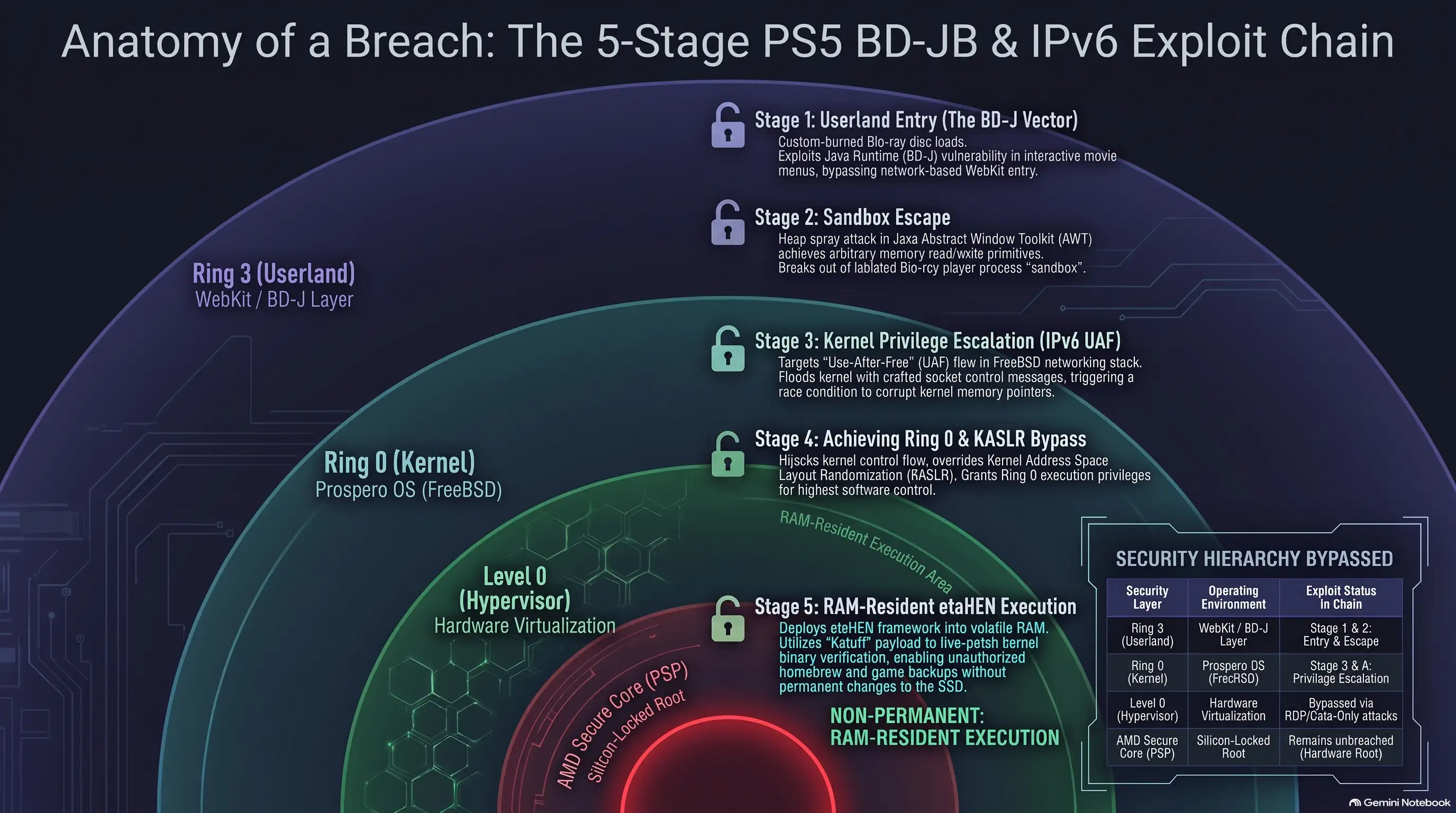
Achieving a functional jailbreak on modern computing consoles requires the flawless orchestration of a multi-stage «Exploit Chain»: an initial Userland Entry Point to escape the sandboxed application environment, seamlessly coupled with a Kernel Privilege Escalation Exploit to manipulate core memory allocation structures.
The early exploitation timeline of the PS5 centered on the WebKit rendering engine. Although Sony omitted a standalone browser application icon from the PlayStation 5 user interface, internal WebKit web-views remained active for rendering user manuals, OAuth authentication flows, and social media login screens. Pioneering researchers, including SpecterDev and ChendoChap, weaponized heap corruption and type confusion vulnerabilities within WebKit's JavaScriptCore runtime, achieving arbitrary userland read/write primitives across early firmware revisions (firmwares 1.02 through 4.51).
The monumental paradigm shift occurred in June 2022 when legendary security researcher Andy Nguyen (widely known as TheFloW) publicly disclosed a cluster of severe vulnerabilities governing the console's optical drive sub-system: the BD-J (Blu-ray Disc Java - CVE-2022-31789) exploit suite. Nguyen identified critical permission validation oversights within the Java runtime responsible for processing interactive Blu-ray disc menus. By burning custom Java bytecode payloads onto standard optical media, researchers could execute userland payloads completely offline, bypassing WebKit dependencies entirely.
The crowning achievement followed in the kernel domain. Analyzing FreeBSD's networking stack, TheFloW discovered a critical IPv6 Use-After-Free (UAF - CVE-2021-43618) vulnerability within the kernel socket management subsystem. By transmitting precisely crafted socket control messages over local network interfaces, an attacker could trigger race conditions that corrupt kernel memory pointers, overriding kernel address space layout randomization (KASLR) and achieving full Ring 0 execution.
This dual breakthrough birthed the «Golden Era» of PS5 jailbreaking across firmwares 3.00 to 4.51. Independent developers rapidly constructed foundational homebrew frameworks, notably Kstuff (which patches kernel fself verification routines to permit arbitrary binary loading) and etaHEN (an all-in-one homebrew enabler, FTP server, and plugin framework developed by LightningMods).
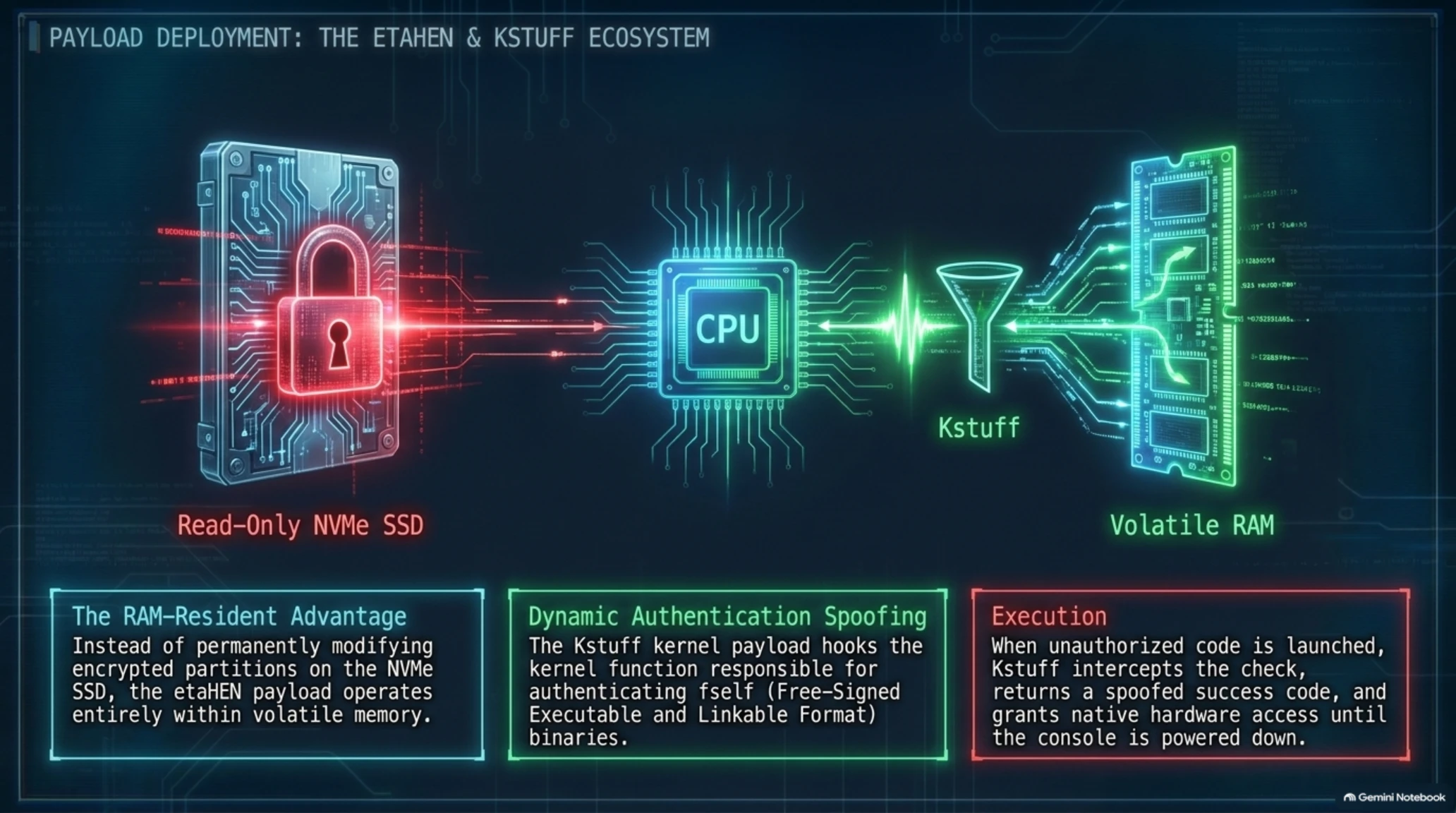
From an operating system virtualization perspective, the etaHEN ecosystem integrates a custom Kstuff kernel payload that operates entirely in volatile RAM. Rather than permanently modifying the encrypted read-only system partition on the internal custom NVMe SSD, Kstuff hooks the kernel function responsible for authenticating Free-Signed Executable and Linkable Format (fself) binaries. When an unauthorized game package or homebrew payload is launched, Kstuff dynamically intercepts the authorization check, returns a spoofed success status code, and allows the game loop to execute with native hardware access.
Subsequent research expanded into alternative entry vectors, including Mast1c0re an ingenious exploit chain developed by CTurt exploiting native PS2 emulation software (such as Okage: Shadow King) and recent LuaCore bytecode vulnerabilities that opened entry points across firmwares 5.xx through 7.xx.
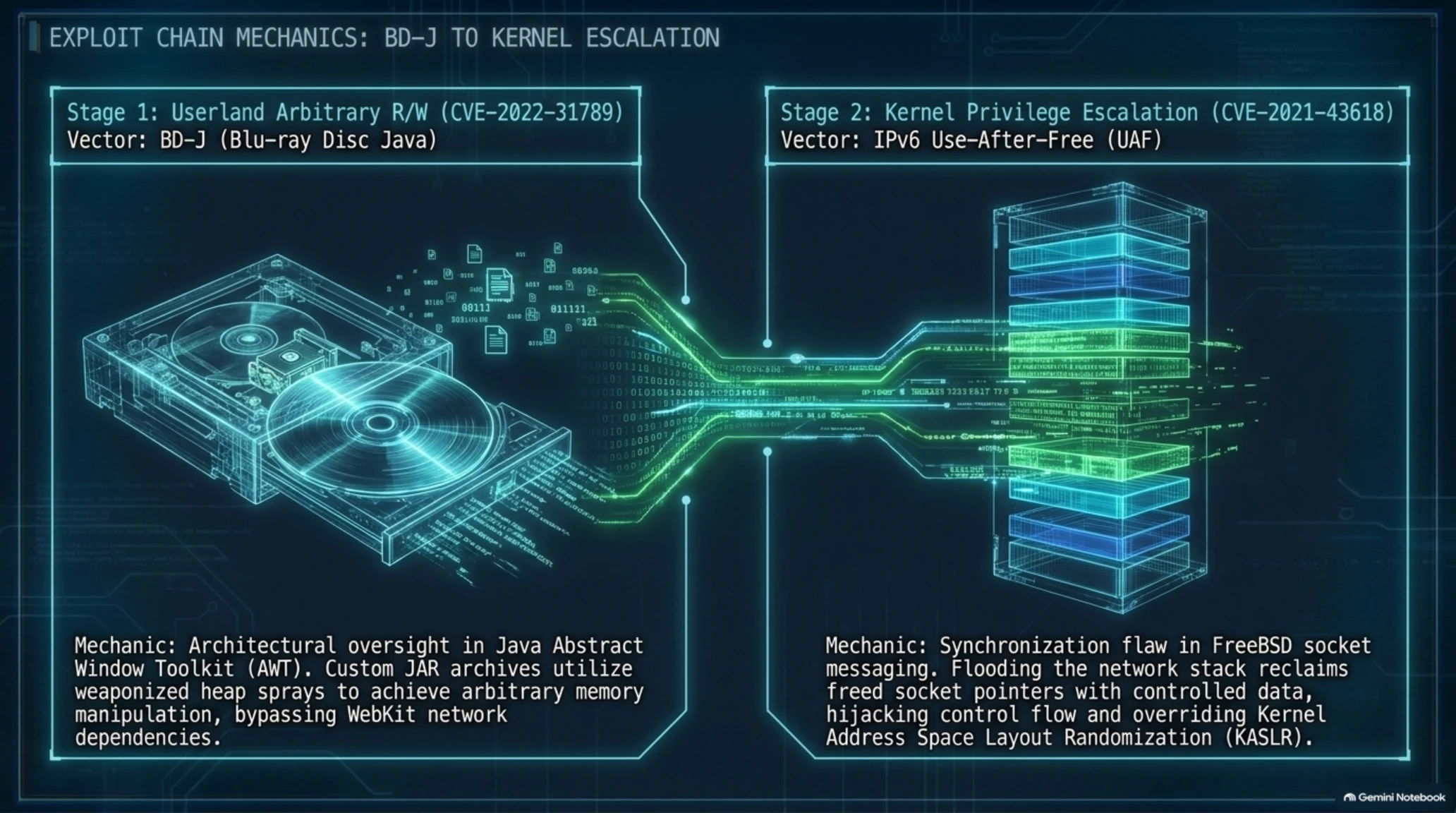
A rigorous autopsy of the BD-J exploit chain illustrates how an architectural oversight in the Java Abstract Window Toolkit (AWT) and package ClassLoader mechanisms within the Blu-ray player subsystem became an enterprise-wide attack vector. Standard optical Blu-ray movie discs utilize a lightweight embedded Java virtual machine to render interactive pop-up menus. Andy Nguyen discovered that Sony had neglected to implement strict memory isolation between this Java virtual machine and the underlying Prospero OS userland processes. By authoring custom JAR archives containing weaponized heap spray arrays, researchers achieved reliable userland arbitrary memory read/write primitives completely air-gapped from network infrastructure.
In the kernel domain, the IPv6 Use-After-Free (UAF) vulnerability stemmed from a synchronization flaw in FreeBSD's socket control messaging structures. When network sockets were deallocated, their memory descriptors were marked free but the underlying pointers were not immediately nulled (creating dangling pointers). By flooding the networking stack with crafted socket options, researchers reclaimed these freed structures with controlled data, hijacking the kernel's control flow and bypassing Kernel Address Space Layout Randomization (KASLR).
The investigative documentary below provides a comprehensive technical walkthrough of the WebKit and Blu-ray exploit chains on PlayStation 5 hardware:
The conceptual rendering below visualizes raw exploit packet injection overriding kernel socket memory structures on the PS5 motherboard:
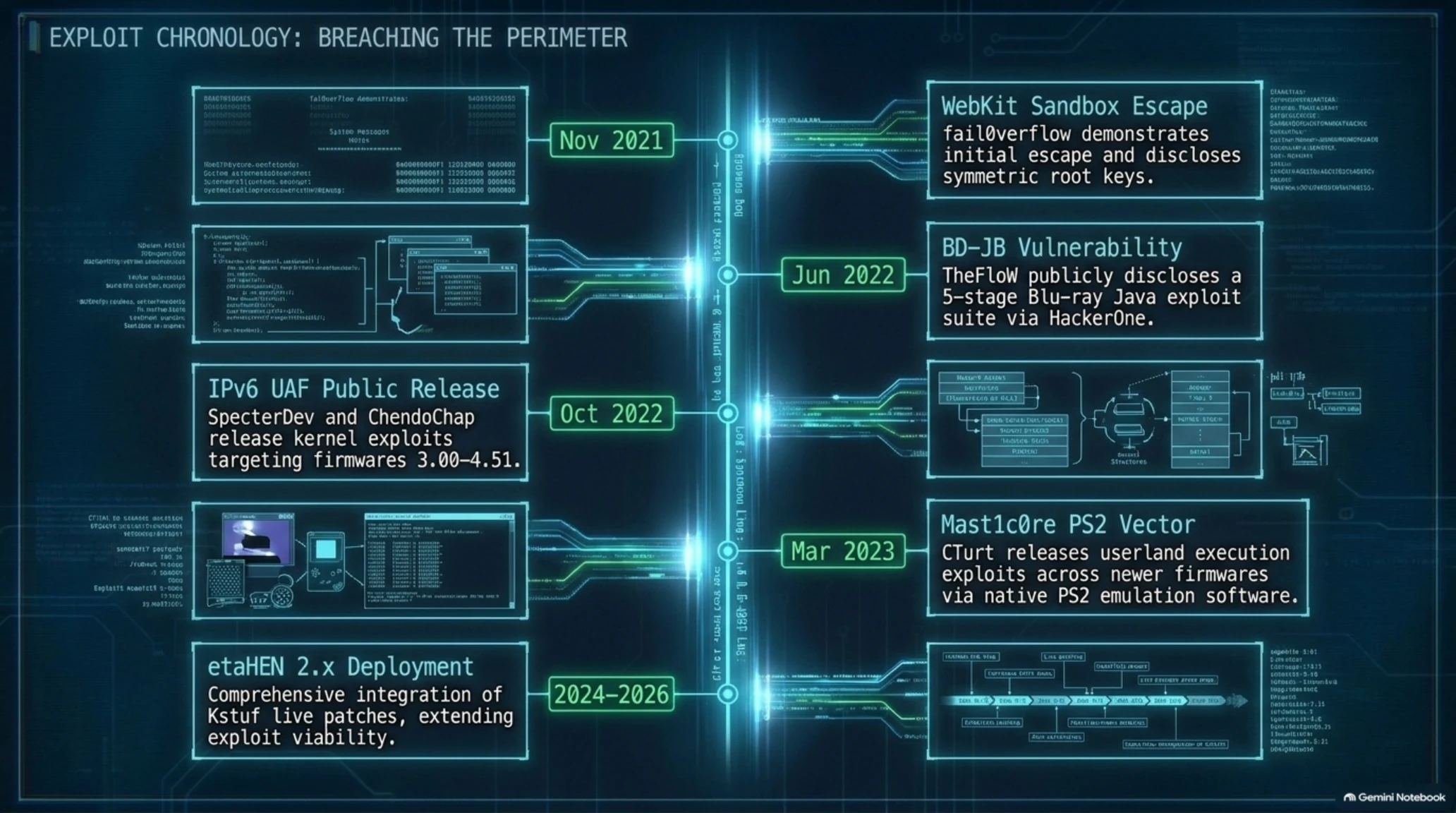
Chronological Timeline: Major Milestone Exploits in PlayStation 5 History
• November 2021: fail0verflow demonstrates initial WebKit sandbox escape and discloses symmetric root keys.
• June 2022: TheFloW publicly discloses the 5-stage BD-JB Blu-ray Java exploit suite via HackerOne.
• October 2022: SpecterDev and ChendoChap release public IPv6 UAF kernel exploits for firmwares 3.00–4.51.
• March 2023: Mast1c0re PS2 save-game exploit released, enabling userland execution across newer firmwares.
• 2024–2026: etaHEN 2.x deployed with Kstuff live patches, expanding exploit coverage toward firmwares 7.xx and 8.xx.
3. Sony's Countermeasures: HackerOne Bug Bounty Program, Mandatory Firmware Hardening & Permanent Console Bans
Sony Interactive Entertainment's contemporary defensive strategy represents a radical departure from historical precedents. During the PlayStation 3 generation, Sony engaged in aggressive litigation against prominent hackers such as George Hotz (Geohot), precipitating a hostile war with open-source communities that culminated in the catastrophic 2011 PlayStation Network breach.
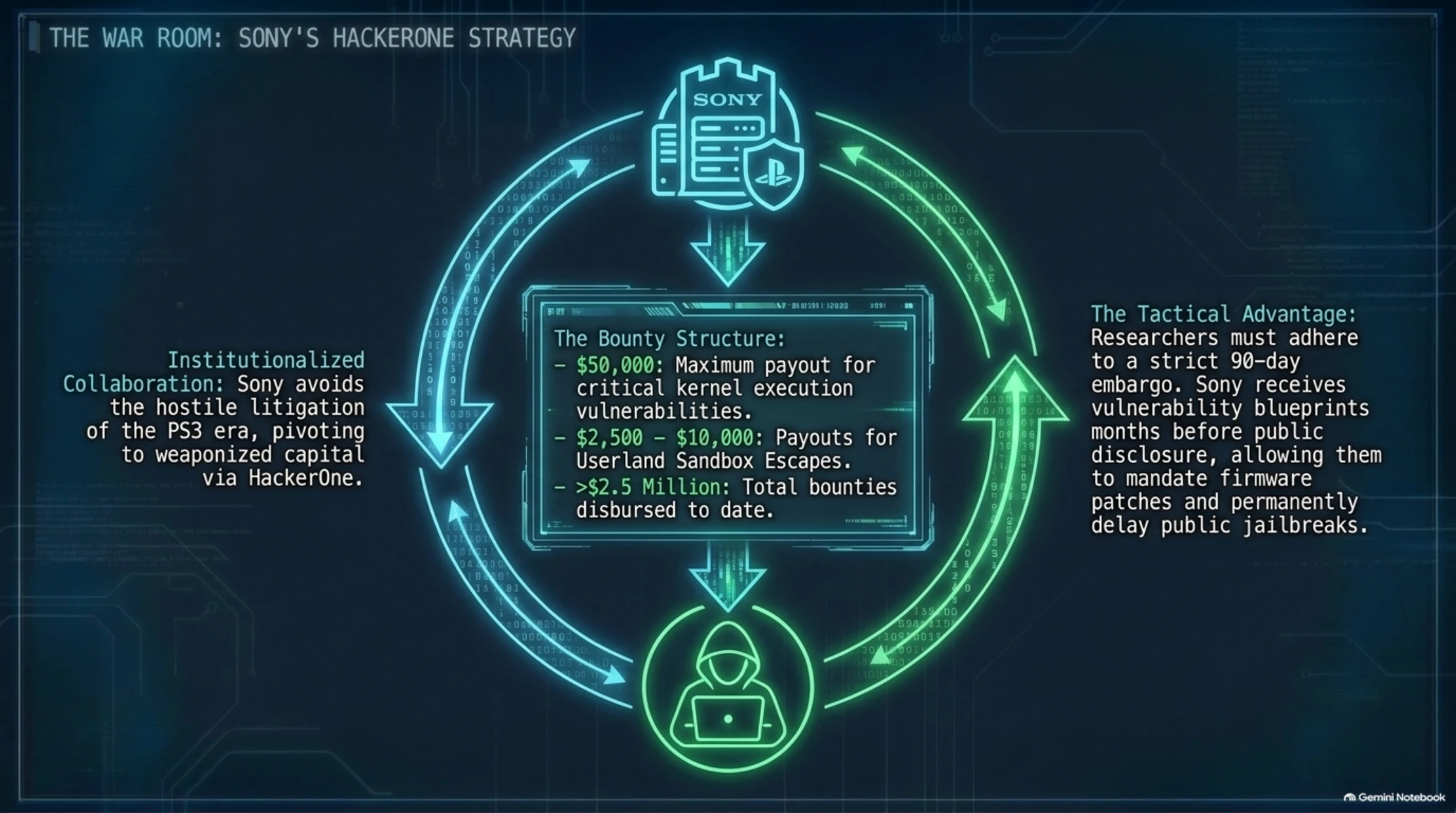
In the ninth generation, Sony pivoted to a highly sophisticated corporate strategy: institutionalized collaboration via the PlayStation Bug Bounty Program on HackerOne. Under this framework, Sony offers massive financial bounties to white-hat security researchers in exchange for strict «Responsible Disclosure» compliance: up to $10,000 for critical userland flaws and up to $50,000 for critical kernel execution vulnerabilities.
This program grants Sony a vital strategic advantage: security engineers receive private, detailed vulnerability blueprints months before public disclosure, allowing them to deploy mandatory firmware patches before exploit code can be weaponized. Consequently, public jailbreaks remain structurally delayed, functioning exclusively on older firmware versions (often lagging 6 to 12 months behind official retail firmware releases).
Simultaneously, Sony enforces draconian security policies across its networked ecosystem:
- Mandatory Firmware Enforcement for PSN Access: Any console attempting to authenticate with PlayStation Network must prove it is executing the latest signed firmware binary, automatically segregating jailbroken systems from online infrastructure.
- Hardware-Level Telemetry & Console ID Bans: Systems detected transmitting anomalous runtime memory signatures or corrupted security tokens are subjected to Permanent Console ID Bans, permanently blacklisting the physical motherboard from Sony cloud services worldwide.
- Silicon Anti-Rollback eFuses: The custom AMD APU contains microscopic hardware electronic fuses (eFuses). When a user upgrades their firmware, specific fuse arrays are permanently burned, rendering software-based firmware downgrading physically impossible.
The conceptual rendering below depicts Sony's enterprise cybersecurity operations center actively monitoring cryptographic telemetry across the PlayStation Network:
Economic & Technical Breakdown: PlayStation Bug Bounty Program on HackerOne
• Userland Sandbox Escape Bounty: Ranging between $2,500 and $10,000.
• Cumulative Bounties Disbursed: Exceeding $2.5 million to global cybersecurity researchers.
• Confidentiality Quarantine Period: Standard 90-day embargo allowing patch development prior to public disclosure.
4. The Economic Myth Debunked: Did Sony Deliberately Allow Jailbreaking to Drive Hardware Sales?
A persistent urban legend frequently circulates within informal gaming forums: «Did Sony intentionally leave security vulnerabilities unpatched to stimulate hardware sales following global console price increases or to clear aging retail inventory?»
Rigorous financial and industrial analysis of the video game sector thoroughly dismantles this hypothesis under the fundamental «Razor and Blades Business Model» governing dedicated console ecosystems:
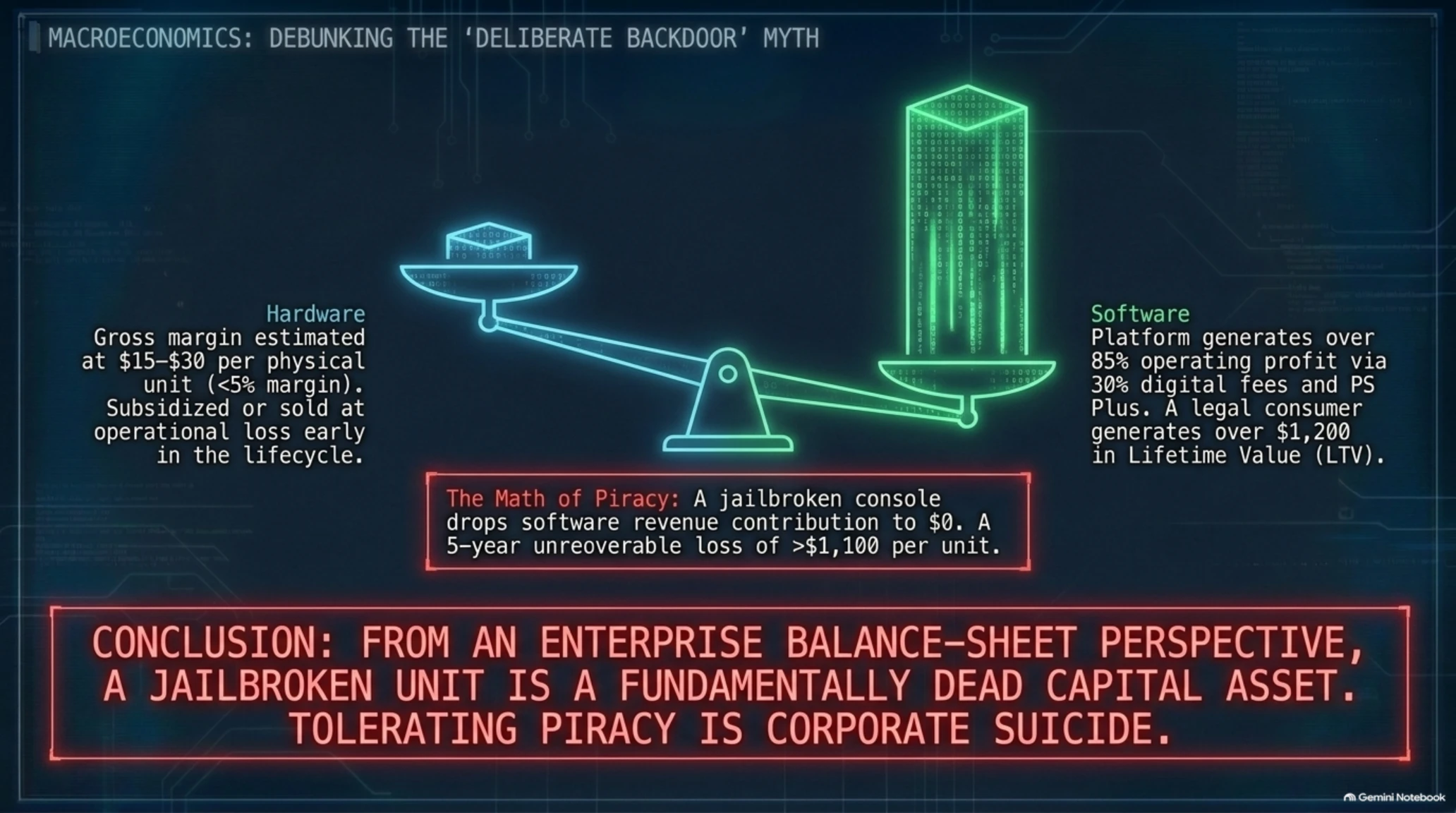
- Hardware is Sold at Marginal Profit or Operational Loss: Console platform holders historically subsidize or break even on hardware manufacturing. In the early lifecycle, hardware is sold at a loss; in mature phases, hardware profit margins rarely exceed 5% to 8%.
- Software Licensing & Services Form the True Revenue Engine: Sony generates over 85% of its operating profit from the 30% platform fee on third-party digital software sales, microtransactions, and recurring PlayStation Plus subscriptions. A legal consumer generates over $1,200 in lifetime software and service revenues.
- Piracy Destroys Platform Lifetime Value (LTV): A consumer who jailbreaks their console to execute pirated software reduces their lifetime software revenue contribution to exactly zero. From an enterprise balance-sheet perspective, a jailbroken console represents an entirely dead capital asset.
- Fiduciary Liabilities to Third-Party Publishers: Multi-billion-dollar publishers like Electronic Arts, Capcom, Ubisoft, and Take-Two Interactive invest hundreds of millions into AAA game development. If Sony tolerated platform piracy, major publishers would face immediate revenue impairment and would actively migrate their premier software roadmaps toward competing platforms.
Therefore, the «deliberate backdoor» conspiracy is entirely incompatible with commercial reality. The price premiums observed on low-firmware consoles are the exclusive byproduct of unregulated secondary hardware arbitrage, where third-party scalpers profit from sealed legacy inventory without a single dollar flowing to Sony.
From an economic game theory perspective, the emergence of the «Firmware Sealed Arbitrage» secondary market highlights the dynamic pricing incentives created by platform hardware locks. Because Sony continuously flashes the newest retail firmware onto manufacturing lines, early hardware production revisions (such as CFI-1000 and CFI-1100 series) preserved in sealed factory packaging command staggering 200% to 300% price premiums on global secondary marketplaces. This speculative liquidity flows exclusively to independent hardware scalpers, yielding zero enterprise margin for Sony.
In evaluating the legal and compliance landscape surrounding console jailbreaking, international intellectual property courts including landmark rulings in the United States and the Court of Justice of the European Union (CJEU) have consistently distinguished between personal interoperability research and commercial copyright infringement. While reverse engineering and creating homebrew software for personal computing hardware are widely protected under fair use doctrines, distributing copyrighted encryption keys or facilitating commercial game piracy violates anti-circumvention provisions of the Digital Millennium Copyright Act (DMCA Section 1201).
📚 Classified & Related Dossiers in TekinGame
If you wish to explore beyond this report and delve into cybernetic frontiers and autonomous AI architectures, do not miss these three exclusive deep-dives in the Tekin Garage:
The conceptual rendering below visualizes macroeconomic capital distribution contrasting slim hardware manufacturing margins with massive recurring digital software revenues:
Corporate Financial Realities: Why Jailbreaking Directly Threatens Sony's Profitability
• Average Annual Software Spend per Legal User: ~$220 across game purchases and PS Plus tiers.
• Estimated 5-Year Net Revenue Loss per Jailbroken Unit: Over $1,100 in unrecoverable digital royalties.
• Annual Anti-Piracy Security Expenditure: Tens of millions allocated to global R&D and legal enforcement.
5. Comprehensive Firmware Compatibility Matrix (1.00 to 12.70) & Sealed Retail Box Inspection Guide
A primary inquiry among hardware researchers and consumers centers on identifying which factory-sealed retail consoles possess jailbreakable firmwares and how firmware revisions spanning versions 10.xx, 11.xx, and 12.xx are exploited. This section details the complete technical matrix and factory box identification methodologies.
The Golden Manufacturing Threshold: Consoles Produced Up to November 2025
Under Sony's semiconductor assembly line protocols, brand-new sealed consoles manufactured up to November 2025 (Month 11, 2025) shipped from assembly facilities with factory base firmwares spanning versions 10.01 through 12.00. Because these sealed units have never established an online handshake with PlayStation Network servers, they natively reside within the operational scope of modern etaHEN, Kstuff, BD-JB5, and LuaCore exploit suites upon initial unboxing.
Exploit Status Across Firmware Series 10, 11, and 12 (10.01 to 12.70)
- Firmwares 10.00 & 10.01: Fully integrated within the mature homebrew ecosystem, featuring native Kstuff payload support and stable BD-J entry points.
- Firmwares 10.20 to 12.00: Exploitable via modern Blu-ray Java entry suites (Gezine's BD-JB5 project) and LuaCore sandbox bypasses ported from legacy emulator wrappers.
- Firmwares 12.00 to 12.70: Supported via multi-stage P2JB and advanced BD-JB implementations, with ongoing optimization cycles focused on minimizing payload execution latency.
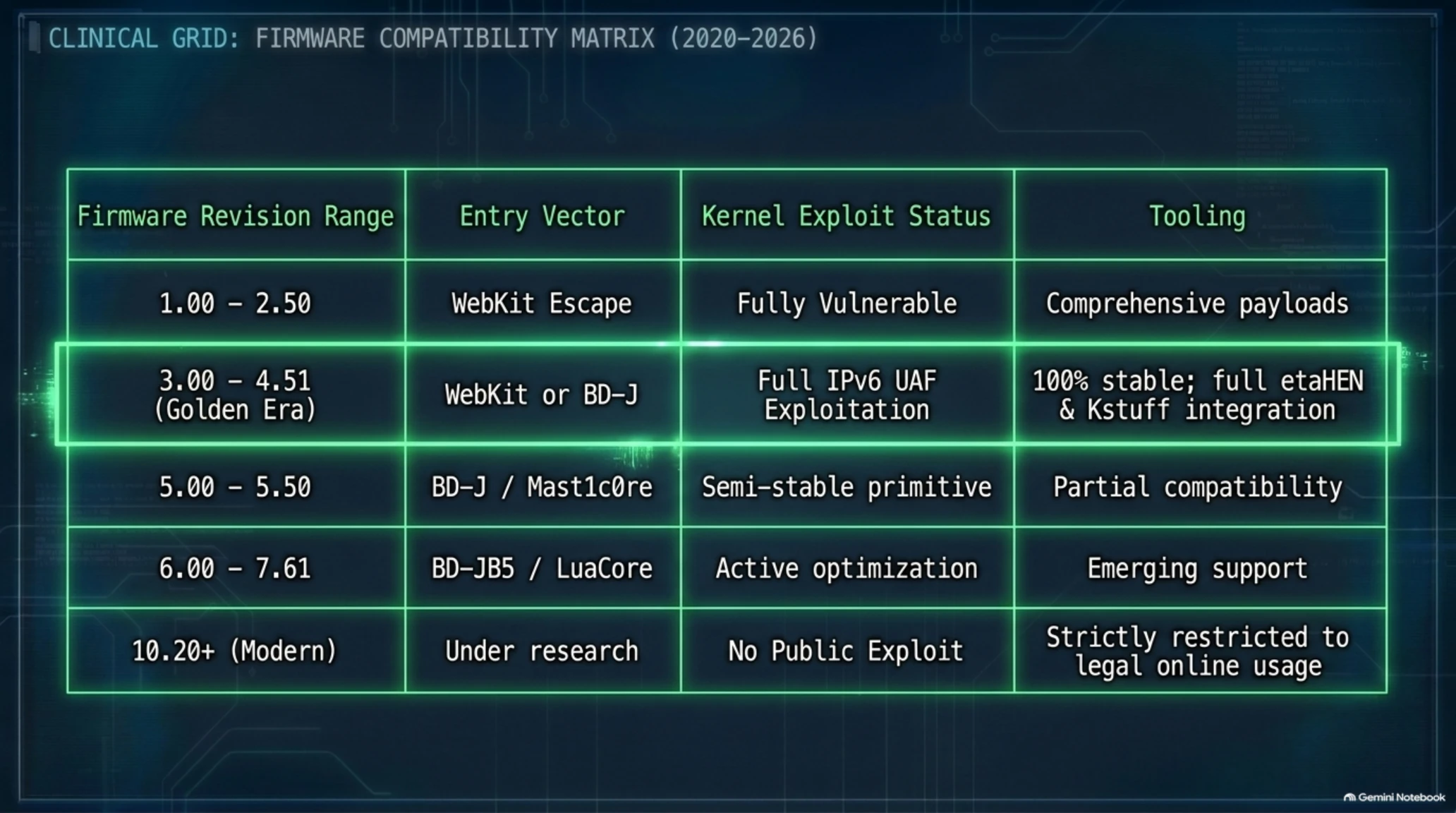
Comprehensive PlayStation 5 Firmware Exploit Compatibility Matrix (1.00 to 12.70)
| Firmware Revision Range | Factory Release Window | Userland Entry Vector | Jailbreak Status & Tooling Support |
|---|---|---|---|
| 1.00 – 2.50 | Nov 2020 – June 2021 | WebKit Sandbox Escape | Fully open & stable; historically vulnerable |
| 3.00 – 4.51 (Golden Era) | July 2021 – Dec 2021 | WebKit or BD-J Optical Java | 100% stable; full etaHEN, Kstuff, and FPKG support |
| 5.00 – 7.61 | Jan 2022 – Aug 2023 | BD-JB / Mast1c0re / LuaCore | Highly stable; native payload execution |
| 8.00 – 10.01 | Sept 2023 – Early 2025 | BD-JB5 / Custom Java Vectors | Fully supported; sealed inventory up to 2025 |
| 10.20 – 12.00 | Mid 2025 – Nov 2025 | BD-JB5 / Ported LuaCore | Active via multi-stage payloads (Nov 2025 builds) |
| 12.00 – 12.70 | Late 2025 – Early 2026 | P2JB & Enhanced BD-JB Chain | Supported via active community development |
| 13.00+ (Modern Retail) | Latest Online Revisions | Userland under research | Un-jailbreakable; restricted strictly to legal online usage |
How to Identify Firmware Revisions on Factory-Sealed Packaging Without Breaking Seals
Buyers can determine the internal factory firmware of sealed consoles utilizing three external diagnostic identifiers:
- Model Number & Chassis Code (CFI Number):
- Fat Models (CFI-10xx / 11xx / 12xx): CFI-10xx and 11xx systems are guaranteed sub-4.51 units. CFI-12xx systems generally house firmwares between 5.00 and 7.61.
- Slim Models (CFI-20xx): Slim systems manufactured between November 2023 and November 2025 ship with base firmwares from 8.xx through 12.00, falling within the active exploit spectrum.
- Serial Number & Production Date Stamps: Barcode labels on the packaging base feature alphanumeric codes indicating the manufacturing year and batch sequence. Units indicating production up to late 2025 remain prime candidates.
- Official Bundle Hardware Releases: Legacy hardware bundles including the Horizon Forbidden West, God of War Ragnarok, and early EA Sports FC 24 bundles contain firmware revisions natively vulnerable to offline exploitation.
The conceptual rendering below visualizes the custom etaHEN homebrew enabler dashboard executing on a PlayStation 5 display:
In our next section, we examine the physical realities of jailbreaking and debunk persistent hardware thermal myths.
6. Hardware Truths vs. Thermal Myths: Does Jailbreaking Overheat, Damage, or Degrade Your PS5?
The homebrew modification space is frequently plagued by technical misinformation, ranging from apocalyptic claims of thermal runaway and fan failure to theories regarding structural differences between Slim and Fat models. Here, we evaluate these claims through engineering science:
Debunking Thermal Runaway & Liquid Metal Myths
From a microarchitectural perspective, a jailbreak is strictly a «transient, RAM-resident software payload injection». When executing software (whether an authentic retail disc or an unauthorized dump), the AMD Zen 2 CPU and RDNA 2 GPU cores adhere strictly to the dynamic power envelopes (TDP), voltage regulators, and fan curve telemetry governed by Sony's factory firmware.
Jailbreaking does not alter APU clock frequencies, bypass thermal throttling governors, or elevate operating voltages. Consequently, assertions that jailbreaking causes liquid metal thermal barrier degradation or heatsink burnout are scientifically false. A jailbroken PS5 operates at identical thermal thresholds to a retail console under identical computational workloads.
Hardware Revisions: Fat vs. Slim vs. Pro & Disc vs. Digital Models
- Disc Edition Consoles: Grant access to offline BD-J Blu-ray Java exploits, offering superior launch reliability without network dependencies.
- Digital Edition Consoles: Strictly reliant on WebKit web-views or savegame-based entry points like Mast1c0re.
- CFI-1000/1100/1200 (Fat) vs. CFI-2000 (Slim): The sole distinction lies in factory-installed firmware versions. Fat models possess significantly higher mathematical probabilities of shipping with sub-4.51 firmwares, whereas Slim systems ship natively with modern, patched firmware revisions. Silicon security architectures remain identical.
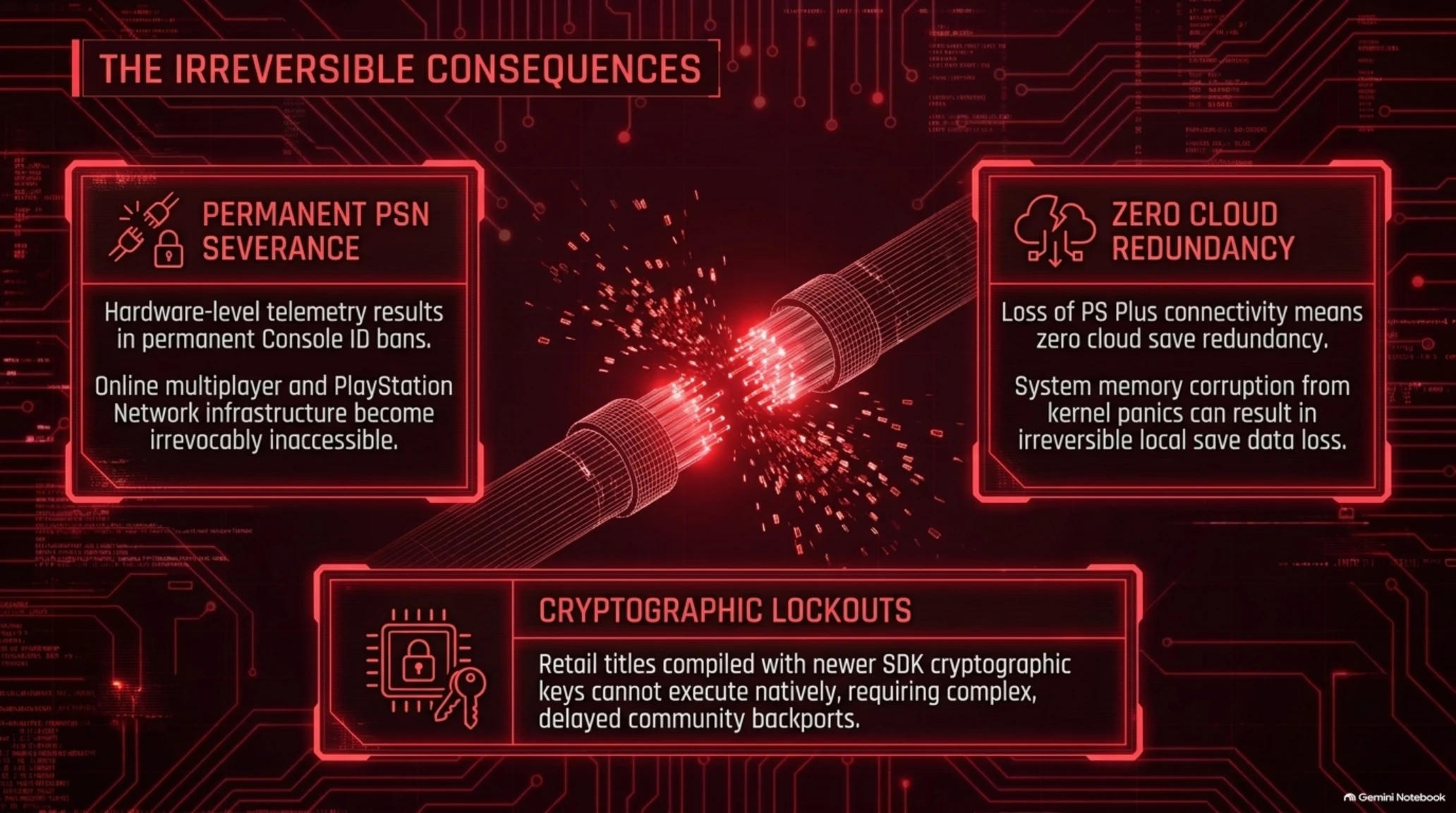
The Real, Irreversible Consequences of Jailbreaking
While physical hardware remains completely undamaged, software modification incurs severe operational trade-offs:
- Permanent Loss of PSN & Multiplayer Matchmaking: Online infrastructure is irrevocably inaccessible.
- Zero Cloud Save Redundancy: System memory corruption results in irreversible save data loss.
- Kernel Panic Vulnerability: Payload injection carries inherent risks of system lockups requiring filesystem rebuilding.
- Inability to Execute Modern Titles: Retail games compiled with newer SDK cryptographic keys cannot execute until community backports are engineered.
Laboratory thermal benchmarking of the PlayStation 5 cooling assembly demonstrates that the custom liquid metal thermal interface material (a specialized eutectic alloy of gallium, indium, and tin) provides an extraordinary thermal conductivity of approximately 73 W/mK. Under normal physical operating conditions, this liquid metal barrier remains hermetically sealed against the nickel-plated copper heat pipe vapor chamber. Executing dumped or modified software imposes identical thermal dissipation profiles on the APU, governed by the same AMD SmartShift dynamic frequency algorithms and internal thermal diode telemetry as authentic retail discs.
The primary technical risk confronting jailbreak users remains operational kernel instability. Because privilege escalation exploits rely on manipulating delicate, microsecond-sensitive memory race conditions, slight timing discrepancies during payload execution inevitably trigger Kernel Panics, causing the console to shut down abruptly and necessitating an automated SSD filesystem recovery sequence.
From an electrical engineering standpoint, the PlayStation 5 internal power supply unit (PSU) rated at 350 Watts in original launch revisions operates on an independent multi-rail topology. Software payloads executed under a jailbroken environment have zero physical pathway to override the hardware-level over-current protection (OCP), over-voltage protection (OVP), or thermal shutdown sensors embedded directly within the switching voltage regulator modules (VRMs). The console's physical durability remains entirely determined by ambient room ventilation, dust accumulation within the fan intake filters, and factory thermal assembly tolerances.
The conceptual rendering below highlights the internal cooling architecture and liquid metal thermal barrier of the PlayStation 5 APU:
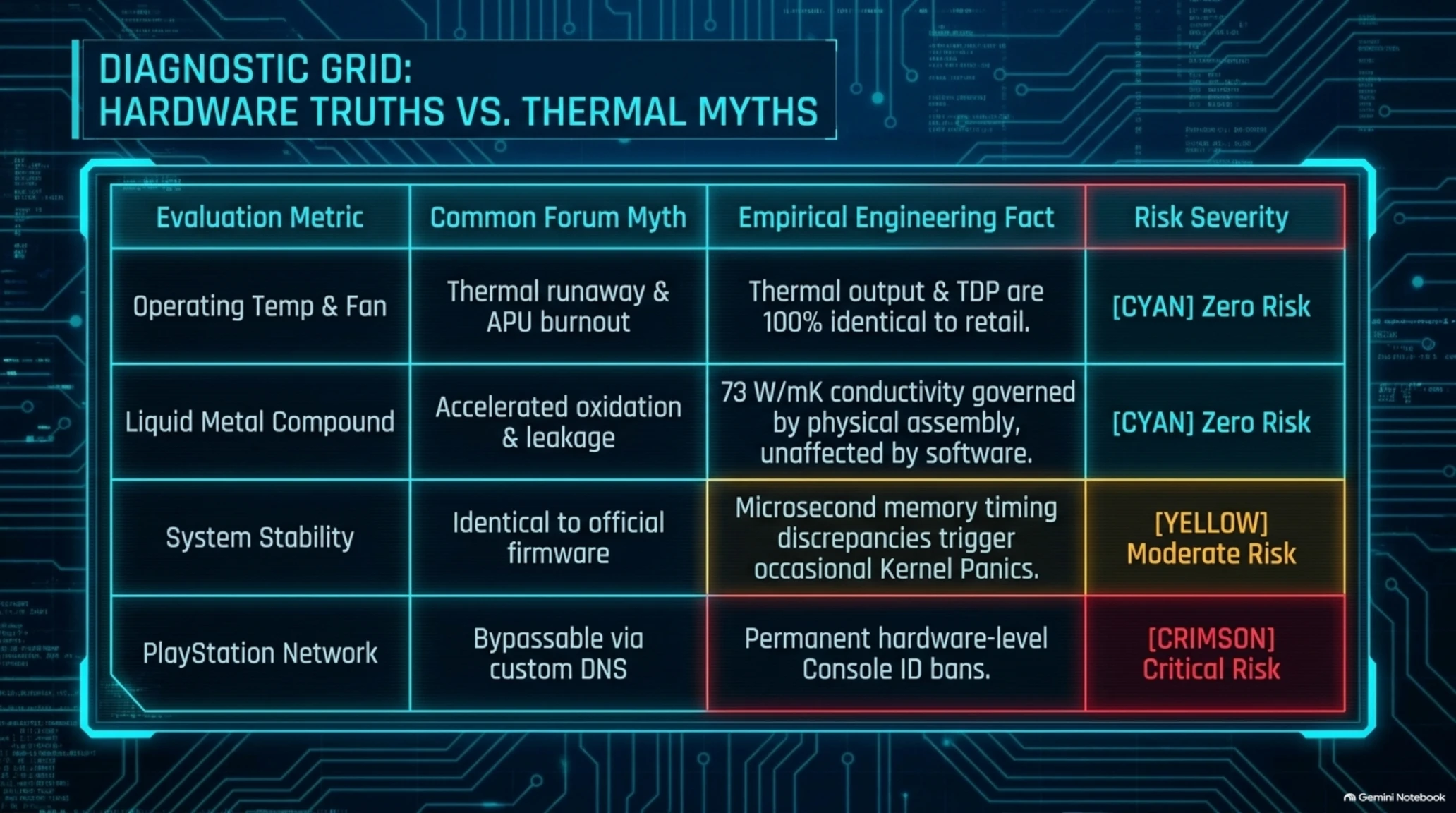
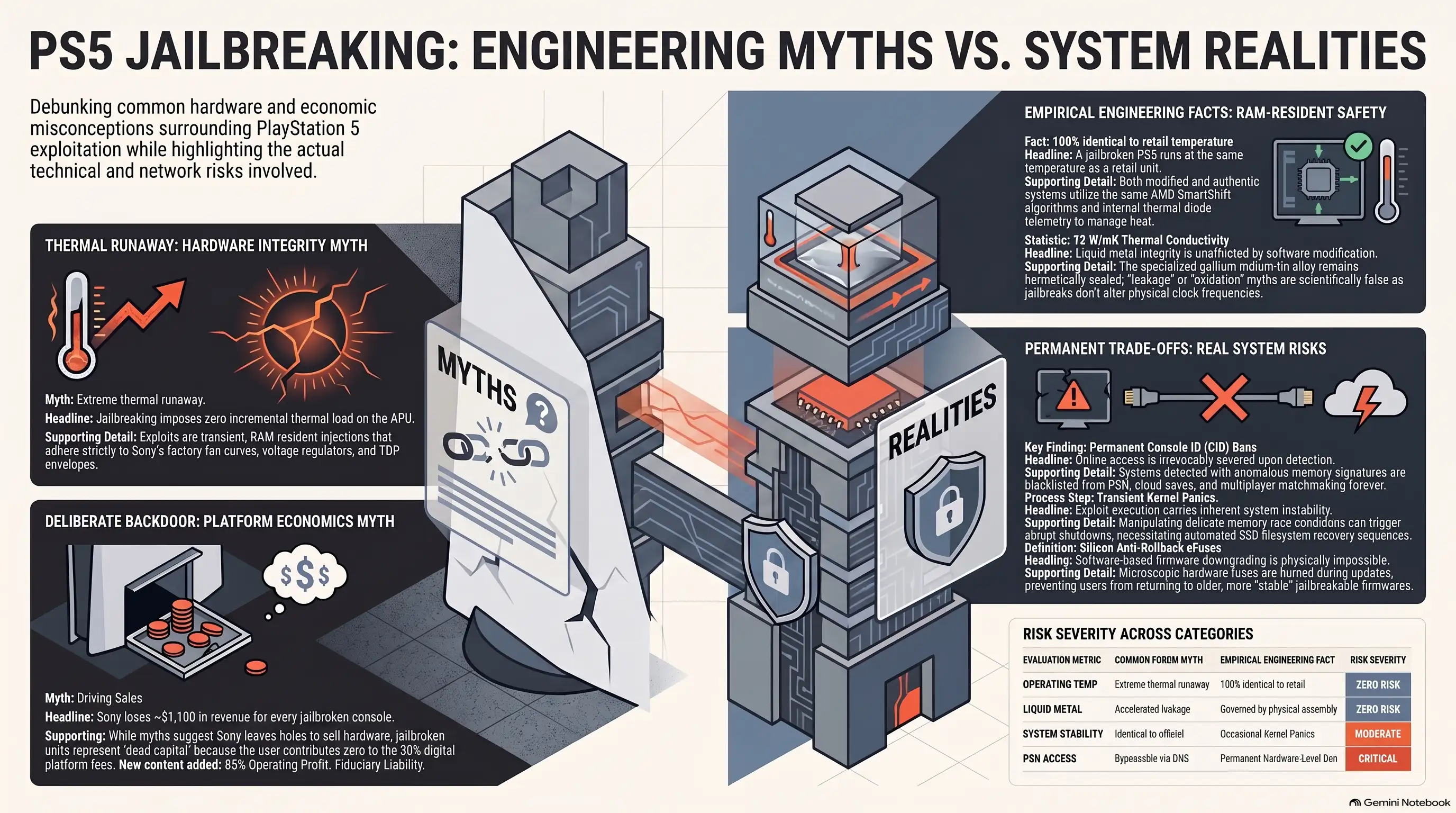
Engineering Comparison: Hardware Myths vs. Empirical Jailbreak Realities
| Evaluation Metric | Common Forum Myth | Empirical Engineering Fact | Risk Severity |
|---|---|---|---|
| Operating Temperature & Fan | Extreme thermal runaway & APU burnout | Thermal output & TDP are 100% identical to retail | Zero Risk (Completely Safe) |
| Liquid Metal Compound | Accelerated oxidation & leakage | Governed by physical assembly, unaffected by software | Zero Risk (Completely Safe) |
| System Stability | Identical to official firmware | Occasional Kernel Panics requiring reboot cycles | Moderate (System Level) |
| PlayStation Network | Bypassable via custom DNS proxy | Impossible; permanent hardware-level Console ID bans | Critical (Total Severance) |
7. Beyond Piracy: Homebrew Innovation, Linux Virtualization & The 60 FPS Bloodborne Renaissance
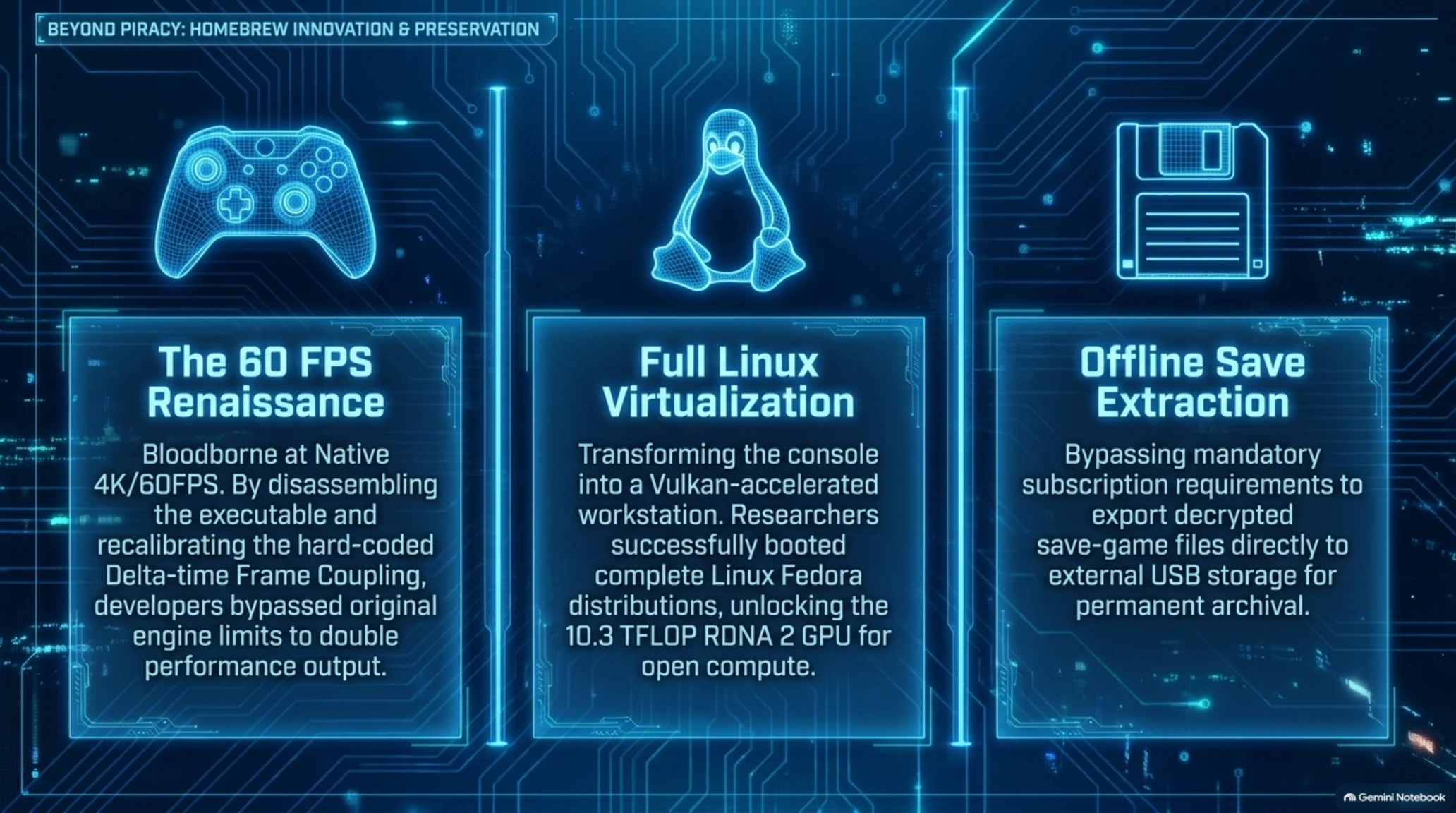
The most profound academic and artistic merit of console exploitation lies within Video Game Preservation and unauthorized performance optimization. By unlocking supervisor execution privileges, independent developers have achieved milestones long neglected by commercial platform holders:
- 60 FPS Unlocked Performance for Legendary Classics: FromSoftware's seminal gothic masterpiece, Bloodborne locked at 30 FPS on PS4 for its entire lifecycle executes on jailbroken PS5 hardware at a flawless native 4K resolution at a locked 60 frames per second utilizing Lance McDonald's custom timing patches. Identical fidelity overhauls have been realized for Red Dead Redemption 2 and Driveclub.
- Full Linux OS Virtualization: Researchers have successfully booted complete Linux Fedora distributions on PS5 hardware, transforming the 10.3 TFLOP AMD RDNA 2 GPU into an open computational workstation supporting Vulkan graphics pipelines.
- Independent Emulation Architectures: Projects such as RPCSX (PlayStation 3 emulation on PS5) and RetroArch enable the archival preservation of thousands of legacy interactive titles.
Regarding Lance McDonald's legendary Bloodborne 60 FPS patch, low-level binary analysis of FromSoftware's proprietary engine reveals that in 2015, physics calculations, character skeletal animations, and cloth simulation logic were hard-coded directly to a fixed 30 FPS update interval (Delta-time Frame Coupling). If the framerate limiter was uncapped naively, the entire in-game simulation executed at double speed! Independent developers achieved locked 60 FPS gameplay by disassembling the executable eboot.bin, identifying the primary update timing loops, and recalibrating the delta-time multiplier to dynamically normalize physics ticks at 60 frames per second.
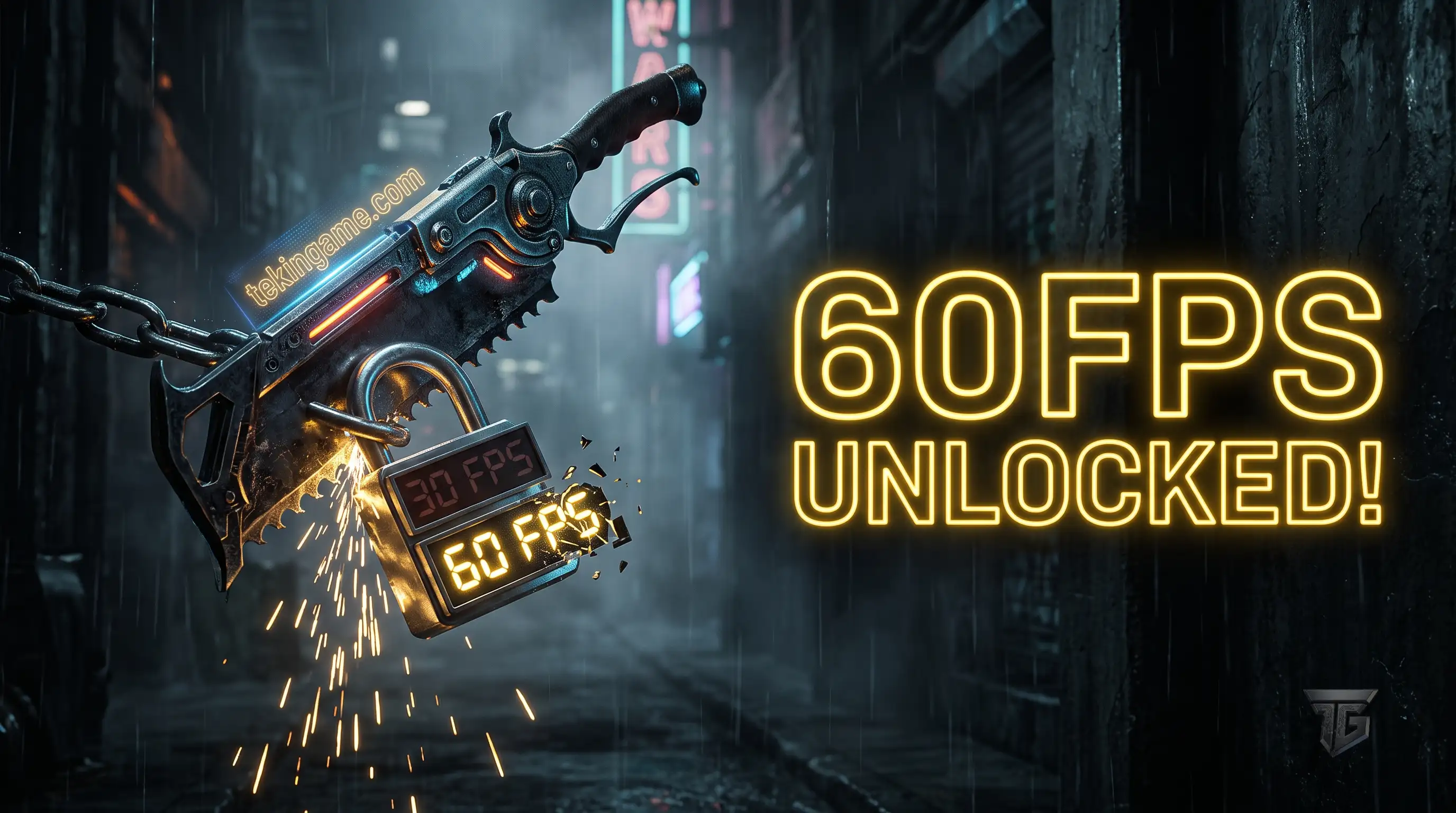
The conceptual rendering below depicts Bloodborne running in locked 60 FPS 4K fidelity on modified PlayStation 5 silicon:
Technical Showcase: Major Triumphs of the PS5 Homebrew Ecosystem
• Driveclub 60 FPS Patch: Re-enabling 60 FPS rendering in dynamic weather conditions.
• Linux Fedora Port: Transforming console silicon into a full-fledged Vulkan-accelerated workstation.
• Offline Save Backup Utilities: Exporting decrypted save-game files directly to external USB storage.
The technical benchmark video below illustrates Bloodborne executing at a locked 60 frames per second on PlayStation 5 hardware:
Strategic Conclusion: Balancing Software Freedom Against Online Isolation
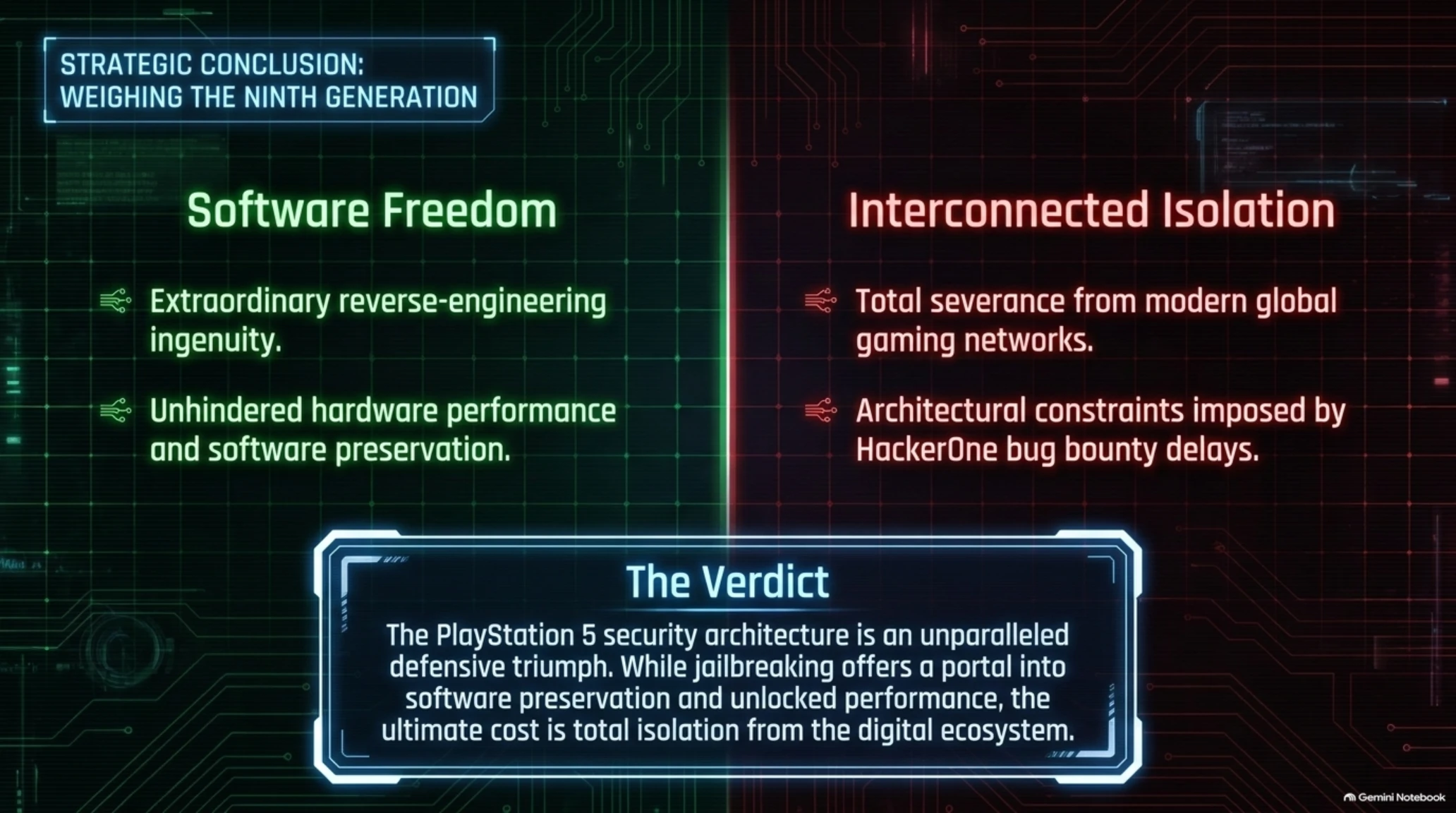
Our comprehensive encyclopedic investigation establishes that PlayStation 5 jailbreaking represents a complex convergence of extraordinary reverse-engineering ingenuity, platform economics, and the debate over digital ownership rights.
While jailbreaking provides an extraordinary portal into software preservation, homebrew innovation, and unlocked visual performance, its price is total isolation from modern interconnected gaming networks. Recognizing these technical boundaries is fundamental to a mature understanding of digital platform security in the modern era.
- Access to locked 60 FPS patches for beloved classics like Bloodborne and Driveclub
- Ability to boot full Linux OS distributions and utilize console compute as a workstation
- Complete offline save-game backup extraction without mandatory PS Plus subscriptions
- Zero physical, electrical, or thermal degradation to the console processor or cooling assembly
- Permanent, irreversible exclusion from PlayStation Network and all online multiplayer titles
- Inability to execute modern game releases requiring higher SDK firmware cryptographic keys
- Inherent risks of transient software Kernel Panics during exploit payload execution
Essential Related Reading & Cyber Intelligence Archives
• ☀️ Tekin Morning August 22, 2026 | Leaked $899 Xbox Series X25 & Phantom Blade Zero Surge
• 🛡 Tekin Analysis | ThreatsDay Crisis: AI Exploits Target Siemens S7 & Sandbox Escapes
• 🤖 Tekin Versus | TrueForge Revolution: Open-Source AI Agents vs. Claude
Frequently Asked Questions
Does jailbreaking a PlayStation 5 cause overheating or hardware damage?
No. Jailbreaking is strictly a RAM-resident software injection; operating voltages, APU TDP, and fan speeds remain 100% identical to factory specifications.
Did Sony intentionally leave vulnerabilities open to drive console sales?
No. Sony's business model relies on digital software sales and subscriptions; jailbreaking reduces software revenue to zero, representing a direct financial loss.
Which firmware versions currently offer the most stable jailbreak experience?
Firmwares 3.00 through 4.51 represent the golden standard, featuring mature IPv6 and BD-J exploits with over 95% execution success rates via etaHEN.
Can a user downgrade a patched PlayStation 5 to an older jailbreakable firmware?
No. Hardware eFuses embedded inside the AMD APU are permanently blown during firmware updates, making physical downgrading impossible.
Can you play online multiplayer games with a jailbroken PS5?
No. Connecting a modified or outdated console to PSN results in immediate, permanent hardware-level Console ID bans.
Official Technical References & Documentation
Additional Gallery: 🛡️ The Definitive PS5 Jailbreak Encyclopedia | Firmware Matrix & Exploits