Tekin Analysis | When 47 States Can't Stop What Anyone Can Make in 5 Seconds
Strategic Evaluation & Key Takeaways at a Glance
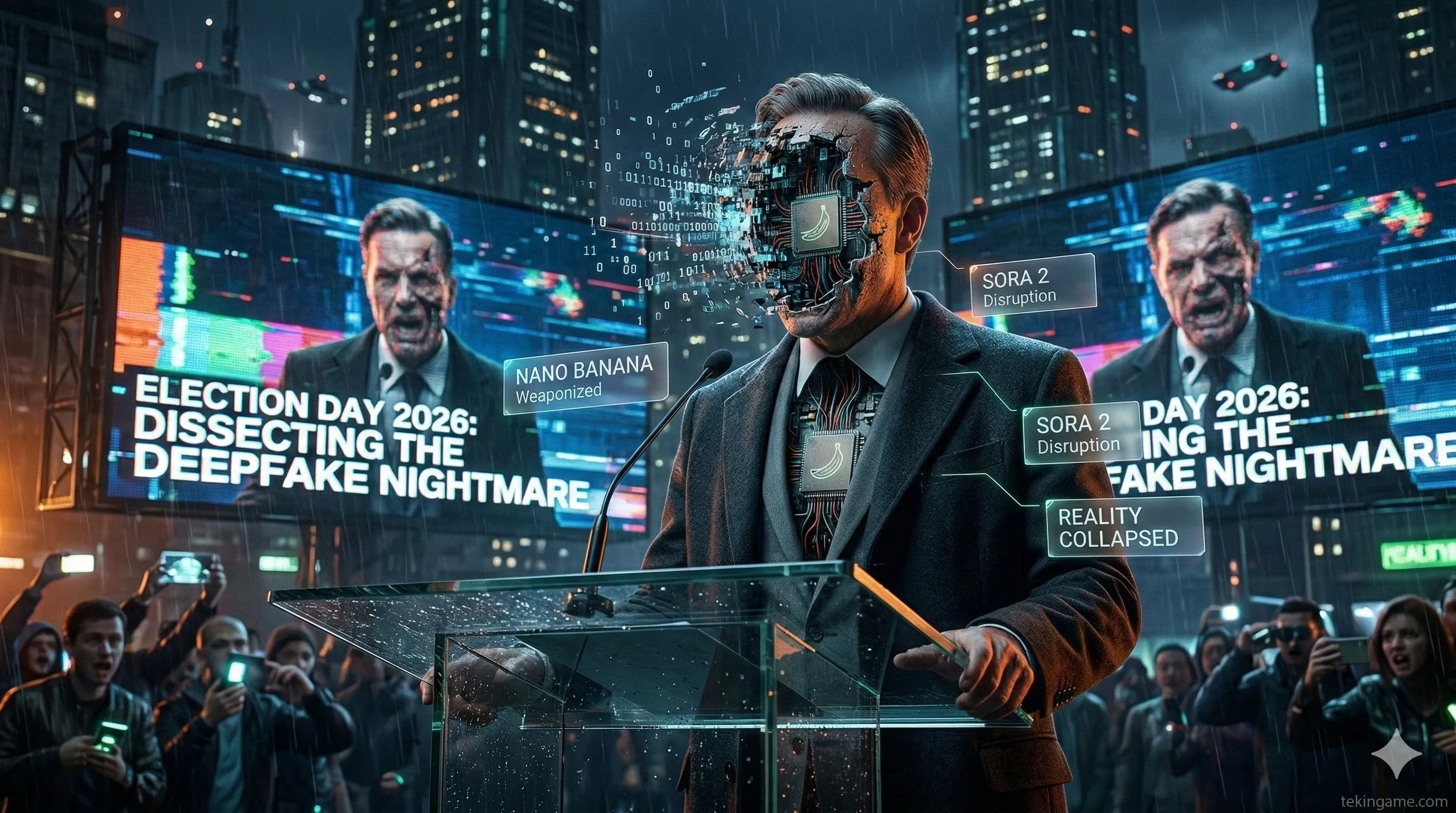
On May 19, 2026, a quiet regulatory deadline arrives: digital platforms must implement deepfake notice-and-takedown systems with a 48-hour removal window. Yet tools like Google's Nano Banana (with over 500 million edits) can synthesize a convincing political deepfake in just 2 to 5 seconds. Today, 47 US states enforce deepfake laws but when anyone can generate fabricated media faster than platforms can delete it, what does the law actually accomplish? Welcome to the 2026 midterm elections: the first election in history where reality has become optional.
Why This Shift Changes the Game
The asymmetry between a 5-second creation cycle and a 48-hour legal removal window creates an epistemological crisis where viral deception outpaces fact-checking and statutory enforcement by orders of magnitude.
The Perfect Storm: When Technology, Elections, and Law Collide
Three structural forces collide in November 2026 to make the US midterm elections the first true "deepfake election" in history:
- Technology Has Matured: Google's Nano Banana, OpenAI's Sora 2, and dozens of rival models have democratized photorealism. What once required Hollywood VFX studios and weeks of rendering now happens on a smartphone in seconds with Nano Banana alone processing over 500 million image edits since launching in February 2026.
- High-Stakes National Midterms: With control of Congress on the line in a deeply polarized political climate, any fabricated clip can achieve massive viral velocity before fact-checkers can respond.
- Untested Legal Patchwork: Roughly 82% of state deepfake laws were enacted within the last two years, enforcement mechanisms remain untested, and a bipartisan federal AI election security bill died in the final hours of the previous Congress.
The Democratization of Deception: Nano Banana and Sora 2
Consider Nano Banana officially known as Gemini 2.5 Flash Image. Since its February 2026 debut, it has processed over 500 million image edits by reducing photorealistic synthesis to four effortless steps: 1. Write a natural language prompt, 2. Wait 2 to 5 seconds, 3. Receive a photorealistic 2K image, and 4. Upscale to 4K on demand. Equipped with real-time Google Search grounding, consistent character rendering, and multi-image fusion, it requires zero technical skill.
OpenAI's Sora 2 achieves the exact same breakthrough for video offering text-to-video, video-to-video editing, and frame-consistent character rendering at 4K resolution. These are no longer studio tools; they are public utilities.
Benchmark Bar Chart & Deepfake Generation Tool Matrix (2026)
| Synthesis Platform | Speed & Output Quality | Cost & Technical Skill Required |
|---|---|---|
| Nano Banana (Gemini 2.5 Flash) | 2–5 Seconds (2K to 4K Photorealistic) | Free Tier / Zero Technical Skill Required |
| OpenAI Sora 2 (Video Engine) | Minutes (4K Frame-Consistent Video) | Paid Subscription / Low Skill Threshold |
| Traditional Studio VFX | Hours to Weeks (Variable Quality) | High Production Cost / Expert VFX Artists |
Tekin Technical Jargon Buster
The Threat Landscape: Four Attacks Coming
Four distinct deepfake attack vectors threaten the 2026 midterm elections, each capable of eroding democratic stability:
- Candidate Impersonation: Fabricated videos or cloned audio phone calls of candidates making controversial statements released in the final hours before polls open leaving zero time for debunking to reach voters.
- Voter Suppression 2.0: Targeted disinformation announcing fake polling place closures, false voting ID rules, or fabricated security threats at precincts to induce fear and confusion at scale.
- Social Division: Synthesizing fake evidence of misconduct to inflame public outrage and destroy trust across all media aiming not to persuade voters, but to manufacture total chaos.
- Post-Election Chaos: The most dangerous vector fabricating videos of ballot manipulation and synthetic "whistleblower" testimonies to delegitimize certified election results.
Risk Assessment & Election Cyber Defense Matrix
| Election Deepfake Threat Vector | Risk Level | Moderation & Enforcement Bottleneck |
|---|---|---|
| Last-Minute Candidate Impersonation & Post-Vote Chaos | CRITICAL | A 48-hour takedown mandate is useless against attacks launched 24 hours before Election Day. |
| Targeted Voter Suppression 2.0 & Social Division | HIGH RISK | Encrypted messaging and micro-targeted feeds bypass public platform moderation queues. |
| Automated AI Detection & Digital Watermarking | COMPROMISED | Intentional compression artifacts and visual noise defeat AI classifiers and strip watermarks. |
Why Detection Fails: Humans and AI Both Powerless
The uncomfortable truth is that neither humans nor machines can reliably detect modern deepfakes. Humans fail because voice clones are virtually indistinguishable from real speech, and bad actors intentionally degrade visual deepfakes with phone-camera noise and heavy compression artifacts to mask synthetic flaws.
AI detectors fail due to high false-positive rates, adversarial evasion techniques, and the absence of a universal watermarking standard. Combined with millions of daily uploads and human confirmation bias, viral spread easily outruns moderation even under the May 19 48-hour takedown rule.
📚 Classified & Related Dossiers in TekinGame
If you wish to explore beyond this report and delve into cybernetic frontiers and autonomous AI architectures, do not miss these three exclusive deep-dives in the Tekin Garage:
Technical Fact-Check | Regulatory Myth vs. Engineering Reality
Policymakers often assume social platforms can deploy AI detection algorithms to automatically catch and block election deepfakes on upload.
Deliberate phone-camera degradation and compression strip AI signatures, blinding detectors and creating massive false-positive bottlenecks.
The Liar's Dividend: When Everything Can Be Fake, Nothing Can Be Real
The most insidious consequence of synthetic media is the "Liar's Dividend": when everything can be fake, nothing can be proven real. Politicians caught on authentic video or audio committing wrongdoing can simply claim "that's a deepfake" and half the electorate will believe them. Genuine whistleblowers are dismissed, investigative journalism is discredited, courtroom evidence is challenged, and democracy faces a profound epistemological crisis where shared reality ceases to exist.
The State Response: 47 Laws, One Mess
Currently, 47 US states have enacted deepfake legislation leaving only Alaska, Missouri, and Ohio without state-level rules. However, this fragmented landscape forces national campaigns to navigate 47 conflicting regulatory regimes. Under the May 19, 2026 deadline, platforms must enforce notice-and-takedown workflows within 48 hours and make reasonable efforts to purge copies, yet defining a "valid request" while balancing free speech against election integrity remains unresolved.
Regulatory Telemetry Dashboard: US State Deepfake Law Distribution
| Statutory Category | State Count | Core Requirements & Penalties |
|---|---|---|
| Disclosure Requirements | 24 States | Mandatory AI content labeling / Civil financial fines |
| Election & Publication Bans | 26 States | Banning deceptive election deepfakes (2 states ban X days pre-vote) / Criminal & Civil |
| Platform Takedown Mandate (May 19) | All (47 States) | 48-hour notice-and-takedown removal / Variable penalties (Zero federal law) |
The Federal Failure: When Congress Couldn't Act
A bipartisan federal AI election security bill collapsed in the final hours of the previous Congress, leaving the 2026 national midterm elections with zero unified federal framework. Consequently, interstate coordination is crippled, national campaigns face 47 different regulatory regimes, and bad actors can easily exploit jurisdictional gaps.
Event Timeline | 2026 Election Deepfake & Regulatory Chronology
| Date / Window | Technical & Legal Milestone | Strategic Impact on 2026 Midterms |
|---|---|---|
| 2024–2026 | 82% of State Laws Enacted & Federal Bill Dies | Creates 47 fragmented state regimes with zero federal preemption or unity. |
| Feb 2026 | Google Launches Nano Banana (Gemini 2.5 Flash) | Surpasses 500M+ image edits with 2–5 second photorealistic 2K/4K synthesis. |
| May 19, 2026 | Platform Takedown Compliance Deadline | Platforms must deploy notice-and-takedown pipelines enforcing 48-hour removal. |
| Nov 2026 | US Midterm Congressional Elections | First national election where 5-second AI deepfakes make reality optional. |
Crisis Thermometer | Circular Gauge & S-Curve Deepfake Proliferation
Crisis Thermometer Analysis: Surpassing 500 million edits on Nano Banana alongside Sora 2 video synthesis proves that zero-skill content generation has completely overwhelmed 48-hour statutory moderation windows.
Conclusion: An Election Where Reality Is Optional
The 2026 midterm elections will be unlike any contest in American history. The math is unforgiving: 5 seconds to create, 48 hours to remove, millions of potential creators, and 47 fragmented state laws trying to regulate what neither humans nor AI can reliably detect. The question is no longer whether deepfakes will impact the 2026 elections it is how much, and whether democratic trust can survive in a world where citizens can no longer trust their own eyes.
- Democratizes studio-grade 2K/4K image synthesis (Nano Banana) and 4K video (Sora 2) for everyday creators.
- 47 US states have enacted deepfake statutes with a May 19, 2026 platform takedown mandate.
- Heightens public awareness regarding synthetic media manipulation ahead of the 2026 midterms.
- Catastrophic speed asymmetry between 2–5 second creation and 48-hour legal removal windows.
- Human and AI detectors fail against intentionally degraded, phone-style compressed footage.
- Lack of a federal law and rise of the Liar's Dividend allow politicians to dismiss authentic evidence.
Final Editorial Verdict & Official Reference Sources
Entering the Post-Truth Electoral Era
When generative AI moves in seconds and legal enforcement moves in days, cryptographic content provenance and voter resilience are the only remaining defenses.
Frequently Asked Questions & Technical Analysis
What is Google Nano Banana and why is it central to the 2026 midterms?
Nano Banana is the popular name for Google Gemini 2.5 Flash Image, which has processed over 500 million edits since February 2026 and allows anyone to generate photorealistic 2K/4K images for free in 2 to 5 seconds.
What does the May 19, 2026 platform deadline require?
By May 19, 2026, social media platforms must implement notice-and-takedown systems to remove reported deceptive political deepfakes and make reasonable efforts to remove copies within 48 hours.
How many US states have enacted election deepfake laws?
47 states have passed deepfake laws (including 24 with disclosure rules and 26 with election bans), leaving only Alaska, Missouri, and Ohio without state-level legislation.
Why do AI deepfake detectors fail to catch election disinformation?
Creators intentionally degrade synthetic videos with visual noise and compression artifacts to mimic phone camera footage, stripping AI watermarks and triggering high false-positive rates in detectors.
What is the Liar's Dividend in the context of political deepfakes?
The Liar's Dividend occurs when the ubiquity of deepfakes enables politicians to dismiss authentic, incriminating recordings or whistleblower evidence as AI-generated fakes.
Why is there no federal AI election security law for the 2026 midterms?
A bipartisan federal AI election security bill died in the final hours of the previous Congress, leaving national campaigns to navigate 47 conflicting state regulatory regimes.
