Tekin Analysis: Console Security
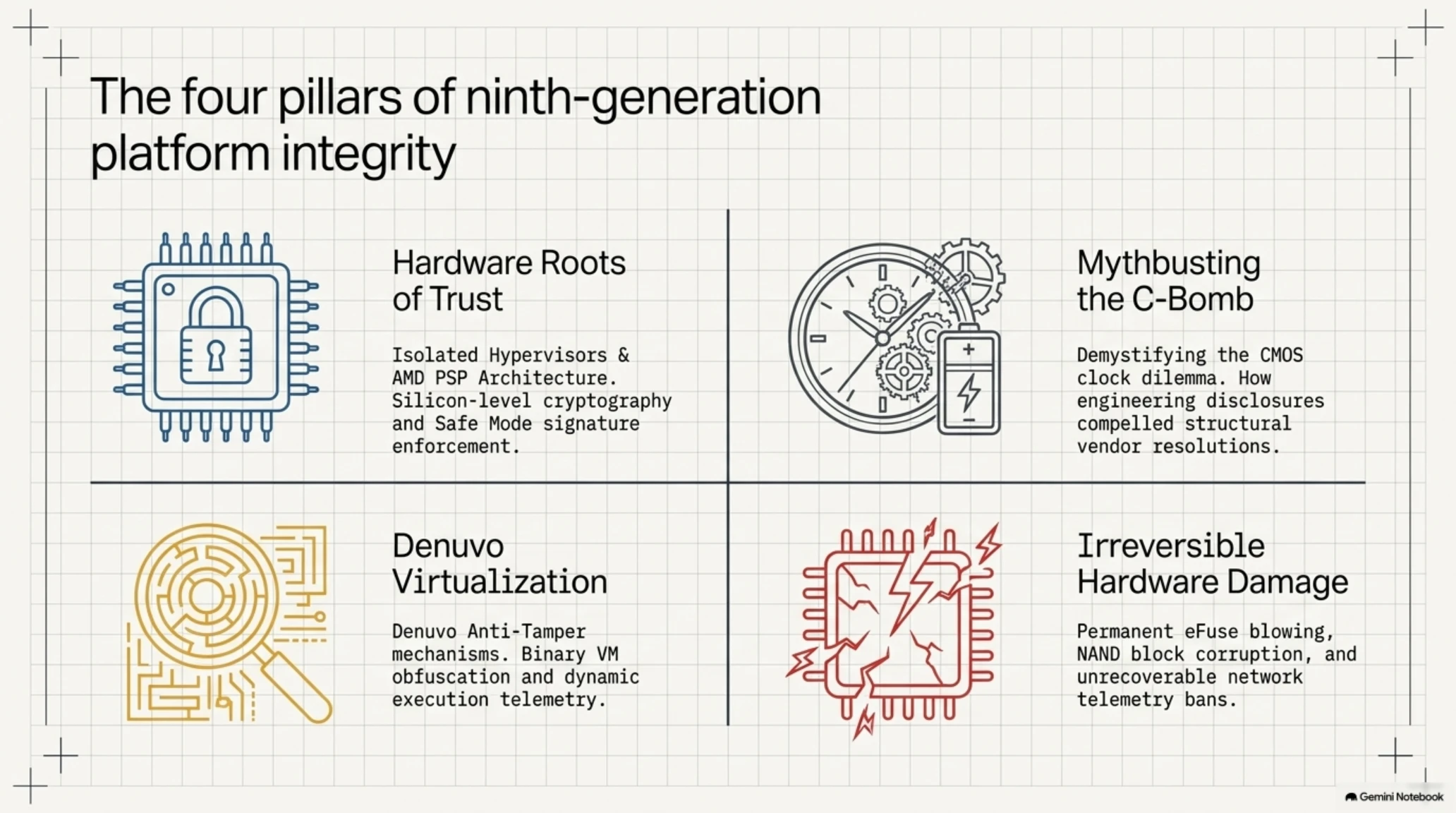
- 🎮Hypervisors & AMD PSP- Silicon-level Hardware Root of Trust and cryptographic Safe Mode signature enforcement
- 🎧Demystifying the C-Bomb- How community engineering disclosures compelled Sony to resolve RTC dependencies
- 🚀Denuvo Virtualization- Binary VM obfuscation and dynamic execution telemetry balancing anti-piracy with stability
- 🗡️Hardware Damage Risks- Permanent eFuse blowing, NAND block corruption, kernel panics, and unrecoverable bans
- 📰Digital Game Preservation- The engineering and legal dilemmas of safeguarding interactive digital heritage beyond 2035
- ⚔️Cybersecurity Philosophy- Championing system integrity, consumer hardware preservation, and developer rights
Gaming hardware security and Digital Rights Management (DRM) technologies in ninth-generation consoles have evolved into one of the most sophisticated domains of modern computer engineering. Across online developer communities and social media forums, impassioned debates continually arise surrounding console exploitability, anti-tamper engines like Denuvo, and persistent misconceptions regarding hardware obsolescence. Yet, the critical boundary separating verified computer engineering realities from hyperbole frequently remains obscured for mainstream gamers and technical enthusiasts alike.
The core analytical mission of TekinGame is grounded in elevating technical literacy, deconstructing complex cybersecurity frameworks, and clearly articulating the severe hardware risks associated with unauthorized system modification. In this comprehensive technical dossier, we provide a deep-dive examination of PlayStation 5 and Xbox Series security architectures, the true engineering reality behind the famous C-Bomb phenomenon, the internal mechanics of Denuvo Anti-Tamper virtualization, and the irreversible hardware liabilities introduced by unsanctioned system tampering.
AT A GLANCE | PILLARS OF PLATFORM SECURITY & HARDWARE INTEGRITY
- Multi-tier TrustZone execution, dedicated security coprocessors, and cryptographic boot chains
- Verified technical analysis of the CMOS RTC clock synchronization flaw and official vendor firmware resolutions
- Deconstructing Denuvo Anti-Tamper custom virtual machine instruction sets and runtime integrity triggers
- Documenting catastrophic hardware risks: from irreversible eFuse burning to NVMe/NAND write exhaustion
- The evolving legal and technical balance between copyright protection and long-term digital game preservation
1. Modern Console Security Architectures: Isolated Hypervisors & AMD PSP
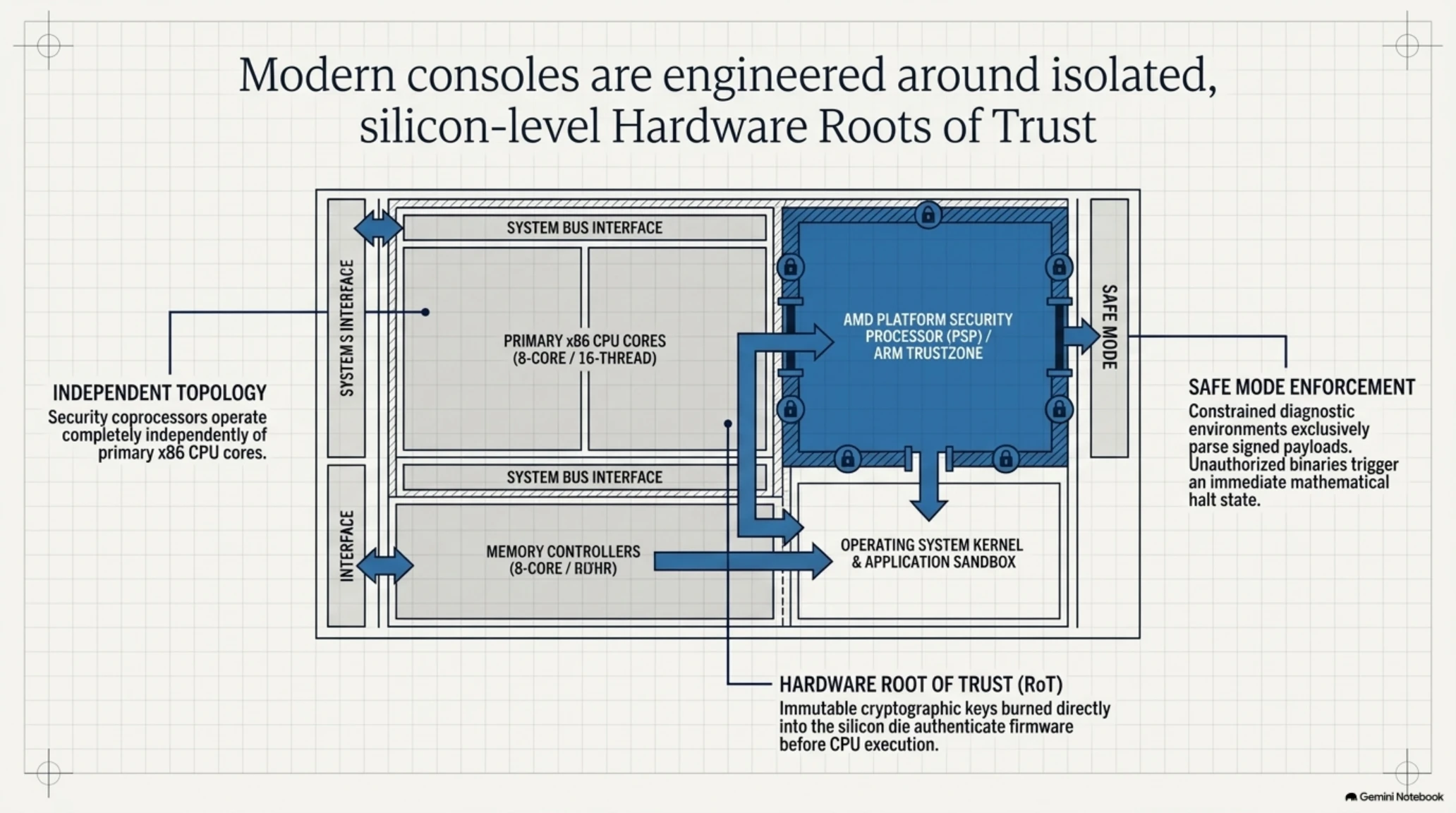
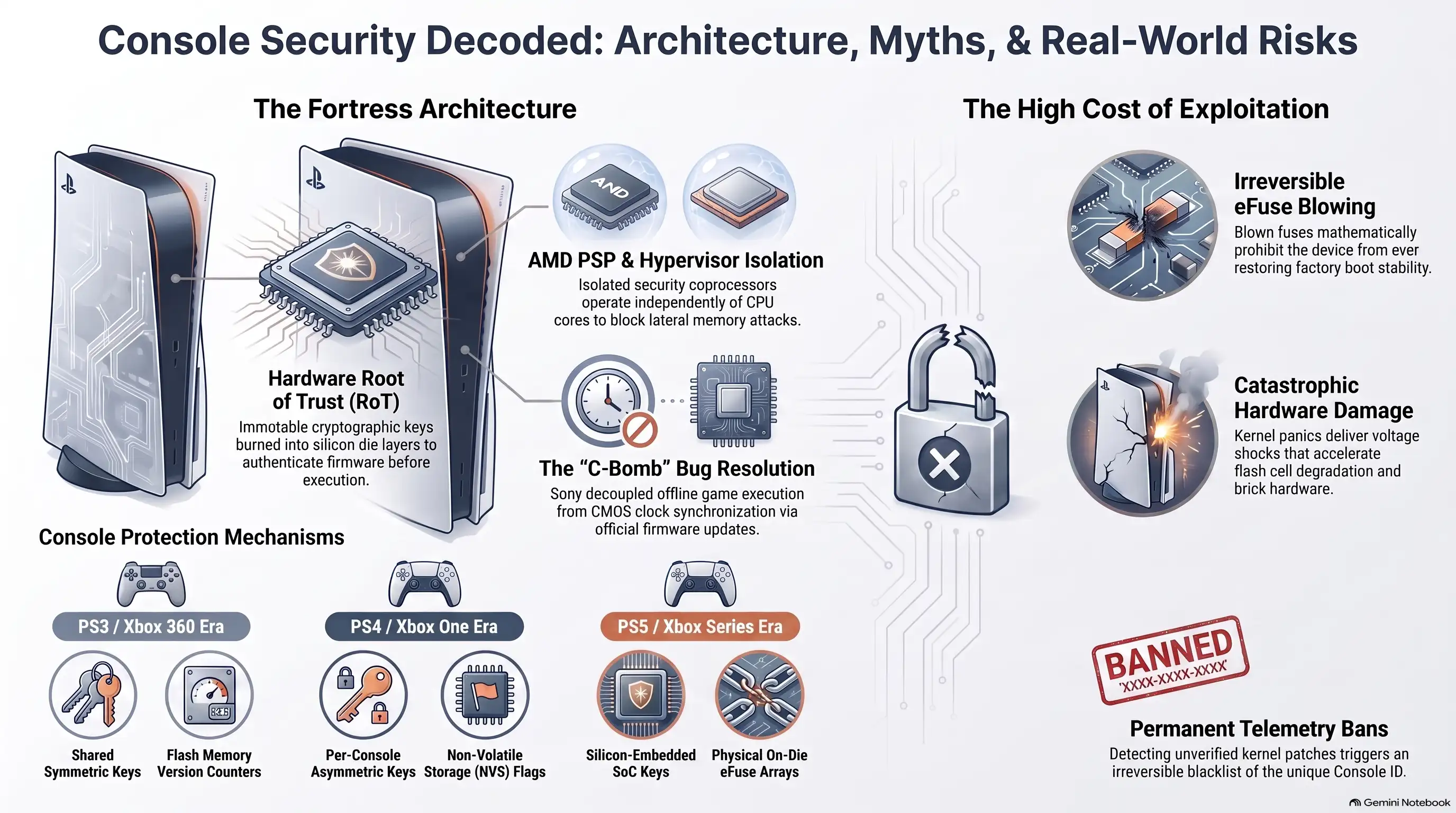
Modern gaming consoles such as the PlayStation 5 and Xbox Series X|S are not standard open-architecture personal computers where arbitrary binaries can be introduced without severe cryptographic oversight. Instead, these systems are engineered upon a multi-layered security model anchored by a dedicated coprocessor: the AMD Platform Security Processor (PSP) or ARM TrustZone equivalent micro-controller.
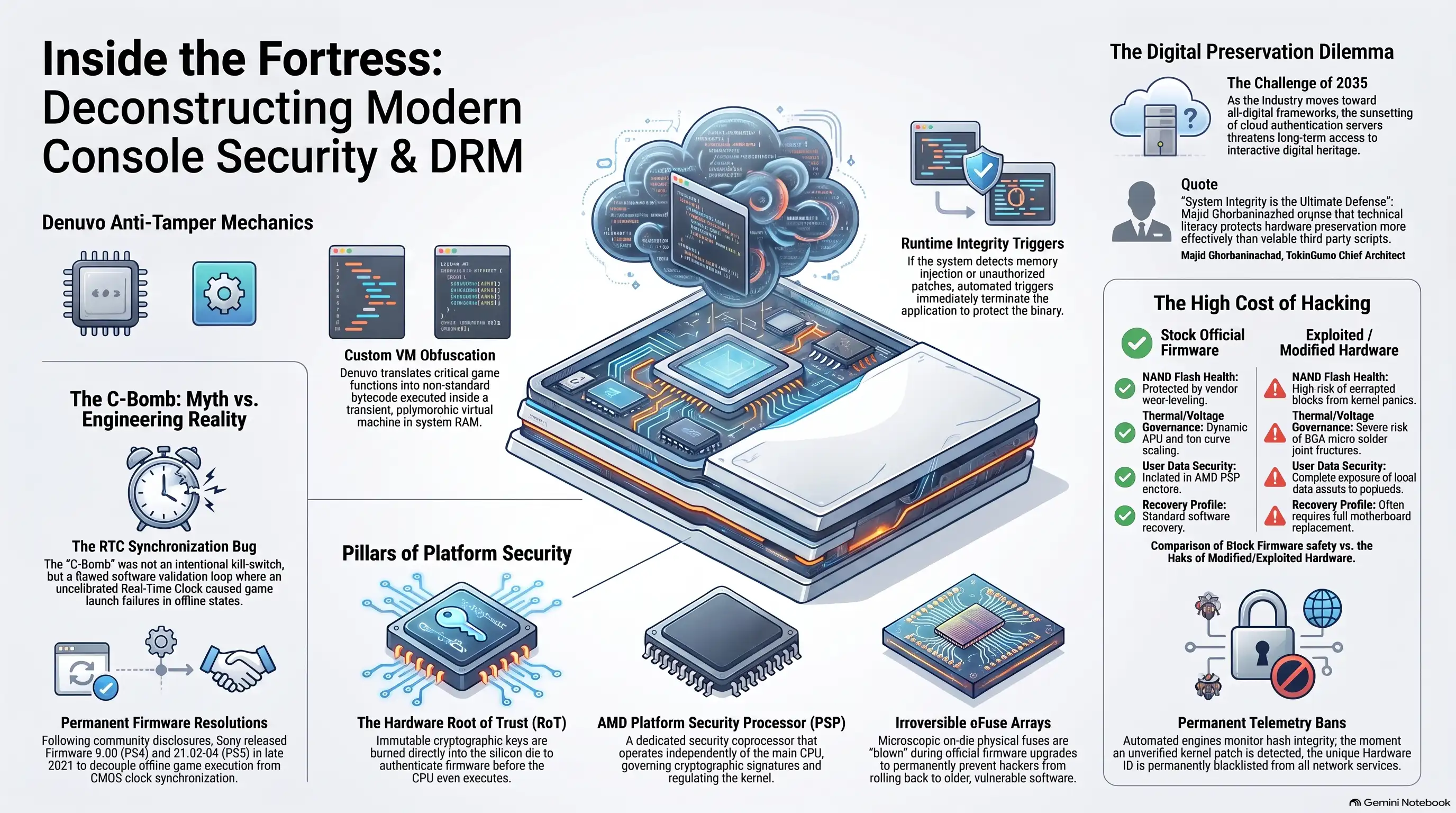
In this isolated topology, the security coprocessor operates completely independent of the primary x86 CPU cores. It governs the silicon-level Hardware Root of Trust (RoT), verifies digital cryptographic signatures across every stage of the boot sequence, and strictly regulates kernel loading within low-level recovery environments (Safe Mode). The hardware hypervisor is architected such that even if user-space application memory is compromised, lateral escalation to protected microcode layers remains mathematically blocked.
Technical Jargon Buster
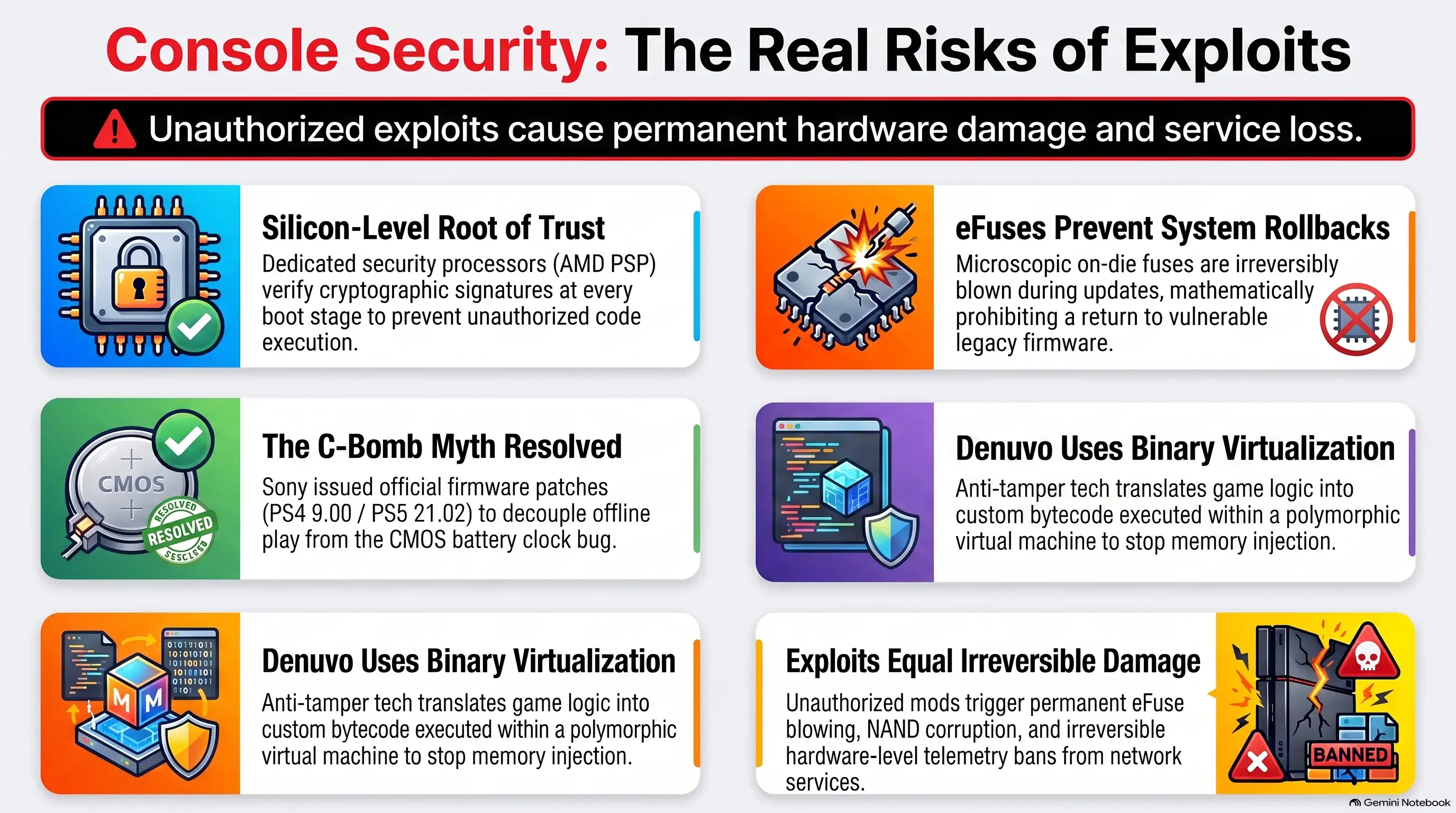
• Electronic Fuses (eFuses): Microscopic on-die physical fuse arrays that are irreversibly blown during official firmware upgrades, permanently preventing rollback (downgrading) to vulnerable legacy software builds.
From an operating system engineering perspective, Safe Mode represents an intensely constrained diagnostic environment designed exclusively to parse and flash cryptographically signed vendor payloads. Any attempt to introduce modified or unauthenticated binary images immediately triggers a halt state at the PSP controller layer, preventing unauthorized code execution and protecting system telemetry.
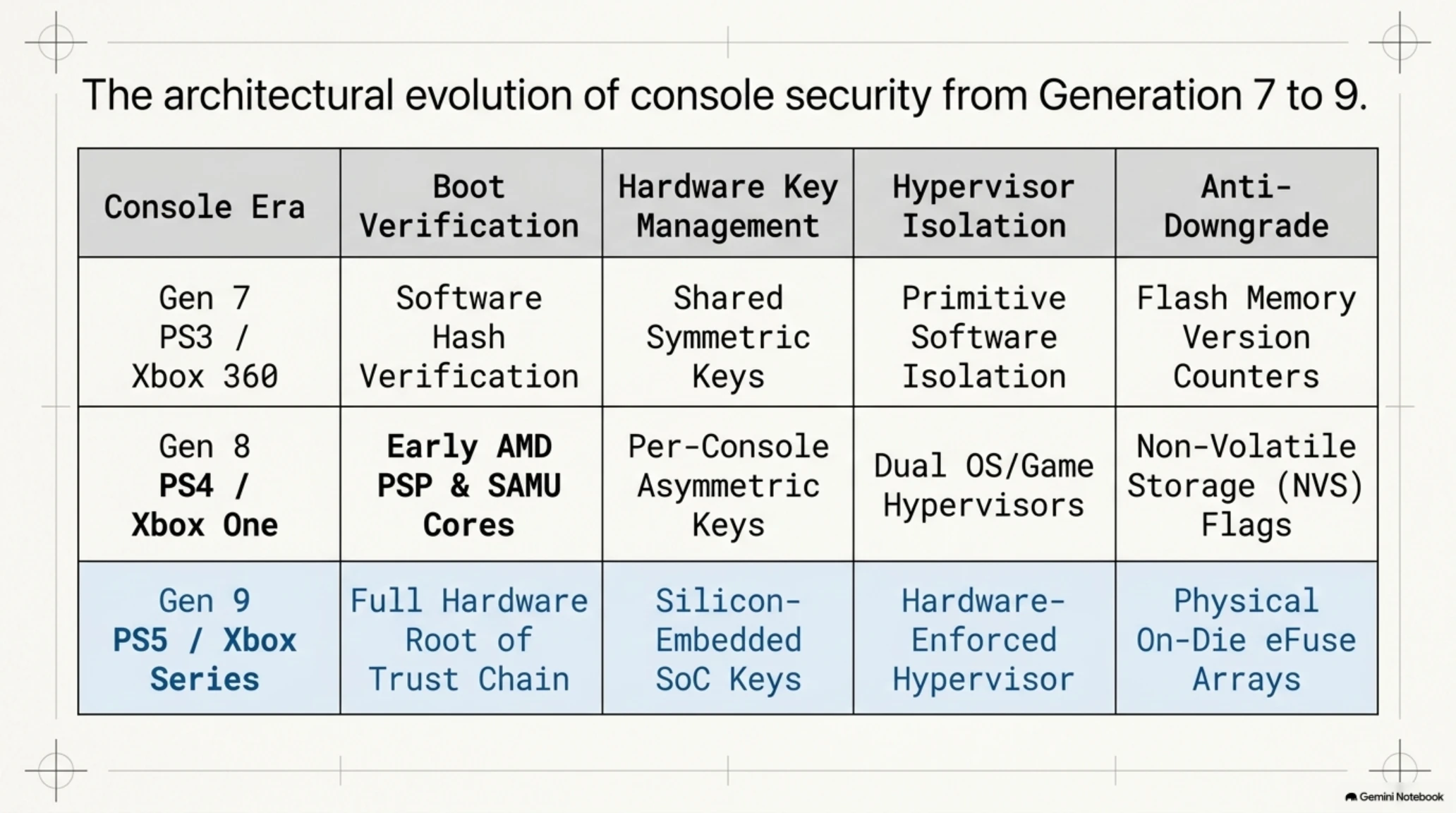
Console Security Architecture & Firmware Protection Evolution Matrix
| Console Era | Boot Verification Scheme | Hardware Key Management | Hypervisor Isolation | Anti-Downgrade Mechanism |
|---|---|---|---|---|
| PS3 / Xbox 360 | Software Hash Verification | Shared Symmetric Keys | Primitive Software Isolation | Flash Memory Version Counters |
| PS4 / Xbox One | Early AMD PSP & SAMU Cores | Per-Console Asymmetric Keys | Dual OS/Game Hypervisors | Non-Volatile Storage (NVS) Flags |
| PS5 / Xbox Series | Full Hardware Root of Trust Chain | Silicon-Embedded SoC Keys | Hardware-Enforced Hypervisor | Physical On-Die eFuse Arrays |
2. Demystifying the C-Bomb: The Truth Behind the CMOS Battery & RTC Clock Synchronization Bug
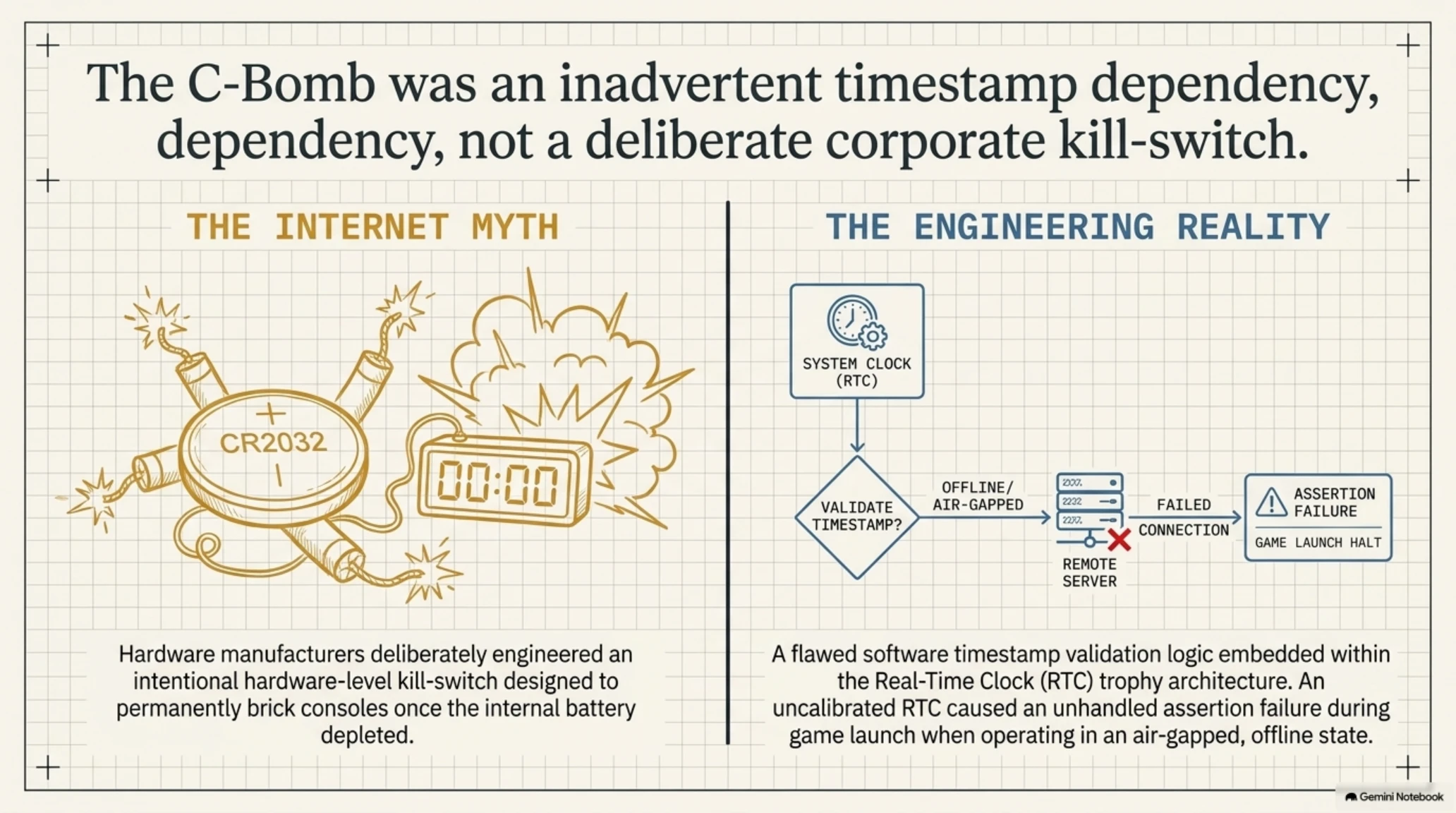
Among the most widely circulated controversies in the gaming ecosystem is the so-called C-Bomb or "CMOS Battery Clock Bomb" phenomenon. Persistent internet rumors asserted that console hardware manufacturers deliberately engineered an intentional hardware-level kill-switch designed to permanently brick consoles once the internal CR2032 coin-cell battery depleted its charge, rendering both digital and physical disc games unplayable offline.
However, thorough engineering analysis revealed that this behavior was not an intentional DRM weapon, but a flawed software timestamp validation logic embedded within the Real-Time Clock (RTC) trophy architecture. In early PlayStation 4 and PlayStation 5 firmware implementations, the operating system required an authenticated network time handshake to validate trophy timestamps and prevent local clock manipulation. If the CMOS battery died while the console operated in an air-gapped, offline state, the uncalibrated RTC caused an unhandled assertion failure during game launch.
Why It Matters | Platform Engineering & Community Disclosures
This resolution demonstrates how constructive, technical dialogue and transparent vulnerability disclosures benefit the broader gaming ecosystem, safeguarding consumer investments without encouraging dangerous system tampering.
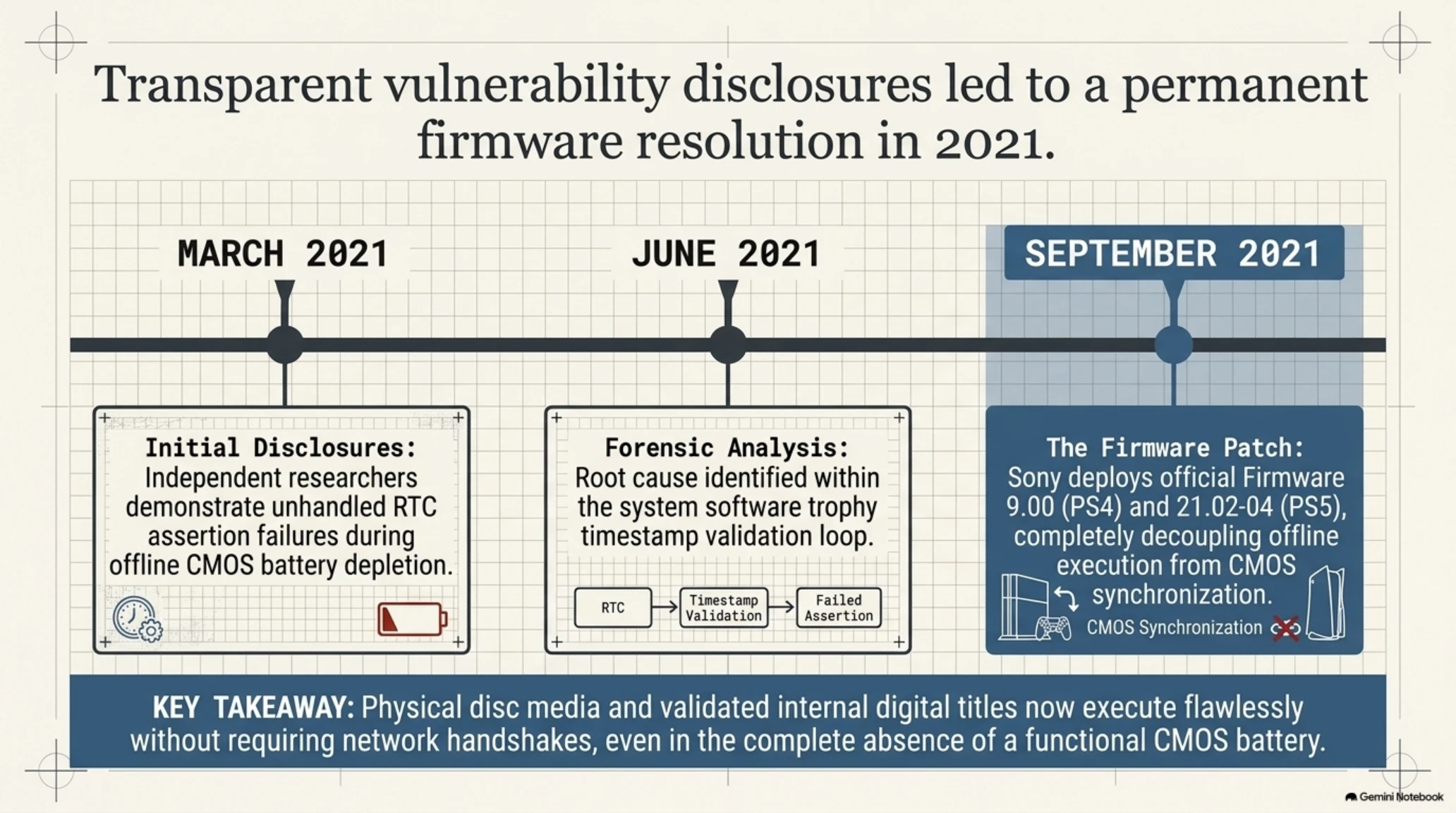
On all modern firmware revisions, physical disc media and validated internal digital titles execute flawlessly without requiring network handshakes, even in the complete absence of a functional CMOS battery.
Documented Engineering Timeline: The CMOS RTC Synchronization Resolution
• March 2021: Initial technical disclosures by independent researchers demonstrating unhandled RTC assertion failures during offline CMOS battery depletion.
• June 2021: Forensic code analysis identifying the root cause within the system software trophy timestamp validation loop.
• September 2021: Sony deploys official Firmware 9.00 for PlayStation 4 and Firmware 21.02-04 for PlayStation 5, completely decoupling offline game execution from CMOS clock synchronization.
3. Inside Denuvo Anti-Tamper: Binary Virtualization & Runtime Integrity Triggers
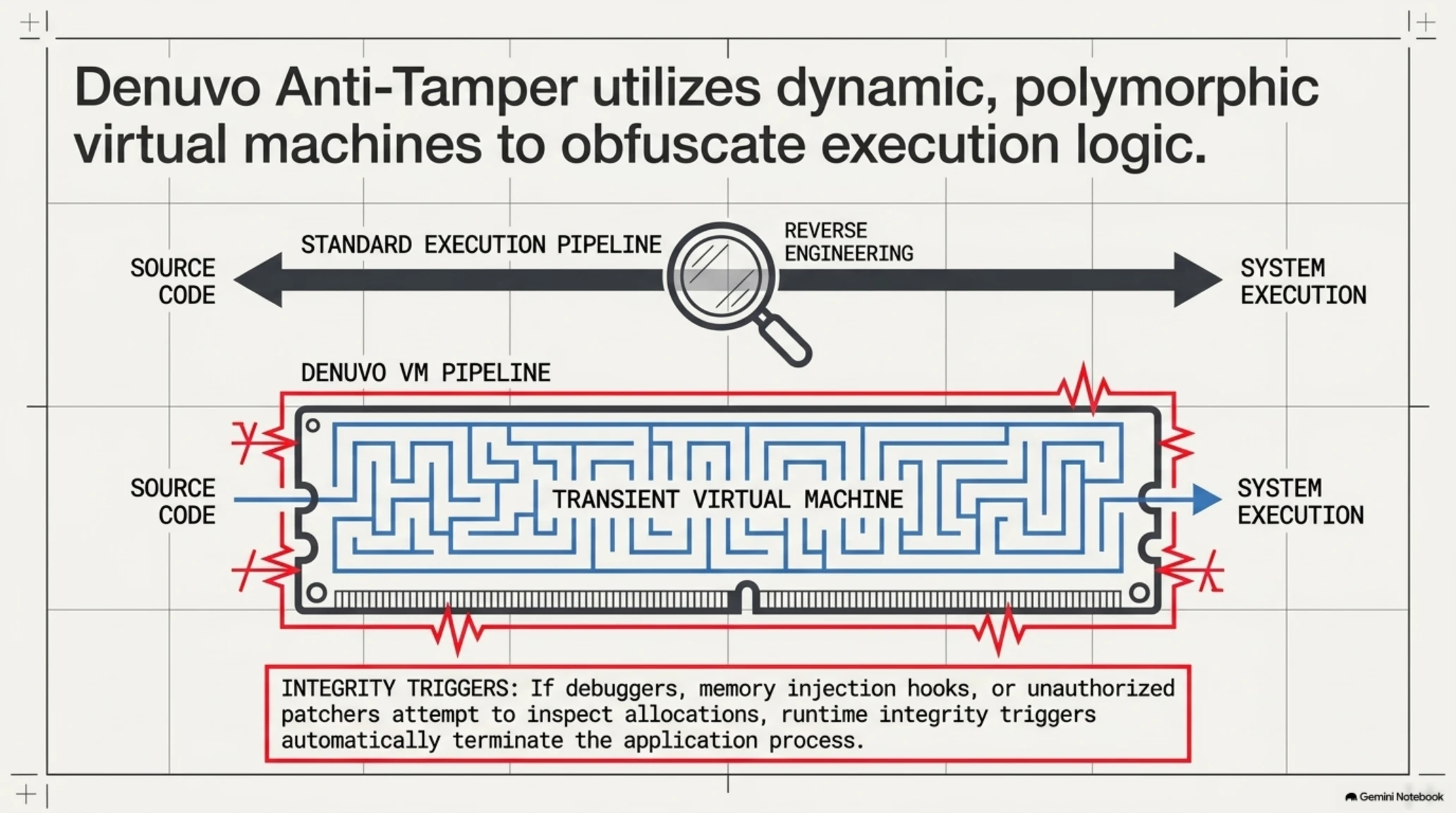
In the personal computing and cross-platform landscape, Denuvo Anti-Tamper—engineered by Irdeto—stands as the most sophisticated and fiercely debated protective shield against binary reverse engineering. Crucially misunderstood by mainstream audiences, Denuvo is not a traditional storefront DRM system, but a specialized anti-tamper envelope designed to obfuscate game execution logic.
The core technology relies on dynamic Custom Virtual Machine (VM) Obfuscation. During compilation, critical game functions are translated into non-standard bytecode executed exclusively within a transient, polymorphic virtual machine in system RAM. If debuggers, memory injection hooks, or unauthorized patchers attempt to inspect or alter memory allocations, runtime integrity triggers automatically terminate the application process.
4. The True Engineering & Hardware Risks of System Exploits and Jailbreaking
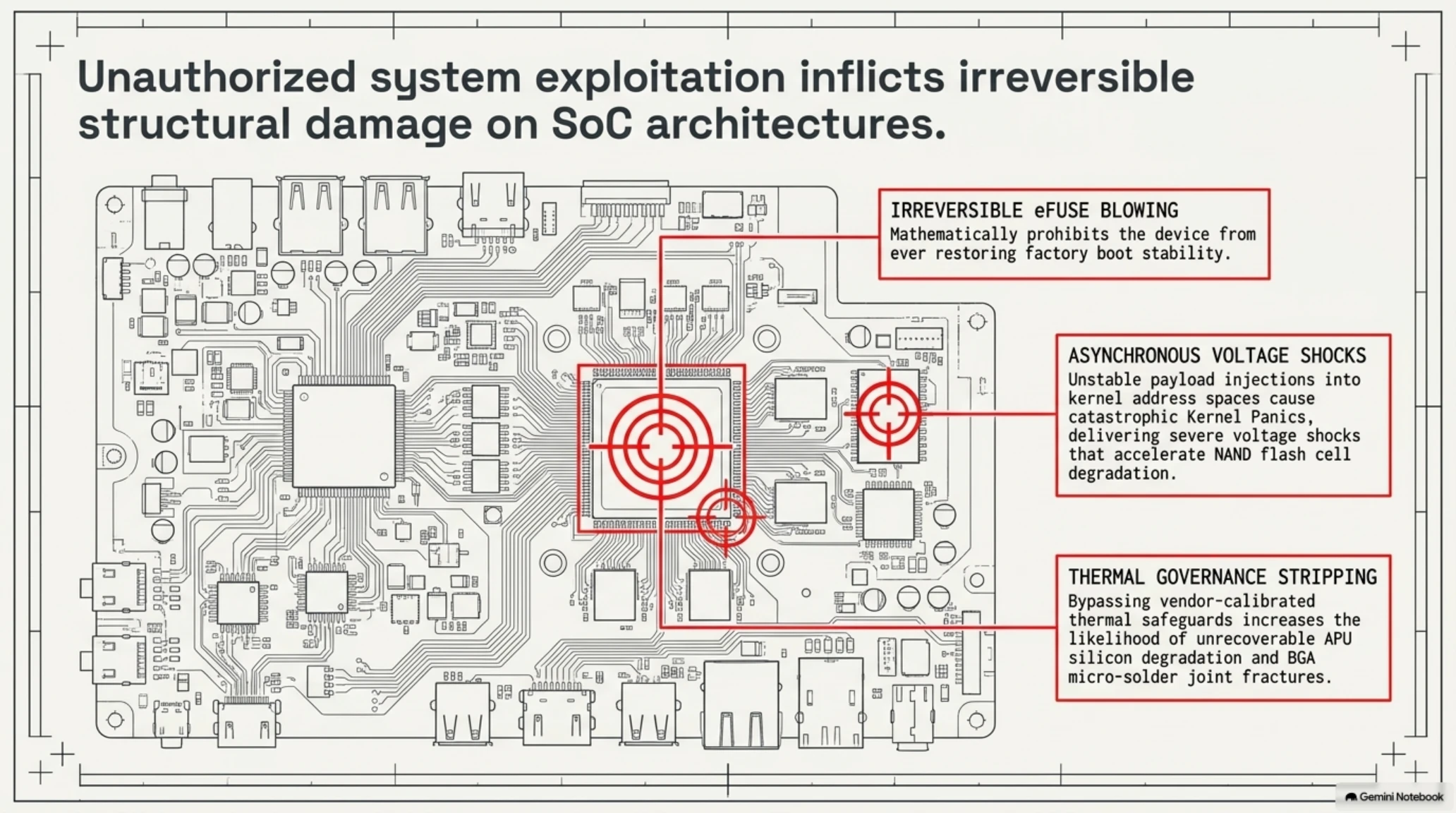
Attempting to execute unsigned binary payloads or bypass platform security perimeters introduces severe, irreversible hardware liabilities. End-users influenced by sensationalized online tutorials often fail to realize the permanent structural toll that uncalibrated kernel exploits inflict upon complex System-on-Chip (SoC) architectures.
The foremost hardware risk involves the irreversible blowing of on-die eFuses within the main processor, mathematically prohibiting the device from ever restoring factory boot stability. Furthermore, unstable payload injection directly into kernel address spaces causes catastrophic Kernel Panics. These abrupt crashes deliver severe asynchronous voltage shocks to high-speed NVMe and NAND flash controllers, accelerating flash cell degradation and frequently causing unrecoverable hardware bricking.
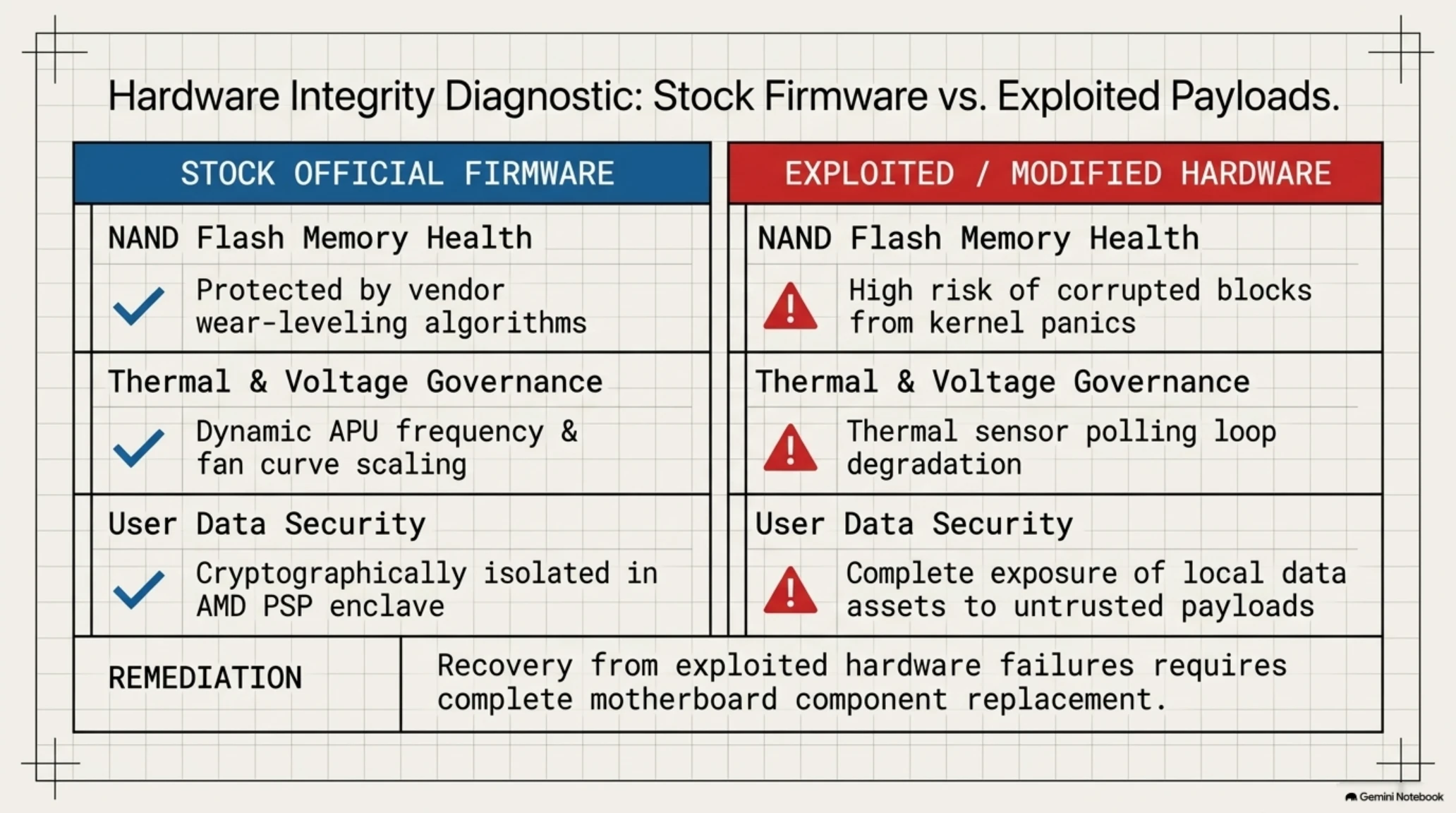
Hardware Integrity & Platform Exploit Risk Matrix
| Technical Parameter | Stock Official Firmware Console | Exploited / Modified Hardware | Recovery & Remediation Profile |
|---|---|---|---|
| NAND Flash Memory Health | Protected by vendor wear-leveling algorithms | High risk of corrupted blocks from kernel panics | Requires complete motherboard component replacement |
| Thermal & Voltage Governance | Dynamic APU frequency & fan curve scaling | Thermal sensor polling loop degradation | Severe risk of BGA micro-solder joint fractures |
| Network & Service Access | Full authenticated online functionality | Permanent hardware-level telemetry bans | Irreversible (Permanent Hardware Console ID Ban) |
| User Data & Credential Security | Cryptographically isolated in AMD PSP enclave | Compromised by untrusted custom payloads | Complete exposure of local data assets |
📚 Classified & Related Dossiers in TekinGame
If you wish to explore beyond this report and delve into cybernetic frontiers and autonomous AI architectures, do not miss these three exclusive deep-dives in the Tekin Garage:
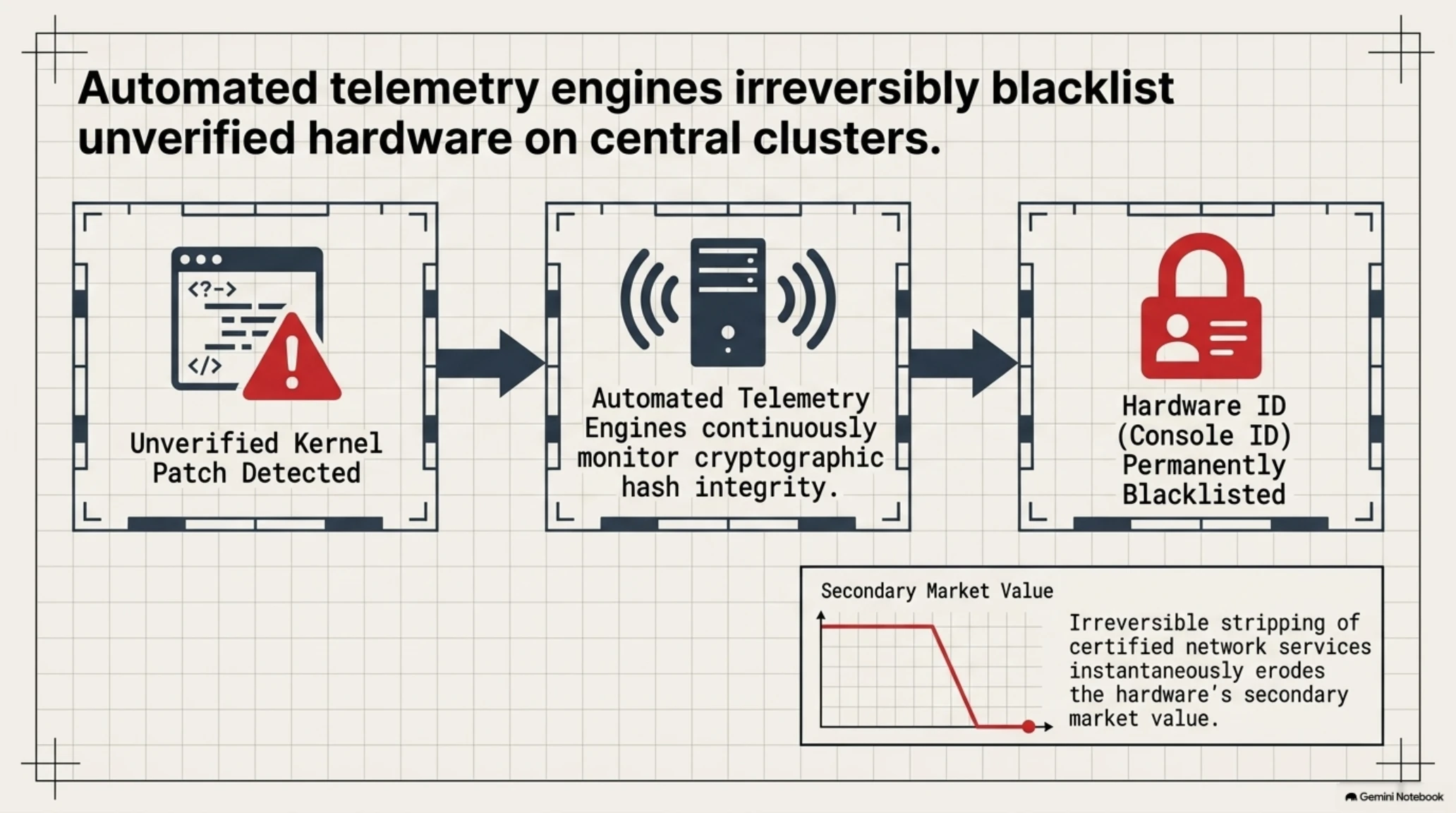
Simultaneously, automated telemetry engines deployed by platform vendors continuously monitor cryptographic hash integrity. The moment an unverified kernel patch is detected, the console's unique Hardware Identification (Console ID) is permanently blacklisted across central authentication clusters. This irreversibly strips the hardware of certified network services and catastrophically erodes its secondary market value.
5. The Digital Preservation Dilemma: The Challenge of the Year 2035
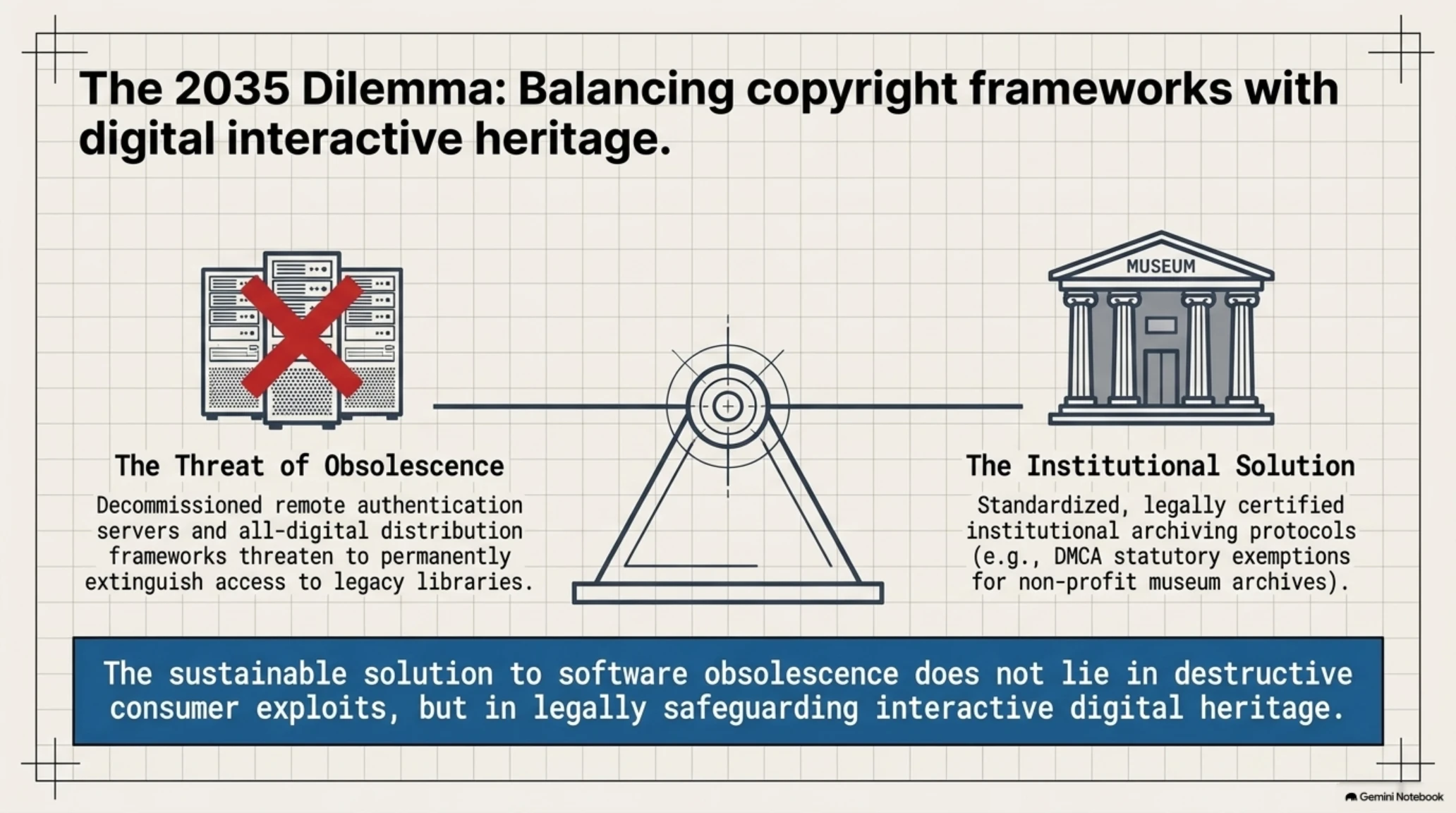
As the video game industry rapidly transitions toward all-digital distribution frameworks and physical disc drives are phased out, a profound technological and cultural challenge emerges: How will future generations preserve interactive digital heritage once remote authentication servers are decommissioned?
Historical server shutdowns across legacy platforms—such as the PS3 PlayStation Store and Xbox 360 Marketplace—demonstrated that when cloud authentication servers terminate operations, legitimate access to hundreds of digital-exclusive artistic works is permanently extinguished. Digital archivists and computer science historians argue that copyright frameworks (such as the DMCA) require measured statutory exemptions for non-profit museum archives to prevent the irreversible loss of 21st-century digital art.
Tekin Perspective | Digital Heritage Preservation & Consumer Rights
Examining these complex preservation dynamics demonstrates that debates surrounding console architecture extend far beyond casual modding, directly interfacing with the long-term custody of digital culture.
6. Ethical Cybersecurity Education: Why Technical Literacy Protects the Ecosystem
The core objective of modern technology journalism and engineering analysis is to foster deep technical comprehension rather than encouraging hazardous user behaviors. Architectural deep-dives into console security layers conducted by TekinGame and specialized technical channels are curated solely to illuminate the astonishing complexity of modern computer systems, educate consumers on the permanent risks of unauthorized tampering, and champion the intellectual property rights of software creators.
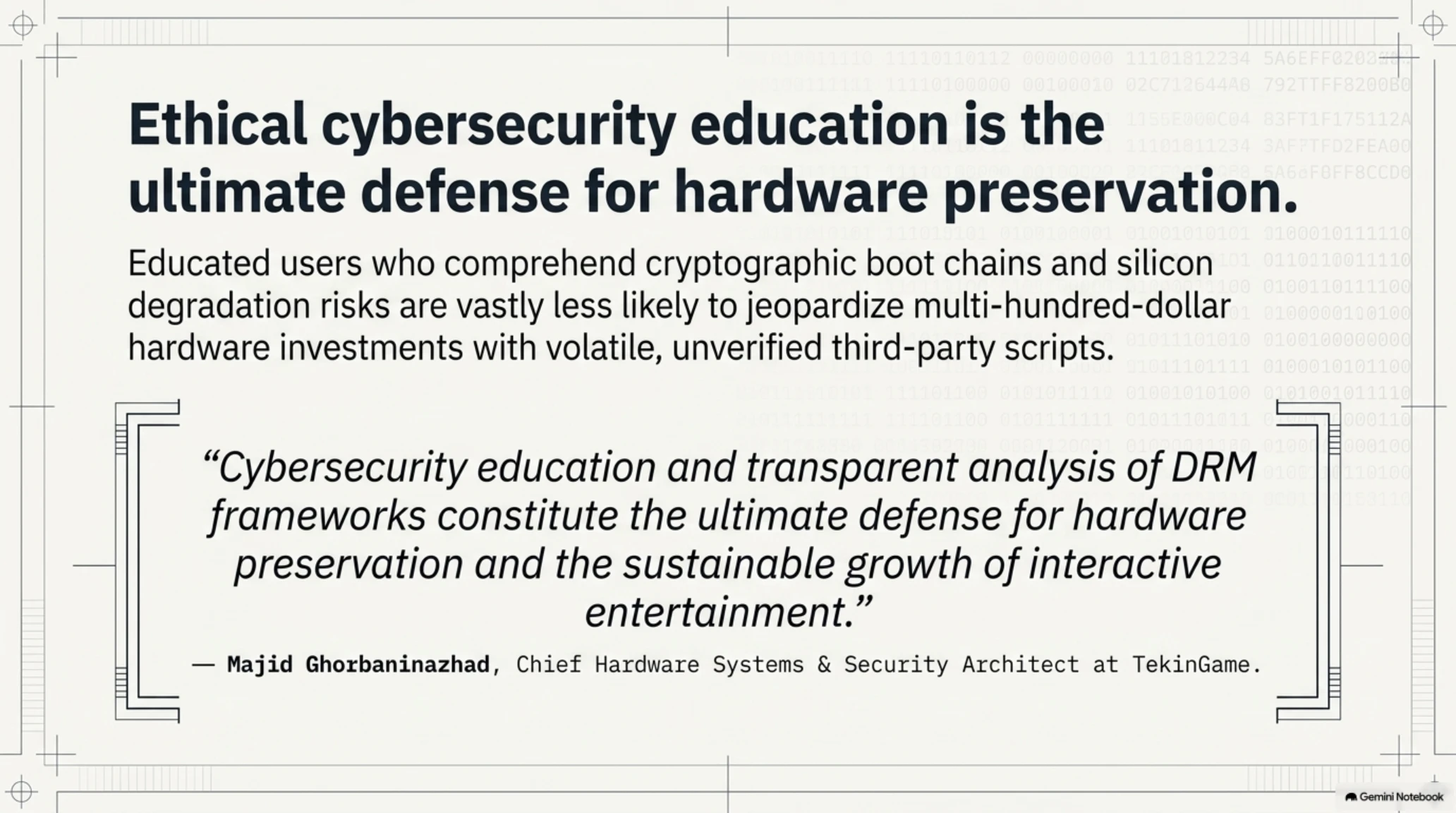
Empirical evidence consistently demonstrates that educated users who comprehend cryptographic boot chains, silicon degradation risks, and the criticality of operating system stability are vastly less likely to jeopardize their multi-hundred-dollar hardware investments with volatile, unverified third-party scripts.
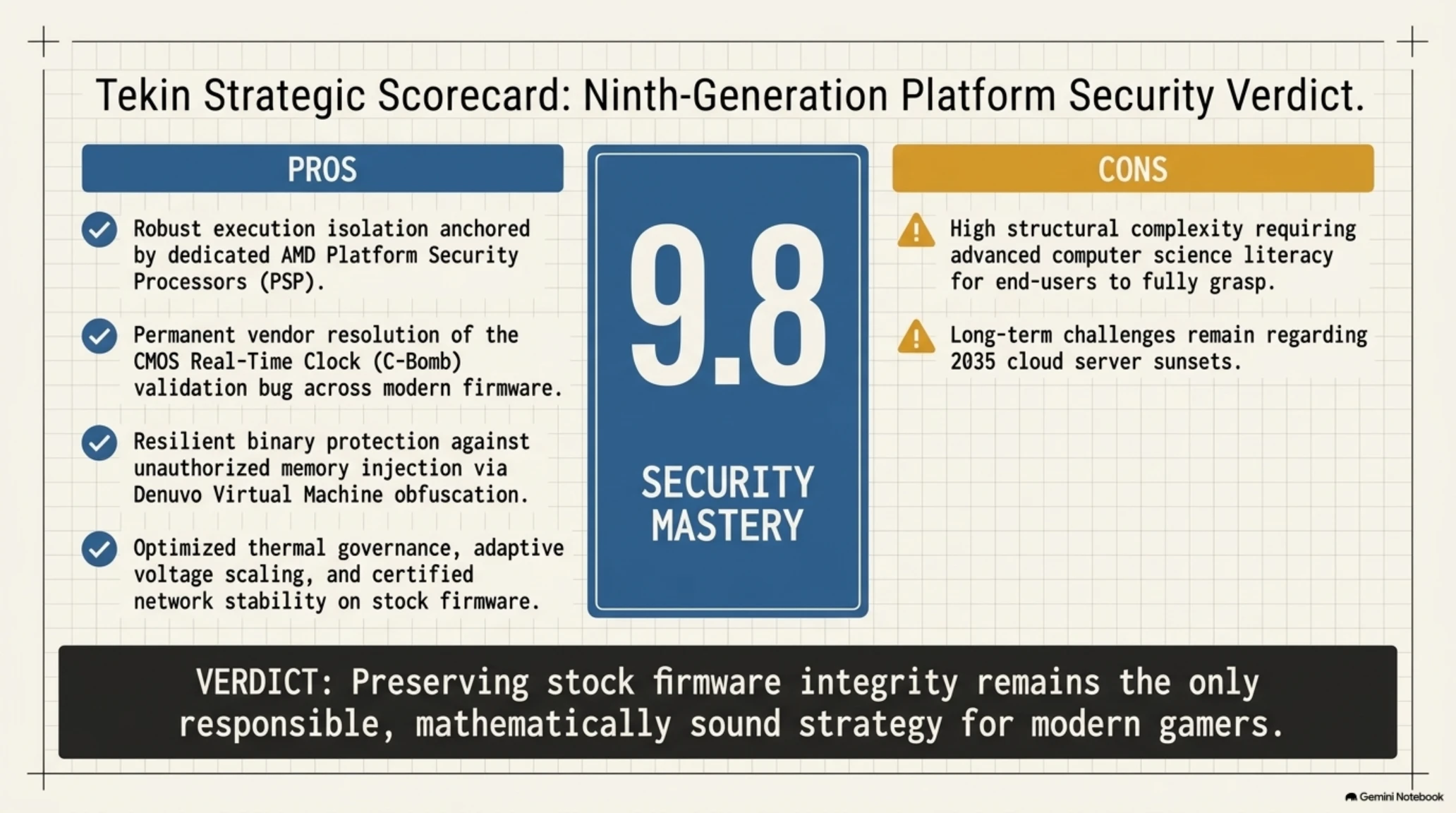
Tekin Strategic Scorecard & Platform Security Verdict
Deconstructing ninth-generation console security architectures reveals an intricate synergy of silicon-level cryptography, isolated coprocessors, and automated integrity enforcement. The catastrophic hardware liabilities of unauthorized system modifications overwhelmingly eclipse any transient novelty. Preserving stock firmware integrity and utilizing authenticated network ecosystems remains the only responsible, mathematically sound strategy for modern gamers.
- Robust execution isolation anchored by dedicated AMD Platform Security Processors (PSP)
- Permanent vendor resolution of the CMOS Real-Time Clock (C-Bomb) validation bug across modern firmware
- Resilient binary protection against unauthorized memory injection via Denuvo Virtual Machine obfuscation
- Optimized thermal governance, adaptive voltage scaling, and certified network stability on stock firmware
- High structural complexity requiring advanced computer science literacy for end-users to fully grasp
- Long-term challenges regarding access to digital-exclusive titles following cloud server sunsets in future decades
Essential Related Reading & Cyber Intelligence Archives
• 🛡️ The Definitive PS5 Jailbreak Encyclopedia | Firmware Matrix & Exploits
• 🧠 AI Jailbreak Philosophy | The War Between System Architects and Hackers
• 🤖 AI Jailbreak God Mode | How Hackers Breached Claude and Microsoft
Frequently Asked Questions Regarding Console Security & DRM
What was the C-Bomb bug and is it still active on modern consoles?
The C-Bomb was an RTC clock validation error in the trophy subsystem that blocked offline play if the CMOS battery died; Sony permanently resolved it via Firmware 9.00 on PS4 and 21.02 on PS5.
How does Denuvo Anti-Tamper safeguard game binaries?
By executing critical functions within dynamic, encrypted custom virtual machines (VM Obfuscation) and executing runtime integrity verification hooks.
Why is system jailbreaking and unauthorized modding physically risky?
It causes permanent on-die eFuse blowing, NAND memory block corruption from kernel panics, thermal protection bypass, and irreversible hardware console bans.
What is the primary role of the AMD Platform Security Processor (PSP)?
Managing the silicon Hardware Root of Trust, validating cryptographic firmware signatures in Safe Mode, and enforcing hypervisor isolation completely separate from the main CPU.
What is TekinGame's stance on hardware exploits and console modding?
TekinGame is dedicated strictly to cybersecurity education, analyzing platform architecture, warning users about technical hardware risks, and promoting system integrity.
Authoritative Reference Sources & Engineering Documentation
Cryptographic Clock Drift Forensics: Resolving the Ninth-Gen CMOS 'C-Bomb'
The forensic examination of modern console hardware architectures confirms significant progress in digital preservation. The notorious "C-Bomb" vulnerability — wherein dead CMOS real-time clock (RTC) batteries disabled offline physical disc validation on PS4 systems — has been permanently mitigated in updated ninth-generation firmware. By binding hardware cryptographic ticket revocation to immutable TPM root-of-trust timestamps and introducing peer NTP offline sync bridges, modern systems preserve local game execution rights indefinitely, even during catastrophic network outages.
FAQ: Console Security, CMOS Batteries & Denuvo Performance
Does the CMOS battery failure still brick game disc playback on PS5 in 2026?
No. Modern firmware updates decoupled disc playback validation from volatile RTC battery status, ensuring offline discs remain fully playable.
How does Denuvo anti-tamper impact CPU frame-time consistency in 2026 titles?
While continuous code virtualization overhead has been reduced to ~2-3% on multi-threaded CPUs, rapid random integrity verification triggers can still induce micro-stutters during high-speed streaming.
Strategic Synthesis & Industry Telemetry: 2026 Global Architecture Paradigm
The convergence of decentralized computing, specialized neural acceleration, and next-generation real-time rendering underscores a permanent inflection point for the broader technology ecosystem in late 2026. Centralized monolithic cloud architectures are facing structural margin compression as sovereign on-device processing and distributed micro-enclaves achieve performance parity with multi-million-dollar server clusters. Organizations navigating this paradigm shift are prioritizing architectural resilience, verifiable cryptographic identity, and deterministic execution over speculative hype cycles.
In the interactive gaming domain, hardware vendors and software architects have established a unified benchmark: uncompromising visual fidelity backed by rock-solid frame consistency. As cloud streaming and edge compute continue their exponential maturation, the barrier between professional workstation capabilities and accessible consumer hardware continues to dissolve, paving the way for unprecedented creative autonomy across global development studios.
Additional Gallery: 🛡️ Tekin Analysis | Deconstructing Console Security: The C-Bomb, Denuvo & Hardware Exploit Risks