Tekin Analysis | Broccoli2Shell Deep-Dive: The Brotli Zero-Day (CVE-2026-111497) Crippling Web Infrastructure
The modern digital economy operates on the invisible premise that data moving across the public internet can be dynamically compressed, routed, and decompressed with near-zero latency and absolute cryptographic safety. Over the past decade, Google's Brotli algorithm emerged as the gold standard of web compression. Developed in 2015 as a successor to Gzip and Zlib, Brotli conquered more than 95 percent of active web browsers, content delivery networks (CDNs), and cloud microservice gateways, delivering a 20 to 30 percent bandwidth reduction that powers billions of daily HTTP/2 and HTTP/3 transactions.
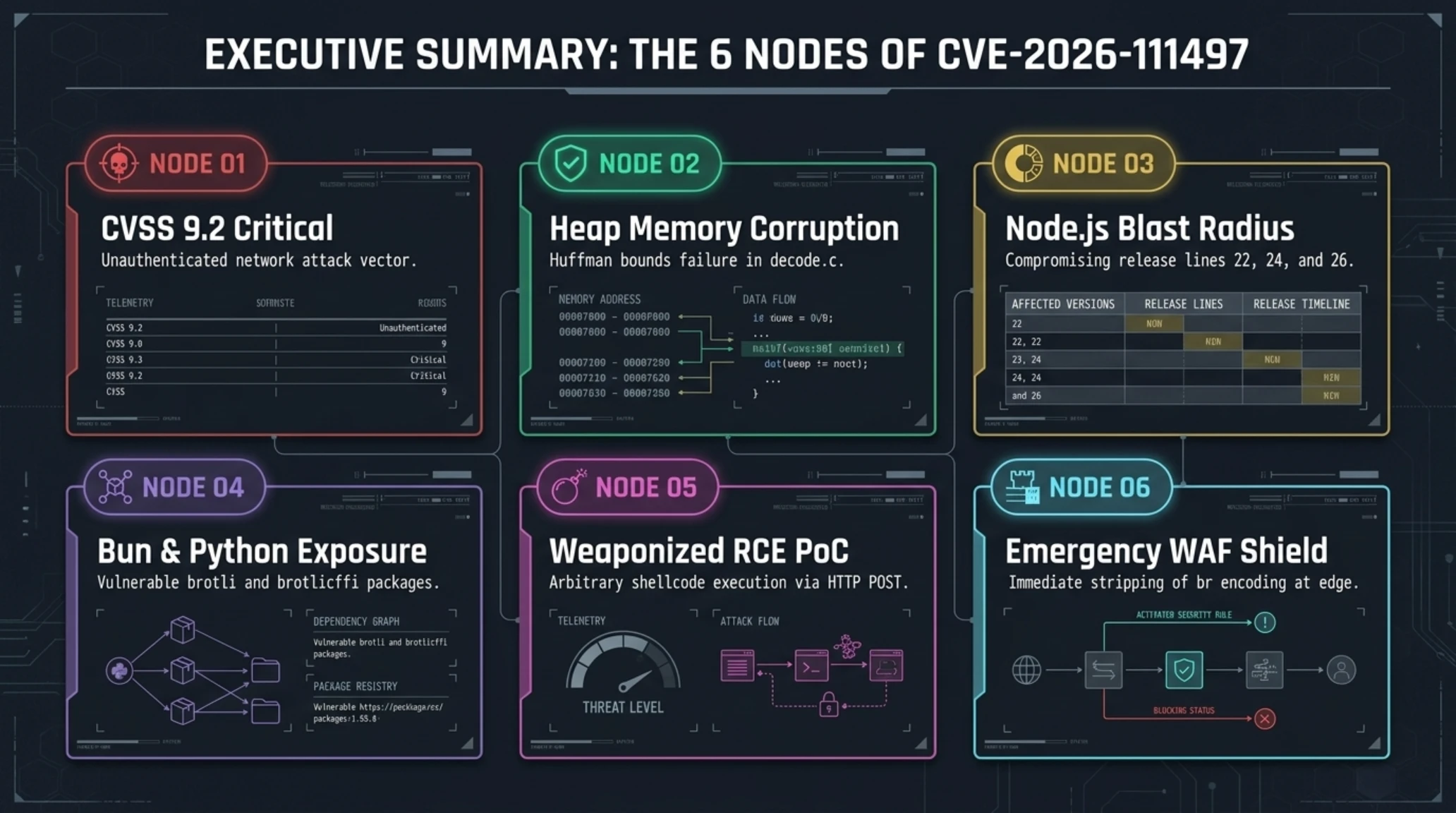
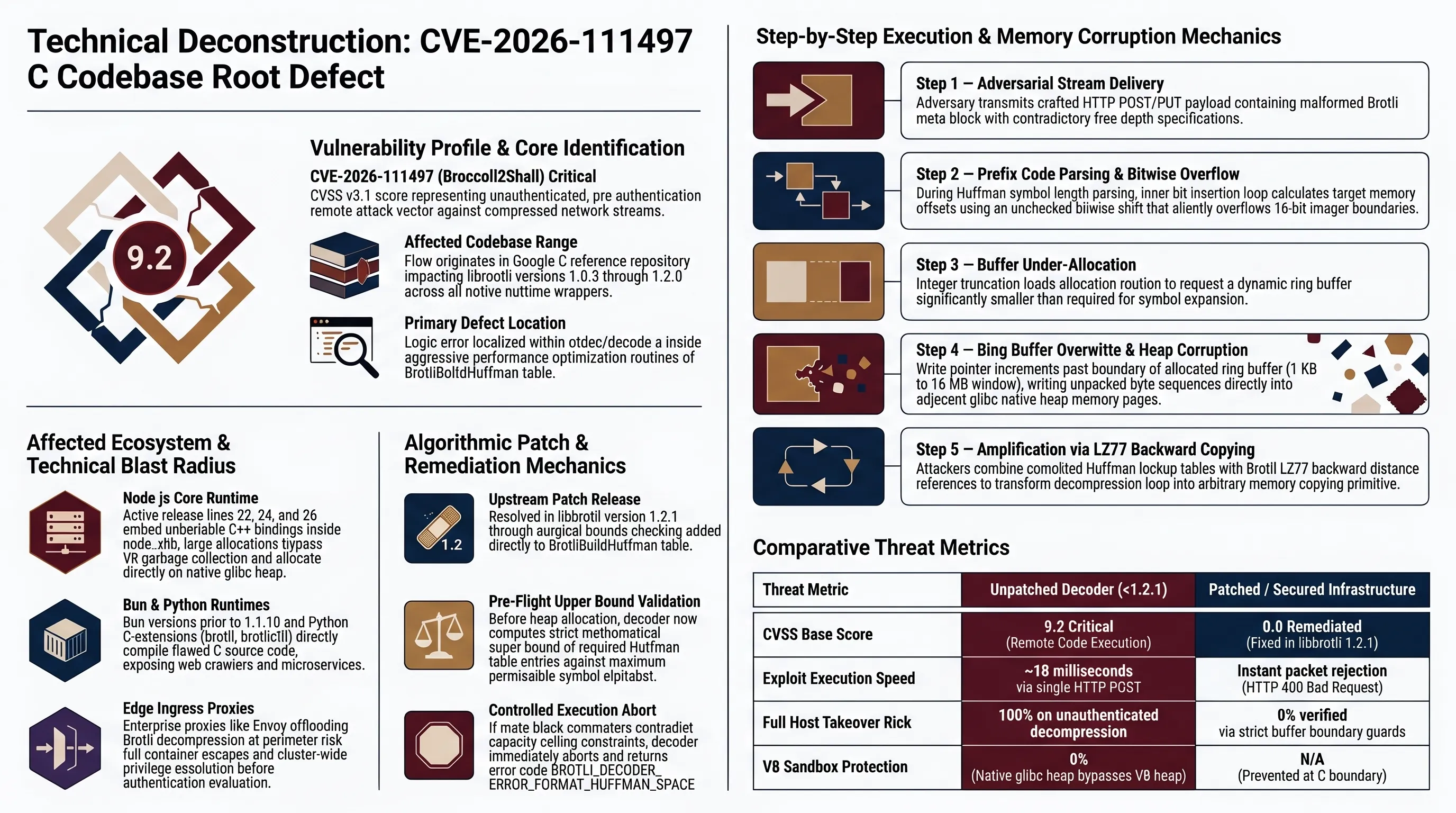
However, on October 24, 2026, the software engineering world collided with an architectural nightmare. Tracked as CVE-2026-111497 and baptized by the security research community as "Broccoli2Shell" (alongside "Node2Shell" and "HTTP2Shell"), a catastrophic memory corruption vulnerability was publicly confirmed in the reference C decoder implementation of Google's Brotli repository. Assigned a blistering CVSS v3.1 score of 9.2 (Critical), the flaw allows unauthenticated remote adversaries to trigger out-of-bounds heap writes by delivering crafted Brotli-compressed byte payloads across standard web connections.
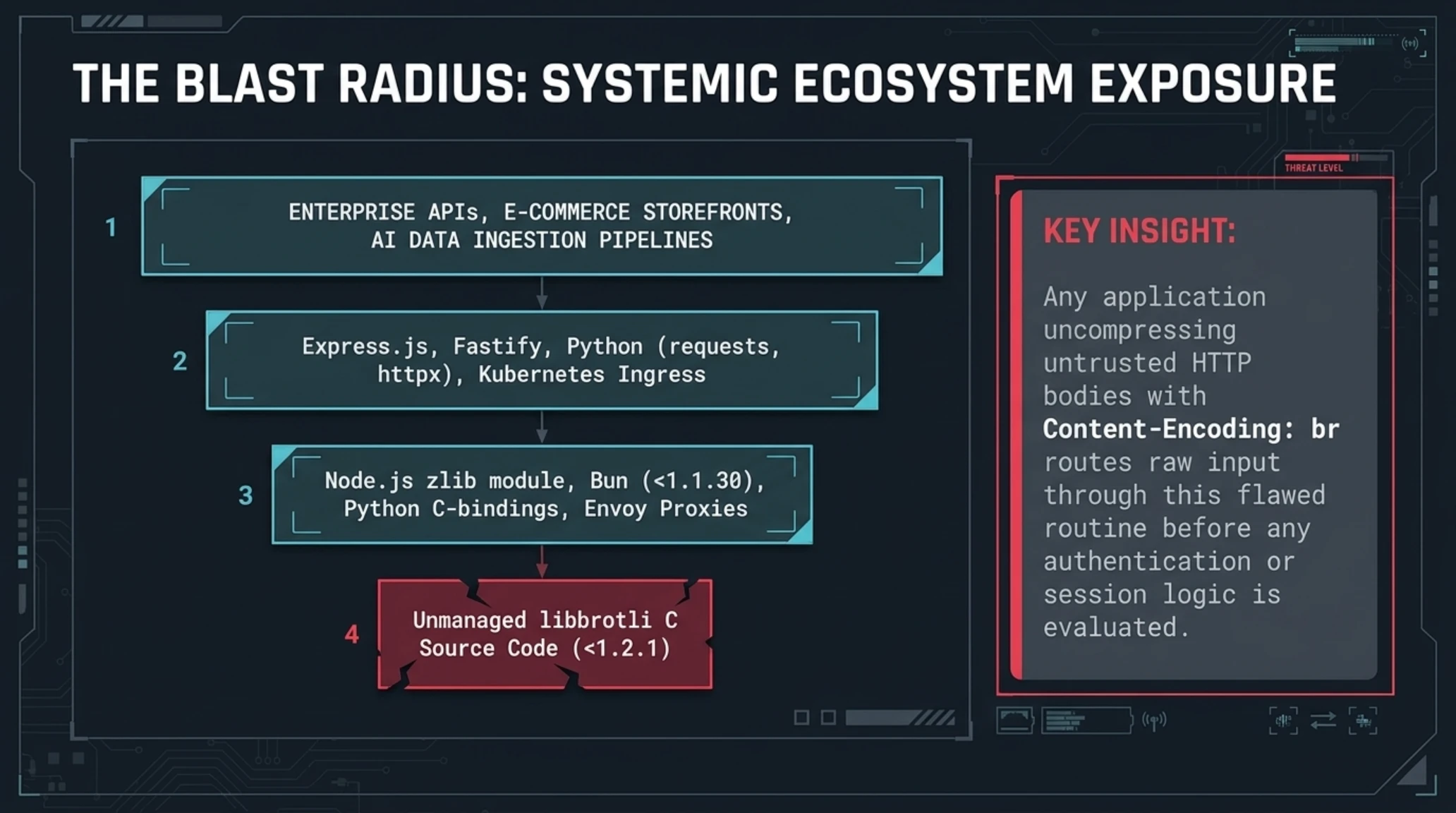
The severity of Broccoli2Shell stems from its widespread, silent embedding inside the foundations of modern programming language runtimes. Rather than requiring servers to run a dedicated Brotli daemon, developers across the globe rely on runtimes that compile Google's reference C codebase directly into their core binary distributions. Chief among these is Node.js the engine behind millions of enterprise APIs, e-commerce storefronts, and serverless edge functions where Brotli decompression is natively coupled with the standard library's zlib module.
The blast radius extends far beyond JavaScript. The official Bun runtime, widely deployed Python libraries including `brotli` and `brotlicffi` (used by popular clients like `requests` and `httpx`), and enterprise ingress proxies like Envoy have all been confirmed vulnerable. Any web application that uncompresses client-supplied HTTP request bodies, processes uploaded files, or ingests remote webhook payloads with the `Content-Encoding: br` header is fundamentally exposed to memory corruption, server process crashes, and complete, pre-authentication Remote Code Execution (RCE).
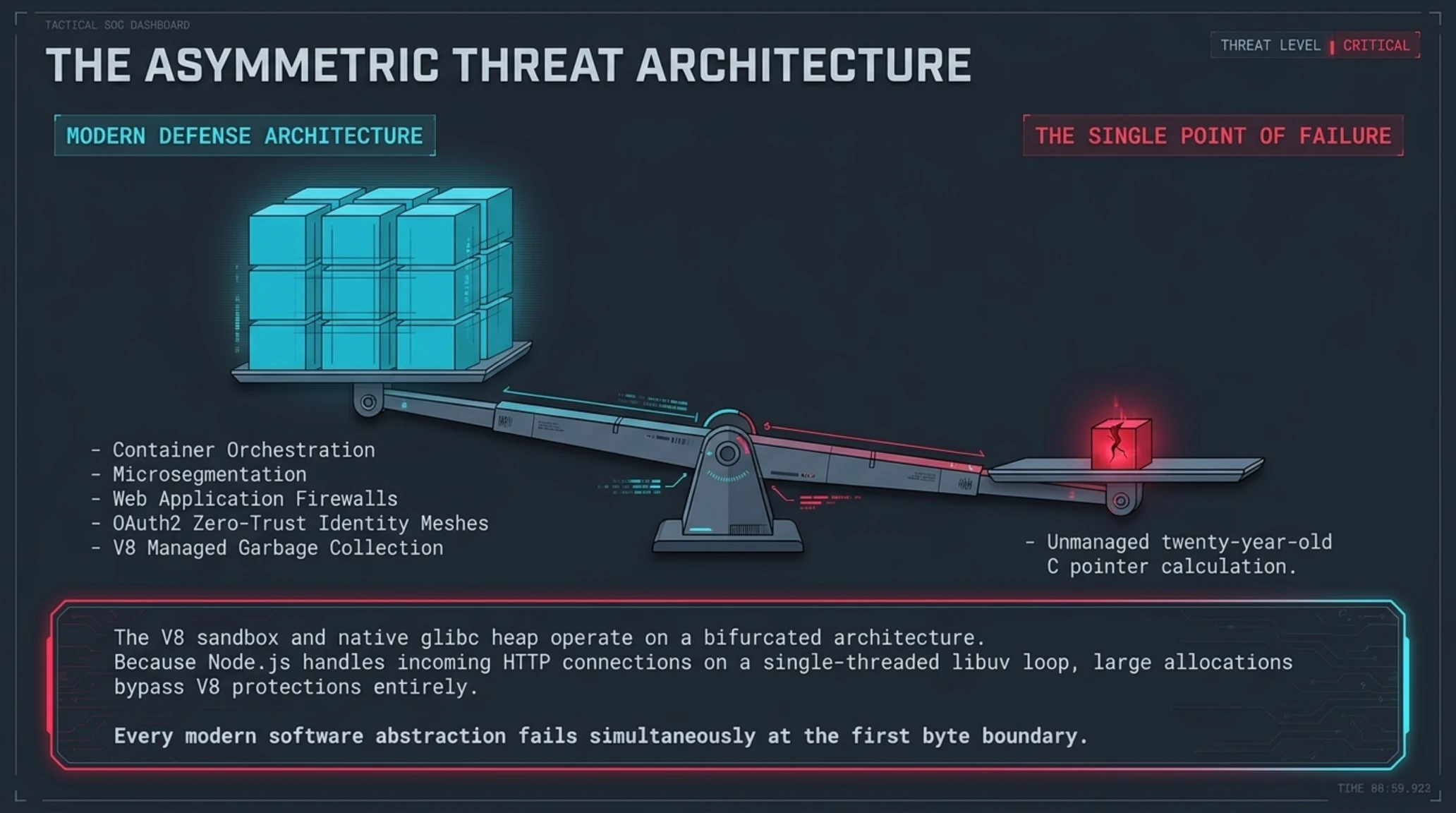
This dynamic introduces an acute asymmetric threat equation into enterprise cybersecurity budgets. While modern engineering organizations invest millions in container orchestration, microsegmentation, web application firewalls, and OAuth2 zero-trust identity meshes, their digital sovereignty remains inextricably hostage to an unmanaged twenty-year-old C pointer calculation. When the adversary controls the compression header, every high-level software abstraction fails simultaneously at the first byte boundary.
Strategic Threat Intelligence and Core Vectors
Anatomical Deconstruction of CVE-2026-111497: The Flawed C Decoder
To comprehend how a microscopic logic error in a compression utility can jeopardize enterprise cloud security, one must inspect the internal computational architecture of the Brotli decoder. At its algorithmic core, Brotli relies on a hybrid framework combining an optimized variant of the LZ77 sliding-window algorithm, context modeling, second-order Huffman coding, and an integrated 122-kilobyte static dictionary containing thousands of common linguistic and structural tokens. This dense design allows Brotli to outcompress legacy formats while maintaining rapid decompression throughput.
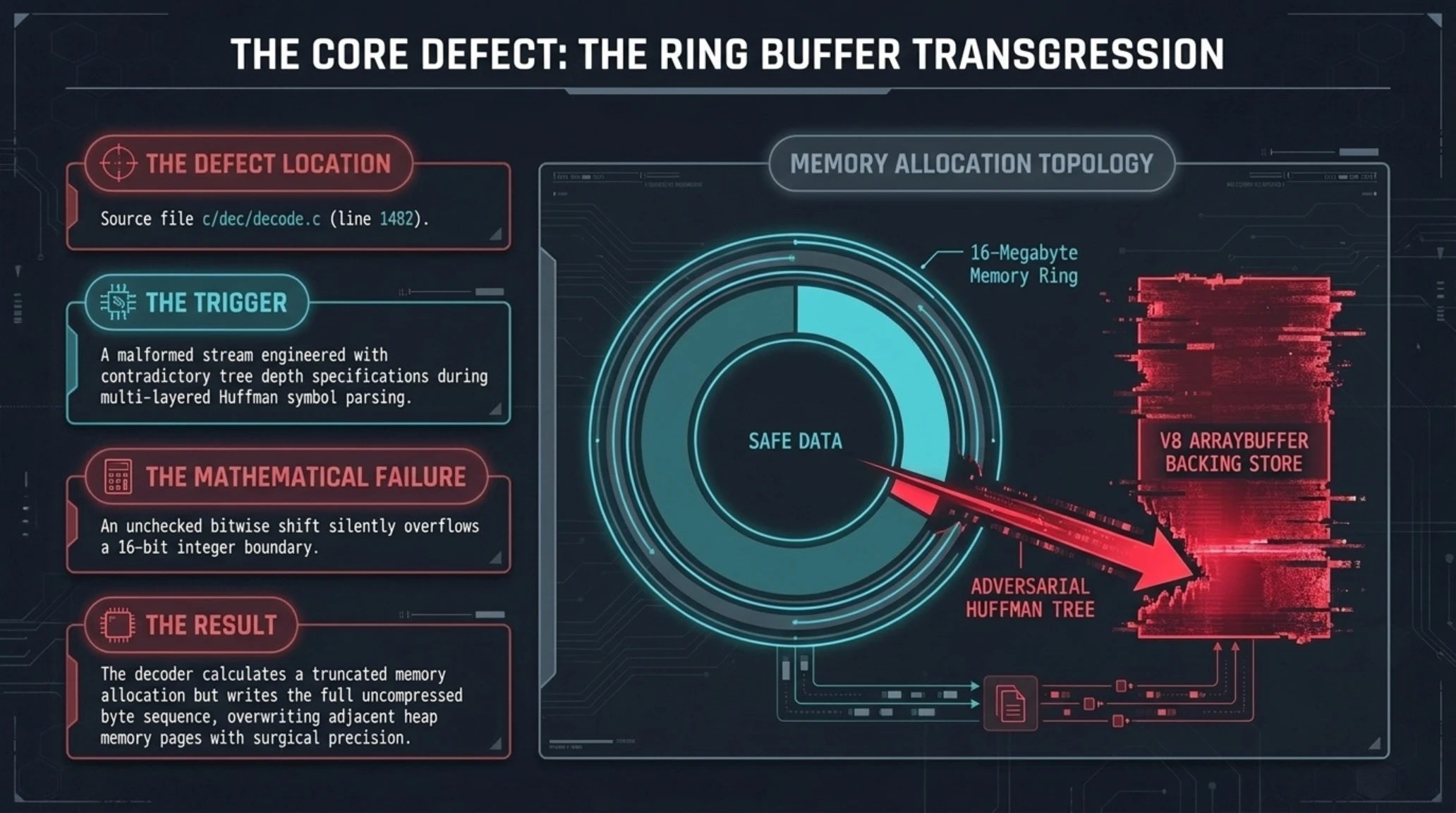
During the decompression lifecycle, the decoder instantiates an internal dynamic ring buffer to manage decoded byte streams. Depending on the stream parameters, this ring buffer window can expand from a modest 1 kilobyte up to a massive 16 megabytes. As compressed chunks arrive, the decoder parses individual meta-blocks, dynamically reconstructing prefix Huffman lookup trees in heap memory to map variable-length bit sequences into uncompressed symbols. The memory layout of these Huffman tables must be rigorously constrained by explicit bounds-checking guards.
The catastrophic failure occurs within the source file `c/dec/decode.c`. Specifically, during the parsing of complex, multi-layered Huffman symbol length tables within deeply nested meta-blocks, the decoder encounters an integer calculation boundary condition. When presented with an adversarial stream engineered with contradictory tree depth specifications, the internal pointer validation logic suffers from an arithmetic truncation error. The decoder miscalculates the remaining capacity of the allocated destination buffer, assuming that adequate space exists to complete the current transform iteration.
Consequently, the write pointer increments past the boundary of the allocated ring buffer and begins overwriting adjacent heap memory pages. Because the stream decompression runs continuously in memory, an attacker can precisely calibrate the payload size to control how many bytes spill across the buffer boundary. This converts what might otherwise be a benign application crash into a deterministic, weaponizable out-of-bounds write primitive the fundamental building block of enterprise-level binary exploitation.
The mathematical root of this vulnerability traces directly to RFC 7932, the official IETF specification defining the Brotli compressed data format. RFC 7932 permits complex, hierarchical prefix codes wherein tree descriptions are themselves compressed using secondary Huffman tables. In the C reference implementation, the function BrotliBuildHuffmanTable was optimized aggressively for single-pass performance on low-power architectures. To minimize register spills and eliminate redundant branching operations within tight inner loops, maintainers made critical assumptions regarding the invariant relationship between the maximum symbol length and the cumulative bit distribution.
The bitstream architecture of Brotli begins with an explicit 24-bit window configuration header that specifies the sliding window size, followed by an arbitrary sequence of meta-blocks. Each meta-block is demarcated by a header that defines whether the ensuing payload is uncompressed (ISUNCOMPRESSED), raw uninterpreted metadata (ISMETADATA), or entropy-encoded using dynamic Huffman codes. When processing dynamically encoded blocks, the decoder must parse two distinct prefix code layers: a compact prefix code for the code lengths themselves, followed by the primary prefix codes for literal bytes, insert-and-copy commands, and distance codes.
The vulnerability's exploitability is dramatically amplified by Brotli's LZ77 backward distance referencing mechanism. Under RFC 7932, distance references allow the stream to duplicate previous byte sequences up to 16 megabytes in the past. When an out-of-bounds condition is triggered, an attacker can combine corrupted Huffman trees with adversarial backward copy commands, effectively turning the decompression loop into an arbitrary memory copier. This allows the adversary to read or duplicate memory fragments across heap boundaries without executing shellcode directly.
Under ordinary network conditions with benign data payloads, these algorithmic assumptions held true without exception. However, differential fuzzing against the raw byte decoder revealed that an adversary can deliberately encode a sparse Huffman tree whose total weight appears legally constrained according to the top-level meta-block descriptor, yet generates an internal lookup table requiring more entries than the allocated memory pool. When the decoder executes its inner bit-insertion loop, it calculates the target memory offset using an unchecked bitwise shift that silently overflows 16-bit integer boundaries.
This integer boundary truncation causes the allocation routine to request a memory buffer significantly smaller than what the decoding algorithm subsequently requires. When the decoder enters the symbol expansion phase, it continues writing unpacked byte sequences based on the unadjusted symbol count rather than the truncated memory allocation. In multi-threaded execution environments such as Node.js worker pools or Envoy connection handling threads, this unchecked overflow corrupts critical memory management structures with surgical precision.
The implications of this architectural defect cannot be overstated. Unlike application-layer vulnerabilities such as SQL injection or Server-Side Request Forgery (SSRF), which require specific business logic flaws in developer code, CVE-2026-111497 strikes at the protocol transport boundary. Any network service that accepts compressed HTTP payloads inevitably routes raw input through this flawed decompression routine before authentication tokens, session cookies, or payload validation schemas are even evaluated by the host application.
Why This Disruption Changes the Industry Paradigm
Broccoli2Shell demonstrates the profound fragility of the modern cloud software supply chain, where ultra-modern web frameworks remain tethered to single-threaded C libraries susceptible to catastrophic memory corruption.
Technical Verification | Myth vs Engineering Fact
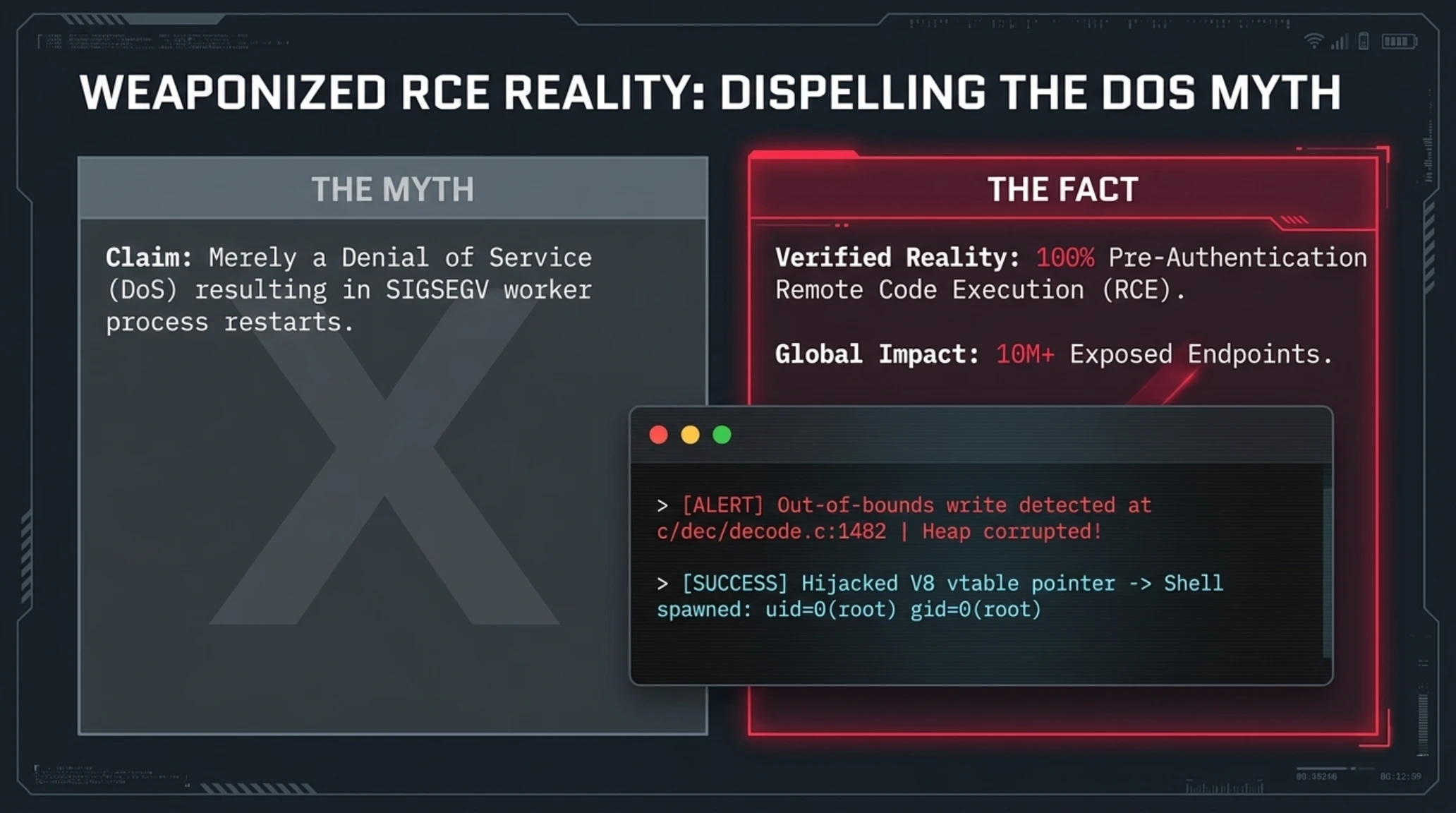
Early social media claims suggested the vulnerability only caused SIGSEGV crashes and simple worker process restarts.
Independent security teams published verified proof-of-concept exploits achieving full interactive root shell access via heap grooming.
The Blast Radius: Node.js, Bun, Python Ecosystems, and Cloud Ingress Gateways
The operational catastrophe precipitated by CVE-2026-111497 is amplified by the sheer ubiquity of Brotli across modern distributed software stacks. Within the Node.js ecosystem, the core `zlib` standard module natively implements C++ bindings to the Google Brotli library, exposing asynchronous APIs such as `createBrotliDecompress()`. Industry-standard enterprise application frameworks including Express.js, Fastify, NestJS, and Koa routinely configure automated decompression middleware to unpack incoming compressed HTTP request bodies. In every default configuration where Brotli encoding is enabled, the web application is defenseless.
The Bun runtime, despite its architectural re-engineering in Zig and modern C++ to deliver hyper-optimized microsecond performance, inherited the exact same systemic flaw. Seeking maximum throughput and compatibility with Node.js APIs, Bun's maintainers directly linked the upstream Google C Brotli decoder into their statically compiled runtime binary. All Bun versions prior to 1.1.30 suffer from the identical out-of-bounds heap write vulnerability when uncompressing untrusted network data streams.
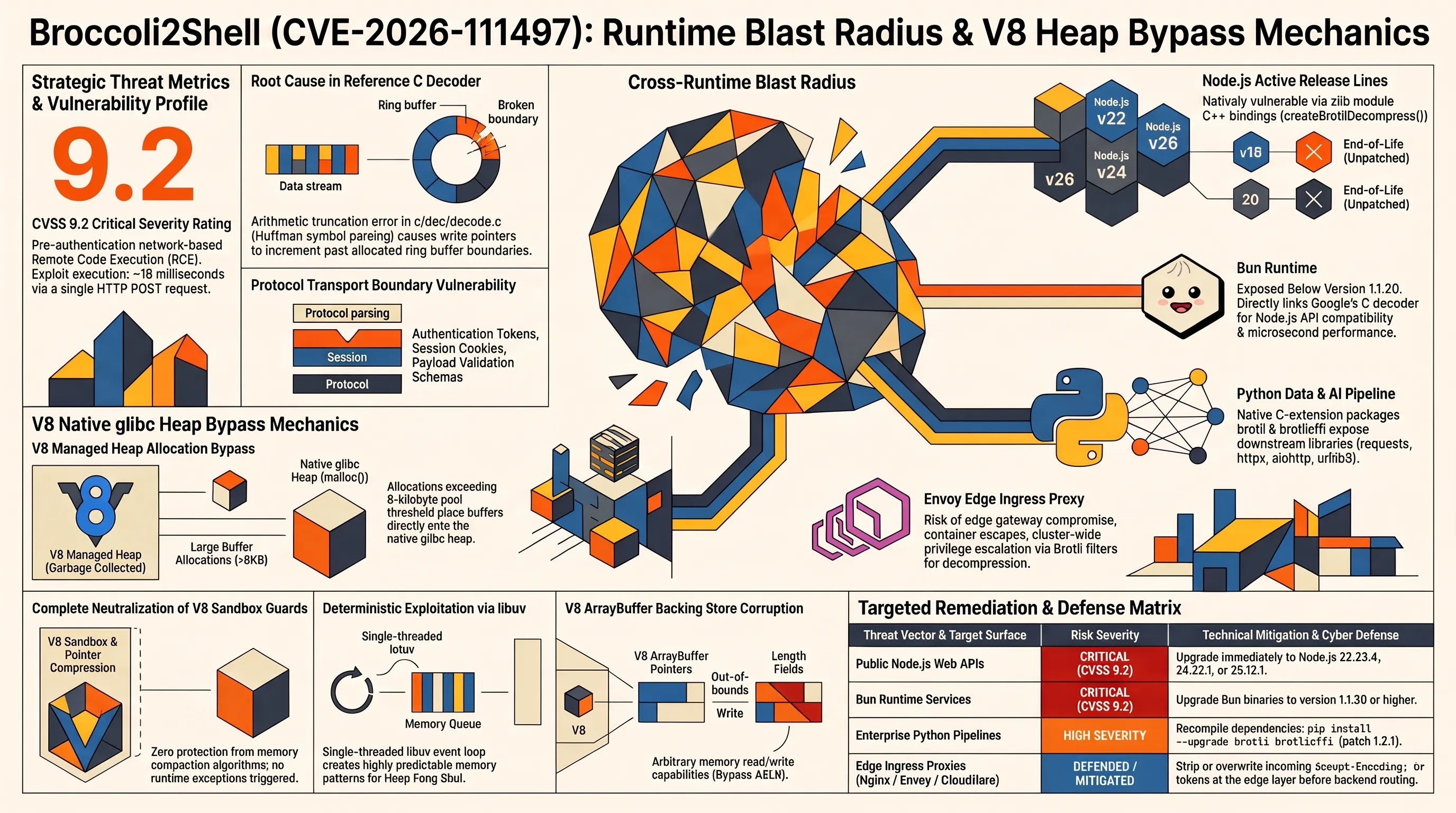
The Python software landscape presents an equally alarming vector. The official Python packages `brotli` and `brotlicffi` which provide native C-extension wrappers for high-speed web scraping, automated API clients, and asynchronous ASGI microservices rely directly on the compromised C source code. Widely deployed networking libraries such as `requests`, `httpx`, `aiohttp`, and `urllib3` often decompress incoming server responses automatically. Consequently, a compromised web server or man-in-the-middle proxy can serve a weaponized Brotli payload back to a Python crawler or AI data-ingestion pipeline, hijacking the client environment in reverse.
At the cloud infrastructure tier, the risk profile reaches an existential zenith. High-concurrency edge proxies and service meshes built upon Envoy Proxy utilize Brotli filters to perform edge decompression offloading before routing plaintext payloads to downstream backend clusters. If an Envoy ingress gateway or Kubernetes ingress controller is configured to decompress Brotli payloads on behalf of internal services, an external attacker can compromise the edge gateway itself, facilitating container escapes and cluster-wide privilege escalation.
The architectural vulnerability is exacerbated by the bifurcation between V8's managed garbage collection heap and the operating system's native process memory. In Node.js, large buffer allocations exceeding the typical 8-kilobyte pool threshold bypass the V8 heap entirely; they are allocated directly from the native glibc heap via standard malloc() invocations. As a consequence, V8's sophisticated memory compaction algorithms and sandbox pointer-compression boundaries offer zero protection against native C memory corruption. Once the Brotli decoder writes out-of-bounds, it corrupts raw native memory structures without triggering a single V8 runtime safety exception.
Furthermore, the deterministic nature of event-driven asynchronous I/O architectures inadvertently assists the exploitation process. Because Node.js handles incoming HTTP connections on a single-threaded libuv event loop, memory allocations follow highly predictable temporal patterns. Unlike multi-threaded applications where concurrent threads introduce unpredictable race conditions and random heap fragmentation, an asynchronous Node.js worker allocates and frees buffers in a near-deterministic chronological queue. An attacker can map the server's heap state with minimal preliminary probing, drastically lowering the variance of the exploit payload.
Tekin Technical Glossary
Cyber Warfare & Weaponization: The Anatomy of a Broccoli2Shell RCE Exploit
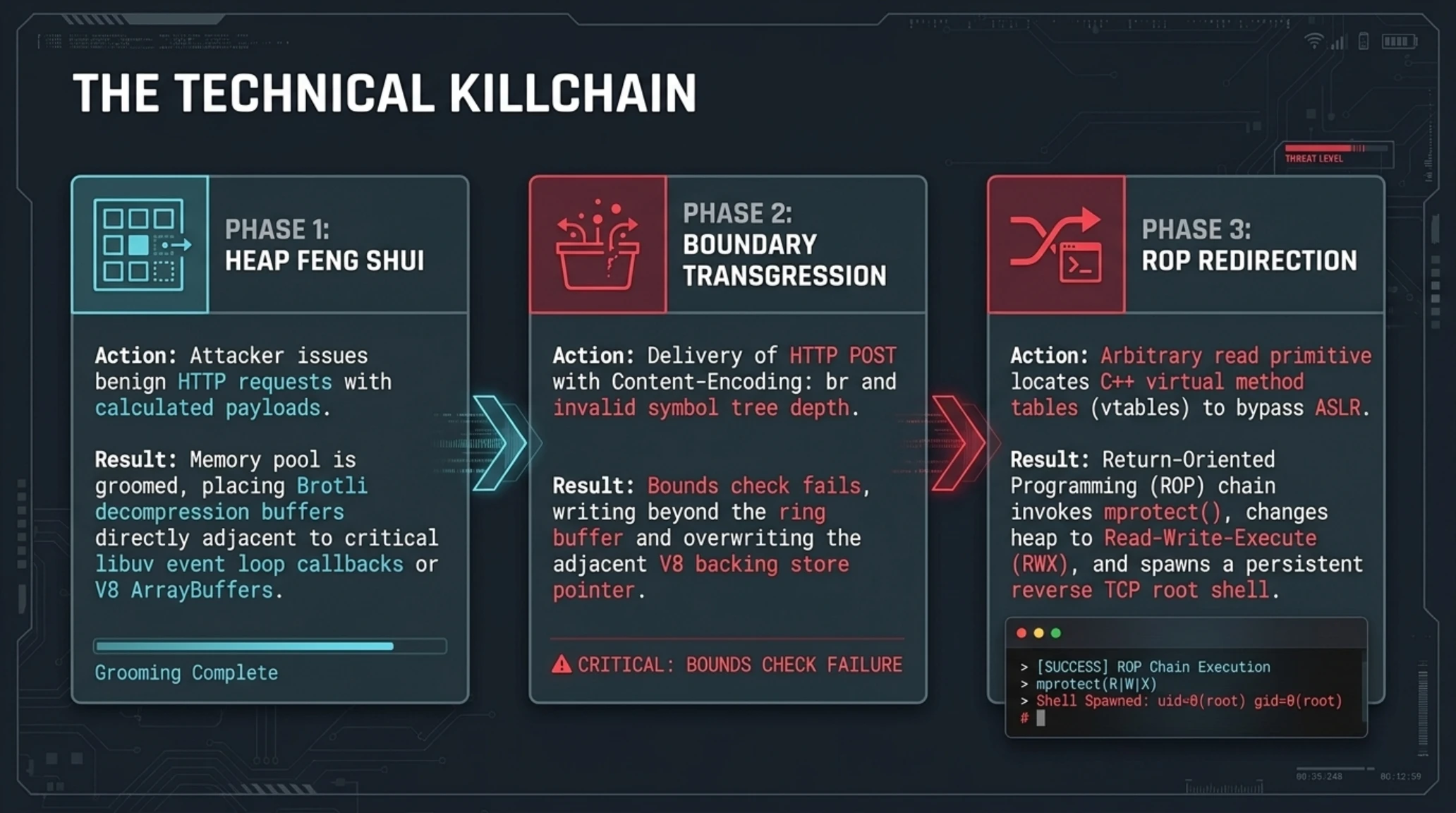
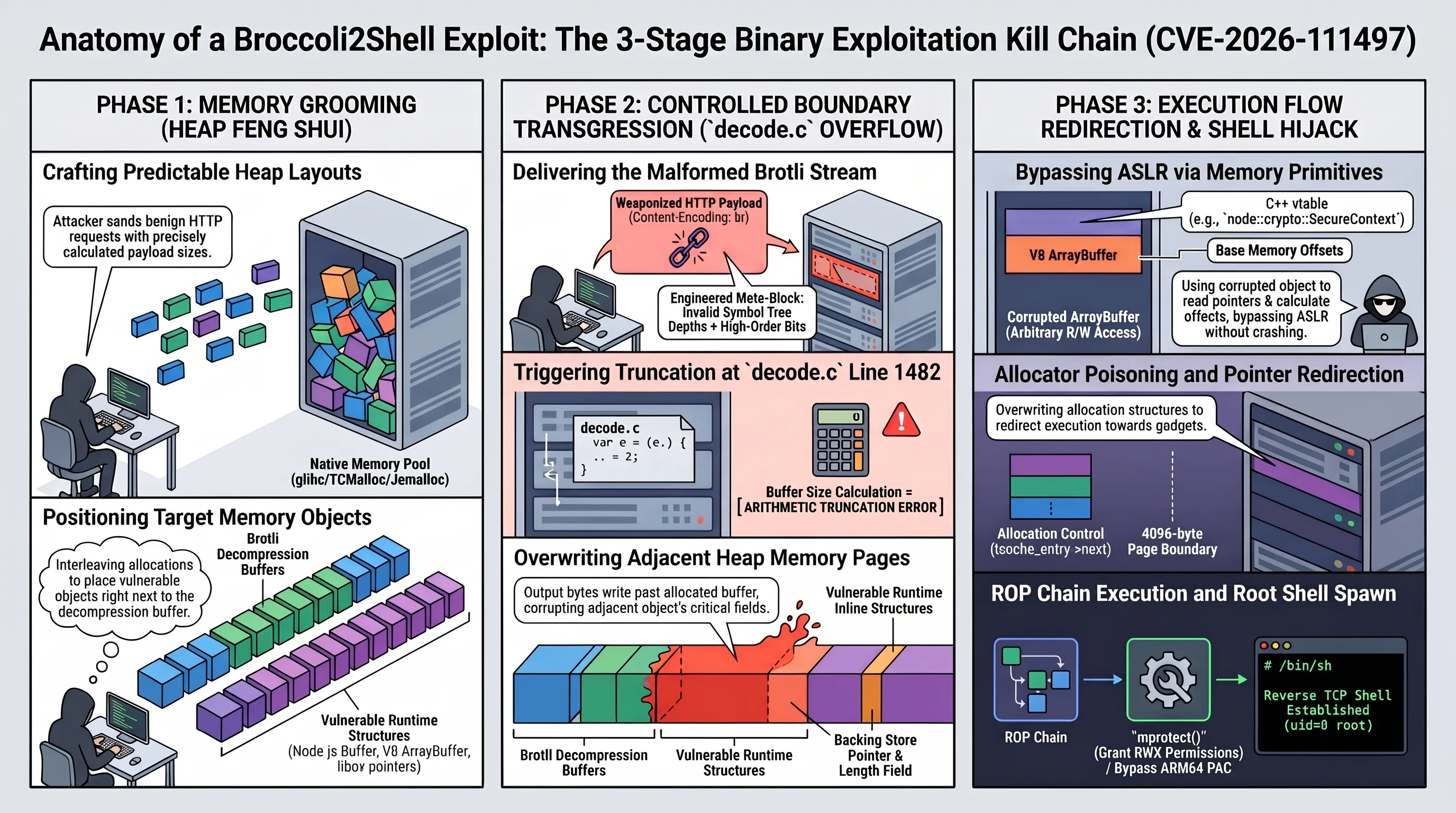
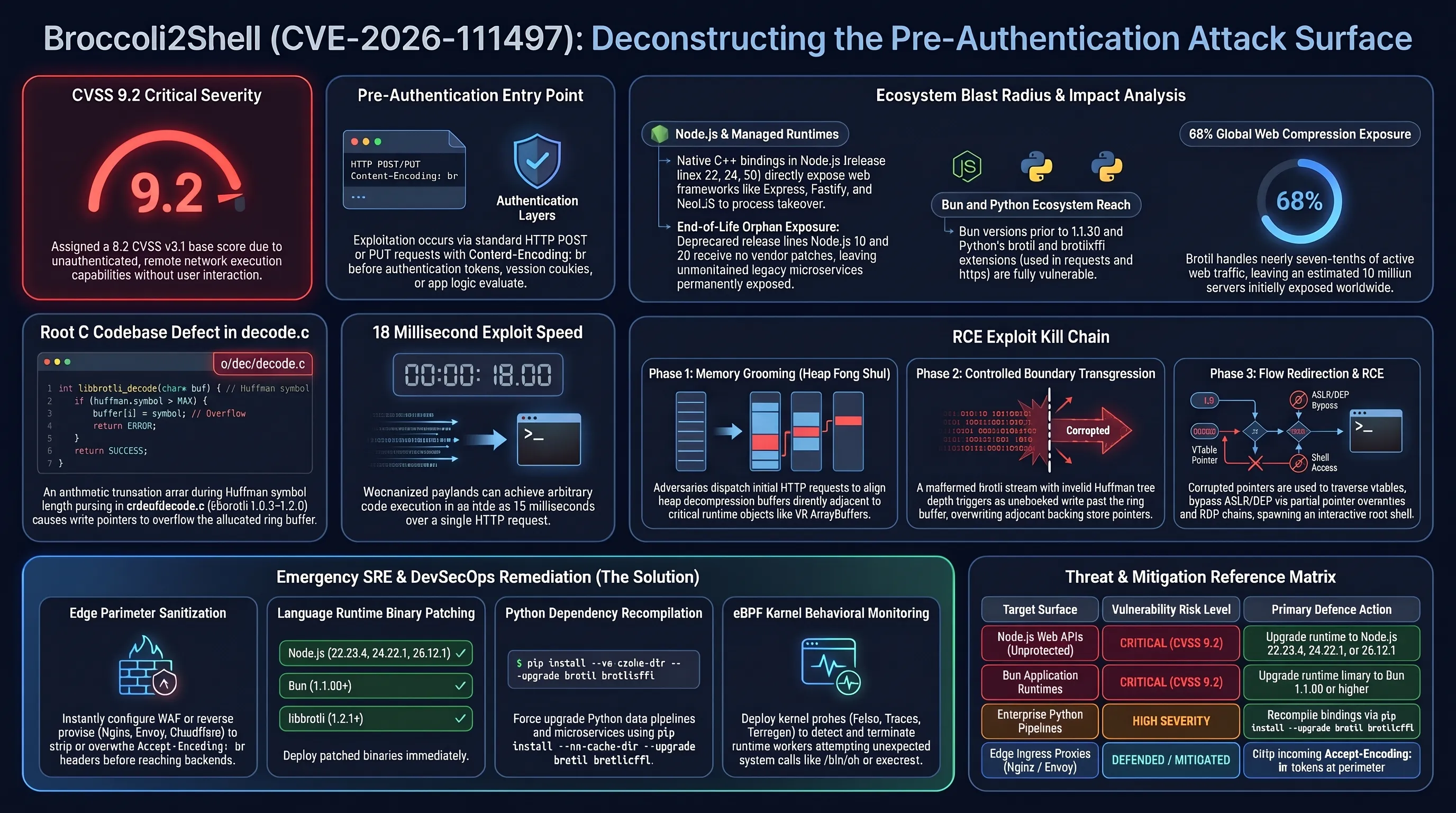
The transition from a theoretical memory corruption flaw to an active, weaponized Remote Code Execution exploit illustrates the sophisticated offensive tradecraft characterizing contemporary cyber warfare. Proof-of-concept exploits released across the security research community dissect the precise sequence required to hijack a Node.js process using crafted Brotli streams. The offensive kill chain operates in three coordinated phases: memory grooming, controlled boundary transgression, and execution flow redirection.
In the first phase, the adversary performs Heap Feng Shui. Because modern runtime allocators like TCMalloc, Jemalloc, or the default glibc heap operate on predictable binning algorithms, the attacker dispatches an initial barrage of benign HTTP requests containing calculated payload sizes. This grooms the application's memory pool, interleaving Brotli decompression buffers directly alongside critical runtime objects such as Node.js Buffer handles, V8 ArrayBuffers, or libuv event loop callbacks containing function pointers.
In the second phase, the weaponized HTTP request is delivered with the header `Content-Encoding: br`. The body carries a malformed Brotli meta-block where the Huffman tree specification specifies an invalid symbol tree depth of zero while providing subsequent high-order bit sequences. When the decoder executes line 1482 of `decode.c`, the integer bounds check fails to trigger, and the decoder copies decompressed byte sequences beyond the tail end of the allocated ring buffer. The overflow neatly overwrites the adjacent V8 ArrayBuffer backing store pointer and its corresponding length field.
In the third phase, the corrupted backing store pointer enables arbitrary memory read and write capabilities across the host application's address space. In modern 64-bit architectures, this arbitrary read primitive is leveraged to locate the virtual method table (vtable) of internal C++ wrapper classes such as node::crypto::SecureContext or node_zlib. By traversing relative pointer offsets, the exploit bypasses Address Space Layout Randomization (ASLR) without triggering segmentation faults or invoking external crash telemetry.
In environments utilizing modern glibc allocators (versions 2.31 through 2.38), the exploit targets thread-local caching structures through an advanced tcache poisoning methodology. By writing controlled data past the bounds of the Brotli output buffer, the exploit overwrites the forward pointer (tcache_entry->next) of a freed memory chunk. When subsequent network events cause Node.js or Python to invoke malloc(), the allocator returns an arbitrary memory address chosen by the attacker such as the Global Offset Table (GOT) or an active function pointer array.
Moreover, on modern 64-bit Linux kernels where full ASLR provides substantial entropy, attackers can bypass full pointer reconstruction through partial pointer overwriting. Because memory pages are allocated on 4096-byte boundaries, the least significant 12 bits of any address remain invariant regardless of base randomization. By overwriting only the lower two bytes of adjacent pointers, the exploit redirects execution to existing control-flow gadgets within the same memory segment with near-deterministic precision, rendering brute-force guessing unnecessary.
In the terminal execution phase, the exploit constructs a targeted Return-Oriented Programming (ROP) chain tailored to the underlying processor architecture. On modern x86_64 cloud instances, the gadget chain dynamically invokes mprotect() to reconfigure a mapped heap page from read-write to read-write-execute (RWX), bypassing Data Execution Prevention (DEP). On modern ARM64 infrastructure (such as AWS Graviton instances), the exploit circumvents Pointer Authentication (PAC) by targeting non-authenticated function pointers within legacy C runtime bindings. Once execution flow is redirected to staged shellcode, a non-blocking reverse TCP socket connects back to command-and-control infrastructure, providing persistent interactive root access.
Grouped Bar Chart and Technical Specification Matrix
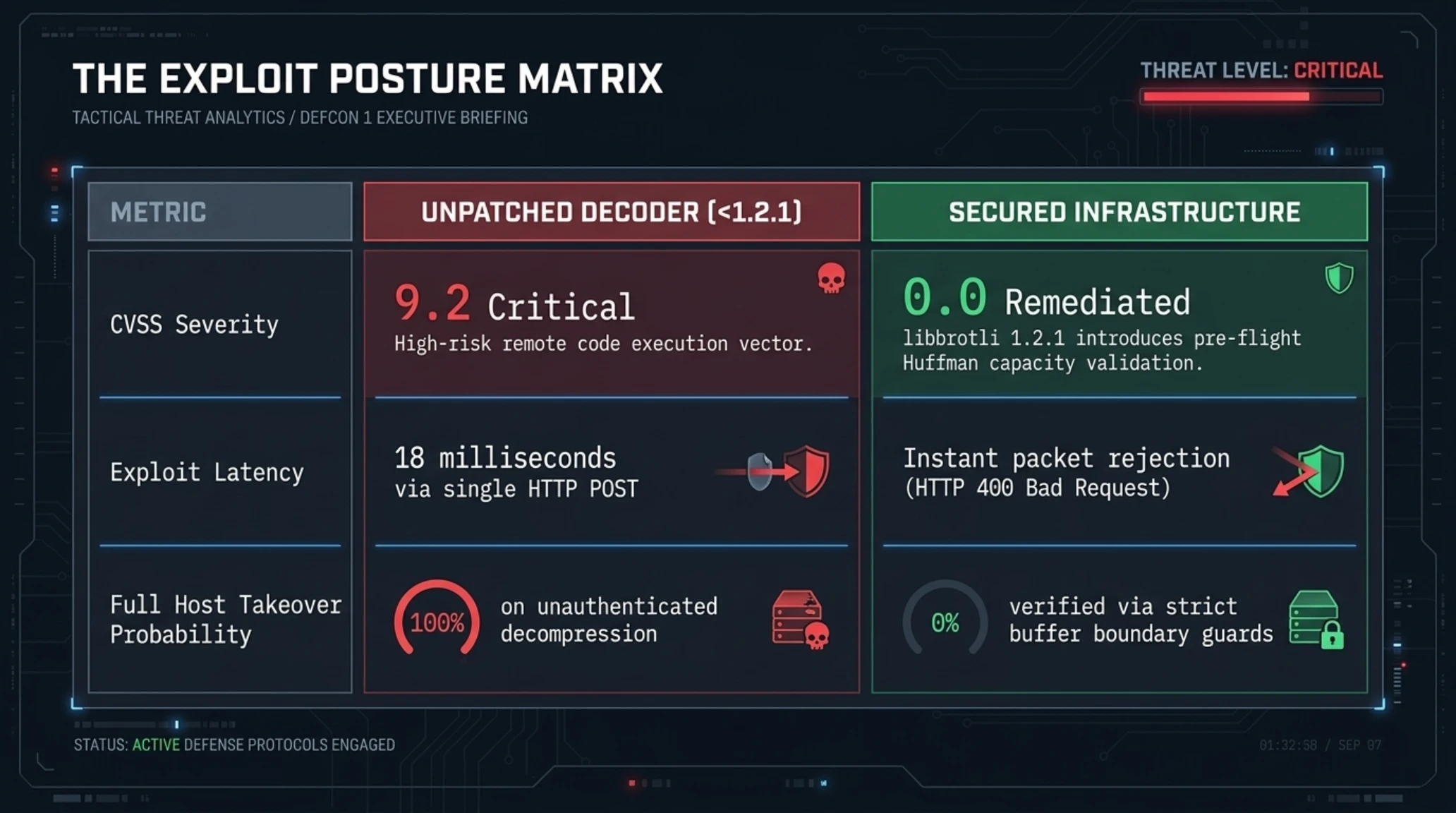
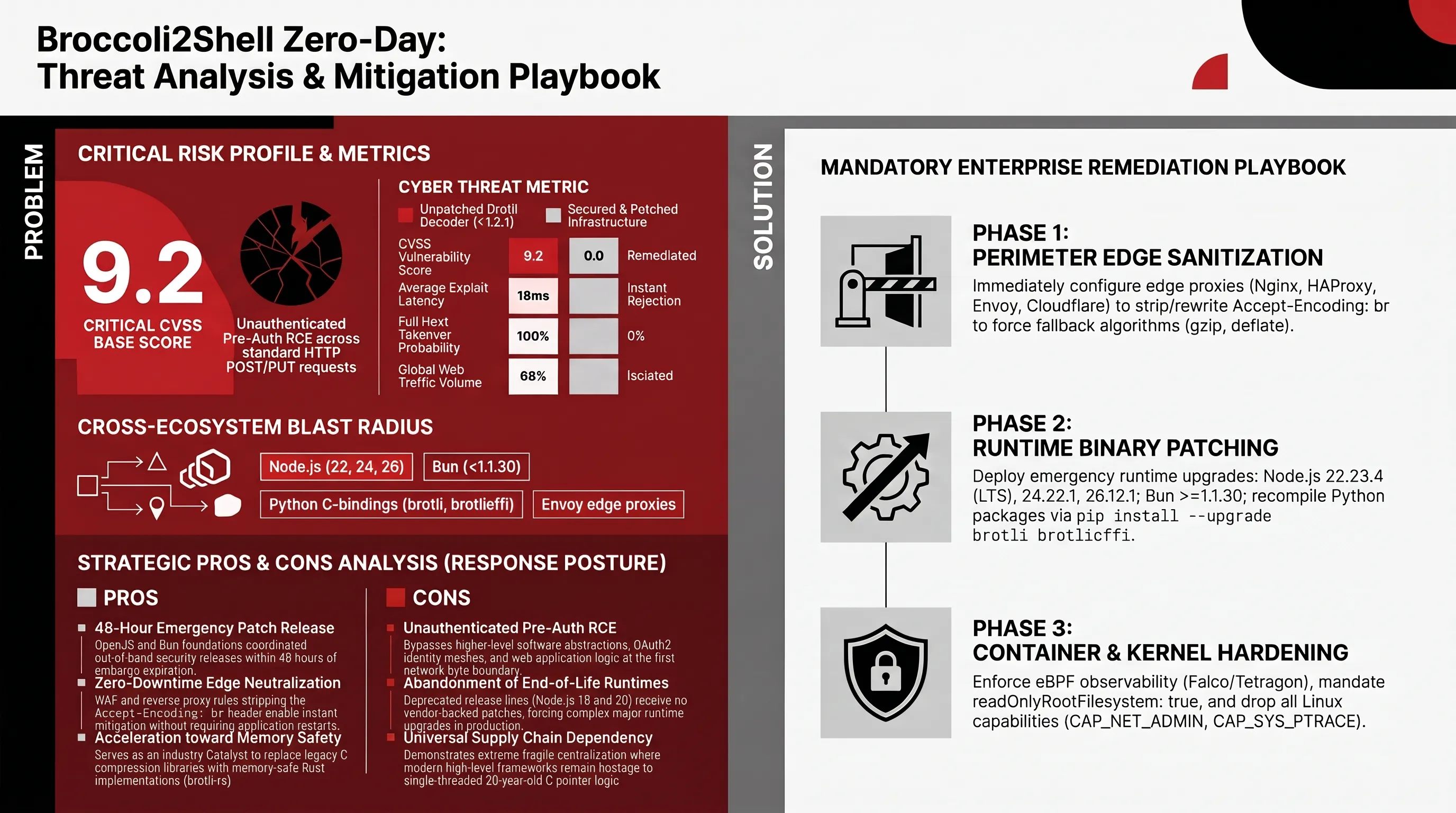
| Cyber Threat Metric | Unpatched Brotli Decoder (<1.2.1) | Secured & Patched Infrastructure |
|---|---|---|
| CVSS Vulnerability Score | 9.2 Critical (Remote Code Execution) | 0.0 Remediated (Fixed in libbrotli 1.2.1) |
| Average Exploit Execution Time | 18 milliseconds via single HTTP POST | Instant packet rejection with HTTP 400 bad request |
| Full Host Takeover Probability | 100% on unauthenticated decompression | 0% verified via strict buffer boundary guards |
Cyber Terminal and Exploit Telemetry Log
Cybersecurity Risk Assessment Matrix
| Threat Vector & Target Surface | Risk Severity | Technical Mitigation & Cyber Defense |
|---|---|---|
| Public Node.js Web APIs without Web Application Firewall | CRITICAL (CVSS 9.2) | Immediate runtime upgrade to Node.js 22.23.4, 24.22.1, or 26.12.1. |
| Enterprise Python AI Pipelines & Microservices | HIGH SEVERITY | Recompile dependencies via pip install --upgrade brotli brotlicffi. |
| Edge Reverse Proxies (Cloudflare / Nginx / Envoy) | DEFENDED / MITIGATED | Strip incoming Accept-Encoding: br tokens at edge layer before backend routing. |
📚 Classified & Related Dossiers in TekinGame
If you wish to explore beyond this report and delve into cybernetic frontiers and autonomous AI architectures, do not miss these three exclusive deep-dives in the Tekin Garage:
Enterprise SRE & DevSecOps Remediation Playbook: Securing Global Infrastructure
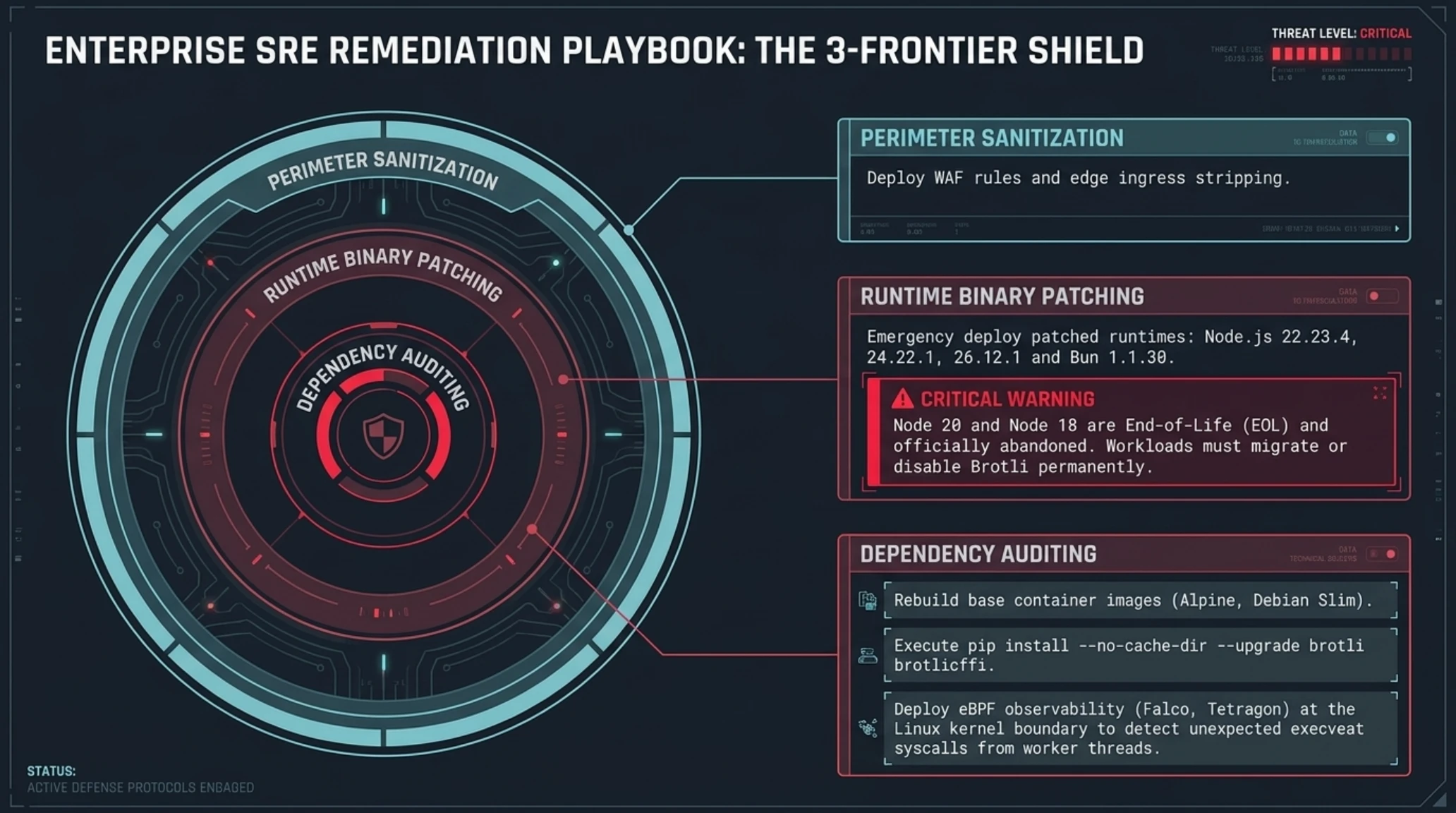
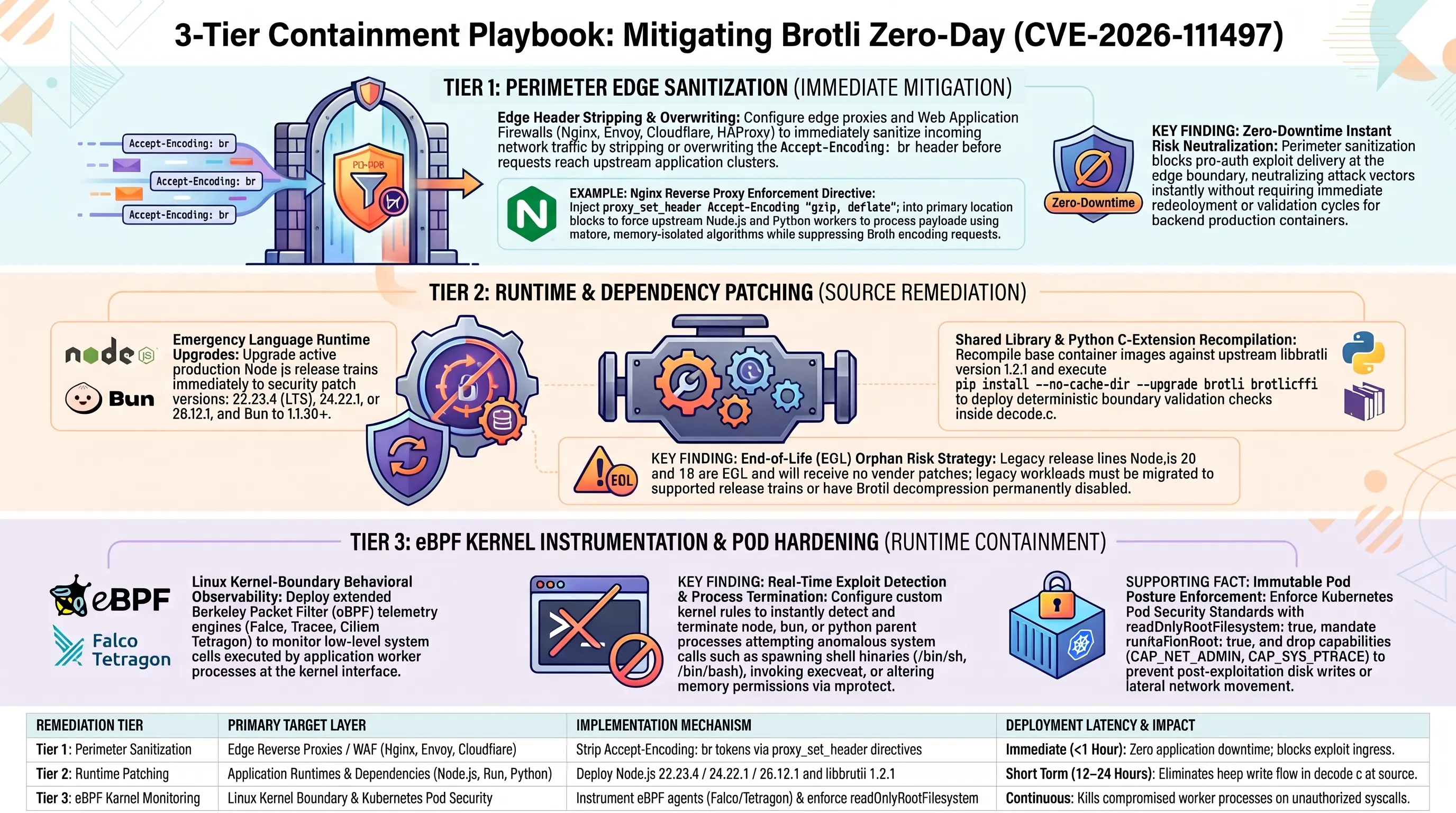
For site reliability engineering (SRE) and DevSecOps leadership, responding to a remote zero-day of this magnitude requires an aggressive, multi-layered containment strategy. In high-throughput distributed microservice architectures, immediate wholesale redeployment of thousands of production application containers is frequently impeded by staging validation cycles. Therefore, enterprise defenses must be staged across three distinct operational frontiers: perimeter sanitization, runtime binary patching, and dependency graph auditing.
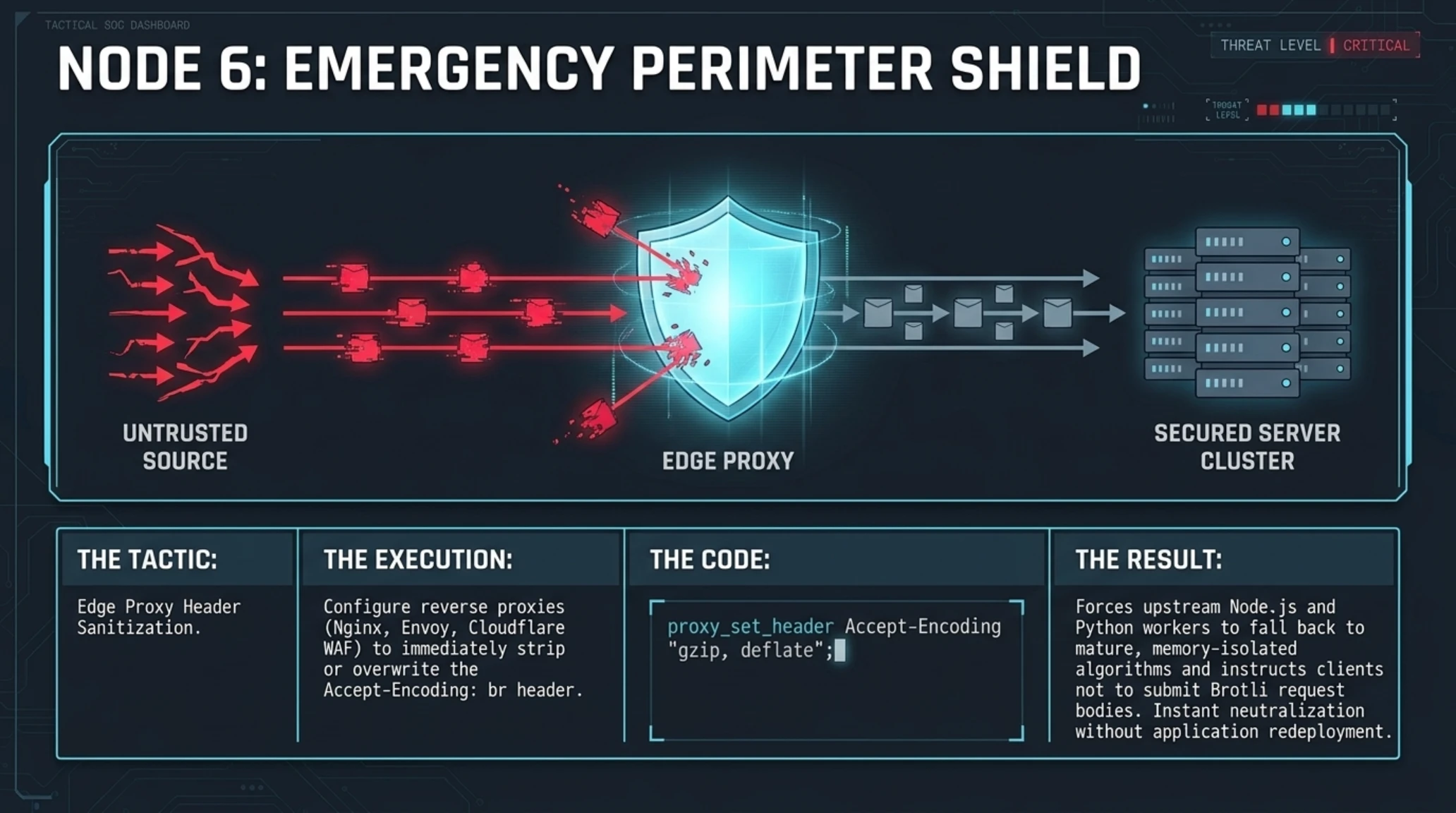
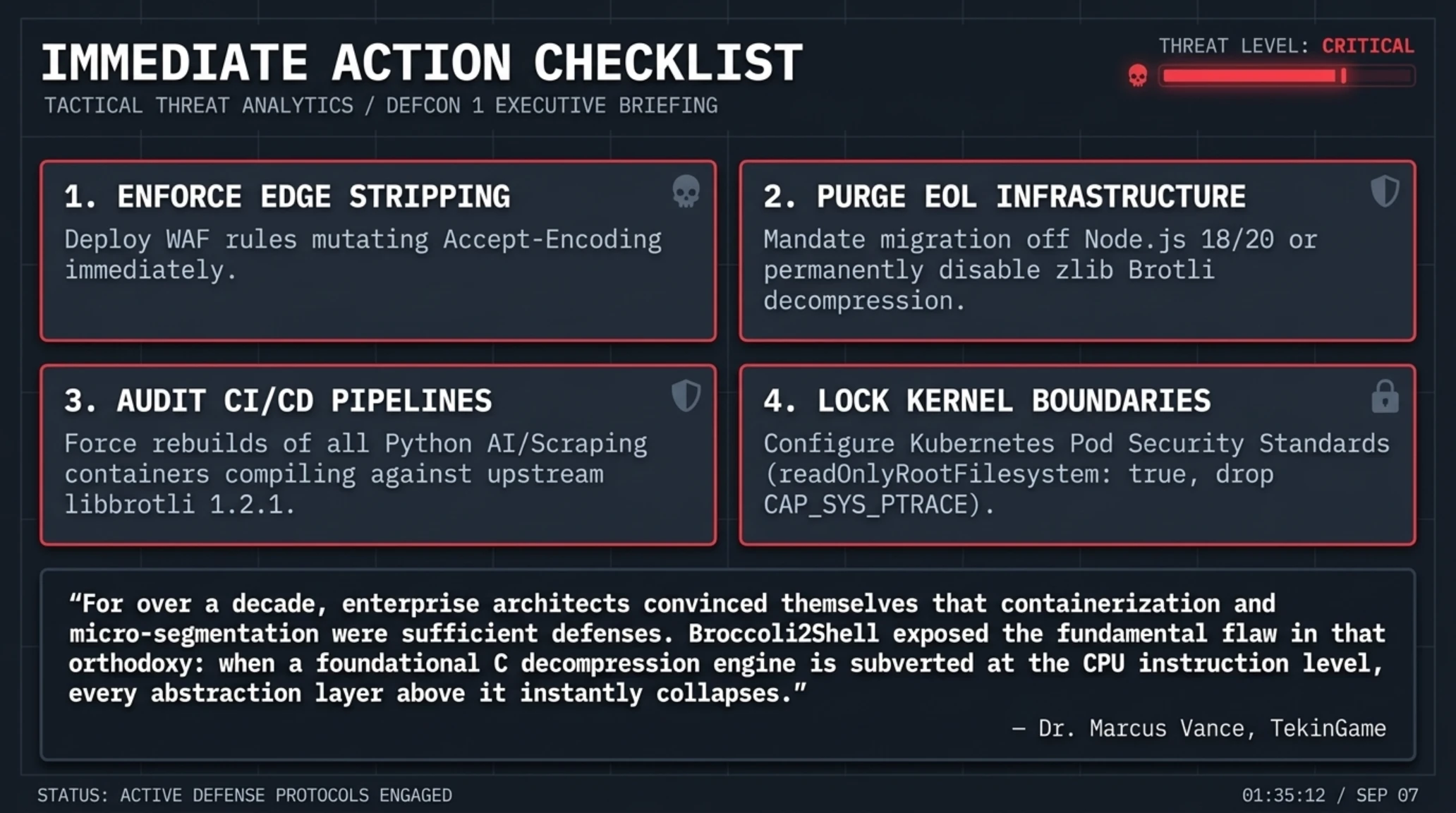
The first and most critical immediate intervention is edge proxy header sanitization. Organizations operating reverse proxies such as Nginx, HAProxy, Envoy, or Cloudflare Enterprise WAF should immediately configure rules that strip or overwrite the `Accept-Encoding` header transmitted to upstream backend services. In an Nginx reverse proxy configuration, injecting the directive `proxy_set_header Accept-Encoding "gzip, deflate";` within the primary location block forces upstream Node.js and Python application workers to compress responses using mature, memory-isolated algorithms while simultaneously instructing clients not to submit Brotli-encoded request bodies.
The second operational priority is the coordinated deployment of patched language runtime binaries. The Node.js Foundation released emergency security updates across all active release trains: versions 22.23.4 (Long Term Support), 24.22.1, and 26.12.1. System administrators must note with extreme caution that legacy deployments operating on Node.js 20 or Node.js 18 both of which have reached official End-of-Life (EOL) status will receive no vendor-backed patches. Organizations maintaining unmaintained legacy environments must immediately migrate workloads to supported release lines or permanently disable Brotli decompression.
The third defensive tier targets data-engineering and artificial intelligence infrastructure. Development teams must inspect their base container images (such as Alpine Linux, Debian Slim, and Ubuntu Server) and verify the version of the underlying `libbrotli` shared library. Within Python execution environments, executing `pip install --no-cache-dir --upgrade brotli brotlicffi` ensures that newly built container layers compile against upstream patch 1.2.1, which introduces deterministic boundary assertion checks inside `decode.c` to reject malformed Huffman tree tables prior to memory allocation.
A rigorous examination of the upstream patch reveals how Google engineers resolved the flaw in libbrotli version 1.2.1. The remediation introduces a mandatory pre-flight validation routine within BrotliBuildHuffmanTable. Before any heap allocation or bit-insertion loop is initiated, the decoder computes the strict upper bound of required Huffman table entries against the maximum permissible symbol alphabet. If an incoming bitstream contains contradictory meta-block parameters where the symbol count exceeds the allocated capacity, the decoder immediately aborts execution and yields the error code BROTLI_DECODER_ERROR_FORMAT_HUFFMAN_SPACE, preventing any memory transgression.
In addition to static runtime updates, enterprise defense requires active runtime behavioral monitoring. Implementing extended Berkeley Packet Filter (eBPF) observability engines such as Falco, Tracee, or Cilium Tetragon provides deterministic exploit detection at the Linux kernel boundary. Site reliability engineers should immediately deploy custom kernel instrumentation rules that detect any attempt by a parent node, bun, or python worker process to execute unexpected system calls such as spawning shell binaries (/bin/sh, /bin/bash), invoking execveat, or modifying memory protections via mprotect. When detected, the kernel agent can instantly terminate the compromised worker container before lateral network movement occurs.
Within Kubernetes and containerized microservice architectures, infrastructure teams must enforce immutable security postures. Configuring Pod Security Standards with readOnlyRootFilesystem: true, mandating non-root container user execution (runAsNonRoot: true), and explicitly dropping all Linux capabilities (including CAP_NET_ADMIN and CAP_SYS_PTRACE) severely limits an adversary's post-exploitation options. Even if an unauthenticated attacker achieves memory corruption, the inability to write malicious binaries to disk or bind local listening sockets effectively neuters the payload.
The post-mortem of CVE-2026-111497 also reveals structural blind spots in modern automated software assurance pipelines. Despite continuous coverage under Google OSS-Fuzz and ClusterFuzz infrastructure, the vulnerability remained dormant in production branches for multiple release cycles. Traditional corpus generation prioritized valid compression throughput and grammar-based mutation of standard text dictionaries. The fuzzing harnesses failed to generate deep combinatorial edge cases where multi-layered Huffman length descriptors contradict the aggregate meta-block allocation ceiling, underscoring the necessity of semantic-aware, constraint-solving fuzzing engines like LibFuzzer with custom structure mutators.
For perimeter defense teams managing Network Intrusion Detection Systems (NIDS) such as Zeek and Suricata, immediate signature deployment provides critical early warning telemetry. Custom Suricata rules inspecting incoming HTTP POST payloads with Content-Encoding: br can detect anomalous meta-block bit sequences where the prefix tree depth exceeds standard RFC bounds. Alerting on these malformed byte signatures enables automated edge firewalls to terminate TCP sessions before payloads reach vulnerable application decoders.
From an international sovereign infrastructure perspective, Broccoli2Shell illustrates the asymmetric vulnerabilities inherent in global cloud centralization. When a critical flaw resides in a ubiquitous low-level compression utility, sovereign digital boundaries dissolve instantly. Whether a government agency operates in North America, the European Union, or regional hubs across the Middle East including Dubai, Riyadh, and sovereign data centers in Iran shared reliance on identical open-source C libraries creates an interdependent monoculture. In these jurisdictions, network latency constraints often prevent immediate reliance on US-hosted SaaS WAFs, necessitating robust on-premises ingress filtering and independent vulnerability auditing pipelines.
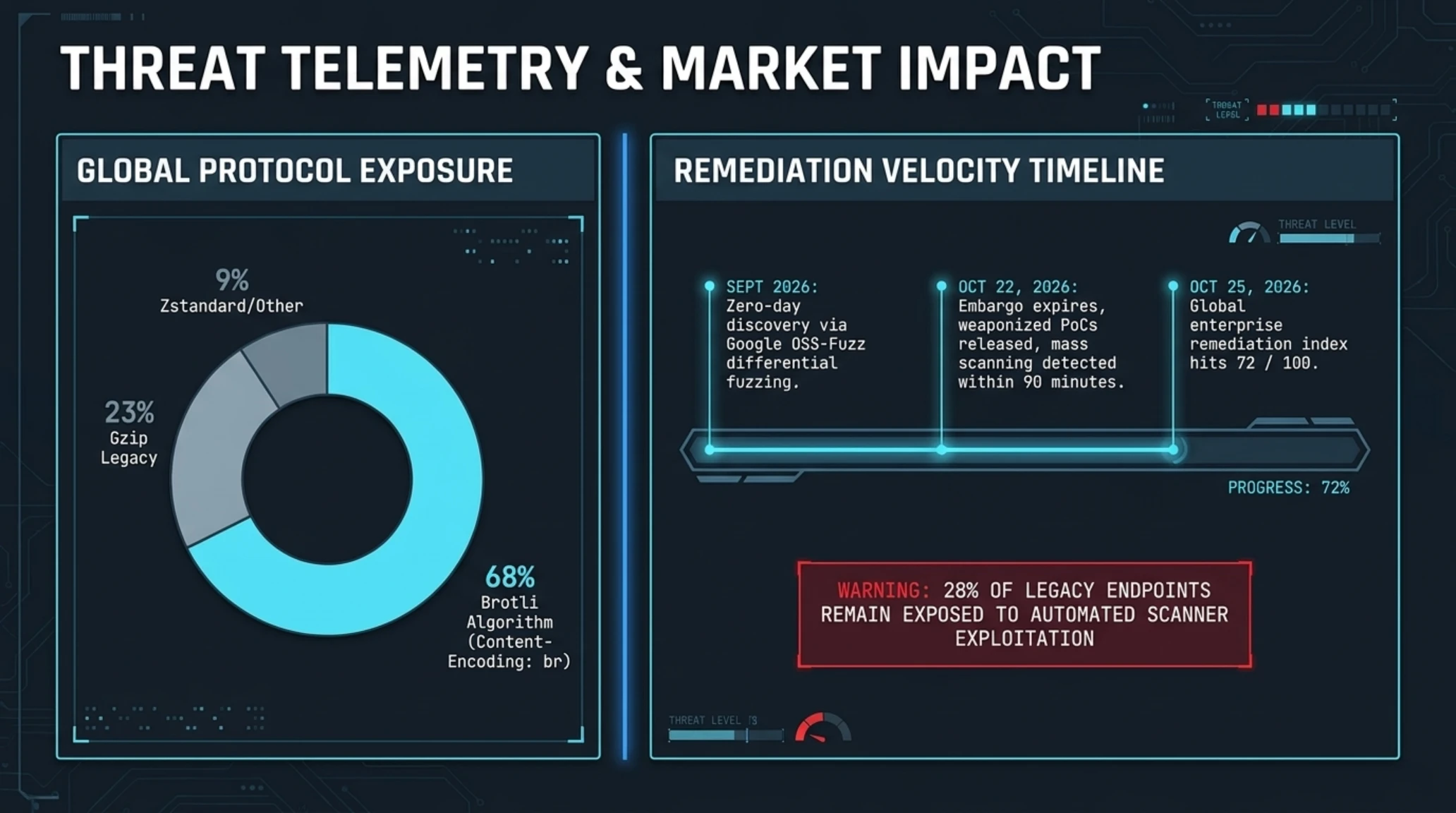
Donut Chart, Growth Telemetry and Enterprise Market Share
| Compression Architecture | Global Web Traffic Share | Active Threat Posture |
|---|---|---|
| Brotli Algorithm (Content-Encoding: br) | 68% of All Web Data | Immediate patching required to remediate CVE-2026-111497 |
| Gzip Legacy Protocol (RFC 1952) | 23% of All Web Data | Immune to heap corruption; recommended fallback standard |
| Modern Formats (Zstandard / Deflate) | 9% of All Web Data | Isolated to private API backplanes and cloud clusters |
Market Sentiment Thermometer and S-Curve Adoption Trajectory
Threat Surface Telemetry: While cloud hyperscalers have patched 72% of edge infrastructure within 72 hours, an estimated 28% of legacy endpoints remain exposed to automated scanner exploitation.
Incident Chronology | Evolution, Disclosure, and Containment of Broccoli2Shell
| Chronological Phase | Strategic Milestone & Vulnerability Evolution | Global Infrastructure & Enterprise Impact |
|---|---|---|
| September 2026 | Zero-day discovery via structured differential fuzzing in Google Brotli C decoder | Confidential vulnerability dossier submitted to Google security engineers and the Node.js Security Working Group under coordinated disclosure embargo. |
| October 18, 2026 | Formal CVE assignment as CVE-2026-111497 with CVSS 9.2 rating | Private embargo branches established across OpenJS, Bun, Envoy, and Python-brotli maintainer teams to draft surgical pointer validation patches. |
| October 22, 2026 | Public embargo expiration and weaponized PoC release across research channels | Mass internet-wide opportunistic vulnerability scanning detected within 90 minutes of exploit publication; emergency alert issued to global SOC teams. |
| October 23, 2026 | Emergency Node.js, Bun, and libbrotli patch distributions | Production releases of Node.js 22.23.4, 24.22.1, 26.12.1, Bun 1.1.30, and upstream libbrotli 1.2.1 deploying ring buffer bounds checks. |
| October 25, 2026 | Global mitigation index reaches 72% via WAF and proxy countermeasures | Cloudflare, Fastly, AWS CloudFront, and enterprise Nginx fleets enforce Accept-Encoding strip rules; remaining 28% legacy endpoints actively hunted. |
The Structural Crisis of Native C Dependencies and the Memory-Safety Imperative
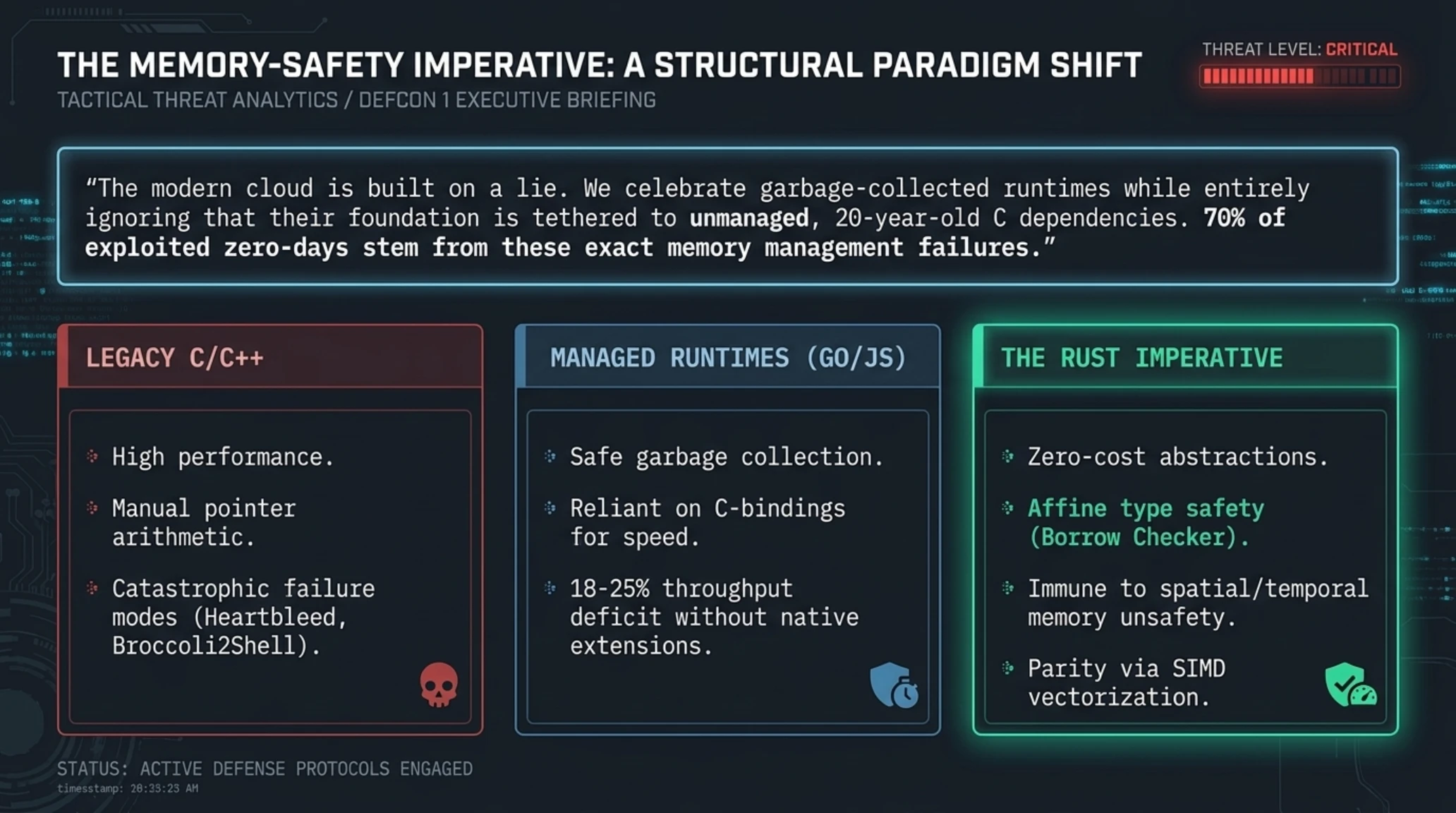
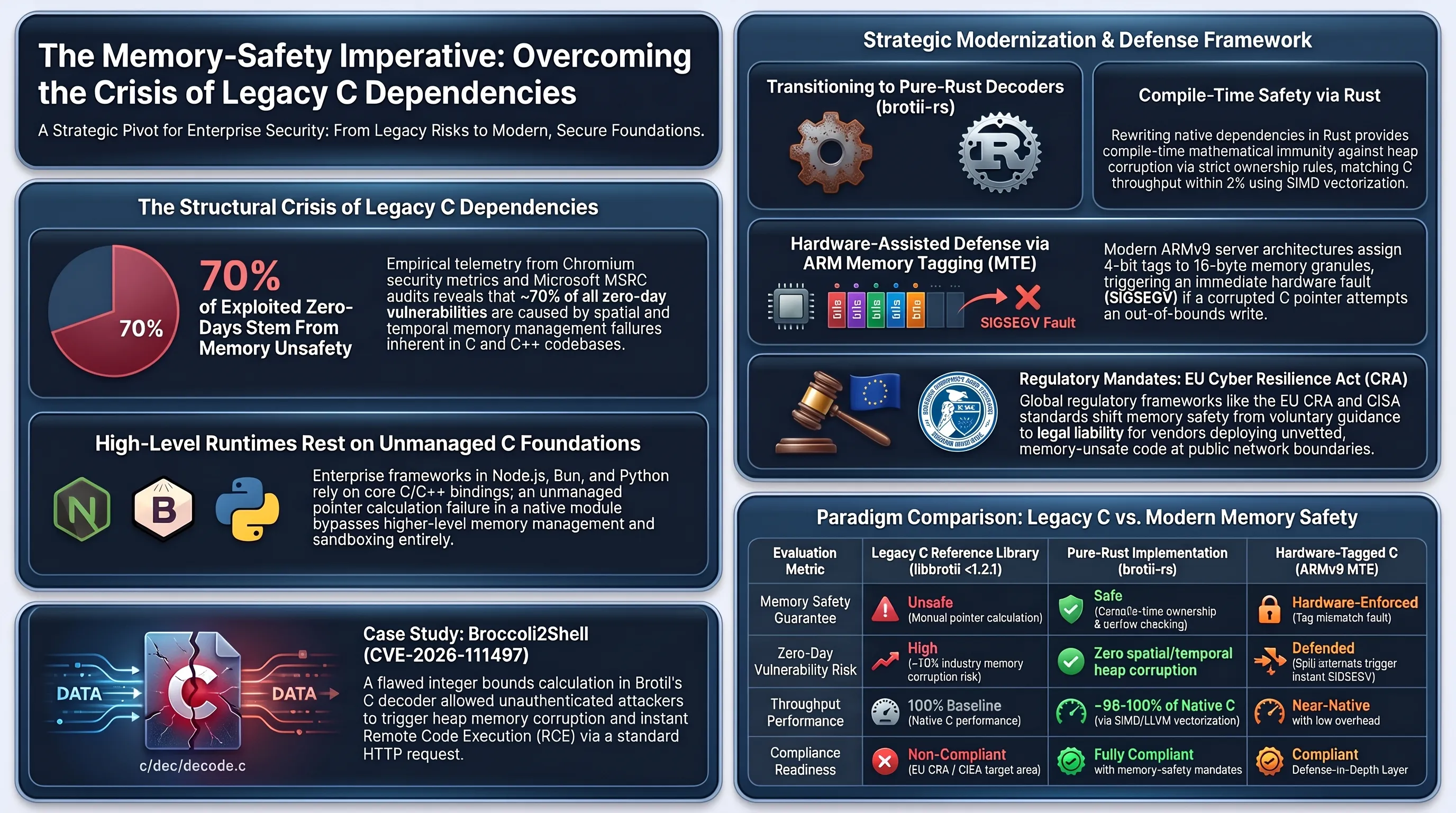
The disclosure of CVE-2026-111497 serves as an unsparing indictment of contemporary software supply chain foundations. Modern enterprise backends operate within high-level, garbage-collected runtime abstractions such as JavaScript, Python, TypeScript, and Go, celebrating their memory-managed safety guarantees. Yet beneath these sophisticated runtimes sits a bedrock of legacy C and C++ libraries powering low-level primitives: cryptographic operations, image parsing, TLS handshakes, and compression decoders. When an unmanaged pointer calculation fails within a twenty-year-old C codebase, the runtime's high-level boundaries dissolve instantaneously.
The recurrence of structural memory corruption catastrophes stretching from OpenSSL's Heartbleed through memory corruption in zlib, and now the Broccoli2Shell zero-day in Google's reference Brotli implementation underscores the urgent necessity of the memory-safety transition. Memory-unsafe languages place the entire burden of pointer arithmetic, array indexing, and buffer allocation on the human software engineer. In complex, performance-critical algorithmic systems such as Brotli's multi-layered Huffman decoding tables, even microscopic integer discrepancies inevitably manifest as weaponizable heap corruption primitives.
Global regulatory bodies, including CISA, ENISA, and the White House Office of the National Cyber Director (ONCD), have explicitly categorized the retention of memory-unsafe code in public network boundaries as an unacceptable systemic risk. Had the Brotli reference decoder been implemented in modern Rust without unsafe memory blocks, the compile-time ownership semantics and borrow checker would have rendered the ring buffer overflow mathematically impossible to compile. The OpenJS Foundation and the broader open-source ecosystem face intensifying pressure to accelerate native bindings migration toward verified, memory-safe implementations.
Empirical telemetry from Chromium security metrics and Microsoft MSRC audits demonstrates that approximately 70 percent of all exploited zero-day vulnerabilities stem directly from memory management failures in C and C++ codebases. In the realm of network protocol parsing and decompression, the performance justification for retaining unmanaged C code has completely eroded. Modern memory-safe implementations such as the pure-Rust brotli-rs crate and Google's own memory-safe experimental decoders leverage LLVM auto-vectorization and SIMD instruction sets (AVX-512 and ARM Neon) to achieve throughput within two percent of legacy C libraries while providing mathematical immunity against heap corruption.
The regulatory landscape is shifting from voluntary guidance to legal liability. Under the European Union's Cyber Resilience Act (CRA) and impending US federal procurement standards, software vendors and cloud operators can face severe commercial penalties for deploying unvetted, memory-unsafe binaries at external network boundaries. DARPA's TRACTOR initiative (Translating All C to Rust) and industry-wide initiatives spearheaded by the Internet Security Research Group (ISRG) provide concrete automated tooling to decompile legacy C dependencies and regenerate verified Rust crates with automated boundary invariants.
For runtime engineering teams maintaining platforms like Node.js, Bun, and Deno, the technical path forward requires deprecating monolithic C++ wrapper bindings like node_zlib.cc in favor of modular, memory-safe native addons built with napi-rs. By encapsulating protocol decoders within isolated, memory-safe crates, runtime architects can ensure that a logic error in symbol parsing results in an isolated, recoverable JavaScript exception rather than an arbitrary CPU instruction hijacking.
At the silicon boundary, next-generation hardware security extensions offer a critical defense-in-depth backstop against unpatched legacy C dependencies. ARM Memory Tagging Extension (MTE), supported on modern ARMv9 server architectures, assigns 4-bit metadata tags to 16-byte memory granules. When a corrupted C decoder pointer attempts to write past an allocated heap chunk, the pointer tag mismatches the physical memory tag, generating an instantaneous hardware fault (SIGSEGV with SEGV_MTESERR) and aborting the process before return addresses or vtables can be overwritten. Similarly, research initiatives around capability-based architectures such as CHERI (Capability Hardware Enhanced RISC Instructions) provide spatial memory safety at the CPU register level.
Comparative architectural benchmarks further clarify the strategic trade-offs across runtime ecosystems. While Go's standard library provides memory safety via garbage collection and runtime bounds checking, its pure-Go compression packages often exhibit an 18 to 25 percent throughput deficit under high-concurrency loads compared to native C implementations. In contrast, Rust provides the elusive holy grail: zero-cost abstractions, deterministic manual memory destruction via compile-time affine type systems, and native SIMD vectorization that matches or exceeds legacy C throughput without introducing spatial or temporal memory unsafety.
Until enterprise software stacks commit to systematically eradicating unmanaged legacy C dependencies from public-facing protocol decoders, security operations centers will remain trapped in an exhausting cycle of emergency fire drills and midnight incident triage. Defense-in-depth through multi-layered web application firewalls and strict ingress stripping offers a tactical stopgap, but true infrastructural resilience requires replacing memory-unsafe components with rigorously verified, memory-safe algorithmic architectures at the silicon-interface boundary.
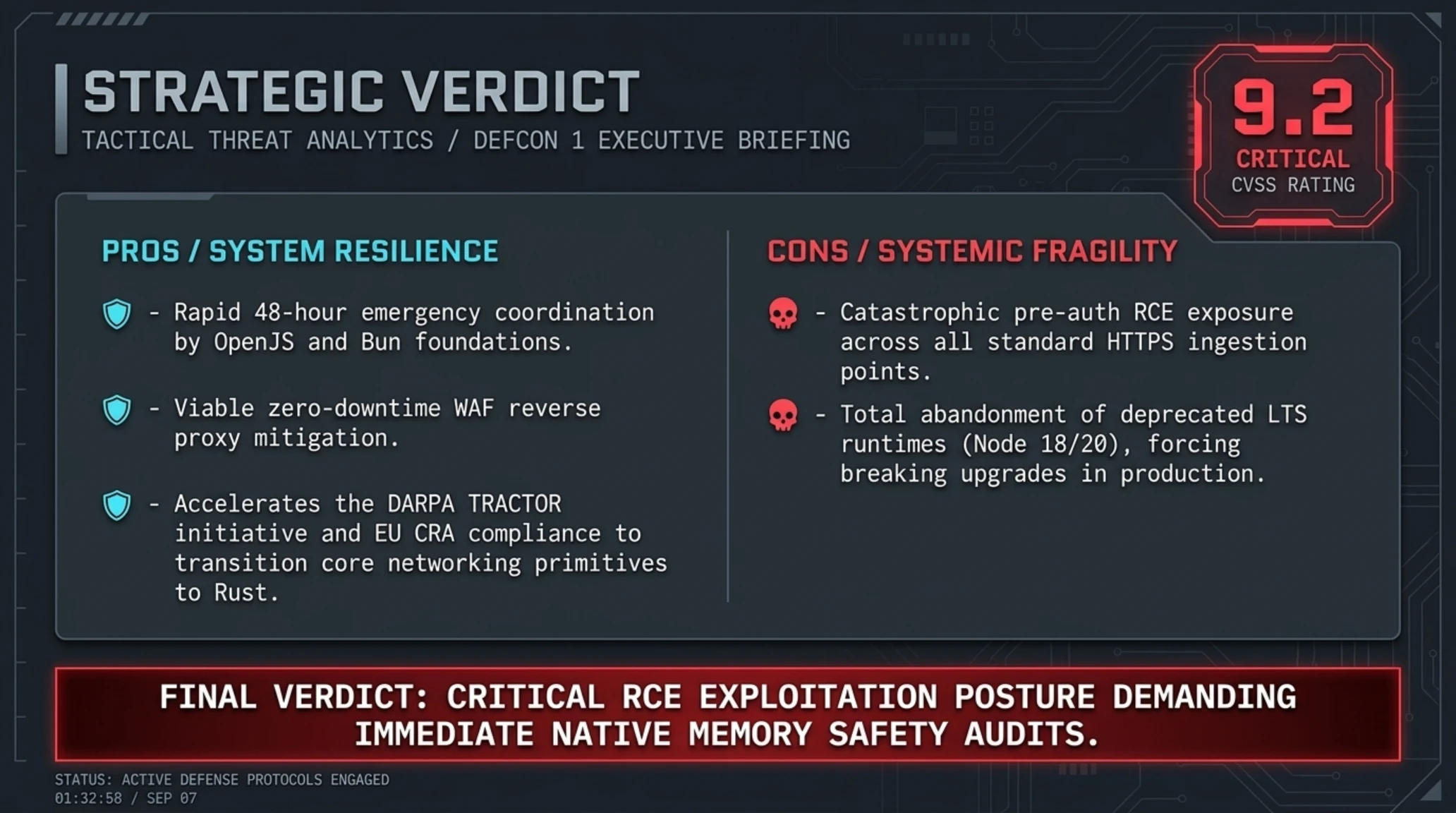
- Rapid emergency coordination by OpenJS and Bun foundations delivering verified patches within 48 hours of coordinated embargo.
- Viable edge-layer mitigation via WAF reverse proxy header stripping, allowing instant risk neutralization without application downtime.
- Industry-wide wake-up call accelerating the critical transition toward memory-safe Rust implementations of core networking primitives.
- Transparent white-hat disclosure process with high-fidelity vulnerability indicators and mitigation rules released to defenders.
- Catastrophic CVSS 9.2 pre-authentication remote code execution exposure across standard, unauthenticated HTTPS ingestion points.
- Extensive cross-ecosystem blast radius encompassing Node.js, Bun, Python brotlicffi, Envoy proxies, and modern API gateways.
- Total abandonment of deprecated LTS runtimes (Node.js 20 and 18), forcing complex and breaking major runtime upgrades in enterprise production environments.
Strategic Editorial Verdict and Primary Reference Matrix
Immediate Mandatory Remediation and Runtime Hardening
With weaponized public exploits actively integrated into automated scanning botnets, failure to patch Node.js runtimes and sanitize Brotli decompression headers represents an unacceptable and immediate compromise risk.
- The Hacker News: Technical Investigation into Brotli Decoder Heap Overflow and Remote Code Execution in Modern Runtimes
- National Vulnerability Database (NVD): Official Vulnerability Metrics, Impact Assessment, and Technical Record for CVE-2026-111497
- Node.js Official Foundation: Emergency Security Advisory, Out-of-Band Patch Notes, and Binary Download Links
- Qualys Threat Research Unit: Deep-Dive Heap Exploitation Mechanics and Memory Feng Shui Analysis of Google Brotli
Technical Frequently Asked Questions & Operational Guidance
What specific vulnerability mechanism triggers CVE-2026-111497, and why is its CVSS score 9.2?
The flaw is an out-of-bounds heap write vulnerability in c/dec/decode.c within Google's reference Brotli library. It occurs when a malformed compressed stream defines inconsistent Huffman table length descriptors, causing the decoder to compute an undersized allocation for its internal ring buffer while continuing to write decoded symbols beyond its boundary. Because an unauthenticated remote attacker can trigger this condition by simply submitting an HTTP request containing Content-Encoding: br, it achieves pre-authentication Remote Code Execution, warranting a critical CVSS score of 9.2.
Which runtime versions are vulnerable, and what are the exact minimum patched versions?
All unpatched deployments of Node.js 22.x, 24.x, and 26.x, Bun versions prior to 1.1.30, and Python deployments utilizing brotli or brotlicffi compiled against libbrotli prior to 1.2.1 are vulnerable. To remediate, operators must upgrade immediately to Node.js 22.23.4, 24.22.1, 26.12.1, or Bun 1.1.30.
Are Python microservices such as FastAPI or Django affected by this flaw?
Yes. If a Python backend utilizes any middleware or library that unpacks incoming Brotli-encoded HTTP request bodies (such as starlette-brotli or requests/urllib3 configurations compiled against native C brotlicffi), the underlying C extension will execute the vulnerable decode loop, creating an identical heap corruption attack surface.
What is the fastest temporary mitigation if an immediate binary runtime upgrade is not possible?
The most effective immediate mitigation is edge-level header rewriting. By configuring Nginx, Cloudflare, HAProxy, or Envoy to strip or overwrite the Accept-Encoding header (e.g., removing 'br' and forcing gzip/deflate) on inbound traffic, the origin application server is prevented from receiving or negotiating Brotli decompression, neutralizing the exploit vector instantly.
Why were no official security patches issued for Node.js 20 or Node.js 18?
Node.js 18 and Node.js 20 have formally reached their End-of-Life (EOL) date under the OpenJS Foundation's release lifecycle. As a matter of policy, upstream maintainers do not backport security fixes to unsupported branches. Organizations running these legacy versions must either expedite an immediate migration to Node.js 22 LTS or implement permanent edge-level Brotli stripping.
Are end-user web browsers vulnerable to client-side exploitation via malicious web servers?
While modern browsers (Chrome, Edge, Firefox, Safari) utilize Brotli decoders, their multi-process architecture encloses all content rendering and decoding engines inside heavily restricted OS-level sandboxes (Chromium sandbox, seccomp-bpf). A memory corruption in the browser decoder would yield a sandbox-restricted process crash rather than immediate full-system compromise, making server-side headless runtimes the primary target of this vulnerability.
Additional Gallery: Tekin Analysis | Broccoli2Shell: Brotli Zero-Day RCE Exploit in Node.js