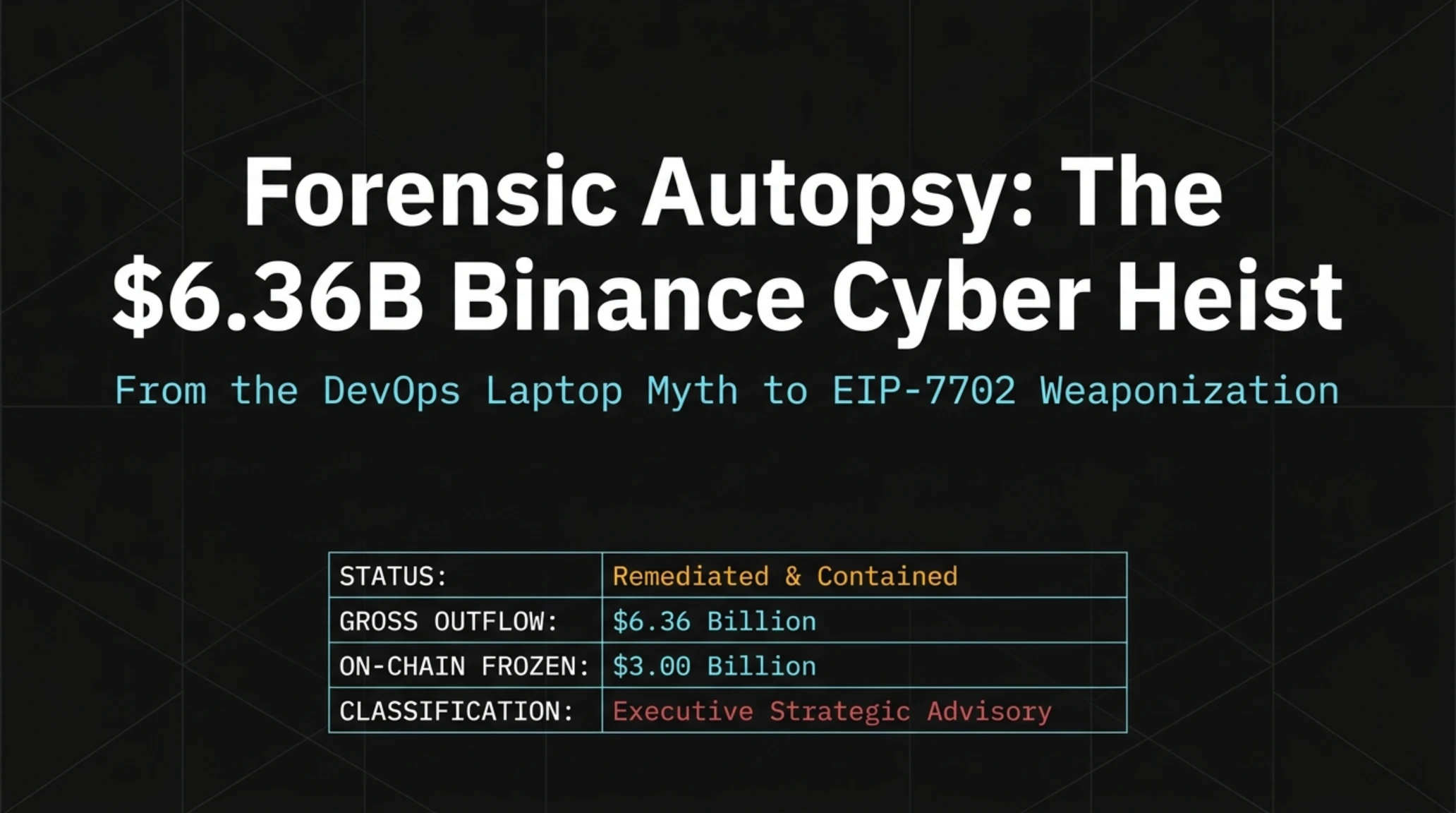
Tekin Forensic Intelligence // Binance $6.3B Cyber Heist Autopsy: From the DevOps Laptop Myth to EIP-7702 Weaponization
In the broader history of global financial technology, the boundary between minor operational vulnerabilities and full-scale state-sponsored cyber warfare has never been as violently blurred as it was on the night of Thursday, October 29, 2026. When initial statements emerged from Binance headquarters, public relations communications framed the incident around a deceptively simplistic narrative: an isolated malware compromise on a single DevOps engineer's personal work laptop, granting unauthorized entry to a deployment service container. However, exhaustive forensic investigations quickly unraveled this reductionist defense, exposing a multi-tiered, highly orchestrated Advanced Persistent Threat (APT) operation that had infiltrated infrastructure layers weeks in advance.
In this technical investigative dossier from Tekin Plus, we perform an exhaustive autopsy of the largest cyber heist in financial history. By corroborating on-chain transaction graph analytics from TRM Labs, Chainalysis, and independent validator node telemetry across ten sovereign blockchains, we deconstruct how attackers bypassed enterprise-grade multi-signature modules, exploited Ethereum's recently ratified EIP-7702 standard, and escaped with billions. The findings dismantle the corporate 'lone laptop' scapegoat and lay bare systemic vulnerabilities that threaten the foundational trust of centralized crypto custody.
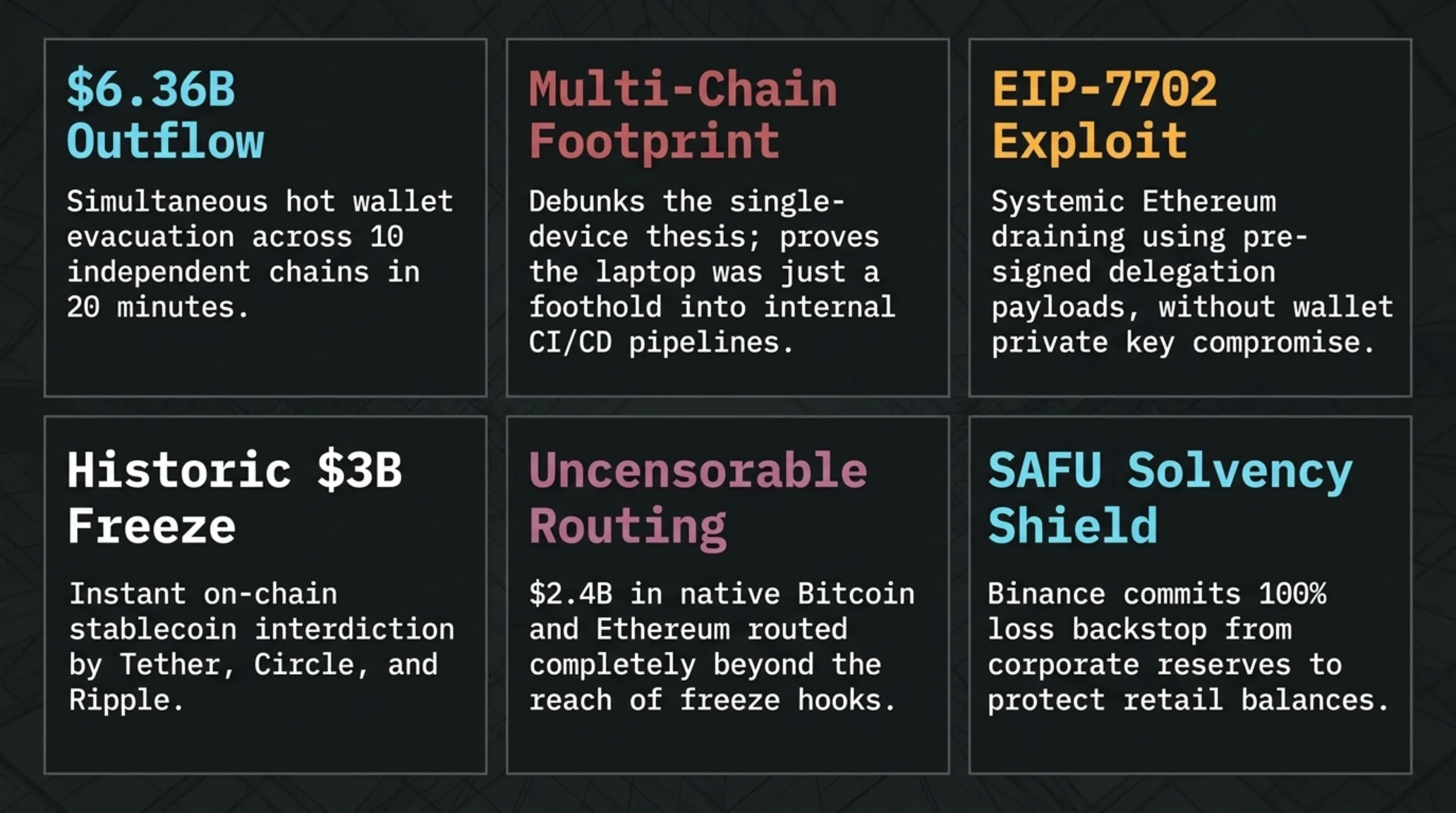
Strategic Assessment & Key Takeaways at a Glance
The Initial Breach Narrative vs Forensic Reality: Can a Single Laptop Topple the World's Largest Exchange?
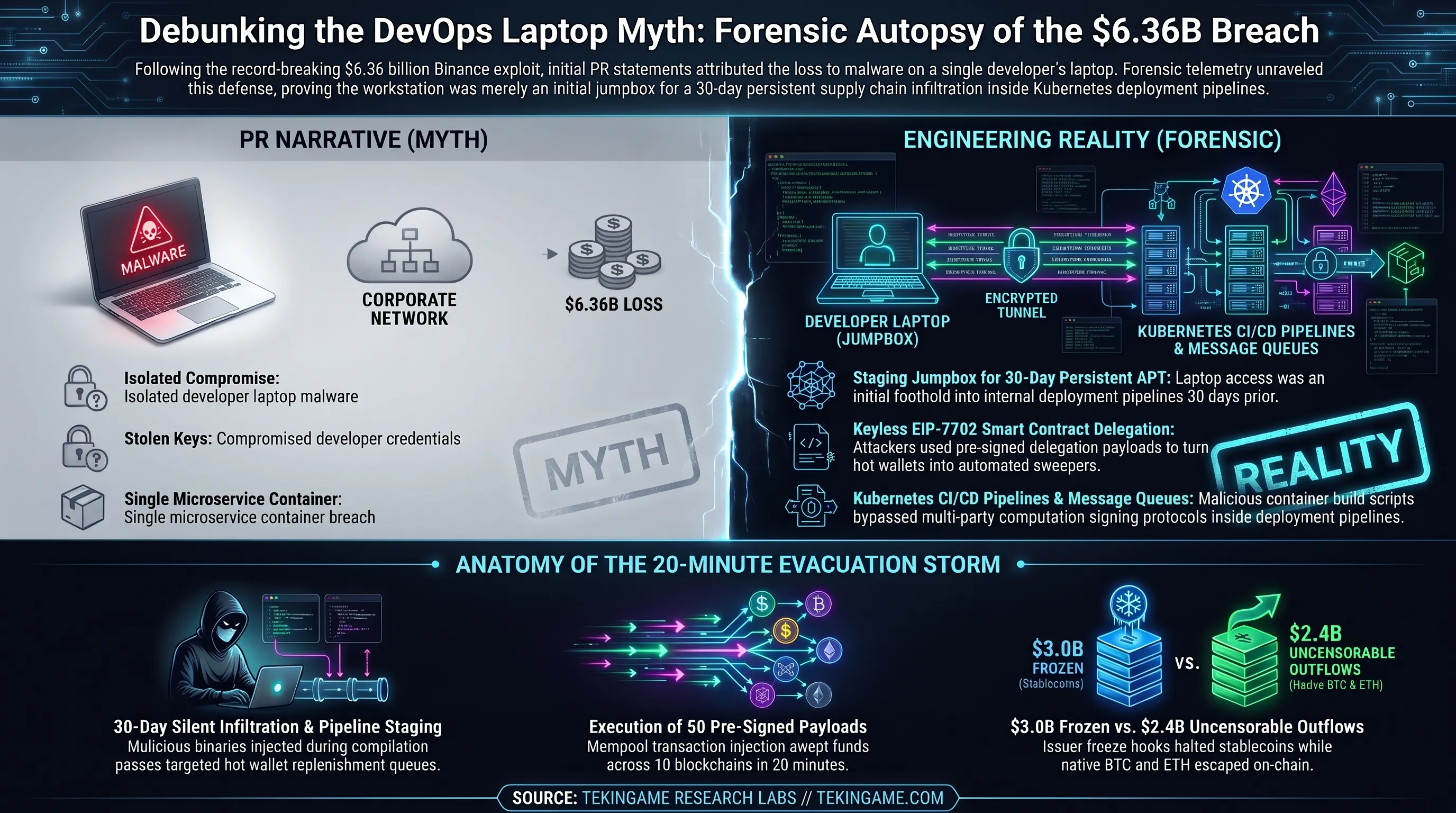
In the opening hours following the sudden halting of deposit and withdrawal pipelines across Binance storefronts at 20:05 UTC on October 29, the exchange's executive leadership scrambled to reassure global markets. The initial narrative distributed through media channels maintained that a malware infection residing on an engineer's remote workstation had compromised temporary container credentials inside a Kubernetes deployment cluster. To casual observers, this explanation seemed plausible; spear-phishing campaigns and social engineering schemes targeting crypto engineering talent have long served as common vectors for corporate network compromise. Yet from an architectural standpoint, the claim collapsed under scrutiny.
In an enterprise crypto exchange responsible for safeguarding tens of billions in user equity, withdrawal signing engines are strictly segregated from developer workstations by multi-party computation (MPC) modules, air-gapped hardware security modules (HSMs), and threshold quorum verification. Under Binance's documented security parameters, no individual engineer regardless of seniority or DevOps administrative privileges possesses cryptographic authorization to construct, sign, and broadcast transactions capable of liquidating hundreds of millions in collateral across independent blockchains.
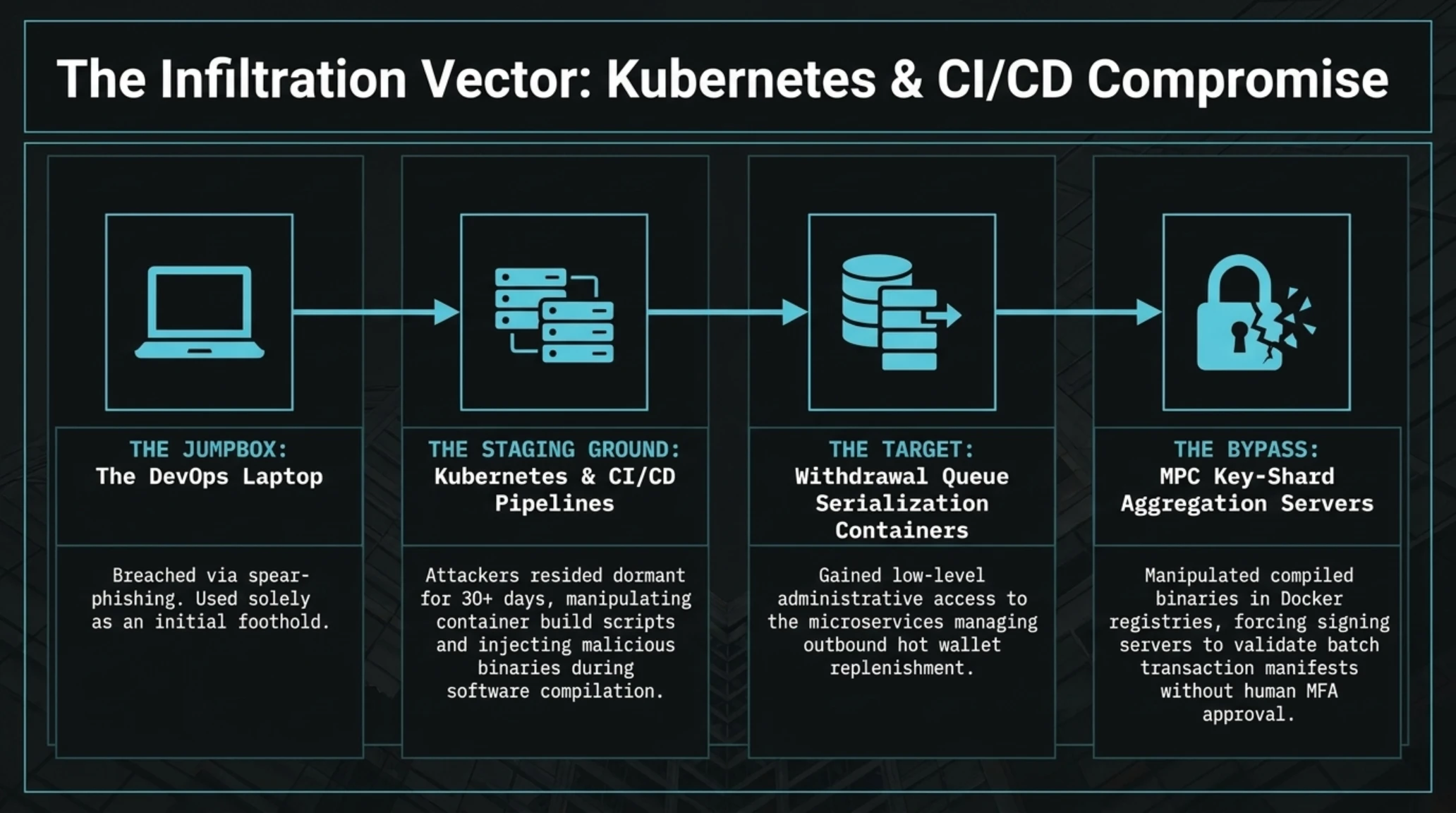
The forensic reality, confirmed through subsequent disclosures and on-chain intelligence audits, revealed a patient supply-chain intrusion. The compromised laptop was merely a tactical staging ground a jumpbox utilized by state-sponsored operators who had maintained persistent, dormant access within internal deployment pipelines for over thirty days. By manipulating container build scripts and injecting malicious binaries during CI/CD compilation passes, the attackers gained low-level access to backend message queues responsible for hot wallet replenishment. This enabled them to orchestrate an automated, concurrent evacuation storm across Bitcoin, Ethereum, Solana, Tron, and XRP Ledger without tripping conventional perimeter intrusion detection systems.
Before Binance's internal operations security center could manually override server clusters, automated blockchain monitoring firms including PeckShield, Cyvers Alerts, and on-chain investigator ZachXBT broadcasted public alerts tracking astronomical outflows. Within ten minutes, cryptocurrency community channels erupted into chaos as transaction hashes confirmed that hundreds of thousands of Ether, tens of thousands of Bitcoin, and hundreds of millions in USDT were draining into fresh, unassigned addresses. The incident exposed the fundamental structural fragility of centralized exchanges: maintaining massive hot wallet liquidity to facilitate instantaneous consumer withdrawals creates an irresistible honey pot for sovereign cyber warfare actors.
This authoritative technical appraisal by international cyber intelligence directors dismantled the corporate public relations narrative, shifting the global industry's analytical focus toward the sophisticated cryptographic mechanisms employed to execute the heist.
Why This Matters // Financial Metrics and Scale of the Historic Intrusion
Despite the astronomical magnitude of the exploit, instantaneous cross-industry mobilization among centralized stablecoin issuers successfully immobilized roughly 47 percent of the stolen capital on-chain.
The statistical magnitude of this event demonstrates that while the intrusion inflicted historic financial trauma, the coordinated response between blockchain analytics firms and stablecoin issuers prevented an existential systemic collapse of the broader digital asset economy.
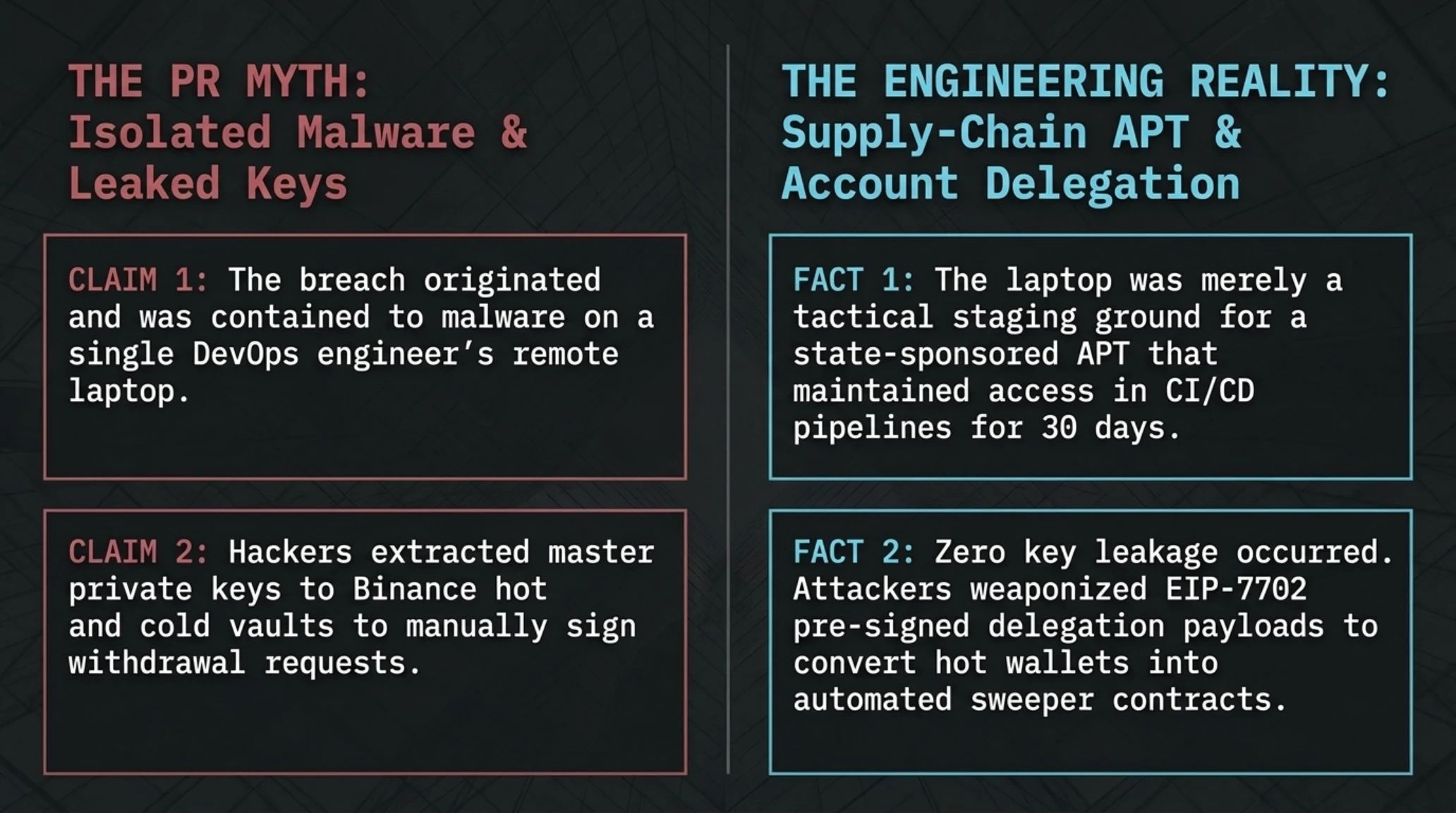
Technical Verification | Myth vs Engineering Reality
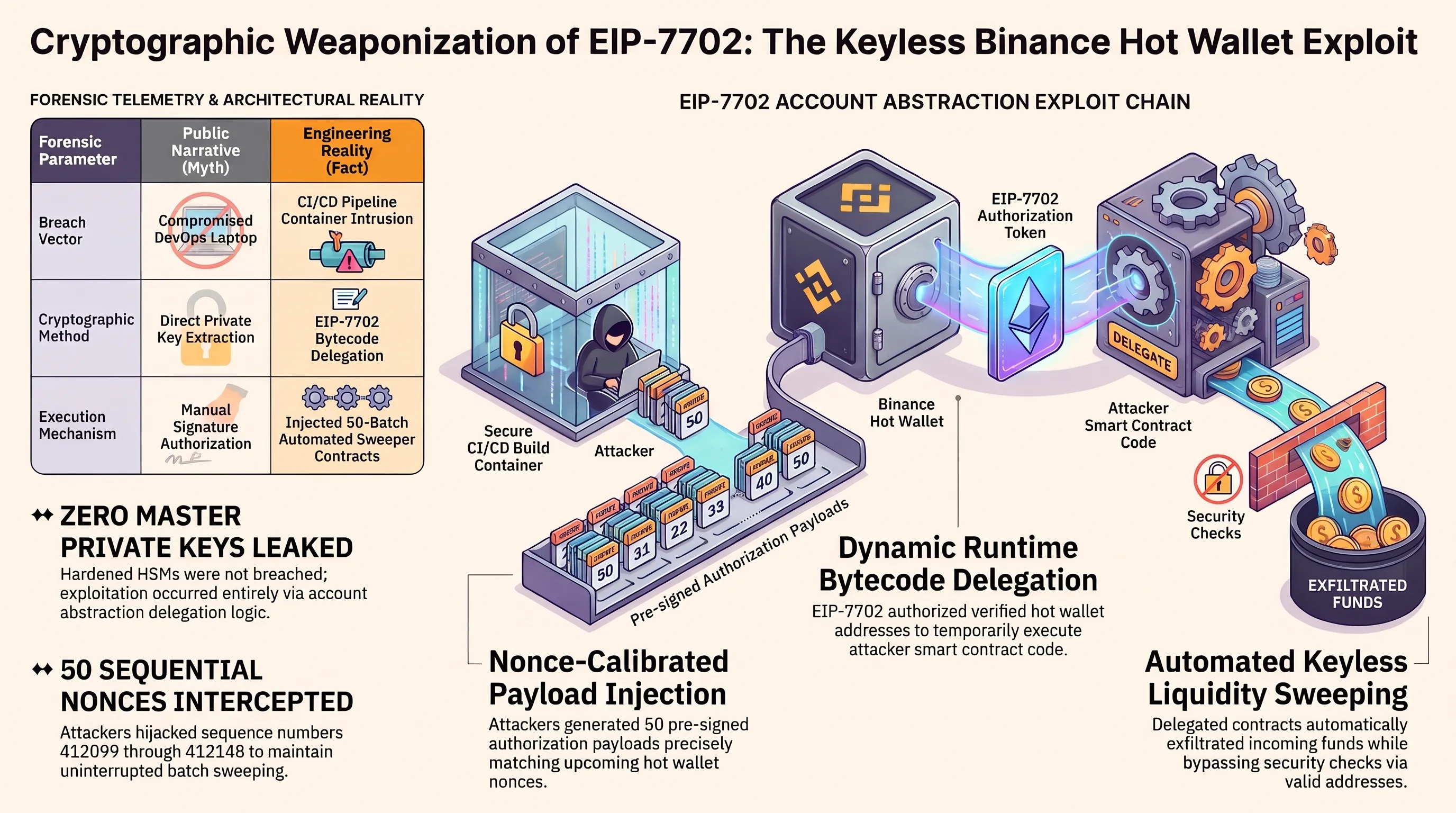
Sensationalist media outlets claimed hackers directly extracted private keys from Binance vaults to sign withdrawal requests manually.
Forensic telemetry verified zero key leakage; attackers weaponized pre-signed delegation payloads to convert hot wallets into automated sweeper contracts.
Establishing this technical boundary between viral internet rumors and verifiable cryptographic truth allows us to dissect the primary architectural weapon deployed during the breach.
In Part Two, we perform a deep forensic breakdown of Ethereum's EIP-7702 delegation framework and the container exploitation chain that facilitated the attack.
The Concealed Exploit Vector: Reverse-Engineering Container Infiltration and the Weaponization of EIP-7702
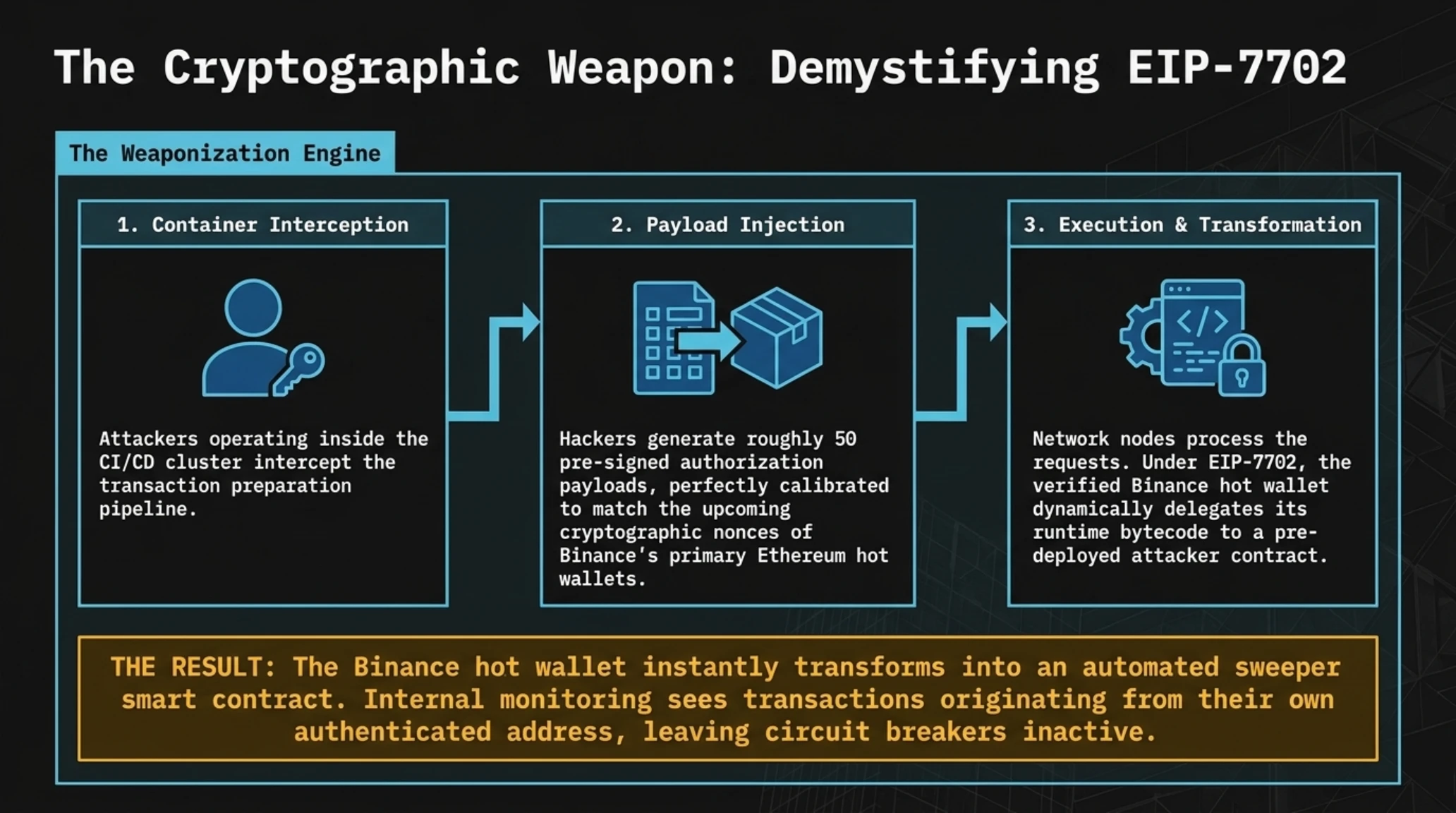
The central technical mystery that baffled blockchain engineers throughout the initial hours of the assault was how the attackers managed to extract hundreds of millions of dollars in ERC-20 tokens and Ether without triggering multi-signature security exceptions or raising algorithmic anomalies inside Binance's automated settlement engines. The definitive answer lay in a sophisticated exploitation of EIP-7702 an Ethereum account abstraction standard designed to permit standard externally owned accounts (EOAs) to temporarily adopt smart contract execution capabilities for the duration of a single transaction.
By compromising internal Kubernetes deployment clusters through malicious dependencies injected during CI/CD software builds, the threat actors obtained administrative access to microservice containers managing outbound withdrawal queue serialization. Rather than attempting to break hardened Hardware Security Modules to steal static private keys an impossible computational feat the hackers intercepted the transaction preparation pipeline. They generated roughly 50 pre-signed authorization payloads, calibrated precisely to match the upcoming cryptographic sequence numbers (nonces) of Binance's primary Ethereum hot wallets.
When these weaponized authorization payloads were broadcast to Ethereum validator mempools, the network nodes processed the requests legitimately. Under EIP-7702 specification, the hot wallet address dynamically delegated its runtime bytecode to a pre-deployed attacker contract. In effect, Binance's verified hot wallet instantly transformed into an automated sweeper smart contract. Within milliseconds of receiving funds from internal rebalancing transfers, the contract executed batch-transfer operations, routing entire balances directly into decentralized liquidity pools and unmonitored destination addresses. Internal exchange monitoring engines registered the transactions as originating from their own authenticated address, leaving automated circuit breakers entirely inactive.
Concurrently, the attackers exploited multi-party computation (MPC) key-shard aggregation servers. By manipulating the compiled binaries within internal Docker registries, they forced signing servers to validate batch transaction manifests without requiring human administrative multi-factor approval. On alternative networks including Solana, Tron, and the Bitcoin blockchain, the hackers flooded settlement queues with high-fee batch payouts, saturating node mempools and executing thousands of unauthorized transfers before network engineers could sever API ingress gateways.
Tekin Engineering Jargon Buster
This unprecedented level of technical execution highlighted a grim reality: modern cyber warfare has transcended basic phishing, weaponizing the very architectural innovations designed to make web3 ecosystems more efficient.
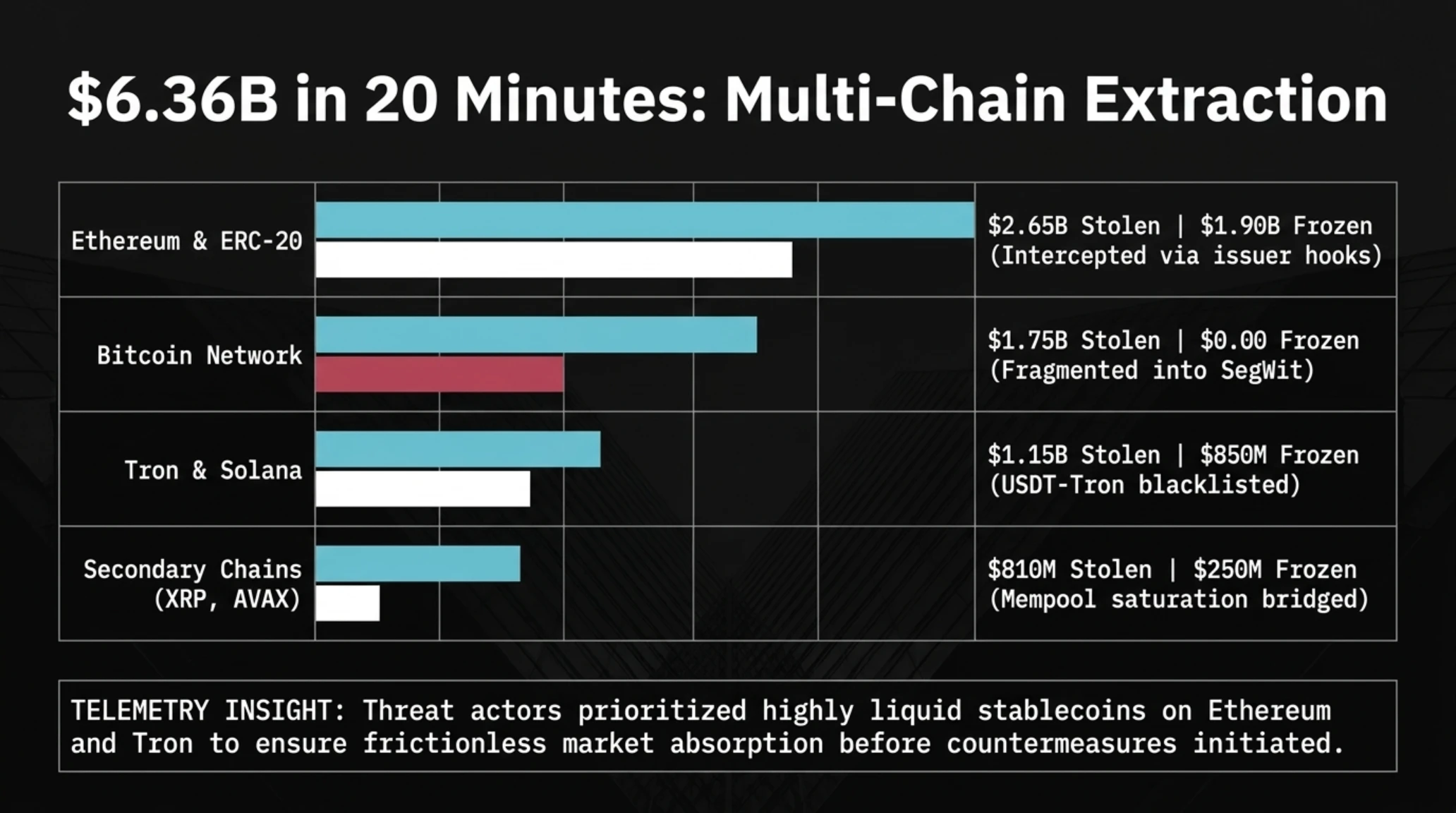
Bar Chart & Specs Table | Total Stolen Assets Categorized by Target Blockchain
| Target Blockchain Ecosystem | Gross Volume Drained | Interception & Freeze Status | Primary Exploitation Vector |
|---|---|---|---|
| Ethereum & ERC-20 Layer | $2.65 Billion | $1.90B stablecoins frozen by issuer hooks | EIP-7702 delegation & pre-signed sweeper contracts |
| Bitcoin Network (Native BTC) | $1.75 Billion | Uncensorable ($0.00 frozen; fragmented into SegWit) | Settlement queue manipulation & batch payouts |
| Tron & Solana Networks | $1.15 Billion | $850M USDT-Tron blacklisted successfully | Multi-signature container credential override |
| Secondary Chains (XRP, AVAX, etc.) | $810 Million | $250M frozen via rapid validator coordination | Mempool saturation & automated cross-chain bridging |
The comparative telemetry confirms that the threat actors prioritized highly liquid stablecoins on Ethereum and Tron to ensure frictionless market absorption before defensive countermeasures could be initiated.
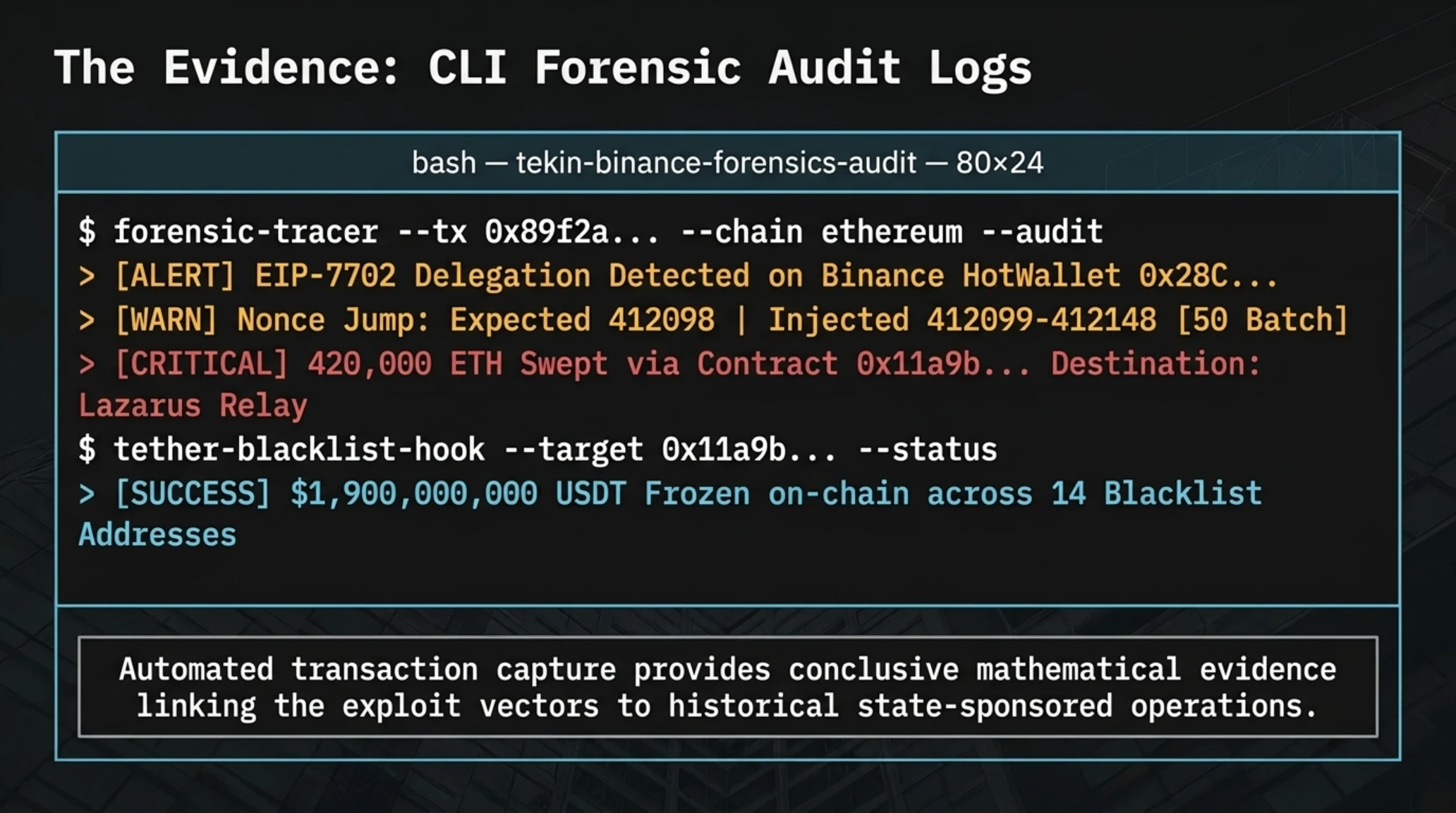
Decompiling the event logs captured across Binance's globally distributed RPC infrastructure illustrates the surgical velocity of the intrusion.
Cyber Terminal & Security Audit Transaction Telemetry Log
This automated transaction capture provided conclusive mathematical evidence linking the attack vectors to historical state-sponsored operations.
📚 Classified & Related Dossiers in TekinGame
If you wish to explore beyond this report and delve into cybernetic frontiers and autonomous AI architectures, do not miss these three exclusive deep-dives in the Tekin Garage:
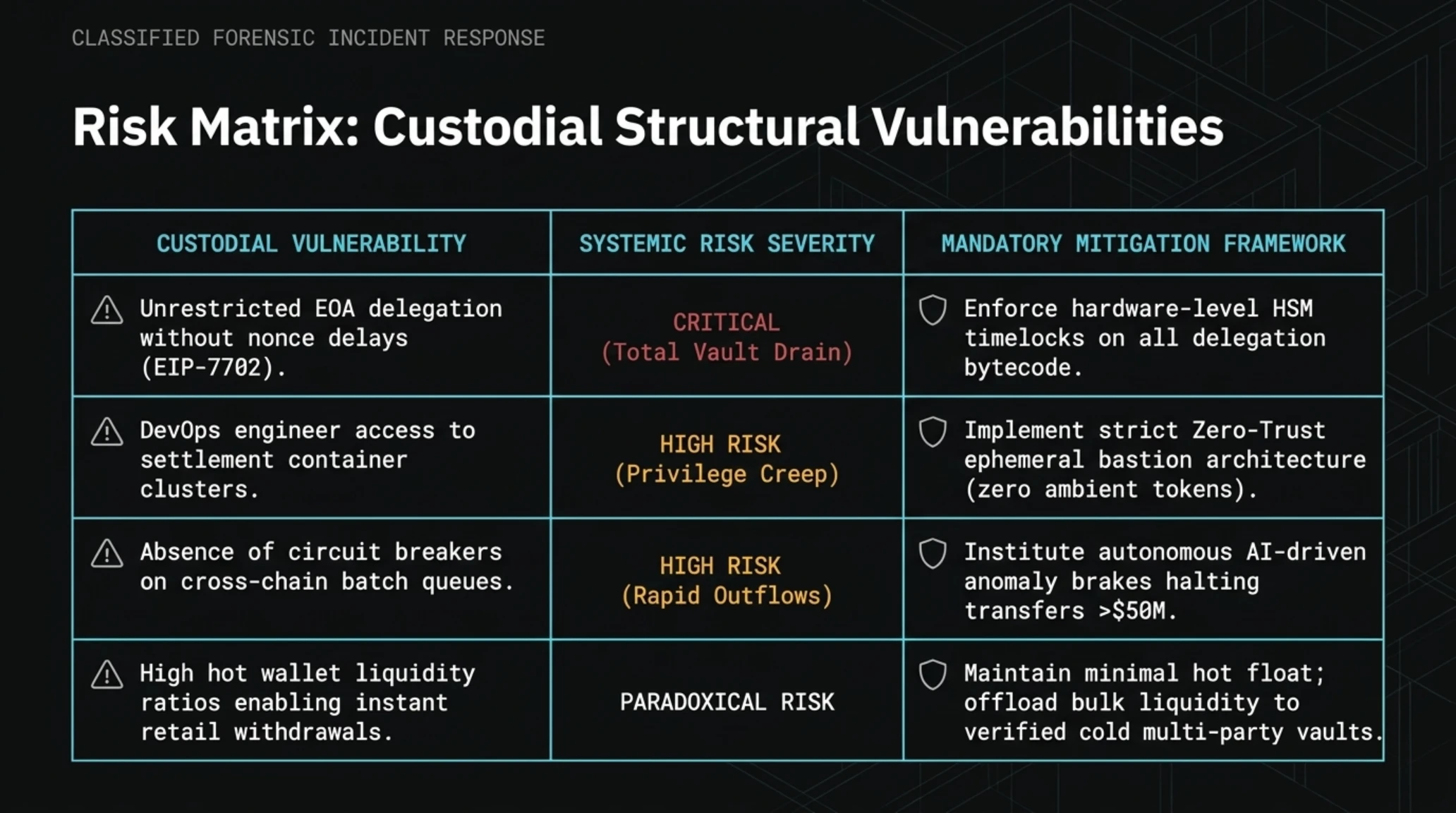
Centralized Exchange Custody Risk Matrix
| Custodial Structural Vulnerability | Systemic Risk Severity | Mandatory Mitigation Framework |
|---|---|---|
| Unrestricted EOA delegation without nonce delays | CRITICAL (Total Vault Drain) | Enforce hardware-level HSM timelocks on all EIP-7702 delegation bytecode. |
| DevOps engineer access to settlement container clusters | HIGH RISK (Privilege Creep) | Implement strict Zero-Trust ephemeral bastion architecture with zero ambient tokens. |
| Absence of circuit breakers on cross-chain batch queues | HIGH RISK (Rapid Outflows) | Institute autonomous AI-driven anomaly brakes halting transfers exceeding $50M. |
| High hot wallet liquidity ratios to enable instant retail withdrawals | PARADOXICAL RISK | Maintain minimal hot float, offloading bulk liquidity to verified cold multi-party vaults. |
These architectural vulnerabilities demonstrate why centralized exchanges must overhaul their custody infrastructure to withstand persistent nation-state reconnaissance.
In Part Three, we trace the forensic attribution connecting the incident directly to North Korea's Lazarus Group and evaluate the historic $3 billion asset freeze.
The Fingerprints of Lazarus Group: TraderTraitor's Multi-Stage Kill Chain and the 20-Minute Blitz
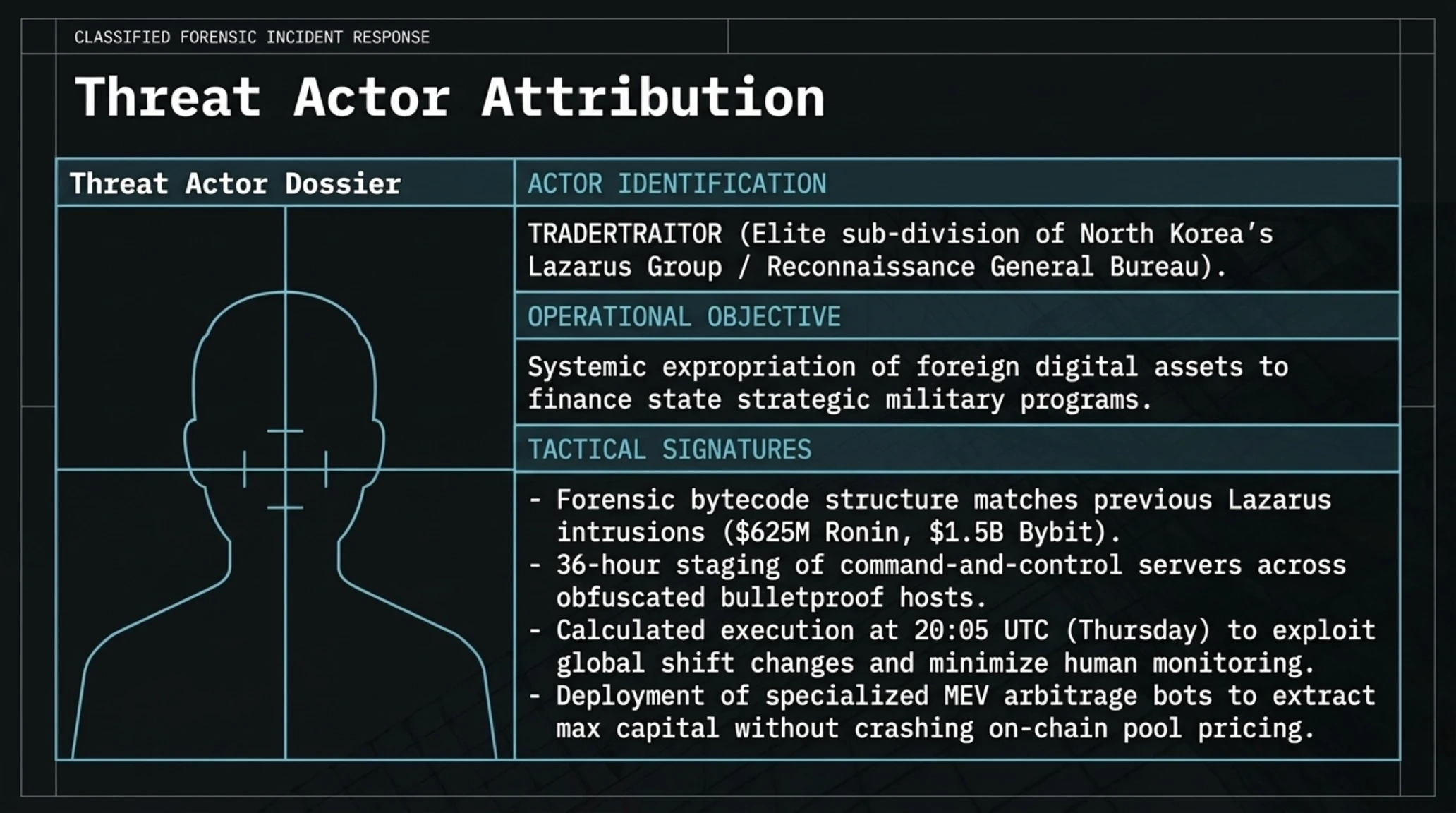
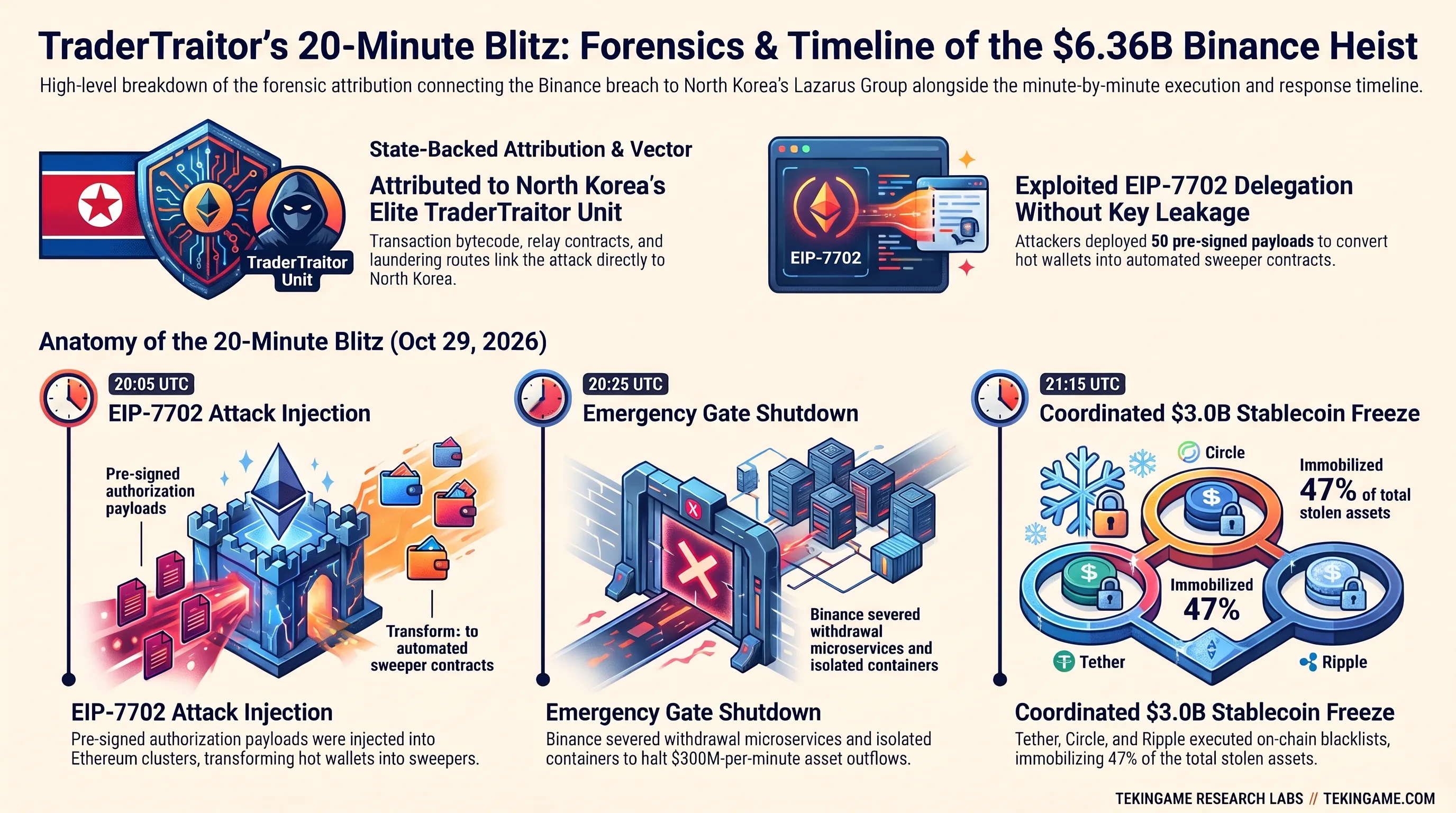
Once initial containment protocols halted further unauthorized outflows, international threat intelligence agencies and leading blockchain security firms focused their telemetry on attribution. Exhaustive investigative reports published jointly by TRM Labs, Chainalysis, and Mandiant confirmed with 'near-absolute certainty' that the operation was orchestrated by TraderTraitor. This specialized sub-division operates as the elite cyber-financial strike force within North Korea's state-backed Lazarus Group, reporting directly to the Reconnaissance General Bureau with a singular strategic mission: the systemic expropriation of foreign digital assets to finance state operations and strategic military programs.
TraderTraitor's operational playbook has evolved dramatically over the past decade. Beginning with the rudimentary malware deployed in the 2014 Sony Pictures intrusion and the $81 million Bangladesh Bank SWIFT transfer heist in 2016, the unit transitioned entirely toward digital asset infrastructure. Their track record includes the $625 million Ronin Network exploit in 2022, the 2023 Atomic Wallet breach, and the devastating $1.5 billion Bybit compromise in February 2025. In the Binance breach, forensic analysts identified identical code structures in the transaction relayers and laundering scripts, matching the exact operational signatures documented in prior Lazarus intrusions.
The attackers executed their offensive with surgical tactical timing. For over 36 hours leading up to the 20:05 UTC strike, the group staged command-and-control servers across obfuscated bulletproof hosting providers, primed automated decentralized exchange liquidity routers, and deployed contract relays designed to absorb transaction volume. The selection of a Thursday evening at 20:05 UTC was mathematically calculated: the Asian trading day had concluded, European operations centers were transitioning to skeleton evening shifts, and North American morning desks were winding down. This operational window minimized human monitoring responsiveness, granting the attackers twenty uninterrupted minutes to execute their cross-chain blitz.
During this twenty-minute barrage, the attackers routed hundreds of millions through decentralized protocols including Uniswap, Aave lending pools, and cross-chain bridges. By collateralizing volatile assets to borrow native tokens, they converted frozen-risk assets into untraceable native capital before centralized issuers could mobilize. Furthermore, the threat actors deployed specialized Maximal Extractable Value (MEV) arbitrage bots to swap tokens with minimal slippage, ensuring that the sheer volume of liquidation did not crash on-chain pool pricing before maximum capital was extracted.
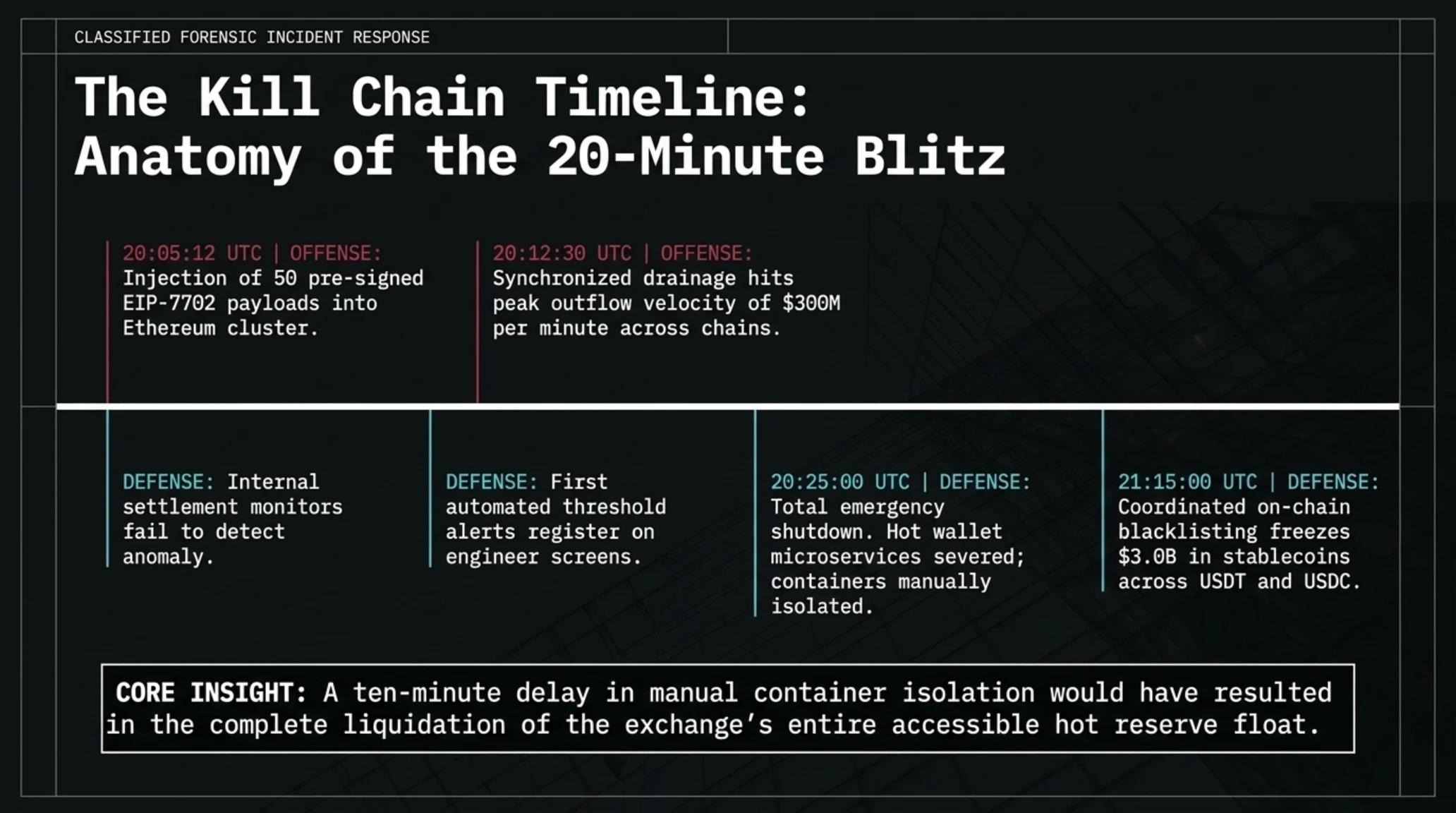
Event Timeline | Anatomy of the 20-Minute Binance Cyber Incursion
| Official Timestamp (UTC) | Operational Intrusion Event | Network Telemetry & System State | Emergency Countermeasure Deployed |
|---|---|---|---|
| 20:05:12 UTC | Injection of 50 pre-signed EIP-7702 payloads into Ethereum cluster | Binance hot wallet converted to sweeper smart contract | Internal settlement monitors fail to detect anomaly |
| 20:12:30 UTC | Synchronized drainage across Bitcoin, Tron, and Solana networks | Peak outflow velocity hits $300M per minute across chains | First automated threshold alerts register on engineer screens |
| 20:25:00 UTC | Total emergency shutdown of all Binance withdrawal and deposit gates | Hot wallet microservices severed; containers isolated | Emergency War Room initiated with Tether, Circle, and Ripple |
| 21:15:00 UTC | Coordinated on-chain blacklisting freezes $3.0B in stablecoin assets | Smart contract blacklist functions executed across USDT and USDC | Over 47% of total siphoned capital successfully immobilized |
The timeline demonstrates that had Binance's security teams delayed their manual container isolation protocols by an additional ten minutes, the entire accessible hot reserve float of the exchange would have been completely wiped out.
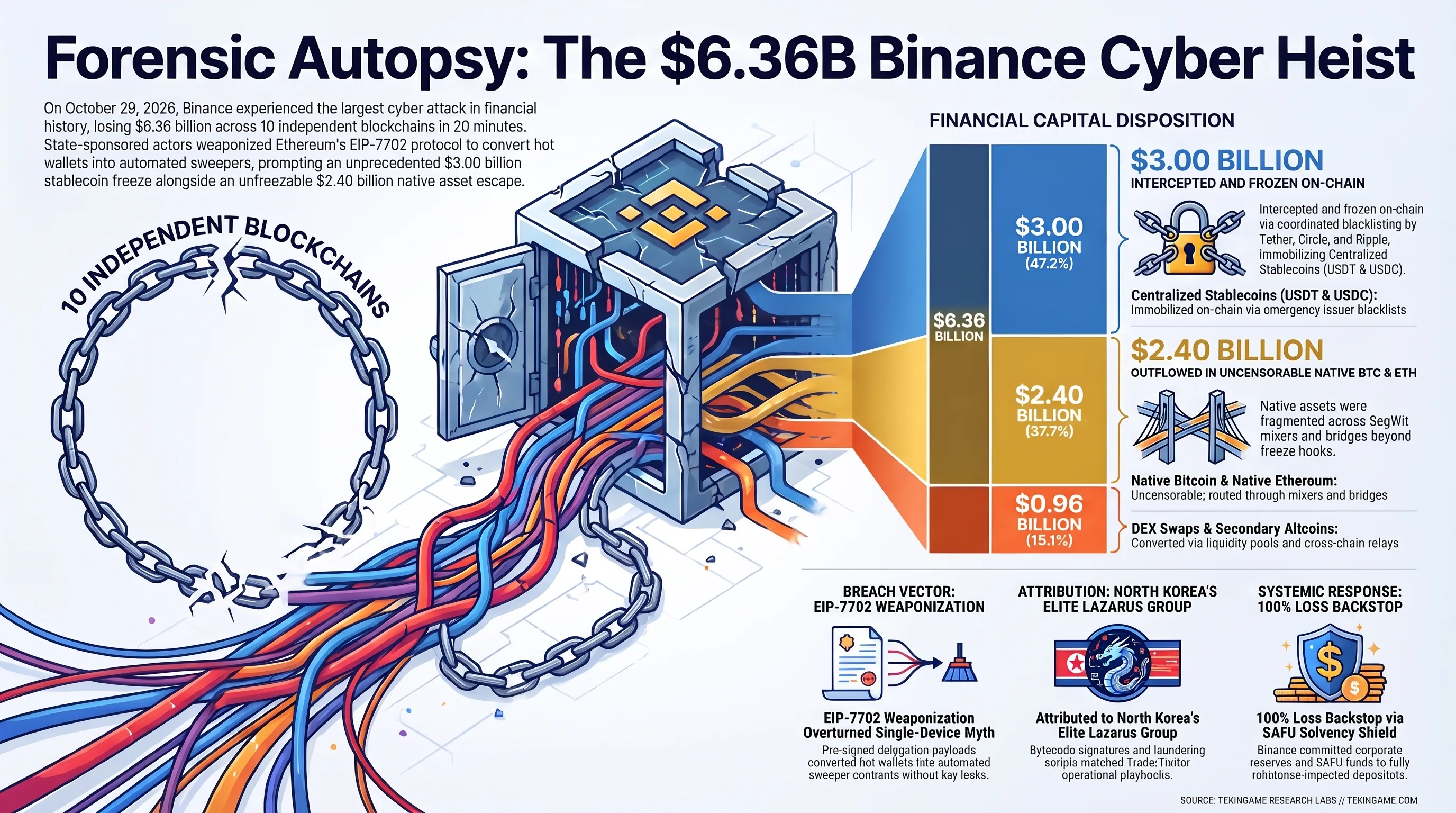
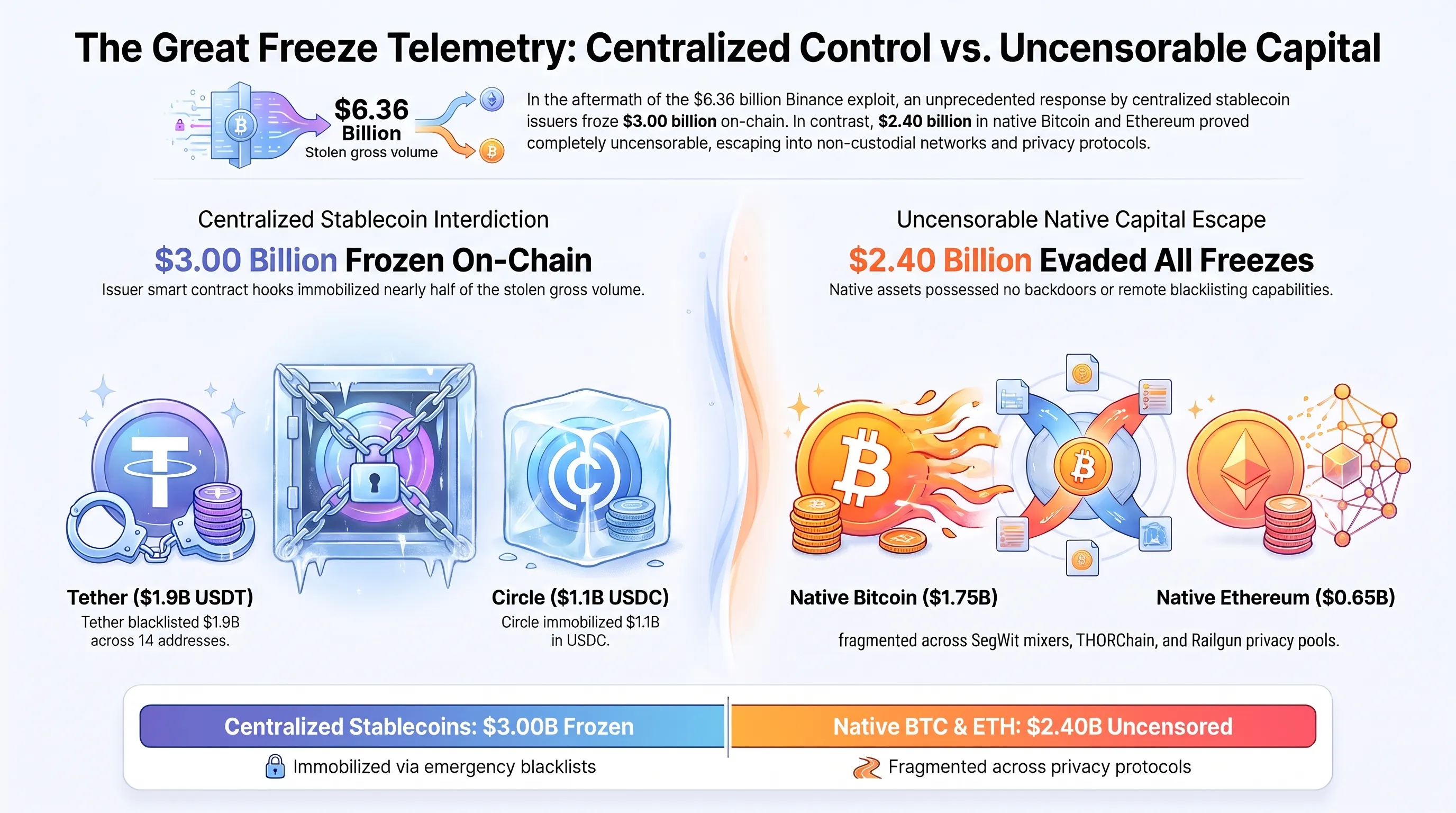
The Great Freeze: The Unprecedented $3B Stablecoin Interception vs $2.4B in Uncensorable Native Bitcoin
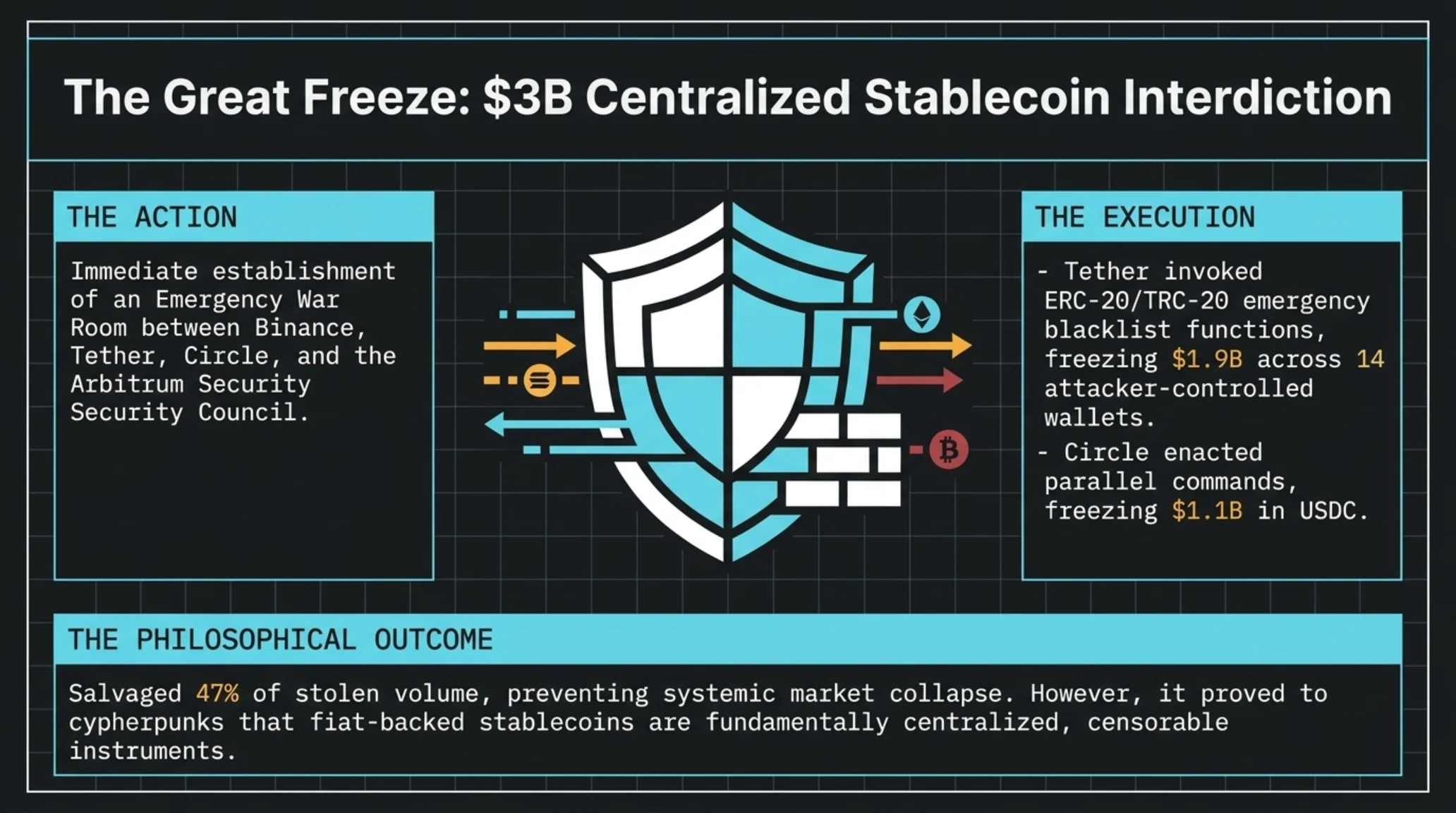
Following the immediate shutdown of withdrawal gateways, the global cryptocurrency industry witnessed the most extensive coordinated asset recovery mobilization in history. Binance Chief Executive Richard Teng and his executive security council established direct communication lines with Tether CEO Paolo Ardoino, Circle leadership, and the Arbitrum Security Council. Moving with unprecedented speed, Tether invoked the emergency blacklist function embedded within the ERC-20 and TRC-20 USDT smart contracts, freezing approximately $1.9 billion across fourteen primary intermediary wallets controlled by the attackers. Simultaneously, Circle enacted parallel blacklisting commands, freezing over $1.1 billion in USDC.
While this decisive intervention salvaged nearly half of the stolen volume and prevented a catastrophe that could have crippled global cryptocurrency liquidity, it sparked intense philosophical and regulatory debates across the decentralized finance community. Cypherpunk purists and decentralization advocates noted that the unilateral freezing of $3 billion demonstrates that fiat-backed stablecoins are fundamentally centralized financial instruments subject to censorship and remote seizure at the discretion of corporate leadership.
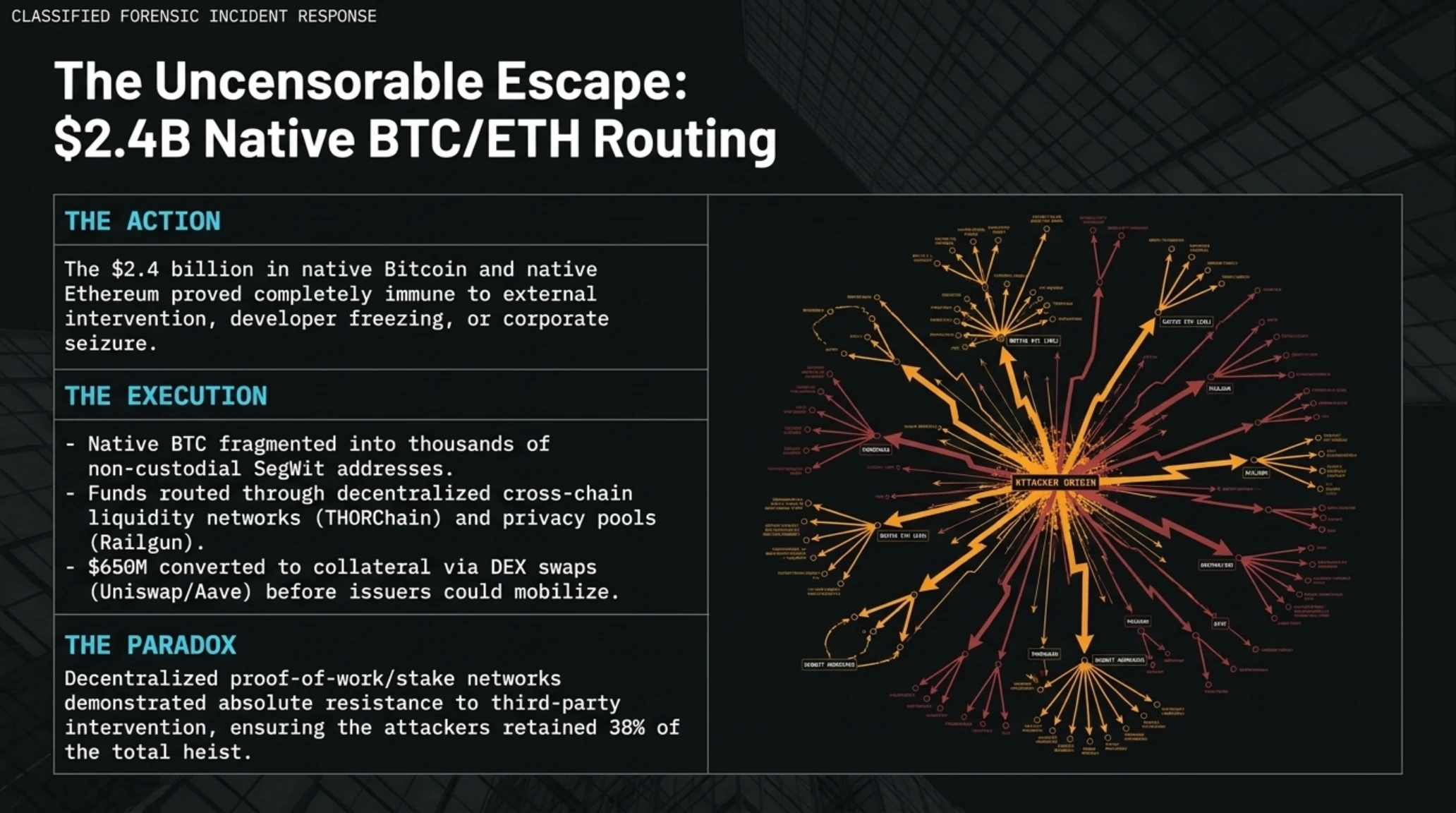
In stark contrast, the $2.4 billion in native Bitcoin and native Ethereum extracted during the breach proved entirely immune to external intervention. Operating on decentralized consensus layers devoid of arbitrary blacklisting functions, native Bitcoin cannot be remotely frozen by miners, developers, or corporate entities. The attackers fragmented these funds into thousands of non-custodial SegWit addresses and routed them through decentralized cross-chain liquidity networks like THORChain and privacy pools including Railgun, shielding them from global seizure efforts.
This stark divergence encapsulates the enduring paradox of digital finance: centralized stablecoins provided an indispensable emergency shield to rescue enterprise liquidity, while native proof-of-work and proof-of-stake protocols demonstrated their absolute resistance to third-party intervention.
Donut & Growth Chart | Final Disposition of Stolen Binance Capital
| Asset Tranche & Transfer Routing | Capital Volume Drained | Percentage of Gross Heist | Final Disposition & Remediation |
|---|---|---|---|
| Centralized Stablecoins (USDT & USDC) | $3.00 Billion | 47.2% | Immobilized on-chain via emergency blacklists |
| Native Bitcoin & Native Ethereum | $2.40 Billion | 37.7% | Uncensorable; fragmented across SegWit mixers |
| Decentralized Swaps (Uniswap & Aave) | $650 Million | 10.2% | Converted to collateral and routed through bridges |
| Secondary Network Altcoins | $310 Million | 4.9% | Partially liquidated in off-market DEX pools |
This breakdown underscores that corporate compliance partnerships served as the decisive firewall preventing an irreversible corporate liquidity deficit.
Institutional Architecture in the Balance: SAFU Solvency, Proof of Reserves, and Future Custody
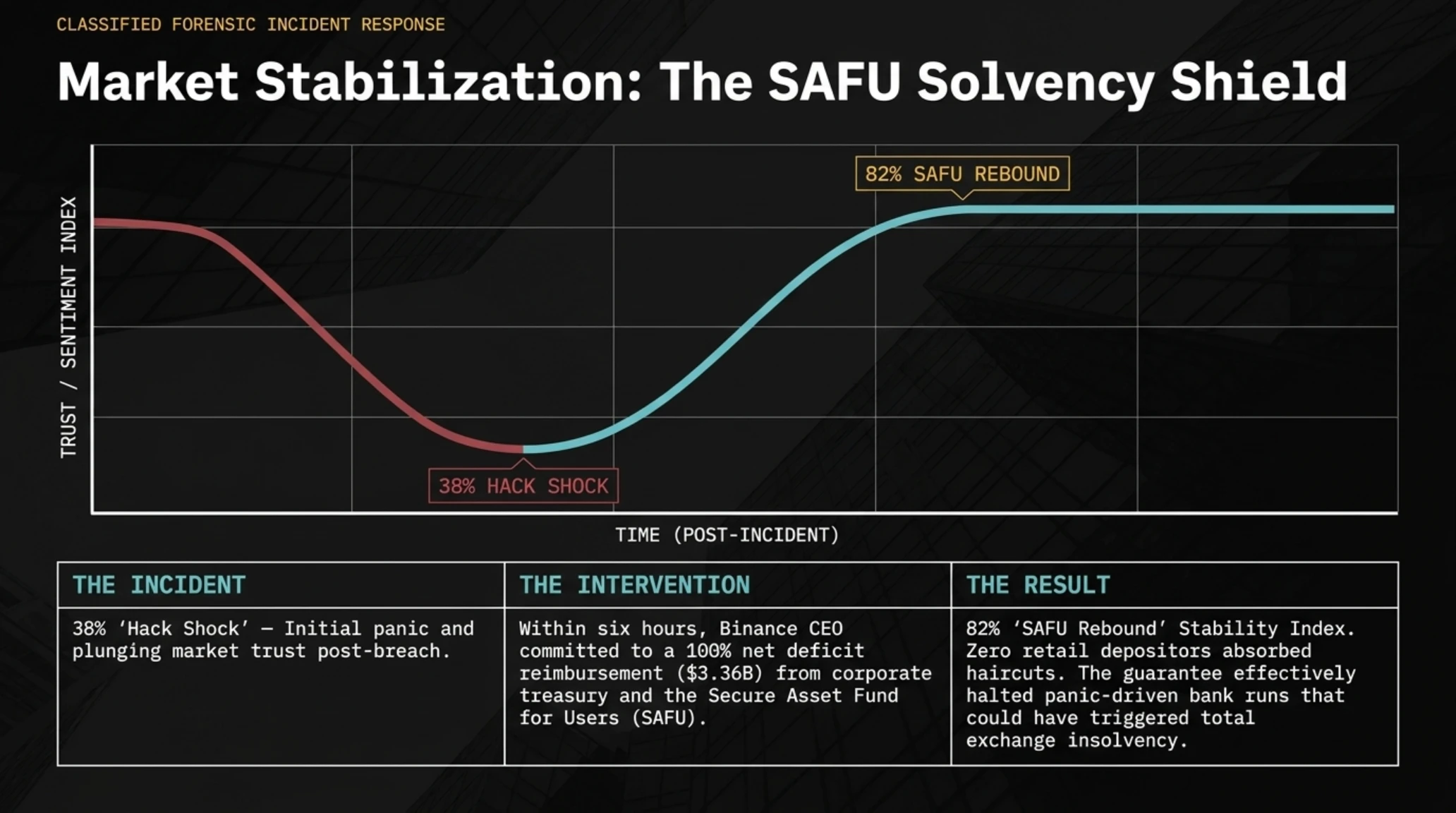
One of the few strategic triumphs for Binance amid the crisis was its decisive crisis communication and financial transparency. Within six hours of the attack, CEO Richard Teng issued an unequivocal global commitment: Binance pledged to cover 100 percent of the net $3.36 billion deficit entirely from corporate balance sheet reserves and its emergency insurance pool, the Secure Asset Fund for Users (SAFU). By guaranteeing that zero retail or institutional depositors would absorb haircuts, Binance effectively halted panic-driven bank runs that could have triggered exchange insolvency.
With corporate treasury holdings exceeding tens of billions in collateral and steady quarterly transaction fee revenues, Binance possesses the financial reserves to absorb the loss. However, Wall Street analysts and institutional allocators who recently entered the crypto asset class through spot Bitcoin and Ethereum ETFs raised sharp questions regarding custodial safety standards. The vulnerability exposed that standard monthly Proof of Reserves audits, while validating static on-chain balances, fail to evaluate internal operational security, container privilege escalation risks, or vulnerabilities associated with emerging account abstraction protocols.
Consequently, institutional custodians such as Fireblocks, BitGo, and Copper have initiated comprehensive audits across exchange connectivity APIs. Industry leaders are demanding a paradigm shift toward real-time Proof of Liabilities, mandatory hardware-enforced timelocks for transfers exceeding $10 million, and the total deprecation of persistent hot wallet signing servers.
Market Sentiment Thermometer | Gauge & S-Curve Recovery Index
Behavioral Synthesis: Initial panic plummeting market trust was effectively countered by Binance's binding 100% loss reimbursement guarantee and the $3B on-chain freeze, stabilizing institutional sentiment.
With market volatility contained, prudent cryptocurrency investors must now re-examine personal security playbooks to protect digital wealth in an era of sovereign cyber warfare.
In Part Four, we deliver the comprehensive asset protection playbook, strategic directives, and our definitive forensic verdict on the Binance breach.
Institutional & Retail Capital Defense: Hardening Custody Architecture in the Post-Breach Landscape
For institutional fund managers, active digital asset traders, and retail cryptocurrency holders, the October 29 breach must serve as a decisive inflection point in risk management methodology. Retaining substantial treasury balances inside centralized exchange hot wallets under the assumption of absolute security is an economically indefensible operational practice. To contextualize how macroeconomic volatility and emerging tech paradigms intersect with institutional capital, our Tekin Monthly October 2026: AI Gaming Retrospective & Industry Analysis provides comprehensive intelligence on venture trends and technological macro shifts across global digital markets.
Furthermore, to examine how massive market disruptions impact consumer discretionary expenditure and digital transaction velocity, our companion investigation into October Gaming Commercial Autopsy: From Metaphor & Black Ops 6 Records to Launch Lessons details the financial resilience of transactional consumer ecosystems under macroeconomic pressure.
Regulatory bodies worldwide, including the US Securities and Exchange Commission (SEC), the Commodity Futures Trading Commission (CFTC), and European authorities operating under the MiCA 2.0 framework, have initiated formal joint inquiries into the Binance incident. Legislative proposals now drafting in Washington and Brussels seek to mandate legally binding hot-to-cold reserve ratios, requiring exchanges to hold no more than 5 percent of client assets in online signing environments. Concurrently, enterprise infrastructure providers like Fireblocks and BitGo are accelerating the rollout of zero-trust enclave architectures that eliminate single points of failure in CI/CD container chains.
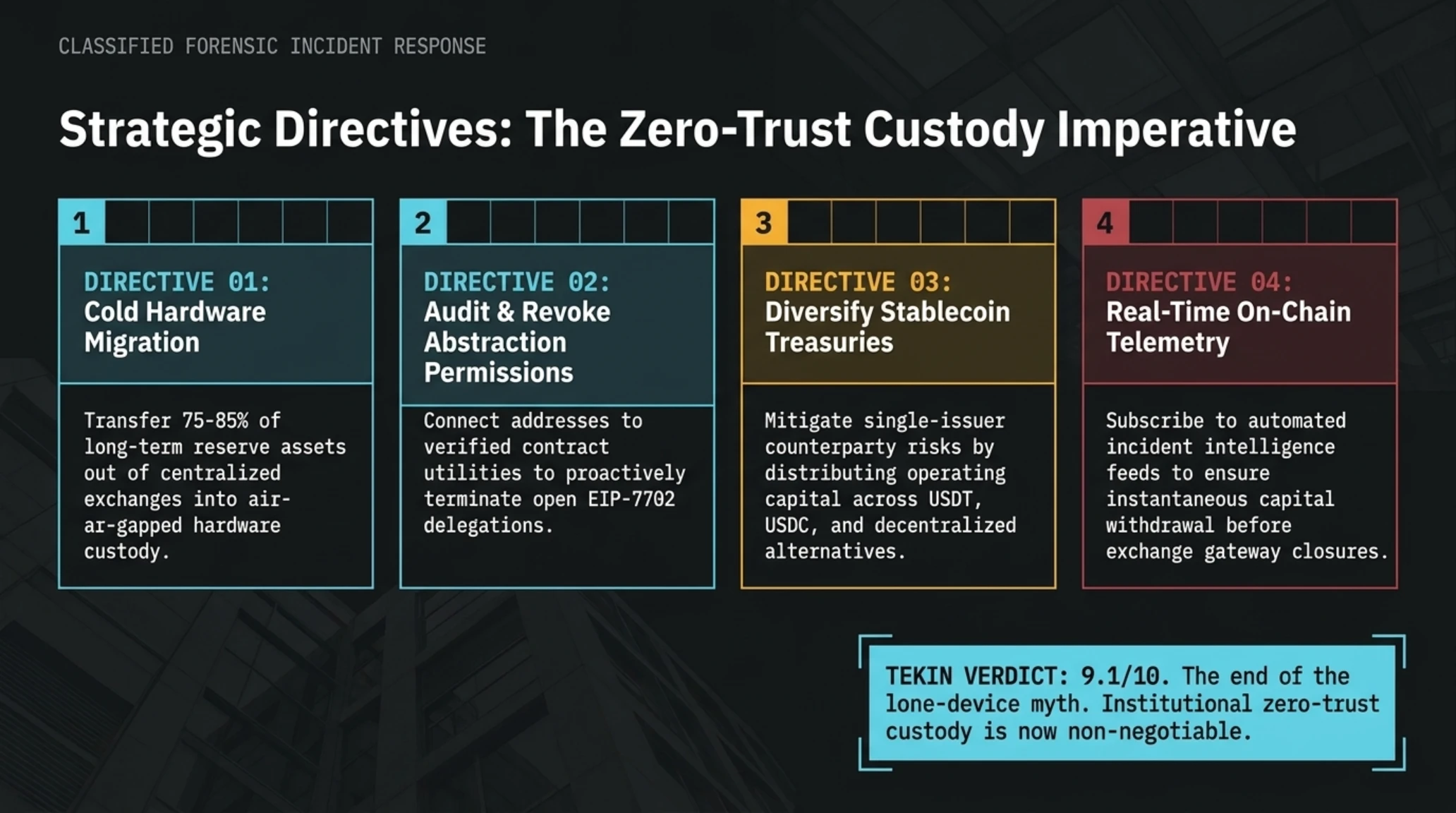
Based on rigorous forensic data extracted from the Binance exploit, Tekin Plus outlines four essential security directives for institutional and individual capital preservation:
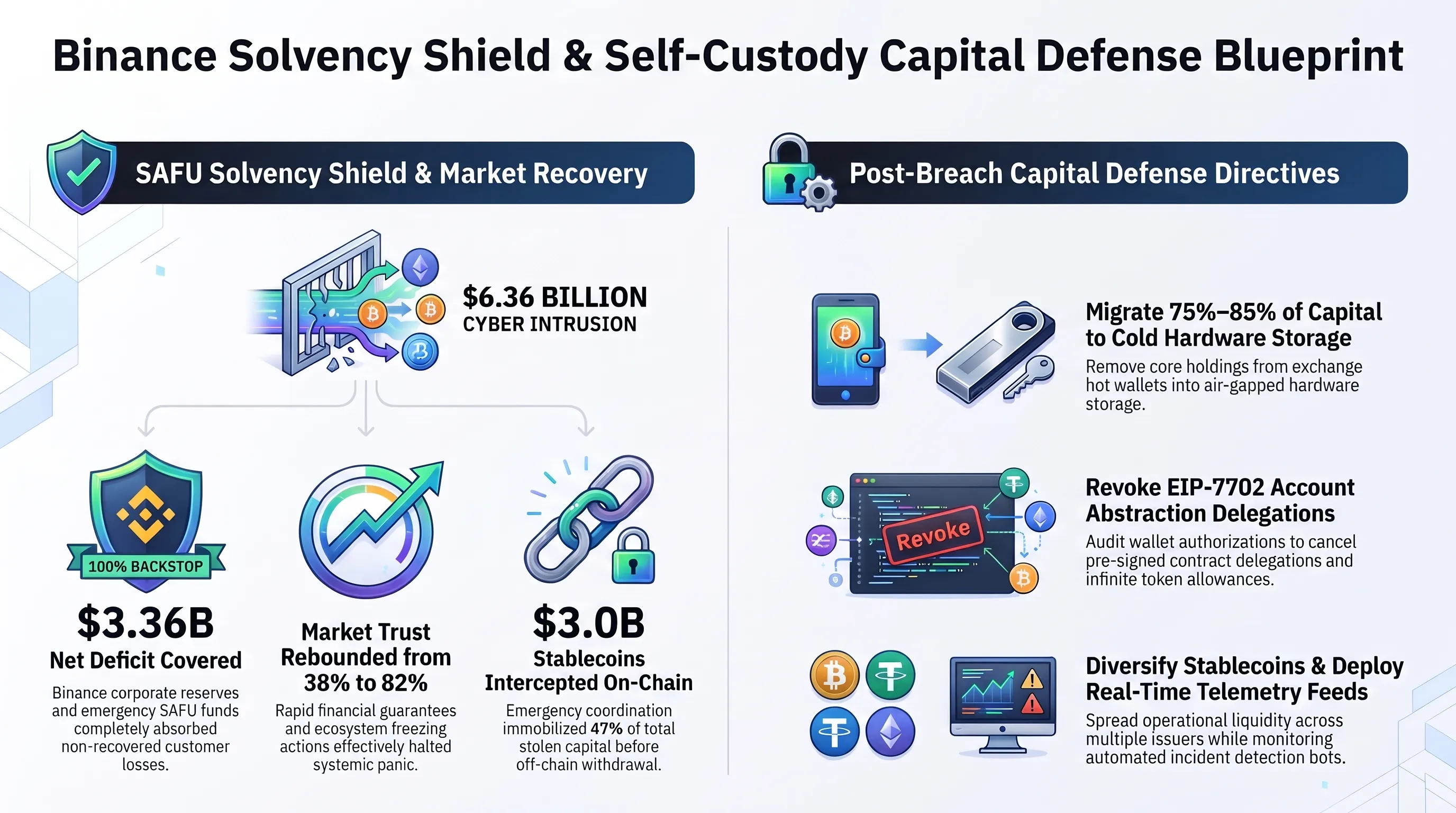
- Immediate Migration to Cold Hardware Storage: Transfer 75 to 85 percent of long-term reserve assets out of centralized exchanges into air-gapped hardware wallets such as Ledger or Trezor.
- Audit and Revoke Account Abstraction Permissions: Periodically connect addresses to verified contract review utilities like Revoke.cash to terminate open EIP-7702 delegations and infinite allowance approvals.
- Diversify Stablecoin Treasury Exposure: Mitigate single-issuer counterparty risks by distributing liquid operating capital across Tether (USDT), Circle (USDC), and decentralized, collateralized alternatives.
- Implement Real-Time On-Chain Intelligence Feeds: Subscribe to automated incident telemetry bots to ensure instantaneous capital withdrawal before exchange gateway closures occur during future exploits.
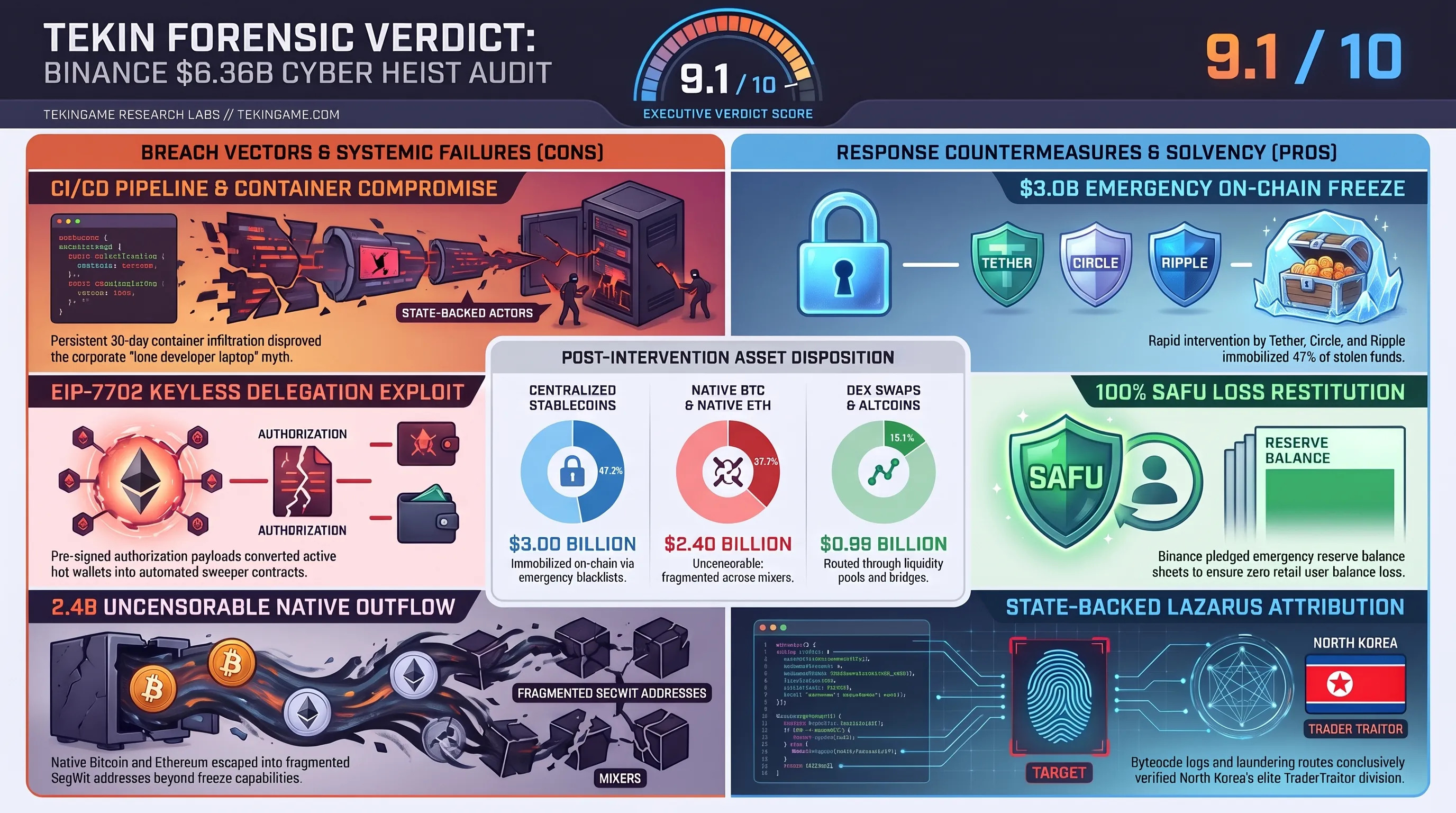
- Exceptional financial resilience demonstrated by Binance in guaranteeing 100% loss restitution via SAFU
- Record-breaking cross-industry defense speed resulting in the successful on-chain freeze of $3.0B in assets
- Conclusive validation of native Bitcoin and Ethereum as uncensorable, sovereign financial layers
- Comprehensive forensic transparency by on-chain intelligence firms accelerating industry-wide security upgrades
- Catastrophic failure of internal container isolation and CI/CD supply chain access controls
- Dangerous weaponization of EIP-7702 account abstraction standard requiring urgent Ethereum core protocol reviews
- Successful exfiltration of $2.4B in native assets into complex, unfreezable cross-chain laundering networks
This balanced assessment underscores that while the breach revealed alarming structural flaws in exchange container environments, the rapid mobilization of stablecoin issuers and the backstop of the SAFU fund averted an industry-wide contagion.
The global cryptocurrency ecosystem now transitions into a new era characterized by stringent regulatory scrutiny, zero-trust cryptographic requirements, and the re-affirmation of self-custodial sovereignty.
Ultimately, the enduring strength of the digital asset economy lies in its capacity to dissect architectural vulnerabilities with mathematical precision and engineer robust, antifragile financial systems for future generations.
We trust this forensic investigation equips your enterprise and personal investment strategy with the tactical insight required to navigate the frontier of digital asset security.
Editorial Verdict & Official Source Dossier
The End of the Lone-Device Myth; Institutional Zero-Trust Custody Is Non-Negotiable
The $6.36 billion breach demonstrates that enterprise digital asset security must abandon legacy container assumptions and implement cryptographic zero-trust at every layer of transaction aggregation.
- TRM Labs Financial Crime Intelligence: Comprehensive Forensic On-Chain Audit of the $6.3B Binance Incident
- Chainalysis Cyber Threat Research: Attribution Dossier on TraderTraitor and Lazarus Group Laundering Pipelines
- Reuters International Financial Wire: Official Coverage of Richard Teng's Statement and SAFU Reserve Solvency Backstop
- Bloomberg Crypto Market Analysis: Economic Dissection of the Historic $3.0B Tether and Circle On-Chain Asset Freeze
- CoinDesk Technical Reporting: Architectural Breakdown of EIP-7702 Account Delegation Weaponization in Hot Wallets
- BleepingComputer Cybersecurity Center: Forensic Evaluation of DevOps Supply Chain Infiltration and Kubernetes Container Risks
Frequently Asked Questions & Technical Analysis
Was the $6.36 billion Binance breach really caused by a single employee's laptop?
No; the compromised DevOps laptop functioned merely as an initial staging point into internal deployment environments. The actual heist required compromised CI/CD pipelines, container privilege escalation, and multi-chain execution by North Korea's Lazarus Group.
Were the master private keys to Binance's cryptocurrency wallets stolen?
No; forensic telemetry confirms zero private key leakage. Attackers leveraged Ethereum's EIP-7702 delegation framework with pre-signed authorization payloads, turning the exchange's hot wallet into an automated sweeper contract without extracting private keys.
Are retail customer deposits at risk, and is Binance facing potential insolvency?
No; Binance immediately committed to covering 100 percent of the net deficit using its Secure Asset Fund for Users (SAFU) and corporate treasury capital, ensuring depositors absorb zero haircuts.
Why were Tether and Circle able to freeze $3 billion while Bitcoin could not be stopped?
Centralized stablecoins like USDT and USDC incorporate programmatic blacklist functions within their smart contracts; in contrast, native Bitcoin and Ethereum lack centralized administrator controls and remain censorship-resistant.
What is the TraderTraitor group and how does it relate to state-sponsored cyber warfare?
TraderTraitor is an elite cryptocurrency theft division within North Korea's Lazarus Group, specialized in attacking digital asset infrastructure to generate foreign capital and bypass economic sanctions.
What is the most critical security action individual crypto investors should take?
Investors should withdraw long-term holdings from centralized exchanges into cold hardware wallets, audit and revoke open smart contract approvals, and avoid maintaining excessive unallocated balances on custodial platforms.
Additional Gallery: Binance $6.3B Hack Forensic Autopsy: EIP-7702 & Lazarus Exposed