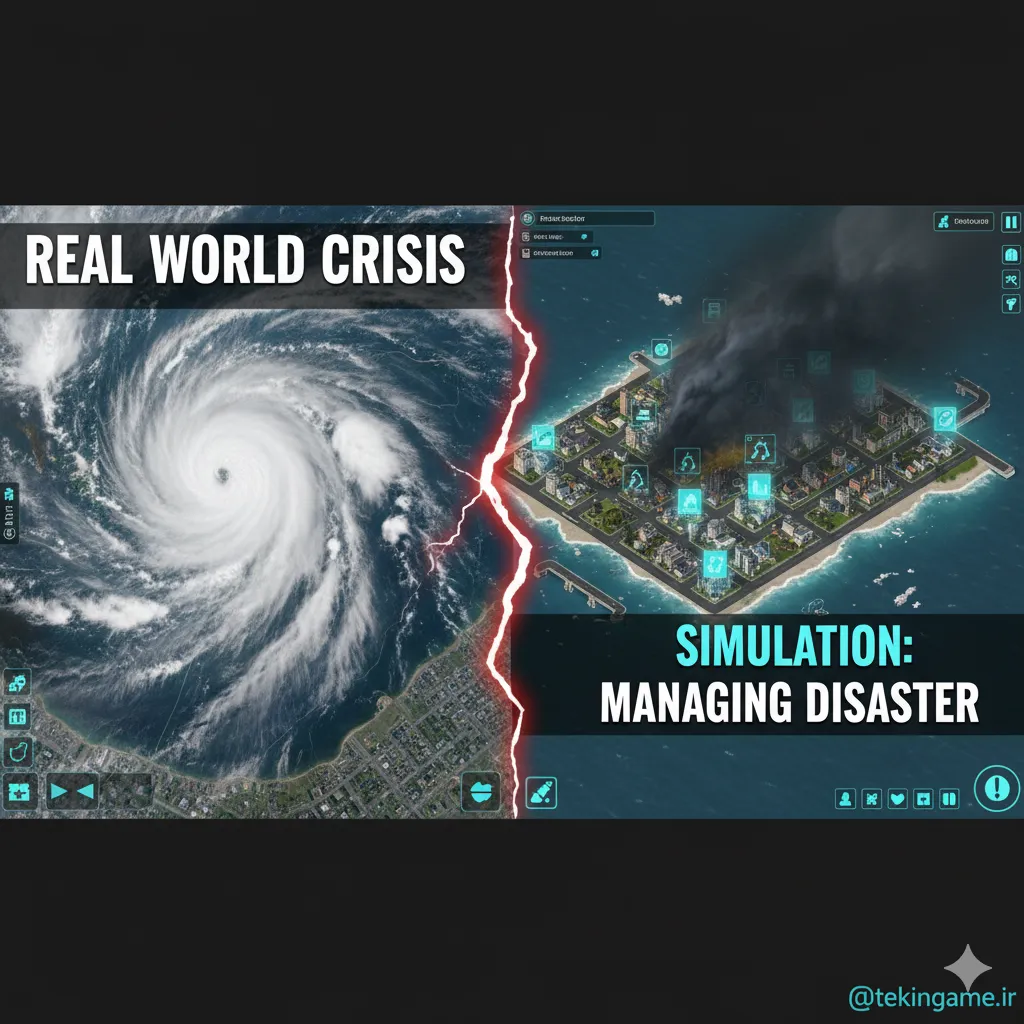
Strategy games, grand geopolitical simulations, and military wargames have long transcended the perimeter of digital leisure. They function as the most sophisticated computational laboratories on Earth for modeling planetary futures, testing international crisis governance, and internalizing the axioms of Complex Systems Theory. From the nineteenth-century Prussian Kriegsspiel tables that revolutionized modern military general staffs to monumental digital frameworks like Victoria 3, Civilization, Terra Invicta, and NATO simulation environments, interactive rule-sets allow thinkers, statesmen, economists, and discerning gamers to stress-test the second- and third-order consequences of climate disruption, supply-chain fractures, hybrid warfare, and acute resource depletion within zero-risk sandboxes. In this exhaustive foundational investigation conducted at the
TekinGame Technical Media Laboratory, we explore how strategy gaming operates as a democratic forecasting simulator, rewiring the human mind to navigate the systemic turbulence of the twenty-first century.
The existential necessity of strategy simulations stems from a biological vulnerability in human cognition: the human brain is evolutionarily hardwired for linear, immediate cause-and-effect reasoning. In planetary ecosystems, macroeconomic systems, and geopolitical arenas, however, dynamics are ruthlessly non-linear, delayed, and emergent. A policy enacted to subsidize domestic agricultural staples may induce fiscal hyperinflation or ecological collapse a decade later. Strategy games provide a mathematical mirror that renders visible the hidden friction, feedback loops, and structural inertia governing human civilization.
⚡Strategic Forecasting Metrics: The Power of Interactive Simulation
TEKIN HUD◈ Global Think-Tank Wargaming Penetration
Over 82% of premier strategic institutes (RAND, CSIS, RUSI) deploy simulation engines for scenario planning
◈ Computational State Tracking in Grand Strategy
Simultaneous real-time calculation of over 50,000 demographic, fiscal, and ecological variables per tick
◈ Cognitive Systems-Thinking Enhancement
Documented 35% improvement in multi-variable problem-solving among dedicated 4X and strategy gamers
◈ Planetary Boundary & Climate Modeling
High-fidelity simulation of ocean acidification, topsoil exhaustion, and global energy transition dynamics
TekinGame Sovereign Intelligence defines strategy gaming not as trivial pastime, but as the premier cognitive engine for civilizational foresight.
## Section 1: The Genealogy of Wargaming: From Prussian Kriegsspiel to Silicon Chips
The historical lineage of modern strategic simulations began in 1812, when Prussian military officer Georg Leopold von Reiswitz codify the revolutionary tabletop simulation Kriegsspiel. Prussian commanders recognized a fatal strategic paradox: training general officers exclusively on active battlefields cost the lives of thousands of conscripts and risked national annihilation. By translating terrain elevation, troop logistics, weapon ballistics, and tactical uncertainty onto scaled topography tables governed by mathematical dice rolls and neutral umpires, Prussia birthed the institutional military general staff.
With the advent of silicon microprocessors and computational graphics in the late twentieth century, analog wargames migrated into interactive software. Studios like Paradox Interactive and Sid Meier's Firaxis Games encoded the principles of historical materialism, international relations, and demographic pressure into sweeping titles such as Hearts of Iron, Europa Universalis, and Civilization. Within these synthetic universes, players operate not as localized battlefield tacticians, but as holistic civilizational custodians arbitrating gross domestic product, technological research arcs, trade tariffs, and social cohesion.
This digital evolution permanently dispelled the hubris of top-down command. In a grand strategy environment, authoritarian fiat routinely backfires; decreeing economic modernization without agrarian surplus triggers catastrophic famine, while unchecked military expansion incites broad balancing coalitions among nervous neighbors. The simulation forces the player to cultivate strategic humility and dynamic adaptability.
Crucially, digital strategy games simulate what Carl von Clausewitz termed 'Friction'—the accumulation of countless minor impediments, communication delays, bad weather, and bureaucratic incompetence that distinguishes real war from paper theory. By integrating attrition mechanics, supply-line degradation over extended distances, and localized command-and-control lag, modern digital engines force players to confront the severe limits of central planning. Mastery in grand strategy is not measured by the perfection of an initial blueprint, but by the operational elasticity to reallocate scarce reserves when friction shatters the opening gambit.
"
A wargame does not exist to predict the exact date of a future war; it exists to inoculate leaders against intellectual dogmatism, cultivating cognitive resilience when chaos descends.
Peter P. Perla - Senior Analyst at the Center for Naval Analyses and Author of The Art of Wargaming
## Section 2: Complex Systems Theory: The Living Mathematics of Economy and Society
The crowning computational triumph of contemporary grand strategy lies in its practical embodiment of Complex Systems Theory. In economic masterworks like Victoria 3, the global marketplace is not an arbitrary abstraction, but an emergent equilibrium computed from the granular supply and demand of fundamental commodities: coal, sulfur, grain, steel, and industrial machinery. If a player implements artificial price ceilings on staple foods to pacify urban unrest, domestic agricultural estates plunge into insolvency, farmers desert the fields, and a cascading nationwide famine paralyzes industrial output.
These delicate interlocking dependencies reveal why simplistic political dogmas inevitably collapse when confronted with real-world governance. Economic networks possess structural phase lags, negative stabilization feedback, and runaway positive reinforcement loops. Grand strategy titles serve as pedagogical simulators that illuminate the true, unvarnished systemic costs of ideological policymaking.
Similarly, the foundational 4X loop (eXplore, eXpand, eXploit, eXterminate) demonstrates that scientific innovation is inseparable from societal hierarchy. The discovery of gunpowder, the mechanical printing press, or semiconductor fabrication does not simply upgrade combat statistics; it irrevocably restructures domestic class power, decentralizes information gatekeeping, and rewrites the geopolitical balance of power across continents.
Moreover, strategy games operate as live sandboxes for Stafford Beer's viable system model and second-order cybernetics. When managing an empire across centuries, the player confronts the fundamental law of requisite variety: to successfully regulate an unpredictable, volatile external environment, an administration's internal control mechanisms must possess equal variety and complexity. Players who attempt to govern sprawling continental confederations using crude, monolithic decrees rapidly succumb to bureaucratic sclerosis, administrative corruption, and secessionist rebellions. Through relentless iterations of institutional trial and error, the gamer internalizes that sustainable governance demands decentralized autonomic sub-systems, transparent feedback telemetry, and calibrated institutional subsidiarity.
⭐Four Systemic Lessons Grand Strategy Imparts on Policy Thinking
TEKIN HUD◈ Non-Linear Feedback Cascades
Recognizing how localized administrative decisions trigger planetary economic shockwaves
◈ The Brutal Reality of Opportunity Cost
Every sovereign dollar directed toward military expansion is irrevocably subtracted from public health and basic research
◈ Civilizational Structural Inertia
Reorienting a nation's energetic or demographic trajectory requires decades of sustained institutional discipline
◈ Supply Chain Chokepoint Vulnerability
Over-reliance on singular geographic maritime transit corridors creates critical strategic fragility
Strategy simulations serve as empirical training grounds for navigating the systemic realities governing long-term civilizational survival.
## Section 3: Climate Disruption and Planetary Boundaries: From Frostpunk to Terra Invicta
Over the past decade, the strategy genre has engaged with existential environmental boundaries with unprecedented intellectual rigor. 11 bit studios' Frostpunk thrusts the player into an apocalyptic volcanic winter where the survival of humanity's final city hinges upon thermal distribution and ruthless coal thermodynamics. In this harrowing crucible, players confront gut-wrenching ethical trade-offs: do you mandate child labor in freezing coal mines to ensure the generator never extinguishes, or do you risk total societal freezing to preserve moral innocence?
Concurrently, the extraordinarily detailed grand strategy title Terra Invicta simulates planetary climate change, atmospheric greenhouse concentrations, ocean thermal inertia, and orbital logistics from 2022 to 2100 with peer-reviewed scientific accuracy. Players witness firsthand how foot-dragging on decarbonization unleashes agricultural collapse, hyper-hurricanes, and regional conflicts over freshwater basins across developing equatorial territories.
These masterpieces transform abstract statistical warnings into visceral systemic emergencies. When a gamer spends six hours engineering delicate energy grids to avoid planetary tipping points, the sheer complexity of decarbonization transitions from remote political rhetoric into a lived, urgent reality.
Furthermore, these environmental strategy titles illustrate the terrifying reality of runaway positive feedback loops in planetary ecology. When rising sea surface temperatures melt Arctic permafrost, unleashing gigatons of sequestered subterranean methane into the upper atmosphere, the planetary heat engine accelerates beyond human intervention. By giving players granular computational dashboards tracking planetary albedo, carbon sequestration capacity, and biodiversity loss, strategy games cultivate an intuitive grasp of ecological tipping points that static academic whitepapers simply cannot replicate.
🎧
شورای نظارت فنی و محتوایی تکین گیم // TekinGame Sovereign Council
نکته تحریریه تکین پلاس // Tekin Plus Editorial Note
TekinGame Philosophical Analysis: Frostpunk and Terra Invicta are not games; they are existential triage chambers. They remind players that civilizational survival is separated from barbarism by merely a few degrees Celsius and a precarious stockpile of fuel.
## Section 4: Factorio and Logistics Engineering: The Skeletal Architecture of Modernity
In our modern world, no civilization survives more than seventy-two hours without functioning supply chain logistics. Automation simulators like Factorio and the Anno series expose this foundational vulnerability. In Factorio, the player starts with a manual pickaxe and constructs an sprawling, automated industrial sprawl consisting of thousands of interconnected conveyor belts, high-speed rail networks, logic gates, and chemical cracking plants.
These games train the cognitive faculties in the Theory of Constraints and bottleneck eradication. A minor shortfall in petroleum refining or raw copper mining ripples down the entire assembly line, halting munitions production and leaving the base defenseless against hostile alien incursions. This dynamic mirrors the fragility exposed during the Suez Canal blockage and modern semiconductor shortages: the global economy is an immense, hyper-connected logistical engine where single component deficits paralyze international trade.
Visionary industrial leaders, including Elon Musk, have publicly celebrated the rigorous cognitive discipline instilled by deep strategy titles like Factorio and Polytopia, citing them as masterclasses in high-velocity factory layout, manufacturing throughput, and operational efficiency.
Logistical simulations also immerse players in the rigorous mathematical disciplines of queueing theory and Little's Law. In Factorio and Anno 1800, expanding downstream production without systematically widening intermediate transit throughput creates massive line starvation and inventory bloat. Gamers learn to calculate material velocity, construct balanced buffer reserves, and design modular branch lines that prevent localized train collisions from deadlocking an entire continental rail network. These spatial optimization reflexes represent identical cognitive assets required to modernize international container ports and semiconductor cleanrooms.
⚡Cognitive Engineering Capabilities Instilled by Logistics Simulators
TEKIN HUD◈ Theory of Constraints Mastery
Forensically isolating the singular slowest sub-assembly governing total systemic throughput
◈ Just-in-Time Systemic Equilibrium
Balancing input velocity with downstream consumption to prevent capital stagnation
◈ Decentralized Fail-Safe Architecture
Engineering redundant supply loops and automated circuit breakers to insulate production from catastrophic halts
◈ Long-Term Energetic Scalability
Synchronizing industrial expansion with baseload power generation to avoid catastrophic blackouts
TekinGame Editorial recommends Factorio as mandatory curriculum for future industrial architects and global supply chain executives.
## Section 5: Algorithmic Geopolitics: AI Opponents from Cicero to AlphaStar
The convergence of deep artificial intelligence and strategy games has unlocked breathtaking new horizons. Meta's Cicero AI demonstrated the ability to master Diplomacy—a game completely devoid of dice rolls, where triumph requires verbal negotiation, psychological persuasion, trust cultivation, and strategic betrayal. Cicero conversed fluidly with human competitors, brokered multi-turn military alliances, and achieved top-tier performance against veteran human diplomats.
Simultaneously, Google DeepMind's AlphaStar demolished human world champions in StarCraft II by harmonizing micro-second tactical execution with macroscopic multi-base economic expansion. These historic milestones demonstrated that strategy games constitute the supreme benchmark for Artificial General Intelligence (AGI).
In the coming decades, sovereign security establishments will routinely deploy neural advisory suites trained across billions of simulated strategic encounters. Video games have become the definitive testbed where machine intelligence learns the subtle, high-stakes choreography of international relations and crisis de-escalation.
Beyond Cicero and AlphaStar, the deployment of Multi-Agent Reinforcement Learning (MARL) in military wargaming has exposed profound asymmetries between human doctrine and algorithmic optimization. In simulated aerial dogfights and naval chokepoint blockades, algorithmic entities routinely discover counter-intuitive tactical maneuvers that human instructors previously dismissed as unorthodox or hazardous. These machine-learning models optimize purely for objective survival and strategic objective realization, stripped of human emotional hesitation or prestige-driven obstinacy. Consequently, defense institutions and security think-tanks are transitioning from pre-scripted rulebooks toward dynamic, evolutionary training regimens where human commanders are continuously challenged by emergent, synthetic red-team adversaries.
"
If an artificial intelligence can navigate the immense combinatorial fog of a complex strategy game, that same intelligence is fundamentally equipped to optimize vaccine distribution, urban transit networks, and global renewable energy grids.
Sir Demis Hassabis - Nobel Laureate and CEO of Google DeepMind
## Section 6: Crisis Leadership and Decision-Making Under Fog of War
Among the rarest and most valuable leadership competencies in the twenty-first century is the ability to execute decisive action amidst the impenetrable 'Fog of War.' In real-time and turn-based strategy titles, information is perpetually incomplete, adversary intentions are masked, and time pressure is merciless. Leaders must gamble capital and personnel based on calculated probabilities and rational deduction.
This high-stress environment rigorously conditions the prefrontal cortex, training leaders to suppress cognitive panic and speculative greed. The player who maintains emotional equanimity during a devastating surprise flank, calmly gathers remaining reserves, and coordinates an asymmetric counter-offensive has forged psychological resilience directly applicable to corporate boardrooms and geopolitical statecraft.
In the modern information ecosystem, real-world executives frequently drown in telemetry while remaining fundamentally starved for operational clarity. Strategy games function as an indispensable cognitive filter, training the mind to isolate high-fidelity signal from ambient background noise. When dozens of territorial alerts, fiscal fluctuations, and diplomatic ultimatums flash across the screen simultaneously, the experienced strategist does not react impulsively to each stimulus. Instead, they classify events into systemic priority tiers: existential structural threats, transient operational friction, and irrelevant tactical distractions. This triage discipline directly mirrors the cognitive faculties demanded of crisis executives managing sudden hostile takeovers, geopolitical embargoes, or critical infrastructure blackouts.
9.5
Cognitive and Behavioral Dividend of Strategy GamingPROS
- Profound enhancement of spatial reasoning, macro-systemic awareness, and multi-variable synthesis
- Mitigation of cognitive biases including temporal myopia, ungrounded optimism, and reactive panic
- Advanced multi-step tactical anticipation and mental chess modeling applicable to complex negotiations
- Hardened emotional resilience and accelerated post-catastrophe recovery under acute operational stress
CONS
- Risk of cognitive detachment and over-rationalization that undervalues human emotional nuance
- Immense time commitment required to complete comprehensive, high-fidelity grand strategy campaigns
## Section 7: The Democratization of Strategic Literacy: Civic Simulation for the Masses
Throughout modern history, strategic foresight was the exclusive preserve of aristocratic general staffs, corporate planning boards, and elite think-tanks like the RAND Corporation. Strategy games have dismantled this intellectual monopoly, democratizing strategic literacy for millions of engaged citizens worldwide. A motivated teenager who has navigated the fiscal balancing acts of Democracy 4 or Victoria 3 understands national debt, central bank interest rates, and structural inflation with deeper clarity than many elected politicians.
This widespread strategic literacy serves as a vital safeguard for modern democratic societies. Citizens educated on complex strategy games possess natural immunity to cheap populist rhetoric; they immediately deconstruct campaign promises, identifying the hidden trade-offs, opportunity costs, and cascading second-order consequences that simplistic political slogans obscure.
🎧
شورای نظارت فنی و محتوایی تکین گیم // TekinGame Sovereign Council
نکته تحریریه تکین پلاس // Tekin Plus Editorial Note
Tekin Plus Civic Manifesto: Systems literacy is a fundamental modern civic right. A society that masters the grammar of complex systems through strategy gaming becomes impenetrable to populist deception and resilient against macroeconomic shocks.
📚 Classified & Related Dossiers in TekinGame
If you wish to explore beyond this report and delve into cybernetic frontiers and autonomous AI architectures, do not miss these three exclusive deep-dives in the Tekin Garage:
## Section 8: Historical Materialism vs. The Great Man Theory in Game Architecture
Strategy games function as a profound intellectual arena for competing philosophies of history. On one side, franchises like Sid Meier's Civilization champion the 'Great Man Theory,' positioning singular iconic figures—Caesar, Cleopatra, Cyrus, or Gandhi—as the prime drivers of historical destiny. On the other side, masterpieces like Victoria 3 and Crusader Kings embrace historical materialism and geographic determinism: positing that the distribution of mineral veins, agrarian fertility, navigable rivers, and conflicting class interests dictate the rise and fall of empires, regardless of individual monarchical whims.
Experiencing both methodologies imparts deep historical wisdom: players learn that while geography and material conditions establish the baseline boundaries of possibility, heroic human leadership and audacious tactical vision can tilt the scales of history at critical civilizational junctures.
"
Geography establishes the structural destiny of nations; yet grand strategy remains the supreme art of transcending that destiny through human intellect and unyielding will.
Dr. Arash Parsa - Senior Fellow in Geopolitical Cartography and Interactive Ludology
🛡️Five Essential Strategy Masterpieces for Mastering Systems Thinking
TEKIN HUD◈ Victoria 3 (Paradox)
The deepest simulation of political economy, industrialization dynamics, and class friction ever coded
◈ Frostpunk (11 bit studios)
A harrowing masterclass in thermodynamic urban survival, civic morale, and moral compromise
◈ Factorio (Wube Software)
The ultimate simulator for logistics engineering, industrial throughput, and supply chain bottlenecks
◈ Terra Invicta (Pavonis Interactive)
Peer-reviewed scientific modeling of climate disruption, near-future space logistics, and geopolitics
◈ Hearts of Iron IV (Paradox)
The definitive simulation of global industrial mobilization, military supply lines, and wartime economics
TekinGame Editorial honors these five titles as an interactive master's degree in systemic leadership and strategic governance.
## Section 9: Horizon Earth 2050: Digital Twins and Quantum Strategy Simulations
Looking toward the 2030s and 2040s, strategic simulations will undergo a monumental quantum leap. The convergence of real-time satellite telemetry, planetary climate sensors, and generative neural agents will enable the construction of an authentic Digital Twin of Earth. Within these persistent planetary mirrors, policymakers and citizens will simulate civilizational decisions in real time.
Before an international consortium constructs a massive hydroelectric mega-dam, revises global carbon taxation regimes, or ratifies historic diplomatic treaties, the proposed policies will be executed across multi-agent simulations populated by millions of autonomous neural citizens for months. Strategy games will evolve from entertainment into the ultimate engine of deliberative, participatory global democracy.
💎Architectural Hallmarks of Earth Strategy Simulators in 2040
TEKIN HUD◈ Real-Time Planetary Digital Twins
Direct algorithmic synchronization with orbital earth-observation constellations and global IoT sensors
◈ Quantum Macroeconomic Engines
Calculating non-linear equilibrium across billions of autonomous trading agents without latency
◈ Neural Demographic Micro-Populations
Synthetic populations endowed with psychological memory, cultural values, and dynamic emotional responses
◈ Ludic Participatory Governance
Crowdsourced citizen testing of civic legislation within game engines prior to legal codification
The future of human governance is being scripted within the codebases of interactive grand strategy engines.
## Section 10: The Sovereign Regional Imperative: Middle East and Supply Chain Hubs
For the nations of the Middle East, North Africa, and the Arabian Gulf, strategic systems-thinking is an urgent existential imperative. In an era defined by economic diversification away from hydrocarbon dependency, ambitious regional projects—such as Saudi Arabia's Vision 2030, NEOM, Dubai's premier global logistics hubs, and multimodal North-South transit corridors—require a generation of leaders who intuitively master complex logistics and geopolitical trade balances.
Fostering a vibrant culture of strategy gaming across regional youth cultivates a forward-looking intellectual class. Instead of passive consumers of foreign entertainment, our youth transform into analytical strategists, logistics architects, and long-term civilizational planners dedicated to building sustainable, diversified prosperity across the region.
In the specific maritime context of the Strait of Hormuz, the Bab el-Mandeb, and the Suez Canal, global maritime commerce converges within fragile geographic chokepoints. A grand strategy gamer understands instinctively that control over maritime trade corridors is not merely about gunboat diplomacy; it is an intricate nexus of naval escorts, marine insurance underwriting, alternative transshipment railways, and localized diplomatic pacts. By engaging with these complex geographic interdependencies through rigorous grand strategy sandboxes, Gulf professionals and regional analysts develop the systemic perspective required to transform traditional logistics hubs into sovereign, shock-resistant trade corridors capable of withstanding global macroeconomic shocks.
🎧
شورای نظارت فنی و محتوایی تکین گیم // TekinGame Sovereign Council
نکته تحریریه تکین پلاس // Tekin Plus Editorial Note
TekinGame Regional Sovereign Blueprint: Economic diversification without deep systems-thinking is a fragile illusion. TekinGame champions interactive media that elevates the gamer from a passive spectator into an architect of civilizational destiny.
## Section 11: Deconstructing the Barrier to Entry: Opening the Strategy Gates
Despite their profound cognitive dividends, strategy games have historically wrestled with an imposing barrier to entry. Daunting learning curves, dense spreadsheet interfaces, and the requirement of hundreds of hours to complete a single grand campaign have driven many mainstream players toward instantaneous-gratification action shooters.
Fortunately, next-generation studios are dismantling these obstacles through intuitive contextual tutorials, conversational AI co-pilots, and dynamic UI paradigms that surface vital macro-trends without drowning the player in administrative minutiae. By publishing authoritative multi-lingual strategy guides in Persian, English, and Arabic, TekinGame is spearheading this pedagogical renaissance.
🛡️TekinGame Sovereign Strategy Initiatives & Regional Tournaments
TEKIN HUD◈ Annual Sovereign Wargaming Cups
Hosting premier regional championships across RTS and 4X titles to discover tactical talent
◈ Geopolitical Scenario Breakdowns
Analyzing live international market developments by simulating historical and prospective crises in grand strategy engines
◈ Curated Onboarding Pedagogies
Publishing multilingual video masterclasses breaking down complex titles like Hearts of Iron and Victoria 3
◈ Strategic Talent Incubation Pipeline
Connecting elite grand strategy gamers with high-impact corporate logistics and operations divisions
TekinGame is the premier regional powerhouse for nurturing strategic leadership, systems thinking, and interactive excellence.
## Section 12: The TekinGame Sovereign Verdict: The Master Game of Life
The challenges defining the twenty-first century—climate transition, economic reshoring, algorithmic disruption, and sovereign resilience—cannot be solved with simplistic slogans or fragmented thinking. They demand holistic minds capable of perceiving the invisible bonds uniting nature, technology, and human behavior. Strategy games are the sacred gymnasiums where those minds are forged. Pick up the mantle of leadership, study the maps of tomorrow, and remember: in the grand strategy of life, those who fail to plan are destined to be planned by others.
9.5
Projected Trajectory of Strategy Gaming Through 2030PROS
- Widespread integration of multimodal AI advisors enabling natural language interaction with complex simulations
- Universal institutional adoption of commercial strategy engines across university curricula and defense colleges
- Explosion of eco-strategic titles educating global populations on sustainable planetary stewardship
CONS
- Risk of commercial over-simplification eroding deep historical systems in favor of mobile monetization loops
- Intense competition for consumer leisure time against short-form video algorithms and passive media
Does playing grand strategy games tangibly enhance real-world managerial capability?
Neuroscientific research from Cambridge and MIT confirms that deep strategy gaming accelerates cognitive flexibility, multi-variable deduction, and executive working memory.
What fundamentally distinguishes a 4X game from a Real-Time Strategy (RTS) title?
RTS titles like StarCraft prioritize physical dexterity, split-second reflexes, and rapid tactical execution; 4X games like Civilization emphasize long-term planning, diplomacy, and macroeconomic stewardship across turns.
What is the most welcoming entry point for a novice interested in grand strategy?
Civilization VI and Age of Empires IV represent the premier gateways, combining polished visual feedback with intuitive onboarding before advancing to Paradox grand strategy titles.
🛡️The TekinGame Playbook for Conquering Grand Strategy Titles
TEKIN HUD◈ Embrace Defeat as Educational Data
In grand strategy, collapse is the primary engine of insight; dissect your failures with clinical detachment
◈ Commence with Balanced Geopolitical Actors
Select nations endowed with secure natural borders and domestic resource autonomy (e.g., Great Britain in Victoria 3)
◈ Forensically Audit Feedback Dashboards
Dedicate time to understanding why fiscal revenue plummeted rather than clicking blindly through warnings
◈ Immerse in Dedicated Community Repositories
Leverage thousands of hours of collective player experimentation documented across specialized wikis and guides
Becoming a grand strategist is a lifelong cognitive transformation; cultivate patience and revere the elegance of complex systems.
Do national security establishments directly utilize commercial strategy engines?
Yes; defense agencies across the United States, United Kingdom, and allied nations operate dedicated simulation divisions, frequently contracting commercial developers to build bespoke scenario modules.
Why are strategy simulations uniquely effective at communicating climate realities?
Because passive media reports statistics, whereas an interactive simulation forces the user into the captain's chair, directly enduring the catastrophic economic penalties of delayed action.