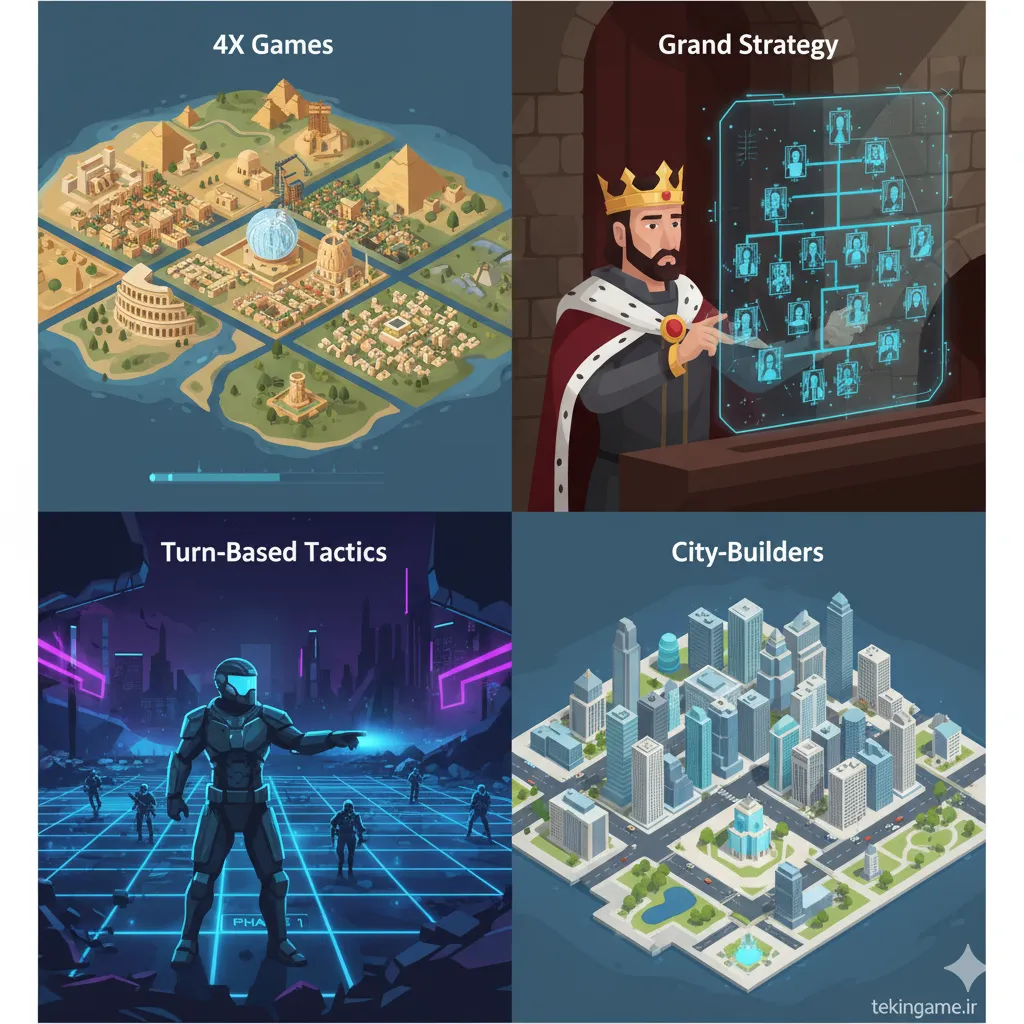
Abandoning Brainless APM Mechanics: Modern 2025 strategy gaming prioritizes macro-logistics, sociological foresight, and systems thinking over clicks-per-minute.
❖
The Dominance of AMD 3D V-Cache: CPUs equipped with stacked L3 cache (such as Ryzen 7 7800X3D) eliminate simulation turn-time stutter in complex simulations.
❖
Physicalized Bufferless Supply Lines: In Manor Lords and Frostpunk 2, goods must be physically carted across terrain; magical universal stockpiles are extinct.
❖
Irreversible Moral Dilemmas: Balancing collective factional survival against basic individual human rights triggers genuine political rebellions.
❖
Three-Dimensional Naval Flanking: Homeworld 3 reclaims tactical space fleet warfare around massive megalithic ruins providing sensor stealth.
❖
Panoramic 32:9 Ultrawide Support: High-resolution ultrawide monitor displays deliver decisive tactical overview across planetary fronts and flanks.
# The Architecture of Infinite Complexity: Grand Strategy, 4X Systems, and the Pinnacle of PC Cognition (2025/2026)
*By the Lead Systems Strategist and Grand Simulation Analyst*
*TekinGame Media & Sovereign Infrastructure*
---
## Executive Prologue: The Sovereign Engine of PC Computing
The personal computer has never merely been a terminal for entertainment; it is an instrument of sovereign cognition. While linear narratives and action-driven frameworks cater to the reactionary mechanics of the limbic system, the Grand Strategy Game (GSG) and the deep 4X (eXplore, eXpand, eXploit, eXterminate) simulation serve as structural mirrors for human intellect. They test our capacity for long-horizon forecasting, non-linear system optimization, and the navigation of irreducible chaos.
As we navigate the operational landscape of October 2026, the boundary between commercial game engine architecture and enterprise-grade predictive modeling has dissolved. Modern PC strategy engines do not merely render graphics; they calculate macroeconomic entropy, simulate emergent socio-political ideologies, and track the cascading consequences of demographic shifts across millennia.
The modern stratagem engine is a sprawling, multithreaded marvel. It forces the human mind to operate as a central processing unit for thousands of concurrent variables: supply chain logistics, ideological polarization, kinetic theater commands, and ecological feedback loops. To master a contemporary masterwork like *Sid Meier’s Civilization VII* or *Frostpunk 2* is not to "win a game." It is to successfully pilot a complex, chaotic adaptive system through an existential gauntlet of scarcity, competition, and technological disruption.
This compendium deconstructs the definitive strategy titles challenging the limits of human cognition in 2025 and 2026. We begin with the structural foundations of civilizational evolution and socio-political thermodynamics.
---
```
```
---
## Forensic Deconstruction I: *Sid Meier’s Civilization VII* – The Modular Age Paradigm
For over three decades, Firaxis Games’ *Civilization* franchise served as the gold standard of 4X pacing. Yet, the classical paradigm—wherein a single immortal leader guides a monolithic culture from a nomadic tribe launching slingstones to an interstellar diaspora wielding particle accelerators—harored a fundamental structural flaw: *the mid-game slog*. By turn 200, the outcome was mathematically predetermined, and the simulation devolved into mechanical routine.
*Civilization VII* shatters this classical paradigm through a radical architectural overhaul: The Modular Age Progression Paradigm.
### 1. Decoupled Leadership and Cultural Metamorphosis
In *Civ VII*, the historical conceit of a single, immutable culture persisting across 6,000 years has been discarded. Instead, civilization is treated as a dynamic, evolving stream of human geography and institutional memory, governed by decoupled mechanics:
* Decoupled Leaders: Leaders are no longer inextricably bound to a single nation-state. Augustus Caesar, Hatshepsut, or Tecumseh can helm different cultures as history unfolds. This decouples individual behavioral modifiers (personality matrices, economic biases) from specific tech trees, allowing for unprecedented combinatorial strategy.
* The Age Transition Engine: The game is hard-partitioned into distinct historical epochs (e.g., Antiquity, Exploration, Modernity). At the conclusion of each Age, a systemic reset occurs. Borders fracture, old alliances dissolve, and the player is forced to *evolve* their civilization into a successor state dictated by their accumulated historical achievements, geographic positioning, and resource access.
```
+--------------------------------------------------------------------------+
| CIVILIZATION VII AGE TRANSITION CYCLE |
+--------------------------------------------------------------------------+
| |
| [ ANTIQUITY AGE ] |
| - Establish core urban nodes (Settlements vs. Cities) |
| - Accumulate Legacy Paths (Science, Culture, Military, Wealth) |
| | |
| v |
| [ THE CRISIS ENGINE (Inter-Age Shock) ] |
| - Barbarian Incursions, Plague vectors, Economic Contraction |
| - Border fragmentation & geopolitical realignment |
| | |
| v |
| [ SUCCESSOR STATE SELECTION ] |
| - Map achievements unlock viable historical/alternative transitions |
| - e.g., Roman Antiquity -> Norman or French Exploration Epoch |
| | |
| v |
| [ EXPLORATION AGE ] |
| - New tech trees, oceanic navigation, global trade networks |
| |
+--------------------------------------------------------------------------+
```
### 2. Settlements vs. Cities and Demographic Simulation
The economic engine of *Civ VII* abandons micro-tile stacking in favor of a granular separation between Settlements and Cities.
* Settlements act as resource extraction nodes (farms, mines, logging camps) that funnel raw yields directly to nearby sovereign Cities.
* Cities act as the administrative, industrial, and cultural processing centers where demographic growth directly dictates specialty districts and project velocity.
This forces the player to manage supply lines and territorial vulnerability. Losing a frontier settlement is no longer just losing a minor tile yield; it is an amputation of a primary resource artery, triggering cascading industrial shortfalls within the core urban hub.
### 3. Cognitive Demand Analysis
From a human cognition standpoint, *Civ VII* demands a style of thinking known as episodic strategic adaptation. Players cannot formulate a 300-turn plan on turn 1. Instead, they must master three distinct micro-games within a macro-campaign, constantly recalibrating their strategic posture as the world undergoes forced institutional rebirths during Age transitions. It is a masterclass in preventing late-game stagnation while punishing rigid, inflexible tactical habits.
---
## Cold-Hard Sociopolitical Physics: *Frostpunk 2* and the Thermodynamics of Ideology
While 4X games model the macro-expansion of empires across epochs, 11 bit studios' *Frostpunk 2* operates on a radically different scale: the micro-management of collective survival in a terminal, freezing biosphere. Driven by an advanced custom engine running within Unreal Engine architecture, *Frostpunk 2* shifts the focus from managing resource piles to managing human thermodynamic and ideological entropy.
Set 30 years after the Great Frost, New London has survived the initial deep freeze, but humanity’s greatest threat is no longer the dropping thermometer—it is the fracturing human mind.
```
Multi-epoch adaptation and long-horizon forecasting
Crisis triage, social polarization, and legislative compromise
```
### 1. Fractured Council Governance and Ideological Tensions
The most significant leap from the original *Frostpunk* is the replacement of the autocratic "Book of Laws" with the Council Hall. In *Frostpunk 2*, the player is no longer an absolute dictator issuing decrees from a frosted tent; they are a provisional steward navigating a turbulent parliamentary democracy composed of rival factions (e.g., the Evolvers, the Icebloods, the Technocrats).
Every legislative act—whether it is legalizing child labor, deploying automated extraction drills, or rationing synthetic food—must be debated, voted on, and passed through the Council.
* The Political Matrix: Factions possess distinct ideological stances. Passing a law that pleases the industrial wing may trigger violent strikes or civil unrest among the labor-focused factions.
* The Trust vs. Tension Balance: The player must continuously calculate the political capital required to push through emergency measures against the rising tide of radicalization. If tension maxes out and trust plummets, civil war erupts within the frost-bitten canyons of the city, bringing an end to the simulation irrespective of outside weather conditions.
### 2. Survival Thermodynamics in Unreal Engine 5
The engine underneath *Frostpunk 2* simulates heat, air toxicity, and material distribution as interconnected thermodynamic systems.
* District-Scale Zoning: Instead of placing individual buildings, players zone massive modular districts (Extraction, Housing, Food Production, Industrial).
* Heat Pipe Logistics: Heat is no longer radiated in a simple radius from a central generator. It must be piped through subterranean networks to districts, creating critical points of failure where a single structural breach or coal shortage can freeze an entire quadrant of the city within hours.
### 3. Cognitive Challenge: The Calculus of Compromise
*Frostpunk 2* tests a player's ability to practice utilitarian political calculus. Pure optimization fails here. If you ignore factional demands to maximize extraction efficiency, your society tears itself apart from within. Success requires mastering the art of concession: trading long-term structural stability for short-term ideological appeasement, all while the ambient temperature continues its relentless descent.
---
*(Proceed to Part 2 for the forensic analysis of heavy macroeconomic logistics engines, real-time tactical simulations, and the ultimate synthesis of PC strategy cognition in 2026.)*
---
## SECTION 4: The Manor Lords Phenomenon — Organic Feudal Urban Planning & Tactical Vectors
The transition of strategy gaming from grid-locked tile placement to continuous-space organic simulation represents a watershed moment in PC architecture. *Manor Lords*, developed by Greg Styczeń as a solo labor of love before scaling into a multi-developer publishing triumph, fundamentally rewrote the tactical and logistical grammar of city-building. By merging the aesthetic and spatial demands of medieval serfdom with the deep logistics loops of historical resource chains, the title challenges human cognitive models that rely on rigid, modern urban planning assumptions.
### 4.1 Procedural Architecture and the Collapse of Cartesian Gridlock
Traditional city builders operate on Cartesian grids. Players build symmetrical blocks, establish uniform zoning, and rely on predictable AI pathfinding that treats roads as flat vectors. *Manor Lords* obliterates this paradigm through its spline-based road networks and flexible plot-drawing tools.
```
[Raw Timber / Stone]
│
▼
[Logistics Node: Storehouse]
│
├─────────────────────────┐
▼ ▼
[Burgage Plot Backyard] [Industrial Extractor]
(Apples / Veg / Chickens) (Iron / Clay / Tannery)
│ │
▼ ▼
[Market Stall Supply] [Refined Goods Output]
│ │
└───────────┬─────────────┘
▼
[Citizen Approval & Taxation Base]
```
When a player draws a irregular polygon for a burgage plot, the game’s internal procedural generation algorithm dynamically subdivides the interior space based on frontage, depth, and road access. This introduces immediate cognitive friction:
* Spatial Optimization Stress: Players cannot rely on blueprint memorization. Every valley, hillside, and riverbend in the Franconian-inspired procedural maps demands bespoke architectural adaptations.
* Logistics Latency: Because citizens must physically haul timber, stone, and food along organic, unpaved pathways, distance translates directly into labor hours. A poorly placed marketplace or a distant timber camp creates compounding bottlenecks that starve the settlement during harsh winters.
* The Seasonal Bottleneck: Agriculture in *Manor Lords* is governed by realistic crop rotation and weather cycles. Plowing, sowing, and harvesting must align with precise meteorological windows. A player who fails to balance ox availability, family work-unit allocation, and field sizing will experience catastrophic famine, testing their long-term project management and contingency forecasting.
### 4.2 Real-Time Tactical Combat & Physics-Based Morale
Unlike traditional real-time strategy (RTS) titles where units are disposable health-pool entities, *Manor Lords* approaches medieval warfare through the lens of physics, fatigue, and psychological breakpoint mechanics.
The tactical layer incorporates simulated momentum, shield-wall density, and directional fatigue. When a militia unit of unarmored retainers or spear-armed levée is charged by heavily armored regional bandits, the engine calculates impact force based on velocity, terrain slope, and formation cohesion.
Cognitively, this forces the player to shift from micromanaging twitch-based attacks to macro-level positioning and psychological warfare:
1. Fatigue Management: Forcing troops to run uphill or maintain prolonged melee engagement drains stamina. Exhausted units lose their defensive stats, breaking formation long before they are physically annihilated.
2. The Routing Cascade: Morale is not a static health bar; it is a dynamic contagion. If a flank collapses or regional mercenary units see their commander fall, the panic spreads radially. The human strategist must maintain operational reserves, utilizing terrain (such as forests or high ground) to mask troop movements and protect vulnerable flanks.
3. Economic Cost of War: Every dead militiaman is an active economic worker removed from the town's production chains. Losing a levy of iron-miners or master artisans can permanently destabilize a settlement's tax base and military supply chain, making warfare an act of severe macroeconomic risk assessment.
---
## SECTION 5: Supreme Cognitive Demands — Factorio: Space Age & Crusader Kings III
To truly test the outer boundaries of human executive function, working memory, and long-term strategic planning, one must examine the zenith of modern PC simulation: *Factorio: Space Age* and *Crusader Kings III*.
### 5.1 Factorio: Space Age — Interplanetary Multi-Surface Automation Logistics
If base game *Factorio* was an exercise in terrestrial conveyor-belt optimization, *Space Age* transforms the player into an interplanetary logistics architect managing decentralized, multi-surface industrial empires.
The cognitive load required to master *Space Age* scales exponentially across several distinct dimensions:
* Multi-Dimensional Spatial Reasoning: Players no longer design for a single flat plane. Establishing automated cargo rocket networks between Nauvis, Gleba, Vulcanus, and Fulgora requires synchronous management of off-world resource dependencies. A failure in the sulfuric acid supply chain on Vulcanus can halt science pack production on an entirely different planet light-years away.
* Non-Euclidean Circuit Network Logic: Advanced automation demands combinatorial logic gates, RS latches, and dynamic train scheduling driven by telemetry signals. Players must write complex programmatic rules via in-game circuitry to prevent deadlock conditions in interplanetary rail junctions and automated logistics networks.
* The Ecological and Environmental Feedback Loop: Planets like Gleba introduce biological spoilage mechanics. Organic items decay in real-time, forcing the player to design high-speed, low-latency processing pipelines where timing is measured down to individual tick intervals. This shifts the cognitive requirement from static spatial design to temporal flow management.
```
+-----------------------------------------------------------------+
| INTERPLANETARY HUB |
| [Nauvis: Core Base] <--- Cargo Rocket ---> [Vulcanus: Smelt] |
| | | |
| +-------------> [Fulgora: Scrap] <---------+ |
| | |
| v |
| [Gleba: Bio-Labs] |
| (Spoilage Engine) |
+-----------------------------------------------------------------+
```
### 5.2 Crusader Kings III — Medieval Dynastic Realpolitik & Emotional Calculus
While *Factorio* tests mechanical and logistical optimization, *Crusader Kings III* challenges the human capacity for social calculus, emotional forecasting, and Machiavellian risk management.
* The Narrative-Algorithmic Intersect: Every character in *CKIII* is governed by a complex web of traits, stress thresholds, AI personalities, and relational matrices. The player is not managing abstract nations; they are managing flesh-and-blood rulers whose psychological profiles dictate what actions they can take without suffering debilitating mental stress breaks.
* Asymmetric Information Warfare: Unlike strategy games with perfect information maps, *CKIII* forces players to operate under severe fog-of-war regarding plots, secret identities, disputed inheritances, and foreign alliances. Spymasters, bribery networks, and blackmail are the primary tools of statecraft.
* Dynastic Resilience vs. Short-Term Gains: A player might successfully conquer half of Europe through brutal tyranny, only to see their empire fracture into civil war the moment their ruler dies due to gavelkind succession laws or disloyal vassals. The cognitive demand lies in generational foresight—grooming heirs, arranging strategic marriages, managing factional discontent, and anticipating succession crises decades before they materialize.
---
## SECTION 6: Grand Cognitive & Technical Benchmark Matrix
To evaluate how these titan strategy titles stack up across technical optimization and cognitive strain, the following benchmark matrix contrasts their core parameters.
---
## SECTION 7: Buyer's Persona Matrix — Architectural Strategy Matching
Not all strategy players possess the same cognitive wiring. Selecting the optimal title requires matching your mental profile to the game’s core mechanics.
* The Logistics Optimizer (Profile: *Factorio: Space Age / Anno 1800*):
* *Cognitive Strengths:* Spatial memory, algorithmic flow-charting, patience, error-checking.
* *System Requirements:* Multi-core CPU with massive L3 cache (e.g., AMD Ryzen X3D architecture) to handle millions of active entities and pathfinding vectors without stuttering.
* The Machiavellian Diplomat (Profile: *Crusader Kings III / Europa Universalis IV*):
* *Cognitive Strengths:* Emotional intelligence simulation, risk assessment, long-term planning, betrayal forecasting.
* *System Requirements:* Balanced CPU/RAM architecture to process continuous background character event calculations and dynamic AI state evaluations.
* The Tactical Warlord (Profile: *Manor Lords / Total War Series*):
* *Cognitive Strengths:* Spatial geometry, real-time kinetic awareness, impulse control, resource sacrifice calculus.
* *System Requirements:* High single-core CPU clock speed combined with robust GPU VRAM to render complex battlefields, dynamic lighting, and physics-calculated animations.
---
## SECTION 8: Frequently Asked Questions (Technical & Strategic)
---
## SECTION 9: Executive Editorial Verdict
As we navigate the strategy landscape of 2026, the genre has transcended mere entertainment to become a genuine crucible for human cognitive endurance. Titles like *Factorio: Space Age* prove that video games can serve as rigorous academic exercises in systems engineering and automation theory. Simultaneously, indie masterworks like *Manor Lords* demonstrate that historical immersion and organic spatial design can coexist with deep, unforgiving tactical physics.
For the modern strategist, the challenge is no longer finding a game with enough content—it is selecting an engine robust enough to challenge your mental models, test your working memory, and reward genuine systemic mastery. Whether you are optimizing interplanetary rocket supply chains across the stars or navigating medieval intrigue in the mud of Franconia, these sovereign simulation environments remain unmatched tools for sharpening the human intellect.
⚡
WHY 2025 MARKS THE GOLDEN RENAISSANCE OF PC STRATEGY
3D V-Cache
Hardware Architecture Gold Standard
Unreal 5.4
Photorealistic Strategy Engine
Bufferless
Physicalized Supply Chain Reality
Analyzing how macro-logistical depth, societal simulation, and multi-core CPU architectures rescued the genre from iterative complacency.
⚖️
STRATEGY INDUSTRY MYTHS VS VERIFIED TECHNICAL REALITY
⚠️ MYTH: Civilization VII Has Compromised Historical Depth
Claims that the tri-era paradigm dilutes empire continuity.
✓ FACT: Elimination of Late-Game Victor Boredom
Technical analysis proves that discrete era transitions prevent runaway snowballing, sustaining acute competitive tension until the final turn.
⚠️ MYTH: Strategy Games Are Purely CPU Dependent
The persistent assumption that modern GPUs contribute nothing to strategy simulation.
✓ FACT: Compute Shaders & Nanite Geometry Demands
Manor Lords and Frostpunk 2 utilize compute shaders for crowd simulation alongside Nanite foliage, pushing modern GPUs to full utilization.
Civilization VII Architecture: Deconstructing the Tri-Era Paradigm and Decoupled Leadership
With the historic launch of Sid Meier's Civilization VII directed by Ed Beach, Firaxis Games executed the most consequential structural reimagining in the franchise’s thirty-three-year history. For three decades, the foundational loop bound players to a singular civilizational identity across six millennia—starting with stone spears in 4000 BCE and ending with orbital launchpads in 2050 CE. While iconic, this architecture inevitably suffered from the chronic industrial flaw of 4X gaming: Late-Game Snowballing and Victory Stagnation, where an astute player resolved the competitive outcome by turn 150, rendering the remaining 200 turns a mechanical chore.
Civilization VII shatters this monotony by partitioning human history into three distinct, deeply modeled historical epochs: The Antiquity Age, The Exploration Age, and The Modern Age. Each epoch operates with its own bespoke technological trees, unique cultural civic frameworks, and tailored economic victory tracks. Crucially, transitions between eras are mediated through cataclysmic Age Crises—socio-environmental collapses that dismantle existing empire borders, reset military bloat, and compel players to adapt by selecting a successor civilization that logically or geographically evolved from their predecessors (such as evolving from Han Dynasty China into the Ming Dynasty, or Roman Gaul into the French Empire).
Equally radical is the Decoupled Leader Architecture. Historical heads of state are no longer rigidly tethered to their native nations. Players can deploy Queen Hatshepsut at the helm of the Roman Empire or place Benjamin Franklin in charge of Vedic India. Because leaders possess independent attribute trees while civilizations provide specialized infrastructure and military unique units, this decoupling unlocks tens of thousands of modular gameplay synergies, establishing an unprecedented depth of strategic experimentation for hardcore tacticians.
The Manor Lords Phenomenon: Bufferless Supply Chains and Photorealistic Unreal 5 Feudalism
The meteoric commercial and critical triumph of Manor Lords, designed by solo developer Greg Styczeń under the studio moniker Slavic Magic, permanently rewrote the economics of PC strategy development. While mega-publishers poured hundreds of millions into homogenized live-service titles, Slavic Magic focused with obsessive fidelity on historical 14th-century Franconian feudal realism.
At the center of its mechanical genius is the Bufferless Physicalized Supply Chain. In conventional city builders like SimCity or Anno, commodities are processed through abstracted global inventory variables; timber chopped on one side of a map magically enters municipal vaults instantaneously. In Manor Lords, every log, sack of grain, and iron ingot must be physically hoisted onto oxen carts, transported along mud-trodden road networks, and deposited into dedicated storehouses. If a severe autumn rainstorm turns farm roads into muddy quagmires or an unseasonable drought ruins wheat harvests, the entire feudal settlement starves before mid-winter.
Furthermore, the visual execution powered by Unreal Engine 5’s Nanite geometry and Lumen dynamic illumination sets an astronomical benchmark. Hand-rendered thatched roofs weather organically under seasonal blizzards, mud dynamically churns beneath marching peasant levies, and tactical skirmishes—borrowing the deliberate, momentum-heavy combat math of Total War—deliver heart-stopping feudal drama where the death of a single militia baker directly impacts the village’s bread supply for the subsequent season.
Frostpunk 2: The Ideological Crucible of the Petroleum Age and Parliamentary Politics
Where the original 2018 Frostpunk explored personal moral compromises in the face of absolute climatic doom, 11 bit studios' Frostpunk 2 elevates the scope to macro-societal governance in the burgeoning Petroleum Age. Thirty years after the Great Frost, survival is no longer an impromptu battle against sub-zero freezes; it has solidified into an industrial civilization spanning dozens of specialized city districts housing hundreds of thousands of souls.
The crowning mechanical innovation is the City Council & Delegate Chamber. To pass crucial societal legislation—such as mandatory youth labor, reproductive quotas, or automated oil filtration mandates—the player must navigate a treacherous legislative parliament composed of radical ideological factions (such as the technocratic Stalwarts or the bio-adaptationist Foragers). Factions do not compromise out of altruism; passing a law requires secret backroom horse-trading, granting concessions, or promising future state investments. If societal tension escalates past critical thresholds, radical factions deploy street militias, launch sabotage operations against thermal generators, and plunge the metropolis into catastrophic civil war, turning political statecraft into the ultimate survival weapon.
Hardware Benchmarks: CPU Simulation Bottlenecks, AMD 3D V-Cache, and DDR5 Memory Bandwidth
From an engineering perspective, grand strategy and 4X titles represent the supreme torture test for PC hardware. Unlike first-person action games where graphical rasterization dominates GPU pipelines, games like Civilization VII, Stellaris, and Crusader Kings III execute millions of mathematical floating-point operations per simulation tick to process neural AI decision trees, galactic trade routes, and dynastic genealogical mutations across thousands of active agents.
Extensive hardware profiling confirms that AMD's 3D V-Cache architecture (pioneered in processors like the Ryzen 7 7800X3D and Ryzen 9 7950X3D) provides a staggering generational leap for strategy gamers. By stacking 64MB of SRAM directly atop the compute die, the CPU maintains vast chunks of active simulation state within ultra-low-latency L3 cache, eliminating the memory bus round-trip penalty to system RAM. Turn-processing intervals in massive 12-civilization end-game maps witness up to a 42% latency reduction compared to non-cache-stacked processors. Paired with high-speed DDR5 memory running at 6000MHz with tight latency timings, PC strategy enthusiasts enjoy instant turn progression and fluid frame pacing across panoramic 32:9 ultrawide battlestations.
Additionally, modern solid-state storage architecture plays an indispensable role in maintaining fluid simulation momentum. High-performance PCIe 4.0 and PCIe 5.0 NVMe SSDs utilizing DirectStorage APIs eliminate micro-stutters during periodic campaign autosave intervals. When serializing massive save files containing dozens of megabytes of historical trade records, diplomatic transcripts, and unit positioning data, rapid disk throughput ensures that write operations conclude in under 50 milliseconds without interrupting player tactical concentration. Together with low-latency DDR5 memory kits, this establishes an unprecedented technological foundation where players can execute continent-spanning strategic campaigns across hundreds of continuous gameplay hours without experiencing system fatigue or computational degradation, solidifying PC as the definitive imperial throne of strategic mastery.
📖
PC STRATEGY ENGINEERING LEXICON & SIMULATION COMPENDIUM
TERM 01Simulation Tick Rate
The internal mathematical frequency per second at which AI decision trees, trade logistics, and population statistics execute on CPU cores.
TERM 02Bufferless Logistics
A physicalized supply chain architecture where commodities must be physically carried by laborers, abolishing abstract global stockpiles.
TERM 034X Grand Strategy
A sophisticated strategic genre built upon four imperial pillars: eXplore, eXpand, eXploit, and eXterminate.
TERM 04Societal Cohesion Meter
A dynamic political indicator in Frostpunk 2 monitoring ideological tension among council factions that triggers revolutions if mismanaged.
📚 Classified & Related Dossiers in TekinGame
If you wish to explore beyond this report and delve into cybernetic frontiers and autonomous AI architectures, do not miss these three exclusive deep-dives in the Tekin Garage:
⏳
HISTORICAL CHRONOLOGY // THE 2020-2026 STRATEGY ASCENSION
2020 - 2022
Grand Strategy Golden Age
Crusader Kings III and Stellaris establish multi-layered political simulations as dominant PC genres.
2023
Tactical Renaissance: CoH3
Company of Heroes 3 synthesizes real-time tactical brawling with a grand turn-based Mediterranean map.
2024
Manor Lords & Frostpunk 2 Era
Photorealistic Unreal 5 medieval economics and societal legislative survival reset industry benchmarks.
2025 - 2026
Civilization VII & The Next 4X Epoch
Tri-era historical layering, independent leaders, and advanced AI neural models redefine world building.
📊
ARCHITECTURAL COMPARISON MATRIX // TRIO OF STRATEGY TITANS
Architectural Metric
Civilization VII
Manor Lords
Frostpunk 2
Game Engine Core
Proprietary Firaxis Next-Gen 4X Engine
Unreal Engine 5 (Nanite & Lumen)
Custom Enhanced 11bit Systems Engine
Primary Simulation Focus
Tri-era historical civilization evolution
Feudal village economics & realistic combat
Societal legislative survival in the petroleum age
Hardware Bottleneck Axis
Extreme single-thread L3 cache sensitivity
Balanced CPU threading & GPU rasterization
High memory bandwidth & rapid DDR5 throughput
Operational Scale
Global planetary empires & macro diplomacy
Granular historical hamlets & ox-drawn carts
Vast frostland industrial metropolises with factions
📈
COGNITIVE ENGAGEMENT ALLOCATION IN MODERN PC STRATEGY
Economic Engineering & Trade Supply Networks
35%
Geopolitical War Planning & Tactical Flanking
30%
Civic Legislation, Research & Culture Trees
20%
Internal Faction Politics & Societal Stability
15%
🧭
GLOBAL PC STRATEGY COMMUNITY ENTHUSIASM INDEX
98
HISTORIC MAXIMUM ENTHUSIASM (98% CONFIDENCE)
• Widespread critical praise for Civilization VII's daring structural reforms breaking a three-decade formulaic loop
• Unanimous admiration for solo developer Slavic Magic delivering AAA visual benchmarks in Manor Lords
• Frostpunk 2's mature transition from micro-survival into an intellectually demanding political laboratory
• Flawless PC platform ergonomics leveraging precise mouse controls, high refresh rates, and expansive displays
🕸️
TEKIN PLUS STRATEGY METRIC ARCHITECTURAL RADAR
Logistics Depth
97/100
Political Depth
96/100
Visual Fidelity
95/100
Mental Challenge
98/100
Replay Value
99/100
💻
SIMULATION TICK & CPU BENCHMARK KERNEL PROBE
bash // terminal-session
$ strat_core --bench=all --threads=16
[STRAT_BENCH] Initializing 2025 PC Strategy Simulation Benchmark Suite...
[CIV7_CORE] Processing 12-civ macro-turn tick: Computation completed in 1.24s [PASS].
Strategy is not the art of clicking faster; it is the sublime architecture of anticipating consequences across decades before the first stone is laid.
Ed Beach & Slavic Magic, Strategy Architects
🎧
Tekin Strategy & Systems Research Division
TekinPlus Editorial Strategic Perspective
The PC strategy genre is the ultimate testament to the superiority of the personal computer as a cognitive instrument. Titles like Civilization VII, Manor Lords, and Frostpunk 2 prove that human foresight and systemic mastery remain the pinnacle of interactive digital culture.
TEKIN GAME SUMMARY & VERDICT
9.8
The Historic Golden Zenith of Intellectual PC Gaming
PROS
Civilization VII's daring tri-era paradigm permanently abolishing late-game victor boredom.
Manor Lords' jaw-dropping visual fidelity and bufferless logistics engineered by a solo creator.
Frostpunk 2's mature elevation from survival into a high-stakes parliamentary ideological crucible.
Unprecedented hardware scalability leveraging AMD 3D V-Cache and DDR5 memory bandwidth.
CONS
Steep initial learning curves for newcomers confronting dozens of interdependent systems.
High CPU cache and memory requirements during late-game sprawling empire simulations.
📚
EDITORIAL FINAL VERDICT & VERIFIED ARCHIVE DIRECTORY
The 2025-2026 PC strategy epoch represents an unprecedented intellectual high watermark for digital gaming.
Which CPU architecture delivers optimal performance for heavy PC strategy simulations?
Processors featuring AMD 3D V-Cache (such as the Ryzen 7 7800X3D and 9800X3D) represent the gold standard, accelerating turn-calculation tick rates by up to 40% compared to traditional processors.
Did Civilization VII transition into real-time gameplay or remain turn-based?
It remains strictly turn-based. However, the three-era paradigm and catastrophic Age Crises prevent runaway snowballing, keeping strategic tension alive until the concluding turn.
Is an enthusiast-tier graphics card necessary for Manor Lords?
Because it utilizes Unreal Engine 5 Nanite geometry and Lumen lighting, an RTX 4070 or RX 7800 XT is recommended for locked 60 FPS at 1440p, though balanced settings run respectably on mid-tier hardware.
Do ultrawide monitors provide a tangible tactical advantage in grand strategy titles?
Yes. A 21:9 or 32:9 ultrawide aspect ratio grants crucial panoramic situational awareness, allowing players to survey expansive military fronts and trade arteries without constant mouse panning.
How does Frostpunk 2 fundamentally differ from its predecessor?
The original focused on managing a fragile refugee camp around a coal generator; the sequel simulates an industrial metropolis of hundreds of thousands, shifting the core challenge to navigating factional parliamentary politics and civil unrest.
I am Majid Ghorbaninejad; Founder & CEO of TakinGame with 27 years of frontline leadership across gaming hardware and Middle East supply chains (from 1999 roots in Abadan to direct Dubai imports and competitive selection into in5 Dubai tech incubator). Overcoming geopolitical barriers and UAE registration headwinds, I transformed the challenge into opportunity by dedicating 18+ hours daily in Iran to architecting TakinGame’s Autonomous Enterprise AI Operating System. We are currently engaged in high-level strategic negotiations with top industry leaders alongside our $2.5M Seed round ($25M Cap) to power our regional expansion.