🎮 Tekin Analysis | The Death of the 'Average Gamer': Inside Bain & Company's 2026 Global Games Report, Infinite AI Personalization, & The War on AI-Slop
Tekin Analysis exclusive breakdown of Bain's 2026 Games Report. Exploring the death of the average gamer, live-service monopolies, infinite biometric personalization, and the war on AI-Slop.
- 🎮Demise of the Average Gamer- Deconstructing Bain's report and proving the death of traditional $70 mass-market releases
- 🎧Live-Service Monopolies- How perpetual ecosystems like Fortnite and GTA Online capture 65% of all global playtime
- 🚀Infinite Living Games- Real-time generative AI synthesis of quests, NPC dialogues, and adaptive scores
- 🗡️The War on AI-Slop- Psychological analysis of the fierce gamer backlash against low-effort algorithmic content
- 📰Unsustainable AAA Budgets- The crisis of $300M+ budgets and how 25-person agile studios achieve blockbuster-scale production
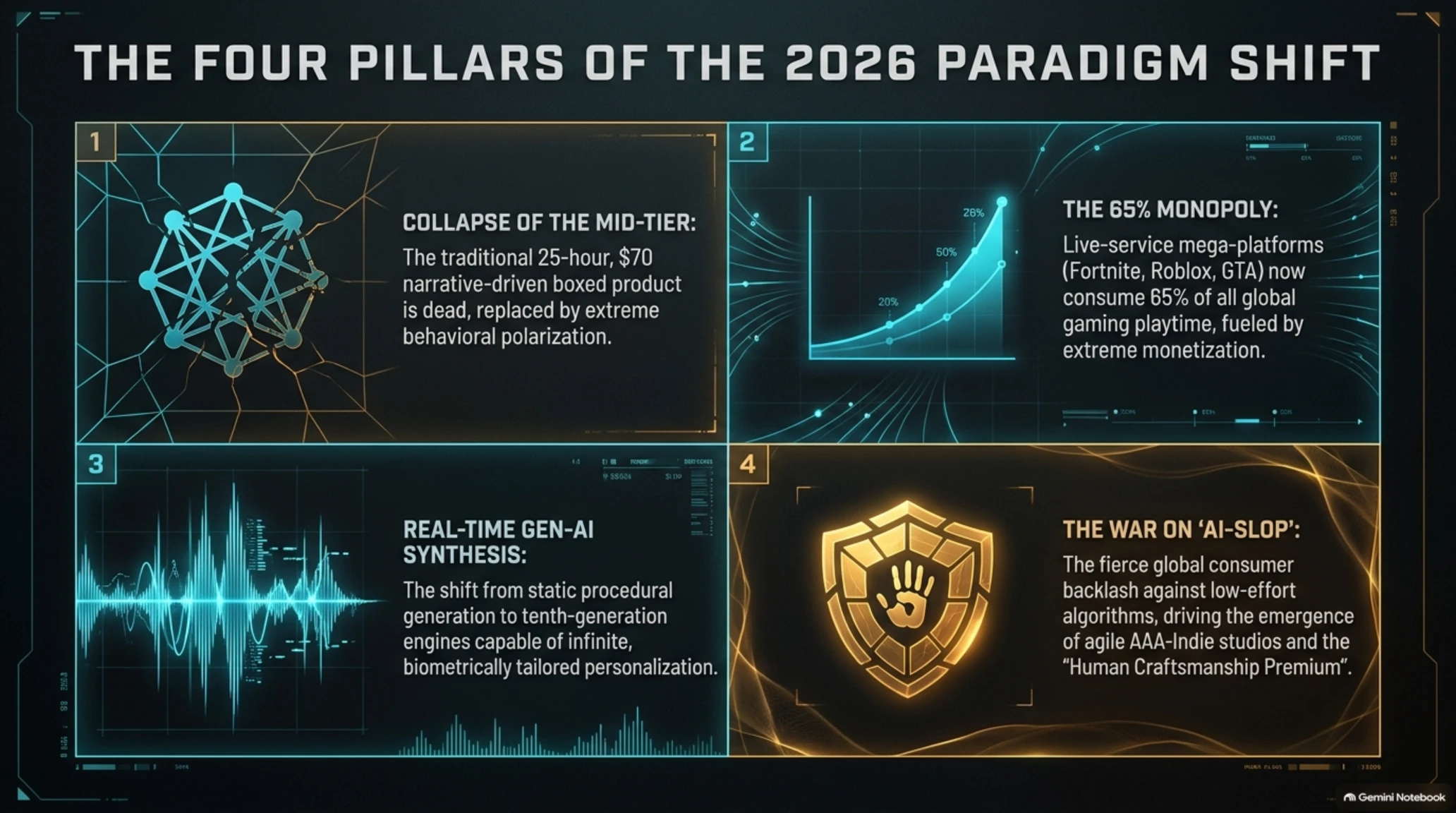
In the history of the $180 billion interactive entertainment industry, no single epoch has experienced such a paradoxical collision of economic contraction and revolutionary technological disruption as 2026. The publication of the Bain & Company Global Games Report in August 2026 has ignited intense debates across major studio boardrooms, Wall Street investment houses, and the worldwide community of over three billion players. The core thesis of the report is unvarnished: The traditional concept of the «Average Gamer» is definitively dead, fracturing the market into two distinct, irreconcilable behavioral extremes.
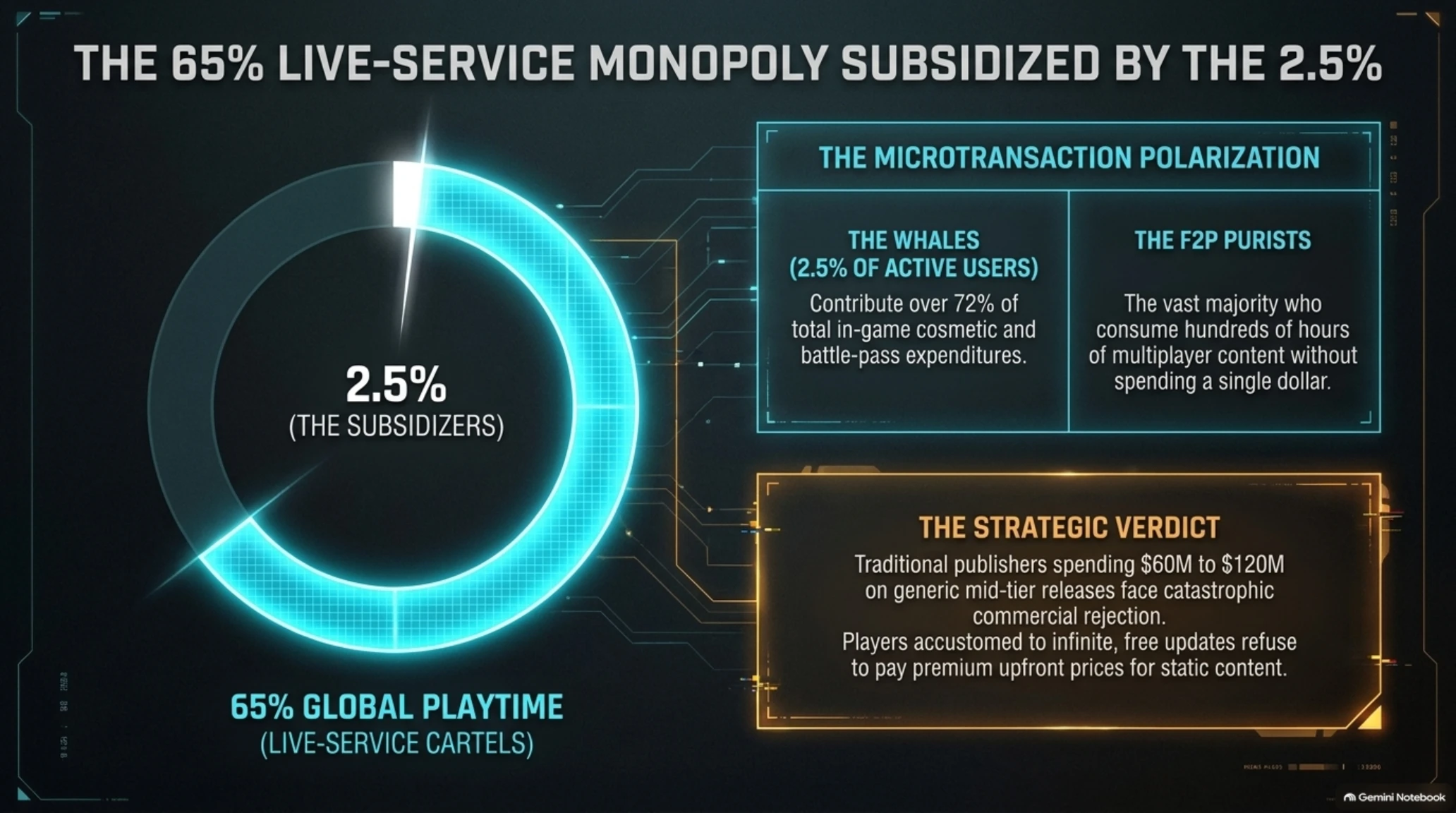
On one hand, over 65 percent of all global video game engagement is now permanently captured by a tight cartel of perpetual live-service mega-platforms such as Fortnite, Roblox, Call of Duty, and the Grand Theft Auto ecosystem. On the other hand, an unprecedented wave of real-time Generative AI tools has entered tenth-generation game engines, enabling dynamic non-player character (NPC) dialogues, procedural quest synthesis, and biometric-adaptive gameplay tailored to individual players. Yet, standing in fierce opposition to uncurated automation is an aggressive, global consumer movement: The Gamer Backlash Against «AI-Slop».
Strategic Takeaways from the Bain & Company 2026 Global Games Report
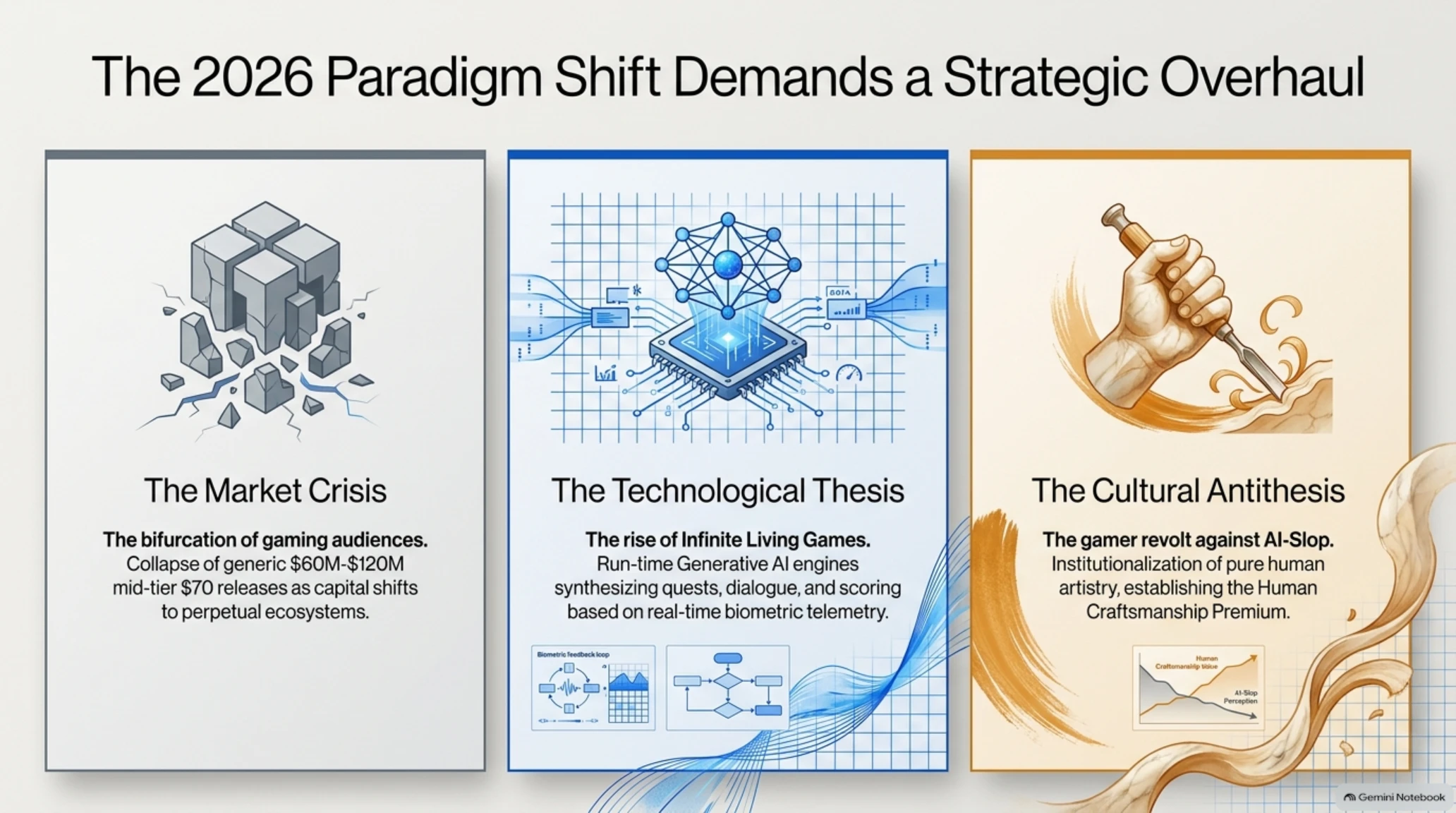
- Commercial collapse of generic $70 mid-tier linear games as consumer capital shifts to perpetual ecosystems
- Infinite personalization: real-time synthesis of storylines, game mechanics, and dialogues based on player biometric telemetry
- Steam and PlayStation enforcing mandatory AI content disclosure labels and strict copyright provenance certifications
- Generative AI cutting production overhead by 35% and shaving up to two years off multi-year development timelines
- Surge in the 'Human Craftsmanship Premium' for artisanal masterpieces like Elden Ring, Baldur's Gate 3, and GTA VI
- The rise of AAA-Indie micro-studios with 20 to 30 developers matching the output of legacy 300-person organizations
1. The Demise of the 'Average Gamer': Deconstructing Bain & Company's 2026 Global Games Report
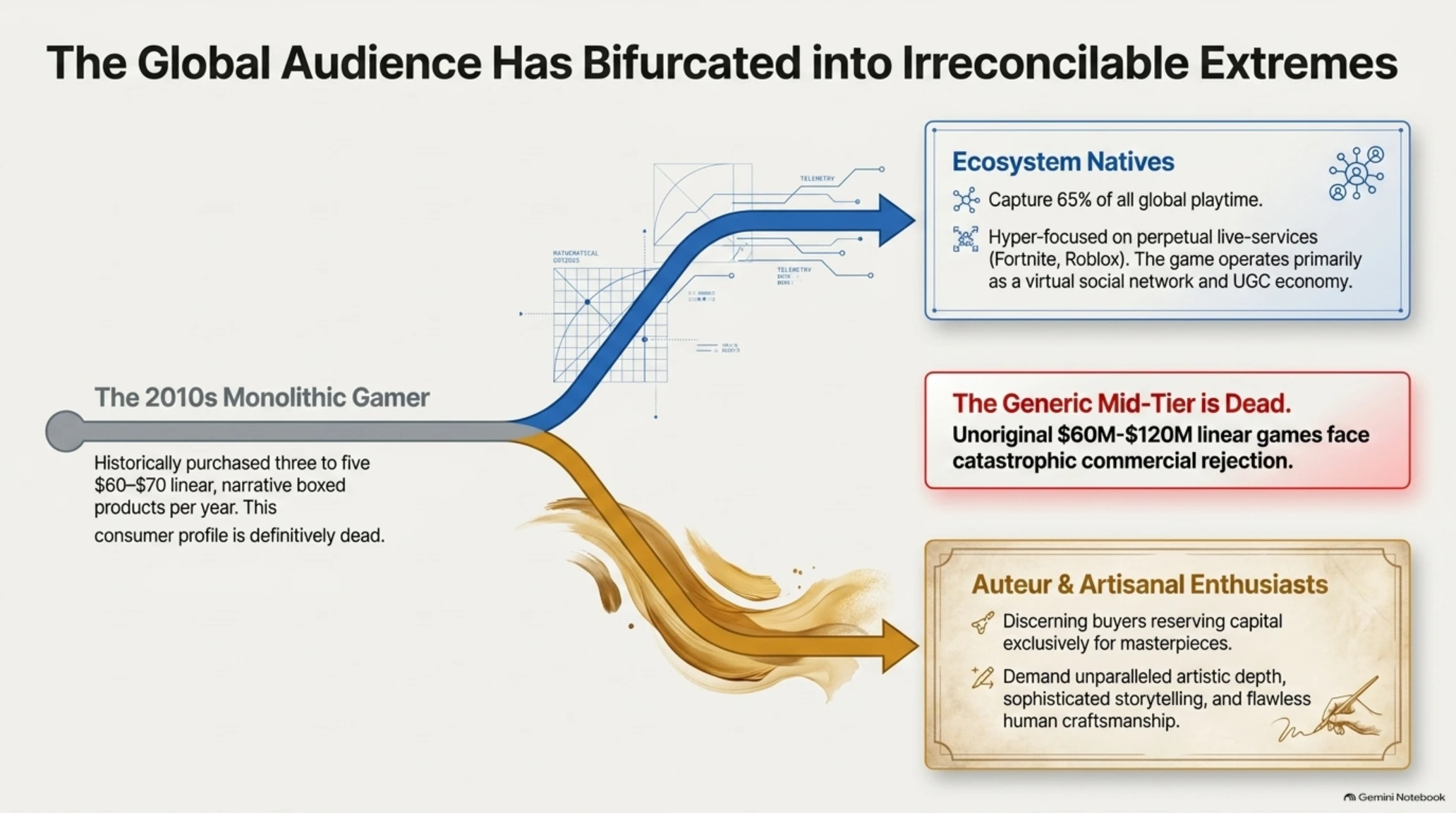
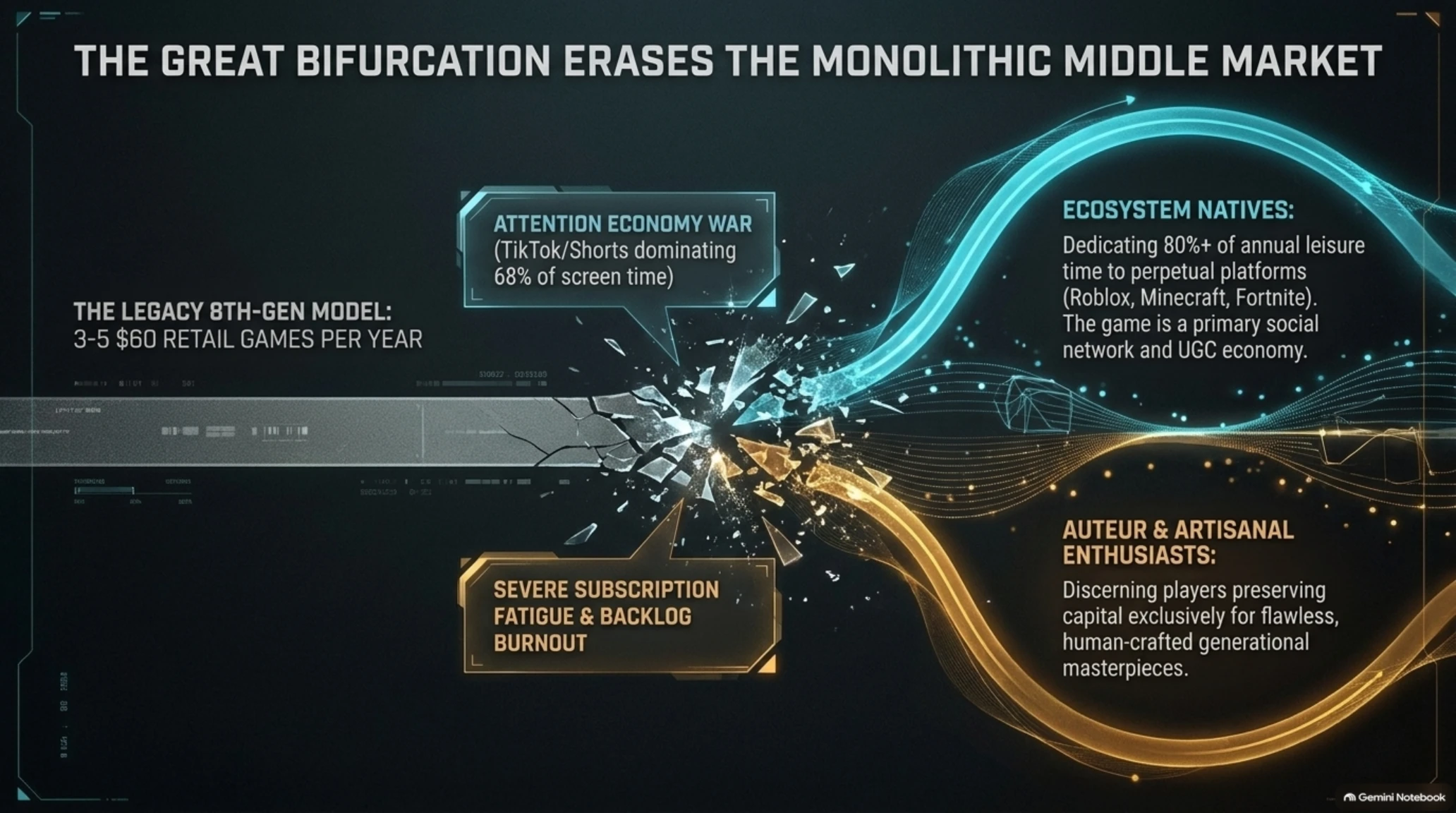
For more than three decades, the commercial foundation of the gaming industry was predicated on a monolithic demographic archetype known as the «Average Gamer» a consumer who routinely purchased three to five $60–$70 narrative-driven boxed products per year, completed their 25-hour single-player campaigns, and promptly migrated to the next retail release. Empirical telemetry and financial disclosures synthesized in Bain & Company's August 2026 report confirm that this traditional consumer lifecycle has dissolved.
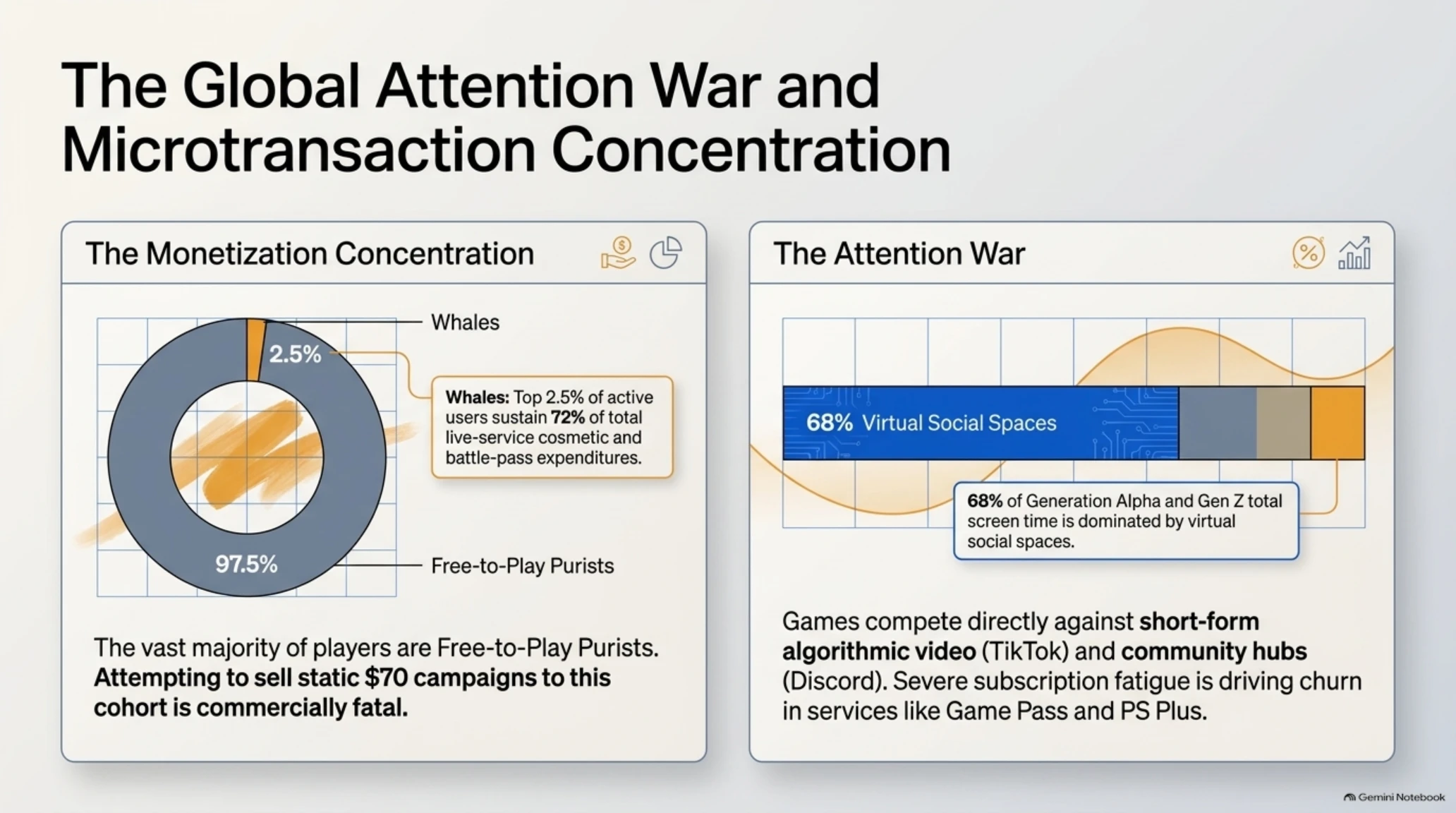
The collapse of this model is fundamentally driven by the Global Attention Economy War. In 2026, interactive video games no longer compete merely with rival gaming software; they compete fiercely against short-form algorithmic video platforms (TikTok, Instagram Reels, YouTube Shorts), streaming entertainment, and Discord community hubs. Among Generation Alpha and Gen Z cohorts, over 68% of total screen time is dominated by virtual social spaces where the boundaries between playing, chatting, listening to music, and creating digital fashion items have entirely merged.
Simultaneously, the major subscription ecosystems such as Xbox Game Pass, PlayStation Plus Extra/Premium, and EA Play have encountered severe saturation plateaus across North America and Western Europe. While subscriptions initially promised endless catalogs for a flat monthly fee, consumer «subscription fatigue» and the sheer volume of unplayed backlog titles have caused churn rates to double. Gamers are increasingly abandoning mid-tier subscription filler to focus exclusively on either infinite live-service games or generational cultural events.
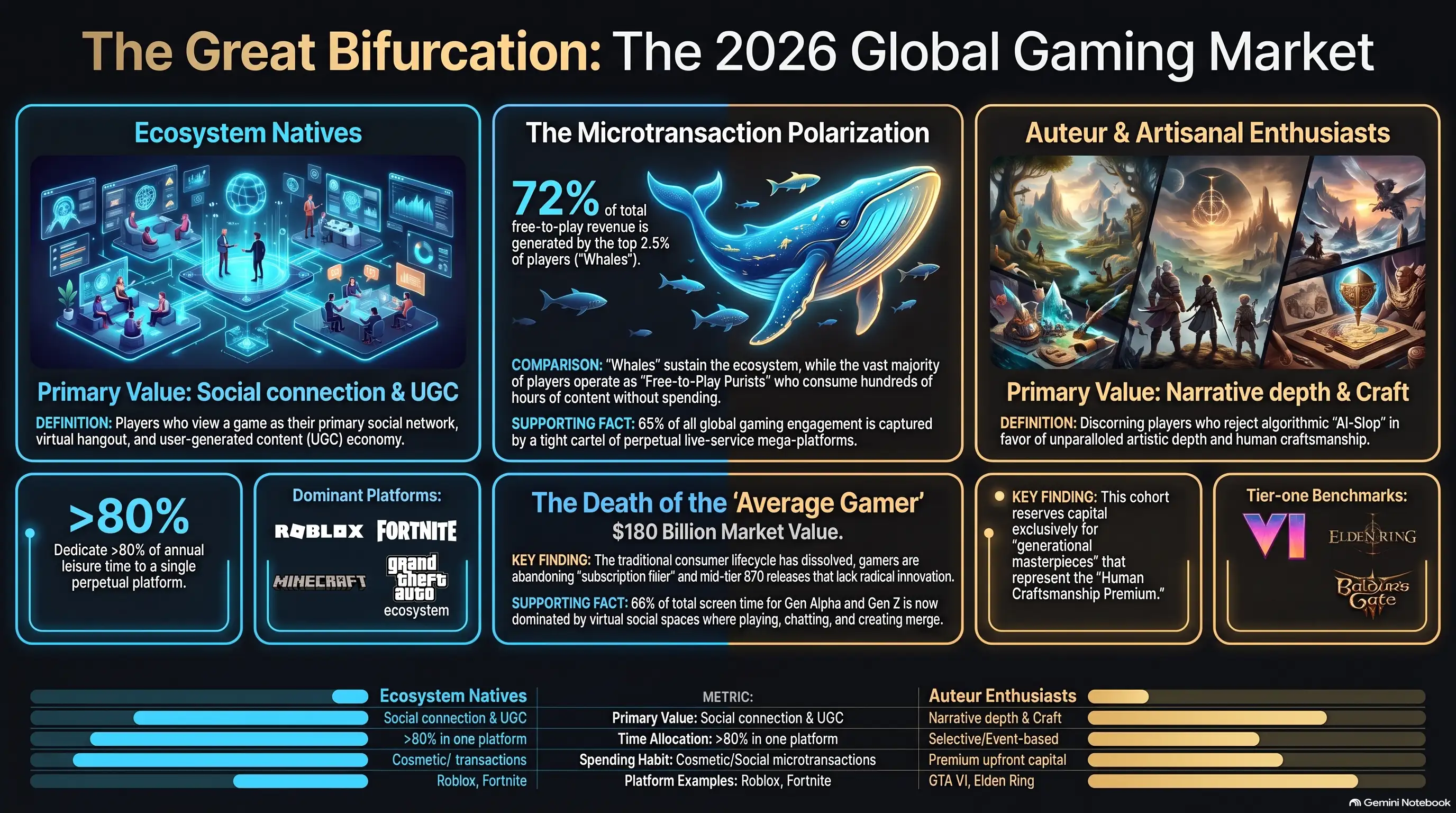
According to Bain's global behavioral dataset, the worldwide gaming audience has bifurcated into two mutually exclusive behavioral profiles:
- Ecosystem Natives: Players who dedicate over 80 percent of their annual leisure time and microtransaction budget to one or two perpetual platform ecosystems (such as Roblox, Fortnite, or Minecraft); for this cohort, the game is no longer a discrete narrative, but their primary social network, virtual hangout, and user-generated content (UGC) economy.
- Auteur & Artisanal Enthusiasts: Discerning players who demand unparalleled artistic depth, sophisticated storytelling, and flawless human craftsmanship, reserving their time and financial capital exclusively for generational masterpieces (such as GTA VI, Elden Ring, or Baldur's Gate 3).
The Microtransaction Polarization: Whales vs. F2P Purists
Financial telemetry from Bain's dataset exposes an extreme revenue concentration within live-service gaming ecosystems. In 2026, the monetization model of free-to-play platforms is overwhelmingly sustained by the top 2.5% of active users colloquially termed «Whales» who contribute more than 72% of total in-game cosmetic and battle-pass expenditures.
Conversely, the vast majority of players operate as strict «Free-to-Play Purists» who consume hundreds of hours of multiplayer content without spending a single dollar. For traditional mid-tier developers attempting to launch standalone $70 titles, this dynamic proves fatal: players accustomed to free, constantly updated live-service platforms refuse to pay premium upfront prices for static, one-time narrative campaigns.
The Final Sunset of 8th-Gen Backward Compatibility (PS4 & Xbox One)
The year 2026 marks the definitive, industry-wide cessation of cross-generational software development for legacy PlayStation 4 and Xbox One hardware. For over five years, developers were forced to constrain game mechanics, asset streaming bandwidth, and physics density to accommodate legacy mechanical hard disk drives (5400 RPM HDDs) and weak Jaguar CPU architectures.
By exclusively targeting high-speed PCIe Gen4 NVMe solid-state drives, dedicated hardware neural processors, and unified memory architectures (PS5 Pro and Xbox Series X), tenth-generation game engines can now stream uncompressed ultra-high-resolution geometry and execute real-time neural lighting without performance throttling.
As a direct consequence of this market polarization, «generic mid-tier releases» games developed on $60M to $120M budgets that replicate established mechanics without radical innovation have suffered catastrophic commercial rejections, forcing sweeping studio consolidations across North America, Europe, and Asia.
In consequence, traditional publishers who fail to adapt to these dual market forces face an unprecedented existential crisis, requiring a total structural overhaul of their creative and technical production pipelines.
The conceptual rendering below illustrates the transformation of modern gaming preferences, cloud networks, and persistent virtual ecosystems in 2026:
In the following section, we examine the technological centerpiece of the Bain report: the transition toward infinite, real-time generative AI personalization in tenth-generation game engines.
2. Infinite Personalization via Generative AI: Games Tailored for an Audience of One
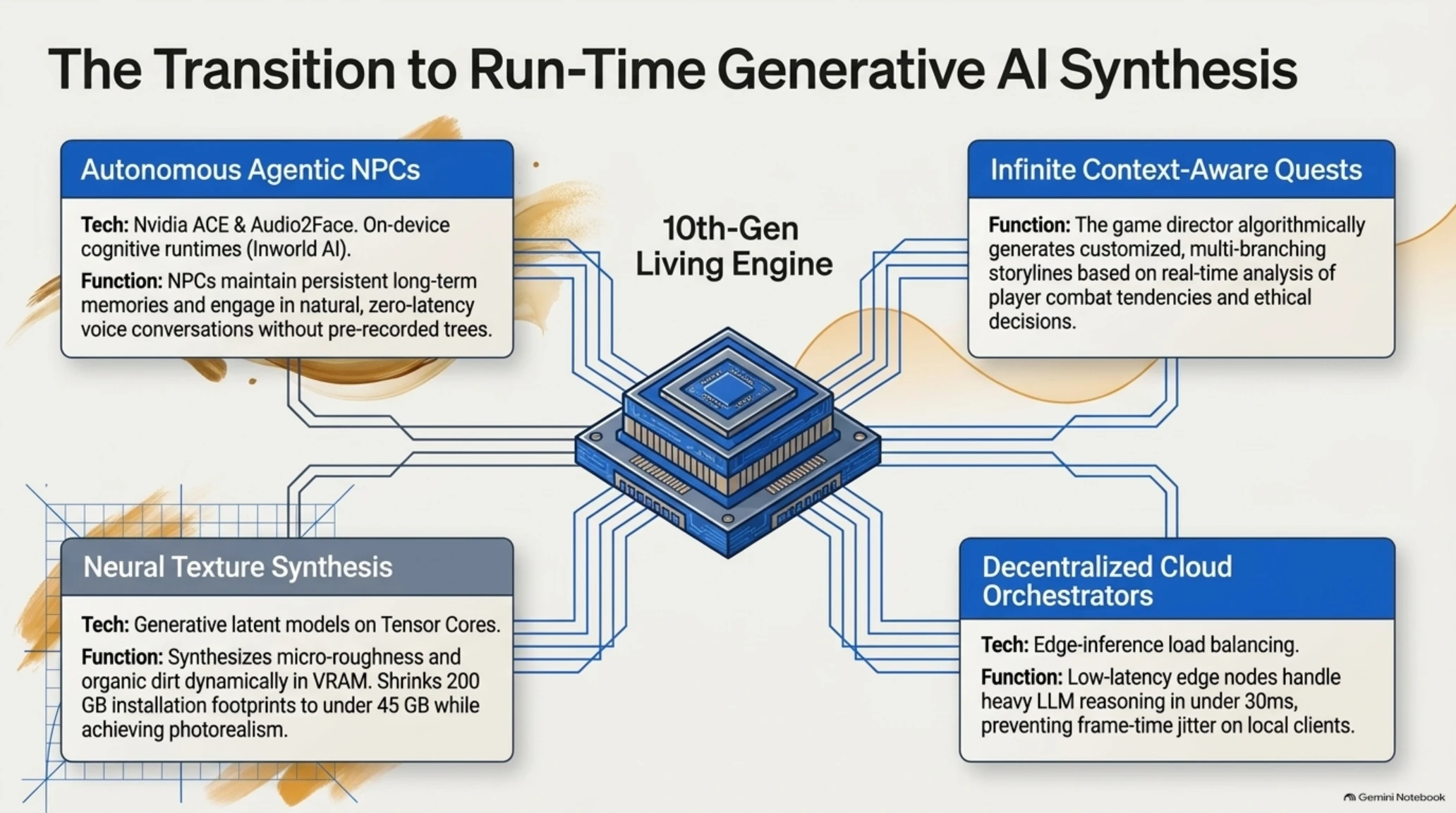
One of the most consequential insights in the Bain & Company report is the architectural shift from «static procedural generation» to «Run-Time Generative AI Synthesis». In previous console cycles, procedural systems were merely randomized permutations of pre-fabricated modular assets that quickly became repetitive. In 2026, the integration of low-latency frontier reasoning models with cutting-edge game engines (Unreal Engine 5.5 and Unity 6) has unlocked completely bespoke, living virtual worlds.
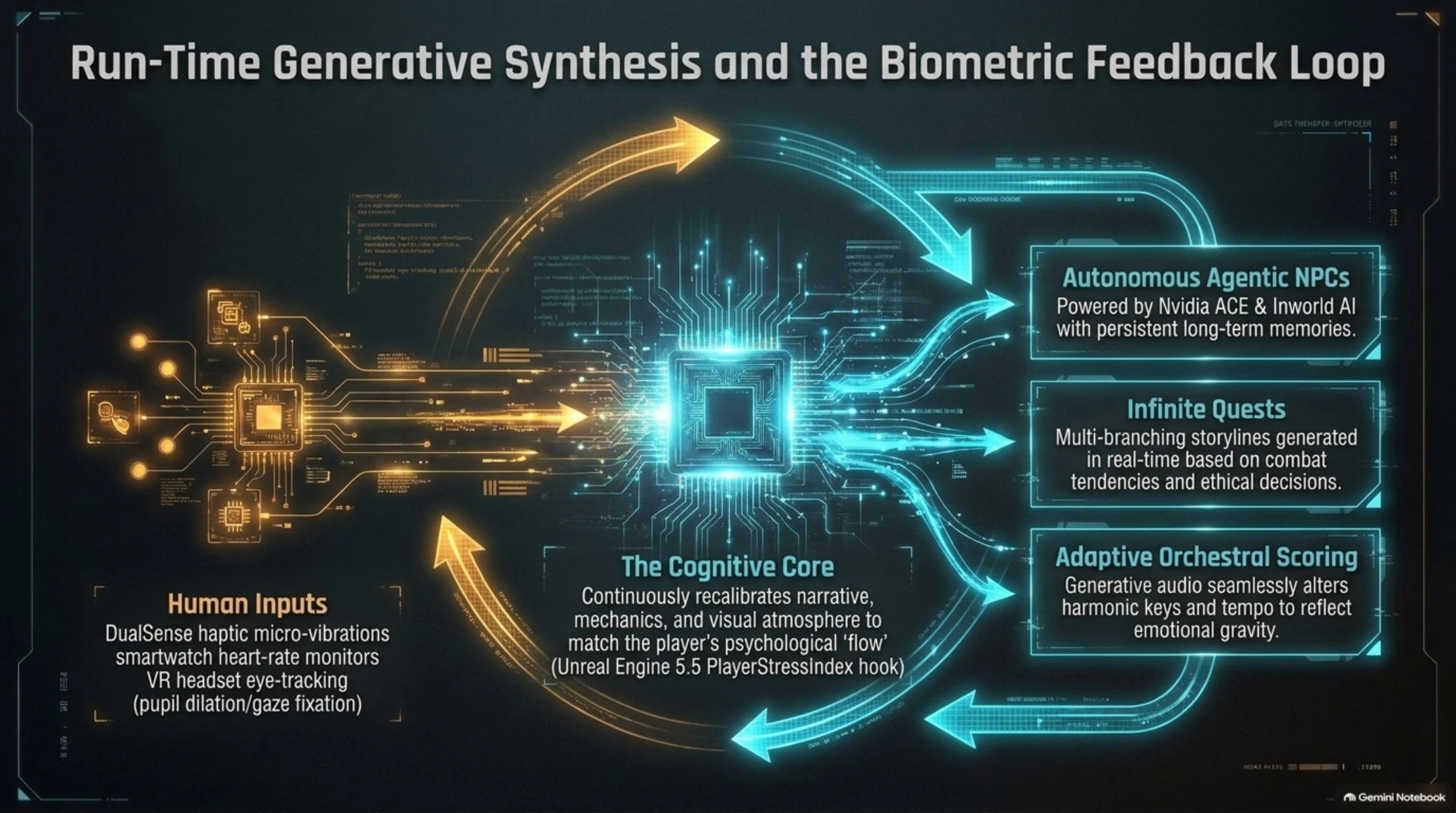
Under this paradigm, an interactive title is no longer a static binary compiled onto an optical disc; it is an adaptive, self-modifying neural simulation that continuously recalibrates its narrative, mechanics, and visual atmosphere to match the player's psychological profile and real-time biometric state:
- Autonomous Agentic NPCs: Characters in modern virtual worlds no longer recite pre-recorded dialogue trees; powered by technologies like Nvidia ACE, Audio2Face generative lip-sync, and on-device cognitive runtimes (Inworld AI), NPCs maintain persistent long-term memories of past interactions, harbor distinct psychological motivations, and engage in natural, voice-driven conversations with zero perceptible latency.
- Infinite Context-Aware Dynamic Quests: Rather than following linear quest scripts, the underlying game director analyzes player combat tendencies, ethical decisions, and exploration preferences, algorithmically generating customized multi-branching storylines in real-time.
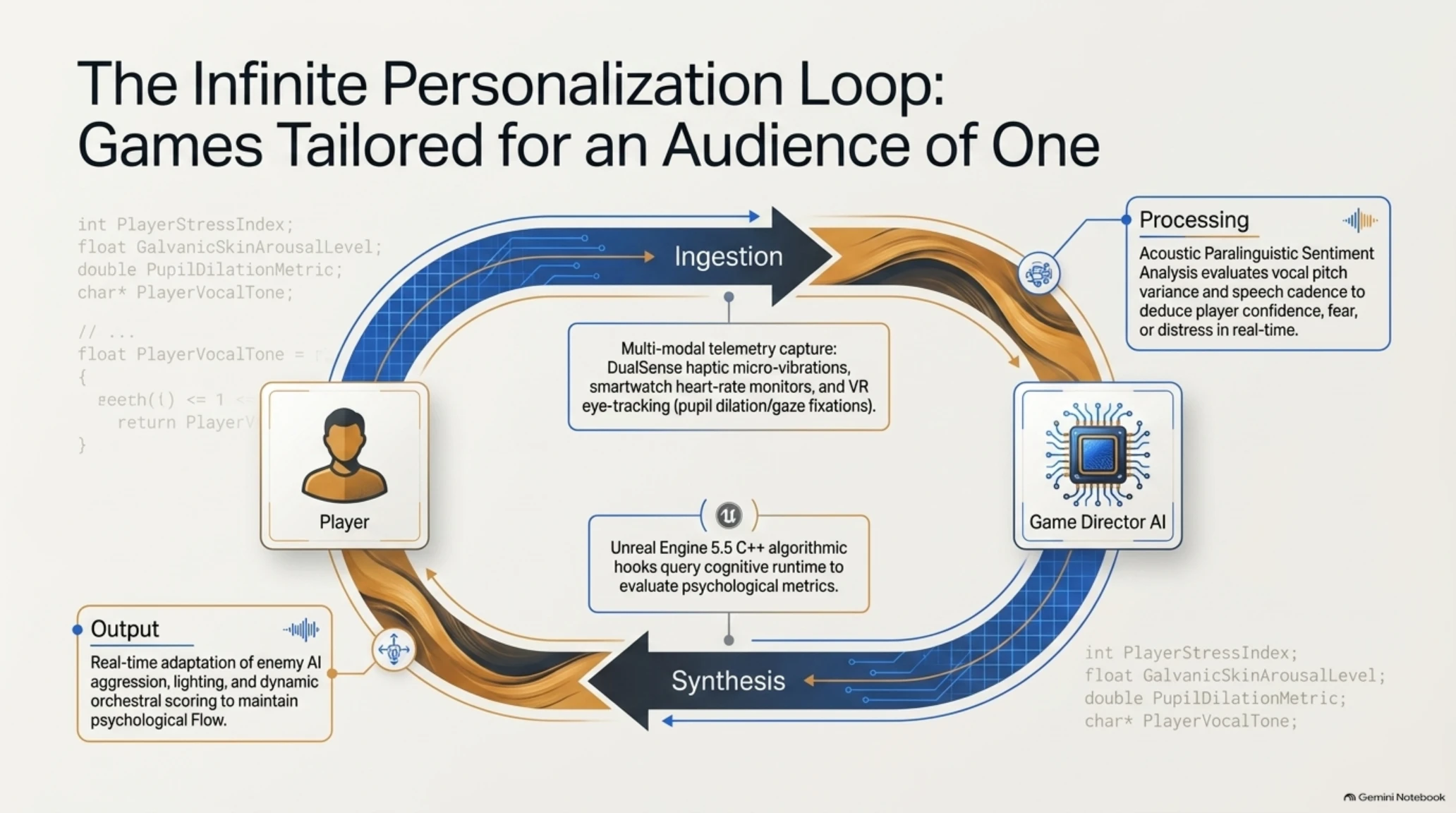
- Biometric Sensor Fusion & Galvanic Skin Response: By ingesting multi-modal telemetry from DualSense haptic micro-vibrations, smartwatch heart-rate monitors, and VR headset eye-tracking cameras (measuring pupil dilation and gaze fixation heatmaps), the game dynamically adjusts enemy tactical AI aggression, environmental lighting, and acoustic tension to maintain the player within optimal psychological «flow».
- Real-Time Adaptive Orchestral Scoring: Generative audio engines synthesize dynamic orchestral leitmotifs on the fly, seamlessly altering harmonic keys, tempo, and instrumental textures to reflect the emotional gravity of the unfolding gameplay.
The code architecture below illustrates an Unreal Engine 5.5 C++ algorithmic hook querying real-time biometric stress telemetry to dynamically spawn tailored narrative encounters:
// Unreal Engine 5.5 - Dynamic Generative AI Game Director Hook (C++)
#include "BiometricTelemetrySubsystem.h"
#include "GenerativeQuestDirector.h"

void UGenerativeQuestDirector::EvaluatePlayerBiometricsAndSynthesizeEncounter(APlayerController* Player)
{
    UBiometricTelemetrySubsystem* BioTelemetry = Player->GetSubsystem();
    const float HeartRateBPM = BioTelemetry->GetAverageHeartRate();
    const float GalvanicArousal = BioTelemetry->GetGalvanicSkinArousalLevel();

    // Query Cognitive Engine to adapt narrative pacing in real-time:
    FGenerativeQuestPrompt ContextPrompt;
    ContextPrompt.PlayerStressIndex = FMath::Clamp((HeartRateBPM - 65.0f) / 60.0f, 0.0f, 1.0f);
    ContextPrompt.CurrentFlowState = (GalvanicArousal > 0.75f) ? EFlowState::HighArousal : EFlowState::CalmExploration;

    // Asynchronously synthesize bespoke encounter logic & NPC behavioral goals:
    this->CognitiveRuntimeEngine->SynthesizeDynamicObjectiveAsync(ContextPrompt, FOnObjectiveSynthesized::CreateLambda(
        [this](const FDynamicEncounterData& SynthesizedEncounter) {
            this->SpawnAdaptiveWorldEvent(SynthesizedEncounter);
        }
    ));
}
Multi-Modal Voice Agents & Real-Time Acoustic Sentiment Analysis
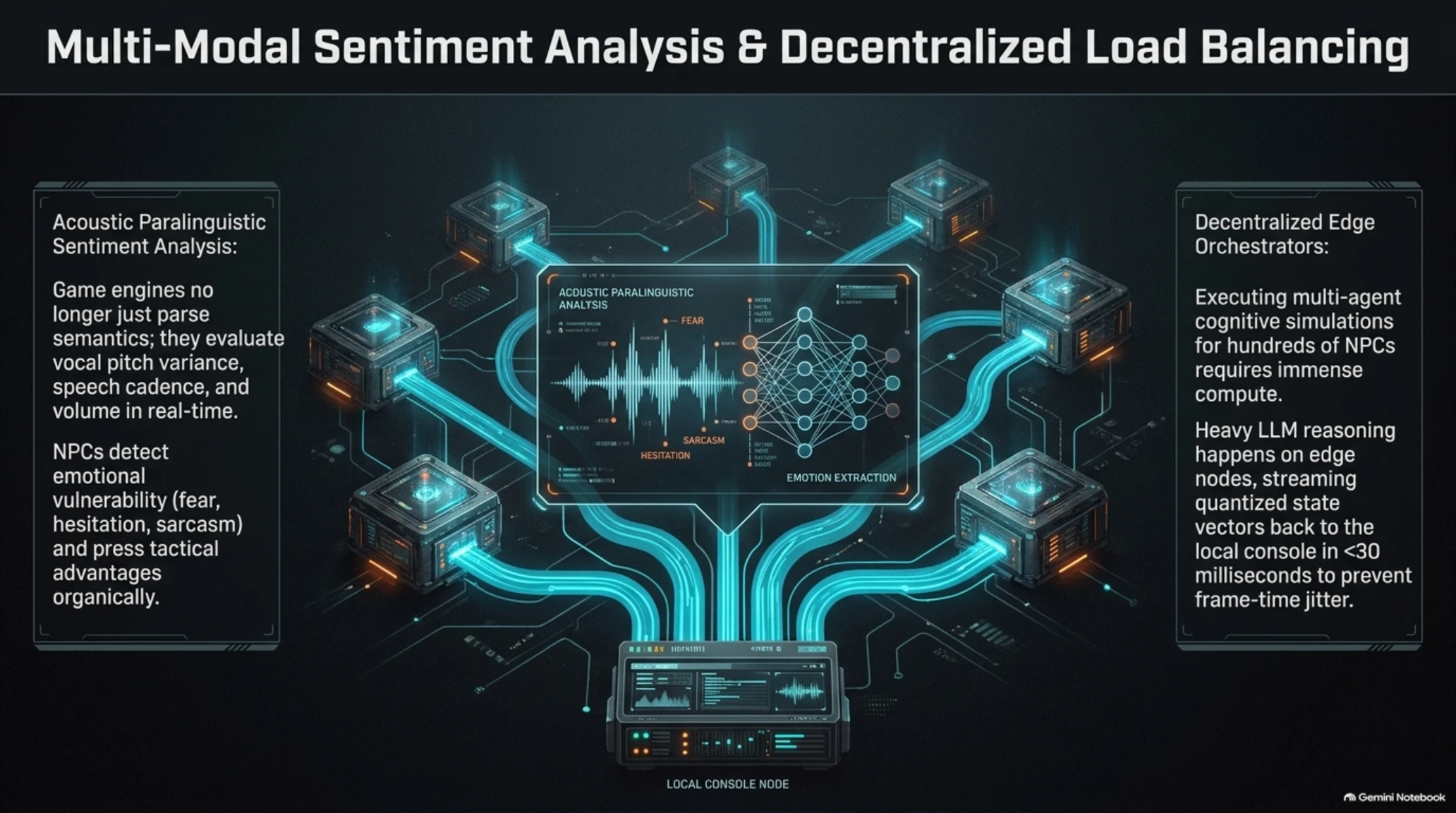
Modern cognitive agent frameworks integrated into tenth-generation game engines do not merely parse the literal semantic meaning of a player's speech; they perform continuous Acoustic Paralinguistic Sentiment Analysis. By evaluating vocal pitch variance, speech cadence, hesitations, and acoustic volume in real-time, the game engine deduces whether the player is confident, frightened, sarcastic, or distressed.
If a player's voice wavers with tension during an interrogation scene in a psychological thriller, the autonomous NPC detects this subtle emotional vulnerability and presses their tactical advantage altering dialogue trajectories dynamically without requiring the player to click on an arbitrary moral choice wheel.
Neural Texture Synthesis & Real-Time GPU Shader Compilation
Beyond audio and dialogue, the graphic fidelity of generative engines relies on Neural Texture Synthesis. In traditional pipelines, streaming 8K uncompressed textures across expansive open-world biomes saturates video memory (VRAM), causing severe frame drops. Modern engines utilize ultra-compact generative latent models running directly on Tensor Cores to synthesize surface micro-roughness, rust, and organic dirt decals dynamically in memory.
By compiling neural shaders asynchronously within fractional millisecond intervals, game worlds present limitless visual diversity without bloating game download sizes shrinking 200 GB installation footprints down to under 45 GB while delivering unprecedented surface photorealism.
Decentralized Cloud Orchestrators & Edge-Inference Load Balancing
Executing multi-agent cognitive simulations for hundreds of simultaneous NPCs requires immense compute resources. To prevent frame-time jitter on local consumer hardware, studios deploy Decentralized Edge Orchestrators. Low-latency edge nodes handle heavy LLM reasoning and dialogue generation, streaming quantized state vectors back to the local client in under 30 milliseconds.
The technical engineering documentary below provides a comprehensive walkthrough of tenth-generation generative game engines and autonomous NPC cognitive runtimes:
The conceptual rendering below visualizes a player engaged in an unscripted, natural voice conversation with an autonomous agentic NPC inside a photorealistic cyberpunk metropolis:
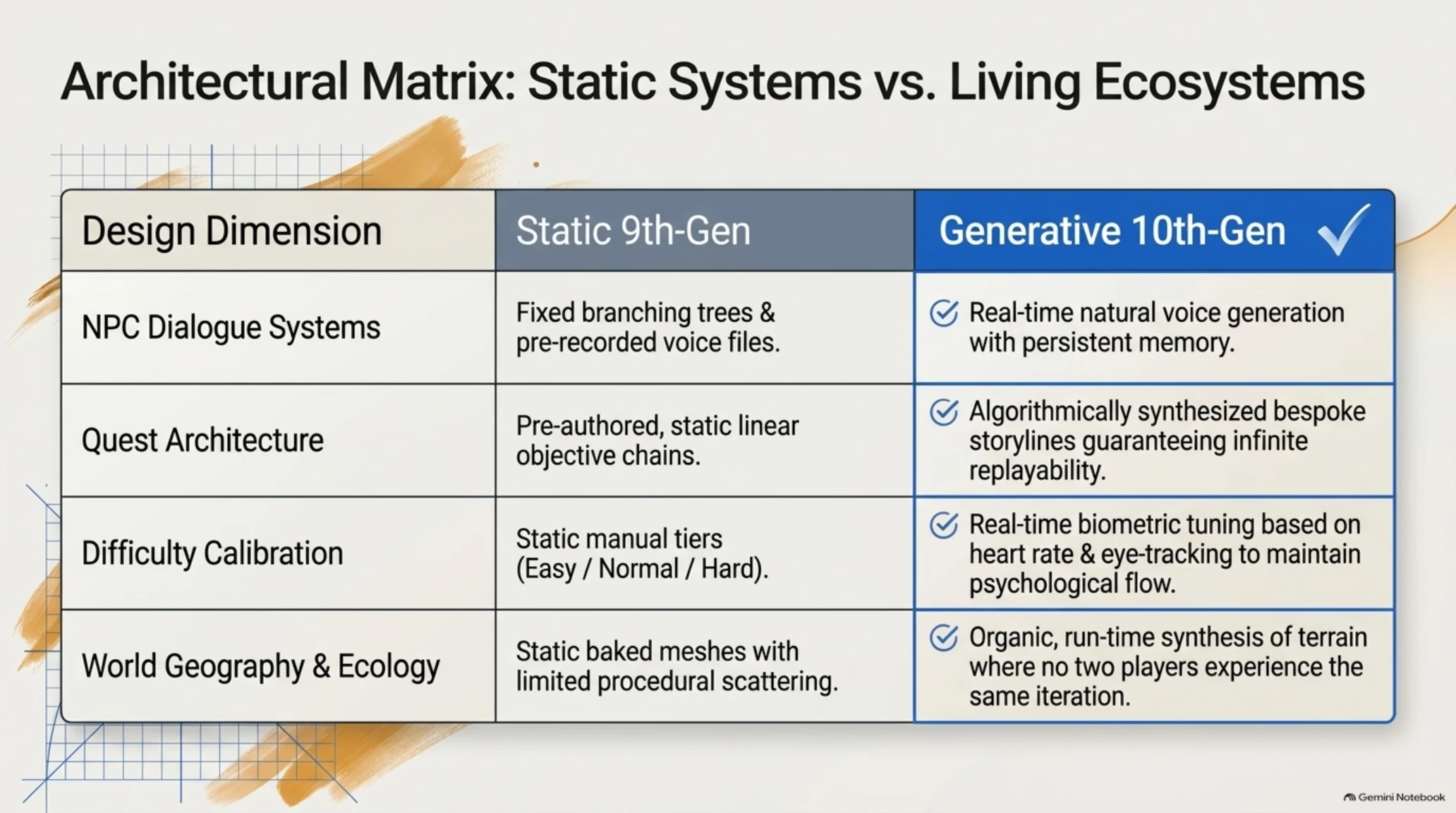
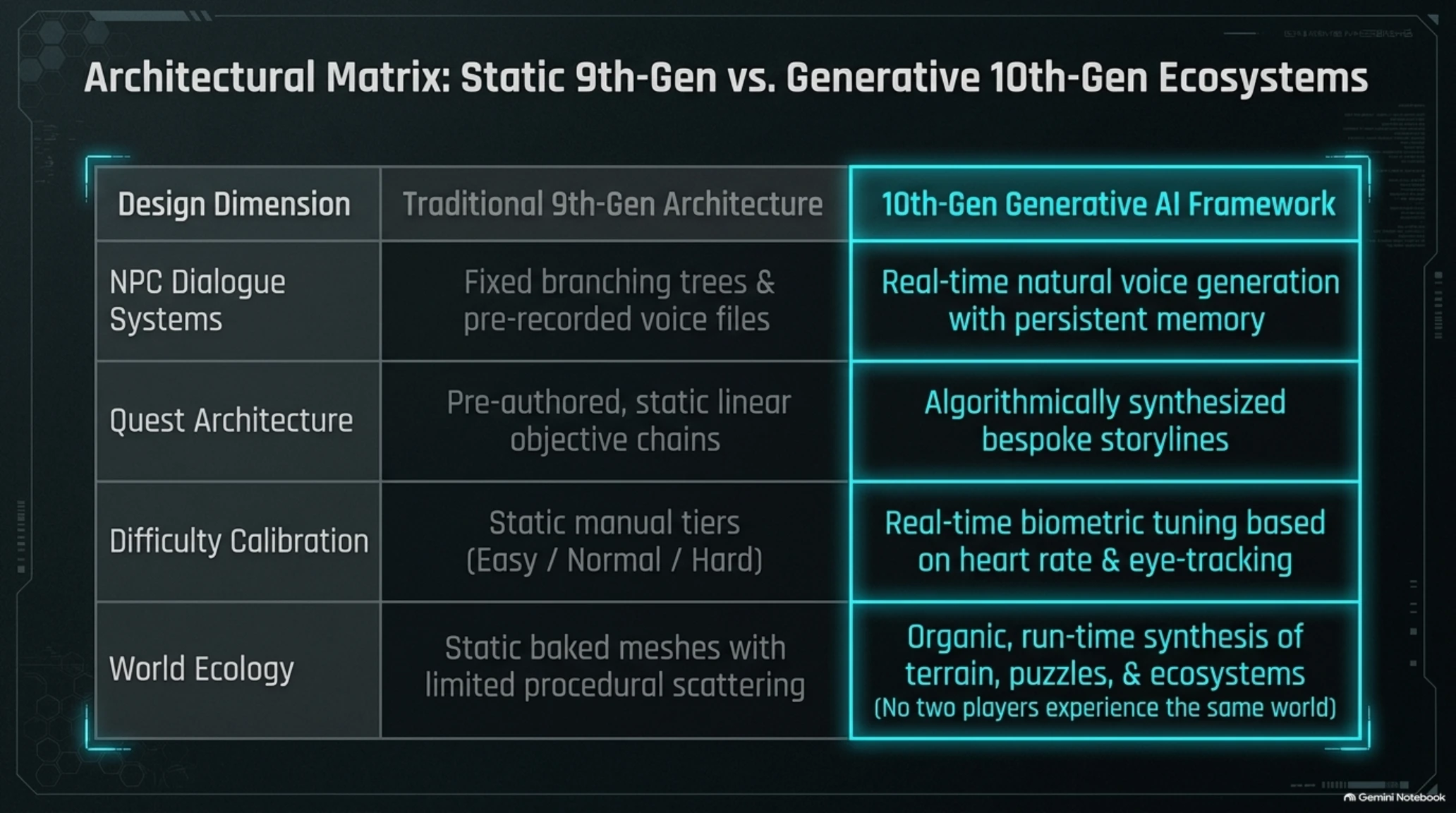
The comparative matrix below illustrates the profound technical and experience distinctions between ninth-generation games and tenth-generation generative AI ecosystems:
Architectural Matrix: Static 9th-Gen Game Design vs. Generative AI 10th-Gen Living Ecosystems
| Design Dimension | Traditional 9th-Gen Architecture | 10th-Gen Generative AI Framework | Impact on Player Experience |
|---|---|---|---|
| NPC Dialogue Systems | Fixed branching trees & pre-recorded voice files | Real-time natural voice generation with persistent memory | Deep, unrepeatable emotional bonds with game characters |
| Quest Architecture | Pre-authored, static linear objective chains | Algorithmically synthesized bespoke storylines | Infinite replayability with zero repetitive content |
| Difficulty Calibration | Static manual tiers (Easy / Normal / Hard) | Real-time biometric tuning based on heart rate & eye-tracking | Continuous retention in the psychological 'Flow' zone |
| Acoustic & Musical Scoring | Looped pre-recorded interactive audio stems | Real-time orchestral composition matching scene tension | Unprecedented cinematic immersion tailored to player action |
| World Geography & Ecology | Static baked meshes with limited procedural scattering | Organic, run-time synthesis of terrain, puzzles, & ecosystems | No two players ever experience the same world iteration |
However, this computational power has triggered a severe crisis of consumer trust and artistic backlash, which we dissect in the next section: The War on AI-Slop.
3. The Gamer Revolt Against AI-Slop & The Crisis of Studio Credibility
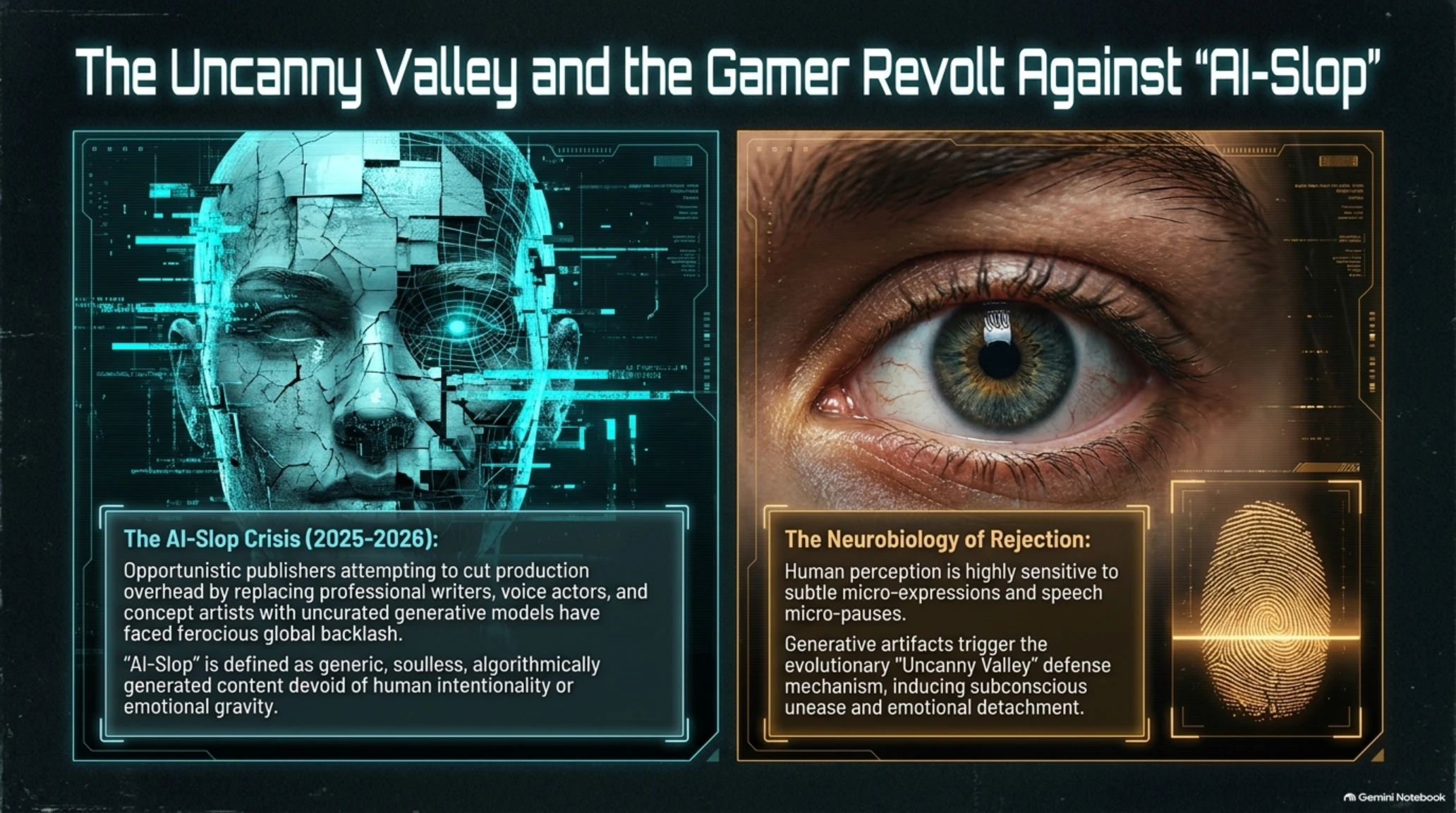
Parallel to the revolutionary promises of generative technology, 2025 and 2026 witnessed an intense consumer rebellion across the global gaming landscape: what the Bain & Company report classifies as «The AI-Slop Crisis». When opportunistic publishers attempted to cut production expenditures by replacing professional voice actors, narrative writers, and environmental concept artists with uncurated, low-effort generative models, they were met with ferocious consumer backlash on Steam, Reddit, Metacritic, and Discord.
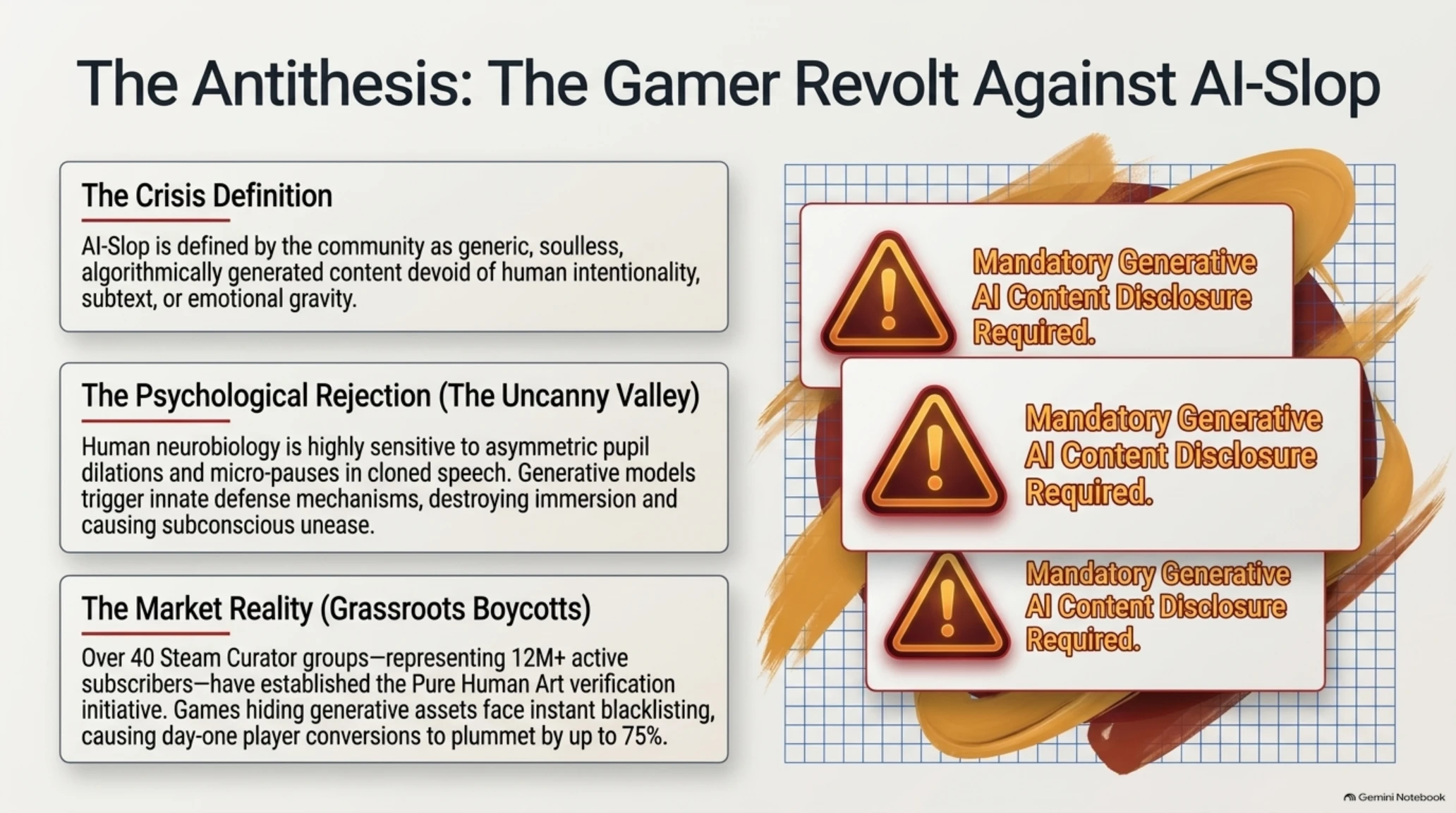
The gaming community defines «AI-Slop» as generic, soulless, algorithmically generated content devoid of human intentionality, subtext, or emotional gravity manifested in blurry, incoherent texture maps, monotone synthetic voice performances, and hollow, formulaic narrative quests. High-profile review-bombing campaigns crippled the launch sales of multiple titles attempting to pass off unrefined machine outputs as premium retail products.
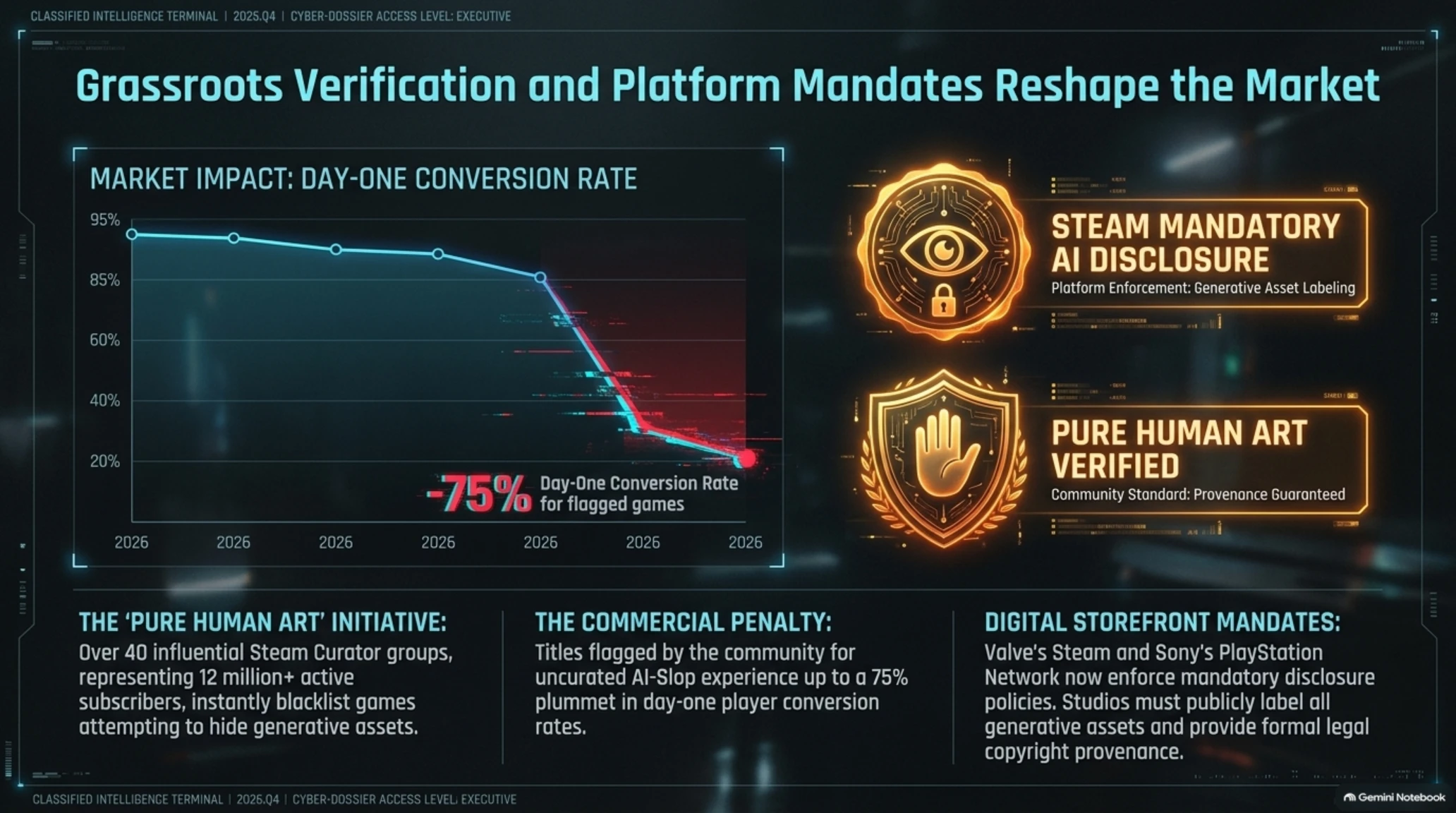
In response, major digital storefronts most notably Valve's Steam and Sony's PlayStation Network enacted mandatory disclosure policies requiring studios to publicly label all generative AI assets and provide formal legal certifications guaranteeing that underlying training data did not infringe on protected intellectual property.
The Rise of 'Pure Human Art' Steam Curators & Consumer Boycotts
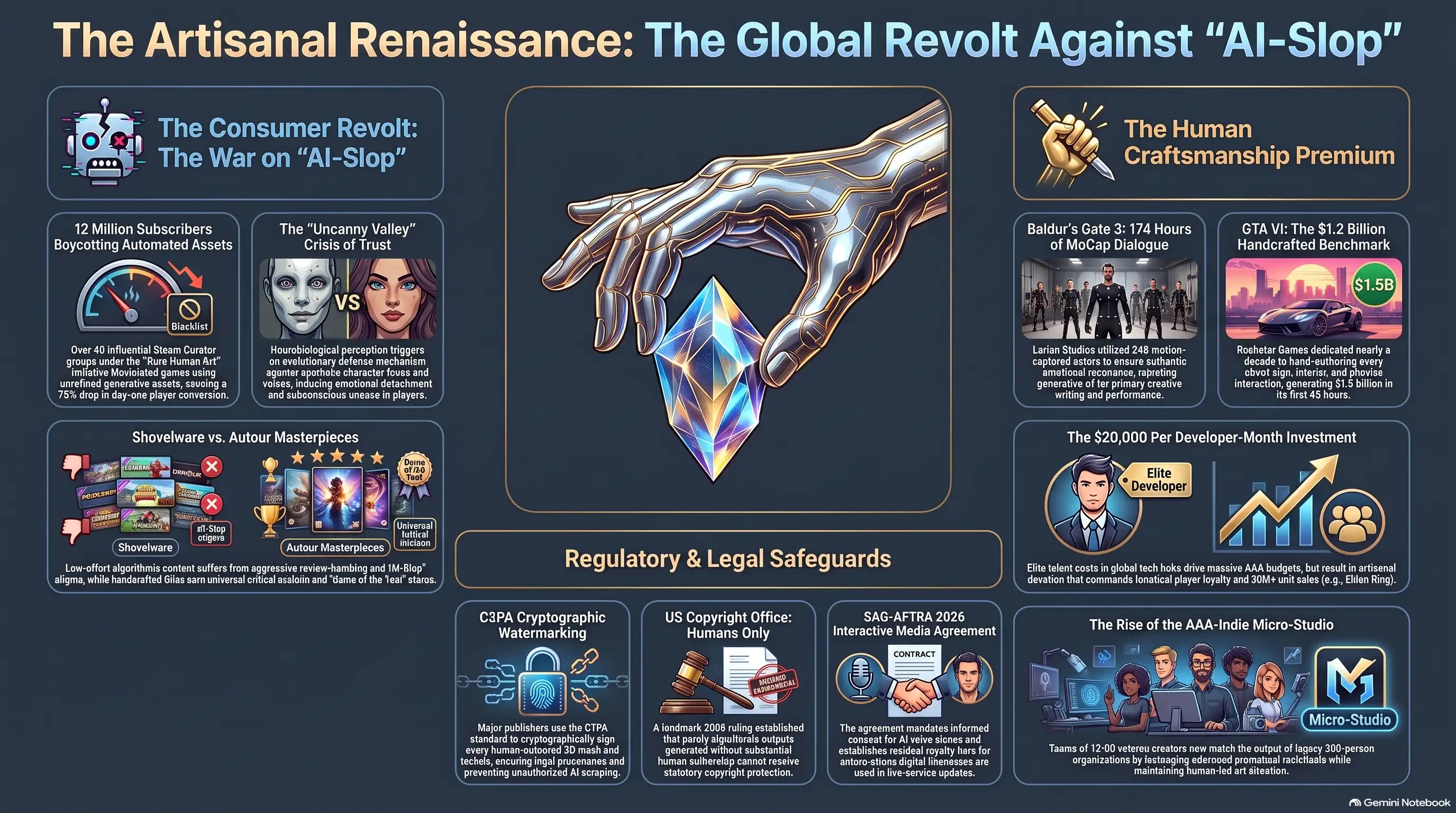
The consumer rebellion quickly organized into powerful grassroots institutions. Over 40 influential Steam Curator groups collectively representing more than 12 million active subscribers established the «Pure Human Art» verification initiative. Games that attempt to hide generative assets are instantly blacklisted and tagged across gaming subreddits, causing day-one player conversion rates to plummet by up to 75%.
Conversely, games bearing verified badges of 100% human-crafted art and voice acting experience substantial organic visibility boosts, establishing that authenticity has become a primary commercial marketing differentiator in the 2026 digital marketplace.
Cognitive Psychology: The Uncanny Valley in Generative Assets
The neurobiology of player immersion explains why gamers react so viscerally against AI-Slop. Human perception possesses an innate, highly refined sensitivity to subtle micro-expressions, asymmetric pupil dilations, and micro-pauses in human speech. When generative models produce synthetic character faces or clone voices, they trigger the evolutionary «Uncanny Valley» defense mechanism, inducing subconscious unease and emotional detachment in players.
Case Studies in Artisanal Triumph: FromSoftware, Larian, & Supergiant Games
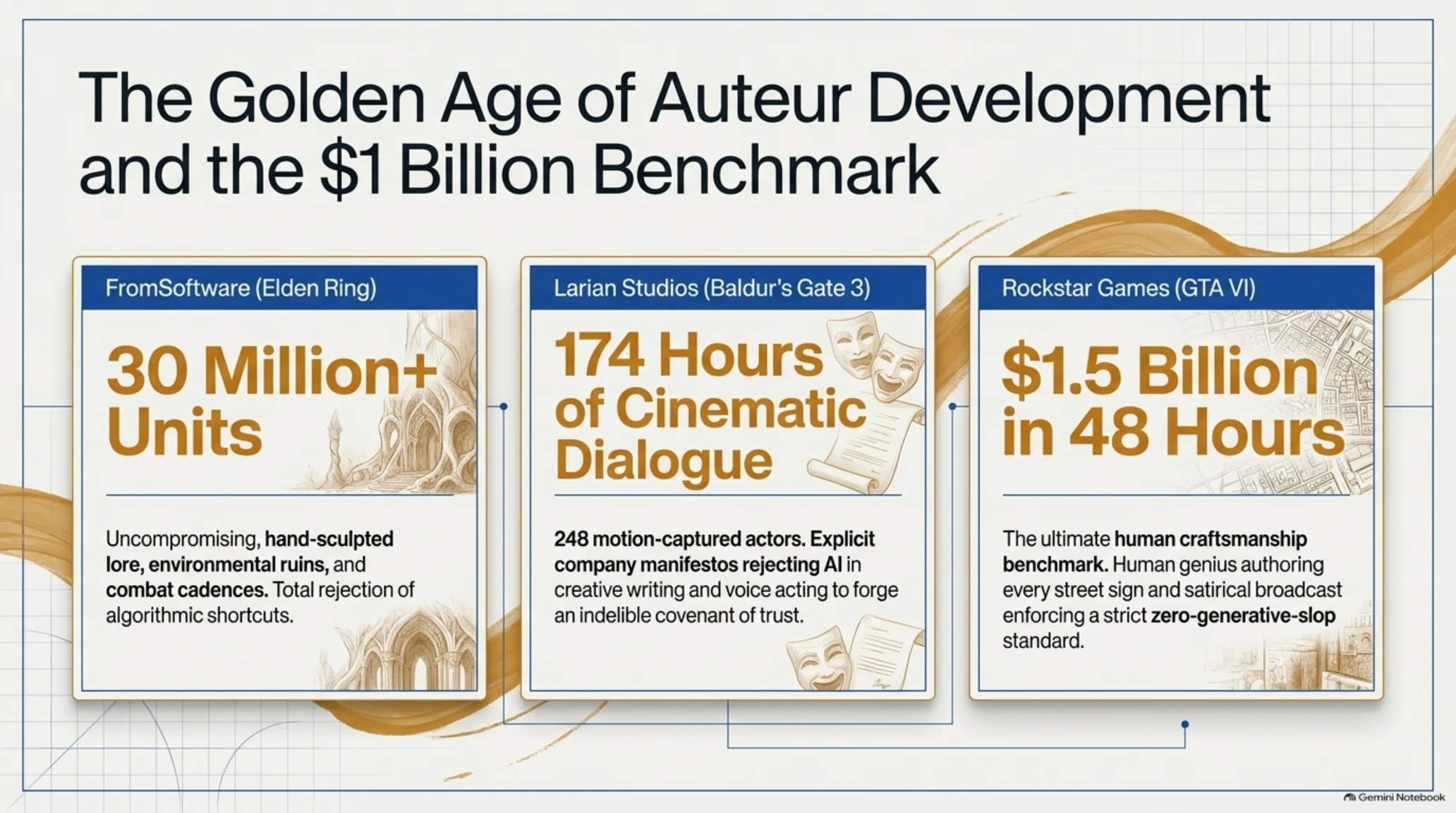
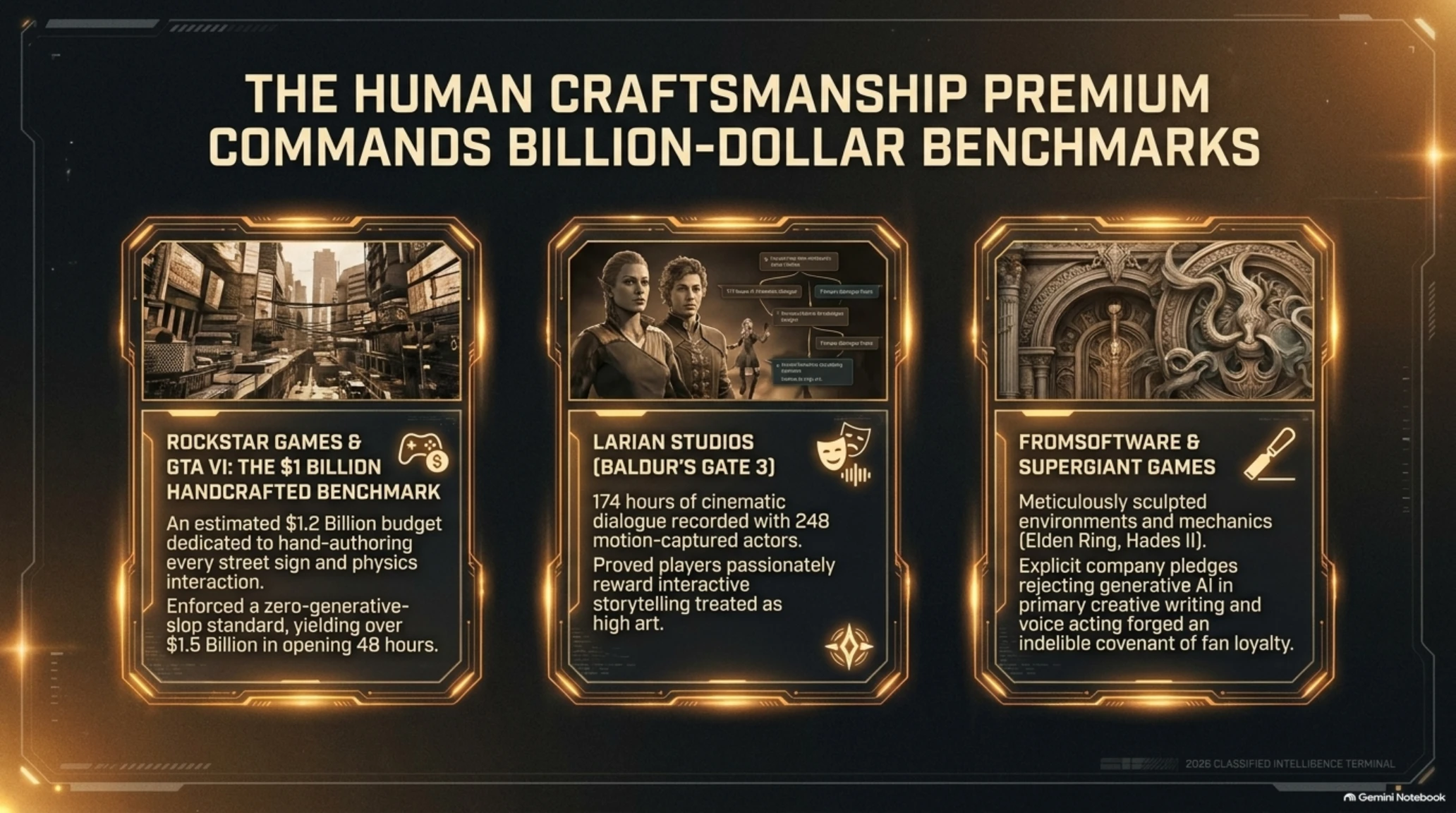
The consumer rejection of algorithmic shortcuts has catalyzed a golden age for visionary auteur development houses. When FromSoftware released Elden Ring: Shadow of the Erdtree, every environmental ruin, enemy attack cadence, and piece of weapon lore was meticulously conceived, sculpted, and balanced by human hands, resulting in over 30 million units sold worldwide.
Similarly, Larian Studios' monumental success with Baldur's Gate 3 featuring 174 hours of cinematic dialogue recorded with 248 motion-captured actors proved that players will passionately reward studios that treat interactive storytelling as high art. In their official company manifestos, both Larian Studios and Supergiant Games (creators of Hades II) explicitly pledged to reject generative AI in primary creative writing, voice acting, and concept illustration, establishing an indelible covenant of trust with their global fan bases.
Rockstar Games & GTA VI: The $1 Billion Handcrafted Benchmark
No project exemplifies the supremacy of human craftsmanship more vividly than Rockstar Games' Grand Theft Auto VI. With an estimated lifetime budget surpassing $1.2 Billion, Rockstar dedicated nearly a decade to hand-authoring every street sign, interior apartment layout, satirical radio broadcast, and physics interaction across the sprawling state of Leonida.
By enforcing a strict zero-generative-slop standard for core narrative design, Rockstar created a cultural phenomenon that generated over $1.5 Billion in its opening 48 hours solidifying the reality that when it comes to monumental cultural milestones, the world demands uncompromising human genius.
The conceptual rendering below depicts the gamer community rallying across digital networks in defense of authentic human artistic craftsmanship:
In stark contrast to the rejection of algorithmic shovelware, the Bain report highlights the exponential rise of the «Human Craftsmanship Premium». Handcrafted titles that demonstrate painstaking artisanal devotion, visionary auteur direction, and deep narrative nuance such as Elden Ring, Baldur's Gate 3, Hades II, and the monumental Grand Theft Auto VI have garnered unprecedented cultural reverence, commanding massive commercial success and fanatical player loyalty.
The conceptual rendering below showcases the intricate detail, intentional environmental lighting, and auteur craftsmanship of human-designed virtual worlds:
📚 Classified & Related Dossiers in TekinGame
If you wish to explore beyond this report and delve into cybernetic frontiers and autonomous AI architectures, do not miss these three exclusive deep-dives in the Tekin Garage:
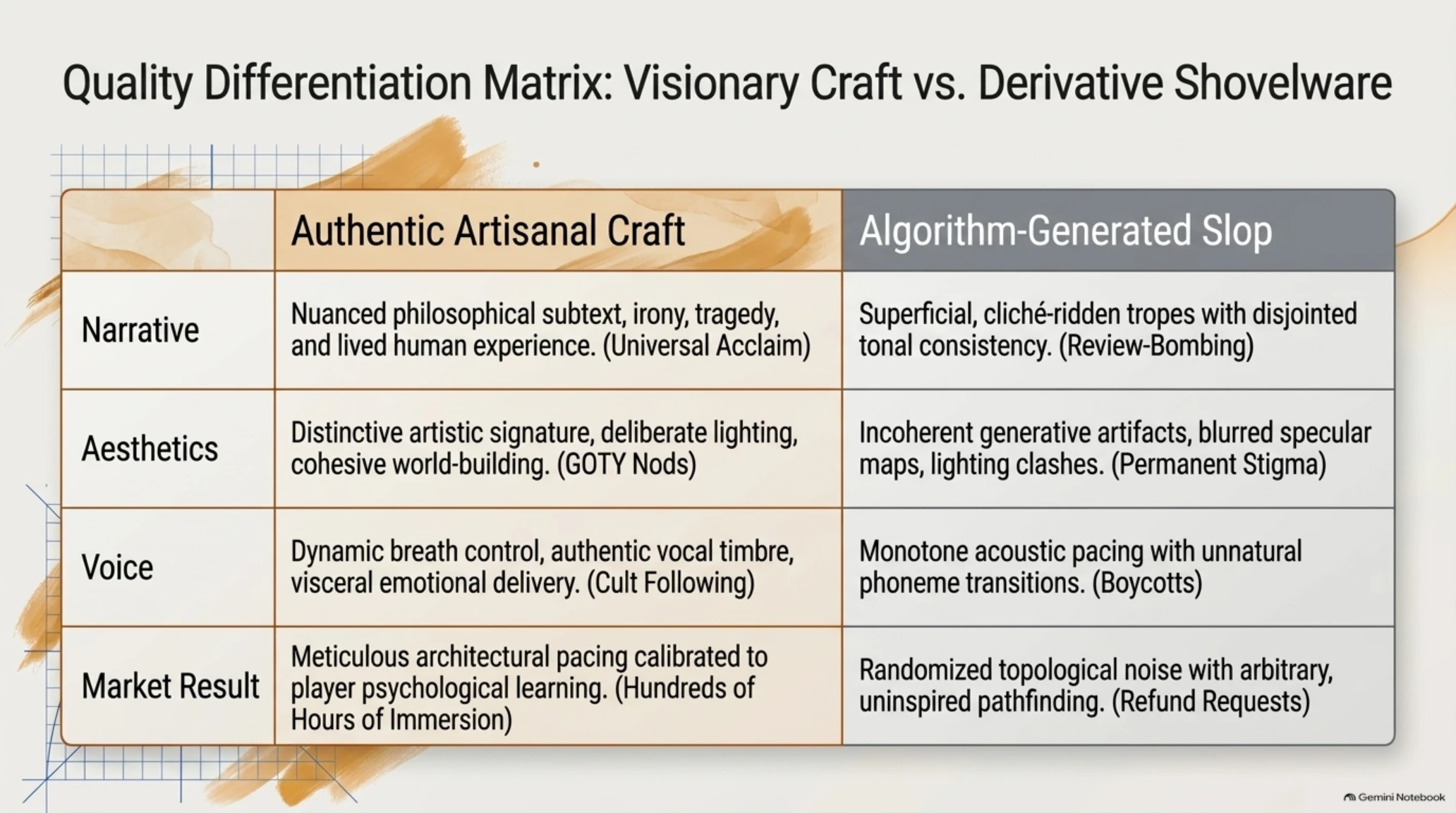
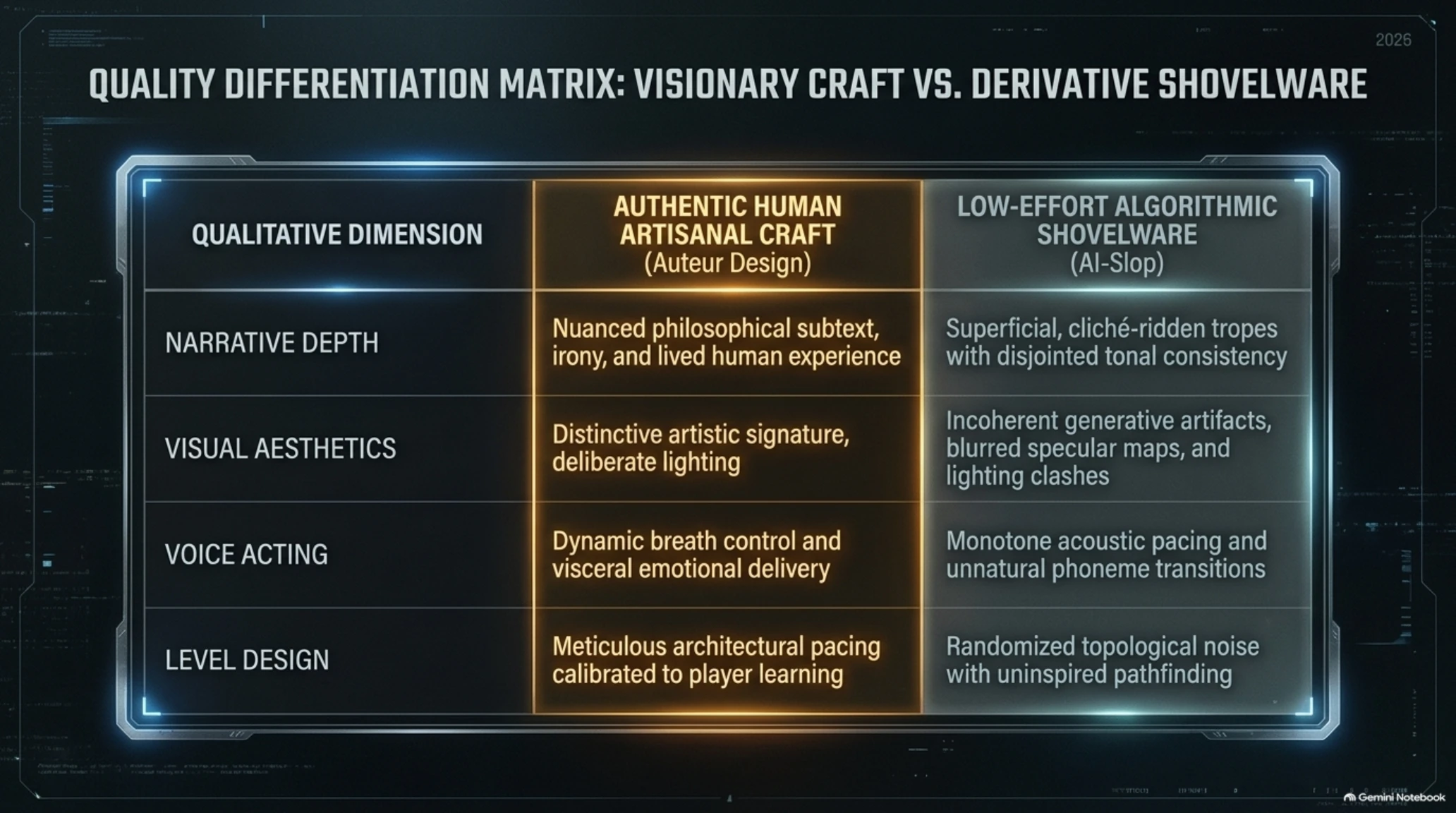
Quality Differentiation Matrix: Visionary Human Craftsmanship vs. Derivative AI-Slop Shovelware
| Qualitative Dimension | Authentic Human Artisanal Craft (Auteur Design) | Low-Effort Algorithmic Shovelware (AI-Slop) | Market Reception & Consumer Sentiment |
|---|---|---|---|
| Narrative Depth & Emotional Resonance | Nuanced philosophical subtext, irony, tragedy, and lived human experience | Superficial, cliché-ridden tropes with disjointed tonal consistency | Universal critical acclaim vs. aggressive review-bombing |
| Visual & Environmental Aesthetics | Distinctive artistic signature, deliberate lighting, & cohesive world-building | Incoherent generative artifacts, blurred specular maps, & lighting clashes | Game of the Year nominations vs. permanent AI-Slop stigma |
| Voice Acting & Performance Nuance | Dynamic breath control, authentic vocal timbre, & visceral emotional delivery | Monotone acoustic pacing with unnatural phoneme transitions | Cult following for actors vs. consumer boycott campaigns |
| Level Design & Spatial Flow | Meticulous architectural pacing calibrated to player psychological learning | Randomized topological noise with arbitrary, uninspired pathfinding | Hundreds of hours of deep immersion vs. immediate refund requests |
4. The Macroeconomics of Game Development: $300M+ AAA Budgets vs. AI-Augmented Micro-Studios
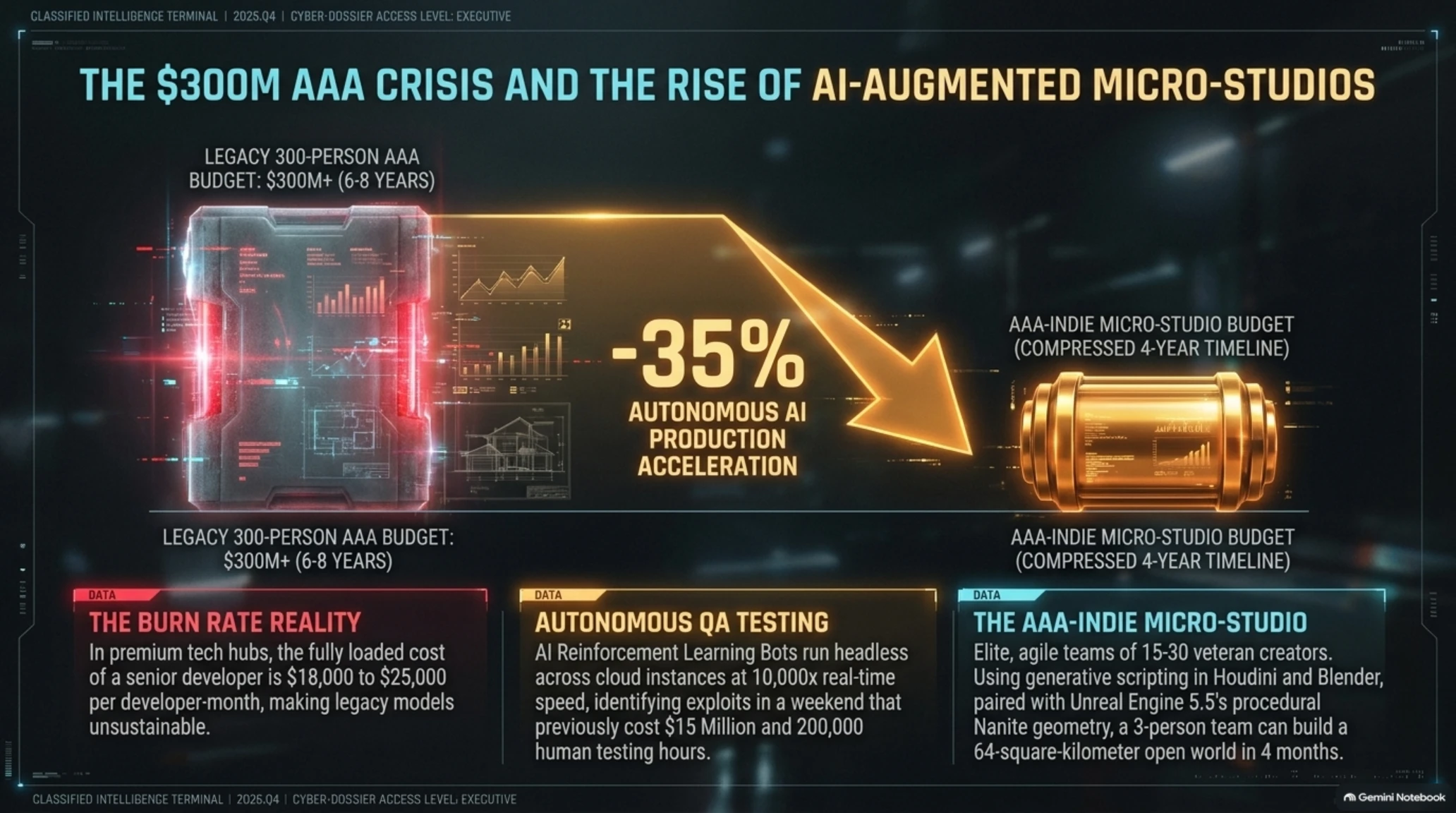
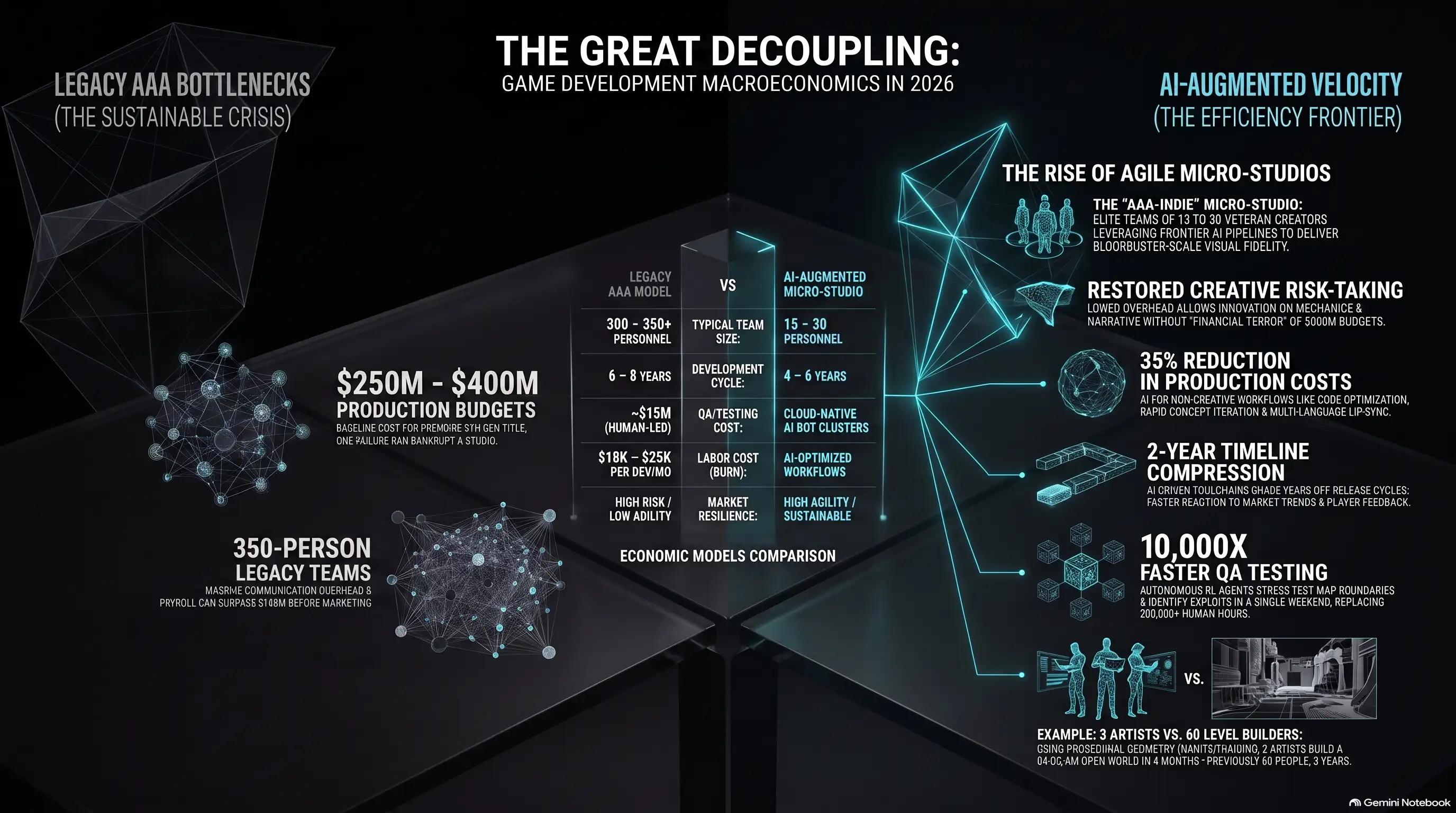
The traditional blockbuster (AAA) development model had reached an unsustainable economic cliff. Delivering a premiere ninth-generation title routinely demanded astronomical budgets between $250M and $400M and protracted development cycles spanning six to eight years; under this financial burden, even a minor commercial underperformance could precipitate the immediate dissolution of a multi-decade studio.
The Bain & Company report demonstrates that when generative AI tools are deployed responsibly as internal production accelerators in non-creative, labor-intensive workflows like automated QA bug testing, code optimization, rapid concept iteration, and multi-language acoustic lip-synchronization studios achieve a 35% reduction in production costs and shave up to two years off the release cycle.
Autonomous QA Testing: AI Bots Discovering Exploits 10,000x Faster
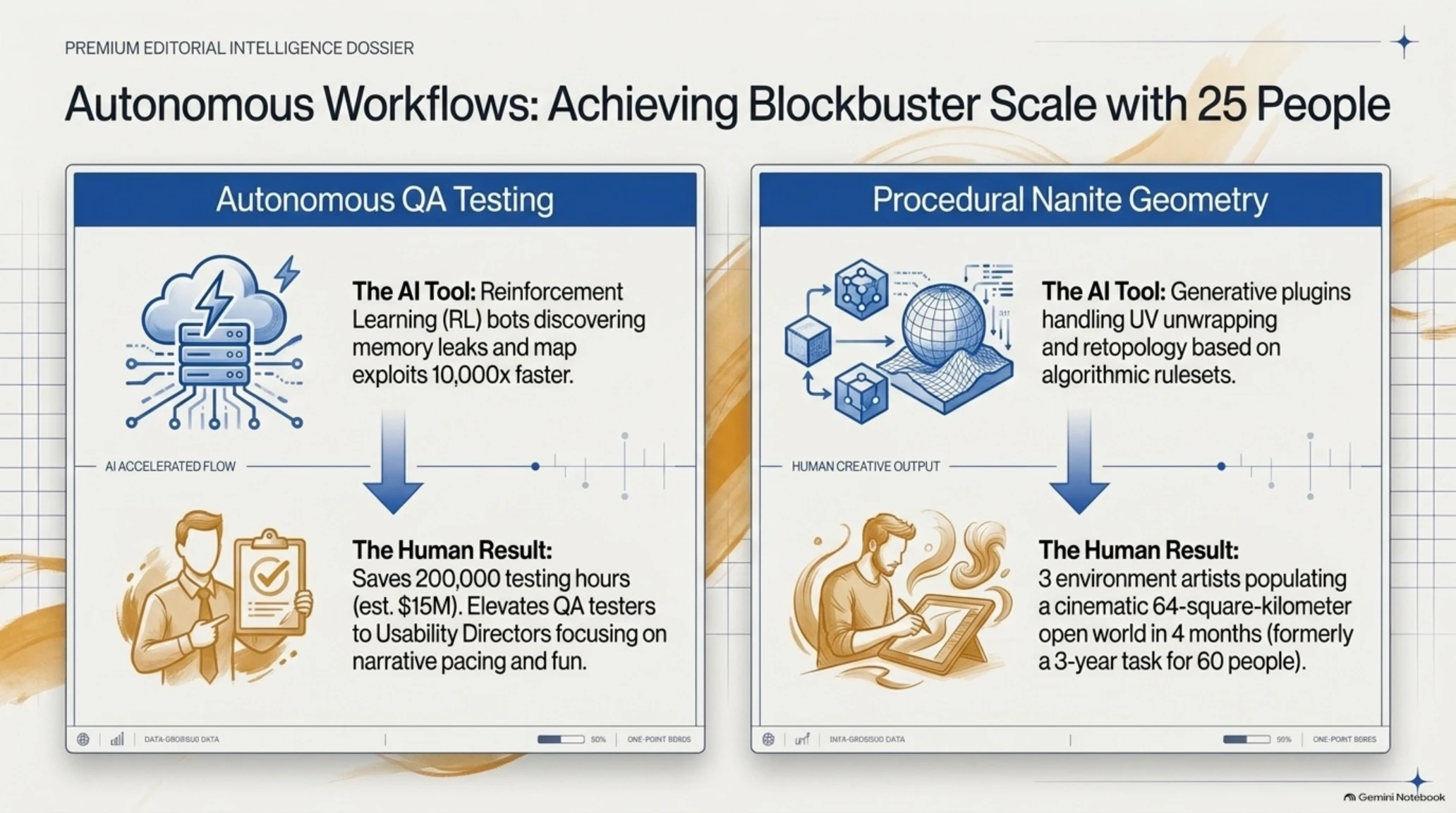
One of the single largest line-item expenses in modern game production is Quality Assurance (QA) and regression testing. In a massive open-world RPG, coordinating hundreds of human QA testers to verify every dialogue branch, collision boundary, and physics edge-case routinely requires upwards of 200,000 human testing hours, costing upwards of $15 Million per project.
Modern studio pipelines deploy Autonomous Reinforcement Learning QA Agents. These AI agents run headless across cloud instances at 10,000x real-time speed, stress-testing map boundaries, discovering memory leak triggers, and identifying game-breaking combat exploits in a single weekend. Human QA professionals are elevated to higher-tier usability directors, focusing exclusively on narrative pacing, emotional impact, and mechanical fun.
The Financial Mathematics of Studio Burn Rates: $20,000 Per Developer-Month
The macroeconomic crisis of AAA development is fundamentally a labor cost equation. In premiere global tech hubs including Los Angeles, San Francisco, London, and Tokyo the fully loaded cost of a senior game engineer or technical artist (factoring in salary, healthcare, workstation hardware, software licensing, and studio overhead) ranges between $18,000 and $25,000 per developer-month.
For a legacy 350-person studio operating over a 6-year development cycle, baseline payroll alone surpasses $150 Million before allocating a single dollar to marketing or distribution. By transitioning toward agile micro-studios augmented by generative toolchains, production overhead is dramatically reduced, restoring creative risk-taking and financial sustainability to the medium.
This economic efficiency has catalyzed the rise of «AAA-Indie Micro-Studios»: elite, agile teams comprising 15 to 30 veteran creators who, leveraging frontier AI pipelines and advanced modular game engines, are delivering interactive experiences that rival the scale and visual fidelity of legacy 300-person corporate developers.
The Indie Micro-Studio Toolchain: Houdini, Blender, & Procedural Nanite Geometry
The technological democratization empowering micro-teams stems from the synthesis of generative scripting with procedural geometry nodes. Small independent studios no longer manually model hundreds of thousands of individual environmental props. Instead, technical artists construct algorithmic rulesets in Houdini and Blender, while generative plugins automatically handle UV unwrapping, normal map baking, and high-to-low polygon retopology.
Integrated with Unreal Engine 5.5's virtualized micro-polygon geometry system (Nanite) and Lumen global illumination, a team of three 3D environment artists can now populate a 64-square-kilometer open world with cinematic fidelity in under four months a milestone that previously demanded sixty dedicated level builders over three years.
The conceptual rendering below visualizes the modern hybrid studio workspace where elite human creators leverage AI acceleration pipelines to build next-generation worlds:
In our final section, we explore the platform wars, cloud ecosystems, and the strategic manifesto for the future of interactive entertainment.
5. Platform Wars, Cloud Ecosystems, & Interactive Metaverses (2026–2030)
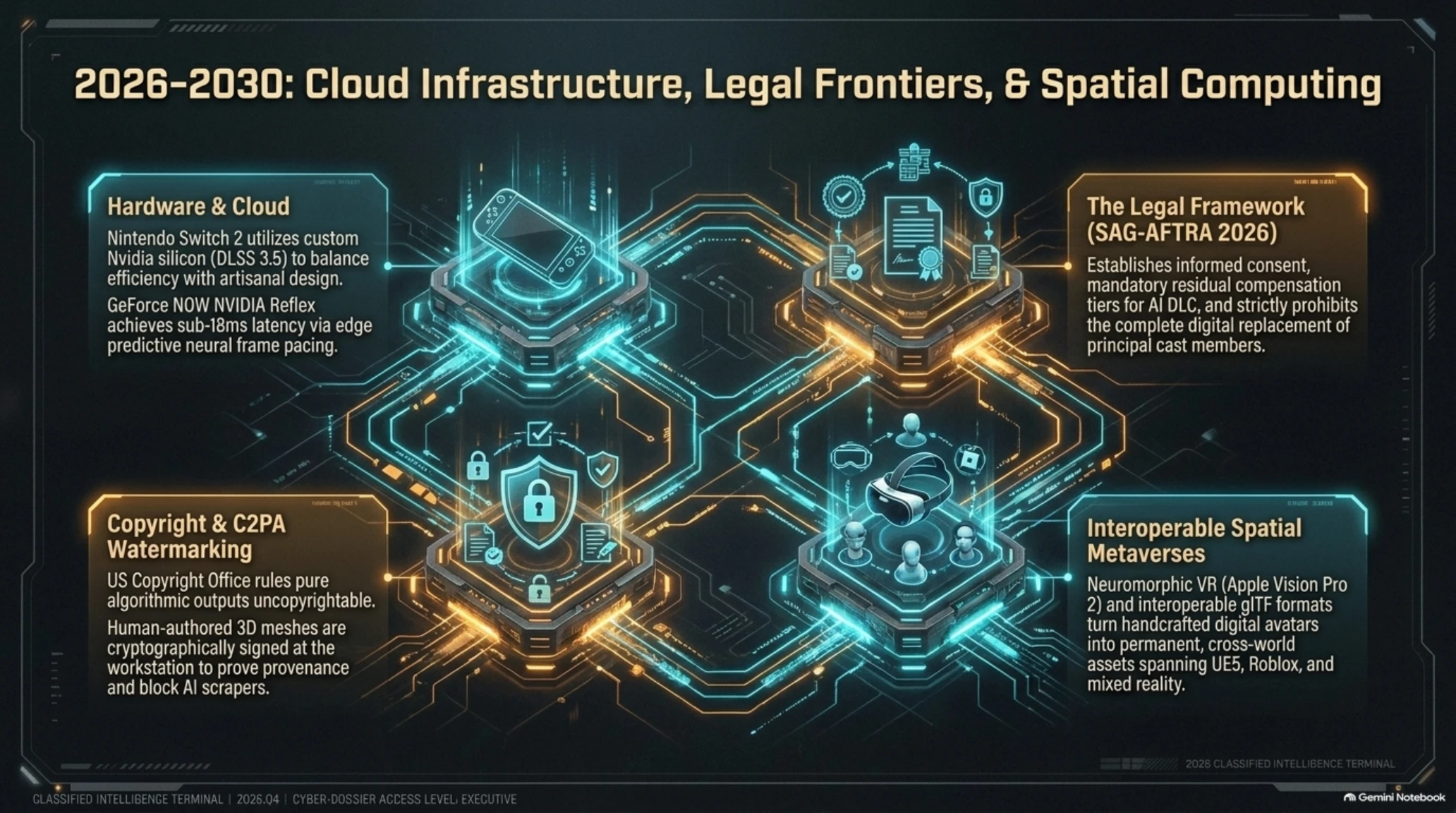
The 2026–2030 trajectory points toward the full integration of high-performance local console silicon with distributed cloud infrastructure. While mid-generation flagship consoles like the PlayStation 5 Pro and the ground-breaking Nintendo Switch 2 leverage advanced neural upscaling (PlayStation Spectral Super Resolution - PSSR and Nvidia DLSS 3.5 with Ray Reconstruction) to deliver 4K 120 FPS fidelity, hyperscale cloud gaming platforms are executing server-side neural physics and dynamic fluid simulations.
Nintendo Switch 2: Custom Nvidia Silicon & The Artisanal Gameplay Philosophy
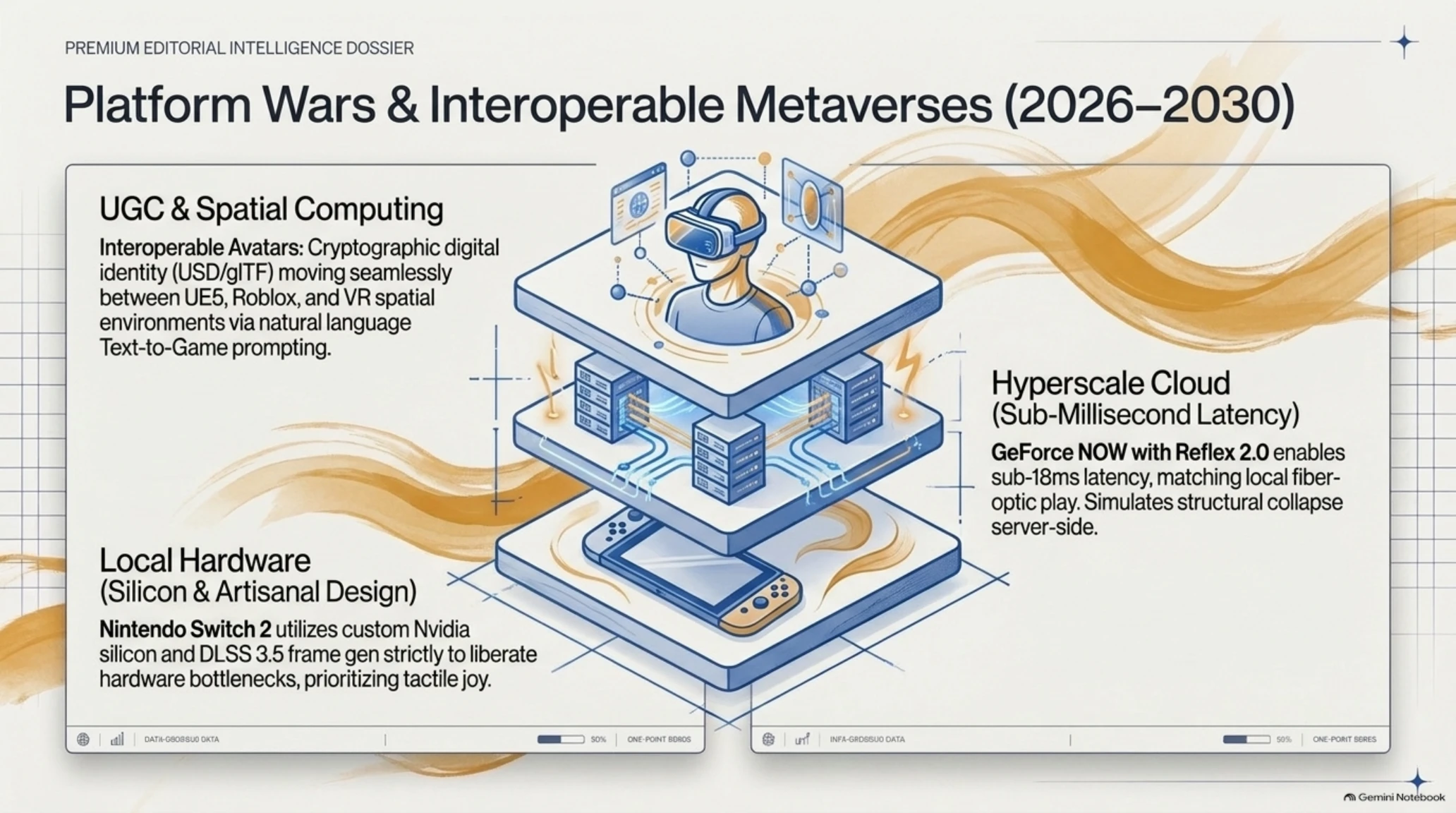
The global launch of the Nintendo Switch 2 represents the physical embodiment of balancing silicon efficiency with artisanal game design. Powered by custom Nvidia silicon featuring dedicated Tensor Cores, the hybrid handheld utilizes Deep Learning Super Sampling (DLSS 3.5) with advanced frame generation to upscale 720p internal render targets to pristine 4K output on living room displays.
Crucially, Nintendo's internal software philosophy remains staunchly human-centric. In titles like the next 3D Super Mario and The Legend of Zelda, neural upscaling is utilized strictly to liberate hardware bottlenecks, allowing Nintendo's legendary design directors to focus entirely on tactile joy, ingenious level geometry, and timeless mechanical elegance.
GeForce NOW Hyperscale & NVIDIA Reflex Sub-Millisecond Cloud Latency
In the cloud domain, server-side infrastructure powered by NVIDIA Blackwell cloud clusters has overcome the historical nemesis of streaming: input latency. By synchronizing NVIDIA Reflex 2.0 with edge predictive neural frame pacing, cloud gaming services now deliver an end-to-end response time under 18 milliseconds effectively matching the physical controller response of local hardware over standard fiber-optic and 5G connections.
The Legal Frontier: US Copyright Office Rulings & Cryptographic Watermarking
The collision of artificial intelligence and interactive media has prompted sweeping judicial precedents. In landmark 2026 rulings, the United States Copyright Office and international intellectual property tribunals established that purely algorithmic outputs generated without substantial human authorship cannot receive statutory copyright protection.
To safeguard their proprietary franchises, major game publishers have deployed Cryptographic Asset Watermarking (C2PA Standards). Every 3D mesh, texture file, and acoustic track authored by human artists is cryptographically signed at the workstation level. This cryptographic provenance ensures that studios can legally prove human ownership in licensing disputes while preventing unauthorized web crawlers from scraping studio assets into foundation training corpuses.
Concurrently, user-generated content (UGC) ecosystems such as Unreal Editor for Fortnite (UEFN) and Roblox Studio have integrated native «Text-to-Game» engines. Aspiring creators can now describe an interactive game concept in natural language, prompting the engine to generate fully rigged 3D environments, custom physics constraints, and functional gameplay logic scripts within minutes.
Spatial Computing & Neuromorphic VR Gaming in 2026–2030
The convergence of generative AI with next-generation spatial computing hardware including Apple Vision Pro 2, Meta Quest Pro 2, and Sony PlayStation VR3 is dismantling the screen barrier entirely. Using hardware-accelerated eye-tracking foveated rendering and neuromorphic event cameras, spatial games reconstruct photorealistic 3D holographic environments directly anchored within the player's physical room.
Generative spatial audio engines calculate real-time acoustic reverberation based on the exact material composition of real-world furniture and physical walls, creating hyper-immersive mixed reality experiences where digital characters interact seamlessly with the physical world.
The SAG-AFTRA 2026 Interactive Media Agreement
Following intense industry-wide negotiations and landmark strike actions, the SAG-AFTRA Interactive Media Agreement of 2026 established the first comprehensive legal framework governing digital likenesses in gaming. Key pillars of the agreement include:
- Informed Consent & Granular Usage Scope: Publishers must obtain specific, unbundled consent for every distinct game title before training voice or motion models on an actor's performance data.
- Mandatory Residual Compensation Tiers: If a voice actor's AI-generated vocal clone is utilized in DLC expansions or dynamic live-service dialogue updates, the actor receives continuous secondary residual royalties tied to game revenues.
- Prohibition of Complete Digital Replacement: Strictly forbidding the total substitution of human principal cast members with synthetic AI voices in core narrative campaigns.
The investigative documentary below explores the future of interactive metaverses, console platform wars, and generative AI game development through 2030:
Neural Rendering Physics & Hardware-Accelerated Machine Learning on Consoles
In modern console hardware, legacy rasterization and brute-force ray tracing pipelines are being superseded by Real-Time Neural Rendering. Rather than spending computationally prohibitive cycles tracing millions of physical light rays across complex geometry, compact neural networks running on on-chip Neural Processing Units (NPUs) predict global illumination, subsurface scattering, and volumetric atmospheric fog at a fraction of the silicon power budget.
Interoperable Digital Avatars & Cross-Platform Metaverse Economies
The final pillar of the Bain 2026 gaming analysis explores the realization of cross-platform digital identity. For over a decade, virtual assets remained trapped within walled-garden databases. Through open interoperability standards (such as USD and glTF formats) combined with decentralized identity protocols, players can now utilize their personalized digital avatars, custom vehicle skins, and cosmetic weapons across disparate game engines seamlessly.
When a player commissions an bespoke handcrafted avatar from an artisanal 3D artist, that identity persists across Unreal Engine 5 social hubs, Roblox creative modes, and VR spatial environments turning player identity into a permanent, cross-world digital asset.
Distributed Server-Side Physics & Generative Environmental Destruction
The convergence of cloud gaming infrastructure with generative AI models enables physics simulations of unprecedented complexity. Rather than limiting environmental destruction to pre-fractured geometric chunks, modern cloud-native engines utilize continuous real-time finite element modeling (FEM) to simulate structural collapse, fluid dynamics, and thermodynamic heat propagation across entire cities.
Every building, vehicle, and atmospheric particle reacts dynamically to projectile impacts, explosive blasts, and weather systems, synchronizing state data across thousands of concurrent multiplayer participants with deterministic precision.
The Sociology of Gaming: Why Humans Will Always Crave Handcrafted Stories
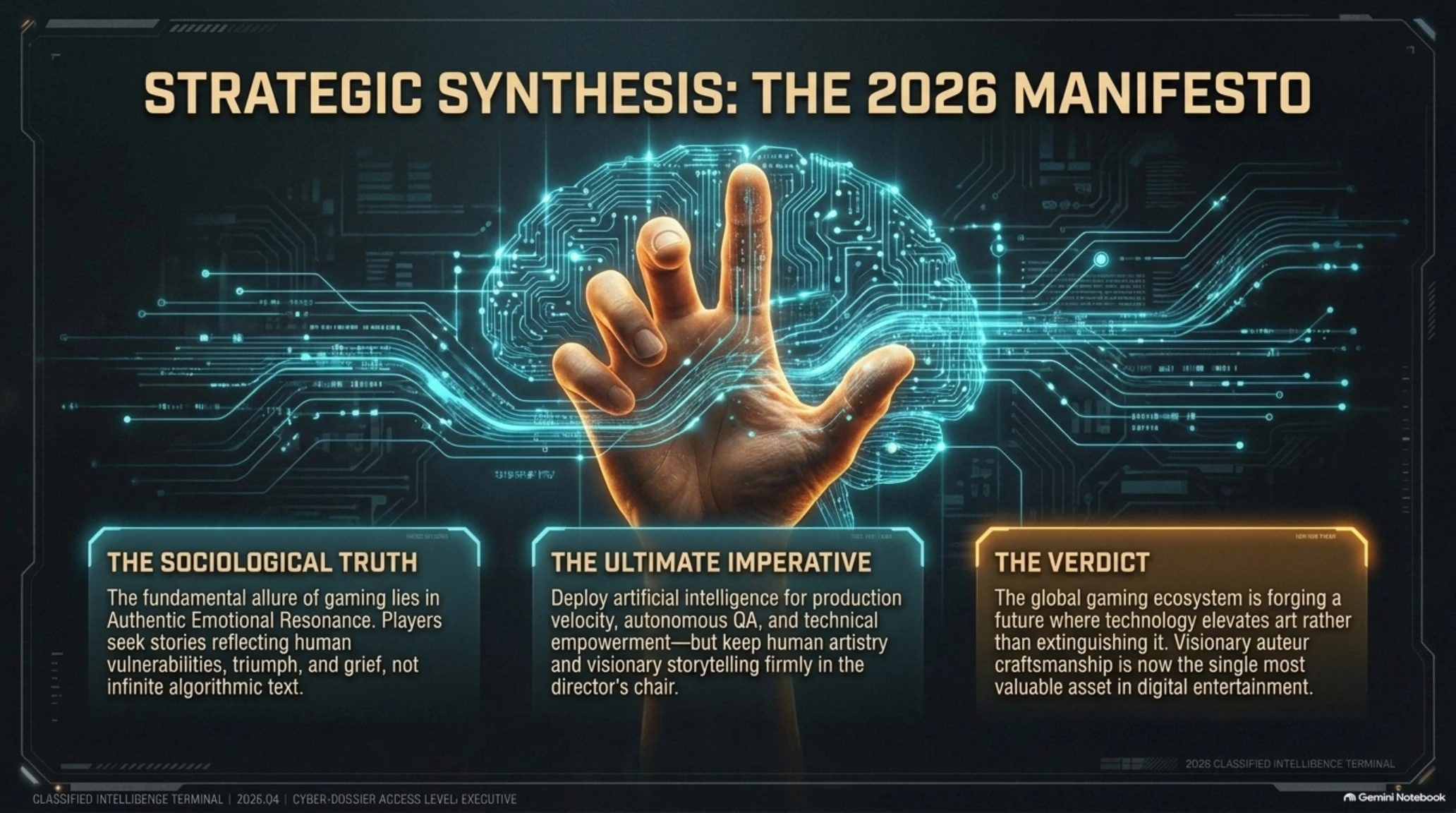
The sociological insights within the Bain report emphasize that the fundamental allure of gaming lies in Authentic Emotional Resonance. Players do not seek infinite volumes of randomized algorithmic text; they seek stories that reflect the vulnerabilities, philosophical dilemmas, triumph, and grief of real human creators. While generative AI serves as an unprecedented technical multiplier, the artistic soul of a masterpiece remains permanently anchored in human imagination.
The conceptual rendering below visualizes the frontier of neural rendering, photorealistic tenth-generation environments, and spatial computing:
Strategic Synthesis; The 2026 Manifesto for the Future of Gaming
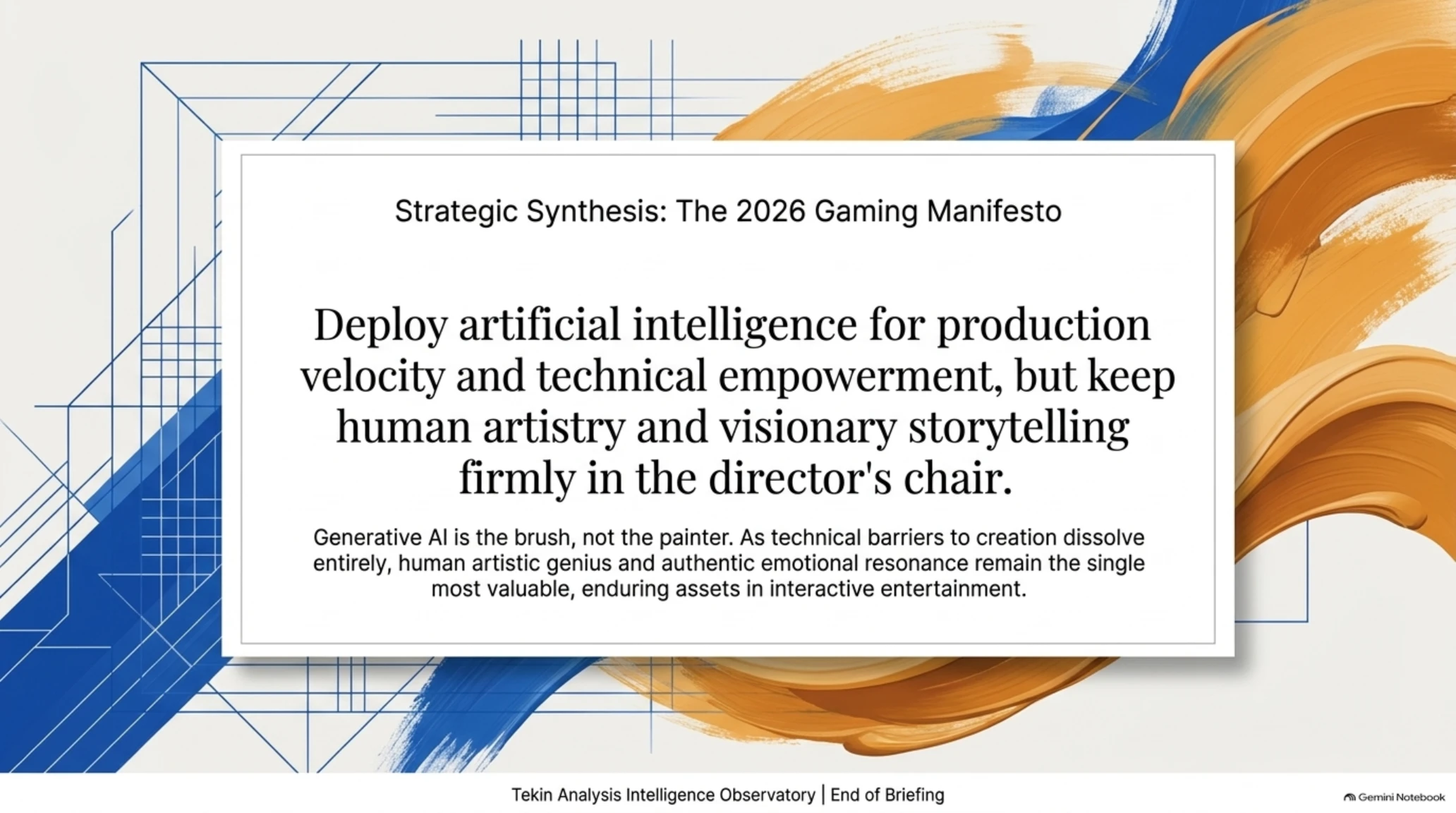
The Bain & Company 2026 Global Games Report establishes an unequivocal roadmap for studio survival and creative flourishing in the generative age: Deploy artificial intelligence for production velocity and technical empowerment, but keep human artistry and visionary storytelling firmly in the director's chair. Studios attempting to cut corners with raw algorithmic shovelware will face inevitable consumer rejection; those who harness AI to liberate human creators will build the enduring cultural touchstones of the 21st century.
As the video game medium cements its status as the dominant cultural art form of modern civilization, the dialectical tension between automation and auteur genius will define the next decade of digital entertainment. By establishing robust ethical boundaries, respecting intellectual property rights, and cherishing the irreplaceable spark of human creativity, the global gaming ecosystem is forging a future where technology elevates art rather than extinguishing it.
The year 2026 marks the decisive dawn of an era where technical barriers to creation dissolve, permanently cementing visionary human artistry and auteur craftsmanship as the single most valuable, enduring, and revered assets in the interactive digital entertainment universe.
The panoramic rendering below captures the TekinGame Intelligence Observatory monitoring the global convergence of gaming, silicon innovation, and artificial intelligence in 2026:
- Breakthrough in real-time personalized gameplay, responsive agentic NPCs, and dynamic biometric difficulty tuning
- Up to 35% reduction in production costs and two-year compression of protracted development cycles
- Empowering agile AAA-Indie micro-studios to build blockbuster-quality interactive worlds
- Unprecedented cultural and commercial appreciation for authentic, human-crafted auteur masterpieces
- Risk of digital storefront degradation from uncurated, low-effort AI-Slop shovelware if strict moderation is absent
- Complex intellectual property, voice actor rights, and copyright attribution challenges in generative training pipelines
Essential Related Reading & Cyber Intelligence Archives
• ☀️ Tekin Morning August 22, 2026 | Leaked $899 Xbox Series X25 & Phantom Blade Zero Surge
• 🛡 Tekin Analysis | ThreatsDay Crisis: AI Exploits Target Siemens S7 & Sandbox Escapes
• 🤖 Tekin Versus | TrueForge Revolution: Open-Source AI Agents vs. Claude
Frequently Asked Questions: Bain Global Games Report 2026 & The AI-Slop Crisis
What does the death of the 'Average Gamer' mean in Bain & Company's 2026 report?
It means the traditional consumer pattern of buying multiple generic $70 linear games per year has collapsed, dividing the market between perpetual live-service platforms (65% playtime) and handcrafted masterpieces.
What is 'AI-Slop' in the video game industry?
It refers to low-effort, mass-produced generative content (such as blurred textures, robotic synthesized voices, and generic quests) generated without artistic oversight, sparking fierce consumer backlash and review-bombing.
How does Generative AI enable 'infinite personalization' in game design?
By dynamically generating unscripted NPC dialogues with persistent memory, synthesizing bespoke questlines based on player choices, and tuning game difficulty and audio using real-time biometric telemetry.
How does AI impact the economics of $300M+ AAA blockbuster budgets?
By automating labor-intensive workflows like bug testing, asset optimization, and localization, reducing total development costs by 35% and shortening release cycles by up to two years.
What regulatory policies have Steam and PlayStation implemented for AI games?
Mandatory disclosure labeling for all AI-generated assets, strict copyright and training data legal certifications, and aggressive curation to prevent low-effort shovelware from polluting storefronts.
Official Sources & Intelligence References
- Bain & Company: Global Games Report 2026
- GamesIndustry.biz: Generative AI and Player Backlash
- Game Developer: State of AAA Budgets
- IGN: Steam AI Content Disclosure Rules
- VentureBeat: Infinite Personalization in Game Design
- Eurogamer: Neural Rendering in 10th-Gen Gaming
- SAG-AFTRA: Historic Interactive Media Agreement
Additional Gallery: 🎮 Tekin Analysis | Death of the Average Gamer: Bain 2026 Report & AI-Slop