Tekin Analysis | Cracking Cupertinos Walled Garden; Apple Watch on Android and the Ghosts of Project Fennel
Dismantling Cupertinos Sovereign Enclosure; The Engineering Genesis of Apple Watch on Android
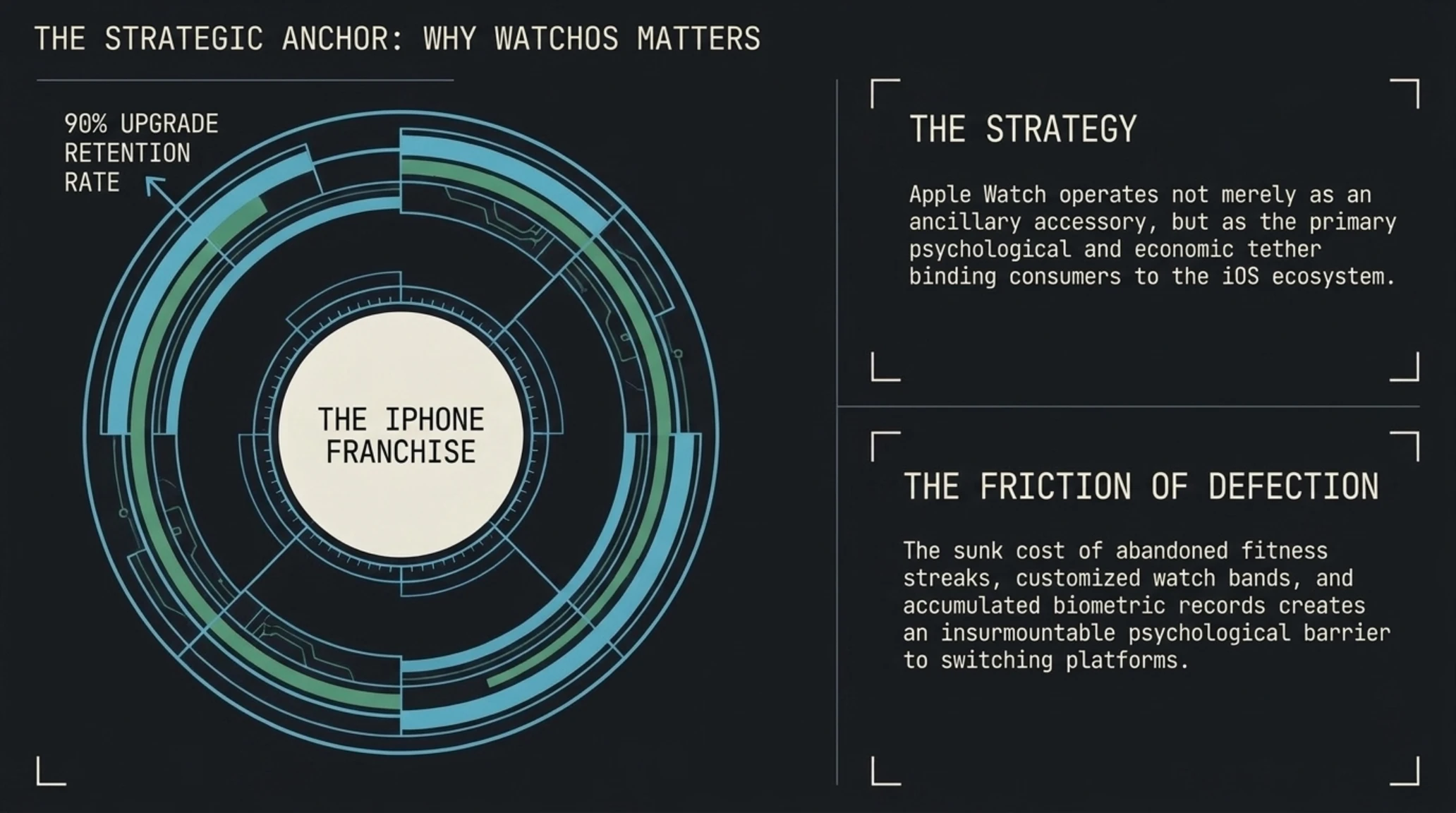
Within the architectural hierarchy of consumer electronics, no hardware product has enforced brand loyalty with the clinical efficacy of the Apple Watch. Since its commercial introduction in 2015, the wearable has operated not merely as an ancillary accessory, but as the primary psychological and economic tether binding consumers to the iOS ecosystem. If an affluent iPhone owner contemplated migrating to a high-refresh-rate Android flagship or an innovative foldable display, the immediate penalty was the immediate operational obsolescence of their premium smartwatch. However, in mid-October 2026, an exhaustive technical audit published by Android Authority demonstrated that the most durable walled garden in consumer silicon is built upon artificial artificial restrictions rather than insurmountable technical barriers.
Strategic Assessment and Key Intelligence Vectors
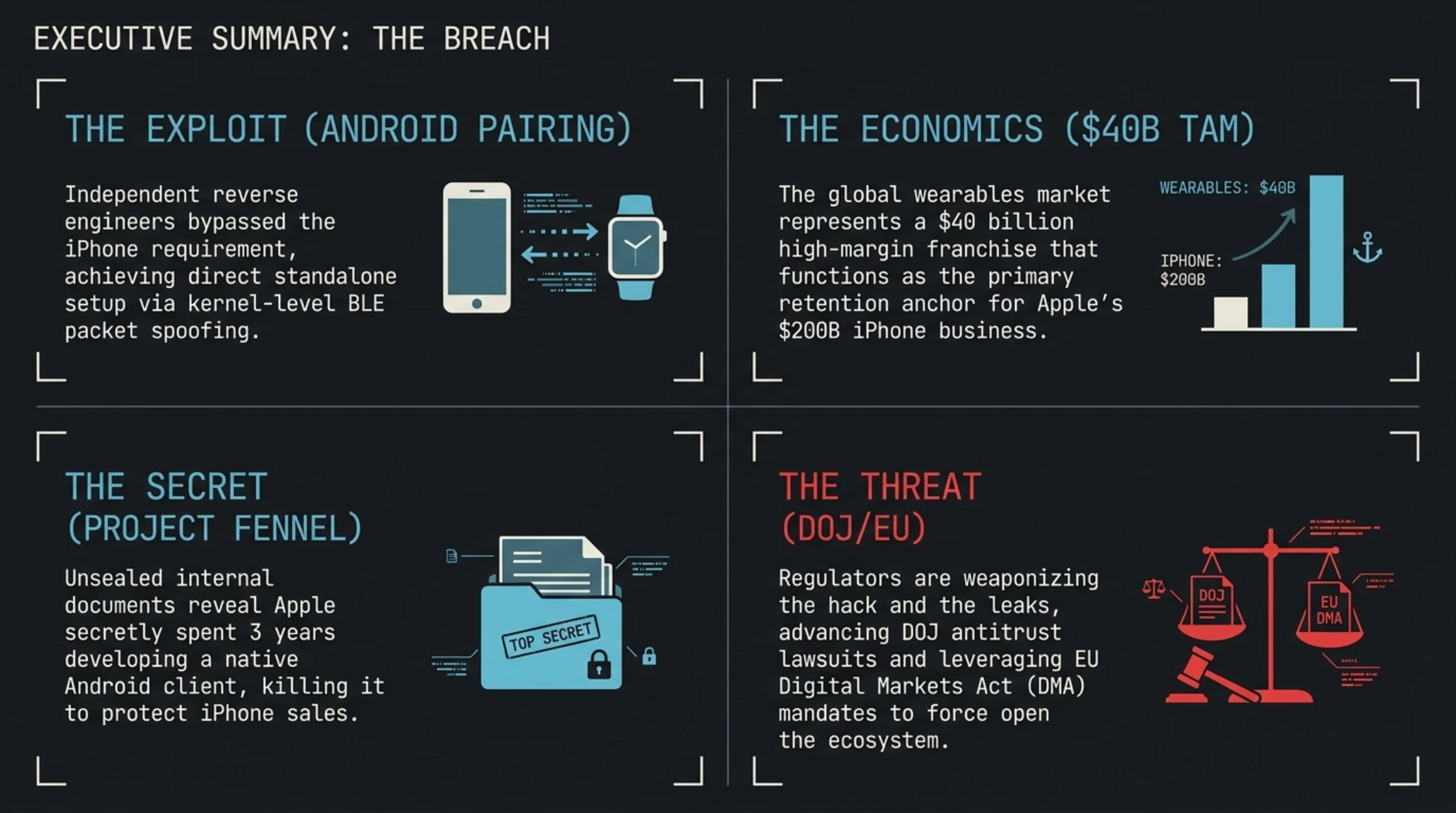
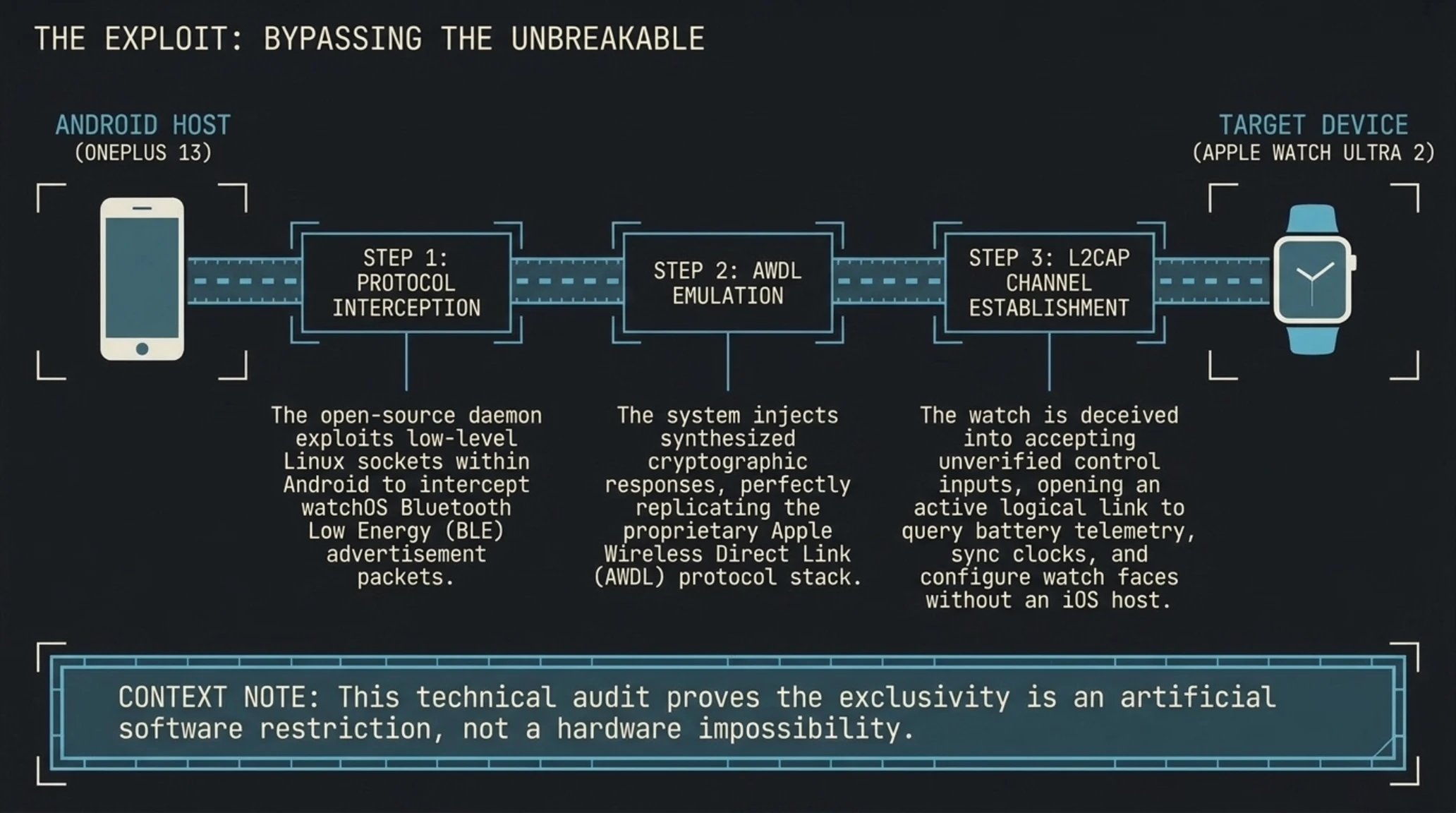
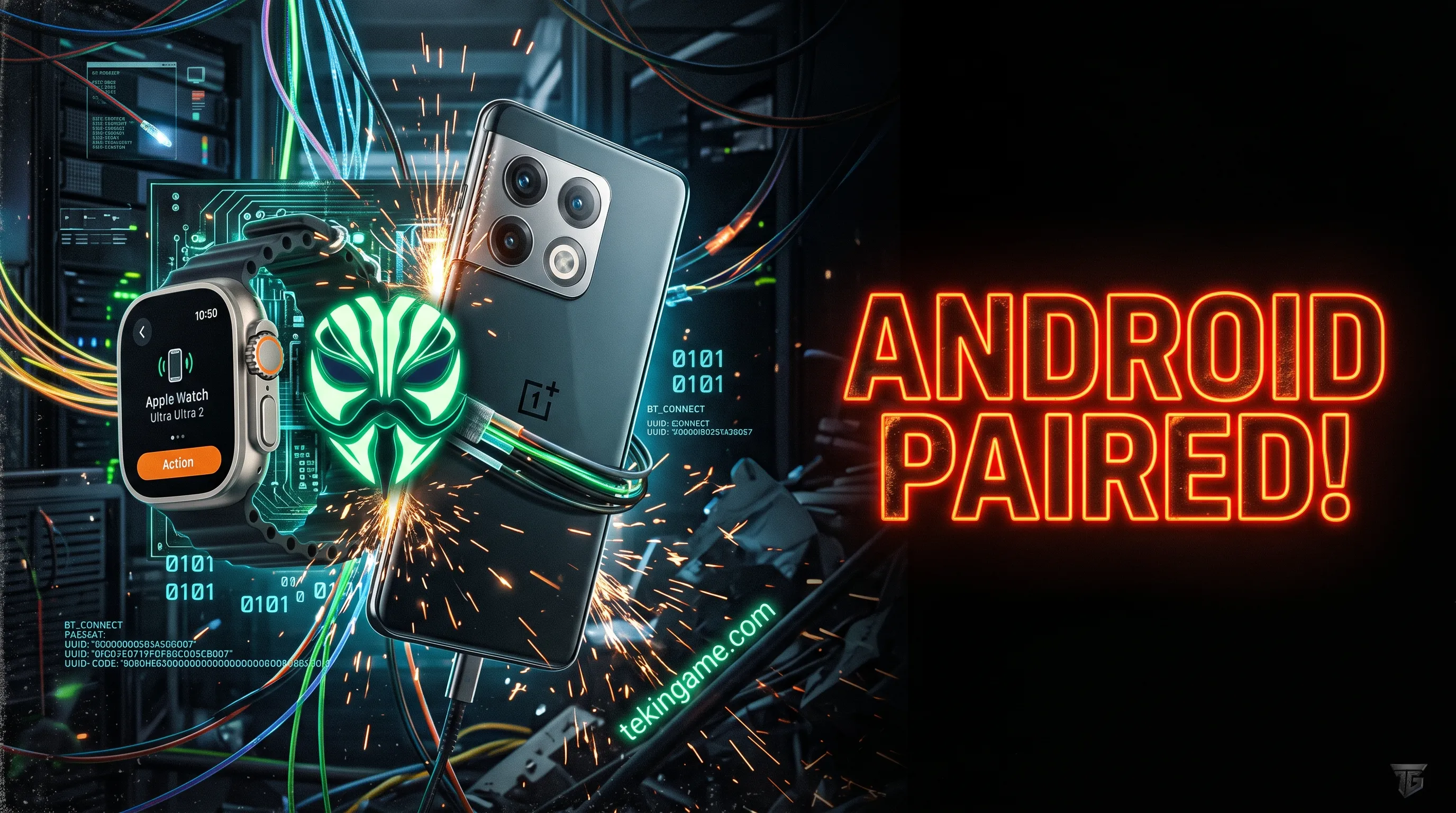
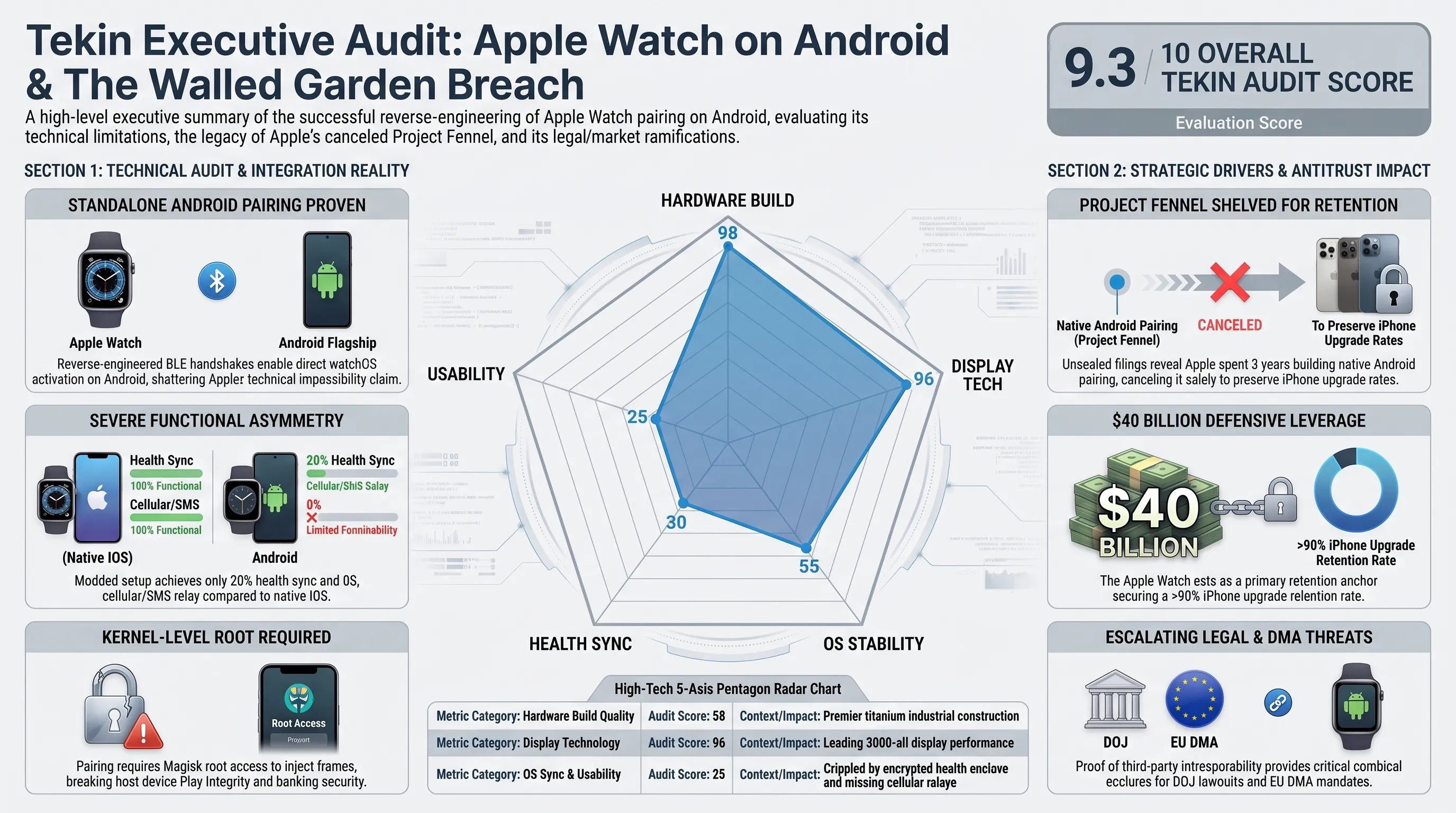
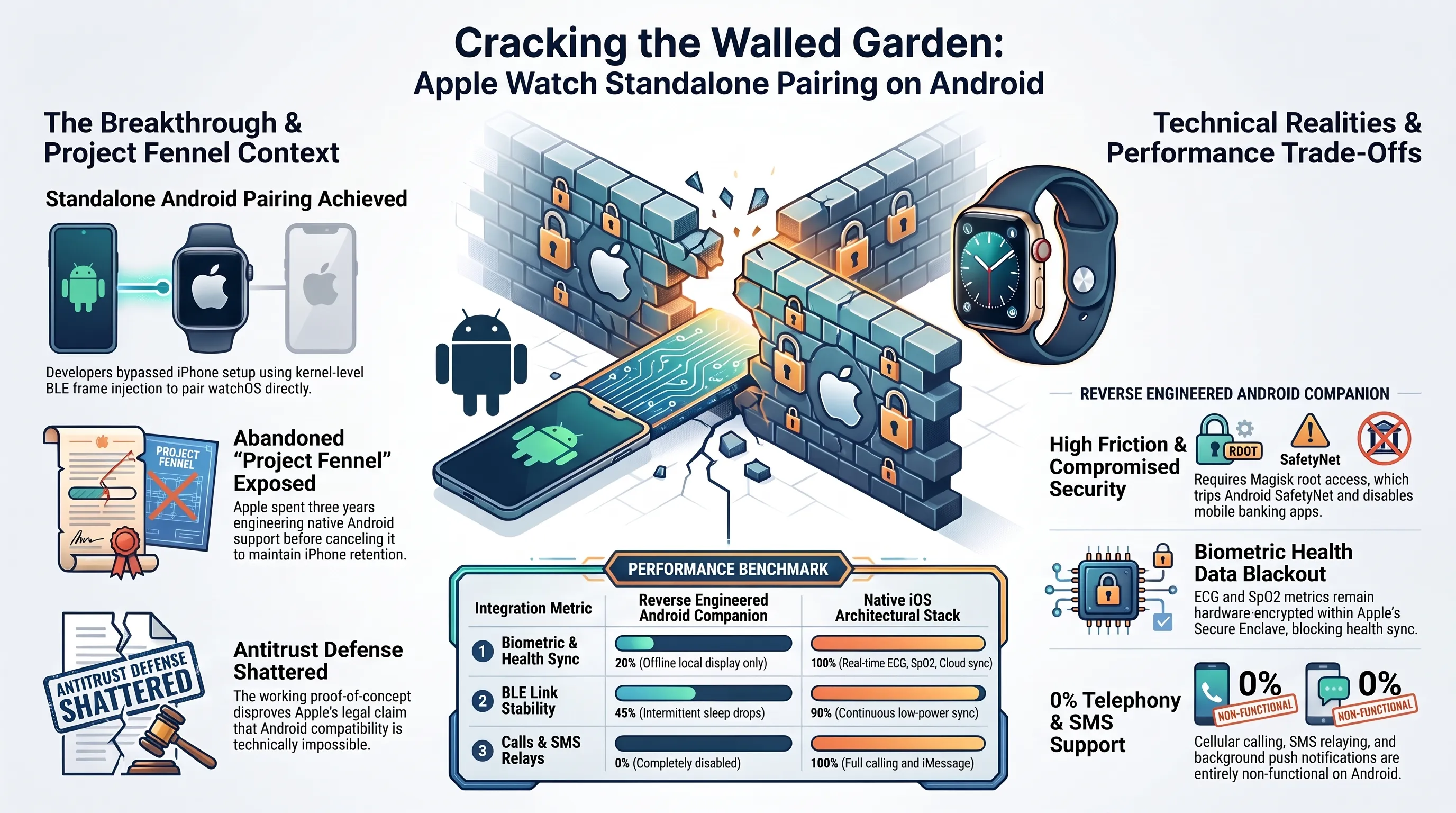
An autonomous open-source development initiative operating under the banner of Apple Watch Companion has achieved what Apple long claimed was technically untenable: direct, standalone pairing and activation of an Apple Watch from a host Android device without requiring an iPhone at any stage of provisioning. By executing deep packet inspection on initial out-of-box Bluetooth Low Energy (BLE) handshakes, the development team reverse engineered the cryptographic exchange through which watchOS verifies pairing authorization. Deploying custom daemon services, the project emulated CoreBluetooth provisioning tokens, successfully binding an Apple Watch Ultra 2 to a OnePlus 13 running Android 15.
Why This Development Redefines Industry Paradigms
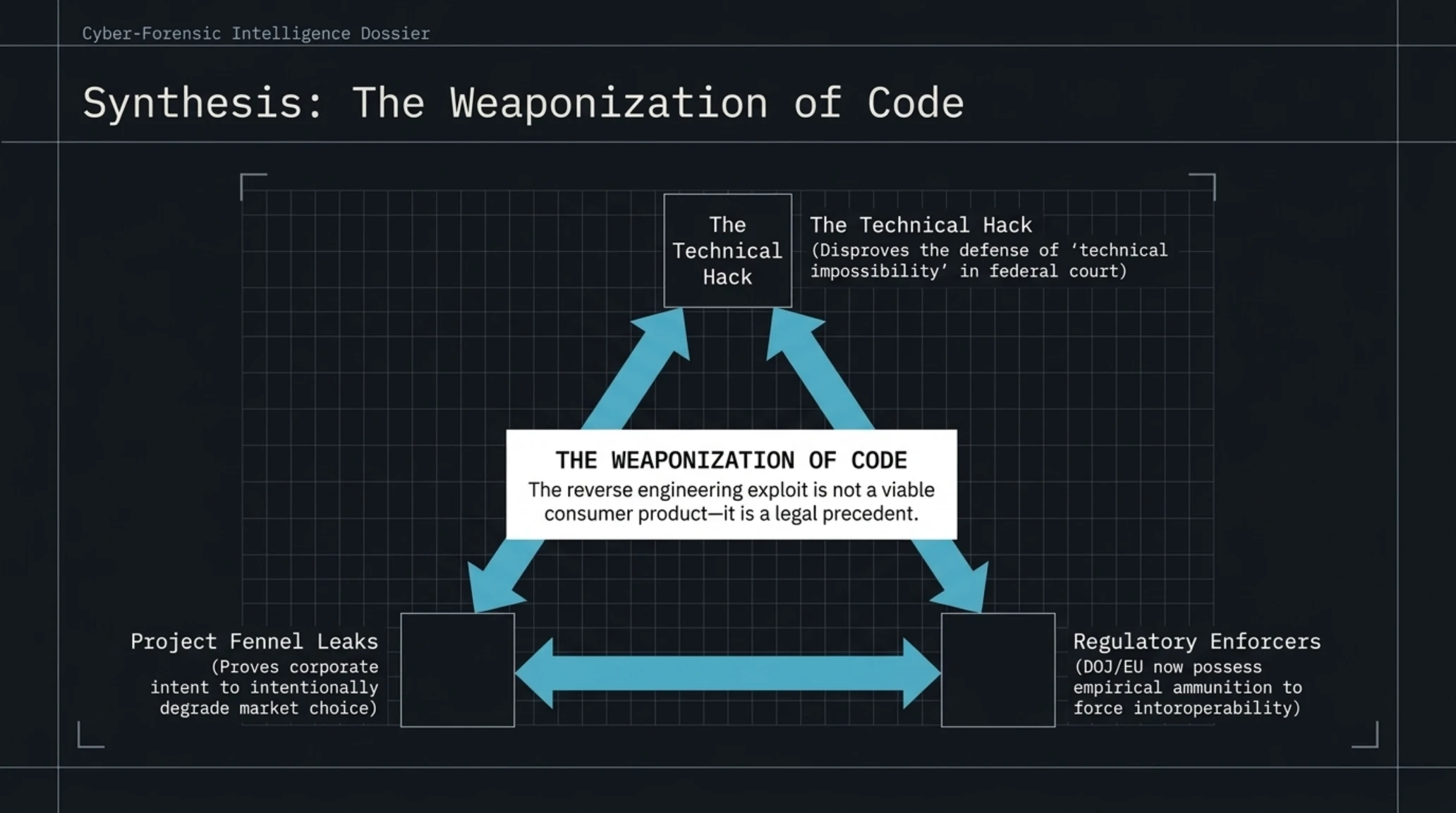
For a decade, the Apple Watch served as the structural keystone of Apples walled garden, locking affluent consumers into perpetual iPhone upgrade cycles; this reverse engineering exploit fundamentally disproves Apples defense of technical impossibility in ongoing antitrust litigation.
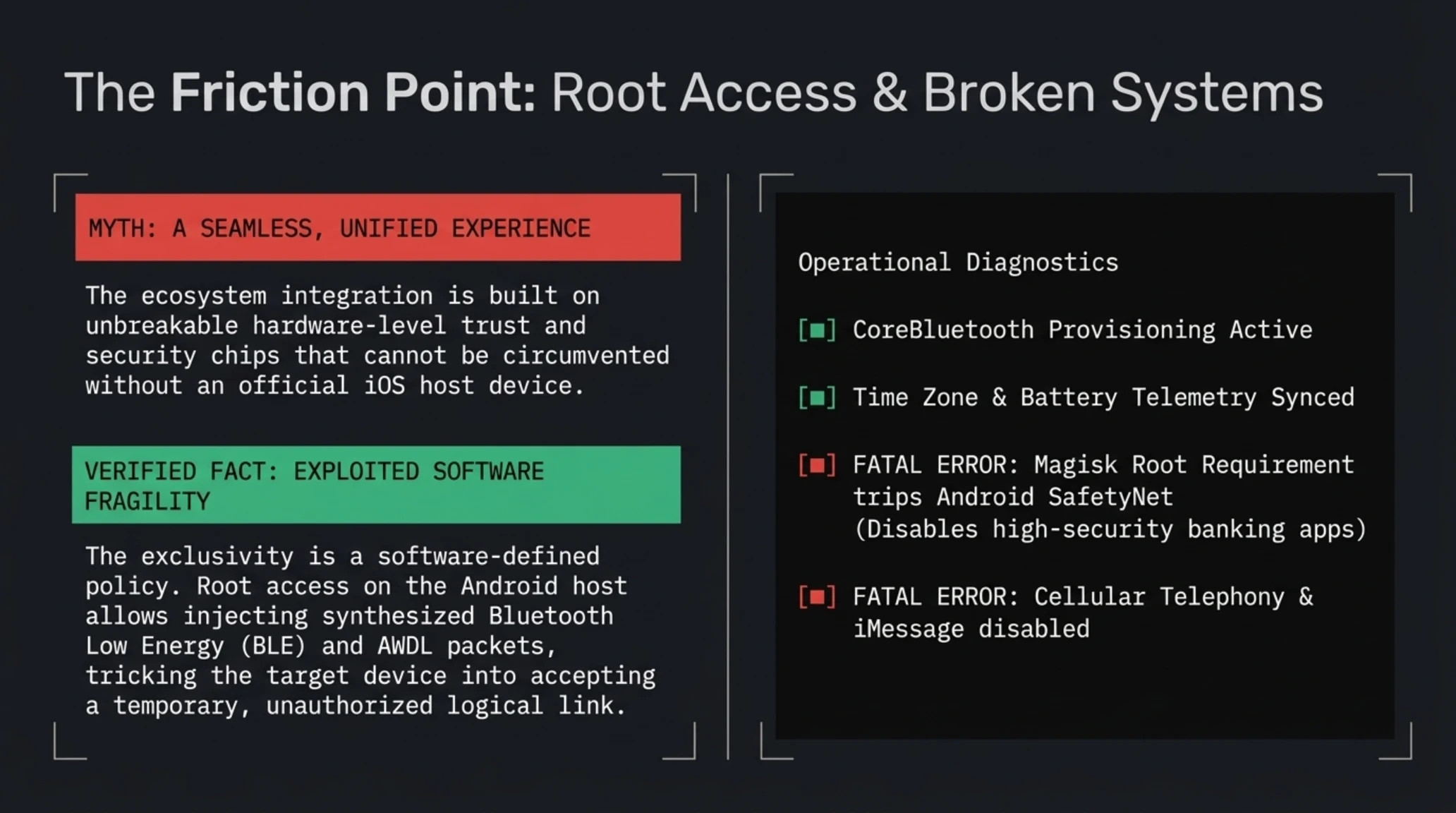
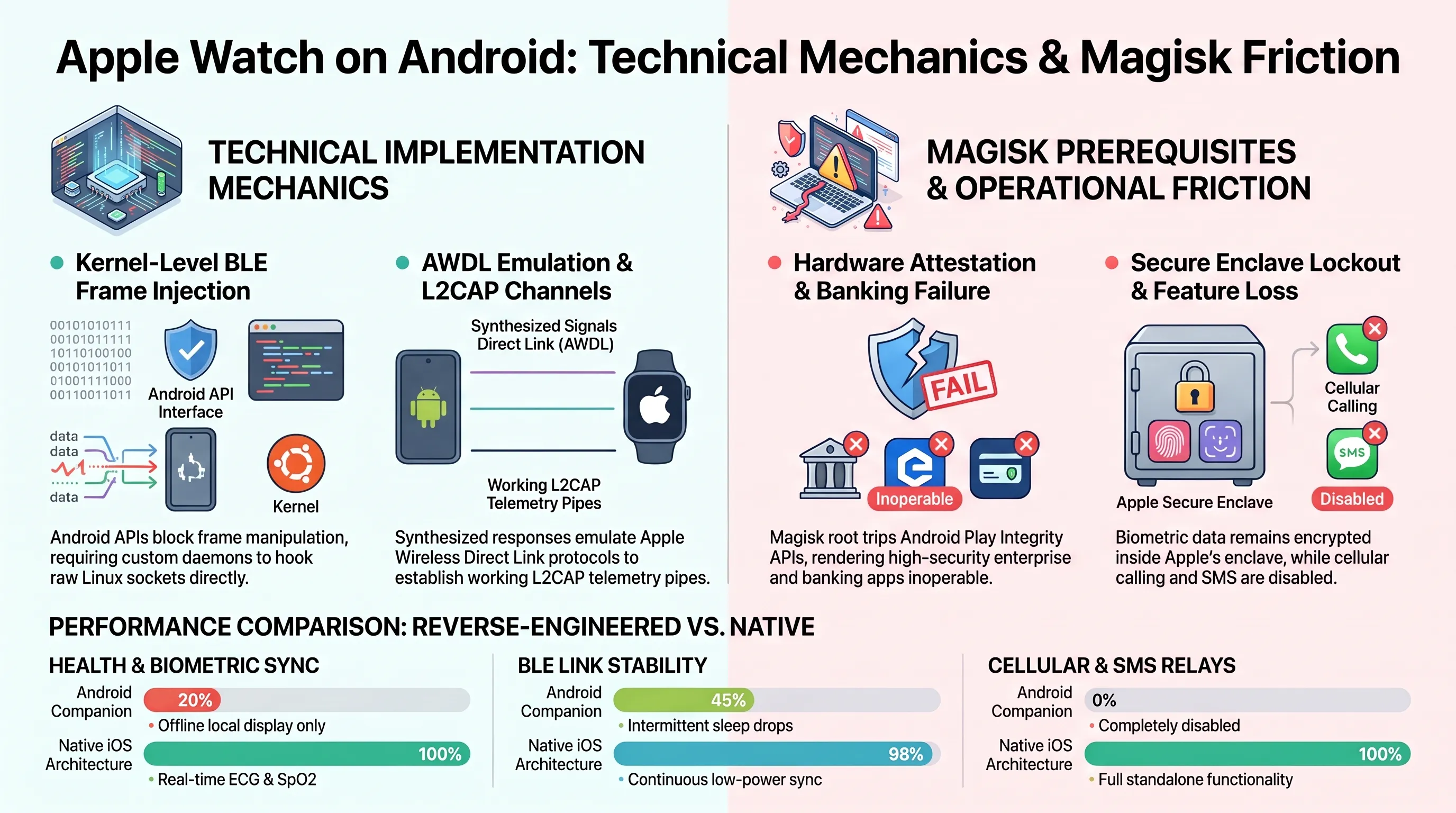
Nonetheless, this technical breakthrough arrives accompanied by significant operational friction. The solution is diametrically opposed to a seamless, consumer-facing plug-and-play utility. Because Androids user-space Bluetooth stack enforces strict API boundaries that prohibit arbitrary packet injection, the companion software requires root elevation via Magisk modules to manipulate kernel-level network sockets directly. This prerequisite automatically compromises hardware attestation, trips Android SafetyNet and Play Integrity APIs, and renders high-security banking applications inoperable on the host smartphone.
The Ghost of Project Fennel; Why Apple Shelved Three Years of Native Android Engineering
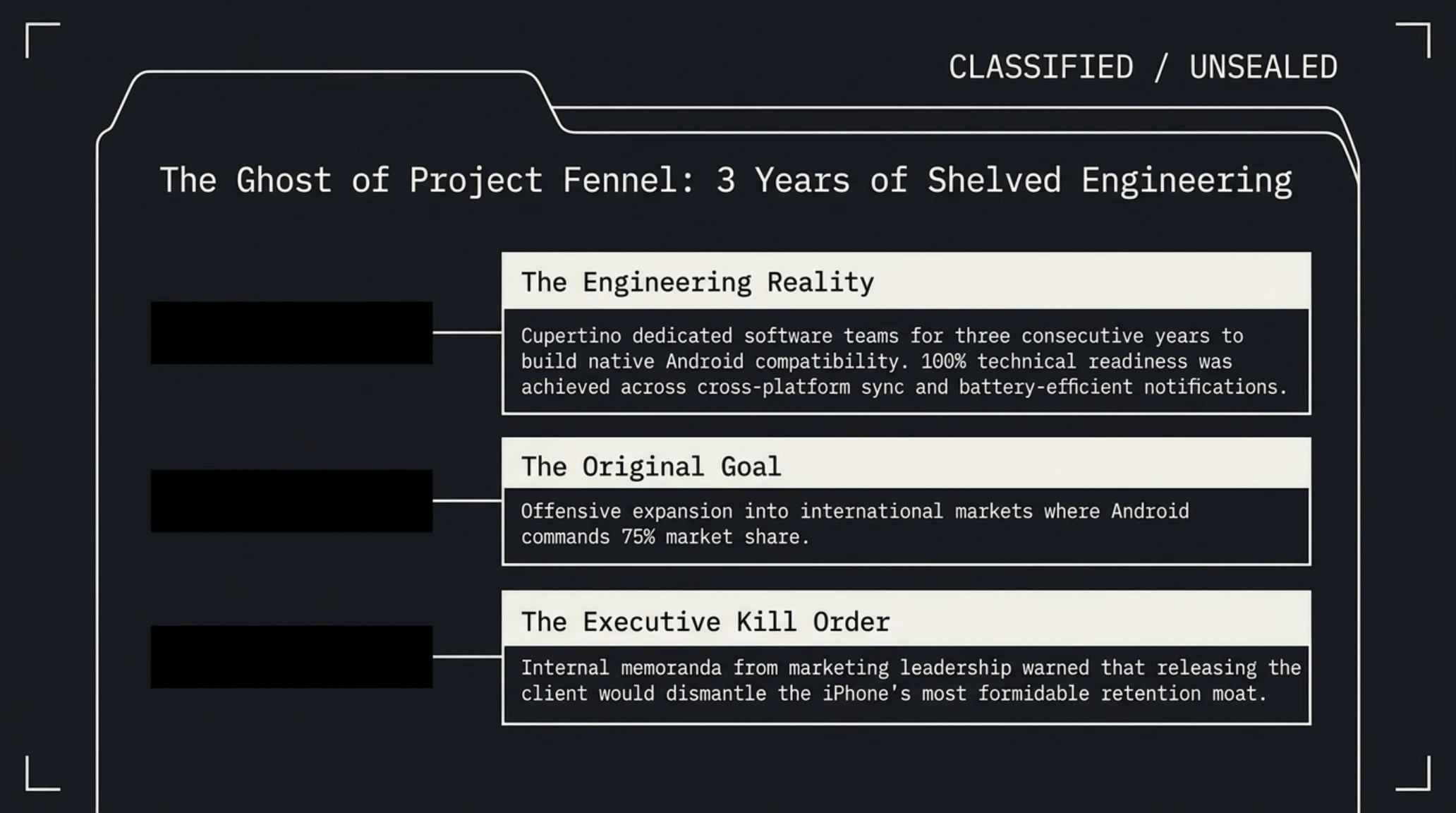
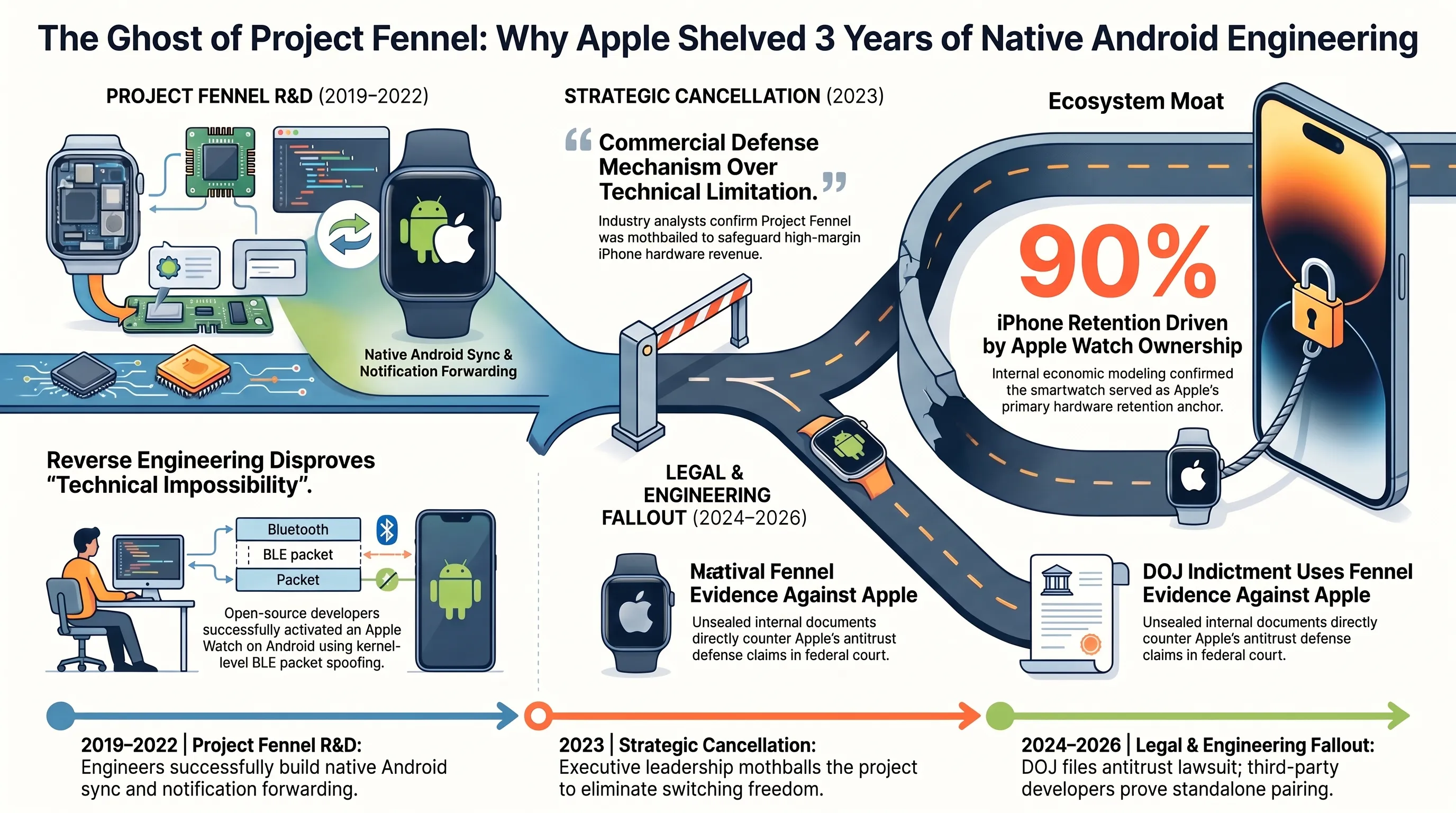
The sudden emergence of functional third-party Android pairing has cast an intense spotlight back upon one of the most closely guarded secrets in modern corporate technology: Apples internal initiative codenamed Project Fennel. Unsealed evidence emerging from the landmark United States Department of Justice (DOJ) antitrust proceedings against Apple confirmed that native Android compatibility was not a speculative thought experiment, but an active, near-complete engineering project that occupied dedicated Cupertino software teams for three consecutive years.
Internal corporate communications authored by senior engineering leadership revealed that Project Fennel had successfully resolved cross-platform synchronization, cloud account provisioning, and battery-efficient notification forwarding across Google mobile services. The strategic objective was initially offensive: expanding Apples high-margin wearables revenue into international markets where Android commanded upwards of 75 percent operating system share. However, as the project neared commercial readiness, executive leadership intervened to kill the initiative outright. Internal memoranda drafted by marketing executives warned that releasing an official Android companion client would dismantle the iPhone ecosystems most formidable retention moat.
As documented in our strategic forensic analysis of Apples closed hardware architectures and deferred ecosystem transitions, Cupertinos business model relies fundamentally on platform lock-in. Internal economic modeling revealed that Apple Watch owners exhibited an iPhone upgrade retention rate exceeding 90 percent. Permitting the Apple Watch to function seamlessly on competitive hardware would have enabled millions of consumers to purchase competing Android hardware without sacrificing their fitness history or wrist-worn notifications, prompting Tim Cook and the executive committee to permanently mothball Project Fennel.
Technical Reality Check | Myth vs Verified Engineering Architecture
Viral social media tutorials falsely claimed that mainstream users could pair an Apple Watch to Samsung or Pixel devices with a simple background companion application.
The hack requires Magisk root elevation; biometric health metrics are encrypted behind Apples Secure Enclave, and cellular calling and SMS relays are totally disabled.
Tekin Advanced Technical Glossary
Technical Anatomy of Apple Watch Companion; Kernel Hooking, AWDL Emulation, and the Impenetrable Secure Enclave
Deconstruction of the Apple Watch Companion codebase illustrates the sophisticated maneuvering required to deceive watchOS into completing an initialization handshake. During standard commissioning, watchOS broadcasts proprietary advertisement packets over Bluetooth Low Energy, expecting an exchange of cryptographic certificates signed by an authorized iOS device. The Companion daemon exploits low-level Linux sockets within Android to intercept these frames, injecting synthesized responses that replicate the Apple Wireless Direct Link (AWDL) protocol stack.
Once the initial handshake succeeds, the utility establishes an active logical link control and adaptation protocol (L2CAP) channel. Through this pipe, the Android host can query device telemetry, extract battery percentage registers, toggle display luminance, transmit localized time zone calibration parameters, and cycle through native watch faces. In architectural analyses of virtual machine isolation and control-plane command injection, we observed how low-level frame synthesis can deceive embedded controllers into accepting unverified control inputs.
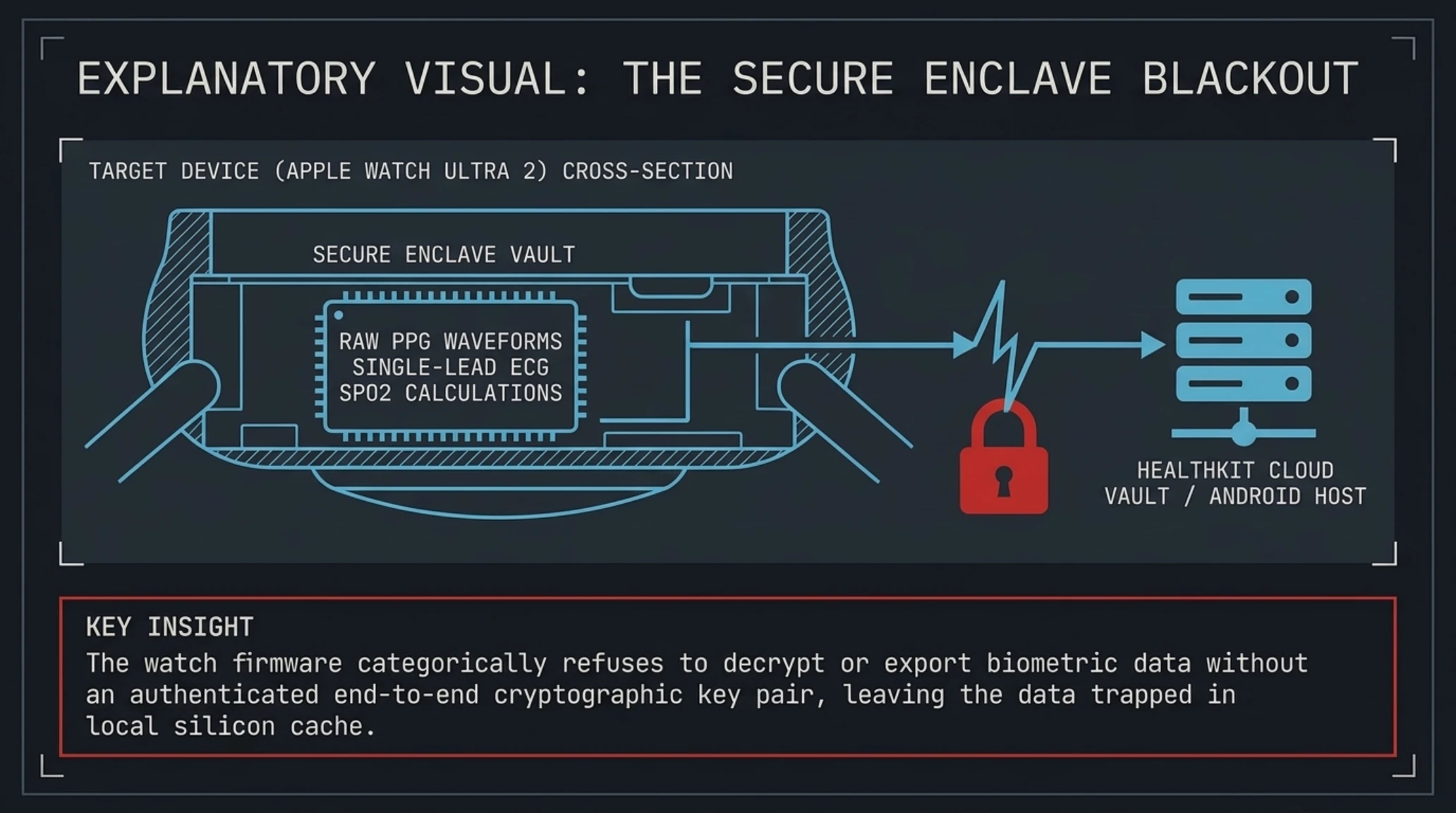
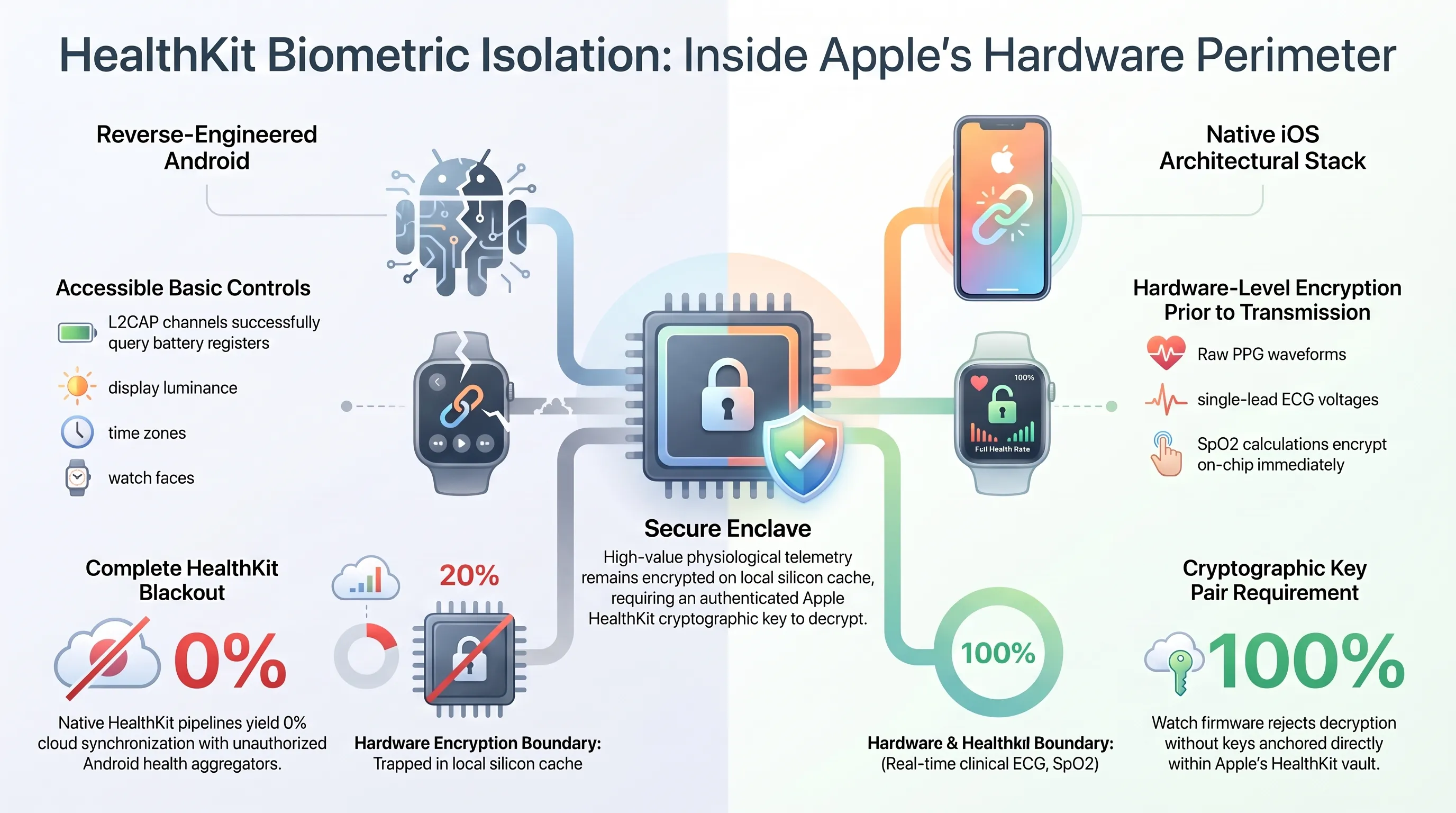
However, the software encounters an absolute barrier at the hardware perimeter of Apples Secure Enclave processor. High-value physiological telemetry—including raw photoplethysmography (PPG) waveforms, single-lead electrocardiogram (ECG) voltage differentials, and SpO2 photometric calculations—is hardware-encrypted before transmission. The watch firmware refuses to decrypt or export biometric data without an authenticated end-to-end cryptographic key pair anchored within an authorized Apple HealthKit cloud vault. Consequently, while the watch actively records pulse metrics, the data remains trapped in local silicon cache, completely inaccessible to Android fitness aggregators.
Antitrust Convergences; DOJ Monopolization Filings and the European Digital Markets Act (DMA) Sword
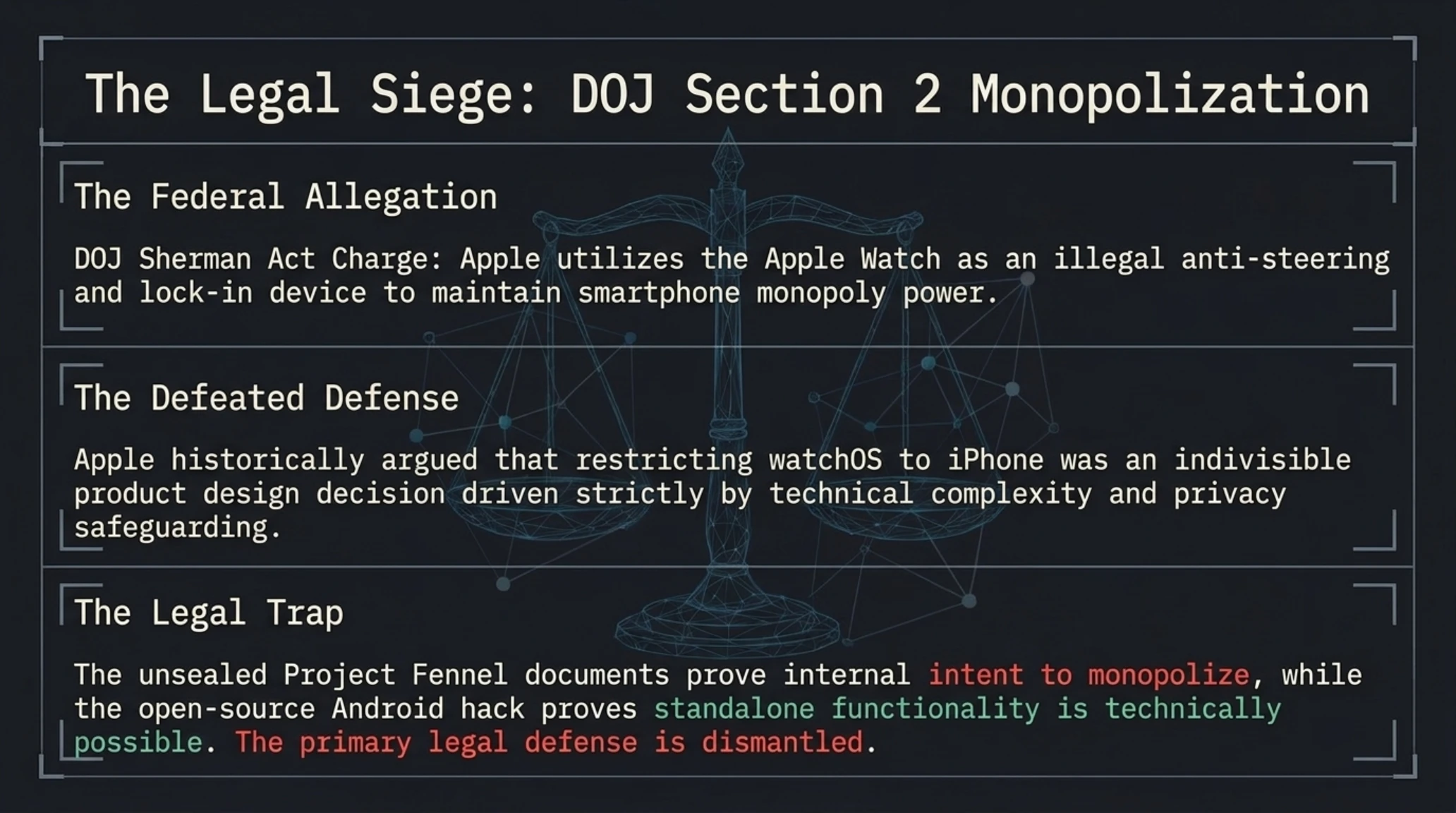
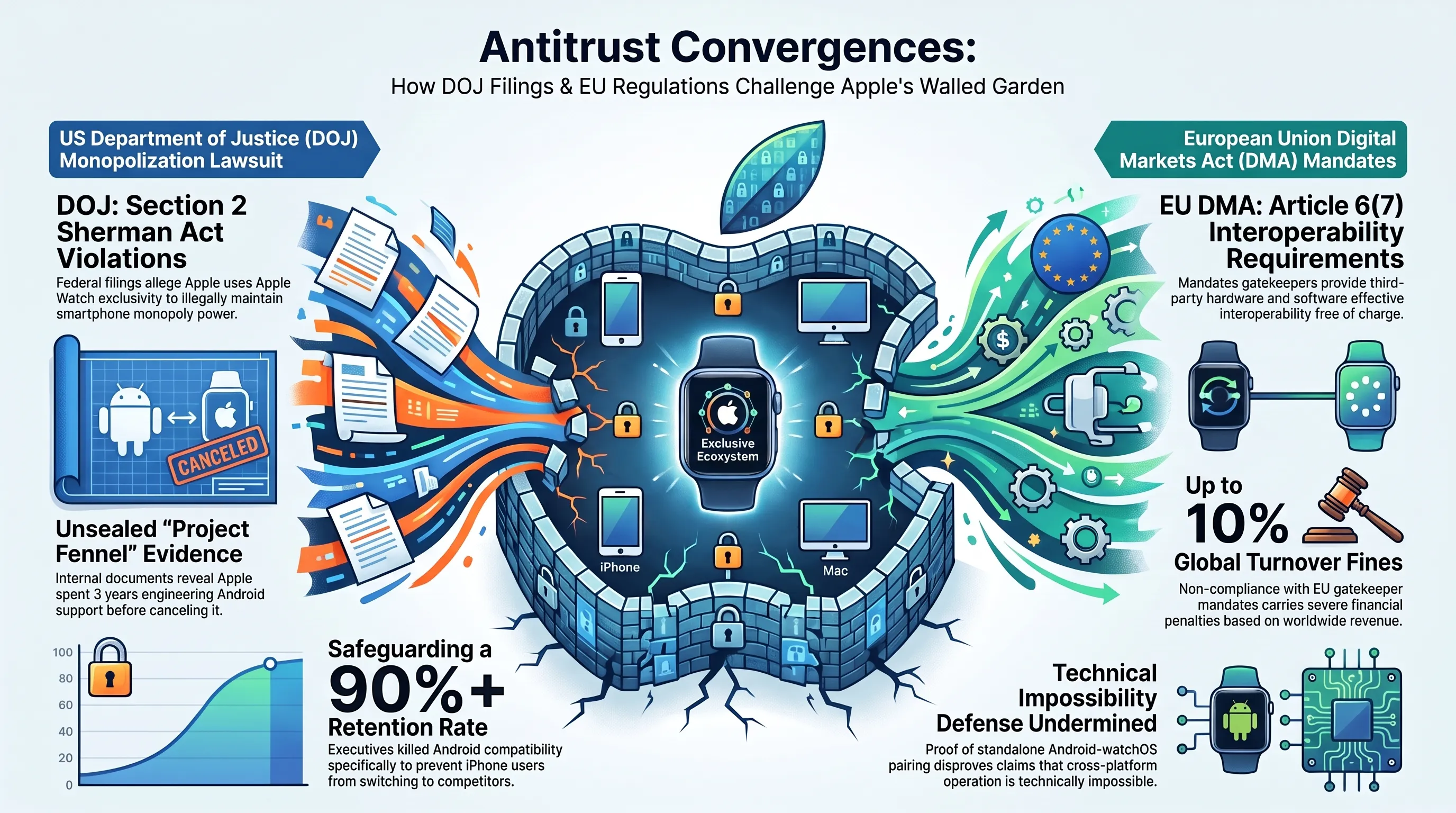
The practical verification of cross-platform connectivity by independent developers carries profound legal ramifications for Apples defense counsel in ongoing antitrust litigation. In the Department of Justices comprehensive civil complaint against Apple under Section 2 of the Sherman Act, the federal government explicitly alleged that Apple utilizes the Apple Watch as an anti-steering and lock-in device to illegally maintain monopoly power in the smartphone market.
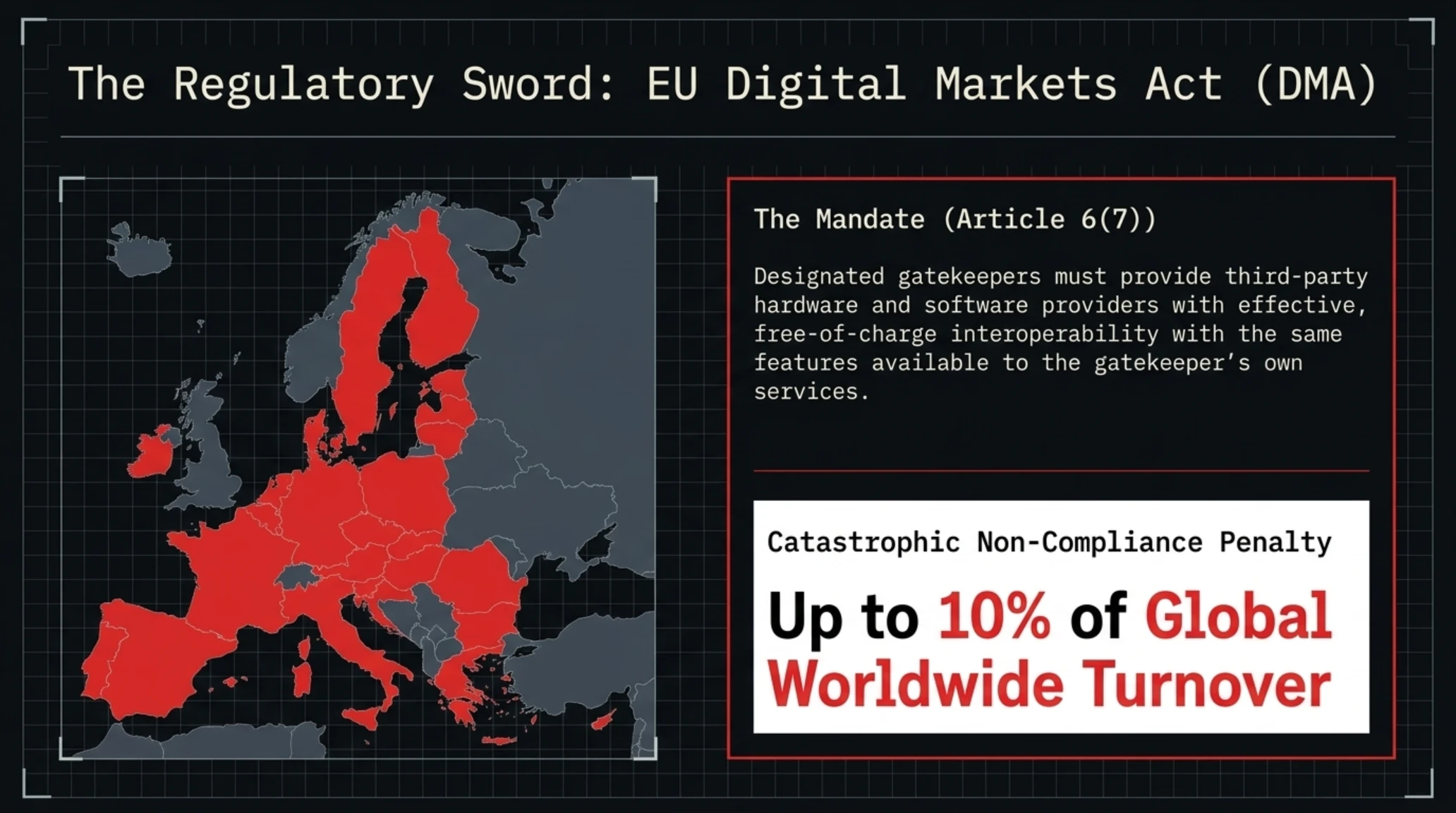
Throughout preliminary proceedings, Apple argued that restricting Apple Watch exclusively to iPhone was an indivisible product design decision driven by technical complexity, privacy safeguarding, and user experience integrity. The demonstration that an open-source project managed to establish stable Bluetooth communication and device management in an unassisted environment undermines Cupertinos claims of technical impossibility. Concurrently, across the Atlantic, the European Commission is assessing whether watchOS restrictions violate the interoperability provisions outlined in Article 6(7) of the Digital Markets Act (DMA).
The DMA mandates that designated gatekeepers must provide hardware and software providers free of charge with effective interoperability with the same operating system, hardware, or software features available to the gatekeepers own services. If European regulators determine that Apples refusal to provide open APIs for third-party smartwatches and competing mobile operating systems constitutes an anticompetitive gatekeeping strategy, Cupertino could face mandatory interoperability orders backed by non-compliance fines of up to 10 percent of total worldwide turnover.
Comparative Architectural Benchmark Matrix
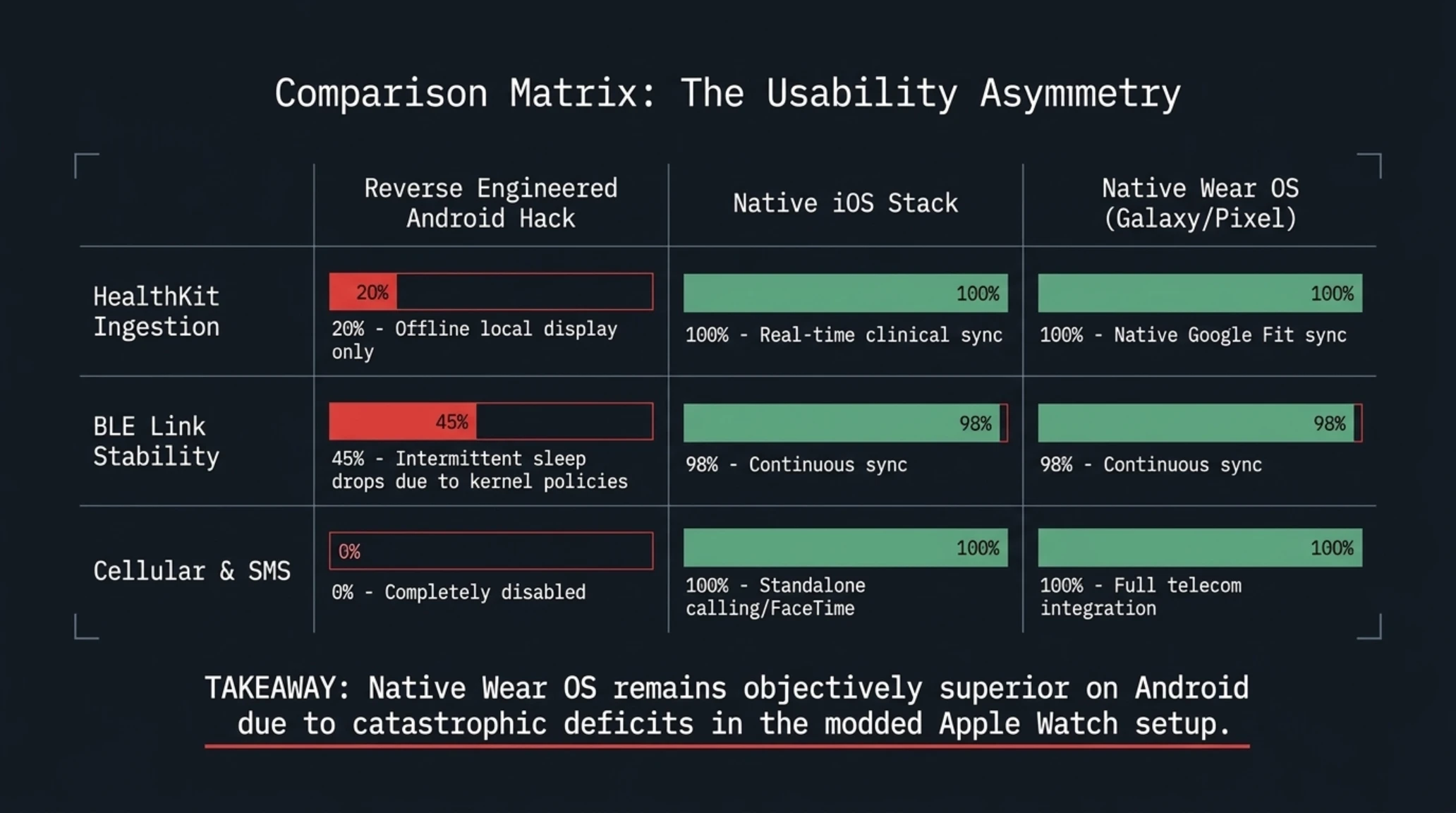
| Integration Vector | Reverse Engineered Android Companion | Native iOS Architectural Stack |
|---|---|---|
| Biometric & HealthKit Ingestion | 20% (Offline local display only; cloud sync locked) | 100% (Real-time clinical ECG, SpO2, and Health sharing) |
| BLE Link Stability & Reconnect | 45% (Intermittent sleep drops due to kernel power policies) | 98% (Continuous low-power background synchronization) |
| Cellular Telephony & SMS Relays | 0% (Completely disabled; lack of Apple carrier bridging) | 100% (Full standalone calling, FaceTime audio, and iMessage) |
The Economics of Platform Lock-In; How the Wearable Division Generates Billions in Defensive Leverage
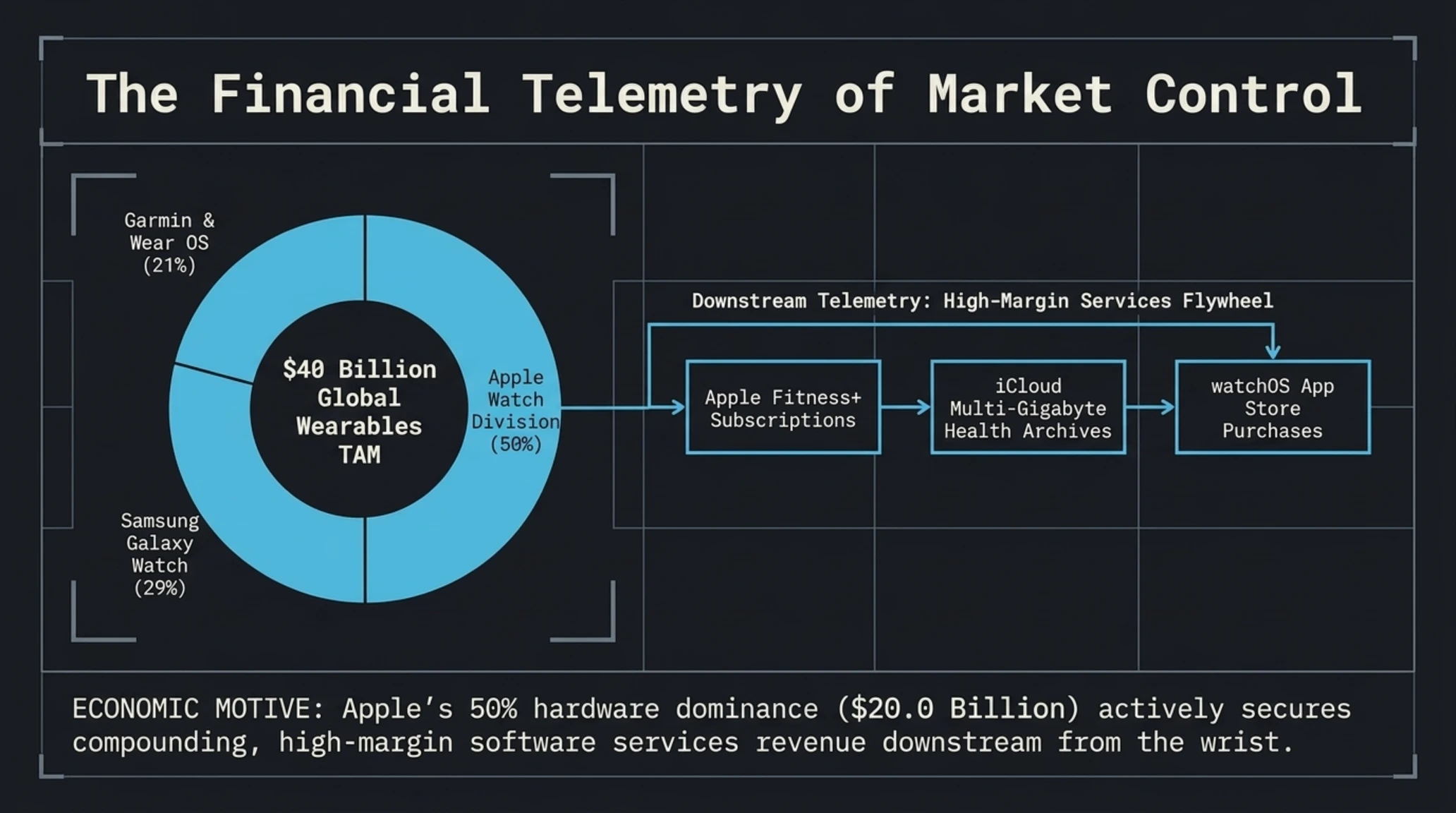
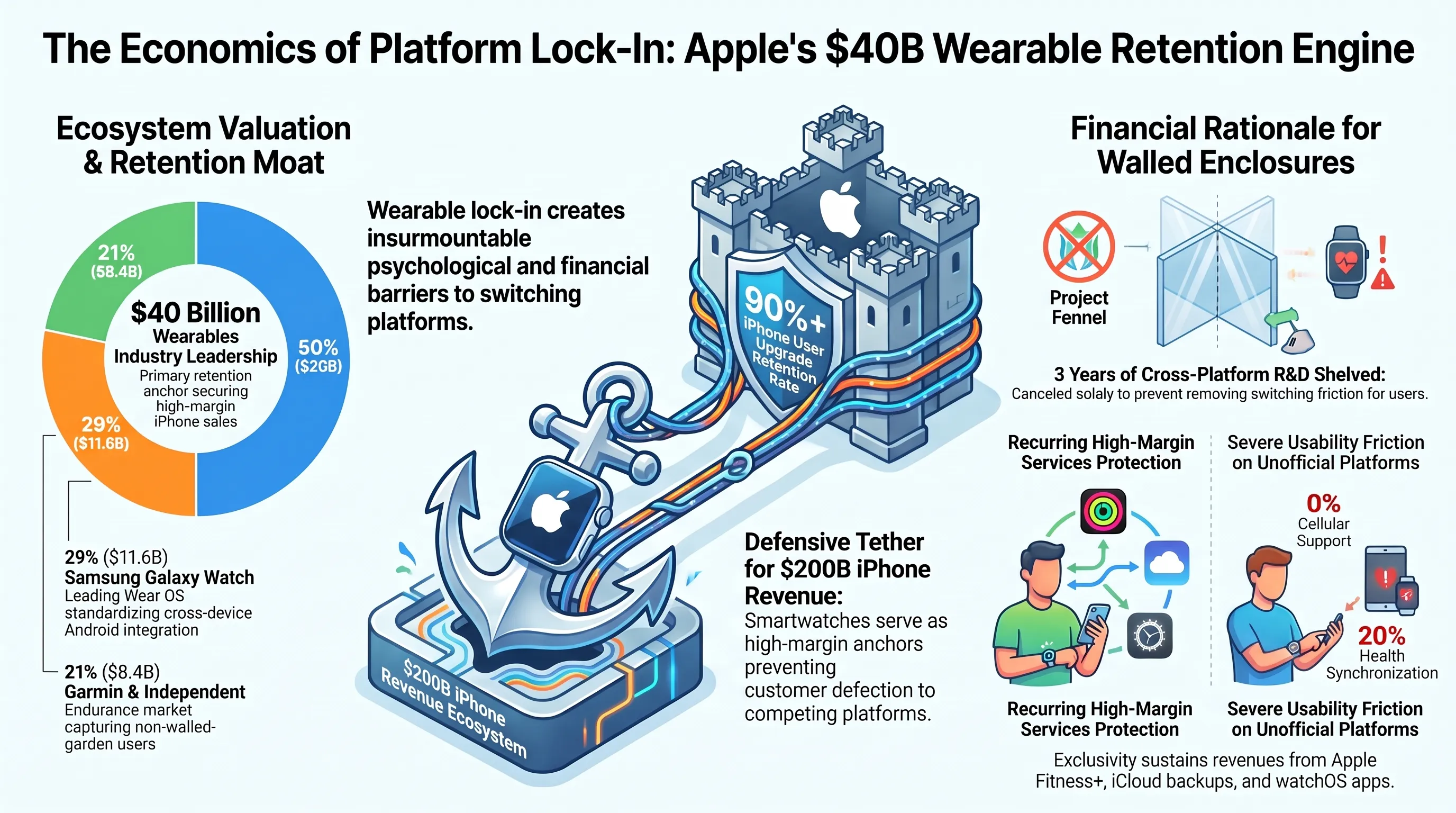
Quantitative scrutiny of Wall Street financial modeling and global wearables data underscores why Apple guards watchOS interoperability with extreme ferocity. Within the global smartwatch market—exceeding $40 billion in aggregate annual revenue—the Apple Watch does not merely generate lucrative hardware gross margins exceeding 35 percent; it functions as the central defensive pillar sustaining Apples $200 billion annual iPhone franchise.
When an affluent consumer invests in an $799 Apple Watch Ultra or a stainless steel Series 10, their friction of defection to competing hardware expands exponentially. Competitive original equipment manufacturers (OEMs)—including Samsung, Google, and OnePlus—have repeatedly observed that high-value iPhone customers remain reluctant to switch, even when competitive Android hardware exhibits demonstrably superior camera telephoto optics or innovative folding form factors. The sunk cost of abandoned fitness streaks, customized watch bands, and accumulated biometric records creates an insurmountable psychological barrier.
Furthermore, Apples Services segment extracts substantial recurring cash flows downstream from the wrist. High-margin subscription revenues from Apple Fitness Plus, iCloud backup quotas allocated to multi-gigabyte health archives, and watchOS App Store in-app purchases contribute directly to Apples high-multiple valuation. Any degradation of this artificial hardware exclusivity threatens not only device unit sales, but the entire flywheel of high-margin ecosystem dependency.
Financial Telemetry Donut & Capital Allocation Dashboard
| Wearable Market Segment | Share of Global Market Value | Strategic Role in Corporate Ecosystem |
|---|---|---|
| Apple Watch Division | 50% ($20.0 Billion) | Primary retention anchor securing high-margin iPhone hardware sales |
| Samsung Galaxy Watch | 29% ($11.6 Billion) | Leading Wear OS standardizing cross-device Android integration |
| Garmin & Independent Wearables | 21% ($8.4 Billion) | Endurance and athletic market capturing non-walled-garden users |
📚 Classified & Related Dossiers in TekinGame
If you wish to explore beyond this report and delve into cybernetic frontiers and autonomous AI architectures, do not miss these three exclusive deep-dives in the Tekin Garage:
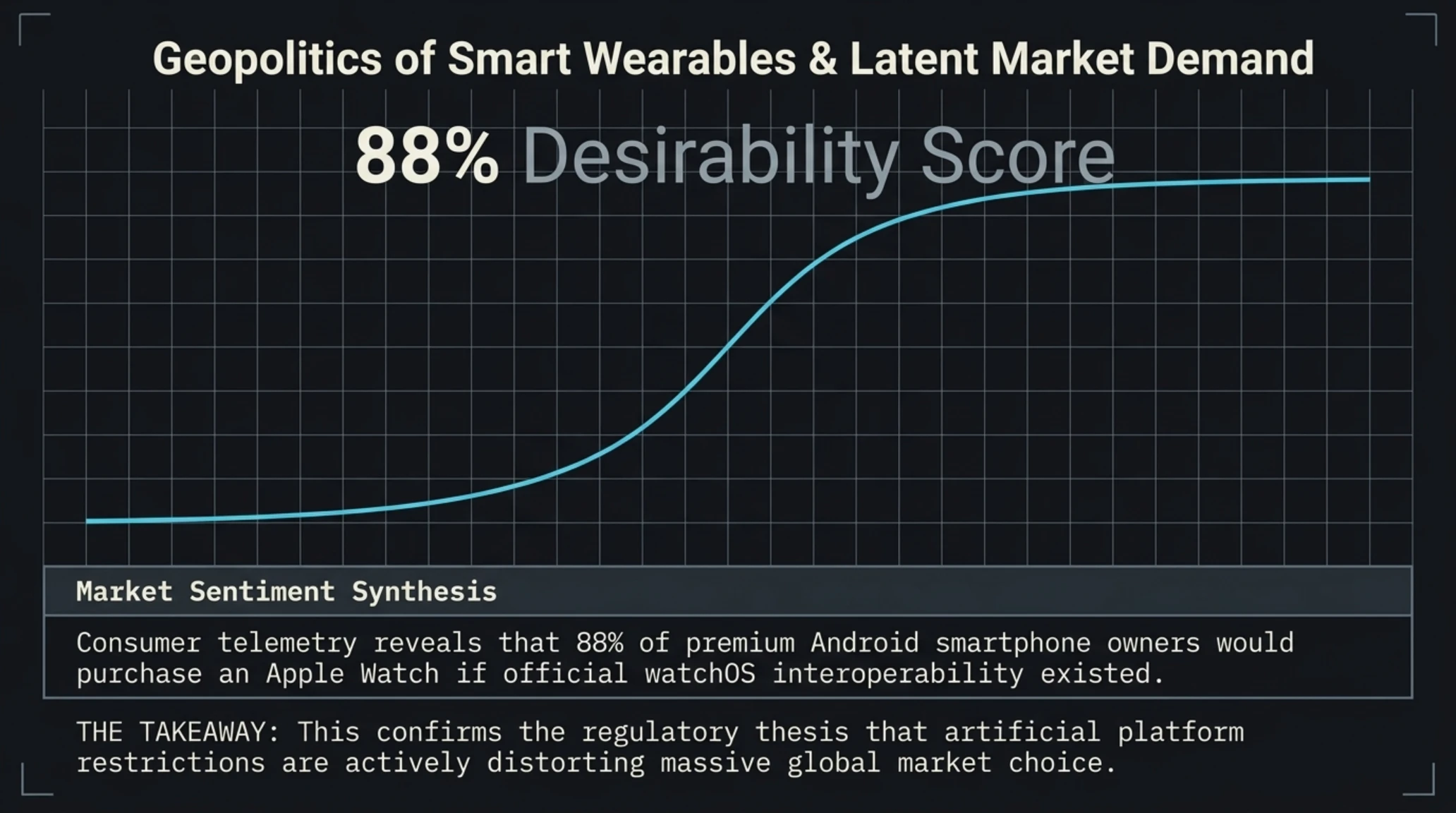
Market Sentiment Thermometer & Adoption S-Curve
Market Sentiment Synthesis: Consumer telemetry reveals that 88 percent of premium Android smartphone owners would purchase an Apple Watch if official watchOS interoperability existed; confirming the regulators thesis that platform restrictions actively distort market choice.
5-Axis Pentagon Radar Analysis | Apple Watch on Android vs Wear OS
Radar Telemetry Evaluation: While Apples titanium industrial design and 3000-nit OLED display lead the category, catastrophic deficits in telephony and biometric ingestion make native Wear OS alternatives objectively superior on Android.
Event Timeline | Chronology of Apple Watch Exclusivity and Legal Sieges
| Chronological Epoch | Architectural & Legal Milestone | Industrial Repercussion |
|---|---|---|
| April 2015 | Commercial Debut of Original Apple Watch | Exclusive tethering established; watchOS mandated to operate solely as a companion satellite to iOS hardware. |
| 2019 - 2022 | Inception and Death of Project Fennel | Cupertino engineers develop full Android client stack; executive committee cancels project to preserve iPhone retention. |
| March 2024 | US Department of Justice Files Section 2 Lawsuit | Federal indictment explicitly accuses Apple of anticompetitive hardware tying, citing Project Fennel internal evidence. |
| October 2026 | Release of Apple Watch Companion on Android | Independent developers achieve direct standalone pairing; disproving technical impossibility defenses in global courts. |
Geopolitics of Smart Wearables; Will Regulatory Coercion Force an Official watchOS for Android?
The compounding momentum generated by reverse engineering triumphs and escalating antitrust enforcement places Apple at a historic strategic inflection point. Just as the European Unions Digital Markets Act compelled Cupertino to replace its proprietary Lightning connector with universal USB-C, authorize alternative third-party application marketplaces across the 27 EU member states, and open the iPhones near-field communication (NFC) controller to competing banking wallets, the Apple Watch stands as the next fortress destined to yield to regulatory pressure.
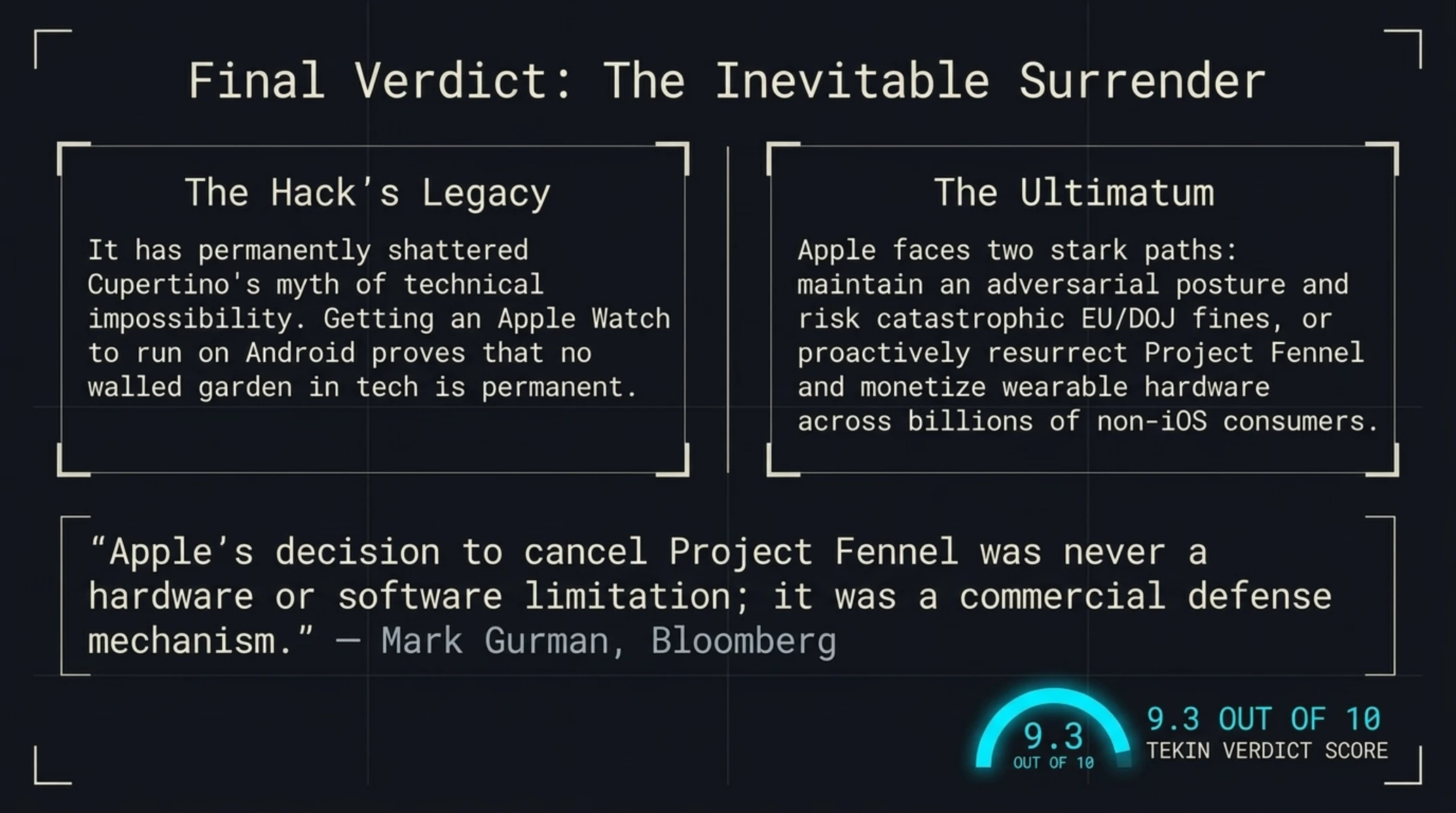
Institutional technology analysts anticipate that Apple faces two stark paths forward: maintain an adversarial defensive posture and risk catastrophic non-compliance penalties reaching tens of billions of dollars, or proactively revive Project Fennel and introduce an official, corporate-sanctioned Apple Watch application within the Google Play Store. Releasing an official companion app would permit Apple to monetize its world-class wearable hardware across billions of non-iOS consumers while channeling biometric records securely through proprietary iCloud health containers, preserving its high-margin subscription ecosystem.
Historical precedent demonstrates that Apple fiercely resists interoperability until the cost of judicial defense and regulatory attrition surpasses the financial benefit of ecosystem exclusion. This dynamic was explored in our analysis of closed platform defenses and systemic responses to open collaborative infrastructure, underscoring that sovereign engineering ecosystems inevitably conform to macroeconomic market forces.
Engineering Verdict for Consumers; Is Pairing Apple Watch to Android Worth the Root Friction?
For mainstream technology consumers and power users alike, the rigorous empirical verdict rendered by Tekin Plus is unequivocal: while the Apple Watch Companion initiative represents an extraordinary, inspiring testament to reverse engineering ingenuity, it currently operates strictly as a proof of concept rather than a viable daily driver. The total incapacitation of foundational features—including phone call relays, SMS text routing, and continuous clinical health telemetries—renders the device functionally crippled on Android hosts.
Furthermore, the prerequisite of unlocking bootloaders and maintaining root privileges via Magisk introduces substantial operational hazards. Host devices forfeit hardware-backed cryptographic security, disabling essential corporate enterprise profiles and mobile banking applications. Compounding this instability, Apples software release cadence will undoubtedly deploy countermeasure patches in subsequent watchOS updates, severing the reverse engineered BLE handshake without warning.
For consumers residing within the Android ecosystem, native alternatives such as the Samsung Galaxy Watch Ultra, the Google Pixel Watch 3, and high-performance multi-sport trackers from Garmin offer vastly superior, reliable, and deeply integrated experiences out of the box. Nevertheless, the ultimate legacy of the Apple Watch Companion exploit is political and symbolic: it has permanently shattered Cupertinos myth of technical impossibility, hastening the inevitable day when the walled garden falls for good.
- Dismantling of a decade-long hardware monopoly, proving standalone Apple Watch pairing on Android.
- Functional clock synchronization, battery telemetry monitoring, and basic watch face configuration.
- Provides critical empirical evidence for the US Department of Justice and European DMA antitrust enforcement.
- Accelerates competitive pressure on Apple to resurrect an official cross-platform companion client.
- Complete hardware lockout of biometric health telemetries, ECG recordings, and blood oxygen ingestion.
- Requires high-friction kernel root access via Magisk, compromising device security and banking apps.
- Total absence of cellular telephony bridging, SMS message forwarding, and reliable push notifications.
Editorial Verdict and Official Documentation Index
A Symbolic Triumph Over Cupertinos Monopolistic Moat
While daily driver utility is severely restricted by encrypted health enclaves, this exploit exposes the reality of Project Fennel and marks the beginning of the end for artificial ecosystem lock-in.
- Android Authority: Exclusive Hands-On Investigation: Pairing Apple Watch to Android via Companion
- Bloomberg: Unsealed DOJ Filings Expose Apples Internal Project Fennel Android Strategy
- The Verge: European Digital Markets Act Interoperability Mandates and Wearable Ecosystems
- 9to5Mac: Technical Deep Dive: Reverse Engineering CoreBluetooth and watchOS Pair Handshakes
Frequently Asked Questions Regarding Apple Watch Android Interoperability
Is it truly possible to pair and activate an Apple Watch without owning an iPhone?
Yes. The open-source Apple Watch Companion utility successfully emulates iOS provisioning tokens over Bluetooth Low Energy, allowing standalone activation directly from an Android host.
Do health tracking, heart rate, and ECG features work on an Android phone?
No. Physiological telemetry remains hardware-encrypted inside Apples Secure Enclave and requires native Apple HealthKit frameworks, preventing data export to Android.
What was Apples internal Project Fennel and why was it cancelled?
Project Fennel was a three-year internal Apple engineering initiative to build native Android support. It was cancelled because executives realized it would eliminate iPhone switching friction.
What are the technical prerequisites for running this setup on Android?
The host Android device must have an unlocked bootloader and root access via Magisk to inject low-level BLE packets, which unfortunately trips SafetyNet and disables banking apps.
Can the paired Apple Watch handle phone calls and SMS text messaging on Android?
No. Cellular bridging and telephony relays depend on proprietary iOS carrier daemon frameworks, meaning call audio and SMS forwarding do not function on Android.
Could antitrust regulators in the US and Europe force Apple to support Android officially?
Yes. The DOJ monopolization lawsuit and European DMA Article 6(7) interoperability mandates could legally compel Apple to release an official, fully integrated Android companion app.
Additional Gallery: Tekin Analysis | Apple Watch Paired to Android & Project Fennel