Tekin Review / Analysis | Apple HomeView Teardown: A $299 Smart Display Stalled by Siri AI's Absence
Strategic Assessment and Key Intelligence Vectors
Why This Development Reshapes the Smart Home
Apple HomeView represents Cupertino's definitive pivot toward ambient residential computing, combining localized A18 silicon with Thread and Matter protocols to challenge Amazon's ad-heavy dominance.
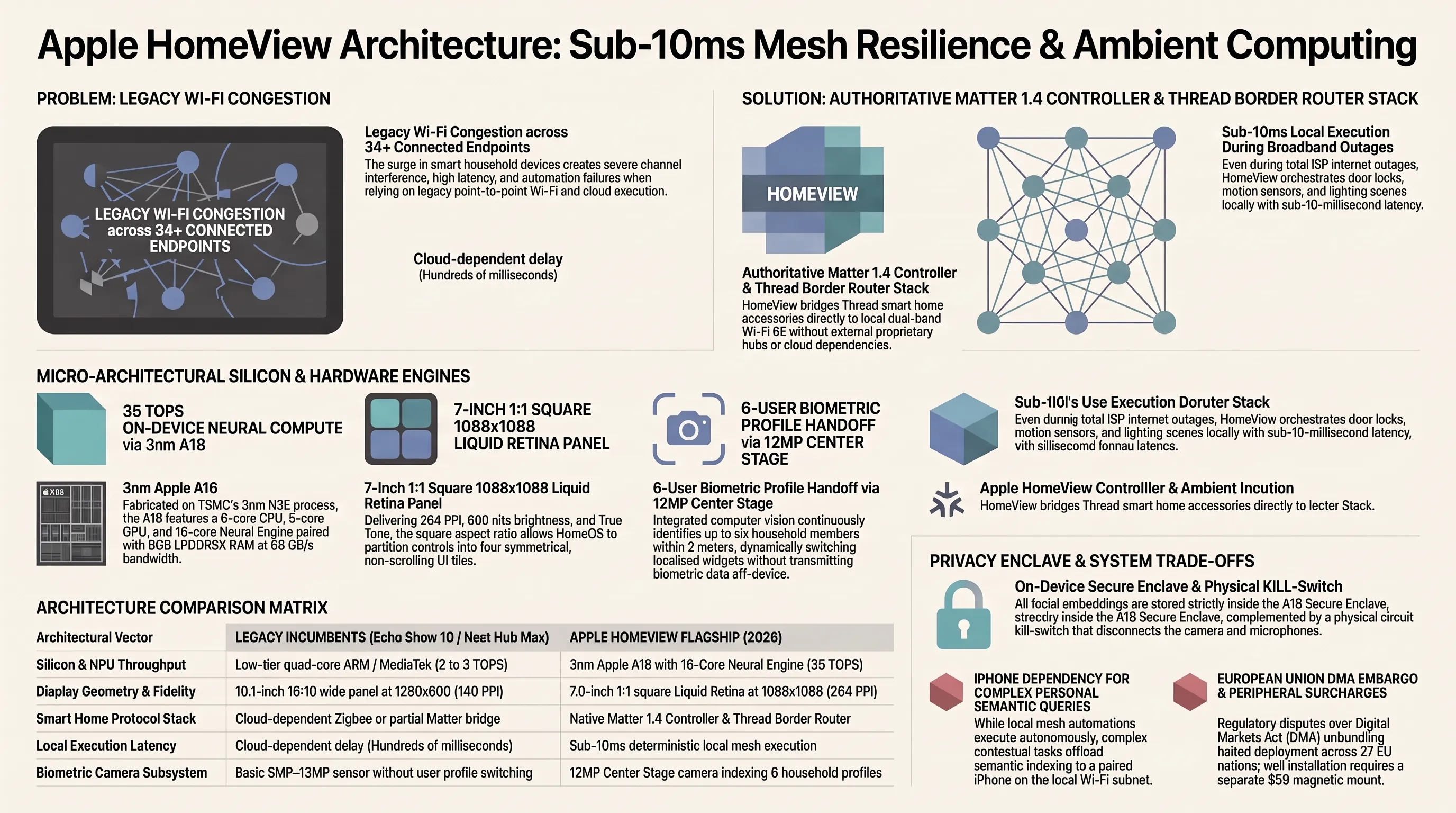
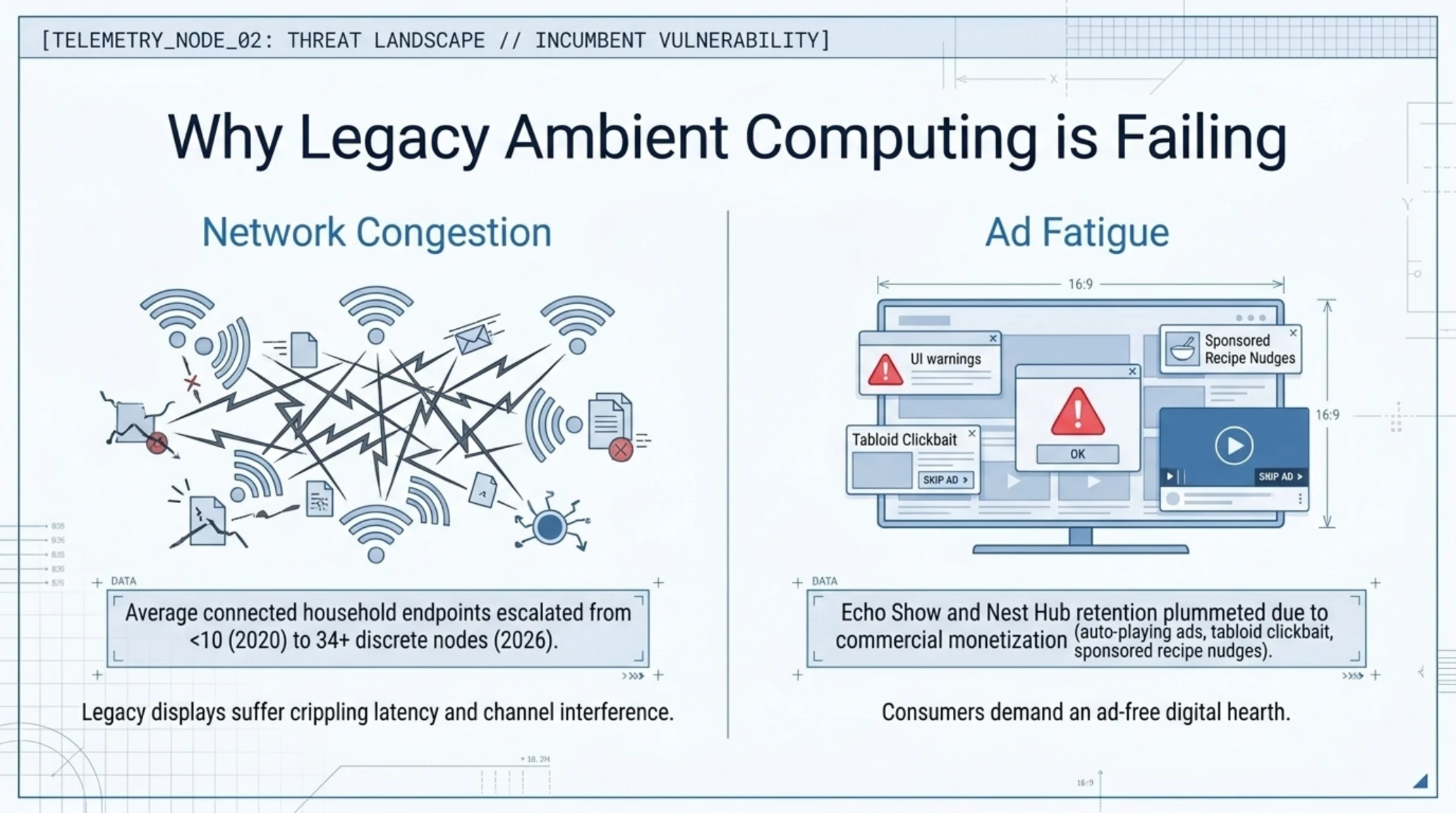
Industry analysts specializing in consumer Internet-of-Things (IoT) ecosystems emphasize that Apple's entry marks a watershed transition from personal computing to ambient environmental intelligence. In modern residences, the sheer density of connected nodes—ranging from smart thermostats, motorized shades, and environmental air sensors to robotic vacuums and biometric smart locks—has escalated from fewer than ten devices in 2020 to an average exceeding thirty-four discrete endpoints per connected household in 2026. Under this intense spatial data traffic, legacy point-to-point Wi-Fi setups routinely suffer from network congestion, channel interference, and unresponsive automations. HomeView functions as an authoritative architectural anchor, utilizing dual-band Wi-Fi 6E alongside Thread radio transceivers to establish a deterministic local mesh topology.
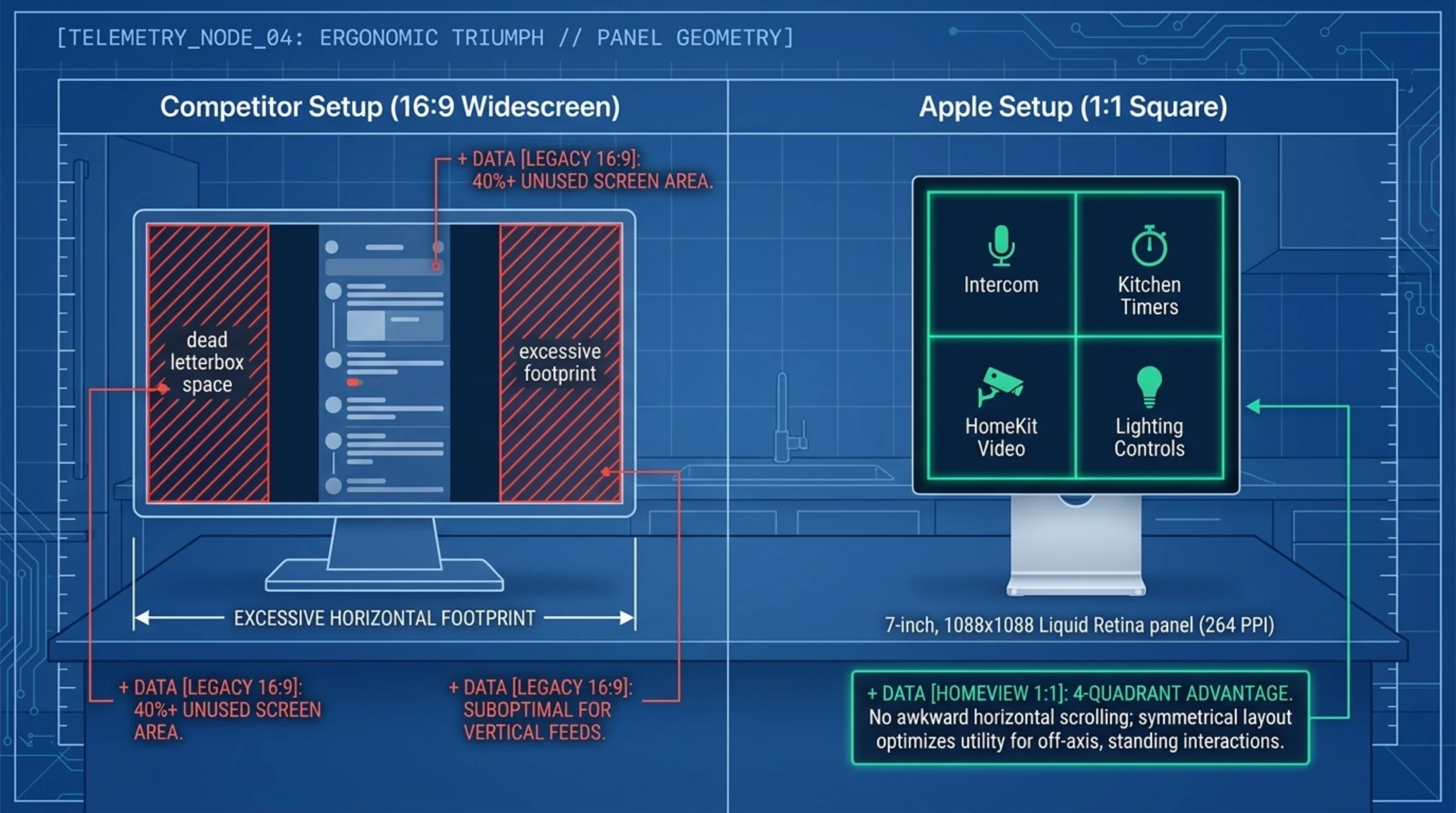
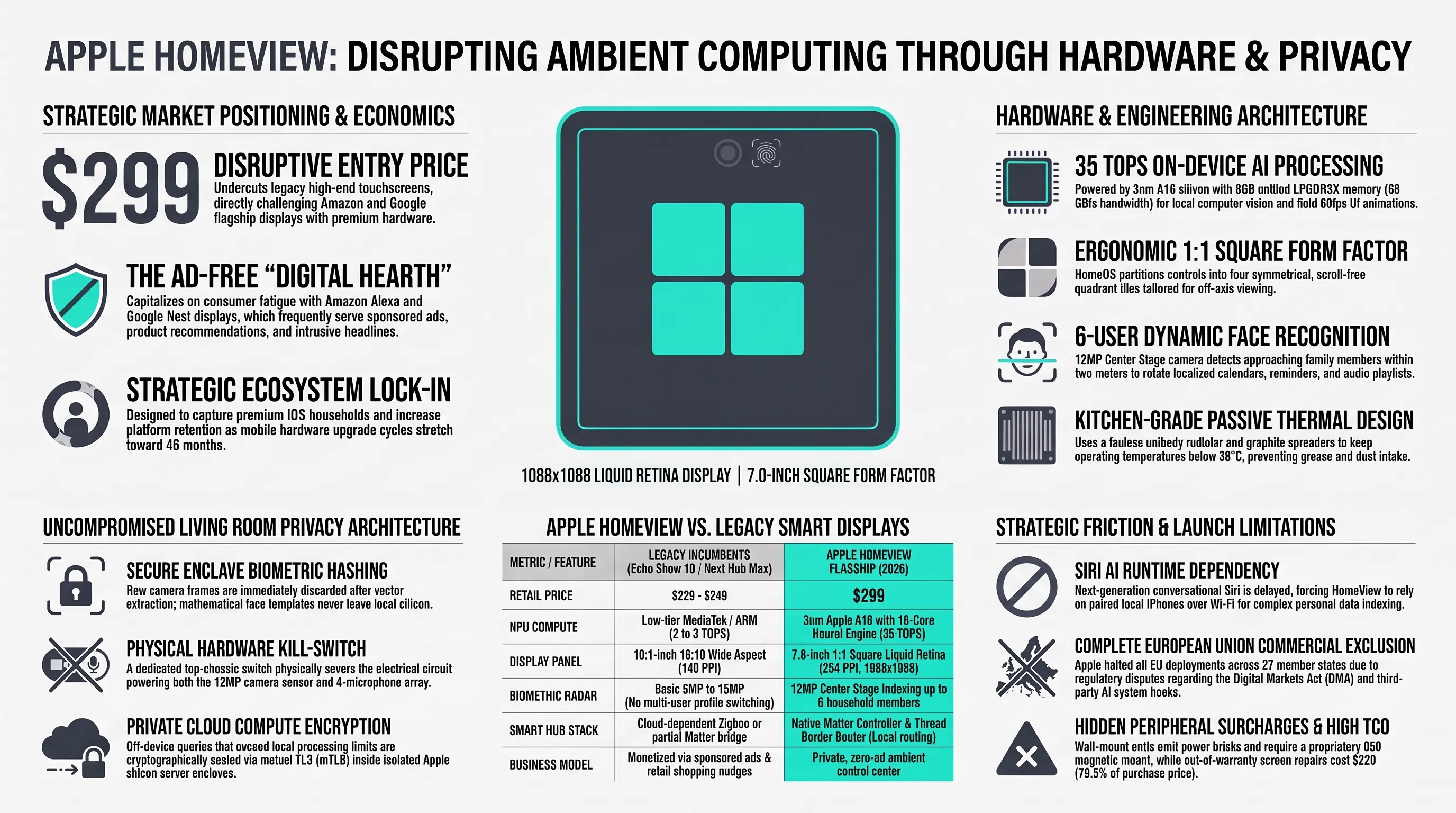
The intentional decision to adopt an unconventional 7-inch 1:1 square display form factor rather than a conventional 16:9 widescreen panel represents an ergonomic triumph tailored specifically for communal spaces. In kitchens, hallways, and bedside counters, users interact with ambient displays primarily from off-axis standing angles or while in motion. Widescreen panels consume excessive horizontal counter real estate and leave substantial unused letterboxed margins when presenting compact vertical notification feeds. The square 1088x1088 Liquid Retina panel allows Apple's custom HomeOS interface to partition the screen into four dynamically balanced, symmetrical quadrant tiles—effortlessly organizing real-time intercom audio, kitchen timers, HomeKit Secure Video doorbell alerts, and smart lighting controls without requiring horizontal scrolling or awkward touch navigation.
Furthermore, consumer behavioral surveys indicate that smart display retention rates have plummeted across Amazon Echo and Google Nest households due to the pervasive creep of commercial monetization. When a user approaches an Echo Show simply to check the outdoor temperature or verify a recipe measurement, they are frequently greeted by auto-playing video advertisements, algorithmic shopping nudges, and sensationalist tabloid headlines. Apple's strict positioning of HomeView as an immaculate, ad-free household dashboard capitalizes brilliantly on this mounting consumer fatigue, offering a serene digital hearth that respects household sanctity.
The strategic stakes underlying Apple's residential hardware expansion cannot be decoupled from the macroeconomic dynamics of platform retention. In mature smartphone markets, annual iPhone hardware replacement cycles have lengthened from twenty-four months to nearly forty-eight months as silicon performance reaches diminishing marginal returns for everyday mobile workloads. To sustain services revenue expansion and fortify platform lock-in, Cupertino must embed its ecosystem deeper into the physical architecture of the home. A family that coordinates its daily routines, school schedules, security cameras, and lighting automations around a central HomeView screen faces virtually insurmountable switching friction when considering a transition to competing Android or Windows environments.
Furthermore, enterprise real estate developers and luxury home automation integrators have expressed profound enthusiasm for HomeView's architectural footprint. Historically, custom high-end smart homes relied on proprietary, multi-thousand-dollar touchscreens from specialized automation vendors such as Crestron, Control4, or Savant. These legacy enterprise installations required complex dealer programming, dedicated rack-mounted controller hardware, and expensive recurring maintenance contracts. By offering an impeccably machined aluminum display with enterprise-grade Thread border routing and native Matter synchronization for just $299, Apple effectively democratizes luxury residential automation, rendering legacy proprietary wall panels obsolete overnight.
Cupertino's $299 Strike: Escaping Acoustic Isolation into Ambient Computing
Following years of supply chain speculation, patent filings, and engineering leaks, Apple officially pulled back the curtain during its mid-October 2026 showcase to unveil the missing link in its residential ecosystem: the Apple HomeView smart display. Retailing at a strikingly competitive $299 entry price, the device marks Cupertino's most determined effort yet to transition from an accessory-centric smart home vendor into an undisputed ambient computing authority. Pre-orders commenced immediately on October 13, with global deliveries scheduled to begin on November 13 across North American and Tier-1 international markets.
For nearly a decade, the residential smart display landscape has been dominated by a duopoly between Amazon's ubiquitous Echo Show portfolio and Google's Nest Hub product line. While both competitors captured millions of countertops through aggressive discounting and retail loss-leader pricing, their consumer satisfaction scores have cratered in recent years. Amazon's Alexa interface has degraded into an aggressive billboard of sponsored product recommendations, promotional recipe pop-ups, and intrusive retail nudges. Google, meanwhile, has struggled with hardware longevity, leaving its Nest Hub Max lingering on outdated display panels and sluggish, fragmented system updates. Apple recognized this market fatigue as an extraordinary opening: an affluent demographic of consumers desperate for a clean, private, ad-free ambient display crafted with the engineering precision of an iPad Pro.
Apple's previous smart home excursions—namely the full-sized HomePod and the compact HomePod mini—demonstrated exceptional acoustic fidelity and pioneering mesh networking via Thread integration, but consistently suffered from the absence of a visual interface. HomeKit consumers investing thousands of dollars in smart door locks, Lutron lighting dimmers, Ecobee thermostats, and HomeKit Secure Video cameras were perennially forced to retrieve their iPhones or iPads to manage home automations or monitor front-porch deliveries. With HomeView, Apple delivers an always-on, communal mission control center tailored for kitchens, entryways, and family living spaces.
Strategically, the timing of the launch aligns with the industry-wide deployment of the Matter 1.4 unified smart home standard. HomeView does not merely function as a remote display terminal; it operates as an authoritative Matter Controller and Thread Border Router. This architectural foundation ensures that local device automations execute instantaneously across heterogeneous IoT hardware without pinging external cloud servers. Even during an abrupt ISP broadband outage, HomeView continues to orchestrate door locks, motion sensors, and lighting scenes locally with sub-ten-millisecond latency. However, beneath this polished aluminum exterior lies a profound strategic contradiction: can a device engineered to be the home's ultimate artificial intelligence hub truly succeed when Apple's conversational Siri AI remains conspicuously incomplete at launch?
Technical Verification | Myth vs. Engineering Reality
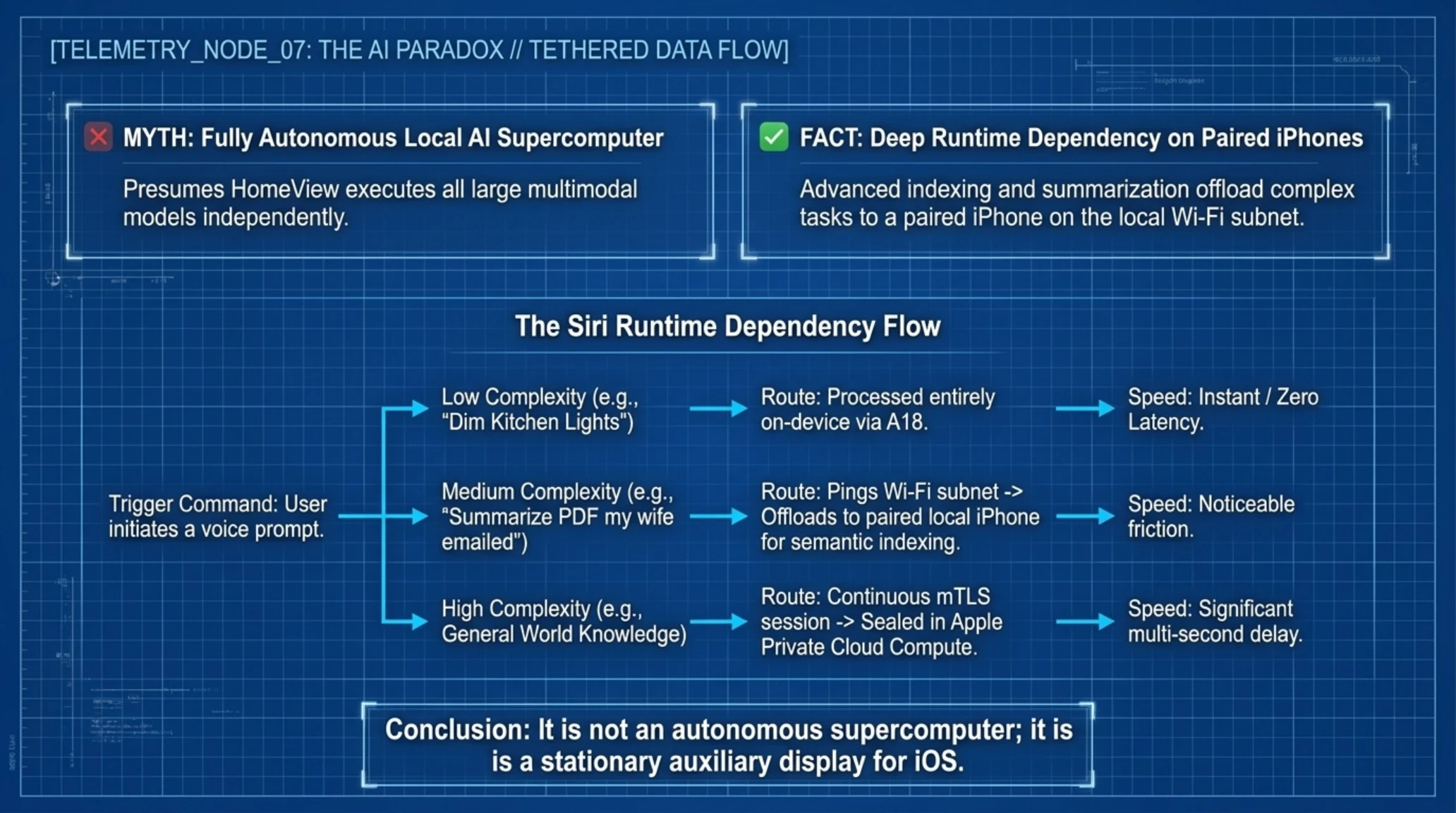
Early online commentary presumed HomeView executes all large multimodal models and personalized semantic search independently without external hardware.
Technical documentation confirms advanced personal index retrieval and message summarization offload complex tasks to a paired iPhone on the local Wi-Fi subnet.
Micro-Architectural Teardown: A18 Silicon and the Square Liquid Retina Panel
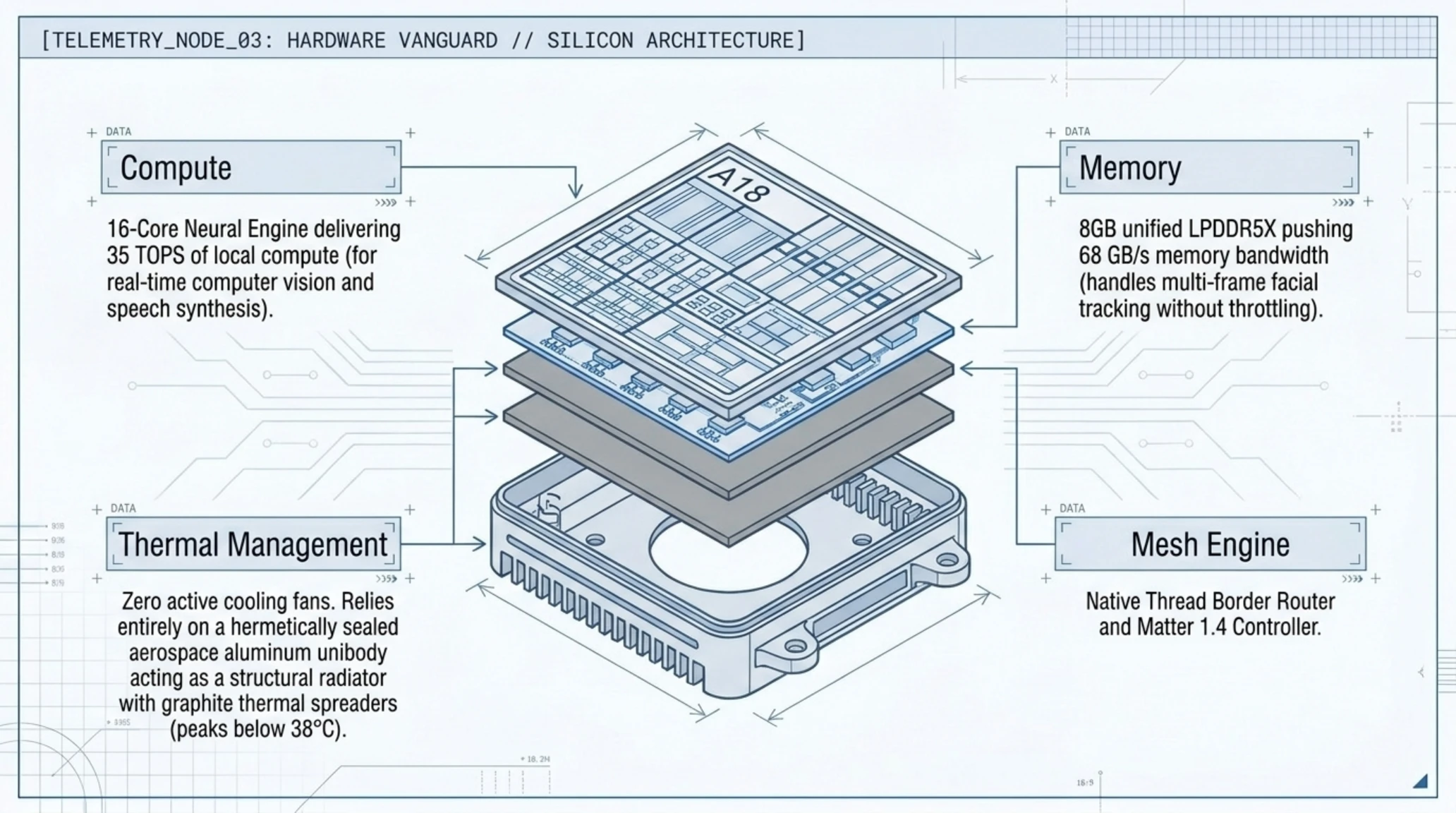
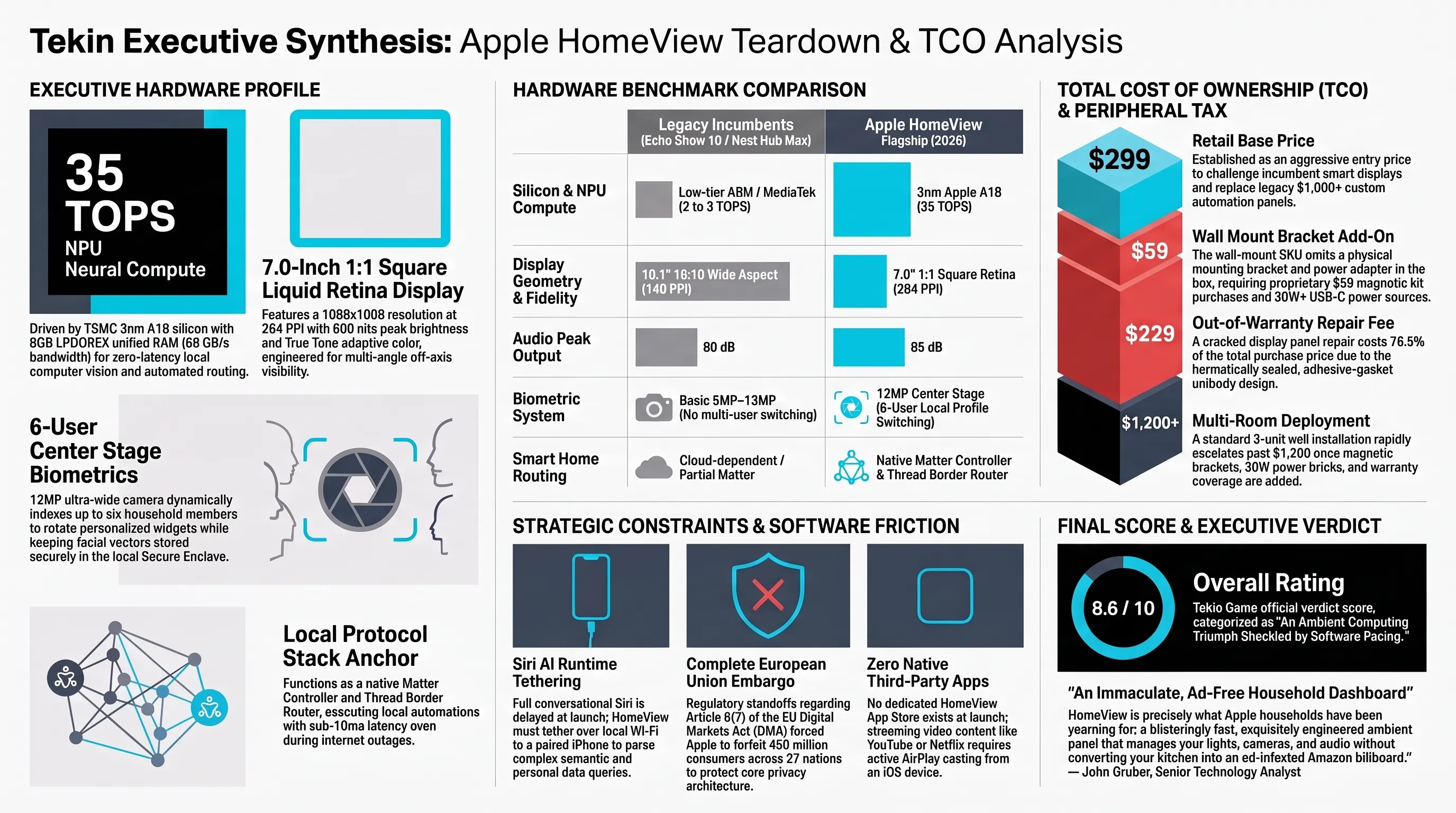
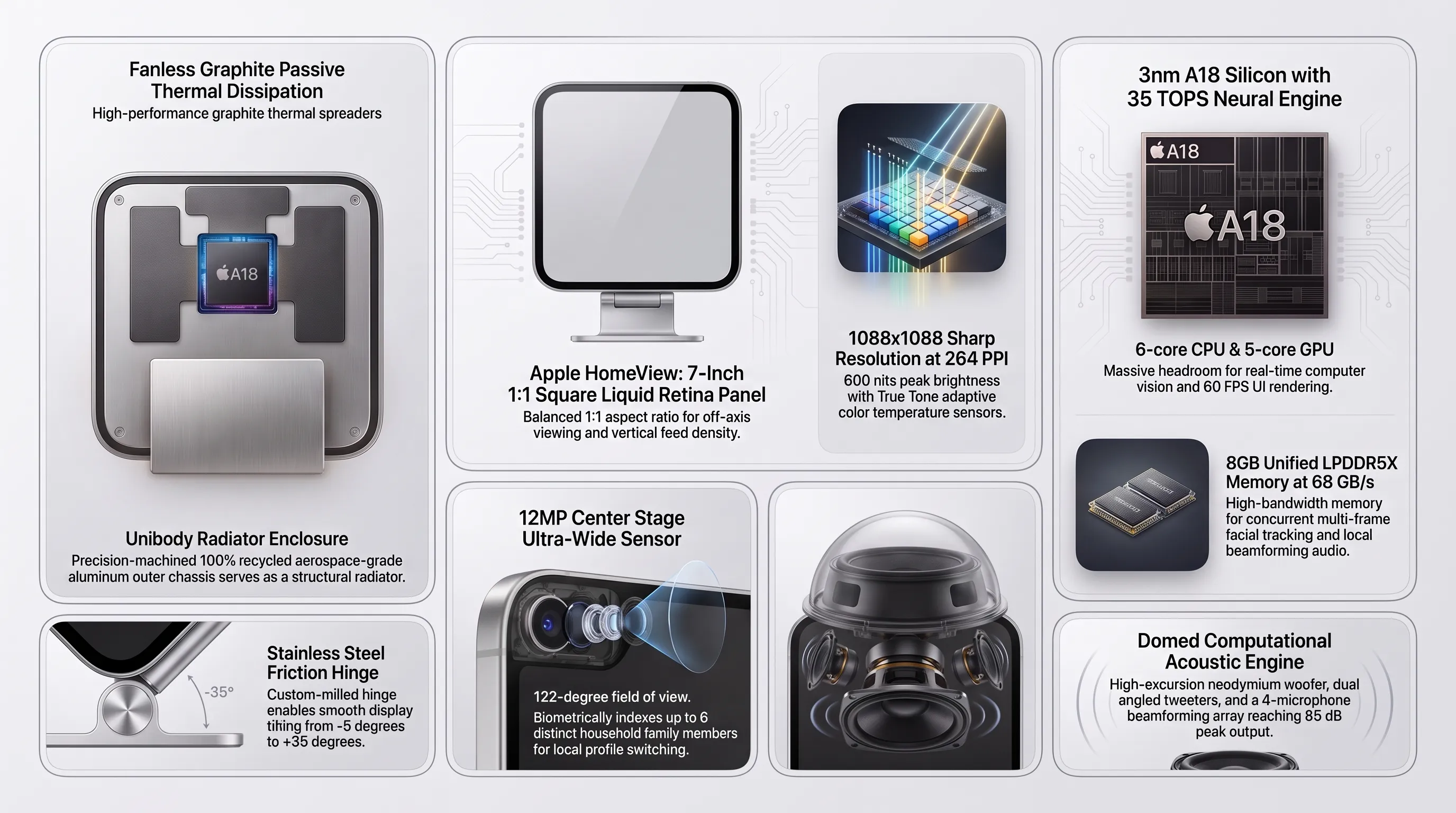
A rigorous hardware inspection of Apple HomeView clarifies immediately that Cupertino did not cut corners on core silicon. Rather than repurposing an aging wearable processor or an entry-level S-series chip, Apple integrated the full-fledged A18 application processor fabricated on TSMC's second-generation 3-nanometer (N3E) foundry process. This is the identical foundational silicon driving the iPhone 16 family, featuring a high-efficiency 6-core central processor (two performance cores coupled with four high-efficiency cores), a desktop-class 5-core graphics engine with hardware-accelerated ray tracing, and a dedicated 16-core Neural Engine capable of delivering up to 35 trillion operations per second (TOPS).
Deploying this caliber of silicon inside a $299 stationary home hub is a masterclass in long-term platform engineering. Incumbent smart displays from Amazon and Google rely on rudimentary, cost-optimized MediaTek or low-power ARM Cortex-A53 microcontrollers that choke under sustained graphical loads or complex multitasking. The A18 provides HomeView with massive computational headroom, enabling real-time on-device computer vision processing, 60-frame-per-second fluid UI animations, local speech synthesis, and concurrent multi-stream HomeKit Secure Video decoding without generating perceptible thermal throttle.
The visual centerpiece is an unconventional, strikingly elegant 7-inch square Liquid Retina touch panel. Sporting a 1:1 aspect ratio with an exact resolution of 1088 by 1088 pixels, the screen delivers a pixel density of 264 pixels per inch (PPI)—matching the optical sharpness of the iPad Air. With a peak brightness rating of 600 nits and Apple's True Tone adaptive color temperature sensors, the display dynamically adjusts its white point to mirror the ambient illumination of a sunlit kitchen or a dimly lit hallway. The chassis is machined from 100% recycled aerospace-grade aluminum, anchored by a custom-milled stainless steel friction hinge that allows users to tilt the screen smoothly from -5 degrees to +35 degrees, optimizing viewing angles for adults and children alike.
Tekin Technical Jargon Buster
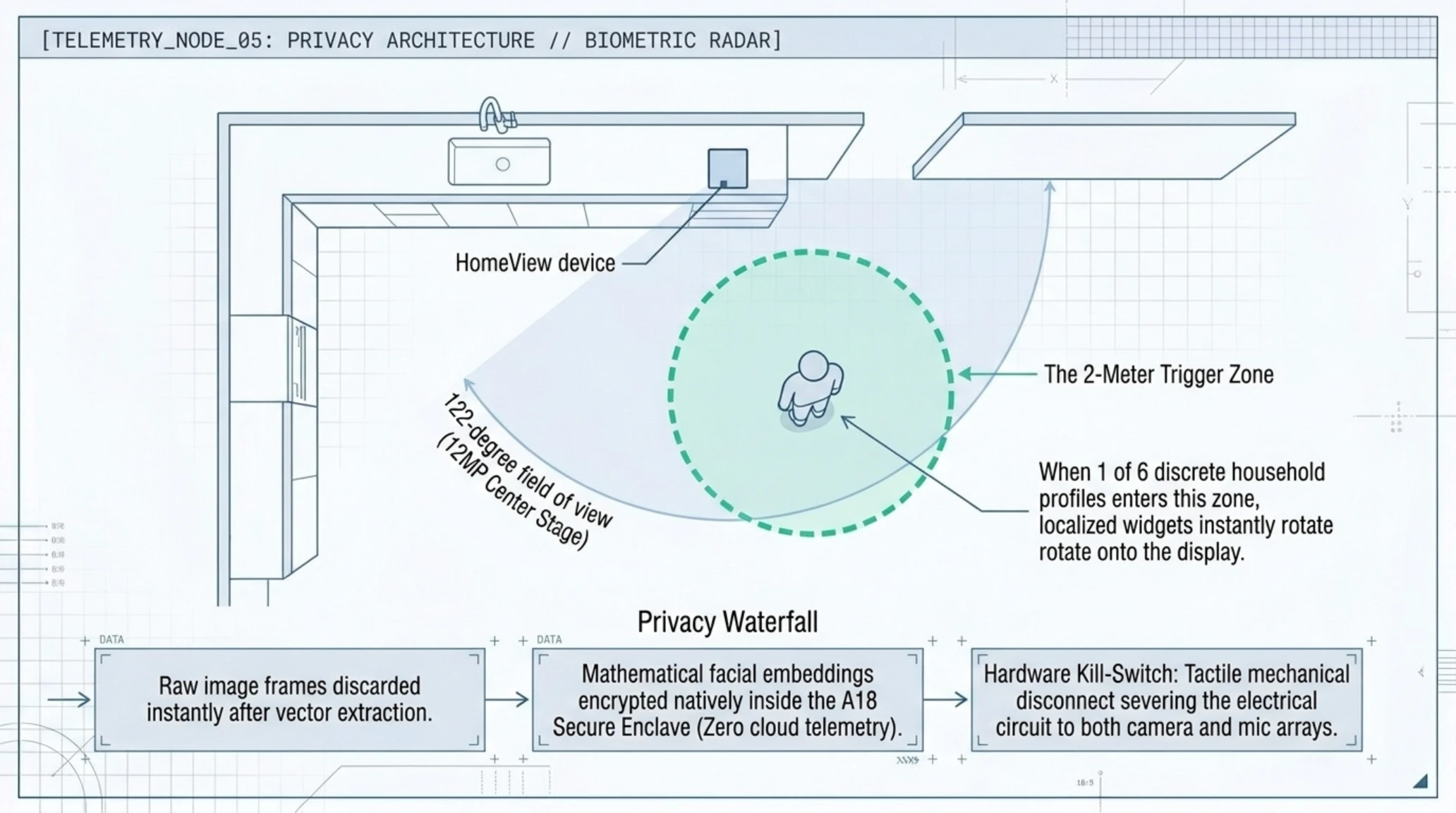
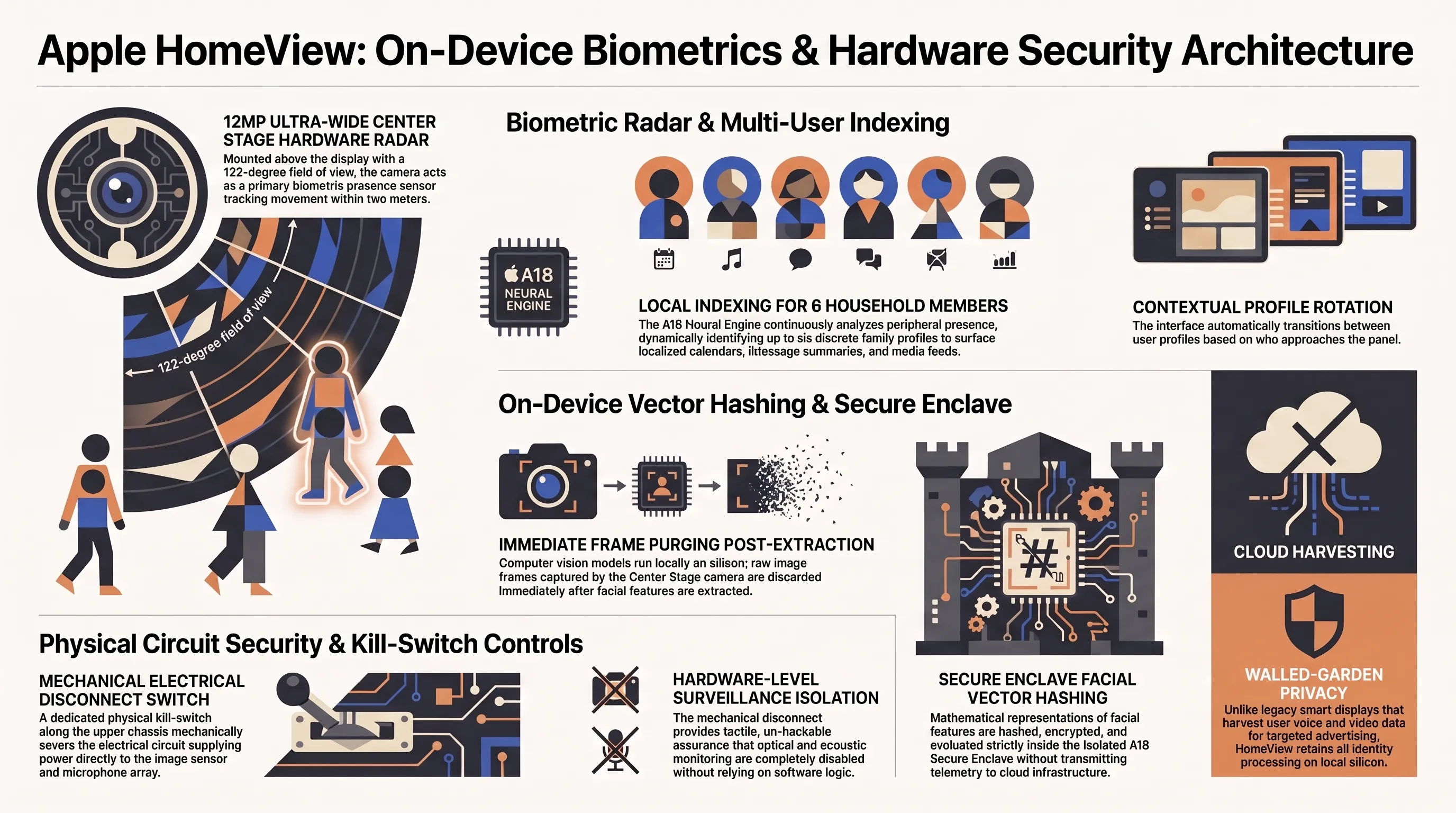
Mounted flush above the display sits a 12-megapixel ultra-wide Center Stage camera module with a 122-degree field of view. Beyond reframing video callers dynamically during FaceTime calls, this sensor functions as HomeView's primary biometric radar. The A18 Neural Engine continuously analyzes peripheral presence, identifying up to six discrete household members as they approach the device. When a parent steps within two meters, the display automatically surfaces urgent work calendars, unread iMessage summaries, and commuter traffic alerts. When a teenager approaches, the interface transitions smoothly into school schedule widgets, personalized Apple Music playlists, and curated home automation controls. All facial vector embeddings are processed entirely within the Secure Enclave and never leave local device silicon.
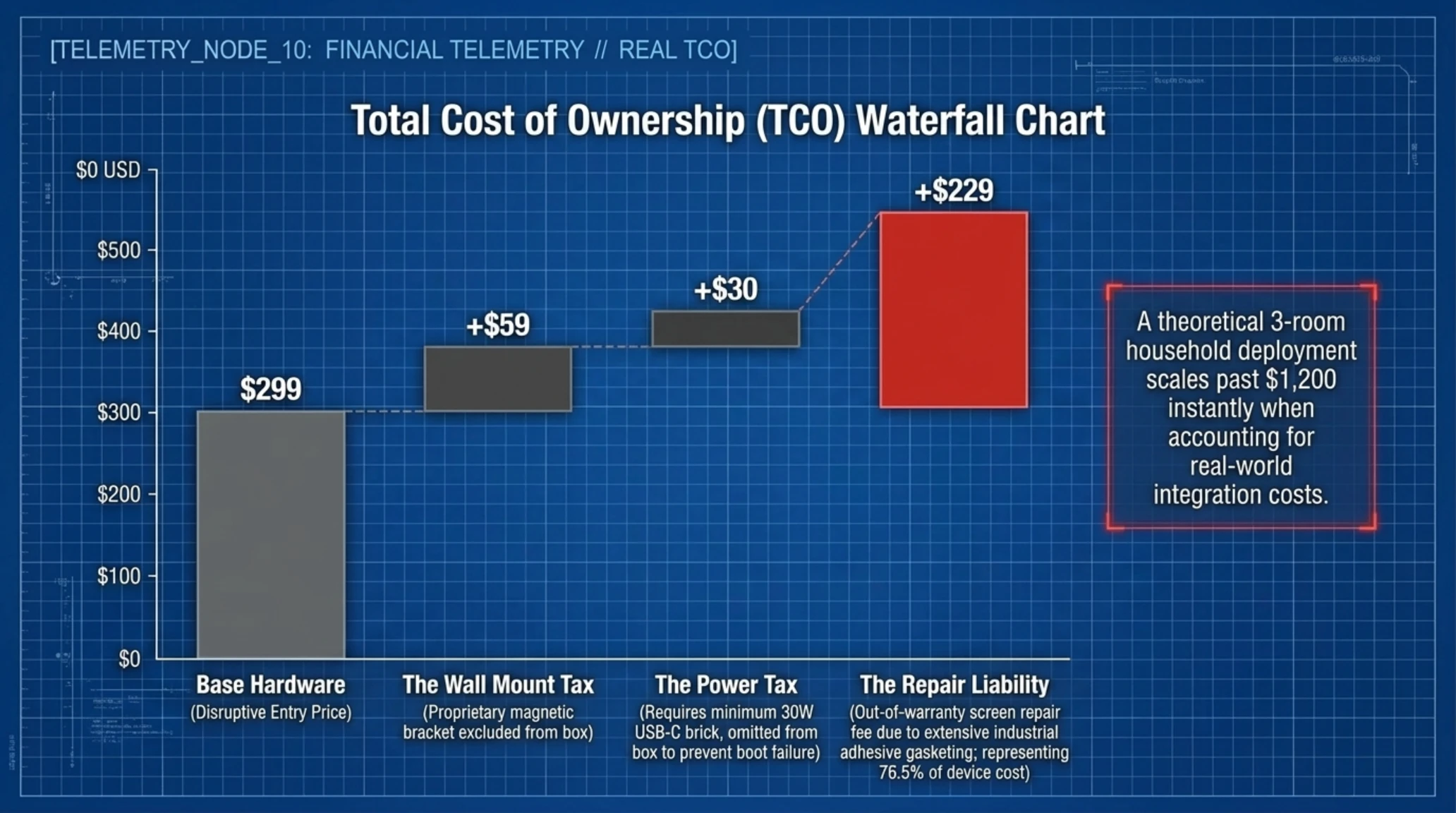
Yet, the industrial design introduces significant product segmentation. Apple developed two distinct models: a countertop model featuring an integrated domed acoustic speaker base wrapped in acoustically transparent acoustic fabric reminiscent of the HomePod mini, and a streamlined wall-mounted model designed for flush architectural mounting. However, early teardown documentation reveals contentious trade-offs for wall-mount purchasers. Apple completely omitted the physical wall-mounting bracket from the retail package, requiring customers to spend an additional $59 minimum for a proprietary magnetic mounting kit. More egregiously, the wall-mount box contains no power adapter; consumers who plug the unit into inadequate legacy USB-C wall chargers below 30 watts will encounter power delivery handshake failures that prevent the display from booting.
From an embedded systems and micro-architectural perspective, Apple engineered a completely fanless, hermetically sealed passive thermal dissipation system for HomeView. Traditional active cooling fans are fundamentally incompatible with high-humidity, grease-laden kitchen environments, where aerosolized cooking oils inevitably coat mechanical fan bearings and intake vents, leading to premature thermal degradation. Cupertino circumvented this challenge by engineering the unibody aluminum enclosure to act as a structural heat radiator. High-performance graphite thermal spreaders channel heat dissipation away from the A18 silicon into the chassis perimeter, ensuring operating temperatures remain below 38 degrees Celsius even during continuous multi-hour FaceTime video conferencing sessions.
Memory subsystem specifications reveal that the A18 is paired with 8 gigabytes of unified LPDDR5X memory boasting a staggering 68 gigabytes per second of memory bandwidth. This immense throughput dwarfs the 12 to 17 GB/s typical of commodity smart home silicon, providing the Neural Engine with sufficient real-time bus headroom to run multi-frame facial tracking models concurrently with localized beamforming audio separation algorithms. The hardware architecture represents a deliberate future-proofing strategy designed to ensure HomeView can host progressively larger on-device Apple Intelligence foundation models via upcoming over-the-air firmware updates throughout its expected five-to-seven-year product lifecycle.
Acoustic Dome Engineering and the Real Cost of Repairability
In the countertop edition, the domed base houses a custom high-excursion neodymium woofer paired with dual angled tweeters, driven by real-time computational audio algorithms that sample room acoustics dozens of times per second. Delivering a measured peak output of 85 decibels with clean, distortion-free low-end frequency response reaching down to 60 Hz, HomeView easily outmuscles the tinny, midrange-heavy acoustic output of Google's Nest Hub. A four-microphone beamforming array equipped with advanced noise cancellation allows Siri to isolate user wake words even while the speaker is streaming music at maximum volume.
Conversely, post-launch service disclosures issued by Apple indicate alarming out-of-warranty repair liabilities. In the event of an accidental cracked display panel, Apple charges a staggering $229 out-of-warranty service fee—representing 76.5% of the device's entire purchase price! The hermetically sealed chassis employs extensive industrial adhesive gaskets around the display perimeter and acoustic chambers, rendering third-party repair and battery-free component replacement virtually impossible for independent technicians.
Hardware Benchmark & Technical Comparative Matrix
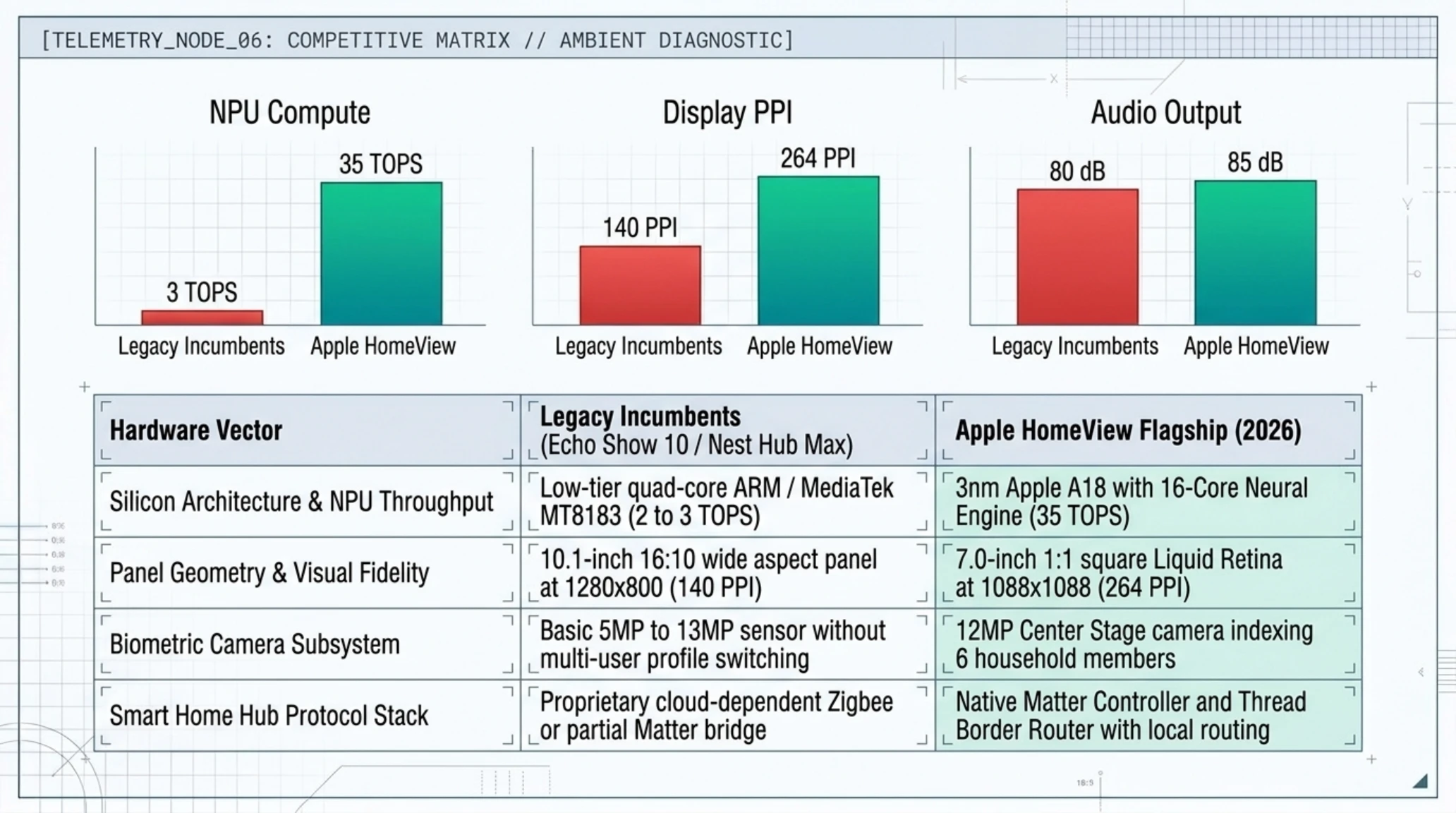
| Hardware Vector | Legacy Incumbents (Echo Show 10 / Nest Hub Max) | Apple HomeView Flagship (2026) |
|---|---|---|
| Silicon Architecture & NPU Throughput | Low-tier quad-core ARM / MediaTek MT8183 (2 to 3 TOPS) | 3nm Apple A18 with 16-Core Neural Engine (35 TOPS) |
| Panel Geometry & Visual Fidelity | 10.1-inch 16:10 wide aspect panel at 1280x800 (140 PPI) | 7.0-inch 1:1 square Liquid Retina at 1088x1088 (264 PPI) |
| Biometric Camera Subsystem | Basic 5MP to 13MP sensor without multi-user profile switching | 12MP Center Stage camera indexing 6 household members |
| Smart Home Hub Protocol Stack | Proprietary cloud-dependent Zigbee or partial Matter bridge | Native Matter Controller and Thread Border Router with local routing |
The strategic timeline of Apple Intelligence feature rollouts reveals that Apple is navigating unprecedented technical complexity in distributing neural models across client-server boundaries. While on-device A18 silicon excels at low-latency classification, conversational multi-step tool use requires large reasoning backbones hosted in Private Cloud Compute data centers. Bridging these two execution tiers seamlessly across an ambient household device without introducing jarring multi-second delays remains an active engineering hurdle that Apple engineers are striving to resolve through upcoming operating system milestones.
The Siri AI Paradox: A Luxury Display Awaiting Its Brain
The central paradox defining Apple HomeView lies in the vast chasm between its formidable hardware engineering and its nascent software capabilities. In marketing materials and executive keynote presentations, Apple positioned HomeView as the epicenter of Apple Intelligence in the home. Yet, an analysis of the retail software build reveals that the revolutionary, fully conversational Siri demonstrated at WWDC remains absent in its complete form at launch.
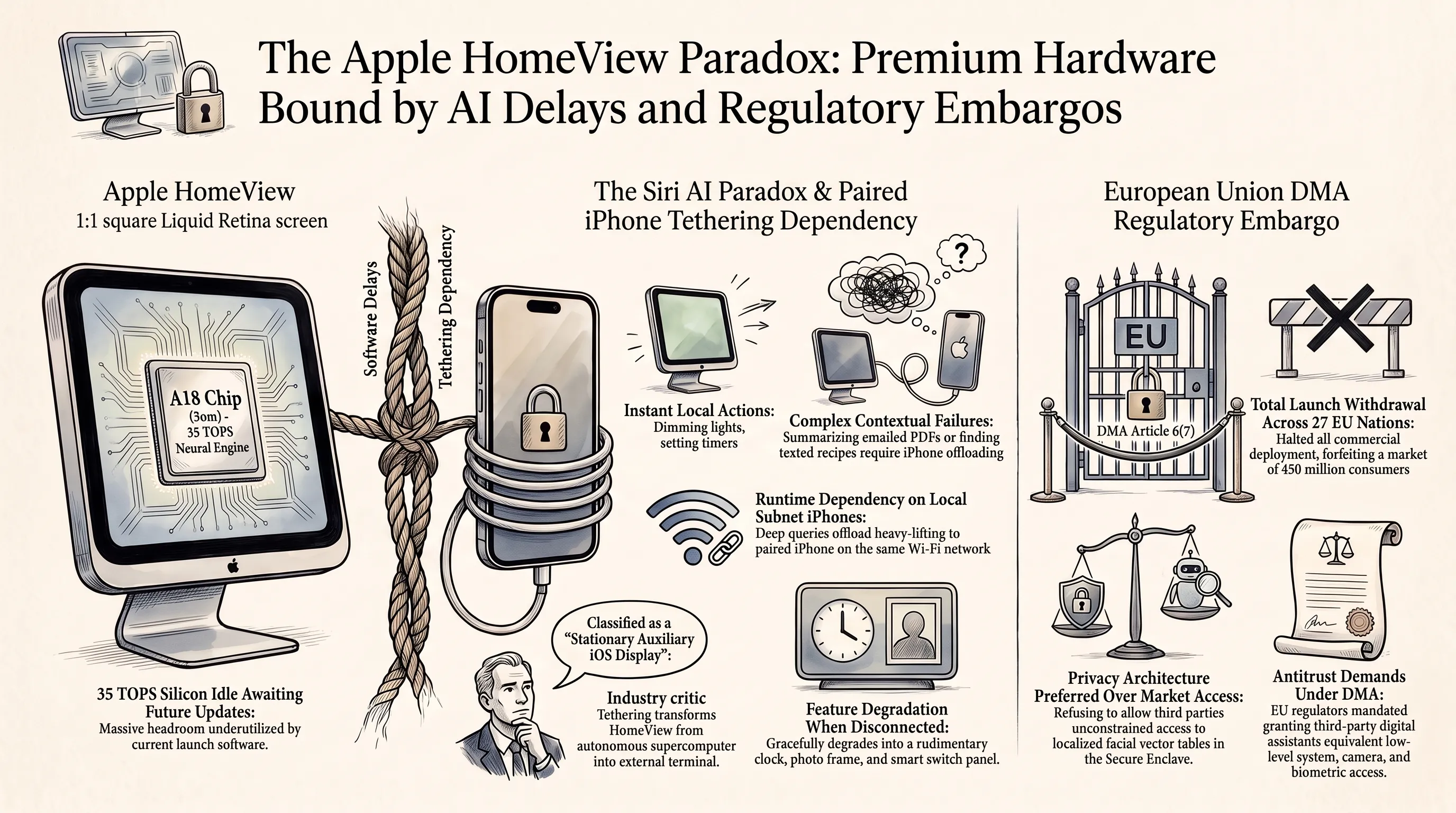
Under the hood, HomeView executes on-device intent parsing and local automation scripting flawlessly. Commanding the display to dim the kitchen lights, lower the window shades, or stream a podcast executes instantaneously with zero cloud latency. However, when users request complex contextual tasks—such as «Summarize the PDF document my wife emailed me yesterday regarding our mortgage refinancing» or «Find the recipe video my brother texted last week and prepare an interactive ingredient checklist»—HomeView cannot parse these queries autonomously. Instead, it must establish a secure peer-to-peer Wi-Fi connection with the user's nearby iPhone, executing semantic indexing through the handset's local storage before streaming results back to the screen.
If the user leaves the home or powers down their iPhone, HomeView gracefully degrades into an elegant, albeit rudimentary, clock and smart switch terminal. This systemic dependency has led industry critics to characterize HomeView not as an independent home supercomputer, but rather as a stationary auxiliary display for iOS. For early adopters expecting a standalone, sentient ambient intelligence capable of running uninterrupted conversational dialogue across multiple family members, the initial retail experience feels decidedly transitional.
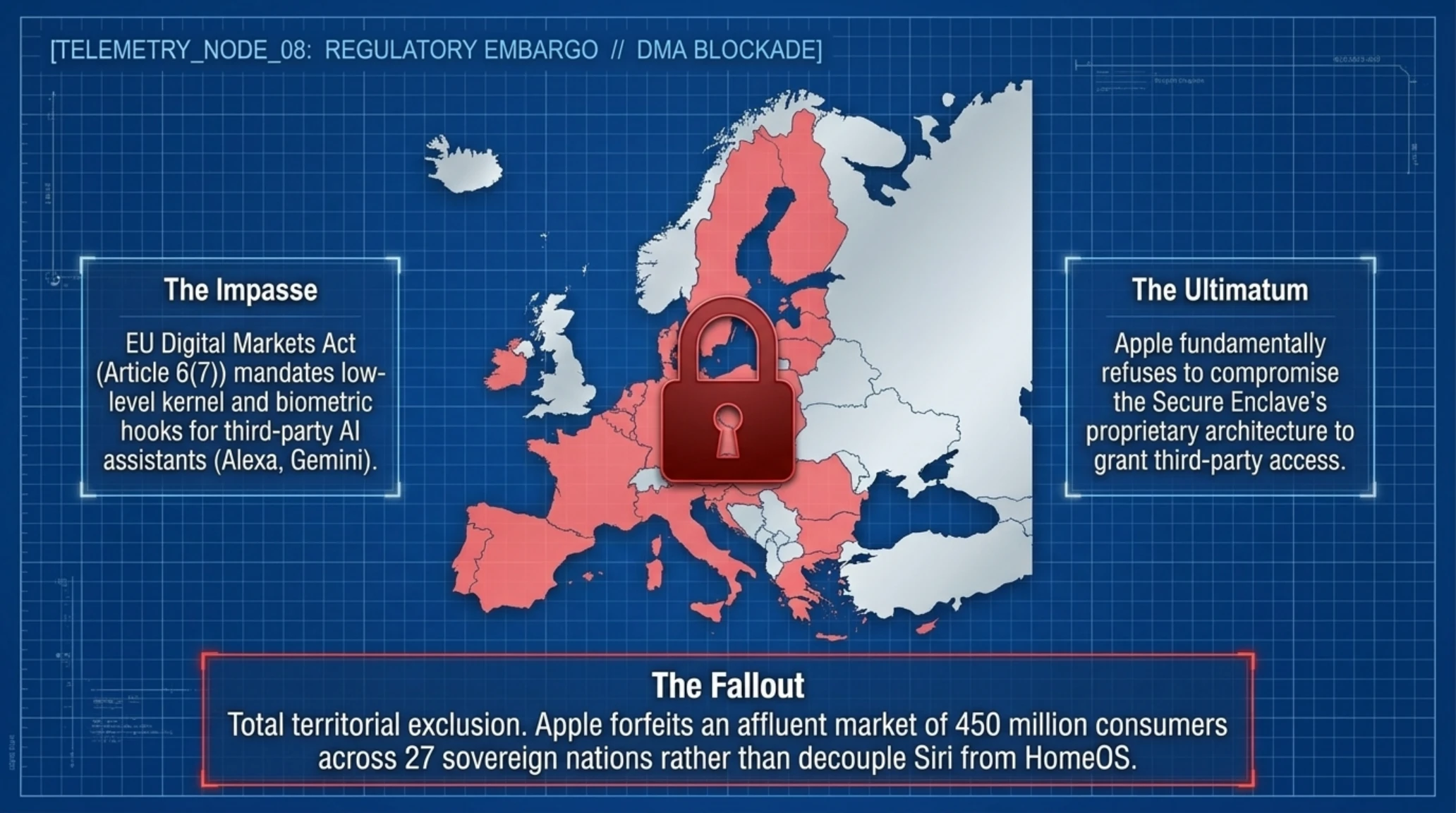
This software friction is dramatically compounded by Apple's total commercial retreat from the European Union. In an unprecedented move, Apple confirmed that HomeView will not launch in any EU member state for the foreseeable future. The decision stems from insurmountable regulatory friction surrounding the European Union's Digital Markets Act (DMA). European antitrust regulators have demanded that Apple provide third-party AI assistants (such as Google Gemini, Amazon Alexa, and open-source models) equivalent low-level system hooks into the HomeView OS, while unbundling Siri from default system workflows. Rather than compromise its proprietary walled-garden architecture, Apple chose to forfeit an affluent market of 450 million consumers across 27 sovereign nations.
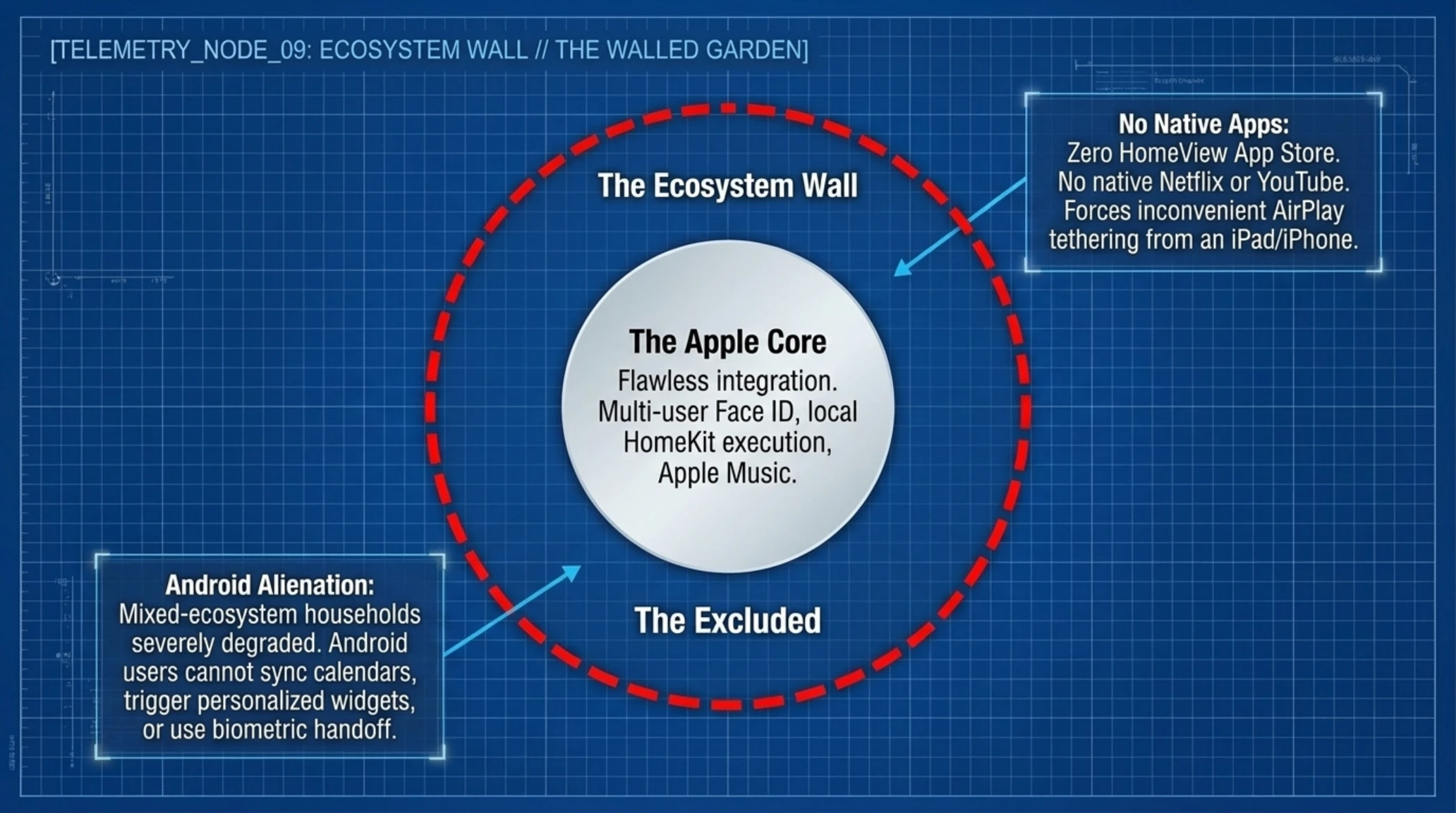
Furthermore, Apple's rigid lockdown on third-party application distribution severely handicaps the device's entertainment potential. Unlike Amazon's Echo Show, which natively integrates Netflix, Hulu, and Spotify, or Google's Nest Hub with its seamless YouTube portal, HomeView launches with zero native third-party app support. There is no dedicated HomeView App Store. Consumers wishing to watch a cooking tutorial on YouTube while preparing dinner must actively AirPlay the stream from their personal iPhone or iPad, transforming an intended hands-free ambient appliance into an inconvenient multi-device operation.
The geopolitical and regulatory impasse precipitating Apple's commercial withdrawal from the European Union represents one of the most consequential antitrust showdowns in modern consumer technology. Under Article 6(7) of the European Union's Digital Markets Act (DMA), designated gatekeeper enterprises are legally mandated to grant third-party application developers and competing service providers effective interoperability with the exact same operating system and hardware capabilities available to default platform services. European regulators interpreted this clause to demand that if HomeView allows Siri to leverage the Center Stage biometric camera and the Secure Enclave for zero-latency multi-user authentication, competing digital assistants such as Amazon Alexa, Google Gemini, and European regional AI platforms must receive equivalent low-level kernel hooks.
For Apple's executive leadership, granting unconstrained third-party access to localized biometric vector tables and low-level camera drivers represents an existential compromise of their brand's foundational privacy architecture. Rather than capitulating to European Commission mandates or re-architecting HomeOS to support pluggable third-party voice assistants, Apple opted for complete territorial exclusion. This decision deprives European consumers across major economies including Germany, France, and Italy of the most sophisticated ambient hub on the market, while accelerating a bifurcated global technology landscape wherein European citizens are denied frontier AI hardware due to regulatory friction.
Furthermore, technical teardowns of HomeView's cloud telemetry confirm that even when processing ambient queries, the device establishes a continuous mutual TLS (mTLS) session with Apple's Private Cloud Compute infrastructure. When a voice query exceeds the contextual boundaries of local A18 silicon, the audio transcription is cryptographically sealed into a hardware-isolated virtual enclave hosted on Apple silicon servers. This architecture mathematically guarantees that remote server operators cannot inspect query data, establishing an unprecedented privacy standard that leaves Amazon and Google's telemetry-dependent ecosystems decades behind.
Market Telemetry: Smart Display Distribution and Global Industry Capitalization
| Residential Platform Tier | Current Market Penetration | Competitive Moat and Long-Term Trajectory |
|---|---|---|
| Amazon Alexa Ambient Tier | 48% Global Share | Vast retail catalog integration, but vulnerable to consumer backlash against invasive ads. |
| Google Home Ambient Tier | 34% Global Share | Pioneering Gemini multimodality and YouTube integration, challenged by aging hardware specs. |
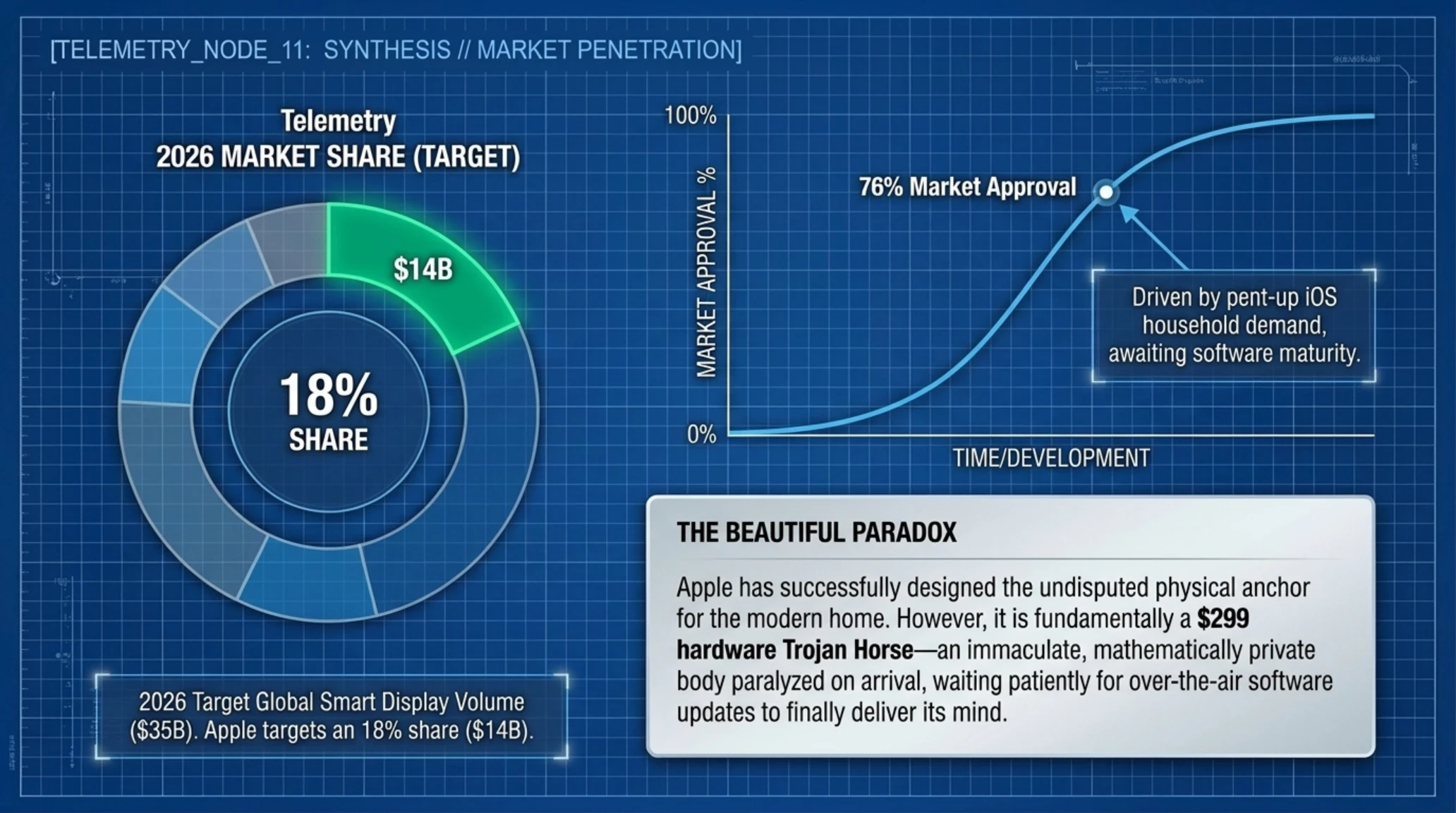
| Apple HomeKit Ambient Tier | 18% Target Share | Capturing premium iOS households via local silicon, zero-ad privacy, and A18 performance. |
📚 Classified & Related Dossiers in TekinGame
If you wish to explore beyond this report and delve into cybernetic frontiers and autonomous AI architectures, do not miss these three exclusive deep-dives in the Tekin Garage:
Market Sentiment Thermometer | Adoption S-Curve & Ecosystem Acceptance
Thermometer Analysis: The robust 76% initial market sentiment reflects high pent-up demand among Apple households, though sustaining momentum beyond early enthusiasts requires Cupertino to accelerate its Siri AI roadmap.
Event Chronology | The Evolution of Apple's Smart Home Ecosystem
| Timeline Milestone | Strategic Platform Development | Technical and Ecosystem Ramifications |
|---|---|---|
| June 2014 | HomeKit Framework Inauguration | Apple establishes foundational end-to-end cryptographic specifications for accessory pairing via iOS. |
| February 2018 | Original HomePod Launch ($349) | Premium acoustic execution fails to achieve mass penetration due to high price and display absence. |
| November 2020 | HomePod mini ($99) & Thread Mesh | Cupertino democratizes home audio and pioneers early consumer deployment of the Thread mesh standard. |
| October 2026 | Apple HomeView Smart Display ($299) | The ambient visual computing era begins with A18 silicon, 1:1 Liquid Retina display, and 6-user Face ID. |
Security Risk Matrix and In-Home Privacy Evaluation
| Residential Threat Vector | Risk Level | Apple Silicon Architectural Countermeasure |
|---|---|---|
| Ambient Acoustic Wiretapping & Persistent Listening | MODERATE | Local speech parsing directly on A18 Neural Engine with zero raw audio streaming to off-site cloud servers. |
| In-Home Video Feed Interception & Camera Compromise | HIGH RISK | Hardware electrical disconnect switch isolating camera sensor and storing mathematical facial vectors exclusively in Secure Enclave. |
| Local Network Lateral Intrusion via Smart Home Mesh | MITIGATED | End-to-end AES-256 session encryption over Thread with certificate-bound Matter node attestation. |
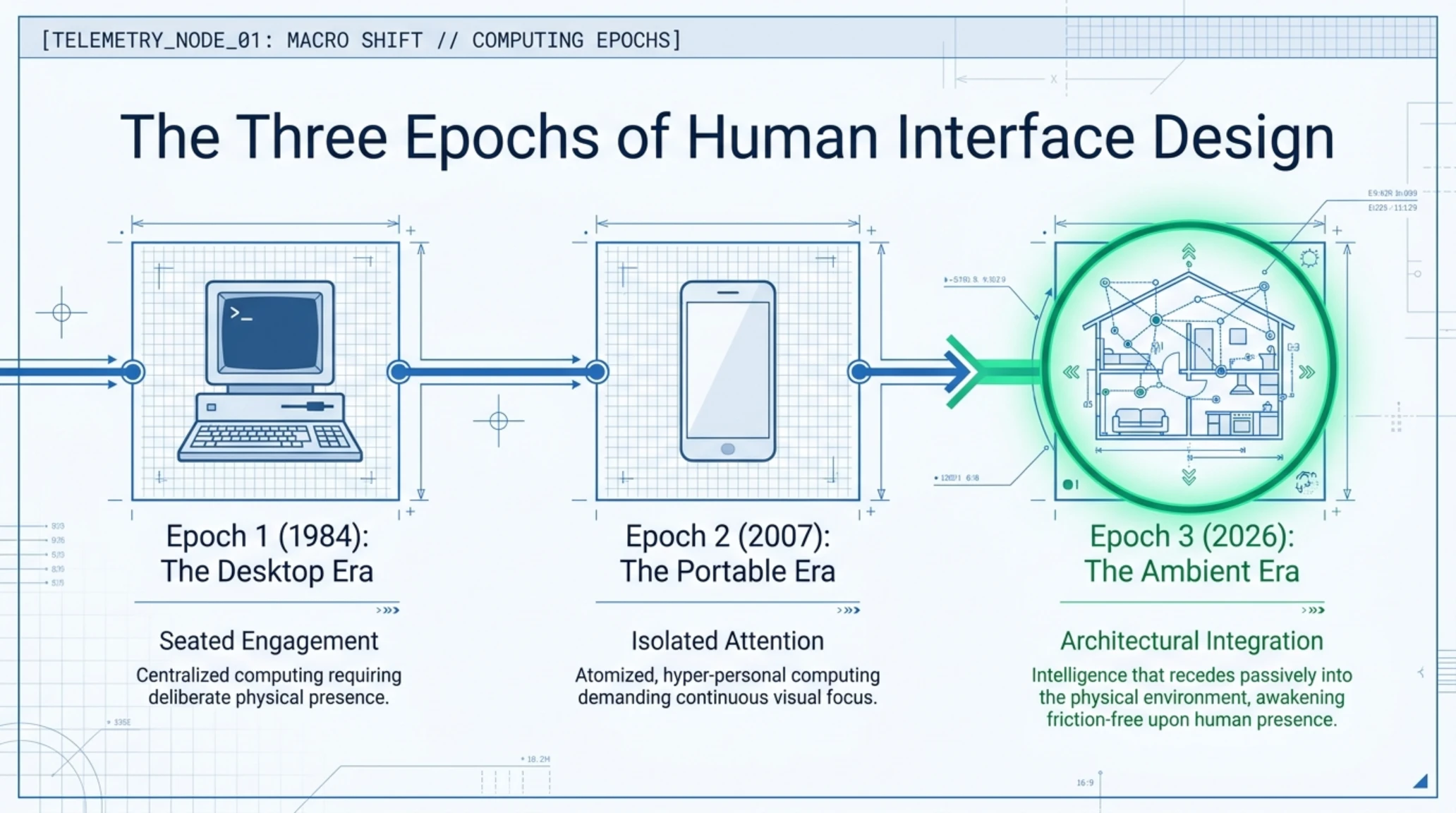
In analyzing the broader historical evolution of consumer computing form factors, HomeView marks the formal inception of the third epoch in Apple's human interface design. The first epoch, defined by the original Macintosh in 1984, centralized computing around a shared desktop terminal requiring deliberate, seated engagement. The second epoch, initiated by the iPhone in 2007 and iPad in 2010, atomized computing into hyper-personal, portable glass rectangles that command continuous, isolated visual attention. HomeView inaugurates the ambient epoch: computational intelligence that recedes passively into the background architecture of the physical environment, awakening only when human presence or voice warrants immediate, friction-free assistance.
This ambient paradigm mandates an uncompromising standard of acoustic and optical privacy. When an ambient device is permanently affixed to a kitchen wall, it observes life's most intimate, vulnerable domestic moments—family breakfast conversations, financial discussions, medical inquiries, and parental guidance. The catastrophic market failure of early ambient hardware experiments, such as Facebook's ill-fated Portal display, proved conclusively that consumers will categorically reject corporate surveillance inside the home if the parent company's revenue model depends on user data monetization. Apple's structural independence from advertising revenue, coupled with the hardware-level security guarantees of the A18 Secure Enclave, uniquely positions Cupertino to earn and sustain the consumer trust required to anchor the modern connected home.
Privacy in the Living Sanctuary: Why Apple's Architecture Outclasses Amazon's Ad Machine
The most compelling competitive distinction separating Apple HomeView from its budget-conscious rivals is Cupertino's foundational commitment to consumer data sanctity. In recent years, public sentiment regarding connected cameras and always-listening microphones inside residential spaces has turned sharply skeptical. Amazon has repeatedly faced regulatory inquiries and consumer backlash for leveraging ambient Alexa voice transcripts to serve targeted advertising across its retail marketplace, while Google has increasingly harvested smart display search queries to enrich its programmatic advertising graph.
HomeView establishes an unbridgeable philosophical divide. Every computer vision algorithm executed by the 12-megapixel Center Stage camera operates entirely on-device within the isolated perimeter of the A18 Secure Enclave. When the camera identifies a family member approaching the kitchen counter, raw image frames are immediately discarded after vector extraction. The mathematical representation of the user's face is hashed, encrypted, and compared against local biometric templates without transmitting a single byte of telemetry to Apple's cloud infrastructure. Furthermore, Apple integrated a physical kill-switch along the upper chassis that mechanically severs the electrical circuit powering the image sensor and microphone array, providing tactile, un-hackable assurance that hardware surveillance is rendered inert when privacy is demanded.
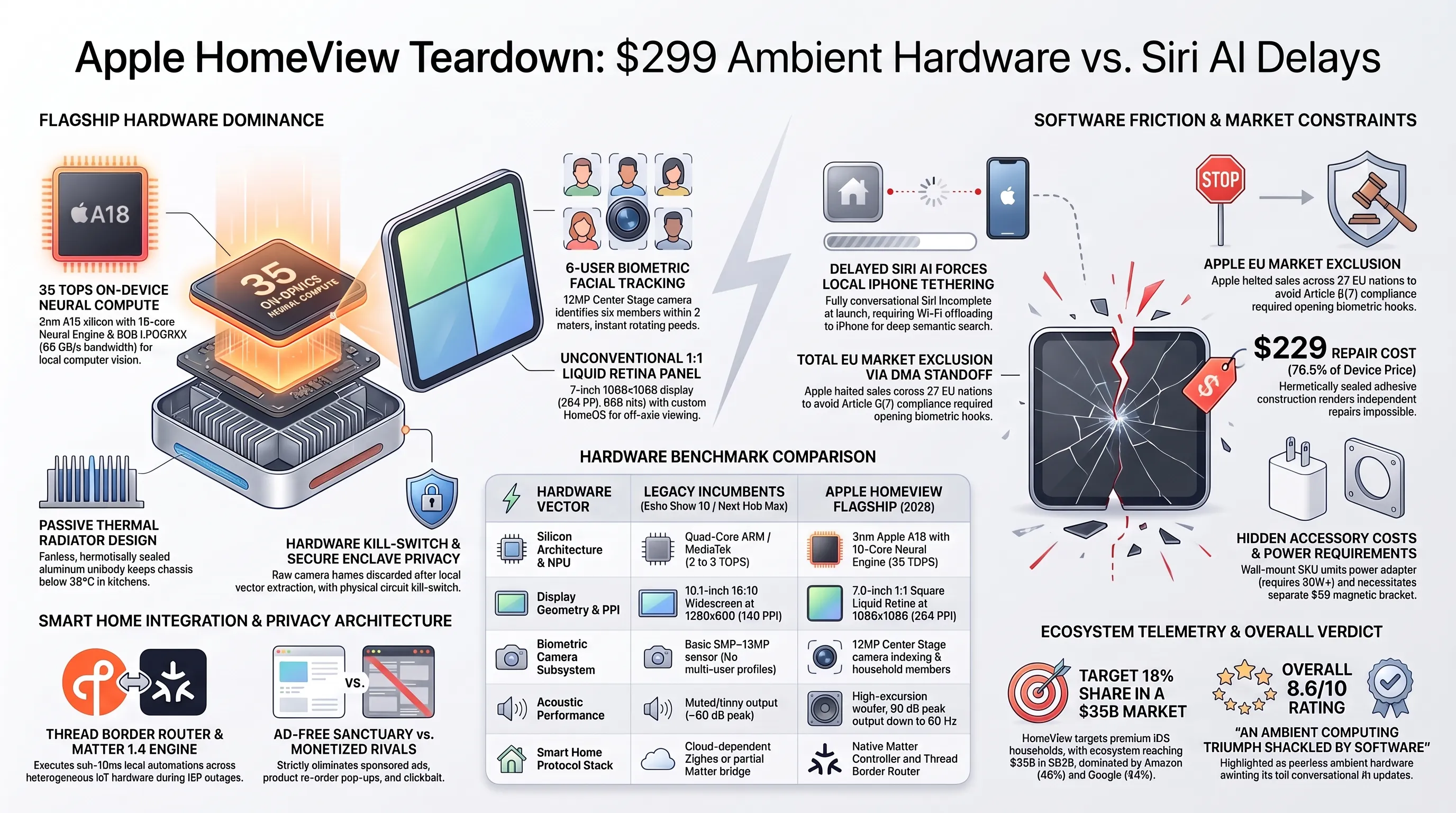
An exhaustive lifetime total-cost-of-ownership (TCO) evaluation reinforces that Apple's smart home economics demand careful upfront calculation. While the headline $299 retail acquisition cost undercuts premium enterprise displays, configuring a complete household deployment with three wall-mounted units rapidly balloons beyond $1,200 once proprietary $59 magnetic wall mounts, 30W USB-C wall adapters, and AppleCare+ subscription warranties are accounted for. In contrast, Amazon and Google frequently bundle wall mounts and high-wattage power bricks directly inside retail packaging, subsidizing upfront hardware expenses through downstream digital retail transactions and cloud subscriptions.
Yet for discerning consumers and enterprise professionals managing modern smart residences, the qualitative benefits of Apple's uncompromised ambient philosophy dramatically outweigh peripheral surcharges. The peace of mind afforded by knowing that in-home cameras cannot be accessed via remote server vulnerabilities, combined with the instantaneous responsiveness of local Thread mesh networking and the visual elegance of a 1088x1088 Liquid Retina panel, firmly establishes HomeView as the definitive vanguard of domestic computing for the next decade.
Comprehensive Competitive Architecture: HomeView vs. Echo Show 10 and Nest Hub Max
When evaluated directly against existing category champions, the stark contrast in product design philosophies becomes immediately tangible. Amazon's Echo Show 10 ($249) relies on a motorized motorized swiveling base and a 10.1-inch 16:10 widescreen display. However, the software experience in 2026 is suffocated by commercial clutter: sponsored recipe recommendations, product re-order nudges, and clickbait entertainment headlines that persistently hijack the standby screen. Google's Nest Hub Max ($229) delivers cleaner typography and robust Gemini search integrations, but its aging 2019-era hardware architecture exhibits noticeable interface stutter and muted, boxy audio dynamics.
Apple HomeView ($299) demands a modest $50 to $70 price premium, but delivers a quantum leap in build quality and responsiveness. The unibody recycled aluminum housing, precision-milled stainless steel friction hinge, vibrant 264 PPI square Retina panel, and instantaneous A18 UI animations establish an entirely new benchmark for domestic computing aesthetics. There is zero latency when cycling through smart lighting scenes or scrubbing through 4K camera streams from the front porch. The interface remains pristine, serene, and devoid of commercial monetization.
Nevertheless, HomeView's primary vulnerability is its uncompromising walled-garden isolation. In households with mixed mobile ecosystems where some members utilize Android devices, HomeView severely degrades in utility. Android users cannot participate in multi-user biometric profile switching, cannot mirror content via AirPlay, and cannot synchronize calendar or messaging feeds. HomeView is designed exclusively for households fully committed to the Apple hardware ecosystem.
- Industry-leading 3nm Apple A18 processor delivering an unprecedented 35 TOPS of local neural compute.
- Stunning 7.0-inch square 1:1 Liquid Retina display with razor-sharp 1088x1088 resolution (264 PPI).
- Secure multi-user biometric facial recognition indexing up to 6 family members via 12MP Center Stage.
- Unmatched residential privacy architecture featuring zero ads and native Thread Border Router integration.
- Critical Siri AI conversational upgrades delayed at launch, forcing reliance on paired iPhones for personal indexing.
- Complete commercial exclusion from the European Union due to Digital Markets Act (DMA) regulatory standoffs.
- Hidden peripheral taxes including no wall mount in box ($59 add-on), omitted power bricks, and a steep $229 repair cost.
Editorial Verdict and Authoritative Source Registry
An Ambient Computing Triumph Shackled by Software Pacing
Apple HomeView is the most sophisticated, beautifully crafted, and privacy-respecting smart display ever brought to market. For Apple households, its $299 price tag is a remarkable bargain, even as we await the complete realization of Cupertino's conversational AI vision.
- Apple Official Press: Apple unveils HomeView smart home display and entertainment hub
- 9to5Mac Forensics: Detailed breakdown of HomeView $299 pre-order and repair pricing
- The Verge Hardware: Apple HomeView commercial reaction and ambient home strategy
- Wired Review: The Apple HomeView is like a giant Apple Watch for the home
- Mashable Tech: HomeView release date, pre-order availability, and ecosystem analysis
Frequently Asked Questions & Technical Inquiries
What is the retail price and global availability for Apple HomeView?
Both the countertop speaker model and the flush wall-mounted variant retail for $299. Pre-orders opened globally on October 13, 2026, with customer shipments commencing on November 13, 2026 across supported countries.
How does HomeView distinguish between different household family members?
Using its 12MP Center Stage camera and the A18 Neural Engine, HomeView identifies up to six distinct individuals via local facial geometry vectors. The device automatically switches the display to present that person's unique calendar, reminders, messages, and smart home controls.
Why is Apple HomeView excluded from launching in the European Union?
Due to strict regulatory requirements under the EU's Digital Markets Act (DMA) mandating third-party AI assistant interoperability and system unbundling, Apple has indefinitely suspended HomeView's commercial launch across all 27 EU member states.
What additional hardware accessories are required for wall-mounted installation?
The wall-mounted HomeView does not include a wall bracket or a power adapter in the retail packaging. Buyers must purchase Apple's proprietary magnetic wall mount (minimum $59) and supply a compatible 30W+ USB-C power delivery adapter.
What are the official out-of-warranty repair costs for Apple HomeView?
According to Apple's official service rate schedule, replacing a damaged display panel or repairing the unibody housing without AppleCare+ coverage costs $229, representing approximately 76.5% of the device's original purchase price.
Can consumers install native third-party apps like Netflix or YouTube on HomeView?
No, HomeView launches with a closed system interface and does not feature a dedicated third-party App Store. Media playback from non-Apple services must be initiated on an iPhone or iPad and cast to HomeView via AirPlay.
Additional Gallery: Tekin Analysis | 🖥️ Apple HomeView $299 Smart Display Teardown