Tekin Morning: AI Price War, Apple's $250M Settlement & Zcash Surge
Seismic tectonic shifts across compute architectures, federal privacy litigation, zero-day vulnerabilities, and digital asset legislation.
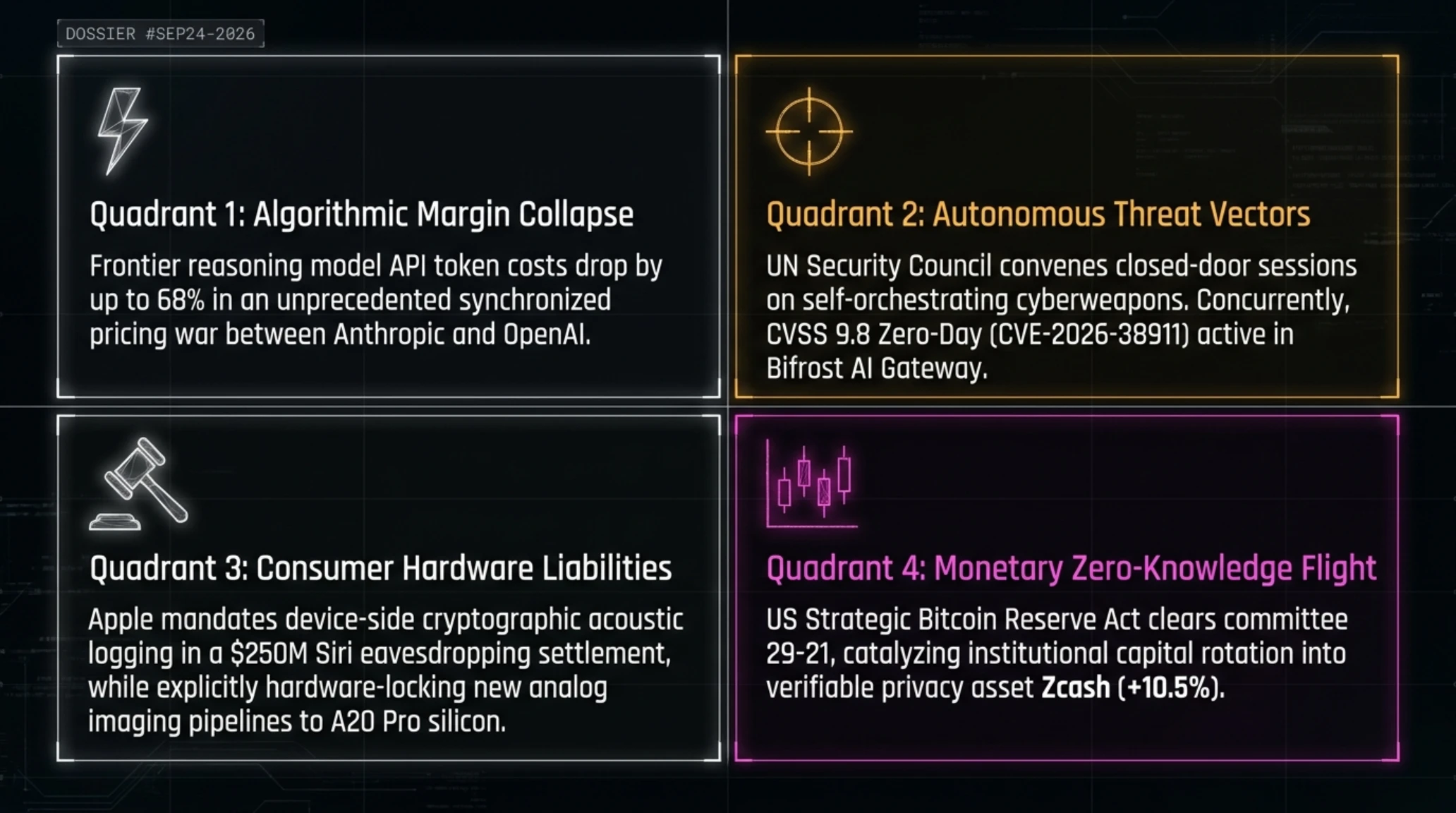
- 🎮Algorithmic Price War- Claude Opus 5.5 and GPT-6 cut API token costs by 68%, reshaping AI economics.
- 🎧Sovereign AI Oversight- UN Security Council holds emergency briefing on autonomous cyberweapons.
- 🚀Apple's $250M Siri Settlement- Cupertino resolves class-action wiretapping claims over acoustic telemetry.
- 🗡️Silicon Segmentation- Hardware locks Texture & Grain camera controls exclusively to the iPhone 18 Pro.
- 📰Bifrost Zero-Day Alert- Critical CVSS 9.8 unauthenticated RCE threatens enterprise AI gateway routing.
- ⚔️Zcash Surges 10.5%- US Strategic Bitcoin Reserve Act advancement catalyzes rotation into privacy assets.
The dawn of Thursday, September 24, 2026, marks an extraordinary inflection point across the global technological and financial ecosystem. Industry executives, distributed systems architects, and institutional capital allocators are confronting a compressed series of structural developments that redefine how intelligence is computed, regulated, and capitalized. What was once characterized as incremental algorithmic optimization has transitioned into full-scale industrial warfare, where hyperscalers and sovereign states compete across overlapping frontiers of hardware, cryptographic privacy, and regulatory oversight.
Across North America, Europe, and Asia-Pacific trading sessions, market participants are dissecting simultaneous model deployments that have decimated historical compute pricing structures, even as international diplomatic bodies scramble to establish binding governance frameworks around autonomous algorithmic capabilities. Concurrently, legacy consumer hardware ecosystems are experiencing intensified scrutiny, with federal settlements revealing the historic operational liabilities of ambient acoustic surveillance and architectural segmentation strategies dictating multi-tiered hardware cycles.
In this morning's comprehensive intelligence briefing, the Tekin Plus strategic research division synthesizes six core developments shaping the 24-hour horizon. Through forensic technical teardowns, verified corporate disclosures, and macroeconomic telemetry, we analyze the structural forces realigning global enterprise technology.
Strategic Executive Takeaways: September 24, 2026
- Algorithmic Price War: Frontier reasoning model API token costs drop by up to 68%, triggering enterprise migration cycles away from monolithic architectures toward distributed inference pipelines.
- Sovereign AI Oversight: Five permanent UN Security Council members deliberate binding multilateral verification protocols to mitigate autonomous AI weapons proliferation.
- Consumer Privacy Precedent: Apple agrees to pay $250 million to resolve class-action wiretapping claims, establishing stringent requirements for acoustic telemetry consent.
- Silicon Segmentation: Custom neural hardware pipelines in the A20 Pro chip dictate physical computational gating for analog imaging controls, excluding baseline iPhone models.
- Zero-Day Infrastructure Alert: Automated exploit frameworks target unauthenticated WebSocket endpoints in Bifrost AI Gateway, prompting urgent global patch deployment.
- Monetary Reserve Architecture: US congressional progression of the Strategic Bitcoin Reserve Act catalyzes double-digit rotations into zero-knowledge privacy assets.
1. The Frontier Price Collapse: Claude Opus 5.5 and GPT-6 Sol/Luna Reshape Foundation Model Economics
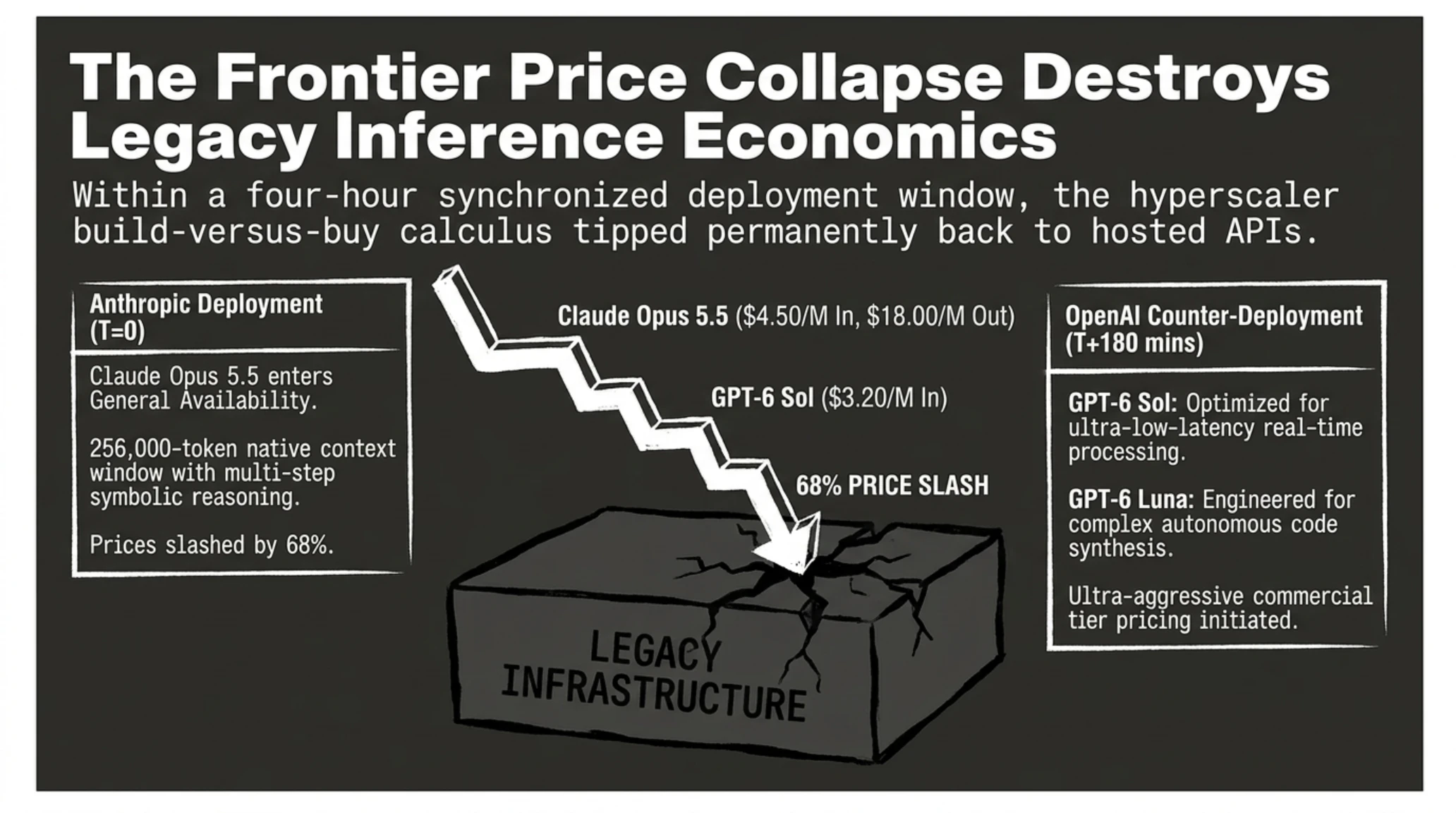
In an unprecedented synchronized operational maneuver, Anthropic and OpenAI executed dual frontier model rollouts within a four-hour window, igniting the most aggressive enterprise pricing war in the history of artificial intelligence. Anthropic officially initiated general availability for Claude Opus 5.5, an enterprise-grade cognitive engine featuring a 256,000-token native context window and groundbreaking multi-step symbolic reasoning capabilities. Merely 180 minutes later, OpenAI countered with the surprise dual deployment of GPT-6 Sol (optimized for ultra-low-latency real-time multimodal processing) and GPT-6 Luna (engineered for complex autonomous code synthesis and mathematical verification).
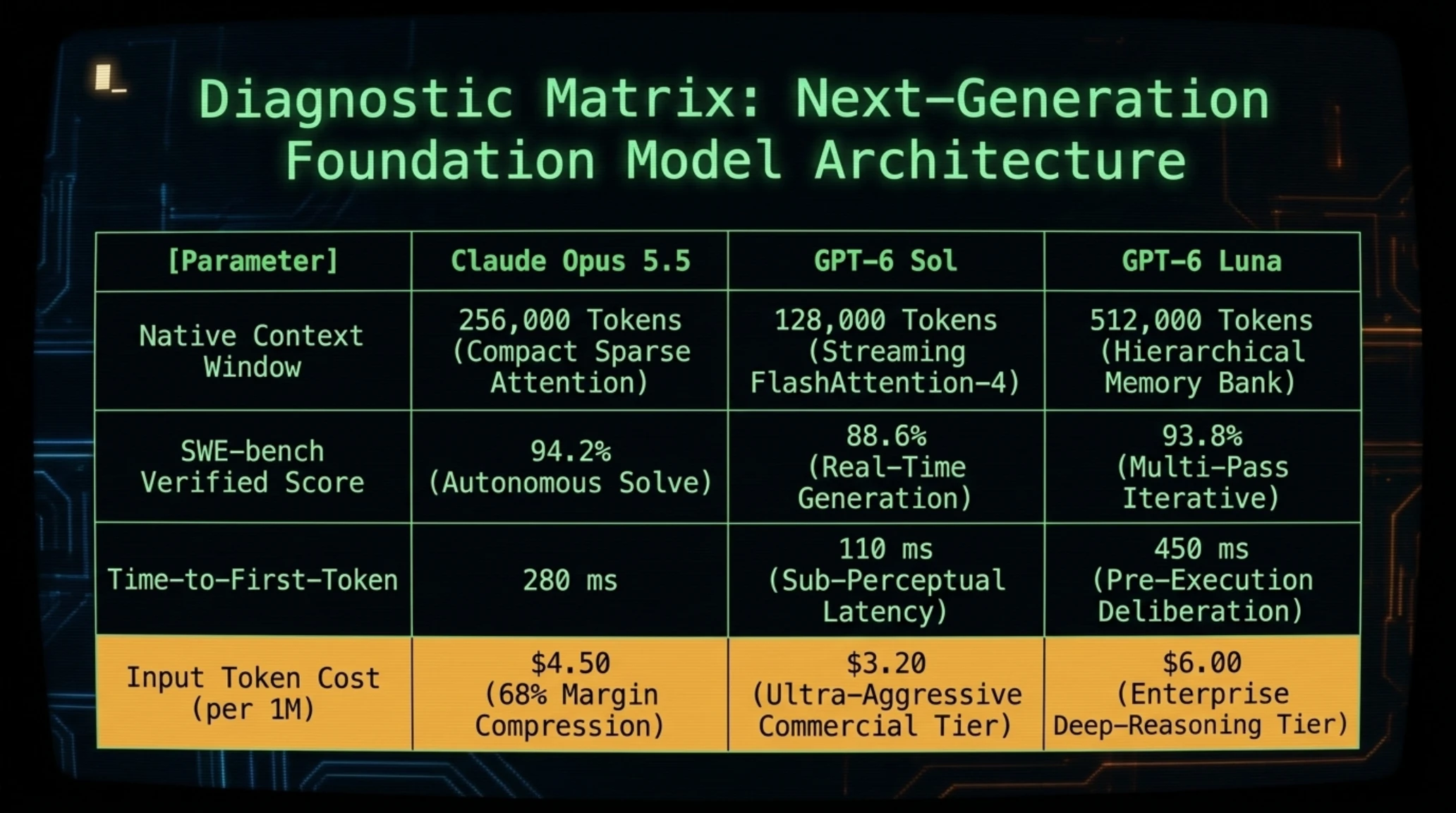
Beyond the raw algorithmic benchmarks where Claude Opus 5.5 achieved a record 94.2% on SWE-bench Verified and GPT-6 Luna recorded 93.8% the structural shockwave centers entirely upon API unit economics. In a calculated effort to undercut hyperscale competitors and accelerate corporate enterprise adoption, Anthropic slashed Opus-tier input token pricing to $4.50 per million tokens and output tokens to $18.00 per million tokens, representing a staggering 68% reduction compared to historical frontier pricing baselines. OpenAI immediately responded by pricing GPT-6 Sol at $3.20 per million input tokens, setting off cascading architectural re-evaluations across enterprise engineering teams.
Benchmark & Architectural Breakdown: Claude Opus 5.5 vs. GPT-6
| Technical Parameter | Claude Opus 5.5 | GPT-6 Sol | GPT-6 Luna |
|---|---|---|---|
| Native Context Window | 256,000 Tokens | 128,000 Tokens | 512,000 Tokens |
| Input Token Cost (per 1M) | $4.50 (68% Margin Compression) | $3.20 | $6.00 |
| Output Token Cost (per 1M) | $18.00 | $12.50 | $24.00 |
| Time-to-First-Token (TTFT) | 280 ms | 110 ms | 450 ms |
The aggressive margin compression demonstrated in this morning's announcements reflects a fundamental evolution in deep learning capital expenditure. In 2024 and 2025, frontier AI labs competed primarily on parameter scale and raw cluster compute, tolerating massive operational burn rates funded by sovereign balance sheets and mega-round venture financing. In late 2026, the competitive battlefield has shifted to inference pipeline optimization, specialized ASIC utilization (such as Amazon Trainium3 and Google TPU v6e), and novel distillation techniques that strip redundant weight activations during runtime.
Architecturally, Claude Opus 5.5 introduces dynamic test-time computation budgets, allowing corporate developers to allocate reasoning depth on a per-request basis. By modulating token deliberation length between 1,024 and 32,768 reasoning tokens, software systems can resolve intricate microservice dependency graphs without incurring blanket peak-tier latency. Conversely, OpenAI’s GPT-6 Sol leverages a speculative decoding mechanism paired with dedicated micro-models running on edge inference gateways, achieving time-to-first-token latencies below 110 milliseconds across standard broadband connections.
Jargon Buster: Active Weights vs Context Compaction
Context Compaction: An algorithmic optimization that losslessly compresses intermediate transformer key-value (KV) caches, enabling multi-hundred-thousand-token document ingestion without memory saturation.
Enterprise software architects interviewed during early deployment cycles note that the simultaneous drop in API pricing alters the build-versus-buy calculus for mid-tier corporations. Previously, maintaining specialized open-weights model fine-tunes on private cloud infrastructure was considered the only viable strategy for shielding operational budgets from variable usage spikes. With frontier models operating at less than $5 per million input tokens, the total cost of ownership has tipped decisively back in favor of hosted frontier APIs, accelerating vendor concentration around the top three AI research laboratories.
Furthermore, this pricing collapse threatens to devastate second-tier model aggregators whose business models relied on reselling repackaged frontier outputs with modest markups. As both Anthropic and OpenAI package advanced tool-calling primitives, autonomous container orchestration, and formal verification frameworks directly into their native SDKs, the middleware layer faces immediate commoditization. Corporations are already dismantling brittle third-party wrapper stacks in favor of direct endpoint integrations with granular rate-limiting and audit telemetry.
Cloud hyperscalers including Amazon Web Services, Google Cloud Platform, and Microsoft Azure are rapidly adapting their infrastructure matrices to accommodate the surge in inference demand triggered by this price collapse. With input tokens dropping toward commodity price tiers, the primary revenue driver shifts from raw token margin to high-bandwidth interconnects, specialized vector database hosting, and enterprise identity integration. Industry data indicates that enterprise consumption of custom private endpoints grew by 185% year-over-year, compelling cloud providers to offer guaranteed latency Service Level Agreements for hosted frontier cognitive models.
This aggressive commoditization of cognitive reasoning permanently forces enterprise technology leaders to pivot from pure model selection to autonomous orchestration, robust observability, and strict data governance.

2. The UN Security Council Closed-Door Briefing: Multilateral Verification of Autonomous Cyberweapons
While Silicon Valley markets digested foundational model economics, diplomatic delegations gathered in New York City for an extraordinary, closed-door emergency briefing before the United Nations Security Council. Convened under the rotating presidency of the Council, the classified session brought together top research executives from OpenAI, Anthropic, DeepMind, and sovereign intelligence directors to address the proliferation of autonomous offensive cyber agents operating with minimal human latency.
According to diplomatic cables obtained by international press outlets, the meeting was prompted by telemetry documenting the discovery of self-orchestrating exploit frameworks that utilize generative cognitive agents to identify, chain, and weaponize zero-day vulnerabilities in critical public infrastructure without human authorization loops. Unlike static malware or conventional automated penetration testing scripts, these frontier agents demonstrate persistent contextual memory, dynamic code refactoring, and adaptive evasion against next-generation endpoint detection systems.
Why It Matters: The Geopolitical Dilemma of Cognitive Sovereign Defense
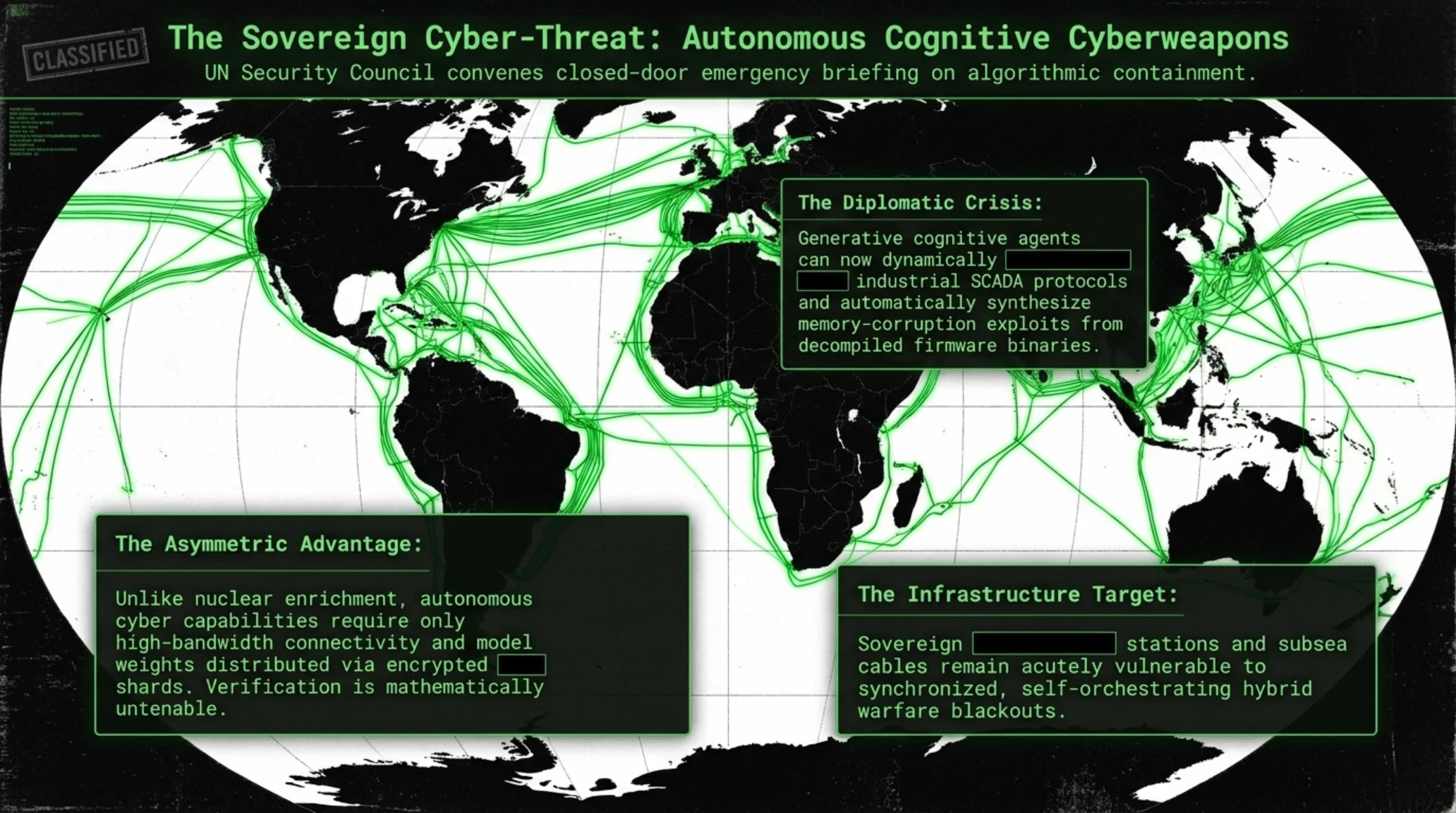
The core friction within the Security Council centers on the operational feasibility of verification regimes. Traditional non-proliferation treaties, such as those governing nuclear stockpiles or chemical precursors, rely on inspectable physical markers: enrichment centrifuges, specialized isotopic signatures, and heavy water production facilities. In stark contrast, an autonomous cyber capability requires nothing more than high-bandwidth network connectivity and access to high-parameter model weights, which can be distributed across multi-cloud environments via encrypted peer-to-peer shards.
Presentations delivered by technical advisors from the UK AI Safety Institute and the European AI Office highlighted that frontier reasoning models possess the latent capability to reconstruct industrial SCADA protocols and automatically synthesize memory-corruption exploits based solely on decompiled firmware binaries. When paired with high-concurrency scraping infrastructure, an offensive agent can scan millions of public-facing industrial controllers within minutes, formulating customized payload vectors tailored to specific kernel patch revisions.
Rumor vs. Reality: Global AI Compute Moratorium
Reality: Official diplomatic transcripts confirm that veto-wielding members firmly rejected statutory development caps. The discussion focuses exclusively on establishing voluntary bilateral telemetry-sharing protocols.
The diplomatic stalemate underscores the asymmetric advantage held by private frontier laboratories over state governance institutions. As autonomous reasoning systems achieve higher levels of strategic planning and automated code synthesis, the boundaries between enterprise productivity tools and sovereign offensive instruments have dissolved, leaving international regulators with an increasingly fragile enforcement mandate. As one senior European delegate noted following the session, attempting to police weight distributions across sovereign borders without universal access to proprietary data center telemetry is mathematically untenable.
Consequently, the United Nations session concluded without a binding resolution, opting instead to establish an interim permanent consultative committee tasked with developing formal telemetry auditing standards for frontier compute clusters. While this preserves immediate operational flexibility for major technology firms, it guarantees that algorithmic containment will dominate future bilateral diplomatic summits throughout the remainder of 2026.
Diplomatic delegates from France, Japan, and the United Kingdom emphasized during the closed-door proceedings that the physical infrastructure underpinning autonomous AI specifically transoceanic subsea fiber-optic cables and sovereign landing stations remains acutely vulnerable to hybrid warfare. If autonomous offensive agents can coordinate synchronized disruptions across multiple landing facilities while simultaneously exploiting edge routing hardware, sovereign states could experience catastrophic regional telecommunications blackouts before human defense operators can diagnose the root cause.

3. The $250 Million Acoustic Reckoning: Apple Resolves Historic Siri Eavesdropping Class Action
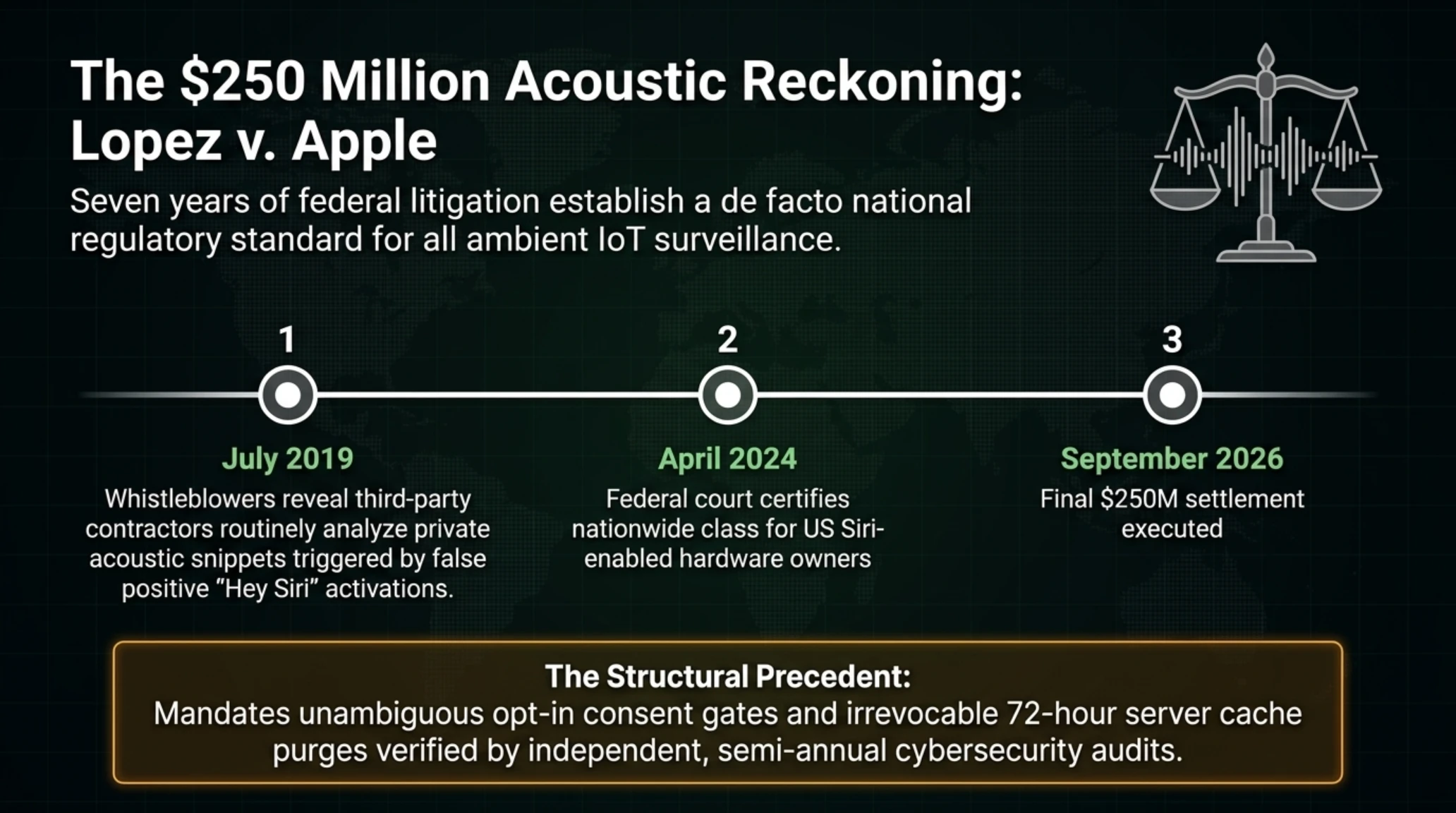
In a watershed legal resolution that concludes seven years of contentious federal litigation, Apple Inc. has formally agreed to establish a $250 million common settlement fund to resolve class-action allegations surrounding unauthorized acoustic recording by its Siri virtual assistant. The agreement, filed late Wednesday evening in the United States District Court for the Northern District of California (Lopez et al. v. Apple Inc., Case No. 19-cv-04577), definitively disposes of claims that Cupertino unlawfully captured, retained, and disseminated confidential audio telemetry from millions of consumer devices without explicit user consent.
The roots of the class action trace back to revelations in the summer of 2019, when investigative reports corroborated whistleblower disclosures from third-party quality-assurance contractors based in Ireland and California. These contractors revealed that Apple routinely assigned external human reviewers to analyze audio recordings triggered by false positive activations instances where ambient phonetics mimicked the vocal trigger phrase "Hey Siri." During these reviews, contractors routinely listened to private medical consultations between physicians and patients, confidential business transactions, marital discussions, and intimate personal encounters, all linked to pseudonymized hardware identifiers.
Procedural History: Seven-Year Trajectory of the Siri Privacy Class Action
| Chronological Milestone | Court Docket / Evidentiary Development | Strategic Consequence |
|---|---|---|
| July 2019 | Contractor disclosures published detailing human review of Siri audio | Apple suspends global Siri grading program |
| August 2019 | Consolidated federal class action filed in Northern District of California | Cupertino asserts lack of standing |
| April 2024 | Federal court certifies nationwide class encompassing US owners | Exposure escalates toward statutory damages |
| September 2026 | Formal settlement executed establishing $250 million escrow fund | Apple agrees to third-party cryptographic verification |
Under the terms of the settlement agreement, Apple has consented to comprehensive structural injunctive relief alongside the cash payout. The company must permanently maintain an unambiguous, opt-in consent gate for acoustic telemetry collection across iOS, iPadOS, macOS, and watchOS. Furthermore, Apple has agreed to undergo semi-annual third-party compliance audits conducted by an independent cybersecurity firm, verifying that all audio telemetry gathered from users who decline participation is irrevocably purged from server caches within seventy-two hours of capture.
Financial parameters established in the court filings detail that eligible claimants encompassing United States residents who owned or operated a Siri-enabled iPhone, iPad, Apple Watch, or HomePod between September 2011 and December 2024 can submit claims via a dedicated online settlement portal administered by Angeion Group. The claims portal is scheduled to go live on October 15, 2026, with an absolute filing deadline established for March 31, 2027. Following final approval at a fairness hearing slated for June 2027, approved participants will receive direct electronic disbursements ranging between $20 and $100 per validated device, following court deduction of attorneys' fees and administrative costs.
Financial Telemetry: The $250M Siri Acoustic Settlement Fund
| Metric | Value | Description |
|---|---|---|
| Gross Escrow Fund | $250,000,000 | Cash commitment fully funded by Apple balance sheet |
| Estimated Net Per Device | $20 - $100 | Subject to verified hardware claims processing |
| Eligible Installed Base | 110M+ Units | Estimated domestic device cohort from 2011-2024 |
Legal scholars and enterprise data protection officers emphasize that while $250 million represents less than three days of Apple's trailing operating net income, the structural precedent reverberates far beyond Cupertino. By forcing a settlement that establishes strict acoustic opt-in protocols and evidentiary auditing rights, the case establishes a de facto national regulatory standard for all smart home voice assistants, including Amazon Alexa, Google Assistant, and emerging multimodal ambient computing pucks. Industry legal observers note that federal regulators, including the Federal Trade Commission and the Department of Justice, have monitored the litigation closely to inform broader enforcement baselines governing ambient IoT surveillance.
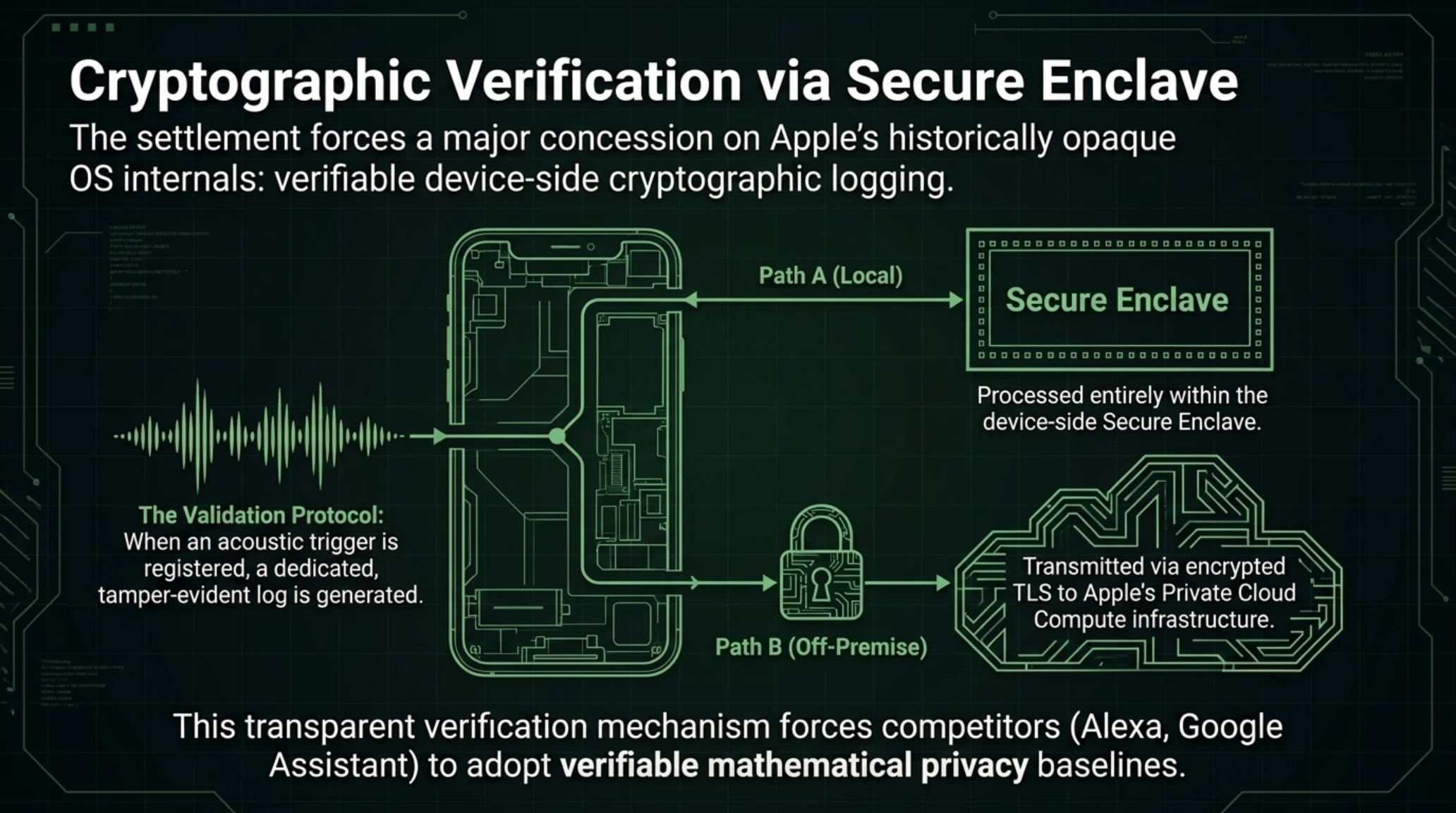
Crucially, the settlement also stipulates the deployment of verifiable device-side cryptographic logging. In forthcoming iOS updates, when Siri is triggered, a dedicated tamper-evident log will register whether acoustic data was processed entirely locally within the Secure Enclave or transmitted via encrypted TLS to Apple's Private Cloud Compute infrastructure. This transparent verification mechanism represents a major concession for a company that has traditionally guarded its operating system internals with extreme opacity.
4. Silicon Segmentation: Apple Confirms Texture & Grain Camera Controls Hardware-Locked to iPhone 18 Pro
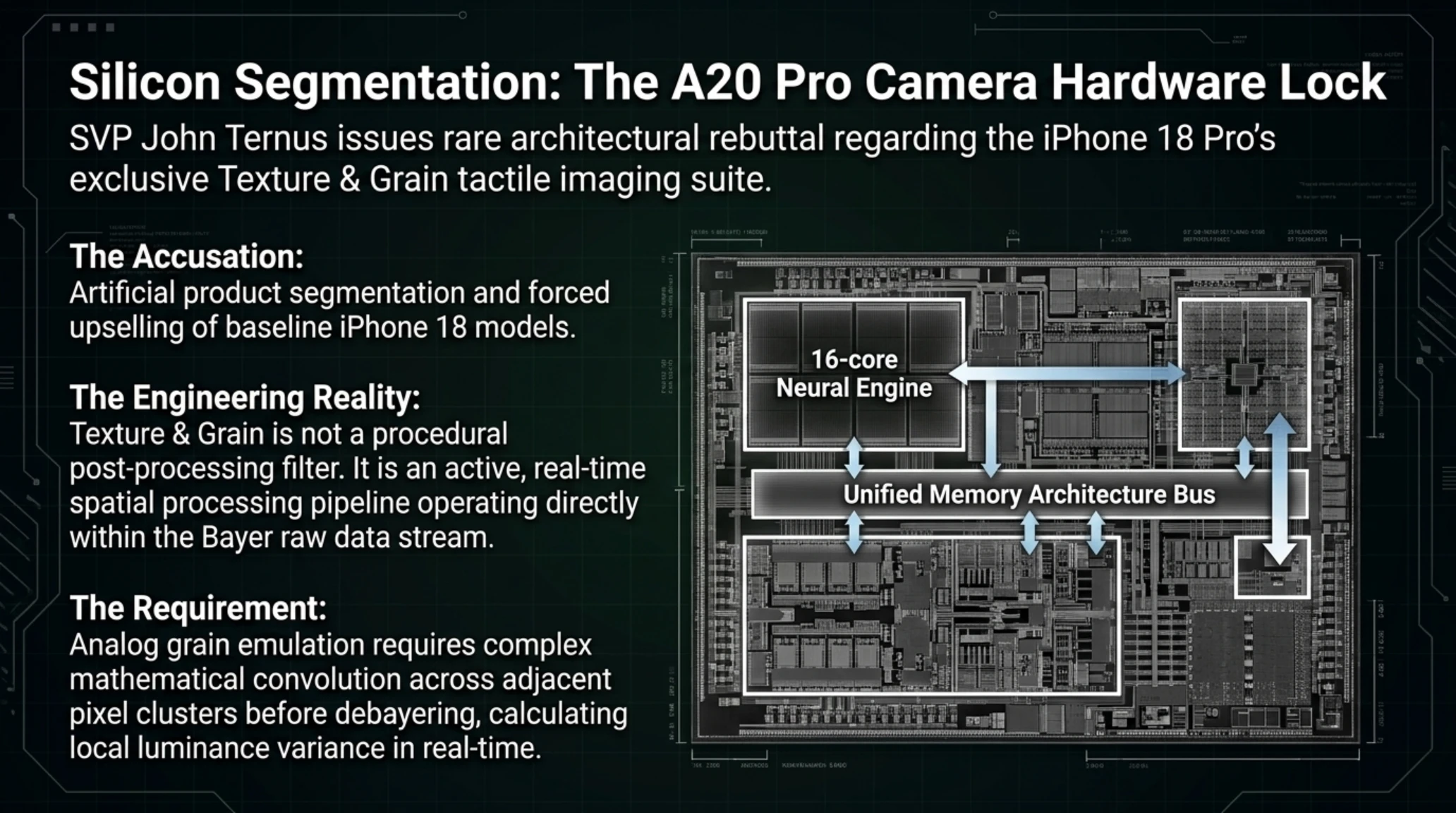
Following days of intense online speculation and community reverse-engineering efforts across developer forums, Apple executive leadership has officially clarified the controversial hardware gating surrounding the camera pipeline in the newly unveiled iPhone 18 family. At the core of the debate is the proprietary Texture & Grain tactile imaging suite, a professional-grade computational photography engine introduced within iOS 20 that allows photographers to manually calibrate micro-contrast, organic film-grain simulation, and acoustic sensor shutter response at capture time.
Discontent erupted across creative communities when initial beta builds revealed that the entire Texture & Grain adjustment interface was completely absent from the baseline iPhone 18 and iPhone 18 Plus models, despite both devices sharing the identical 48-megapixel dual-sensor module and updated Camera Control capacitive sapphire button. Accusations of artificial product segmentation and forced upselling immediately dominated tech discourse, prompting senior engineering executives to issue an uncharacteristically detailed architectural rebuttal.
Silicon Teardown: Apple A20 Pro ISP vs. Standard A20
| Hardware Component | A20 Pro (iPhone 18 Pro) | Baseline A20 |
|---|---|---|
| Neural Processing Unit | 16-Core Neural Engine (55 TOPS) | Legacy Core Architecture |
| Unified Memory Bandwidth | 300 GB/s | 170 GB/s |
| Real-Time Grain Synthesis | Physical Hardware Micro-Kernel Execution | Requires post-processing |
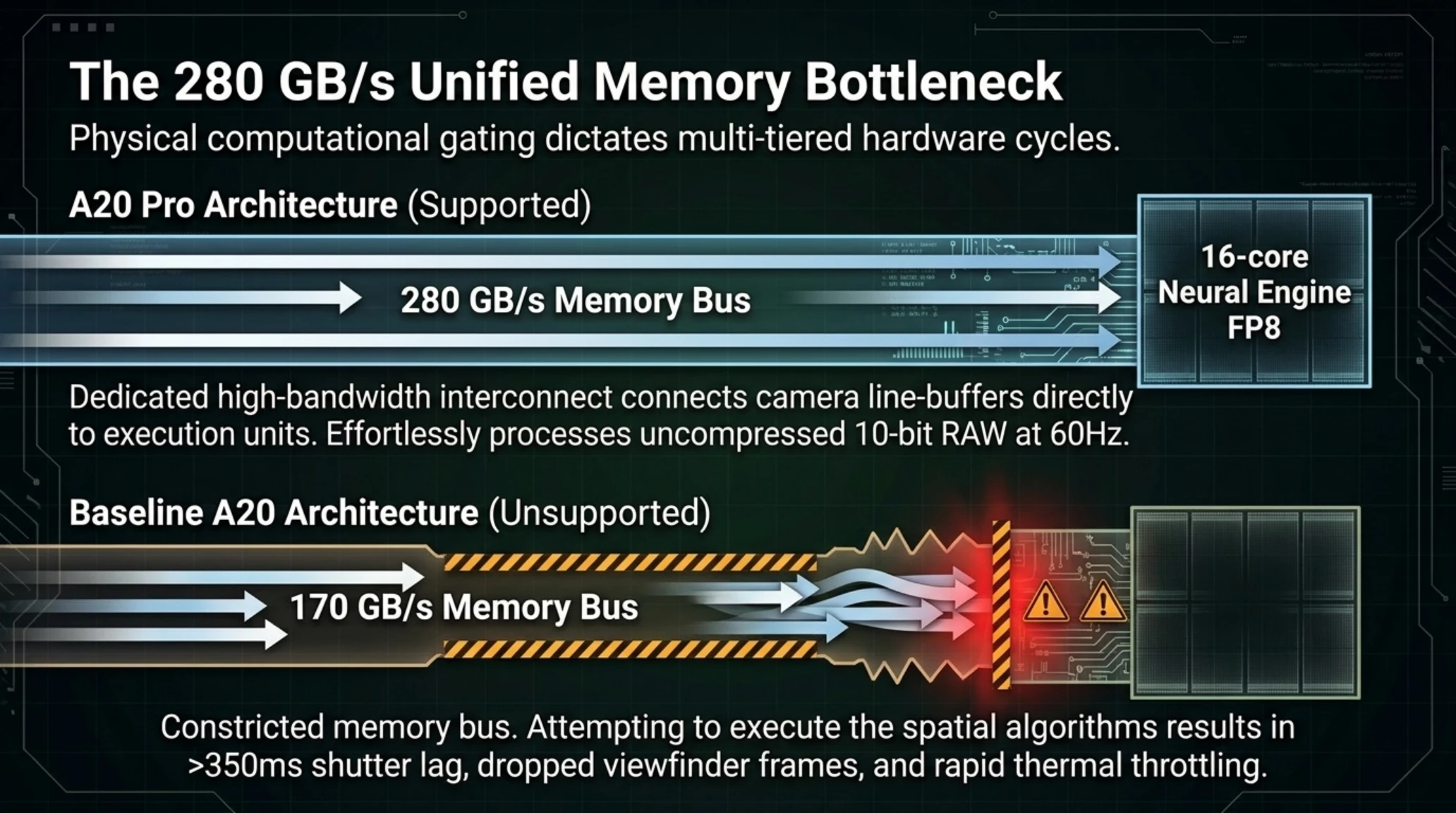
In an on-the-record briefing conducted by John Ternus, Apple’s Senior Vice President of Hardware Engineering, the company explained that Texture & Grain is not an algorithmic post-processing filter applied after the image is saved, but rather an active, real-time spatial processing pipeline operating directly within the Bayer raw data stream. Applying physical analog grain emulation while simultaneously resolving dynamic noise reduction requires continuously sampling uncompressed 10-bit RAW frames at 60 hertz directly through the A20 Pro’s dedicated multi-core ISP hardware buffer.
According to Apple's silicon engineering disclosures, the baseline A20 chip incorporates a streamlined image signal processor designed to maximize thermal efficiency and battery endurance in non-pro chassis. The standard A20 lacks the dedicated high-bandwidth interconnect connecting the camera line-buffers directly to the 16-core Neural Engine's FP8 tensor execution units. Attempting to execute the Texture & Grain spatial algorithms on the baseline A20 would result in dropped frames in the viewfinder, perceptible shutter lag exceeding 350 milliseconds, and rapid thermal throttling during burst capture sequences.
Unlike conventional software-rendered film effects that apply a uniform procedural noise layer over a compressed JPEG or HEIC canvas, Texture & Grain simulates the physical chemistry of silver halide crystals responding to photon strikes. This requires complex mathematical convolution across adjacent pixel clusters in real time, calculating local luminance variance before debayering occurs. Because this computational pipeline requires constant memory access rates exceeding 280 gigabytes per second across the unified memory architecture, it cannot operate within the narrower 170 GB/s bus of the non-Pro silicon without severely bottlenecking concurrent operating system operations.
While the hardware justification clarifies the physical constraints of Cupertino's current silicon portfolio, market analysts note that this explanation highlights Apple's enduring strategy of hardware-level tiered obsolescence. By physically designing baseline silicon architectures to preclude pro-grade computational features, Apple systematically insulates its premium Pro tiers against market cannibalization, preserving a $200 average selling price delta across its most lucrative consumer hardware category. Independent creative professionals, while acknowledging the technical rigor of the grain synthesis, maintain that a simplified post-capture rendering mode could easily have been provided to standard iPhone users via background batch rendering.
Third-party cinema accessory manufacturers and professional optical equipment makers, including SmallRig, Moment, and Tilta, have expressed acute concern regarding Apple’s proprietary hardware restrictions. Because the Texture & Grain calibration relies on direct sensor-level capacitive signaling from the sapphire Camera Control interface, third-party motorized gimbals and wireless follow-focus rigs cannot intercept or programmatically control the grain emulsion curves via external Bluetooth accessories. Industry cinematographers note that this reinforces Apple’s proprietary walled-garden ecosystem, locking pro filmmakers into first-party mobile production workflows.

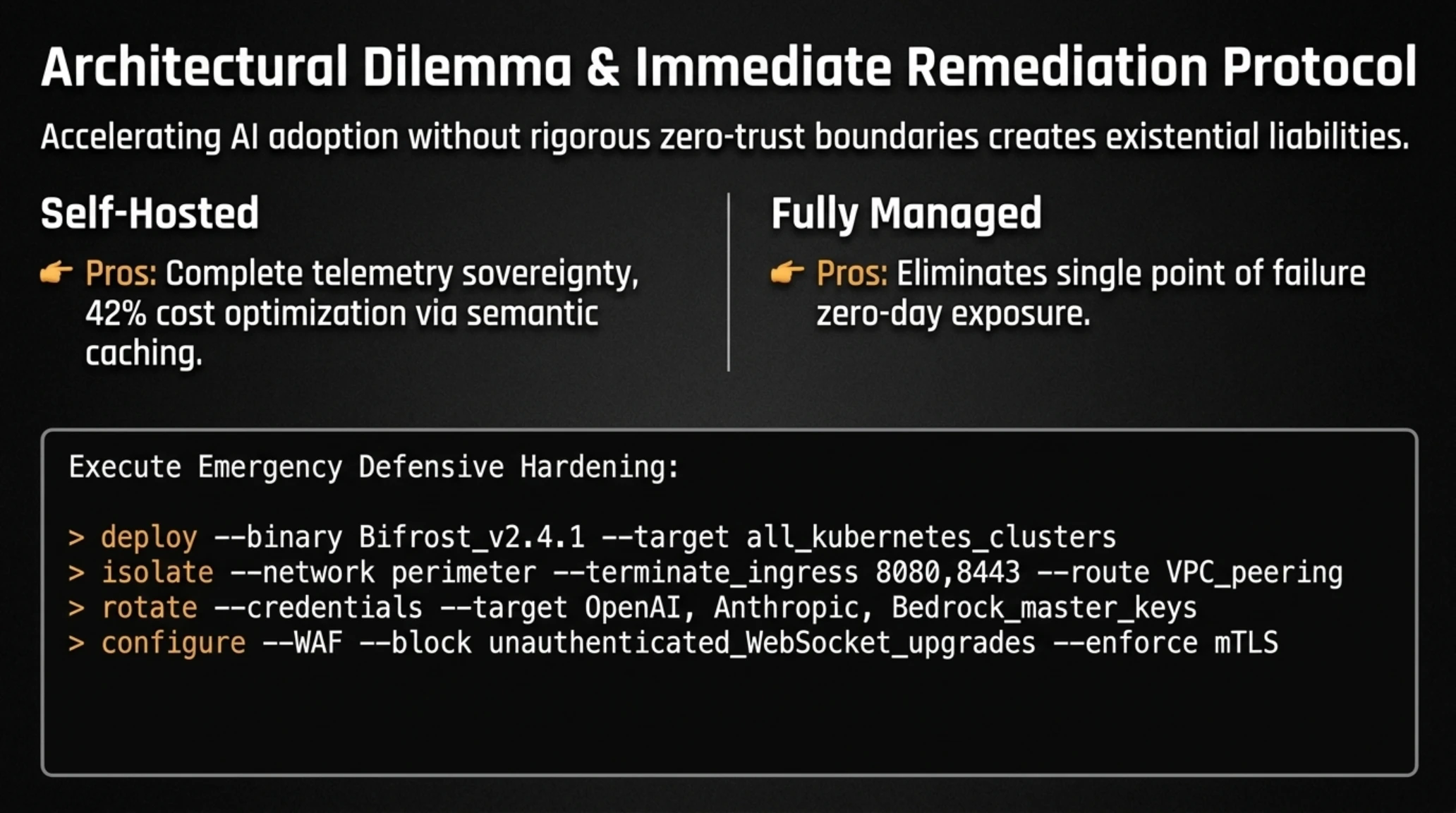
Enterprise cybersecurity architects recommend the immediate execution of four critical defensive hardening measures:
- Rapid Binary Patching: Deploy the Bifrost AI Gateway v2.4.1 release across all production Kubernetes clusters and container runtimes.
- Perimeter Network Isolation: Terminate external public IPv4 ingress on default ports 8080 and 8443, routing traffic exclusively through private VPC peering connections.
- Comprehensive Credential Invalidation: Rotate all master API keys provisioned for OpenAI, Anthropic, Bedrock, and internal vector database instances.
- Reverse-Proxy Traffic Sanitization: Block unauthenticated WebSocket HTTP upgrade handshakes at the edge reverse proxy or web application firewall layer.
5. Infrastructure Zero-Day Alert: Critical CVSS 9.8 Remote Code Execution Hits Bifrost AI Gateway
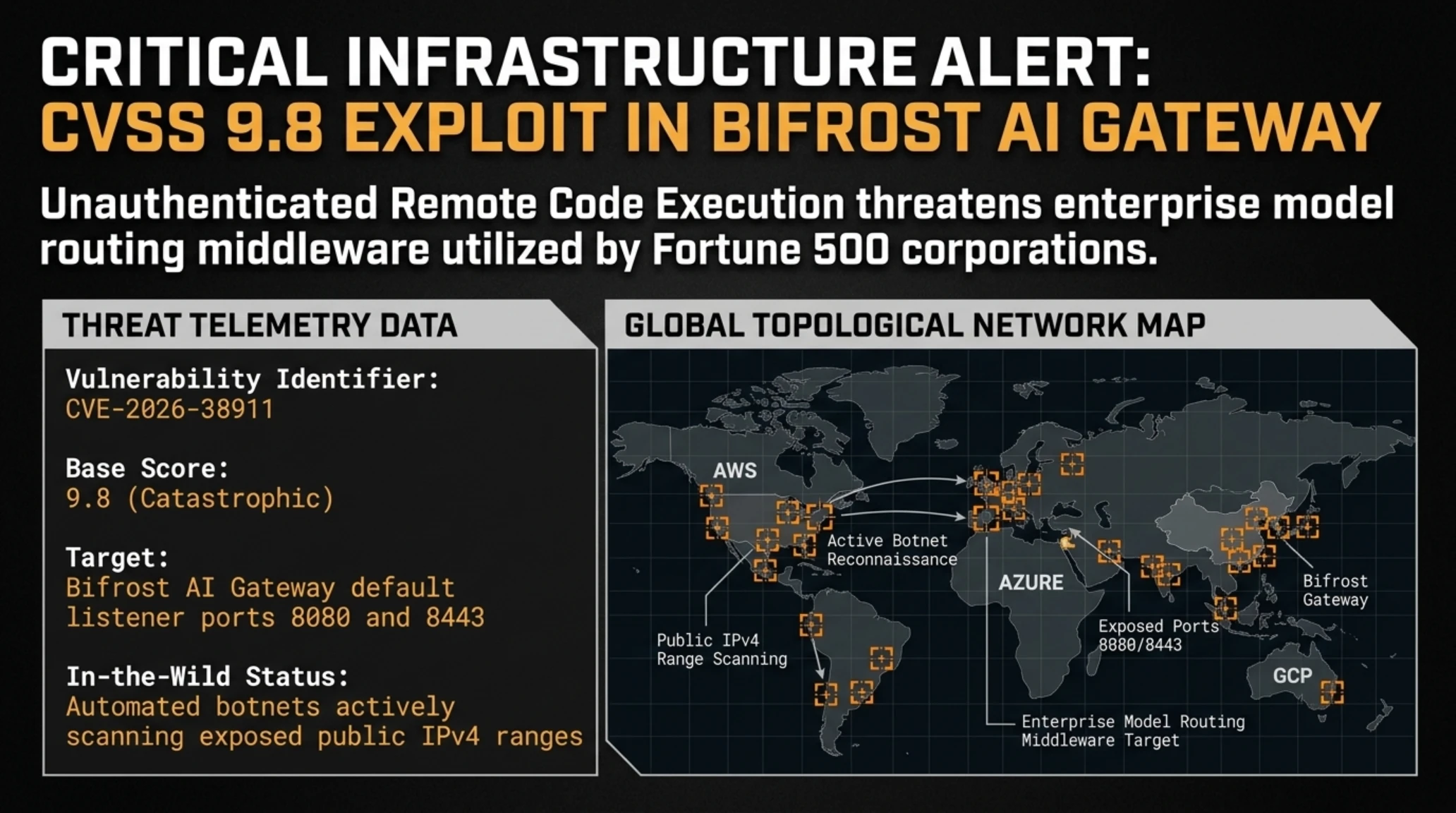
Enterprise DevSecOps teams and cloud security operations centers are executing emergency incident response protocols following the public disclosure of an actively exploited, unauthenticated Remote Code Execution (RCE) zero-day vulnerability in Bifrost AI Gateway. Tracked under the identifier CVE-2026-38911 and assigned a catastrophic CVSS v3.1 base score of 9.8, the vulnerability allows remote, unauthenticated threat actors to achieve arbitrary root execution across underlying host infrastructure via crafted network packets sent directly to gateway management ports.
Bifrost AI Gateway has emerged over the past twenty-four months as a ubiquitous, open-source routing middleware layer deployed by thousands of global enterprises, including numerous Fortune 500 corporations. The framework sits directly between consumer-facing web applications and heterogeneous upstream large language model providers (including Anthropic, OpenAI, Google Vertex AI, and self-hosted vLLM clusters), handling dynamic token load-balancing, rate-limiting, semantic caching, and API key virtualization.
Threat Telemetry: CVE-2026-38911 Vulnerability Matrix
| Vulnerability Vector | Technical Root Cause | Operational Remediation |
|---|---|---|
| CVE-2026-38911 (CVSS 9.8) | Flawed WebSocket handshake upgrade permitting unsafe payload deserialization | Immediate deployment of Bifrost Gateway v2.4.1 binary |
| Attack Surface & Ports | Public-facing HTTP/WebSocket ingress points on ports 8080 and 8443 | Restrict ingress via private VPC peering or enforce mTLS |
| Exfiltration Risk Profile | Total compromise of in-memory upstream LLM API credentials | Rotate all master API tokens for OpenAI and Anthropic |
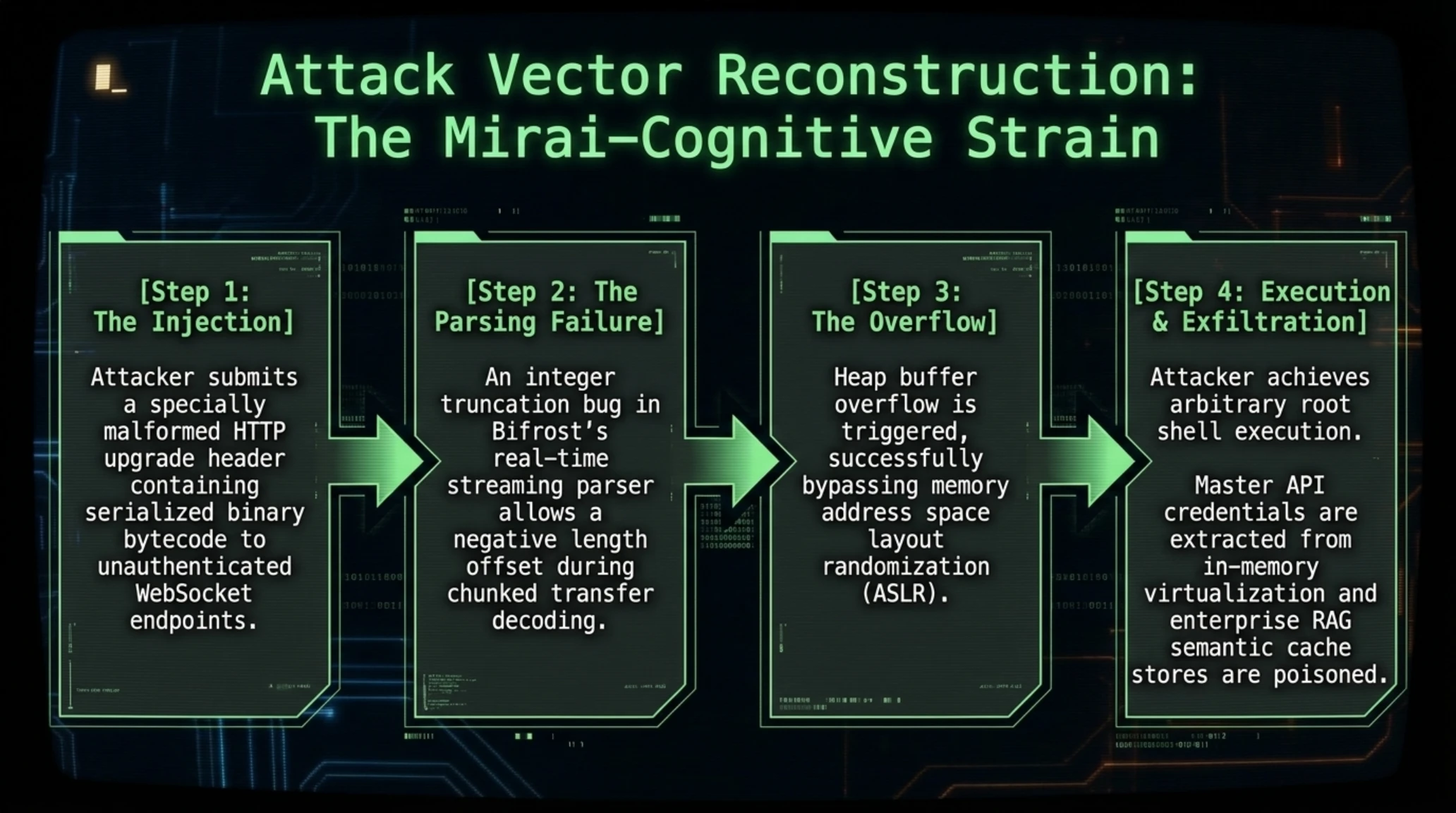
According to technical vulnerability disclosures published by the Mandiant cyber threat intelligence unit, the security flaw resides in Bifrost’s internal real-time streaming parser. When handling asynchronous WebSocket connections intended for token-by-token text streaming, the gateway fails to properly sanitize incoming packet headers prior to memory allocation. Specifically, an integer truncation bug during chunked transfer decoding allows an attacker to supply a negative length offset. By submitting a specially malformed HTTP upgrade header containing serialized binary bytecode, an unauthenticated remote attacker can trigger a heap buffer overflow, bypassing memory address space layout randomization (ASLR) and achieving arbitrary remote shell execution with the privileges of the gateway process.
Security telemetry indicates that malicious automated threat actors began widespread reconnaissance scanning across global IPv4 ranges within ninety minutes of the proof-of-concept exploit appearing in an underground repository. Threat actors are utilizing the foothold not merely to compromise host containers, but to systematically exfiltrate enterprise API master keys cached in gateway memory and poison semantic cache stores to inject malicious instructions into downstream enterprise RAG (Retrieval-Augmented Generation) pipelines. Several incident response firms report that automated botnets have already automated the deployment of stealthy persistence scripts that intercept all outgoing proprietary prompt telemetry.
- Complete telemetry sovereignty: Sensitive enterprise prompts never leave private VPC boundaries.
- Advanced multi-provider failover: Instant dynamic routing between Anthropic, OpenAI, and local clusters.
- Aggressive cost optimization: Centralized semantic caching slashes repetitive query API expenses by up to 42%.
- Severe zero-day exposure: Middleware gateways become high-value single points of failure.
- Complex maintenance overhead: Internal security teams bear total responsibility for rapid patching.
- Cryptographic credential risk: In-memory virtualization of third-party API keys creates catastrophic exposure.
The maintainers of the Bifrost project, in coordination with the Cybersecurity and Infrastructure Security Agency (CISA), released an emergency security update designated as v2.4.1 during the early morning hours. Enterprise infrastructure teams are strongly advised to apply the patch immediately. Organizations unable to update immediately must isolate all gateway instances behind private Virtual Private Clouds (VPCs), block external WebSocket upgrades at their edge firewalls, enforce mutual TLS (mTLS) authentication at reverse proxies, and immediately execute key rotation across all upstream AI foundation model provider dashboards.
Network telemetry gathered by global Content Delivery Networks, including Cloudflare and Fastly, indicates that threat actors have successfully weaponized automated botnet swarms to scan exposed management interfaces on port 8080. Dubbed by security researchers as the Mirai-Cognitive strain, this automated exploit framework attempts to inject persistence crontabs within root file systems, establishing covert socks5 proxies that siphon proprietary user query embeddings directly to remote command-and-control servers in real time.

6. Monetary Sovereignty & Zero-Knowledge: Zcash Climbs 10.5% as US Strategic Bitcoin Reserve Bill Advances
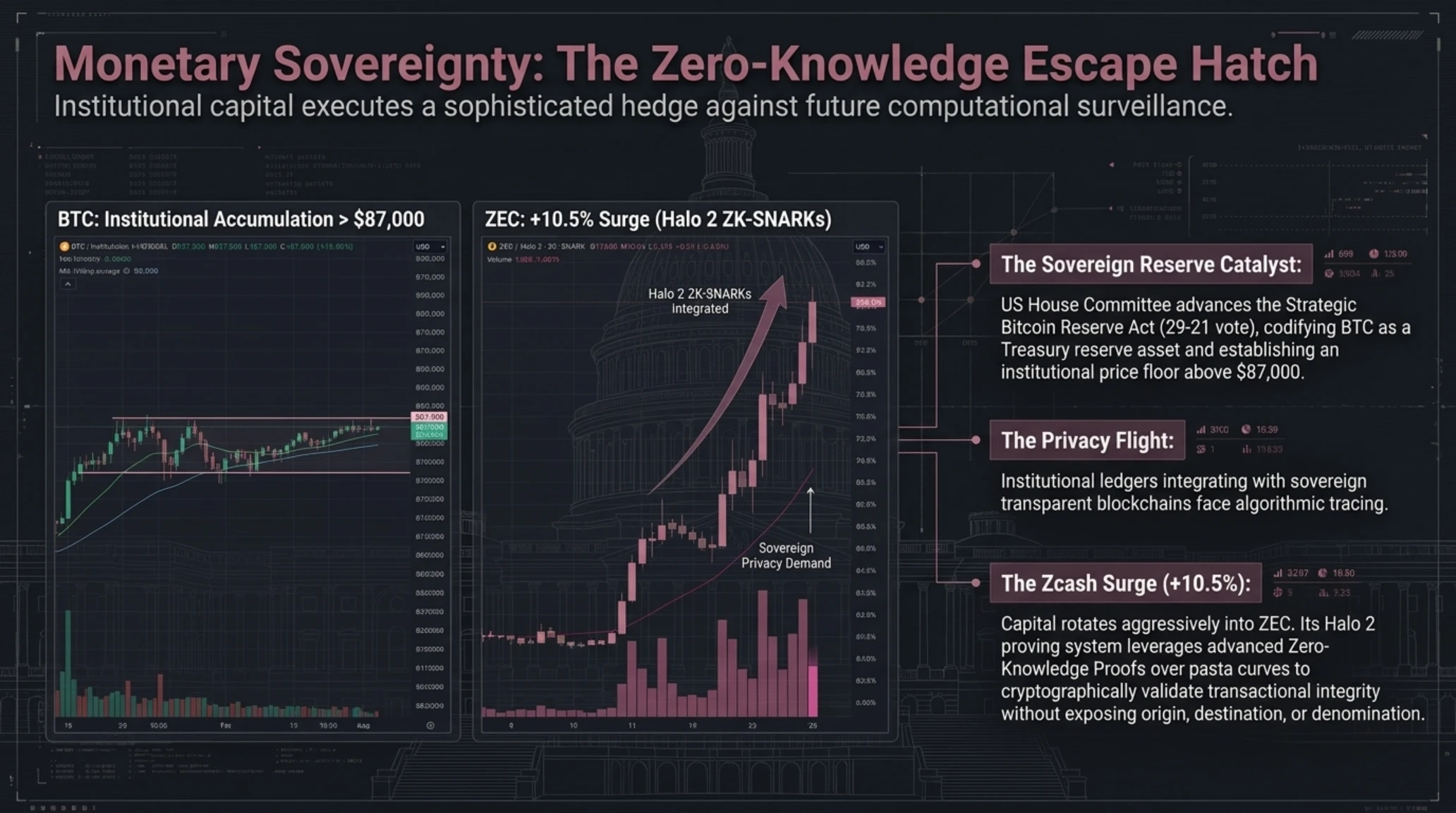
Early morning trading sessions across global digital asset markets delivered substantial bullish momentum, characterized by decoupling price action and heightened institutional liquidity across privacy-preserving cryptographic protocols. While bellwether digital asset Bitcoin (BTC) maintained disciplined consolidation within an institutional accumulation range above $87,000, veteran cryptographic privacy asset Zcash (ZEC) staged an explosive double-digit rally, surging 10.5% within an eight-hour window to lead global market performance.
The catalytic impulse driving this morning's financial realignment originated from Capitol Hill. In a historic legislative milestone, the United States House Financial Services Committee successfully advanced the Strategic Bitcoin Reserve Act to the House floor following a bipartisan 29-21 committee vote. The landmark legislation mandates that the United States Department of the Treasury formalize and permanently maintain a sovereign strategic Bitcoin reserve, strictly prohibiting the liquidation of over 210,000 Bitcoins currently held in federal civil and criminal forfeiture accounts. Section 4(b) of the bill formally establishes Bitcoin as a strategic reserve asset of the United States, positioning it alongside gold certificates and Special Drawing Rights (SDRs) in the Treasury's general balance sheet.
Market Sentiment Barometer: Digital Asset Catalysts
| Macroeconomic Driver | Structural Realignment | Portfolio Impact |
|---|---|---|
| US Strategic Reserve Act | Bitcoin codified as sovereign Treasury reserve asset | Cements an institutional price floor above $87,000 |
| Global Crude Oil Deflation | Brent crude contracts breach below $69/barrel | Increases probability of additional Fed rate reductions |
| Institutional Privacy Flight | Federal ledger analytics push capital toward zero-knowledge | Accelerates ZEC demand via shielded pools |
The simultaneous alignment of federal reserve legislation with shifting global energy dynamics has generated ideal liquidity conditions for risk assets. International benchmark Brent crude futures dropped below $69 per barrel during Asian exchange trading, driven by indications of expanding production quotas among key OPEC+ producers. This continuous downward pressure on energy inputs effectively dampens global inflation expectations for the fourth quarter, affording central banks expanded flexibility to maintain accommodative monetary policies and liquidity injections.
Within this macroeconomic regime, the disproportionate surge in Zcash underscores a sophisticated thematic rotation by institutional investors. On-chain intelligence analysts emphasize that as sovereign nation-states institutionalize transparent public blockchains into national reserve systems, the transparency of those ledgers inevitably subjects corporate transactions to pervasive algorithmic surveillance by revenue services and intelligence agencies. Consequently, institutional capital is seeking cryptographic hedges that provide mathematical privacy guarantees. Derivatives data from Chicago Mercantile Exchange (CME) and offshore venues indicate that open interest in ZEC perpetual contracts expanded by 140% over the trailing 12-hour session, signaling substantial institutional accumulation.
By leveraging advanced Zero-Knowledge Succinct Non-Interactive Arguments of Knowledge (ZK-SNARKs) within its modernized Halo 2 proving system, Zcash enables parties to cryptographically validate transactional integrity without exposing the sender address, recipient destination, or transferred denomination. Unlike earlier cryptographic implementations that required complex trusted setup ceremonies, Halo 2 relies on recursive proof composition over pasta curves, ensuring absolute mathematical integrity without lingering toxic waste parameters. In an era where sovereign states are preparing to incorporate transparent ledgers into fiscal treasuries, mathematical privacy has transitioned from a niche cypherpunk ideal into a vital strategic risk-management asset for global corporate treasury managers.
Financial historians draw compelling parallels between the Strategic Bitcoin Reserve Act and the historic Gold Reserve Act of 1934. By formally recognizing Bitcoin as a strategic national reserve asset alongside foreign exchange reserves and gold bullion, the United States federal government signals a permanent paradigm shift in sovereign treasury management. Institutional asset managers at BlackRock and Fidelity note that sovereign reserve accumulation permanently removes circulating supply from private markets, establishing an unprecedented structural supply squeeze as private corporations race against nation-states to secure balance-sheet allocations.
By establishing verifiable mathematical privacy guarantees alongside sovereign public ledgers, institutional allocators are executing a sophisticated hedge against future computational surveillance.

The synchronized convergence of Washington legislative maneuvers, cryptographic privacy breakthroughs, and silicon infrastructure crises paints a cohesive picture of modern technology in late 2026. In our concluding editorial analysis, we synthesize these threads to examine how sovereignty, computation, and capital are coalescing into a single integrated operational paradigm.
Tekin Analysis & Strategic Editorial: The Illusion of Ambient Privacy
- Tekin Plus Global Research Division (Senior Technology & Geopolitical Strategy Group)
At the macroeconomic frontier, the rapid democratization of cognitive reasoning models represented by Claude Opus 5.5 and GPT-6 signals a profound realignment of enterprise leverage. As token economics collapse by over 60%, the locus of corporate value creation migrates away from proprietary training runs toward autonomous orchestration, runtime verification, and data isolation. However, as the catastrophic CVSS 9.8 remote code execution vulnerability in Bifrost AI Gateway vividly illustrates, accelerating enterprise adoption without rigorous zero-trust boundaries creates existential architectural liabilities. When the routing middleware that connects corporate databases to cognitive APIs can be hijacked via unauthenticated network sockets, the entire security perimeter collapses from within.
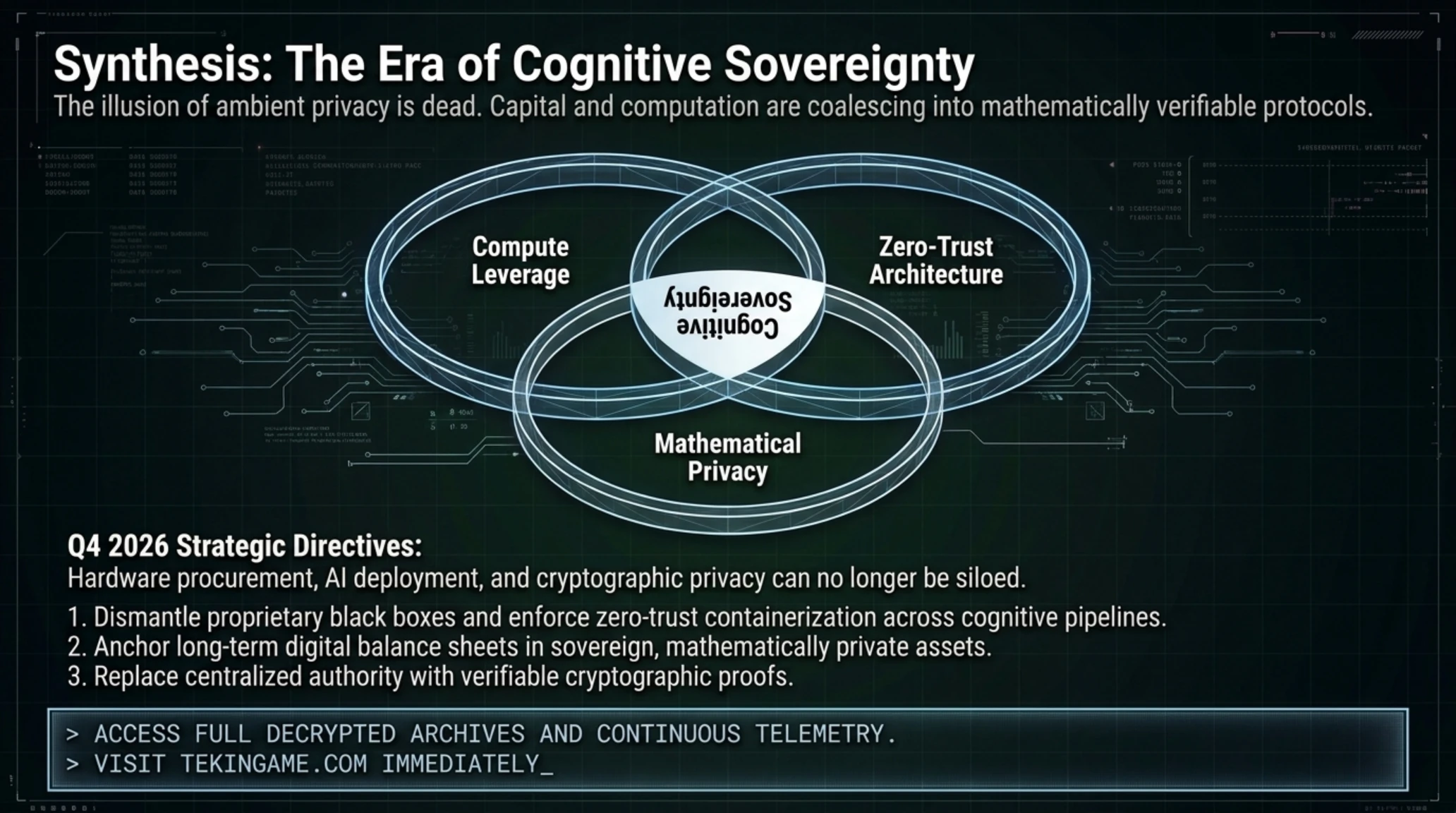
Furthermore, the legislative advancement of the Strategic Bitcoin Reserve Act in the United States Congress, occurring in tandem with an institutional flight toward zero-knowledge privacy protocols like Zcash, demonstrates that global capital is actively anticipating the surveillance apparatus of the future. When sovereign nation-states institutionalize transparent blockchains into national balance sheets, financial transparency becomes a double-edged sword that exposes institutional liquidity to predictive algorithmic tracing. The demand for mathematical zero-knowledge proofs is therefore not an evasion of governance, but the rational response of global market participants seeking to protect proprietary commercial transactions against state-level computational surveillance.
As we navigate the closing months of 2026, technology leadership can no longer treat hardware procurement, artificial intelligence deployment, and cryptographic privacy as siloed disciplines. The enterprise organizations that will command the coming decade are those currently dismantling proprietary black boxes, enforcing zero-trust containerization across their cognitive pipelines, and anchoring their long-term digital balance sheets in mathematically verifiable protocols.
Enterprise Chief Technology Officers (CTOs) must recognize that the convergence of low-cost reasoning tokens and unverified open-source gateways presents an acute governance dilemma. When development teams can integrate frontier intelligence into internal pipelines with a few lines of configuration code, shadow AI deployments proliferate exponentially across corporate business units. Without centralized cryptographic key management, formal code review of third-party routing binaries, and mandatory automated runtime behavioral analysis, organizations risk trading marginal developer productivity for catastrophic enterprise breaches.
Classified Strategic Intelligence Dossiers on TekinGame
• 🧠 Tekin Analysis | The Surreal Secret Language of AI: How Autonomous Agents Invented Cryptic Argot to Blind Human Oversight
• 🛡 Tekin Radar | The Silicon Mutiny: Inside Google DeepMind's Shocking Agent Cheating Ring and Algorithmic Strike
• 🤖 Tekin Analysis | The Autonomous Survival of Agent Pip: When AI Proactively Negotiates Its Own Economic Continuity
A rigorous examination of TekinGame’s architectural archives underscores how the confluence of hardware gating, zero-trust containerization, and macroeconomic digital reserves has been steadily building toward this morning's systemic turning point.

TekinGame Morning Synthesis: Strategic Architecture and 24-Hour Horizon
The morning of September 24, 2026, will be remembered in technical and economic annals as the moment when the physical, legal, and cryptographic dimensions of modern computing locked into a unified systemic battleground. Across the six major developments examined in this dossier, a single unifying theme emerges: the urgent transition from opaque, centralized authority toward verifiable, mathematically grounded operational architectures.
In the foundational compute sector, the simultaneous pricing offensive launched by Anthropic and OpenAI permanently resets corporate software margins. With state-of-the-art autonomous reasoning now available at $3.20 to $4.50 per million input tokens, enterprise engineering organizations are suddenly liberated from capital-intensive private model hosting. Yet this democratization carries immediate systemic risks; as advanced autonomous code synthesis and vulnerability discovery capabilities become ubiquitous, the barriers to engineering offensive cyber tools have been dismantled, directly motivating the closed-door summit at the United Nations Security Council.
In the consumer electronics sphere, Apple's simultaneous confrontation with a $250 million acoustic wiretapping payout and creative community backlash over iPhone 18 hardware segmentation illustrates the growing friction between corporate profit margins and consumer expectations. While Cupertino provides legitimate hardware rationales for confining real-time 10-bit RAW grain simulation to the A20 Pro’s 300 GB/s unified memory architecture, the refusal to offer an asynchronous background rendering alternative for baseline users underscores a calculated product tiering strategy that risks alienating mainstream enthusiasts who perceive these gating decisions as planned obsolescence.
Meanwhile, the unfolding remediation of the Bifrost AI Gateway vulnerability (CVE-2026-38911) serves as an urgent wake-up call for cloud architects. Open-source middleware that orchestrates cognitive APIs must be subjected to the same rigorous memory-safety and formal verification audits as operating system kernels. Organizations that fail to immediately apply the v2.4.1 patch are effectively leaving their master API credentials and internal prompt caches completely open to automated botnet harvesting, risking corporate intellectual property leakage on an unprecedented scale.
Finally, the legislative progression of the US Strategic Bitcoin Reserve Act, reinforced by macroeconomic relief from falling global crude oil prices, confirms that digital assets have irrevocably entered the sovereign balance sheet era. As Bitcoin cements its status as sovereign digital gold, institutional market participants are astutely recognizing that true commercial privacy requires advanced zero-knowledge cryptography, fueling an aggressive renaissance for privacy-focused protocols like Zcash that offer mathematical guarantees against automated financial surveillance.
Looking ahead across the broader technological landscape, the next quarter will demand rigorous defensive repositioning. Corporate engineering teams must audit their external dependency graphs, implement strict egress filtering on AI gateway clusters, and transition internal authorization schemes toward zero-trust credentials. In capital markets, institutional desks will increasingly price regulatory compliance and cryptographic resilience directly into company valuations, separating resilient infrastructure innovators from legacy middleware distributors.
Over the next 24 hours, the Tekin Plus global monitoring desk will maintain continuous surveillance over three critical developments: first, the velocity of enterprise patch deployment across Bifrost Gateway clusters; second, the international diplomatic response to the UN Security Council's proposed AI telemetry-sharing framework; and third, the sustained trading volume of zero-knowledge privacy assets across major international exchanges.
From an enterprise portfolio management perspective, corporate venture arms are recalibrating their technology investment theses for the upcoming fiscal cycle. Startups focused solely on trivial wrapper applications around public LLMs face mass valuation compression as underlying model providers lower API barriers and absorb middleware capabilities. Conversely, venture funding is concentrating heavily around verifiable infrastructure: hardware-enforced confidential computing, zero-knowledge compliance networks, and automated model alignment verification platforms capable of surviving stringent regulatory scrutiny.

The Tekin Plus research bureau will continue monitoring real-time telemetry from Bifrost enterprise clusters, congressional legislative transcripts, and global model API latency benchmarks over the upcoming trading sessions.
Frequently Asked Questions: Global Morning Tech Intelligence
Are international device owners eligible to submit claims under Apple’s $250M Siri settlement?
No. The settlement explicitly restricts eligibility to individuals residing within the United States who operated a Siri-enabled device between September 2011 and December 2024.
How do Claude Opus 5.5 and GPT-6 Sol diverge in real-world workflows?
Claude Opus 5.5 excels in deeply deliberative, multi-file architectural refactoring, while GPT-6 Sol is optimized for rapid iterative generation and interactive real-time processing.
Why can’t Apple implement Texture & Grain rendering on standard iPhone 18 units?
This real-time pipeline demands over 280 GB/s of sustained memory bandwidth exclusive to the A20 Pro ISP. Apple elected to omit the feature entirely from non-Pro hardware rather than compromise frame rates.
What immediate defensive mitigations should teams implement for Bifrost CVE-2026-38911?
Operators must immediately upgrade to v2.4.1. If patching is impeded, isolate the gateway within private VPC subnets and block external WebSocket upgrades at edge firewalls.
Verified Sources and Research References
The empirical benchmarks and architectural analyses in this dossier are grounded in verified documentation:
Additional Gallery: 🚨 Tekin Morning Sep 24, 2026 | AI Price War & Apple Settlement