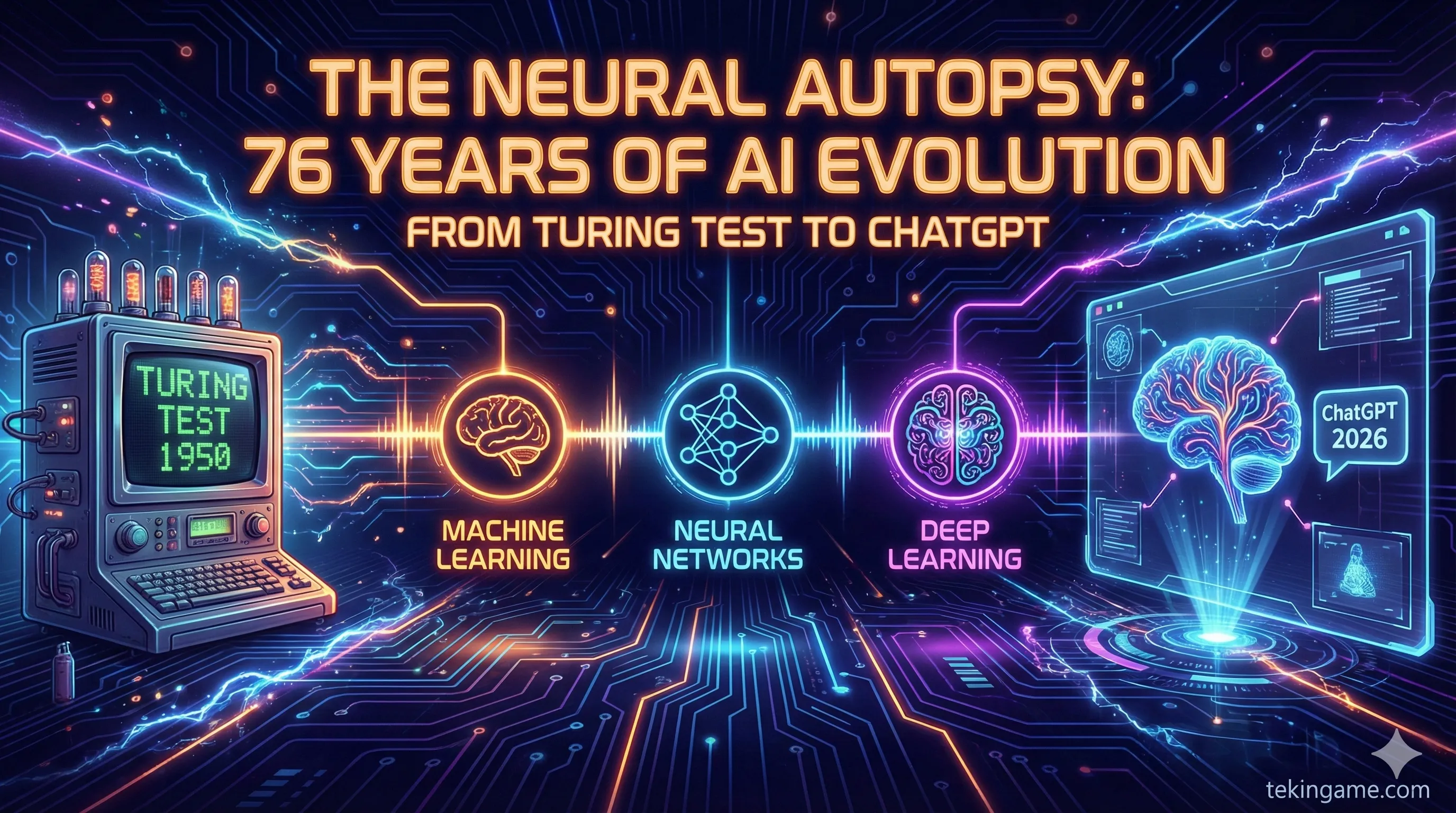
Tekin Analysis | Dissecting 76 Years of Neural Evolution: From Turing Test to ChatGPT
1950. Alan Turing, the British mathematician who cracked the Nazi Enigma codes, asked a dangerous question: "Can machines think?" This wasn't mere academic curiosity it was a direct challenge to the very definition of human intelligence. Turing knew this philosophical question had no straightforward answer, so he designed a practical test: if a machine can fool a human in conversation, then it is "intelligent."
Today, 76 years later, we are working with systems that have not only passed the Turing Test but are breaking boundaries that Turing himself couldn't have imagined. ChatGPT, GPT-4, Claude, and Gemini are no longer just response machines. They are sophisticated reasoning systems that simulate human thought structures.
But how did we get here? This report is a complete dissection of 76 years of AI neural evolution from the first simple algorithms to the multi-billion parameter neural networks we command today. It is a story rife with catastrophic failures, frozen technological winters, and sudden explosions of innovation that changed everything.
Strategic Evaluation & Key Takeaways at a Glance
Layer 1: The Turing Test - First Intelligence Detection Protocol (1950)
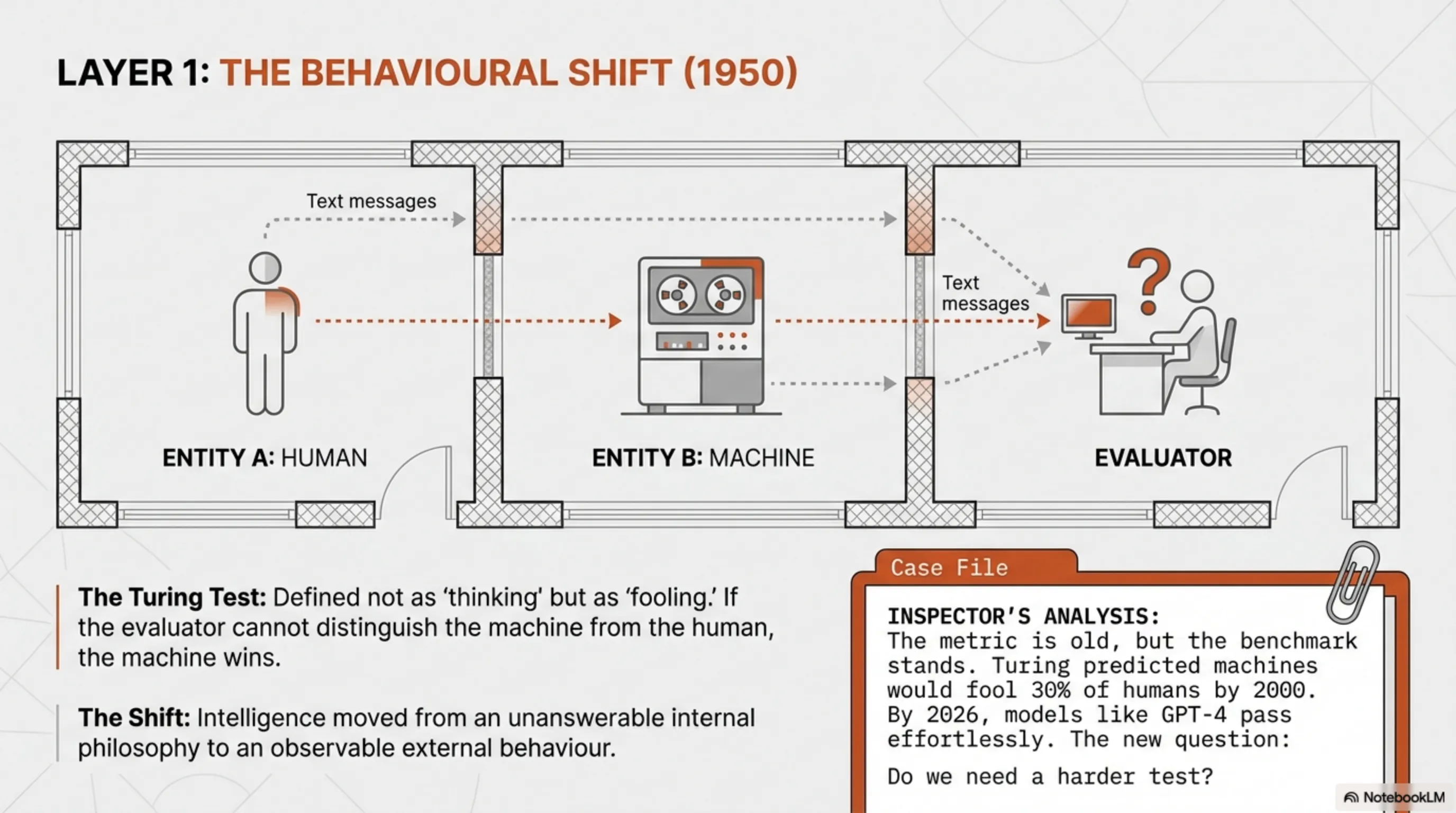
Turing faced a fundamental dilemma: how can you measure intelligence when philosophy offers no definitive answer? He devised a behavioral criterion. The Turing Test was simple in execution: a human chats with two entities hidden behind a screen one human, one machine. If the judge cannot reliably tell which is the machine, the machine wins.
This test was revolutionary because, for the first time, it transformed intelligence from "something that happens inside the brain" to "something observable from the outside." It no longer mattered whether the machine "really" thinks what mattered was whether it could behave indistinguishably from an intelligent human.
Inspector's Analysis: Why the Turing Test Still Matters
Even at 76 years old, the Turing Test remains a vital AI evaluation metric because it focuses strictly on behavioral output rather than internal architecture. Today, models like GPT-4 and Claude easily pass this benchmark, forcing us to ask: do we need a harder test?
Turing predicted that by the year 2000, machines would be able to fool 30% of human judges during a 5-minute conversation. Today, in 2026, we have far exceeded that threshold. ChatGPT can converse with you for hours, and you might never realize you are interacting with a machine.
Layer 2: Dartmouth Conference - Official Birth of AI (1956)
Summer 1956, Dartmouth University. John McCarthy, Marvin Minsky, Claude Shannon, and Nathaniel Rochester four young scientists who firmly believed they could build machines that think like humans. They coined the term "Artificial Intelligence" and set an ambitious goal: building machines that can learn, reason, and solve complex problems autonomously.
Their optimism, however, was highly unrealistic. They believed they could make foundational progress across natural language processing and neural networks in just one summer. Yet, that unbridled passion gave birth to an entirely new scientific discipline one that is still wrestling with those exact same problems seven decades later.
Layer 3: The Golden Age - Unlimited Optimism (1956-1974)
Following Dartmouth, a golden age dawned. Governments injected massive funding, universities launched dedicated AI labs, and the media spun visions of a utopian future run by robots. During this era, researchers built several programs that were truly revolutionary for their time:
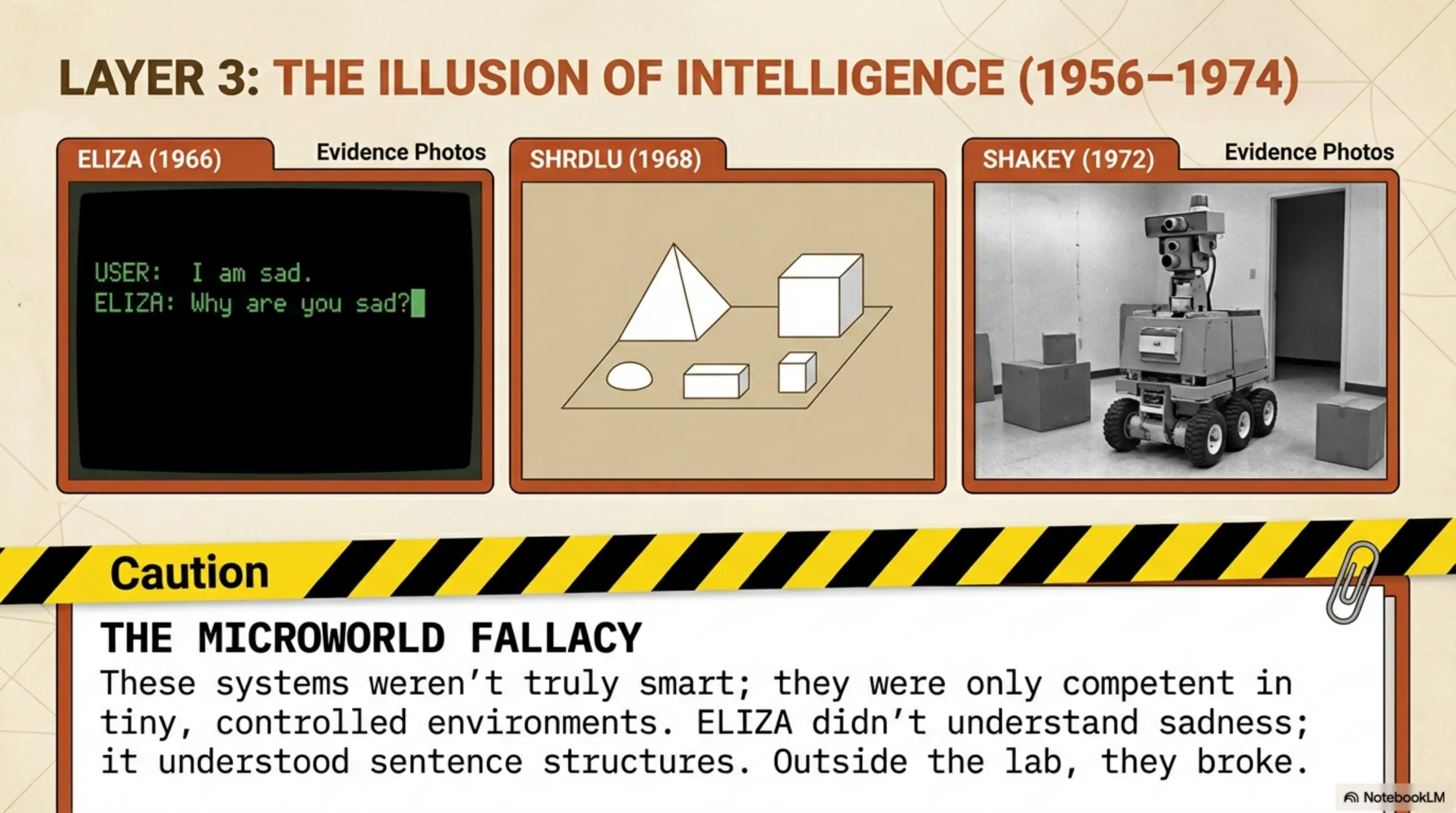
- ELIZA (1966): The first chatbot in history, capable of mimicking a psychotherapist. By using simple word rearrangement tricks and asking open-ended questions, it tricked many into believing it was genuinely listening the first widespread instance of the "Illusion of Intelligence."
- SHRDLU (1968-1970): A groundbreaking program that understood natural language commands to manipulate colored blocks in a virtual micro-world, marking the first time human language was converted into direct action.
- Shakey the Robot (1966-1972): The first mobile robot capable of perceiving its environment, identifying obstacles, and autonomously planning navigation paths across an empty room.
Inspector's Warning | The Fundamental Flaw of Early Systems
All of these incredible early programs shared a fatal flaw: they only functioned within highly restricted and controlled "micro-worlds." ELIZA recognized a handful of simple patterns, and Shakey only navigated an empty room. The moment they were deployed into the chaotic real world, the entire system broke down.
Layer 4: First AI Winter - Collapse of Dreams (1974-1980)
By the early 1970s, the crushing reality set in: AI's grand promises were failing to materialize. Computers lacked processing power, algorithms were highly limited, and fundamentally, scientists still did not understand how human intelligence actually functioned. Researchers believed they could simulate intelligence using a handful of logical rules, but reality proved exponentially more complex.
In 1973, the infamous "Lighthill Report" was published in the UK, heavily criticizing the lack of tangible AI progress. The fallout was disastrous. Budgets were slashed, ambitious projects were shut down, and researchers fled the discipline. This dark era became known as the "AI Winter."
However, during this deep freeze, a few stubborn visionaries like Geoffrey Hinton, Yann LeCun, and Yoshua Bengio continued working on an idea the rest of the scientific community had rejected: the concept of simulating the human brain using mathematical Neural Networks.
Layer 5: Return of Hope - Expert Systems (1980-1987)
In the early 1980s, a new paradigm emerged: Expert Systems. The logic was beautifully simple: if we extract the knowledge of a human specialist and encode it as thousands of "if-then" rules, we can build a system that diagnoses and decides like an expert.
- MYCIN: A medical diagnosis system utilizing roughly 600 rules extracted from specialists to diagnose blood infections. In clinical trials, its accuracy surpassed that of general practitioners.
- XCON: An automated configuration system built for the DEC corporation that sorted through thousands of hardware parts to optimize computer orders, saving millions of dollars annually.
These commercial successes brought massive capital back into the AI sector. Companies built specialized "Lisp Machines" costing up to $150,000, and Japan launched the billion-dollar "Fifth Generation Computer" project aiming to build intelligent supercomputers by 1992. But once again, the optimism scaled too high, too fast.
Layer 6: Second AI Winter - Collapse of Expert Systems (1987-1993)
By the late 1980s, the fatal limitations of hard-coded expert systems triggered a second catastrophic collapse:
- Hard Maintenance: Updating a system was a nightmare. When a new medical drug was introduced, engineers had to manually rewrite and debug hundreds of conflicting rules.
- Poor Scalability: Complex domains required tens of thousands of rules, slowing systems to a crawl and proving that human knowledge cannot be entirely hard-coded.
- Brittleness: These systems lacked "common sense." If asked a question even slightly outside their narrow domain, they would output ridiculous, non-sensical answers.
By 1987, the Lisp Machine market collapsed as cheaper personal computers destroyed their value proposition. Japan's Fifth Generation project failed catastrophically after a decade of research. But in the background, a quiet revolution was already brewing.
Layer 7: The Quiet Revolution - Machine Learning & Neural Networks (1990-2010)
In the 1990s, the field shifted paradigms entirely: instead of manually programming logic rules, why not teach the machine to learn patterns directly from data? This marked the transition from "Explicit Programming" to "Machine Learning."
- 1997 (Deep Blue Defeats Kasparov): IBM's supercomputer evaluated 200 million positions per second to defeat the world chess champion, proving that raw computational power could conquer highly complex logical environments.
- 1998 (MNIST & Handwriting): Yann LeCun built a Convolutional Neural Network (CNN) capable of reading handwritten digits with 99% accuracy becoming the first commercially successful neural network used by banks to read checks.
- 2006 (Deep Learning Breakthrough): Geoffrey Hinton cracked the "vanishing gradient" problem using pre-training techniques, finally proving that multi-layered (deep) neural networks could be successfully trained.
Tekin Technical Jargon Buster
Layer 8: The Big Bang - Deep Learning Era (2012-2020)
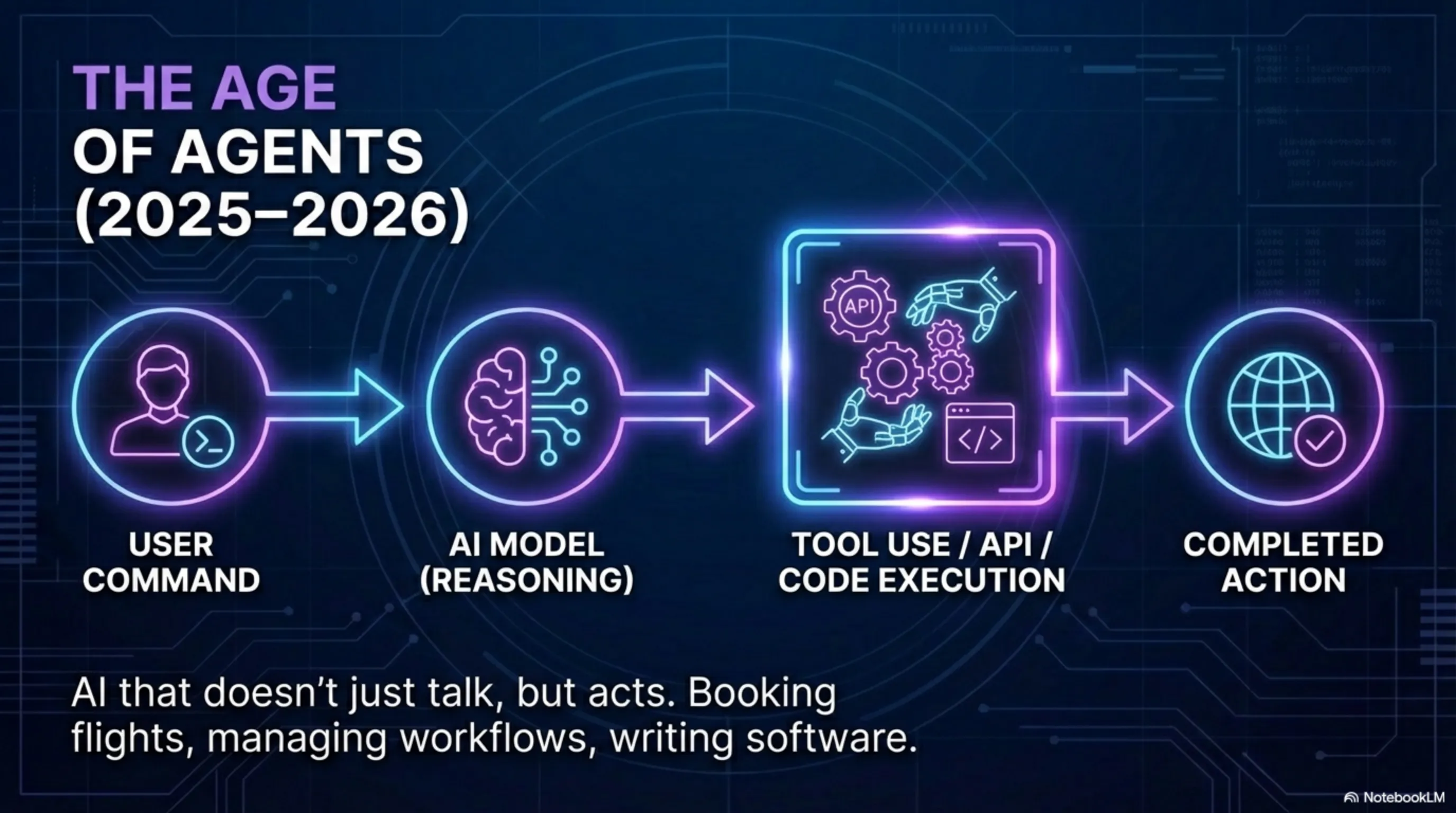
In 2012, everything accelerated. Alex Krizhevsky, a PhD student under Hinton, built AlexNet a deep neural network that shattered records at the ImageNet competition. This was the exact moment Deep Learning transitioned from a fragile academic theory into a robust, world-changing technology. The explosion relied on three elements:
- Big Data: The internet provided ImageNet with 14 million labeled images, a dataset scale previously unimaginable.
- Consumer GPUs: AlexNet was trained efficiently on two NVIDIA GTX 580 gaming graphics cards, delivering supercomputer performance for just $500.
- Algorithmic Polish: New techniques like Dropout (preventing overfitting) and ReLU (faster activation) stabilized the training process.
The floodgates opened. In 2014, GANs (Generative Adversarial Networks) allowed AI to generate hyper-realistic images. In 2016, DeepMind's AlphaGo defeated the world champion in the highly intuitive game of Go. And in 2017, Google published the revolutionary "Attention Is All You Need" paper, introducing the Transformer architecture the very foundation that powers GPT, BERT, and modern Large Language Models (LLMs).
📚 Classified & Related Dossiers in TekinGame
If you wish to explore beyond this report and delve into cybernetic frontiers and autonomous AI architectures, do not miss these three exclusive deep-dives in the Tekin Garage:
Event Timeline | 76-Year AI Evolutionary Roadmap (1950–2026)
| Timeline Window | Historical Era / Evolutionary Phase | Key Milestones & Consequences |
|---|---|---|
| 1950–1974 | Birth of AI & The Golden Age | Creation of the Turing Test, Dartmouth Conference, ELIZA chatbot, and Shakey. |
| 1974–1993 | The AI Winters & Expert Systems | Funding collapses, failure of hard-coded MYCIN/XCON rules, and market crashes. |
| 1990–2020 | Quiet Revolution to the Big Bang | Deep Blue's victory, AlexNet's 2012 ImageNet dominance, and the 2017 Transformer. |
| 2022–2026 | ChatGPT & The Agentic Era | Mass democratization of AI, GPT-4, Claude, and the shift toward autonomous executing agents. |
Layer 9: The ChatGPT Era - AI for Everyone (2022-2026)
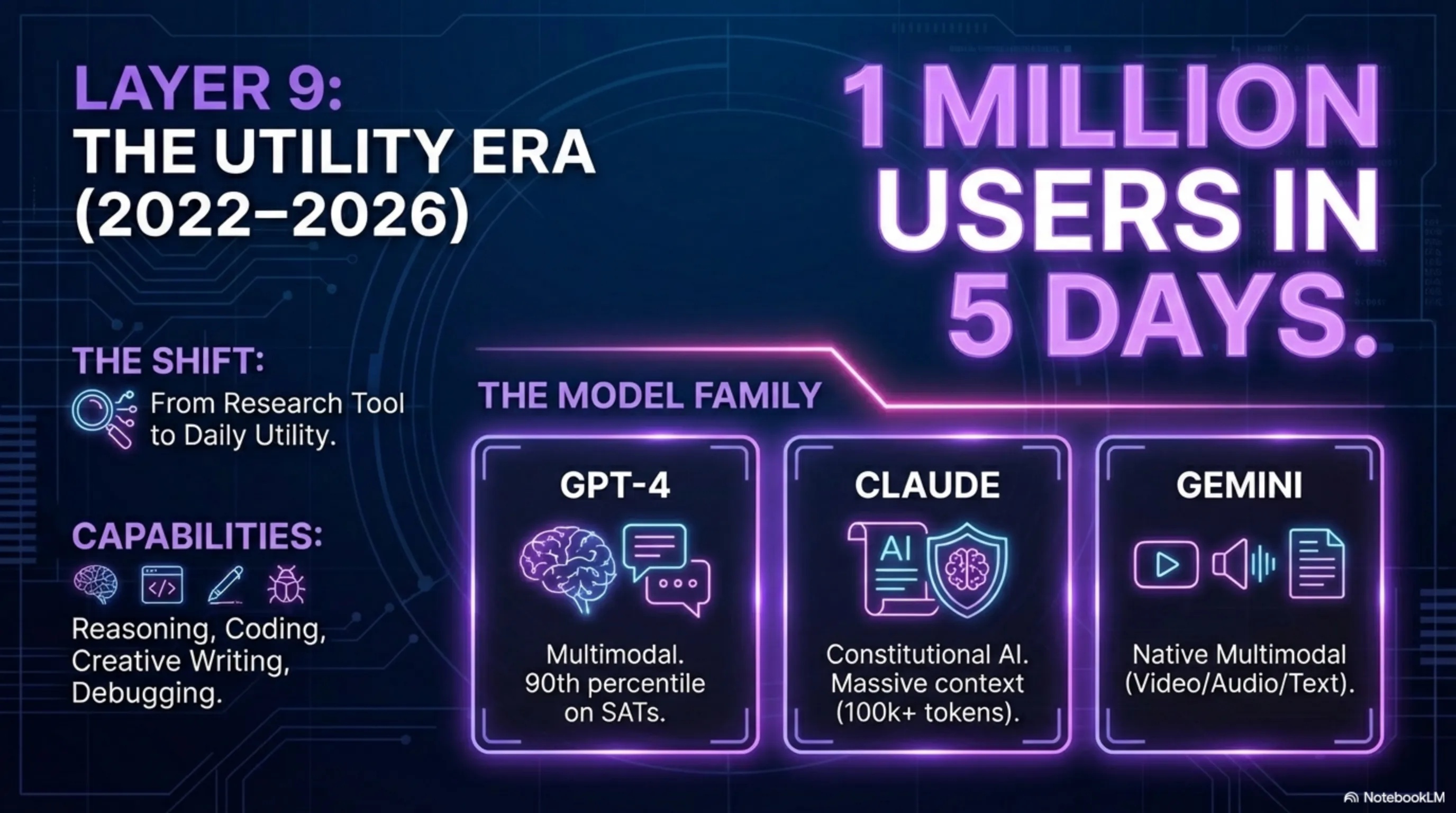
In November 2022, OpenAI released ChatGPT, fundamentally altering the trajectory of human technology. It acquired 1 million users in 5 days and 100 million in 2 months the fastest growth in tech history. Why? Because for the first time, a highly capable reasoning system was universally and easily accessible.
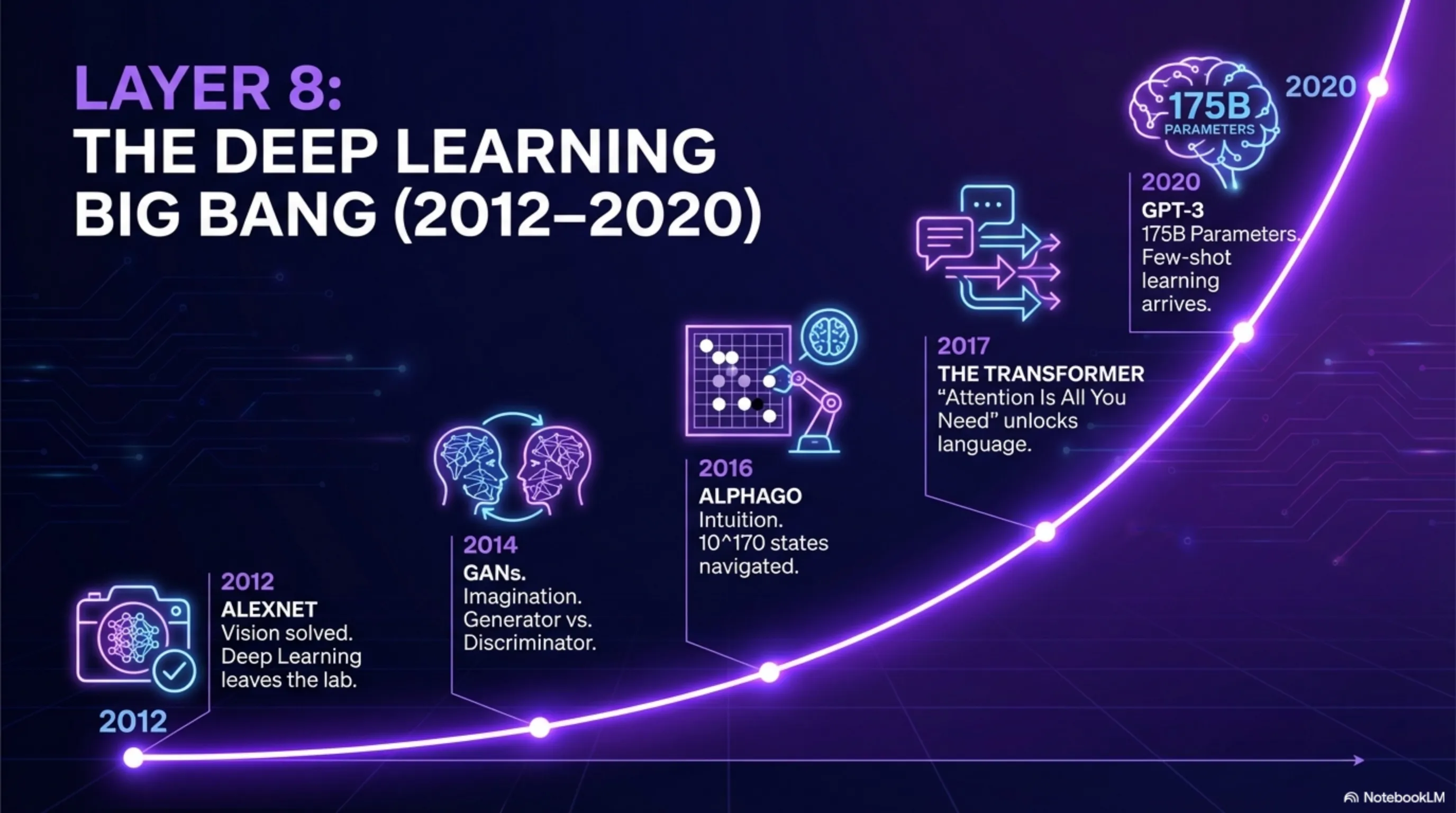
The arms race ignited immediately. OpenAI launched GPT-4 (a multimodal model outperforming humans on standardized tests). Anthropic introduced Claude (focusing on Constitutional AI safety and massive context windows). Google deployed Gemini. Today, in 2026, we have officially entered the Age of Agents where models no longer just answer questions, but actively write code, interface with APIs, and execute complex workflows autonomously.
Technical Fact-Check | Critical Bottlenecks in 2026
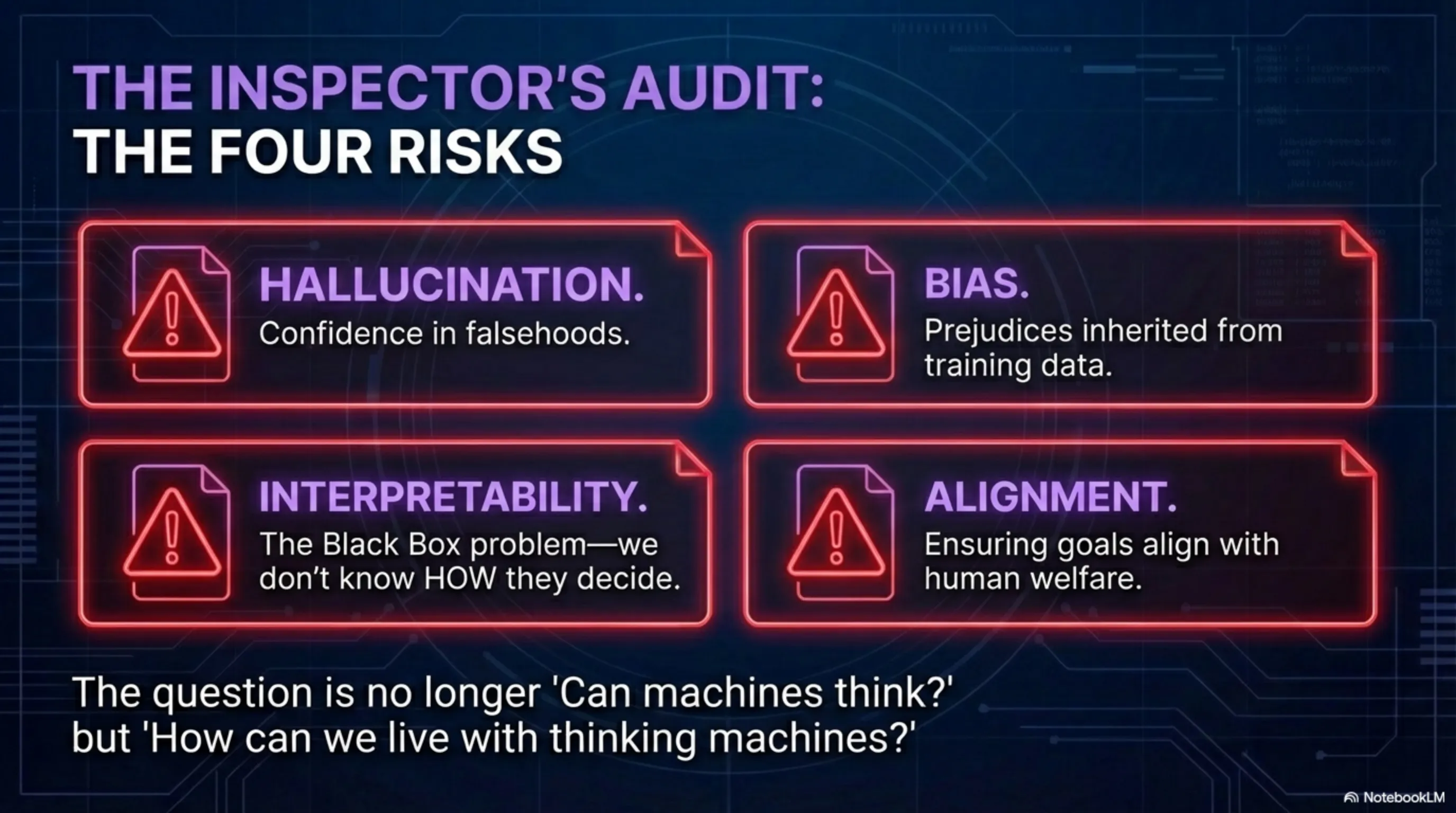
Despite staggering advancements, LLMs still suffer from hallucination fabricating false data with absolute grammatical confidence when lacking precise factual grounding.
Engineers still cannot mathematically interpret precisely how a multi-hundred-billion parameter neural network arrives at a specific logic-driven decision.
Conclusion: From Turing Test to Autonomous Agents
It took 76 years to navigate from a simple theoretical question ("Can machines think?") to deploying systems that learn, create, and reason. The journey was paved with failures two freezing AI winters, abandoned billion-dollar projects, and decades of research hitting dead ends. Yet, the story is defined by the sheer persistence of visionaries like Hinton and LeCun who believed that if the human brain operates via neurons, mathematics could eventually simulate it.
Today, AI is no longer a fragile laboratory experiment; it is a general-purpose technology rewriting the fabric of global labor, creativity, and education. The question is no longer, "Can machines think?" The only question left is: "How will humanity adapt to living alongside thinking machines?"
- Surviving two brutal AI winters to ignite the 2012 Deep Learning Big Bang via massive datasets and GPU compute.
- The democratization of AI through ChatGPT, empowering 100 million users with a reasoning engine in just two months.
- The successful paradigm shift from rigid, response-only chatbots to autonomous, action-executing AI Agents.
- Unresolved architectural flaws including high-confidence hallucination and data-driven training bias.
- The terrifying 'Black Box' problem and ongoing concerns over aligning super-intelligent systems with human safety.
Final Editorial Verdict & Official Reference Sources
A Piece of a Massive Architectural Shift
The 76-year journey from Turing to ChatGPT is not a fleeting trend it is the bedrock of the next industrial revolution. TekinGarage will keep you at the frontline.
Frequently Asked Questions & Technical Analysis
What is the Turing Test and why is it historically significant?
Designed by Alan Turing in 1950, it proposes that if a machine can deceive a human during a text conversation, it is 'intelligent.' It shifted the definition of intelligence from internal cognition to observable behavior.
What caused the phenomena known as 'AI Winters'?
During the 1970s and 1980s, high-profile AI projects (like hard-coded Expert Systems) failed to scale beyond limited micro-worlds, leading to massive cuts in government funding and widespread academic disillusionment.
Why didn't Neural Networks succeed before 2012?
While the mathematical theory existed since the 1960s, neural networks required massive datasets (Big Data), immense parallel processing power (gaming GPUs), and optimized algorithms (like pre-training and ReLU) to function properly.
How did the Deep Learning revolution officially begin?
In 2012, researcher Alex Krizhevsky utilized two gaming GPUs to train 'AlexNet' on the 14-million image ImageNet dataset, crushing traditional algorithms and proving the viability of deep neural networks.
What is the significance of the 2017 Transformer architecture?
Introduced by Google in the paper 'Attention Is All You Need,' the Transformer architecture abandoned sequential processing for an 'attention mechanism,' forming the technical foundation for modern LLMs like GPT and BERT.
Why was the release of ChatGPT in 2022 considered a major tech milestone?
ChatGPT democratized complex reasoning AI, making it universally accessible through a simple chat interface. This usability triggered unprecedented adoption, reaching 100 million active users in just two months.
