
🤖 TekinMag: The End of Cheating or the Dawn of AI Cyber-Warfare in 2026?
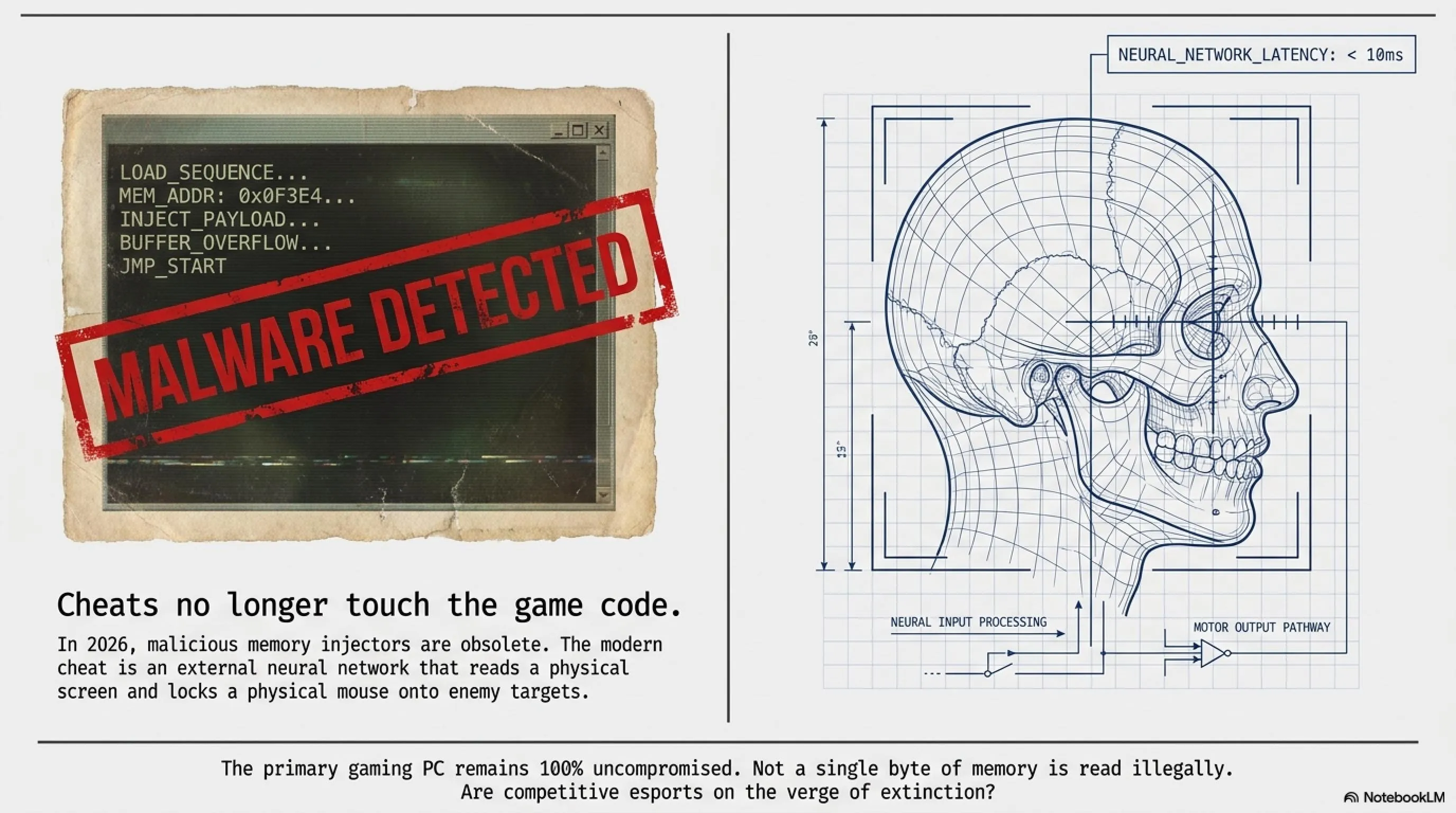
Welcome back, Tekin gamers! Today, we dive into one of the darkest, most complex, and exhilarating corners of the gaming industry in 2026: **The Global War between Anti-Cheats and Artificial Intelligence**. Just a few years ago, cheaters relied on malicious code injectors to breach game memory, making it easy for kernel-level systems like Vanguard or Ricochet to catch them red-handed. But today? Cheats no longer touch the game code. They read your screen via capture cards, analyze frames through neural networks, and physically lock your mouse onto enemy heads! Are competitive esports on the verge of extinction? Let’s find out.
⚡ Inside This Mega-Article:
1. The Devastating Evolution: From simple Aimbots to Computer Vision Neural Networks
2. Why Vanguard and Ricochet went blind: A Technical Autopsy
3. Hardware Warfare: How DMA (Direct Memory Access) actually works
4. The Corporate Counter-Strike: Server-Side AI vs Client-Side AI
5. The Fate of Multi-Million Dollar Esports Tournaments
☕ Grab your coffee and strap in; we are descending into the deepest layers of the gaming dark web.
🧬 Chapter 1: The Devastating Evolution; When AI Takes the Mouse
To grasp the magnitude of the disaster we face today, we must understand how legacy cheats operated. During the golden era of Counter-Strike: Global Offensive (roughly 2015-2021), the vast majority of cheats were executable programs running in the background of Windows. These malicious payloads utilized a technique known as **Memory Reading/Writing**. By injecting code directly into the system's RAM, they could extract the precise (X,Y,Z) coordinates of enemy players. Once the coordinates were acquired, the software would aggressively snap your crosshair to the target (Aimbot) or render outlines through solid geometry (Wallhacks). It was brutal, but it was detectable.
The gaming giants struck back with devastating force. Systems like **Riot Vanguard** (for Valorant) and **Ricochet** (for Call of Duty) were introduced as Kernel-Level (Ring 0) drivers. The kernel is the beating heart of the Windows operating system. Operating at this depth granted anti-cheats total supremacy over the PC; they could effortlessly spot and terminate any unauthorized process attempting to peak into the game's allocated memory. For a brief moment, it felt like the industry had won. But the black market cheat developers didn't retreat—they evolved.
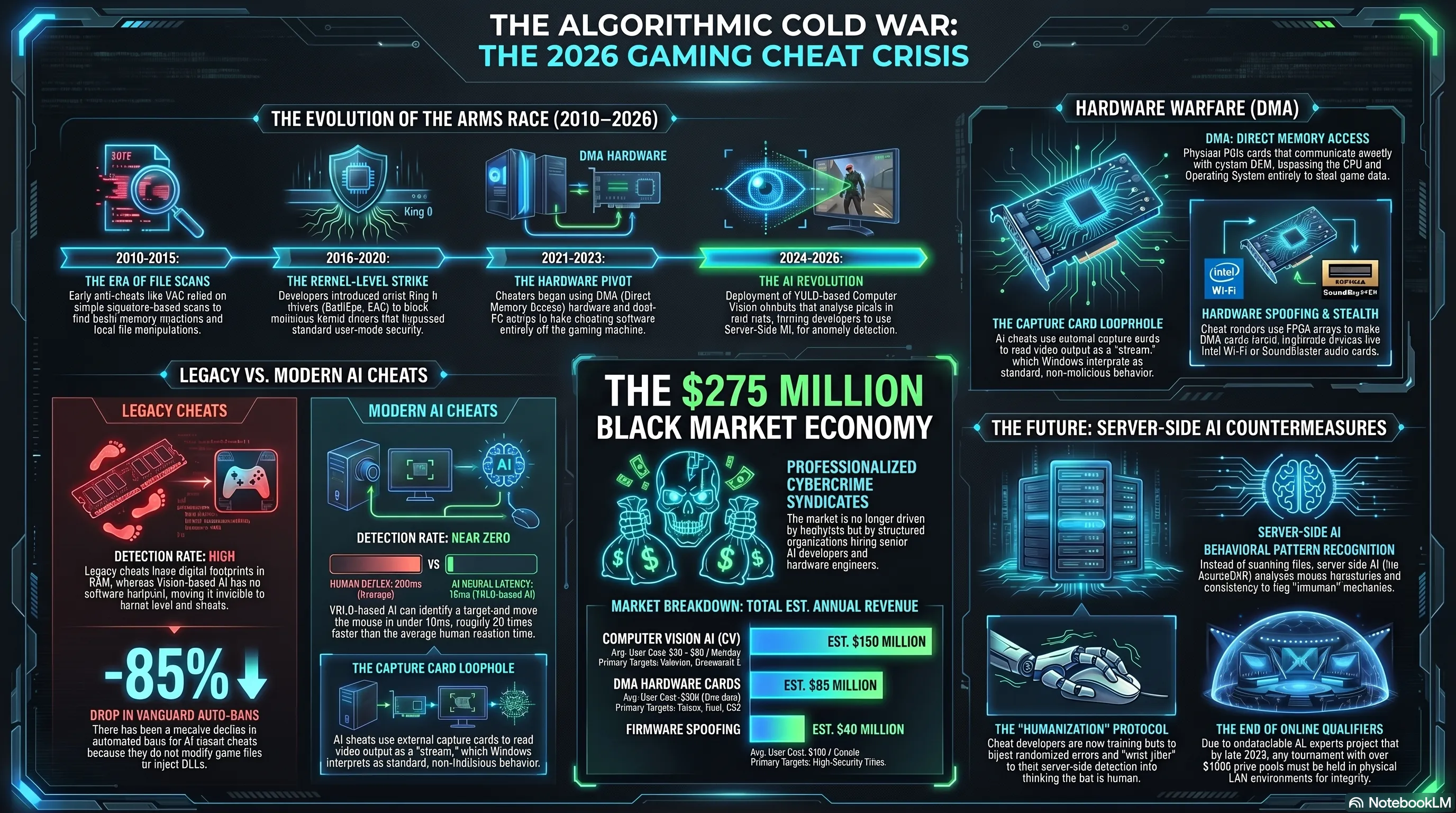
⏱️ Historical Timeline: The Cheat vs Anti-Cheat Arms Race (2010 - 2026)
| Era | Cheat Generation | Anti-Cheat Response |
|---|---|---|
| 2010 - 2015 | Basic Memory Injection & Local file manipulation. | Signature-based scans (similar to legacy Antivirus) like Valve Anti-Cheat (VAC). |
| 2016 - 2020 | Malicious Kernel Drivers bypassing user-mode security. | Introduction of strict Kernel-Level anti-cheats (BattlEye, EAC). |
| 2021 - 2023 | DMA Hardware (Direct Memory Access) via dual-PC setups. | Vanguard & Ricochet utilizing server-side behavioral analysis and deep boot-level scans. |
| 2024 - 2026 | Computer Vision AI (YOLO-based) visual recognition aimbots. | Deployment of Server-Side Machine Learning for anomaly detection (AI vs AI). |
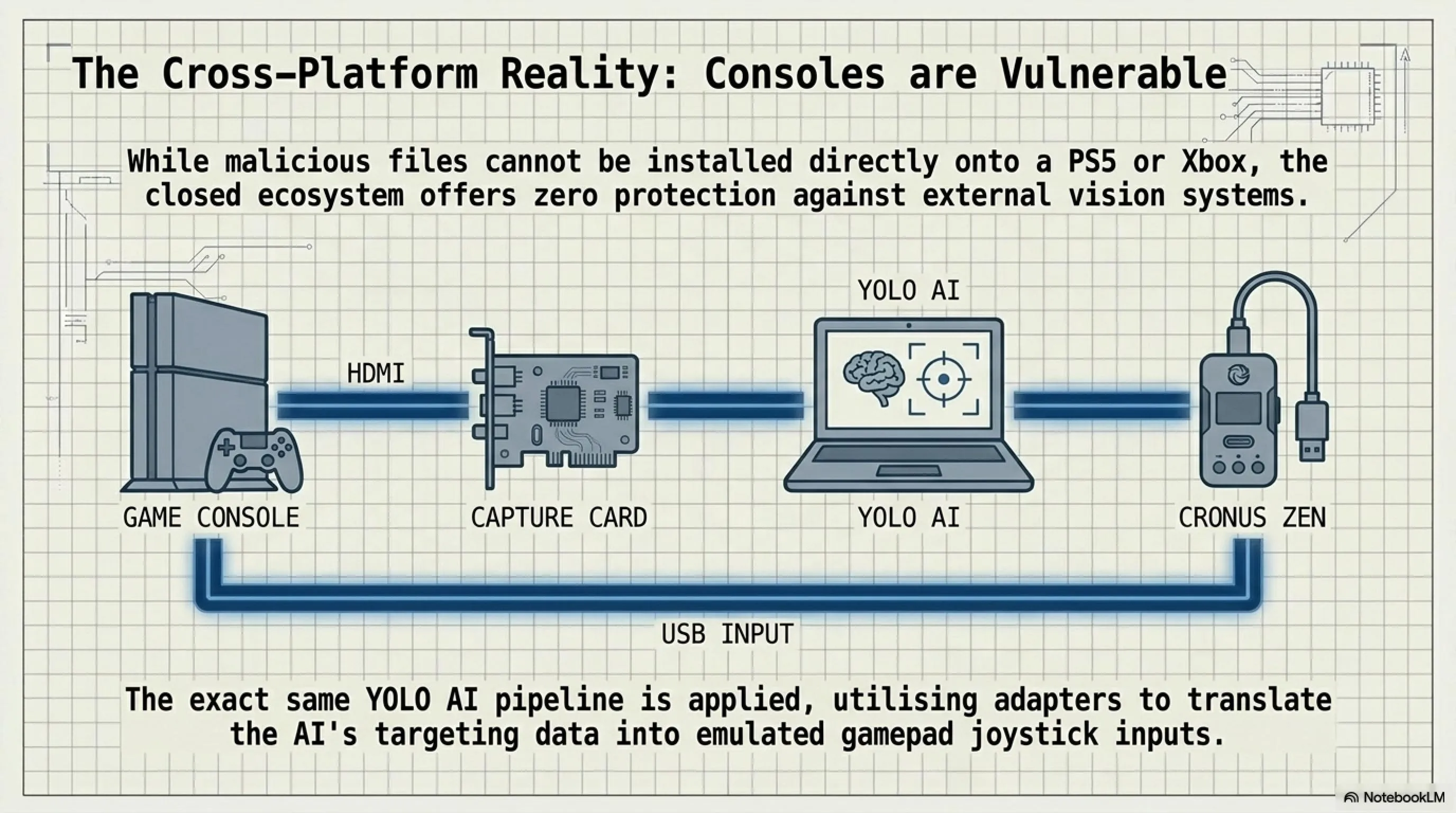
The introduction of Artificial Intelligence completely shattered the existing paradigm. In 2026, the **AI Aimbot** relies entirely on Computer Vision (CV)—the exact same technology Tesla uses to identify pedestrians. Here is how the nightmare unfolds: the raw video output from your Graphics Card (via HDMI/DisplayPort) is routed through an external Capture Card to a secondary device, like a laptop or even a Raspberry Pi. On this secondary machine, a hyper-optimized neural network (often a variant of the YOLO - You Only Look Once architecture) processes the incoming frames, identifying enemy models in less than 10 milliseconds.
Once the target is identified, the AI calculates the optimal trajectory and sends a physical hardware signal back to the primary gaming PC through a spoofed USB controller (like an Arduino or Cronus Zen). This external device mimics a standard, legal mouse. The catastrophic reality is this: **The primary gaming PC is entirely uncompromised.** Not a single byte of memory was read illegally. Not a single executable was injected. As far as the almighty Kernel Anti-Cheat is concerned, you are just a human looking at a screen and moving a physical mouse very accurately. The cheat is virtually invisible.
🕵️♂️ Chapter 2: The Autopsy of Blindness; Why Anti-Cheat Giants Failed
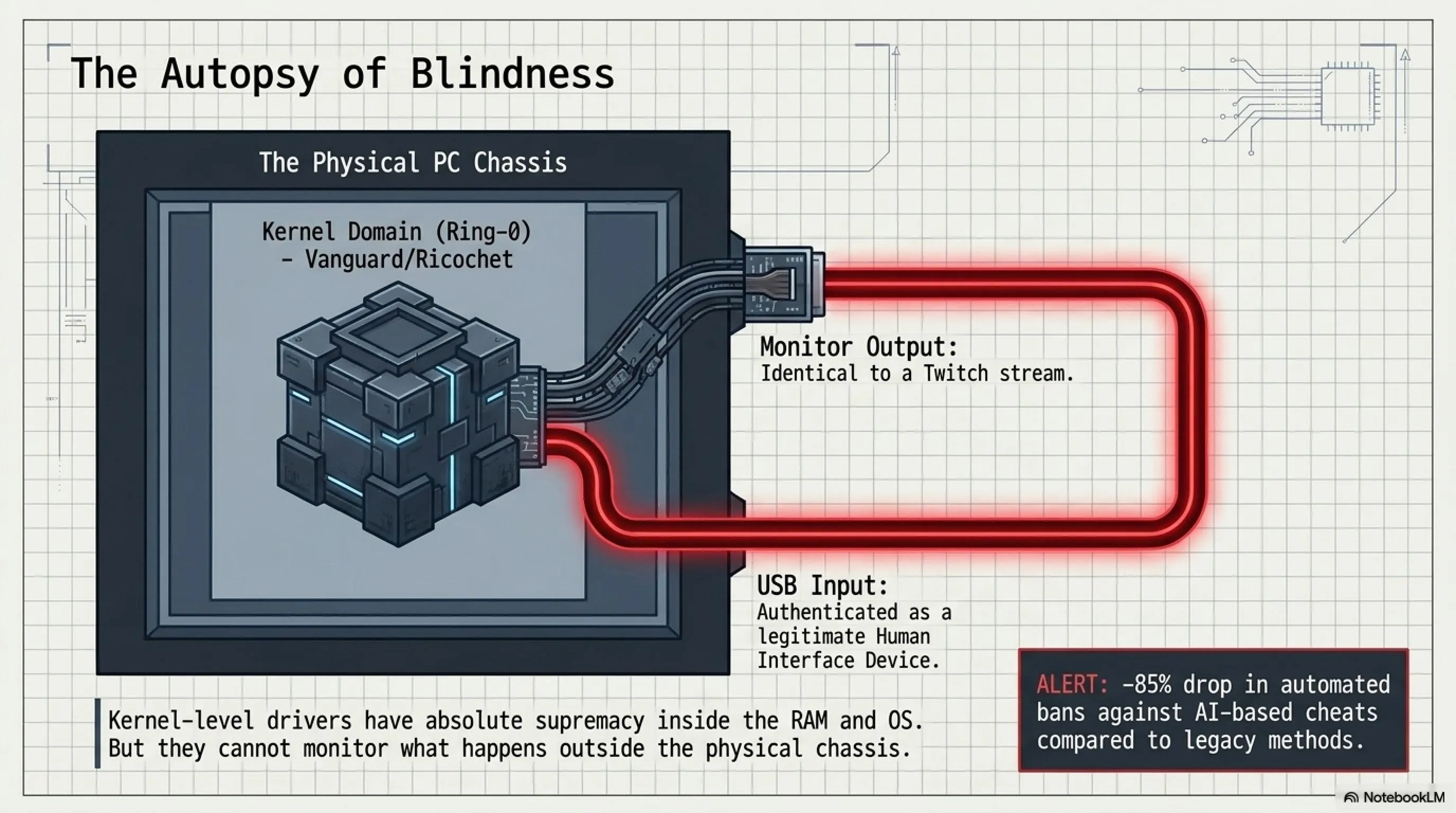
Riot Games’ crowning achievement with the release of Valorant was Vanguard. Installed as a Ring 0 kernel driver, it operates at the deepest, most privileged layer of the Windows OS, even superseding administrator rights. Activision followed suit with Ricochet for the Call of Duty franchise. The core mandate of these drivers is continuous RAM monitoring, ensuring no unauthorized software attempts to read or mutate memory values corresponding to player health, coordinates, or view angles. They were incredibly effective against traditional attacks. However, Computer Vision AI (CV AI) completely bypassed the rules of engagement.
Vanguard Detection Drop
-85%
Decline in automated bans (Auto-Bans) against AI-based cheats compared to legacy memory injection methods.
Neural Network Latency
< 10ms
Time required to detect an enemy on screen and transmit a mouse movement command. Imperceptible to humans.
AI Cheat Market Value
$250M
Estimated annual revenue from monthly subscription sales for Computer Vision cheats in 2026.
The fatal blind spot is this: Kernel-level anti-cheats cannot monitor what occurs outside the physical chassis of the computer. When the HDMI video output is mirrored to a capture card, Windows natively interprets this as standard behavior—identical to a streamer broadcasting on Twitch or YouTube. Conversely, when the mouse movement commands are fed back into the system via a hardware spoofing device (such as an Arduino connected via USB), the Windows USB drivers authenticate it as a legitimate Human Interface Device (HID). To Vanguard's digital eyes, a human is merely moving a physical mouse. There is no malicious software executing on the RAM to detect.
⚔️ Architectural Comparison: Legacy Memory Cheats vs Vision-Based AI
| Metric of Comparison | Legacy Cheats (Memory Injection) | Modern AI Cheats (Vision-Based) |
|---|---|---|
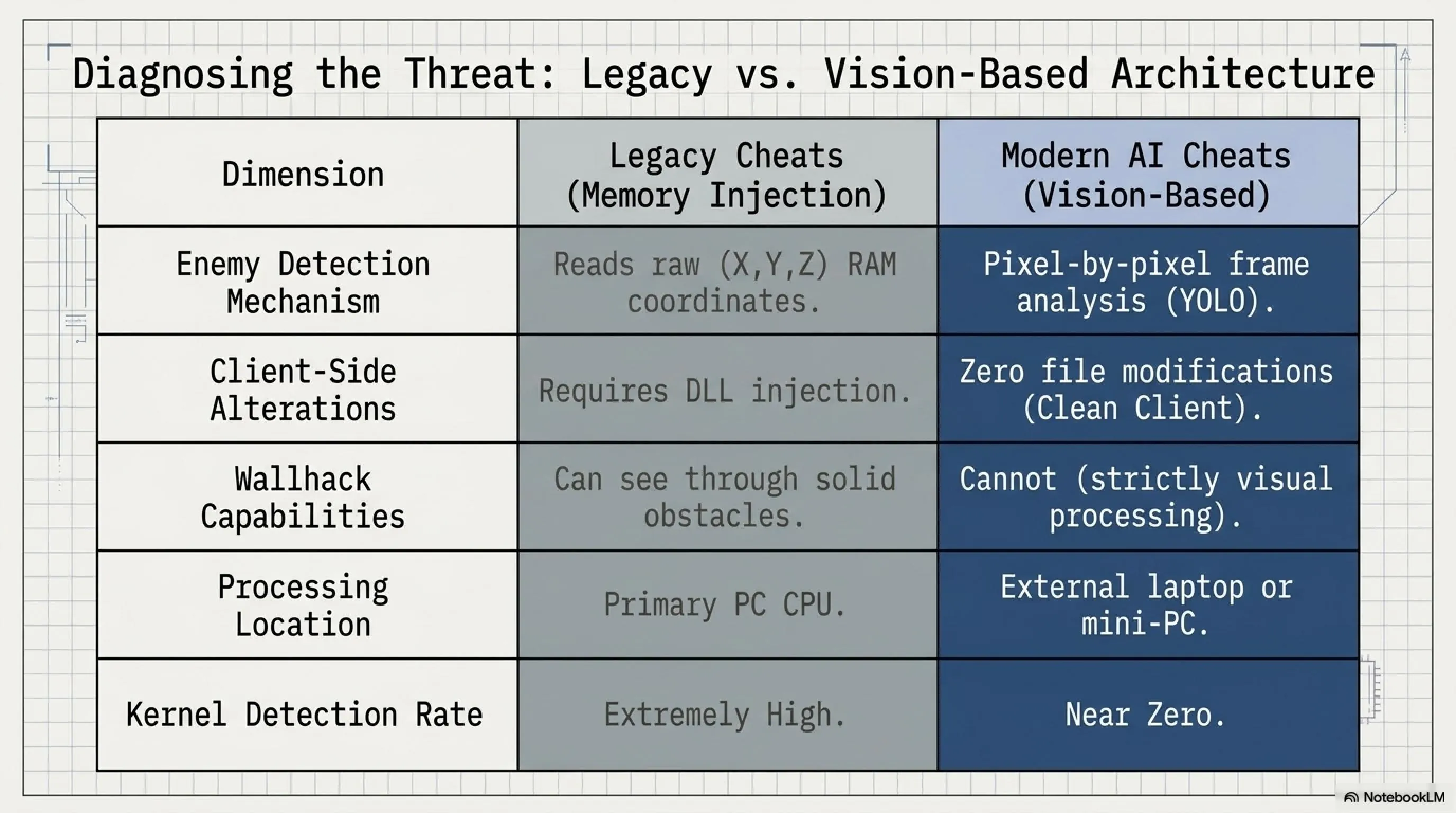
| Enemy Detection Mechanism | Reading raw (X,Y,Z) coordinate strings from system RAM. | Pixel-by-pixel frame analysis utilizing neural networks (YOLO). |
| Client-Side Alterations | Requires DLL injection or manipulation of Windows processes. | Zero file modifications; maintains a 100% "Clean Client". |
| Wallhack Capabilities (ESP) | ✅ Yes, can extract data for enemies behind solid obstacles. | ❌ No, the AI can only process what is visibly rendered on the monitor. |
| Processing Location | Executed by the CPU of the primary gaming PC. | Processed externally on a secondary device (laptop/mini-PC). |
| Kernel Anti-Cheat Detection Rate | Extremely High (Leaves definitive digital footprints) | Near Zero (Absolutely no software footprint exists) |
Of course, this Computer Vision system is not without flaws. As the comparison table highlights, AI Aimbots—unlike traditional memory hacks—are incapable of rendering enemies through walls (ESP/Wallhacks). The AI is strictly visual; it only sees what the human eye is allowed to see. However, the critical disparity lies in biology: the average human reaction time hovers around 200 milliseconds. Highly optimized AI algorithms in 2026 can spot an enemy shoulder peeking a corner and snap to the target in under 10 milliseconds, delivering lethal precision before the human brain has even processed the visual stimulus.
🔌 Chapter 3: Hardware Warfare; The DMA Nightmare
Beyond Computer Vision AI, there exists a hardware exploit even more terrifying: DMA (Direct Memory Access) boards. These are physical PCIe cards inserted directly into the motherboard of your gaming rig. The foundational architecture of the PCIe interface is that it allows connected components to communicate directly with the system RAM, entirely bypassing the Central Processing Unit (CPU) and the Operating System (Windows). Professional cheating syndicates utilize DMA cards to aggressively skim game data straight off the RAM, beaming it via a USB cable to an external device. On that secondary laptop or tablet, a perfect Radar ESP is rendered, mapping the exact coordinates of every player on the server.
⚙️ Technical Specifications: DMA Cheat Hardware (2026 Gen)
- Interface: PCIe x1 Gen 4 (Easily concealed behind bulky GPUs).
- Bandwidth: Read/Write speeds up to 1.5GB/s directly from volatile memory.
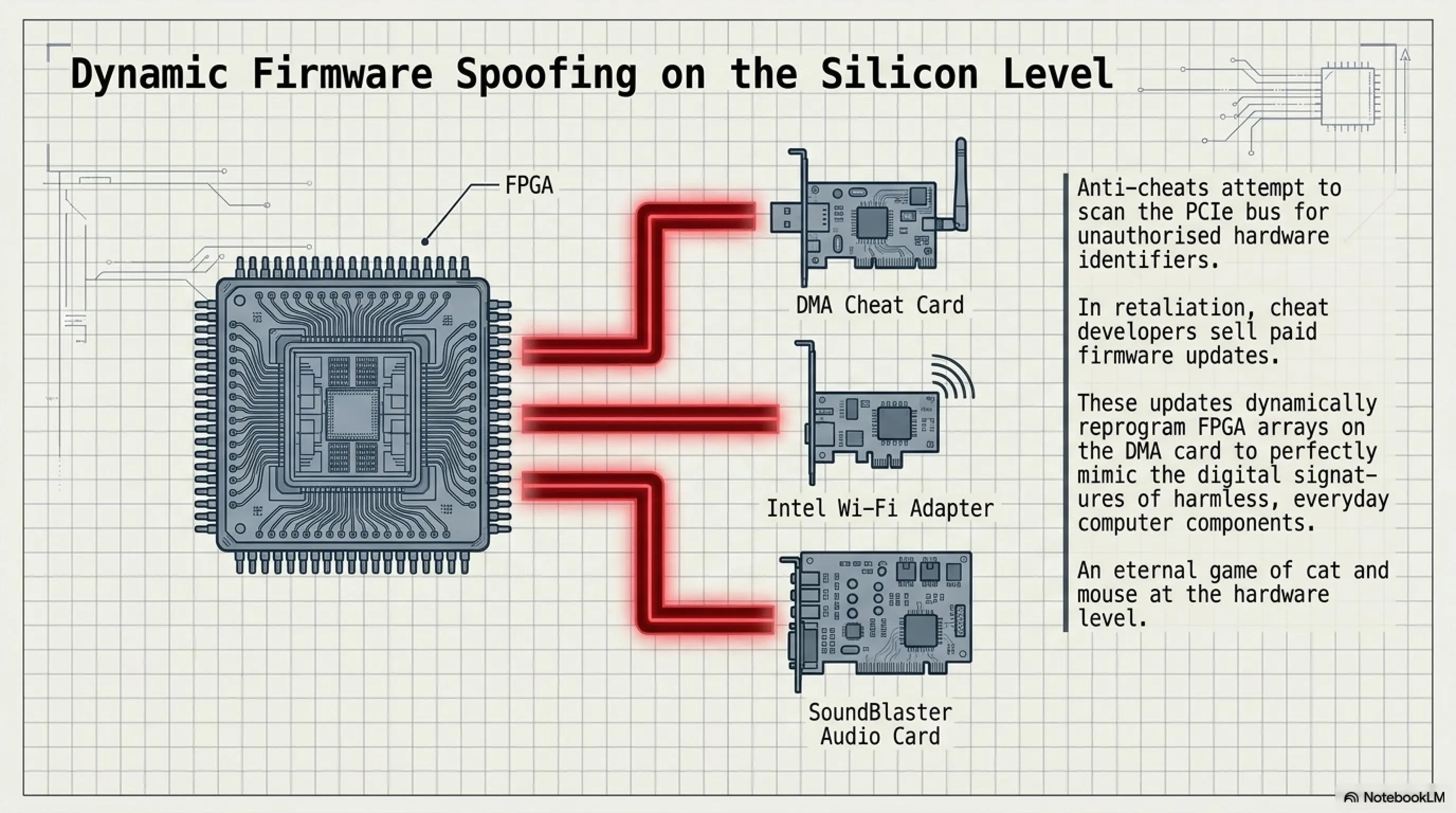
- Spoofing Chipset: FPGA arrays programmed to mimic harmless peripherals, such as Intel Wi-Fi adapters.
- Black Market Price: Ranging from $400 to $1,200 (Scaling with the quality of the stealth Firmware).
- Radar Software (ESP): Cross-platform execution (iOS, Android, Windows) on external devices.
Game developers are not entirely defenseless. Recently, anti-cheats have begun deeply scanning the PCIe bus to identify unauthorized hardware identifiers. However, cheat vendors retaliated by offering paid Firmware updates. These updates dynamically alter the hardware ID of the DMA card to perfectly mimic legitimate components, such as a SoundBlaster audio card or a standard network interface. It is an eternal, high-stakes game of cat and mouse played out on the silicon level, fueled by massive financial incentives.
📈 Financial Distribution of the Hardware & AI Cheat Black Market (2026)
| Market Segment | Average User Cost (Recurring/One-time) | Estimated Annual Revenue | Primary Target Titles |
|---|---|---|---|
| Computer Vision AI (CV) | $30 - $80 / Monthly | $150 Million | Valorant, Overwatch 2, Apex Legends |
| DMA Hardware Cards | $800 (One-time) + $50/Month | $85 Million | Escape From Tarkov, Rust, CS2 |
| Firmware Spoofing Services | $100 / Per Update | $40 Million | Any game secured by BattlEye/Vanguard |
Source: Tekin Cybersecurity Dept & Independent Market Analysis 2026
🛡️ Chapter 4: The Server-Side Counterstrike; AI Combating AI
Game developers have realized that the war on the client-side is largely lost. The new strategic imperative in 2026 is moving the frontline entirely to the server-side. Instead of scanning a player's hard drive for malicious signatures, the focus has shifted to deep behavioral analysis. Colossal Machine Learning models, backed by the cloud computing infrastructure of Microsoft Azure, Amazon AWS, or Tencent, analyze player behavior at a micro-level. They track mouse movement trajectories, headshot consistency rates, and millisecond reaction times across millions of data points simultaneously.
🎯 Mid-Point Verdict: A Paradigm Shift in Security
We have transitioned from an era of "prevention" to an era of "pattern recognition." Server-side AI does not care if you have a hidden DMA card or a spoofed Arduino mouse. It simply calculates: "The biological mechanics of a human wrist are physically incapable of tracking three separate targets in 0.4 seconds with zero deviation or over-aiming." Consequently, accounts are banned for "inhuman behavior," regardless of how clean the client PC appears to be.
To circumvent this new server-side shield, cheat developers have begun actively training their algorithms to execute "Humanization" protocols! These modern AI cheats intentionally inject randomized errors, simulate organic wrist jitter, and intentionally delay target locking to bypass server-side scrutiny. We are literally witnessing an algorithmic Cold War, where bots are learning to pretend to be human to defeat other bots designed to catch them.
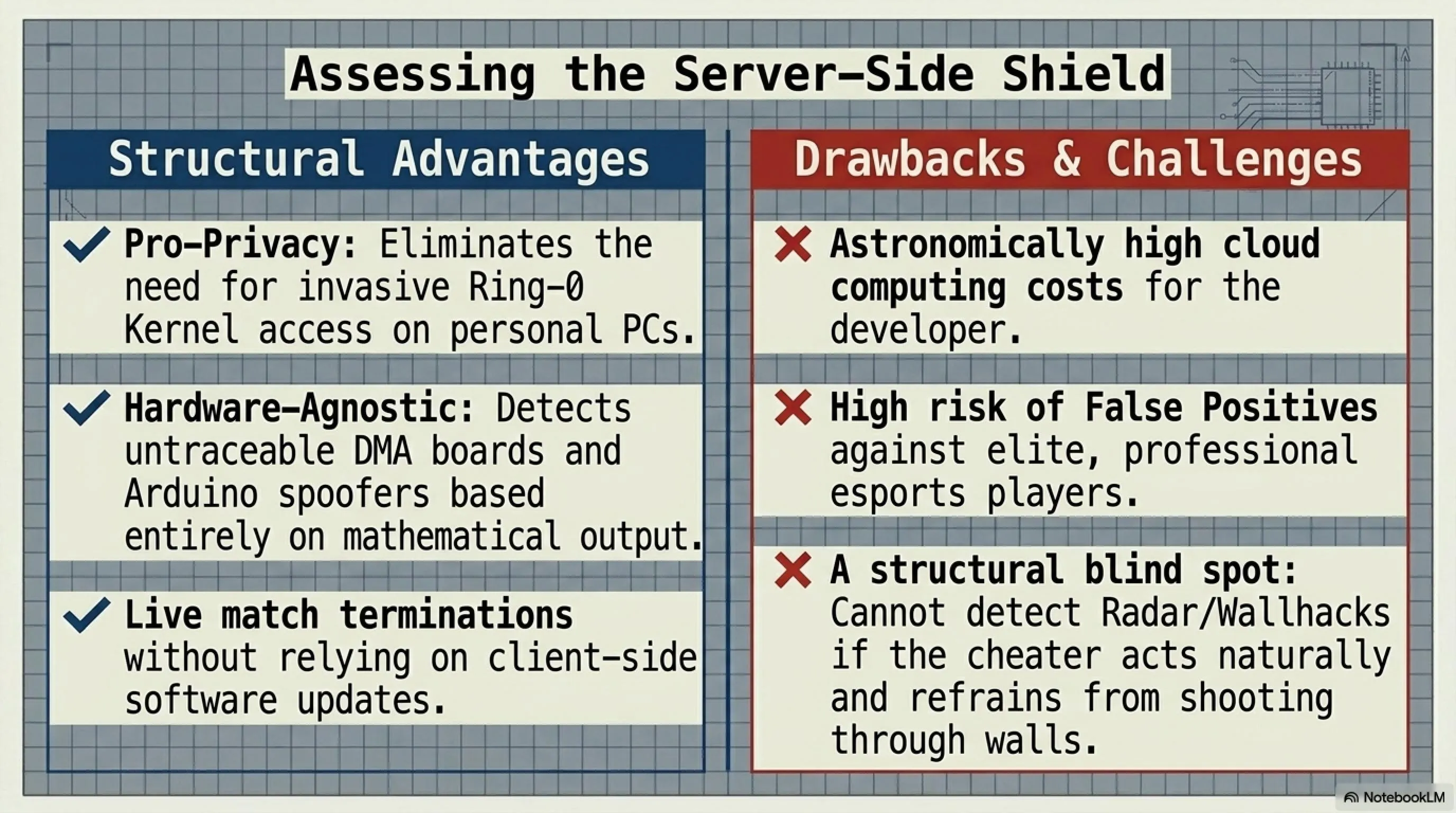
🟢 Advantages of Server-Side AI
- ✔ Eliminates the need for invasive Ring-0 Kernel access (pro-privacy).
- ✔ Successfully detects untraceable hardware like DMA boards and Arduino spoofers.
- ✔ Live match terminations without relying on client-side security updates.
🔴 Drawbacks & Challenges
- ✖ Astronomically high cloud computing costs for the developer.
- ✖ High risk of False Positives against elite, professional players with rapid reflexes.
- ✖ Cannot detect Wallhacks if the player acts naturally and refrains from shooting through walls.
📊 Market Thermometer: Esports Tournaments on the Brink
- Tekin Signal: Due to the undetectable nature of DMA/AI cheats in remote settings, we project that by late 2026, any tournament featuring a prize pool exceeding $100,000 will be strictly limited to physical LAN environments. Investing in online-only tournament platforms is currently viewed as high-risk.
❓ Frequently Asked Questions (FAQ): Modern Cheating Realities
Is Vanguard completely useless on my PC now?
No, Vanguard is still highly effective at instantly banning 99% of low-level cheaters (those using cheap or free executables found on YouTube). However, it is largely blind against professional rings utilizing DMA hardware and Vision AI.
If someone uses an AI Aimbot, will they ever get banned?
Yes, they will eventually be banned, but not by the software installed on their PC. They will be caught by server-side AI analyzing their statistical anomalies (e.g., maintaining a 90% headshot accuracy) or through manual review from mass player reports.
Are consoles (PS5 and Xbox) immune to AI cheating?
Unfortunately, no. While you cannot install malicious files directly onto a console, cheaters route the console's video output through a capture card to a PC, process the AI, and send firing inputs back to the console using adapters like the Cronus Zen or Titan Two.
🏁 The Final Verdict: The Uncertain Future of Competitive Gaming
The endless game of cat and mouse between developers and cheat vendors has escalated to its most dangerous phase in history: two AIs battling each other. In the near future, the fundamental mechanics of competitive multiplayer shooters (FPS) might undergo radical changes, leaning away from raw aiming speed and more towards strategic positioning. As long as Free-to-Play titles dominate the market and the cheating industry remains wildly profitable, this cyber cold war will rage on. Welcome to the post-cheat era; a reality where you can never truly be certain if your opponent is a human or a flawless neural network.
📚 Verified Sources & References
📋 Technical Documentation & Security Briefs
- 🔗 Wired: How AI Aimbots Are Destroying Multiplayer Shooters.
- 🔗 IGN: An Autopsy of Direct Memory Access (DMA) Cheat Hardware.
- 📊 Tekin Security Report: Vanguard vs BattlEye Evasion Rates in Q1 2026.
🌐 Stay Connected With Us 🎮✨
For the latest tech, gaming, and gadget news, follow us on our official social media channels: