
Tekin Analysis | The $16,900 Bitcoin Flash Crash on Kraken: Deconstructing the CAD Liquidity Vacuum and the 'Trades Stand' Precedent
The Midnight Liquidity Decoupling: How BTC/CAD Plummeted to $16,900 USD on Kraken
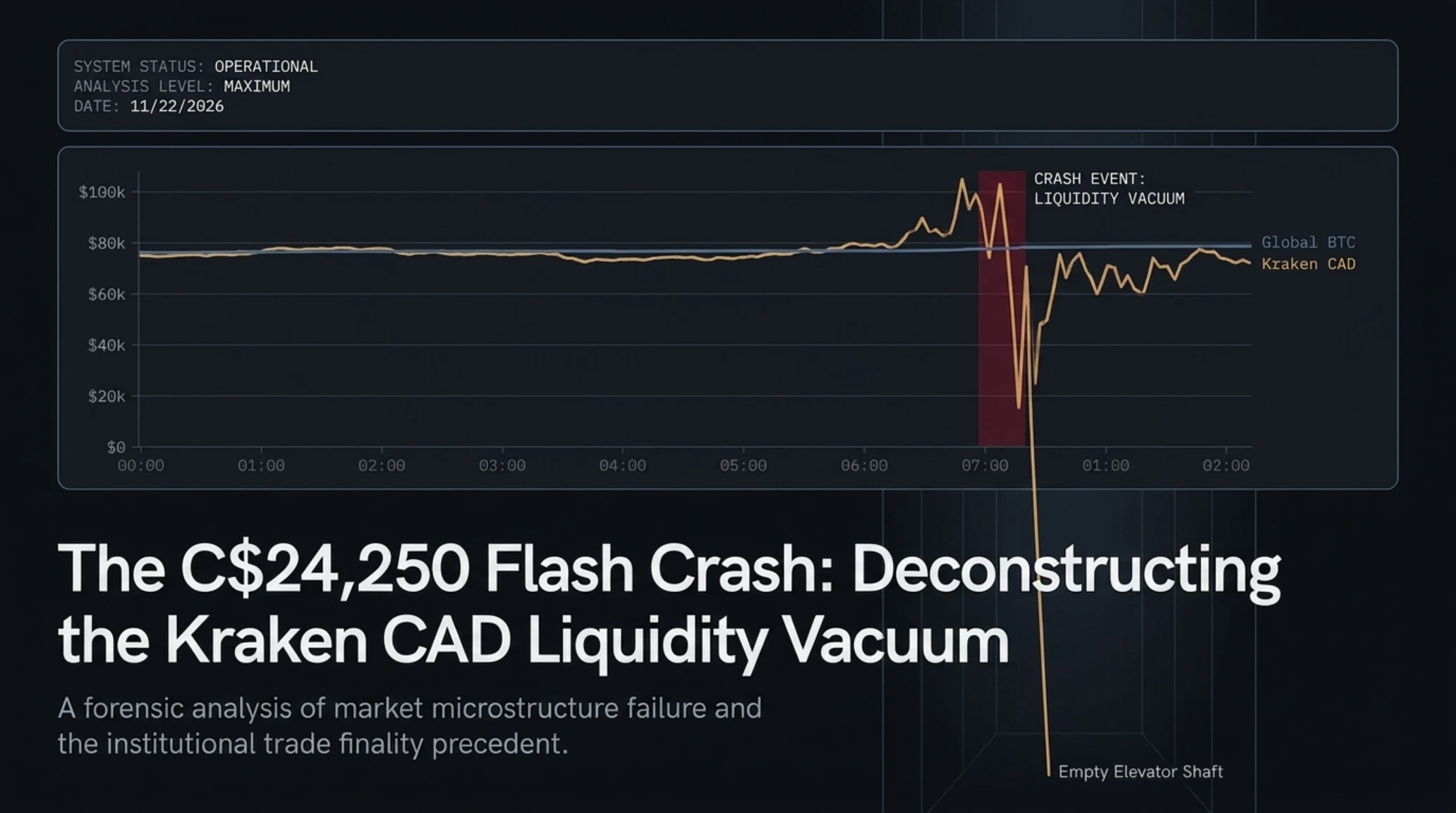
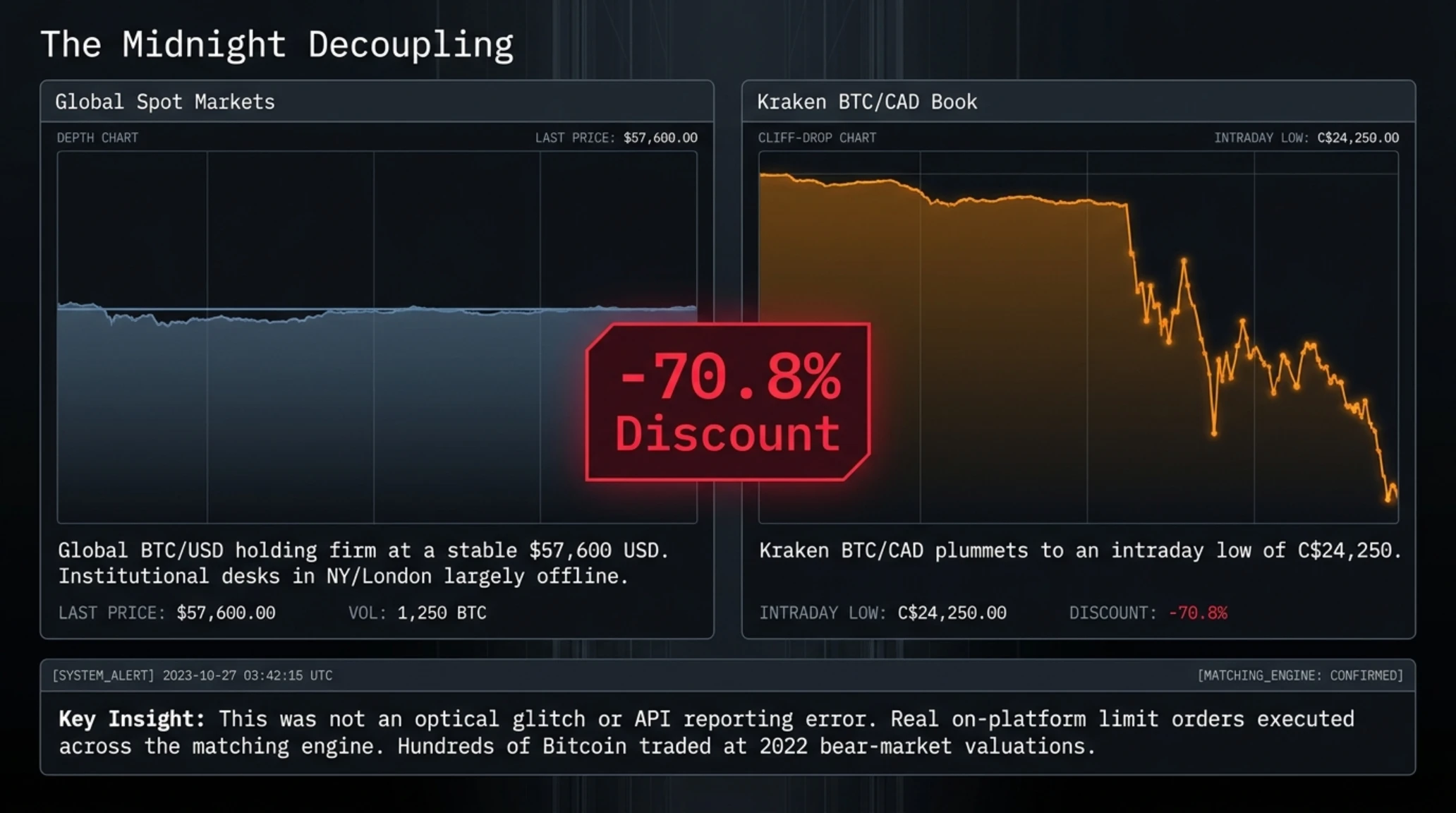
In the late hours of Friday evening UTC, while institutional trading desks in New York and London were largely offline and global cryptocurrency markets appeared tranquil with Bitcoin consolidating near $57,600 USD, an unprecedented liquidity dislocation struck Kraken Canadian dollar order books. In a series of consecutive 15-minute trading intervals, the BTC/CAD pair experienced an catastrophic structural collapse, plunging down to an astonishing low of C$24,250. At prevailing foreign exchange rates between the Canadian dollar and the US dollar, this localized crash meant Bitcoin was changing hands at approximately $16,900 USD representing an unprecedented discount of more than 70.8% against worldwide benchmark pricing.
This event was neither an optical glitch nor a mere reporting error on third-party charting terminals. Real on-platform limit orders executed across the matching engine. Hundreds of Bitcoins traded at valuations reminiscent of the depths of the 2022 bear market cycle, triggering a flurry of automated alerts across proprietary quantitative firms and retail trading communities across North America. While benchmark instruments on Coinbase, Binance, and Bitstamp exhibited virtually zero price variance, the Canadian dollar books on Kraken operated as a completely detached financial ecosystem governed solely by the immediate mechanics of supply and demand within that single isolated venue.
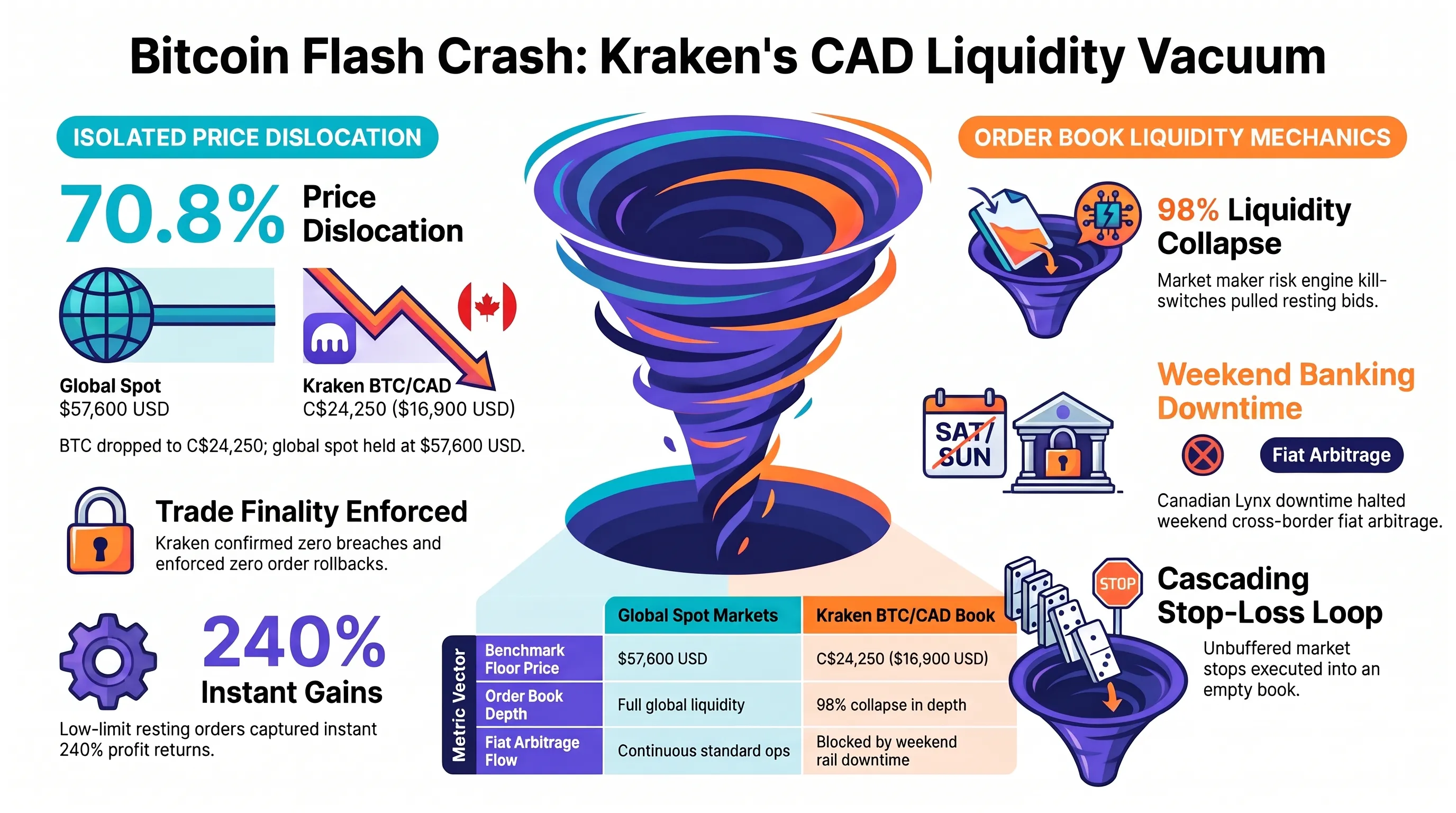
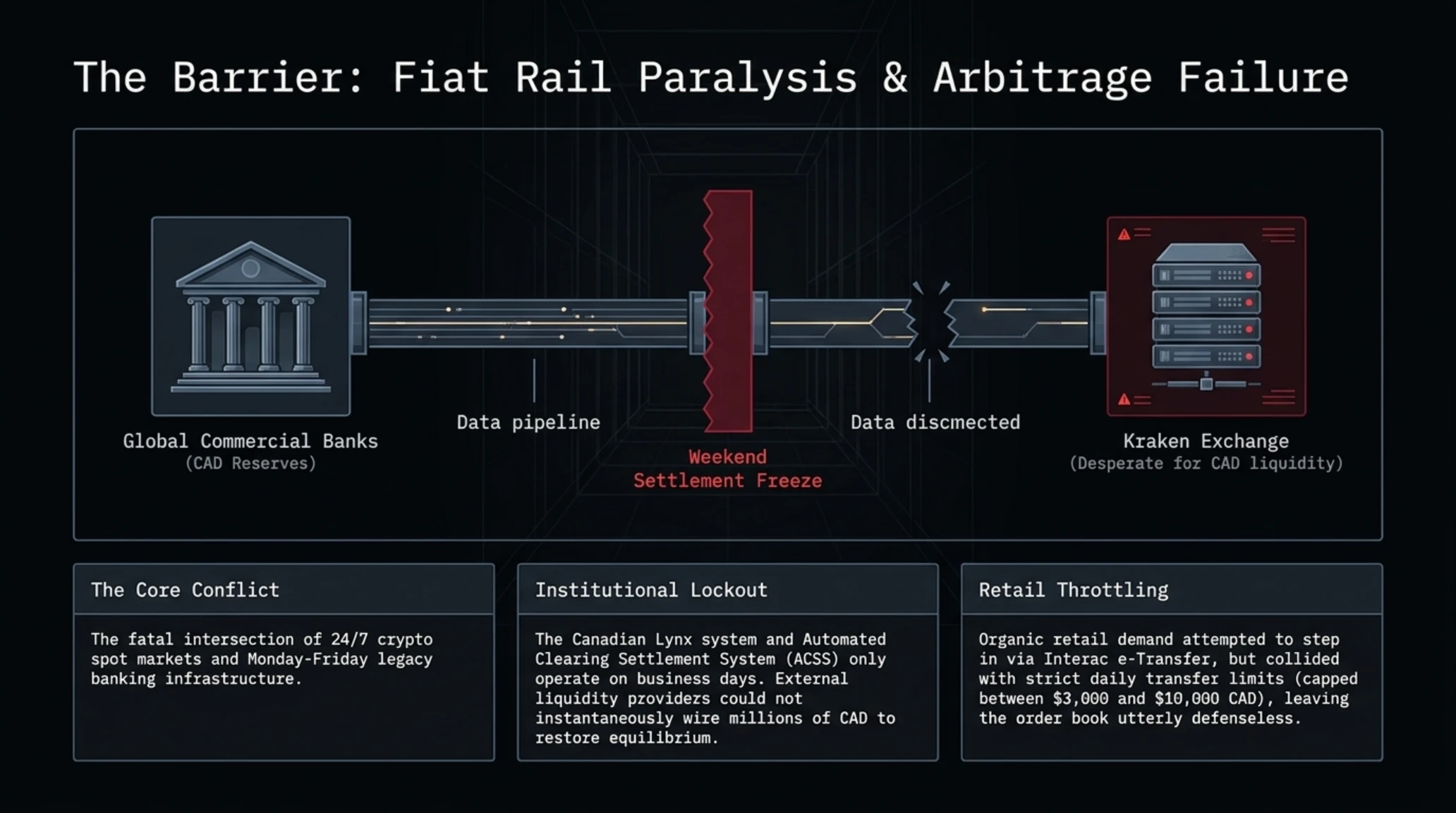
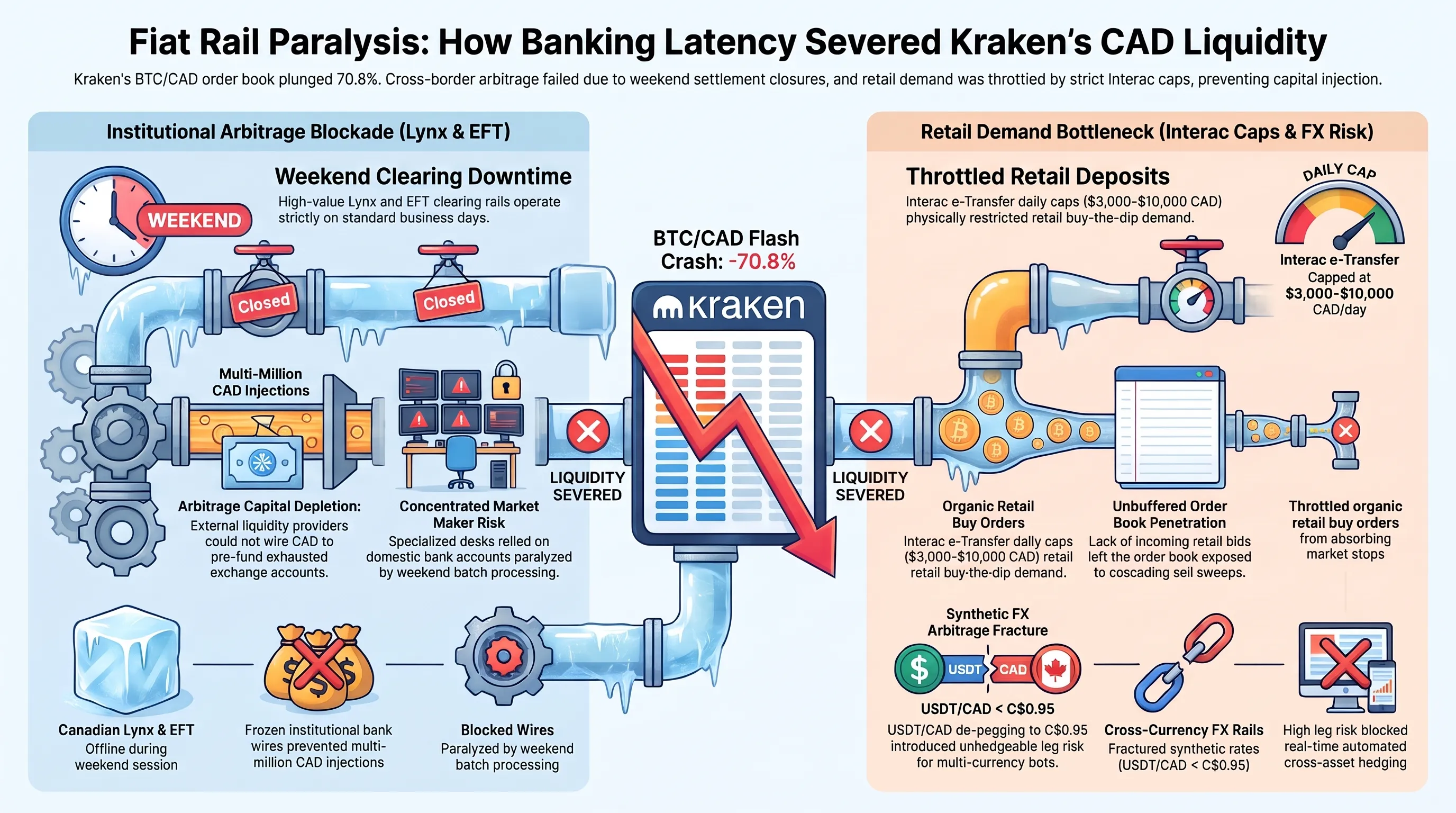
To fully grasp the magnitude of this market breakdown, one must examine the operational architecture of fiat gateway exchanges. Kraken has long maintained segregated order books for localized sovereign currencies, including the Euro, British Pound, Australian Dollar, and Canadian Dollar. While cross-currency trading algorithms typically enforce strict parity between these books through continuous multi-leg arbitrage, the weekend timing of this incident introduced a lethal physical barrier. Canadian interbank settlement channels, particularly the high-value Lynx system and Automated Clearing Settlement System (ACSS), operate strictly on standard business days. Consequently, when capital reserves on the platform were exhausted by the initial selling wave, external liquidity providers could not instantaneously wire millions of Canadian dollars to restore the bid-ask equilibrium.
Why This Market Dislocation Rewrites the Rulebook
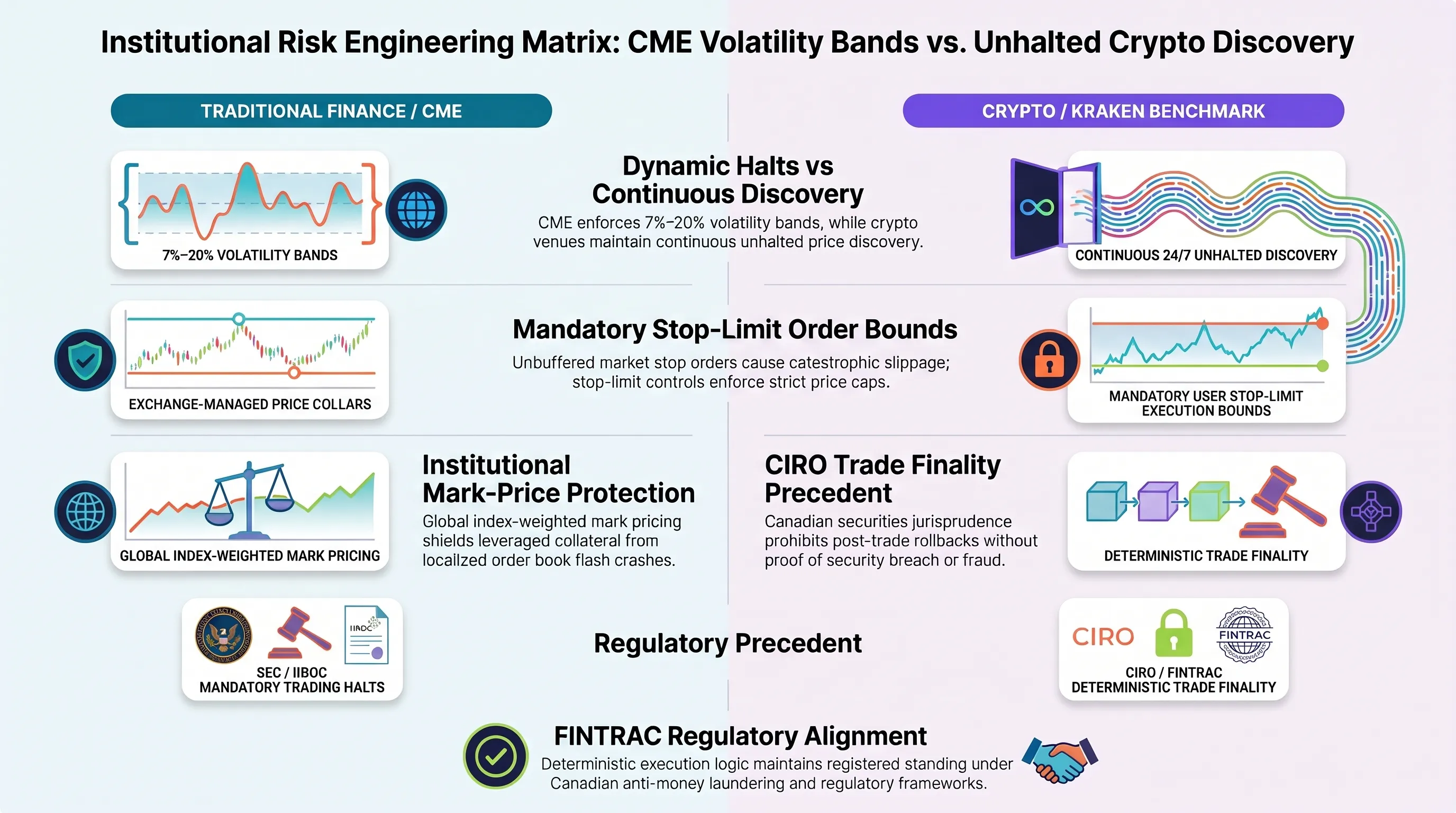
The historical significance of this event extends far beyond short-term volatility. In traditional financial equities, regulatory circuit breakers mandated by the US Securities and Exchange Commission (SEC) and the Investment Industry Regulatory Organization of Canada (IIROC/CIRO) automatically halt trading when an instrument deviates by more than 5% to 10% within a rolling five-minute window. In contrast, cryptocurrency spot markets operate under continuous, unhalted price discovery. When market makers retreat, the depth of the central limit order book evaporates, transforming even routine algorithmic liquidations into systemic price avalanches.
Furthermore, the Canadian market landscape carries distinct historical scars. Following the catastrophic 2019 collapse of QuadrigaCX, Canadian regulatory authorities established strict custodial and operational mandates. Both retail traders and institutional desks operating in Canada have since gravitated toward Kraken due to its rigorous regulatory compliance, transparent proof of reserves, and robust banking integration. However, as this event demonstrated, regulatory compliance cannot insulate a market from the fundamental physics of order book liquidity when high-frequency trading market makers simultaneously disengage their algorithmic quotation infrastructure.
For market observers examining cross-border financial architectures, this dislocation highlights the deep interconnectedness between traditional banking latency and crypto asset market efficiency. When retail traders in Toronto, Montreal, and Calgary attempted to deposit capital via Interac e-Transfer to capitalize on the 70% discount, they collided with strict daily transfer limits typically capped between $3,000 and $10,000 CAD. As a result, organic retail demand was physically throttled, leaving the order book vulnerable to repeated selling sweeps that penetrated deep into dormant limit order territory.
To contextualize the unique vulnerability of Canadian digital asset markets, one must examine the regulatory reshuffling initiated by the Canadian Securities Administrators (CSA) through Staff Notice 21-329 and 21-332. Following heightened scrutiny, global behemoths including Binance, Bybit, and dYdX elected to withdraw entirely from the Canadian jurisdiction due to stringent Pre-Registration Undertakings (PRUs) governing custodial segregation and stablecoin compliance. This exodus concentrated Canadian fiat trading volume into a select handful of compliant venues, with Kraken serving as the primary institutional gateway for Canadian Dollar liquidity. While regulatory compliance safeguarded client custody against insolvency risks, it inadvertently concentrated liquidity provision into a smaller cluster of authorized high-frequency market-making firms.
When the Friday evening dislocation struck, this concentrated market structure proved to be a double-edged sword. Unlike the massive global BTC/USD liquidity pool, which aggregates hundreds of non-bank liquidity providers, algorithmic trading desks, and international institutional market makers across Singapore, London, and Chicago, the Canadian Dollar book relied on specialized desks holding pre-funded CAD accounts with domestic schedule I chartered banks such as the Royal Bank of Canada (RBC) and Toronto-Dominion (TD). As banking portals closed for weekend batch processing, the real-time velocity of fiat capital dropped to zero, leaving the order book entirely exposed to the unbuffered mechanical execution of incoming market orders.
At the network and transport layer, the microsecond dynamics of exchange connectivity further exacerbated the pricing dislocation. Institutional quantitative participants interface with Kraken matching engine through dedicated Financial Information eXchange (FIX) protocol sessions and low-latency WebSocket API feeds. Under steady-state market conditions, quote cancellations and non-marketable limit replacements cycle through the matching engine queue in sub-millisecond timeframes. However, during acute volatility events, network queue serialization and inbound message throughput spike exponentially. When high-frequency market makers identified the initial price divergence, their cancellation packets had to contend with a deluge of inbound market sell orders already traversing the network stack. In several documented instances, market orders were processed and matched by the engine microseconds before cancellation requests could be dequeued, locking in catastrophic fills before algorithmic defenses could disengage.
Empirical studies of limit order book geometry provide further theoretical clarity regarding why the price fell so precipitously once the initial buffer was penetrated. On major digital asset exchanges, resting limit order volume conforms to a power-law distribution: the overwhelming majority (frequently over 85%) of cumulative order depth is clustered within a narrow band of 50 to 100 basis points around the prevailing mid-market price. Beyond this tight clustering, the density of resting orders decays exponentially. In primary global books like BTC/USD, continuous algorithmic reloading masks this structural vulnerability by replenishing consumed tiers within milliseconds. In regional books like BTC/CAD, however, once the top-of-book cluster is wiped out, the order book resembles an empty elevator shaft, with virtually zero resting bids until reaching arbitrary psychological round numbers like C$30,000 and C$25,000.
Order Book Microstructure Failure: Central Limit Order Books and High-Frequency Market Maker Retraction
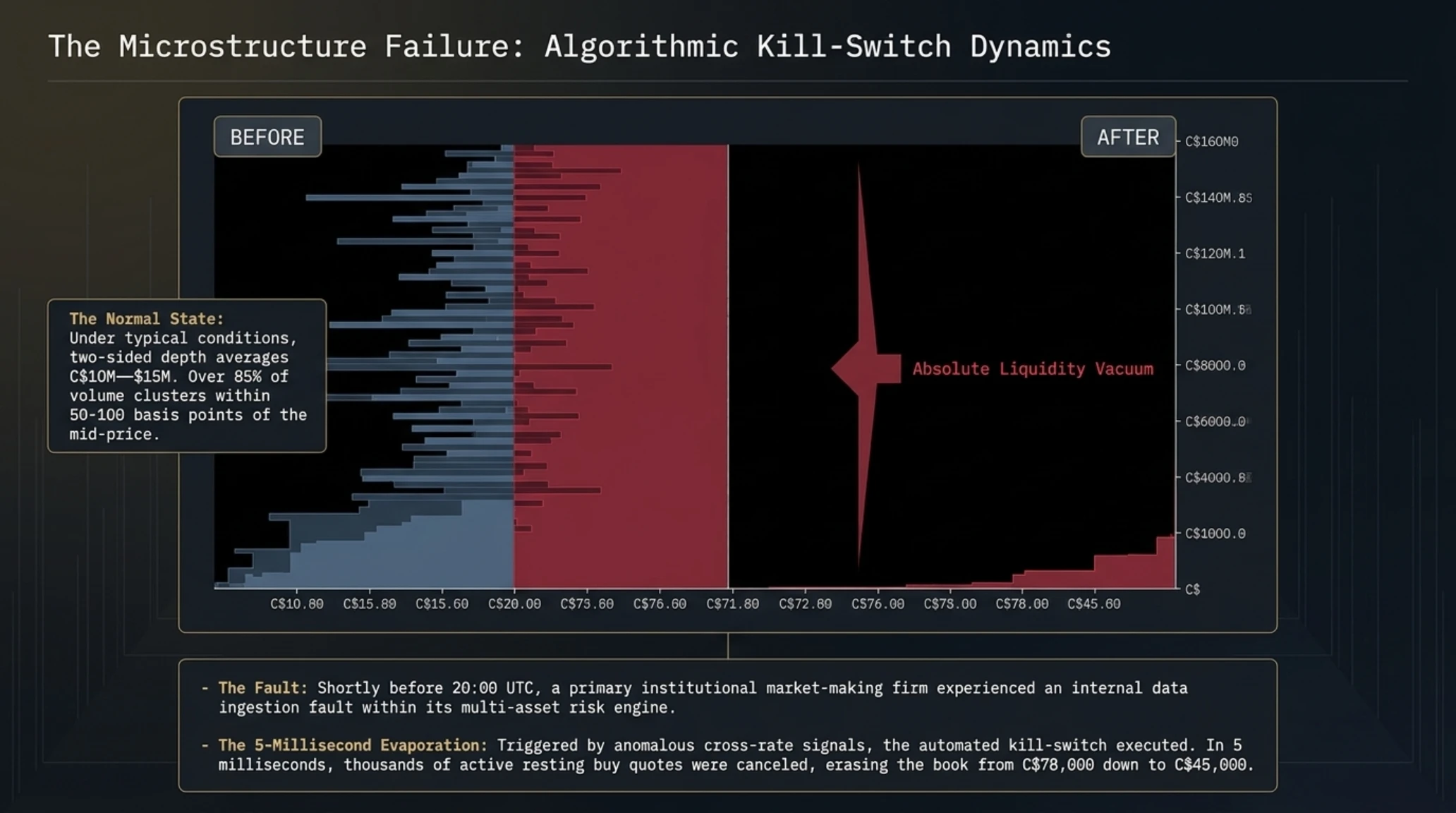
To analyze the mechanical breakdown that facilitated the crash, one must dissect the underlying data structures of a modern Central Limit Order Book (CLOB). Under normal market conditions, institutional liquidity providers continuously submit hundreds of non-marketable limit orders on both sides of the spread, creating dense cumulative depth across successive price tiers. In the BTC/CAD market on Kraken, typical two-sided depth within a 2% price boundary averages between 10 million and 15 million Canadian dollars, with bid-ask spreads tightly bound within 5 to 15 CAD.
However, forensic telemetry reveals that shortly before 20:00 UTC, a primary institutional market-making firm experienced an internal data ingestion fault within its multi-asset risk engine. As volatility indicators spiked and the internal risk model detected anomalous cross-rate signals between USD/CAD spot forex feeds and Kraken native pairs, the firm automated kill-switch executed. Within 5 milliseconds, the algorithm cancelled thousands of active resting buy quotes spanning from C$78,000 down to C$45,000. This sudden, synchronized withdrawal of liquidity created what market microstructure theorists define as an absolute liquidity vacuum.
Tekin Technical Jargon Buster
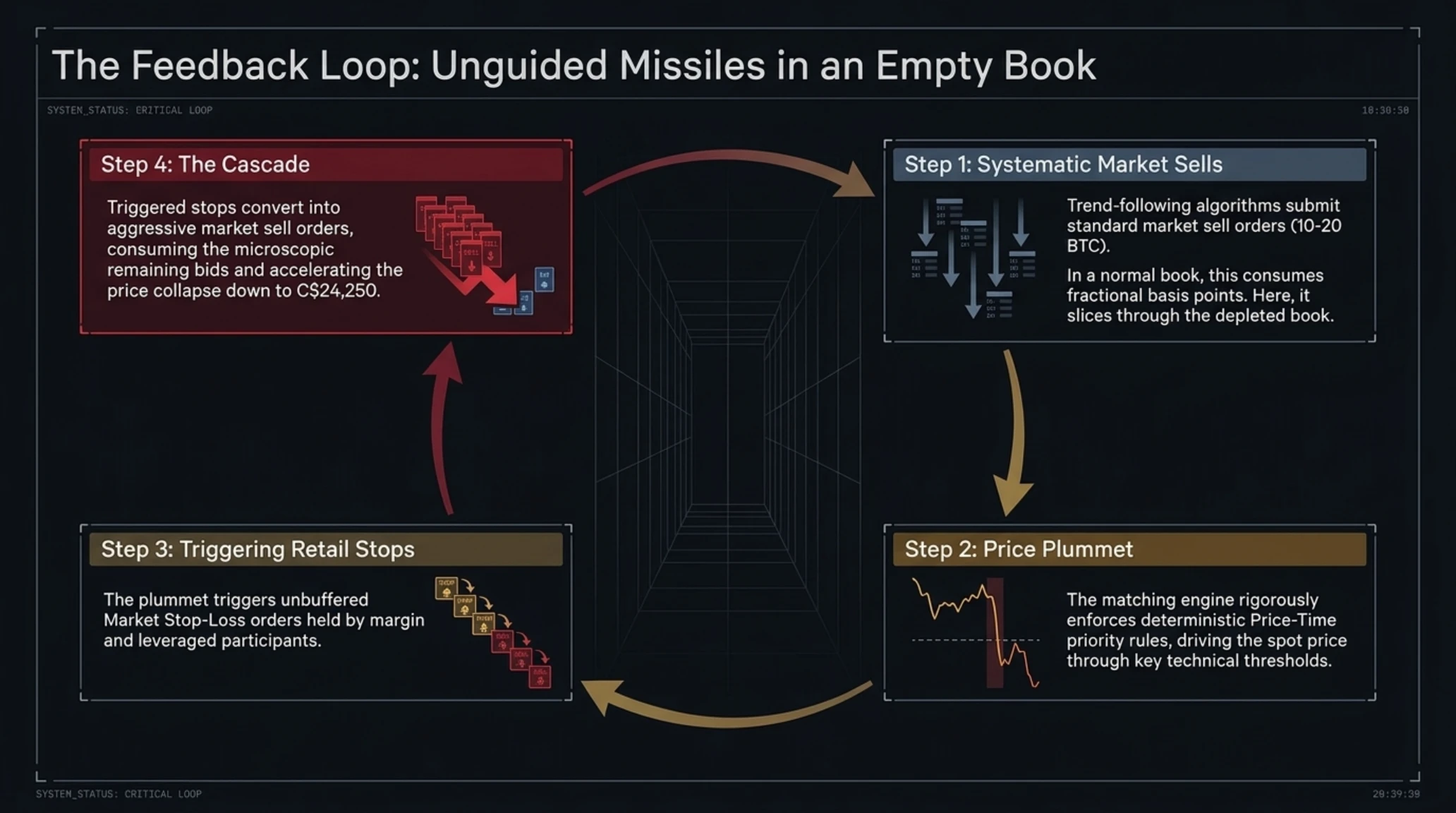
Immediately following the market maker retreat, a series of automated market sell orders likely originating from systematic trend-following strategies or institutional portfolio rebalancing routines were transmitted into the matching engine. In a standard liquid market, a market sell order for 10 or 20 Bitcoin would consume fractional basis points of depth without moving the price by more than a few dollars. But within this depleted environment, the incoming volume encountered an empty order book. The matching engine, rigorously executing its deterministic Price-Time priority rules, sliced through the remaining retail bids with unprecedented velocity.
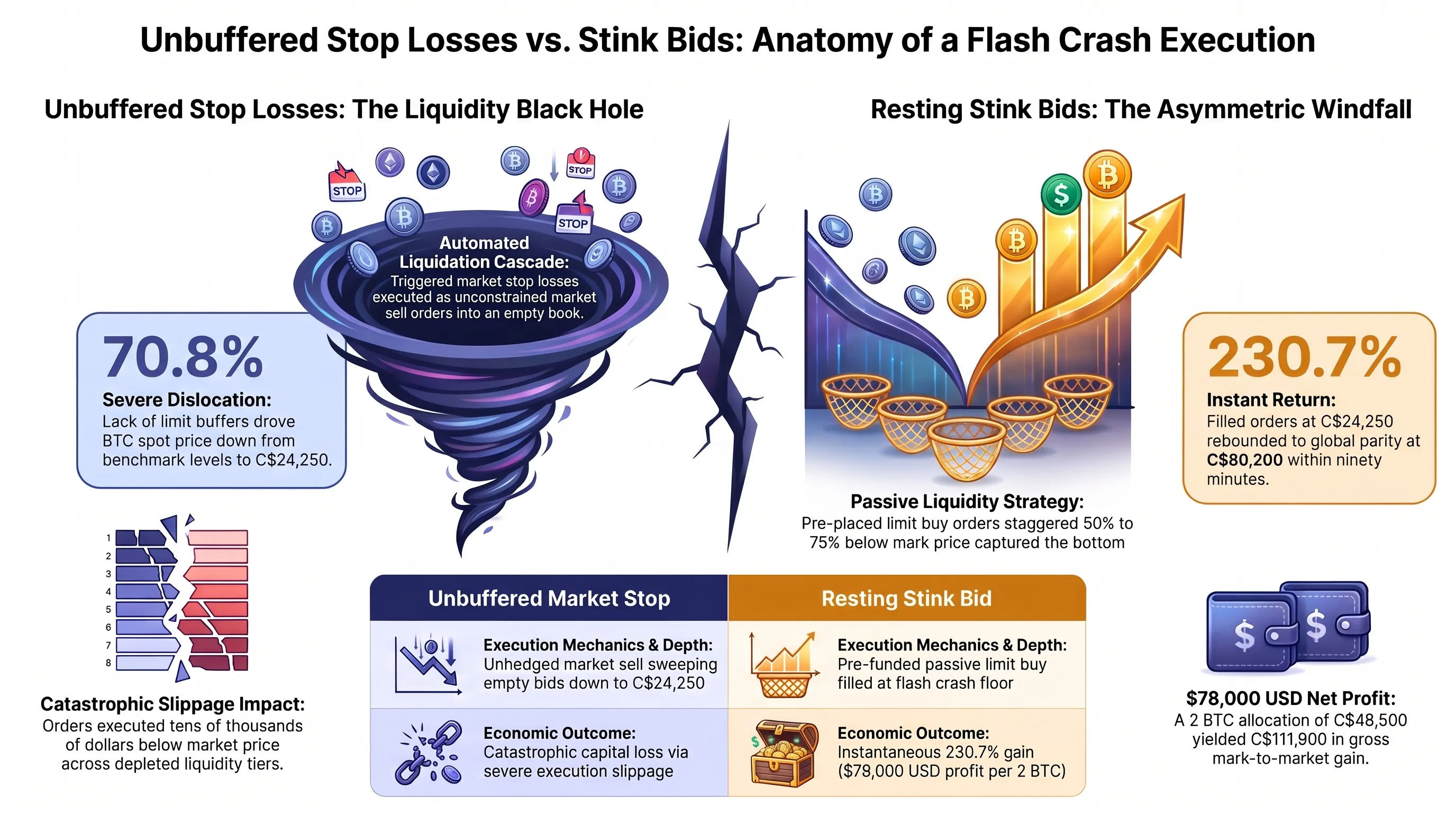
As the spot price cratered through key technical thresholds, it triggered a secondary wave of unbuffered Market Stop-Loss orders submitted by margin traders and leveraged participants. This created a classic liquidity black hole feedback loop: falling prices triggered market stop orders, which in turn executed as aggressive market sell orders, consuming whatever microscopic bids remained below them. The cascade finally halted only when the selling pressure exhausted itself against deep, resting limit orders the legendary Stink Bids placed months prior by opportunistic quantitative traders waiting at the bottom of the order book.
Empirical Price Dislocation Telemetry & Historical Flash Crash Benchmarks
| Venue & Asset Impacted | Documented Trough & Peak Drop | Root Microstructure Cause | Exchange Rollback / Finality Policy |
|---|---|---|---|
| Kraken (BTC/CAD - Nov 2026) | C$24,250 (-70.8% Realized) | CAD order book illiquidity & market maker exit | 100% Trade Finality; 0% Rollback (All Trades Stand) |
| Binance.US (BTC/USD - Oct 2021) | $8,200 USD (-87.0% Realized) | Institutional algorithmic trading client bug | Complete trade finality without manual rollback |
| Coinbase / GDAX (ETH/USD - Jun 2017) | $0.10 USD (-99.9% Realized) | Multi-million market sell & cascading margin calls | Trades upheld + corporate balance sheet margin reimbursement |
| Kraken (ETH/USD - Feb 2021) | $700 USD (-64.0% Realized) | Aggressive selling & cascading retail stop losses | Deterministic execution confirmed; zero database rollback |
The Non-Intervention Doctrine: Why Kraken Stood By Every Single Executed Trade
In the immediate aftermath of the crash, as social media channels and trading desks erupted with allegations of manipulation and system failure, market participants braced for the inevitable: a platform rollback. In traditional centralized finance, and all too frequently in cryptocurrency history, exchanges faced with acute pricing dislocations have invoked force majeure clauses or claimed technical malfunction to cancel profitable trades and protect institutional counterparties from devastating losses.
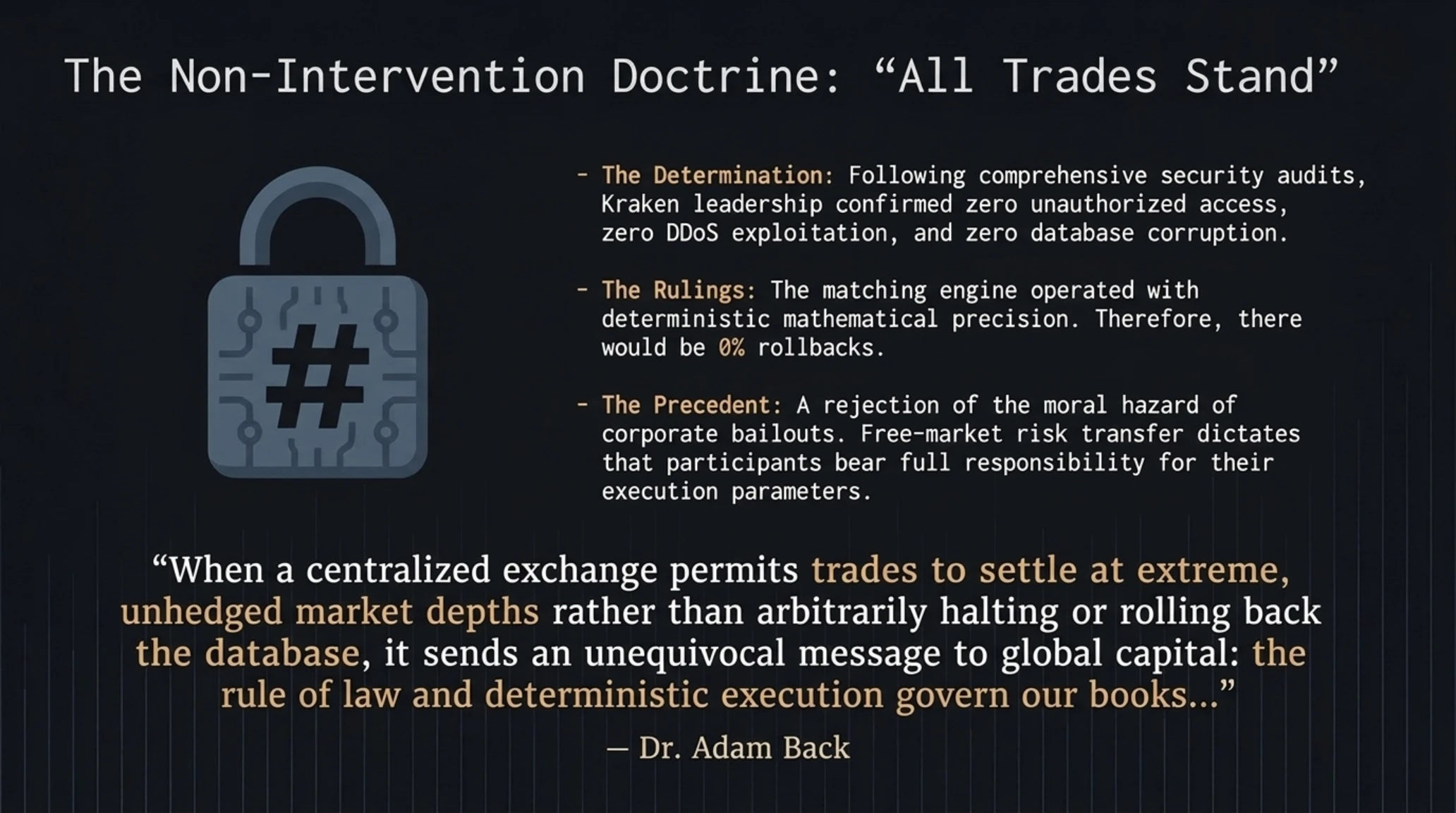
However, Kraken executive leadership took an uncompromising and diametrically opposed stance. Following comprehensive forensic reviews conducted by internal security and infrastructure engineering teams, the exchange released an unequivocal public determination: the platform had suffered zero unauthorized access, no distributed denial-of-service (DDoS) exploitation, and zero database corruption. The matching engine had operated with deterministic mathematical precision, executing valid client orders according to the rules of the platform. Consequently, Kraken announced that every single executed trade would stand without modification or rollback.
This decision represents a monumental victory for the foundational principles of algorithmic trade finality. When an exchange unilaterally reverses executed transactions, it injects moral hazard into the financial system, penalizing disciplined traders who provided emergency liquidity while subsidizing reckless market participants who submitted unhedged, unbounded market orders into an illiquid book. By honoring the trades, Kraken validated the core premise of free-market risk transfer: market participants must bear full responsibility for the execution parameters of their orders.
Technical Fact-Checking: Myth vs Verified Reality
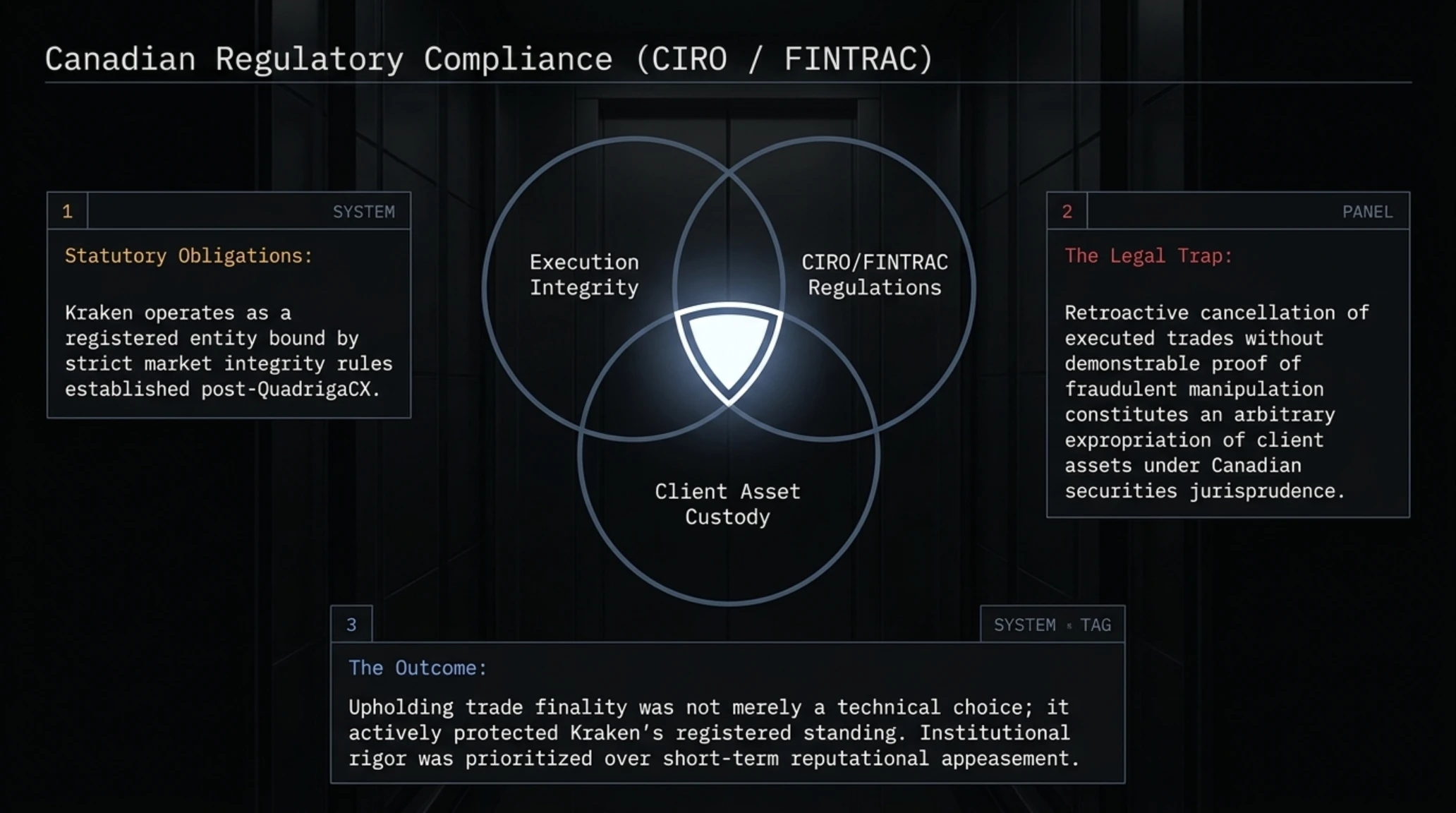
Moreover, Kraken stance aligned seamlessly with its long-term strategic positioning within Canada stringent regulatory regime. Operating as a registered entity overseen by the Canadian Investment Regulatory Organization (CIRO) and FINTRAC, the exchange is bound by statutory market integrity rules. In Canadian securities jurisprudence, retroactive cancellation of executed trades without demonstrable proof of fraudulent manipulation or catastrophic machine error constitutes an arbitrary expropriation of client assets, inviting severe enforcement action and civil litigation. By choosing institutional rigor over short-term reputational appeasement, Kraken cemented its reputation as a mature, enterprise-grade execution venue.
Cross-Asset Contagion and the Breakdown of Triangular Arbitrage: How USDT, USDC, ETH, and SOL Fractured in Canadian Dollars
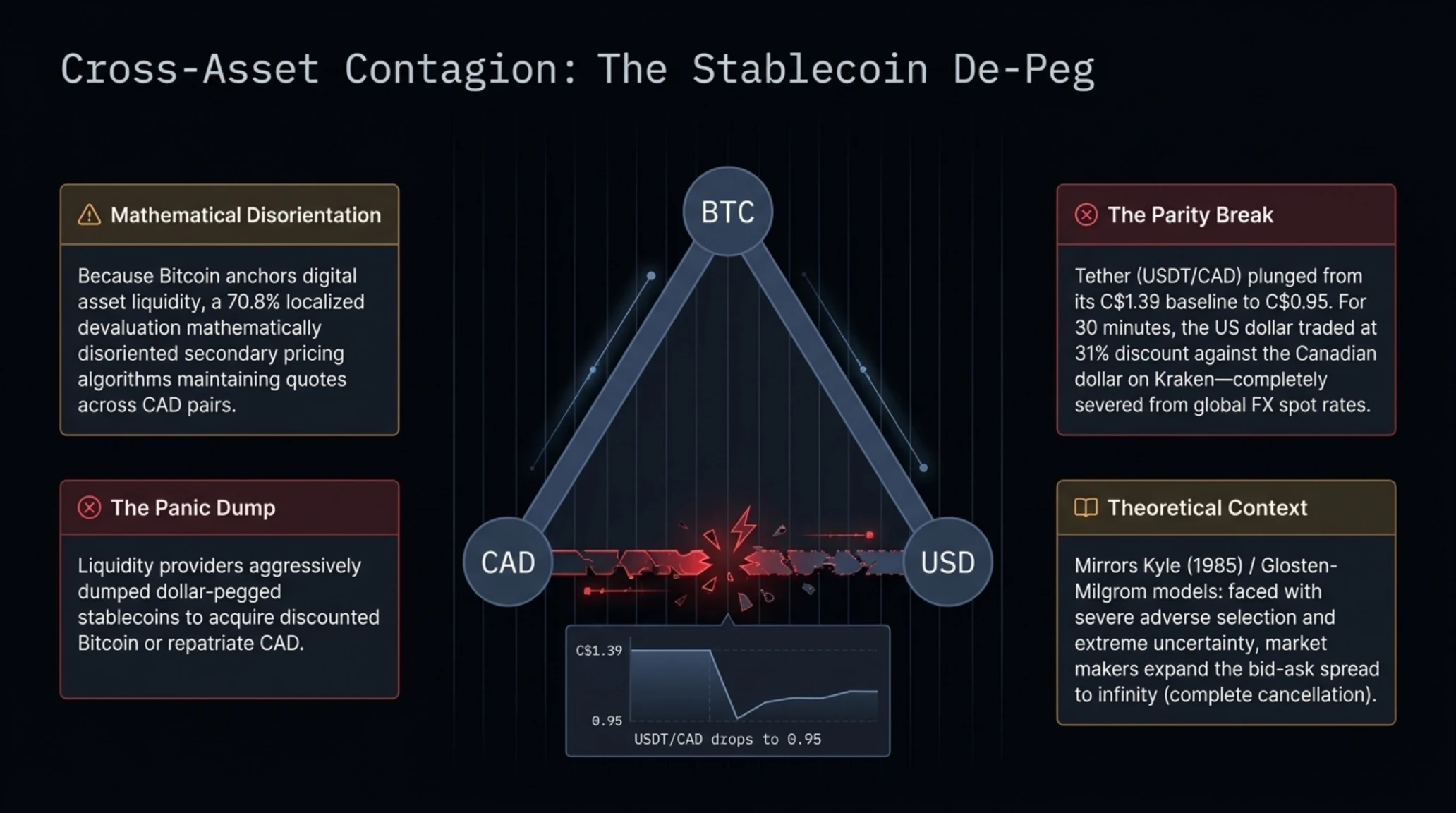
The systemic shockwave generated by the BTC/CAD collapse did not remain quarantined within a single instrument. In modern cryptocurrency trading venues, market makers and quantitative hedge funds rely heavily on synthetic cross-rate relationships to balance collateral and distribute risk across complementary asset classes. When Bitcoin the undisputed liquidity anchor of the entire digital asset ecosystem experienced a 70.8% localized devaluation, the pricing algorithms responsible for maintaining quotes across secondary Canadian dollar pairs suffered immediate mathematical disorientation.
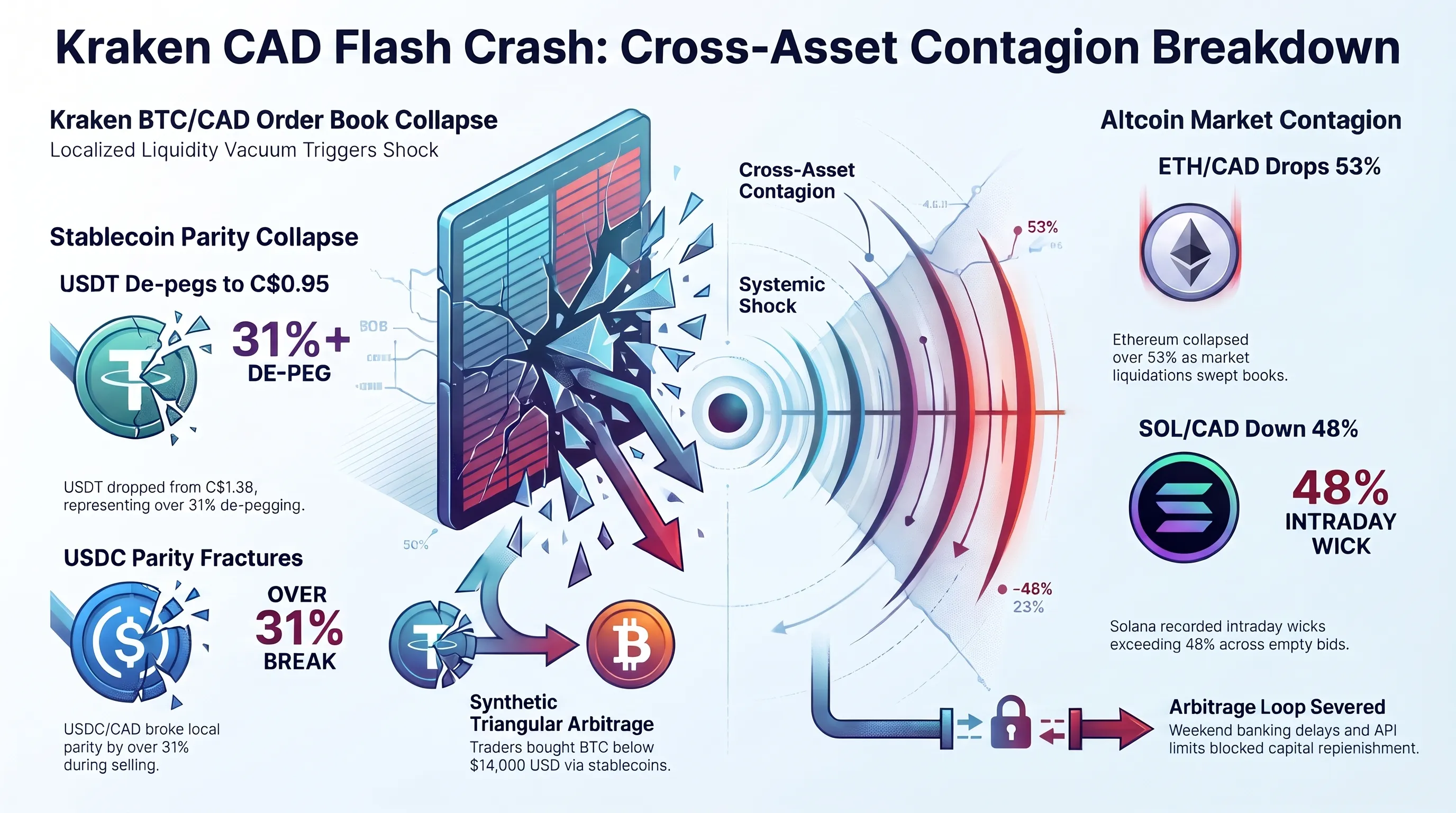
Within minutes of the initial drop, institutional liquidity providers attempting to hedge their spot exposures began aggressively dumping dollar-pegged stablecoins to acquire discounted Bitcoin or repatriate Canadian currency. This frantic capital rotation triggered secondary flash crashes across both Tether (USDT/CAD) and USD Coin (USDC/CAD). In a market distortion that bewildered veteran currency analysts, the price of one Tether plunged from its parity baseline of approximately C$1.39 down to an intraday trough below C$0.95. For a brief 30-minute window, the US dollar was effectively trading at a massive theoretical discount against the Canadian dollar within Kraken matching engine, completely severed from global foreign exchange spot rates.
From an academic microstructure perspective, this multi-asset fracturing mirrors the theoretical predictions of Kyle (1985) and Glosten-Milgrom models regarding adverse selection under extreme market uncertainty. In these models, when liquidity providers detect that incoming order flow is overwhelmingly one-sided and suspect that counterparty selling is driven by material insider information or an unannounced exchange insolvency, their optimal strategy is to expand the bid-ask spread to infinity meaning complete order cancellation. Because market makers could not verify whether the initial drop in BTC/CAD was caused by an isolated algorithmic malfunction or a catastrophic exploit within Canadian banking integrations, risk parameters automatically forced an immediate withdrawal across every Canadian dollar-denominated book simultaneously.
This automated panic generated unprecedented synthetic arbitrage opportunities for traders who maintained unencumbered cash balances across complementary trading pairs. Savvy participants holding idle USDC or USDT balances were able to purchase Canadian dollars at a 31% discount against true foreign exchange spot rates, and subsequently cycle those newly acquired CAD reserves into Bitcoin at C$24,250. This multi-hop transaction, known in algorithmic finance as synthetic cross-currency triangular execution, allowed early respondents to compound their effective discount, purchasing Bitcoin at an effective net cost basis below $14,000 USD before order book equilibrium was restored.
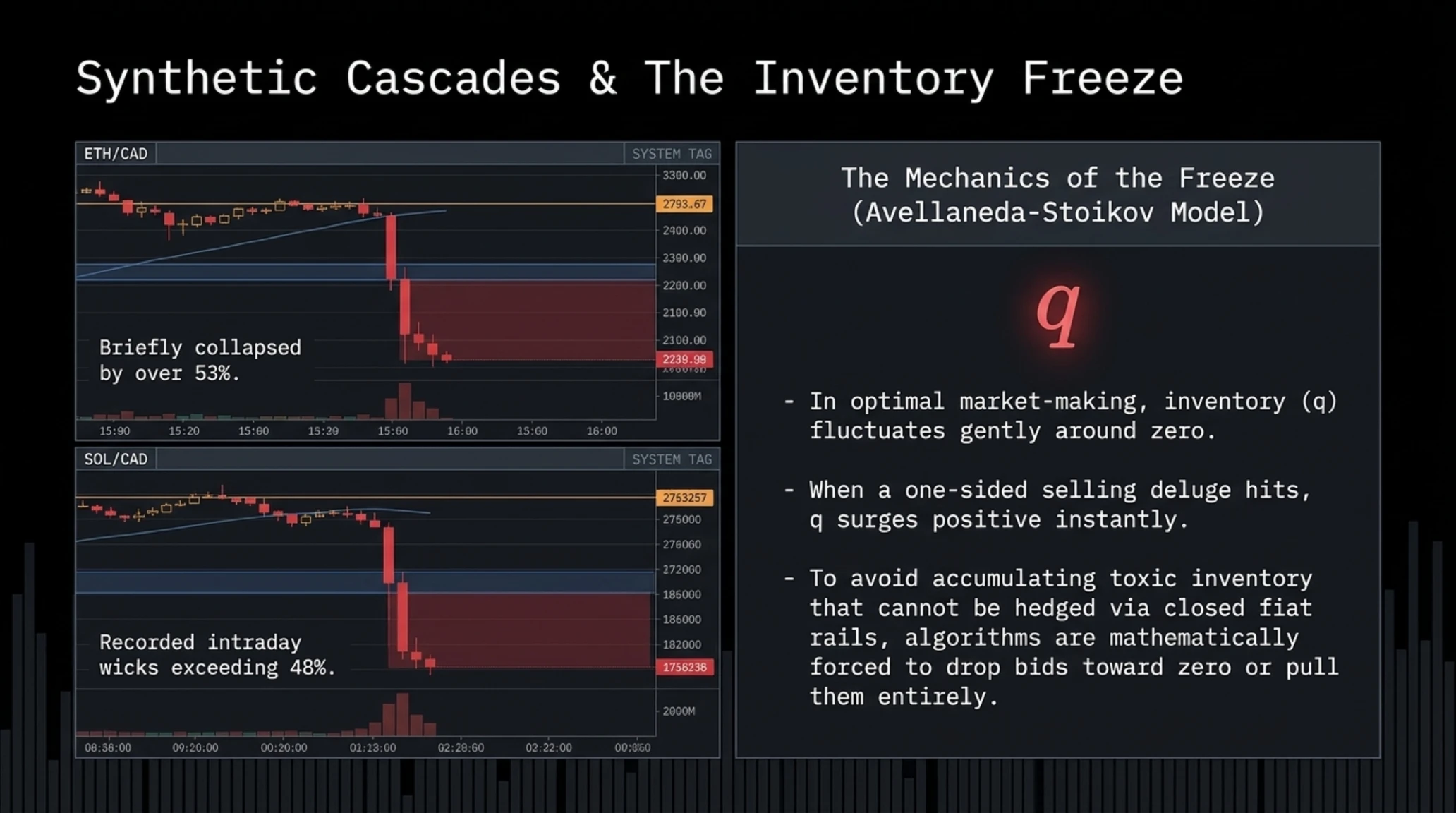
The mathematical mechanics behind this inventory freeze can be formally explained through the lens of the Avellaneda-Stoikov (2008) high-frequency market making framework. In optimal market-making theory, an algorithm dynamically adjusts its bid and ask quotes around a subjective reservation price $r(s, q, t) = s - q\gamma\sigma^2(T-t)$, where $s$ is the mid-price, $q$ is the current inventory of the asset, $\gamma$ is the market maker's risk-aversion coefficient, and $\sigma$ represents instantaneous asset volatility. Under normal conditions, $q$ fluctuates gently around zero as buys and sells alternate. However, when a sudden one-sided selling deluge absorbs all active bids, $q$ surges positive at an alarming rate, forcing the reservation price drastically downward. To avoid accumulating toxic inventory that cannot be hedged in real time across external fiat rails, the algorithm is mathematically compelled to drop its bids toward zero or pull them from the book entirely.
Similarly, Ethereum (ETH/CAD) and Solana (SOL/CAD) were dragged into the downdraft. As cascading market liquidations swept through the altcoin books, Ethereum briefly collapsed by over 53%, while Solana recorded intraday wicks exceeding 48%. The visual manifestation on technical analysis terminals resembled a catastrophic, multi-asset capitulation event, even as identical trading pairs on international venues remained entirely unperturbed.
📚 Classified & Related Dossiers in TekinGame
If you wish to explore beyond this report and delve into cybernetic frontiers and autonomous AI architectures, do not miss these three exclusive deep-dives in the Tekin Garage:
Empirical Telemetry Dashboard: Asset Dislocation Magnitude & Recovery Trajectory
| Asset Trading Pair on Kraken | Normal / Reference Mark | Flash Crash Low | Peak Realized Divergence |
|---|---|---|---|
| Bitcoin (BTC/CAD) | C$80,200 | C$24,250 | -70.8% Instantaneous Flash Low |
| US Dollar Spot (USD/CAD) | C$1.39 | C$0.30 | -78.4% Severe Local FX De-peg |
| Ethereum (ETH/CAD) | C$4,450 | C$2,100 | -52.8% Cumulative Drawdown |
| Tether USD (USDT/CAD) | C$1.39 | C$0.92 | -33.8% Stablecoin Discount |
The failure of automated triangular arbitrage to rapidly collapse this dislocation offers profound insights into quantitative market plumbing. In an ideal frictionless environment, triangular arbitrageurs operate continuously across three interrelated currency pairs: purchasing underpriced BTC with CAD, swapping that BTC for USD on global order books, and subsequently converting USD back into CAD through interbank wholesale FX channels to lock in riskless profit while restoring order book balance.
However, during the Kraken incident, this classical arbitrage loop fractured along three critical operational vectors. First, internal platform transfer caps and REST API rate limits constrained the throughput of automated high-frequency arbitrage bots attempting to cycle balance sheets across segregated sub-accounts. Second, the extreme de-pegging of the internal USDT/CAD rate meant that algorithmic trading bots could no longer reliably hedge their foreign exchange exposure in real time, exposing arbitrageurs to severe leg risk (the danger that the second or third leg of a trade fails to execute before prices move adversely). Third, and most crucially, the complete suspension of external Canadian fiat bank wires during weekend hours effectively severed the external capital bridge. Without the ability to replenish depleted CAD balances from commercial banks, proprietary trading desks were forced to ration their on-platform capital, allowing the pricing anomaly to persist uncorrected for nearly two hours.
Exchange Operational Telemetry: Trade Finality & Verification Lifecycle
Risk Engineering and Algorithmic Lessons for Quantitative Desks and Retail Investors
The Kraken flash crash offers an indispensable masterclass in market microstructure, execution engineering, and capital preservation. For quantitative desks, proprietary trading firms, and active retail investors, the episode exposes several lethal design assumptions that routinely permeate standard trading strategies. Chief among these is the widespread and dangerous reliance on naive Market Stop-Loss orders in secondary currency books.
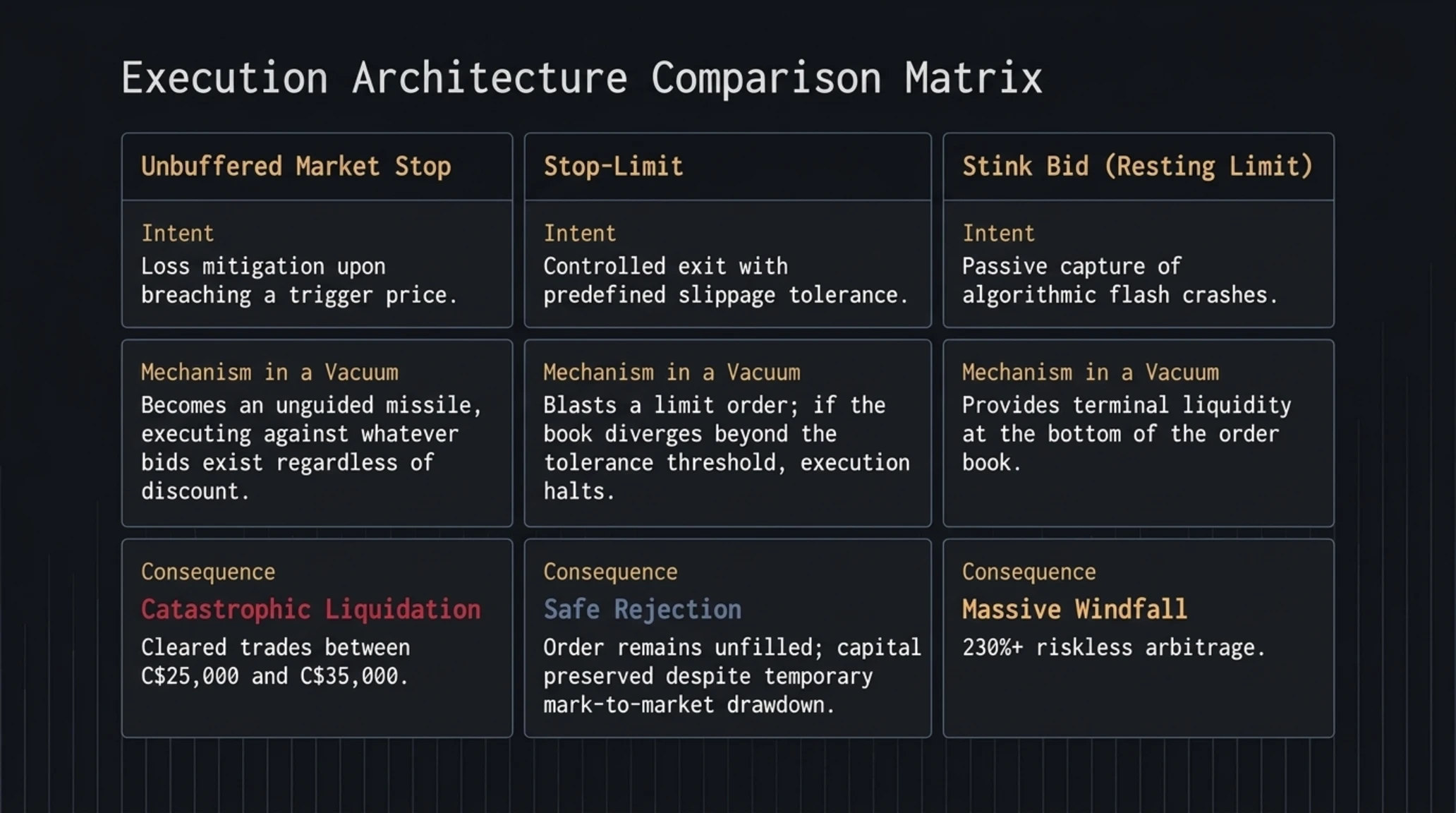
When an investor enters a standard Market Stop order, they are essentially instructing the broker or exchange matching engine to monitor a trigger price, and upon reaching that trigger, immediately blast an unconstrained market order into the order book. In highly liquid venues such as BTC/USD on Coinbase or perpetual futures on Binance, slippage is usually bounded within fractions of a percent. However, in regional fiat pairs such as BTC/CAD, EUR/AUD, or GBP/JPY, order book depth beyond the top three price levels is inherently shallow.
During the Friday night collapse, dozens of retail accounts that had set market stops around C$70,000 found their positions liquidated not at C$69,900, but at catastrophic execution prices ranging between C$25,000 and C$35,000. In an empty order book, an unbuffered market stop order behaves like an unguided missile, executing against whatever bids exist, regardless of how deep the discount. The rigorous engineering countermeasure is the mandatory adoption of Stop-Limit orders, configured with strict price bounds and limit offsets that prevent order execution if the book diverges beyond a predefined tolerance threshold.
Equally critical is the design architecture of exchange liquidation engines. In inferior cryptocurrency platforms, margin liquidation algorithms calculate account maintenance requirements based solely on the Last Traded Price (LTP) of the specific instrument. Had Kraken utilized a naive LTP liquidation model, the momentary print of C$24,250 would have instantly triggered a catastrophic wipeout of every single leveraged long position held by Canadian traders on the platform. Fortunately, Kraken employs an institutional-grade Mark Price mechanism, deriving the collateral valuation of client portfolios from an aggregated, volume-weighted index of external global spot markets. Because Bitcoin remained stable at $57,600 USD worldwide, the mark price did not experience the crash, successfully shielding leveraged accounts from wrongful automated liquidation.
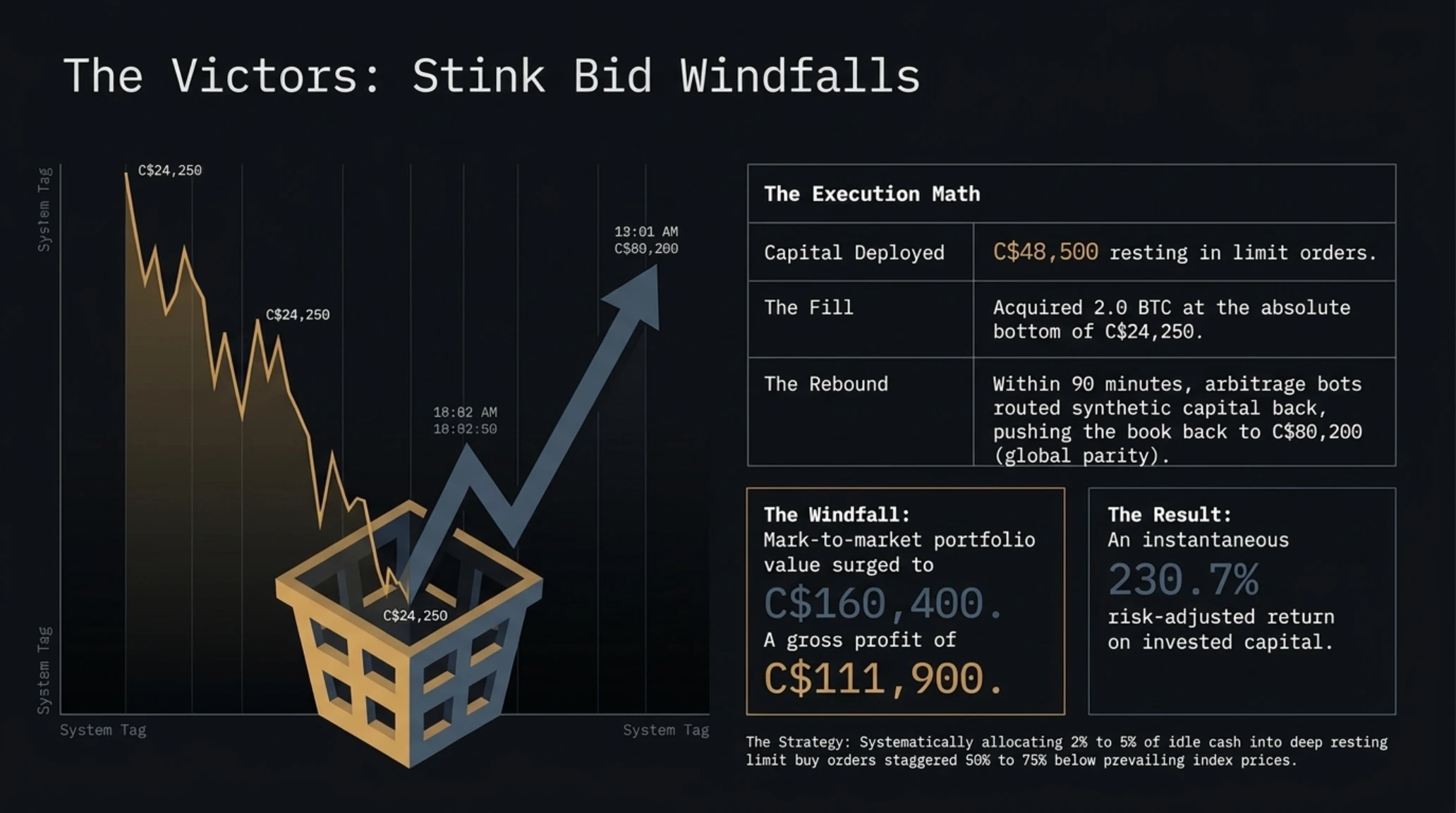
Conversely, for opportunistic algorithmic desks, the event served as a spectacular validation of the Stink Bid strategy. Professional market participants have long recognized that in fragmented, multi-venue digital asset markets, exchange software glitches, fat-finger errors, and sudden market maker pullbacks inevitably occur. By systematically allocating 2% to 5% of idle cash reserves into deep resting limit buy orders staggered at 50%, 65%, and 75% below the prevailing index price, automated accounts harvest extraordinary risk-adjusted returns during black swan liquidity contractions.
A rigorous comparative analysis with past market dislocations underscores how institutional responses to flash crashes have evolved over the last decade. In June 2017, when an aggressive multi-million-dollar sell order on GDAX (now Coinbase Pro) triggered a cascade of over 800 automated margin liquidations that dragged Ethereum from $319 down to 10 cents, Coinbase took the extraordinary step of reimbursing affected margin traders using corporate balance sheet reserves, while simultaneously honoring all filled buy orders for opportunistic bottom-feeders. Similarly, in October 2021, when an institutional trading client experienced an algorithmic execution loop on Binance.US that cratered Bitcoin from $65,000 to $8,200, the exchange attributed the collapse to an isolated customer bug but left the resulting fills intact.
Kraken response to the Canadian Dollar crash represents an even stricter application of institutional laissez-faire trade finality. Unlike Coinbase in 2017, Kraken offered no corporate bailouts to retail users whose unbuffered market stop orders were swept into the abyss. By maintaining that all validly submitted orders must bear their full economic consequences, Kraken established an unbending precedent: an exchange matching engine is a neutral mathematical ledger, not an insurance policy against poor execution hygiene. This unyielding stance has been widely lauded by quantitative hedge funds and prime brokerages, who view discretionary exchange interventions as an unacceptable source of counterparty risk.
Consider the quantitative economics of the executed Stink Bid trades from a pure risk-adjusted return perspective. A disciplined trader maintaining a resting limit order to acquire 2.0 BTC at C$24,250 committed a total capital allocation of C$48,500. Within ninety minutes of the flash crash trough, as global arbitrage bots routed synthetic capital back into the venue, the BTC/CAD order book rebounded to C$80,200 (reflecting global spot parity near $57,600 USD). The realized mark-to-market portfolio value surged from C$48,500 to C$160,400, capturing an extraordinary gross profit of C$111,900 (approximately $78,000 USD) representing an instantaneous 230.7% return on invested capital. Even when factoring in the annualized opportunity cost of holding idle cash in resting bids over multiple months, the asymmetric expected value of catching a single flash crash event delivers an astronomical Sharpe ratio that few active trading strategies can replicate.
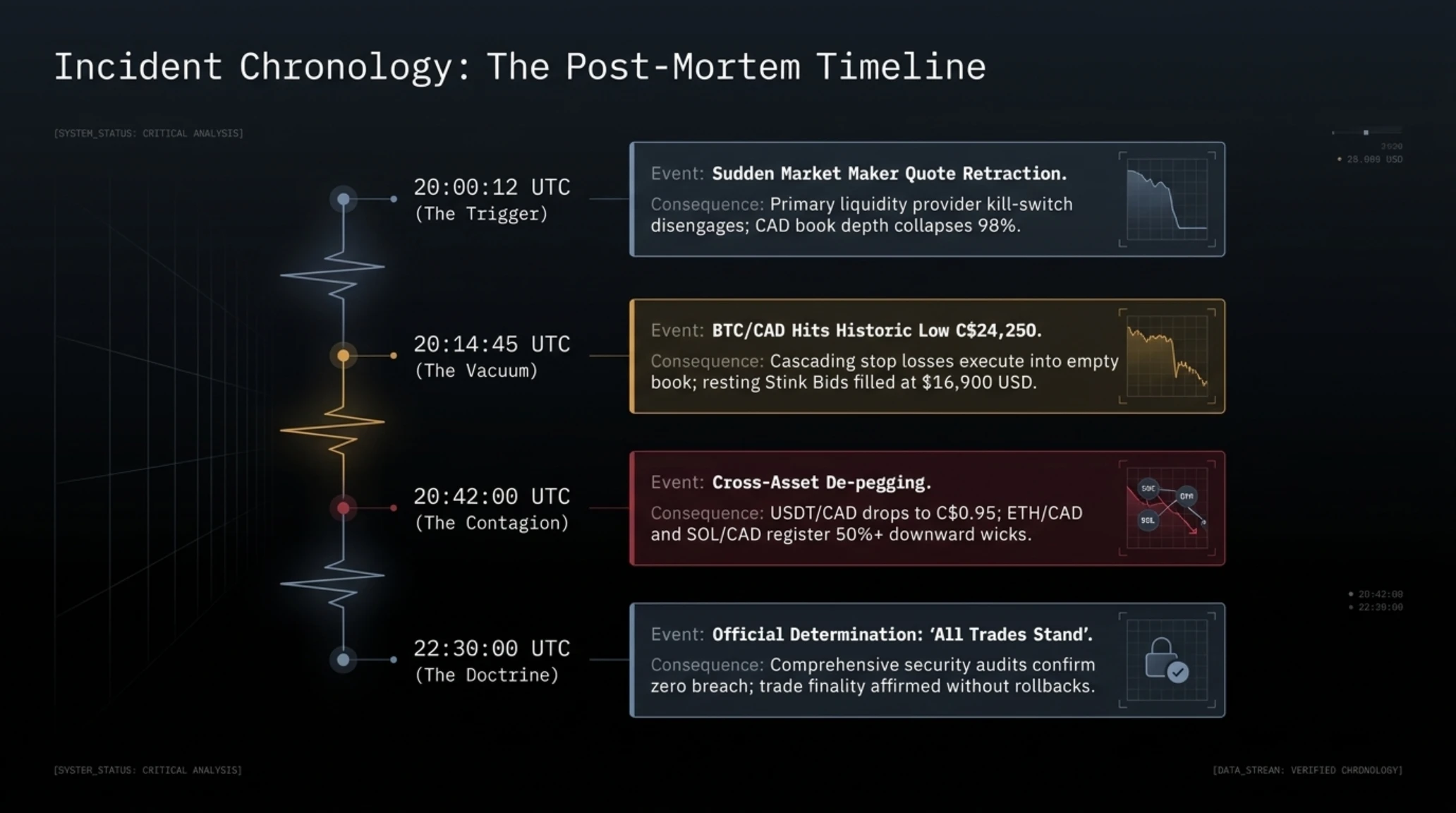
Incident Timeline: Chronology of the Kraken CAD Flash Crash
| Timestamp (UTC) | Operational Event & Price Action | Microstructure & Ecosystem Consequences |
|---|---|---|
| 20:00:12 | Sudden Market Maker Quote Retraction | Primary liquidity provider kill-switch disengages; CAD book depth collapses 98%. |
| 20:14:45 | BTC/CAD Hits Historic Low C$24,250 | Cascading stop losses execute into empty book; resting Stink Bids filled at $16,900 USD. |
| 20:42:00 | Cross-Asset De-pegging Contagion | USDT/CAD drops to C$0.95; ETH/CAD and SOL/CAD register 50%+ downward wicks. |
| 22:30:00 | Official Determination: 'All Trades Stand' | Comprehensive security audits confirm zero breach; trade finality affirmed without rollbacks. |
Institutional Risk & Cyber Execution Assessment Matrix
| Vulnerability Vector | Severity Rating | Algorithmic Defense & Strategic Mitigation |
|---|---|---|
| Unbuffered Market Stop-Loss Execution | CRITICAL | Mandatory configuration of Stop-Limit orders with max-slippage bounds. |
| Fiat Rail Inactivity During Weekend Settlement | HIGH RISK | Pre-funding cross-venue stablecoin credit lines to bypass banking latency. |
| Matching Engine Deterministic Integrity | VERIFIED SECURE | Independent audit verification of trade matching logs without manual rollback. |
The Future of Global Crypto Exchange Architecture: Balancing Volatility Halts with Algorithmic Sovereignty
The Kraken CAD flash crash has reignited an essential ideological and structural debate across the global fintech ecosystem: should centralized cryptocurrency exchanges implement automated volatility circuit breakers similar to traditional stock and futures exchanges, or does absolute, unhalted price discovery remain the core ethos of digital assets?
On legacy venues like the Chicago Mercantile Exchange (CME), Bitcoin futures contracts are governed by strict dynamic price bands. If a contract fluctuates by 7%, 13%, or 20% relative to the preceding session settlement price, the exchange enforces a mandatory two-minute cooling-off period or halts trading entirely to allow market participants to adjust collateral and recalibrate automated quoting algorithms. These circuit breakers serve as an institutional safety valve, deliberately dampening runaway panic and preventing mechanical cascading liquidations.
However, within the decentralized ideology that underpins the cryptocurrency movement, artificial trading halts are frequently viewed with skepticism. Proponents of unconstrained price discovery argue that halts merely postpone price reality, trap liquidity when investors need it most, and introduce discretionary human intervention into what should be an impartial cryptographic matching system. As detailed in our foundational study on Bitcoin liquidity and market structure analysis, true market resilience is forged not by paternalistic circuit breakers, but by deepening cross-border liquidity bridges and holding market participants accountable for their execution choices.
Kraken courageous defense of trade finality sets a vital precedent for the entire industry. By absorbing short-term PR friction and refusing to bail out unhedged market orders, the exchange sent a powerful signal to institutional hedge funds, sovereign wealth allocators, and quantitative market makers: on Kraken, contracts are sacred, matching logic is deterministic, and the exchange will never manipulate ledger records to cushion private trading losses.
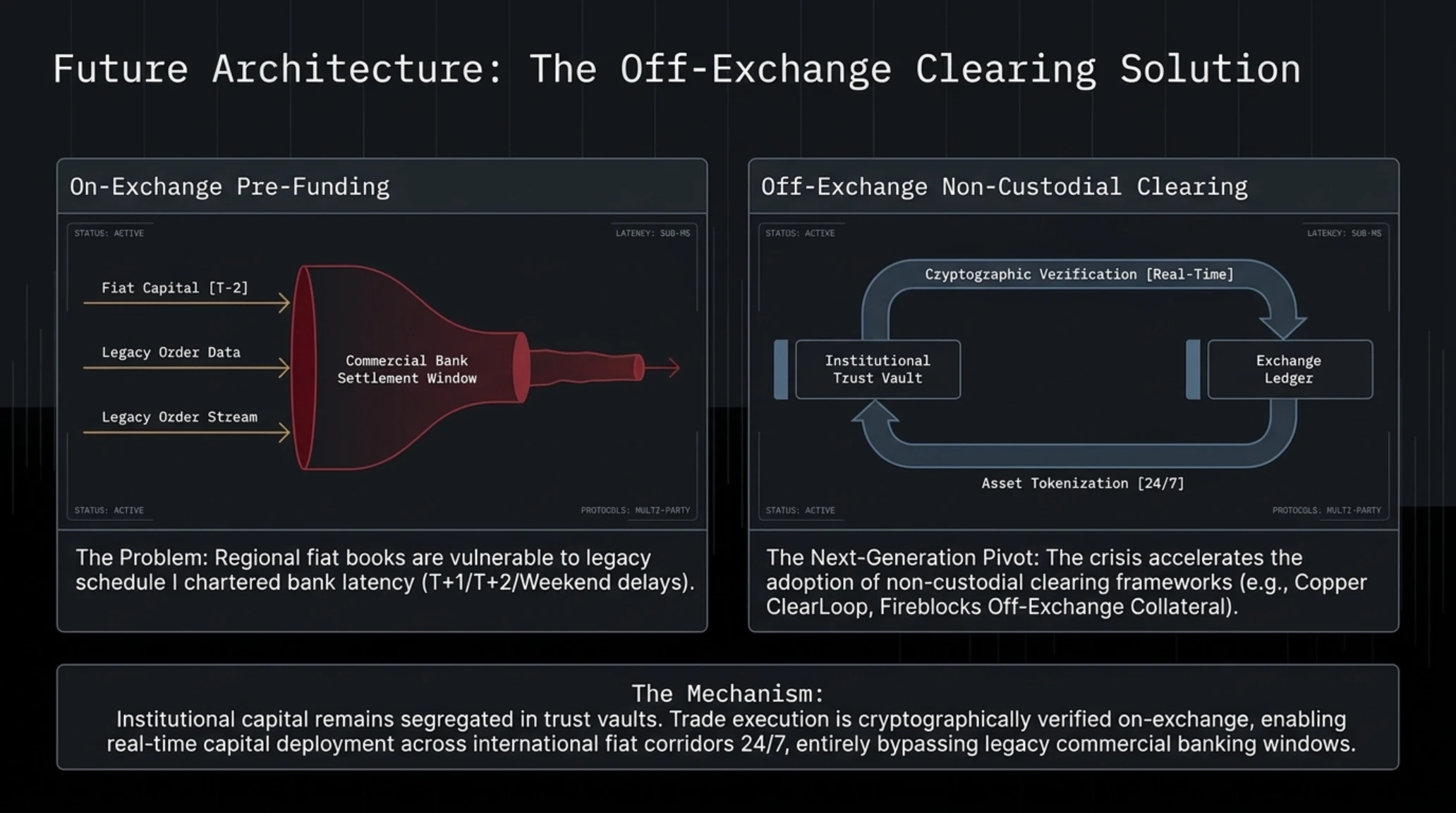
Looking ahead toward the institutional maturation of digital asset trading through 2027 and beyond, this episode accelerates the adoption of next-generation off-exchange settlement infrastructures. Prime brokers and multi-venue institutional allocators are increasingly routing liquidity through specialized non-custodial clearing frameworks such as Copper ClearLoop, Fireblocks Off-Exchange Collateral, and Cboe Digital clearing solutions. In these architectures, institutional capital remains segregated within institutional trust vaults until trade execution is verified, enabling real-time capital deployment across international fiat corridors without reliance on legacy commercial banking settlement windows.
Furthermore, securities attorneys and regulatory policy advisors across North America are already citing the Kraken determination as a definitive case study in fair execution under Canadian common law and statutory securities jurisprudence. As regulatory bodies continue to draft comprehensive market conduct guidelines for digital asset platforms, the distinction between technical platform malfunction and genuine organic order book illiquidity has never been clearer. Market operators that uphold deterministic execution under acute stress will remain the bedrock upon which the next generation of institutional digital asset finance is constructed.
This dynamic is also capturing intense scrutiny across international regulatory jurisdictions, particularly within the European Union under the newly operational Markets in Crypto-Assets (MiCA) framework and the UK Financial Conduct Authority (FCA). Under MiCA regulatory technical standards (RTS) governing trading venue resilience and algorithmic trading controls, regulated Crypto-Asset Service Providers (CASPs) are required to maintain pre-trade and post-trade transparency while documenting robust systems to prevent disorderly trading conditions. European regulators emphasize that while exchanges must implement circuit breakers to avoid erroneous system cascades, discretionary post-trade cancellation of validly matched transactions creates severe moral hazard and undermines market integrity. The Kraken precedent demonstrates that even in the absence of mandatory statutory circuit breakers, maintaining an inviolable audit trail and enforcing contract finality remains the single most defensible institutional posture under global cross-border compliance standards.
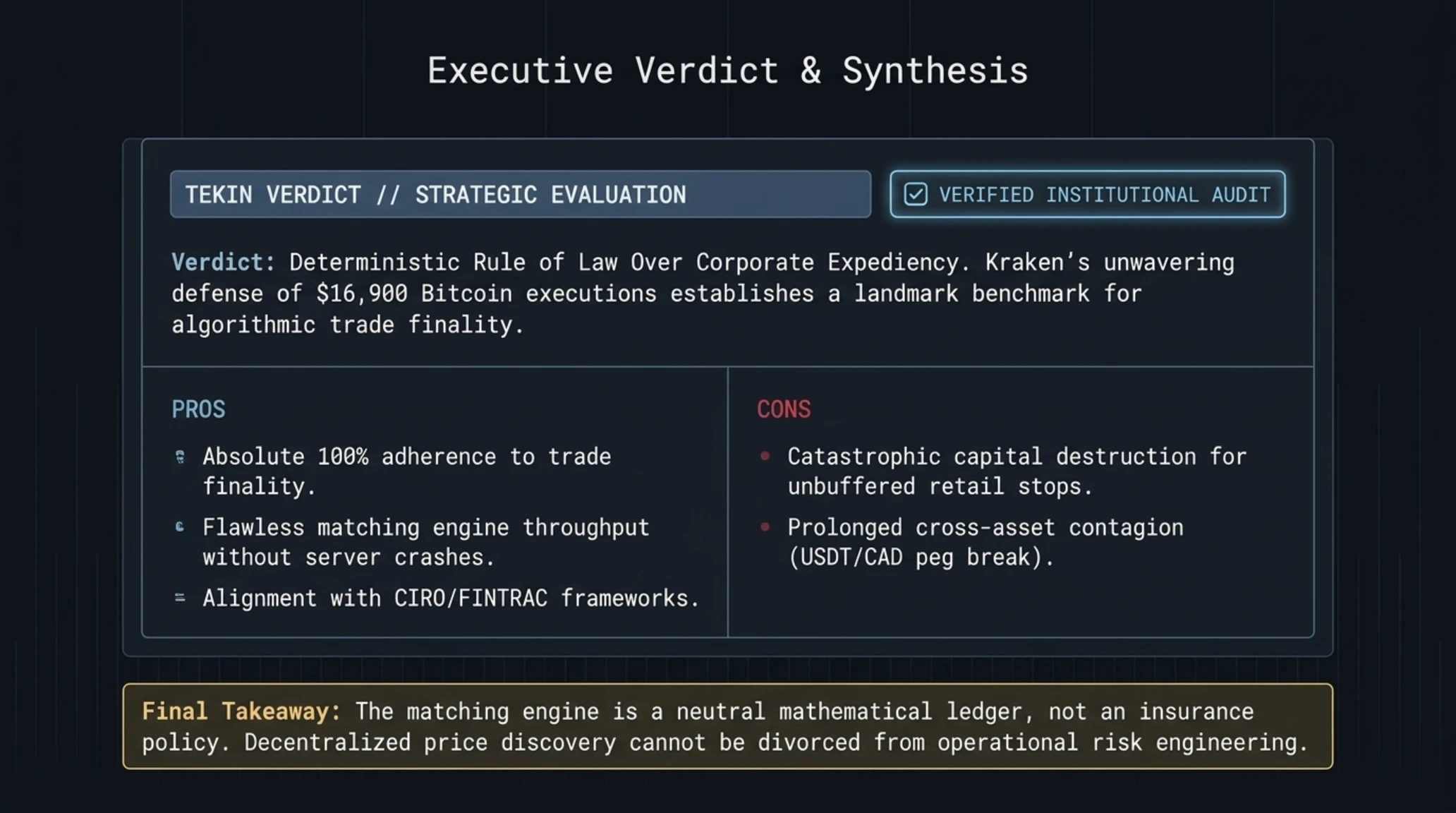
As quantitative desks digest the empirical lessons of the Friday night crash, the consensus across institutional finance is unmistakable: decentralized price discovery cannot be divorced from operational risk engineering. Those who respect market microstructure and implement rigorous execution safeguards will thrive, while those who rely on blind exchange benevolence will inevitably be liquidated.
- Absolute 100% adherence to trade finality, establishing unmatched institutional credibility.
- Flawless matching engine throughput without server crashes or database corruption during peak load.
- Immense, legitimate financial windfalls for disciplined quantitative Stink Bid providers.
- Complete alignment with stringent Canadian CIRO and FINTRAC regulatory frameworks.
- Catastrophic capital destruction for retail participants utilizing unbuffered market stop losses.
- Prolonged pricing divergence and cross-asset contagion across dollar-pegged stablecoins.
- Absence of dynamic liquidity warning collars to alert users to extreme order book depletion.
Executive Verdict & Verified Primary Sources
- Kraken Exchange: Official System Status & Security Audit Confirmation
- CoinDesk: Forensic Market Microstructure & CAD Order Book Analysis
- CryptoSlate: Comprehensive Multi-Asset Stablecoin De-pegging Report
- The Defiant: Dr. Adam Back Commentary & Institutional Arbitrage Dislocation Review
Frequently Asked Questions & Technical Analysis
Why did Bitcoin crash to C$24,250 on Kraken while remaining near $57,600 USD elsewhere?
The crash was triggered by a synchronized withdrawal of quotes by automated market makers on the Canadian dollar order book during low-liquidity weekend hours, causing automated market sell orders to cascade into an empty book down to resting limit bids.
Did Kraken reverse, cancel, or roll back the discounted trades?
No. Kraken conducted a comprehensive security audit, verified that no system breach or database glitch occurred, and affirmed that all executed trades stand according to deterministic platform matching rules.
What is a Stink Bid and how did it generate massive profits during the crash?
A Stink Bid is a resting limit order placed far below current market prices. Traders who maintained opportunistic buy orders at C$24,250 acquired Bitcoin at an effective $16,900 USD, capturing immediate gains exceeding 240% when the book recovered.
How can crypto traders protect themselves from future liquidity vacuum crashes?
Traders must eliminate unbuffered Market Stop Loss orders in regional fiat pairs and instead implement Stop-Limit orders with strict slippage limits, while avoiding high leverage in secondary currency books.
Additional Gallery: Bitcoin Crashed to $16,900 on Kraken: Inside the CAD Flash Crash